


10 Essential Jean-Luc Picard Episodes
10Starship Mine
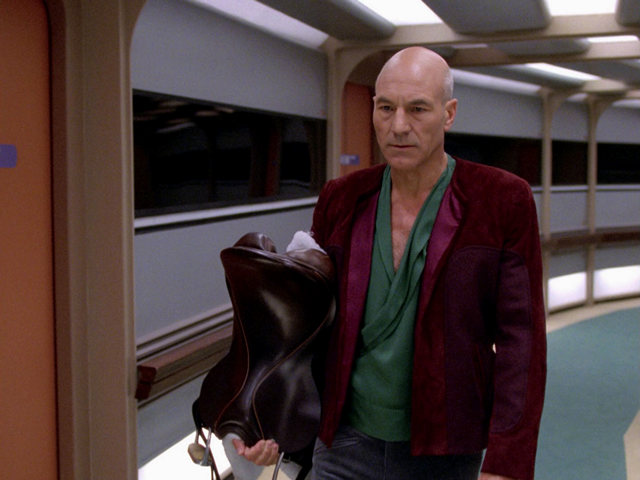
"Die Hard" on the Enterprise? More or less! The ship is being evacuated for a baryon sweep, but a group of terrorists posing as technicians has other plans. Picard, who wants to escape a diplomatic reception and returns to get his saddle, happens to be the only one left aboard when he realizes that something is wrong. He has to sneak around the ship, improvise weapons and take out the intruders one by one. There is something of a guilty pleasure in watching the usually dignified Picard turn into a one-man fighting force, complete with a few decidedly un-Starfleet methods. Though probably not ethically correct, he is actually quite good at killing the terrorists, while they repeatedly spare his life. Maybe he is just lucky, but he certainly makes the most of it. In the end, their ship is destroyed in the explosion of the stolen trilithium resin, perhaps an instance of poetic justice, although Picard brings it about by removing the safety pin. We will see Patrick Stewart in action-hero mode again in "First Contact", but "Starship Mine" is a particularly exciting outing for Picard within the TNG series. Read the full review.
9Sarek
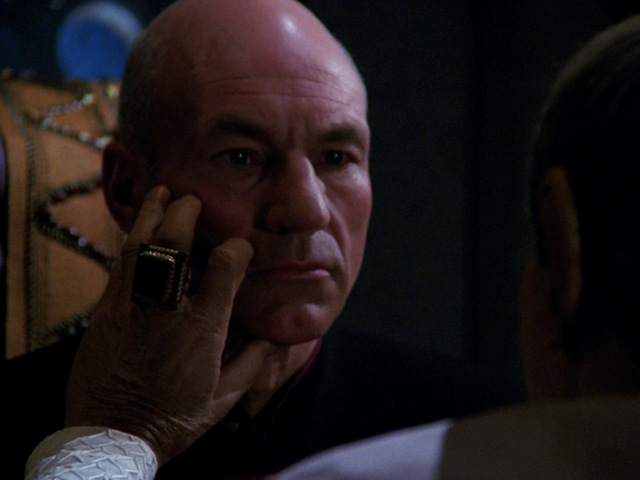
Having Spock's father Sarek aboard the Enterprise is quite an occasion, but the legendary Vulcan ambassador is not quite himself anymore. The string quartet that brings a tear to his eye is an obvious giveaway. He suffers from Bendii Syndrome, which gradually robs him of his ability to control his emotions. Picard eventually agrees to a mind meld with him so Sarek can complete his diplomatic mission, and what follows is an extraordinary performance by Patrick Stewart. Overwhelmed by all the emotions Sarek usually suppresses, Picard goes through a complete emotional breakdown. Stewart handles this brilliantly, showing us a completely new side of his character. It is also a particularly good episode for his friendship with Beverly Crusher, who is there for him when he needs her most and when he wouldn't want to have anyone else at his side. Picard's willingness to take on Sarek's suffering is quite remarkable, and this elevates the episode above an otherwise conventional diplomatic story. Read the full review.
8Chain of Command I/II
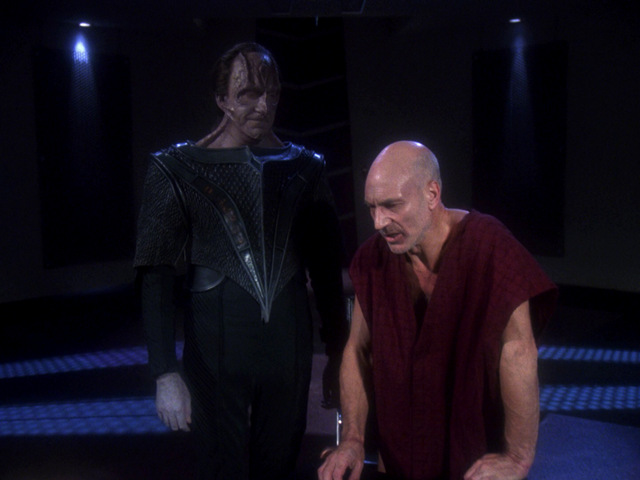
"There are four lights!" Few lines in Star Trek have become as popular as this one, and are used in so many memes. The story leading up to it is one of Picard's most harrowing experiences. He is sent on a secret mission, deliberately lured into a trap and captured by the Cardassians. Gul Madred, played by David Warner, subjects him to psychological and physical torture, trying to break his resistance and make him accept a reality that doesn't exist. The scenes between Stewart and Warner are outstanding. The two actors already knew each other from their time with the Royal Shakespeare Company, and Stewart later said that he hence enjoyed working with Warner very much. That is perhaps a slightly surprising thing to hear given what he is put through on screen! The second part is the real reason for including this two-parter, and it gives Patrick Stewart one of his finest opportunities to demonstrate what he can do as an actor. Read the full review.
7The Measure of a Man
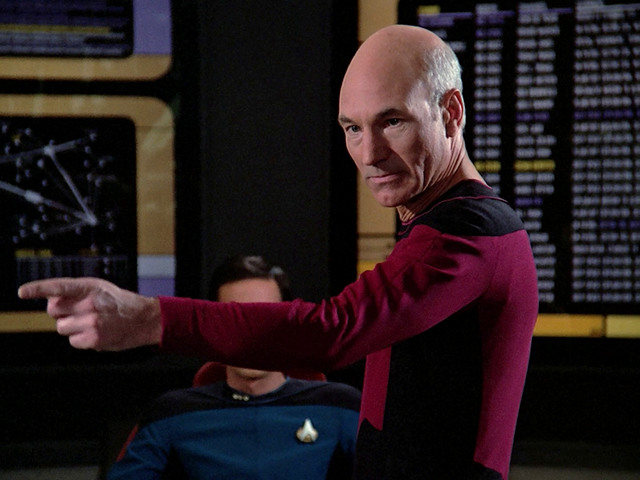
Data's right to exist as an individual is at stake, and suddenly Picard and Riker find themselves in rather unusual roles. Picard has to defend his friend in a hastily arranged hearing, while Riker is ordered to argue that Data is not a sentient life form and is therefore Starfleet property. Neither of them is happy with the situation, but they have to play their assigned roles. Otherwise, the law would rule in Commander Maddox's favor, allowing him to disassemble the android. Picard, who is always a very capable debater, is especially impressive here. His closing argument is one of his finest speeches, as he takes the judge through Maddox's criteria for establishing sentience and shows that Data meets two of them, while the third cannot be conclusively established one way or the other. The argument that follows impresses me even more: "Your Honor, Starfleet was founded to seek out new life. Well, there it sits." This is primarily a Data episode, but Picard's line of reasoning and Stewart's performance are so strong that I simply cannot leave it out. It is also one of the finest examples of what Star Trek can do when it tackles a genuinely interesting philosophical question. Read the full review.
6Darmok
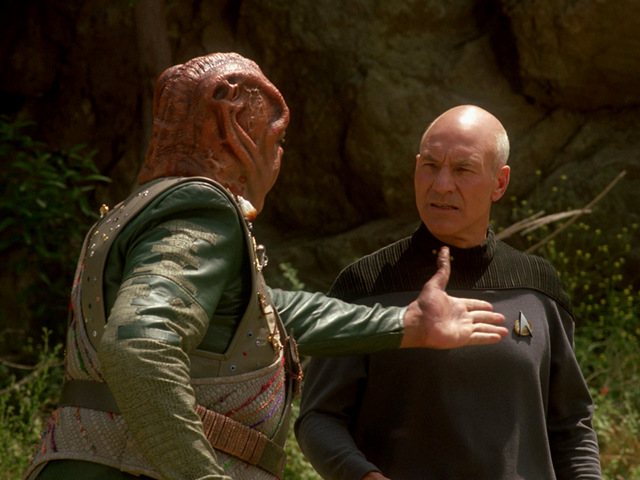
Imagine being stranded on a planet with someone who speaks in riddles you cannot possibly understand, while your attempts to communicate in what you consider clear language seem to get you nowhere. That is what happens to Picard with Captain Dathon of the Tamarians. Dathon uses references to people and events from Tamarian mythology, and Picard has to figure out what all these strange expressions mean. The Tamarians have deliberately arranged the encounter to force the two captains to find a way to communicate. "Darmok and Jalad at Tanagra" eventually becomes more than just a mysterious expression: Picard begins to understand the story behind the words and, in doing so, gains an understanding of the Tamarian way of thinking. This is one of the finest examples of Star Trek exploring the challenges of communication. The two captains eventually develop a genuine mutual understanding, not just of each other's language but also of each other's feelings and intentions. Dathon ultimately dies: "Shaka, when the walls fell." But the encounter leaves a lasting positive impression on Picard. Read the full review.
5The Chase
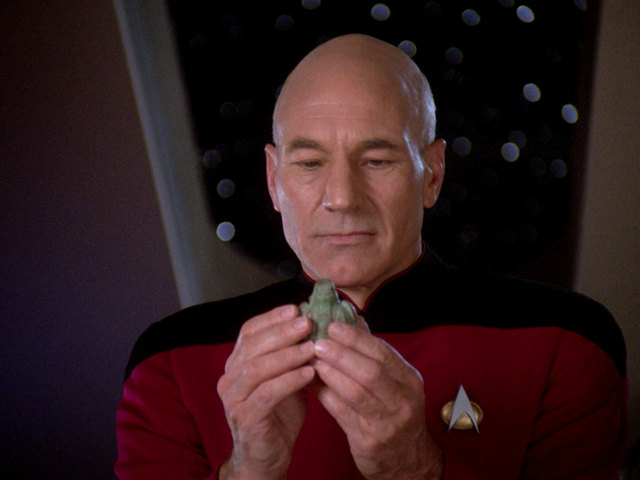
Picard's old archaeology professor, Richard Galen, turns up with an offer that he considers difficult to refuse. Picard has always had a passion for archaeology but ultimately chose to explore the stars instead, much to Galen's disappointment. Now he wants Picard to help solve an extraordinary galactic puzzle, even if that means giving up his position as a starship captain. Galen is clearly asking too much, but we can see how tempted Picard is. The scene in which the captain opens the Kurlan naiskos, a gift from his former professor, is especially touching. His eyes even become moist as he looks at the figures. But the real surprise comes at the end, when the pieces of the puzzle finally fall into place and give the late professor's work a meaning much more significant than he could have hoped for. The revelation that all humanoid civilizations in the galaxy were seeded by an ancient race is absolutely incredible. It gives Picard plenty to think about, and he's not the only one. His Romulan counterpart calls him and acknowledges that perhaps they are more alike than they thought. Despite some uneven pacing, the finale makes this episode a major milestone for Star Trek as a whole, while the personal connection to Galen's work makes it particularly important for Picard. Read the full review.
4All Good Things
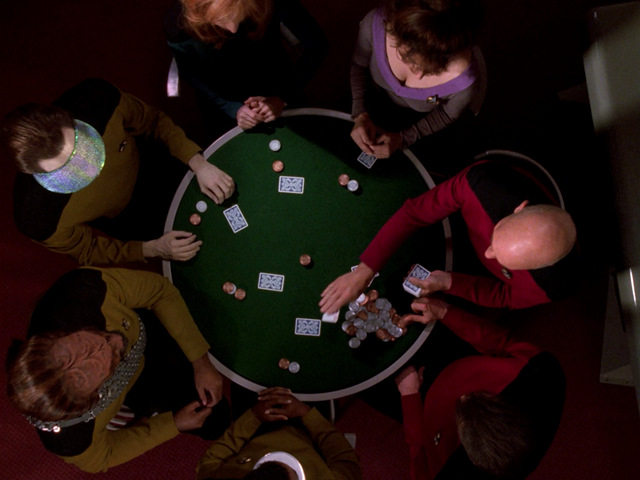
What a rollercoaster ride! Q has devised an elaborate puzzle for Picard, which he must solve while jumping back and forth between three different points in time. We see him on his first day aboard the Enterprise, back in the present and in a future where he suffers from Irumodic Syndrome and his mental abilities are severely impaired. And it is always the present-day Picard who experiences these jumps, making him the only one who witnesses the whole bizarre sequence of events. Patrick Stewart does a wonderful job portraying Picard at these different stages of his life, from the officer whose crew doesn't trust him yet to the older man who struggles with trusting his own mind. The episode is playful, inventive and full of surprises, while also giving us a glimpse of what might lie ahead for Picard and his crew. It is a wonderfully fitting conclusion to the series, bringing everything together without becoming overly sentimental. And then there's that final poker game. The captain joins his senior officers for the first time, and the scene closes when the cards are dealt, with Picard's words "The sky's the limit." What a perfect way to say goodbye! Read the full review.
3Tapestry
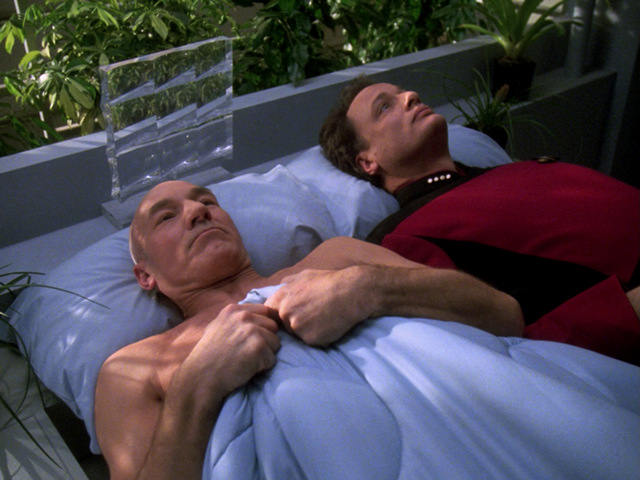
"You're dead. This is the afterlife, and I'm God." Well, that is certainly one way of greeting someone! Q gives the seriously wounded Picard the opportunity to revisit his past and undo the incident with the Nausicaans that cost him his natural heart. Picard takes the opportunity, but then discovers that without that youthful act of carelessness, he has become a rather dull and unambitious person. The episode switches between curious and serious moments, and there is an interesting, perhaps even controversial message at its core. Does taking unnecessary risks really make us more successful? Is a reckless young officer more likely to become a great captain than someone who remains cautious? That is hardly an advisable career strategy! Nevertheless, Picard learns something important about himself and comes to appreciate the experiences that have shaped him, including his mistakes. It is a personal story, with Q once again playing his mischievous game, and a most entertaining way of exploring what makes Picard the person he is. Read the full review.
2The Best of Both Worlds I/II
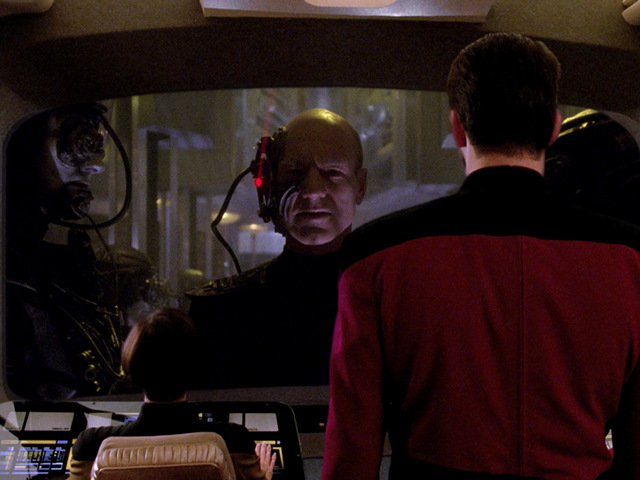
This is an obvious choice. "The Best of Both Worlds I/II" remains one of the most pivotal and best-known episodes of Star Trek to this day. The Borg are coming, and Picard is at the center of the confrontation. In the first part, he is still the captain trying to protect the Federation, but in the second he has become Locutus, literally the spokesman of the Borg, leading their assault on Earth. It is quite a transformation, and the image of the assimilated Picard is among the most iconic in the entire franchise. Meanwhile, the Enterprise crew does everything they can to stop the Borg and, just as importantly, to save their captain because they also care for the needs of the few. They refuse to simply sacrifice him for the greater good. Even as Locutus, Picard is not entirely lost, and the tiny clue he provides, "Sleep", becomes the key to defeating the Borg. His role is very different in the two parts, but he remains at the heart of the story throughout. This is not just an essential Picard episode but a defining moment for Star Trek, with consequences that will be felt for years to come. Read the full review.
1The Inner Light
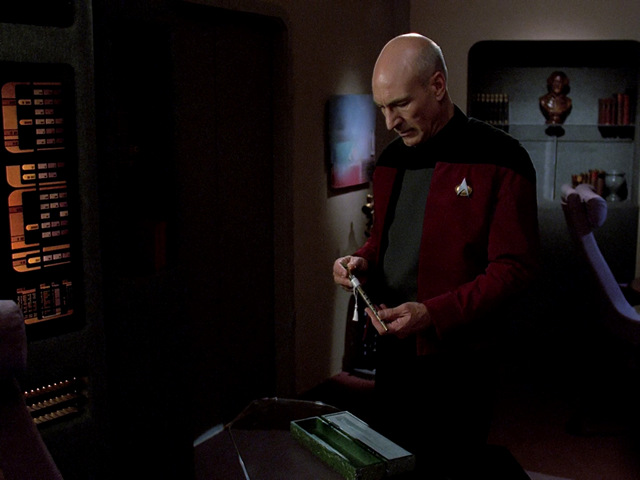
This is the episode everyone would probably expect at the top of a list like this, and for good reason. Through an alien probe, our captain experiences almost an entire lifetime on the long-dead planet Kataan, some 10,000 years in the past. This is not actual time travel but an experience induced directly in his brain. He lives as a man named Kamin, learns to play the flute, has children and watches them grow up. He becomes old himself and eventually witnesses the gradual death of his world as the planet dries out. The heartbreaking revelation is that Kataan perished 10,000 years ago and its inhabitants sent out the probe to preserve the memory of their civilization. Picard has lived almost an entire life in what amounts to just a few minutes in real time. Patrick Stewart makes this strange experience feel completely real, convincingly portraying a man who gradually comes to regard this other life as his own. The final moment, back on the Enterprise again, when Picard opens the small box and finds the real flute inside, is an absolute tearjerker. It never fails to bring tears to our eyes. This is quite possibly the finest Picard story of them all, but it is also an episode you could show to someone who has never watched Star Trek and who isn't particularly interested in science fiction. It is simply a beautiful story about life and love, and about preserving memories. Read the full review.
Honorable Mentions
Some other noteworthy Picard episodes of TNG:
- "Yesterday's Enterprise" - Picard has to make a difficult decision, ensuring that history remembers the name Enterprise.
- "Sins of the Father" - With Worf's honor at stake, Picard supports his friend before the Klingon High Council as his cha'DIch.
- "The Drumhead" - When Admiral Satie embarks on a witch hunt, Picard finally puts a stop to it by quoting her own father's words against her.
- "Unification I/II" - Following on from "Sarek", Picard joins Spock on Romulus in a quest to reunite the Vulcan and Romulan peoples.
- "Who Watches the Watchers" - Picard holds the Prime Directive in high regard, but finds himself worshipped as a god by the Mintakans and risks his life to set things right.
- "Suddenly Human" - While trying to repatriate a human boy abducted by the Talarians, Picard reluctantly becomes a father figure to him.
- "The First Duty" - Picard uncovers the secret behind the accident at Starfleet Academy and reminds Wesley that a Starfleet officer's first duty is to the truth.
- "Captain's Holiday" - Picard simply wants to relax on Risa, but instead meets a fascinating woman and finds himself caught up in an unwelcome adventure.
- "The Big Goodbye" - Picard plays his favorite fictional detective, complete with fedora, but ends up in the pioneering holodeck failure.
- "Family" - Still recovering from his experience with the Borg, Picard visits his family's vineyard and finally makes peace with his brother Robert.
All four TNG movies involve Picard strongly and personally.
Jean-Luc Picard is naturally strongly involved throughout Star Trek: Picard, so his memorable moments are spread across the series. Patrick Stewart is consistently excellent, even when the stories fail to live up to his performance or the callbacks to earlier Star Trek are not entirely convincing. Among the moments that stand out, at least in terms of emotional impact, are Picard's reunion with the Rikers and their family in "Nepenthe", his death and new life in "Et in Arcadia Ego, Part II" and his reconciliation with his own childhood (and with Q no less) in "Farewell". The third season gives him some especially moving experiences as a father, notably in "Seventeen Seconds" and "No Win Scenario". His encounter with Ro Laren in "Imposters" is another highlight, as it brings a difficult history between the two characters to a powerful conclusion.


