


Audio Drama Reviews
Audiobooks
Star Trek Picard: No Man's Land
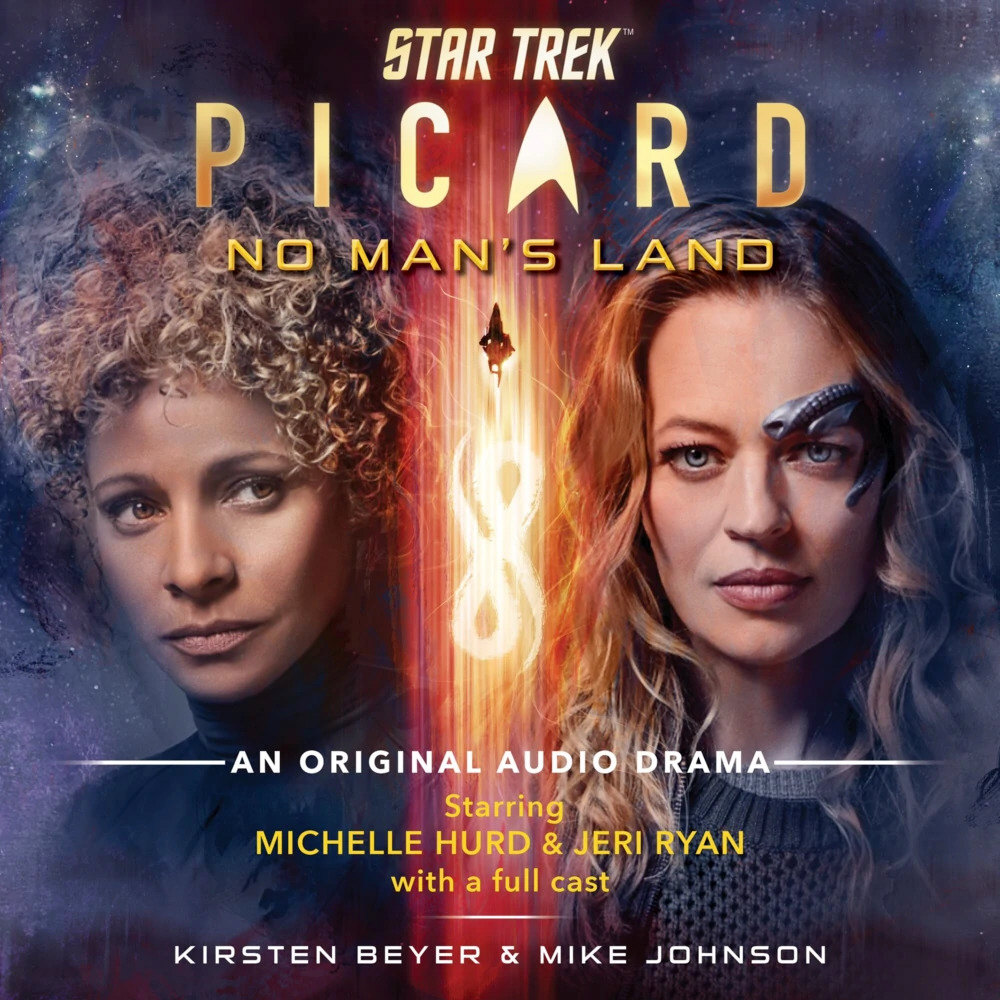 Whetting the appetite for Picard's imminent second season, No Man's Land is a rare foray by Trek into the medium of the full-cast audio drama. Given that other franchises, most notably Doctor Who, have created huge and successful lines in audio, and that Trek audiobooks (as in readings of prose rather than actual audioplays) are an established product, it's odd that there have been so few of these over the years.
Given how well it works, No Man's Land could very well kick off a whole new direction for Trek fiction. Picard and Discovery writer, and Pocket Books author Kirsten Beyer joins with comics writer Mike Johnson to work in this new medium. At just over an hour-and-a-half long, it's nicely paced, and a good deal happens, with plenty of audio-only action and tension. First and foremost, though, this is a personal drama, focusing on character relationships, primarily the two leads. Michelle Hurd and Jeri Ryan star as Raffi Musiker and Seven of Nine respectively, picking up their screen roles and building on them. Much of this is to do with their tenuous new romance, teased at the end of the last episode of Picard's first season.
While it was good to see a same-sex romance on Trek, especially between two older women (a rarity on television still), it did seem to come out of nowhere, especially as Raffi and Seven hadn't interacted all that much on screen before then. No Man's Land redresses the balance, exploring their feelings for each other and convincingly portraying the two women as nervously falling for each other. It's no whirlwind affair; both Raffi and Seven are damaged by their previous experiences and are cautious in making new connections. Much of Raffi's personal background was hinted at on screen, and explored in more detail in the Picard novel The Last Best Hope. Seven's post-Voyager life, on the other hand, remains quite mysterious, and while the audio sketches in some details, there's plenty of room left for the TV series to explore more without worrying about contradiction.
The lack of visuals really hammers home just how different Ryan's performance is to her Voyager days. She simply doesn't sound the same after twenty-plus years, and the older, more human but even more guarded Seven is a distinctly different, yet recognisable, version of the character. Aside from exploring her reluctant attitude to relationships, the story delves into her history with the Fenris Rangers, the still virtually unknown power that has taken over some of the Romulan Empire's former sphere of influence. While they remain quite mysterious after this, the impression we get is of a loose alliance of various life forms trying to keep some sort of order in a dangerous region of space.
The plot concerns the Rangers bringing Seven back into service to help them track down a figure from her past, who, inexplicably, appears on galactic records going back centuries. A brutal Romulan warlord, one of many vying for power in the region, is stopping at nothing to discover his secret, and the Rangers are trying to prevent him gaining more power and destabilising the quadrant further. We're introduced to some fun characters in the Rangers' employ, including Deet, who comes across as quite a Star Wars-style character with his peculiar voice and language. The authors generally resist the urge to have characters over-describe what they're seeing - a common mistake in audio - which pleasantly leaves the alien characters' appearances up to the listeners imagination.
In spite of a strong performance by the remaining cast, this is solidly Seven and Raffi's story, and the plot exists to service the emotional storyline as the two women work out what it is they want from life and each other. If there's a complaint, it's that the music is sometimes intrusive, but largely the sound design works well and helps make the production recognisably Star Trek. While it's not essential listening, it's an enjoyable and satisfying story that is, fundamentally, about love.
Kirsten Beyer and Mike Johnson, Star Trek Picard: No Man's Land, Simon & Schuster Audio, 2022.
ISBN: 9781797124537
Web Series
Star Trek: Khan
 As some sort of preface, I have never been a fan of Nicholas Meyer's idea of a TV series about Khan Noonien Singh and his people's exile on Ceti Alpha V. If there is one storyline in classic Star Trek that feels fully told, it's Khan's. Only tiny gaps remain, and nothing should truly surprise us or force us to re-evaluate what we know for decades. Moreover, nearly everyone in charge of new Trek seems obsessed with either drawing on Khan's legacy or reviving him outright, to the point that I've grown tired of it. On top of that, the temptation to go with Discovery-level visuals would likely have undermined the show's authenticity. I was somewhat relieved when the originally proposed TV miniseries was downgraded to an audio drama in the form of a podcast series, written by Kirsten Beyer and David Mack, based on Meyer's idea. Even so, I didn't look forward too much to its release in September 2025 and only listened a couple of months later during the Christmas break.
So, what do I think of Star Trek: Khan? Were my apprehensions confirmed? As I mentioned, I began with fairly low expectations. It took me three episodes to settle into the story, get used to both familiar and new characters and get accustomed to the audio format itself. I'm not a great listener - either watching or reading suits me better. It was difficult for me to follow the interactions of the characters, even though the story was still straightforward at the beginning. Beyond those personal hurdles, I also found the first three episodes rather formulaic. They cover the predictable "arrival in a new world" scenario without offering much reward for my attention. The infamous Ceti eels (alongside other creatures) keep killing Khan's people as expected. At least, we also learn that Augment women are infertile, which casts new significance on traitorous Starfleet officer Marla McGivers, who has joined them.
Another issue with the opening chapters is that they feel almost wholesome, given that these are dangerous criminals, who were rightfully exiled by Kirk. The campfire atmosphere and the compassion with those who mourn dead friends clearly pave a path to redemption. Several of Khan's followers are portrayed as decent, and even Khan himself is unusually soft-spoken and accommodating. Marla McGivers, by contrast, is depicted as far more confident and determined than she was aboard the Enterprise in "Space Seed". Well, the TOS episode was produced in the 1960's with all the according gender stereotypes. Still, that doesn't justify that I didn't really recognize her at first and that she fits in better than she realistically would. Interestingly, she is initially portrayed as fascinated by Khan and by the chance to witness history firsthand, rather than simply infatuated with him. While not entirely faithful to the original character, I enjoyed Wrenn Schmidt's performance as McGivers, who serves as a guide that gives the story structure.
The first three episodes mainly set the stage for more engaging later developments. Several new characters among Khan's followers are introduced. In a manner of speaking, they are all new, since in "Space Seed" no one else that I'm aware of had meaningful dialogue, and in "Star Trek II" they always followed Khan's orders, briefly questioning them only when he went for vengeance instead of freedom. It's refreshing that Joachim, Ivan, Ursula, Madot and others are given distinct personalities and roles in the audio drama. Admittedly, this doesn't align perfectly with the TV episode or the film, but the narrative explains that only the most loyal survive, which provides some rationale. By episode 4, the ensemble feels well established.
As for Khan himself, he evolves throughout the series. As the months pass, as his people keep dying and as the explosion of Ceti Alpha VI and other pivotal events unfold, his mood and his whole worldview shift dramatically. Naveen Andrews does an excellent job transitioning from the initially almost benevolent Khan to the vengeful figure we know from "Star Trek II". This transformation may have been deemed important for the story, especially since the second half of the series introduces surprises, some of which are perfectly consistent with Khan's established backstory and others are more far-fetched. Yet, the portrayal of Khan as a protective father figure (while glossing over his vicious past) goes too far in my view, a bit like infamously with Emperor Georgiou. Although the kindness of Khan emphasizes his eventual breakdown and vow of revenge, the theme of tyranny and violence should have been a consistent thread throughout.
Overall, I appreciate the various twists. The story could have remained simplistic - Ceti eels kill Khan's people, Marla dies, Khan despairs even before the neighboring planet breaks apart - but that would have been dull. Instead, the narrative grows much more complex. Without spoiling too much, there is internal rivalry but also outside interference, and a revelation that ultimately exonerates Captain Kirk, who could not have known the planet would explode. A lot of details tie in with canon Trek, and Star Trek: Khan is most enjoyable when we get to connect the dots.
The series comes with a frame story, in which historian Dr. Rosalind Lear investigates Ceti Alpha V as a guest aboard the USS Excelsior and somehow gains access to Khan's lost logs. George Takei makes a cameo as Captain Hikaru Sulu, vehemently defending Kirk's decision to exile Khan on that planet. Tim Russ appears as Ensign Tuvok, supervising and supporting Lear. He eventually uncovers her secret. Hearing these two veterans again was a delight.
I must give Nicholas Meyer and the creative team credit for crafting a series that becomes increasingly captivating, with well-timed twists. In hindsight, the biggest point of criticism is the unwarranted partial or temporary redemption of Khan. I would have liked more exploration of the Eugenics Wars, of Federation law on Augments and of the official assessment of Khan, especially since the frame story hints at these themes. The series would have had the potential to go beyond the immediate survival narrative. Still, it revealed more than I expected, considering I never asked for it in the first place.
Whether all of this is or should be canon is still another question. It may open a can of worms to include non-visual media. Star Trek: Khan features strong voice acting and high production values. Yet, I am glad it wasn't made into a TV series, as in this case some things are better left to our imagination.
Available on the Official Star Trek YouTube channel


