Star Trek: Starfleet Academy (SFA) Season 1 Reviews
Season 1
Kids These DaysBeta TestVitus RefluxVox in ExcelsoSeries Acclimation MilCome, Let's AwayKo'ZeineThe Life of the Stars300th NightRubincon
Kids These Days
Synopsis
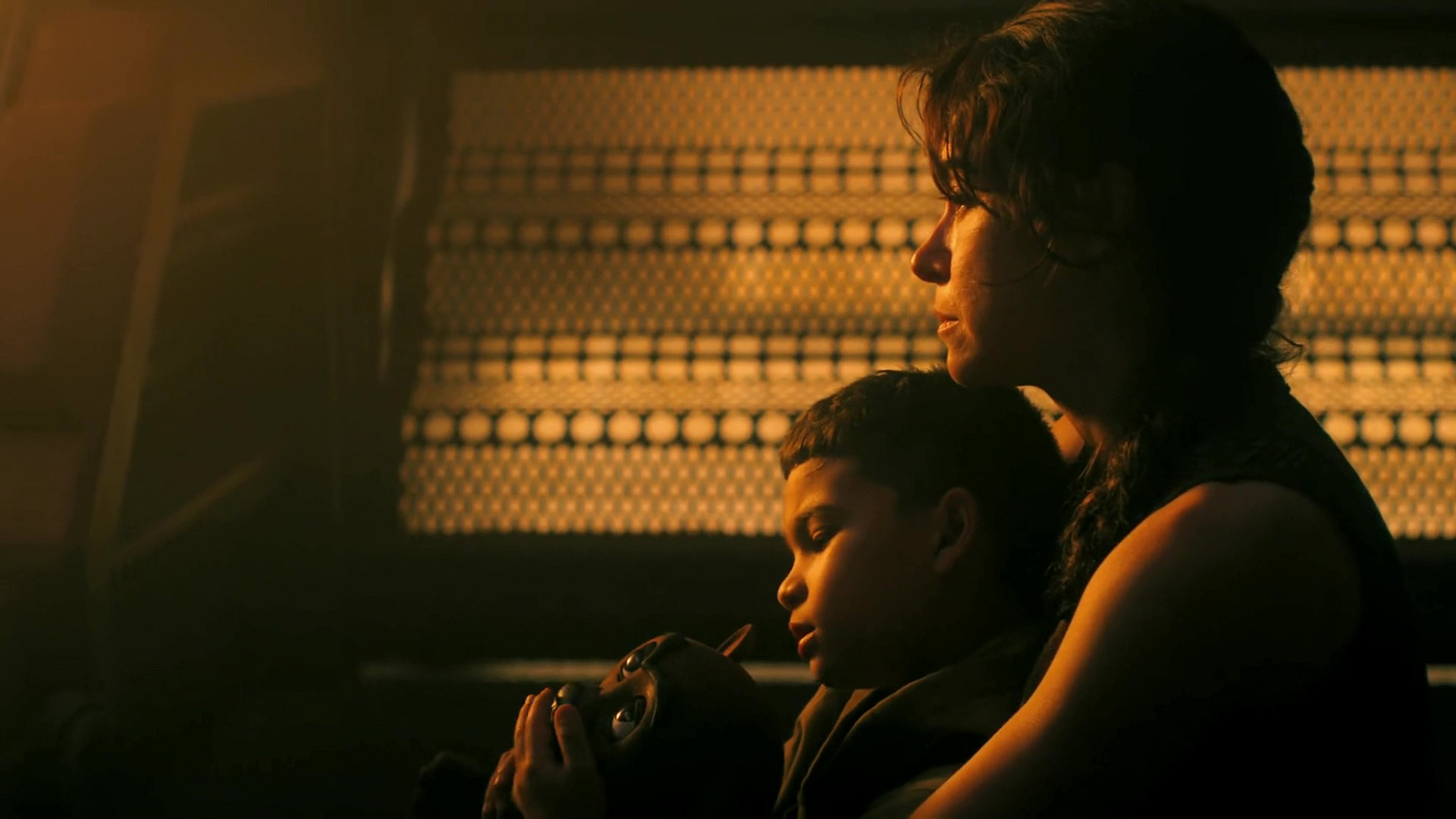
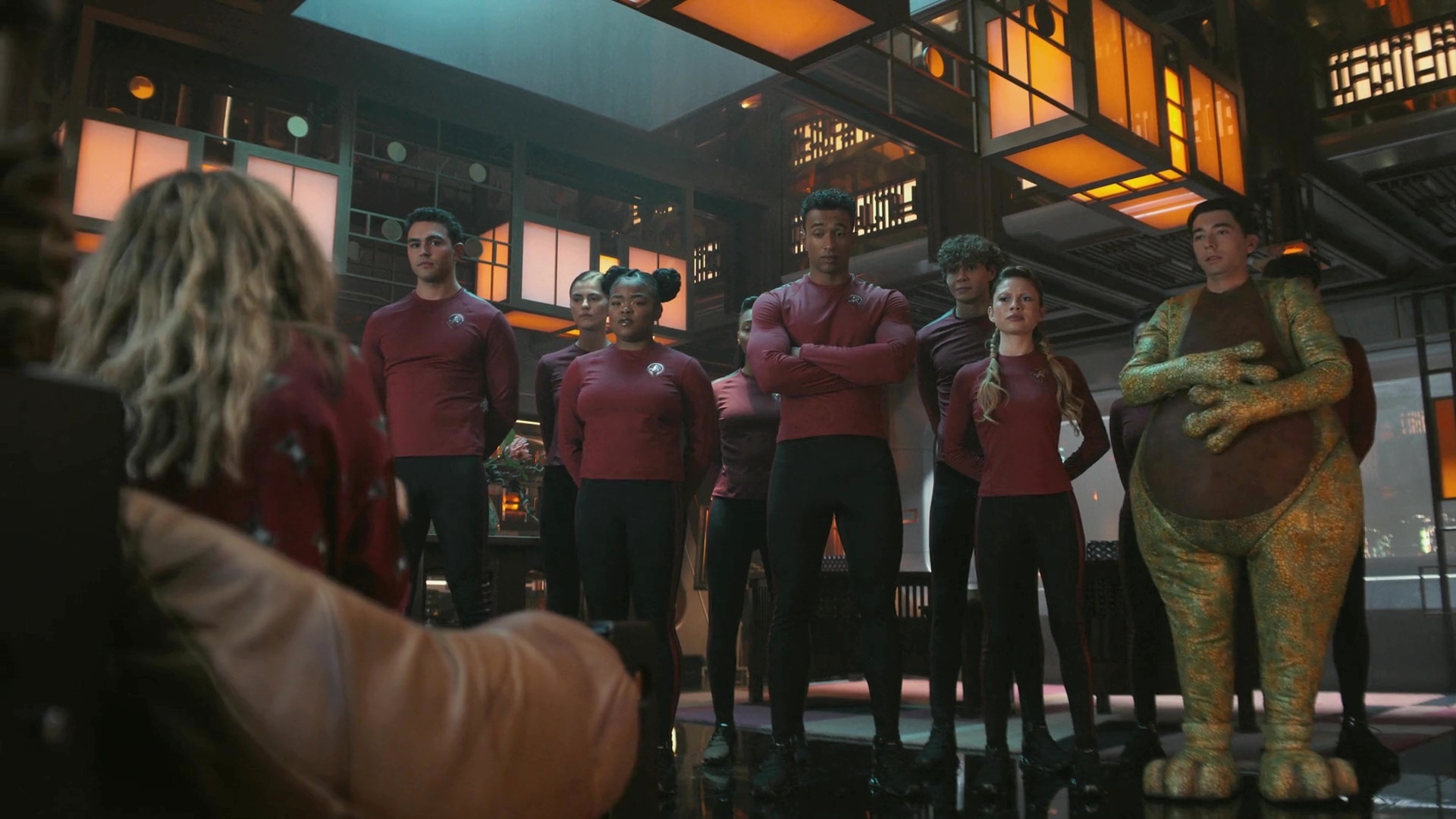
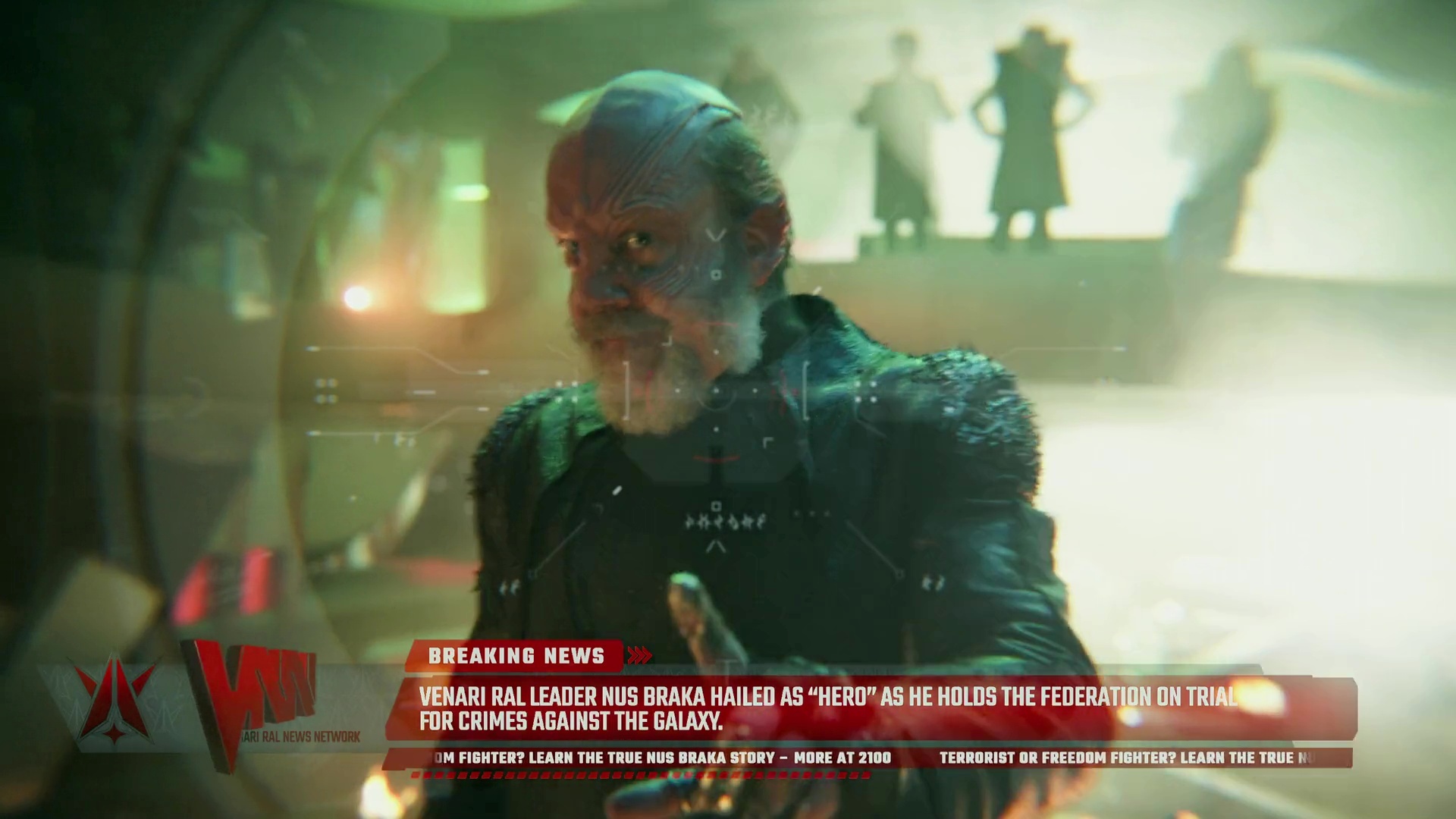
Stardate 853724.6: In the bleak post-Burn era, a Klingarite pirate named Nus Braka of the Venari Ral group murdered a Starfleet pilot to steal food rations and help young mother Anisha Mir and her little son Caleb. Starfleet officer Nahla Ake sentences Braka to life in prison and sends Anisha to a rehabilitation colony, with the intention to take care of her son. But Caleb runs away and starts a criminal career. — 15 years later: Caleb is arrested on Toroth after trying to hijack a prisoner shuttle. Admiral Vance tells Nahla Ake that the boy has been found. She is working at a school now, but accepts the admiral's offer to serve as the chancellor of the newly opened Starfleet Academy. She travels to Toroth and tells Caleb that his mother escaped from prison a year ago. She gets the boy released from prison under the condition that he joins Starfleet Academy. On the USS Athena, which serves both as a starship and a campus, Caleb gets acquainted with other cadets but he does not intend to make friends or stay for long. He secretly tries to contact his mother. Nus Braka picks up the message, intercepts and attacks the USS Athena with programmable matter that disables the ship's transporters and weapons. He comes aboard and demands the Athena's warp drive as a prize. As the peaceful Klingon Jay-Den Kraag and other cadets struggle to save Cadet Master Lura Thok, who has been injured by debris, Caleb has an idea how to get rid of the programmable matter that paralyzes the ship. He needs to know the atomic signature and find the right frequency to reprogram it. As the cadets are not authorized to use EV suits, the Khionian Darem Reymi with his unusual physiology volunteers to go out and scan the foreign matter on the hull. Genesis Lythe uses the Doctor's command code to activate the tractor beam and save Reymi, who has passed out during his extended stay in open space. After photonic cadet SAM has found the right frequency, Caleb is ready to activate the main deflector to reprogram all programmable matter on the hull. Ake fakes a warp core breach to make Braka leave engineering, but he he smells the deception and returns just as Caleb is ready to activate the sequence. The two get into a fight, in the course of which they bump their heads into the console, thereby pushing the button. The Athena's weapons come back online, and Ake destroys Braka's ship. Braka himself, however, takes an escape pod. The Athena arrives in San Francisco. Getting the ship into danger would be a reason for expulsion but Nahla Ake honors Caleb's unselfish conduct during the crisis and sentences him to 100 hours of menial labor and 90 days of curfew.
Review
As the premiere of Starfleet Academy approached, my expectations were low - but not dismissive. I tried to keep an open mind, even though this is the epitome of a show the fans never wanted. Ever since the internet has existed, an Academy-centered series has reliably ranked among the least popular options in fan polls. When Discovery premiered in 2017, it followed a long absence of Star Trek from television, and many were still willing to grant it some benefit of the doubt in spite of the unloved serialized prequel/reboot concept. After years of seemingly more downs than ups in new Trek, Starfleet Academy arrives in a different context. Set in the unpopular post-Burn Discovery continuity of the 32nd century, it additionally revives an equally unpopular premise. It wasn't only the die-hard naysayers who gave Starfleet Academy a bad rap. More measured fans expressed skepticism about the setting and character concepts as well. But maybe the series will surprise us and find its place within the franchise?
Much has already been said about Starfleet Academy's premise as some sort of Starfleet 90210 that seems at odds with Trek's motto of boldly going, about young characters that come across as entitled, about heavy nostalgia bait in trailers, about contrived hybrid species, clumsy names and awkward humor. At the same time, the series boasts an accomplished cast and impressive sets that just wait to be filled with life. Rather than reiterating my own or others people's apprehensions, let's dive straight into the first episode, "Kids These Days".
Nahla Ake's narration right at the beginning evokes the glorious past of Starfleet and then switches to the catastrophe that destroyed everything: the Burn. This doesn't get any more detailed, it also doesn't refer to specific events of Discovery, and I sort of like that because it is efficient. Also, it is one of only two shameless nostalgia baits in the series premiere, the other one being the "memory wall" of past Starfleet officers, almost all of whom are familiar names. All other legacy references are integrated more smoothly, like the Doctor's famous line "Tricorder... medical tricorder".
The episode takes some 12 minutes to establish the backstory of Caleb Mir, who had a close bond with his mother, including a secret code, and who was taken away from her by Nahla Ake. While we already knew the basic premise from the introductory notes on the characters, two facts come as a surprise. Nus Braka apparently stole food for Anisha and Caleb Mir, which paints him in a somewhat more positive light than if he killed that Starfleet officer solely for profit. But he quickly gambles away that little bit of sympathy with his evil laughter. Maybe we will still learn how Anisha became involved with the obvious madman. There is certainly more to explore than the flashback reveals.
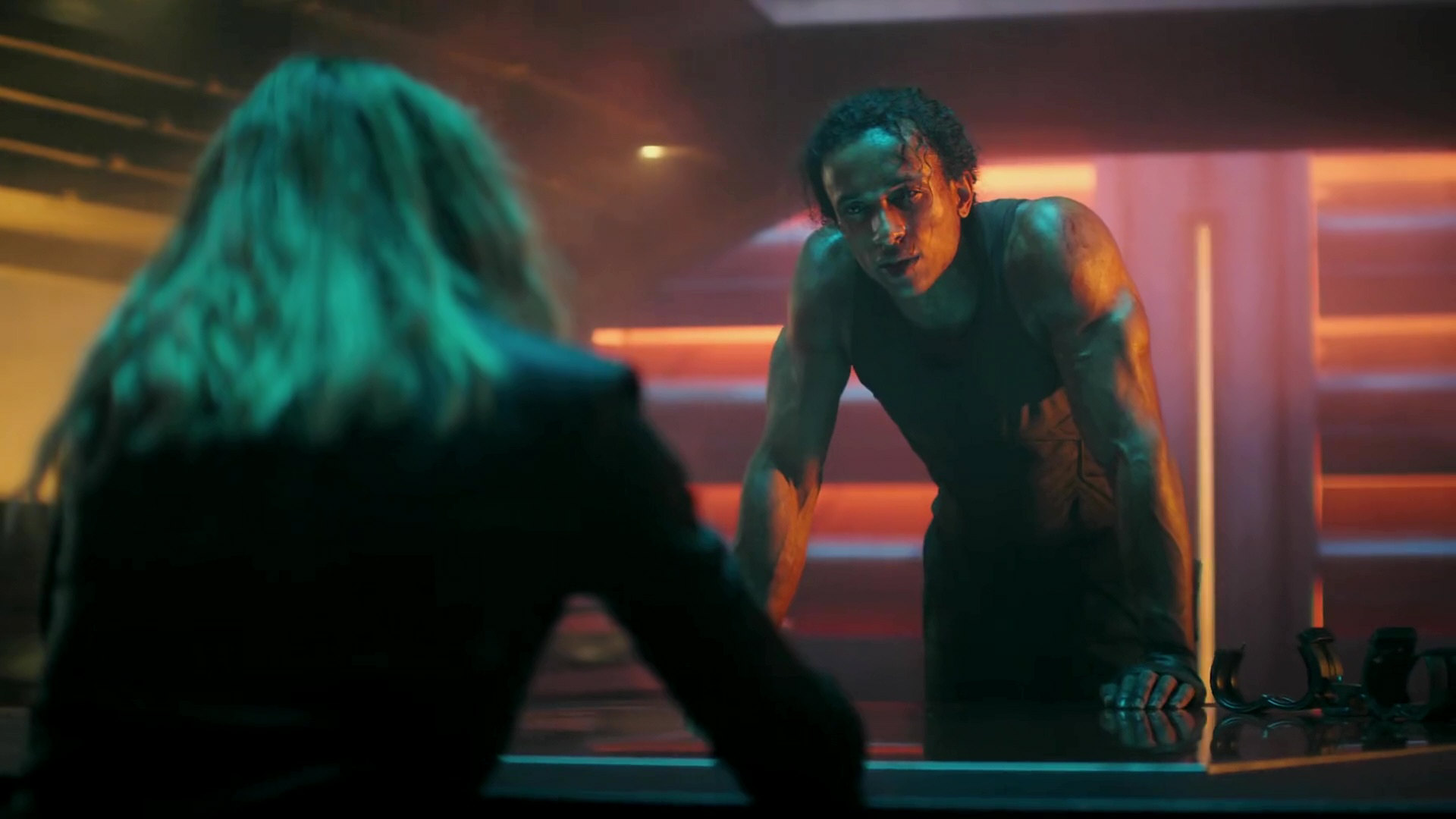
Anyway, the second surprise is that little Caleb has been conditioned by his mother ("Don't trust them!") and uses the very first chance to run away. The fact that Caleb was a rebel and a crook (or a misunderstood prodigy?) already at the age of about six years(!) is supposed to let his following criminal career appear more plausible. But it makes the character unlikable right from the start. 15 years later, Caleb is a fully-fledged criminal and an overall irresponsible and selfish asshole (arguably worse than two familiar Trek examples, Kelvin-Kirk and Jack Crusher). He would (and quite possibly did) kill to find his mother. Some have it in their genes, some got bad education or took a wrong turn - it is too simple to blame felonies on the circumstances and paint Caleb as a mere victim of injustice. I think there is a reason why the guards taunt him (probably because he attacks them all the time until he is eventually successful) and why he gets the Hannibal Lecter treatment as a "biter". Perhaps this is all meant to emphasize his hunger for freedom but it is extremely off-putting to me. Caleb is a crude testosterone monster that I would give a wide berth. He is written almost like a caricature, yet I have to concede Sandro Rosta is convincing throughout.
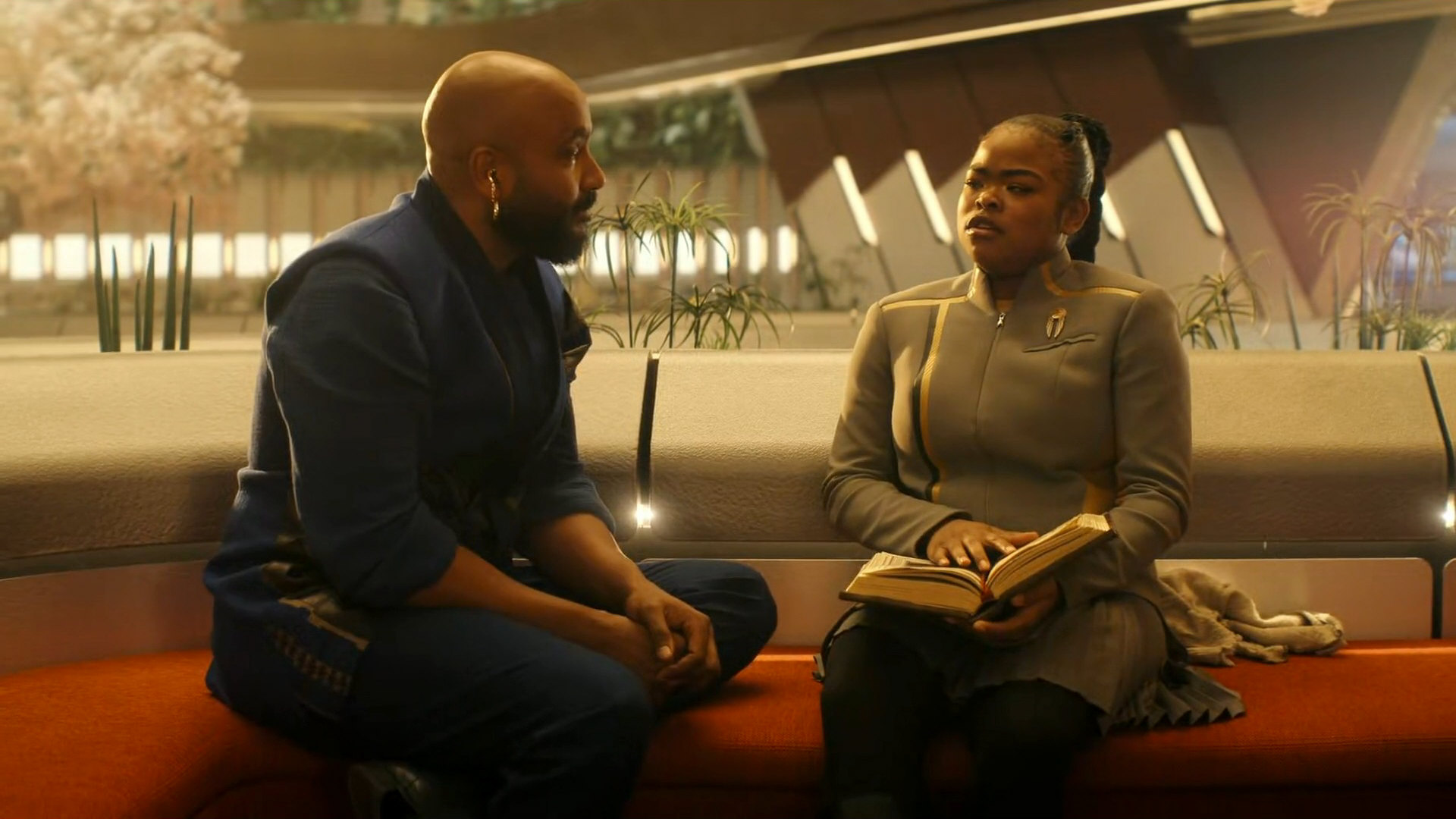
Caleb Mir is defiant as fuck, but undergoes a miraculous instant transformation once he steps out of the transporter beam, with a regulation haircut and a uniform. He still doesn't want to stay in Starfleet. He still doesn't want to make friends. He hacks the communication console to contact his mother. Yet it seems like he received a dose of xanax - Caleb has become sociable, almost tame. Sorry, I don't buy it. He leaves being an asshole to fellow cadet Darem Reymi. I understand the underlying intention for that. Darem Reymi is a wealthy heir, he is presumptuous and almost racist. He embodies everything that the underdog Caleb Mir supposedly would despise. But - isn't Caleb entitled just as well? Isn't he given a fantastic second chance despite his criminal record? And a third one at the end of the episode? The class conflict the story tries to construct doesn't work for me. I am glad it ends when Reymi doesn't turn so bad after all and the "We're in it together" attitude prevails.
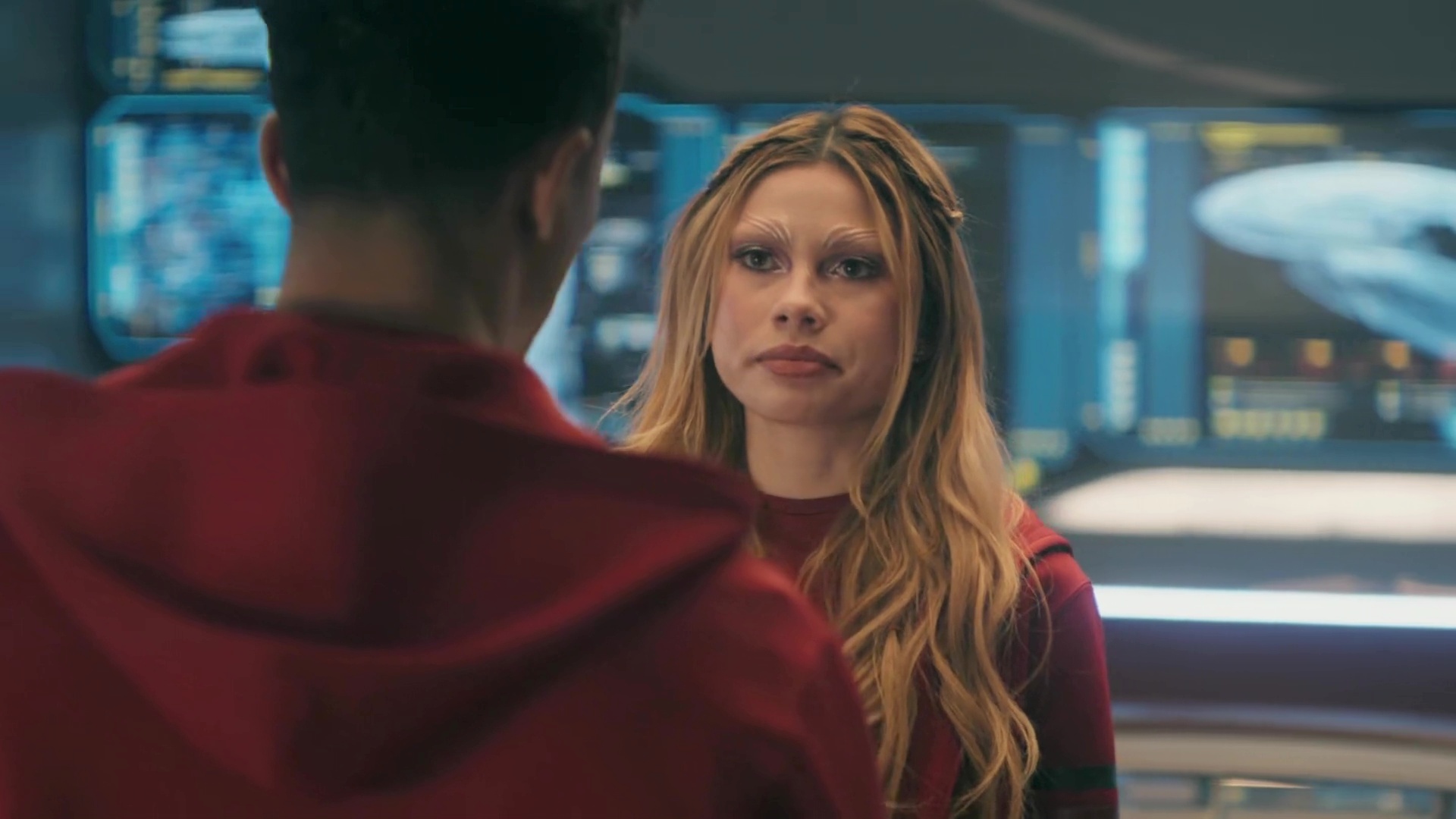
Among the other cadets, Genesis Lythe (what a bland geocentric name for an alien girl) is attractive and charming. Other than that, she isn't all that interesting yet, except in her function to help introduce Caleb, Darem and SAM. I was apprehensive of Jay-Den Kraag because I couldn't imagine a peaceful Klingon bird watcher. But I think I like his character, the only issue (besides the silly name - Jayden, seriously?) being his dreadfully artificial sounding slow voice. I thought we had left that awkwardness behind in Discovery. Speaking of awkwardness, I think I need to see more of photonic cadet SAM. Right now, she is a blend of comic relief and deus ex machina. Other than that, she makes a certain demographic happy through the fourth wall by stating she feels "invisible". It is foreseeable that she will forge a bond with our Doctor. I would like to know more of SAM's purpose. I am actually glad that she explicitly states she was created to interact with beings of flesh and blood, apparently by a colony of holograms. While I wouldn't exclude that photonic beings may develop some sort of procreation, we're still in the realm of programming where there is no randomness like in genetics. In other words, having a purpose is part of a hologram's existence in my view, you don't just create one blindly.
Holly Hunter as Nahla Ake is the standout of the cast. I enjoy her lines. And although the "memorial wall" scene is overly nostalgic, I like how she delivers the speech with an unassuming voice. I previously criticized that as lacking determination but I was mistaken - it fits in the context of her returning after a long absence. This is also illustrated by her taking place in the captain's chair initially with her knees pressed together like a shy girl - only to switch to comfortable crouching a bit later. Maybe the latter is not the best example for the cadets, but I doubt they normally see live pictures from the bridge.
Paul Giamatti as Nus Braka, on the other hand, is a huge disappointment. As already mentioned, his evil laughter is stereotypical of a cheap villain. I compared him to Khan in previous comments because of the revenge motive, but Nus Braka reminds me even more of Mudd at this point - and I'm not talking about the charming con man from TOS but the cynical felon from Discovery. His tic-tac-toe haircut is ridiculous, his acting is over the top and many of his lines are cheesy. We learn that he is a "Klingarite", which right now has no further meaning than to signal that this is the far future, and there may be hybrid cultures. The same applies to Lura Thok's Klingon/Jem'Hadar (Kling'Hadar?) heritage.
When Nahla Ake steps onto the bridge, she greets each crew member by name, having learned them on the shuttle. I wonder how many will speak beyond the occasional "Aye, captain." Since the series centers on the cadets, I fear the bridge crew may end up just as insignificant as most of Discovery's.
Some of the story is dark, which may be justified for the parts taking place in the bleak post-Burn world and/or on an alien planet. It is fine with me if it just sets up the series but is not something I would like to see every week. This applies even more to violence and rudeness, of which this first episode has plenty. As much as it is deemed realistic, I miss the fine manners of TOS or TNG. I also miss the times when heroes or villains didn't have super-strength. I mean, what is so bad about being just able to deliver a painful blow into the stomach? Why has it become the rule to send your opponent a couple of meters against the next wall or ceiling? On a final critical note, what is a "regulation haircut", except for an archaic discrimination against male humans and no one else?
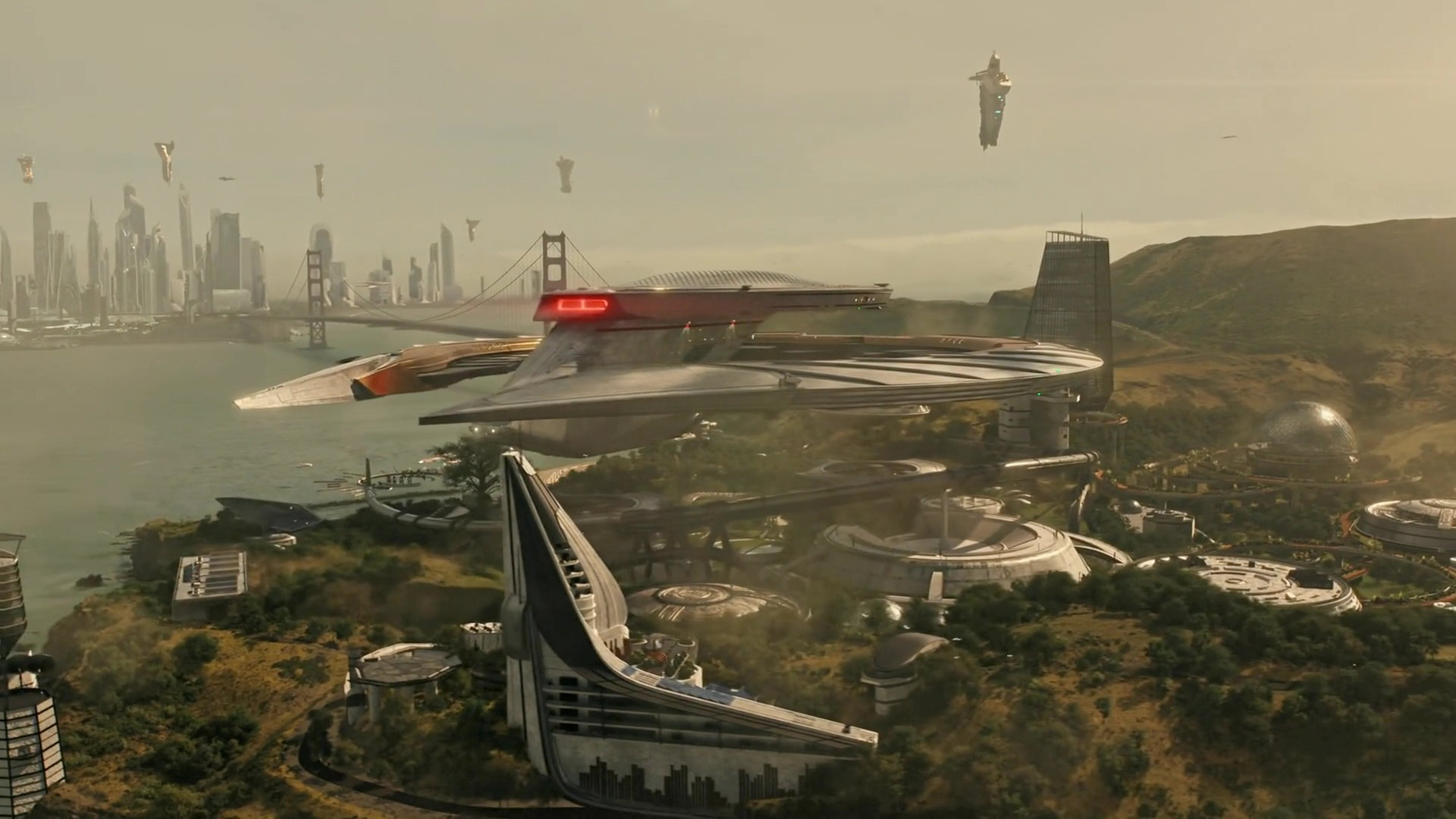
I like the shiny interior of the USS Athena, although it is overdesigned in many regards. This is in contrast to the exterior, which is simply boring and ugly. I will probably never get accustomed to 32nd century ships, but even in this bland era there are better designed examples. Overall, the series has spectacular visuals though. From what I have seen so far, it is still a step up from Discovery's latest seasons. I don't like the title sequences very much, which (at least for now) consist of a brief and unremarkable title card at the beginning and subdued end credits, although the music in the latter starts with a touch of Jean-Michel Jarre. Finally, kudos for producing this series in Full HD instead the smaller "cinematic" 1920x800 format.
I have written a lot about characters and themes, but not yet about the story. Maybe this is because it isn't all that interesting. The tragic separation of Caleb from his mother doesn't leave me cold, but as already mentioned it is sort of annihilated by him becoming an asshole. In the following, there is more exposition and a mostly successful introduction of characters. It comes with quite a bit of humor, which sometimes works (such as in the interaction of the cadets with Lura Thok) and sometimes is dumb ("I swallowed my commbadge"). Overall, this part is more rewarding than the cookie-cutter plot of Nus Braka attacking the Athena. I wonder anyway why both he and Nahla Ake are so obsessed with the boy that they change or risk their lives. In the promotion campaign it still seemed like it's between Ake and Braka, but the episode is all about Caleb. I hope Starfleet Academy can move on and leave the ground of this small-minded small-universe premise. Right now, I can say the series has potential but doesn't get into motion yet.
Annotations
- Continuity:
- The Torothans previously appeared in ENT: "Desert Crossing".
- There is a cadet from Cheron (TOS: "Let That Be Your Last Battlefield").
- Nitpicking:
- Lura Thok has been criticized for being half Jem'Hadar, although Jem'Hadar cannot procreate by design. She introduces herself as "daughter of Asmaret from the Klingon House of Dak'Hatas and the Jem'Hadar lineage of Kah-Baj." So she is an offspring of Kah-Baj only genetically speaking.
- It's the 32nd century, and a six-year-old boy can simply steal a commbadge and use the extremely powerful device without authorization.
- There is no good reason why Nahla Ake would want to investigate the phenomenon close to the Athena's flight path. At least, there is no reason for Nus Braka to assume she would fall for the trap.
- Caleb Mir sends the message to his mother, which Nus Braka intercepts, upon which he devises a plan, sets up the trap in the Athena's flight path and is ready to attack - and all this in at most a few hours!
- Cadets are not authorized for safety reasons to use EV suits. But they are allowed to open the airlock.
- Since when is capturing an escape pod a problem?
- No one can tell me the cadets in the corridor that exploded are fine in the end. There are many casualties that the happy ending glosses over.
- Remarkable dialogues:
- "That thing is taking us to the school?" - "That thing *is* the school." (Caleb Mir and Nahla Ake)
- "You said you burn for life." - "I said 'yearn'." - "No matter. Now you will save my life." (Lura Thok and Jay-Den Kraag)
- Remarkable ship: The USS Athena NCC-392023 can drop its warp engines, descend into the atmosphere and dock to the familiar Starfleet Academy ground in San Francisco.
- Remarkable music: The Doctor says the opera club will start with "Di quella pira" from Il trovatore by Giuseppe Verdi, but we don't hear it (yet).
- Tacky music: I love the original song "San Francisco" by Scott McKenzie (it's from my birth year after all!) but I don't think it fits here, even though (or just because?) it was attempted to blend it in, using a symphonic version.
Rating: 5
Beta Test
Synopsis
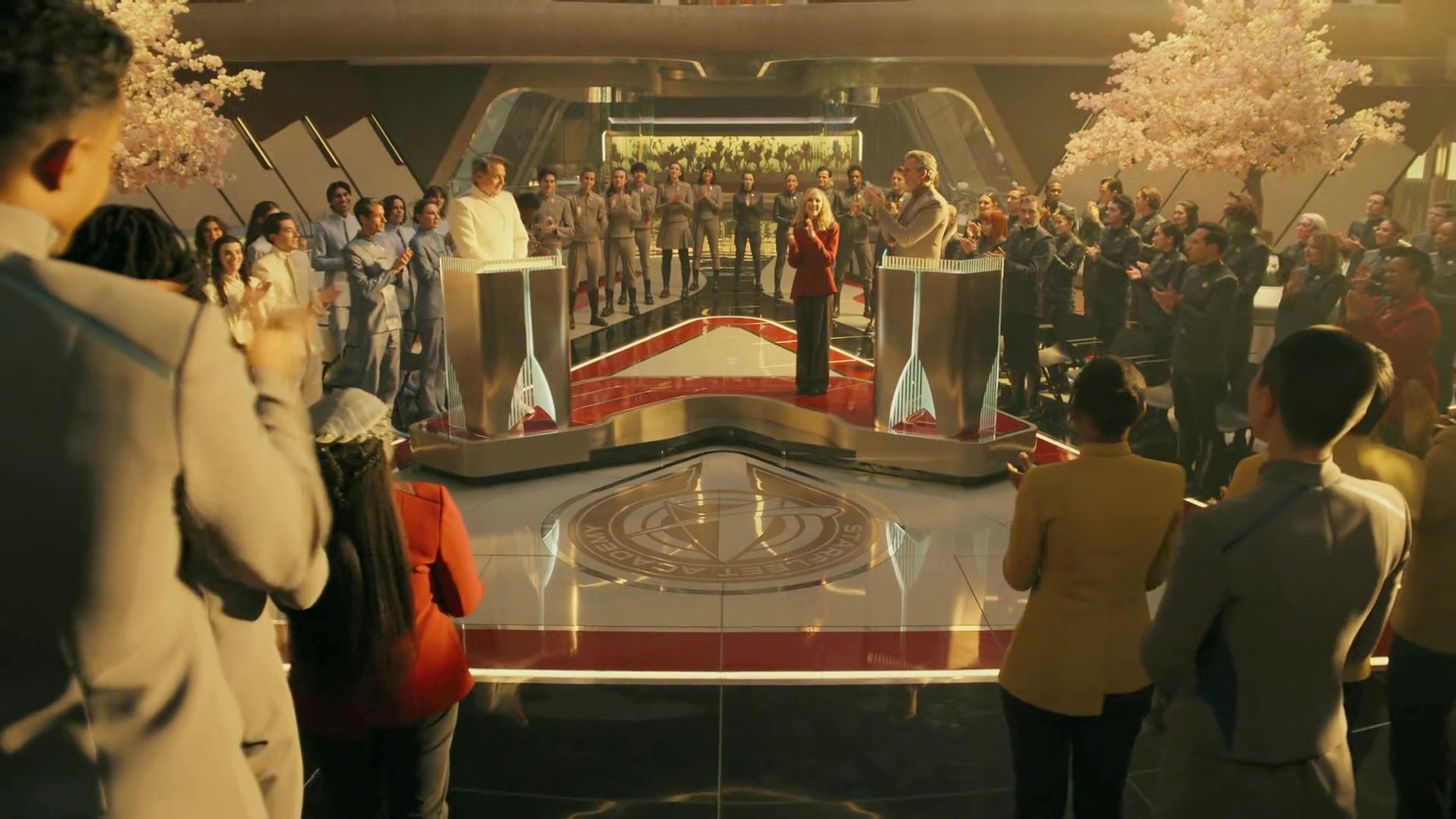
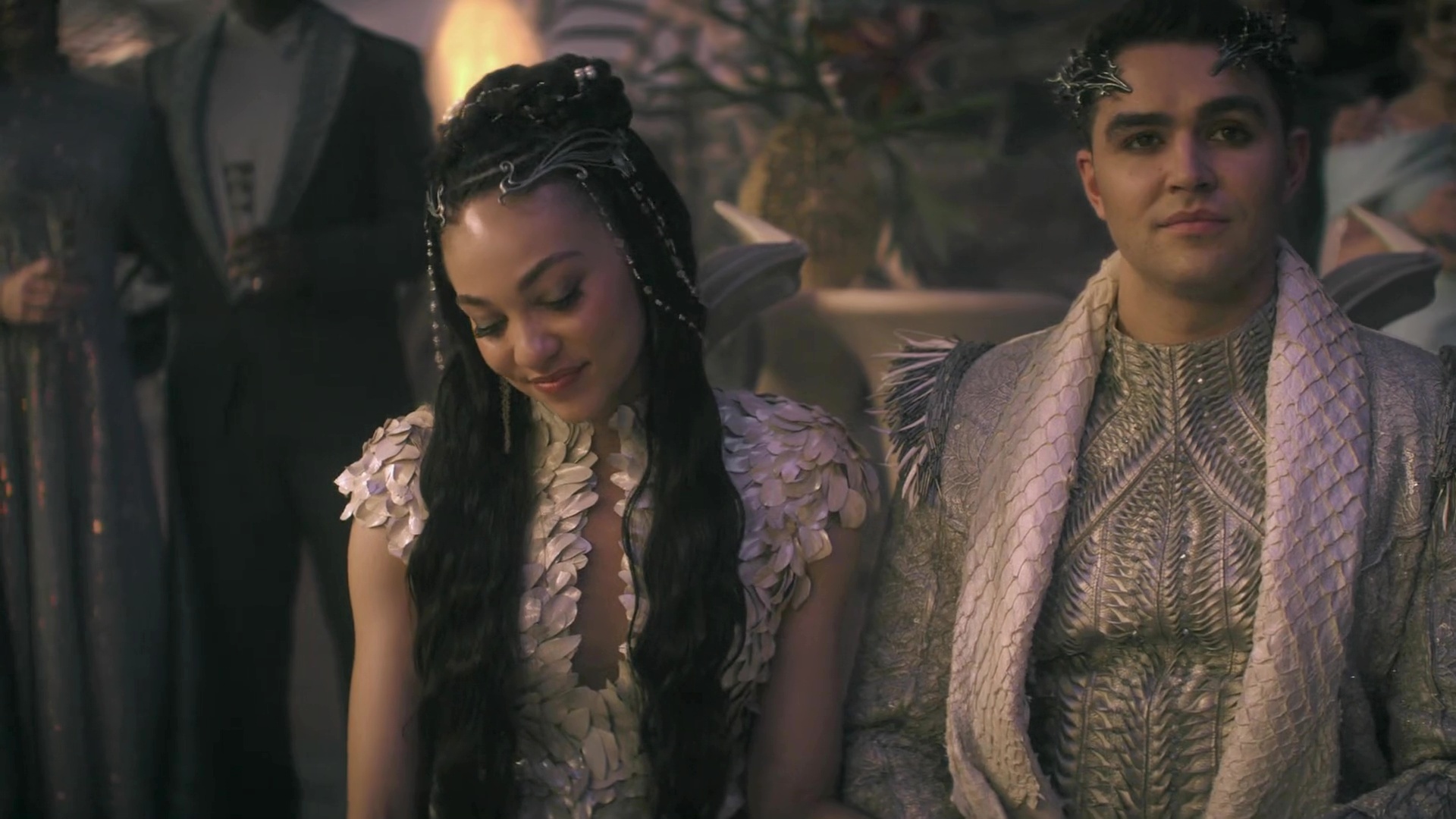
The semester starts, the cadets attend their first courses and are assigned their rooms. To Caleb's dismay, his Khionian rival Darem Reymi is his roommate. Vance and Ake are expecting a delegation from Betazed, including President Emerin Sadal. Betazed has shielded itself against the rest of the galaxy with a psionic barrier and is reluctant to join the Federation again. Ake proposes to let the cadets join the meetings, so they can learn diplomacy and the Betazoids will be impressed by the future generation of officers. Caleb, however, continues to hack the Academy's systems and search for Goja V, the planet that his mother was last seen on according to Braka but that doesn't exist in Federation databases. When he gets humiliated in front of Jett Reno's physics class, he runs away. Just as he is about to climb over the fence, he encounters the lovely Tarima. He gets apprehended and dragged into the conference room to attend the negotiations, only to learn that Tarima is Emerin Sadal's daughter. When someone is requested to show Tarima around on the campus, she points at Caleb. He agrees, also because he hopes for privileges that allow him to find out more about Goja V. The negotiations keep dragging on, with Betazed demanding more than the Federation is willing to offer for them to rejoin. Tarima is open to Caleb about her dreams. She notices how desperate he is to find Goja V, opens the Betazed star charts and locates the planet for him, upon which he shows her the humpback whales she hoped to see on Earth. She also tells him about the neuro inhibtor she is wearing because otherwise she might hurt someone with her psychic forces. But when she suspects that Caleb was nice to her only out of selfish interests, they get into an argument and avoid each other. Likewise, President Sadal ends the negotiations without a result. Speaking to Caleb, Ake has an idea how to get the president interested again, upon which Caleb apologizes to Tarima and she asks her father to stay for another day. Ake proposes to move the seat of the government to Betazed instead of Paris. Sadal agrees. In the meantime, Starfleet Intelligence has been to Goja V and has found a crew manifest of a ship leaving the planet that includes Anisha Mir. Caleb returns to his quarters, only to notice he has a second roommate: Ocam Sadal of Betazed. His sister Tarima, on the other hand, has decided to join Starfleet's War College instead.
Review
After the pilot episode, we have two Starfleet Academy characters that are well introduced and already familiar, while the rest still need more work. This doesn't happen yet in "Beta Test". The episode focuses even more on Nahla and Caleb (and later Tarima), with the other cadets almost absent or pushed into the background. This doesn't have to be a bad thing. "Beta Test" is also less exciting than the pilot, being literally grounded after the USS Athena has set down. But the lack of action is not among the problems of this episode.
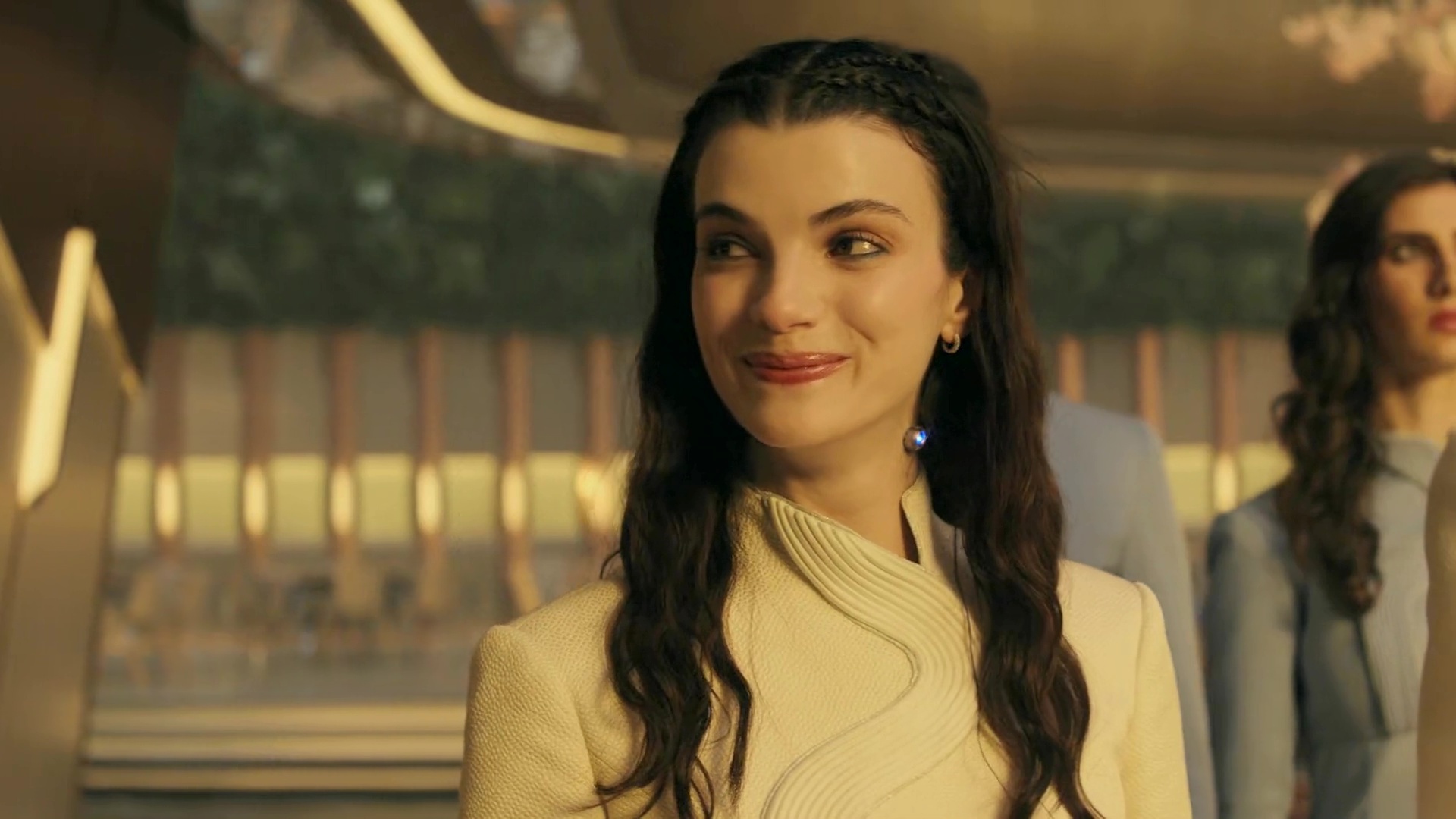
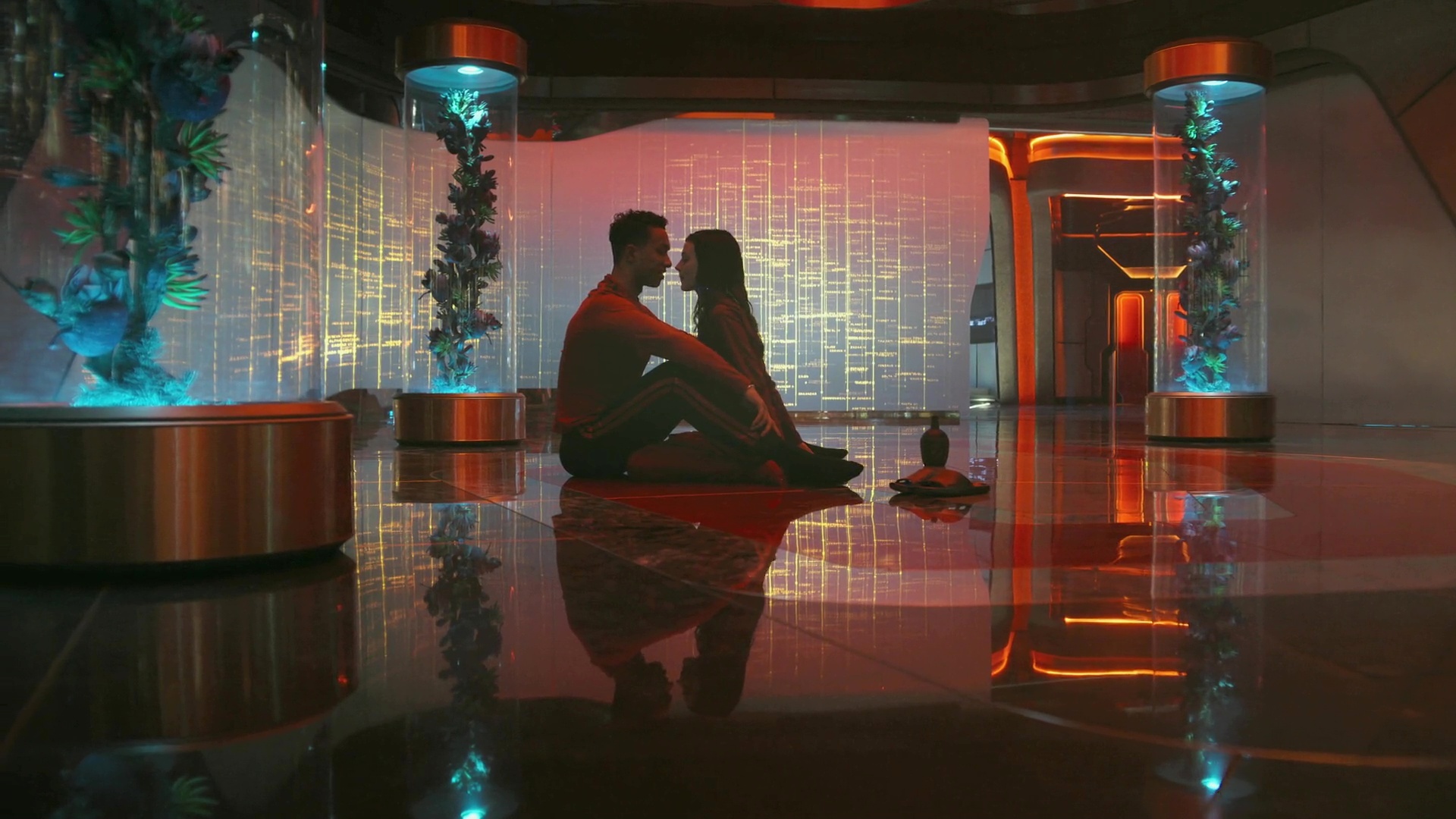
If we look at the basic plot of "Beta Test", it should work just fine. There's Caleb, who may have become more sociable after stepping through the gate that gave him a regulation haircut and uniform. At least he is no longer ferocious. But he still uses every opportunity to annoy people, especially Nahla Ake. By chance or fate, just as he is about to leave for good, he meets the angelic Tarima - of course without admitting he is falling in love, because he's a renegade after all. He once again gets special treatment when he is allowed to show the president's daughter around the Academy campus. In the end, their bond helps to forge the bond between the Federation of Betazed. If we look at just these points, it all fits together, including the irony that Caleb should rather be doing menial labor as punishment (of which we have seen nothing yet) but instead gets more privileges.
One key issue with "Beta Test" is that it is filled with silly situations, and even parts that start out thoughtful or realistic often descend into embarrassment. Take Caleb Mir and Darem Reymi as an example when they discover they are roomies and they both protest. This is what we could expect, knowing they are rivals and always full of testosterone. It is actually funny for that brief moment, and good for plenty of future clashes over petty topics. It's a YA show after all. But then they are called to Ake's office, in an unnecessary continuation of the awkward situation that ends with no result but pure cringe. And this scene is just a taste, not even among the worst examples.
As I started watching, I was still hoping the silliness would end after the opening credits. But no - it continues for much of the runtime. Agreed, the core story, meaning the negotiation and the romantic scenes with Tarima and Caleb, can be taken seriously for the most part. But the rest is full of lame jokes, absurd characters and props, nostalgia bait and other concepts that feel off. It seems that for every cool idea in the story and execution (and there are quite a few that I will mention later) there are three irritating ones.
To start with, the xenobiology, xenomythology and "yelling and be yelled at" classes are a joke. Self-replicating mucus, seriously? Like in the horrible Very Short Treks episode with the snot people that I would rather forget? Basically, it is fine that SFA reuses clichés about colleges and military schools - with some cadets not able to take the pressure, which too get played for laughs. Perhaps I should accept that's what YA shows are made of. But even a light-hearted introduction to the strange world of education could have been done better. I liked both the Doctor and Lura Thok in the pilot, as no-nonsense officers and instructors. But as they enter the classroom, they seem to forget it's about teaching, not showing off.
Why did Ake think it was a great idea to hold the negotiations in front of her "children" instead of behind closed doors? Doesn't she know anything about diplomacy, about its sensitivities and the need for discretion? Doesn't she know how teens are and how they could ruin everything? Which Caleb almost does. This is not a debate club, it's reality. Ake herself tells Caleb: "People will live and die because of what happens today." Seriously, Vance should have stopped her instead of just smirking. I'm not sure he really agrees with her, but our Admiral Yes-Man doesn't have the guts to call her out. On another note about Nahla Ake, she walks around barefoot and makes up reasons when criticized for it. As much as I like her unconventional ways of acting and talking, in this case I would have preferred her to leave it uncommented because some things make more of an impact when you just shrug instead of explaining too much.
We may value that Ake has endless patience with Caleb. We may appreciate she negotiates everything with him instead of ordering tasks and schedules. Or punishments. But it becomes clear in "Beta Test" that she crosses reasonable limits of granting leeway. We have to keep in mind she is responsible for hundreds of other cadets, and she gives him privilege after privilege and chance after chance, ultimately neglecting everyone else and giving them the impression Caleb is a nepo baby. This is poison for discipline.
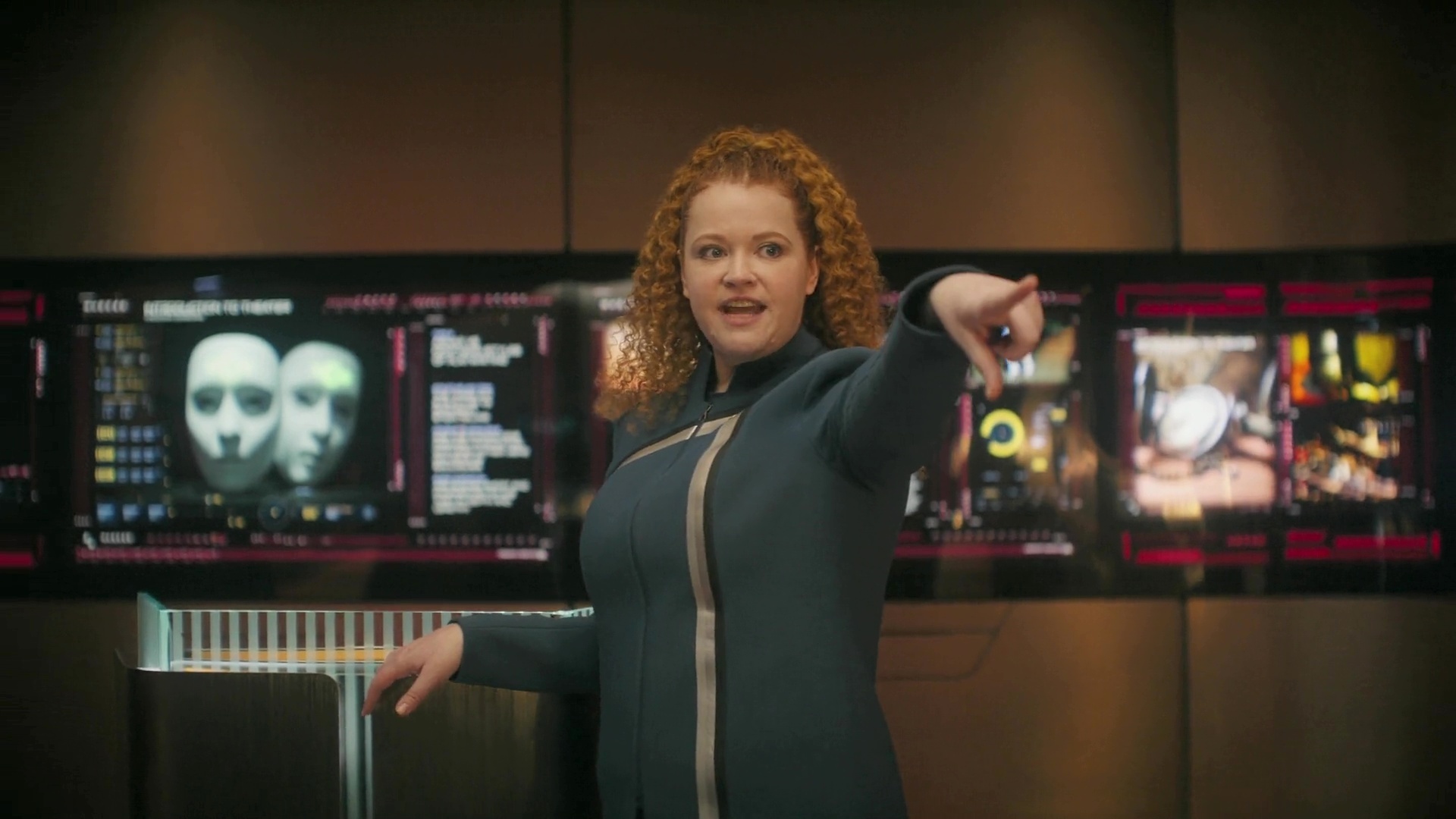
I love Reno's physics course. After the other teachers have become caricatures and even Ake seems to have lost her mind (hopefully only temporarily), she looks like the only reasonable person at the Academy. We may object that Reno doesn't talk much about her actual topic either. But that happens after she notices someone isn't paying attention (of course, it's Caleb), and she switches the topic and speaks about life - his life. Is it just me and I overrate a collection of truisms she tells her students? Is it just me and I forgive her the weird anachronism of the "mixtape" because it is from my time? I think what she says is funny, enlightening and encouraging, perhaps the best lines of the series so far. And delivered with rough charm. Tig Notaro has never been better on Trek.
Unfortunately this highlight ends with the slapstick scene in which Caleb first gets covered in mucus that SAM spills on him and then in disinfection foam that a hologram sprays on him with some kind of extinguisher. Yes, this is funny and I admit I laughed, but as a key element of the story it fails. It should not have made an idiot of him. It should not have been used to set up greater things. It becomes absurd when Caleb, still in his messy uniform, gets dragged into the Sato Atrium and draws everyone's attention. So much for making a good impression on the Betazoids!
There are many nostalgia baits that are not subtle at all, such as the James T. Kirk Pavilion or the Boothby Gardens, with both plaques shown too obviously. Here, look, our legacy! This is your Star Trek! You have to love it! Also, the reference "Boldly go where no one has gone before" in Ake's speech is too much in your face. SFA tries hard to tick as many boxes as possible.
I mentioned it already in the review of the pilot, SFA also has a problem with naming. The "War College" is another example. Seriously, who would still refer to "War" in the name of a military academy, without Donald Trump having a say in it?
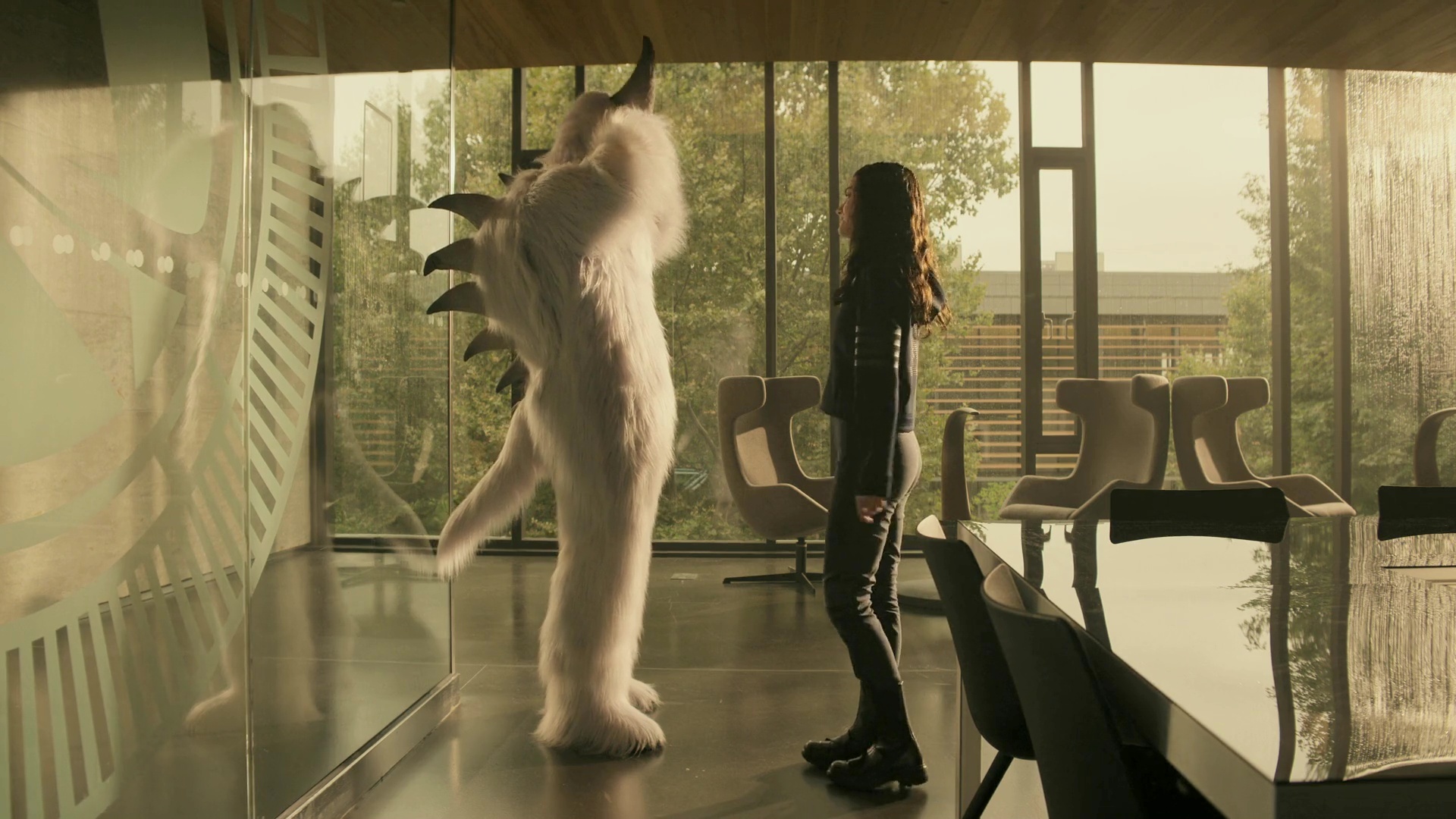
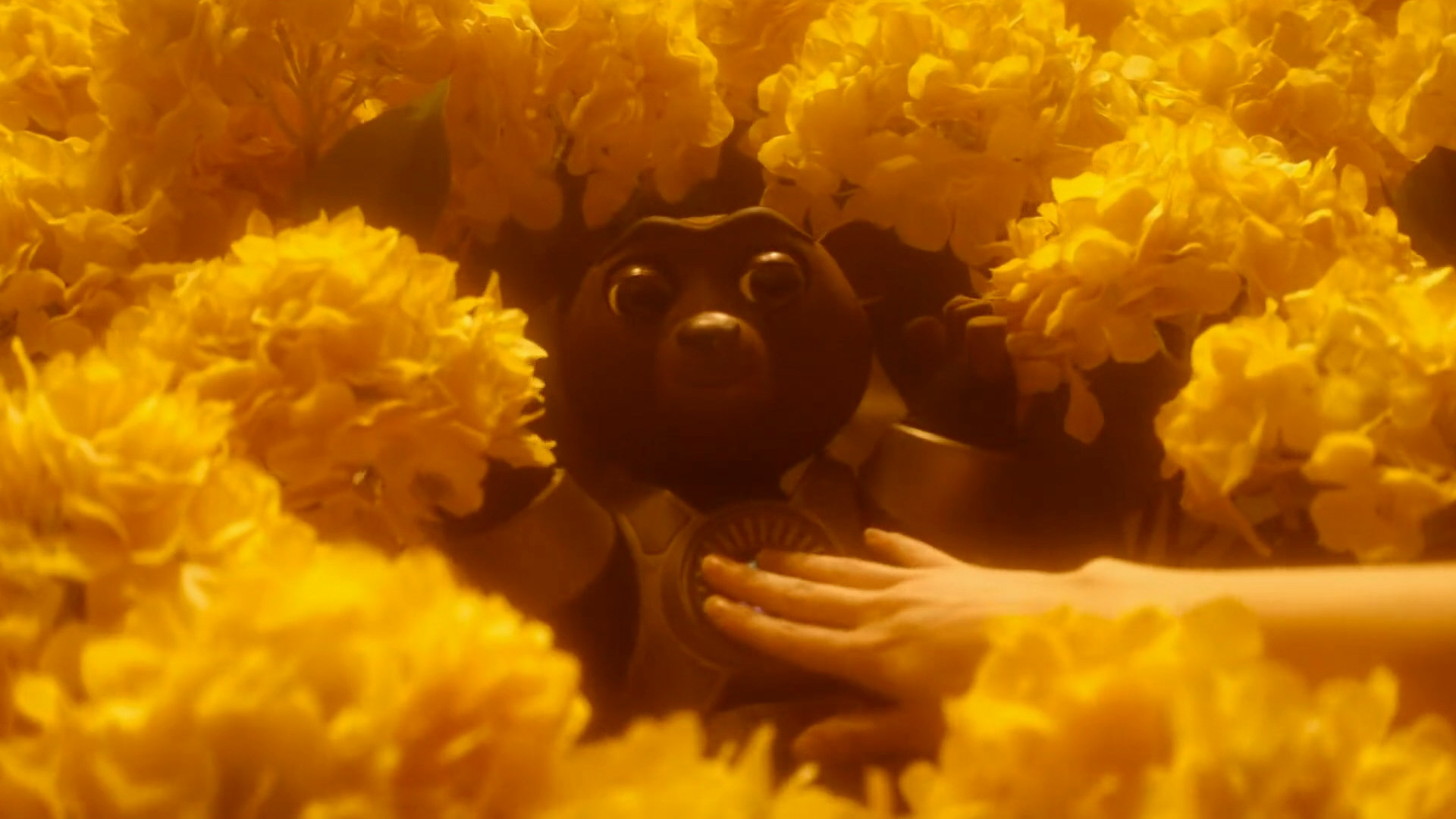
Then there are two legacy characters that don't work at all. Most obviously there is the Brikar - Rok-Tahk's species from Prodigy. I can understand that the producers wanted to bring the rock people into live action, but this attempt is a total failure. SFA's Brikar is 100% an animation character, looking almost the same as in Prodigy, although in the animated series all characters were caricatures of the real-world races they represent. Imagine the Tellarite Jankom Pog in a live-action series, with the exact look as in PRO. He would be ridiculous. Even the clothing of the Brikar is like Rok-Tahk's original one in the mining colony - they seem to have forgotten she wore a uniform throughout the complete second season. The exocomp is almost as unfitting because the design is exactly as it was 800 years ago - it is the future, make things futuristic instead of nostalgic! And speaking of stuff floating around all the time, the DOTs may be useful for repairs, but drones serving food at a diplomatic reception should be a no-go! It is the 32nd century, think of something decent, at least for such a festive occasion!
I wrote about the pilot that some jokes were successful and some were cheesy. We do have quite a few good ones in "Beta Test" as well. Caleb being "literally on the fence" when he interrupts his escape attempt and speaks to Tarima was a no-brainer. Just as her saying "She's pregnant" about the humpback whale like a certain famous telepathic person. Others could have been good but suffer from being out of place, like Caleb complaining about the cold soup and Ake telling him it was gazpacho. The way Caleb disables a hologram by simply giving an instruction that overloads the processor buffers would have been funny at the time of TOS or TNG but doesn't work today. On the danger of repeating myself, if the writers hadn't been obsessed with squeezing in something humorous, weird or nostalgic every few seconds, the episode could have been better. For instance, Caleb says "There's a Borg" when he is arrested. Lower Decks had countless of these offhand jokes, where they were more fitting. Once again, the live-action series borrows from animated comedy without acknowledging it follows different rules.
The details (the kind that should usually go unnoticed) are the icing on the cake: repeated silly PA announcements, an obnoxious window-wiping DOT, a wastebasket that plays the TOS fanfare - oh, come on!
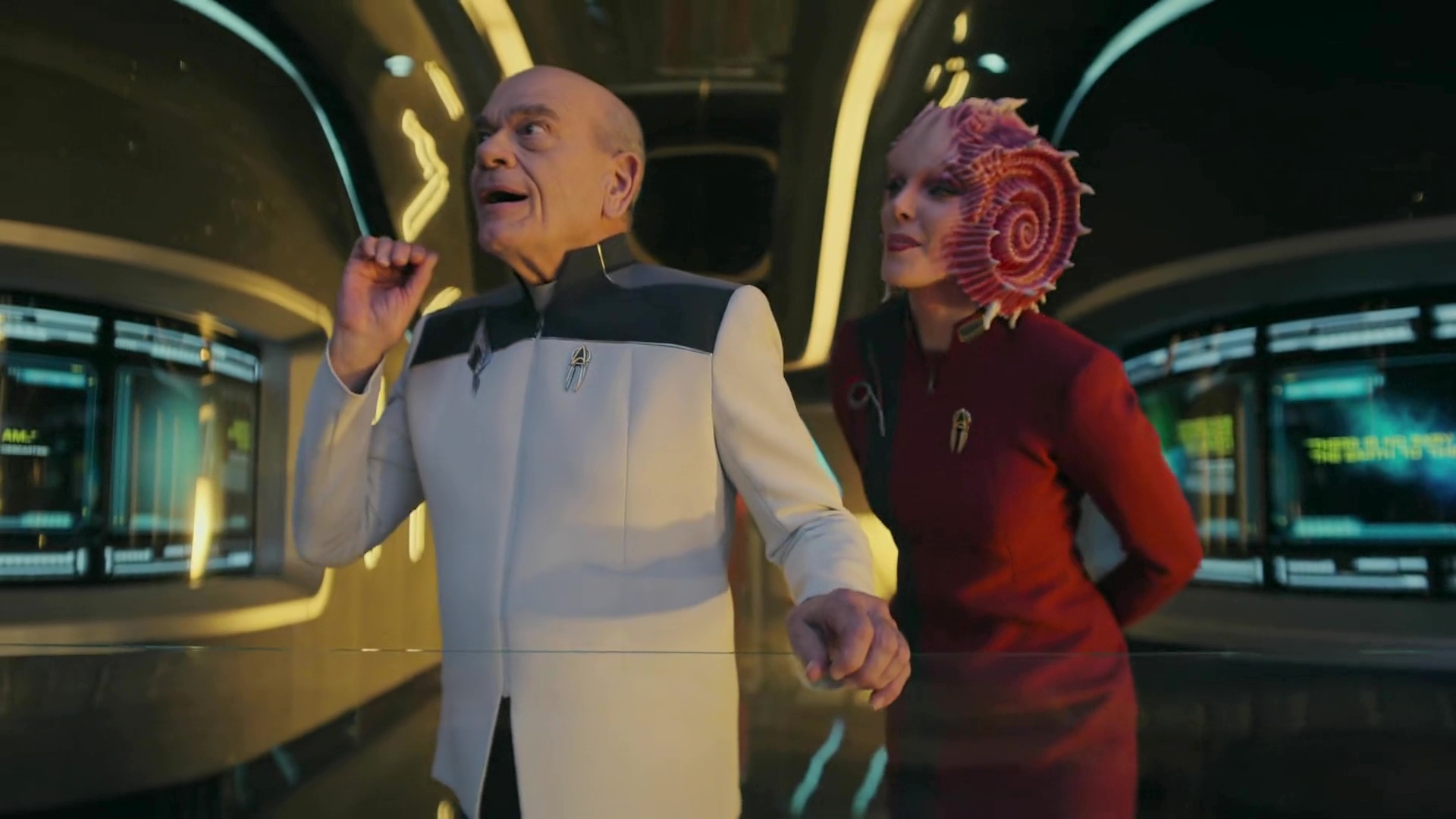
This takes me to the wonderful details. The two arias that the Doctor sings in a duet with the alien officer mirror what is happening at the diplomatic reception below. "Pa-pa-pa" from Mozart's Die Zauberflöte with the line "So liebe Kinderlein" is sung as Ake and Sadal begin to talk about their dear little kids. As they return to the negotiations, the aria "Jetzt, Schätzchen, jetzt sind wir allein" from Fidelio by Beethoven can be heard, which includes the line "Wann wirst du das Jawort mir geben?" (When will you marry me?), and which ends without a conclusion just as President Sadal is leaving.
One outcome of the episode is that the capital of the Federation is moved to Betazed. Some will argue my complaints are nitpicking, but the way it happens compromises the story and even the attempt at 32nd century worldbuilding. First of all, it is far-fetched that Ake gets the idea to offer the seat of government to the Betazoids just because she says "if you stay... we could build something" to Caleb. This is so contrived it would have been better shown as Ake having the idea without anything inspiring her. Furthermore, who has the authority to offer and close such an impactful contract on behalf of the Federation - Ake and Vance? Just a day earlier they both praised democracy in the Federation and affirmed it can only exist with consensus, and now they make swift decisions and ignore all that - with a "deal" like in a Trumpian dystopia. Likewise, President Sadal accepts without asking anyone, and it takes him only a few seconds. It looks very much like he lets his vanity decide, rather than his mind. So this part of the plot falls flat on almost every level.
"Beta Test" shows the full opening credits of Starfleet Academy for the first time. Like in Discovery and Picard, they are visually attractive but without a space theme. The music is possibly the least remarkable composition of any Star Trek titles. It includes notes from Ilia's theme and from the main titles of "Star Trek: The Motion Picture" and "Star Trek: The Wrath of Khan", all of which are among my favorite Star Trek music. But I don't think this homage works except as yet another nostalgia bait, and I also don't think the subdued theme suits the idea of the series.
As I already said, "Beta Test" could have worked very well and could have consolidated a few things with less goofy humor and fewer unnecessary references. But the writers couldn't resist turning life on campus into a joke. There are annoyances that almost ruin it for me, although none of them is meant to be important. I love Jett Reno's lessons and the analogies between the arias and the actual events. The romance is fine, whereas the diplomatic plot starts silly, becomes heavy-handed and ends with an unconvincing resolution. Overall, an episode with the potential for seven points that gets only four.
Annotations
- Continuity:
- SFA continues to use the uncalled-for reboot Ferengi make-up that was introduced in Discovery.
- This is the first live-action appearance of a Brikar - who looks almost exactly like Rok-Tahk on Star Trek Prodigy, without any adaptation of the design for live action.
- There is also an Exocomp cadet or crew member (TNG: "The Quality of Life", LOW).
- The species of the Doctor's duet partner was introduced in "Star Trek Into Darkness" and already appeared as a singer in "Section 31".
- Betazoids so far always had black irises and were telepathic as a general rule (with half-Betazoid Deanna being only empathic).
- Nitpicking:
- The cadets are assigned their quarters after the flight to Earth and after one or two days of courses. Where did they sleep until then? In the cargo bay?
- Why that ugly fence on the beach promenade? Even if keeping the cadets from walking around the perimeter were deemed necessary, there could be more decent barriers in the 32nd century that wouldn't give them the impression of being locked up.
- Why are humpback whales in some sort of fishtank? Or is this the quarters for cetacean crews? And why doesn't Caleb tell Tarima of the whales earlier when she explicitly says she would love to see them?
- Caleb has been on the run for the past 15 years. Hacking may have helped him survive, although it is a thing you don't learn without having access to the technology. But how could he become a genius in temporal mechanics and pretty much everything else?
- After learning that finding his mother is the most important thing in Caleb's life, Tarima accuses him of not being open and of having manipulated her, upon which Caleb gets defensive. But why? He couldn't have known that the planet is behind the psionic barrier and that Tarima can readily locate it.
- Remarkable quotes:
- "One day, you'll all stare death in the face as she stares back. Yes! Death has eyes!" (Lura Thok)
- "I didn't ask your name. I asked who you are. What do you stand for? Have you ever seen a ghost? Made a mixtape? What is the worst birthday present you ever got?" (Jett Reno)
- Remarkable classical music:
- Wolfgang Amadeus Mozart, Die Zauberflöte, KV 620, Act II, "Pa-pa-pa"
- Ludwig van Beethoven, Fidelio, Op. 72, Act I, Scene I, "Jetzt, Schätzchen, jetzt sind wir allein"
- Remarkable appearance: President Sadal is played by Anthony Natale, who is deaf. Hence the sign language, although other Betazoids are able to communicate verbally.
Rating: 4
Vitus Reflux
Synopsis
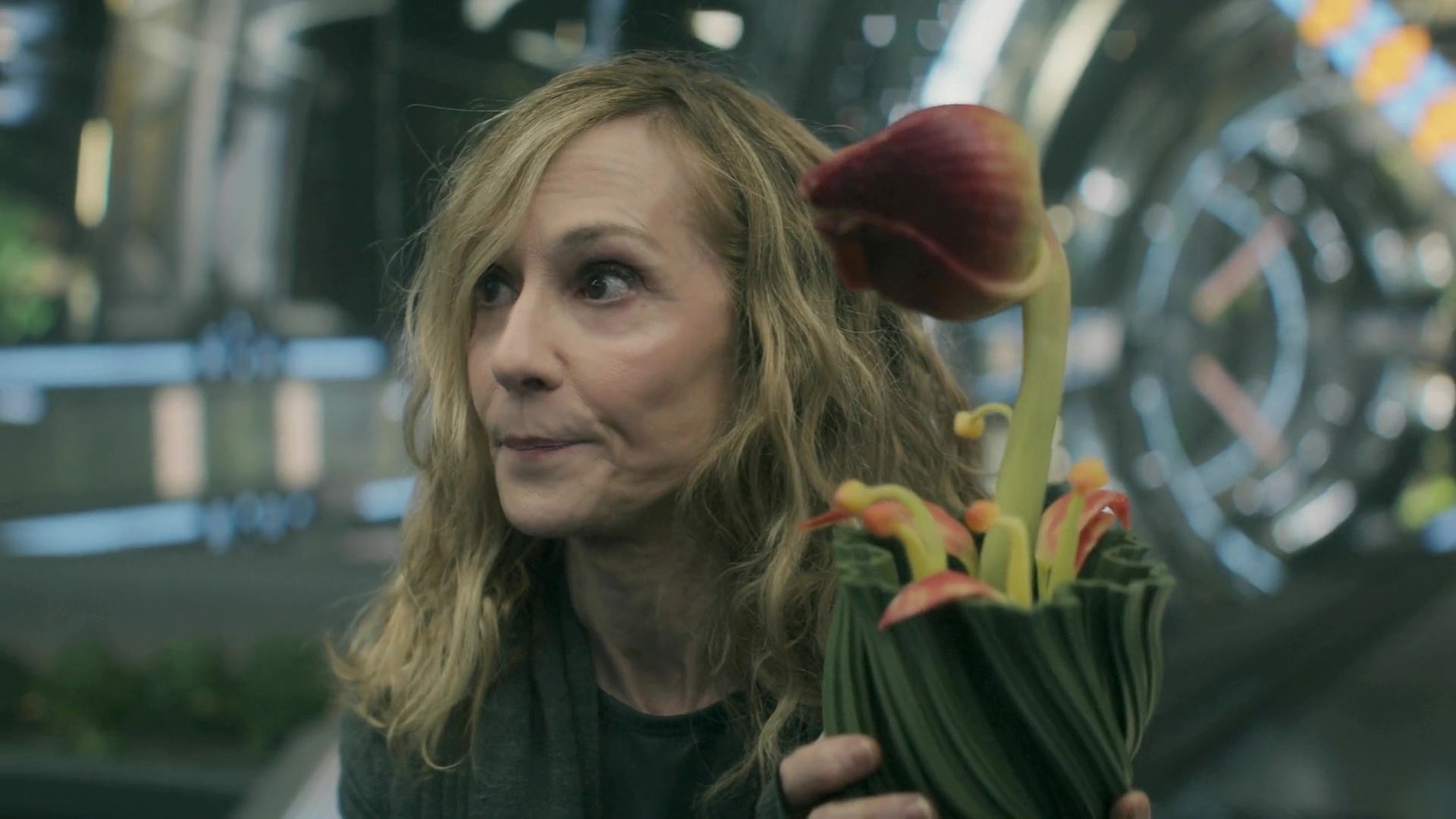
Stardate 868858.7: A group from the neighboring War College pranks Academy cadets by beaming them from the locker room into public spaces. Nahla Ake complains but chooses not to demand a formal apology from Kelrec, the chancellor of the War College. Meanwhile, Darem Reymi and Genesis Lythe compete to become captain of Starfleet Academy's calica team, a combat training sport. A shoot-out decides the winner, and Reymi takes the role. Later, after having been pranked again, the Academy team challenges the War College to an illegal calica match in the Sato Atrium at night. The War College leads three games to one when Reymi is forced out and Lythe steps in. She changes tactics, relying on clever tricks instead of bold attacks, and begins to turn the tide. But the match is discovered, and the Academy cadets are summoned by Ake, who is furious. Lythe, however, realizes Ake had hinted at an alternative way to beat the War College - through a legendary prank. Disguised as the War College's mascot, a Mugato, Caleb sneaks into their quarters, disables security and thereby allows SAM to spread spores of "vitus reflux", a plant-like fungus that they enhanced with a growth accelerant. Tarima senses him. She stops Caleb, tells him she joined the War College to master her mental powers, not because of him, then presses the alarm and kisses him. Because "vitus reflux" is a protected species, Kelrec has no choice but to allow it to grow in the War College. In the end, Caleb learns that Ake herself once pulled off a famous prank when she beamed students onto the roof of Alcatraz - a stunt the War College cadets simply copied.
Review
Starfleet Academy really is a tough case to get into, and to get an opinion on. I watched the first two episodes, I rewatched them, I wrote my reviews, I wrote an additional editorial, I read dozens of other people's takes and hundreds of comments (not to mention the numerous YouTube clickbait titles like "It's a disaster" that I flipped through). In hindsight, especially my second review seems harsh, as it focused on the many nuisances, although the story overall was just fine. It seems I still need time to get accustomed to the format and tone of this new series, and I can only suspect so would the people who decided to write it off immediately.
"Beta Test" probably wasn't so bad after all, also because I now have a new reference. "Vitus Reflux" is the episode that epitomizes everything that I was afraid SFA would be about. It is actually even worse than my apprehensions about esprit de corps, unhealthy competition, inappropriate pranks and superiors with double standards.
The episode starts off as decent. We've got the competition between Genesis and Darem over who gets up earlier for the daily fitness (or should I say: leadership) training. Caleb, on the other hand, doesn't care at all, which strikes me as unrealistic, considering that he is a model athlete, apparently without having to work on it in any form. Anyway, the rivalry between the two ambitious cadets is set up nicely, and (as became visible as early as the pilot episode) I think it once again confirms that they are much more alike than they admit. Specifically, the two compete for the position of captain of the calica team. We don't know yet at this point what calica actually is. In any case, it's some sort of team sport.
Then there's the first prank, the one that the War College students play on our Academy cadets by beaming them from the locker room into public places, almost naked (or completely naked, in Caleb's case). This would have been amusing as a one-off joke. Still, I don't think it is a great prank for the 32nd century, a full 1000 years(!) after the invention of the transporter. Anyway, it still works for now, and it made me chuckle.
After the opening credits, however, the whole story falls apart - fast and radically. Although the general tone remains funny, several moments cross a line and become absurd or inappropriate. Others are simply tedious, like Nahla Ake's riddle-laden monologues and the dull shooting game with its strange rules. The competition between the two schools and between our two ambitious cadets serves as a guiding thread. But the story lacks relevance. It is all about rivalry, vanity and adolescent egos, without any depth or further implications, without character growth. On the contrary, we learn in the end that pulling the best prank is important, just like being the team captain. I'm not kidding, that's the take-away.
There are so many parts of the story that are off to me that I don't even know where to start. Take Jett Reno. I praised the character last week, saying that she dealt very well with someone not being interested in her class. She now acts as Lura Thok's co-coach, although Reno is the last person I would associate with overseeing sports or battle drills. She lampshades this with the words "I'm a nerd/jock hybrid", obviously because no one came up with a better rationale to involve her. Then there's the cringey argument between the two women about French/Klingon cuisine. The writers were preoccupied with casually establishing that they are a couple, which they managed at the expense of the rest of their lines being cheesy.
Oh, and speaking of Klingon culture, it looks like the writers didn't have an idea of what to do with the pacifist Jay-Den either, in a story that is all about conflicts, rehearsing for conflicts, and getting into more conflicts in the process. So he approaches the rivals from the War College to tell them two Klingon jokes, of which the first one is so bad that no one would ever want to hear the second one. Yes, the socially awkward guy who makes an idiot of himself for our amusement is a common stereotype of YA shows - but even scenes that are embarrassing for a character by design can be written and directed without coming across as pure cringe.
The fungus that looks like a plant from a comic and talks like a parrot is the kind of silliness that might have worked as a small joke on Lower Decks. But as we can already tell from the fact that the episode is named after it, it plays a far greater role than it should in a series that wants to be taken seriously. I already mentioned it, SFA also has a problem with naming, and the idiotic pseudo-Latin "vitus reflux" is a new low point. It almost hurts every time I hear, read or write it. Please, consult someone who knows either Latin or Linnaean taxonomy (preferably both) next time, and don't make up such a crap!
"Vitus reflux" is also known as the "empathy flower", and Ake mentions "empathy" no fewer than ten times in the episode. Of course, like "patience" and "growth", this is part of her encrypted message to the cadets to use the fungus as a weapon against their enemies from the War College. The idea that someone non-telepathic (Genesis in this case) could find out what she wants to tell is so awfully far-fetched it fails as a plot point and shatters the credibility of the whole story. Also, if it was additionally meant to be ironic to mention empathy, patience and growth frequently in a story that is about (and sort of promotes) the opposite, it doesn't work for me.
As in the past two episodes, Genesis initially comes across as someone who values balance and would rather mediate than fight things out. I like that aspect about her. But it is foreseeable that she would change over the course of her rivalry with Darem Reymi, after failing to beat him. And she essentially makes a U-turn. During the calica match with the War College, she takes over and cheats on a massive scale, rather than trying to win by the rules. SAM says it is according to the rules that she may make herself permeable so no one can hit her, which is a stretch. But even if we accept that, destroying replicators and creating a fake mascot as a bait is certainly not permissible and should have ended in disqualification in any realistic scenario! It was probably the intention to show Lythe as unconventional and more Starfleet-like in contrast to the War College students, who simply shoot their way through because that's what the game is about. What she did was probably meant to look a bit Kirk-like. This is also mirrored in the totally inappropriate line by Ake at the end of the episode, in which she praises the prank and tells Caleb what Starfleet should be about - but more on that later. Anyway, it is also Lythe who comes up with the idea of the prank that goes way too far, although Ake planted the seed.
Regarding Darem Reymi, after losing his captain position to Lythe and being understandably sulky, he thinks he owes her an apology. Honestly, I don't even think he would have had to apologize. It would have been enough to admit that she won (albeit through recklessness) and to pledge allegiance. But never mind, he starts what sounds like an apology - except that it isn't one. Instead, it's a pretext: "Oh, I was so competitive, and I was so envious when I lost to you. This is because my parents pushed me too hard, and I had that one traumatic experience when I was a kid." Star Trek Discovery had a similarly unfitting and badly timed justification for wrong behavior in DIS: "Stormy Weather", when Owosekun explained to Saru that her failure to obey orders was rooted in her childhood. It isn't quite as absurd here in SFA, but it's the same kind of inept writing that turns a simple conflict, which could have been resolved with a simple "sorry", into a verbose exploration of old wounds that no one would realistically want to hear about during a turbolift ride.
One final note on the competition for the team captain's position. It is decided in a shoot-out, oddly before we even learn what a normal game of calica looks like. This simply doesn't feel right. Calica is supposed to be a team sport, right? It is about surviving in real combat, about protecting yourself but also covering your teammates. A mere shoot-out just doesn't do it justice. Maybe the later realization that calica, by the rules, isn't such a great game anyway is supposed to call the selection of Reymi as captain into question. But it should have been made clear from the start that it's not about who is the best shooter, but who is the best leader. And honestly, neither Reymi nor Lythe come across as particularly strong leaders anyway in light of all the problems discussed above and below. None of them really grows, they simply stake their claims.
But let me finally address the elephant in the room. I already mentioned the big prank. I already mentioned the silly plant fungus. The cadets spread the spores inside War College, together with a growth accelerant. It then grows to an enormous size and expels the cadets from their quarters. Is this funny? Depends on whether you're outside or inside. Is it original? Perhaps, at least more so than beaming rivals from one place to another. But is it ethical? A few cadets get injured if I'm not mistaken. We also learn that "vitus reflux" (this name really hurts my stomach) is a protected species and therefore can't be removed. At that point, it's no longer a prank; it is clearly sabotage. I am also quite sure that if there are laws against cutting down or killing this precious species (and perhaps even sentient, wasn't there something about empathy?), it is also not allowed to manipulate it to grow to monstrous, unnatural sizes. Sorry, this prank isn't funny at all once we consider the consequences that realistically should have followed. The worst part is that everyone seems cool with it. For some reason, Kelrec doesn't seem to mind that his cadets were attacked, that his War College is now uninhabitable and that he makes a terrible impression on the Oversight Committee. Ake doesn't mind that her students committed a crime (if we are honest). Of course, the real reason she approves is that they paid back the War College for stealing her beaming prank. Everything is glossed over in this forced happy ending (in which the fungus lived happily ever after?). Ake even says a bit later, referring to what the cadets did, "That's what Starfleet needs to do again" - sabotage and messing around with endangered species? This is completely out of line. I need to stop thinking about this writing failure; it just makes me angry.
There is one more scene that bothers me enormously, which probably isn't an accident or oversight, but a deliberate creative decision. The Starfleet Academy promotion video, in how it looks and sounds and in how it is presented on campus, is eerily similar to the clips in "Starship Troopers", the dystopian and satirical film based on the novel by Robert Heinlein, which is decidedly anti-Trek. I am quite sure the people who made this episode were aware of this and thought it would be a great reference. It isn't.
I have to admit parts of "Vitus Reflux" are humorous. It does include a couple of nice jokes and funny situations, such as the "culturally sensitive moment" when Darem hugs Kelrec in a "Khionian apology ritual" to get a DNA sample. Let me give you one more example, because not everything is bad. I like the awkwardness of the situation when Ake calls the cadets to her office after the illegal calica match. She is in her pajamas, and Ocam is still in his lapling costume and repeatedly scratches his leg until she tells him to stop because it makes her nervous. This is the kind of humor I want to see more of - humor that feels natural (or naturally weird, in this case). Well, it could have been even better if Ake hadn't put her bare feet on the table on about half a dozen other occasions in this episode. I enjoyed her signature move in the first two episodes, but it is getting on my nerves by now. It is a bit like having six Riker maneuvers in every single TNG episode.
One other scene that I like comes to my mind. When the mugato mascot storms out of the War College quarters, Tarima can sense it's Caleb (who has sabotaged the security for the prank). A wonderful exchange unfolds that remains serious despite his silly costume. Compared to what else happens at the Academy, their romance is unusually mature.
I started this review by looking back at "Beta Test", which I now see differently. That may not happen with "Vitus Reflux", because it is not a good story that I failed to appreciate due to anger over details. It is a narrative that is fundamentally flawed because of its focus on petty rivalries and, worse, because of its reprehensible moral that it is acceptable, even cool, to destroy replicators or entire buildings as long as you are on the supposedly "morally superior" team. With no one embodying this more clearly than Chancellor Nahla Ake herself. She turns out to be the most prominent proponent of this recklessness, driven by nothing more than wounded vanity.
I already mentioned the numerous YouTubers who have decided that Starfleet Academy sucks (usually before it even aired) and who make money by preaching this view to the masses. I hope I have also made it clear that I do not agree with them. This episode provides them with plenty of ammunition, but I still believe it is not symptomatic of the show and merely a one-time misfire.
Annotations
- Continuity: The lapling (mascot of Starfleet Academy) first appeared in Kivas Fajo's collection in TNG: "The Most Toys", the Mugato (of War College), of course, in TOS: "A Private Little War".
- Nitpicking: "Vitus reflux" is neither correct biological taxonomy nor even grammatically correct Latin.
- Remarkable backstory: Darem Reymi used to play the Bajoran belaklavion as a kid. One day, he was playing on a stage, with his parents sitting in the front row. He missed a note, and they left before he was finished.
- Remarkable absence: The Doctor does not appear in this episode.
- Dedication: The end credits begin with a card honoring Carla Mingiardi, who worked in the costume department for Discovery and died of cancer on 9 September 2024.
Rating: 1
Vox in Excelso
Synopsis
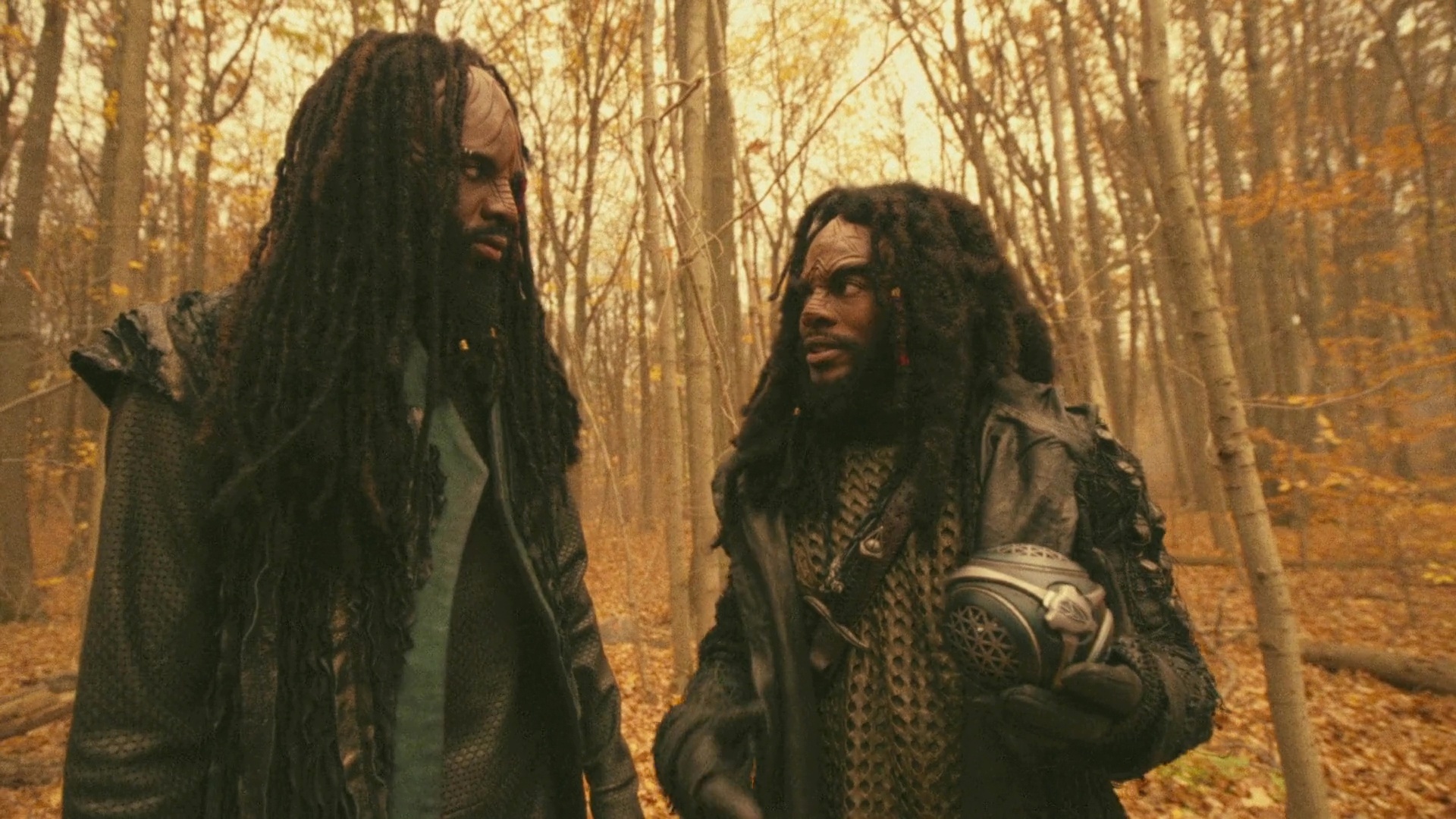
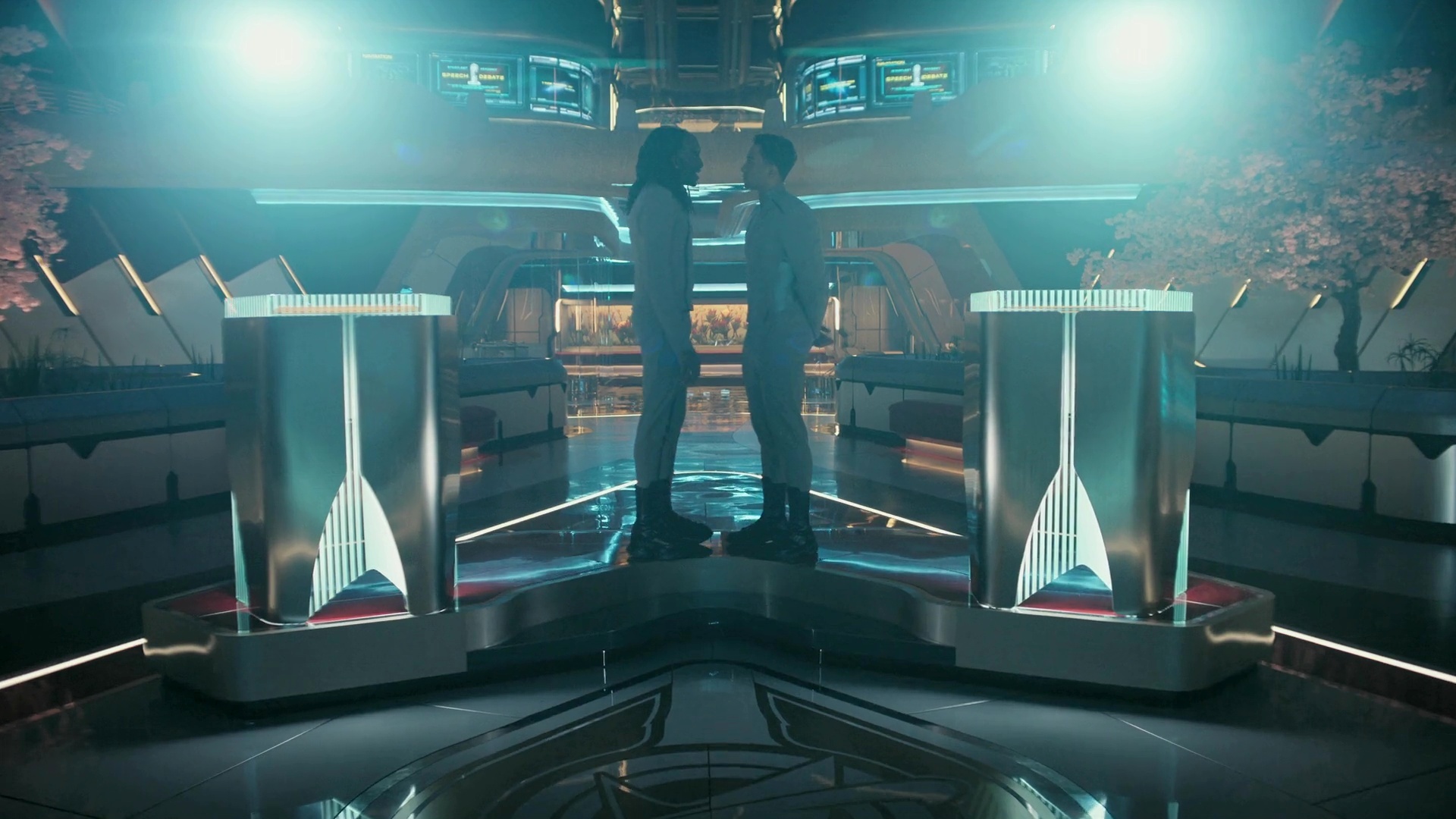
Stardate 868943.8: As the USS Athena is about to leave for the first official space mission, the cadets rehearse for the debate competition under the Doctor's supervision. Jay-Den Kraag is too nervous to speak in public and has to pass. News arrives that a Klingon transport carrying Jay-Den's family has crashed on the way to a refugee camp. Qo'noS had become uninhabitable when the dilithium reactors exploded in the Burn. Jay-Den remembers how his family refused to accept that he didn't want to become a warrior, and how only his brother Thar understood him. Thar, however, was killed while trying to acquire an outlawed Federation dermal regenerator for him. Jay-Den later disappointed his father by refusing to shoot a bird in a rite of passage, after which his father missed his own shot. All this weighs heavily on him, but he insists on switching the debate topic to the Klingon refugee crisis, and the Doctor grudgingly agrees. The Federation may have a solution in the form of the planet Faan Alpha, which could become a new home for the Klingons. But Obel Wochak, who happens to be an old acquaintance of Nahla Ake, refuses on behalf of the houses. Darem shows Jay-Den a Khionian breathing technique to help him hold up under pressure. Still, when he argues against Caleb's position that the Federation should help the Klingons, he gets personal and emotional, leading to a clash that gets both of them disqualified. Lura Thok talks to Jay-Den and helps him consider that maybe his father wanted to set him free, to allow him to go his own way. With new confidence that he is a true Klingon after all, Jay-Den argues that only a Klingon solution can help the Klingons. The Athena and other starships set course for Faan Alpha, where they declare that Klingon trespassers into Federation territory will be regarded as enemies. A Klingon fleet arrives and opens fire, even though they are no match for Starfleet. When the Starfleet ships retreat, the Klingons claim victory and take the planet for themselves. Obel Wochak is satisfied with this outcome, and he has a surprise for Jay-Den: His family is alive. Jay-Den and Caleb apologize to each other.
Review
The first thing to notice about "Vox in Excelso" is that a lot happens in flashbacks and narration, and rather little in the here and now. In particular, a massive chain of disasters unfolds in Jay-Den's backstory. We learn that the Klingon homeworld became uninhabitable as a result of the Burn, that his people were scattered across the galaxy and forced to live in miserable refugee camps, that his family rejected his non-violent way of living, that his brother (the only one who understood him) was killed (and while trying to support Jay-Den's wishes, no less), that his father abandoned him when he refused to shoot a bird as an initiation ritual. That's a lot of traumatic experiences. And as if all of this weren't enough, Jay-Den is informed that his family is missing after their transport crashed. Oh, and even before he hears about that latest disaster, he breaks down at the debater's desk because he's afraid of public speaking, which seems unrelated to everything else. Talk about total traumatic overkill for our Klingon bird watcher.
All of the Klingon tragedy and Jay-Den's personal tragedy is only mentioned or (in the better cases) shown in flashbacks. I like how his former life in the wilderness is visualized, with a family that has lost everything and clings to what they consider traditional values more than ever, without the technology he would love to have but that they deem un-Klingon. The idea that his brother died trying to get a Federation device for Jay-Den, and that this exact regenerator could have saved him, is heartbreaking. But it still feels disconnected from what happens here and now at the Academy. Jay-Den's emotional state comes across as a mix of depression and defiance. It is hard to tell which of his many issues weighs on him the most. Is it the fate of his people? At least that's what he says when he demands the debate topic be switched to the Klingon refugee crisis. Is it his personal experience of not being accepted for who he is, losing his beloved brother and eventually being abandoned by his family - who are now missing? Of course - who wouldn't understand that. With so much emotional baggage, it's only natural that Jay-Den himself doesn't know which part hurts the most. Still, I would have liked the finer details to be worked out. Either that, or the sheer amount of tragedy should have been reduced to be more manageable. Wouldn't it have been enough if Jay-Den had simply been estranged from his family? Or if the Klingons were in trouble, but his family supported his decision to leave for Starfleet? But the most contrived and anticlimactic part of the story is that the Kraag family is casually said to have survived without appearing in person, which raises the question why they had to go missing in the first place.
Another aspect of Jay-Den's emotional state is that he doesn't accept help (and definitely doesn't want pity). This too is understandable. But it adds yet another layer to his trauma that the story doesn't handle all that well. Somehow everything in the present results in our Klingon being even more sad or sulky. Actor Karim Diané conveys this consistently, and his performance feels somewhat one-dimensional. Most notably, Jay-Den has a falling out with Caleb, who offers to team up with him (and thereby cover for his weakness), which Jay-Den interprets as pity. Darem, of all people, helps him cope with his public speaking problem using the Khionian breathing technique, actually addressing the issue (or at least one of the many issues). That is one of the few moments I genuinely liked, although it felt weird how they stood nose to nose.
The interactions with other characters don't work so well for me. Caleb has gone from totally renitent underdog to Cadet Perfect, who is ambitious yet considerate and who knows and does everything better. Now we learn that he's also a master debater, which raises the question of where he could have possibly learned that - in which hideout or prison. Sorry, I don't buy it, especially since Caleb has this ability for the sole plot-driven reason of being vastly superior to Jay-Den in this regard and coming across as patronizing when he offers his help. I also don't like this framing because when Jay-Den later clashes with Caleb, it is probably supposed to look like the latter is being smug, although he simply has the better arguments. Also, it is Jay-Den who gets emotional three times before Caleb loses patience with his opponent.
The enlightenment Lura Thok provides for our Klingon isn't convincing either. Her suggestion that his father may have abandoned him out of love to give him freedom, rather than because he was a shame to the family, is just bad speculation. Which brings me back to the possible closure that is not happening: if his father survived, Jay-Den may ask him. Anyway, after talking with Lura Thok, Jay-Den sort of makes peace with his family, feels like a true Klingon maybe for the first time in his life, has an idea how to help his people the Klingon way and feels ready to address it in the still ongoing debate. He doesn't need time to let anything sink in - he only needs three seconds to say "Get me back on that debate stage!" Because apparently that solved Jay-Den's problems with, well, everything?
Let me comment a bit more on the Klingon crisis. It is lame. Their homeworld was already devastated in "Star Trek: The Undiscovered Country" but most likely recovered. In a similar vein, Romulus was destroyed, plus Vulcan in the Kelvin Timeline. The Burn as the ultimate galactic apocalypse may excuse a lot in-universe, also considering that Klingons so far were absent from the 32nd century for real-world reasons. However, planetary disasters are overused as plot devices in modern Trek - especially with the extra emotional impact of destroying worlds we already know instead of random planets of the week. As much as Starfleet Academy is about honoring the past and rebuilding after the Burn, it also seems very willing to destroy what we love.
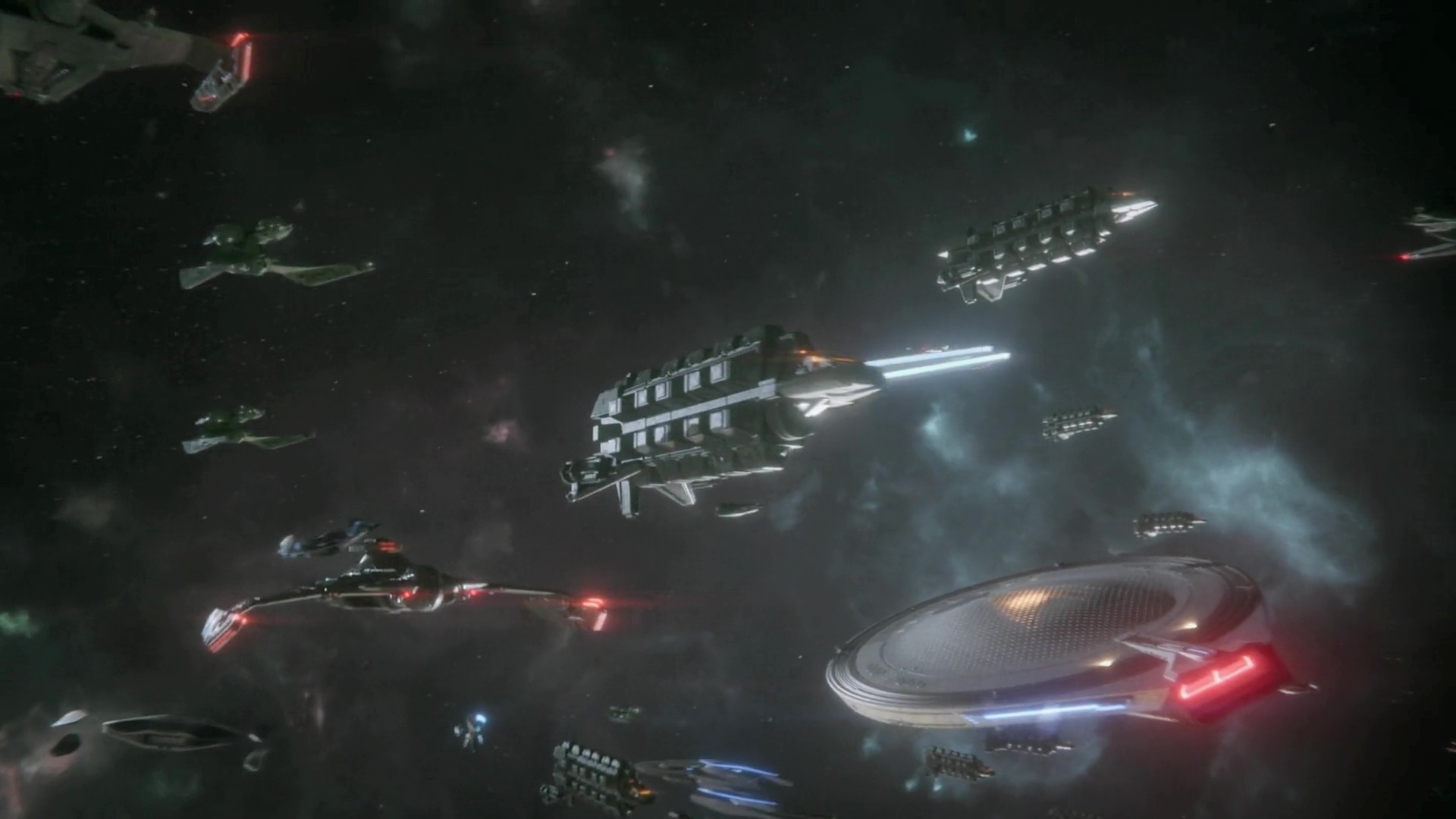
It is also contrived that the "Klingon solution" is essentially to stage a fake battle - a show to make the Klingons feel like they won, even though their forces were inferior. I can see how it mirrors Lura Thok encouraging Jay-Den. She gave him an option that might not hold up to scrutiny just to give him confidence. But Klingon ships have tactical sensors, and those in charge aren't idiots. They should have recognized the ruse. They should have realized the victory wasn't honorable. Also, didn't we just have a similar diplomatic trick, giving the other side what they want but never dared to ask, in "Beta Test"? But hey, it works in a story that is much more about Jay-Den than about other Klingons. And after very little happening for as long as 50 minutes, at least we get a satisfying finale that brings the A-plot and B-plot together.
On a final critical note, I have a problem with the language used at Starfleet Academy. And no, I don't mean the occasional swear words that seem to trigger many old-school fans. I take issue with disrespectful designations like calling cadets "zygotes" or "a twinkle in your father's pants". At one point, the Doctor justifies his use of the word "chickenshit" to a cadet, silencing the justified complaint by insisting that his age entitles him to speak that way. I don't know whether there's a layer of irony I'm missing, but this condescension is so 19th century. Not 24th century.
"Vox in Excelso" is about debates. It's accordingly verbose. It's even more about Jay-Den's backstory, which, as already mentioned, overshadows present events. I like that his character gets explored, but I feel it should have been done with half as much tragedy or less. And although the story isn't as sharp for these reasons, I'm glad that Jay-Den shows growth as a character. I don't care much for the B-plot. The Klingon tragedy is handled too superficially and Obel Wochak, Ake's old acquaintance, is likable but inefficient as a guest character. But I like how the conflict gets resolved the Star Trek way. All in all, "Vox in Excelso" is hardly average compared with similar debate- or diplomacy-heavy Trek stories. It's also less fun and requires more patience than the previous three episodes (assuming that "Vitus Reflux" was supposed to be funny). At least this time the title is correct Latin.
Annotations
- Continuity:
- The debate competition is named for Aaron Satie, and Satie's words "With the first link, the chain is forged" that the Doctor quotes were famously spoken by Picard in TNG: "The Drumhead".
- Jay-Den's family finds temporary refuge on Krios Prime, which was a Klingon colony in TNG: "The Mind's Eye", although TNG: "The Perfect Mate" and ENT: "Precious Cargo" tell a somewhat different story.
- It looks like the Klingons have adopted last names instead of the former "Worf, Son of Mogh" pattern.
- Nitpicking: The Doctor actually says: "With the first link, the chain is forged. The first speech censured, the first thought forbidden, us all, irrevocably." This doesn't make sense. He leaves out the part "...the first freedom denied, chains us all, irrevocably".
- Remarkable quotes:
- "We all want to punch Caleb in the face. Even Caleb wants to punch himself in the face. It's a core tenet of his personality." (Darem Reymi)
- "Your destiny, little brother, it is not here. It is out there in the stars." (Thar Kraag)
- Remarkable ships: The battle sequence shows familiar Klingon freighter designs, which would be over 800 years old by then...
- Remarkable absence: Jett Reno does not appear in this episode.
Rating: 3
Series Acclimation Mil
Synopsis
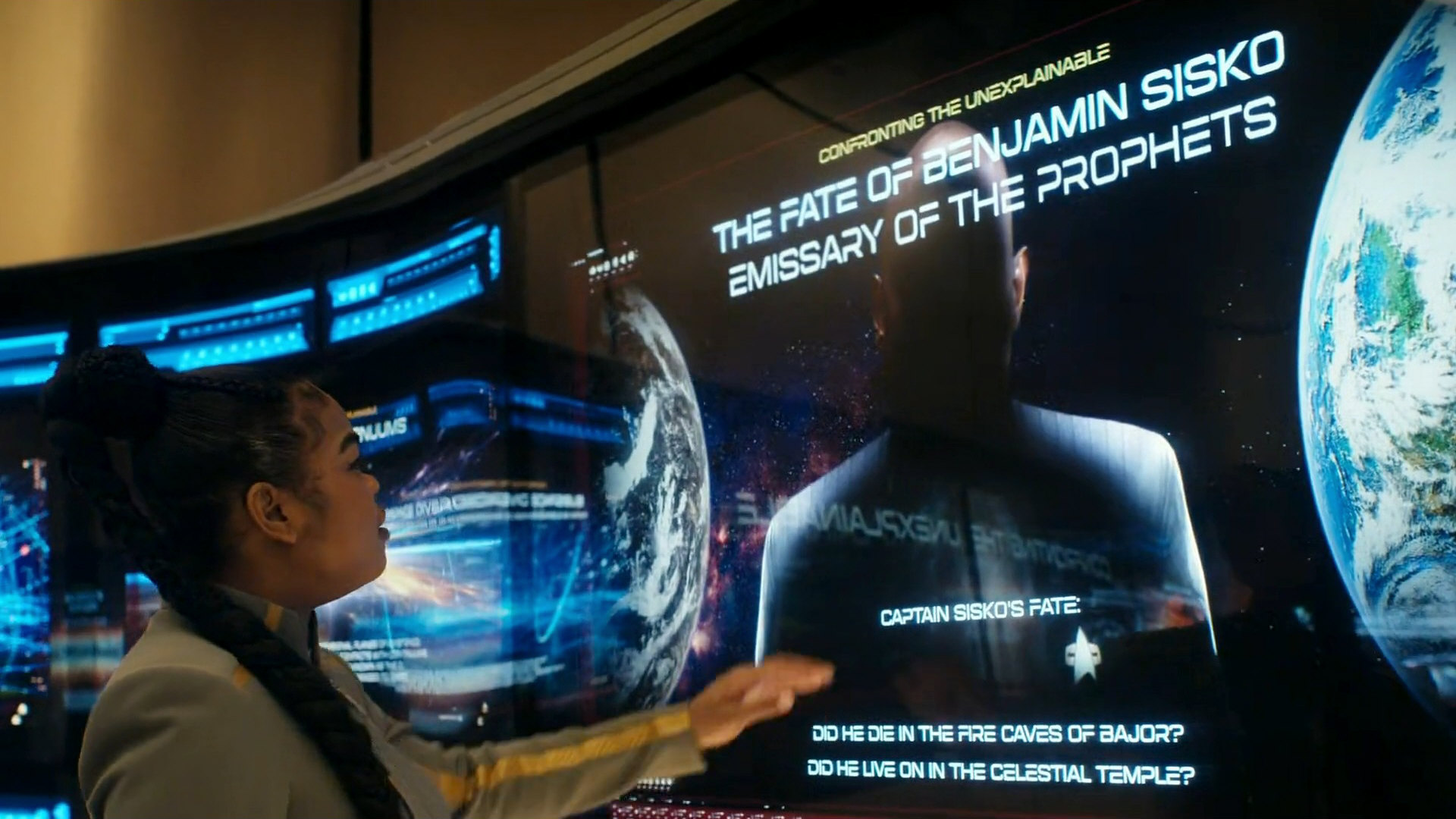
Series Acclimation Mil aka SAM receives new instructions from the Makers, the photonic civilization that created her to understand organics. They are unhappy with her progress and threaten to pull her out of the Academy. Instead of spending time on music courses, they order her to enroll in the seminar called "Confronting the Unexplainable". SAM reluctantly agrees. When she is about to choose a subject, she comes across the mystery of Benjamin Sisko, who vanished in the Bajoran Fire Caves and was never seen again. This catches her attention because he too was an emissary, sent to the Bajorans by the Prophets. She studies Sisko's history and talks with Bajoran students and with Nahla Ake, but she doesn't make progress in solving the mystery. Meanwhile, Ake teams up with Kelrec, who is desperate to perform a ritual correctly for Chancellor Amal from Alpherat, hoping to secure a strategic alliance with her. Caleb tries to modify SAM's program so she could taste Creole food like Sisko used to cook, but fails. Instead, he figures out how she can experience the effects of alcohol, which leads to her starting a fight with other cadets in a bar. As the semester nears its end and SAM is about to fail the course, her teacher gives her the book Anslem by Jake Sisko, along with a holographic version of Jake. Through this, SAM finally gains the insight she was searching for. She realizes that Ben Sisko's life, like her own, was predetermined, but he still made the best of it. In the end, her teacher reveals that she is the host of the Dax symbiont.
Review
The access media received the first six episodes of SFA in advance. They seemed to agree that the fifth one, "Series Acclimation Mil" co-written by Tawny Newsome, was the best of the bunch. Without giving away any spoilers, they mentioned it would appeal to old-school fans. The episode trailer revealed that it's about solving the riddle of Benjamin Sisko's disappearance in DS9: "What You Leave Behind." For me, that idea was unsettling instead of exciting. I gave Newsome the benefit of the doubt that she would handle the legacy that we love with respect. Yet, isn't it better to leave some questions unanswered? In Sisko's case, there was a lot of speculation, even playfully referenced in LOW: "Reflections". We never knew whether he returned from the Celestial Temple, which he could have done at any time given the Prophets' non-linear existence. But did we really want to know? Did we want the confirmation that Sisko abandoned his family? I didn't. The DS9 finale worked fine as it was. Back in the day, I would have wanted Sisko to return in a movie or a real sequel, with Avery Brooks playing him - not for the exploitation of the legacy, and especially not in light of recent fever dreams like SNW: "Wedding Bell Blues". Those were my thoughts when I sat down to watch the episode.
I just watched "Series Acclimation Mil". First things first, it's okay for me to learn that Sisko never returned. I would have preferred it not to be disclosed, but the story handles his fate and the aftermath with decency for the most part. I was delighted to see Cirroc Lofton appear as Jake Sisko and tell the story from his perspective, and to hear Avery Brooks speak the end narration. Their appearances made my legacy Trek heart jump for a moment. Aside from its nostalgic moments, the episode provides very little substance, however.
It is both a blessing and a curse that the exploration of what exactly happened to our captain remains cursory. On one hand, I wouldn't have wanted to know more. On the other hand, it's anticlimactic that SAM explicitly sets out to solve the case and learns nothing new. Her teacher tells her, "You are not going to solve this mystery with facts alone", which seems to mean the task isn't to find Sisko but to understand him. I get that. I also get that all the talk about gumbo and tomatoes is symbolic rather than something that really matters in SAM's research. In the end, SAM arguably learns more about herself than about Sisko's fate, as already foreshadowed in the episode title. That's fine, but the Sisko connection feels like an unnecessary add-on to a legacy storyline, much like DIS: "Unification III". What's worse, the attempt to frame their destinies as intertwined is pretentious, since Sisko is a revered legend, with whom SAM has nothing in common beyond a contrived narrative link - unless we evoke destiny. It is also too verbose, falling into Discovery-style buzzword bingo: feelings, love, connection. At some point, the statements become repetitive and don't go deeper than that. The episode is almost an hour long. Shorter would have been better.
It have to admit it is heartwarming how Jake helps SAM understand she can make the best of her life based on his dad's example, defying her Makers' stance "What you feel is irrelevant to your mission". But he is only an interactive hologram. And even if he is some vision created for her by his father (I hope that's not true because that would be the ultimate pretension!), how can he tell SAM that she is amazing and that she is fit for her job without knowing her? Well, apparently he doesn't need to. She's special, as the narrative keeps reminding us. And nowadays, being special or simply being yourself is treated as the ultimate qualification. That's all it takes. But sarcasm aside, giving her self-confidence is the core idea, which only gets watered down by the verbosity and by other events and twists. The revelation of SAM's teacher, played by Tawny Newsome herself, as the Dax symbiont is another aspect that almost feels like hubris. In any case, it is a contrived instance of small universe syndrome that hurts the credibility of the story. I don't think the narrow-minded Makers who wanted SAM to take the course were foresighted enough to plan for her to choose the Sisko topic and meet the only person alive who still remembers him. Yet, I just don't want to believe that it is SAM's destiny to meet Dax, by virtue of the Prophets. That part of the story and its possible implications don't work for me at all. Even if Illa Dax is supposed to become a series regular, she could have been introduced in a more believable way.
One afterthought about the SAM/Sisko connection: SAM finds a personal hero in Sisko based on the superficial commonality that they are both emissaries. Fortunately it deepens a bit as the story goes on. Conversely, the one person who is most like SAM and whom she admired in "Kids These Days" hasn't interacted much with her since then. If I'm not mistaken, he doesn't enjoy her presence and treats her with even less respect than he shows the other cadets (if that's possible). It may be interesting to see where this goes in the series, but for now grumpy doc doesn't leave a good impression. With a few exceptions, he was far less conceited when he was 800 years younger.
I wrote in my review of "Vitus Reflux" that the story stumbled from one embarrassing or annoying situation into another. Unfortunately, that's true for "Series Acclimation Mil" as well. SAM's Tik Tok-style intro with intentionally childlike graphics is still fun, and I don't mind if SFA uses stylistic devices like this now and then. I also don't mind that Khionians can't digest bananas and vomit glitter. These are silly jokes that are successful in the scope of the show if not overdone.
One kind of humor that really bothers me is drunk jokes. It worked in "First Contact" with Deanna because she could handle it and the situation remained playful overall. It doesn't work when people get intoxicated, make fools of themselves or become aggressive, especially if they are young and inexperienced. Even though SAM is only programmed to be drunk, the effect in the narrative is the same - especially for the cadets she beats up! Sorry, not funny. And speaking of her programming, I wonder if Caleb couldn't have done it without making her violent. I also don't understand why he doesn't help the tattooed person SAM throws out of the bar, who must be injured. "Probably not our business?" Seriously? Not my humor at all. On another note, the whole bar thing feels disconnected from the rest anyway and serves no purpose in the story. It starts with some cadets not even knowing there is a cadet bar. They've been hanging out together for months or are roommates, but no one mentions the bar if it's supposed to be so cool?
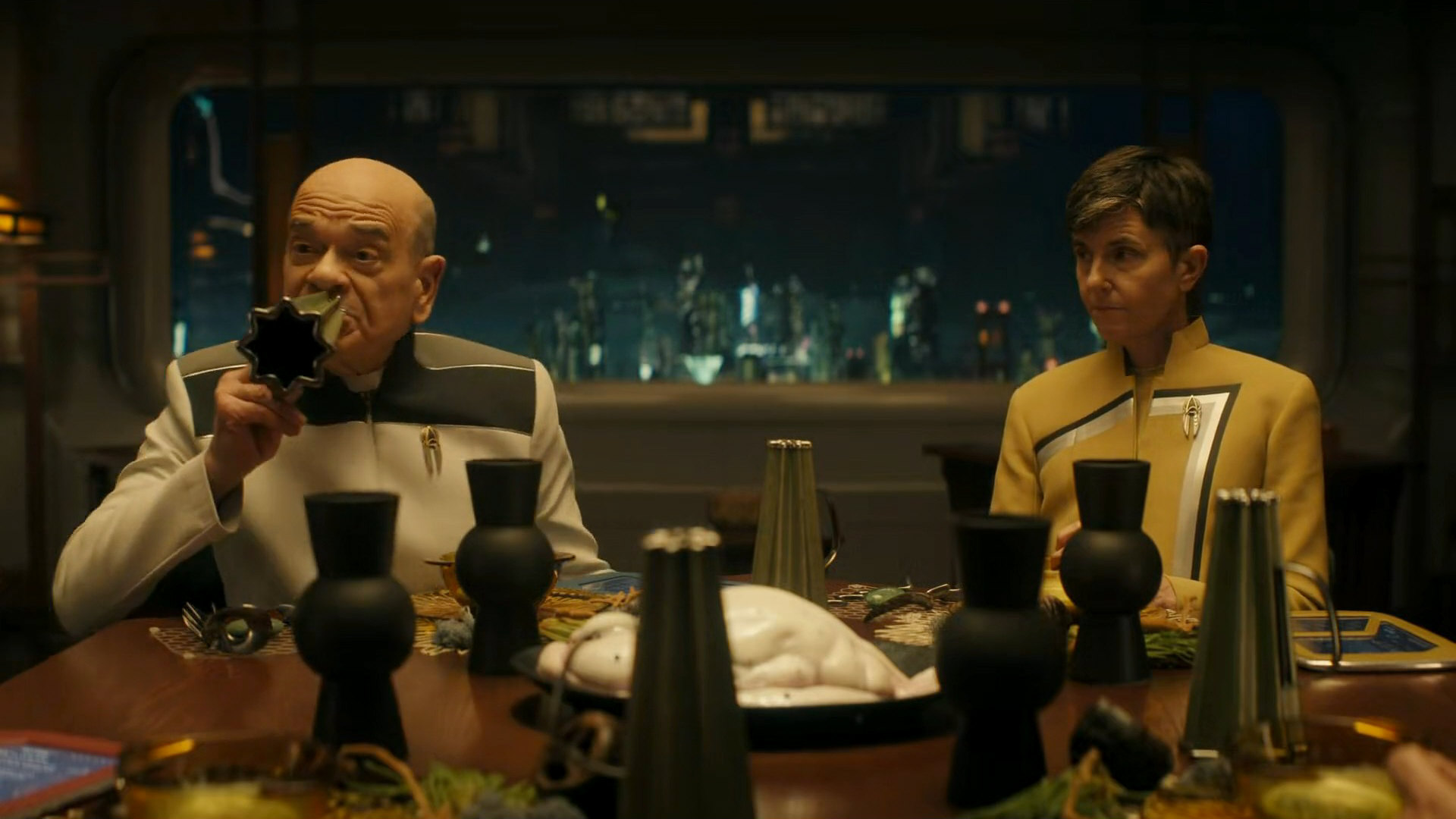
There are other attempts at humor that just don't land. But the worst annoyance in the episode is Ake and Kelrec's preparation for the ceremony with Chancellor Amal, together with the Doctor and Jett Reno. Classic Trek had awkward situations too, but this one is played out excessively and yet doesn't get resolved at all. Maybe Amal will appear in the next episode, but there's not the slightest reward or punchline in "Series Acclimation Mil". I'm not sure I even want this farce to continue and see how they handle the actual guests (and their eels).
The controversy about Starfleet Academy is ongoing. Although the access media were several weeks ahead, the detractors are the loudest group. Well, some simply decided SFA was bad even before the first episode. Still, I agree with a couple of of their points. The series isn't just hit and miss in the first five episodes. There are issues all of them share: childish characters, tasteless humor, cringey situations, meaningless verbosity, a lack of focus on relevant themes. Not all of this can be excused by the series being new or aimed at a younger generation of fans. So if I'm asked whether SFA is the worst Trek series, based on what I've seen so far, I have to say yes.
Annotations
- Continuity:
- Jake Sisko's book Anslem was first mentioned in the parallel timeline in DS9: "The Visitor".
- The Doctor says that Lewis Zimmerman once met Ben Sisko, which happened in DS9: "Dr. Bashir, I Presume?".
- The bar named The Launching Pad (now: The Academy) was the one where Cadet Solok studied "illogical human bonding rituals", as mentioned in DS9: "Take me Out to the Holosuite".
- Ben Sisko vanished in the Fire Caves in DS9: "What You Leave Behind", but he appeared to Kasidy in a vision, telling her he may return some day.
- Nitpicking:
- A Bajoran grabs SAM's ear and says her pagh is strong. He must be lying because I doubt pagh is part of her program.
- SAM opens a Bajoran Orb, which is said to be one of the original Orbs and begins to talk to Sisko. But it is a holographic version. Does she really expect to connect with Sisko as a hologram touching another hologram?
- Remarkable quote: "Divine laws are simpler than human ones, which is why it takes a lifetime to be able to understand them. Only love can understand them. Only love can interpret these words as they were meant to be interpreted." (Benjamin Sisko)
- Remarkable facts:
- In the last 1000 years, the Federation has encountered 4633 sentient species and over 37 trillion individuals.
- Khionians produce large amounts of polyphenol oxidase, causing high-potassium foods (like bananas) to rot the minute they are ingested.
- The Sisko Museum is in New Orleans but provides virtual access.
- Remarkable observation: If I'm not mistaken, Ben Sisko's face is not once recognizable in this whole episode that is about him. We can only see silhouettes, if at all. The Bajorans are explicitly said not to show his face any longer. It looks like the production just didn't want to pay royalties to Avery Brooks.
- Remarkable music: The end credits use the theme from Deep Space Nine, rather than the regular theme.
Rating: 2
Come, Let's Away
Synopsis
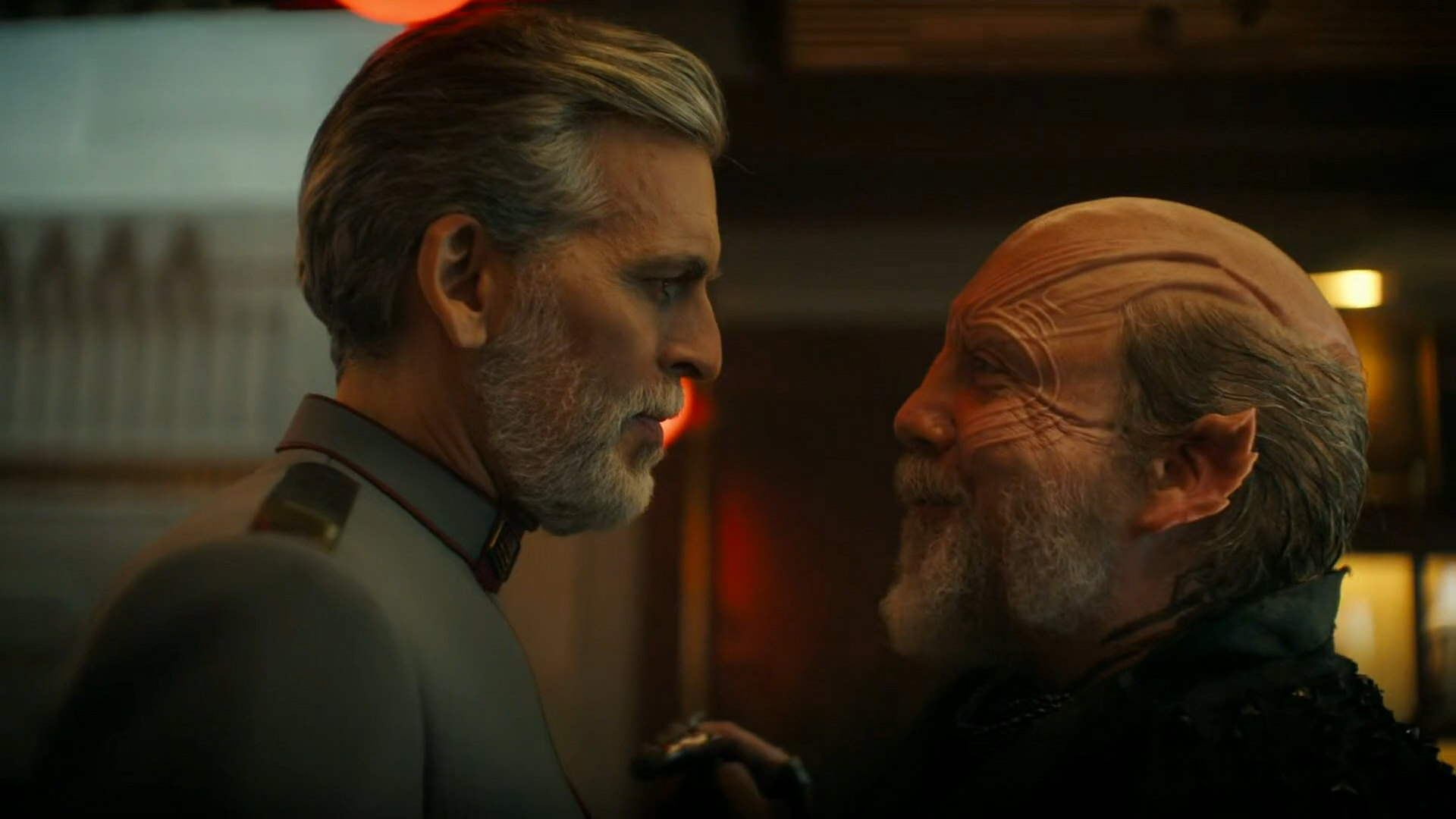
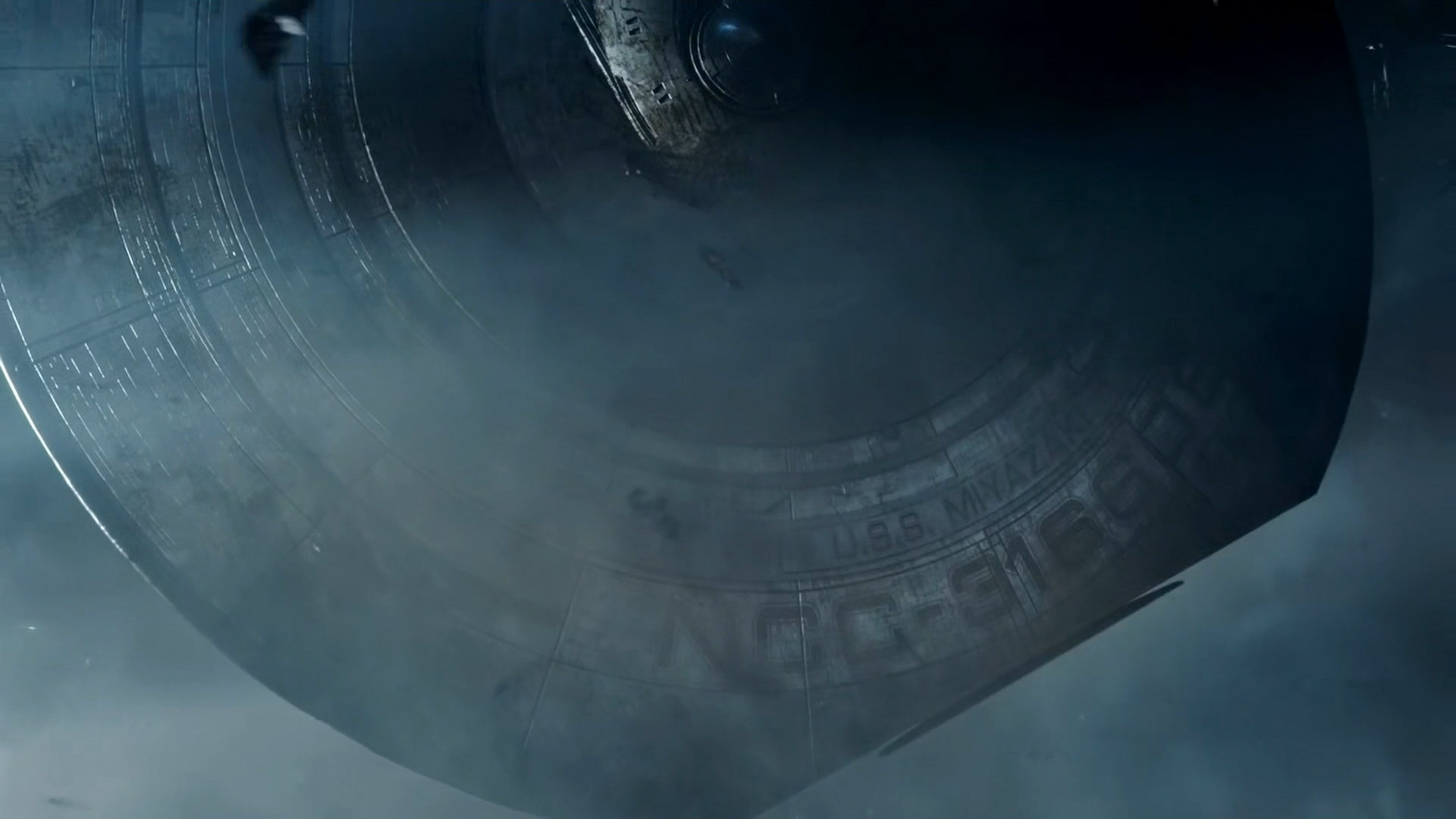
As the USS Athena is en route to a training in space, Tarima telepathically connects to Caleb and comes across his childhood trauma of being separated from his mum, which alienates him. As the ship has arrived at the training ground, Ake and Kelrec explain the mission. A team of cadets with an instructor is to board the derelict USS Miyazaki, whose singularity drive failed catastrophically over 100 years ago and killed the crew. Their task is to restore power. The War College has been using the ship in the past, and it's the first time Starfleet Academy joins for the training. After Caleb Mir has successfully restored life support, suddenly someone boards the Miyazaki, apparently from a cloaked ship. The intruders are hybrid creatures that identify themselves as the Furies. They take Caleb, Jay-Den, SAM, Kyle, B'Avi and Commander Tomov hostages, erect a jamming field that prevents transporting and demand a high ransom, which Ake agrees to pay. Yet, they single out B'Avi to be thrown out of the airlock as a message, upon which a fight ensues. Tomok sacrifices his life and the five cadets escape to the bridge. Vance proposes to ask Nus Braka's for advice because he is known to have defeated the Furies in Sector 119 before. Ake grudgingly speaks with the pirate. On the Miyazaki bridge, the cadets manage to reboot the main computer and erect a forcefield just as the Furies are about to break through the door. Ake feels that Nus Braka has a hidden agenda, suspecting he still has problems with the Furies that he doesn't mention. Still, she agrees to his demands, upon which Braka reveals that the Furies are sensitive to sound. Vance sends the USS Sargasso, which is usually stationed at Starbase J-19 Alpha to protect a secret research project. The ship is supposed to kill the Furies with a sonic weapon. As a backup, Tarima prepares to contact Caleb with instructions on how to activate the singularity drive of the Miyazaki, which would disrupt the jamming field of the Furies. On the Athena, Genesis Lythe locates the cloaked ship and the Sargasso prepares to fire - but the ship turns out to be one of the Venari Ral, not of the Furies. The pirates disable the Sargasso and escape. With the help of B'Avi, who has worked on the singularity drive before, Caleb manages to restart it. But the jamming field holds. The Furies break through the forcefield, damage SAM and kill B'Avi. Tarima sends a sound wave through her telepathic connection with Caleb, which kills the Furies. The cadets can be beamed out. But Tarima is in a critical condition after this stunt. And worse, the Venari Ral have ransacked Starbase J-19 in the meantime and killed many of its crew. The hostage taking on the Miyazaki was just a bait to lure the Sargasso away.
Review
Starfleet Academy gets dead serious in its sixth episode. Although Nus Braka already appeared in the pilot "Kids These Days" and used deadly violence, that story stayed fairly light in tone. It glossed over the fact that several cadets were probably killed, seriously injured or traumatized. So the first nice thing I can say about "Come, Let's Away" is that the episode does not repeat this mistake. It drops the jokes and plain silliness that dominated the first five installments and keeps that tone all the way to the downbeat ending. In-universe, the events of "Come, Let's Away" feel like a wake-up call for the characters, both cadets and instructors. They used to treat everything with a playful attitude so far, and now they are confronted with real terror and death. If I didn't know that modern-day episodes are not written and produced one by one with room for course corrections, I might think something was adjusted mid-season in the real world too.
But let me look at the story more closely. It is dark and usually hits the right note. Still, it is not especially tense, with pacing being a key issue. There are action sequences on the Miyazaki where things happen so quickly that it is hard to follow. That's fine, since it feels realistic. The problem is that instead of staying with the away team and showing the consequences, such as injuries or deaths, the episode keeps cutting to scenes on the Athena where no one even knows what is going on. This too is legitimate. But it becomes frustrating when we are shown Braka instead. Whether we enjoy his spiteful monologues or not (I don't), there are simply more urgent and interesting things happening elsewhere. The first negotiation scene with Braka lasts almost nine minutes, while the cadets on the Miyazaki are desperately trying to seal the bridge against the Furies. That is only the clearest example. Overall, the timing feels off. In the middle of a crisis, Starfleet somehow has plenty of time to bring Braka aboard, fill him up with alcohol, make small talk, negotiate, make more small talk, consult the President, draft an agreement and handle other formalities. In the end, that part of the episode is just boring. Since "Come, Let's Away" runs a full hour, cutting ten minutes of Nus Braka might have helped the suspense. I already didn't like him in the pilot, and now that he talks nonstop for minutes at a time, he becomes hard to endure.
This brings me to Nus Braka's background and motivation. In the end, it turns out to be mostly a pretext, which makes much of what he says pointless in hindsight. Braka claims it is personal, and perhaps he believes it is. In "Kids These Days", we could still assume he was mixing business (getting the warp drive) with his revenge. Here, it feels more like he is hiding behind a mask of madness and a supposed personal connection to Ake. He seems too scheming for a lunatic and too profit-oriented for a stalker. I would not say Ake believes all the bullshit he tells her. She's not naive, but she doesn't remain completely unaffected either. She and Vance make a catastrophic mistake when they trust Braka, who already fooled them once. We all know how that saying goes. That's the whole story already. She should feel guilty about that, not about anything he accuses her of, whether it concerns her son or Braka himself. There isn't anything personal here beyond that one bad decision to trust him, despite the hateful "personal" message Braka sends her in the end. And this is one more reason why the focus on Braka's lies and insinuations and the time spent on his monologues should have been cut down. It just doesn't become more meaningful as he continues it ad nauseam.
Starfleet Academy, like Discovery seasons 3 to 5, takes place in the 32nd century, about 800 years after the most popular Star Trek era. Yet, standard situations such as space battles, infiltrations of enemy ships or the hostage scenario in "Come, Let's Away" are written with the same constraints in mind as in classic Trek. One persistent issue is that personal transporters exist, but hardly anyone uses them. There may be in-universe reasons why the cadets do not have them or why they would not work on the Miyazaki. More generally, when the story does try to explain why advanced technology cannot be used or how enemy systems are countered with even more technology, it often becomes overly complicated. We already saw that with the programmable matter in "Kids These Days". "Come, Let's Away" does not go into as much detail, but it leaves many open questions instead. Moving Discovery to the far future was meant to free it from canon restrictions, yet the setting now feels limited by the need to tell stories without making everything too tech-heavy.
Overall, what happens in "Come, Let's Away" is still somewhat plausible. The bigger problems are not even complex Treknology issues but basic physics and logic. What Nus Braka says about wormholes, more like a side comment and in just two sentences, is a level of stupidity that almost makes my brain explode. There are more examples in the annotations. The story is full of avoidable beginner mistakes and omissions.
I wrote in a recent review that Caleb Mir comes across as "Cadet Perfect". That mainly refers to how he studies and seeks to outperform everyone else. It has been a while since his last openly defiant comments and actions, probably in "Beta Test". So it is a bit surprising to see him openly criticize the Federation and Starfleet again, and in a way that is clearly inappropriate, especially with an instructor present. He says about the comic book: "Federation propaganda. Feel-good, colonizing bullshit to brainwash poor kids into fighting the good fight for Big Brother Starfleet." This leads to no disciplinary action at all. In my view, it could even justify dismissal. He also seems to make comments like this regularly, which may explain why no one reacts strongly and why Darem Reymi said he wanted to punch him. Troublemakers like Mir, who always bite the hand that feeds them, are unpopular for a reason. We may even understand Mir as a clearly unintentional analogy to left-wing activists who fight the system that gives them lots of privileges.
On another note about Caleb, he is unfair when he complains about Tarima entering his thoughts. He knew she was telepathic. He knew she struggled to control it. He should have realized it was an accident when she accessed a memory he didn't want to share. Conversely, Tarima previously criticized him in "Beta Test" for not opening up, even though he was never dishonest and had every right to keep his traumatic past private. In that sense, they could be even now. They are not, as Tarima is unable to accept his apology and walks away in a huff. Still, I like how her initially uncomfortable abilities end up saving everyone - even if it is not clear who actually screamed the Furies to death. That subplot, including the revelation that Tarima caused her dad's deafness, is one of the stronger elements of the episode, even though it remains secondary.
In the end, the positive and negative aspects of "Come, Let's Away" more or less balance each other out. The lack of silliness and exaggerated character behavior is welcome, even if the sharp tonal shift might be difficult to handle in future episodes. The Furies first appear to be a major new threat to the Federation, but they turn out to be simple space zombies with no recognizable further potential. That role is clearly meant for Nus Braka. Even though I cannot stand him, it is obvious that we haven't seen the last of him or the Venari Ral.
Annotations
- Continuity: Betazoids used to be full telepaths in classic Trek. "Beta Test" already created the impression that they are merely empathic now. In "Come, Let's Away", Ocam more or less explicitly confirms the retcon when he says that Tarima is special and only she can "go in".
- Nitpicking:
- The exterior of the USS Miyazaki is 23rd century all over, stylistically clearly the same as Pike's reboot Constitution class. Yet, the registry is NCC-316608. It seems extremely unlikely that Starfleet would use an over 800-year-old ship to test a new drive and just assign a new registry to it. What's more, B'Avi's comic book shows the crew of the ship in 23rd century uniforms. This is so extremely odd, if not blatantly wrong, that I wonder whether the Miyazaki was supposed to be that old in a previous revision of the story, to justify the use of SNW sets.
- The entire crew of the Miyazaki was killed due to a catastrophic failure of the experimental singularity drive. But how? The ship obviously didn't explode. It was just damaged in unspecified ways. Maybe it suffered hull breaches or there were radiation leaks, but this wouldn't kill the entire crew. Nus Braka may not tell the truth, but he confirms the observation when he insinuates that "it went down piece by piece". So why could no one take a shuttle or escape pod?
- Nus Braka says the same about the ship Nahla Ake's son was on. And he seems to know that Ake could have helped. So it's essentially the same question again, until it's not. We already know it happened in the Burn. And didn't the Burn cause dilithium to explode, rather than cause gradual system failures? We don't know if Braka tells the truth and whether everyone on that ship died, though.
- Vance contacts Nus Braka because he is known to have defeated the Furies before. This is a thin justification of why Braka and only Braka could help. Well, the villain could have offered his services in case Vance hadn't called him, but that would have set off the admiral's alarm bells. After what happened in "Kids These Days", it is the second time that Nus Braka is simply lucky that Starfleet is more stupid than he is.
- The Venari Ral have a starship that can be cloaked and that can destroy an Intrepid-class ship. So what was the reason to lure the USS Sargasso away from Starbase J-19 into an extremely complicated and highly uncertain trap?
- Nus Braka says he owns "a lovely stretch of space between two unstable wormholes" and used to charge the people of the Taygeta system for traveling from Taygeta I to Taygeta IV, until the Federation supplied dilithium to operate warp drives. This is evidence the writers have no grasp of the concepts of wormholes and planetary systems. Firstly, it needs just one wormhole with two exits, not two wormholes. Secondly, if it's unstable, it can't be used for space travel - at least Braka doesn't mention that he stabilized it. Thirdly, planets always orbit a central star at different angular speeds, making a wormhole useless for interplanetary journeys, unless Braka continuously moves both exits to follow the planets. Fourthly, warp in a star system may be a thing (sometimes it isn't), but the question must be allowed what is so bad about travel times of a few hours with impulse drive. Fifthly, wormholes are gravitational anomalies - and unstable wormholes would destabilize the whole system (the possible excuse for the Bajoran wormhole being that it is stable and located beyond the planetary orbits).
- There is no reason why Genesis and Darem would keep their positions on the bridge in the crisis, instead of experienced officers.
- Genesis finds the cloaked vessel, by running scans with lots of manual input to find the one region where the debris density is different. This may have been an acceptable method in the 1980's, but not today. What happened to AI in the years between 2026 and the 32nd century?
- The cloaked ship decloaks moments later, and everything is ready - but only to turn on the subwoofer of the USS Sargasso. Why are both Starfleet ships not firing all weapons on the enemy ship? The sad result is that both of them get disabled by the Venari Ral.
- Sound in space, part I: How can the sonic weapon of the Sargasso possibly work?
- Sound in space, part II: Tarima is connected to Caleb's mind and somehow sends sound through space and through the jamming field. I doubt that Caleb screams the Furies to death. So what happens?
- Remarkable dialogue: "Okay? If it's a weird Betazoid thing, then you should just..." - "I should what? Control it better? Hide?" - "You can't just go into my head and see things like that." - "It's not a weird Betazoid thing. It's part of who I am." (Caleb and Tarima)
- Remarkable facts:
- Tarima is responsible for her father's deafness. As a child, she once couldn't control her powers and blew out his auditory cortex.
- Nahla Ake may have saved her son when his ship suffered a catastrophic malfunction. But she chose not to risk her ship and crew.
- Remarkable music: The song "UFO" by Olivia Dean plays during Tarima and Caleb's love scene.
Rating: 4
Ko'Zeine
Synopsis
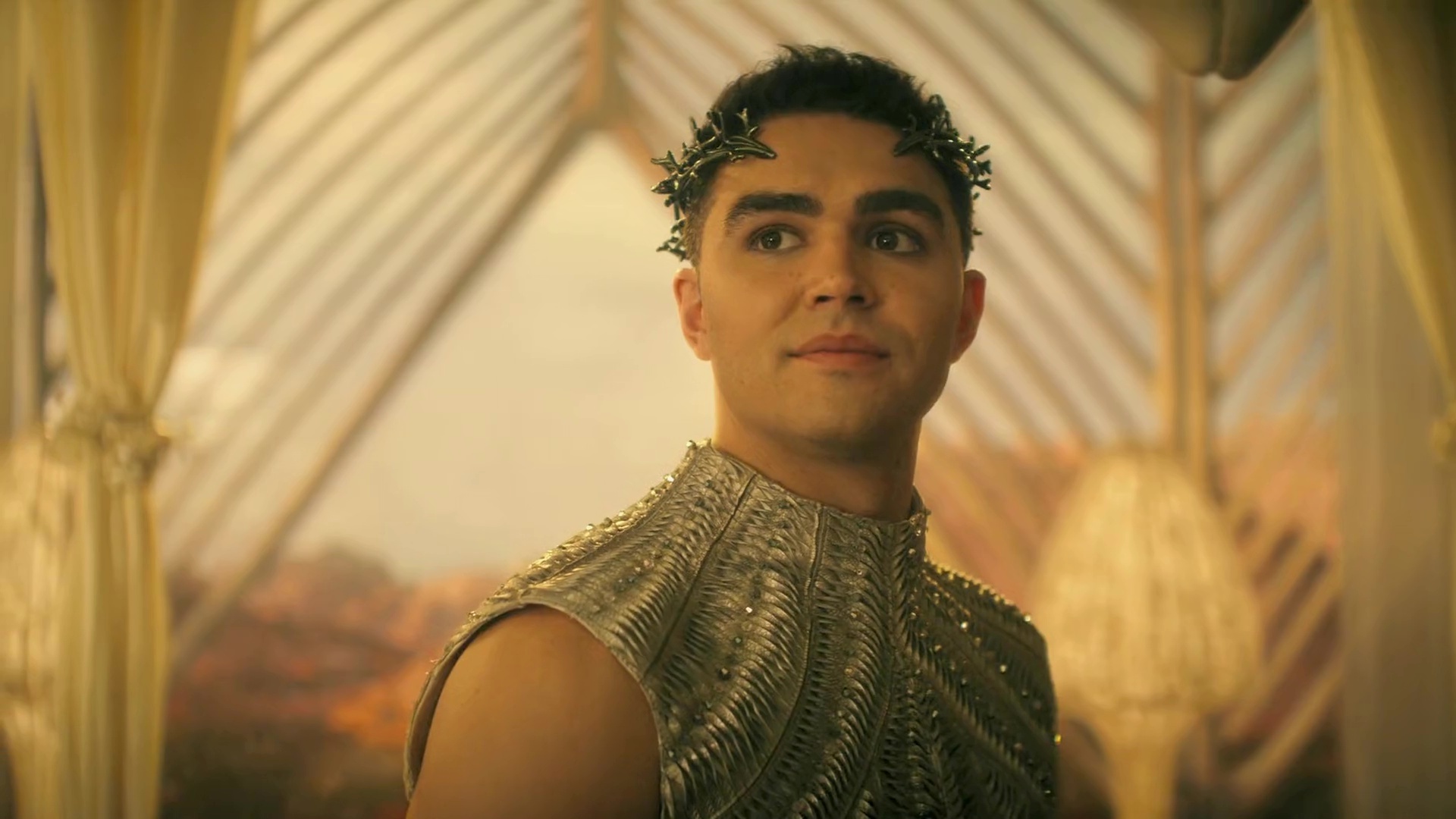
It is "all-worlds break" before the spring semester starts at the Academy. The cadets leave to spend their time on their homeworlds or with guest families. Before Genesis Lythe departs, Nahla Ake tells her she would recommend her for the pre-command track. While Tarima is recovering on Betazed and he hasn't been in contact with her for weeks, Caleb Mir doesn't feel like leaving. He gets Ake's permission to stay on campus. Jay-Den is planning to spend time with his friend Kyle on Ibiza, but he witnesses a spatial rift opening and someone kidnapping Darem Reymi. He follows them into the anomaly and ends up on a moon in the Khionian realm. Ready to attack the kidnappers, Jay-Den learns that this is a traditional Khionian wedding abduction. Darem saves the situation by introducing Jay-Den as his best man, his ko'zeine. At the Academy, as Caleb is taking a sunbath, Genesis Lythe runs into him. She was booked on a long-range shuttle but chose to stay behind. She suggests they hang out on the empty campus and eventually challenges him to break into the bridge of the Athena. Caleb tries to stop her when she goes too far, but she generates a key that would give her access to her personnel file. Jett Reno catches them red-handed, and they are taken to Nahla Ake. Lythe takes the blame, saying she wanted to intercept her manipulated recommendation letters before they were sent to the pre-command committee. Ake does not expel her, but cancels her nomination for the pre-command track and sentences her and Caleb to menial work. On the Khionian moon, Darem starts doubting whether he really wants to marry his bride Kaira and rule the Khionians with her, or return to the Academy, to a life he has come to love. He upsets Jay-Den when he says he cannot just run away like the Klingon did. Jay-Den still returns for his speech as best man, in which he praises the outgoing person Darem is at the Academy - a person Kaira does not know because he always used to hold back. She eventually convinces him to abdicate so he can return to the Academy.
Review
Let me start my review with some praise that this episode continues well after the dramatic and tragic events last week. It is appropriate that things are not quite back to normal and that the cadets are still struggling with their feelings of loss and, in Caleb's case, guilt. Starfleet Academy is consequential at a point in the series where it really matters. This also means that little is going on in this episode in terms of action, which is fine with me in principle.
Well, but hardly anything is happening at all in "Ko'Zeine", and what is happening turns out to be quite formulaic. We have two pairings of cadets that come together by chance, or maybe by fate, in ways the cadets themselves would not have chosen. The first, in the more important story thread, comes about when Jay-Den follows the apparent kidnapping of Darem and stumbles into the Khionian Royal Wedding. Their backgrounds couldn't be more different. Darem is a self-confessed conceited asshole from a powerful family, and Jay-Den is an outsider who escaped his narrow-minded underprivileged culture to make his dreams come true. The two have not been on good terms ever since the rich kid mocked the Klingon bird watcher on his first day at the Academy. But Darem was also the one who boosted Jay-Den's self-confidence when he had to make his stand in the debate club in "Vox in Excelso". In a way, Jay-Den returns the favor now and gives Darem the courage to say no to a life that he has been prepared for since childhood but that may not be what he really wants. Actually, he doesn't even have to make that decision by himself. After learning that Darem feels comfortable at the Academy, Kaira accuses him of lying to her and breaks up with him - which is shown as a blessing for him.
Ever since TOS: "Amok Time", it has been a standard situation that someone from the regular crew is about to leave the ship or Starfleet because of some other commitment. "Ko'Zeine" is similar to the situation Spock once found himself in when he was to marry a woman he thought he loved because he was promised to her as a child but who doesn't want him any more. At least, our makeshift best man Jay-Den doesn't have to fight to the death to resolve the dilemma. Anyway, as the trope more generally goes, when a main character is about to depart, it is always like a rubber band that snaps them back to Starfleet. And "Ko'Zeine" is a prime example. Darem loves Starfleet more than he loves Kaira, and he wants to explore the stars rather than rule his world. What's more, Kaira seems to be possessive, and he may be lucky to be separated from her. It sounds like an oversimplification, but I don't see more in it. Jay-Den holds a speech as best man and describes Darem humorously yet truthfully, in a way that Kaira recognizes that "Starfleet Darem" is the true unrestrained Darem. This scene is one of the few I like. But it tells the whole story already. It is not bad that the story is simple, but for that it is too clichéd. And it is disappointing that we never really witness the purportedly "quiet" Darem that Kaira would have wanted to have, except through her own statement. Sure, he is somewhat different than usual, but by human standards he may simply have cold feet, which is understandable a few hours before getting married, royal wedding or not.
Speaking of human standards, I wrote in a previous review that Darem is totally human except for that one sequence in which he mutates into a scaly creature and walks across the hull of the Athena in "Kids These Days". It would have been a great opportunity in "Ko'Zeine" to show the Khionians as truly alien. But they not only keep their human form the whole time, they also have wedding customs that are the same as in Western human cultures, including ceremonial kidnapping, a best man person, champagne and 19th century classical music. Maybe that was deemed necessary to get the story across, maybe it was for budget reasons, but it still is bland and feels wrong to depict the Khionians as humans with rarely used super-powers instead of actual aliens.
The second plot thread is about "Miss Supercool" Genesis Lythe, who is eager to outperform everyone at the Academy while never losing her temper. She runs into self-confessed rebel Caleb Mir. The two are pretty much alone on campus, and Genesis uses the opportunity to enlist renegade Caleb to help her pull off all kinds of silly games they would not be allowed during the semester, like "toxic or non-toxic" with the Doctor's biological samples. Am I the only one who has a problem with them risking their health and messing around with possibly valuable assets, with lifeforms? Anyway, she is clearly much more enthusiastic about breaking the rules than Caleb, who does it on a regular basis. Although we know since "Vitus Reflux" that Genesis does not mind causing collateral damage when it comes to following her ambition, it seems out of character that she would risk her place at the Academy just to have some fun. It then becomes clear that breaking into the bridge is not about fun. She wants to get her hands on her personnel files before the pre-command committee notices they are forged.
The parallels between the two plots become apparent gradually. Both feature unlikely pairs of cadets. Both Darem and Genesis are about to leave Starfleet Academy - Darem because he feels obliged to his people, Genesis because she faked her way into being accepted. Both go out of their way to be able to stay - Darem by abdicating and Genesis by trying to delete the evidence of her forgery. The analogy is interesting in an odd way, but it also feels contrived. Both can eventually stay at the Academy because that is what the cliché demands from main characters. "You faked credentials? No problem, you're a good student after all. You feel like abdicating because Starfleet Academy means more to you than your wife and your people? Sure, whatever you please." This is way too easy. Moreover, with Nahla Ake always issuing menial work instead of real consequences for cadets who are way out of line, she further undermines what little authority she has as the Academy Chancellor. At least this is the first time we actually see someone doing that menial labor.
I also think that realistically nothing in Genesis Lythe's recommendations could have been so bad that she would have had to fake it in the first place. She was allegedly described as a person who "doesn't trust that she belongs where she is" and is "driven out of fear." I don't see that in her at all. And even if the statements are authentic, who would write something like that in a letter of recommendation, unless they actively wanted to sabotage her admission? Her motivation to cover up her manipulation seems obvious, while the reasons for her to make that mistake in the first place are not plausible in the slightest. Once again, where is the person that is driven by fear and doesn't know where she belongs? That's not Genesis. It is made up out of thin air. This is still worse than with Darem Reymi's purportedly so different side as a servant to his people and wife that does not become as clear as it should have.
In the end, both plots remain shallow and rely on contrived and implausible back stories to get Darem and Genesis into emotional trouble, only to resolve it effortlessly. For the most part, "Ko'Zeine" is simply boring - a filler episode that pretends to be more. There are comparably few things that genuinely frustrate me this time, but since when is being less annoying a benchmark for a good Trek show?
Annotations
- Remarkable quotes:
- "You've got, like, four pairs of boots in here. You don't even wear shoes!" (Caleb, about Ake's suitcase)
- "Uh, well, if this were a Klingon wedding, Kaira would now bite Darem and they would break each other's clavicles." (Jay-Den)
- Cringey costume: I didn't want to address it at first, but it is just too bizarre to remain uncommented. Jay-Den suddenly switches into an overtly feminine dress for the Khionian wedding, just like the bride, even though every other male guest is wearing male clothes and even though he spends the entire event shivering because of the cold. I have no issue with him being gay or with him wearing a skant (if it is a standard option), but the dress takes it too far. It doesn't appear like a character decision but like the writers forcing a statement that doesn't align with the setting, the culture or Jay-Den himself.
- Remarkable music: The song at the end is "We Watch the Stars" by Fink.
Rating: 2
The Life of the Stars
Synopsis
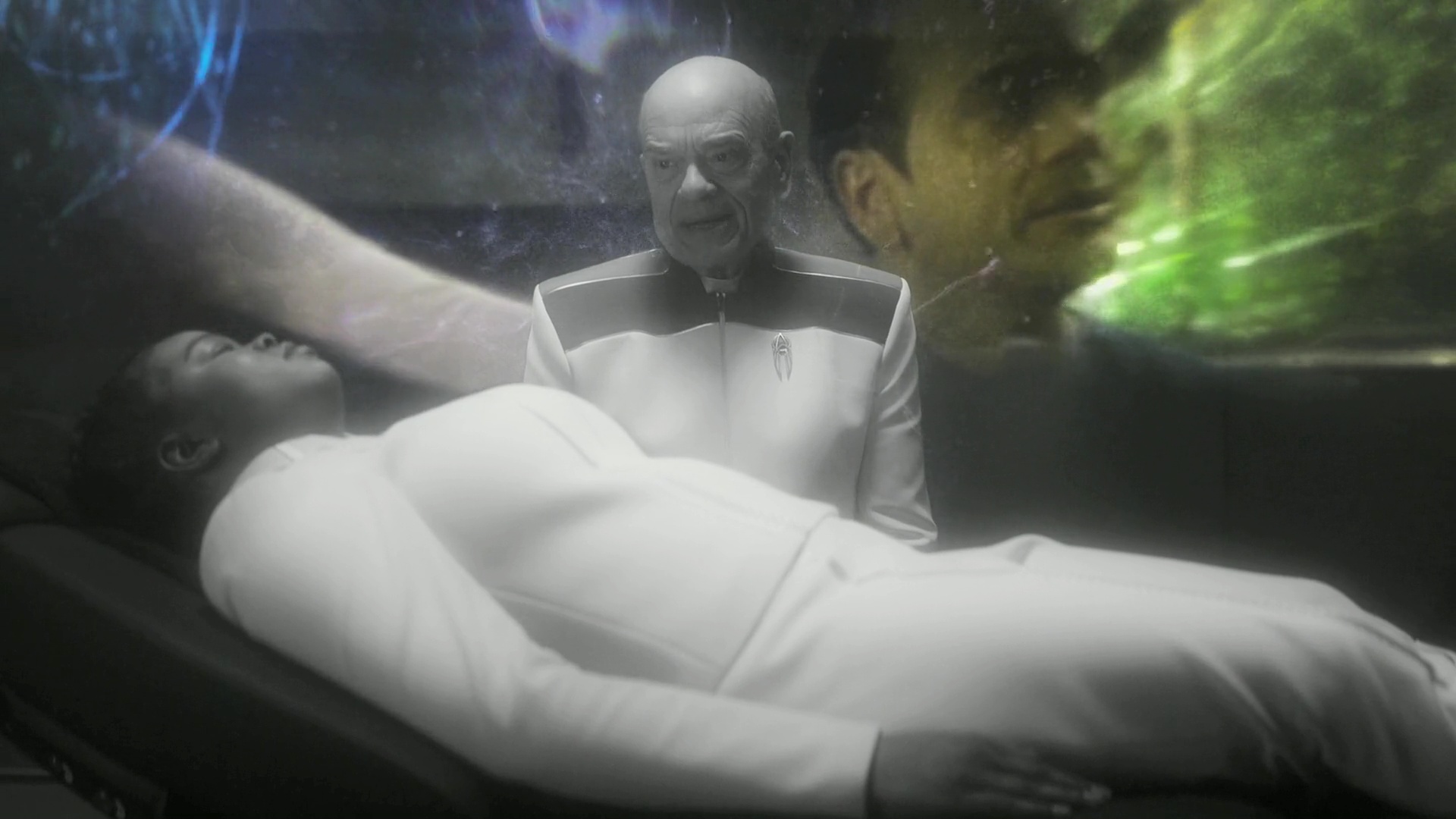
Stardate 869372.1: Tarima returns from Betazed with a new neural inhibitor. Instead of going back to the War College, she joins Starfleet Academy for her own safety. Everyone is still shaken by what happened on the Miyazaki, so Captain Ake brings in Lieutenant Tilly to act as a kind of therapist. Tilly tries to motivate the cadets to study and put on a stage play, but at first no one except SAM is interested. SAM chooses Our Town by Thornton Wilder. SAM, however, suffers from glitches in her holographic matrix until she finally collapses in class. The Doctor and Ake take her to her homeworld Kasq, a place outside space and time. SAM departs suddenly, but not before leaving a note for Tarima, telling her she should play the role of Emily. The people of Kasq are unable to help SAM. They discover that her program has been running without enough resilience because she was created without any previous experiences to draw on. The Doctor hesitates when Nahla Ake suggests that he could provide those memories, since he has avoided loving someone (that he would eventually lose) for centuries. In the end he agrees and spends 17 years with SAM on Kasq, which amounts to only a few weeks outside their world. Meanwhile at Starfleet Academy, Tilly encourages the cadets to talk about their feelings, but the conversation upsets Tarima. She compares herself to the "ghost girl" Emily from the play and announces that she is quitting. The other cadets gather to rehearse anyway. Tarima suddenly returns and joins them. Some time later, SAM also comes back with the Doctor, who is now her "parent".
Review
Phew. I don't know where to start. Maybe with the most obvious and most consistent impressions I got of "The Life of the Stars". It is extremely verbose, very uneventful and overall boring. It is one hour of talking about feelings almost non-stop, which becomes tedious - only to arrive at the key statement that, for reasons not sufficiently developed until then, love is the most important of them all. Even Discovery never pushed the idea that only feelings matter and that love trumps everything in such an intrusive way. What strikes me most is how depressive the episode is for most of its run time. There have been many sad or tragic Trek episodes in the past, but they all came with an arc of suspense, a hard moral lesson, a curious resolution of some sort or at least a light-hearted B-plot. "The Life of the Stars" doesn't have any of that. It is driven by grief and apathy, with Tilly's attempted pep talk perhaps making things worse instead of better. It ends on a positive note, but a restrained one that is neither uplifting nor rewarding for the hardships of watching it. It may have been meant to be a tear-jerker, but I was so tired it didn't touch me.
"The Life of the Stars" deals with traumas that go well beyond what happened two weeks ago. The Miyazaki is cited as the main reason why everyone is depressed, although we can imagine other explanations why Darem is aggressive or why Tarima is so frail. There are definitely different reasons for the Doctor. It is noticeable that, while the gloomy mood affects characters like Ake as well, the story focuses on two people. Tarima creates her own misery because her trauma, but also her personality, keep her from enjoying the fact that she is alive and has friends. And even rather than SAM, the second central figure turns out to be the Doctor, who is stuck in probably century-long self-pity over the friends and family he has lost. Considering how openly everything revolves around feelings, it feels odd that SAM's holographic matrix is repaired essentially through an extensive recoding instead of anything that resembles therapy. In a way, something similar seems to apply to Tarima, who changes her mind suddenly and off-screen after being pushed so hard that she wanted to quit. I don't deny that this can happen in real life, but in a TV episode it would have worked better if Tarima and the other cadets had gained more confidence and optimism through a shared success, for instance.
A bit like already "Series Acclimation Mil", "The Life of the Stars" tries to appear more meaningful than it actually is, especially by bringing in the stage play, by quoting from it ceaselessly and building analogies around it. One of my problems is that I simply don't know Our Town, which makes the whole thing less accessible to me. I understand the intended irony that Darem, who canceled his wedding last week, is the one asked to comment on the reluctant marriage, and that Caleb and Tarima, the two with an uneasy relationship, end up playing that couple - or rather don't play it, because they never actually perform. Both ideas are curious but not funny, and they remain insignificant. There may be other analogies I missed, but the big one, that Tarima feels like a "ghost girl" like Emily in the play, seems forced. She has a point when she complains about how everyone treats her, but that could have been developed without feeling contrived.
I also wonder why Lieutenant Tilly gets involved in the first place. She is a scientist or engineer and has never appeared as a literature teacher, much less as a therapist. It makes no sense that she would be enlisted for this specific purpose. There was no need to invent an excuse for her to appear, since DIS season 4 clearly established that she left the ship to teach at the Academy. So why not bring her in naturally, as someone who is already present and happens to have an idea on how to help the students? Tilly, a person Ake arguably wouldn't even know, being hired by her as a world-class trauma expert is bizarrely contrived.
Regarding the Doctor, it takes a while until everything comes together and until it becomes clear why he has avoided to get close to SAM, which culminates in him refusing to take her hand. It was foreshadowed in a previous episode that he feels grief because he lost everyone he ever knew. But he has had centuries to deal with that, and it never made much sense to me, so I saw it more as a side note. Now we learn that it matters a lot indeed and that he specifically mourns the loss of his holographic daughter Belle from VOY: "Real Life", saying that to him it was just yesterday. In a story that otherwise goes out of its way to explore emotions, I would have expected a more nuanced reasoning than this nostalgia bait. Also, hasn't the Doctor lost everyone of his family on Voyager? Like Janeway? Or Seven? Or Naomi? But Belle seems to matter more. Damn you, B'Elanna Torres!
I have two positive notes on characters. Whatever people say about the gay Klingon Jay-Den, he is one of the figures that actually work, maybe mostly as comic relief or as a mirror that reflects that something is wrong, but still. Well, and everyone should have a Genesis in their class. Despite the so far two attempts to make her appear more edgy, she is still defined by her genuine kindness.
When Tarima returns to the Academy, she is clearly not ready. It is so obvious that it hurts. And as if her apathetic expression wasn't painful enough, she is welcomed by Ake and the Doctor, and the first thing they do is tell her how fragile she is and that the War College wouldn't have been good for her, hence the transfer to Starfleet Academy - literally her safe space! Why does she return, and why is she allowed to return, without having overcome the worst of her trauma, even if that means she might never return? Starfleet Academy may not be as demanding or "dangerous" as the War College, which is absurd in itself because we're talking about the future elite of Starfleet. It is open to cadets who are obviously not fit and are being told exactly that. Tarima's inability to say sorry or accept a sorry is another thing that bothers me. She meets Caleb essentially to be disappointed by him. This is a consistent pattern in her behavior and has little to do with her being drunk and nothing with the Miyazaki, as it is at least the third time they part ways after an unnecessary dispute she provoked or failed to avoid.
One thing that bothers me enormously, especially in a DEI-heavy series, is that it reinforces character stereotypes. Everyone loves SAM because she is so joyful, as if that were the only part of her personality that mattered. Likewise, everyone is concerned about Tarima because she is so fragile - I mean, just look at her. The show that set out to break new ground for diversity gets lost in superficialities and also in favoritism instead of real character development. And worse, it pushes this through the fourth wall. We are literally told who to like and why.
As an afterthought to last week's episode, it struck me that, with one exception, the cadets we follow have almost no intrinsic motivation to join Starfleet. This reinforces the concerns I had before the series even began, that we are dealing with a group of nepo babies, and the show keeps signaling that no amount of misbehavior will ever get them expelled. So who actually wanted to become a Starfleet officer? Caleb Mir was basically pressed into service. SAM was created as an emissary and has barely existed long enough to make any decision (and wouldn't she have to apply again after her reboot?). Tarima and Ocam are at the Academy for political reasons, not personal ambition. Last week we learned that Darem intended to stay only five years, while Genesis was apparently judged as someone who wouldn't fit in at all, assuming her mysterious recommendation letters are true. That leaves Jay-Den as the only cadet who genuinely wants to be in Starfleet. Maybe Genesis, Darem and some others have grown into the role by now, but the bad feeling remains that they took Academy slots from applicants who would have wanted and deserved the opportunity more. In "The Life of the Stars", Caleb reaffirms in cryptic language that neither he himself nor Tarima are at the Academy of their own will. This adds to my other impressions, that some of them are simply not fit for the service and that the Academy serves more like a safe harbor than a school preparing for missions to the stars.
When I try to break down "The Life of the Stars" to what actually happens and look for possible takeaways, I find very little. Aside from SAM's repair, which happens by giving her a childhood and at least has some emotional impact after all, the story stumbles aimlessly from one downer to another. I almost miss the silliness of the first few episodes. In a way, "The Life of the Stars" fails for the opposite reason as "Vitus Reflux". What the latter had too much of in terms of inconsiderate jokes, this one has too much of an almost infectious depression. Going to such unmotivated and uncalled-for extremes puts me off. So it is two out of ten points yet again.
Annotations
- Further talking points:
- If I understand it correctly, War College was initially deemed more suited for Tarima because she might hurt someone, and now Starfleet Academy is considered safer because she could hurt herself.
- The voice of Kasq never really said it was possible to reboot SAM, and that newly acquired memories would make her more resilient. Ake proposes it out of the blue, which seems far-fetched.
- I doubt it is possible to fill SAM with 17 years of experience she would need for the Academy, without ever interacting with the real world and real organic lifeforms. And seriously, 17 years with the Doctor as her dad must have been a hard time for her.
- The planet in VOY: "Blink of an Eye" was never given a name. "Gotana" (after the character Gotana-Retz) is retroactively made up.
- Remarkable monologue: "The sky is beginning to show some streaks of light over in the East. How many dawns have I seen? Alone, while most of the crew is on the verge of waking, with a new perspective granted by a good night's rest. It's an illusion, I want to say. I was here the whole time, and nothing has changed. But time is their beast. Time is my beast. It bites us differently." (Doctor)
- Remarkable music:
- Nahla Ake's gramophone plays "Dôme épais le jasmin" from the opera Lakmé by Léo Delibes.
- The Doctor plays "E lucevan le stelle" from Tosca by Giacomo Puccini on the shuttle.
Rating: 2
300th Night
Synopsis
It is the end of the academic year, and the USS Athena heads to Betazed for the opening ceremony of the new government complex. Everyone is looking forward to it except for Caleb Mir, who still has not received word from his mother Anisha. SAM suggests he try something from his childhood, which makes Caleb remember the password his mum once gave him. He discovers she has been sending him messages ever since she escaped from prison. Meanwhile, a new threat emerges when Nus Braka detonates a mine made from the Omega-47 substance he stole from Starbase J-19. As the Federation goes into lockdown and starships gather to protect member planets, Caleb sees no chance of reaching his mum except on his own. He begins to manipulate a shuttle to escape but soon finds himself joined by SAM, Darem and Genesis. Together they travel to the non-Federation planet Ukeck, where Anisha Mir plans to meet Caleb according to her latest message. When Ake learns about the missing cadets, she decides to defy orders and follow them after offloading the other cadets on Betazed, even though she risks running into the Venari Ral. Jay-Den and Tarima secretly stay on board. As Caleb arrives at the marketplace on Ukeck, he eventually finds his mother. She is wary of his friends, and no one tells her they are in Starfleet because it would scare her off. When the Venari Ral announce the annexation of the planet and time is running out, Caleb says he will go with his mum, angering his friends. But as Genesis, Darem and SAM are arrested and face execution as Federation spies, Anisha Mir steps in as a witness and tries to give them an alibi. The situation escalates, and a firefight breaks out in which Anisha is wounded. In the meantime, the Athena arrives at Ukeck. Because a forcefield surrounds the planet now, Ake takes the ship into the atmosphere and beams out the cadets and Anisha Mir. The Venari Ral pursue them and use an isolytic charge to force the ship out of warp. As the enemy ships begin to tear the hull apart, Ake decides to separate the saucer and escape on auxiliary warp. But it is too late. The Venari Ral have blocked the entrance to Federation space with Omega-47 mines. The Athena is now the only Starfleet ship left outside the deadly circumvallation.
Review
I don't know if I had some sort of predisposition because there finally had to be a good episode in this show, but I liked "300th Night" from the start. Jay-Den's R'uustai ritual, which celebrates the family (old and new) and reminds Caleb that he still hasn't found his mum, sets the tone. Add his difficulty to talk to Tarima, who can read his mind and could call him out for alleged dishonesty at any moment. Caleb may be extremely sharp and resourceful, he may have a bright future because of that, he may have found friends, he may have found love, but he still hasn't arrived at the Academy. The episode works well with this theme. Gone is the silliness of the first couple of episodes that often glossed over his life's drama. Gone too is the attempt to sidetrack the main storyline with more trauma and depressive talking about trauma, as in last week's episode. Everything in terms of feelings is more organic and more earned in "300th Night".
It is a stupid mistake by Caleb, and maybe a small bitter note in an otherwise solid story, that he didn't think sooner of entering the password his mum gave him as a child. It would still be believable if he had never used it before or if he simply hadn't remembered it. But he explicitly says he stopped trying it years ago. That is understandable. Yet the whole situation changed when two things happened. His entry into Starfleet Academy gave him (usually unauthorized) access to a broader range of communication channels, and he learned that his mother had escaped from prison, which made him even more eager to reach her - only that he doesn't ever try the password he remembers well and just hasn't used in years. It is a trope that the most intelligent people overlook the simplest solutions, but he never gave me that impression before. The issue of him learning how he can contact Anisha could have been handled better in the story.
Anyway, it is obvious what would happen: Caleb would try to run away again to finally find his mum. It is predictable, but that is exactly why the scene in which he walks into Ake's meeting is so interesting. He learns how serious the situation in the Federation is and then claims his personal matter can wait. And the way he then candidly bids farewell to Tarima, confessing his feelings and finally matching what he says with what she senses in him, works well too.
Caleb wants to go alone. He still ends up gathering a crew for his unauthorized mission because the selfless SAM, the wary Genesis and the drunk Darem enter his shuttle in quick succession. This is silly and contrived but also spirited and amusing. Their escape from the Athena into the transwarp conduit just around the corner is too easy, but I admit I wouldn't even have wanted to see more trouble in this sequence. It would have made a standard situation, which merely serves to get things moving, unnecessarily complicated. I can live with Darem puking glitter once again, which remains the only facepalm moment of the episode for me (well, if we ignore the usual stupid PA announcement for Specialist Krebs, who hopefully will be killed removed before season 2).
The new SAM, who actually lived 17 years at the Doctor's side to collect experiences, is introduced casually and skillfully. The difference is noticeable as she is clearly less childish, yet it is subtle enough that she is still perceived as the person she was, as Caleb confirms.
Caleb finally finds his mum on Ukeck, ironically when she puts a knife to his neck because she is very alert and perceives him as suspicious. Their reunion, shown at first in close-ups, is tense. Their attempt to catch up on the last 14 years, at least briefly, is an earned emotional moment. But then comes the question of what Caleb is doing now. As it turns out, he never wanted to stay at the Academy, supposedly because it would anger his mum but maybe also because he never felt at home there (or never allowed himself to). He must have been telling himself this all along, ignoring that he now has friends, not just fellow cadets but also Ake. As I mentioned before, the most intelligent people sometimes miss the simplest truths, and here is another, more credible example. Caleb then insults his friends, who don't want to lose him, because it helps him cut the emotional ties he doesn't want to face. He is extremely unfair but also in such an emotional state that he is barely himself.
The scenes that follow are a bit messy. The other three cadets are apprehended and immediately put on trial in the marketplace. Then Anisha Mir steps in to help them without having a plan or talking to Caleb. A firefight starts because of a stupid coincidence. But miraculously none of the kids are killed until the Athena arrives in a predictable orbital flight maneuver we have seen many times in modern Trek. This part is not completely satisfying, but the episode is so good until then that I can overlook the weaknesses of the showdown.
On a critical note about discipline, Admiral Vance once again encourages Ake to disobey orders as long as it is not a direct order, which he carefully avoids giving. Both Ake and Vance are totally in character, but at some point we have to ask whether there are any limits to insubordination or unauthorized solo runs. And of course our cadets, all of them, break the rules again, although we can excuse Genesis and Darem, who were more or less forced to join the illegal mission to Ukeck, and Tarima and Jay-Den, who were simply hiding on the ship when they should have left. By the way, after being locked up in Ake's quarters, the latter two do not appear at the end, although it would have made sense to release them. Maybe a reason will become apparent in next week's season finale.
The elephant in the room is that once again the Federation is threatened by a weapon of total overkill mass destruction, essentially an Omega-molecule-enhanced Burn 2.0. It is a shame that writers of modern Trek, since 2009, rarely consider anything less than an apocalyptic threat scenario. In addition, the science of this superweapon, how it is described and depicted is laughably unrealistic, like Red Matter, the spore drive or the origin of the Burn before. I don't know where the storyline of the locked up Federation goes. It is possible the idea of the Athena, manned with a skeleton crew and a few cadets, being the only line of defense against the Venari Ral has potential for much more than a cliffhanger. It is possible that a big reveal will let Anisha Mir appear in a different light. But given how moronic the groundwork for the storyline is, let's hope they get done with it in the season finale.
Anyway, Starfleet Academy finally proves that it can deliver. "300th Night" is a good episode, though not a standout. It is meaningful in the series context and has much of what I enjoy about Trek. It still has many issues, most of which are inherent to this series or to modern Trek.
Annotations
- Continuity:
- Omega-47 is obviously meant to be a variation of the Omega Molecule from VOY: "The Omega Directive".
- When she takes the ship into the atmosphere of Ukeck, Ake calls it "pull a Q'mau", which refers to the stunt from DIS: "Red Directive". Yet, she doesn't stop a sand avalanche, whereas ships hover in the atmosphere all the time in modern Trek, so the specific analogy doesn't work here.
- Nitpicking:
- Where is the experienced bridge crew of the Athena when Ake could need them? Sure, she may not have wanted them to take part in her unauthorized mission, but it feels odd, still in the 32nd century, for three people to run a huge starship. Eventually, as already in "Come, Let's Away", it is the cadets who are apparently needed man the stations.
- The look at the mine boundary at the end of the episode is absurdly unrealistic. Size relations are off by many orders of magnitude. We can see several celestial bodies that are impossibly close together - on both sides of the boundary! The phenomenon itself is composed of hexagonal segments, whose visibility defies an explanation - unless it isn't just a network of single mines but an impermeable forcefield that would have to stretch across millions of square light-years and would require a ludicrous amount of power. The Athena is literally parked meters away from that border, which turns out to be perfectly defined - just a few meters more, and a whole Federation sector would go boom! This is ridiculous. As we zoom out and those planets on both sides become visible, their relative sizes and distances prove we are still directly in front of the phenomenon, and it would have to look accordingly flat. But we can clearly see the curvature of a sphere, the way it can only appear from thousands of light-years away. This final shot is so totally wrong it could not even have been used as a symbolic depiction on a monitor, much less as a real view from open space.
- It is totally unrealistic anyway how Nus Braka, even with 32nd century technology, could encircle the whole Federation with those mines. Let's say the diameter is 1000 light-years, which gives us a surface of about 3 million square light-years that would have to be closed with tens of thousands of mines (if a single mine can destroy a complete sector).
- Remarkable dialogues:
- "Hang on! Port nacelle is down." - "Nobody panic! We have two nacelles for a reason!" - "I thought we had two nacelles so we don't just fly in circles?" (Genesis, SAM, Darem)
- "You grew up." - "Wasn't my idea." (Anisha and Caleb)
- Remarkable fact: You've got to love the 32nd century. They can build a capital in under a year.
Rating: 6
Rubincon
Synopsis
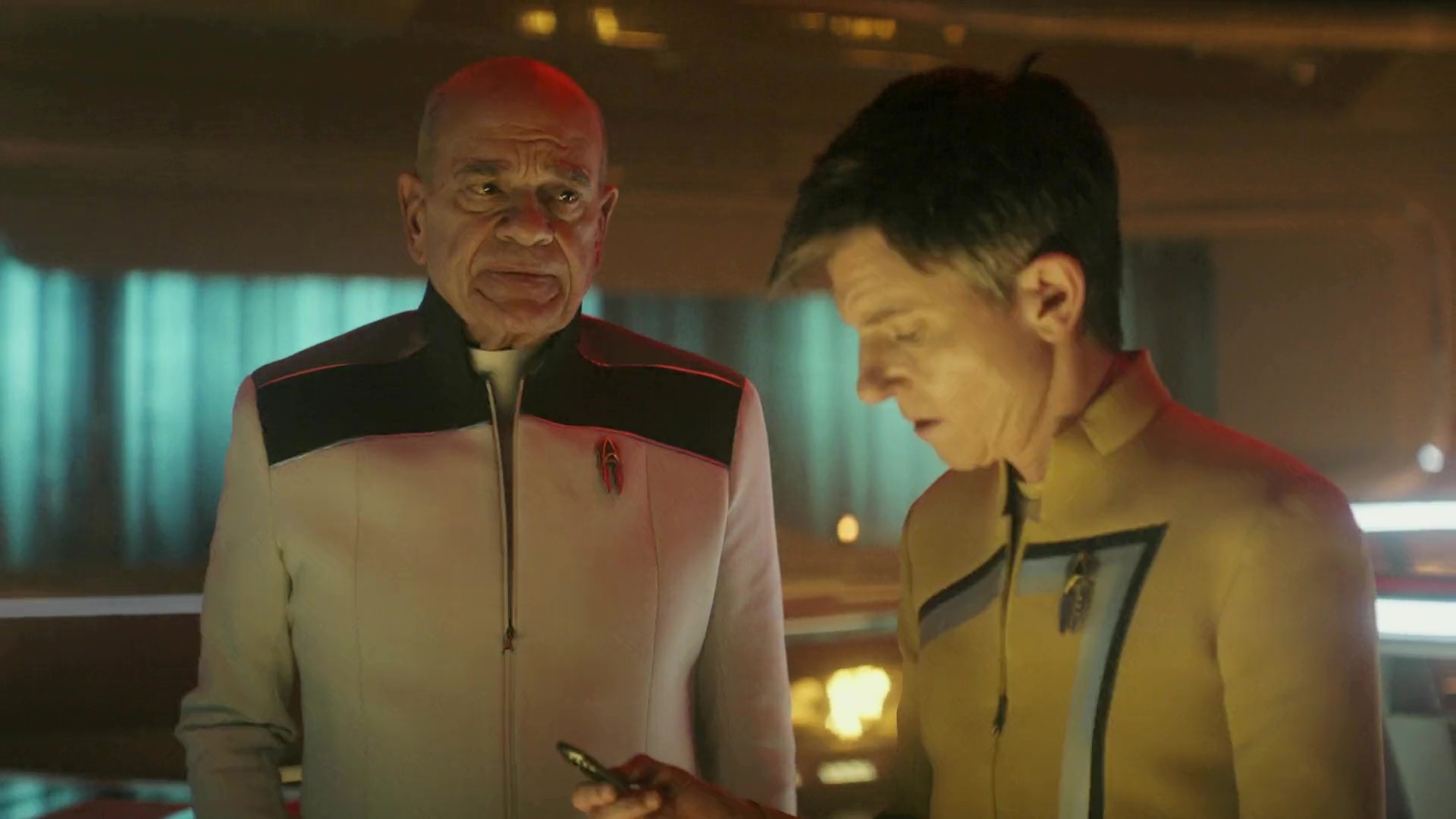
Stardate 869631.7: The whole Federation has been isolated by a layer of Omega-47 mines that are interconnected so that any attempt to break through would trigger their detonation and kill billions. Aboard the Athena, Anisha Mir is shocked to see Nahla Ake, the officer who once sentenced her to prison. But she agrees to create a diversion for Nus Braka. Ake still manages to hide the cadets from the sensors as Braka boards the ship. He decides to take Ake and Mir with him and orders the ship to be blown up. But the Doctor successfully creates a holographic explosion while the actual Athena remains intact. The ship, however, has no long-range sensors and no weapons. Reno and Caleb manage to restore the warp drive. The Doctor's program is damaged after his holographic diversion. He speaks in riddles, but SAM and Jay-Den discover that he has identified a method to stabilize the Omega-47 mines that he tries to communicate. Tarima works on finding the subspace frequency of the mines, and SAM develops the algorithm needed to control them. In the Sato Atrium, now under Braka's control, he stages a show trial against the Federation and against Ake, with Anisha Mir acting as both witness and jury. Tarima connects with Caleb to find out where his mother is. She guides the crew to the coordinates of the Atrium, where the Athena hides in a nebula while SAM continues working on deactivating the mines. In the meantime, Braka declares Ake, and therefore the Federation, guilty. But Caleb appears and demands to speak. He says that Starfleet is his new home. He and Ake also debunk the story Braka invented about the Federation killing his family, which causes him to lose the support of the Venari Ral. In revenge, he prepares to detonate the minefield, but the Omega-47 molecules are now stable. A Federation fleet arrives, and Braka and the rest of his people are apprehended. Caleb returns to the Academy.
Review
Caleb's reunion with his mother in last week's episode came with hints of a potential unsettling twist in the season finale, that his mother was secretly still working for Braka or that she might even be the mastermind behind the minefield. But the story of "Rubincon" plays it safe and this doesn't happen. I personally wouldn't have minded Anisha Mir turning out to be evil, as it might have added another layer of conflict and might have been an incentive for Tatiana Maslany to appear as Anisha Mir more often than if she is simply a loving mother with some Starfleet issues. I am convinced she would be a much better villain than Nus Braka. Another twist could have been that the minefield would not be brought down in the finale, and that the season would end with another cliffhanger, leaving it unclear if and when normal life at the Academy and in the Federation would be possible again. But I am glad that the story deals with the over-the-top threat so quickly, because the idea and execution was ridiculous in the first place and because it would not have suited the series to pit cadets against a galaxy-destroying villain for more than one or two episodes.
So regarding the two big expectations I had, the episode goes for something more straightforward and much easier to digest. I think we can say the same about the rest of the story, but not in a positive sense. "Rubincon" is full of standard plot elements without real surprises. It all starts out as hopeless, with Ake and Mir abducted and with the ship badly damaged and totally alone against a superior enemy fleet. But then, step by step, the situation improves because someone has a brilliant idea, has special abilities or because of pure chance. While this is how many Trek stories work, here it feels too much like paint by numbers, almost like a checklist rather than a smooth story. It often appears contrived and does not develop naturally. Things happen because plot.
Take the discovery of the method to stabilize Omega-47. The Doctor is glitching for some reason after acting as a holographic decoy, which already feels weak considering that the same happened to SAM only recently. He speaks in riddles and SAM and Jay-Den are desperate because they have no idea how to repair her dad. Okay, so two of the very few people on board focus on the Doctor, which is laudable. But when they realize after a while that they cannot help him, would it not make sense to deactivate the EMH and work on systems on the ship that can actually be repaired? Instead, the opposite happens. Genesis, who is in command at that moment, comes down - not to help with repairs but to provide moral support for SAM. That too may be laudable, but there are much more urgent tasks at hand for all of them. Also, rather than concerned about her dad, SAM has a problem because she now is so different than she was before her reprogramming. Then Jay-Den suddenly realizes, apparently just because SAM and Genesis have time to talk in their secret language, that the "glue" in the Doctor's gibberish might refer to gluons and that "Rubin-con" refers to the rubin crystals used to stabilize the Omega-47 molecule. Okay... So the storyline about the Doctor being damaged was basically created for a cheap wordplay (and for confusion about the correct episode title). We have to wonder anyway why the Doctor would suddenly come up with a solution. There were no signs that he could know it. Otherwise restoring him would rightly have been a top priority - but that would have ruined the surprise and would not have allowed the wordplay. And finally, suddenly no one is concerned any more that the Doctor is sick, and we are not shown how he is eventually repaired. It simply stops mattering, as the focus on certain themes while neglecting others is driven by the plot.
This is just the most obvious example, but other elements of the plot are developed in a similar way. Some parts are simply repetitive, like using the same trick of hiding from sensors from last week. Others strain credibility, such as the way Tarima "feels" the way to Caleb's mother like a medium, even though it is explicitly said not to be magic, which is clearly not true.
The show trial against Ake and against the Federation is tedious, and if it was meant to be a classic courtroom drama or perhaps a parody of one, it does not work. It is clear from the start that it is a total farce, staged by Nus Braka to exact revenge. But for some reason everyone takes it seriously, or at least pretends to. Ake keeps arguing even though it is obvious she will be declared guilty. In her case we could say she is trying to buy time for herself and for the Athena. She eventually gets her moment when she destroys the myth that the Federation attacked Braka's colony when he was a child (well, we may pretend she does, see the annotations). But this only happens after the "verdict" and only because Caleb appears. It only works because the mines have already been deactivated. Ake could not have known that this would happen. So it is successful in the end, but only with an enormous amount of luck. Still, I like how Ake not only exposes Braka's lifelong lie but also points out that he still has the temper of the child he was when his family died during the attempt to build a weapon.
Braka chooses Anisha Mir to act as his witness and judge, apparently expecting her to rule in his favor. And she does falter at times. Sometimes it even seems as if she hates Ake more than she hates the man who got her into prison, who tried to kill her son, who murdered many others and who now holds the whole galaxy hostage. It seems possible that she might side with him again. Does she really consider it, or is she simply playing along? We don't really know. She is the one character who doesn't get real closure in the episode, because in the end she simply has to accept that her son will stay at the Academy.
Most of the trial is very personal. It's about Braka, Mir and Ake. It is partly about the Federation, but not at all about the billions of people who are supposedly watching. Braka briefly mentions political demands, but he talks much more about revenge and offers no vision of the future at all, except perhaps anarchy. If he tried to prove anything to the viewers and it was meant to be propaganda, it was doomed from the start. What he really shows is that he puts his personal agenda above everything else instead of acting in the interest of his people. Braka is a terrible leader, if that is even what he wants to be. In fact, we so far have never seen him lead anyone at any point in the series. So although the trial is supposed to be political, it ultimately becomes nothing more than a madman's revenge show.
The Venari Ral who stand with him must have been aware of what Braka is like. Yet, they only leave once his supposed childhood trauma is exposed as a lie, as if that would suddenly change everything. That revelation realistically shouldn't have had a meaningful impact on them, so the plot point doesn't work for me at all. But somehow the story is intent on answering questions we never asked, with Braka's note about him playing tic-tac-toe in the sand being the worst example - they first give the villain a silly haircut, only to invent a "perfect" rationale to deflect the criticism.
Starfleet Academy, like Discovery, has a habit of choosing odd moments for conversations about feelings and relationships. I already mentioned Genesis, who finds time to support SAM emotionally even though everyone is needed to repair the ship and the Doctor. Reno's conversation with Caleb works better, since they are already working together on the warp drive. It feels more natural and includes some of the best lines in the episode.
Overall, "Rubincon" is moderately exciting only because the stakes are so absurdly high, while its arc of suspense falls flat compared to last week. It clearly plays things safe. There are no unexpected twists, interesting revelations or tragic outcomes, and everything is resolved neatly in the end. It is nice that every member of the regular crew and the cadets contributes something to bringing down the mines and defeating Braka, but it all feels too easy and not very organic. It feels like the story is simply trying to reach the intended ending of the season, giving everyone closure while ticking all the boxes. The episode does have a few enjoyable moments, and those moments usually happen when Braka is not on screen. I just cannot stand the character and his theatrical villainy.
The series had a rough start and was unfairly criticized even before it aired. I admit I was biased too, but I tried to watch every episode with an open mind instead of thinking "let's see how badly they mess this up this time". Still, one thing I noticed was that it usually became clear quite early in each episode whether I would like it at least a little or whether the rest would be difficult to sit through. Many SFA episodes ended up being consistently full of frustrations and annoyances. On the other hand, the series is at least episodic and did have a few small highlights.
The second season has already been filmed and hence will hardly benefit from viewer feedback. Hopefully there will still be some course corrections though. One positive thing about SFA is that, with the exception mentioned earlier, I have come to like the characters and the cast, both the older and the younger ones. While the stories and dialogue need improvement, the character work is generally quite good, even compared with earlier Trek series and certainly superior to Discovery's. The acting is fine, with poor Paul Giamatti doing the best he can in an ungrateful one-dimensional role.
Annotations
- Continuity: We can see the Doctor's holographic emitter for the first time in the series. It has been working for over 800 years.
- Nitpicking:
- The "design flaw" that a 0.029% increase of air pressure can be used to hide oneself from sensors was established last week and is taken advantage of again. This is totally unrealistic because even the slightest movement in a room would cause greater fluctuations. Also, a 0.029% increase is said to induce dizziness. Seriously?
- It is one thing to create the visuals of an explosion. But the Venari Ral ships have sensors that would register evidence of a real explosion such as a shockwave and all kinds of radiation, for which to fake, well, the Doctor would actually have to explode.
- The Venari Ral fire their weapons, so often that they expect the already crippled Athena to explode. But this apparently doesn't do any further damage, although the shields were previously mentioned to be down. Does the Doctor's holographic decoy also act as a shield? I doubt it.
- The Venari Ral use grappling cables? A technology that is outdated for about 900 years?
- The first time Tarima entered Caleb's mind in "Come, Let's Away" she stumbled across a hidden childhood memory. How in the world can she find his mother reading his mind? It's explicitly stated not to be magic, but it is.
- It is a key plot point that the red fire in the sky Braka saw as a child was caused by ignited strontium mined in his colony and not by Federation weapons. Ake and Caleb claim that Federation fire, "at least for the last few hundred years, has always been blue or green." But there are many examples in Discovery of red weapon fire. Maybe they silently refer only to shipboard weapons, rather than to hand phasers, and they also silently exclude the Discovery. But it is stated and understood as an absolute truth, which makes it wrong.
- Ake argues that Starfleet developed Omega-47 as a power source, not as a weapon. But Vance stated in "Come, Let's Away" and once again in "300th Night" that it was indeed a weapon development. Ake may be lying for tactical reasons but she shatters the credibility of the Federation.
- Remarkable quote: "Leap clear of all that is corporeal... and make yourself greater." (Ake's cue to the Doctor to act as a holographic decoy)
- Remarkably cheesy quote: "I think I have to pee." (Genesis, as she takes place in the captain's chair)
- Remarkable fact: The USS Discovery was considered an option, but even a spore drive jump could have triggered the mine network.
- Remarkable credits: This episode doesn't have the usual cheerful opening credits with music but simple title cards. The end credits are accompanied by child photos of the main and regular guest cast.
Rating: 3