Star Trek: Strange New Worlds (SNW) Season 4 Reviews
Season 1Season 2Season 3Season 4
Valles MarinerisThe Griffin IncidentHuman Best FriendA Case of ChiaroscuroLevel-Five Transporter AccidentOff-HourLike Chronitons Through the HourglassOrders of MagnitudeOnce La'an a TimeTomorrow's Enterprise
Valles Marineris
Synopsis
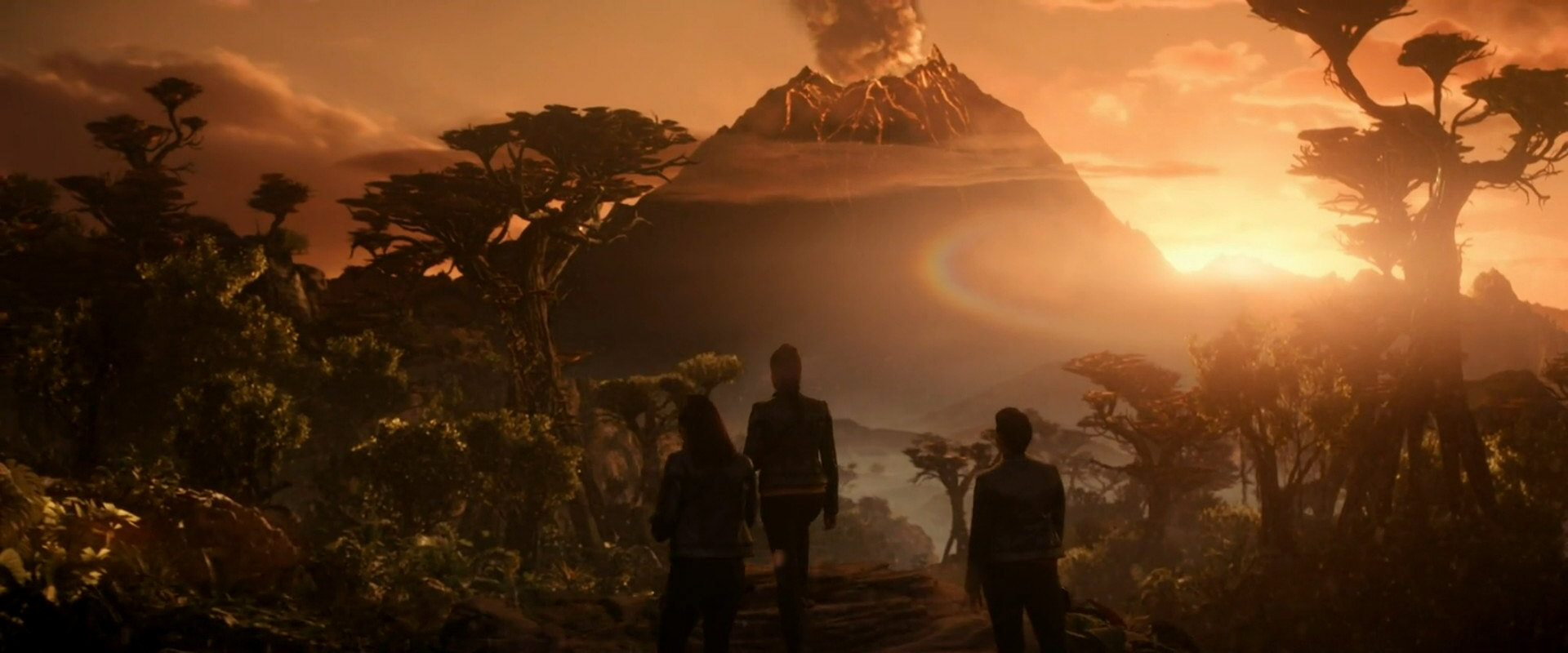
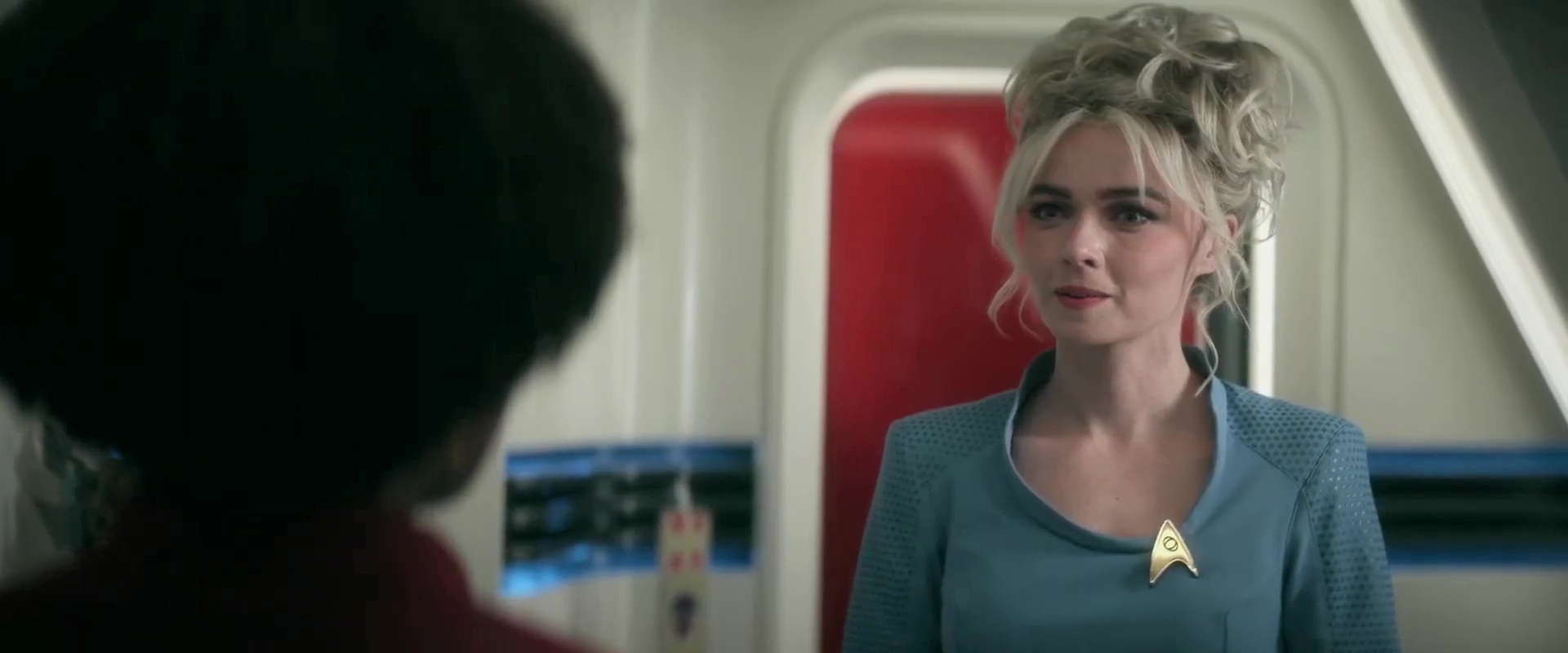
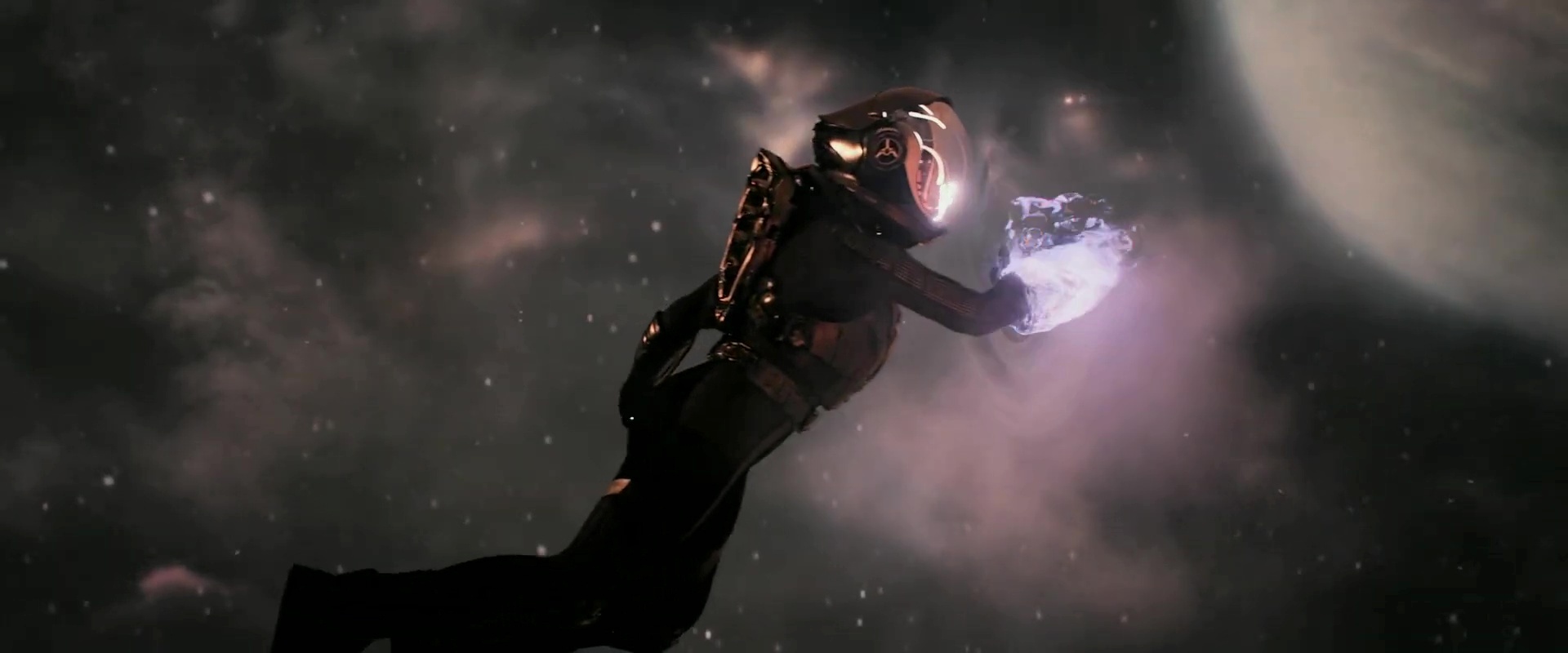
Stardate 2492.5: After completing a routine mission on Tulaxar, Admiral April offers Pike a promotion to the rank of commodore, which the captain says he will consider. The Enterprise investigates a rare interstellar squall, a phenomenon involving extreme distortions of space-time. The crew receives a distress call from a Starfleet buoy inside the anomaly. Pike orders the Enterprise to enter, but the ship quickly loses power and becomes trapped. With main power offline, the crew determines that they need iridium to restart the ship's engines. Sensors identify a nearby M-class planet containing the required element, and Una, La'an and Erica take a shuttle to retrieve it. The planet turns out to be a primordial world populated by strange creatures. While the landing party searches for the iridium, the Enterprise is ensnared by an alien vessel using energy tendrils. Its commander, a humanoid woman named Cassell, comes aboard and demands that the powerless ship be surrendered as a prize. Pike tries to convince her that cooperation is a better idea. Spock eventually determines that they have been displaced in space and time: they are in the Sol System 65 million years in the past. The planet where the iridium is located is Earth. Cassell reveals that her people are Martians, who have been fighting a desperate war against the Dol'drm. When one of the enemy ships crashed on Mars, they carved away a vast section of the planet's surface to contain it, creating what will one day be known as Valles Marineris. She steals one of the Enterprise's antimatter power cells after discovering that Pike has concealed the truth about the ship's origin. On prehistoric Earth, Una, La'an and Erica make their way through dinosaurs before recovering the iridium they need inside the wreckage of a crashed Dol'drm spacecraft. They take it to the Enterprise, allowing the ship's systems to be restored. The Enterprise pursues the Martian vessel as it prepares to destroy the fifth planet of the Sol system in a suicide attack, using the stolen antimatter. Pike initially orders an interception, but then realizes that this planet no longer exists in his own time. He calls off the attack, allowing history to unfold as it always has. The planet explodes, forming the asteroid belt, while one massive fragment strikes Earth near the Yucatán Peninsula, causing the extinction of the dinosaurs and paving the way for the evolution of humanity. Mars shifts its orbit and becomes a barren world. As the resulting shockwave reaches the Enterprise, Spock concludes that its energy can propel the ship back to its own time. The ship returns to the present, where the crew reflects on having ensured humanity's own existence. Pike mourns the fate of the Martians, but M'Benga notes that he took samples of their DNA, confirming that it appears in many later species. La'an notices unusual changes in herself and suspects that some of her dormant Augment genes may have been reactivated. Pike declines the promotion, realizing that his place is aboard the Enterprise. Instead, Una Chin-Riley is promoted to commander.
Review
Four years ago, Strange New Worlds began as the series many Star Trek fans had been asking for. After the serialized storytelling of Discovery and Picard, it brought back standalone weekly adventures and returned to a lighter tone, even though it also played fast and loose with canon and redefined established characters. The series was willing to experiment from the start. Season 1 only dipped its toes into different genres, but season 2 embraced them more enthusiastically with a sitcom, a partially animated crossover and a musical. Season 3 pushed that formula even further, with every other episode relying on gimmicks or self-awareness. For me, that trend reached its low point with "Four-and-a-Half Vulcans", which I found unbearable.
The people in charge were clearly aware that not everyone appreciated this direction. Although season 4 had already been filmed, they promised the show would become "more serious". Later, they softened that wording to "fewer big swings", a phrase that entertainment outlets kept repeating almost like a reassurance to disappointed fans. At the same time, the season 4 trailers carefully avoided showing the crew's transformation into Muppets, even though it had already been confirmed for episode 5. But that's not even my main concern. I don't mind genre-bending when it isn't an end in itself or an excuse to deliver cheap gags, which I think was the problem with season 3's "big swings". My question is whether there will still be substance beneath the stylistic experiments. And although I have given up hope that canon will ever be more than something to play with, the least the writers can do is let our characters simply have adventures instead of constantly constructing stories whose primary purpose is to tie into TOS, often only to contradict it in the process.
So what does the season premiere "Valles Marineris" have in store? More of the same kind of "big swings", or a return to something that feels like classic Trek? Actually, neither. Or both? My first reaction: what a rollercoaster ride of an episode!
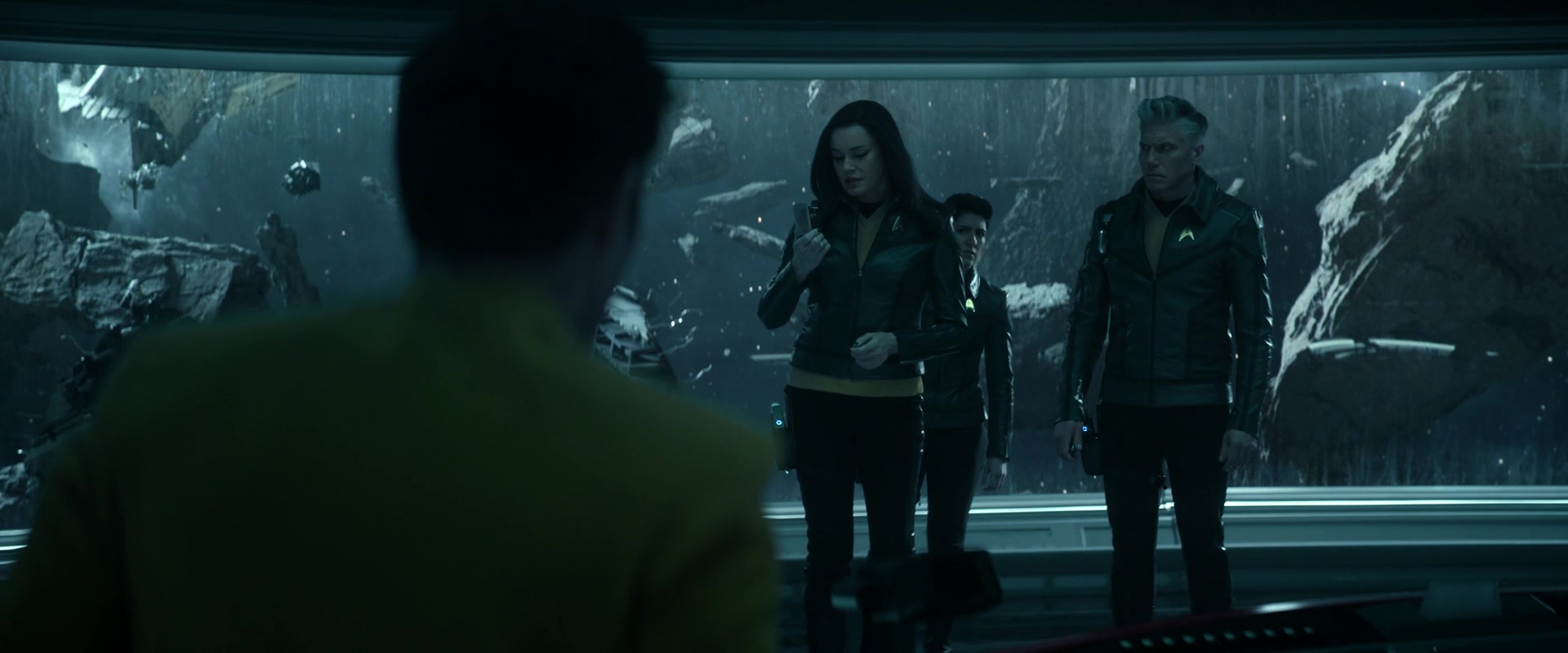
It starts off in a rather routine fashion. The whole sequence with Pike and his team riding horses lasts only about two minutes, and we never learn what the mission is about beyond delivering some medicine to a planet. But that doesn't matter anyway in the following. It is simply a pleasant opening for the new season, with no further relevance except to show that our captain enjoys riding, as if we didn't already know that. In fact, he lingers a little longer than originally planned because he enjoys it so much. At this point we have no idea where the episode is heading, except that it will have no further horses. The title itself turns out to be something of a red herring. The landscape where Pike, La'an and M'Benga are riding looks Martian, yet the floating rocks make it obvious that this is an alien world. So this is clearly not Valles Marineris after all, even though the title encourages us to think about Mars. We will actually see Mars later in the episode, but not as we know the planet.
Pike is still mourning the loss of Batel, and we learn that he has spent the past six months on routine assignments. It serves as a brief wrap-up of the previous season, although it feels more like skipping over those six months because it wouldn't have been interesting. A lot may have happened during that time, even if the missions themselves are labeled as routine. Admiral April then offers Pike a promotion to commodore, and the captain seems to consider it. In the end he decides to remain on the Enterprise because he realizes that this is where he belongs. But I don't think the mission itself really changes his mind. The small promotion subplot feels tacked on. It could easily have been omitted without affecting the story in any meaningful way, so it doesn't really convince me.
There are a few other bits of setup as well. Scotty keeps teasing Ortegas, and she happily gives as good as she gets. The banter continues throughout the episode, but for now I have no idea where it is leading, or whether it is leading anywhere at all. I could do without it. We are also introduced to a new Vulcan cadet. She represents the familiar ENT-type of her species, not only reserved but also arrogant by human standards. Uhura struggles to establish any kind of connection with her because the cadet has no interest in doing so. This feels a bit more like groundwork for a future storyline, but remains more like a nuisance for now.
The Enterprise then runs into what looks like the usual space anomaly of the week, without me anticipating it would become something far bigger. Everything that happens at first is pretty standard. The ship encounters a mysterious phenomenon, there is of course a reason to fly into it because of a distress call, and naturally the ship gets trapped. Pelia has already mentioned that space-time fluctuates wildly inside the anomaly, so "time" is the decisive clue. The moment the crew picks up a Starfleet signal, it is easy to anticipate that it originates from the Enterprise itself at another point in time, much like the setup in VOY: "Parallax". Up to this point, everything feels a little too familiar. The ship loses power, gets tossed around inside the anomaly, and the VFX team clearly had fun creating the spectacle. It all looks impressive, but so far it is not particularly exciting.
Things become more intriguing when the ship suddenly finds itself near three M-class planets. In order to obtain iridium for the ship's engines, a shuttle is dispatched to one of them, a primordial world inhabited by giant creatures. From the season trailers we already know these are dinosaurs. Also, Paramount had announced that the episode involved traveling 65 million years into the past. We all know what happened to the dinosaurs 65 million years ago, so from the very beginning it is obvious that the landing party has arrived on a beautifully animated prehistoric Earth, leading up to a story that, at this point, I was tempted to label "Jurassic Trek" (if it weren't actually the Cretaceous Period). The question that remains unanswered (until the end, BTW) is why the Enterprise has suddenly ended up in our own solar system. Because destiny? And then there's another elephant in the room: three M-class planets? Last time I checked, the Sol system only had one. That exact number, however, will become important later.
An alien vessel appears and captures the Enterprise with what looks like a giant energy tractor beam in the form of tendrils. To me, that visual is more silly than threatening. Modern Star Trek is oddly obsessed with tendrils and tentacles, whether as physical objects or energy effects.
Fifteen minutes into this hour-long episode, the opening credits finally roll. After the break, Pike first communicates with the alien commander by audio only. The crew assumes the aliens possess only impulse drive and concludes that handing over the Enterprise would violate the Prime Directive. Honestly, at this point I think the Prime Directive should be the least of their concerns. These aliens are trying to seize the ship by force and clearly possess technology far beyond anything primitive, regardless of whether they have warp drive or not. The whole argument feels rather forced. Then several revelations arrive in quick succession. Spock confirms that they have indeed traveled 65 million years into the past. The shuttle is on Earth, exactly where we expected it to be. And the mysterious aliens reveal that they originate from the fourth planet of the solar system: Mars.
Martians. They are actually Martians. No kidding.
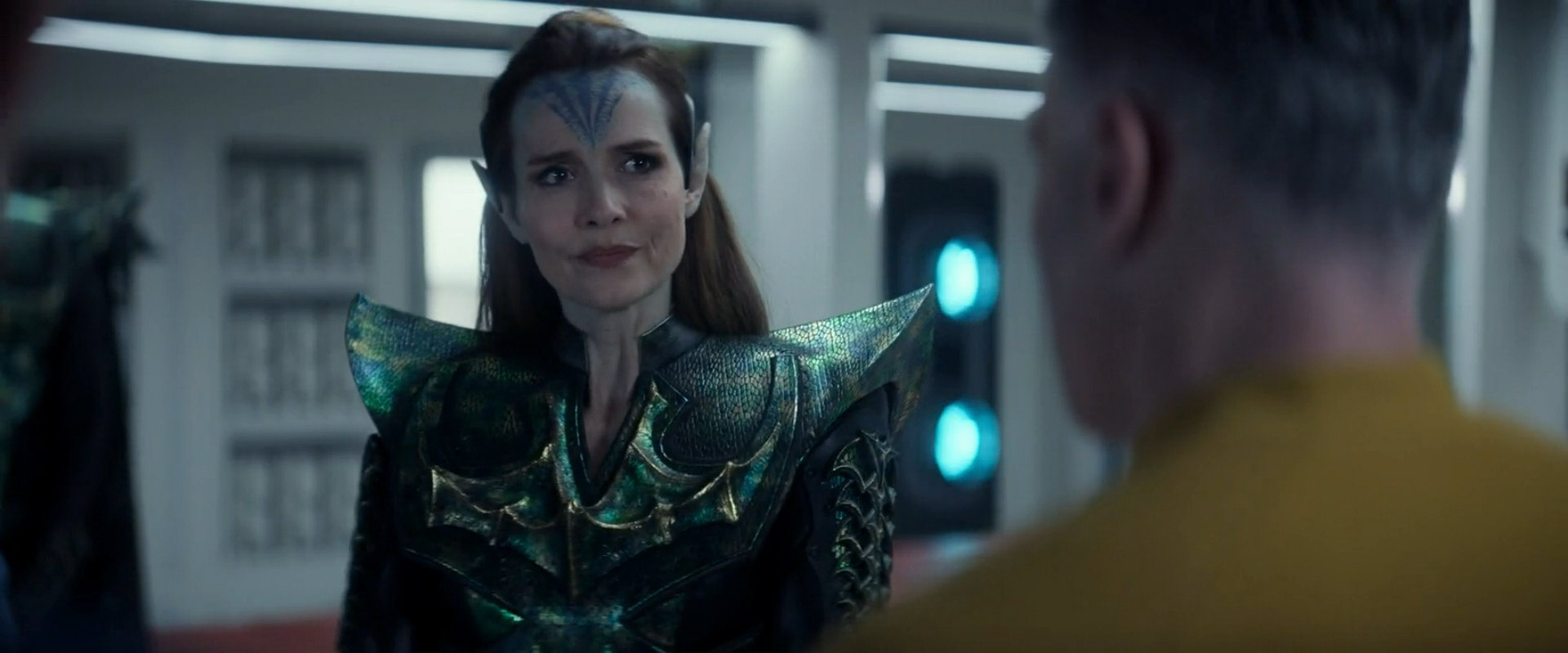
Naturally, I was torn. Martians are an obsolete concept from the dawn of sci-fi. No one still takes them seriously. So what would Star Trek's Martians look like? The answer is... rather disappointing. Because they look like the Martians of 1930s pulp magazines, with facial markings, pointed ears and exaggerated shoulder pads. Instead of feeling alien, they come across as vintage - like in a "Captain Proton" adventure. For quite some time the episode borders on parody. This was definitely one of the rollercoaster's low points for me, because I simply found these Martians ridiculous. Sorry. We also learn that they can phase through walls, a convenient ability that exists entirely because the plot requires it. It sets up something in the sense of Chekhov's gun, but otherwise never really makes sense. Nor do we ever find out whether they possess warp drive. It briefly becomes a major issue, as already mentioned, only to be quietly forgotten because it turns out to be irrelevant to the rest of the story.
Meanwhile, on Earth, Ortegas, Una and La'an have made their way past the dinosaurs to get their hands on the iridium. By now it has been confirmed that this really is prehistoric Earth, complete with a T-Rex. They are not allowed to kill any of the animals because of the Temporal Prime Directive and the danger of the butterfly effect. Sorry, but I don't buy that. The butterfly effect does not care whether you kill a dinosaur or merely stun it. Any interaction with the past could potentially change the future, hence the name of the effect. Realistically, they could hardly touch anything without affecting history. I also don't like that the dinos are portrayed as creatures that our all-female landing party can easily stun or even chase off with a punch, joking about them rather than treating them as genuinely frightening.
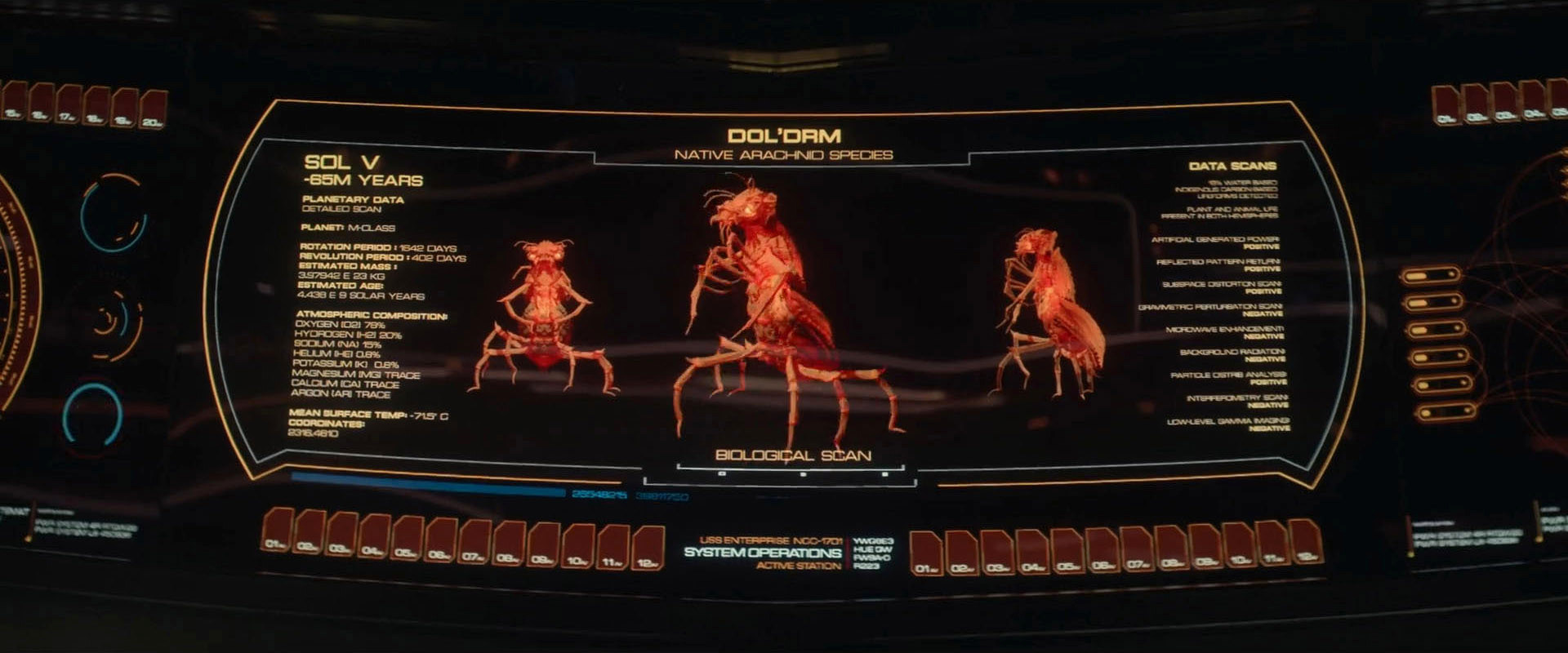
At the same time aboard the Enterprise, Pike explains the Federation to Cassell, the Martian commander, describing a future in which former enemies coexist peacefully. He suggests that the Martians and the Dol'drm might one day find a similar path. At this point I found myself wondering where the episode was going. Was this turning into a sermon? Of course Pike would say these things (much like he did in SNW: "Strange New Worlds"), but it goes on for several minutes without really contributing to the plot. And it becomes super awkward at latest with his attempt to explain what "carrot on a stick" means. We also learn how Valles Marineris supposedly came into existence. According to Cassell, a Dol'drm vessel crashed on Mars, forcing the Martians to tear away the surrounding landscape in order to contain it, thereby creating the enormous canyon. The Dol'drm themselves are said to be an unstoppable, insectoid enemy. It is an effective tragic backstory and explains the title quite nicely. More importantly, it foreshadows the episode's still larger ambition of entirely rewriting the history of our solar system.
Pike continues to show the Martians around his ship, discussing its technology and his ideals of peace. Naturally he does not reveal that he is from the future. But this creates another inconsistency. On Earth, everyone is obsessively careful not to alter history by harming a dinosaur. On the Enterprise, however, the Martians are allowed to inspect advanced Federation technology and learn about the future in considerable detail. By the episode's own logic, that should have vastly greater consequences than anything happening on the planet below. In this one regard, the reasoning simply doesn't work for me.
Meanwhile, Spock determines a theoretical way for the Enterprise to return to its own time. This is clearly another of the episode's many Chekhov's guns, carefully planted for later. In fact, the script generally handles its internal logic rather well. Almost every piece of information introduced along the way will become relevant before the story is over. And so Commander Cassell uses her unlikely phasing ability to pass through the Enterprise's walls and steal the antimatter fuel cell. I actually like that she still takes the time to speak with Pike instead of simply disappearing with it. Perhaps Pike's hospitality now pays off. She confronts him calmly, pointing out that despite telling her all those nice things he has not been honest with her. She has seen enough on computer displays to learn how humans measure time and to realize that they are from 65 million years in the future. She has also discovered that her own homeworld Mars will one day become a barren wasteland. Cassell has a point, and she is anything but a conventional villain. In fact, I would hesitate to call her a villain at all. She is portrayed as compassionate, reasonable and willing to negotiate. The only exception is the Dol'drm. To her they are nothing more than destructive insects, enemies with whom no compromise is possible, even though Uhura demonstrates that the Enterprise may possess ways to communicate with them. That reaction is perhaps understandable, given everything her people have suffered.
Meanwhile, the landing party finally reaches the iridium deposit. They discover it in the form of a power cell in the wreck of what appears to be a Dol'drm cryo ship. The implication is that the insects intended to colonize Earth until the Martians shot them down, although the episode never explicitly confirms that. It is another piece of rewritten prehistoric history, an interesting touch, but ultimately not important to the plot.
When a smaller dinosaur attacks (a velociraptor I think), La'an has no time to draw her phaser and instinctively punches the creature instead. To her own surprise, it works. Later she concludes that some of her dormant Augment genes may somehow have been reactivated. Like the new Vulcan cadet and the ongoing banter between Scotty and Ortegas, this is another storyline that will likely continue later in the season. It also feels somewhat contrived. Since La'an was introduced as a descendant of Khan Noonien Singh, the writers apparently feel obliged to make something of it, to justify the heritage retroactively. Personally, I always found her interesting despite the backstory rather than because of it, so I could have done without this development. But we'll see where it leads.
And then comes the episode's truly enormous reveal. We have already established that the planet is Earth, 65 million years ago. We have dinosaurs and an inhabited Mars. And we keep in mind that there are three M-class planets in the Sol system. Clearly something even bigger is about to happen. Once the landing party returns with the iridium, the Enterprise is finally able to restart its engines using a spare antimatter fuel cell. The crew intercepts Commander Cassell's vessel, which is heading in a suicide mission for the fifth planet of the Sol system, another Earth-like world. Mercury, Venus, Earth, Mars... and then the fifth planet, exactly where we know there is only the asteroid belt today. The episode doesn't spell it out yet, presumably trusting the audience to put the pieces together. The Martians destroy the Dol'drm homeworld with the stolen antimatter. The result will be the asteroid belt.
I fully expected the interception of the Martian ship to fail. What still surprised me was how it fails. It is not because the Enterprise is too late but because Pike consciously decides to let it happen. He chooses to sacrifice an entire world, and presumably billions of Dol'drm, because he realizes that this event is necessary to preserve the future. This is what I customarily call a predestination phenomenon (rather than a temporal paradox). Everything was always supposed to happen this way. The Enterprise creates the Sol system as we know it by allowing its antimatter to be stolen. The destruction of the fifth planet creates the asteroid belt. Mars shifts its orbit, turning it into the barren world of the future. And one fragment strikes Earth at Yucatán, causing the extinction of the dinosaurs and making human evolution possible. All of it happens because the Enterprise followed its own distress beacon into the anomaly in the first place, another predestination event. Although predestination is a recurring concept in Trek (the first time was in TOS: "Assignment: Earth"), the one in "Valles Marineris" is amazingly ambitious regarding the complexity of its impact.
In terms of sheer scale, this is the arguably biggest story Star Trek has ever attempted to tell. The producers promised they would do "fewer big swings" in season 4. Yet this may well be Star Trek's biggest swing ever. The Martian civilization, the origin of Valles Marineris, the fifth planet inhabited by insectoids, the creation of the asteroid belt, the extinction of the dinosaurs, the evolution of humanity. It is difficult to imagine a more far-reaching story.
What starts as a run-of-the-mill space adventure gradually grows into something enormous. At the same time, I don't think the episode is entirely successful in getting there. Everything is meticulously constructed. The script successfully pieces the puzzle together in the finale. On a storytelling level, it is remarkably coherent, at least if we don't start to talk about the scientific plausibility. What doesn't work quite as well for me are the characters. Their actions sometimes feel governed by the needs of the plot and the dialogue rarely feels especially natural. I have a hard time putting my finger on exactly why. Perhaps I simply need another viewing.
In that sense, "Valles Marineris" reminds me of TNG: "The Chase". That episode also revolved around a single revelation with enormous implications for the entire Star Trek Universe. The difference is that "The Chase" presented its idea in a grounded (if somewhat bumpy) story, whereas everything in "Valles Marineris" is just big - perhaps too big for the characters to handle.
Of course, there are plenty of scientific objections. If advanced civilizations had existed in our solar system 65 million years ago, we should find traces of them. Perhaps not of the insectoid civilization on the fifth planet, but on Mars, in open space and possibly even on Earth. I also wonder how all this fits with other Star Trek lore, such as the dinosaurs that supposedly evolved into the Voth in VOY: "Distant Origin". I would have to revisit that episode to see whether the two stories can be reconciled.
Yet scientific plausibility is not the key issue here. As a work of science fiction, the episode is bold and largely internally consistent. It also turns into an unexpected collection of genre crossovers. It begins almost like "Western Trek" with Pike on horseback. Then it becomes "Star Trek meets Jurassic Park". The humanoid Martians make it feel briefly like "Star Trek meets My Favorite Martian". The crashed Dol'drm vessel evokes "Alien", while the seemingly unstoppable insectoid enemy recalls "Starship Troopers". I wouldn't know any Star Trek episode to have blended so many familiar science-fiction ideas into a single story.
Overall, the Martian design still strikes me as rather silly and character interactions are not always convincing. The resolution, for better or worse, is totally over the top. But the central story is surprisingly well constructed and leaves me with plenty to think about. The ethical implications of the time travel are only partially explored, often overshadowed by other questions or simply glossed over. In the end, the whole affair is swept under the rug - in the usual way DIS and SNW love to rewrite history on a grand scale only to pretend they didn't. Still, this is an episode people will still be discussing years from now. For that ambition alone, despite my reservations, it deserves seven points.
Annotations
- Nitpicking:
- The question was asked, but it remains unexplained why the ship ended up in the Sol system of all places.
- Una sets her phaser to stun, expecting that it would work on a T-Rex, as if this would require the same amount of energy as stunning a humanoid. Strangely enough, the story proves her right.
- For some reason, the Temporal Prime Directive applies to the actions of the landing party on prehistoric Earth, but not to interactions with the Martians.
- The Martians need only one hour to turn a regular antimatter pod into a weapon that is capable of blowing up a whole planet. If they are so powerful, warp core breaches should realistically destroy a lot more than "only" a single ship.
- Remarkable quote: "If they were settlers, I'm not sure if I should feel sad or... relieved." (La'an, about the dead Dol'drm in the ship wreck on Earth)
- Remarkable scene: When Pike speaks of being alone, the translator uses the Martian word for "widower". Cassell condoles, and Pike doesn't contradict when he learns why.
Rating: 7
The Griffin Incident
Synopsis
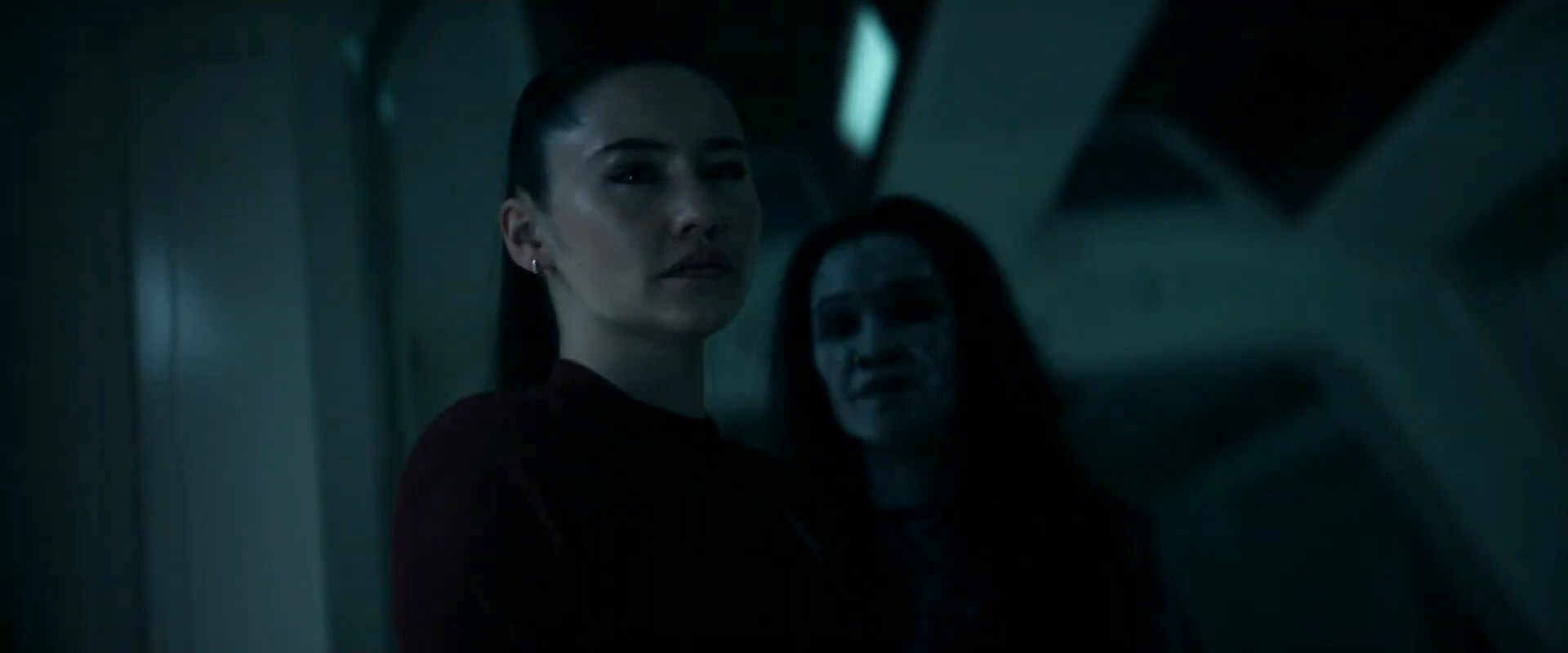
Stardate 2903.9: Jim Kirk, La'an and Spock are traveling on a shuttle when they detect a faint signal coming from a debris field. There they discover the USS Griffin, a Starfleet vessel that has been missing for nine years. They beam aboard to investigate. Spock inadvertently restores power to the ship, leaving them with one hour of life support to uncover what happened. The Griffin is eerily deserted. There is no sign of the crew, no evidence of an alien intruder, an epidemic or any other obvious catastrophe. Soon, apparitions begin to manifest throughout the ship. In sickbay, Spock encounters T'Pring, who seems completely real. La'an is haunted by visions of Security Chief Rose Harper, who appears to have been the last surviving officer. Kirk, meanwhile, hears the voice of his infant son David. Their investigation reveals that increasingly erratic behavior spread among the crew until they turned on one another in a frenzy of violence. Harper was unable to prevent the massacre, in the course of which most of the crew was beamed into open space. After their shuttle has been destroyed, Kirk tries to send an SOS. When Pike, Una, Uhura, Erica Ortegas and Sam Kirk arrive to rescue the stranded officers, the situation rapidly spirals out of control. T'Pring turns against Spock and attempts to kill him. Sam begins suffering terrifying visions, and Jim struggles to keep him calm. Overwhelmed by the apparitions, La'an loses control over her actions. Pike and Una descend into madness and begin injuring themselves. On the bridge, Kirk watches helplessly as Sam is sucked into space when the window shatters. He escapes into a corridor where he is stabbed by La'an. In sickbay, T'Pring once again prepares to kill Spock, but he regains his emotional control through a disciplined Vulcan meditation, causing the apparition to vanish. At the last possible moment before she can kill him, Kirk and La'an are beamed off the Griffin. Pike and his team were never actually aboard that ship. The true cause of the disaster on the Griffin remains unresolved, and the ship is turned over to Starfleet's mysterious Division 12 for further investigation.
Review
It takes "The Griffin Incident" only about one minute to fall back on a whole bunch of clichés. The first is that James Kirk is with our crew yet again. He is in every other SNW episode for no obvious reason. Then they are flying through a debris field, something that also happens several times per season. Next they discover yet another abandoned Constitution-class (or Sombra-class?) ship, which seem to be omnipresent. And, of course, we get the perhaps most overused Star Trek trope of them all: the dark and empty sister ship. It is immediately obvious that the rest will take place aboard the abandoned USS Griffin. Or, as Kirk puts it in an additional contrived reference: "Let's boldly go." That's not a particularly promising setup because it feels so thoroughly hackneyed. The beginning of "The Griffin Incident" is built almost entirely out of familiar genre conventions. But I was willing to give it a chance because the people in charge had been promising a legit horror story, and perhaps one in which the horror elements would be used wiser than in last season's zombie episode "Shuttle to Kenfori". I'm not the biggest fan of that genre, but if the horror is embedded into a believable Trek context, it can absolutely work.
Once Kirk, La'an and Spock board the Griffin, the first signs of a conventional haunted-ship story appear. They encounter voices, mysterious figures, blood and phaser burns. The episode also uses the investigation to explore the personal lives of the three characters. Kirk begins talking to La'an about Carol Marcus and, inevitably, his infant son David. I was a bit bored after a while. The story drew a bit of suspense from the scary atmosphere on the ship, rather than from what actually happened. But about fifteen minutes into it, I was hopeful something interesting might still be coming up.
We then learn about Rose Harper, the Griffin's security chief, who (whether she really existed or not) is clearly intended as a mirror image of La'an. Harper grew increasingly desperate as the crew descended into madness. As per the log entries, their behavior became erratic until they began killing one another. And that introduces yet another familiar Star Trek trope. We've seen crews hallucinating, driven insane and turning on each other in TOS: "The Naked Time", TNG: "The Naked Now", TNG: "Night Terrors", DS9: "Dramatis Personae", ENT: "Strange New World", ENT: "Singularity" and several other episodes. The pattern is immediately recognizable. In fact, this is the moment when I realized there was probably little potential left in the story. Twenty minutes into the episode, and it was obvious where everything was heading. I turned out to be completely right about that, although I did not anticipate just how bad this whole thing would ultimately become.
Spock is now alone in sickbay, and this is where the apparitions really begin to take shape and become tangible. T'Pring is suddenly present, his ex-fiancée, or perhaps his future fiancée, depending on which angle we take. In any case, as T'Pring appears, it strongly recalls TNG: "Night Terrors", particularly the morgue sequence where the corpses begin to rise around Dr. Crusher. I don't mind that the same visual motif is used here. What makes this different is that T'Pring is consistently shown as completely real. She talks to Spock and interacts with him, and she seems genuinely confused, wondering why she is on the Griffin. The episode deliberately creates the impression that she has somehow actually been transported there. Of course, we know that cannot be true, but the writing increasingly deceives the audience.
Meanwhile, the shuttle is destroyed, eliminating the obvious escape route - another familiar plot device. The pattern of the apparitions also becomes clear. T'Pring appears to Spock, Rose Harper appears to La'an and the voice of David appears to Kirk. Each of them is confronted with someone they feel deeply connected to. In La'an's case, the episode emphasizes that Starfleet is her family, a point it states verbatim twice. This seems to make sense in the logic of the story. It is just not particularly interesting.
The plot, or rather what pretends to be plot, now becomes downright absurd. We know T'Pring is a hallucination or ghost, yet she functions as an active physical character. She helps repair the sickbay door. Even worse, we see events from her perspective, including a shot in which she stuns Spock and he is shown lying unconscious on the floor. It is presented in the exact way it would be done if T'Pring were physically present. I absolutely hate this kind of writing. I don't mind unreliable perception from a character's point of view, but I strongly object when the episode lies to the audience through supposedly objective scenes. And this won't be the last time "The Griffin Incident" resorts to that trick.
La'an, meanwhile, is surrounded by the crew members that Rose Harper couldn't save. They are essentially zombies, and Harper herself repeatedly reappears as one. We've already had zombies last season. I have never been fond of that kind of horror, and here it feels especially contrived.
The episode continues to revolve around the personal issues we already know from the three characters. Kirk is haunted by his inability to be with his family, La'an is consumed by guilt because Rose Harper could not save her crew and Spock is once again defined by his struggle between his human and Vulcan sides. That last point has become especially repetitive. We've already had "Amok Spock", "Charades" and "Four-and-a-Half Vulcans". We now get another iteration of the same theme. And since SNW is fixated on his ears anyway, there is a slasher horror twist to it now. This time Spock cuts his own ear. Of course, we are shown how T'Pring does it, but in reality it is Spock harming himself. Because he's not Vulcan enough. Or suddenly too Vulcan? The story is not interested in providing a motivation. The sequence makes no sense and has no meaningful emotional impact. It is ultimately another cheap attempt to torment and humiliate Spock because of his mixed heritage. The episode lingers on the green blood and turns his identity conflict into a gore scene. I find that completely tasteless. T'Pring then tries to kill Spock, and not for the last time.
Next comes the arrival of the alleged rescue party. I never believed for a second that the real Pike, Una, Uhura, Ortegas and Sam Kirk would arrive only thirty minutes into the episode. It was obvious that they had to be illusory. The problem is that the episode once again presents them as fully autonomous individuals with their own consciousness, free will and independent actions. That is exactly the kind of writing I cannot stand. Showing hallucinations is one thing, but portraying them through an objective lens as if they are genuinely real is an inadmissible trick to mislead the audience.
La'an has lost control in the meantime. The episode ties this into the recent storyline about her ancestry, her fear that there is something fundamentally wrong with her and the implication that she has inherited something dark from Khan. She beams the fake Ortegas into the transporter buffer, but the story never provides a reason for why she does it. In fact, it provides no explanation for anything that happens aboard the Griffin. There are no rules about who is real, who is an apparition, and whether the apparitions (or even the real characters) are acting independently.
Without rules, everything is free to descend into chaos. George Kirk is sucked into space when the bridge window shatters. Jim Kirk escapes, only to be stabbed by La'an, who has by now succumbed completely to whatever force is present aboard the Griffin. What she does makes no sense because so far she was obsessed with saving everyone, and now she is about to kill Kirk instead, in full "Event Horizon" mode. Perhaps because Harper did the same. Who knows. I honestly don't know why I still care. I'm apparently supposed to enjoy this pure exploitation without asking questions. And not only the action is tasteless, but also the verbal support that La'an provides for herself as she sets out to finish Kirk. She mentions prophetically that David will also be stabbed to death, in a remote corner of space. This foreshadowing is so disgusting, I still can't believe she really said that. Meanwhile in sickbay, T'Pring attempts to kill Spock again, after Una has slashed open her abdomen and Pike has cut off his own fingers. By this point, the episode has become so grotesque and dumb that I found it almost impossible to finish, much less to see any merit in it. Even though one might argue that this is what horror is made of, the genre crossover totally fails because it has nothing to counterbalance the unsavory elements. Nothing still reminds me of Star Trek, other than familiar characters that are thrown into a mindless slasher movie.
In the end, Spock, La'an and Jim Kirk are rescued. Of course they are, and no one else, because they were the only real people aboard all along. No surprise here.
And then comes the resolution. There isn't one. Division 12 will take care of it. That's it.
I often criticize Star Trek when rationales for weirdness are weak or clichéd, whether it is an alien virus, a telepathic influence, a holodeck malfunction or some other familiar device. But "The Griffin Incident" does not even attempt that. It simply ends without providing any explanation for what happened aboard the Griffin.
What makes it even worse is that after the rescue there are still about ten minutes left, and this time is spent almost entirely on aimless conversation. Chapel tells Spock a story that has no significance, except that someone in the writers' room felt they should talk. Pike tells La'an a ghost story, which feels awkwardly inappropriate after what she's been through. Kirk talks to Uhura, who prophetically reassures him that he will be fine in the future, in another one of those hollow TOS callbacks that Akiva Goldsman keeps pushing so hard. But she calls him Jim, which she will never do in the future. It is all filler. The episode even cuts away just as Kirk is about to call Carol Marcus, which might actually have been one of the very few genuinely interesting scenes.
In an afterthought about the character development, as already mentioned we get another round of Spock's identity crisis, a conflict that has already been explored exploited ad nauseam. Well, Spock rediscovers logic (and I fully expect he will break up with La'an because of that). In order to find some merit in it, we may argue it serves to set up Spock the way he will be in TOS, but I bet we haven't seen the last of "Emo Spock" in the series. And even those who enjoyed it should ask themselves whether they want to read "Spock returned to logic after cutting off his ear in an inexplicable delirious state" in his biography. Kirk, meanwhile, finds strength by thinking of his family. His is the only character arc that gains any new dimension, contrived as the references to the future may be. On the other hand, we get the destruction of La'an's character. I honestly cannot describe it any other way. She is the one who completely loses control and nearly kills Kirk, and the episode's implicit explanation is essentially, "You have bad genes, and you couldn't control yourself." In contrast to Spock and Kirk, she is simply portrayed as someone who can't resist the darkness within her because she is an Augment. That's an insensitive direction for the character (although it likely serves a purpose and prepares for her departure from the series). I liked La'an before this episode.
So, what are we left with after "The Griffin Incident"? The setup entirely consists of familiar Star Trek clichés, but this is one of its smallest problems. The episode is well crafted from a technical standpoint. At times, it gave me the creeps the way it was meant to. But that was increasingly overshadowed by countless extreme annoyances. There is no recognizable plot, just sequences of horror clichés. The episode exploits the characters' back stories, rather than further developing them. It also indulges in tasteless body horror: ears being cut, fingers being severed, blood everywhere. None of it has any emotional weight. It's shock value for its own sake. Then there's the constant cheating. "The Griffin Incident" repeatedly presents illusions as fully real, autonomous characters acting independently in objectively framed scenes. It's not just that the characters hallucinate in-universe. The audience is deliberately deceived through dishonest storytelling. I found that incredibly frustrating. In the end, nothing is resolved. Everything about the Griffin remains a mystery. No explanation, no revelation, no twist, no afterthoughts. The writing simply refuses to provide any form of payoff.
I know many fans liked it. But I honestly cannot remember another recent episode that annoyed and disgusted me this much, perhaps not even "Four-and-a-Half Vulcans" from last season. I found it unwatchable despite its good direction and technical merits. For me, this is unquestionably a zero-point episode. In fact, I am struggling with making that call because I have to revise my list of the ten worst Star Trek episodes again. I wrote at the beginning that horror is not really my genre, but my problem with "The Griffin Incident" is not that it's horror or that I don't understand horror. The problem is that it's all style with absolutely no substance. It is a meaningless, incoherent and unsavory spectacle wrapped in a Star Trek setting. Right now, I hope I never have to watch it again.
Annotations
- Continuity: The USS Griffin NCC-1067 is another Constitution-class ship that was lost, unless it is another Sombra class. It vanished with a crew of 300 nine years before the episode.
- Disturbing quote: "Your little boy is going to die... at the end of a blade at the edge of space." (La'an, under the influence of whatever)
Rating: 0
Human Best Friend
Synopsis
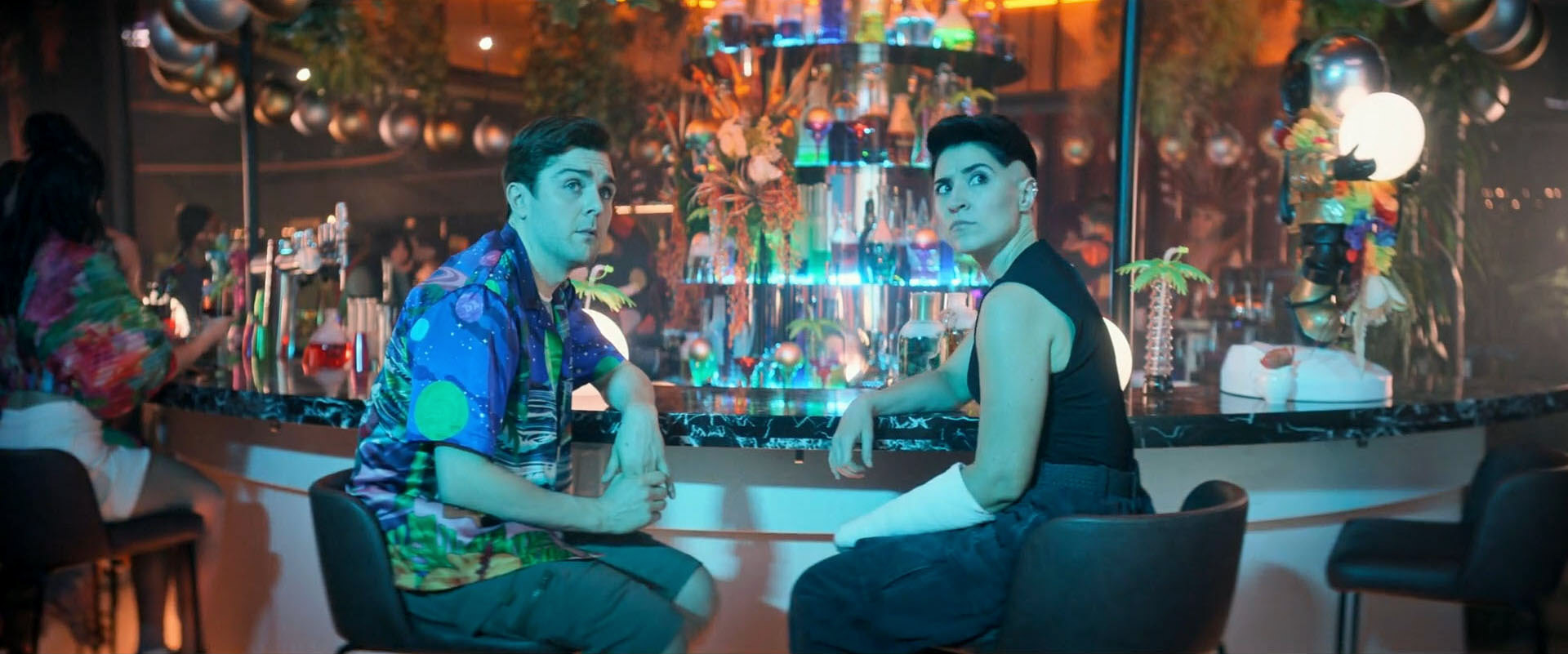
Stardate 2011.7: The Enterprise is en route to the Rodaxian homeworld for peace negotiations. As the crew has become increasingly stressed, Pike authorizes shore leave for Spock, La'an, M'Benga, Chapel, Uhura, Scotty, Ortegas, Una and himself. They take a shuttle to Cesnar Grand, a supposedly safe tech-free pleasure world whose atmosphere is said to have a mildly intoxicating effect. Ortegas and Scotty later wake up with severe hangovers and no memory of the past couple of hours. Ortegas apparently has a broken arm, Pike has disappeared and Spock is hallucinating that James Kirk is with him. As they search for the other missing crew members, they find Uhura partying, Una singing Klingon power ballads in a bar, M'Benga working as a bartender and Pike getting an elaborate horse tattoo. The administrator of Cesnar Grand, Dendru, has left them an envelope with the message that the Rodaxian delegation will arrive in only two hours, and now they realize their shuttle is missing. Their attempts to find it are repeatedly derailed by the lingering effects of the planet's atmosphere. Scotty retrieves Uhura's tricorder but smashes it. Spock mind-melds with a plant, which intensifies his hallucinations. Scotty and Ortegas eventually locate La'an, who has transformed a relaxation course into a fierce anbo-jyutsu tournament, and recruit her help in fighting their way to the shuttle. After reaching the shuttle, Ortegas finds the missing isolinear key hidden in her cast, and she and Scotty successfully reactivate it. However, they are immediately ambushed and tied up. Dendru reveals that they themselves had instructed him to stop them from retrieving the shuttle, even by force if necessary. They gather the scattered crew, including Chapel, who is playing bingo with elderly alien women, and finally make it back to the Enterprise just in time for the Rodaxians' arrival. While the still intoxicated Pike welcomes the alien guests, Scotty and Ortegas repair the shuttle together and resolve the personal conflict that has been driving a wedge between them. They then discover a bomb hidden aboard. Scotty has activated its reactive casing, and releasing it will trigger the explosion. This was the reason they hid the shuttle while they were inebriated. With Spock's help, they fly the shuttle away from the Enterprise, and despite his continuing hallucinations about Kirk, he successfully beams them to safety moments before the bomb goes off. The Rodaxians witness the explosion and mistake it for a traditional ceremonial display honoring their delegation. The apparent diplomatic disaster becomes an unexpected success and the peace negotiations proceed as planned, while the saboteur is exposed and arrested. Meanwhile, Kirk tells Spock that he really was with him all along.
Review
So far, season 4 has been no less gimmicky than season 3. "Valles Marineris" may be labeled "Jurassic Trek", although reducing it to the dinosaurs would be unfair. The episode was wildly over the top, but I found it immensely entertaining, even though most other reviewers apparently hated it. "The Griffin Incident", in contrast, was essentially "Gore Trek": empty, disjointed and increasingly disgusting. I had a hard time sitting through that mess, while most others seemed to enjoy it thoroughly. So these two latest excursions into different genres turned out controversial in an unexpected way. It came as no surprise that still another genre experiment was coming up, one that, judging from the preview photos and description, looked suspiciously like "Hangover Trek".
One thing I like about "Human Best Friend" is that the constant childish bickering between Ortegas and Scotty, which came out of the blue two episodes ago, actually turns out to have a purpose. It is not just there for comic relief. Scotty is insecure about everything related to piloting, while Ortegas cannot control her anger because of unresolved resentment toward her brother. The resolution is not particularly creative, but it is satisfying enough and gives their conflict some emotional grounding. I'm not even sure it is the episode's main theme because there's more going on, but their gradual coming to terms with one another is one of its few strengths.
As the episode begins, it is clear that Ortegas and Scotty are not the only ones at odds with each other, albeit for reasons that remain unexplained and that have little or nothing to do with what happened on the Griffin. Anyway, the entire crew is tense and irritable, which is deliberately exaggerated and immediately reminds me of TOS: "Shore Leave". I would have to watch that episode again because it's been a long time, but I think the basic setup is quite similar. "Human Best Friend" embraces an accordingly campy tone, such as with Dendru, the flamboyant administrator of Cesnar Grand, who feels like a TOS-style character. There are also direct references to The Original Series. Of course, we get a Tribble (because an episode like this just has to include Tribbles), a Mugato and even the strange alien dog from "The Enemy Within". With all these (too obvious) Easter eggs, the episode initially felt almost like a live-action version of a typical Lower Decks story. Regarding the campiness, I gave it the benefit of the doubt that it would not turn into another "Wedding Bell Blues", which descended into plain silliness. So I was still on board with the tone, while waiting for something more substantial to emerge beneath the surface.
The second act begins with Ortegas and Scotty waking up with no memory of what happened, which is presumably a reference to "The Hangover". I've never seen the movie, so I can't comment on any specific parallels. It's not exactly the kind of premise I would want for Star Trek, but then again, not every Star Trek episode has to be serious, so I was ready to go along with it. The part I'm not willing to accept is that the story is about hallucinations again. In particular, Spock spends the whole time hallucinating, almost as he did last week. It's the same thing all over again, only this time designed to be funny instead of gory. It is simply bad timing to put these episodes back to back. Even if they had been separated, I still wouldn't like it, but the repetition with the same idea turned in the opposite direction makes it worse.
Spock believes he is imagining Kirk, while Ortegas and Scotty try to figure out what actually happened: where everyone is, who took the shuttle and why nothing makes sense. The problem is that the comedy remains broad throughout, without real highlights or a major payoff. Almost everyone is out of character, as it happens so often on SNW. Uhura becoming the ultimate party girl is mildly entertaining. Una singing a Klingon version of "Total Eclipse of the Heart" (R.I.P. Bonnie Tyler) makes me smirk for a moment. M'Benga as an awkward bartender and Pike getting a horse tattoo are not even slightly amusing. I keep waiting for the episode to become genuinely funny, and it never does. Most of these scenes get at most a brief smile out of me and then move on.
It's good but doesn't save the episode that there is still a story underneath the surface (unlike it was the case last week). Ortegas and Scotty are not just stumbling through a comedy sketch. They are trying to solve a mystery, and they end up tracing a strange chain of events back to themselves. When they eventually find the shuttle, they are kidnapped. As it turns out, they themselves had instructed Dendru to keep them away from the shuttle no matter what they did, and to tie them up if necessary. That reveal is funny for a moment, precisely because it initially makes no sense. It makes a little more sense later, so there is at least some reward for all the weird things that happen during their "journey", just like the fake cast. Ortegas never really broke her arm but hid the shuttle's isolinear key inside it. There was a plan, arguably not a good one because they were inebriated, and the episode eventually tries to explain why they went to such bizarre lengths to hide the shuttle from their future selves.
We also get La'an terrorizing a formerly peaceful yoga class with her martial arts exercises. Unlike pretty much everyone else, she is not allowed to have fun for a change. Compare her with Una or Uhura, and the contrast is striking. La'an is always La'an. It reinforces the picture the series has been painting all along, but especially in "Four-and-a-Half Vulcans" and the first two episodes of season 4: La'an's Augment heritage resurfaces, and she becomes increasingly aggressive and power-hungry. As I wrote in my review of "The Griffin Incident", it is sad how they reduce her to a one-note potential villain. There is also no sign of her suffering from PTSD or other aftereffects of what happened last week. As much as I would personally prefer to forget that episode, the writers shouldn't.
The last major character I have not mentioned yet is Chapel, who spends her time playing bingo with elderly alien women until that also descends into chaos for reasons. Like the other character detours, this is not nearly as funny as it was probably intended to be. Pike ends up with a face tattoo, which is supposed to be a comic payoff, but I find it more cringe-inducing than amusing. The same goes for the scene in which he welcomes the Rodaxian delegation while he and the rest of the senior staff are still intoxicated.
When Scotty and Ortegas discover the bomb, the plot suddenly becomes serious but also absurd. Apparently there is no way for them to call for help, sound a red alert or contact security. The writing simply ignores all of that because it needs the two of them to solve the problem on their own, with support only from Spock, who himself receives help from an imagined Kirk to find the precise timing for the transporter beam that saves Ortegas and Scotty moments before the shuttle explodes. At least, the part with the message about the bomb whispered down the line, which arrived as being about an avocado, is genuinely funny, as unrealistic as the idea is.
Then we learn that Kirk has actually been there all along because he happened to be on Cesnar too. At that point, I felt cheated again, a bit as I did last week. Once again, the writing clouds reality and then asks us, besides accepting a totally incredible coincidence, to reinterpret what we were shown all along. Maybe I am supposed to go back and rewatch it to verify whether the real Kirk could have realistically been present and how he could sneak aboard the Enterprise. I'm not going to do that because I simply don't care. Kirk is there, hallucinated or not, because this series insists on bringing him into almost everything, and because the writers want Spock to confide in him and reveal his inner self to his new "human best friend". It is clearly meant to be an important step in their relationship, but it leaves me mostly cold. It is forced prequel storytelling all over again, something this series has relied on far too often. Perhaps it brings them meaningfully closer to the friendship we know from TOS. But do we need to see how they become best friends before Kirk takes command? My answer is no. I never asked for it, and I care little about it, especially as a storyline that takes time away from themes that could be more interesting than nostalgia bait.
The episode has a couple of clear TOS references, as already mentioned. And it also includes a bit about Scotty ripping off his finger, a very obvious nod to James Doohan losing a finger during the Normandy invasion in World War II. I don't think that a war injury should be turned into a joke. The reference feels especially out of place after the amount of mutilation we already endured in "The Griffin Incident". There are several more scenes that just don't work. Is there an explanation for why Scotty intentionally drops the tricorder, except that his intoxication serves an excuse for, well, everything? And why is La'an obsessed with Scotty's shirt as some kind of trophy? I also can't believe they actually show Ortegas as a cactus for a moment because Spock still thinks everyone is a plant. This is not funny but simply cringe. Is it also racist?
"Human Best Friend" is not unbearable like last week's "The Griffin Incident", but it shows our crew as a bunch of idiots throughout and ends up as infantile and embarrassing. It repeats some of the mistakes of that disastrous horror episode, especially the use of hallucinations and the way they are presented to deceive the audience. There is a small payoff in the Scotty and Ortegas arc. There are some more attempts to give the story some emotional weight, which all get drowned in forced comedy. Any deeper meaning is hard to find beneath all the silliness. The way the episode handles Kirk and Spock is particularly awkward. Whether that is the real Kirk or part of Spock's hallucinations hardly matters. Overall, the episode is clearly conceived as a conceptual stunt first and a story second. In the end, "Human Best Friend" is at least only normally bad, not insufferably bad.
Annotations
- Remarkable dialogue: "Lieutenant, I heard about the avocado." - "What?" - "The message you gave to Uhura, which she passed down the line. 'Palm, avocado bad, tell captain'?" - "I should've known that wouldn't work." - "Using reverse human logic, I deduced that you may have been referring to a bomb on board. Or just bad avocados. Either way, I am here to help." (Spock and Ortegas)
- Cheesy quotes:
- "My mind to your leaves. My thoughts to your root system." (Spock, mind-melding with a pot plant)
- "We are Starfleet officers, and as of right now, we are back on duty. Even if the world is on fire, no interruptions. There's too much at stake. - A steak sounds really good right now, doesn't it?" (Pike)
- "Formal hello. I'm USS Christopher Pike." (Pike, to the Rodaxians)
- "Everything's peachy. Formal peachy." (Una, to the Rodaxians)
- Remarkable scene: The Cesnar Grand commercial features TAS-style animations.
- Over-the-top set: We could already see in "Those Old Scientists" that the shuttlebay is ridiculously out of scale. "Human Best Friend" offers the best look at the set so far. With a clear width of the shuttlebay of some 50 meters plus corridors on both sides, the Enterprise would have to measure over 900 meters overall.
- Remarkable fact: Scotty crashed seven shuttles during his piloting class.
Rating: 1
A Case of Chiaroscuro
Synopsis
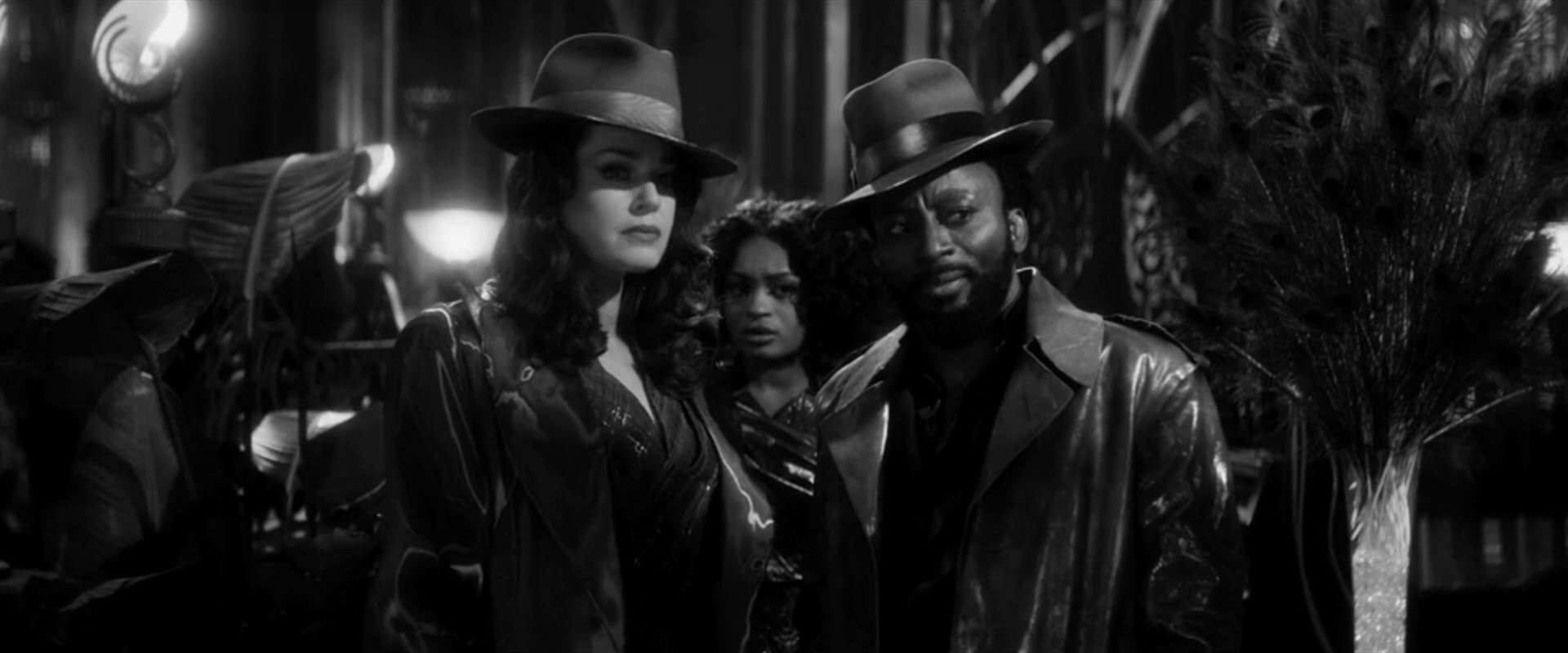
Stardate 2122.4: The Enterprise is sent to retrieve the Federation probe Angelo-1, which has overheated and shut down inside Klingon territory. To avoid detection, Una Chin-Riley, Uhura and M'Benga travel in a shuttle. The central star of the Mat'Aar system emits infrared blackbody radiation, which renders everyone unable to perceive color. When they receive a proximity alert because of a Klingon D7 cruiser, they have to land on the occupied planet Mat'Aar XII and blend in with the local population, who look human. Una is mistaken for a woman named Nevette by a man called Roman. The real Nevette owns a bar and appears to be a local resistance leader. Una is drawn into Nevette's life, including a confrontation with a woman who appears to be a traitor working for the Klingons. Before dying from poisoning, the woman gives Una the frequency of 34.6MHz. Kor, a member of the imperial family and governor of Mat'Aar, knows Nevette, who is working for the Klingons, putting the landing party in immediate danger. As they try to leave the city, they run into a Klingon control point where a civilian is killed. Uhura is arrested by the Klingons and interrogated by Kor. Una and M'Benga escape and meet Ja'lem, Nevette's bartender who is secretly working for the resistance. She herself is actually a double agent who publicly collaborates with the Klingons while secretly helping the resistance. Una and M'Benga search Nevette's office for her ID card. Una gains access to a hidden room through facial recognition and discovers that the resistance is developing an EMP weapon to disable the planet's Klingon shield and surveillance technology. They find the ID card, but they also discover Nevette herself, dead inside a cryogenic chamber. The question becomes who murdered her and now knows that Una is an impostor. Una and M'Benga suspect that 34.6MHz is the frequency on which the EMP detonator operates. They achieve Uhura's release by providing her with an ID card through Ja'lem. Uhura, meanwhile, has learned that the Klingons are about to seal the planet behind an impenetrable atmospheric barrier. Although they now have the means to escape, Una decides to help the resistance instead. She gets the detonator, but Roman reveals that he murdered Nevette and hence knows that Una is not who she pretends to be. During their struggle, Una secretly places the detonator in Roman's pocket. The device activates automatically when its carrier passes through a Klingon control point. So when Roman runs to report to the Klingons, he inadvertently triggers the EMP, which disables Klingon technology across the planet and leaves the orbiting D7 cruiser mostly inoperative. Having helped the resistance, the landing party departs and leaves Ja'lem to lead the movement. Meanwhile, aboard the Enterprise, La'an investigates a supposed tampering of the probe Angelo-1. She eventually discovers that Chapel deliberately altered the probe's records. She did so to conceal evidence that a medical ship had previously entered Klingon space. Once the shuttle returns, the Enterprise leaves the star system, and color vision is restored.
Review
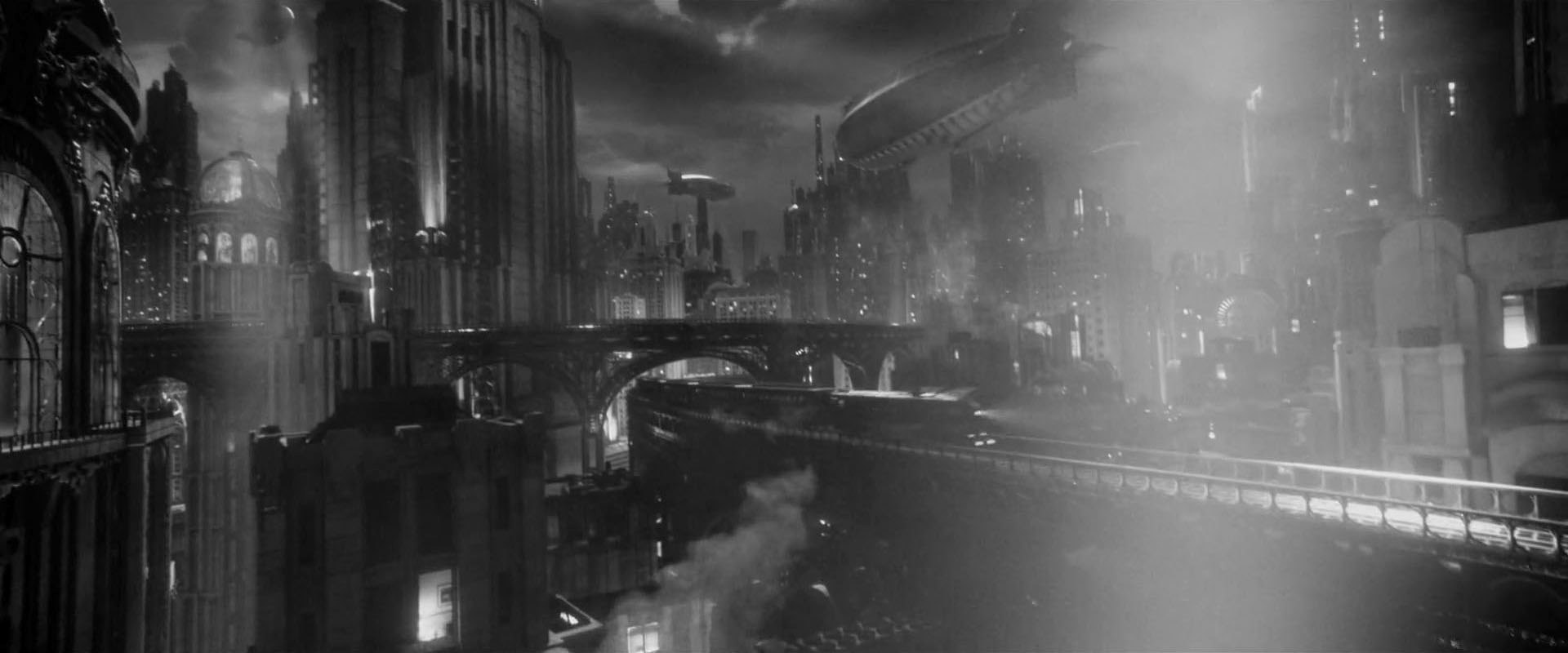
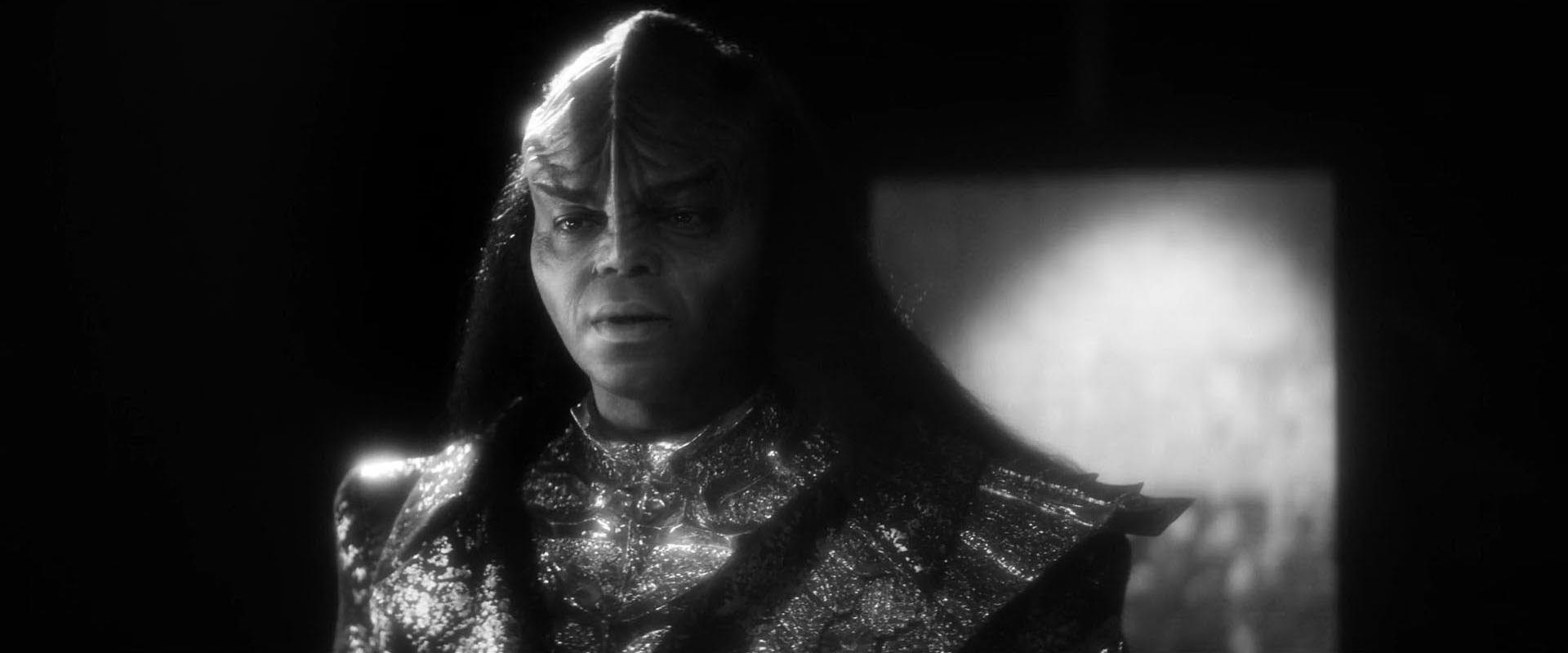
We are four episodes into SNW season 4, and there is still no sign of a normal Star Trek episode. Instead, we get yet another genre crossover, this time with film noir. "A Case of Chiaroscuro" is all in black and white, obviously as a stylistic choice rather than something that is relevant to the story. Well, we do get an explanation for why everything is monochrome nonetheless. The infrared blackbody spectrum of the central star in the Mat'Aar system somehow interferes with color vision. But infrared radiation is essentially heat, so how could it have such a specific effect on the human body? And how could it do so when the radiation is blocked, as through the shuttle's shields or aboard the Enterprise? This all doesn't make sense. We've already had an episode where impaired color vision was, in contrast, an important part of the story: the fan-produced "What Ships Are For" of Star Trek Continues. There, the explanation was that some kind of radiation affects the cones in the human eye with a lasting effect, making color vision impossible. It was integrated intelligently and actually mattered a lot to the plot. Here, the black-and-white effect is a mere stylistic device, gaining only a tiny bit of relevance when Uhura, posing as a native woman, speaks of the color green although she shouldn't know it.
The stylistic choices to turn this into a film noir episode go beyond simply taking away the color. The planet Mat'Aar XII looks just like 1930's Earth or like Earth's future as envisioned in "Metropolis", complete with expressionist skyscrapers, airships, elevated railways, vintage cars, cigarettes, trenchcoats and fedoras. Of course, we've had various parallel Earths in TOS, but there it was a budget limitation and the series tried to make some limited sense of the settings, with the notable exception of "Miri", where Earth's identical twin was simply lampshaded as an incredible coincidence. "A Case of Chiaroscuro" doesn't even try to justify why Mat'Aar XII, including its human population, is a perfect carbon copy of Earth (or of a fictional retrofuturistic planet). What many will probably see as a homage may just as well be labeled as a lazy creative decision that puts style before story. What I mean to say is that the concept to lean so heavily on TOS and on classic movies is lazy, even though the set design itself is excellent.
But there is still another elephant in the room - something else that we are expected to accept before we can get into the actual story. Una doesn't just resemble Nevette. She is identical to the secret resistance leader of the planet, so precisely that no one suspects anything and the face recognition in Nevette's office admits her. And as if that wasn't enough, she runs into a man that knows Nevette in the endless maze of streets in the cities on the planet. Uhura asks what the odds are of meeting one's exact doppelgänger - a question that remains unanswered and is probably supposed to be ascribed to fate. Only once we accept that ludicrous coincidence can we enjoy the story, but it is hard to get there.
The questions don't end here. Why doesn't Una deny she is Nevette? You are on an alien planet, you know nothing about that planet and you are mistaken for someone. Why would you play along without knowing the rules? Why would you want to attract unnecessary attention? There are two more important reasons not to do it. First, the only logical reasoning would be that she isn't an exact doppelgänger of an existing person. Second, the real person could appear at any moment. In this particular (unreasonable) case, both assumptions are not true, but Una has no way of knowing that. It therefore adds another layer to an already ridiculous coincidence. Overall, the landing party pretends to keep a low profile, but if we're honest, even before the conscious decision to help them they behave as if it's a good idea to have as much interaction as possible with the local population, which is obviously not a good idea, at least not under reasonable circumstances.
Another thing that bothers me is that M'Benga is an expert in everything. He knows how Klingon occupation works and how you deal with it. He recognizes Kor in a dim bar in black and white. He concludes that the woman who is apparently a collaborator died from the Borgia plant, which presumably isn't even native to the planet. Of course, he wants to give Uhura some security, but I really don't like how M'Benga is written in this episode. He seems to have an answer to any question.
As the story progresses, it gets better because the pieces begin to fit together. There are rewards for the viewer, and it becomes especially interesting when Una learns that the actual Nevette is dead. There is no longer a danger that the real person might return and expose her, but there is someone who murdered her and knows that Una is an impostor. Overall, the resistance storyline is a nice setup, especially as it keeps the loyalties and intentions of the various players uncertain. Yet it comes with yet another coincidence: Una happens to arrive on the planet just one day before the Klingons are going to close the atmospheric shield around it forever. So she not only happens to run into her exact doppelgänger's life, she also does so on a crucial day in the history of the planet. That is hard to sell, even though there are precedents in Trek's long history.
If we disregard that coincidence too, the rest of the plot works reasonably well. I like how Uhura, who has been afraid of the mission so far, keeps her nerve and picks up something in Klingon during her interrogation. I knew she would. When the Klingons are talking in the background in what later turns out to be a rare dialect and without being subtitled, it is obvious that they are saying something important that Uhura understands. Like many elements of the story, this is predictable, but it is not any less enjoyable because of that.
Meanwhile, there is a B-plot taking place aboard the Enterprise. La'an suspects that the probe was manipulated and thinks there are hidden messages. Spock tells her that he doesn't believe her, but she remains convinced that something is wrong. This continues the story of La'an becoming increasingly Augment-like, aggressive but also apprehensive, which is a continuation of a character direction I already don't care for. But even if I disregard that, the subplot is simply not interesting.
Eventually, La'an discovers that Christine Chapel has tampered with the probe. She removed recordings of a starship entering Klingon space because they would have damaged its captain's reputation, effectively concealing the incident as a favor to her. I find this conclusion particularly unconvincing because Chapel is suddenly an absolute expert in hacking, data manipulation and encryption, all without anyone noticing. Even La'an, who only has a hunch and no proof that something is wrong, is made to believe that she is imagining things. I also object to Starfleet being all about cover-ups once again. Everyone is covering up something for everyone else. It has become a tradition in the Discoverse, starting with Discovery and continuing with Pike, who has already covered up Una's genetic manipulations, M'Benga's actions on two occasions and, just two weeks ago, La'an's attempt to murder Kirk aboard the Griffin. Now we get yet another example of that frustrating pattern.
Perhaps most importantly, the episode is about Una making up her mind to help the people of Mat'Aar instead of simply getting away. That is a noble decision, and it provides some character development for Una, who has not been in the focus very often. I think the last time she really had the spotlight was "Ad Astra Per Aspera" in season 2. I still have a hard time overlooking the coincidences, but that aspect of the story works rather well. On another critical note (and speaking of cover-ups), Una clearly violates the Prime Directive in the process, but nobody seems concerned about that.
As for the title, chiaroscuro refers to an artistic technique involving strong contrasts between light and dark, which fits the conventions of film noir, where deliberate use of shadows was common, besides everything being in black and white. So what remains after "A Case of Chiaroscuro"? Overall, it is an average episode with an average spy story. I don't raise its rating because it is in black and white with sharp contrasts, because it is a homage to film noir, because everything looks like it belongs in "Metropolis" or because it is even more obviously a nod to "Casablanca" (right down to the scene in which the Klingons' chanting gets drowned out by a local tune). But I don't lower the rating for those aspects either, even though they are contrived. The decision to develop everything from a stylistic concept is lazy, but at least the writers manage to put a functional story underneath it this time, which wasn't the case in the two preceding episodes that were largely devoid of meaning. "A Case of Chiaroscuro" is style over substance yet again, but there is enough substance here to justify the style.
Annotations
- Continuity: Knowing the mindset of the people producing SNW, it is safe to say that this episode's Kor is meant to be the exact same person as in TOS: "Errand of Mercy", especially since he speaks and acts much like a Klingon in TOS. Memory Alpha will likely comply and merge them into one article. But we can still claim that he's a relative of the same name (not unusual among Klingons), whose inherited Augment features (that reboot Trek ignores) are not visible.
- Nitpicking:
- When Uhura says she is not yet accustomed to everything being in black and white, M'Benga suggests to raise the tritanium blast shields of the shuttle. This accomplishes - nothing. What I would have expected is that the blast shields block the mysterious heat radiation that prevents color vision, and for this to be visualized by showing everything aboard in color again. The way it is actually depicted, it has no effect at all.
- Uhura poses the question what are the odds of meeting one's exact doppelgänger (and on an alien world no less). We don't get an answer.
- Uhura is arrested because she doesn't have an ID card. She makes up the last name Nakuru in her interrogation. Later, after Ja'lem has faked an ID card for her, she is released. But Ja'lem couldn't possibly know her alleged last name. She only mentions it to M'Benga afterwards, saying that she chose the name of a friend's (obviously M'Benga's) hometown in Kenya.
- There is no reason to build the detonator in a way that it activates only in the presence of a Klingon control post - any of them. If the location of the detonator doesn't matter anyway, a simple button would have been a lot easier and safer.
- Remarkable quotes:
- "I know 600 different words for 'bad.' This is worse than all of them." (Uhura)
- "May Mat'Aar never waver." (Mat'Aar citizen, before being shot by Klingons)
- "I have great admiration for your enterprise." (Kor)
- "Irony notwithstanding, few things in life are black and white." (M'Benga)
Rating: 4
Level-Five Transporter Accident
Synopsis
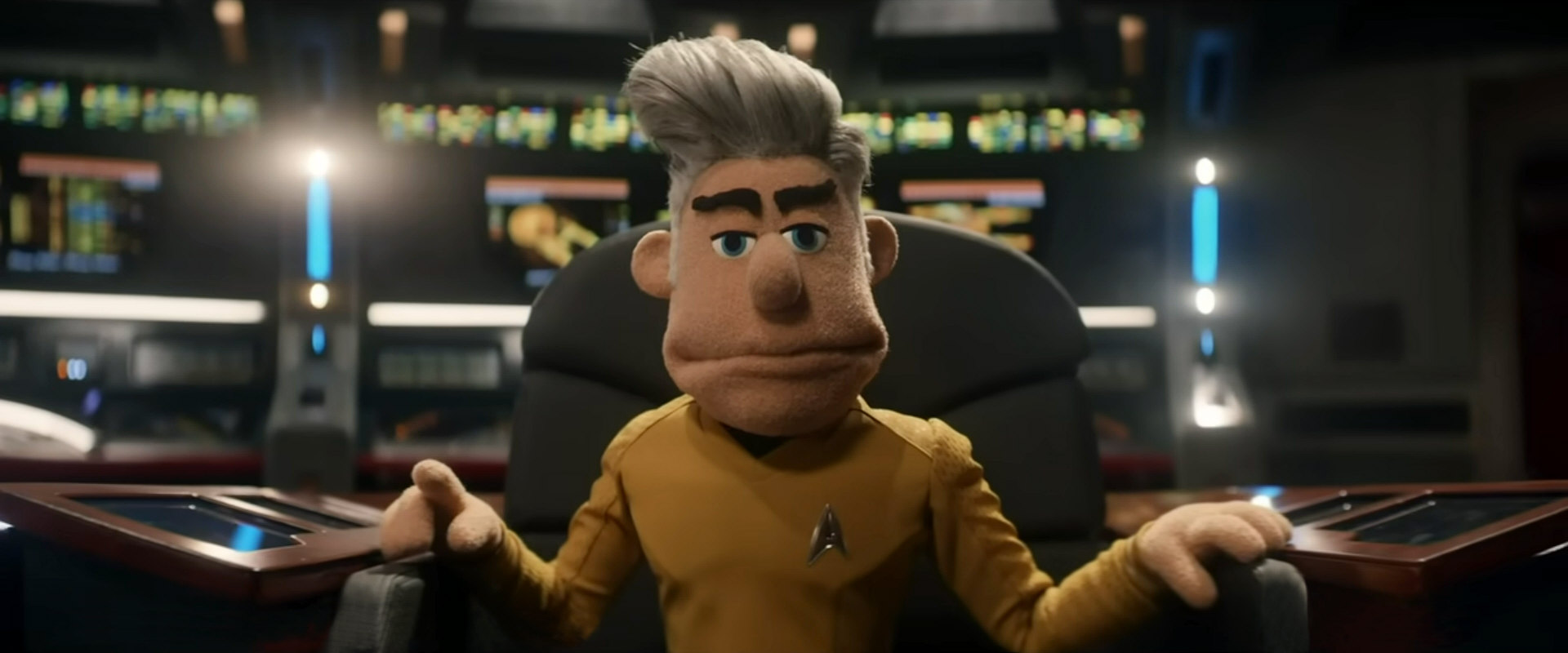
Stardate 3019.4: The Enterprise is en route to Vulcan, where Spock intends to study logic. But Admiral April orders the ship to secure Rizonian space against pirate activity. Meanwhile, Scotty is trying to break the transporter distance record. The current record is 25,000 kilometers, but he wants to beam a creepy puppet named "Little Ricky" 30,000 kilometers to another starship, into the quarters of his Academy rival Declan Milder. The experiment goes wrong while Spock is aboard a shuttle deploying transporter buoys to help Scott. Everyone on the Enterprise, including T'Pring, who has come to meet Spock, is transformed into a puppet. The nearest starship that Admiral April can send is two days away, leaving Spock to operate the Enterprise almost entirely by himself, as the puppets are alive but unable to operate any controls. Before he can find a solution, Orion pirates approach the ship. Spock helps Uhura establish an audio-only channel, and Pike threatens to respond with force if the Orions come any closer. They initially turn away, but Uhura accidentally activates video communication, revealing that everyone aboard the Enterprise except Spock is now a puppet. The Orions attack and board the ship. Spock attempts to resist the invaders but is quickly apprehended. The Orions demand the Enterprise's control codes, which Spock refuses to provide. They take control of the bridge and threaten to kill Pike by putting him in an airlock. When Spock still doesn't cooperate, the Orions eject the captain into space. However, Pike survives because he is a puppet. The other puppets realize that they can exploit this and begin to behave like that. They overpower their Orion guard while T'Pring frees Spock. The crew retakes the bridge, but Spock needs to find a way to incapacitate the remaining Orions. He evacuates the air from the bridge and holds his breath longer than the pirates, who eventually pass out. Spock later wakes up in sickbay to discover that the puppets have somehow brought him there and somehow transported the Orions to the brig. The Enterprise is back under their control. The crew now wants to experience the same as Pike and spend some time floating through space as puppets. Meanwhile, Spock talks to T'Pring and reaffirms his desire to return to Vulcan and pursue a life devoted to logic. When he finally wakes up, he sees T'Pring standing beside him. She is no longer a puppet and assures him that she never was: he passed out during the transporter experiment and dreamed the rest.
Review
It's time to clear the buffer
It's time to beam the team
It's time to watch the patterns drift into a fluffy stream
It's time to put on Spock ears
It's time to comb Pike's hair
It's time to place the Muppet right in the captain's chair
Why do we always come here?
I guess we'll never know
It's like a kind of torture
To have to watch the show
So now let's get things started
Why don't you get things started?
It's time to get things started
On the most navigational, computational, gravitational, Federational
This is what we call the Season Four!
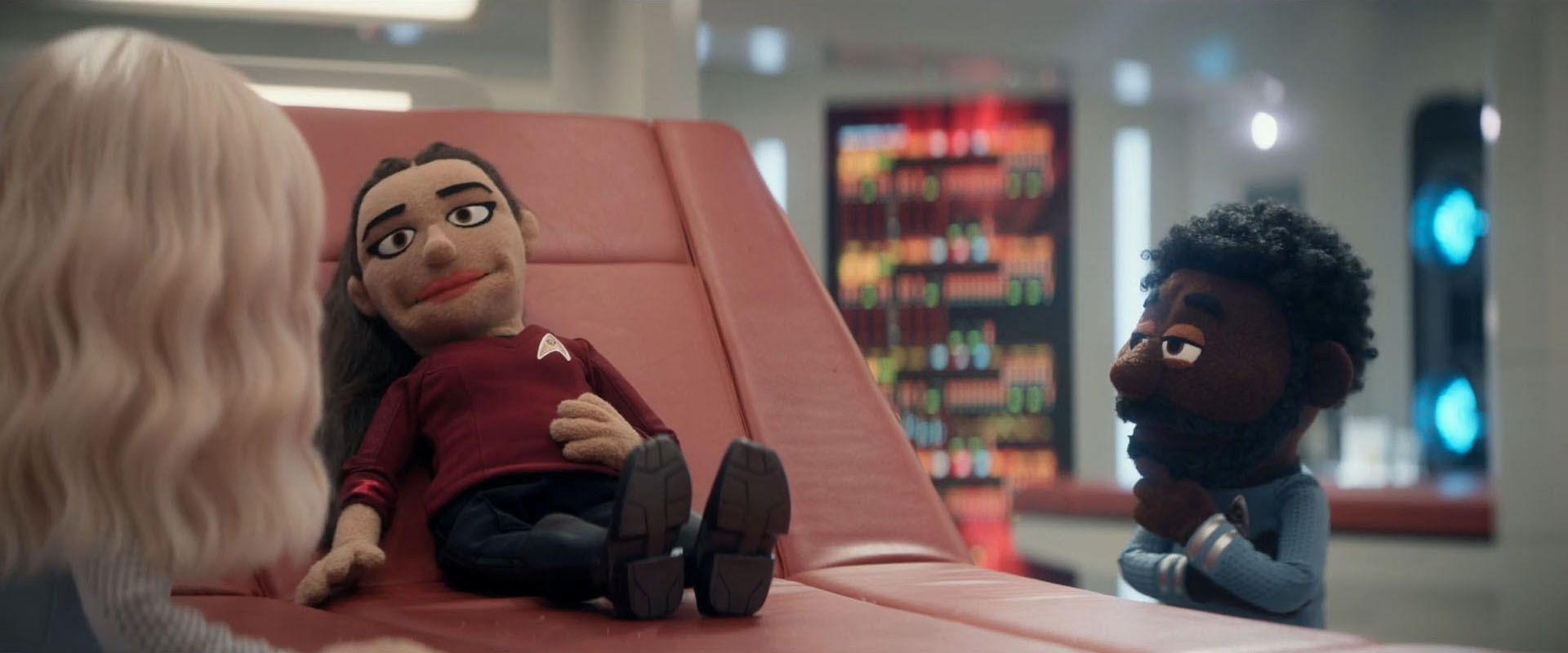
It's the halfway point of season 4, and the gimmickry continues relentlessly. It's time for the Muppet episode. The idea was teased a year ago, and not everyone welcomed it, to put it mildly. Most reactions openly ridiculed the decision to do something with Muppets. While I tried to keep an open mind, I was with the critics insofar as this is clearly yet another instance of putting style before substance. Before even seeing it, we could tell for sure that "Level-Five Transporter Accident" is made to show the crew as Muppets in the first place and then try to build some kind of story around that theme.
The idea of turning everyone but Spock into a puppet is grotesque in the first place, and the way it actually happens in the episode and the way the story unfolds makes it even more absurd. There are additional cues that it all isn't true, which I initially interpreted as ordinary continuity errors, such as April's statement that the closest ship is not 30,000km but two days away or that the puppets are suddenly in Pike's quarters after previously retreating to the ready room. Anyway, the writing ultimately solves the issue by revealing that it was all just a dream. I'm relieved I don't have to care about anything that happens because none of it is real. Still, it's a lazy cop-out. There is no takeaway, except that we don't have the burden to understand or to explain what we have just watched.
What remains is yet another episode about Spock, his logic, his emotions, his relationships, his struggle with his mixed heritage and with living among illogical humans, on a ship governed by "chaos" and "hijinks". He keeps forming unusual bonds with people whenever he goes through this process. Last season we had "Wedding Bell Blues", where Korby went from being his rival to being his buddy. Then there is Kirk, who keeps turning up in Spock's emotional life, most recently in "Human Best Friend", where Spock imagines that Kirk is with him throughout the episode - or Kirk is actually with him, whatever. Now, only three weeks after he already hallucinated T'Pring in a delusional state of mind, he imagines himself with her as a puppet, and it is simply another variation on the same "Spock talks about his feelings to an unlikely buddy in a bizarre situation" theme. The series is so tiresomely fixated on the character that, in that regard, it might actually have been more interesting to let the entire crew experience being puppets, absurd as that premise may be. But in the end, absolutely everything that remains is about Spock. It is not about the puppets at all because that never happened. The much-maligned concept is not only yet another stylistic stunt, but one that has zero impact on the story.
The plot, irrelevant as almost everything may be in the end, is heavily influenced by TNG: "Rascals". In that episode, Picard, Ro, Guinan and Keiko are turned into children by a transporter accident and can no longer perform their duties properly. They doubt whether they are still fully capable and valuable members of the crew and struggle with their new identities. Then the ship is taken over by the Ferengi with surprising ease just as it is by the Orions here, and the intruders are amused to find those kids. Eventually, the children defeat them by remembering they are children, while the puppets here overpower the equally dumb Orions by acting like puppets. The parallels are obvious. Perhaps "Level-Five Transporter Accident" is intended as a parody of "Rascals". But to me, it doesn't diminish the TNG story. That episode is unusually silly by classic Trek standards, certainly, but it is still a real story with consequences and with quite some character development. It is simply superior to this mess of imagined puppets in Spock's troubled mind.
One thing we need to address - and perhaps the central problem, rather than the transformation into puppets itself - is that "Level-Five Transporter Accident" simply isn't funny. It isn't the cheerfully anarchic Muppet Show in space that I had expected. They build these cuddly puppets that I would love to buy as merchandise (especially Pike and La'an are gorgeous). Their look and feel invites the characters to behave in comical ways, but they make a straight-faced episode out of them. I have the impression that, unlike the equally unfunny "Human Best Friend", it was never meant to be a comedy. It starts seriously, with Spock reconsidering his decision to return to logic and La'an (predictably) breaking up with him. When he can't go to Vulcan to pursue the path of logic, he turns to T'Pring instead. It's all quirky, but so is everything involving Spock on SNW to some degree. By the show's standards, this is still serious. Even Scotty is completely in character by SNW standards. Once again, like in the anachronistic holodeck farce "A Space Adventure Hour", he experiments irresponsibly with technology, this time to pull a prank on an old rival. This is just normal business in this show or in modern Trek in general, and none of it is played for laughs.
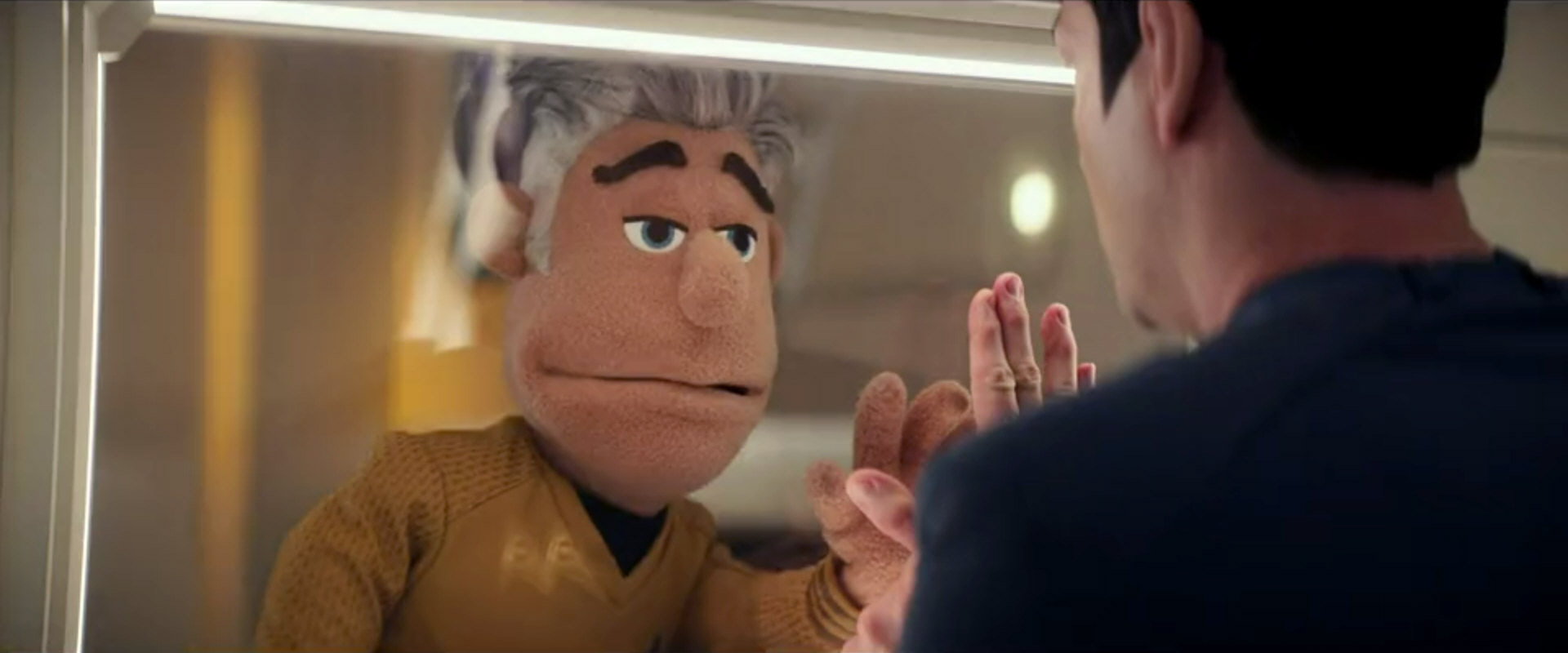
And then the crew turns into puppets, which could have changed everything. There are a few moments that are mildly amusing as they struggle to operate the controls while being too tiny and soft. But the writing treats the mere sight of our characters as puppets as sufficient comedy, a premise that wears itself out after a few minutes. I don't think I laughed once during the entire episode. The various ways the fluffy crew gets mutilated unpleasantly remind of the body horror in "The Griffin Incident". And don't get me started on the insensitive "homage" as Puppet Pike prepares to die, quoting the needs of the many, while Spock is watching though the glass pane. This is like a Star Trek spoof written by a ten-year-old who secretly resents having to watch the show with his parents. To me, that is the biggest failing of all. Whatever the puppet transformation is meant to mean - whether it is real, a dream or something else entirely - you turn Star Trek characters into adorable little puppets, and it never becomes something special, never evolves beyond "everyone's made of felt". That is a remarkably fundamental failure.
So what can I say about "Level-Five Transporter Accident" in a nutshell? Perhaps I'm a grumpy old man like Statler and Waldorf. Perhaps I get it all wrong because I have a problem with modern Trek's idea of humor. Perhaps I also get it wrong because I expected something that would make the transformation meaningful within the story. I am relieved that they are not actually puppets and that I don't have to explain how any of this could possibly work. But what remains? It's just Spock again. It's "Spock Amok", "Charades", "Wedding Bell Blues" or "Human Best Friend", only this time with imagined puppets. It may be supposed to have a deeper meaning in that it reinforces Spock's decision to return to logic. But it does so in a dream, much like his rediscovery of logic in "The Griffin Incident" that likewise occurred in an absurd situation where he was not himself. Can't Spock simply make a normal decision in a normal reality through his own free will, without the series having to turn it into a fever dream every time? SNW is utterly obsessed with showing us Spock's state of mind and his mental struggles. It keeps doing so in increasingly immature ways, which only adds insult to injury. So yes, "Level-Five Transporter Accident" is another catastrophic failure in this so far pathetic season, and a predictable one, if we keep in mind how stories are developed in the series and how especially Spock is handled.
Annotations
- Nitpicking: While the Enterprise is on patrol duty in Rizonian space, multiple ships are within 30,000 kilometers, according to Spock, including the USS Witmere where Scotty wants to beam the puppet. That extreme proximity doesn't make any sense. Of course, this setting serves a second purpose, to provide a hint that Spock only imagines the puppets, because April later states that the closest ship is two days away. The latter would actually have been a much more plausible scenario but then Scotty wouldn't have been able to pull that prank on his rival on the Witmere.
- Remarkable quotes:
- "I will only return to your ship if you assure me: no hijinks of any kind." (T'Pring, lampshading that every time she came aboard something absurd happened)
- "I am sewing as fast as I can. I only have four fingers." (Chapel, as she repairs Pelia)
- "I'm shorter and fluffier than usual, but I'm still the captain and Spock is in trouble, so I'm going to save him so he can save us." (Pike)
- Remarkable ship: We see the Orion ship Vo'Nee, with a design similar to the vessels we saw on Star Trek Enterprise.
- Remarkable fact: The current transporter distance record is 25,000 kilometers, held by Declan Milder, currently aboard the USS Witmere, deck 8, crew quarters B37.
Rating: 1
Off-Hour
Synopsis
Stardate 1213.72: The Enterprise is on its way to Starbase 7 for upgrades. Dr. Boyce, the ship's former chief medical officer, has come aboard, while M'Benga tells Nurse Chapel that he intends to leave the Enterprise, much to her displeasure. Suddenly, the Enterprise is caught in an anomaly, apparently a wormhole traveling at warp. The ship is pulled inside and spins out of control. The inertial dampers fail, injuring members of the bridge crew. Scotty's turbolift becomes stuck. Engineering has to be sealed off. In sickbay, M'Benga is critically injured when a lab table crushes his abdomen. The phenomenon accelerates the Enterprise to extreme warp speeds, which will likely destroy the ship as it crosses the warp threshold. Scotty works with the Vulcan cadet A'Sha to restore the sensors, but they are unable to find a solution. In the port galley, the grav plating fails, and Una breaks her leg while restoring normal gravity. With internal communication being difficult, Chapel finally manages to contact Dr. Boyce, who is also trapped in the port galley. He orders her to support him and to abandon M'Benga because he is dying anyway, but Chapel refuses to leave him. As most of the ship's sensors are offline and a deployed buoy is quickly destroyed, the crew decides to use an ion pod to obtain readings of the phenomenon. Spock volunteers for a spacewalk to reach the pod and record the necessary data. However, when the pod begins to overheat, Pike has to jettison it without knowing whether Spock is still inside. La'an goes outside to search for him. Meanwhile, Chapel develops an idea to save M'Benga. She proposes a hypothetical treatment involving strong-force neutrinos, which are abundant inside the phenomenon. These neutrinos could also replenish the ship's depleted fuel supply. The Enterprise waits for Spock's sensor data while La'an eventually finds him in the launch bay of the ion pod and brings him back aboard. The data on the chip is destroyed, but La'an can retrieve it through a mind-meld with Spock. In order to reach the neutrinos, there is no power left for course corrections, and the Enterprise has to fly straight toward the warp threshold. The ship survives the passage intact and successfully collects the particles. Chapel opens the sickbay doors, exposing it to temperatures close to absolute zero, and freezes M'Benga. She then treats him with the neutrinos but collapses from exhaustion. When she wakes up, M'Benga is lying beside her, alive. By then, the Enterprise has regained enough power to break free of the anomaly, and the ship is finally safe again.
Review
It's episode six, and we finally get the conventional Star Trek story most of us have probably been waiting for, one that draws its suspense from the situation rather than from gimmicks. Of course, we are well familiar with this kind of plot, in which a shipwide disaster isolates parts of the crew and disables critical systems. There is nothing unusual about it, but in light of my experiences with season 4 so far, I mean that in the best sense. There are many parallels to TNG: "Disaster", where the Enterprise-D likewise runs into a phenomenon, systems are down, crew members are trapped in different parts of the ship and everyone has to find their individual way out of the predicament. This is the basic theme of "Off-Hour" too, although the circumstances are a lot more dramatic here. Pike's Enterprise is at warp and largely inoperable, yet the wormhole-like anomaly continues to accelerate it. If nothing happens, the ship is going to fall apart. That gives the crisis more urgency than in "Disaster", DS9: "Starship Down" or in other examples of this familiar type of story. The frequently displayed countdown is the only misstep in this regard - a needless gimmick intruding on an episode that otherwise succeeds precisely because it doesn't rely on any.
There are some elements we have not seen in quite this form before, such as the failure of the inertial dampeners. I actually like the idea and how it gets visualized. When a ship was hit and everything was shaking, it too often looked like in TOS: the traditional tilting from left to right, with the crew acting as if they were being thrown around, more or less awkwardly. Here, however, there is a considerable shift in the inertial forces aboard the ship and, later, a failure of the artificial gravity in the port galley. They strike with more force and appear as a real threat. The piano collapses under its own increased weight. You can hear the crack when Una breaks her leg, and M'Benga is even worse off when the lab table crushes him and essentially cuts him in half. This is certainly more intense, although it is also rather unpleasant. We've already had the horror episode "The Griffin Incident", and only last week we saw puppets being cut or ripped apart. Now we get something similar again. Less bodily harm may have been better for a change. So I'm of two minds about the heightened danger in this otherwise relatively straightforward "ship in distress" story.
I also appreciate that everyone in the crew is back to normal again, after they were driven to insanity, acted like idiots and finally mutated to silly puppets. Speaking of the crew, it occurs to me that Christine Chapel, a major character in the first three seasons, was sidelined in the first half of season 4. I hardly even noticed her. Now she is back again, and I appreciate that because she is, for better or worse with regard to continuity with TOS, one of the key figures of the series. It is okay that her story gets very personal, but I still don't quite understand why she reacts so aggressively when she learns that M'Benga intends to leave the Enterprise. Maybe it is simply because he did not let her know in advance. He told the captain and requested the transfer of Boyce, so he had clearly been planning it without telling her. Yet, she gets really angry at him and starts shouting, which I think is unwarranted. Of course, we know since "The Broken Circle" and "Under the Cloak of War" that they have known each other since the war and that they are close, still it doesn't feel right. My impression is that after the end of her relationship with Spock the writers were anxious to give her emotional involvement again - although saving M'Benga would have been more than enough in this regard, without her preceding outburst.
I don't know yet where this is leading. M'Benga survives, of course, and at some point he will either be demoted or (more likely) temporarily leave the ship because we know that McCoy is waiting. (My expectation is that Dr. Piper from "Where No Man Has Gone Before" will be ignored and that his absence from SNW's final season will be justified with a throwaway line.) But I don't believe M'Benga will really be gone so soon and Boyce is really going to stay, or perhaps serve in addition to M'Benga as the second medical officer. The setup oddly reminds me of M'Benga being second after McCoy in the just two TOS episodes in which he appeared. I find that a bit contrived. Once again, it feels as if the series is trying to foreshadow or explain things that will eventually happen in TOS, and to make a big emotional story out of those developments. Every personal decision in SNW is always totally a matter of feelings anyway.
The way Chapel ultimately saves M'Benga and also the ship is very contrived and very hard to believe. After just checking the doctor's notes about hypothetical treatments for a moment, our nurse suddenly becomes a world-class expert in particle physics and comes up with the method that the newly discovered strong-force neutrinos can save M'Benga and also produce fuel for the ship. It then takes the crew only 20 minutes, under dire circumstances on a ship practically without power, to implement this major breakthrough in physics and engineering, which ultimately comes across as pure magic. That is one aspect that should have been handled in a much more credible way. It is also excessive that Spock has to walk to the ion pod. It additionally never becomes quite clear from where Spock starts the spacewalk, how he got to that airlock in the first place, what exactly the sensor data can be used for and why data recorded at extremely high warp will still be helpful 10 minutes later. Maybe the pieces all fit together when I watch this a second time, take extensive notes and analyze it. But I doubt it. I don't think all the relevant details were properly considered when this was written. It is too clearly constructed to justify a Burnham-style spacewalk at high warp.
The chip with Spock's collected data is no longer readable, but La'an can access the information through a mind meld with the injured Vulcan. That's a nice touch. And, more on a side note here, it isn't a nice touch that the episode doesn't spare at least a few seconds to show or only hint at Spock's recovery. Anyway, "Off-Hour" has several moments of the crew working together in unusual ways, although not everything is equally successful. I don't care much for how Pelia responds to Scotty's professional crisis with generic motivational platitudes instead of actual engineering advice. During the whole time she speaks to him over the comm, she does not say anything about physics or engineering. Not once. Instead, she talks about lemonade. I know that is simply how Pelia is written, so I'm not complaining that she is inconsistent or suddenly out of character. She's always like that, but she's not an engineer to me. Pelia is a little old lady who loves to hear herself talk and tell anecdotes, which for some reason motivates Scotty. Of course, she also tells him that he has to be a "miracle worker" because we all know he is a miracle worker. Strange New Worlds is really obsessed with working off all the familiar conceptions about TOS characters, even if they are nicknames without real in-universe significance. The whole Pelia-Scotty storyline doesn't work for me.
However, I do like Scotty better here than in most past episodes. Martin Quinn's Scotty is generally much quirkier. He is an irresponsible and jumpy rookie, not at all like the seasoned person I know from TOS, merely five years later. But at least within SNW's own redefinition of the character, it all makes sense in "Off-Hour". He is well written and played as someone who is competent but uncertain in a crisis, and who gradually gains confidence in the ship as well as in his own abilities.
Overall, "Off-Hour" is thrilling and intense. It comes with a decent plot but would have been better if everything had not been so exaggerated. This applies to the bodily harm, to the implausible science and engineering feats and to the spacewalk. The story could have been more convincing if these elements had been written with greater realism and a better sense of proportion, which IMHO would have been possible without losing suspense. It might have benefited from following the example of TNG: "Disaster", where no one was cut in half, there was no overdone space action and no completely new physics was developed within a few minutes. Also, the character relationships don't work quite as well as they could, with emotional motives unnecessarily overshadowing professionalism both in the M'Benga/Chapel and Pelia/Scotty subplots. My verdict is that "Off-Hour" is one of the stronger SNW episodes, but it should have been more restrained and perhaps more like classic Trek for that matter.
Annotations
- Continuity:
- Dr. Boyce appeared in the first pilot "The Cage" as Pike's fatherly friend, not as the callous person he is here.
- Rahda is obviously meant to be the same woman of Indian descent as in TOS: "That Which Survives".
- The ion pod and the decision to jettison it while someone might still be inside, of course, is a reference to TOS: "Court Martial".
- Nitpicking:
- I don't understand the path of Spock's spacewalk. It apparently isn't possible to enter the ion pod from inside the ship because the way is blocked. Scotty can be beamed into the hull just on the other side of the pod. There is explicitly only enough energy for that one transport sequence. Spock is said to be the closest to the pod, although he is currently in the port galley and the pod is on the starboard side of the engineering hull, separated by hundreds of meters of primary hull, neck and secondary hull. This whole way wouldn't take him a couple of minutes of spacewalk but more like three hours. So from where do he (and later La'an) actually start? We can see him approach the location of the pod from the aft end of the ship. So he somehow reached the shuttlebay first (all the way from the port galley), only to move forward again.
- "Warp threshold" normally refers to the transition from sublight to warp, but not here. I've already gone into great lengths elsewhere, explaining why a (second) "threshold" as a general upper limit for warp speeds doesn't make sense, even if we disregard some of the shenanigans in the VOY episode of the same name. If anything, there may be a specific safety limit for the structural integrity of the ship, which wouldn't be called a "threshold". The wording feels like a deliberate and frankly silly red herring, insinuating that the crew might turn into salamanders.
- What exactly are the sensor readings about the neutrinos needed for if they are either far ahead or all around the ship all the time and no course correction is possible anyway? It looks like more specific readings are required for some reason.
- But if this is so, how are readings taken at high warp still useful after traveling billions of further kilometers?
- M'Benga says "the temperature will drop to negative 400 degrees". That's either a stupid mistake or it is obsolete, because no one in the scientific community still uses Fahrenheit today, much less in the 23rd century. But the actual problem is that the unheated corridors of the ship would never cool down so quickly.
- Remarkable dialogue: "Inertial dampeners?" - "They are currently running out of power. If we lose them.." - "We'll all be rolled into black pudding." - "As a vegetarian, I find your metaphor illogical." (Scott and A'Sha)
- Remarkable joke: "An Aquan was invited to a Lanthanite's birthday party. And he has to bring a gift. He decided to present her with a Benzar turtle. The Aquan explains, 'This turtle is special. It lives 20,000 years.' The Lanthanite sighs and says, 'Pets. You love them. And then... they go and die on you.'"
Rating: 6
Like Chronitons Through the Hourglass
Synopsis
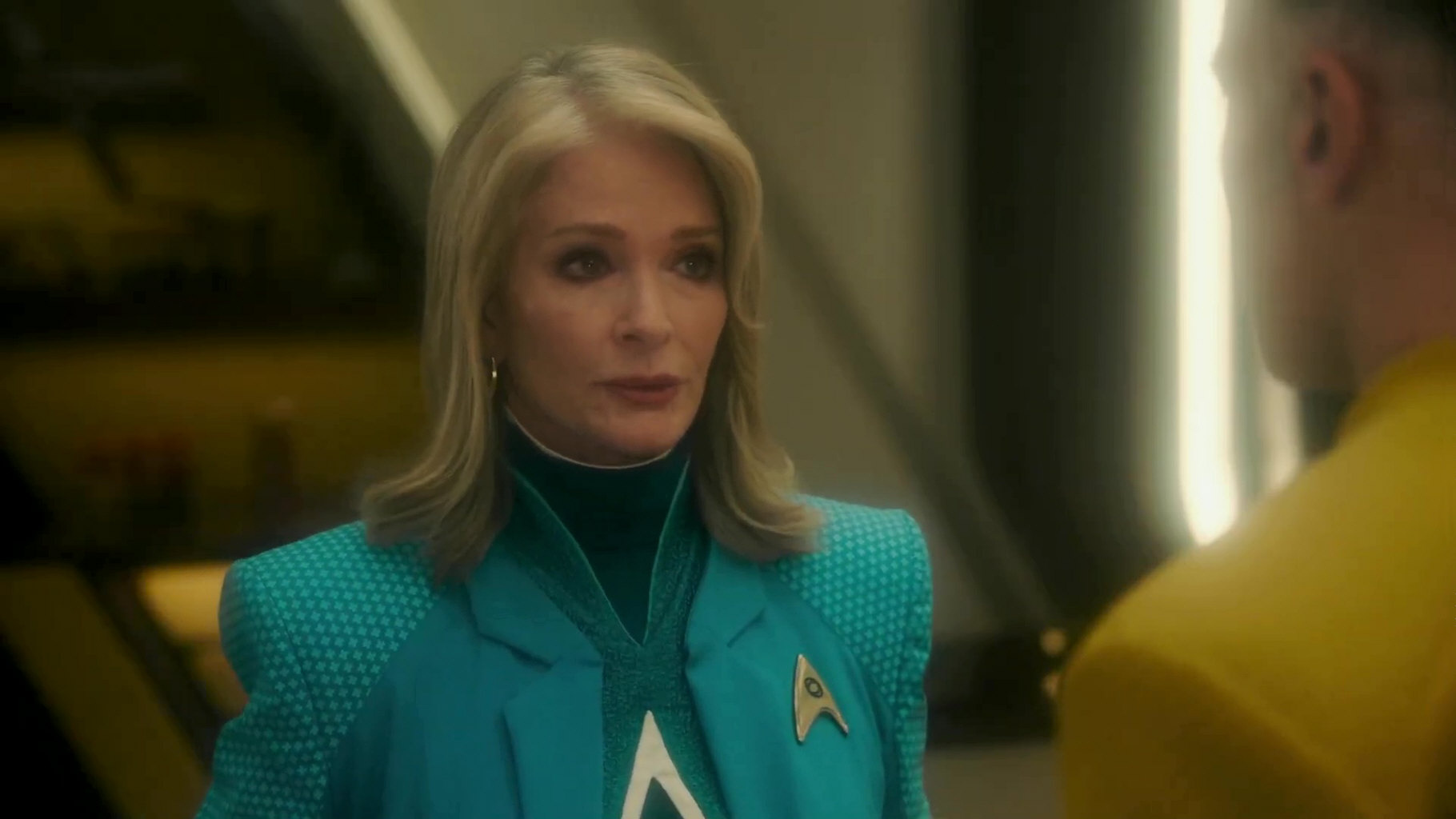
Stardate 2654.9: Captain Pike wakes up in sickbay and is told that he has been in a shuttle accident and is suffering from amnesia. But he notices that, rather than he himself, everyone else behaves strangely. The crew speaks with exaggerated dramatic pauses and treats even the most mundane situations like scenes from a soap opera. He is sent to a session with the ship's counselor. He also learns that Uhura is his daughter, or at least that is what she believes after getting the alleged result of an DNA test. Pike discovers that the entire crew are mind-manipulated by the entity known as Trelane. He is expected to participate in a "family counseling session" and tries to walk away, but has no choice but to play along. He just hopes that Trelane will bring the bizarre scenario to an end soon. In sickbay, Spock, who was also aboard the shuttle, is seriously injured and needs a live heart transplant. One possible donor is his brother Sybok. La'an has freed Sybok from prison, but he is reluctant to help. He takes La'an's phaser, but when he recognizes that she, like everyone else, loves Spock, he finally agrees to become the donor. At the same time, M'Benga doubts that he can perform the transplant because his hand is shaking. He believes he has contracted "space madness". Ortegas, who claims to suffer from the same condition, gives him new confidence by encouraging him to accept his weakness rather than fight it. The operation goes ahead and M'Benga succeeds. However, Sybok subsequently goes into cardiac arrest. Meanwhile, Pike encounters Juliet, his daughter from a fake reality, who has been recreated by Trelane. Although he knows that she is not real, he develops genuine feelings for her. Trelane is satisfied with the scenario he has created as part of a student assignment and receives a B-minus for his efforts. He then ends the simulation. The crew remembers everything that happened, but none of them was actually in danger.
Review
Preface: After just one episode with a decent story and actual science fiction, SNW seems to be back to its dismal pattern. The announcements readily give away that "Like Chronitons Through the Hourglass" is yet another crazy experiment. The series has finally used up its credit with me in this regard. I expected that horror and Star Trek could mix well and was looking forward to "The Griffin Incident". I barely even made it to the end. I initially gave "Human Best Friend" the benefit of the doubt because I imagined its campy premise might at least be fun. It wasn't. Then came the long-teased Muppet episode, "Level-Five Transporter Accident". Again, I thought they couldn't mess up such a premise too badly. They did. And now we are apparently getting a soap opera episode. Yet another self-indulgent genre crossover.
Even if it should turn out to be fun, against my expectations, "Like Chronitons Through the Hourglass" is yet another time the show gives us anything but genuine Star Trek. The first thing that came to my mind after reading the premise was: Isn't Strange New Worlds a soap opera anyway? Isn't it essentially "Everyone Loves Spock"? Isn't this simply taking the series further down the road paved by "Charades" and "Wedding Bell Blues", to name only the most obvious examples? And then there's the return of Trelane. I already considered him the worst use of a legacy character in the whole series, which is saying something because SNW has no shortage of such contrived cameos. So that is what is on my mind before sitting down to see "Like Chronitons Through the Hourglass".
Now about the actual episode that I just watched. We have Pike waking up in sickbay, apparently suffering from amnesia. At first, this looks a bit like "Hangover Trek II", but it soon becomes clear where this is going. Our captain is perfectly normal this time, and we see everything from his perspective, while everyone else is acting strangely. His crew speaks in melodramatic ways, with unnatural pauses. They are are somehow mind-controlled, brainwashed or otherwise manipulated. As we already learned in the preview trailer, Trelane is behind all of this. Well, Pike interrupts Trelane as he introduces himself and we can only hear that his name starts with "T" - apparently because the producers are reluctant to openly admit that they rewrite canon and hence use what I call the Rumplestiltskin trick. Anyway, even for those who watch the episode unspoiled, the character's involvement doesn't remain a secret for long, because he appears right before the opening credits. That revelation pretty much gives away everything that has happened and everything that is still going to happen. As in "Wedding Bell Blues", we can be sure that this is an artificial scenario and that none of it is real. At the same time, it is meant to be "real" in the sense that whatever happens is supposed to have some significance for the characters. At least, they will remember it, even though they are never in control of their own actions.
I already mentioned it in the preface: Isn't Strange New Worlds basically a soap opera already? It took only a few minutes for me to realize that this is essentially a standard SNW episode, a cheesy one with a completely unoriginal and clichéd story if we look at the bare building blocks of the plot. Everyone is behaving strangely and there are unrealistic plot twists, which is also perfectly normal for the show, at latest since this season. So what we have is pretty much business as usual on SNW, except that someone has added soft focus, ominous music and dramatic pauses to make it more soap opera-like. Only the laugh track is missing.
And it's not just the setup and style. It's also in the character relationships and the dialogue. Is it fundamentally different here because everything is modeled as a soap opera? Not really. We've got lines like M'Benga saying, "I've lost my feeling of connection with Starfleet." That is a perfectly normal Discoverse quote, with "connection" being a notoriously overused buzzword. It could have been spoken anywhere in Discovery or in Strange New Worlds itself. They talk about their feelings all the time anyway, and it doesn't come across as a parody or as particularly unusual. Likewise, there's Sybok's realization: "I find it deeply irritating that so many people like you love my brother." That is a perfectly normal theme in this show, where everything is focused on Spock and everyone is obsessed with him. So once again, nothing is really different here. The focus on emotions may be seen as a self-ironical comment, but I think the series is past the point where even that is still funny. In some way, they are trying to create a Star Trek episode in the style of a soap opera without recognizing that SNW has been like this all along. And that is precisely why the whole idea doesn't work for me.
There's rather little going on in "Like Chronitons Through the Hourglass". Uhura thinks she is Pike's daughter, which of course is absurd because she had real parents. We've got the "space madness" part about M'Benga, with Ortegas helping him through the crisis with some rather trivial advice: just accept your weakness or something along those lines. A calendar motto, and more evidence of normal Discoverse business. And then there's La'an interacting with Sybok, who is not the actual character, but Spock's twin, played by Ethan Peck, just with longer hair. In other words, whatever this fake Sybok does or says is meaningless, the only positive side effect being that it doesn't violate canon.
And it becomes worse the longer I watch. There's a tiny bit of humor, but it comes solely from Pike being annoyed, and only at the very beginning. After a few minutes, even that disappears completely. It's not funny, and it's not really anything else either. It feels eventless and irrelevant. I could be annoyed, but I'm just bored by it. And when I get to the end, my only question is: what was the point? This episode leaves me with almost nothing.
Of course, it is supposed to have an emotional impact. The writers remembered the season 3 finale "New Life and New Civilizations", where Pike imagined being with Batel and having a daughter named Juliet. Maybe he hasn't been thinking about her for a long time, because after all, she only appeared in some sort of dream. And now she comes back, of course only as another illusion, this time created by Trelane, stirring up emotions he thought he had lost or forgotten. They essentially just repeat the trick pulled in "New Life and New Civilizations". The logic and science in that episode were totally absurd, but that one sequence had an "Inner Life" impact. I liked that. It was one of the very few things I enjoyed about that episode. And now they simply pull the trick again in an otherwise completely meaningless story. I don't think it works. The fake daughter placed into the hollow plot doesn't save "Like Chronitons Through the Hourglass". I must admit, they got me when she appeared, but only for a moment. Then the feeling passed and the emptiness of the episode took over again.
There is that little bit of humor at the beginning and that brief moment of emotional impact toward the end, but I was waiting the whole time for something: some payoff, some twist, some meaningful revelation, something that made me think. It never happened. The writers seem content with an episode that just ends, as already in "The Griffin Incident". I was also waiting in vain for the temporal anomaly teased in the official announcement by Paramount and in the episode title itself. So it all ends with Trelane, who is a little boy by Q standards and who created this whole thing essentially as his school homework, which he tries to pass off as a "dissertation". He gets a B-minus for his soap opera project to explore human emotions. And no, that's not a payoff.
This episode thankfully is only 45 minutes long, but after Trelane has ended the scenario and it is practically over, there are still eight minutes left. These are filled with aimless talking, also like in "The Griffin Incident". The crew remembers everything and discusses what they experienced, but it is essentially "tell" while not "showing". La'an ominously says goodbye to Spock (I think she will be gone for good by the end of the season), and Pike finally decides to speak to the ship's counselor of his own free will. He talks about Juliet. He weeps. Okay, that's something. But it's a contrived emotion shoehorned into a hollow story.
Oh well, there's also a post-credit sequence, apparently because there was still time left that could be filled with, well, something. And so we get a postponed "Days of the Enterprise" soap opera intro, followed by an unfunny "shaky box" commercial with Trelane that only unpleasantly reminds me of "The Trouble with Edward".
Overall, this is another low point of this season, which so far is clearly the worst season of the franchise. I know some people enjoy the new direction of the show, as it becomes increasingly unwilling to be Star Trek any longer. But, except for its uncalled-for frequency - with two in three episodes currently being genre excursions - I don't even object to the device in itself. Classic Trek has shown many times that an outrageous premise can make for something genuinely special if it comes with a significant, funny, entertaining or otherwise worthwhile story. "Qpid", "Our Man Bashir", "Trials and Tribble-ations" and "Bride of Chaotica!" are just a few examples. Some work better than others, but not even "Qpid" is as empty as this. In "Like Chronitons Through the Hourglass", style and dialogues are barely exaggerated enough to function as a parody, the story has practically no substance beyond the premise, and the emotional material feels artificially inserted to make the whole thing seem more meaningful than it actually is. SNW ceaselessly keeps trying weird concepts, which would be tolerable if not the concept routinely were the whole point, with nothing underneath it to make it memorable.
Annotations
- Continuity: The other Q in this episode wears a judge robe familiar from "Encounter at Farpoint" and "All Good Things".
- Remarkable quote: "Of late, I've been studying your breed in a more formal capacity. And during my erudition, I fell in love with an art form that explores the raw, unrepentant beauty of human emotion. It is body cleaning theater." (Trelane)
- Remarkable screen ratio: Like other "television" scenarios in the series, the illusory part was filmed in the (larger) normal 16:9 ratio.
- Remarkable appearance: Deidre Hall, who famously appeared on Days of Our Lives, can be seen as Eleanor Chivers, the ship's counselor.
Rating: 1
Orders of Magnitude
Synopsis

Stardate 2179.3: Kirk visits the Enterprise while the ship is in orbit around a moon from where an SOS signal was received. On their search for its origin, Pike, Una, Uhura, Chapel and the Vulcan cadet A'Sha enter a cave where communication with the Enterprise is impossible. Meanwhile, a shuttle arrives with Admiral Simon Reeger, a war hero. He takes command of the Enterprise to track a gamma-ray signature from a cloaked ship that he believes was responsible for the Vaardan massacre, in which five million Federation citizens were killed. He appoints Lieutenant Commander James Kirk, technically the highest-ranking officer aboard, as his first officer. Reeger served with George Kirk, Jim and Sam's father, during the Battle of Zeta Reticuli against the Klingons. Reeger was captain of the USS Constitution and won a major victory despite being outgunned by four Klingon cruisers. M'Benga was also aboard the Constitution at the time. The Enterprise follows the radiation trail to Argos II, a non-Federation world. The ship runs silent. To everyone's shock, Reeger orders a cargo ship disabled with a photon torpedo rather than risk revealing the Enterprise's presence. Once the ship is in orbit, the admiral issues General Order 24, which would destroy the entire surface of the planet even though 5000 people live there. He believes it is the home base of the cloaked ship, although there is no evidence for that. Kirk protests and tries to reason with him, but Reeger simply dismisses him. Meanwhile, the landing party is apprehended by a group of Andorian smugglers in the cave. They demand Starfleet communication codes, but Pike refuses to provide them. The leader attacks A'Sha with a crystal, causing skin damage whose medical treatment he refuses. On the Enterprise, Reeger plans to route phaser power through the warp engines to carry out General Order 24. Kirk volunteers to oversee the necessary engineering modifications and has Scotty explain how it will work. Back on the bridge, the admiral notices that Kirk is trying to send a message to Starfleet, warning them about the plan. He has La'an arrest him, but Kirk manages to grab her phaser and stun her. On the planet, Uhura agrees to help the Andorian smugglers set up their transmitter. When she finally activates the device, however, it produces a piercing sound. She grabs a phaser rifle and disables the Andorians. When their leader points his phaser at her, Uhura instead fires at the ceiling, causing crystals to rain down and kill him. Back aboard the Enterprise, it is clear that Reeger wants revenge for the massacre, in which his whole family was killed. Jim Kirk now joins forces with his brother. Sam has also discovered that their father was actually in command of the Constitution during the Battle of Zeta Reticuli and that Reeger took the credit for the victory. Kirk then attempts to sabotage the phaser couplings, but he is beamed out, injured by the radiation. Kirk claims that he has rigged the phasers so that the Enterprise will explode and says he will undo the modification only if Reeger backs down. The furious Reeger beats him and threatens to kill him until M'Benga declares the admiral unfit for duty. Kirk was bluffing, however. He never actually managed to modify the phasers. In the end, the landing party returns and the remaining Andorian smugglers are placed in the brig. Reeger eventually realizes that someone drugged him so he would freak out. M'Benga claims responsibility, even though it was actually Kirk who put cordrazine into the admiral's coffee. M'Benga takes the blame because he wants Jim Kirk to restore George Kirk's reputation. A'Sha recovers from her injuries, but she announces to leave Starfleet. Uhura is saddened by that decision, but Pike field-promotes her to lieutenant junior grade.
Review
"Orders of Magnitude" is the first episode of season 4 that I watch without expectations or apprehensions. It is pleasantly free of divisive gimmickry and tells a classic "Badmiral" story. When Admiral Reeger comes aboard the Enterprise, everyone is in awe. The people on the ship revere him, are happy to meet him and are proud to serve under him. But we know this type of story. Something just has to be off, either about Reeger's mission to pursue the cloaked enemy vessel or about his motives. So it is pretty obvious where this is going, but the story builds it skillfully. The admiral initially serves as an example of leadership. He motivates his crew, takes time to explain his orders and thereby builds trust. When Kirk contradicts him, Reeger takes him aside afterward; he doesn't openly scold him and remains constructive. So everything begins well, and that makes what follows more effective.
There are two levels of the story that unfold in parallel. The first is about what is happening in the present and what the admiral is ready to do in order to track down and destroy the alien attacker. The second is about events that took place on the USS Constitution during the Klingon War. Reeger was the captain at the time and fought against four D7 cruisers that outgunned his ship. George Kirk was aboard as his first officer, and M'Benga as the chief medical officer. The official narrative is that Reeger is a war hero, who defeated the enemy ships thanks to his resourcefulness. For some reason, however, George Kirk's career more or less ended after the victorious battle, while Reeger's skyrocketed. There seems to be something wrong with that story. There's also something definitely wrong with the admiral's ruthless determination to hunt down the alien vessel at any cost. Is this still threat prevention, or rather revenge?
Kirk becomes increasingly skeptical of the admiral's orders, while everyone else on the bridge, such as Spock, La'an and Ortegas, is just visibly uncomfortable. First they have to attack a helpless freighter, and then Reeger orders General Order 24 to destroy the entire surface of a planet and kill 5000 people. They may not agree with it, but those are their orders - just not for Kirk. He finds out that the admiral's family was among the victims of the attack that the unknown alien vessel carried out, which of course isn't proof that what Reeger is doing now is wrong but definitely a strong motive for revenge. Kirk has an additional personal motivation to stop Reeger because of what happened in the past. He suspects that his father's stalled career may have something to do with the admiral, but at this point it is only a hunch. And just as the admiral's orders in the present become less and less ethical, his involvement in the battle in the past and his relationship with his former crew make less and less sense to Kirk.
Sam Kirk additionally has just found out that Reeger was not even in command during the battle. Their father had taken over command. Jim digs further, looks up the medical files and learns that Reeger was unable to command the ship due to his injuries. M'Benga confirms that. The pieces fit together. Reeger took credit for the victory while sabotaging George Kirk's career, and everyone covered it up for the greater good so that Reeger could remain the war hero. That is designed to add to his guilt in the current situation. But his past wrongdoings hardly prove that the admiral is also wrong in the present. That is the first problem I have with the plot. The two stories are tied together by the way it is written, but in reality they hardly touch each other. In the end, the lie about the Battle at Zeta Reticuli remains a completely separate issue, which ultimately raises the question if that part of the story was needed at all. It is not brought up again after Reeger admits that he faked the records. Realistically, he would have to stand trial for that, but the discussion with Pike only revolves around what has just happened on the ship. It is only realistic considering the current situation has to take precedence, yet the past so far played a major role, especially for the Kirks, and now it lacks closure. In this regard, would they really take the time to hack computers to look up old records that wouldn't realistically help them in the current crisis, first Sam and then Jim? I somehow doubt it. I also don't like how casually Sam reveals that he looked up a classified file and discovered that their father took over command. He just happens to have found this information when Jim believes he needs it.
The main plot itself is strong at its core nonetheless. Reeger's quest for revenge and Kirk doing everything he can to stop him make for one of the best stories of Strange New Worlds. A few things don't work as well as they could, but it is overall convincing. There are unlikely coincidences, as in so many SNW stories, among which at least the small universe syndrome is a bit easier to accept this time because it serves a good purpose in the story. I also don't mind that Kirk is aboard yet again with yet another excuse. "Orders of Magnitude" is another occasion where he is strongly involved, much like last season's "The Sehlat Who Ate Its Tail", which was also earned character development for Kirk. The only thing I don't like this time is the typical Goldsman moment in which Kirk once again foreshadows that Spock will one day serve under a very lucky captain, who will of course be himself.
What is particularly effective is how the two brothers complement each other, each according to his own abilities. As already mentioned, it feels somewhat out of place that they suddenly decide to restore their father's reputation during an ongoing crisis, and that part doesn't completely convince me. Still, their story holds together despite a few small flaws. What doesn't work as well is Kirk and La'an. Of course they have things to talk out after what happened in "The Griffin Incident". They didn't do so at the end of that episode, even though there were ten minutes left in which seemingly everyone talked with everyone else. They also didn't do it in "Human Best Friend", which would have been another opportunity for them to address their problems. Instead, Kirk was talking with Spock all the time. There is the symbolism of La'an wearing the watch from their common alternate universe adventure. They have quite a bit of interaction in "Orders of Magnitude", but it remains awkward and inconclusive. They hold different opinions about Reeger but never talk them out, La'an points a phaser at Kirk, Kirk takes the phaser and stuns her, and La'an then hunts him. But there is no resolution. They could either have made more of the volatile Kirk-La'an relationship, or they could have had them act more professionally. As it stands, it doesn't have much merit for me.
When Pike is back on the ship and the alien vessel has escaped, everyone gathers in the ready room with the admiral. Neither Reeger nor anyone else appears to have been arrested for anything. It is laudable that they first talk and try to sort out the situation because it is unclear exactly what happened. Kirk sabotaged the ship, Reeger became violent and beat Kirk, upon which M'Benga relieved Reeger of command. So it makes sense to discuss the case before jumping to conclusions. But the conversation takes a strange turn and gives rise to an unnecessary twist. Reeger suddenly says, "I'm not like that", and we don't really know what he is talking about. I assume he means that he is not the kind of person who would beat someone or even threaten to kill them. I don't share his self-assessment because he absolutely appeared to be in control of his actions when he assaulted Kirk, not like he was drugged, not paranoid as foreshadowed by M'Benga, not at all like McCoy in "The City on the Edge of Forever". He does freak out, but rather like someone who is desperate when his actions are exposed as criminal. But let us give him the benefit of the doubt. In that case, Reeger essentially says that he may be someone who falsifies records and destroys someone else's career for his own benefit and who would kill 5,000 people because they might be behind an attack on the Federation - but he is not violent. Without providing any proof, he claims he was set up and was drugged, and for some reason everyone seems to believe him. It feels forced.
Then M'Benga, in the second part of the twist, comes forward and says he was the one who drugged Reeger so that he could declare him unfit for duty. I don't like the idea. We already know that our doctor has repeatedly been portrayed as a morally flexible character, and we all remember what he did in "Under the Cloak of War". Once again, he shows his dubious side because somehow it always has to be him. But then comes the third part, in which it turns out that M'Benga only takes the blame for something Kirk actually did. Kirk was the one who put cordrazine into the admiral's coffee, in the hope that he would do something that allows to relieve him of command or that he would confess his lies about George Kirk. Either way it isn't a particularly good plan. So we have a Badmiral whose actions in the present are unethical, which alone would have been sufficient to establish the dark side of his character. Instead, the story gives him an unnecessary additional layer of guilt, only to partially exonerate him with an out-of-the-blue revelation. In addition, the resolution of the case we would have deserved was traded for that contrived and morally dubious triple twist.
I still expect that the final two episodes of the season will deal with what happened in "Orders of Magnitude". M'Benga should have to face consequences, this time perhaps without Pike covering him up. Reeger, meanwhile, may get away with his most likely unwarranted issuing of General Order 24. He may also get away with falsifying the logs of the Constitution, and George Kirk's record may not be set straight for political reasons. This is quite possible because, as I already mentioned, that issue is not brought up again after previously mattering a great deal to the two Kirks and after his confession, which he made under the influence of the drug. And speaking of Jim Kirk, regarding his clear insubordination and attempted sabotage of the ship, what will happen to him? Common sense may tell us that if Reeger is guilty of violating an ethical code, the charges against Kirk may be dropped, and vice versa. But in a court martial the two cases may not be linked that way. The same applies to Sam Kirk. In any case, it will be a shame if all these issues are simply swept under the rug like so much else in SNW.
Speaking of which, I just don't like the cover-up part in the backstory. Everyone aboard the Constitution concealed Reeger's misconduct, his taking credit for the battle and the damage he did to George Kirk's career. The Discoverse is full of examples of Starfleet personnel lying and covering things up, and I'm tired of it.
The plot thread in the cave is much less captivating. The landing party investigates the SOS signal and encounters Andorian smugglers or terrorists or whatever. It is basically a conventional hostage situation, and we don't really learn what their goal or motivation is. At some point, the Andorian leader talks about being disappointed with Starfleet, when in reality he was discharged because of insubordination. I like the moment when Uhura appeals to his honor, referring to what Hemmer told her about his culture. The rest of the story comes down to Uhura complying because she wants to save the life of Vulcan cadet A'Sha, who is in her charge. She only pretends to modify the transmitter according to the Andorians' demands. Instead, she uses it to stun them with a piercing sound, and then defeats the hostage takers single-handedly. To me, this feels a bit too much like an excuse to give this Uhura more action than any other Uhura had in any other Star Trek. I don't mind that the way she handles the situation is a bit implausible. I appreciate that Uhura remembers her training, as she says, and gets into action with the noble goal of saving A'Sha. But in the end, it happens in a plot thread that is nowhere near as interesting as the main plot.
One small issue is with the score of the episode. Up until the point where Kirk realizes that something is wrong, it is a strange blend of cheerful and ominous music, although neither really fits the mood. It changes to something more appropriate after about 20 minutes, as the situation becomes increasingly dramatic.
"Orders of Magnitude" is definitely one of the stronger SNW episodes. I was almost tempted to rank it alongside the top installments, such as "Those Old Scientists" or "The Sehlat Who Ate Its Tail". It has a couple of issues, but at its core it's a solid and mostly credible story, with tense direction and strong acting - particularly in the confrontation between Kirk (Paul Wesley) and Simon Reeger (Joe Morton). In the end, though, I may have changed my opinion a bit because of the unsatisfactory final twist and because of the cover-ups, which don't sit well with me. This is 6 points, rather than 7 or 8.
Annotations
- Continuity:
- Cordrazine famously first appeared in TOS: "The City on the Edge of Forever", where it drove McCoy crazy.
- General Order 24 was first mentioned in "A Taste of Armageddon", issued by Captain Kirk.
- Although the enemy ship remains mysterious, there are some hints it may be the Romulan ship that will appear a couple of years later in TOS: "Balance of Terror". This is either a red herring, or it will give rise to more continuity issues that I will comment on once we have the confirmation.
- Nitpicking:
- What happened to the good old distress call? In this episode, like already "The Griffin Incident", characters repeatedly mention an "SOS signal", which usually isn't a thing in Star Trek.
- It feels paradoxical that the landing party would search for the transmitter of an emergency signal inside a cave from where communication with the outside world is impossible.
- Sending any kind of signal would reveal the presence of the Enterprise, whereas an antimatter explosion wouldn't? The torpedo is said to be "zero thrust" but would rather need to be "zero yield" in order not to appear on sensors.
- The design we know as the D7 class didn't exist during the Klingon War. It was introduced afterwards, as explicitly shown and mentioned in DIS: "Point of Light". The Sech class was called "D7" in "Choose Your Pain" but I doubt we are meant to imagine the Constitution fought against that design.
- After the cloaked ship has left, it would be a good idea to investigate the planet and whether there really is an enemy base (of the Romulans?), but no one seems interested in that any longer.
- Remarkable dialogues:
- "Admiral, all I'm saying is that there must be a middle ground." - "If war has taught me anything, it's taught me that the middle ground is where most people die." (Kirk and Reeger)
- "Your SOS signal was specifically designed to lure in a Federation ship." - "Starfleet officers are easily betrayed by their savior complex." (Uhura and the Andorian)
- Remarkable fact: This is the first time (in canon Trek) we can associate the name USS Constitution with the registry NCC-1700.
Rating: 6
Once La'an a Time
Synopsis
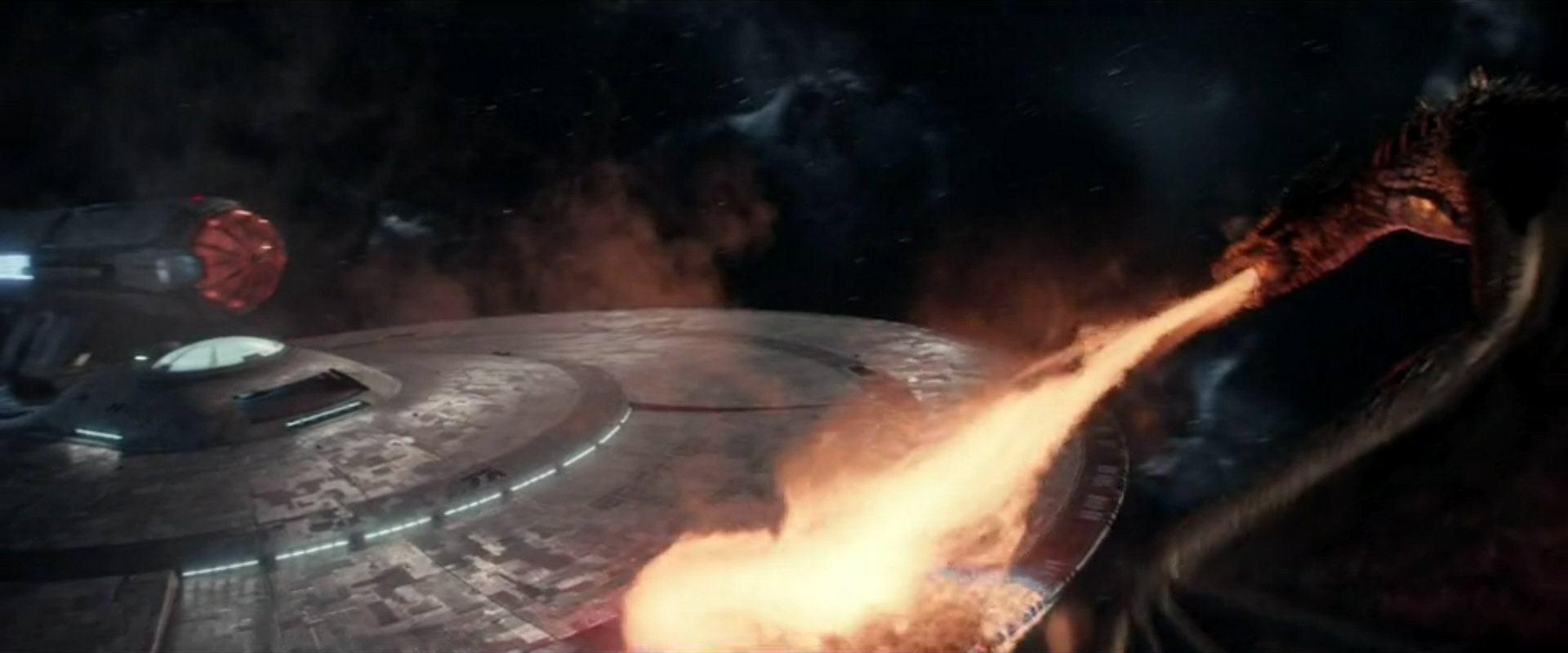
Stardate 2355.6: The Enterprise returns from a mission to a Benzite dignitary wedding. La'an saved the celebration by exposing an Orion diplomat as a spy, but she also caused considerable chaos in the process. Soon afterward, the Enterprise discovers a planet that has its own propulsion system. Pike, Spock, Pelia and La'an beam down to investigate and discover that this is a fantasy world based on the Elysian Kingdom scenario once created for Dr. M'Benga that no one else has a memory of. The doctor explains that the inhabitants are duplicates of the Enterprise crew, placed in the setting of a fantasy novel. The landing party decides to blend in, but La'an is unwilling to play the pampered princess Thalia. Pike, aka Sir Rauth, Spock, aka Wizard Pollux, and Pelia are arrested by Queen Neve's guards. In this world, Thalia has been imprisoned in a dungeon. Prince Dashing, a fantasy version of Kirk, comes to rescue Thalia, although La'an does not actually need to be rescued. She pretends that she needs to retrieve a necklace from the queen's castle that is especially important to her. Meanwhile, Pike, Spock and Pelia are taken to the dungeon, where they encounter the actual princess. When questioned by Queen Neve, who is modeled after Uhura, Pelia claims to be the author of the novel and promises to rewrite the story in Neve's favor. On the outside, Sir Adya, the fantasy version of Ortegas, joins Dashing and La'an's quest. They enter a swamp in search of the key to the castle, only to discover that Z'ymira, aka Una, has it. The real Sir Rauth and Pollux find a communicator and use it to beam aboard the Enterprise, the "Iron Dragon", where they pretend to be Pike and Spock. Queen Neve's guards capture Prince Dashing and La'an. Dashing turns out to be a werewolf, but the princess accepts him the way he is. Lady Audrey, aka Christine Chapel, then creates a potion combining the dark side, represented by La'an, with the bright side, represented by the princess. After drinking it, Neve transforms into a dragon and attacks the Enterprise. Pollux defeats her with a "cosmic blast", effectively using magic against her. Back on the planet, La'an and the princess have somehow switched personalities: La'an has become sensitive while the princess has taken on La'an's usual aggression. They fight each other, only to realize that instead of choosing between the two sides, they can combine them. They both drink the potion and regain a balance between their opposing personalities. With Queen Neve defeated, the princess and Prince Dashing take power on the planet. La'an takes the princess's dog, since the prince is allergic to it. The necklace she wanted to retrieve really exists. Having finally found a balance between her two sides, La'an is no longer consumed by her anger. She meets Kirk again, and the two agree to start over. Meanwhile, Pelia chooses to stay behind on the fantasy planet.
Review
So here we are again with another whimsical episode. And it's not a fresh idea, but a sequel to "The Elysian Kingdom" from season 1, which started this unfortunate trend and was not particularly well received. Yet here we are, continuing it regardless. In that episode, everything revolved around M'Benga, his daughter Rukiya and that Boltzmann brain, or whatever that consciousness inside the nebula really was. It could read emotions and, for some reason, built a dream world that helped M'Benga overcome his pain over his sick daughter. Eventually, it created a new life for Rukiya, even though it meant she could never meet her father again, except for that one visit from the future. So that was the rather implausible but heartbreaking way in which the nebula read and processed M'Benga's feelings. M'Benga's involvement is only marginal this time. Rukiya doesn't appear again. It's all about La'an now, but once more it's about an unresolved trauma, giving this sequel a bit of continuity beyond simply reusing the same fictional characters in a wholly different setting.
"Once La'an a Time" is meant to make sense within the realm of fantasy. Queen Neve drinks a potion that turns her into a dragon, while La'an and the princess become more moderate versions of themselves. The space dragon attacks the Enterprise, and the wizard modeled after Spock defeats it with a "cosmic blast". It's all magic. We're not supposed to scrutinize it or ask how any of it works. But that's precisely the problem. Fantasy and Star Trek simply don't mix well, and if further proof is needed, this episode demonstrates it more clearly than anything that came before.
This was not yet so much of an issue in "The Elysian Kingdom". In that episode, the crew played the characters, with the ship serving as a stage. Now we have a persistent fairy-tale world designed as a Flat Earth, complete with Cinderella's castle and inhabited by real people, which remains an unexplained mystery, especially since it apparently serves the sole purpose to take care of La'an's inner conflict. Unlike in the season 1 episode, where the sorcery was moderate, we can see large-scale physical transformations and eventually the "healing" of La'an's soul through a magic potion. Well, TOS: "The Enemy Within" did something similar, but at least it maintained the appearance of being grounded in science. Unlike in the earlier SNW episode, where only M'Benga was aware of what was happening and remained skeptical throughout, everyone in "Once La'an a Time" accepts the concept of magic after a few minutes and plays along, with only La'an remaining reluctant a bit longer. And unlike "The Elysian Kingdom", where everything still fit together to a certain extent, there is no guiding thread in this episode, which feels more like a sequence of strange situations. This is very funny at times, but only for brief moments. Even if we put up with the magic and the mystery, the story is a mess. One thing happens, then another, and the plot keeps moving because the next fantasy element is required for some reason - such as to prepare the next punchline.
I also don't like that Kirk, both as "Prince Dashing" and as himself, is present yet again. And then there's that unresolved Kirk-La'an thing, which has been kept artificially alive and stretched across almost the entire season. It finally gets resolved now, as they decide to start over. I didn't see that coming. I was under the impression she would leave the show because of canon. The title "Once La'an a Time" certainly sounded like a departure to me, so I was mistaken about that. I was especially mistaken about La'an and Kirk because I firmly expected that relationship to be over. La'an had her affair with another version of him in the parallel reality. The real Kirk was drawn to her, but he was with Carol Marcus, so it never worked out. The disappointed La'an then turned to Spock, who himself was suffering from Christine breaking up with him, and that was soon over too. This is soap opera territory: they are together, then apart and together again, in various combinations.
The same pattern applies to La'an herself, who keeps finding her inner balance, losing it and finding it again, just as the storyline requires it. In retrospect, her recent fear that the Augment DNA might eventually turn her into a second Khan feels more like a lazy excuse for her aggressive and apprehensive phase, or a red herring of sorts. It seemed to suggest that her genes might be driving her in that direction, whereas in my impression it was more likely a self-sustaining mental process in which her fear fed her anger, and her anger in turn reinforced her fear. Fortunately, because any explanation based on her heritage may have been racist. Still, it's essentially the same kind of character development that Spock is going through in the series, only doubled for La'an. Spock surmises she is torn between the two sides of herself, which applies to himself just as well. Anyway, Strange New Worlds simply can't let these themes go. It keeps recycling the same emotional conflicts and relationship dynamics, which by now have become the central features of the series. It really is a soap opera.
The big themes still exist in SNW, but by now the "smaller" episodes invariably revolve around a character's personal struggles. Discovery started this trend, but SNW has taken it a step further by making emotional drama a central theme in its own right. There are the eponymous strange new worlds, but too often they are merely the scenery for yet another story about a someone's feelings. This time, the world was literally created for that very purpose! One or two episodes per season that are built around a character's inner conflicts are acceptable, but when this happens every other week (in season 4: 3x Spock, 1x Pike, 2x La'an, plus La'an's side plots), something has gone badly wrong. And I'm not even talking about the bizarre settings of these episodes here. Show us more science fiction! Show us more thought-provoking stories, not endless trauma therapy!
"Once La'an a Time" is funny in spite of everything. There are a few hilarious situations as Sir Rauth and Pollux take on the roles of Pike and Spock. Other than that, most of the entertainment comes from one-liners such as "Whomst is not a word." I laughed hard about a couple of jokes like this, so the humor is definitely there, unlike in the other episodes of this season that pretended to be comedies. And despite an equally silly premise, I think the acting is a lot better than the painful performances (whether they were intentional or not) we had to endure in "Human Best Friend" or "Like Chronitons Through the Hourglass". But when it comes to how everything is developed beyond preparing the jokes, I simply don't care for it.
Overall, "Once La'an a Time" is a sequel to an episode that almost nobody particularly liked in the first place, and I think it was made because the actors and crew had so much fun with it, simply ignoring how unpopular "The Elysian Kingdom" is among the fans. Once again, our characters find themselves in a scenario that makes them behave like a bunch of idiots, while the plot itself is an incoherent mess. It relies on pure magic and presents it as something that actually happens. There isn't even the slightest attempt to make sense of it in-universe, apart from La'an lampshading the absurdity with the line, "So magic is a real thing now?" It's designed to conclude a totally unnecessary detour in La'an's character development, in the course of which she is "cured" by alchemy, rather than through the psychotherapy she would have needed and she even alludes to. It is wrong in so many ways. Yet "Once La'an a Time" is not quite as bad as I expected, and it clearly is more fun than the other whimsical episodes of this season. But if "not quite the worst" is the new yardstick, then the franchise is in serious trouble.
So we have ten episodes this season. Presupposing that the finale, "Tomorrow's Enterprise", is a traditional time travel story, it can be summarized as follows: four episodes with serious premises and six "big swings". The balance is totally off. And those six gimmicky installments sucked to various degrees. They range from really bad but funny, like this week's episode, to absolutely unwatchable. Only one of them was actually decent: "A Case of Chiaroscuro". That's a terrible record for this season.
Annotations
- Continuity: This is a sequel to "The Elysian Kingdom" with the same fictional characters, who for some reason are real now, on a real "Flat Earth".
- Remarkable fun dialogues:
- "The Orion dignitary was a spy. Okay? I prevented an intergalactic incident and saved a marriage." - "But putting the groom's face in his own cake and lighting the bride's dress on fire..." (La'an and Pike)
- "It is I, Sir Rauth, with whomst thou speakest." - "'Whomst' is not a word." (Pike and Ridley)
- "I am Captain Pike, and this is Mr. Spock. And this... this is Benny Russell, the author of that book." - "Uh... what?" - "Is it true? You are the author of this tome?" - "Yup, that's me. And also, I'm a duchess." (Pike, Pelia and Neve)
- "It would give us the strength that Queen Neve took from us. Putting us back in balance. Perhaps putting the entire world in balance. And removing from her what she has stolen from us." - "And possibly turning us into dragons?" - "You say that like it's a bad thing." (Thalia and La'an)
- Remarkable fun scene: Sir Rauth as Pike and Pollux as Spock rehearse their signature phrases "Hit it" and "Fascinating" respectively.
Rating: 2
Tomorrow's Enterprise
Synopsis
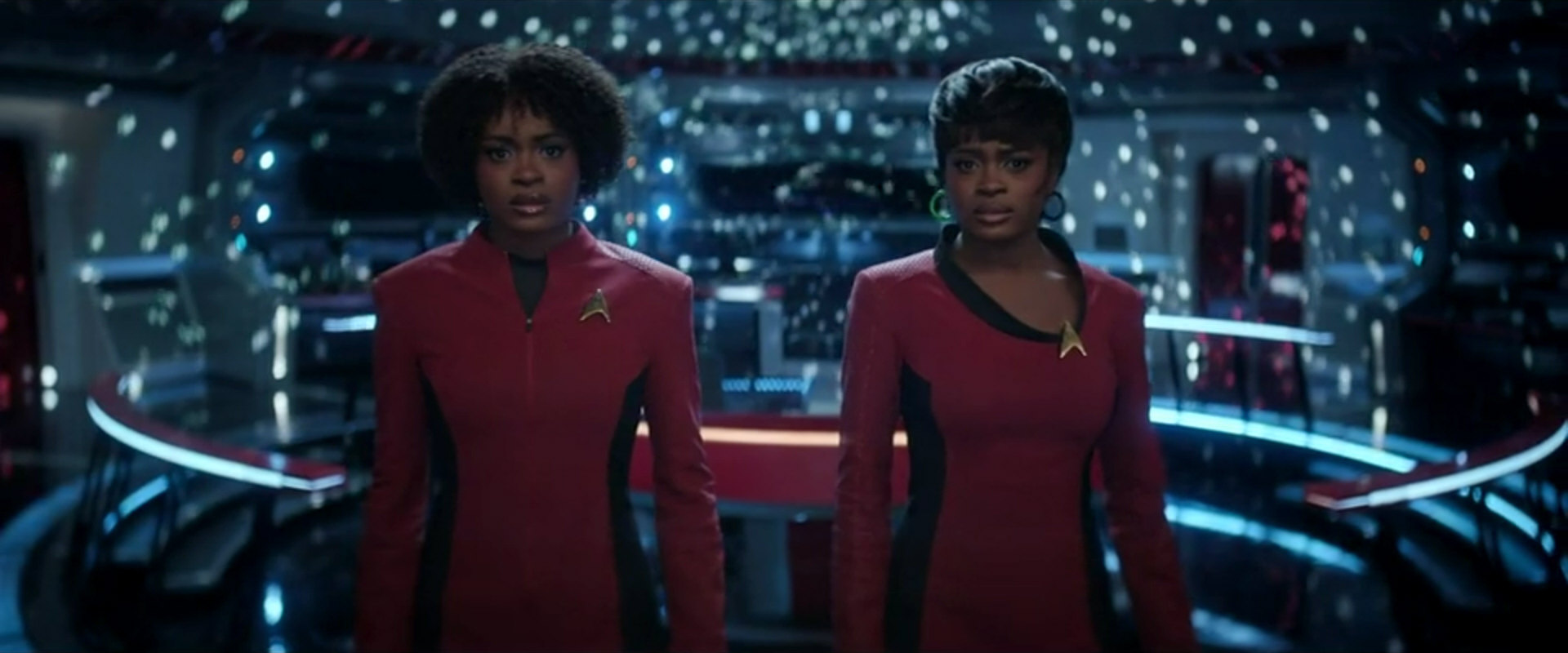
Stardate 2873.2: The Enterprise investigates a white hole and launches a probe. The theory is that there is a black hole on the other side of the phenomenon. On the bridge, Lieutenant Uhura receives an anomalous signal from the white hole that sounds like music. An energy surge then hits the Enterprise and holds it in some sort of tractor beam. Uhura is distressed because she hears an emergency call from Scotty, who appears to be in danger sometime in the future. She tracks the origin of the signal and establishes a communications link, only to discover that she is talking to herself in the future. Her other self is on the Enterprise one year later, on Stardate 2876.2, investigating a black hole. By then, Ortegas is no longer assigned to the ship, but she returns to pilot a shuttle with Uhura and Scotty. An energy surge hits the shuttle, injuring Uhura, who is beamed back to the Enterprise while Scotty and Ortegas apparently die. However, once she is back on the ship, she learns that she had actually been alone on the shuttle. Ortegas was not there, and Scotty had died one year earlier - at the time the Enterprise was caught in that white hole. Present and future Uhura coordinate their efforts. Present Uhura asks Spock to investigate how the temporal effect might be reversed, while future Uhura requests the solution from him one year later. Spock tells her that she needs a dilithium diamond. Present Uhura gets the needed material from Scotty, upon which the diamond takes one year to grow. Future Uhura eventually takes the completed dilithium diamond. The two Uhuras return to their respective bridges and prepare to send a reverse pulse to initiate the time reset. However, a pulse from the anomaly forms on both sides and causes them to switch places. Present Uhura is now in the future, while future Uhura finds herself in the present. Future Uhura meets Scotty again, who is dead in her timeline. He tells her that there was an audible frequency, like a sound, and she recognizes it as familiar. Both Uhuras receive clearance from their captains, Pike in the present and Kirk in the future, to continue their efforts to restore the timeline. Future Uhura then sends herself a message to the future in the form of a mural containing a code that can be used to decode the music coming from the anomaly. Present Uhura, now in the future, recognizes the decoded message as referring to a kind of space baby that is about to be born. She, Kirk and Chapel realize that they have to help deliver it. The future Uhura in the present and present Uhura in the future both climb onto the saucer section and launch drones into the white hole or black hole. They lose control of the drones, and the attempt fails. In the present, the console explodes and kills Scotty, just as predicted. As a last resort, the two Uhuras dive into the anomaly. They meet inside it and discover that non-linear aliens live there outside space-time. The aliens send the two Uhuras back to their respective ships and reset time. As a result, the timeline is restored and Scotty is alive again.
Review
It is hard to start a review of "Tomorrow's Enterprise" because it is so bloated. There is so much packed into this episode that I first need to sort my thoughts and somehow get my brain working again after everything I have just witnessed. Maybe let's start with the title. "Tomorrow's Enterprise" insinuates that it is somehow related to TNG: "Yesterday's Enterprise", but that is really only the name. Story-wise, there are much clearer parallels to TNG: "All Good Things". In particular, we have the Enterprise in the present and the future at the edge of an anomaly, with one person having to coordinate the efforts across different times. Of course, there are only two Enterprises here, whereas there were three in the TNG finale. But the anti-time concept is similar. In both episodes, the characters are caught in an effect that originates in the future and reaches into the present. In "All Good Things" it was the result of a game played by Q, whereas here it is caused, at least to some extent as it seems, by another kind of space aliens. They are described as entities that give birth to "space babies", but they are actually much more like the Prophets from DS9 than the space whales in TNG: "Galaxy's Child". They exist outside space-time and have god-like powers, and in the end they resolve everything through a literal deus ex machina. That is the core of the story, although there is a lot more to it, and mostly not to its advantage.
The setting is that we are on the Enterprise of the future, where we see Uhura, along with other members of the crew. And this future is only one year away. The episode hence sort of foreshadows what will happen in the series finale, which is only six episodes away. If SNW had been canceled after season 4, I can imagine "Tomorrow's Enterprise" serving as a series finale in much the same way as "All Good Things" did for TNG. As they were filmed back to back, it seems unlikely that this was actually the intention, yet the episode almost feels as if it had been written with that possibility in mind. The way it is presented at this point of the series, however, is actually a bit of a pity, because it gives us much more than just a glimpse of how the series will end. We already had something similar in the season 1 finale, "A Quality of Mercy", but that was an ephemeral parallel timeline, so we could assume that history would not actually turn out that way. Here, however, we see in much more detail what could be the actual future, only one year ahead, and it is much harder to argue that things could turn out very differently.
We know that the SNW series finale will show Kirk taking the captain's chair of the Enterprise. The producers have been clear about that. So what can we already see here? The first thing, of course, is Uhura. She has the hairstyle and uniform of TOS, or at least a reimagining of the latter. It is the uniform that we already saw in "A Quality of Mercy", and her haircut now makes her look remarkably like Nichelle Nichols. Unfortunately, that is about the only thing that is designed to align with TOS. First of all, the SNW Enterprise of the future doesn't look any different than usual, except for an artificially introduced different color grading. Then there is Dr. Boyce. He was the Enterprise's CMO a couple of years earlier in "The Cage", and now he is back again for some reason. We already had him appear once this season in "Off-Hour", purportedly to replace M'Benga eventually. Now we learn that he will still be on the ship one year later under Captain Kirk, at a time when M'Benga is gone as expected but McCoy is already on board. We do not see him yet, but we will next season. At the same time, the story simply ignores Dr. Piper from "Where No Man Has Gone Before". That is the first problem with trying to reconcile this future with TOS.
There are more issues along these lines. When she travels back to the past, future Uhura refers to Pike as an admiral, but Pike was never an admiral. In TOS: "The Menagerie", he was consistently referred to as a captain or fleet captain. Then there is Gary Mitchell. By mentioning him, the writing obviously wants to create the impression that it doesn't completely ignore "Where No Man Has Gone Before". But could Uhura really have met him? She is not aboard the Enterprise in "Where No Man Has Gone Before", whereas Mitchell (briefly?) is, as is Dr. Piper. And if Mitchell is still alive in Uhura's future, this also means that the episode ignores that the uniforms were different in the second pilot. So once again, things do not quite add up. We can argue that encounters happened off-screen. Or that this is a future that has not happened yet and that it can still turn out differently. We know that the timeline has already been changed once when Scotty died, and if Scotty is not dead in the restored timeline, perhaps these other things will also turn out differently. There are certainly possibilities.
But ultimately, questions like these highlight one of the fundamental problems of the whole Discoverse. We cannot tell what is supposed to be a change with story relevance, and what inconsistencies come to pass because of negligence or ignorance creative decisions, so we are expected to accept them as part of the reboot. We cannot distinguish these categories. I have brought this up several times before, and it becomes particularly obvious here.
I have also noted several times already that Celia Rose Gooding really nails it. She is Uhura. I'm generally opposed to reboots and their necessary mass recastings. But when a single role is recast, I do not mind when new actors bring their own performances to established characters. They do not have to perfectly imitate the original actors; they just have to have the age and looks and to deliver a credible interpretation. With the way she acts and with her appearance, Gooding does a lot more than that. She comes eerily close to Nichelle Nichols, as already mentioned. It really brings back those fond memories of TOS. Unfortunately, she is the only one. Despite nearly everyone's hairstyles being closer to TOS, none of the other characters strikes me as being reminiscent of the originals they are based on, and least of all Scotty. He always remains the rookie in SNW. He is awkward and inexperienced, rather than the seasoned man in his forties we know from TOS. Now that we see him at the time of TOS, there is no denying any more that the character has been redefined completely. Pairing the two actors is convincing if we simply look at Martin Quinn as Scotty and Celia Rose Gooding as Uhura. They make a nice couple. But James Doohan's Scotty and Nichelle Nichols' Uhura had relatively few interactions during TOS. Well, TOS never cared much for relationships, whereas SNW is obsessed with them, so we cannot really tell what might have developed between them off-screen. And we know from "Star Trek V" that Scotty did care about Uhura at some point. Perhaps that could have developed over time. But Scotty's age does not fit, and neither does the way this relationship is introduced.
As already mentioned, the story has many similarities to "All Good Things", but the TNG episode was complex in a much more satisfying way. Ultimately, everything there boiled down to Q playing his game and Picard recognizing the concept of anti-time, with events happening before they were possible. "Tomorrow's Enterprise" uses a similar idea but has a lot more going on that often distracts from whatever we could learn about the Uhuras or the black hole aliens. We even get the poker game, but instead of including it once toward the end as an homage to "All Good Things", it feels shoehorned in through the many times it is referred to before it is eventually shown. Uhura being known for bluffing comes completely out of the blue, and I fail to see its relevance to the story, as hard as the idea is being pushed here. There are several other examples of factoids or other aspects that seem to have been included simply because the writers wanted another homage or another detail for viewers to marvel at. The result is a story that feels overengineered and overwritten.
A lot is happening, but at the same time some scenes are remarkably lengthy. "All Good Things" was one and a half hours long and did not have a single boring or pointless minute. "Tomorrow's Enterprise", on the other hand, contains a lot of talking that is presumably meant to serve the story but does not lead to very much. The episode could have had much more impact if it had concentrated on its core ideas instead of piling on numerous side aspects and continuity references. La'an is a good example. She is barely involved at all, except for one scene in which she talks to Uhura about the dangers of time travel, which in her words is "heartbreaking". Of course, this is meant to call back to "Tomorrow and Tomorrow and Tomorrow", where La'an was with alternate Kirk, who was shot and died. It remains vague and feels somewhat out of context. Time travel is hardly unfamiliar territory for Uhura. Our crew had their enormous adventure only weeks ago in "Valles Marineris", when they went 65 million years into the past and created the biggest temporal paradox ever. No one really needs to lecture Uhura on the topic. This includes Pike, who, just like La'an, makes insinuations to Uhura without saying anything. He does not explicitly mention his allegedly inescapable fate of ending up in a wheelchair, and it has no purpose but to remind attentive viewers of just that. It doesn't mean anything to Uhura.
The story itself develops rather slowly. I appreciate the initial mystery about Uhura being plagued by Scotty's desperate call, although I don't quite understand whether that "anomalous message" really was sent or only manifests in her head. For about 18 minutes it looks like a routine episode that plays nice, until something decisive happens. Future Uhura is beamed back from the shuttle and learns that Scotty was not with her. He has actually been dead for a year. Suddenly the story becomes much more dramatic and interesting. And I find the unexpected twist that present Scotty is the one Uhura has to worry about, rather than one from the future, particularly effective. At the same time, this first timeline change and the temporal hijinks that follow raise a number of issues.
The first question is why Uhura was alone on the shuttle in that changed reality. I find that very unlikely. I do not have major complaints about the time travel mechanics themselves, though. We have the situation where effects from the future reach into the past, and there are some grandfather paradox elements. But these are acceptable, as they allow for genuinely good interaction between the two Uhuras across time, at least if we don't bother to ask for an explanation of what exactly that dilithium diamond is supposed to accomplish. Future Uhura also retains memories from a timeline that no longer exists, which is a common theme in Trek. Then the two Uhuras somehow switch places for reasons that never become clear. I'm still not going to complain too much about that because Star Trek has shown equally strange temporal situations before. Regarding the time travel mechanics, the resolution leaves room for different interpretations: some things may have happened naturally, while others may have been fabricated by the aliens. I can accept that to some extent.
What I cannot accept are the really big offenders in terms of science and story logic. There are several situations where I simply had to pause the episode and think, "What the f...?", because they are so absurd. The first is the mural. We learn that future Uhura, while in the past, created a mural containing a cryptic alien scripture. Then past Uhura, while in the future, sees that mural and suddenly realizes that it is a message from herself, which can be used to decode the musical notes from the anomaly. That is absurdly far-fetched. If the purpose was to send her future self a message at exactly the right time, there are countless ways to accomplish that which would be much clearer and more reliable. This method is simply nonsense. I don't buy it.
But it gets worse. Uhura, Pike and Christine see the message that the universal translator renders as "We are the midwives. The baby is breeching, stay clear." They interpret this literally. There is apparently a space baby that is in a breech position, which is why they need to help deliver it. And of course Christine Chapel is the expert because she has delivered many babies, so presumably she can also handle a space birth. Uhura then has to walk on the hull with drones, which cannot apparently be done from inside the ship, although no reason is provided. She also has to wear those gloves with tactile interface, apparently because every baby has to be handled with great care. Then it gets even more ridiculous: the pulses coming from the anomaly are contractions! And as Uhura is outside, Christine gives advice that the baby knows where the exit is or that the baby is beginning to panic. It is so ludicrous.
It's arguably not as laughable as Christine Chapel's expertise on space births, but the low point in terms of science is the depiction of the black hole. The anomaly has a razor-sharp border as the Schwarzschild radius, with the Enterprise sitting only a few meters away. Uhura can then simply dive into the black hole without herself or the ship getting spaghettified, which would actually happen way before she crossed that boundary. It is the most absurd depiction of a black hole in the history of Star Trek, and we've had many offenders already. Maybe the aliens somehow make this possible, but the story never establishes that, and by this point the whole thing has lost me. There are many more scientific problems, even if we are willing to put up with the aliens and their god-like powers.
As already mentioned, "Tomorrow's Enterprise" ends with the aliens sending Uhura back in a deus ex machina solution. And additionally, it all ends without Uhura or anyone else of the crew having accomplished anything by themselves. They don't manage to undo the temporal changes, they don't actually deliver the baby (at least not that I'm aware of). It all boils down to the aliens resetting time and saving Scotty with what is a quintessential reset button, after they had trapped the two ships for reasons I don't quite understand. As mentioned, I am willing to accept the temporal mechanics, but it ultimately remains open to speculation what happened and why. I would have expected some kind of explanation or revelation, and some things to make more sense in hindsight, but there is nothing like that. Instead, the two Uhuras essentially run into wormhole aliens who explain nothing except that they are non-linear and beyond comprehension, the Prophets from DS9 in everything but name. They may or may not be intended to be the familiar Prophets, but who knows? And who cares? Either way, it is a disappointing ending, one that also takes away some of the emotional impact for me.
This episode has a lot to offer, and there are many more noteworthy details that I mention in the annotations. But it is overwritten. It comes with a reset button instead of a real reward. It could have taken more care with its core issues. It could have been scientifically at least somewhat credible instead of totally ludicrous. And even though it was never seriously the intention in SNW, it could have dealt with the future in a way that honors TOS beyond simply giving Uhura the TOS uniform and hairstyle. It could also have told a more focused story instead of being so heavily indebted to "All Good Things", which remains vastly superior to this mess. There are still many good aspects about it, but it seems every one of them comes with a caveat. I appreciate that Uhura gets quite a bit of character development here, although it doesn't move beyond the usual self-affirmation as it is so common in SNW. Her romance with Scotty is fine, but explicitly only within the scope of this reboot. I like the final moments when Uhura muses about the here and now being all that matters, although it sounds much like a calendar motto when I give it more than superficial thought. Overall, "Tomorrow's Enterprise" is presented like a landmark episode, with superb CGI and a great musical arrangement, yet its narrative falls surprisingly flat.
I do appreciate this episode as the finale to a fourth season that otherwise was genuinely fucked up. We had four reasonable episodes and six genre crossovers that had little to nothing to do with the Star Trek I love. "Tomorrow's Enterprise" is among the episodes that are true to Star Trek, but it is not among the franchise's strongest hours, and not even among SNW's strongest hours. It remains entertaining, but replaces quality with quantity, so to speak, and somehow drowns part of the emotional impact in all kinds of ideas that have been shoehorned into the story without adding up to something coherent.
Annotations
- Continuity:
- After Dr. Boyce unexpectedly came back in "Off-Hour", the question is what he is still doing on the ship one year later, now alongside McCoy, who replaces M'Benga, rather than Dr. Piper, who apparently doesn't exist in SNW. Perhaps this may be explained by the timeline shown one year in the future being different from the one of TOS.
- Uhura never called Dr. McCoy "Bones".
- Pike wasn't an admiral when he had his accident. At least, he was repeatedly referred to as a captain or fleet captain in TOS: "The Menagerie". If that is a timeline change, it also indicates that his fate in the wheelchair is not inescapable.
- Uhura could have met Gary Mitchell off-screen, but it feels contrived, since he was aboard for a brief time just as Uhura apparently wasn't.
- Is La'an dead in the future, or at least in a possible future? Jim Kirk looks like that when Uhura mentions her.
- We can see an Aurelian from TAS: "The Jihad" (for the first time in live action) and a member of the feline species of M'Ress (supposedly Caitian) from TAS (for the first time since the TOS movies, discounting the alleged Caitians from "Star Trek Into Darkness").
- Nitpicking:
- La'an gives Uhura the advice to find the target of the distress call, which doesn't seem to make sense. Does she actually mean to say source? And if she meant to say source, isn't that what Uhura has been doing all along when she scanned the anomaly, so far in vain?
- After reality has changed, what was future Uhura doing alone on the shuttle investigating the anomaly?
- Scotty says he picked up a signal, which Uhura describes as "an audible frequency, like a sound wave". In other words, sound in space - which she will actually hear with her own ears while in space a bit later.
- The Schwarzschild radius is literally a few meters away from the Enterprise, but there are no extreme gravitational forces that tear the ship and Uhura apart, and also no fluctuations whatsoever.
- Remarkable quotes
- "I don't know how she fell out of the airlock, Captain Kirk." (Ortegas, jokingly, about Uhura)
- "Personal log. Stardate... today. Not tomorrow and not yesterday. The past is over. The future hasn't happened yet. The only moment that's real, that we actually live in, is now. It's the only day that matters. How you spend it and how you define it. My future is not all I think about anymore. I'm not afraid of it. I'm lucky to be here in the moment. To not know what adventure will come my way every week. Because the not knowing is a gift. And part of that gift for me is, I'm going to spend this moment and every moment to come doing what I love with the ones I love." (Uhura)
Rating: 5