The Animated Series (TAS) Season 2 Guest Reviews
Season 1Season 2
The Pirates of Orion
Synopsis
Stardate 6334.1: When Mr. Spock contracts a deadly case of choriocytosis, the Enterprise races to rendezvous with the USS Huron, a Starfleet freighter carrying the drug strobolin that is essential for Spock's treatment. En route, the Huron is attacked by an Orion pirate vessel, which steals its cargo including the strobolin. The Enterprise is able to follow the Orions' trail, capture the vessel, and recover the cargo, curing Mr. Spock. As a result of the incident, Captain Kirk intends to end the Federation's recognition of Orion as a "neutral" power.
Review
Like Vulcans, Orions were introduced in Star Trek's original pilot "The Cage." Vulcans received the most development of Star Trek's aliens through TOS and its movies. (Added to this is a substantial amount of problematic attention given to Vulcans in "Star Trek: Enterprise.") Similarly Klingons received an even greater degree of development, beginning with their language "Star Trek III: The Search for Spock," and their culture in "Star Trek: The Next Generation." And we learned more than anyone probably wanted to know about Bajoran religion and politics in "Star Trek: Deep Space Nine." Along the way, we've gained a reasonably solid sense of the Romulans, the Cardassians, and the Ferengi.
Not so, the Orions. Orions have continued to receive a significant number of mentions and appearances throughout the franchise (TOS, TAS, DS9, VOY, ENT, DIS, LOW), but the portrayals are generally shallow, inconsistent, and even incoherent. Incredibly, after mentions in 6 previous series, the first time we've seen the Orion homeworld depicted is in a brief holodeck simulation in LOW: "Second Contact." And although Ensign D'Vana Tendi (introduced in the same episode) is the first Orion to be a main character in any series, almost nothing has set her apart as distinctly "Orion".*
Although an Orion conspiracy was central to the plot of TOS: "Journey to Babel," TAS: "The Pirates of Orion" was the first Star Trek episode to focus on the Orions. Once again we see that the Orions are a minor power, which is avowedly "neutral," albeit one that is continuously exploiting that status in order to sanction smuggling and piracy. We also reprise the idea, established in "Journey to Babel," that Orions will commit suicide rather than allow themselves to be caught in the act. Unfortunately, aside from these details, "The Pirates of Orion" adds little in the way of useful development.
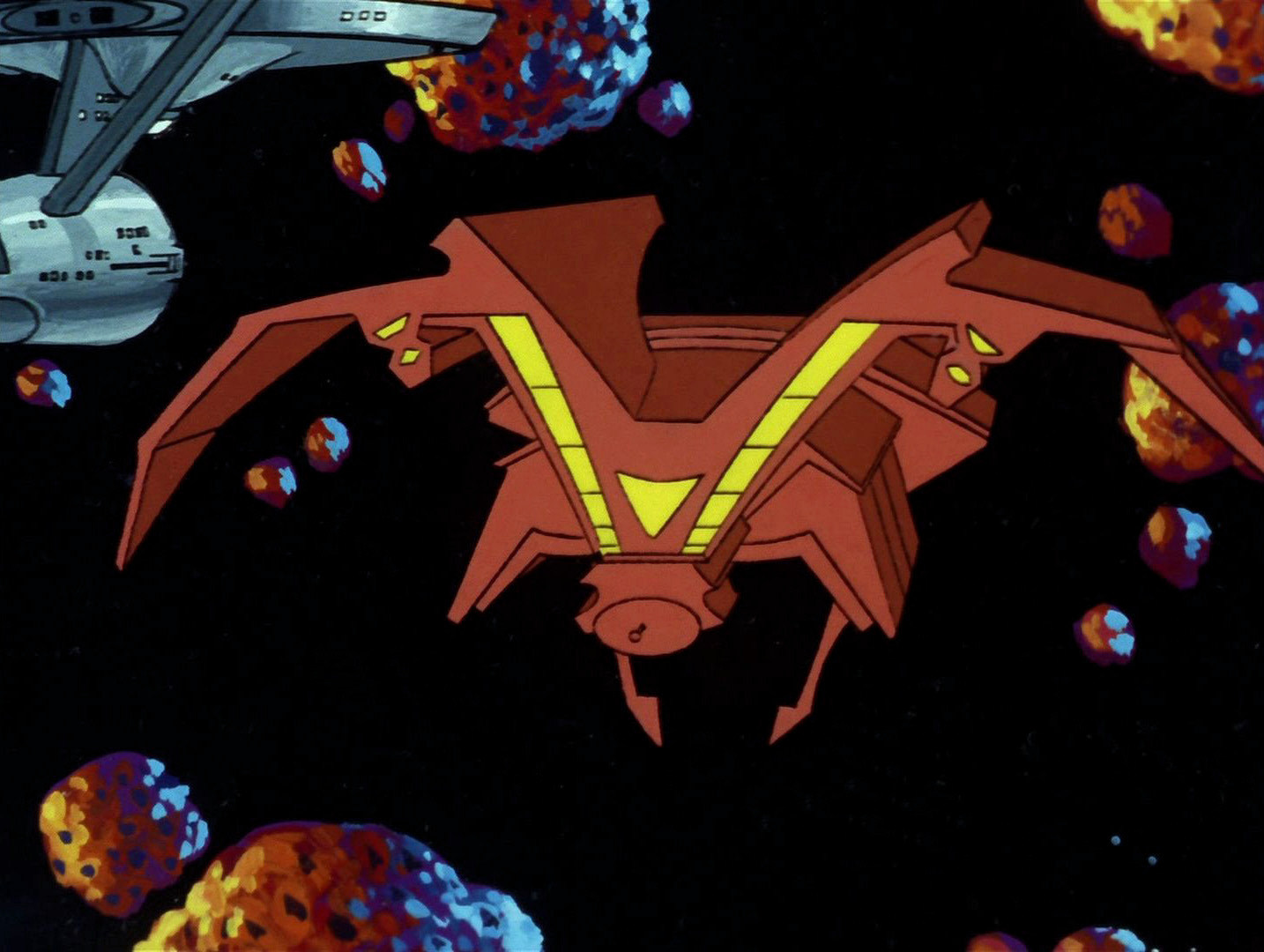
In "Journey to Babel," the Orion ship was portrayed as a tiny blob of light due to budget constraints (and we don't see much more than this in TOS-R). "The Pirates of Orion" introduces the first design for an Orion ship. While it looks cool enough in its head-on view, we never have a side or rear shot to understand how it works. Unlike the Orion ship in "Journey to Babel" which was smaller but faster than the Enterprise, the Orions in "The Pirates of Orion" indicate that their ship can't match the Enterprise in speed or weaponry. However, bizarrely, when the Enterprise and the Orion ship square off, the latter appears substantially larger than a Constitution-class starship --- hardly an appropriate scale for a pirate marauder. Likewise, the Orions wear uniforms that seem more appropriate for cartoon supervillains than for pirates. Worst of all, throughout the episode, "Orion" (oh-RYE-un) is consistently mispronounced (ARR-ee-un)!
Rather than taking the opportunity to develop anything interesting about the Orions and their culture, the episode reduces them to aliens of the week. Instead the focus once again is on the race to treat a rare disease with an even rarer drug (already a very tired trope in TOS).
*At least nothing distinctly Orion as of the first seven episodes of the first season of "Star Trek: Lower Decks," when this review was written.
Annotations
- Remarkable Starfleet freighter: The episode introduces the USS Huron (NCC-F1913) with a remarkable TOS-era design, much larger than the Antares-type ships introduced in TAS: "More Tribbles, More Troubles." Like the crews of the Antares (TOS: "Charlie X"), Constellation (TOS: "The Doomsday Machine"), and Exeter (TOS: "The Omega Glory"), the crew of the Huron have their own distinct insignia badge.
Rating: 2 (John Hamer)
Bem
Synopsis
Stardate 7403.6: The Enterprise is hosting Ari bn Bem, a Pandronian observer with the honorary rank of commander. Although Commander Bem has remained in his quarters through most of the tour, he insists on joining the landing party when the ship reaches Delta Theta III. Kirk is reluctant to allow Bem beam down to the planet because the primitive natives are potentially hostile. On the planet's surface, Commander Bem surreptitiously replaces Kirk's and Spock's phasers and communicators with non-functioning replicas. As the landing party prepares to set up equipment to monitor the natives, Bem runs into the rain forest. Kirk and Spock follow and discover that a party of Delta Thetan hunters have captured the Pandronian. Although Kirk and Spock realize their communicators and phasers are non-functional, they decide to follow Bem to effect a rescue; instead they are themselves captured by the natives. Imprisoned together in wooden cages, Bem reveals that Pandronians are "colony" lifeforms able to disassemble themselves (and thus Bem is able to escape through the bars). He also admits that he took the phasers and communicators in order to test Kirk and Spock's capacities. Once again armed, Kirk and Spock escape their cages, but immediately attract the attention of a powerful energy being that serves as the guardian of the Delta Thetans. Eventually, Kirk is able to negotiate with the energy being, which allows the landing party to depart the planet, which is placed under strict quarantine.
Review
What a mess of an episode! David Gerrold, author of TOS: "The Trouble with Tribbles," and TAS: "More Tribbles, More Troubles," returns for his last and least successful outing Star Trek outing. Originally pitched as a season 3 TOS episode, "Bem" was apparently subject to massive re-writes that fundamentally altered its initial premise and unsuccessfully wedged in an unconnected Gene Roddenberry plotline.
The original concept was for the Enterprise to host an officer who is completely alien in both physiology and philosophy, an actual BEM or "Bug-Eyed Monster." However, as drawn in the episode, Bem appears humanoid. Despite having sufficient relations with planet Pandro to accept an observer on a starship, no one in the Federation is apparently aware that Pandronians are "colony" lifeforms whose head, torso, arms, and legs can separate and walk or float around. The Pandronian intellect is apparently also a combination of brains in the individual parts, since Bem decides at one point that the particular merger has failed and should be dissolved permanently. The fact that the separated legs need to have their own little arms and grabbers is weird. If the separated head, torso, and presumably arms can just float around, why do the legs need to walk? As presented, Pandronian physiology is absurd.
The Pandronians' "alien" culture is also muddled. Gerrold originally intended for Bem to be a kind of practical joker and vestiges of this remain when Bem sets the transporter coordinates so that Kirk and Spock materialize above water and immediately fall into a lake, and again when Bem swaps out their equipment for fakes. Given Gerrold's previous success with comedy, this might have been a fruitful direction to take the script. Instead, these become inexplicable, isolated incidents and the Pandronian philosophy in general comes off as inscrutable.
Unfortunately, the moral is likewise muddled. Generally, when developing a story where our heroes learn about someone truly alien, they ought to first be turned off by the ways differences lead to problems. And then later, they come to appreciate that the alien culture that originally seemed to wrong, actually has a understandable rationale. Instead, it's Bem who comes to realize that he was misbehaving according to human expectations and the episode's moral is that he needs to learn from his mistakes. As Star Trek morals go, this one is flawed at best. Interestingly, when the premise of an alien officer exchange program is recycled in TNG: "A Matter of Honor," once again it's the alien officer who has to learn why his customs were mistaken.
The Roddenberrian B-plot involves a "god-like" energy being who is supervising the evolution of a primitive species operating at a hunter-gatherer level of technology. In some ways, this is similar to TOS: "The Apple," where a planet of primitives are being overseen by the computer Vaal. Although Kirk quickly decides to destroy Vaal, whom the natives revere as a god, he has the opposite reaction here and it's not immediately clear why. Why is it better for a primitive society to be controlled by energy being acting as a god than a computer acting as a god? The episode's conclusion comes of as especially paternalistic. At least the people of Vaal got a chance to speak (prior to being ignored). Kirk doesn't even bother to try to communicate with the Delta Thetans.
Annotations
- Remarkably dubious name: The Pandronian observer is named "Ari bn Bem." The name deliberately references the Scifi slang phrase "Bug-Eyed Monster," of which BEM is an acronym. Although juvenile in-jokes and references have frequently made their way into Okudagrams (usually meant to be illegible), this is an example where an in-joke has inappropriately risen to the level of the title character's name. Episode author David Gerrold is Jewish and the rest of Bem's name is apparently also some sort of insider reference as "Ari" is a common Hebrew name meaning "lion of God" and "bn" means "son of" in Hebrew.
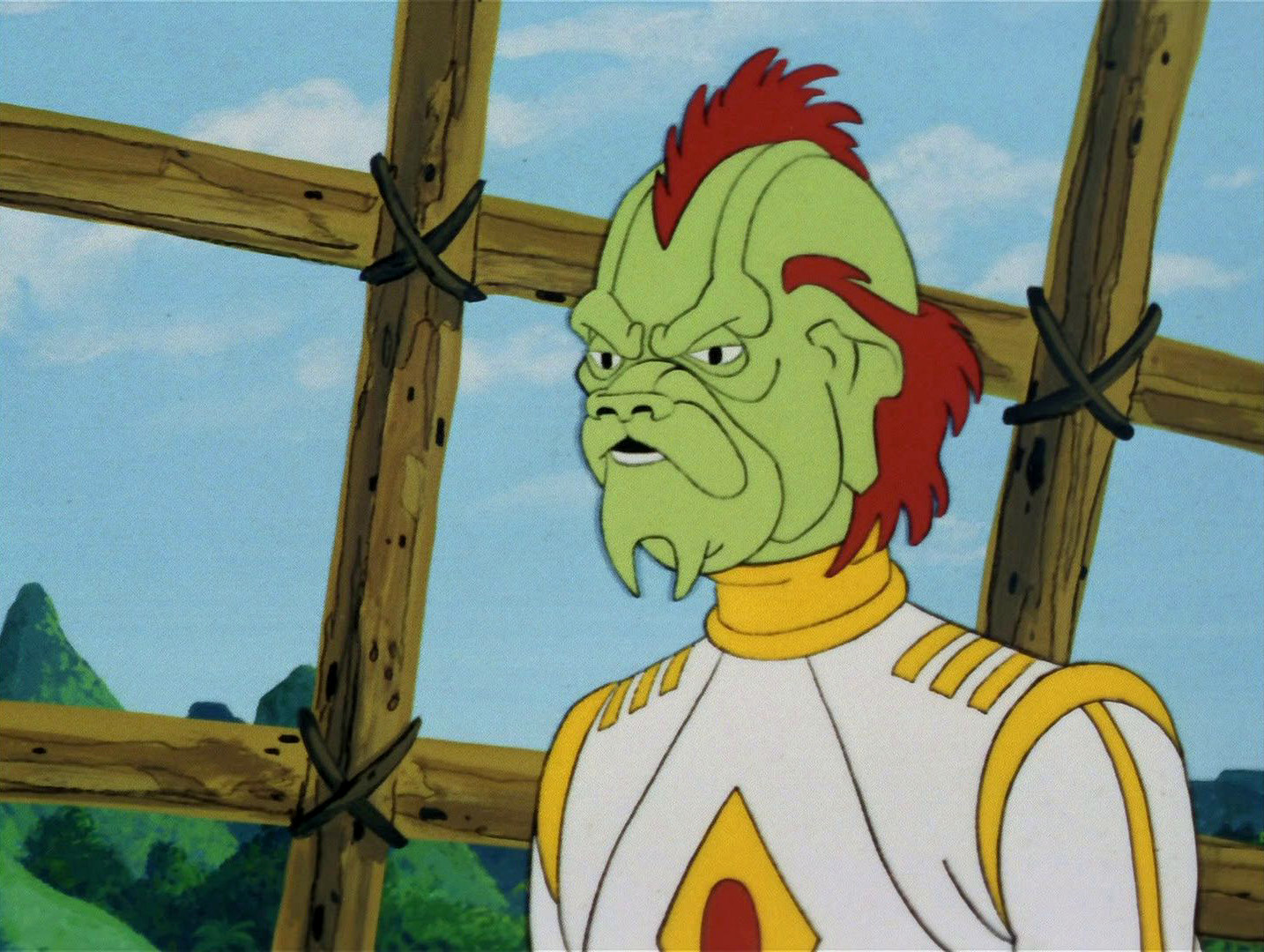
- Remarkable indigenous species: The Delta Thetans are reptiloids that look really cool. I really would have preferred that the episode focus on them. Instead, they're relegated to a non-speaker role behind Bem and their guardian energy being.
- Recycled premise: A planet of primitives protected by a godlike energy being guardian was recycled in TNG: "Justice" and later VOY: "Caretaker." The premise of an alien officer exchange is revisited in TNG: "A Matter of Honor." The idea that Starfleet sets up equipment to monitor primitive species is revisited in TNG: "Who Watches the Watchers?" and "Star Trek: Insurrection."
- Remarkable name: This is the first episode to establish "Tiberius" as Kirk's middle name. Kirk's full name repeated half a dozen times during the episode.
- Remarkably obtuse greeting: "Kirk to alien intelligence. This is captain James Tiberius Kirk calling the ruling intelligence of this planet. Answer me, please... This is captain James Tiberius Kirk calling the ruling intelligence of this planet. Do you hear me? Kirk to entity. Kirk to entity?"
Rating: 3 (John Hamer)
The Practical Joker
Synopsis
Stardate 3183.3: Synopsis in main TAS listing
Review
Like many TAS episodes, "The Practical Joker" is rushed with some plot holes. Most of the jokes are not even very funny. Worst of all, the ship creates itself an inflatable Enterprise of equal size. What the heck? Why would the Enterprise be equipped with an inflatable fake in the first place? Did the computer create it? If so, how? It all seems too silly to me.
Annotations
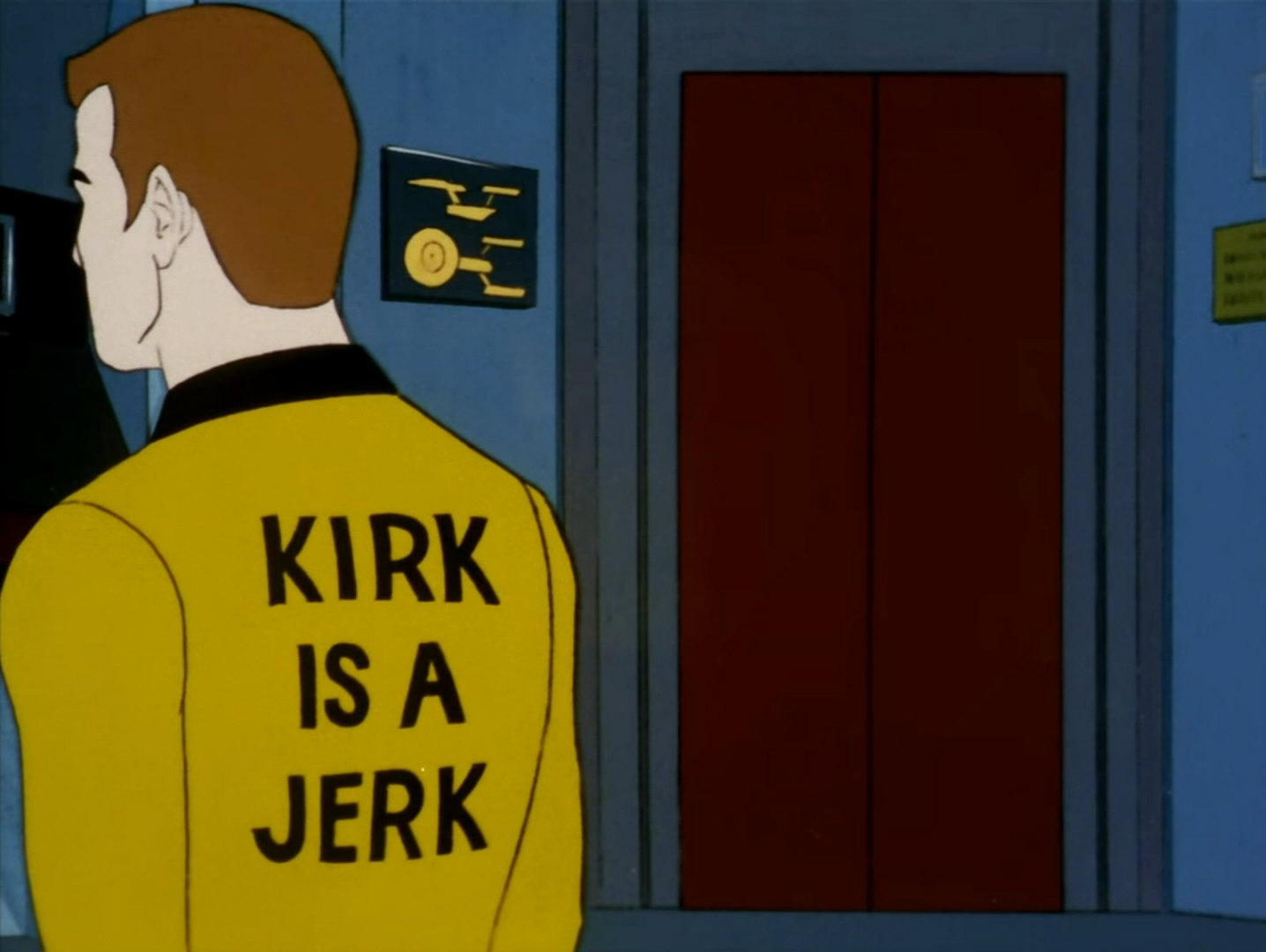
- Remarkable prank: Kirk has a new shirt made for himself and the computer prints on the back of it "Kirk is a Jerk". Probably the only funny joke of the episode.
- Remarkable technology: The rec room. Could it be that Starfleet already had holodecks on some of their ships? This would not work well with TNG where is is assumed that holodecks are a fairly new technology. However, since this series is animated (and poorly at that) we could assume that the rec room is not as realistic as a holodeck from the 24th century. If this were the case, then Riker's comment about being astonished by the perfection of the holodeck would make sense. Also, in "The Practical Joker" the team decides to try and find a wall since the room is only so big. This trick would not work in the many holodeck malfunctions of the TNG era.
- Remarkable voice: Majel Barrett seems to provide the voice for the ships computer. Majel would later do the voice for Starfleet ship computers in the TNG era.
Rating: 3 (Chris)
The Practical Joker
Synopsis
Stardate 3183.3: To escape a Romulan ambush, Kirk directs the Enterprise through an energy field, which causes serious damage to the ship's main computer. The computer begins to behave illogically, seemingly delighting in playing "practical jokes" on the crew. Attempts to disengage the computer fail, leading to a loss of manual control over the ship. After the computer returns the Enterprise to the Neutral Zone to play a prank on the Romulans, Kirk is able to trick it to traveling back through the energy field which reverses the damage.
Review
In John M. Ford's excellent comedic Star Trek novel, How Much for Just the Planet?, the Enterprise is testing a decoy that has the appearance and sensor profile of a Constitution-class starship, but is actually an inflatable balloon. The idea for the decoy comes from TAS: "The Practical Joker." If the episode had taken the time to establish the existence of the balloon decoy somewhere the start of the story (as was done in the novel), deploying it at the end might have been perfect. The idea that the Romulans fear dishonor and that the Enterprise computer wants to revenge itself on the Romulans by tricking them with a practical joke is very solid. Unfortunately, the fact that the balloon isn't foreshadowed or explained (why would it be 10x larger than the Enterprise?!) undercuts both the point and the potential humor. How Much for Just the Planet? is a pretty funny novel. "The Practical Joker"? Sadly not so funny.
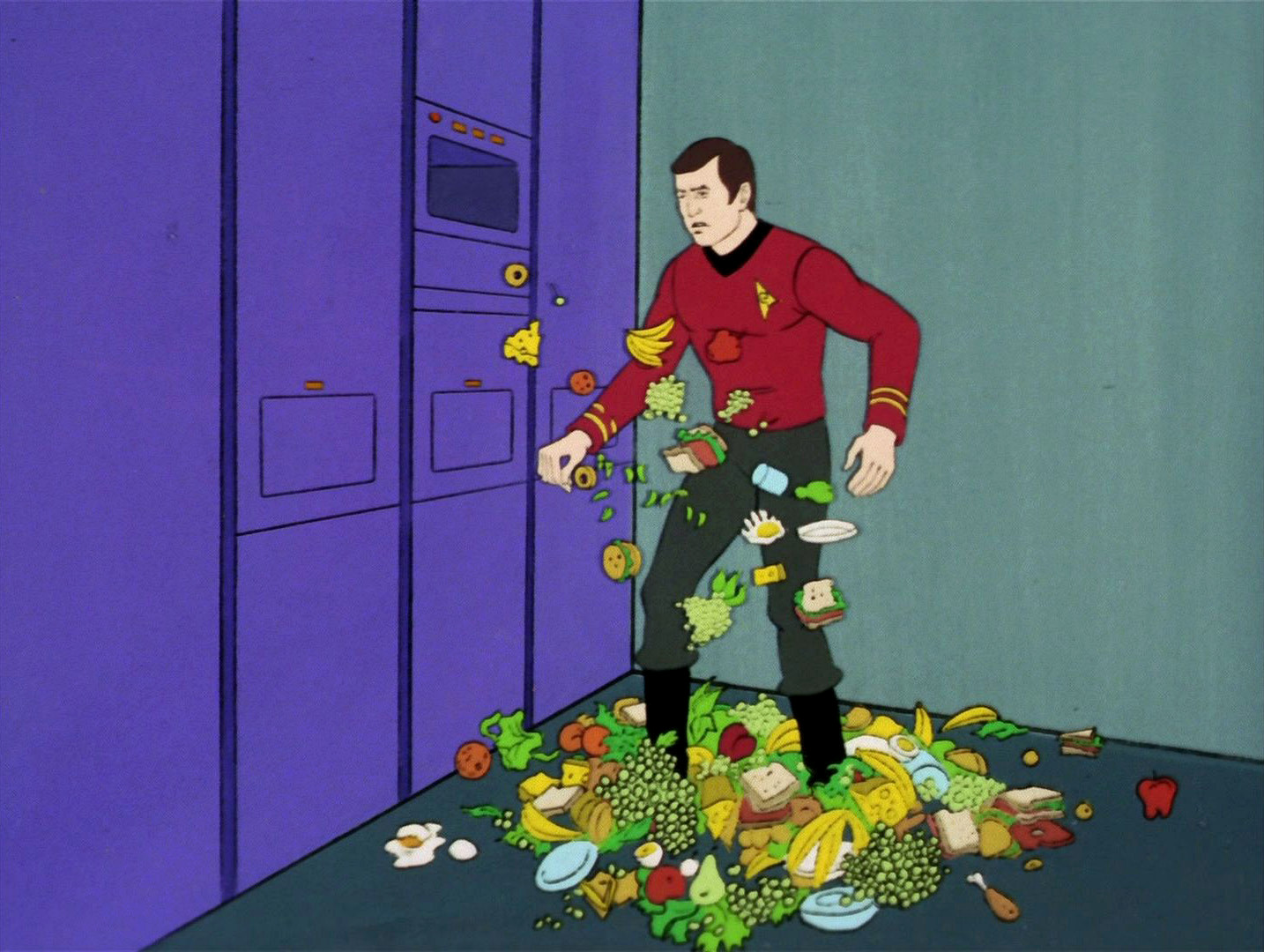
The jokes presented are: glasses that cause the crew to spill on their uniforms; a bendy fork that drops food; an binocular instrument that paints circles around Spock's eyes; food spraying out of the synthesizer slot, including a pie-in-the-face for Scotty; the phrase "KIRK IS A JERK" written on the backs of all Kirk's uniforms; coating the deck floor with slippery ice; creating a holographic pit/trap and later a blizzard the "Rec Room" (proto-holodeck); flooding the environmental systems with "laughing gas;" and finally diverting the ship to Romulan Neutral Zone and deploying a giant, inflatable balloon duplicate of the Enterprise. Circle-eye and pie-in-the-face are classics and were mildly funny and I kind of like "Kirk is a Jerk," but overall the humor was too juvenile to get me to laugh. If the practical jokes had been funny, this might have been a really great little romp.
Much more significant is the episode's introduction of a holodeck. Although called the "Rec Room," the characteristics are largely identical to the Holodeck as it's later established in TNG: "Encounter at Farpoint." Also identical: it immediately malfunctions and nearly turns deadly for everyone trapped inside. The scene where Scotty and the engineers are outside the doors, trying to pry them open is repeated exactly in TNG: "The Big Goodbye" and many later installments.
Annotations
- Remarkable reprises: The Enterprise computer creates a holographic blizzard in the Rec Room to prevent McCoy, Uhura, and Sulu from reaching the exit. On the holodeck in LOW: "Terminal Provocations," Ensign Rutherford runs a blizzard program to wear down Badgey. Sulu previously nearly froze to death in TOS: "The Enemy Within."
- Nitpicking: Although Kirk's solution of tricking the computer is better than talking it into committing suicide, once again the writers of TOS and TAS have no understanding of computers. It's also not clear why a second trip through the energy field would correct the problem; more likely it would make matters worse.
- Actually funny ending quote: "Turn off those food synthesizers! We're knee-deep in desserts and they're still pouring out!" -Romulan Commander. After their own computers become practical jokers, the Romulans finally receive their "just desserts."
Rating: 4 (John Hamer)
Albatross
Synopsis
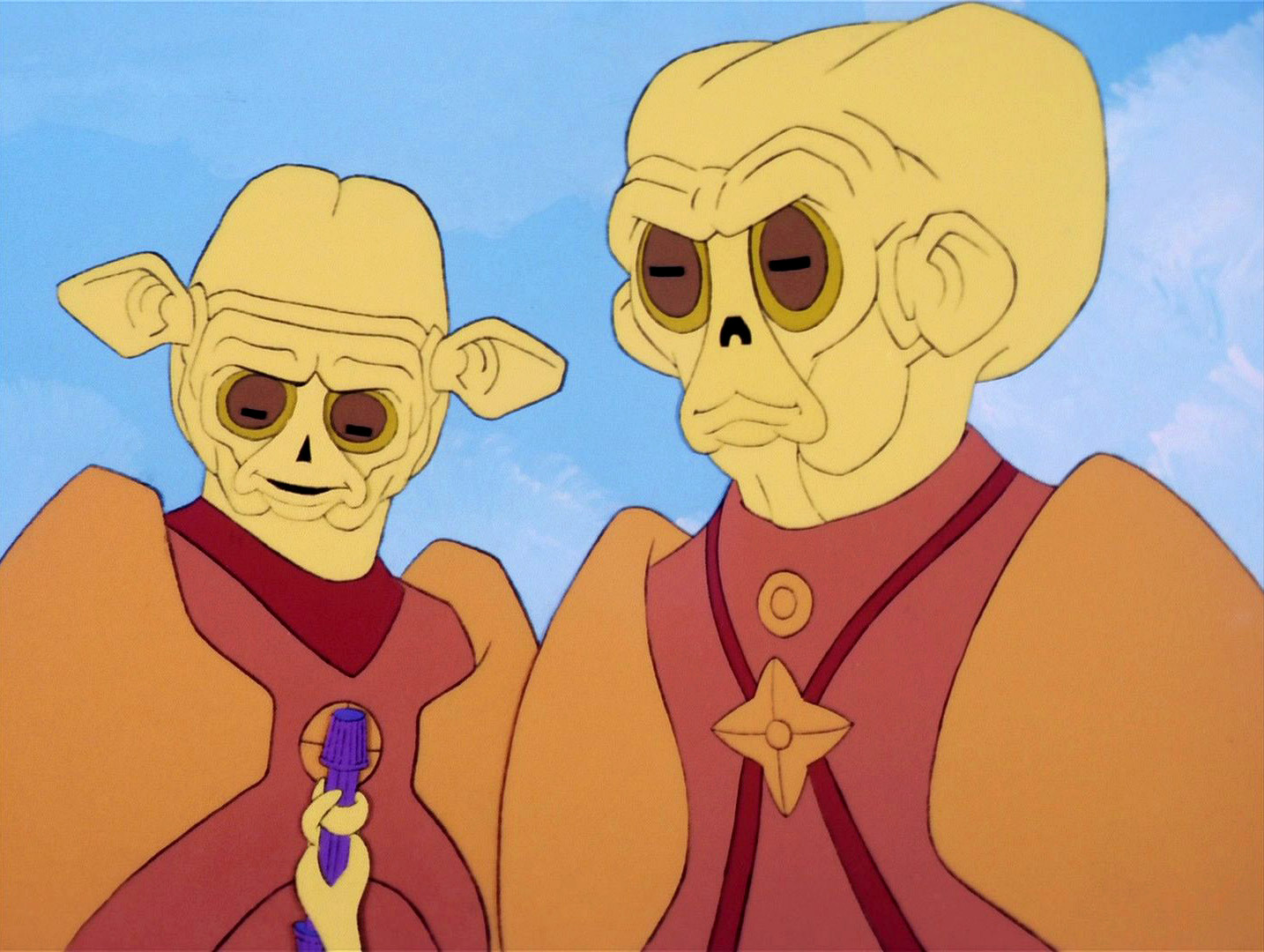
Stardate 5275.6: As the USS Enterprise completes delivery of medical supplies to Dramia, the planet's Supreme Prefect serves a warrant for the arrest of Chief Medical Officer Leonard McCoy. According to the charges, 19 years earlier McCoy caused a plague on Dramia II (a second inhabited world in the Dramian star system) while overseeing an inoculation program for the Saurian virus. As the Dramians are a sophisticated civilization with an extradition treaty with the Federation, Captain Kirk has no choice but to leave McCoy in their custody as he takes the Enterprise to Dramia II to conduct an investigation. Commander Demos, the head of Dramian security, pursues them in a shuttle and sneaks aboard the Enterprise, where he is, in turn, taken into custody. As the Enterprise approaches Dramia II, it passes through an orbiting aurora, whose radiation is deemed harmless. A landing party from the Enterprise encounters the sole survivor of the plague, a Dramian named Kol-Tai who has only positive memories of Dr. McCoy. As the ship returns with Kol-Tai to Dramia prime, it again passes through the aurora radiation; almost immediately thereafter Kol-Tai, Captain Kirk, and everyone else on the ship begins to exhibit symptoms of the plague, except Spock (as Vulcans are immune). Spock breaks Dr. McCoy out of the Dramian prison so that he can synthesize an antidote to the plague, using the same Saurian virus antibodies that allowed Kol-Tai to survive the first plague. Curing the plague, the Dramians drop all the charges against McCoy and instead present him with award for his "achievements in the field of interstellar medicine."
Review
Among TAS episodes, "Albatross" has one of the more complicated plots. I never really got into it as a child, and it's taken a few viewings to finally get through it so that I can complete a review. I like the basic setting of the episode. Unlike TOS, where most aliens effectively looked the same as humans, or the TNG-era, where most aliens looked like humans with different prosthetic "head bumps," the Dramians are far more alien. Moreover, they have a sophisticated, technologically advanced society that the Federation takes seriously. But unfortunately beyond this foundation, the episode does almost nothing to develop Dramian culture or distinctives.
While Dr. McCoy becomes unsure of himself when faced with the charges, they never seem credible. It's clear from the start that there is some kind of misunderstanding. And while the unravelling of the mystery is complicated, it's not ultimately satisfactory. The Dramians blame Dr. McCoy for a plague that wiped out the population of Dremia II shortly after he inoculated the population, following the common fallacy of post hoc ergo propter hoc. But we later learn that Kol-Tai survived the plague because he had been inoculated by Dr. McCoy for a different virus. Except didn't Dr. McCoy inoculate everyone on Dremia II for Saurian virus? Why did Kol-Tai alone survive? The complexity of the "orbiting aurora" is similarly inexplicable. Apparently the changes in the color of the aurora are causing the symptoms in the plague whereby its victims change pigmentation color. And this is somehow a "red herring" that prevents the diagnosis of the plague. And yet the aurora does seem to be the cause of the plague.
While there is some action in the episode, it likewise does not make sense. Dramian Commander Demos pursues the Enterprise in a shuttle-sized scout craft and Captain Kirk "tricks" him by opening his shuttle-bay doors to let him land. But these weren't just accidentally left open. Demos watches them open and lands even so. He's immediately caught as anyone might expect to be. Can you imagine a Japanese pilot in World War II landing his fighter on a US aircraft carrier and then expecting that he could just sneak around the ship?
Although the population of an entire planet has died of plague, no one gives any thought of quarantining the sole-survivor Kol-Tai when he is beamed aboard the Enterprise. And although some thought is given to McCoy's life when he chooses to beam aboard to find a cure, no precautions against infection are taken.
As written, the episode does not make a lot of sense. Nor do I understand the title. It's presumably an allusion to Samuel Taylor Coleridge's The Rime of the Ancient Mariner (1798), but how so?
Annotations
- Continuity: TOS gave us Saurian brandy. This episode gives us a "Saurian virus." A Saurian would later be seen in the background of ST:TMP and the race would be further developed in DIS and LOW.
- Nitpicking: The main planet is called "Dramia," and the colony is called "Dramia II." It would have made a lot more sense if the main planet had a name like "Dramia Prime" or "Dramia I," but essentially no world-building was done for Dramian culture other than to malign their justice system.
Rating: 2 (John Hamer)
How Sharper Than a Serpent's Tooth
Synopsis
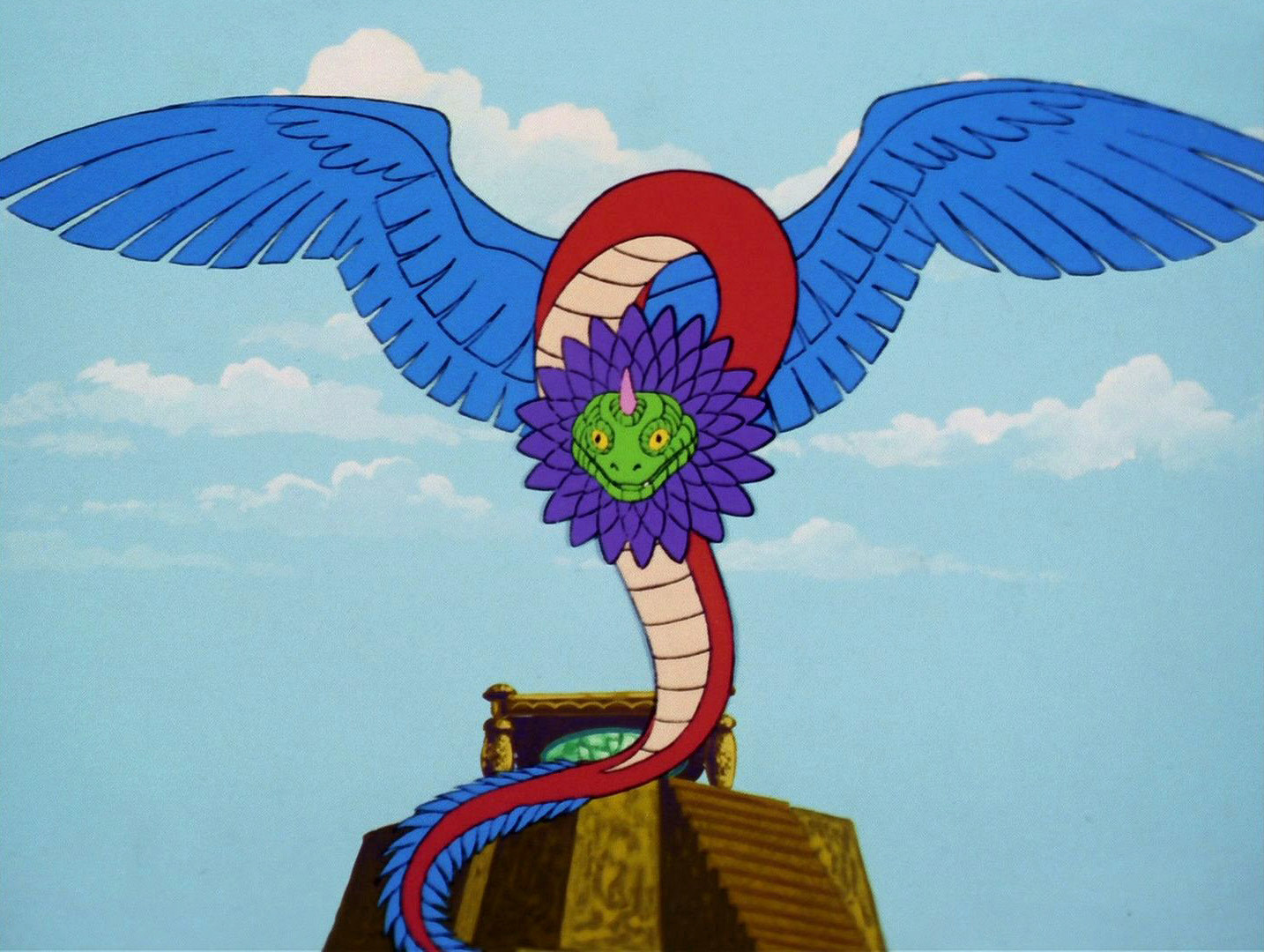
Stardate 6063.4: Following the trail of a probe that visited and scanned the solar system before self-destructing, the USS Enterprise encounters a technologically sophisticated alien vessel. Uniquely composed of crystalline ceramic, the vessel is twice as large as a Constitution class starship and is surrounded by an immense energy field. The alien projects a force globe around the Enterprise which is pulled out of warp. Phasers are unable to penetrate the force globe. With the Enterprise helpless the alien vessel approaches, apparently using holographic emitters to change its appearance to assume the form of a winged serpent. Enterprise helmsmen Ensign Walker Bear, a native American from the Comanche nation, immediately recognizes it as "Kukulkan" --- a divine figure from Mayan legend. This recognition causes the vessel (or entity) to hail the crew and give them one chance to redeem humanity. Kukulkan transports Captain Kirk, Ensign Walking Bear, Dr. McCoy, and Lt. Cmdr. Scott to a vast empty space within his ship, which appears to operate as a kind of holodeck. The Enterprise personnel initially find themselves within an alien forest and then a spectacular city filled with obelisks, colonnades, statues, and pyramids. Surmising that the city is a riddle, Kirk ascends the central pyramid and has the others aim various serpent-headed statues to reflect the sun's rays at its apex. The solution of the problem causes Kukulkan to appear to Captain Kirk and the others in the form of a winged serpent. As he explains his purpose, Kukulkan transports them to his menagerie, filled with exotic alien creatures. Although they exist in tiny transparent cages, Kukulkan explains that mentally they believe themselves to be in their own perfect environments. Kukulkan explains that he is the last of his kind and that he visited Earth's ancient past to try to impose tranquility on humanity. Having failed in the past, he sent the probe to assess humans in the present, only to conclude that are still warlike. Meanwhile, back on the Enterprise, Spock concludes that the force globe can only resist force in one direction. By both pushing and pulling on it simultaneously, the Enterprise is able to shatter it using a warp burst. As Kukulkan attempts to recapture the ship, Kirk and the others release a dangerous Capellan power cat from the menagerie, resulting in chaos. As the Enterprise disables Kukulkan's central power source, Kirk saves him by tranquilizing the power cat. This gesture ultimately convinces Kukulkan to let the Enterprise and humanity go to navigate its own course.
Review
The instant Kirk calls to a red-shirted helmsman, "reduce speed to warp factor 2, Mr. Walking Bear," we are on alert that the sudden appearance of a previously unknown native American bridge officer is unlikely to be a coincidence. While Star Trek's heart may have been in the right place, its actual inclusion of native Americans in its storytelling has often been cringe-worthy. That TOS "The Paradise Syndrome" took place on an unnamed planet with a population of generic American Indians (all played by white actors in makeup) may have been par for the course in American Westerns of the 1960s, but it still makes liberal use of every stereotype from the "noble savage" to white people being mistaken for gods.
The story of native Americans in TNG's "Journey's End" comes off has ham-fisted in a 1990s-way as Picard is called upon to forcibly remove American Indian settlers from a planet they have colonized in Cardassian space. (To put a button on this, we learn that Picard had a previously unknown ancestor who had participated as a soldier in Spanish Mexico, who aided in suppressing the Pueblo Revolt of 1680.) This rather disappointing episode provided the background concept for Voyager's Commander Chakotay, another well-meaning attempt to provide native American inclusion that too frequently resulted in falling into unfortunate tropes.
In contrast to these past and future attempts, Ensign Walking Bear is not portrayed as having native wisdom or a special affinity with nature. He explains his awareness of Kukulkan reasonably enough as someone who is interested in indigenous heritage and culture. While he is given membership in a specific native nation (the Comanche), Walking Bear has too few lines to build a complete portrait of the character --- and his blandness is not helped by generic voicework from James Doohan (who is also voicing Arex and Kukulkan in this episode in addition to his regular role of Mr. Scott). By the time we get to the wrap up, when Kirk, Spock, and McCoy are talking about the episode's title, "How sharper than a serpent's tooth..." (a quotation from Shakespeare), Mr. Walking Bear has long since disappeared from the scene and adds no final reflections on Kukulkan.
Already in my review of TAS: "The Magicks of Megas-Tu," I complained that ancient Earth was visited by far too many "ancient astronauts" --- more often than not, aliens posing as gods. Unfortunately, Kukulkan's visit to the Mayas, the Toltecs, and the ancient Chinese is just one of many tired re-treads. Aliens keeping menageries is also a trope that began all the way back with Star Trek's original pilot, "The Cage," and was already repeated in TAS: "The Eye of the Beholder." (Lower Decks will later parody the tiredness of the trope in "I Have No Bones Yet I Must Flee.") It's not totally worn out here as alien animals up to this point have been relatively rare.
Finally, the tendency of over-powerful beings acting paternalistically had already been done time and again in TOS. How does the behavior of Kukulkan in this story add anything fresh to the more tragic story of Apollo in "Who Mourns for Adonais?"
Annotations
- Interesting continuity: Although the Capellan power cat was native to the planet Capella IV that Kirk, Spock, and McCoy visited in TOS "Friday's Child," they fortunately never met one in the wild while they were roaming its canyons.
- Remarkable alien: This episode gives significant screen time to the ship's Edoan navigator, Lt. Arex. While Edoans have tri-lateral symmetry below the neck with three legs, three arms, and three fingers on each hand, above the neck they have a pretty normal head with two eyes, one nose, and one mouth (which has always struck me as wrong).
- Remarkable aside: With this review, I have finally completed reviews of the whole run of TAS (a mere 22 episodes). It's amazing to me the amount of work Bernd has done to write reviews of all the series! Thank you, Bernd!
Rating: 3 (John Hamer)
The Counter-Clock Incident
Synopsis
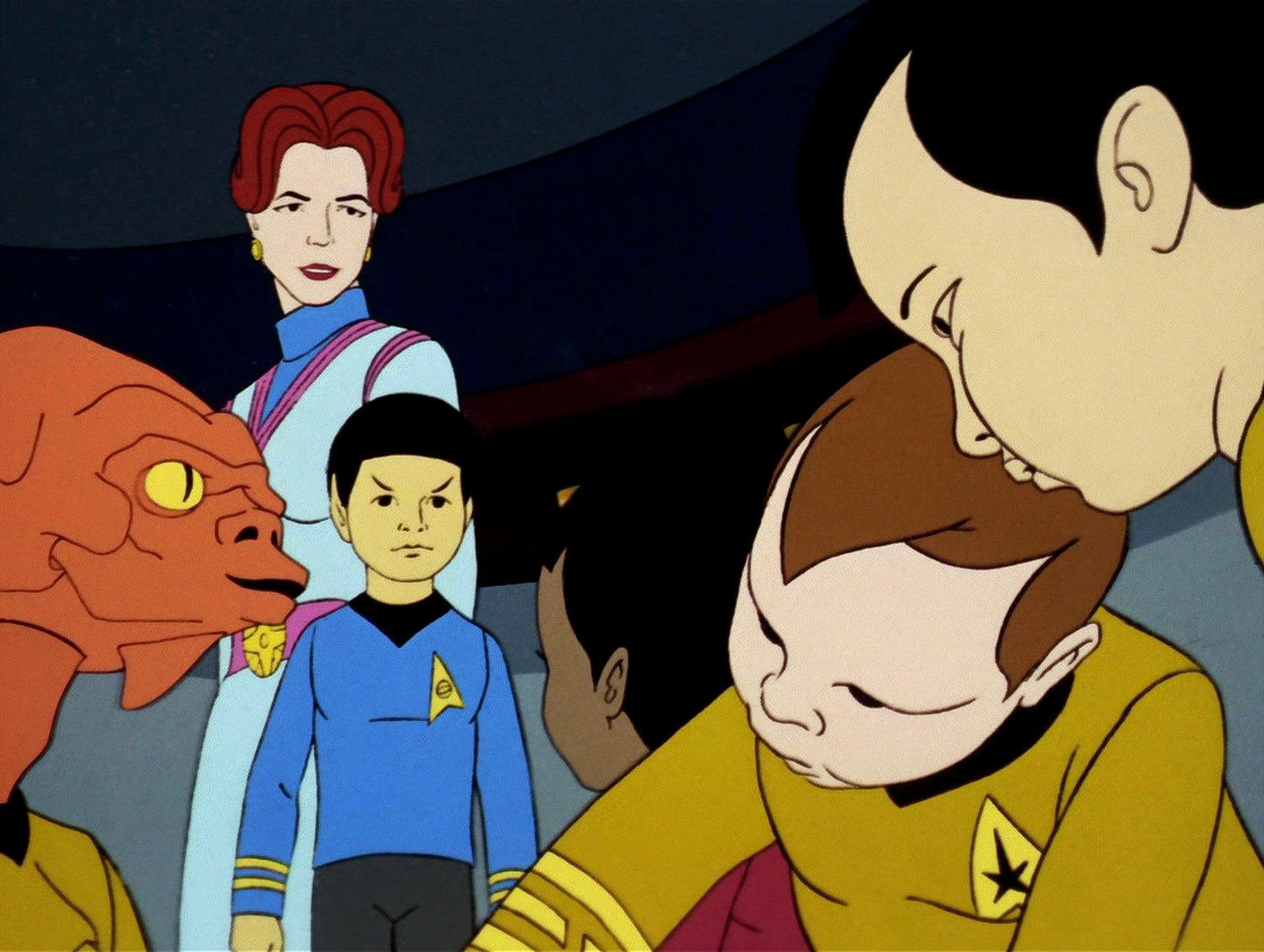
Stardate 6770.3: While transporting Commodore Robert April and his wife, Dr. Sarah April to Babel, the Enterprise encounters an alien scout ship that is hurtling itself into the Beta Niobe supernova at the impossible velocity of warp 36. Attempting to stop the pilot from committing suicide, the Enterprise locks a tractor beam on the ship. But instead of halting its descent, the Enterprise is pulled along and collides with the supernova, which turns out to be a gateway into a negative "Counter-Clock Universe." The Enterprise travels to the planet Arret, which corresponds to Earth in the positive universe, in an attempt to return to normal space. In the meantime, it's learned that the crew are growing younger at a rapid pace. Eventually Kirk, Uhura, Sulu, and the others are reduced to toddlers and Spock becomes a teenager. Fortunately, Commodore April started out old enough to remain an adult long enough to pilot the Enterprise back home.
Review
In the Seinfeld episode, "The Bizarro Jerry," Jerry tries to explain the relationship of Superman and Bizarro to Elaine.
Jerry: "...Bizarro Superman. Superman's exact opposite, who lives in the backwards bizarro world. Up is down. Down is up. He says 'Hello' when he leaves, 'Good bye' when he arrives."
Elaine: "Shouldn't he say 'Bad bye'? Isn't that the, opposite of 'Good bye'?"
Jerry: "No. It's still a goodbye."
Elaine: "Uh, does he live underwater?"
Jerry: "No."
Elaine: "Is he black...?"
Jerry: "Look. Just forget it, already, all right?"
As Elaine quickly points out, the idea of Bizarro as a backwards Superman doesn't hold up to even casual scrutiny. Unfortunately, that's also true of the "Counter-Clock Universe." In the Counter-Clock Universe, space is white light and the stars are black spots. But why isn't everything else inverted color-wise? In the Counter-Clock Universe, the Enterprise and all other ships fly backwards, but why aren't they also upside-down? The planet that corresponds galactographically with Earth is "Arret" --- which is "Terra" spelled backwards. But why isn't the Beta Niobe supernova not known as the "Eboin Ateb" in the Counter-Clock Universe?
As with the Bizarro Superman, the premise of the Counter-Clock Universe works better if you don't ask too many questions. The episode's setup is a vehicle to show the Enterprise crew as teenagers and then toddlers, which reverses the setup in TOS: "The Deadly Years," when Kirk and other officers are rapidly aging. This has the potential for a lot of fun, but the cast do very little as their younger selves other than be confused. Much more zaniness is had by the youthened Picard, Guinan, Ro, and Keiko in TNG: "Rascals."
The Enterprise crew are getting younger because time is experienced in reverse in the Counter-Clock Universe. As Spock comments when he observes that Karla Five's son is an old man (Karl Four) and her father (presumably named Karl Six) is a baby, "Most logical, if the flow of time is reversed, then one is born at an old age and dies in infancy. Your descendants are born before you, and your ancestors are born after you." Except how does it work to be "born" as an old man?
None of this explains why the Enterprise crew are getting younger at an amazingly accelerated rate. In the end, the fact that there are more conceptual holes than substance to the "Counter-Clock Universe" undercuts what might otherwise be a good episode.
Annotations
- Remarkable officers: Commodore Robert April is established in this episode as the Enterprise's original captain, predating James Kirk and Christopher Pike. Dr. Sarah April was the original Chief Medical Officer.
- Remarkable flower: Dr April's Capellan flower has a lifespan of only a few hours. It blooms and then wilts in our universe and then reverses its lifespan in the Counter-Clock Universe. The germination rate of another plant sample (Diomedian scarlet moss) was one of the "clues" that alerted Dr. Crusher to a lost day in TNG: "Clues".
Rating: 4 (John Hamer)