


Polyhedra in Star Trek
by Jörg Hillebrand and Bernd Schneider
Introduction to PolyhedraPolyhedra on ScreenAppendix
Polyhedra appear in various forms in Star Trek episodes, from decorative objects, dice and puzzles to scientific models and mysterious alien devices. While some of these shapes are only visible briefly on screen, they often have recognizable geometric structures. The purpose of this article is to identify and catalog notable polyhedra that appear in Star Trek, and to provide a geometric reference for fans interested in the mathematics behind these objects.
We identified the following polyhedra: tetrahedron, cube, octahedron, dodecahedron, icosahedron, cuboctahedron, rhombicuboctahedron, truncated cube, truncated octahedron, icosidodecahedron, truncated icosahedron, truncated cuboctahedron, pentakis dodecahedron, square pyramid, pentagonal trapezohedron. Each entry includes a 3D view together with a brief summary of the polyhedron's key properties.
Introduction to Polyhedra
Polyhedra are three-dimensional geometric objects whose surfaces consist of flat polygonal faces. Most polyhedra identified here belong to one of three important families.
- Platonic solids are the five perfectly regular polyhedra: tetrahedron, cube, octahedron, dodecahedron and icosahedron.
- Archimedean solids are highly symmetrical polyhedra composed of more than one type of regular polygon, often created by truncating Platonic solids.
- Catalan solids are the duals of the Archimedean solids.
- The square pyramid belongs to the broader family of pyramids.
The properties listed in this article consist of the polyhedron's classification, faces, edges, vertices and duals. Faces are the polygons making up the surface; edges are where faces meet; vertices are the corners where edges intersect. The dual polyhedron is formed by exchanging faces and vertices. For example, the cube and octahedron are duals of one another, while the tetrahedron is self-dual.


One of the most remarkable features of polyhedra is their symmetry. The Platonic solids possess the highest degree of symmetry possible for convex polyhedra. Many Archimedean and Catalan solids inherit similarly elegant forms. Another important property is Euler's formula, which states that for every convex polyhedron: Faces + Vertices - Edges = 2.
Platonic solids are limited to only five examples. Polyhedra as a whole comprise prisms, pyramids and other convex structures, allowing objects with arbitrarily many faces that can increasingly resemble a sphere.
Polyhedra on Screen
Tetrahedron
The tetrahedron is the simplest possible convex polyhedron, consisting of just four triangular faces. Every vertex touches every other vertex, giving it a uniquely compact structure. The regular tetrahedron is one of the five Platonic solids and is notable for being self-dual.

Tetrahedron
- Classification: Platonic solid
- Faces: 4x triangle
- Edges: 6
- Vertices: 4
- Dual: Self-dual
We can see tetrahedra, or perhaps truncated tetrahedra, as the dice of the Chula game in DS9: "Move Along Home". These later mutate to Tongo dice, as seen in DS9: "Ferengi Love Songs".
A pyramidal Bandai Pair Match game appears on tables in Ten Forward in many episodes. Only in TNG: "True Q", we can see a similar object, but shaped as a tetrahedron. Another notable tetrahedron is the container in which Annorax preserves a lock of his wife's hair in VOY: "Year of Hell".


Cube
The regular hexahedron aka cube is arguably the most recognizable of all polyhedra. Built from six congruent square faces meeting at right angles, it occupies a central place in geometry, mathematics, everyday life and Star Trek. Among the Platonic solids, it is unique for having square faces, and its dual is the octahedron.

Cube
- Classification: Platonic solid
- Faces: 6x square
- Edges: 12
- Vertices: 8
- Dual: Octahedron
The by far most famous polyhedron in Star Trek is the Borg cube. But a cube-shaped spacecraft had already appeared as Balok's buoy in TOS: "The Corbomite Maneuver".


Of course, there are countless other cubes in Star Trek. As already mentioned, the Tongo dice in DS9: "Ferengi Love Songs" are tetrahedra. In DS9: "Rules of Aquisition", on the other hand, we can see cube-shaped dice in use. In DS9: "The Begotten", Odo uses a cube and a square pyramid to handle the infant Changeling.
Finally, the famous food cubes of TOS shouldn't remain unmentioned.


Octahedron
An octahedron is a polyhedron with eight faces, most commonly the regular octahedron composed of eight equilateral triangles. As one of the Platonic solids, it exhibits exceptional symmetry and can be viewed as two square pyramids joined base-to-base. Its dual is the cube.

Octahedron
- Classification: Platonic solid
- Faces: 8x triangle
- Edges: 12
- Vertices: 6
- Dual: Cube
The Borg love simple polyhedra, and so it doesn't surprise that the Borg Queen's ship in VOY: "Dark Frontier" is an octahedron - at least an approximate one.


Dodecahedron
A dodecahedron is any polyhedron with twelve faces, though the name most commonly refers to the regular dodecahedron. Made entirely of regular pentagons, it is one of the rare Platonic solids and has fascinated mathematicians and philosophers since antiquity. Its dual polyhedron is the icosahedron.

Dodecahedron
- Classification: Platonic solid
- Faces: 12x pentagon
- Edges: 30
- Vertices: 20
- Dual: Icosahedron
 We can see that the DMA controller that Booker and Tarka strive to destroy in DIS: "Rubicon" is a dodecahedron.


A dodecahedron-shaped floating vase is among the objects in Adam Soong's house in PIC: "Fly Me to the Moon". The PIC season 2 opening credits also show such a object.


Icosahedron
An icosahedron is, in the broadest sense, any polyhedron with twenty faces. We specifically look at the regular icosahedron, one of the five Platonic solids. Composed of twenty equilateral triangles arranged with perfect symmetry, it has more faces than any other Platonic solid and serves as the dual of the dodecahedron.

Icosahedron
- Classification: Platonic solid
- Faces: 20x triangle
- Edges: 30
- Vertices: 12
- Dual: Dodecahedron
 An icosahedron appears as a die in LOW: "The Least Dangerous Game", the real-world inspiration being Dungeons & Dragons, which is also reflected in the in-universe name of the game, "Bat'leths & BiHnuchs". Another icosahedron can be seen as the "Glumpus", a huge nanite cluster, in LOW: "The Best Exotic Nanite Hotel".


Finally, the dreams of AI Zora in DIS: "...But to Connect" appear inside an icosahedron-shaped volume.


Cuboctahedron
The cuboctahedron is an Archimedean solid that can be derived by truncating either a cube or an octahedron to the appropriate depth. Its triangular and square faces occur in equal edge lengths and symmetrical proportions, making it one of the most elegant transitional forms between the two Platonic solids. Its dual is the rhombic dodecahedron.

Cuboctahedron
- Classification: Archimedean solid
- Faces: 8x triangle, 6x square
- Edges: 24
- Vertices: 12
- Dual: Rhombic dodecahedron
The Kelvans convert non-essential crew members of the Enterprise to dehydrated cuboctahedron-shaped objects. Rojan demonstrates that he can kill the person by crushing the object that contains the essence of Yeoman Thomson.


The Tallonian crystal from DS9: "Hippocratic Oath" is another cuboctahedron.


Rhombicuboctahedron
A rhombicuboctahedron is an Archimedean solid composed of eighteen squares and eight equilateral triangles. It can be derived from the cube and octahedron through a process of expansion, resulting in a highly symmetrical shape in which one square and two triangles meet at every vertex. Its dual is the deltoidal icositetrahedron.

Rhombicuboctahedron
- Classification: Archimedean solid
- Faces: 18x square, 8x triangle
- Edges: 48
- Vertices: 24
- Dual: Deltoidal icositetrahedron
In TNG: "Unification II", we can briefly see a variety of Vulcan dice. They also appear in the teaser of "Gambit I". The auction photo shows the four types more clearly. We can now identify a square pyramid, an octahedron, a truncated octahedron (see below) and one new shape, a rhombicuboctahedron. And yes, only the octahedron would be a fair die.


Truncated cube
The truncated cube results from slicing off the corners of a cube so that each original vertex is replaced by a new equilateral triangular face. The resulting Archimedean solid combines triangular and octagonal faces while preserving a high degree of symmetry. Its dual is the triakis octahedron.

Truncated cube
- Classification: Archimedean solid
- Faces: 8x triangle, 6x octagon
- Edges: 36
- Vertices: 24
- Dual: Triakis octahedron
One of the most notable truncated cubes in Star Trek can be found aboard a Borg tactical cube, in the central plexus, in VOY: "Unimatrix Zero II".


Truncated octahedron
A truncated octahedron is obtained by cutting the vertices from a regular octahedron. The resulting solid consists of hexagonal and square faces and is notable for being one of the few Archimedean solids that can fill three-dimensional space without gaps. Its dual is the tetrakis hexahedron.

Truncated octahedron
- Classification: Archimedean solid
- Faces: 8x hexagon, 6x square
- Edges: 36
- Vertices: 24
- Dual: Tetrakis hexahedron
The electronic puzzle Sheer Lunacy in VOY: "Think Tank" is shaped like a truncated octahedron. It becomes a craze on Voyager, until Seven of Nine is handed the game, solving it in a matter of seconds.


Icosidodecahedron
The icosidodecahedron is an Archimedean solid positioned midway between the icosahedron and dodecahedron. It combines triangular and pentagonal faces in a highly symmetrical arrangement, with each vertex shared by two triangles and two pentagons. Its dual is the rhombic triacontahedron.

Icosidodecahedron
- Classification: Archimedean solid
- Faces: 20x triangle, 12x pentagon
- Edges: 60
- Vertices: 30
- Dual: Rhombic triacontahedron
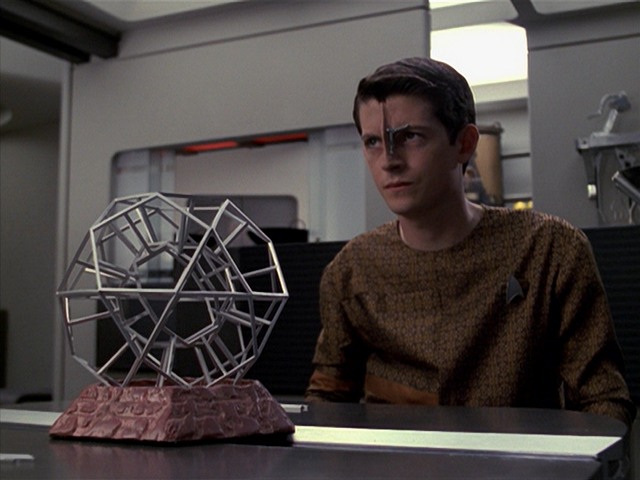
The famous Vulcan kal-toh game becomes a icosidodecahedron when it is solved, as seen in VOY: "The Omega Directive" and "Endgame".

Truncated icosahedron
The truncated icosahedron is an Archimedean solid formed by cutting the vertices from a regular icosahedron. This operation replaces the original vertices with pentagonal faces while enlarging the triangular faces into hexagons, creating a very familiar pattern of 12 pentagons and 20 hexagons. It is the shape of the traditional football (soccer) of and the carbon molecule buckminsterfullerene. The dual is the pentakis dodecahedron.

Truncated icosahedron
- Classification: Archimedean solid
- Faces: 12x pentagon, 20x hexagon
- Edges: 90
- Vertices: 60
- Dual: Pentakis dodecahedron
In TNG: "Firstborn", Alexander and his friend Eric create models of fullerenes in their chemistry class, but they fill the balls with water to Worf's chagrin. If we look at their creations, we can see that they deviate from actual fullerenes. There are hexagons in places where we should see pentagons, and the shapes of the faces are overall too irregular. It seems they intended to build buckminsterfullerene and got it wrong.


We can see truncated icosahedra in a holographic game in TNG: "Unnatural Selection". A real football can be seen in the background in Lavelle's quarters in TNG: "Lower Decks". This remains the only football in Star Trek for decades.


Thanks to Rios practicing his skills, Picard season 1 shows three types of footballs. A futsal ball appears in PIC: "The Impossible Box" (with the painted on lines of the truncated icosahedron not following the actual structure of the surface) and two different types of traditional balls in PIC: "Et in Arcadia Ego II". We can see the black/silver ball unfolded; it contains a molecular solvent grenade.


Truncated cuboctahedron
The truncated cuboctahedron is an Archimedean solid created by cutting away the vertices of a cuboctahedron. This process produces a highly symmetrical shape with square, hexagonal and octagonal faces. Owing to its complexity and large number of faces, it is sometimes known as the great rhombicuboctahedron.

Truncated cuboctahedron
- Classification: Archimedean solid
- Faces: 12x square, 8x hexagon, 6x octagon
- Edges: 72
- Vertices: 48
- Dual: Disdyakis dodecahedron
Icheb creates a truncated cuboctahedron in a clay sculpting class in VOY: "Ashes to Ashes". It is the probably only polyhedron in Star Trek that gets described. Icheb says: "A twenty six sided polyhedron, composed of hexagons, octagons and squares."


Pentakis dodecahedron
The pentakis dodecahedron is a Catalan solid formed by erecting a pyramid on each face of a dodecahedron. Although all of its faces are triangles, they are not regular, distinguishing it from the Platonic solids. It is the dual polyhedron of the above truncated icosahedron.

Pentakis dodecahedron
- Classification: Catalan solid
- Faces: 60x triangle
- Edges: 90
- Vertices: 32
- Dual: Truncated icosahedron
As seen in VOY: "The Omega Directive", the Omega molecule takes on the shape of a pentakis dodecahedron. Seven: "Omega is infinitely complex, yet harmonious. To the Borg it represents perfection. I wish to understand that perfection."


Square pyramid
A square pyramid is formed by connecting the corners of a square base to a single apex above it. While not one of the Platonic solids, it is among the most familiar polyhedra due to its resemblance to many ancient monuments and architectural forms. The regular square pyramid is also self-dual.

Square pyramid
- Classification: Pyramid
- Faces: 1x square, 4x triangle
- Edges: 8
- Vertices: 5
- Dual: Self-dual
Square pyramids can be seen as power distribution nodes aboard Borg ships. In TNG: "The Best of Both Worlds", they are famously destroyed to create a short-term diversion.


Another notable square pyramid is the Pair Match game, as it can be seen in Ten Forward in many episodes.


Pentagonal trapezohedron
The pentagonal trapezohedron is a decahedron composed of ten congruent kite-shaped faces. Best known as the shape of the ten-sided die used in tabletop gaming, it possesses a striking appearance with two opposite apices and a ring of alternating vertices around its equator. The pentagonal trapezohedron is the dual of the pentagonal antiprism.

Pentagonal trapezohedron
- Classification: Trapezohedron
- Faces: 10x kite
- Edges: 20
- Vertices: 12
- Dual: Pentagonal antiprism
Four ten-sided dice are part of the Kotra game in DS9: "Empok Nor" and "Wrongs Darker Than Death or Night" We can also see alternative dice with 12 faces (dodecahedra).


Appendix
Double hexagonal antiprism
As some sort of honorable mention, a second vase visible in PIC: "Fly Me to the Moon" besides the dodecahedron can best be described as a double hexagonal antiprism (at least, that's the best we came up with). It is not among the classic regular polyhedra.


Alleged dodecahedron
In VOY: "Alliances" Neelix meets a Kazon named Tersa in a bar, who is trying to solve a puzzle.
TERSA: A puzzle. What brings you here, Talaxian?
NEELIX: I'm good at puzzles, perhaps I can help?
TERSA: The dancer showed it to me. By moving only two rods this dodecahedron can become an icosahedron. She said she'd spend the night with the man who could solve it.
NEELIX: Oh, a splendid motivation, to be sure. I might just be able to make your night a memorable one.
TERSA: You know how to solve this?
NEELIX: I might, if you'll hear me out first.
It is obvious that this can't be an unfolded dodecahedron because there are triangles and squares but not a single pentagon. With the exception of one trapezoid, it looks like a cuboctahedron, although it wouldn't be possible to fold it in several places. The poor guy is definitely being scammed, and Neelix is bluffing!
Credits
Polyhedron views created with Polyhedra Viewer by @tesseralis.


