The Next Generation (TNG) Season 4 Guest Reviews
Season 1Season 2Season 3Season 4Season 5Season 6Season 7
Remember Me
Synopsis
Stardate not given: Synopsis in main TNG listing
Review
I have no real reason why this episode was done, except as the ubiquitous bottle type - a stop gap to better stories and to keep the franchise going.
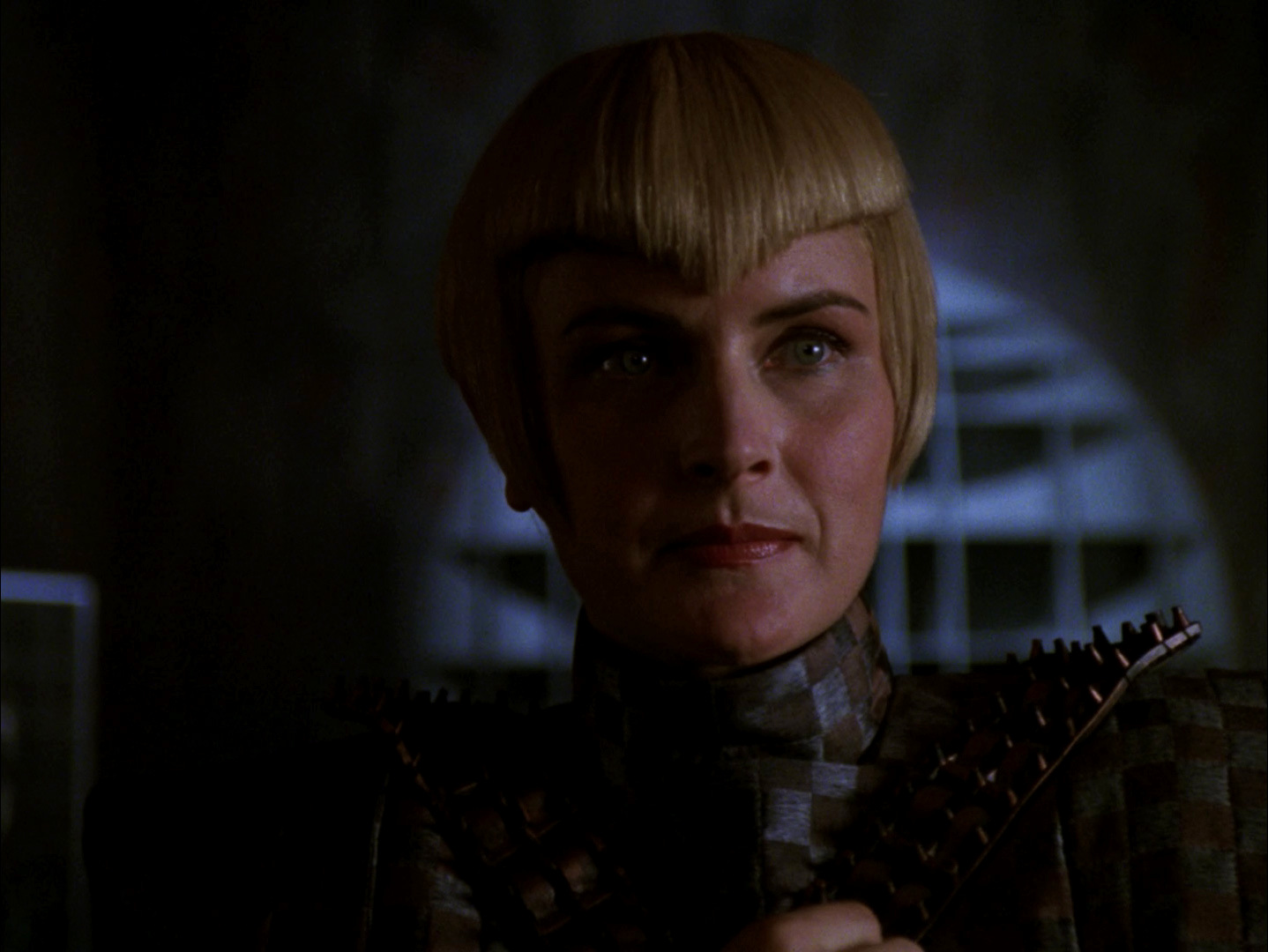
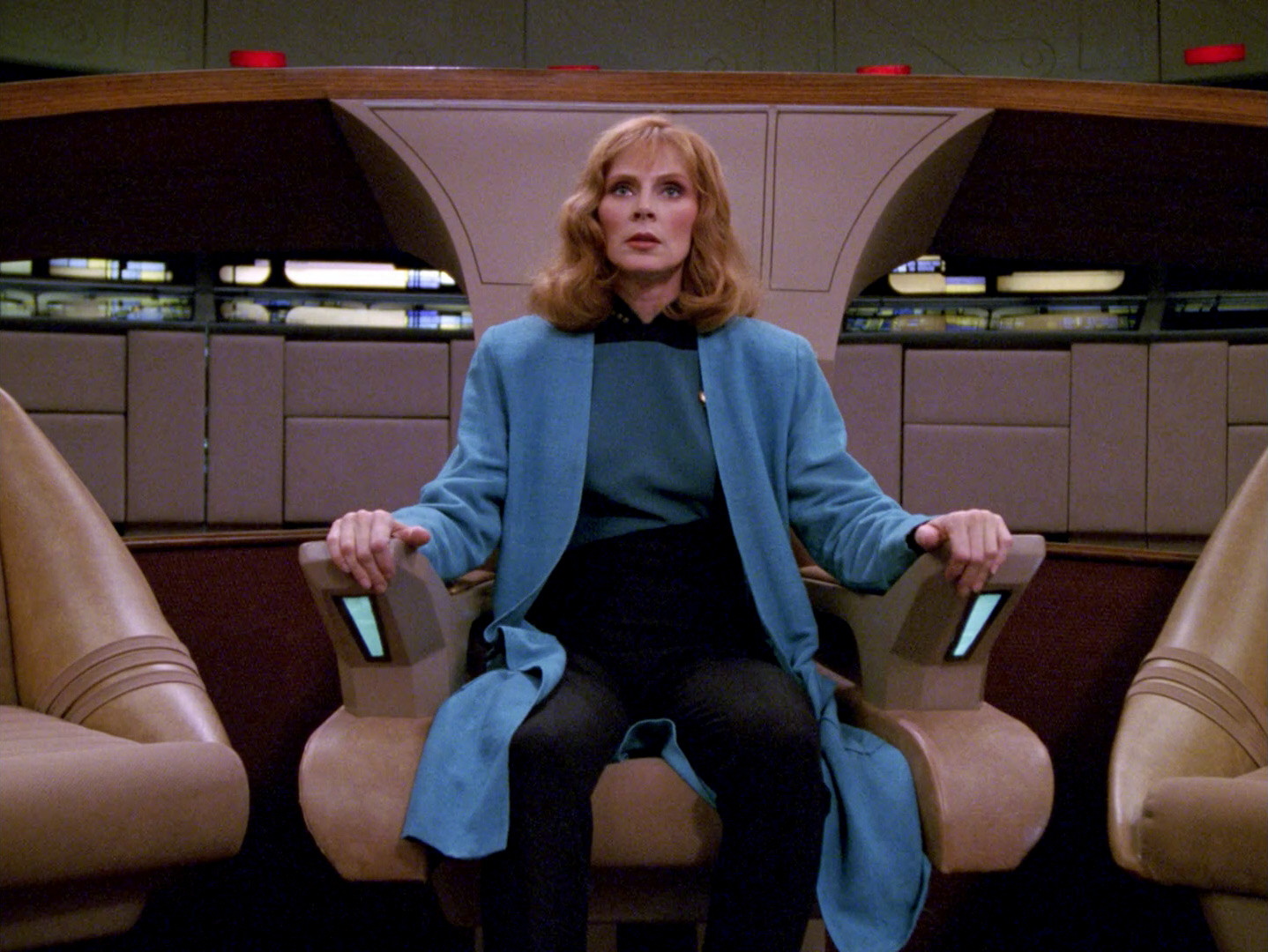
So an experiment in the warp drives makes all the crew slowly disappear, only Dr Crusher is the one who notices it, and all the remaining crew keep forgetting who the missing are; Bev fears she will go and vows to remember the lost. In the end its resolved thanks to the timely arrival of the Traveler and Wesley. By dragging Bev through the same anomaly, the day is saved and this tedious episode is over.
I have no qualms about bottle episodes but there are good ones (TNG: "The Drumhead" is a perfect example) when thought is put in and there is bland shit like this. Utterly banal, it serves no purpose except to bide time for the series. They could have done some sort of acting, make more dimensions to Bev or any character, SOMETHING!! Instead what we get is a disappearance story designed to do nothing more than kill time. It has no relevance, revelation, point, or purpose.
Remember Me? Rather not.
Annotations
- Remarkable back story: This episode was originally a subplot for the TNG ep "Family", but due to budget restraints, it did not happen. The Traveller was shoved in to ensure a 'plausible' story. The original idea was a dream sequence! Michael Piller introduced him to make the story work, whereas Cliff Bole the director pointed out he was only drafted in because he is big at Conventions. Lord >:(
Rating: 0 (Chris S)
Reunion
Synopsis
Stardate not given: Synopsis in main TNG listing
Review
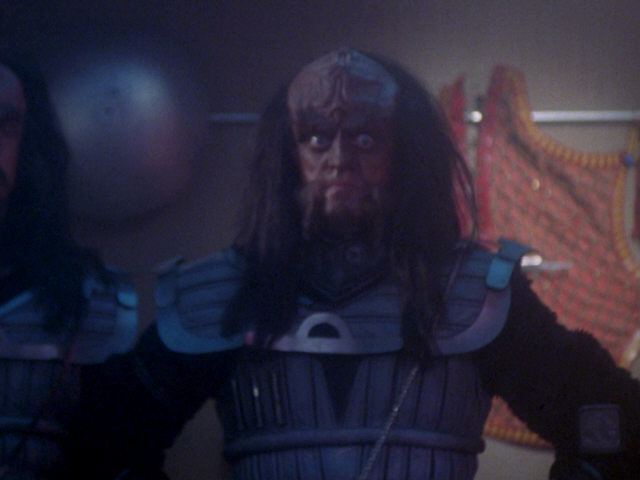
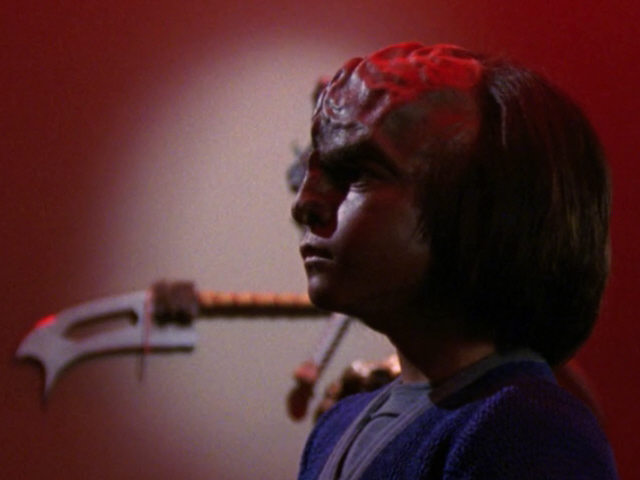
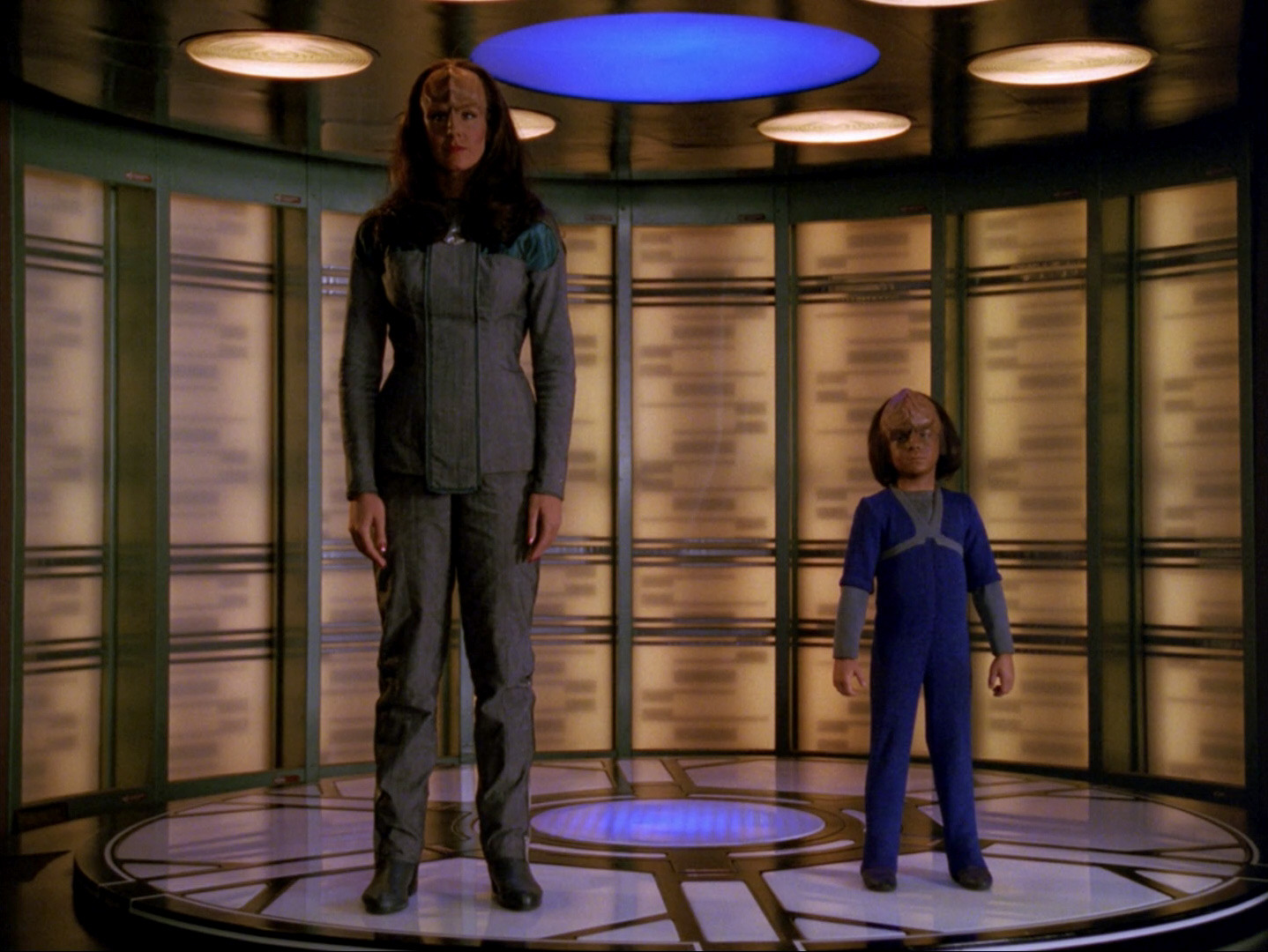
"Reunion" does many things: it introduces Gowron and Alexander, kills off K'mpec and Duras, and, lamentably, K'Ehleyr, provides a complex problem of interstellar diplomacy and delves further into Klingon culture. Yet with all of this, the episode is tightly written and never feels crowded. K'Ehleyr was an interesting character to begin with, but in this episode she comes into her own as ambassador to the Klingon Empire, advisor to Picard in his role as arbiter, and delving into Worf's discommendation. Her arid brand of sarcasm is perfected as she browbeats Worf, Gowron and Duras. And then she dies. Had she lived, the plot possibilities would have been endless, particularly in the way she brings Gowron to heel. In terms of emotional content though, the murder and all that follows rings true. Worf's duel with Duras is a high point, particularly when he doesn't stop when Riker orders him to. Picard's stuffy dressing-down afterward is a disappointing denouement, showing that the Federation's "respect" for other cultures is somewhat limited by human cultural bias, a recurring problem. In light of what we learn in Enterprise of the Andorian duelling tradition, is it believable that humans have such a chokehold on Federation policy? Altogether, though, this is certainly the best episode of the Klingon arc, and one of the best of the series.
Nitpicking: What was the point of the bomb? It was clearly too small to be effective, and, if you watch when it goes off, Duras's men are closer to him than to anyone he might want to kill. What was the purpose of killing K'Ehleyr? What did Duras think would be the consequence if Worf had not killed him? Compare the Klingon political system as portrayed here with that seen in "Star Trek VI". Here, power goes to the strongest, with the implication that in "modern" practice the succession is settled exclusively by a duel. While "Star Trek VI" featured an urbane and sophisticated political class, here one is left wondering how these bumpy-headed barbarians could run a village, much less an interstellar empire.
Annotations
- Remarkable dialogues:
- "Not even a bite on the cheek for old times' sake?" -K'Ehleyr to Worf
- "Opportunities that will present themselves only if you come to power. You talk like a Ferengi." -K'Ehleyr in response to Gowron''s bribe
- "A Klingon who kills without showing his face must not be allowed to lead the Council. Such a man would be capable of anything." -K'mpec to Picard
- "Have you ever seen death? Then look, and always remember." -Worf to Alexander
- Great moments: K'Ehleyr's caustic remarks - confronting Worf about his discommendation, snubbing Gowron and confronting Duras, and every other scene. Worf avenging K'Ehleyr.
- Remarkable firsts: This is the first time we see a bat'leth fight, and also the introduction of the Vor'cha class attack cruiser, the first new Klingon ship of the TNG era.
Rating: 9 (Anthony Rodger)
Final Mission
Synopsis
Stardate not given: Synopsis in main TNG listing
Review
I like this episode - it's simple and raises a subject I think Star Trek tends to overlook - the dangers of space and travelling in it.
Both stories are simple without forcing one or two character to the front and is VERY well thought out I feel; no daft anomalies for story sake, no romances, crisis of command, or politics. Just good old fashion simple no-nonsense space travel and the perils that are faced.
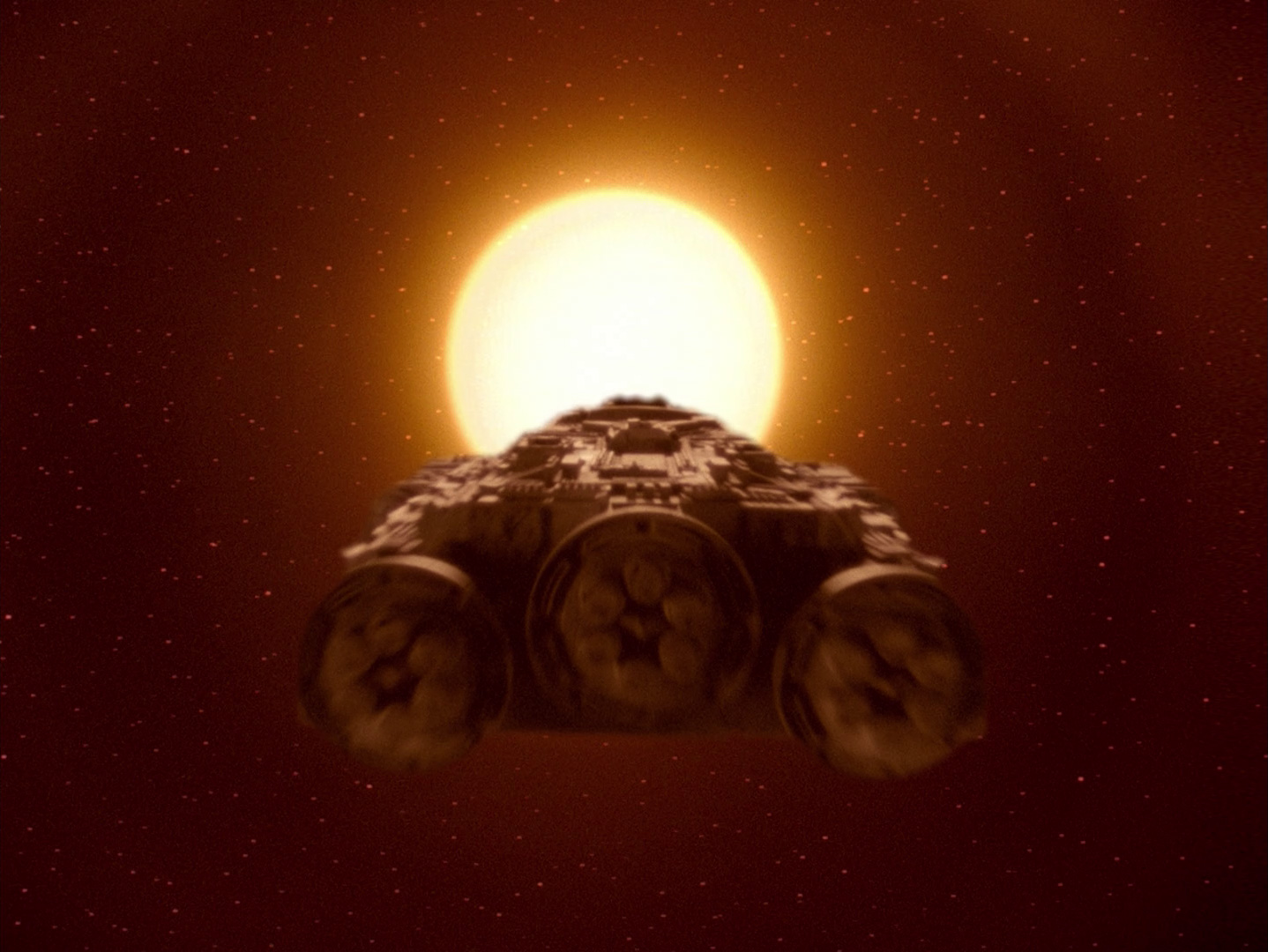
The first is very basic but shows the professionalism and dedication of the crew and their technology - something I feel gets washed away with OTT technobabble. An alien barge full of lethal radioactive matter is putting a planet in peril, and here (thank the stars) there is NO race hiding a sinister secret, or that it really contains some illegal stuff, or other obvious nonsense to make a pseudo moral point that is as obvious as a flashing light in the dark. It's interstellar driftwood that needs clearing. Best way is to send it to the sun, but is complicated by an asteroid field - so they come up with a way to carry it there, clear the field in some very good SFX scenes - and job's done.
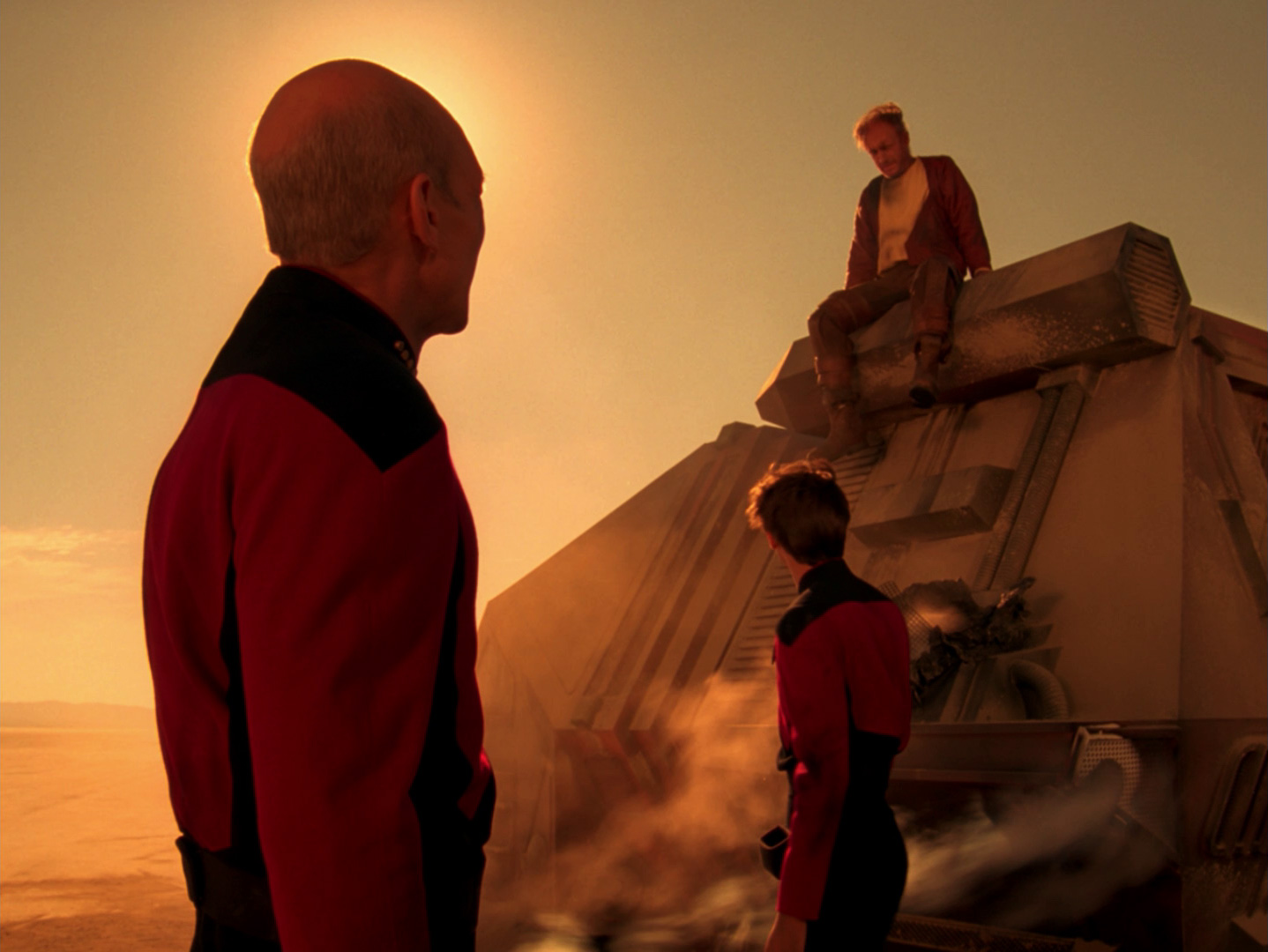
The second is about a typical planetary dispute, and for reasons I cannot fathom - maybe out of respect - Picard and Wesley take a knackered shuttle to the place. As expected it goes wrong and the shuttle crashes. The difference is that it's in the middle of nowhere - not a studio forest or a place not far from convenient civilisation. Here, the lot have to really survive. The basic method of that is to find shelter and they do. However in a clever twist they find water but its guarded by an alien device - for once there is no technobabble about it - it's alien, its in the way of their only means of survival, and that's all I need to know. Here I feel is the test of the crew, to handle the unknown and keep it together.
The end result is obvious but the episode is done straight to the point - no patronising morality play, no magical technology, no stupid unreasonable inane rivalry, no cast doing foolish things that has no point except for forced drama - just they are here and this is how we deal with it. Simple.
An episode I will always make time for.
Annotations
- Remarkable scene: The Enterprise towing the barge to the sun and cutting through the minor asteroid belt around it. Nice warm orange with silhouettes of the belt - beautiful.
- Remarkable prop: The old phaser pistols from "Star Trek III" being used, and shows what a superb design they are - FAR superior to stupid dustbusters Starfleet officers use as standard.
Rating: 9 (Chris S)
The Wounded
Synopsis
Stardate not given: Synopsis in main TNG listing
Review
At the time this came out I thought this was a well written piece; It still is after all this time and has not waned; however in hindsight it is also one of the many keystones that would make the foundations for Star Trek: Deep Space Nine.
The plot starts off typically enough: the Enterprise investigates a series of disturbing reports of an attack in an "enemy space"; this time its the Cardassian Peace Treaty Zone. On arrival they are attacked by one of the said alien ships and of course, it goes down the road of enemy having the initial advantage and then the tables are turned by said crew of the Enterprise; it then leads to the clichéd communications of said aliens making the usual accusations and threats about the Federation and so forth.
The difference here is that the accusations are true. Picard learns that a Star Fleet ship, the USS Phoenix, has gone on a crusade against the Cardassians, violating the treaty and bringing both sides to the brink of war. If said ship is not stopped, conflict will erupt.
Again it goes into the realm of cliché when the Cardassians send over representatives and there are the usual accusations of ineptness by said aliens to Picard in hunting down the Phoenix and other such things; in fact the episode feels like "Suddenly Human".
However, this episode has a lot that makes it stand out from that one. In fact it's the complete reverse and is very pacy; to preserve the peace so much, Picard is even willing to allow the transponder codes of the Phoenix to be given to a Cardassian warship to intercept and destroy the Phoenix. When the end result is the destruction of said warship at the hands of the Phoenix, tensions rise to terrible levels.
This episode could have dived into clichés and clichés - alas a common factor in Voyager and DS9 - but here what makes this episode enjoyable is the acting of three characters, the narrative, and the ending.
First off - Picard. Unlike Janeway or Sisko, Picard is a thinker, a man who weighs up pros and cons, a listener, and most important of all, a man of moral and wisdom. If this situation was in Sisko's hand he'd probably have given Maxwell a hard time, quoting regulations by shouting his head off and glaring like an untamed beast or even so far as destroying the Phoenix or threatening something important - look to DS9's "For the Uniform" as a prime example; had Janeway done it she would have boarded the ship with a security team, threaten the crew to surrender and probably fired on the Phoenix - see "Equinox" to see the point.
This is what makes this episode excellent; Picard acts properly and that is emphasised thanks to the excellent acting of Patrick Stewart - he is diplomatic and calm towards the Cardassians despite their doubts, and is equal so when Maxwell comes to him.
On the subject of Maxwell, he is excellently portrayed by Bob Gunton as a man with a mission - albeit illegal. His motives are dual - mainly because he doesn't trust the Cardassians, and partly because they killed his family. However why he does what he does he tells Picard in a well acted sequence. The Cardassians are re-arming; placing 'science stations' at key points that would give them first strikes into Federation space, and that supply ships are running with countermeasures to defy sensor scans. Yet when confronted with this, Picard asks the most common sense of questions: "Where is the proof?" After a well acted exchange, Maxwell is allowed back to his ship but must return to Star Fleet.
It is that act that leads to the ending and the final actor; Chief O'Brien. Most times we see him as the witty transporter chief but here we see a man with both a past and a future - we see Keiko who discusses his time as a soldier against the Cardassians with grand reluctance; we see his resentment to the aliens when they board ship yet we also see him a man who hates himself for what he became and is trying to find his inner peace; and finally he knows Maxwell, and is not just the source of intelligence for Picard to use, but also the solution. Colm Meaney is on excellent form in showing restraint, modesty, reluctance, and pride.
At the climax, the Phoenix corners one of these Cardassian supply ships and tells Picard to scan and board it. Picard reluctantly readies himself for a firefight with the Phoenix. It is O'Brien however who saves the day by teleporting over to Maxwell's ship and stops him - by talking to him.
In the end the situation is resolved; not rushed, forced, or convenient; the Phoenix returns home, Maxwell is confined, and peace is restored. However a final last moment clever plot point is played; Maxwell is right; the supply ship was shielding itself from their scans, and that the research stations are 'too convenient' near specific points for an invasion. Picard delivers an ultimatum to Gul Macet to deliver to his masters "we are watching"; and in that, the feeling is justified - not malevolent, ridiculous, or bitter. Perfect.
When I first saw this I was a tad disappointed that there was no fight - now in hindsight, I am glad of the quality of the plot here, and that it did not go down the expected route of a "Wrath of Kahn" Next Generation style with the Enterprise and the Phoenix at each other's throat (all down to them being the same ship different orientation). The acting is top notch with an excellent sound story, topped with a final twist.
Excellent. 9/10.
Annotations
- Remarkable facts:
- Director of this episode Chip Chalmers noted "This episode aired during the Gulf War and was about Picard doing everything he could do to prevent a war, happened during a time when the United States of America was doing everything it could to start a war. I thought it was a real interesting dichotomy of ideas."
- Bob Gunton also played the infamous Warden Norton in the 1994 masterpiece "The Shawshank Redemption".
- The scene where O'Brien and Captain Maxwell sing "The Minstrel Boy" was suggested by Michael Piller. The song tune would be used in one of O'Brien's final scenes in Star Trek, near the end of DS9: "What You Leave Behind". The Minstrel Boy was originally written in memory of those who died during the 1798 rebellion of United Irishmen. This scene is also a highlight to Rick Berman and Jeri Taylor.
- This episode is the initial building blocks of everything that would later make the Cardassians what they are - the introduction of Kanar their drink, their manners (Chip Chalmers quoting "We introduced a new enemy that's finally able to speak on the level of Picard. They're not grunting, they're not giggling, they're not mutes or all-knowing entities. Here are the Cardassians who also graduated first in their class and they're able to carry on highly intelligent conversations with Picard, but they're sinister as hell."), and their appearance (Michael Westmore based the Cardassian look on an abstract painting he had seen two years earlier of a wide-shouldered woman with what appeared to be a spoon in the center of her forehead); other attributes would go - facial hair, headgear, the uniform, and the weapons fire = instead of pink they would later become amber.
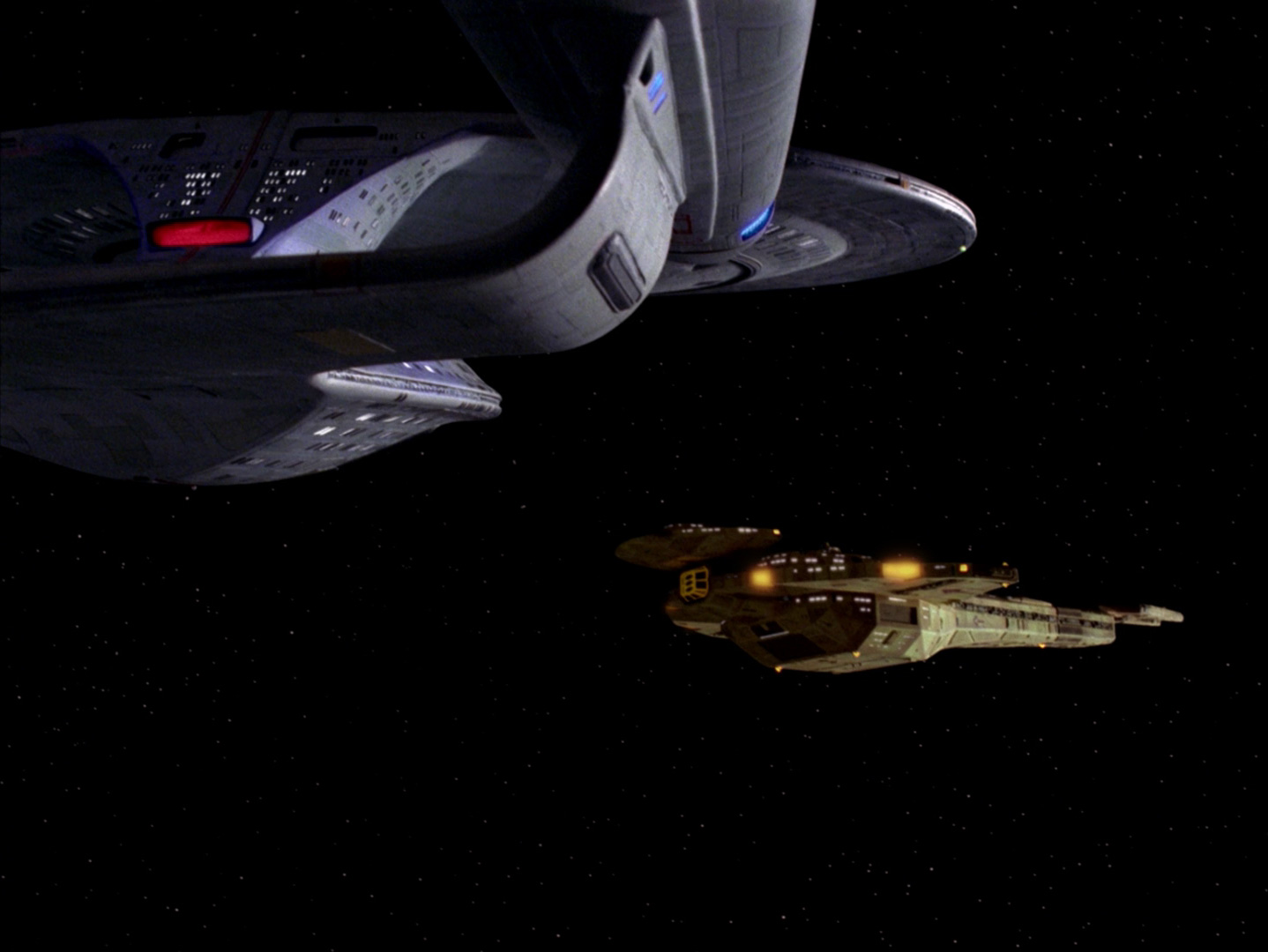
- Remarkable ships: Close-up on the USS Phoenix and the introduction of the Cardassian Galor Class.
Rating: 9 (Chris S)
The Wounded
Synopsis
Stardate 44429.6: Synopsis in main TNG listing
Review
Two captains confront each other, in absentia in the beginning, then face to face. Well, nothing unusual except... these two are not Starfleet Captain Picard and his yet another alien adversary. They are both Starfleet captains. Such an unexpected twist makes the story doubly exciting. So much so that we're not even confused by the fact that the battle scene we can see just as moving of dots on the viewscreen. Because what is unfolding before us is a real human tragedy. The tragedy of a man who is truly wounded, not physically, but so deeply that his wound continues to bleed after so many years. Bob Gunton has done an excellent job as Captain Maxwell. He clearly knows his character's background and believes it. Just look at his face when he talks to Picard in their scene together.
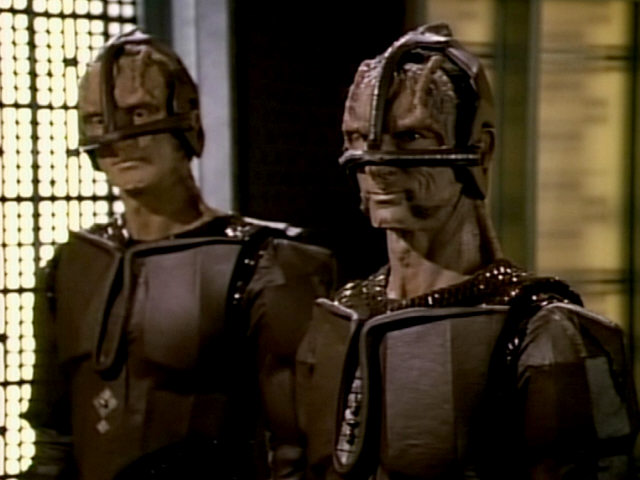
Furthermore, the story unexpectedly brings O'Brien (oh my, it doesn't matter what rank he has) to the fore, and as it turns out, not for nothing. When Colm Meaney is given the right material, he goes all out. Yes, it is boring to stand in the teleport room set and make by face from time to time, but nothing more. Of course, the character will be fully revealed later when he joins the main cast of DS-9. But even here we see an excellent performance from an experienced and complete actor. So the Picard-Maxwell tandem is replaced by the Maxwell-O'Brien tandem, and these two bring the story to a climax when they sing The Ministrel Boy together. The slight confusion about why we didn't know O'Brien served on the Rutledge as tactical officer under Maxwell is easily ignored. We also had no idea about the Cardassians and their (apparently) long-standing conflict with the Federation just the day before. Besides, O'Brien's scenes with Keiko and two Cardassians in Ten Forward explain everything, briefly but clearly. Author Jeri Taylor has done a good job here, in contrast to the weak, in my opinion, 'Suddenly Human'. And, of course, let's not forget Mark Alamo. He not only introduced us to Gul Maset, the first Cardassian we see. He managed to convey the character of the entire race without bulging eyes and brandishing various stabbing and slashing objects, just by intonation and a slight smile at the corners of his mouth, mixing cold menace with a touch of inner madness.
There are a few controversial points, though they don't detract too much from the overall impression. We get no explanation as to why the Phoenix crew obeys Maxwell's obviously illegal orders without question, and no one dares to object. Moreover, we don't see any of them, only Maxwell. Picard takes Maxwell at his word that he is willing to obey Starfleet orders and return to Federation space, which may seem a bit naive. On the other hand, we already know Picard and can accept that for him the word of any Starfleet captain is as sacred as his own. Only teleporting through shields, which goes against the basic principles, seems to be an unfortunate mistake. O'Brien's explanation that he knows how the Phoenix shields work sounds unconvincing. How could he possibly have knowledge of such a peculiarity if he had never been aboard that ship before?
What is equally remarkable is that this episode unwittingly laid the groundwork for a whole new direction for the franchise, which would later materialise in DC-9. Trek's history might have taken a very different path had the Cardassians not appeared here. But it would have been a shame if they had remained just another alien of the week. Of all the enemies of the Federation, I always thought the Cardassians were the most realistic. Not the Klingons with their bat'leth-mek'leths, not the scheming Romulans, but the Cardassians. Later they'll be more developed and fleshed out. But anyway, it might seem that Taylor, followed by Rick Berman and Michael Piller, have looked into some kind of magic mirror. Even today it's still possible to see parallels in the real world. Watch the evening news and find the Cardassia on the world map at the first attempt. We even have our own, home-grown Dukat, driven mad by realising of self-greatness. Too bad the other side isn't even Sisko, but a pompous idiot. Well, that's an aside. Overall, we have an excellent episode that deserves high praise.
Annotations
- Remarkable quotes:
- "Trust is earned, not given away." (Worf)
- "Do you expect us to believe that you are using every means at your disposal - to track down one of your own?" (Macet, to Picard)
- "There you are... potato casserole - a dish fit for kings." (O'Brien, to Keiko)
- Remarkable dialogue: "I'm not gonna win this one, am I, chief?" - "No, sir." (Maxwell and O'Brien)
Rating: 9 (Paul)
The Drumhead
Synopsis
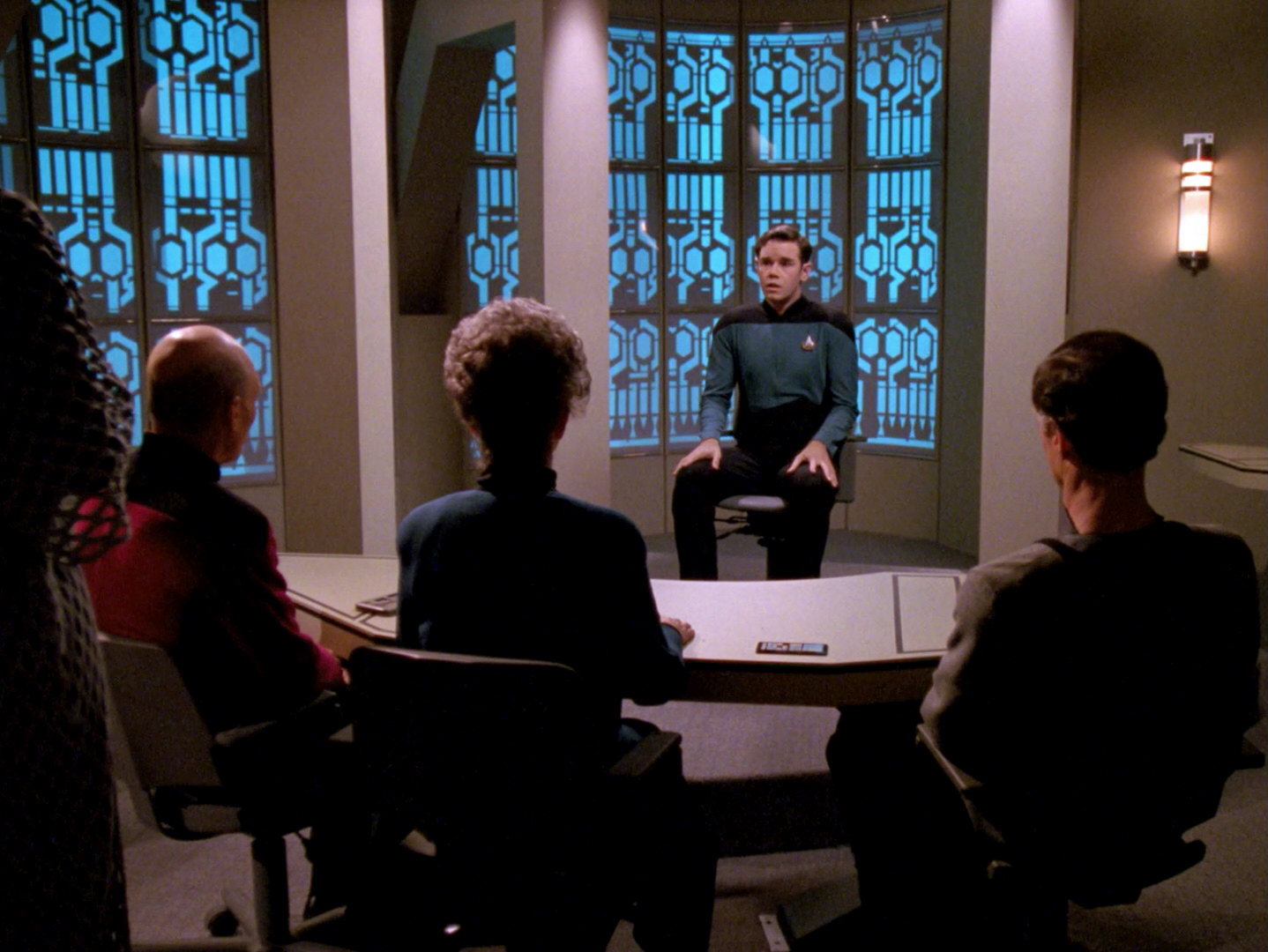
Stardate not given: When an explosion aboard the Enterprise disables the ship, its cause is suspected to be initiated by visiting Klingon officer J'Dan. As a result, investigators from Starfleet are sent to confirm this incident. However, although J'Dan is found to have been stealing data from the Enterprise, the explosion is an accident. Nevertheless, the investigators are convinced that J'Dan did not work alone, and as a result a witch hunt starts aboard the flagship of the fleet, not sparing anyone to achieve its agenda.
Review
I love this episode because this is to me what would happen to a society dedicated to the betterment of themselves and their attitudes to other "lesser" cultures. Despite their high ideals, there is still a lot of ignorance and pride about. They claim to have shunned their old ways but when push comes to shove it can come to the surface - and in this episode this is well played out.
So many elements here to emphasise this - the immediate accusation of J'Dan because he is different - and that difference is that he is a Non-Starfleet officer - instinctual obvious choice. Then the attitudes of the investigators - noticeably Admiral Norah Satie (played well by Jean Simmons) who is no doubt proud to be heading this investigation, especially aboard the flagship of the fleet, convinced their is more to this than meets the eye. Her support in the Betazed Sabin is like interrogation PC style - subtle in appearance but brutally effective in result. Then the way the incident changes - from a simple investigation, then an accident to a blatant witch hunt. The finest part of all of this is the dialogue exchanged between Picard and Worf - Picard wisdom and experience, Worf warrior and defender. It is here that Star Trek - sci-fi at its best - makes us stop, listen, and most important of all think. No phasers, no ships, no special effects, no silliness - just good acting. Only gripe was the slight over the top challenge at Picard's trial but on the whole a real rare gem.
Annotations
- Remarkable quote: "Mr. Worf, villains who twirl their mustaches are easy to spot. Those who clothe themselves in good deeds are well-camouflaged." And the exchange ends on this...perfect. Here it shows that we must be vigilant, as Worf admits. And how easily we are duped by those we think have good intentions.
- Remarkable dialogue: "Sir, the Federation does have enemies! We must seek them out!" - "Oh, yes. That's how it starts, but the road from legitimate suspicion to rampant paranoia is very much shorter than we think. Something is wrong here, Mr. Worf. I don't like what we have become!" (Worf - Picard: The exchange in the ready room begins with this)
- From Memory Alpha: In the Star Trek: The Next Generation Companion Jeri Taylor names this episode's script as the one she was most proud of. This is one of Michael Dorn's two favorite TNG episodes, the other being "The Offspring".
Rating: 8 (Chris)
The Host
Synopsis
Stardate 44821.3: Synopsis in main TNG listing.
Review
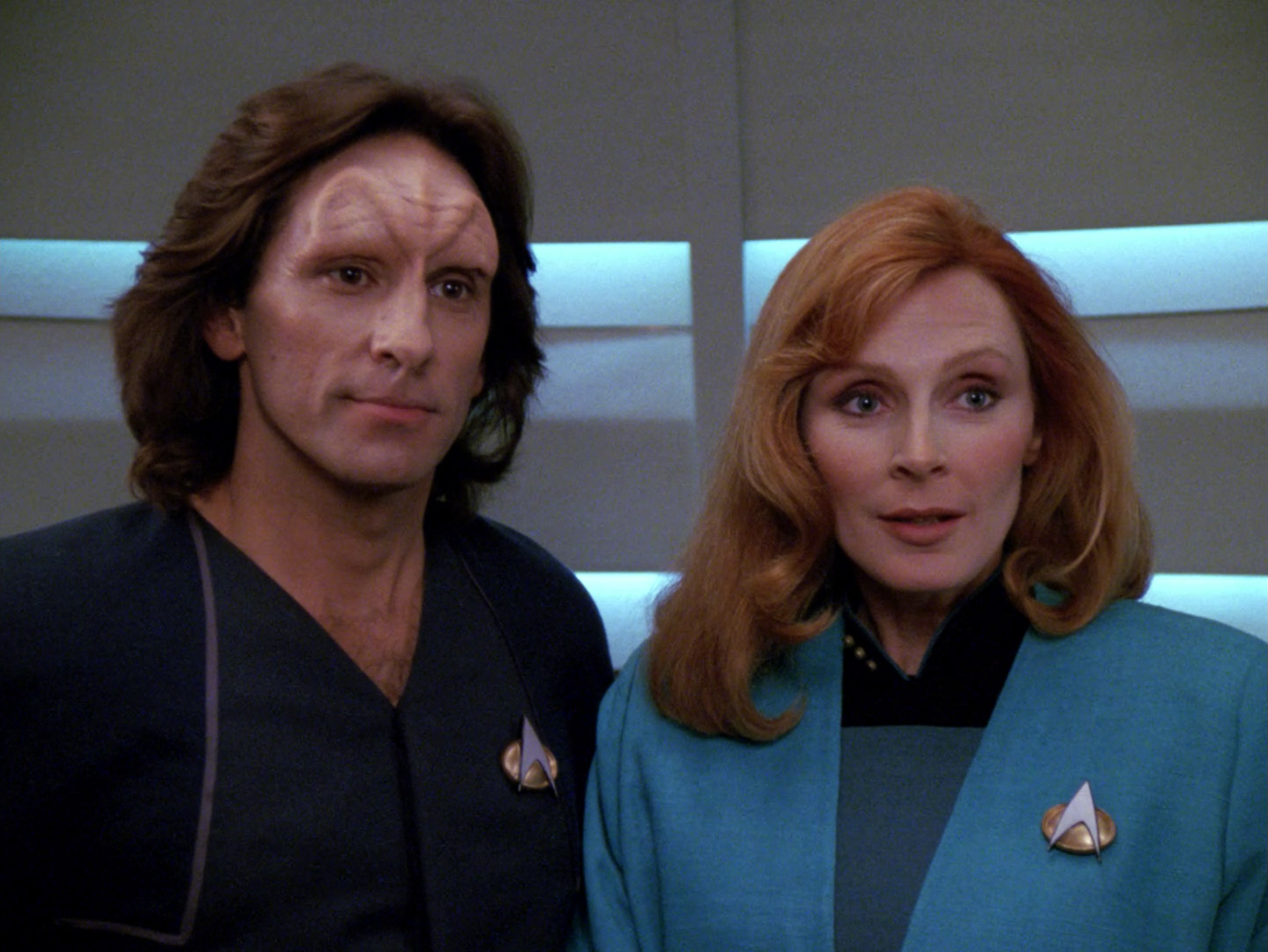
"The Host" is the episode where the Trill --- a "joined species" consisting of a humanoid host and a parasitic symbiont --- were first introduced. The idea was intriguing enough that the creators of Deep Space Nine reused the Trill to create the Dax character. Nearly all of the development of the Trill on DS9 contradicts the Trill as portrayed in "The Host": the makeup was different (standard headbumps exchanged for Kriosian spots), there is no ban on using the transporter, and it became established that the Trill were longstanding Federation members (not a mystery race whose true nature had been a secret). "The Host" can hardly be faulted for these subsequent changes, which were apparently necessary to make Dax an attractive (no bumps) and viable (transportable) character with many past lives that were relevant to Federation history.
That said, "The Host" can be blamed for its own shortcomings, which are many. The focus of the episode is Beverly Crusher's love affair with Odan, who begins the episode with a very attractive male Trill host body. When that host body dies, the Odan symbiont is temporarily transferred into Will Riker, a friend Beverly thinks of "as a brother." Although the newly joined being that results is technically still Odan, and although he still has the same feelings for Beverly and expects her feelings to remain, she is suddenly confronted with a lover who looks and sounds (and is in the same body as) someone who is a long-time, platonic friend. Her disinterest in continuing the relationship is very understandable. Less understandable is Counselor Troi's strong advice to Beverly to continue the relationship. If Beverly felt good about the situation and wanted to continue the relationship, more power to her; but if she didn't (and she clearly felt incredibly awkward), Troi's pushy advice was nosey and unhelpful.
The worst part of this whole thing is Troi's speech which compares loving a boyfriend with loving a father, and equates a woman's feelings of romantic love with a child's desire to be protected. This is a horribly regressive speech for two women of the 24th century --- and it comes after Troi and Beverly have been hanging out in the ship's beauty salon together! Finally, when Beverly decides to resume the relationship, she does so by going to Odan's quarters, babbling passively, and allowing Odan/Riker to make the moves. We might as well watch re-runs of TOS: "Turnabout Intruder" since the sexism is just as unreformed.
At the end of the episode, when Odan is transferred into his new Trill host, an attractive woman, Beverly is unwilling to even consider continuing the relationship. Although Odan has crossed a gender barrier and is now a "she," this final change seems frankly less freaky than kissing someone who is like a brother to you. Although Beverly couches it in being unable to handle so many changes, her ultimate reaction seems gratuitously homophobic.
Despite these problems, the episode isn't a disaster. As introduced, the Trill are already an interesting idea; it's little wonder that DS9's creators decided to revisit the concept. As interesting as they are, the critical aspect that "The Host" fails to touch on is the role of the host in the relationship. In DS9 we find that the personality in the joined person is likewise joined, but in this episode the personality of the host appears to be entirely submerged --- there is no hint that Will Riker has any say over his body while Odan is calling the shots. Perhaps the episode would have been improved if the writers had spent time exploring these ideas instead of hanging out with Beverly in the beauty salon.
Annotations
- "Remarkable race": This episode marks the introduction of the Trill, but when the race reappears in DS9 its characteristics and history are significantly different.
- Remarkable quote: "The first man I ever loved was my father. He was strong and tall. He carried me when the ground was muddy. He chased away the monsters that hid under my bed at night. And he sang to me and kept me safe. And he went away. What I wouldn't give to hear those songs again. To feel his arms protect me. I never will. But I can still feel his warmth and his love as though he were here with me. If you can feel those things from the man we know as Will Riker, accept them. Accept the love." -Troi
Rating: 4 (John Hamer)
In Theory
Synopsis
Stardate not given: Synopsis in main TNG listing
Review
A well executed episode.
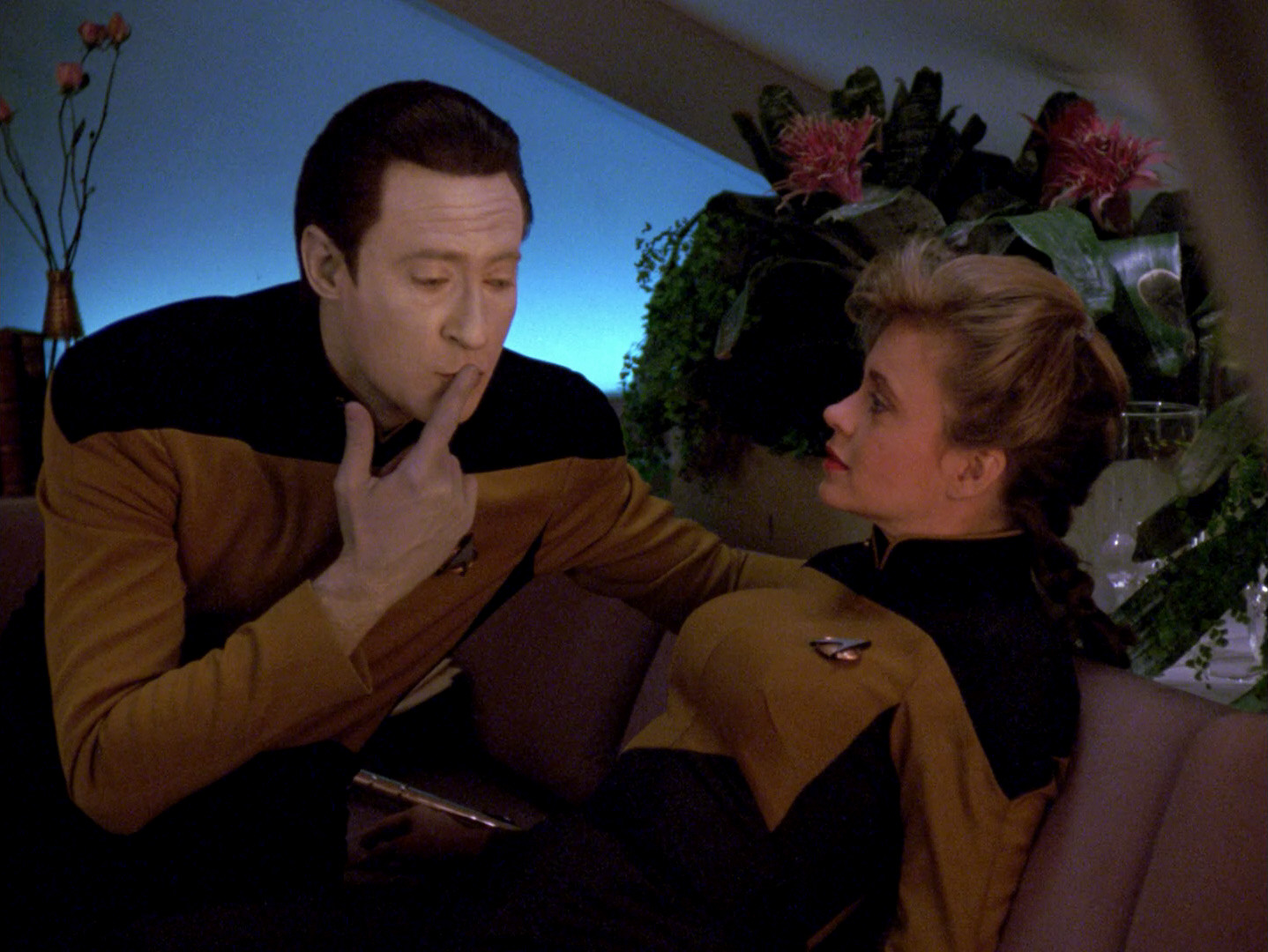
The prime story of Data and Ensign Jenna D'Sora is interesting in many ways - mainly the real differences between a mechanism and a human being. She is on the rebound and is looking for love, he is trying to understand the concept of romance via programs and recommendations.
It's bittersweet how it turns out, and there are a lot of amusing incidents here, like his chat to Worf and Riker, Picard's determined but failed attempts to elude Data's request on women, the clunky way how Data fails to see the signs of romance and the poor countermeasures employed. In the end it all falls apart, Jenna is a woman - Data is an android, and when she ends it, he deletes the program and carries on. She may be devastated, but it's inevitable looking at the way things were going to go. He is incapable of emotion.
Yet this was allowed to occur, I am amazed despite the fact that Deanna warned against this, it was permitted - more amazed that SHE did not stop this from happening. I mean for Data to "progress" is it right for a woman's at her most vulnerable to be literally exploited?
What is more surprising is that romances are allowed to blossom aboard a starship. Some will say that it encourages bonding but what happens when break ups occur? Having said that they do have families aboard...
However it's not focused on too much because the second story is far more interesting - the discovery of Dark Matter. This is what space exploration is about - encountering the unknown and how to deal with it. When it's discovered that this Dark Matter can phase shift the walls in a well executed build up series of events, the crew know they are in trouble - when Lt Van Mayter dies when she falls through the floor that then rematerialises, they know they have to escape fast.
In a spin similar to TNG: "Booby Trap", Picard once again shows why he has earned the right of command due to his vast experience - this time by using a shuttle as a guide through the nebula of Dark Matter. Yet, even with his skills and experiences, he is way out of his depth, and as he carries on guiding the Enterprise out of the nebula, his shuttle bears the brunt of the phase shifts, to such a point the vehicle becomes a death trap. Only a well executed transport saves him from the exploding shuttle.
It's a great episode - its original, well done, and worthy of a watch.
Annotations
- Remarkable fact: Patrick Stewart directed this episode, and is most proud of it.
- Remarkable scenes:
- Lt Van Mayer embedded in the floor; the chairs by the window in the ready room, and the phasing of all the panels in engineering shocking various crewmembers.
- Picard's shuttle striking a dark matter blob, and the nacelle phasing, before the ship spins out of control and explodes.
- Remarkable dialogues:
- "Captain. I am seeking advice in how to..." - "Yes, I've heard Data. And I would be delighted to offer any advice I can on understanding women. When I have some I'll let you know." -Data and Captain Picard
- "I require advice." (laughs) "Don't look at me." (Data turns his head and looks away from her) -Data and Guinan
- Remarkable quote: During a lover's quarrel, Data yells "I am not your mother!" to an astonished Jenna - pure class acting and comedy.
Rating: 8 (Chris S)
Redemption I/II
Synopsis
Stardate not given: Synopsis in main TNG listing
Review
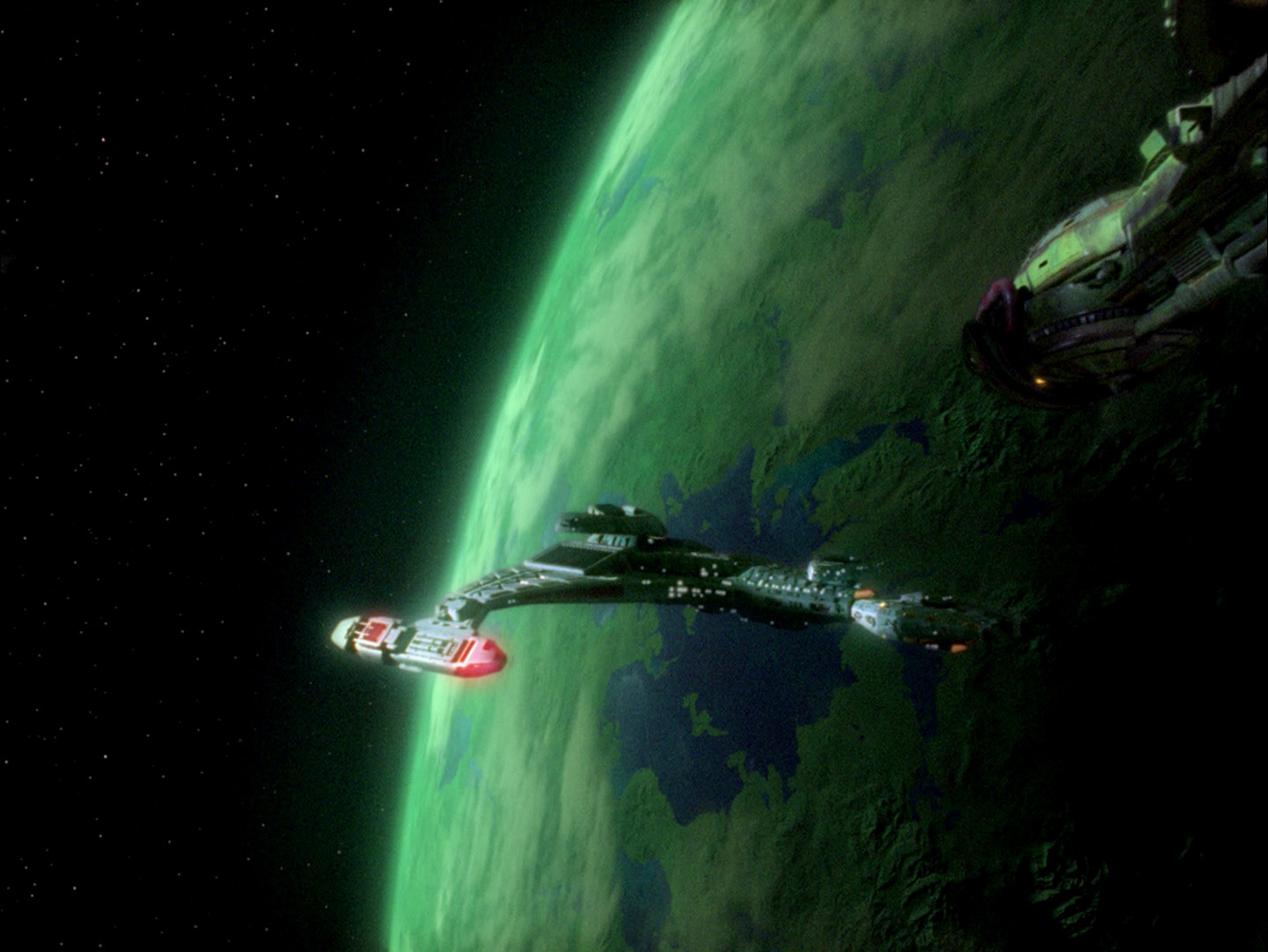
This two parter is the result of numerous episodes that has built it up - "Reunion", "Yesterday's Enterprise", "Sins of the Father", "The Neutral Zone", and "The Mind's Eye". As in the mentioned episodes, the story is about the Romulans' plan to destroy the Federation/Klingon Alliance. In theory this should be a belter and in a way it ties up all the 'loose ends' from the previous episodes.
We learn that Gowron is to be sworn into office by right, but is challenged by the Duras family who reveal that Duras has a son, a squab called Toral. As a result they challenge Gowron's place. Gowron is the leader by right but due to corruption, tradition, and 'pride', most Klingon houses back the Duras family despite the fact that Duras's father betrayed the Khitomer colony and it is well known, but the shame of a highly respectable Klingon would tear the Empire apart (See TNG ep "Sins of the Father").
However the best kept secret to secure the stability of the nation is blasted when in a bid to keep tradition flowing Gowron refuses to bow. The Klingon Civil War all fear has begun. There are good moments in this; the above sequence is a constant reminder that burying scandal to preserve peace is like corking a fizzy drink. At some point it will give way to an explosive reaction.
There is the overall build-up, the few seen but well placed fights, and the good conclusion. Worf is the key here and is well played by Mr Dorn as best as possible. He is infuriated by the ineptness of the Klingon society, the dishonour he has to bear, and being forced to choose sides. That was a sort of shock when he leaves Star Fleet to join Gowron, but his choice is a valid one. It's his people, his race/species, and justice of sorts needs to be done.
On Star Fleet, Picard takes the right course of action - it's not their war, and it's not right of him to intervene - that is down to the Federation and its governors to make that choice. However, Picard is not one who is willing to sit back either - he knows that the Romulans are behind numerous attempts to destroy the Federation/Klingon alliance, and he knows they are involved via previous evidence, and the potential of the failure of the alliance too irresistible to ignore. His idea of the Tachyon net to form a "blockade" between both the Romulans and the Klingons is well done - he knows that the Romulans would be annoyed but also there is little they can do - any act would expose their hand.
It's in this that the entire two part episode is clunky to say the least.
First is the actress playing the Star Fleet Admiral - oh my gawd - talk about cardboard! Wood is more interesting - she overdraws every criticism, she overdoes every condemnation, and she relents in the most clumsiest manner. Wince able.
The deployment of Data to the Sutherland is another embarrassing point - Lt. C. Chris Hobson is a dreadful officer - Star Fleet is supposed to deal with the unknown and work with the unhuman, yet he wants to get off ship, challenge Data because he is a machine, and berates him for being 'inhuman'? How the hell did he get into Star Fleet? More to the point, why is he such an asshole!? It's always the same - Data has to be the lynchpin of some conflict or incident, the cause of some prejudice (Look to Pulaski to get my point). Can't Hobson be supportive? Be a too by the book officer? Or a decent chap? His actions would have him disciplined - especially at such a critical stage with the Klingons and Romulans.
On that, first the Romulans - more to the point the return of Denise Crosby - as the Romulan nemesis Sela. Denise left because she felt that Tasha was too banal, too inept - so she returns as what? A villain who is banal and inept too....so what did her return accomplish? Also we learn that Tasha was taken from the Enterprise-C and that Guinan in her wise mage role, "knows but does not know" that Sela is Tasha's daughter - and the entire story is ruined by this stupid time travelling fiasco.
The Klingons - god sake, here we go again but more panto - they snarl, growl, challenge, drool, and the bit in their "pub" is ludicrous - head butting, fist fights for fun, arm wrestling with knives!! Getting pissed, threatening each other. No wonder Worf was mortified about planning! I am amazed that anyone DOES ANYTHING!! It was so embarrassing! The Great Klingon race reduced to pissed pub thugs.
The ending is typical but needed; Data's assignment to the Sunderland is the key to victory, and the Duras's plans fail with the sisters of Duras fleeing and leaving poor Toral at the mercies of Gowron. When Worf is given the chance to kill the poor lad, he chooses not to, and spares him - and to me the title is apt: this is Worf's redemption for the deaths and failures building up to this. His victory is not that his family name has been restored but his return to the Enterprise. He is at peace.
The best bit of all is Data's explanation to Picard why he disobeyed his orders to rejoin the fleet - he acted on a whim - but that is not the real reason - the real beauty is Picard's praise for Data's act, which he acted with the right judgement, despite the orders.
When Star Trek gets its right, its brilliant - and here it is; it's true that many obey orders just like that - and justify actions because of it, but here is a reminder what command is about - responsibility.
6/10 overall.
Annotations
- Remarkable dialogue: "The claim, 'I was only following orders' has been used to justify too many tragedies in our history. Starfleet does not want officers who will blindly follow orders without analyzing the situation. Your actions were appropriate for the circumstances, and I have noted that in your record." -Captain Picard, to Data
- Remarkable quote: "Mr Data - Nicely done" Captain Picard, to Data
Rating: 6 (Chris S)

Proceed to TNG Season 5 Guest Reviews