The Original Series (TOS) Season 1 Reviews
The CageWhere No Man Has Gone BeforeThe Corbomite ManeuverMudd's WomenThe Enemy
Within
The Man Trap
The Naked TimeCharlie XBalance of TerrorWhat are Little Girls Made of?Dagger of the MindMiri
The Conscience of the KingThe Galileo SevenCourt
MartialThe Menagerie I/IIShore LeaveThe Squire
of Gothos
ArenaThe
Alternative FactorTomorrow is YesterdayThe Return of the ArchonsA Taste of ArmageddonSpace Seed
This Side of ParadiseThe Devil in the DarkErrand of MercyThe City on the Edge of ForeverOperation
- Annihilate!
The Cage
Synopsis
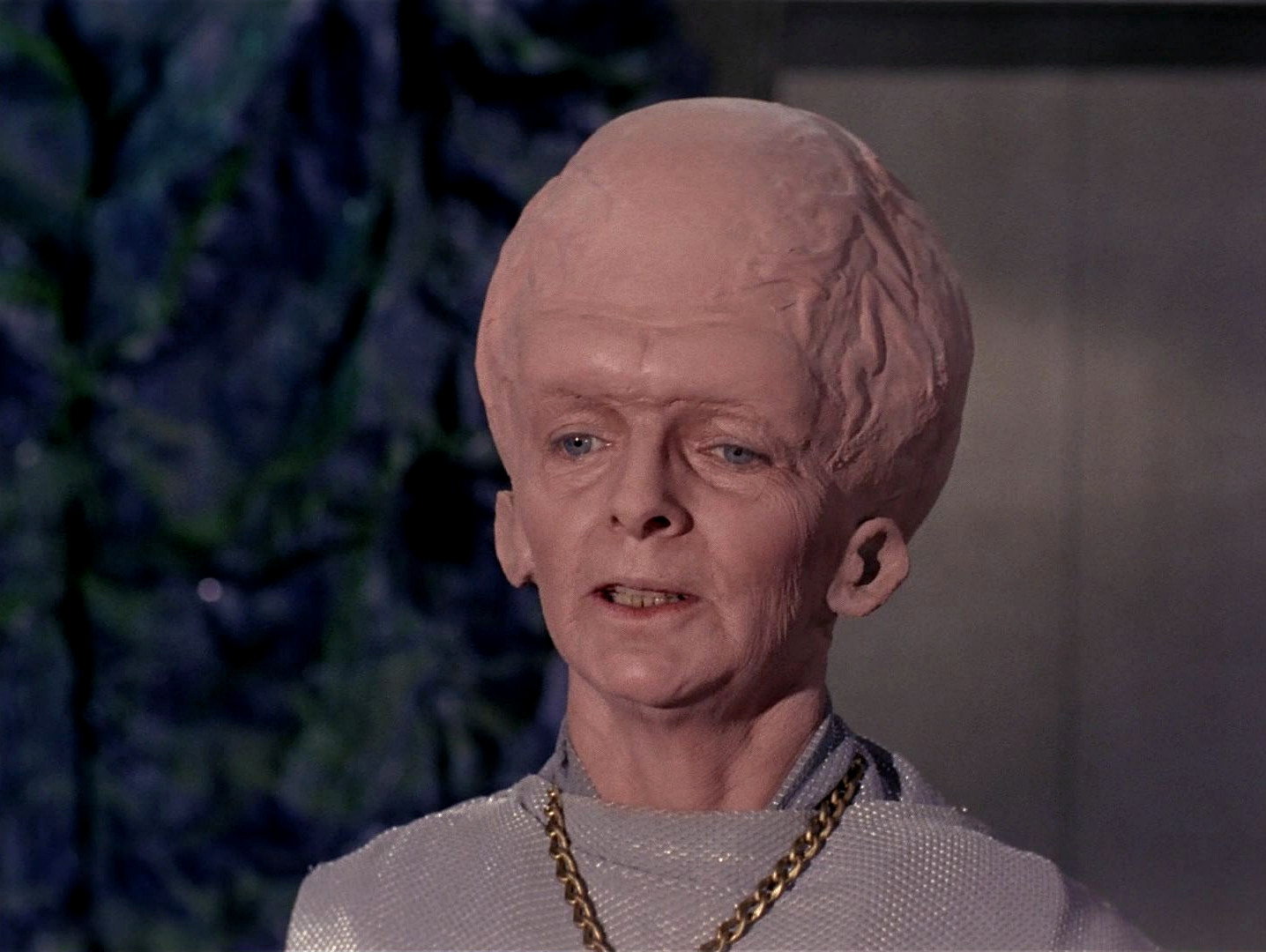
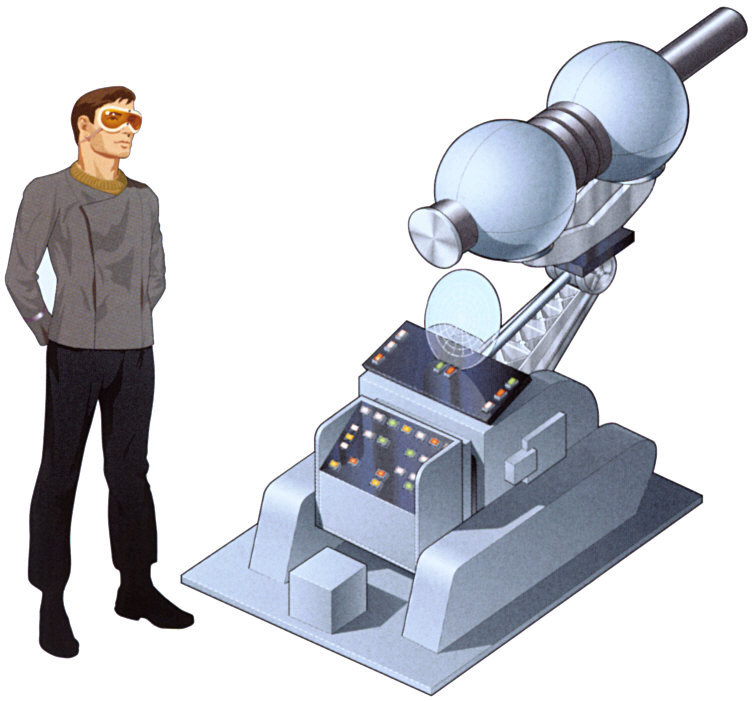
Stardate not given: The Enterprise, commanded by Captain Pike, discovers survivors from a ship that crashed on the planet Talos IV twenty years ago. Among them is the young Vina. Pike is abducted by the indigenous Talosians and subjected to illusions, in which Vina appears too. Meanwhile on the surface, the camp of survivors has vanished and the crew attempts to break into the underground city of the Talosians with a big laser cannon to free their captain, apparently in vain. The Talosians' goal is to make Pike mate with Vina to breed slaves, because after many centuries in which they focused on their mental development they can't maintain their machines any longer. Pike and his crew finally prevail when they refuse to believe in the Talosian illusions any longer. Vina, however, is really a woman who was found alive by the Talosians. Since they didn't know anything about human physiology, they couldn't help her. She never recovered from her injuries and is kept alive only through the illusions.
Review
Considering how convincingly it demonstrates the concept of telepathy and the power of illusions, the first Star Trek pilot is science fiction at its best. Hallucinating crew members have become a favorite theme of Star Trek since then, but in favor of live action they are seldom discussed on such an intellectually demanding level as here - long before the idea "cyberspace" became popular in science fiction and in the real-world, and also long before the holodeck. Vina says about the Talosians: "When dreams become more important than reality, you give up travel, building, creating." These almost prophetic words anticipate today's criticism of video game and internet addiction. Overall, "The Cage" didn't underestimate the viewer's intelligence. I think this was exactly the reason why "The Cage" was famously rejected by the network as being "too cerebral" in the first place.
While the rest of the crew have only a few lines, the cautious and suspicious Captain Christopher Pike is excellently impersonated by Jeffrey Hunter. The second character of importance is Vina, played by Susan Oliver, who undergoes a remarkable development in the course of the episode until the whole extent of her tragedy becomes apparent. She first appears to be just a gratuitous component in Pike's illusions before she turns out to be a prisoner just like Pike, only much more desperate, and ultimately a woman who could not even survive without the Talosian illusions.
The pilot episode is not just overall well conceived but also the work that went into every line of dialogue deserves praise. I like the language of the Talosians, who call Pike a "specimen" and refer to him as "it".
One point of criticism is that violence eventually resolves the situation, when Pike's "primitive" emotions enable him to overpower one of the Talosians and ultimately when "Number One" sets a laser to overload, to demonstrate that humans would rather die than live in captivity. This also lays the foundation of the frequently recurring theme of humans being scorned by "superior lifeforms" for their intrinsic violence. Another thing that doesn't work so well is the mention of several motives that would later show up in Pike's illusions, which was intended to be casual but appears as contrived. It may have been better to actually show Rigel VII and even Mojave and green Orion women in some fashion to introduce them instead of just mentioning them.
Annotations
- Remarkable quote: "The customs and history of your race show a unique hatred of captivity. Even when it's pleasant and benevolent, you prefer death. This makes you too violent and dangerous a species for our needs." (Talosian guard)
- Remarkable scene: Pike aims at the transparent wall of his prison cell with a seemingly discharged laser, and only when he points the laser at the head of one Talosian, the truth is revealed, that he actually blasted a hole into the wall. This is one of my most impressive memories from my early viewings of Star Trek (well, I actually saw the same scene in "The Menagerie").
- Remarkable characters: "Number One", the nameless first officer (Majel Barrett) and Spock (Leonard Nimoy), who occasionally smiled in this episode. Gene Roddenberry was asked to drop both of them because the network thought the viewers couldn't get accustomed to a woman in a high-ranking position or an alien as a main character. The compromise was that Roddenberry kept the alien and gave him the cold and rational characteristics of the abandoned "Number One".
- Remarkable facts (that are subject to be revised in later episodes):
- "The Cage" is very interesting viewing because many familiar concepts of Star Trek have not yet been established. This includes the different props and uniforms as well as the background score and, of course, Spock's not yet so logical character.
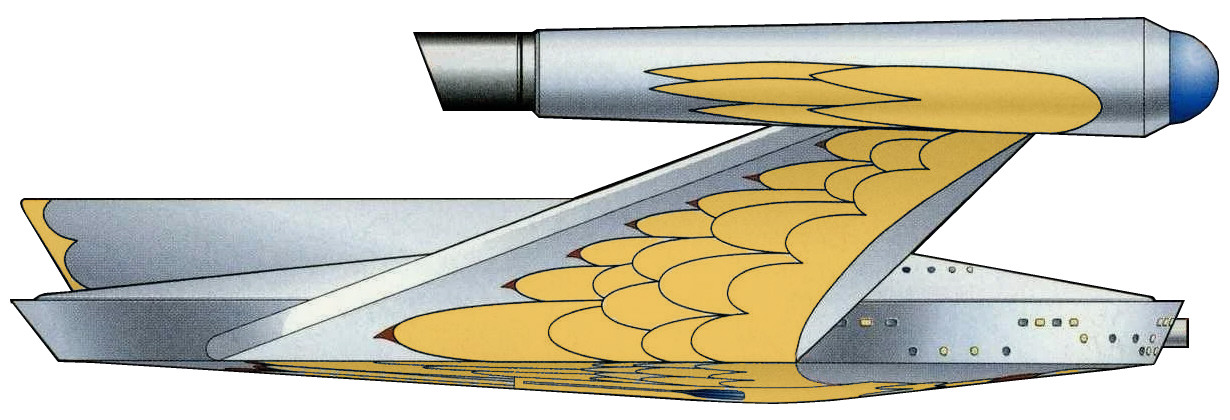
- Several details of the Enterprise in the pilot version are different from the ship as it would appear in the regular episodes. The crew complement of the Enterprise is 203 at this time. -- According to Pike "USS" stands for "United Space Ship".
- "The time barrier has been broken.", whatever that could refer to in terms of "modern" Treknology. The ship can go to "time warp factor 7". On another occasion in the episode, the warp drive is referred to as "hyperdrive".
- Captain Pike tells the Talosians that he came from "the other end of this galaxy". Based on what we know about the speeds and distances in the Federation, this is more than just grossly exaggerated.
- Spock can control the main viewer of the ship with gestures.
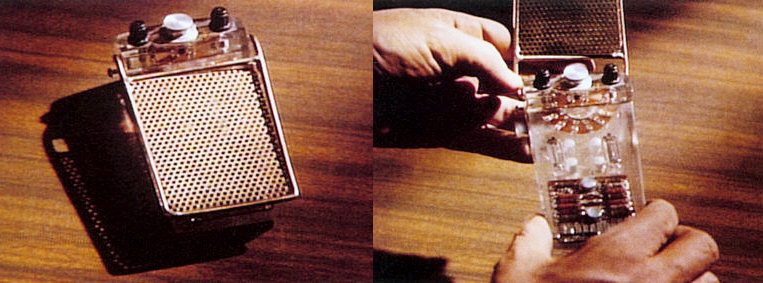
- Remarkable props: the transparent communicators, the laser guns and the big laser cannon, all designed by Wah Chang
Rating: 8
Where No Man Has Gone Before
Synopsis
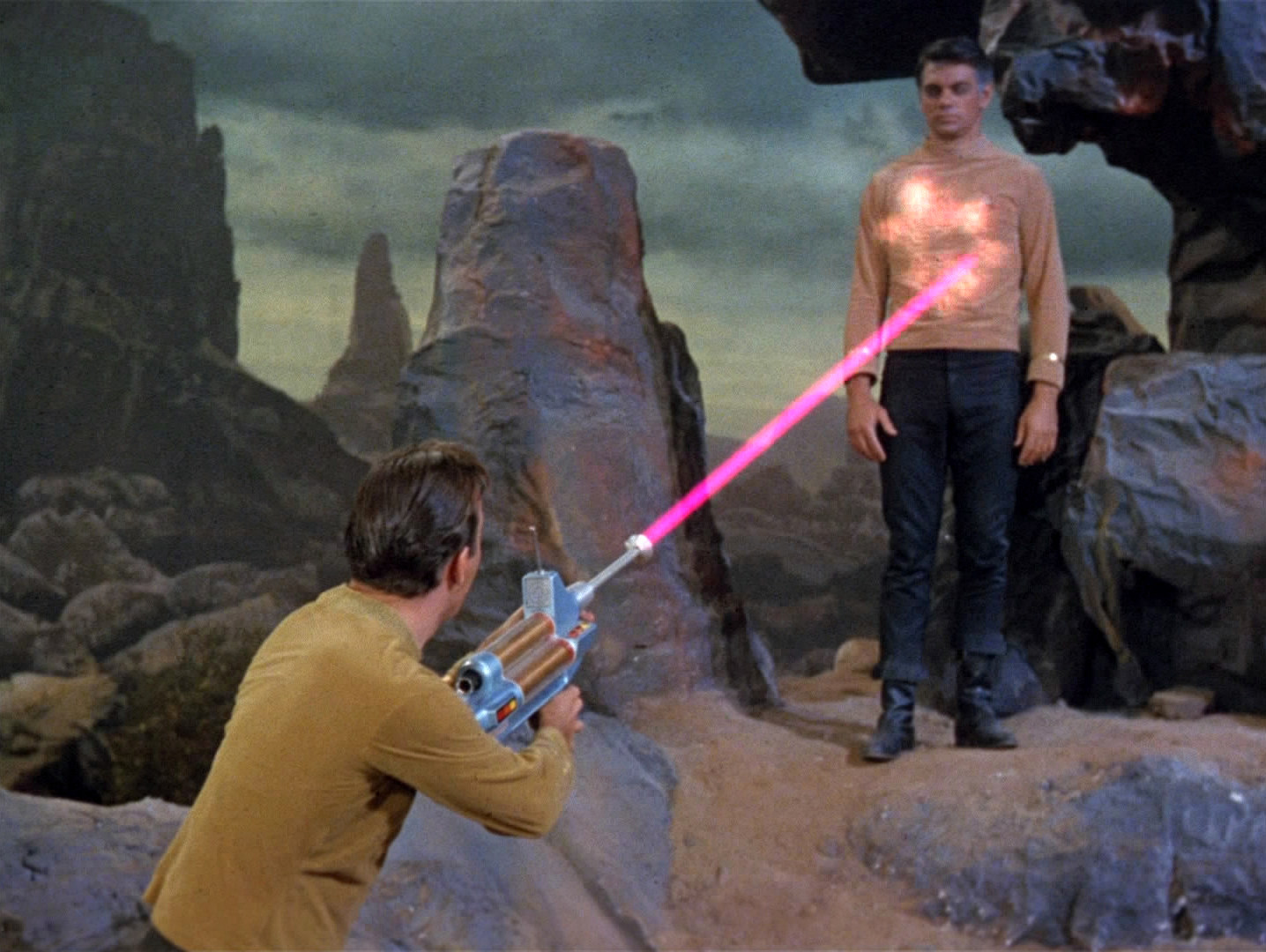
Stardate 1312.4: On the way to the Galactic Barrier the Enterprise picks up a disaster recorder from the old Earth ship S.S. Valiant that disappeared 200 years ago, indicating that something related to extrasensory perception (ESP) happened to the crew. The Enterprise crosses the barrier nonetheless, whereby nine crew members are killed and the engines burn out. Moreover Kirk's old friend Gary Mitchell begins to develop ESP powers that pose a growing threat to the ship. Kirk assigns psychiatrist Dr. Elizabeth Dehner to observe him. When the Enterprise arrives at the Delta Vega station for repairs, Kirk sees no other way but to exile the dangerous individual that Mitchell has become on the uninhabited planet, with the option to blow up the facility if necessary. Mitchell, however, kills Lt. Kelso and escapes with Dehner who too has mutated in the meantime. Kirk goes after them with a phaser rifle, but Mitchell easily anticipates the attack and prepares to execute his old friend. Dehner, with what is left of her humanity, decides to help the captain and weakens Mitchell at the expense of her own life so Kirk can kill him.
Review
After "The Cage" had purportedly been panned by network executives as "too cerebral", Gene Roddenberry's second Star Trek pilot was obviously governed by the motto "more action". The new captain Jim Kirk is clearly more energetic and more determined than Pike, and he only falters because he has to exile and ultimately kill his old friend Gary Mitchell. Kirk's involvement in the story is very personal, and the focus is on his friendship and the emerging conflict with Gary all the time, with Spock and Dehner acting much as their respective advisors. I like how the anecdotes from their past are woven into the story without appearing contrived, such as the "blonde lab technician" that Mitchell once introduced to Kirk (Could this have been Carol Marcus?), or the poisoned dart that Mitchell caught in Kirk's place.
I also like very much how Mitchell's transformation is being portrayed, as he suddenly has a reverb in his voice, then begins to read with incredibly fast speed, later makes the lifesign readouts above his bed run wild, and even simulates his own death. Yet, it never becomes quite plausible why Mitchell's development to a godlike being goes along with a simultaneous loss of morality. Well, no one could predict what would happen to a human being who was suddenly equipped with supernatural abilities. Clearly a race that develops such powers over many millennia in the course of evolution may look down on other sentient species just like humans on insects. But the case is different here. For all we can see Gary Mitchell acquires his powers extremely fast and much like an add-on to his being human. Would he really lose his respect for human life and forget all his moral values in a matter of days? Does unlimited power inevitably lead to unlimited corruption? Or is Mitchell rather intoxicated like he were drunk or drugged? Is he in a state that would amplify the worst that is in him? I can't tell, but no matter who or what he really is, he shows an alarming lack of reason, of ethics and of compassion. And I can't help the impression that much of the ruthless villain he becomes must have been a part of his human personality all along, and that Kirk failed to notice or to acknowledge that.
Kirk and the crew of the Enterprise may be prepared for the encounter with aliens, but obviously not for the alien in a human being. Kirk has sympathy with Mitchell, but this is most of all because the man used to be his friend. Dehner speaks in Mitchell's favor in her role as a scientist, and also because she may already know that she is awaiting the same mutation. Only Spock is uncompromising with his opinion that Mitchell must be disabled or killed before it is too late. As much as everyone's welfare is his laudable and logical concern, Spock's stance comes across as rather intolerant though. Spock is mistrustful of Mitchell from the very first moment, and he never gives him the benefit of the doubt, that Mitchell's lack of morality may be just a matter of insufficient adaptation to his new situation. In Spock's view it appears almost like a necessity that absolute power leads to absolute corruption. Something that at least Dehner proves wrong in the end.
Anyway, as fascinating the topic of ESP power may be, towards the end the characters act too much like stereotypical superheroes than as we would expect in a science fiction series that strives to be taken seriously. In particular it is a shame that after Dehner has weakened Mitchell for a while, it boils down to a simple fist fight with Kirk. I would have wished for a more elaborate ending of the episode, and a more appropriate one for two men who used to be friends and who tragically became enemies.
Overall "Where No Man Has Gone Before" doesn't quite live up to its ambitious science fiction premise. This is why I think the episode is rather superficial compared to "The Cage" and does not stand out from the better regular TOS episodes. The strong characters of Mitchell and Dehner, both of whom play more important roles than Spock here, are sacrificed in a similar way as Decker and Ilia in "Star Trek: The Motion Picture" years later. I think it was a pity to lose them.
Annotations
- Remarkable changes:
- Due to its unique position between the first pilot and the series there are many changes we can witness in "Where No Man Has Gone Before". Most obviously the cast is new. In addition to the captain, almost all other characters were replaced. Only Spock remained.
- It is, however, the last time we see Spock with the steep eyebrows. This make-up, as well as his haircut, will be modified for the first regular episode.
- Scotty and Sulu are new to the crew, but the latter is not yet at the helm but acts as a physicist.
- Dr. Piper is the second chief medical officer of the ship that we know of, and he would be replaced by Dr. McCoy in the series.
- The uniforms don't yet have the intense colors and black collars. And the shoulder part looks quite "untidy" with the wrinkled zipper, which may have been one reason to alter them.
- The Enterprise bridge still has the old rounded screen and the lamp-like monitors, but already red railing of the series version. The bridge is still with out the familiar beeping sounds.
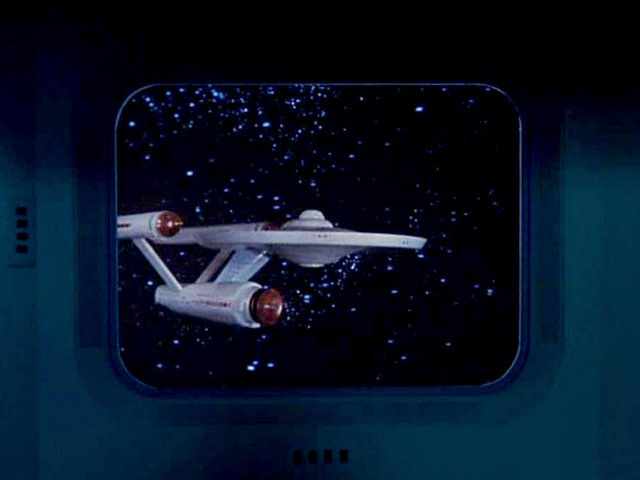
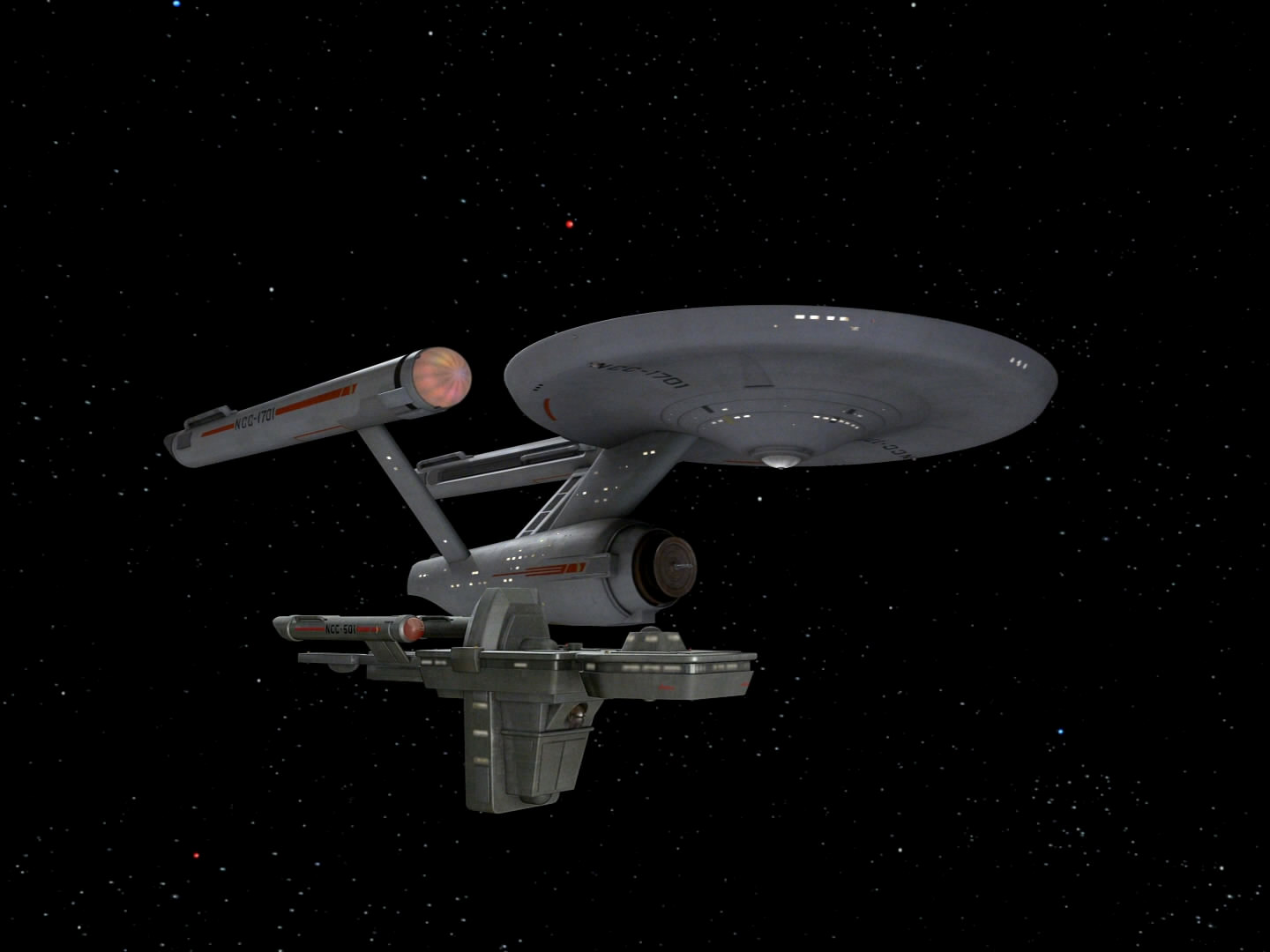
- It is the last time that we see the pilot version of the ship from outside, although stock footage of it will occasionally appear in the series.
- It is the last regular appearance of the transparent communicators too.
- Remarkable first times: There are several more first times in this second pilot episode. We can see the first blowing consoles ever on Star Trek and Kirk's first fist fight and first torn shirt.
- Inconsistencies:
- Spock says: "One of my ancestors married a human female." We will learn briefly later in "The Corbomite Maneuver" that this human female is none other than his mother. Would he really choose such indefinite words to refer to his mother?
- It is curious in hindsight that Kirk asks Dr. Dehner about ESP rather than Spock, who clearly has such abilities as a Vulcan, and that she and Mitchell develop ESP powers rather than him. Maybe it was not yet considered at the time that Vulcans are telepathic?
- So the Enterprise has traveled beyond the edge of the galaxy for the first time. The engines are badly damaged and without main power. And it would take years to reach an Earth base, but Delta Vega with its huge lithium cracking facility is conveniently only a few light days away, according to Spock.
- The tombstone created by Mitchell reads "James R Kirk C 1277.4 to 1313.7", although Kirk always refers to himself as James T. Kirk. The "death" date is the current stardate, so we can conclude that Kirk was born on stardate 1277.4. This doesn't make sense though, considering that TOS stardates count up several hundreds per year.
- Continuity:
- A bit like already in "The Cage", Spock is still rather emotional here. He is shouting in a state of stress. Ironically, this is exactly what he will criticize about Bailey in "The Corbomite Maneuver"!
- Lithium plays a big role here as the ship's fuel. But lithium is a real chemical element that couldn't possibly provide the required power. So later in the first season (more precisely in "The Alternative Factor") the fictional dilithium would take over that role.
- Curiosities:
- The reports on Dehner and Mitchell are written with a typewriter.
- When Kirk aims at the rock above Mitchell and blows off one big chunk, it precisely fills the grave like a plug.
- Remarkable poem: "My love has wings. Slender, feathered things with grace in upswept curve and tapered tip." (The Nightingale Woman, written by Tarbolde on the Canopus planet back in 1996)
- Remarkably cheesy explanation: "If you want the mathematics of this, Mitchell's ability is increasing geometrically. That is, like having a penny, doubling it every day. In a month, you'll be a millionaire." (Sulu, as if he were to explain exponential growth to little kids)
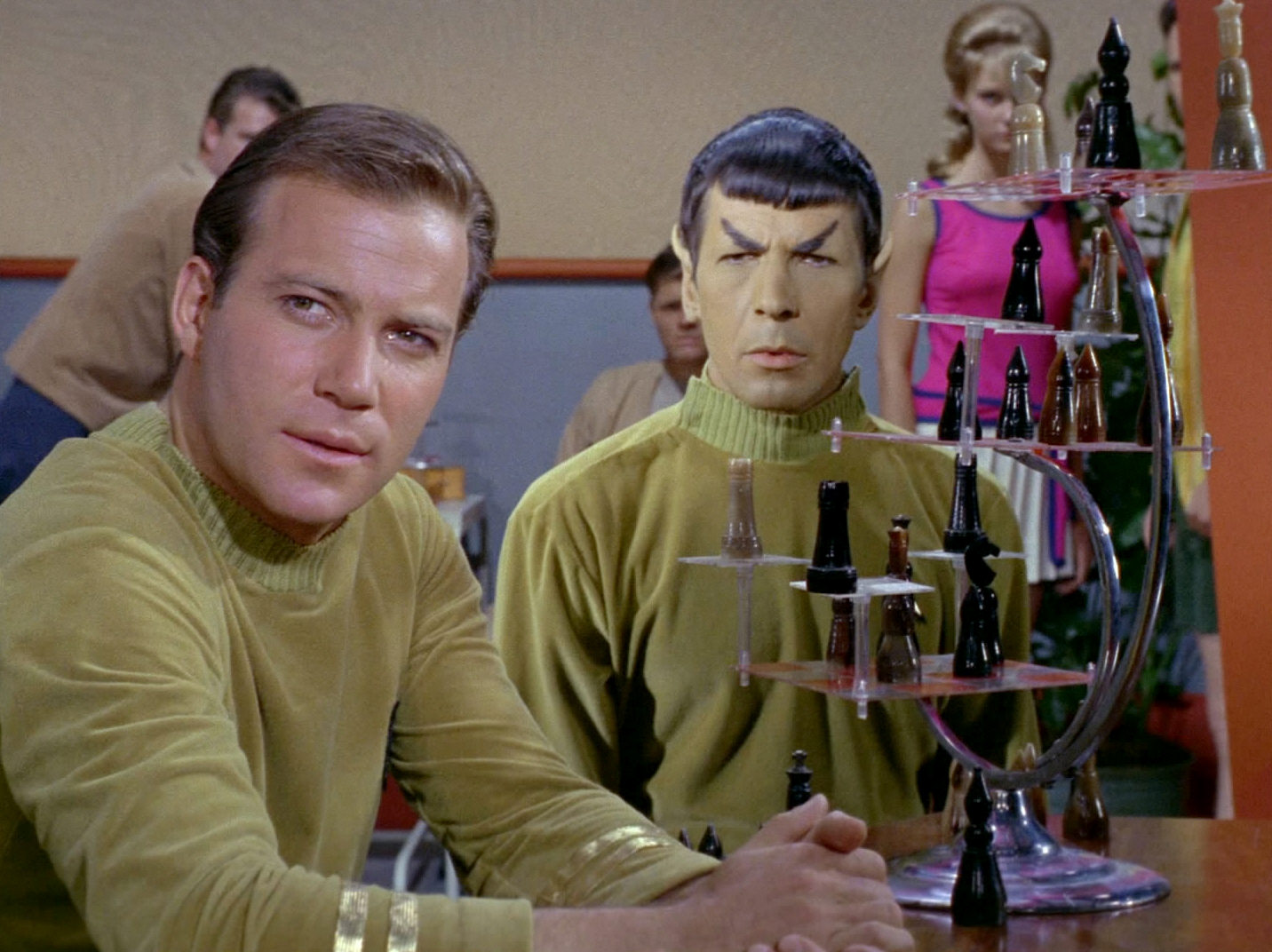
- Remarkable props: first appearance of the 3D chess and of the phaser rifle that will never return
- Remarkable facts:
- The S.S. Valiant vanished about 200 years prior to the episode.
- According to Mitchell, there are almost 100 women aboard the Enterprise.
- Crew losses: 12
Rating: 6
The Corbomite Maneuver
Synopsis
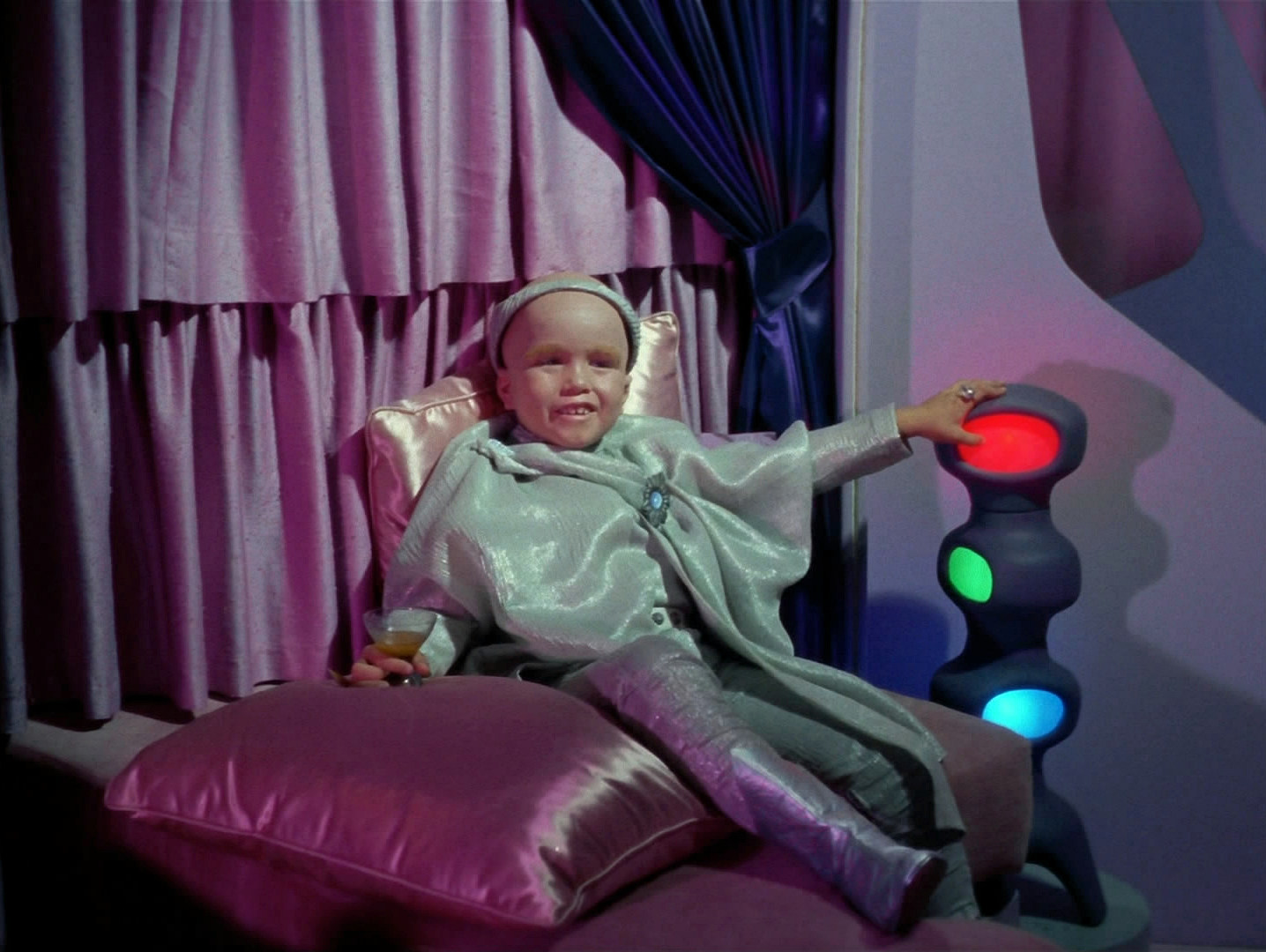
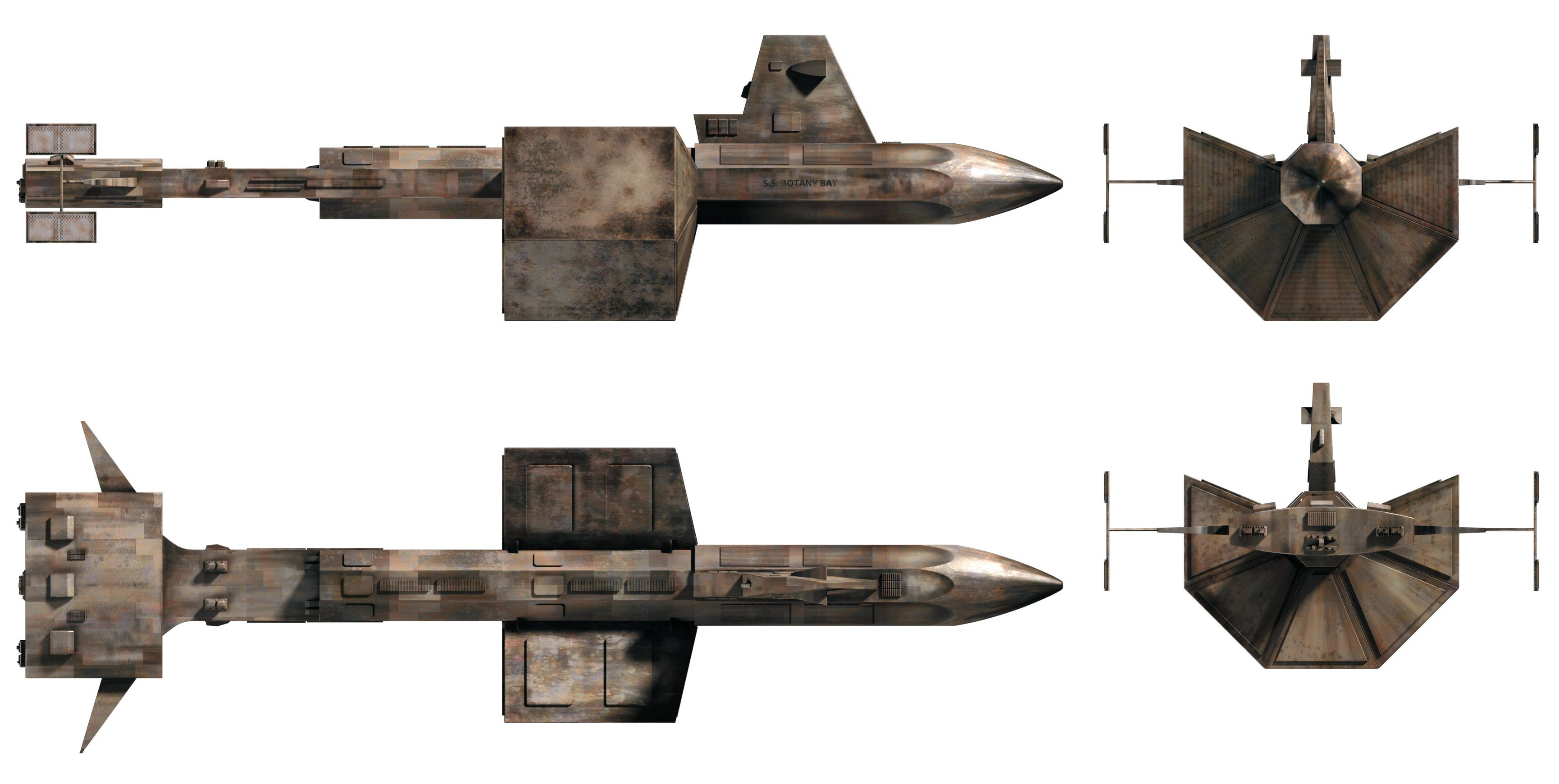
Stardate 1512.2: When the Enterprise's flight path is blocked by a buoy of unknown origin, Kirk has to destroy it to break free. Soon a massive and highly advanced alien vessel of the "First Federation" appears, and its commander named Balok announces that he would destroy the hostile and primitive intruder. Kirk has to bluff in order to save the ship, and he pretends that a substance called "corbomite" would reflect the energy on the attacker. Balok then sends a smaller vessel to tow away the Enterprise for dismantling. But the Enterprise successfully breaks away and leaves the alien vessel powerless as it seems. Kirk, McCoy and Bailey, who was previously most afraid of the alien threat, beam over and are greeted by the real Balok, a friendly child-like alien who just wanted to test whether the Enterprise's crew was really peaceful. Bailey then volunteers to stay aboard the Fesarius to establish relations with Balok.
Review
This episode is an overall entertaining poker game, although the straightforward plot is not quite sufficient to fill the scheduled 45 minutes. We have to keep in mind that TOS generally didn't make use of secondary plots, which might have compensated for that. This is why the story appears protracted, has a somewhat slow pace and is not quite as exciting as the title and synopsis suggest. There are some exceptionally thrilling scenes though, for instance when Sulu counts down the time until the ship's destruction, or when everyone repeatedly warns Kirk that the engines are overloading, and he still doesn't give the order to disengage them.
I think the most important aspect about the episode is that it becomes obvious that Star Trek is not about destroying the enemy at all cost, but about trying to find a peaceful agreement. Which should be easy in this particular case despite the bad start because Balok turns out to be an explorer just like the crew of the Enterprise, only with rather peculiar methods. It is a symbolic, albeit not very plausible solution that of all crew members the one who was scared most by Balok stays with him to establish good relations. I am not sure if Bailey, as a navigator, would be the person of choice to establish the first contact. Well, maybe he also has a special training for that, but in that case he shouldn't have been all that afraid. It is generally a bit frustrating that the guest characters are often weenies compared to the heroes, especially to Kirk. Also, Bailey's previous failure in the crisis does not really come across as credible. Bailey could have been confused or agitated and may have pressed the wrong buttons in the presence of the danger. But the way he just sits there in total lethargy and suddenly raises from his seat and starts talking trash simply doesn't feel right.
"The Corbomite Maneuver" is the first produced regular episode of TOS, after the two pilot movies. In a way, it is almost like a third pilot episode, as it establishes several important facts, such as Spock having a human mother. It also takes time to explore the character of Kirk, whose main concern is always the ship and who is capable of thinking out of the box. Furthermore, it shows some of the everyday work on the ship. And the phaser drill that Kirk deems necessary demonstrates that the Enterprise needs the whole crew to operate efficiently, and not just some geniuses in the senior staff (something that several later episodes will neglect).
Annotations
- Remarkable first times:
- There are several more first times in the episode, but some things would be revised later in the first season. It is the first time that the crew wear the familiar TOS uniforms with black collars. Some crew members, such as notably Spock, Sulu and Bailey, still have an unusually high collar with a clearly visible zipper on their uniforms. And Uhura is still in a yellow uniform in this episode and in "Mudd's Women".
- It is also the first time that we hear the familiar bridge sounds.
- Also, it is the first episode with Sulu on the helm.
- The turbolift has double doors here, with additional gray inner doors.
- Kirk refers to the Enterprise as a "United Earth Ship", and several more times to Earth being the point of origin of his vessel, rather than the Federation.
- Curiosity: Apparently neither the klaxon sound during red alert nor Sulu's call "Captain Kirk to the bridge." make it to sickbay. The red light is flashing silently, and McCoy doesn't tell the captain because he wants to finish the examination.
- Remarkable dialogues:
- "Raising my voice back there doesn't mean I was scared or couldn't do my job. It means I happen to have a human thing called an adrenaline gland." - "It does sound most inconvenient, however. Have you considered having it removed?" (Bailey and Spock)
- "Has it occurred to you that there's a certain inefficiency in constantly questioning me on things you've already made up your mind about?" - "It gives me emotional security." (Spock and Kirk)
- "When I find the headquarters genius that assigned me a female yeoman." - "What's the matter, Jim. Don't you trust yourself?" - "I've already got a female to worry about. Her name's the Enterprise." (Kirk and McCoy)
- Remarkable quote: "What am I, a doctor or a moon shuttle conductor?" (McCoy, also a first time)
- Remarkable score: The episode's score that would be re-used a couple of times is one of the most exciting of TOS, and iconic like few others.
- Remarkable ship: the Fesarius, essentially a big sphere consisting of nothing but pulsing light bulbs. The vessel was refined in the remastered episode. Also in TOS-R, we can see how the light from the cube-shaped buoy realistically illuminates the Enterprise.
Rating: 5
Mudd's Women
Synopsis
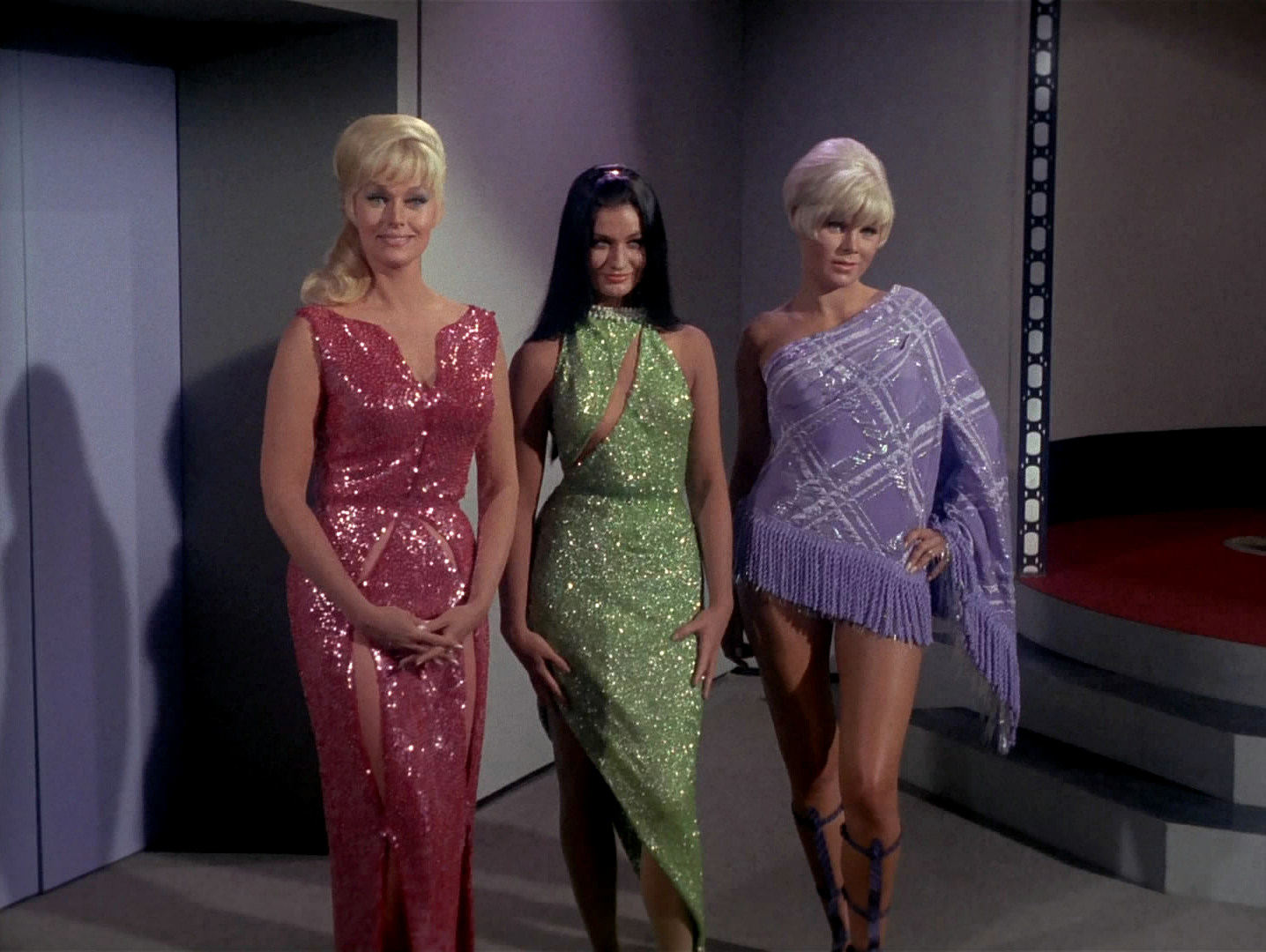
Stardate 1329.1: The Enterprise beams out the crew of a small freighter whose engines are overloading. The captain, a man who calls himself Leo Walsh, is accompanied by three attractive women, who enchant the male members of the crew. Leo Walsh's actual name, however, turns out to be Harcourt Fenton "Harry" Mudd, against whom there are a number of charges. In the meantime the Enterprise is heading for Rigel XII to acquire lithium crystals to replace the ones that burnt out during the pursuit of Mudd's ship. Mudd contacts the miners on that planet and proposes to sell the three women to them. At this point no one knows that the women are taking so-called Venus drugs that restore their beauty. On Rigel XII, Ruth and Magda are happy to marry two of the miners, while Eve reluctantly stays with the third one, Ben Childress. She is unattractive again after not taking the drug. Kirk and Mudd beam down again to get hold of the crystals eventually, and give Eve pills that quickly make her look beautiful again. But it is just a placebo, and still has much the same effect.
Review
Spock provides a perfect summary at the end of "Mudd's Women": "I'm happy the affair is over. A most annoying, emotional episode." I couldn't express it better. In short, this episode is based on an incredibly sexist premise. It has an implausible story to start with, and it becomes totally ludicrous in the final minutes. The episode is also rife with silly dialogues and all kinds of platitudes and is overplayed above all.
"Mudd's Women" has the probably most blatant depiction of sexism in the whole series, as Harry Mudd intends to sell the three women like slaves. And except for Eve, who is tired of taking the pills that she thinks restore her beauty, they are quite happy with the prospect of getting married immediately with any man who buys them. Even as Harry takes them to Rigel XII, a desolate and stormy planet inhabited by no one else but three roughnecks, who fight for the possession of the women. It appears to be the chief goal of these women and ultimately the only reason for their existence to be good wives - and to be beautiful for their husbands as long as it lasts.
As Eve is not taking the drugs any longer, Ben Childress discovers the fraud (in a sidetracked scene that makes it look like they were married for years and not together for just a few hours, at least so is their quarreling). When Kirk beams down with Mudd, Childress complains about Eve as if she were defective merchandise. But the worst part of the episode is still to come. Eve takes the drug one more time, and she is suddenly beautiful again, with perfect make-up and hair too. As if it were meant to rectify the so far sexist notions in the episode, Kirk tells her: "There's only one kind of woman. You either believe in yourself, or you don't." And he reveals that Eve has actually taken a placebo. A placebo that replaces your plastic surgeon, your lipstick and eyeliner and your hairdresser! This is the true women's liberation. You only have to believe in yourself, and you look like Federation's Next Top Model. Give me a break. This is the single least plausible thing shown in the whole series. I rather believe in the existence of beings composed of pure energy than in this crap.
It seems that at the time the episode was being produced it was not yet clear that Star Trek was being made with the premise of being literally credible and not only symbolically. The intentional symbolic impact is the only way to explain why the mere fact that a woman "believes in herself" restores her beauty. We can also ascribe the coincidence that there are exactly three miners on the whole planet, who all "need" a wife, to the effort to make things fit symbolically, rather than logically. Finally, we learn nothing about the three women except that Eve is not content with Harry's plan. We don't know anything about their histories and desires. The three serve as mere plot devices, although the story is built around them in a superficial view. They epitomize a role model, rather than being characters in their own right. Unfortunately it is a role model of the 60s. The 1660s.
There may be worse episodes in TOS. But as Spock already said for me, I watched "Mudd's Women" with growing annoyance. There are very few things that I like. There is a good deal of comical potential as the three beautiful women enter the scene and most importantly in Harry Mudd's character, who would return in "I, Mudd". I like the scene when he is being interrogated, and the computer repeatedly comments on his statements as being "incorrect".
Annotations
- Inconsistencies:
- Why are there no replacement crystals, if they are only the size of a fist? No matter how expensive they are, Starfleet can't be serious to provide the ship with just four crystals that can burn out simultaneously under certain circumstances.
- Life support and everything else is on batteries after the last circuit has burnt out. But it happens conveniently in the immediate vicinity of Rigel XII, as the Enterprise reaches the planet with auxiliary impulse.
- The Enterprise can hardly maintain orbit around Rigel XII, but the transporter is being used all the time.
- It remains unexplained why Ruth's presence makes the display on McCoy's biobed run wild, and why the women have an almost hypnotic effect on the men. The latter could be attributed to them producing lots of pheromones, but it is not mentioned in any fashion, and Dr. McCoy should have been able to find that out, even though he was distracted of sorts.
- Remarkable Spock: Spock is unusually amused, much like in "The Cage". It appears that he too is affected by the presence of the women in spite of everything that he says.
- Remarkable technology: The lithium crystals. We may want to interpret their function as some sort of battery (maybe even akin to lithium ion batteries) instead of being the ship's main power source. This would work if it weren't for the fact that raw lithium from a mine is absolutely sufficient to replace the burnt out devices. And if there weren't batteries anyway in addition to the crystals.
- Remarkable uniform: Uhura is wearing a yellow uniform for the second and last time.
- Remarkable fact: McCoy says to Spock: "Smack right in the old heart. Oh, I'm sorry. In your case, it would be about here." McCoy then points to a place where his liver should be. This indicates that the Vulcan heart is in a different location.
- Remastering: In the remastered version of the episode we see Harry Mudd's ship for the first time (at least, for the first time as more than just a light). And now the asteroid belt sequence on the Enterprise's screen finally shows exactly what is in the dialogue.
Rating: 1
The Enemy Within
Synopsis
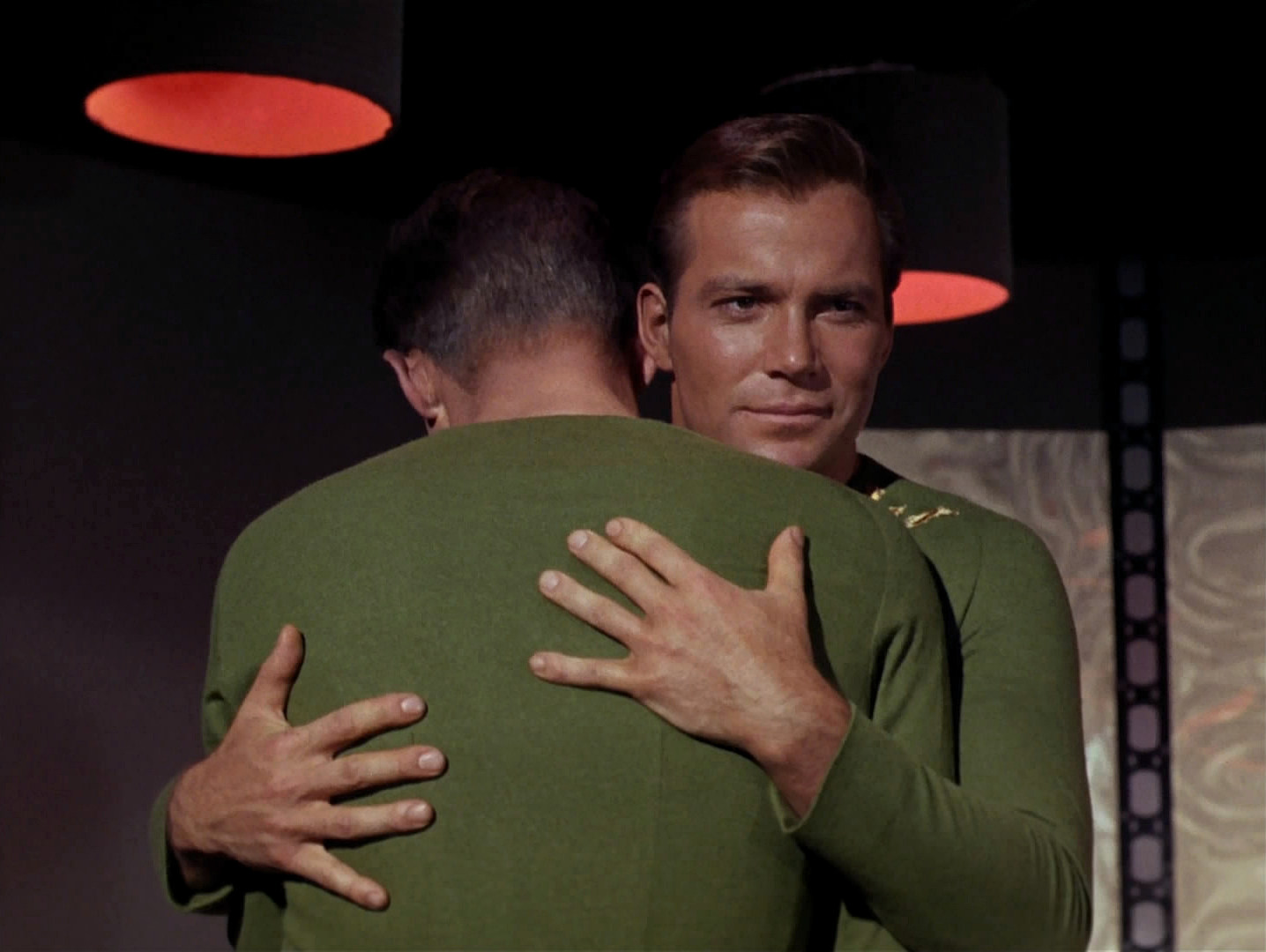
Stardate 1672.1: A strange magnetic ore leads to a transporter malfunction that splits Kirk into one aggressive and one cautious person. The two Kirks struggle for the control of the ship, but it also becomes obvious that they are dependent on one another. After the malfunction has been discovered and, moreover, the "evil" Kirk has damaged the transporter circuits, Sulu and his landing party down on the planet can't be beamed up while the temperature is falling rapidly. Spock and Scott devise a method to merge the two Kirks again. When they test it on an alien dog that has been split up in the same fashion, the animal dies because of the stress. But Spock affirms that his intelligence would spare the captain that fate. The two Kirks are re-assembled successfully, and the landing party can be beamed up in time.
Review
This is the first of many stories about Kirk doubles, and the probably best one. While the idea of splitting up one person into different facets of his personality is scientific nonsense, its hypothetical impact is shown impressively. And since the very concept of the transporter is implausible anyway, it only needs a small leap of faith to accept that the technology is capable of separating specific parts of living organisms and putting them together again. Considering that the transporter was initially much like a stopgap (because showing a shuttle landing in almost every episode would have been too expensive), this episode turns the concept into an advantage as it opens up completely new story opportunities.
The episode is also one of the best character studies of TOS. Well, maybe Shatner exaggerates a bit doing the "Mr. Hyde". It is probably Shatner's recurring embodiment of extreme emotional states that earned him the reputation of being a bad actor among some critics. But in this particular case I can well imagine that a human being driven only by instincts would really behave like that, including the grimaces. Also, whatever we may think of it, it is not Shatner's acting alone, because close-ups of his sweaty face with illumination creating unusual shadows add greatly to the impression of the "evil Kirk". Overall I liked the portrayal. I rather have a small gripe with the "good Kirk" occasionally being quite energetic too. For instance, he fights for his reputation when Rand accuses him of harassing her. In my view "good Kirk" should have been less determined and more intimidated all the time.
I'm not quite content with the editing of this episode, which has a few too harsh cuts. For instance, Spock can be seen leaving Kirk's quarters alone, and in the very next instant they enter the transporter room together. Or the scene when evil Kirk disables Fisher, followed by a cut on good Kirk's face. Some filler shots, such as the Enterprise in space or people on the corridor, would have been good to separate the scenes.
Annotations
- Oddity: After the "evil Kirk" has materialized, Kirk makes the following log entry: "Unknown to any of us during this time, a duplicate of me, some strange alter ego, had been created by the transporter malfunction." Unlike in later episodes, this log entry describes the situation in retrospect.
- Nitpicking:
- There is one enormous plot hole. Why wasn't it possible to rescue Sulu and the away team with a shuttle? The real-world reason that the shuttle model was not yet available at that time is no excuse, since it would not have been necessary to show it. Since the Enterprise was supposed to have shuttles from the very beginning, a reason why they can't be used ought to have been mentioned.
- Spock refers to himself as the ship's second officer. Who would be the first officer then?
- Remarkable set: It is the only episode to show us the space behind the machinery in main engineering. The set was extended for this one episode.
- Remarkable quotes:
- McCoy's famous "He's dead, Jim." for the first time
- "We all have our darker side. We need it - it's half of what we are. It's not really ugly, it's human." (McCoy)
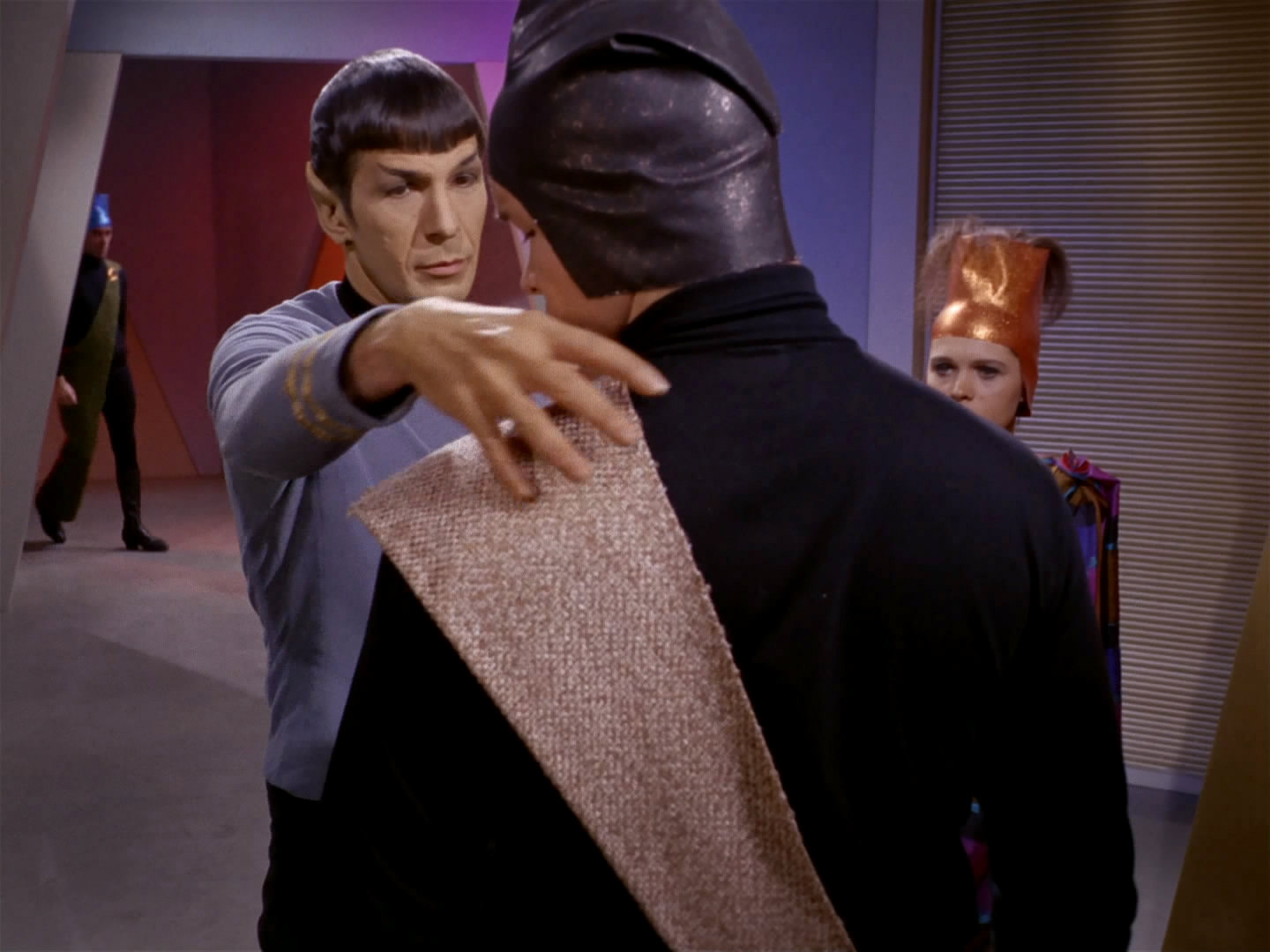
- Remarkable fact: The FSNP ("famous Spock nerve pinch") is shown for the first time. Leonard Nimoy did not want Spock to simply knock out Kirk, so he improvised the neck pinch as a more elegant Vulcan way to render someone unconscious.
Rating: 6
The Man Trap
Synopsis
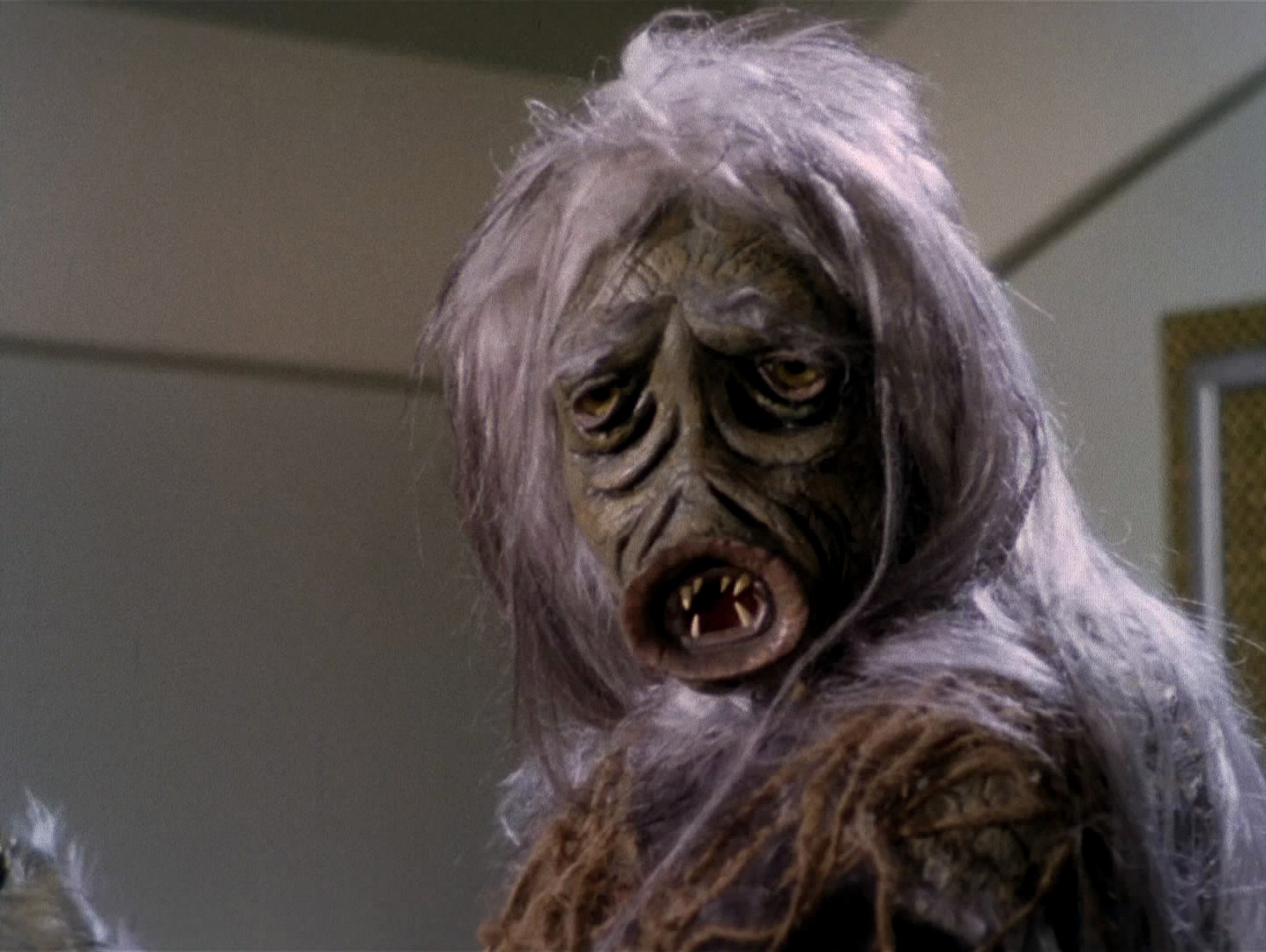
Stardate 1513.1: Kirk, McCoy and Crewman Darnell beam down to a routine visit of the planet M-113, where Prof. Crater and his wife Nancy are working all alone on excavations. All the two ask for is supplies of salt. McCoy once had a relationship with Nancy, but he does not notice that something is wrong with her. Soon Darnell, who was waiting outside the house, is found dead. Kirk has more people beam down to investigate what is going on, but Nancy and Crater vanish. One more crewman is found dead, while Nancy Crater morphs into another man she has just killed and is beamed aboard the Enterprise. After killing yet another crewman there she enters McCoy's quarters, and while the tired physician is sleeping she assumes his shape. In the meantime Kirk and Spock have found Prof. Crater. He admits that the creature killed his wife and has replaced her. The creature is the last of its kind and needs large amounts of salt for its survival that is sucks from the bodies of its victims. But then the creature strikes again in McCoy's guise, and Crater is dead too. When it attacks Kirk, the real McCoy has to shoot the salt vampire that finally shows its true form.
Review
"The Man Trap" was the first Star Trek episode ever to air, on 8 September 1966. According to Robert H. Justman and Herbert F. Solow this episode was chosen for the series premiere because it was a solid action plot, and because it wasn't set entirely on the ship. Although "The Corbomite Maneuver" arguably does a better job of introducing the crew and the ship's mission, I second that decision. The straightforward premise that an unknown shape-shifting alien entity keeps killing crewmen until its true nature is revealed must have been quite promising at the time, and the way that alien life is presented here shows the idea of going "where no man has gone before" like no other early episode.
Well, we've had so many more and better "alien parasite" and "shapeshifter" plots in 40 years of Star Trek (not to mention the "lonely scientist" cliché that is established here). I usually don't like criticizing the original in favor of the follow-ups, but while the story has its merits many things were not worked out carefully enough in "The Man Trap".
Unfortunately the overall pace of the episode is too slow. Crewmen are frequently killed, there are many cues. Still it takes the whole episode to unmask the "salt vampire", which makes everyone look incompetent, perhaps with the exception of Spock who at one point suspects that there is something wrong with McCoy. One key problem is the editing. Almost customarily when another dead man has been found or when something else strange has happened, there is a cut to unsuspecting crew members who carry on with whatever they are doing and are being informed minutes later. This takes away what little suspense has been built up in a scene.
One laudable aspect about the episode is that it tries to illustrate the crew's (especially Sulu's and Uhura's) everyday lives on the ship, something that is done in a couple of other first season episodes and will be neglected later on.
Annotations
- Problems:
- It does not have to be an error, but it remains unexplained how, in addition to the shape-shifting ability, the creature can appear in three different guises at the same time because Kirk, McCoy and Darnell see three different women. It must possess additional mental powers. But this ability never plays a big role in the following (except perhaps in the crewman of Uhura's dreams), and as such it is only unnecessary weight.
- When Kirk informs the Enterprise that the intruder can assume any form, he neglects to mention that Nancy Crater is dead, so if she should show up it would be definitely the creature.
- Curiosities:
- One peculiarity I notice in comparison with most other episodes is Kirk's calm voice in his log entries, especially the first one. Also, Kirk remains unusually composed throughout the whole episode, we could almost say that Shatner is under-acting.
- Speaking of log entries, like already in "The Enemy Within" Kirk describes the first encounter with Nancy Crater, when each one of the landing party saw a different woman, in retrospect.
- Remarkable dialogue: "Why don't you tell me I'm an attractive young lady, or ask me if I've ever been in love? Tell me how your planet Vulcan looks on a lazy evening when the moon is full." - "Vulcan has no moon, Miss Uhura." (Spock and Uhura)
- Remarkable quote: "May the Great Bird of the Galaxy bless your planet." (Sulu, to Rand)
- Remarkable ship set: Sulu's botanical lab with Beauregard (aka Gertrude), the touchy carnivorous plant
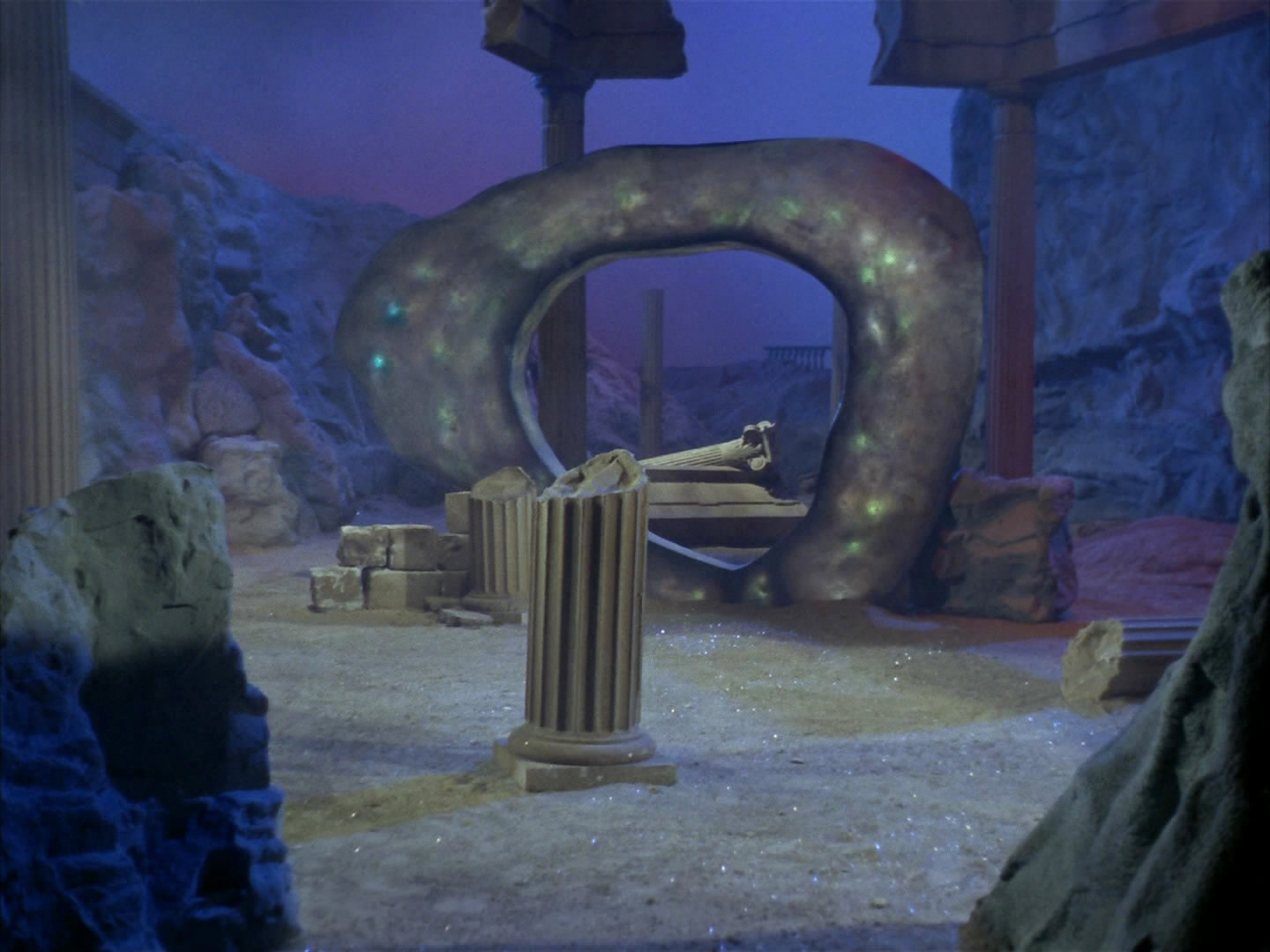
- Remarkable planet set: The landscape with the ruins of M-113 are arguably among the best TOS planet sets that were built in the studio. In the remastered episode, a digital version of this set with more depth was created but only shown at one occasion in the episode.
- Remarkable prop: Crater is using a laser pistol, of the style of "The Cage".
- Remarkable facts:
- Spock about the Borgia plant that allegedly killed Darnell: "Borgia plant listed in library record tapes as carbon group three vegetation similar to Earth nightshade family. Alkaloid poison. Chemical structure common to class M planets. About the strange mottling on his facial skin surface. There is no reference to this symptom."
- Darnell sees a woman in "Nancy Crater" that he had met on Wrigley's Pleasure Planet.
- Uhura encounters a Swahili-speaking crew member that she has just been imagining.
- We see Spock's green blood for the first time (that the salt vampire doesn't like).
- Crew losses: 4
Rating: 4
The Naked Time
Synopsis
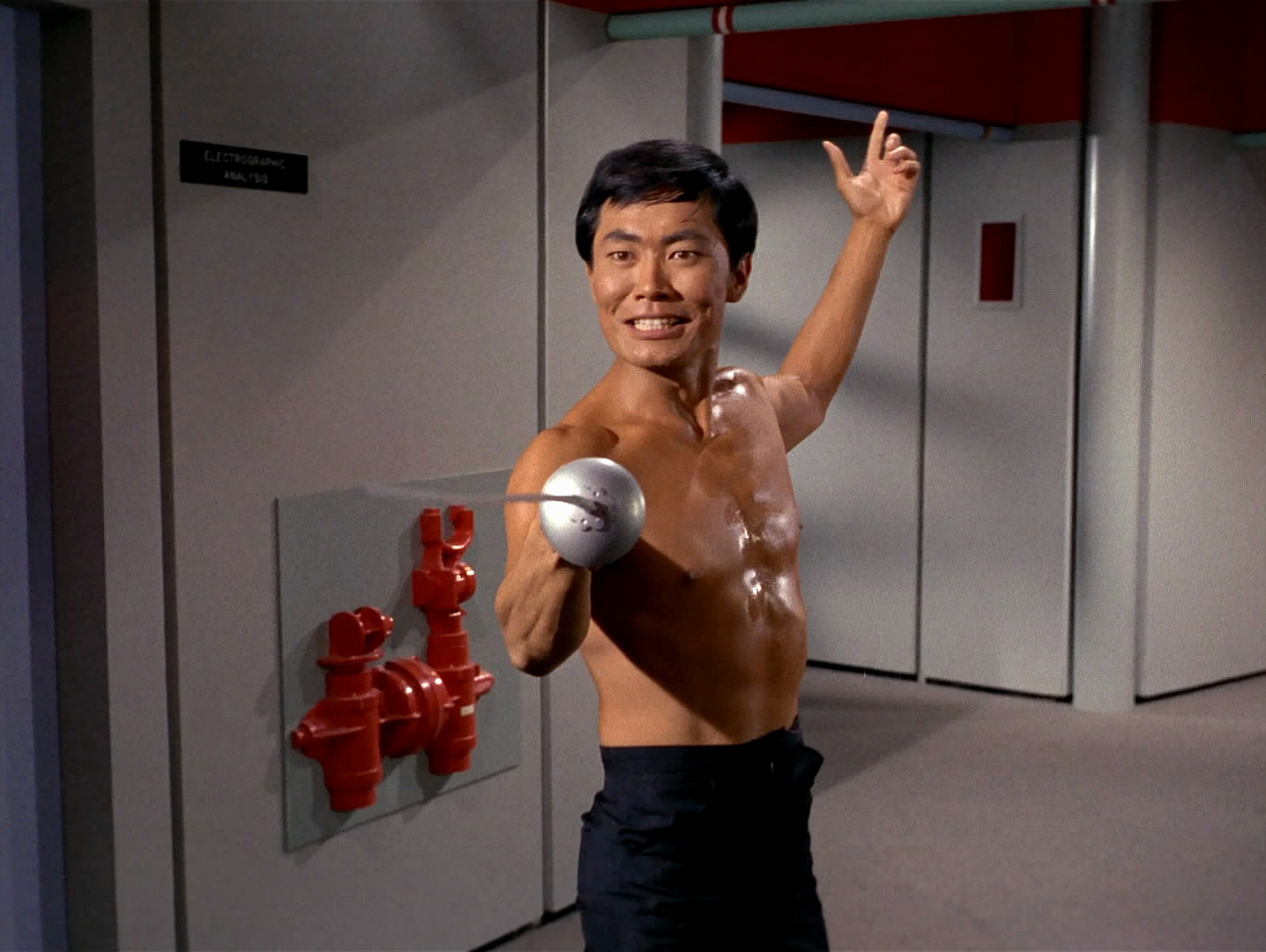
Stardate 1704.2: While Spock and his assistant Termolen are investigating strange occurrences on an outpost on the collapsing planet Psi 2000 that have killed the complete crew, Termolen contracts an infection. This infection is not detected and spreads among the Enterprise crew through skin contact, causing their emotions to go to extremes. Termolen, who was weary of his life as a space explorer, even dies. Kevin Riley, on the other hand, becomes megalomaniac, locks himself up in the engine room and shuts down the propulsion system. Using a completely new procedure to restart the engines Spock and Scotty save the Enterprise from crashing into the planet, and the ship also travels back in time.
Review
This episode has grown on me like few others. This is mainly because it skillfully combines a thrilling story, a great deal of character development and some comic relief. Actually, it is remarkable that this is one of the most amusing and light-hearted TOS episodes, although the situation is frightening. And despite the shaky science in the final couple of minutes, the story remains quite credible at any stage. Especially the characters' actions and decisions at any time make sense, at least of those who are not yet affected by the spreading disease.
Some of the best science fiction stories deal with invisible effects that only become apparent through acting. The episode could have gone without the "rattle snake" sound as a broad hint that someone is being infected. The actors' performances overall deserve praise, although especially "Captain" Riley suffers a bit from over-acting. It should have been possible to show that he is out of his mind without the permanent exaggerated gestures.
In particular Spock's character is developed in this episode. Nimoy shows impressively how his character is torn between his Vulcan education that dictates him to suppress his emotions and his human heritage. Kirk, on the other hand, loves the Enterprise more than anyone or anything else, so he is (almost) immune to the infection, and it won't be the last time in TOS. I only dislike the unnecessary violence when Kirk beats the mentally absent Spock. He should have sought another way to get through to him. Everyone else of the cast has a few nice scenes too, even Uhura and Chapel. There is hardly another TOS episode that does such a good job involving everyone on the ship. Something else I like is that we see the crew in their spare time, something that falls short in most other TOS episodes. Especially Sulu and Riley appear as quite "life-like" characters before the virus strikes. Unfortunately Riley will only return in "The Conscience of the King" in a small role.
While Kevin Riley's megalomania may not have shown up in his psychological profile (he seems to be quite sensible before the virus takes effect), I wonder how Joe Termolen could have ever made it onto the ship. He was a real weenie even before he got infected. As this only adds to the impression that Spock and Kirk are super-human, it should have been toned down.
Annotations
- Nitpicking:
- It is not clear whether the environmental suits of Spock and Termolen are designed to protect against contamination and infection or only against the cold. But even in the latter case I would have expected them to be half-way air-tight (which they obviously aren't because Termolen takes off a glove and rubs his nose under the hood).
- Water is transformed into a complex chain of molecules? Dammit, I'm not a chemist but that is impossible.
- While the ship is traveling back in time, we see a counter running in reverse that is apparently supposed to be a shipboard clock. But as opposed to the receiver of a Starfleet time signal such a clock would always continue to run in forward direction.
- Remarkable quotes:
- "Richelieu - beware!" (Sulu)
- "Lieutenant Uhura. You've interrupted my song. I'm sorry that there'll be no ice cream for you tonight." (Riley)
- "I cannot change the laws of physics." (Scotty)
- Remarkable performance: Irish folk songs by Lt. "Capt." Kevin Riley, if one likes them performed this way
- Remarkable sequel: A similar disease will return in the follow-up TNG: "The Naked Now".
- Remarkable fact: A pulse of 242 and a "practically non-existent" blood pressure is considered normal for a Vulcan.
- Remarkable prop: The food processor appears in this episode, and it produces jelly cubes that don't really look delicious.
- Crew losses: 1
Rating: 7
Charlie X
Synopsis
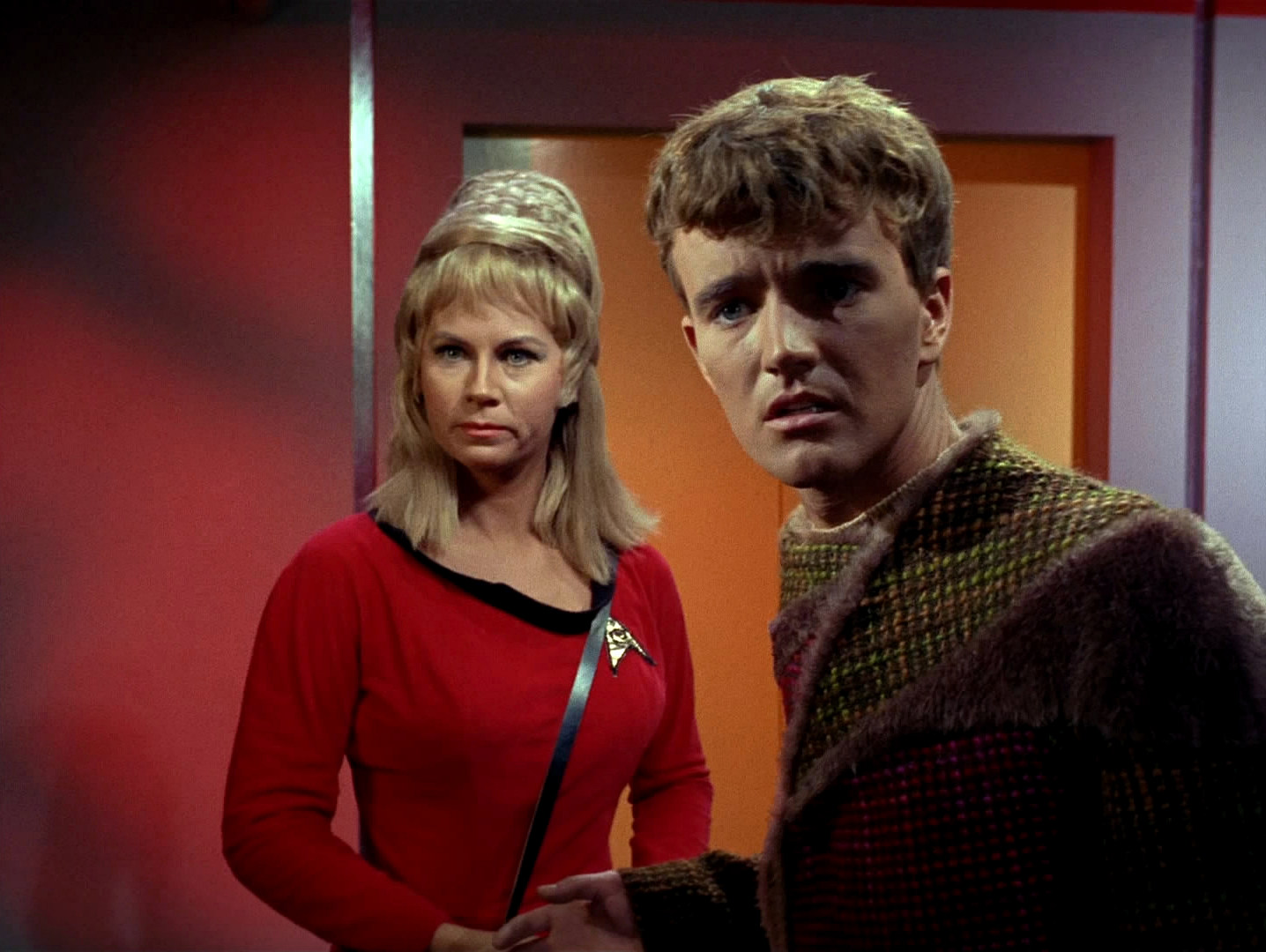
Stardate 1533.6: The Enterprise takes over Charlie Evans from the starship Antares. The 17-year-old boy has spent most of his life alone on the planet Thasus as it seems. The inexperienced Charlie develops an interest for Yeoman Rand. It soon becomes clear that he has supernatural powers and uses them against everyone who doesn't give him what he wants, transmuting crew members or making them disappear. When the Antares explodes, it turns out that Charlie has sabotaged the ship. He soon controls the Enterprise too, but Kirk has devised a plan to challenge Charlie, while Spock and McCoy are switching on all systems to weaken the boy. Eventually a Thasian ship appears. The Thasians, who have abandoned their physical bodies ages ago, restore the Enterprise crew to normal and take back Charlie to their planet, as he would not be able to control his powers when among humans.
Review
The idea of a boy, who has spent most of his childhood alone or, as it is discovered later, actually among non-corporeal aliens, is not a bad one. But for some reason kids and teenies in Star Trek are customarily annoying or at least unpopular, and "Charlie X" is the first in a long tradition including "Miri" later this season, "And the Children Shall Lead" and finally Wesley Crusher. Especially Charlie's interest in Janice Rand is never really credible. Irrespective of his true nature and origin, the poor boy should first learn who he himself is.
In this light it is noteworthy how well Kirk puts up with Charlie's adolescent misbehavior at any time. Even more than that, Kirk seems to have a genuine sympathy for the needs of the teenager and a lot of patience, and the boy respects him for that. In addition, this one time it is Kirk who shows more tolerance for and understanding of a strange guest than Spock or McCoy, because he correctly attributes some of Charlie's mysterious characteristics to his human nature and his youth and inexperience. Well, at any rate Charlie, who feels misunderstood and blames everyone but himself for his self-imposed misery, is not a normal teen boy though. I think he is a psycho with psychokinetic powers. And I could imagine that without all his powers he might grab a phaser one day and shoot down his teacher and classmates.
On a final note, the quite open depiction of gender roles of the 1960s make this episode look particularly anachronistic: the Antares as an all-male vessel on which women would have no place, Kirk's lessons on being a "gentleman" (rather than telling the boy a bit about human sexuality), men who are fighting in the gym while women are doing gymnastics.
Annotations
- Remarkable quote: "You go slow, be gentle. It's no one-way street. You know how you feel and that's all. It's how the girl feels too. Don't press. If the girl feels anything for you at all, you'll know." (Kirk)
- Remarkable performance: Spock plays on the Vulcan lute, and Uhura begins to sing "Oh, on the starship Enterprise, there's someone who's in Satan's guise", whereupon Spock has to smirk. I would have loved to see more leisure activities like that in TOS.
- Remarkable scene: I like how Charlie pulls off the card trick (that an Antares crew member allegedly showed him), as this nicely foreshadows his supernatural abilities. But considering that stopping Spock's lyre and Uhura's voice from making sounds just prior to that was the even better "trick", the order should have been reversed.
- Remarkable facts:
- The crew complement of the Enterprise is exactly 428, according to Kirk.
- The plan was to take Charlie Evans to Earth Colony Five.
- Remarkable ships:
- The Antares is said to be a "cargo vessel" in Kirk's first log entry but later a "science probe ship" and finally a "survey ship". The ship unfortunately never appears on screen in the episode, an omission that was eventually fixed in TOS-R. The Antares was destroyed because Charlie removed a "warped baffle plate on the shield of their energy pile" (whatever that's supposed to be) that would have blown up anyway according to him.
- We just see a green cloud instead of a Thasian ship, although Uhura explicitly states there is one. TOS-R shows a combination of the two: a blurry green ship.
Rating: 4
Balance of Terror
Synopsis
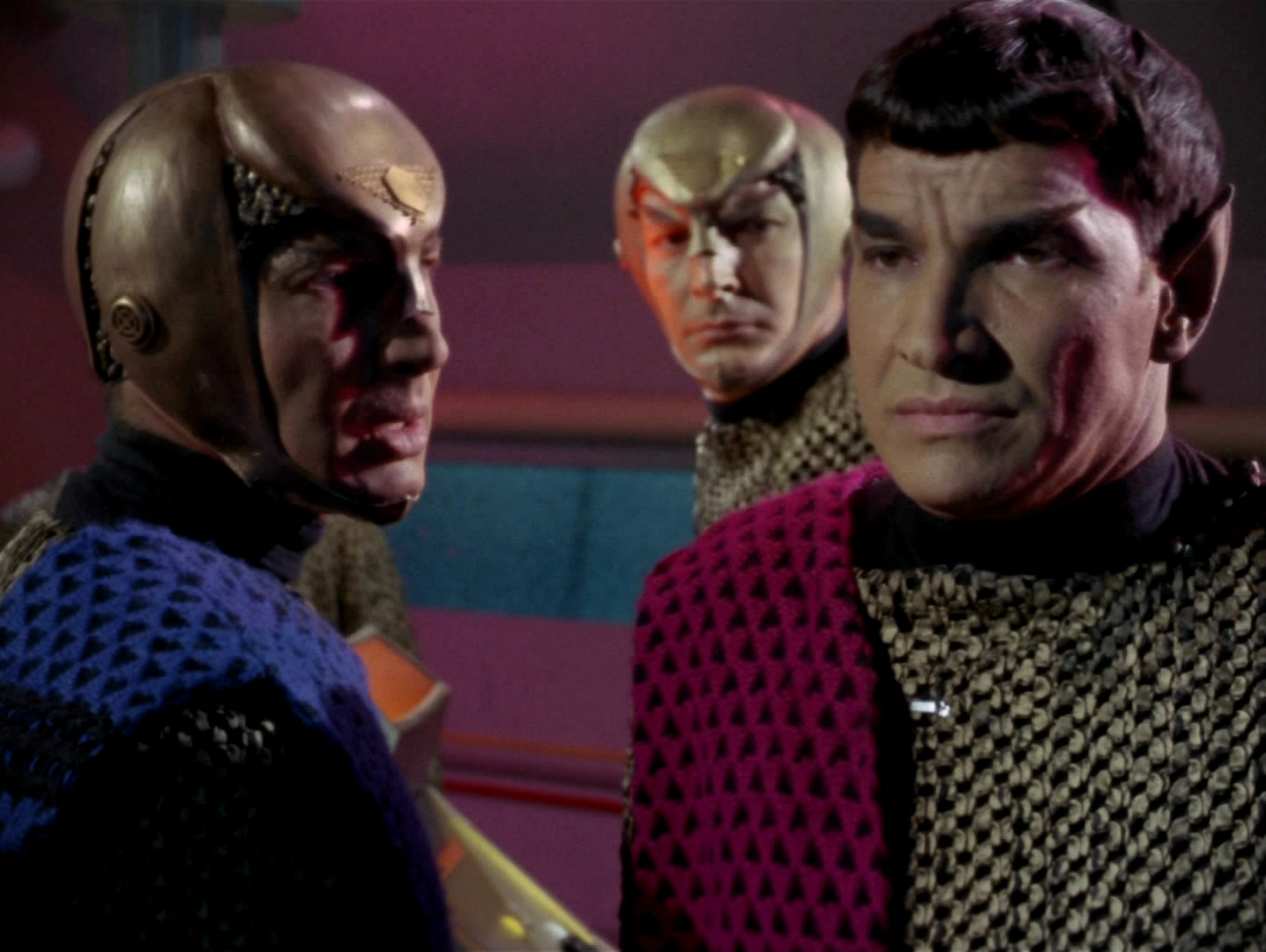
Stardate 1709.1: The wedding ceremony of Angela Martine and Robert Tomlinson is interrupted by a red alert because Earth Outpost 4 is under attack, after Outposts 2 and 3 have already vanished. These outposts were set up a century ago to monitor the Neutral Zone that was negotiated via subspace radio after a war with the Romulan Star Empire. Now the Romulans have sent a cloakable vessel with a powerful plasma weapon to get rid of the outposts. When Spock manages to retrieve a video signal from the attacking ship, Lt. Stiles, who lost a relative in the war and suspects that there could be Romulan spies on the Enterprise, is shocked to see that the Romulans look just like Vulcans. Spock surmises that the Romulans may be an ancient offshoot of Vulcan colonization. When Kirk finally manages to anticipate the moves of the cloaked enemy vessel, the Romulans desperately detonate a nuclear warhead directly ahead of the Enterprise. The Romulan ship is already on its way home, when Kirk orders the Enterprise to play "dead", luring the enemy into a trap. The Romulan commander refuses to be rescued from his crippled ship and initiates the self-destruct. The Enterprise has lost one crew member: Tomlinson.
Review
This episode, unlike most others, is a bit warlike as it focuses on a military conflict, rather than on political, cultural or philosophical matters. On the other hand, many TOS episodes with profound underlying ideas boil down to rather mindless fist or phaser fights that often emerge out of the blue, so it is only honest that "Balance of Terror" has a genuinely military setting. Kirk and the Enterprise are facing a worthy enemy for the first time, an enemy who is neither totally superior nor hopelessly outgunned but just strong enough to make the military aspect interesting. The setting reminds me a lot of an American destroyer chasing a German submarine, which may have been the author's intention or motivation. Anyway, this is the most thrilling episode of Star Trek so far. And it has a clear message that, in a war, eventually both sides will lose in some fashion. The episode begins with a wedding ceremony, and it ends with Kirk comforting the bride and widow. There is no reason to celebrate a victory.
The tense situation aboard the Enterprise comes across as quite convincing. Only Lt. Stiles is a bit annoying, and he takes the Romulan War that he can possibly only know from history books and family tales way too personally. Even more so than the somewhat xenophobic Bailey in "The Corbomite Maneuver", he is an uninteresting character, one who is just good for a few inappropriate and ill-considered phrases that make the rest of the crew appear even more level-headed. High praise goes to the depiction of the Romulan enemies. It is remarkable that some scenes are shown from a Romulan perspective and that their commander is not driven by revenge, by greed, by political ambition or by some other lower motive but just by his sense of duty. Unfortunately such a fair depiction of Starfleet's enemies will remain an exception in Star Trek.
"Balance of Terror" is also a pivotal episode, because it establishes an important part of the history of Earth and the Federation that later installments will build upon. It only seems rather far-fetched that humans still don't have an idea how Romulans look like after one hundred years. It would have been better if the appearance of the Romulans had been known to the crew in advance and if Stiles had been given more conclusive reasons to question Spock's loyalty than only his look.
Annotations
- Remarkable quote: "Another war...must it always be so? How many comrades have we lost in this way?... Obedience. Duty. Death, and more death..." (Romulan commander, played by Mark Lenard)
- Remarkable ship: the Romulan Bird-of-Prey with its crammed bridge
- Crew losses: 1
Rating: 8
What are Little Girls Made of?
Synopsis
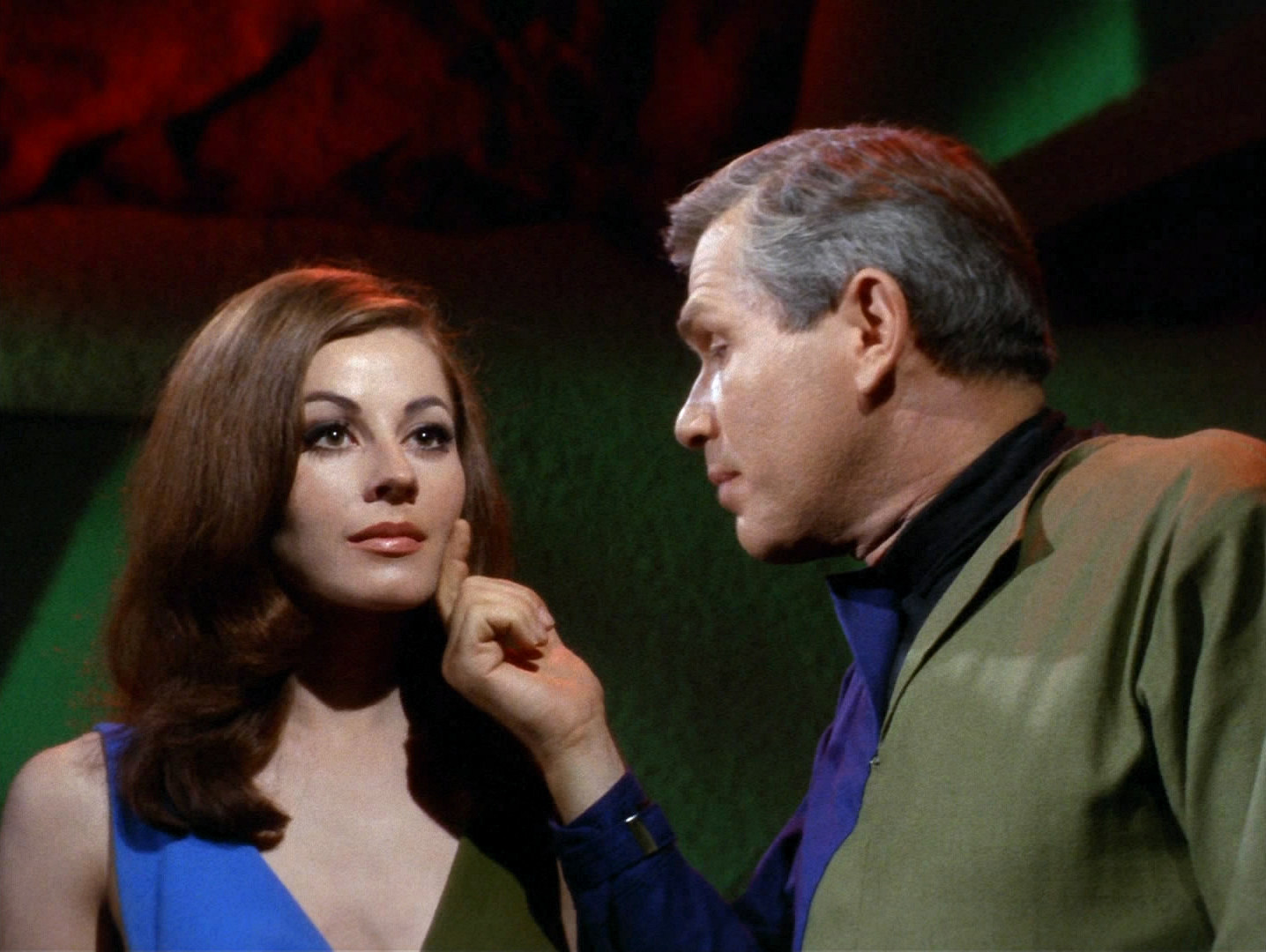
Stardate 2712.4: The Enterprise receives a message from the famous archeologist Dr. Korby, who happens to be Nurse Chapel's fiancé and who was believed to have died on Exo III. After they have beamed down, two security officers are killed by a tall android called Ruk, while Korby and his assistants Brown and Andrea capture Kirk and Chapel. Korby uses abandoned alien technology to create androids to populate the galaxy with the goal to create a better society, beginning with Kirk whom he tries to replace with an android. Eventually the man who calls himself Korby turns out to be an android himself. But the Korby android has to recognize that his mission has failed, and that he is not superior to human beings. He kills himself and his assistant Andrea.
Review
I have to admit that I didn't recognize the complexity of this episode until I watched it again after many years. "What Are Little Girls Made of?" includes more ramifications of the existence of "perfect" androids than I was previously willing to give it credit for. It includes literary motives from "Frankenstein" to "Forbidden Planet" and multiple ironical twists when Dr. Korby himself turns out to be an android, when he has to recognize that his perfect world of androids is a failure and when ultimately the concept of love kills him. But the episode tries to accomplish just too much.
The plot is nicely developed and quite thrilling (with some good camera work) up to the point when Korby duplicates Kirk about half-way through the episode. After that I would have hoped to see more determination from everyone, but the only one who acts and who repeatedly attempts to escape or verbally confronts his opponent is Kirk. Kirk gives Spock a cue, he even tries to seduce Andrea, while Korby is just bantering and Christine remains lethargic. The discussion about androids takes too many different directions, or revolves around trivial details. Korby's goal is to build a better world, Ruk is determined to extinguish anyone inferior, that's about all we learn about their motivations.
The episode introduces many clichés that should reappear frequently, such as ancient technology that is still functional, rebelling androids or crew members that are replaced by doppelgangers. To the episode's credit, all these motives are still fresh and new here. But everything is being explained and demonstrated too ostentatiously, such as how androids can perfectly imitate voices or have no emotions.
I'm not sure whether the strong involvement of Christine Chapel benefited the episode. So Chapel joined Starfleet just to find Korby. This sounds to me like a rather contrived idea to get Majel Barrett's character introduced. But her role also gives the story a human touch, rather than the usual old acquaintances of Kirk that appear in various episodes. Only that Chapel's interaction with Korby is never really intense. Even though it is probably meant to appear awkward because Korby is actually an android, it just doesn't work out. Rather than that, it is nice to see how Kirk and everyone else of the crew care about Chapel. Likewise, Korby's relationship with Andrea remains on the surface. Her role in the story does not really extend beyond giving Kirk a chance to test his art of seduction anyway.
Annotations
- Remarkable dialogue: "Can you imagine how life could be improved if we could do away with jealousy, greed, hate." - "It can also be improved by eliminating love, tenderness, sentiment - the other side of the coin." (Korby and Kirk)
- Remarkable android: the beautiful Andrea (Sherry Jackson)
- Remarkable absence: McCoy is missing in this episode.
- Remarkable fact: Spock calls Dr. Korby the "Pasteur of archeological medicine".
- Remarkable prop: Dr. Korby kills himself and Andrea with an old laser pistol as in "The Cage".
- Remarkable machine: I like the idea and design of the "android making machine".
- Crew losses: 2
Rating: 4
Dagger of the Mind
Synopsis
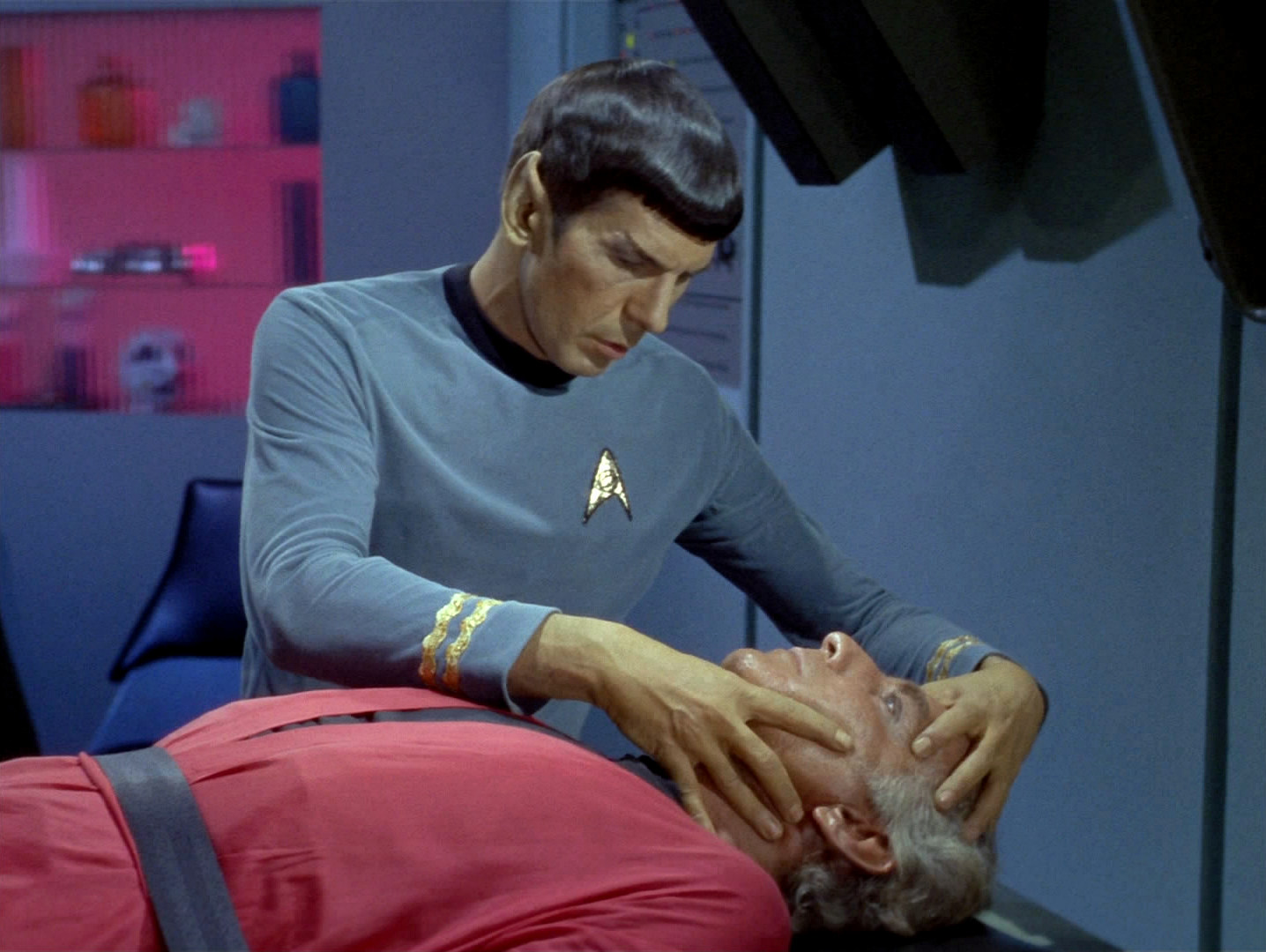
Stardate 2715.1: The Enterprise beams up a box from the mental institution on Tantalus V, in which the lunatic Dr. Van Gelder has been hiding to escape. He requests asylum on the ship. McCoy surmises that something is wrong in the institution, but Kirk trusts in Adams's flawless reputation. Nonetheless he beams down with psychiatrist Dr. Helen Noel to investigate the case. In sickbay Van Gelder talks of a "neural neutralizer" used by Dr. Adams on him and other patients, and he warns that the landing party would be in danger. Spock learns more from him through a Vulcan mind-meld. In the Tantalus colony Kirk and Noel are secretly trying out the neural neutralizer, when Adams appears and uses it on Kirk at full power. Noel manages to escape, and she disables the power supply, thereby taking down the colony's forcefield and allowing Spock to beam down. Kirk grasps the opportunity and overwhelms Adams. When the power is switched on again, Adams is still lying in the neural neutralizer, and he dies as his mind is being erased.
Review
This episode will certainly be remembered for the first Vulcan mind-meld. But aside from this one impressive scene there isn't much special about it. The promising idea of a mental institution with a stainless record but a dark secret is wasted because it is just too obvious what is going on down there. Considering that we can be sure that Dr. Adams is a charlatan almost right from the start, it would have been at least a bit more interesting if only Adams had tried to justify his actions, but there is nothing like that, also because no one really challenges him at any time. He just pretends to heal his patients, while in reality he, well, "neutralizes" them. At latest when he comes and torments Kirk he behaves like a cookie-cutter villain whose goal and motivation does not matter. He just carries on, whatever he could still accomplish in his mad rage. And before he can even face the consequences of his wrongdoings and try to defend himself, poetic justice comes to pass and he is killed by his own machine. Van Gelder is another disappointing character. He is just nuts throughout the episode, and his permanent screaming comes across as very stagy.
The even bigger failing of the episode, however, is that Kirk's previous encounter with Helen Noel is made such a big deal, as if he normally never talks to the members of the medical staff and never ever gets involved with women. What's more, with probably just a few doctors in McCoy's staff, why would it be such a surprise for Kirk to meet her again? Anyway, as soon as we see Noel on the transporter platform, accompanied by the "romantic" score, we know the direction this all would take. The whole issue of Helen Noel being a woman who may have had a crush on Kirk or vice versa or whatever does not work out at all. Essentially it only serves as the incentive for Adams to suggest to Kirk that he is madly in love with her. And even this doesn't incapacitate the captain for very long. The writer may have recognized that the idea of a lovesick Kirk was just too corny, and quickly returned him to normal. It fits the cliché, because as already seen in "The Naked Time", Kirk may be immune to thought manipulation and he loves the Enterprise more than anything or anyone else.
Although we get the idea what would happen very early, the plot isn't all that bad. But it is full of missed opportunities. For instance, there could have been more of a conflict over Dr. Adams's methods. At first Captain Kirk holds Dr. Adams in high regard and he does not trust in McCoy's suspicions that there has to be something wrong in the Tantalus colony. Kirk quite obviously doesn't want McCoy to beam down with him because the doctor would likely not restrain himself and end up offending Adams. He explicitly asks for some other person instead. McCoy is accordingly pissed. I think that this character conflict ought to have been further worked out. But as soon as Kirk is on the planet and sees the neural neutralizer, he too becomes skeptical. He talks openly to Spock and McCoy only after Adams has left the room and insists on staying longer on the planet than originally intended. His role of being unsuspecting has been transferred to Dr. Noel, who finds a reason or an excuse for everything that Adams is doing down there. She appears as rather naive, or as an expert who does not concede that good theories may not work out in practice. Considering that Kirk's sudden change of mind is not as dramatic as it could have been anyway, Noel should have been the suspicious crew member. But a Kirk who stands corrected was apparently something not to be shown in TOS.
The episode is also full of gratuitous or simply dumb names. Kirk meets Helen Noel on a Christmas party, "Noel" being French for Christmas. This is so daft that it hurts. The name Lethe for Adams's assistant, after the river of forgetfulness in Greek mythology, on the other hand, makes sense. She may have purposefully chosen it after leaving her old life behind (and perhaps she was a pleasant person prior to the treatment and forgot that too). "Tantalus", however, is a quite inappropriate name for a benevolent institution, because Tantalus was penalized with eternal pain ("tantalized") for his deeds, and it foreshadows what Adams is really doing down there. Finally, who in the world would associate something positive with a device that even Adams himself calls a "neural neutralizer"?
Annotations
- Inconsistencies:
- When the transporter operator tries to beam down the supplies to the Tantalus colony in vain before the forcefield has been lowered, he appears as very incompetent. But at least it nicely establishes the high security in this institution.
- Immediately after the captain has left and without checking whether he is really gone, the operator of the neural neutralizer increases the power of the device and does something the captain was not meant to know of at any rate.
- The neural neutralizer is completely devoid of safety precautions. The power can be increased to maximum for any time desired, and there is nothing such as a safe power-on state.
- On the bridge at the very end of the episode, just after McCoy's remark that Adams died of loneliness, I wonder what could be so funny that Kirk and even Spock begin to smile.
- Remarkable dialogue: "Interesting. You Earth people glorify organized violence for forty centuries, but you imprison those who employ it privately." - "And, of course, your people found an answer." - "We disposed of emotion, Doctor. Where there is no emotion there is no motive for violence." (Spock and McCoy)
- Remarkable fact: We see the first Vulcan mind-meld.
Rating: 2
Miri
Synopsis
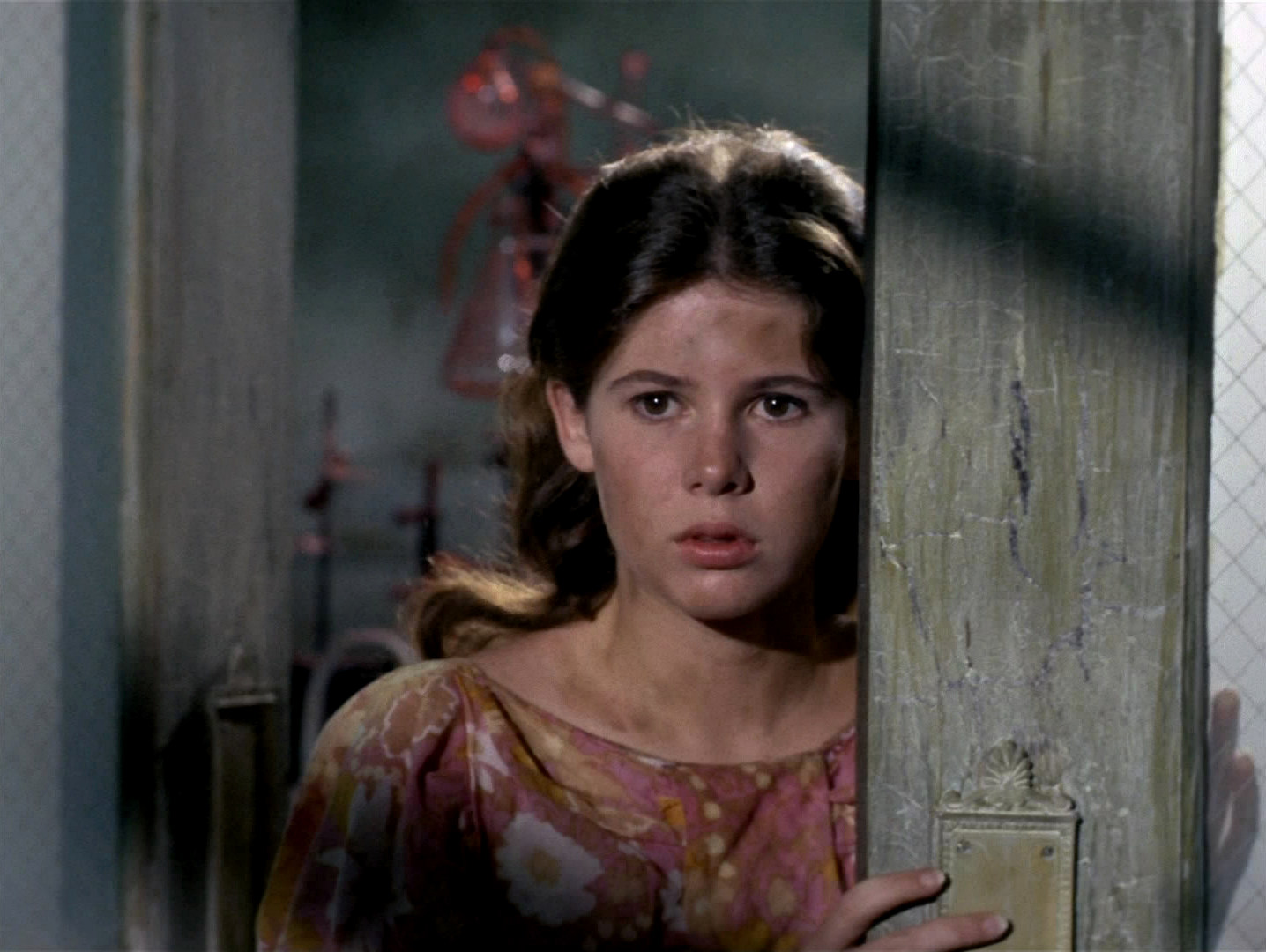
Stardate 2713.5: The Enterprise receives a distress call and arrives at a planet that is an exact duplicate of Earth! A landing party beams down and finds a town that has apparently been abandoned long ago. But then they are attacked by a disfigured humanoid boy that soon dies of an unknown disease. The only other inhabitants of the planet seem to be children, of whom only a teenage girl named Miri trusts the strangers. It soon becomes evident that the landing party is suffering from the same disease that killed the boy. Actually, on the planet a life prolongation program created a virus that killed the complete adult population 300 years ago and left only the children, whose aging was extremely slowed down. But every child entering puberty contracts the disease likewise. With only few days left, McCoy and Spock work on a cure, but they can't test the vaccine because they would need the ship's computer to determine the right dose, and the children have taken away their communicators and kidnapped Yeoman Rand. Miri agrees to lead Captain Kirk to the other children, and he can finally convince them to release Rand and hand out the devices. In the meantime, however, McCoy has injected himself a dose of the vaccine, which successfully removes his blemishes.
Review
I used to list this one among the "Worst of TOS" episodes but recently changed my mind a bit. I now don't want to dismiss this episode entirely just because I find some aspects exasperating. Watching "Miri" with the squeaking horde of children, their dreadful rhymes and rituals and their absurdly twisted logic certainly requires an unusual amount of patience. And while I admit the depiction of the savage children who have been left to themselves for centuries may be even quite realistic, it makes the episode almost as hard to endure as it would be to have these little monsters around in real life. But once I managed to look past the annoying children at the heart of the story, I discovered some redeeming qualities.
Miri, portrayed by Kim Darby who really does an awesome job here, is definitely a remarkable and memorable character, and not just because she is the only significant teenage girl role of the series. She is very likable to start with, in strong contrast to all the other children. Her crush on Kirk comes across as credible, as does her jealousy when she discovers that Janice Rand is interested in him too, which she may be even rather aware of than Kirk himself. Miri's faltering as she is caught between child's play and responsibility makes sense too. In many ways she is a teenage girl in her puberty with all the same experiences as everyone of her age in a normal world, only under much more dramatic circumstances. It is worth mentioning that at the time the episode was produced Kim Darby was already 19, which I am almost ashamed I never noticed before but which may explain why her chemistry with Shatner worked out better than it would have with a girl who was just around 13 years.
McCoy's and Spock's race against time to develop a vaccine for themselves and everyone else is another thing that I like. Although it has been done in "The Naked Time" before, the idea is still relatively fresh here, and appears more credible than in most of the following stories of this type. McCoy's self-experimentation that Spock comments with "Who will understand the medical mind?" is certainly a highlight, although I concede it is a bit stagy.
But aside from the children I have one other big problem with "Miri". The Enterprise runs into a planet that is an exact duplicate of Earth, which is arguably the most amazing discovery in the history of space exploration! It is a huge bummer that after the big surprise in the teaser the plot boils down to something small and almost trivial as fighting a nasty virus and an equally nasty gang of children. We don't learn whether the planet is natural or artificial, much less is the secret of the ancient civilization that possibly built it uncovered. Even after the problem with the virus has been solved, no one bothers to investigate the planet, how it was created, by whom and why. A bigger opportunity has never been squandered. If not in this episode, the mystery of the duplicate Earth ought to have been further explored in a follow-up.
Annotations
- Remarkable language: The children refer to themselves as the "Onlies", while grown-ups are contracted to "Grups". The time before the plague is aptly called the "Before Time".
- Inconsistencies:
- Dr. McCoy refers to the mutated teenager that has just died as "it". This is quite inappropriate as he is aware that "it" was a human boy, who just happened to have a terrible disease.
- Kirk explicitly mentions the food supplies that are running low on the planet. But it is implausible in the first place how the children could survive as long as 300 years on canned food or something like that. Also, if he can't even find the hiding places of the children themselves, how is it possible to assess their food supplies?
- When the children have taken away the communicators, it takes a few days until Kirk finally decides to retrieve them. Couldn't the Enterprise have done anything in the meantime? Such as beaming down communicators, or perhaps a landing party with protective garment?
- Well, it shouldn't remain unmentioned, but it is simply artistic license that after the vaccine takes effect the blemishes in McCoy's face are going away in a matter of seconds.
- Remarkable quotes:
- "Captain's Log, stardate 2713.5. In the distant reaches of our galaxy, we have made an astonishing discovery. Earth type radio signals coming from a planet which apparently is an exact duplicate of the Earth. It seems impossible, but there it is." (Kirk)
- "No blah, blah, blah!" (Kirk, to the horde of children)
- Remarkable dialogue: "Miri. She really loved you, you know." - "Yes. I never get involved with older women, Yeoman." (Kirk and Rand)
Rating: 2
The Conscience of the King
Synopsis
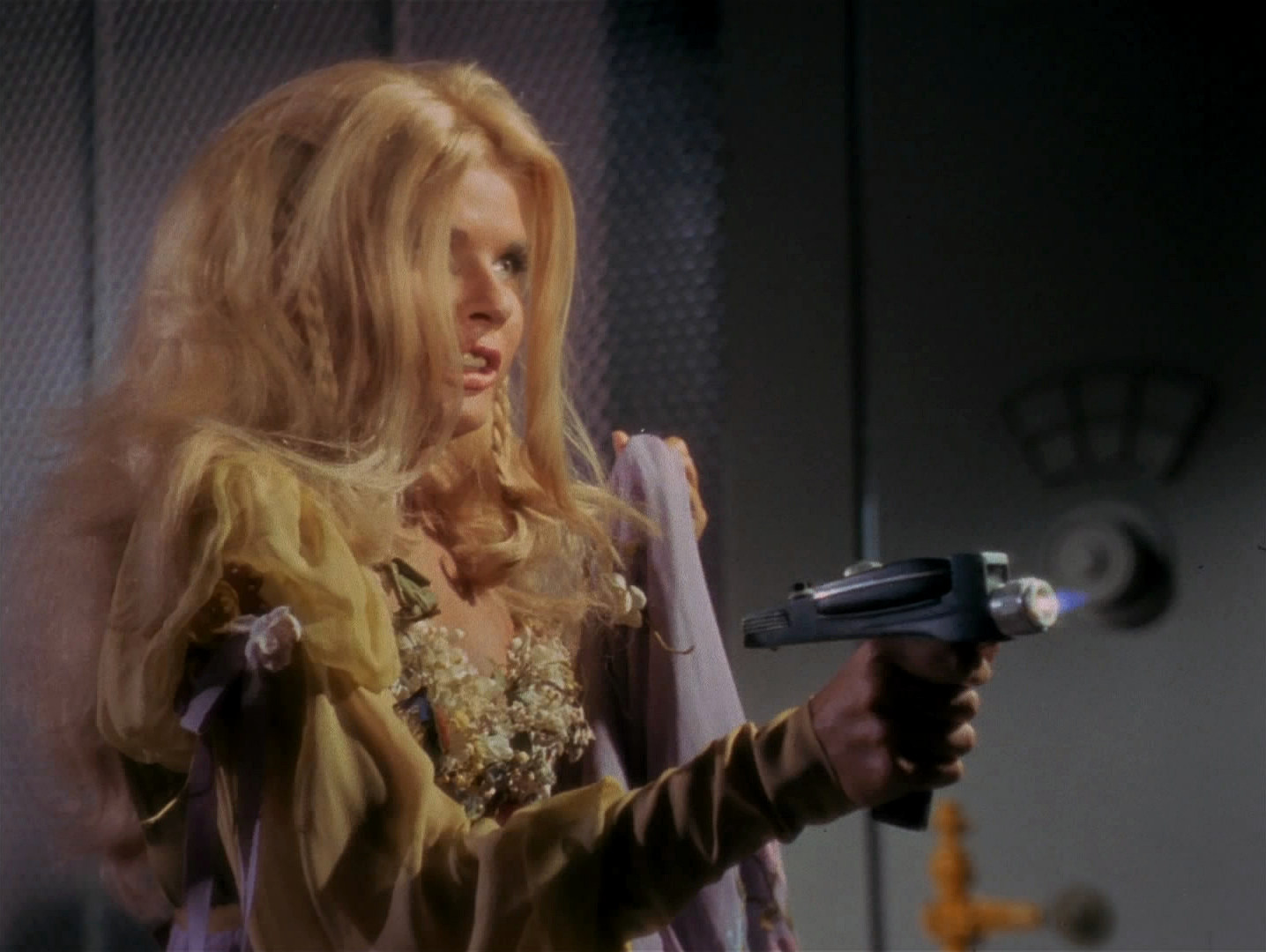
Stardate 2817.6: The Enterprise arrives at Planet Q, where Dr. Leighton has allegedly developed a synthetic food that could help the starving colonists on Cygnia Minor. But actually the scientist wants Kirk to have a look at the actor Karidian, who Leighton believes is actually Kodos the Executioner. 20 years ago Kodos was the governor of the planet Taurus IV. When the food supplies were lost, he ordered the execution of half the population. Kirk, however, seeks further proof. He makes the acquaintance of Karidian's lovely daughter Eleonore. When they take a walk on the planet surface, they find Leighton's dead body. Kirk consults the ship's database and he finds that, after Leighton's death, he and Lt. Riley are the only eyewitnesses left to identify Kodos. He invites Karidian's theater company to the Enterprise to confirm his suspicion. When an attempt is made to kill Riley, he confronts Karidian with the charges. But while there is no doubt about his guilt any longer, it turns out that actually Leonore killed all the eyewitnesses to protect her father.
Review
Just for a change, this episode does not need any science fiction plot device to tell the story. I like the light-hearted tone that dominates the first acts and Kirk's flirting with Leonore Karidian, the first credible love story of Star Trek. In particular the scenes at the party and on the observation deck have a coziness that is otherwise absent from TOS. I also like how the Hamlet and Macbeth stage plays and other Shakespeare references are embedded in the episode and how they reflect the story of Kodos/Karidian.
But speaking of stage plays, the script, the direction as well as some of the actors' performances are all quite stagy. It almost seems as if the Shakespeare dramas rub off on the "real" life in the 23rd century. Leighton shows up only two times before he is killed, but his intonation and his whole conduct appear unnatural to me. And his eyepatch that is revealed to actually cover half of his face in an overly climactic fashion adds to this impression. I can still understand that Karidian and his daughter are acting in real life much as they do on stage, but they appear to have infected other characters and most obviously Kirk too.
Kirk is out of his mind much of the time, and this is the principal weakness of the episode. When I watch his actions I'm inclined to question his sanity. He seems to leave out no opportunity to make almost disastrous mistakes. He pays no real attention to the data that the computer provides on Kodos. He skips the further information on Kodos dated stardate 2794.7, which would have been just a few weeks ago. Why doesn't he listen to it? He looks at the photographs of Kodos and Karidian on the screen, trying to spot similarities. Why doesn't he ask Spock to have a look when he enters the room? He alienates Spock when he turns the Enterprise into a passenger transport. Again, why doesn't Kirk let in at least his first officer on his suspicion? Not even when he transfers Riley to engineering, seemingly against all reason. Spock would be the last one to spill the beans. Why doesn't Kirk do anything else to protect Riley except for the transfer? Why doesn't he warn him? Why doesn't he let him in anyway? Riley barely survives the conveniently half-hearted attempt to kill him with poison in his milk. And how much more proof does Kirk still need after talking to Karidian in person and after comparing the voice patterns that this man really is Kodos? Finally, what about the murder of Leighton? Kirk does not seem to care for the investigation. It almost seems as if there is no investigation at all. At least it is never mentioned again.
Aside from the overall stagy nature of the setting and occasionally of the acting too, there is good interaction between Kirk and Eleonore. But there is almost none between her and her father until the final minutes, although it ought to have been set up in some fashion. Likewise, Kirk confronts Karidian with his past in only one scene. The whole back story and its impact on the characters would have deserved to be better introduced or perhaps visualized - for instance in the form of flashbacks. And when it comes to explaining how and why Eleonore killed all these people, it looks like a switch is simply flipped, turning her insane and sparing the writer from further justifying anything. In hindsight it was very counterproductive of her not only to kill the eyewitnesses in the first place (stupid enough) but even in the presence of the theater company. Moreover, if Karidian really wanted to protect his daughter as he affirms, why did he tell her about his true identity in the first place?
One somewhat surprising recurrent theme of the episode is criticism of technology. It comes from Eleonore in almost every of her scenes, from her father and ultimately even from Kirk when he doubts the result of the speech comparison done by the computer.
Annotations
- Coincidences: This episode is rife with improbable coincidences. Firstly, how slim is the chance for 2 of a group of only 8 people among billions of human beings to be on a ship with a crew of 400? It would have been a lot more credible, had Kirk approved of Riley's transfer to the Enterprise because of a feeling that he owes a fellow survivor a favor. But Kirk evidently doesn't know anything about Riley's history. Even if Riley came to the Enterprise by pure chance, wouldn't Kirk read his personnel file? Even if he had had only a glance of the file, he would never have forgotten that Riley was another survivor. On the other hand, the personnel files may not contain details from the childhood, even if they are dramatic. And as we will learn in "Journey to Babel", Kirk doesn't even know his first officer's personnel file. Secondly, Kirk and Leonore almost stumble across Leighton's dead body. This also raises the question if Leonore couldn't find a better way to murder him than ambushing him close to his apartment, where it could have easily been observed. Thirdly, Kirk seems to know everyone who is out in space. The fact that Kirk has met Leighton before can be explained with their common past on Tarsus IV. But Kirk also knows the captain of the Astral Queen, which must be one of a myriad of civilian vessels.
- Inconsistencies:
- Dr. Thomas Leighton seems to have a sick kind of humor when he lures the Enterprise to Planet Q, pretending that he has developed a new synthetic food that could end the famine on Cygnia Minor. Not only does he insult the famine victims on Cygnia Minor, it also sounds like an awkward tongue-in-cheek reference to the events on Tarsus IV, when Kodos killed the starving colonists. It is odd anyway that famines appear to be a rather common problem in remote colonies. On the other hand, Leighton may have become an expert in famine relief just because of the experiences in his youth, which would at least explain why he of all people could have a possible solution.
- Why is it an "Arcturian Macbeth", as Kirk remarks? Karidian and his company are human. Perhaps it was an Arcturian who adapted the play for the "Galactic Cultural Exchange" that is mentioned later in the episode. It should have been further explained though.
- Why was the case closed when the body of Kodos was not positively identified?
- The missing possibility to compare the faces of Kodos and Karidian is one of the examples where real-world technology has surpassed Trek technology quite obviously. At least the Enterprise computer can do a voice analysis.
- What is a "double red alert"? Kirk issues this alert when he hears the humming of a phaser on overload. But double red alert will never appear again, not even in cases of extreme emergency.
- Why are eyewitnesses, who have briefly seen the man twenty years ago, so crucial to prove that Karidian is Kodos? Wouldn't a thorough investigation of Karidian's past be much more fruitful? Spock's logic that everything that has happened can't be a coincidence may not be court-type evidence, but may suffice to put Karidian on trial.
- Remarkable editing error: Leighton tells Kirk already during the stage play in the teaser that he has identified Kodos the Executioner. However, immediately after the opening credits Kirk still optimistically notes in his log entry that he has come to the planet because Leighton has developed a new food that could end a famine. Only to be upset about Leighton's false pretenses in the very next scene. The scenes were probably re-ordered, as director Gerd Oswald decided to start the episode with Macbeth's dagger, which he deemed more dramatic.
- Remarkable scene: Kirk and Spock are searching for the overloading phaser in Kirk's quarters. Kirk orders Spock to leave and evacuate the deck. Then Kirk spots the phaser behind the red glass of the red alert light. An exceptionally thrilling scene in an episode with otherwise rather clumsy directing.
- Remarkable music:
- At the party the TOS theme is being played as lounge music.
- Uhura sings "Beyond Antares" in the rec room.
- Remarkable set: I love the observation deck, located between the outer hull and the hangar deck (here the "flight deck"). It is the redressed interior of the Romulan Bird-of-Prey.
- Remarkable facts: Kodos was the governor of the planet Tarsus IV twenty years ago. When an alien fungus destroyed the food supplies, he ordered the execution of half the population, 4000 people altogether, in order to save the other, "stronger", half. A burnt body was found but never positively identified as Kodos.
Rating: 3
The Galileo Seven
Synopsis
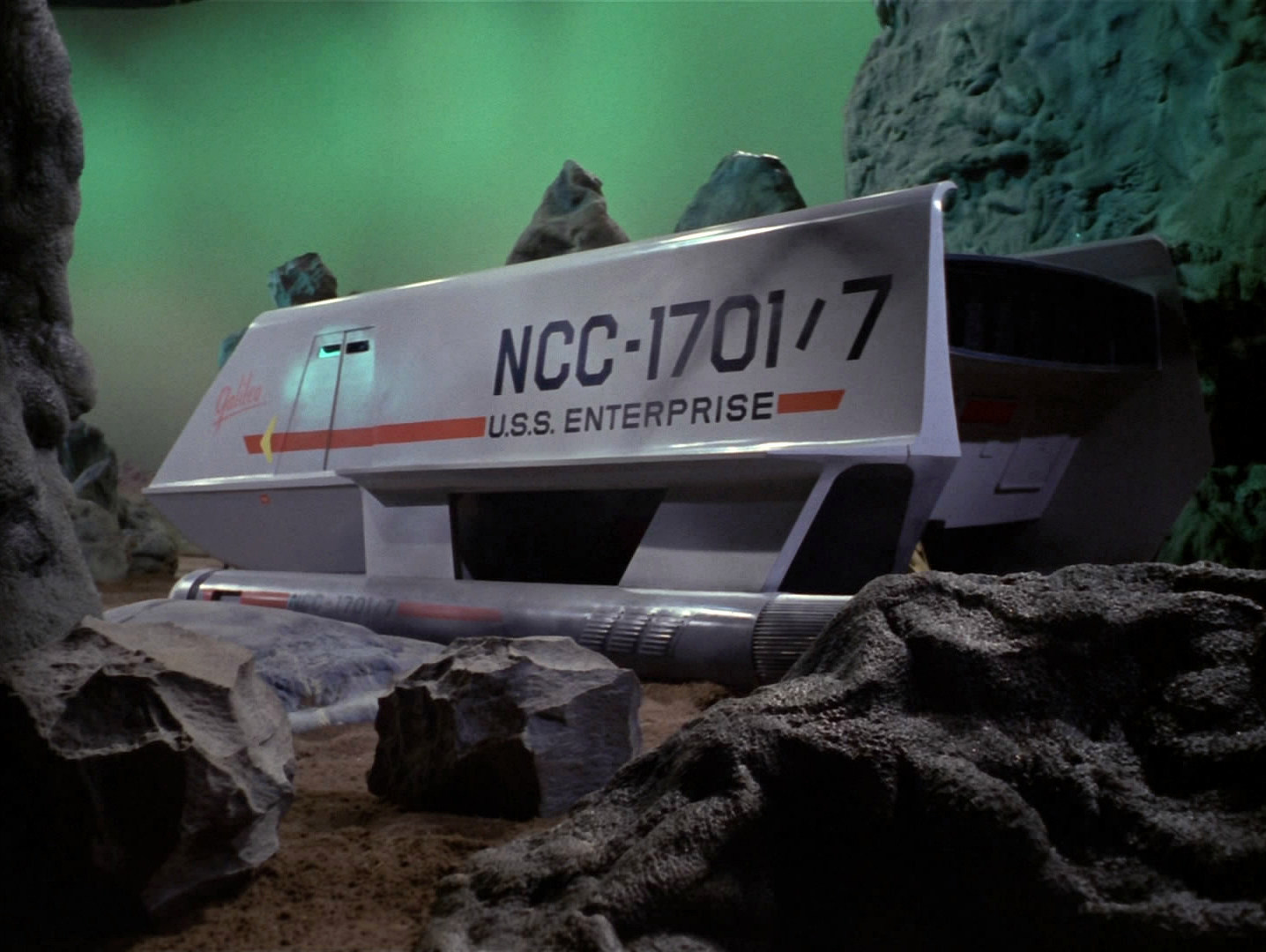
Stardate 2821.5: The Enterprise is carrying medical supplies for Makus III when Kirk, against the wishes of High Commissioner Ferris, decides to launch a shuttle to investigate the quasar-like formation of Murasaki 312. The shuttle Galileo with Spock, McCoy, Scott, Yeoman Mears, Boma, Gaetano and Latimer, however, is pulled off course and crashes on a barely inhabitable planet. Moreover, Latimer and some time later Gaetano are killed by indigenous creatures. As the fuel supply is exhausted, Scott has devised a method to use the phasers to power the shuttle. In the meantime, Kirk has to break off the search for the Galileo on Ferris's orders and sets a course to Makus III, albeit at very slow speed. The shuttle lifts off, but the Enterprise's sensors are unable to locate it. In a "logical action of desperation", as he explains it, Spock ignites what little fuel is left as a beacon for the Enterprise crew to see on the screen. The five crew members are rescued just as the shuttle begins to break apart in the planet's atmosphere.
Review
"The Galileo Seven" tells a straightforward story that is credibly presented for the most part. I like the many nifty technical details that are included almost casually and without resorting to technobabble, such as Scott's idea to use the phasers as an emergency power supply, his electrifying of the shuttle hull to repel the attackers or Spock's "desperate" idea to ignite the fuel to signal the Enterprise. The shuttle appears for the first time in Star Trek, and it will never again be featured so extensively in the series. The Galileo is much like an eighth crew member on the planet surface. Considering how frequently the later Star Trek series build stories around crashed shuttles and the marooned crew, this first and only episode of its kind in TOS is definitely something special.
I like the development of the story and the conflict that arises between Spock and the rest of the crew, especially Boma, who openly expresses his disapproval of Spock's decisions. And while Boma could have restrained himself a little more, Spock frequently gives him new reasons for grievances. Spock implicitly proposes to leave three of the crew behind to save weight, rather than some equipment as it seems. When Latimer is lying dead in front of him, he cares about the spear that killed him instead about the man. He refuses to take part in a service for Latimer. He is opposed to attacking the natives to get rid of them, because he mistakenly thinks they are open to reason. But then Spock sets out to find Gaetano, although it is unlikely that the man is still alive, only to return with his dead body. Vice versa, his crewmates rescue Spock, whose legs are buried under a piece of rock, although the shuttle needs to lift off immediately.
However, I also have two gripes regarding Spock's statements and actions. Firstly, I wonder why McCoy and eventually Spock himself make such a big deal of this being Spock's first command. I mean, the man has been in Starfleet for more than a decade, so no one can tell me he never commanded a shuttle on a short-term mission of exploration before. Secondly, while Spock's rationality (or cold-bloodedness) about his people's situation is definitely in character, his permanent citing of logical courses of action is overdone. Well, as it turns out he becomes increasingly uncertain when he recognizes that his logic doesn't get him anywhere, and he not only has to justify it to the crew but also to himself. Still, also in regards to my first complaint, he creates the impression that there is nothing besides logic, no experience, no training, no advice from subordinated officers. It almost seems Spock can't make decisions by himself, without Kirk's orders and guidance.
Annotations
- Remarkable dialogues:
- "Now gentlemen, I suggest we move outside to make a further examination of the hull in the event we've overlooked any minor damage." - "If any minor damage was overlooked, it was when they put his head together." - "Not his head, Mister Boma, his heart. His heart." (Spock, Boma, McCoy)
- "Mister Spock, you said a while ago that there were always alternatives." - "Did l? I may have been mistaken." - "Well, at least I lived long enough to hear that." (Scotty, Spock, McCoy)
- Remarkable quotes:
- "There are always alternatives." (Spock)
- "Logic informed me that under the circumstances, the only possible action would have to be one of desperation." (Spock)
- Remarkable shuttle: The shuttle Galileo, funded by the company AMT that in turn received the license to sell a scale model of it, makes its first appearance. It is one great little ship, very detailed on the inside as well as on the outside.
- Remarkable fact: Kirk orders Sulu to set a course for Makus III at "space normal speed", which is obviously what would be called impulse speed on later occasions.
- Remarkable translation: The German episode title is "Notlandung auf Galileo 7" ("Emergency Landing on Galileo 7"), as if the title referred to the planet.
- Remastering: This episode profits like few others from the remastering. The quasar-like formation Murasaki 312 was reworked, actually in a way to resemble what is known as a microquasar today. Also, the planet is now correctly shrouded by the greenish nebula, instead of being green itself. The shuttle launches and flights are much more realistic than in the original episode, and the Columbus has got individual markings.
- Crew losses: 3
Rating: 6
Court Martial
Synopsis
Stardate 2947.3: The Enterprise arrives at Starbase 11 for repairs after an ion storm. During the storm Kirk had to jettison the ion pod, which was occupied by Lt. Cmdr. Ben Finney, but not before issuing a red alert. Finney, however, apparently didn't make it out in time. On the starbase Commodore Stone reviews evidence of the incident, and he urges Kirk to give up his command. When Kirk refuses, Stone sets up a court martial for negligent homicide. Kirk meets his old flame Areel Shaw, only to learn that she is the prosecutor. He finds help in the person of the old-fashioned attorney Samuel Cogley. All of Cogley's efforts seem to be in vain when visual evidence of Kirk pressing the "Jettison Ion Pod" button already at yellow alert is presented. Spock, however, discovers programming errors in the Enterprise's computer, a hint that it has been tampered with. Finney may be still alive. The court moves to the Enterprise in order to find Finney on the ship. He has faked his death and has been hiding in engineering, in the hope that he could ruin Kirk's career, for Kirk was promoted ahead of him.
Review
I have a soft sport for "Court Martial" in spite of its flaws (which may have to do with the many rewrites during its production). I like the idea of the criminal case and also the special mood that is prevalent through much of the episode. Usually Kirk is the one who challenges his opponents, this time it is the other way round. This time knee-jerk action doesn't help him but only patience and trust in the competence of his friends and his attorney. He has to fight for his reputation. Everyone else is unusually hostile towards him, and all of his accomplishments suddenly don't seem to matter any longer. On the downside, the way suddenly everyone in Starfleet seems to turn his back on Kirk is overdone. I would at least have omitted the scene in the bar, where almost Kirk's complete Academy class seems to have gathered, as he remarks himself, and they exchange malicious glances. That was incredibly contrived.
But overall Kirk's trial is absolutely convincing. His friends Spock and McCoy try to support him in their testimonies, although Areel Shaw's questions would leave them no other choice but to confirm her charges. Areel Shaw herself is not very comfortable in her role either, but she makes the best of it, even up to the point of alleging that Kirk had a strong motive (claiming that he returned Finney's hatred for him). I also enjoyed Samuel Cogley as a hopelessly anachronistic attorney, who prefers books over computers and who rather lends credence to people's statements than to computer data. Yet, Cogley would have lost the case. Only because of Spock's investigation of the computer he can turn the tables. It is the sound synergy of humanity and technology that saves Kirk.
Following a quite interesting first half the episode gradually loses its coherence after the visual evidence of Kirk prematurely pressing the button is presented. The story rushes to its conclusion and doesn't leave time for Kirk, for instance, to question his own sanity. Also, Spock should have done a thorough investigation of the computer data instead of just playing chess, which gives him at most a crude idea that something is wrong with the programming. But I ascribe this omission to the lacking understanding of a computer's operation in the 1960s. We also need to wonder why Stone allows Kirk, who is still on trial, to go down to engineering with a phaser.
The biggest weakness of the episode, however, is Ben Finney. He is a high-ranking officer and records officer on the Enterprise, and Kirk's old friend and/or rival no less, and we have never even heard of him before. When we finally see him, he winds up as a cookie-cutter madman making devilish grimaces. After all that Kirk has gone through, he encounters a ludicrously weak opponent in a poor excuse of a showdown. What did Finney want to do anyway? Hide on the Enterprise for the rest of his life? This question almost ruins the whole plot. It is also an omission that Jamie doesn't come down to engineering to appease her father. An according scene was cut from the episode.
Annotations
- Remarkable scene: McCoy records the heartbeat of each person aboard the ship and eliminates it from the overall noise, so the remaining heartbeat proves there is one more person aboard: Finney. Fascinating, Bones!
- Remarkable dialogue: "Mr. Spock, you're the most cold-blooded man I've ever known!" - "Why, thank you, Doctor." (McCoy and Spock)
- Remarkable quotes:
- "All of my old friends look like doctors. All of his look like you." (McCoy, to Areel Shaw)
- "You have to be either an obsessive crackpot who's escaped from his keeper or Samuel T. Cogley, attorney at law." (Kirk)
- "Gentlemen, human beings have characteristics just as inanimate objects do. It is impossible for Captain Kirk to act out of panic or malice. It is not his nature." (Spock)
- Remarkable speech: "And I repeat, I speak of rights. A machine has none. A man must. My client has the right to face his accuser, and if you do not grant him that right, you have brought us down to the level of the machine. Indeed, you have elevated that machine above us. I ask that my motion be granted, and more than that, gentlemen. In the name of humanity, fading in the shadow of the machine, I demand it. I demand it!" (Cogley)
- Remarkable score: The TOS title theme is played in the bar scene, as already in "The Conscience of the King".
- Strange technology: No one explains what an ion pod is useful for. And why it has to be operated by a high-ranking officer (although it is stated that he simply at the top of the duty roster).
- Remarkable facts:
- Books are very unusual in the 23rd century, and Cogley is one of the few people still using them.
- Finney's daughter Jamie was named for James Kirk.
- Starships such as the Republic used to have "atomic matter piles". This was apparently conceived at a time when it was not yet clear that Federation starship are powered by antimatter.
- Kirk mentions the "Vulcanian" expedition, and even Spock refers to himself as a half-"Vulcanian". This became "Vulcan" in later episodes.
- Remastering: While there are some new shots of the planet in TOS-R, the strange angles of the buildings as seen through the window remain unchanged. They were corrected for TOS-R: "The Menagerie, Part I" that also takes place on Starbase 11. Most notably the opening shots of the remastered episode show us the damage on the Enterprise, and the hole where the ion pod was supposedly located.
Rating: 5
The Menagerie I/II
Synopsis
Stardate 3012.4: Spock summons the Enterprise to Starbase 11 and hijacks the ship, while Kirk is still on the planet. Spock's plan is to take his former Captain Pike to Talos IV, the planet they visited 13 years ago. Pike suffers from complete paralysis after being exposed to delta rays. The Talosian illusions would be the only way to give him a life worth living. The shuttle with Captain Kirk and Commodore in pursuit of the Enterprise runs out of fuel, and the two are beamed aboard. Now Spock is facing death penalty because of General Order 4 that quarantines the planet Planet Talos IV. But his trial, including the presence of Mendez on the ship, has only been an illusion created by the Talosians. When the Enterprise arrives at the planet, Starfleet suspends the death penalty, and Pike is allowed to stay on Talos IV.
Review
Although I am aware this is one of the favorite episodes of many fans, I see "The Menagerie" as an awkward patchwork compared to the original, "The Cage".
The first 30 minutes of the link and frame story, before the transmission from Talos begins, is still decent drama. It is heartbreaking how Pike keeps (desperately?) blinking "no", after Spock has let him in on his plan to take him to Talos IV. I like the thrill in Spock's preparations to hijack the ship. I like Kirk's and McCoy's discussion about Pike's condition. I like their controversy regarding Spock's loyalty, with McCoy of all people defending Spock. All this would have had the potential for a great episode. But in the following the trial is again and again interrupted and deferred by the transmissions from Talos IV, so frequently that it becomes annoying.
We really need to wonder why anyone would even remotely consider a movie, as opposed to a real recording, as permissible evidence in a trial. It needs more than the usual suspension of disbelief to imagine that we are watching a truthful depiction of the events on Talos IV. Especially since the transmission shows much of the story from Pike's very personal perspective (much of it consisting of illusions), but not as seen with his own eyes. A simple message in which the Talosian declare that they would welcome Pike on their planet would have been absolutely sufficient for Spock to make his point. Well, he says that the showing of the whole story "would divert you [Kirk] from too soon regaining control of your vessel". Still, this one line is a weak justification for one hour of mumbo-jumbo.
The idea of a death penalty for just contacting or going to a planet is bizarre, especially since it would have been a sufficient threat to Spock to be charged with mutiny, which would definitely have cost him his career. As absurd the death sentence already is, it adds insult to injury how quickly and effortlessly the law is suspended in the end. The Talosians welcome Captain Pike to stay there, so everything is fine. And if it were punishable with death to take a starship to Romulus, would it be alleviating circumstances if the Romulans kindly invited you? As much as it is an understandable and humane decision to allow Pike to stay on Talos IV and to forego Spock's punishment, isn't it *exactly* the case which to prevent General Order 4 was originally issued for? Pike may be a special case because he was more or less invited by the inhabitants, still it isn't plausible that he should have special rights and getting him to Talos could be any less of a crime. But according to the explicit statement from Starbase 11 that in view of Pike's merits General Order 4 would be suspended Starfleet's elite apparently isn't subjected to laws, or can be swiftly exonerated any time.
Summarizing, the whole concept of this episode was to use as much stock footage from "The Cage" as possible, and considering "The Menagerie" didn't fit into the TOS sequence of events very well anyway, I wonder why Roddenberry didn't just release the excellent unchanged pilot episode instead. "The Menagerie" would make a decent separate episode without the unlikely death penalty, without the showing of the complete Talosian "historical documents" as "evidence" and with Commodore Mendez actually being present. In figures, I've given "The Cage" 8 points, the original part of "The Menagerie" would be good for 6 points, but sorry, the actual clip show scores no more than 3.
Annotations
- Remarkable quote: "A Vulcan can no sooner be disloyal than he can exist without breathing." (Kirk)
Rating: 3
Shore Leave
Synopsis

Stardate 3025.3: During the investigation of an apparently uninhabited planet as a possible shore leave destination McCoy speaks of "Alice in Wonderland". Briefly later he sees a big talking rabbit, who is followed by a little girl. Kirk beams down on McCoy's request and runs into Finnegan, his old rival from Starfleet Academy, as well as Ruth, his old love. Other members of the landing party too encounter people and things that they were just thinking of. Eventually McCoy is killed by a knight with a lance and Ensign Teller dies in an aircraft attack. Kirk gathers the landing party around him, ordering them to stand still and stop imagining things that would come true. The caretaker of the place appears and explains that the whole planet is there for their enjoyment. McCoy and Teller are alive and well.
Review
"Shore Leave" is quite amusing for the most part, although it takes the members of the landing party (with the exception of Spock) the whole episode to notice that everything unusual that happens is a manifestation of their thoughts and that they have to restrain themselves in order not to invoke calamity.
Especially Captain Kirk acts just as if the creations of his mind were real. It is still understandable that he has an urge to talk to Ruth and to pay back Finnegan even though it is crystal clear that they are unreal. Kirk's fellow officers of the 24th century would seek that kind of distraction on the holodeck. But even after his friend McCoy has been killed, Kirk spends almost ten minutes thrashing his old nemesis Finnegan. And he visibly has fun, as his impish grinning unmistakably shows us. It is either pretense or an absurd misconception that he expects a phantom, a robot only programmed for his "pleasure", to tell him what is going on. And aside from the utter impiety I just can't stand unwarranted violence, even though Kirk is the only one who gets beaten up in a masochistic fashion, while his own blows only damage a machine. At least Kirk eventually decides that Ruth is more interesting than Finnegan.
Anyway, I'd like to cut everything of Finnegan from the episode, because the character is obnoxious beyond all reason. Hard to believe that this childish moron is the reincarnation of a real person whom Kirk met at the Academy.
Annotations
- Remarkable errors:
- Gene Roddenberry was purportedly heavily rewriting this episode even as it was already being shot on location. Fortunately the almost inevitable discontinuities are not too gross. On one occasion the events do not really fit together, when Kirk, Spock and Sulu are going after the tiger in the hills, only to arrive at the glade to witness how McCoy is being killed.
- Also, after Don Juan's first (off-screen) assault the black collar of Tonia Barrow's uniform is totally ripped off on the right side and partially on the left side. She then puts on the princess dress. When Don Juan reappears, she is wearing the uniform tunic again, but this time the right side is intact again, while the collar on the left side is torn off even more than before.
- The WWII plane is represented by stock footage of three different types: An F4U Corsair, a P-47 Thunderbolt and, in the close take, a Japanese Zero.
- Remarkable dialogues:
- "All right, but you stay right there. Don't peek." - "My dear girl, I am a doctor. When I peek, it's in the line of duty." (Tonia Barrows, changing to the princess costume, and McCoy)
- "Any chance these could be hallucinations?" - "One hallucination flattened me with a clout on the jaw." (Spock and Kirk, about Finnegan)
- Remarkable appearance: Barbara Baldavin previously appeared as Angela Martine in TOS: "Balance of Terror". Her last name is Teller in this episode. At one point, however, Rodriguez calls here "Angela".
- Remarkable uniform: Finnegan wears a light silver-gray shirt, obviously the 23rd century cadet's uniform.
- Remarkable location: This is the first episode to be partially shot at Vasquez Rocks.
- Remarkable fact: Sulu's characterization is consistent with "The Naked Time" and "Charlie X". He is interested in the planet's flora and he imagines to meet a Samurai with a sword. In addition, Sulu turns out to be a collector of ancient projectile weapons.
- Remarkable sequel: The Amusement Park Planet will reappear in TAS: "Once Upon a Planet".
Rating: 5
The Squire of Gothos
Synopsis
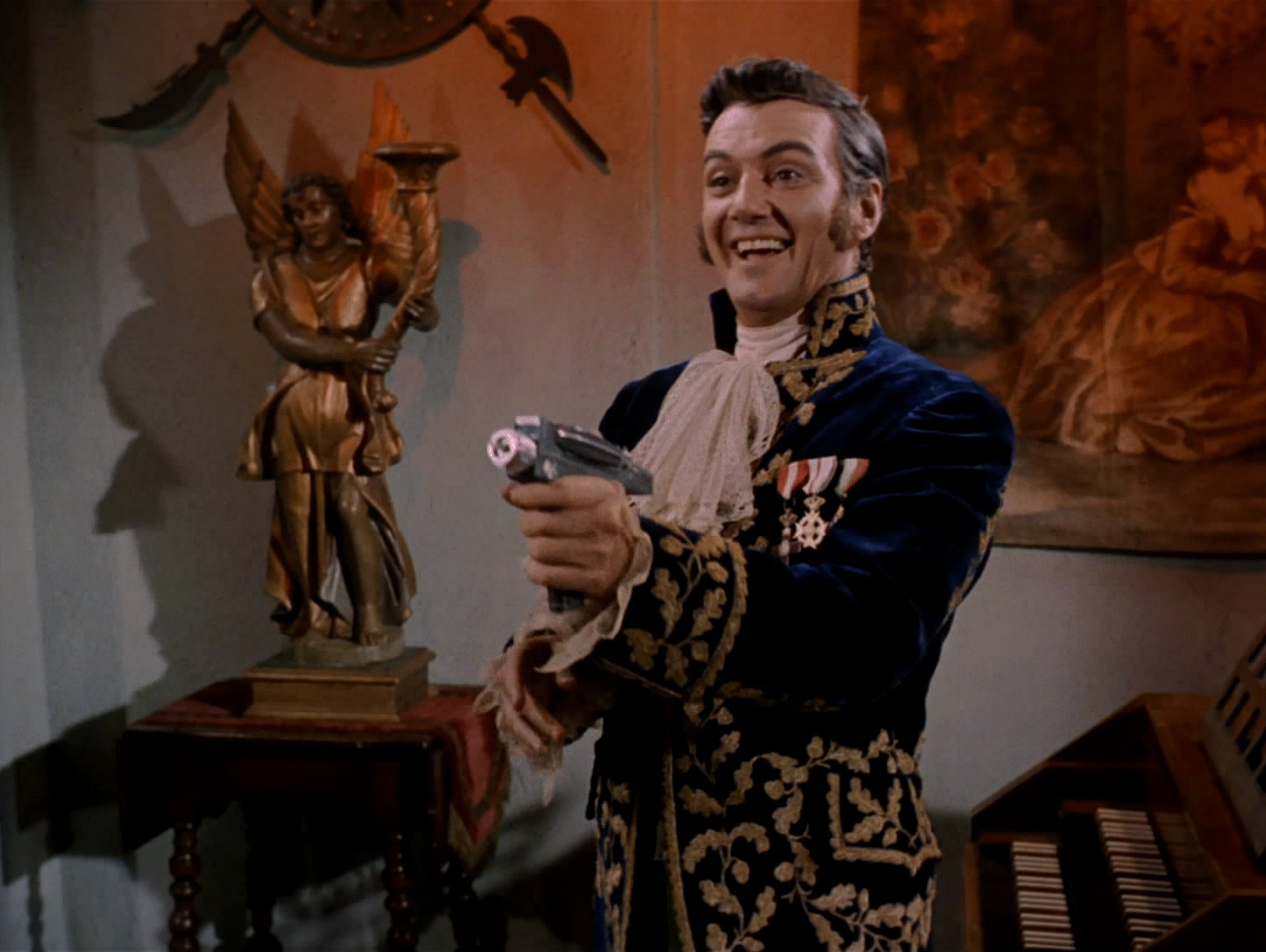
Stardate 2124.5: A planet appears in the Enterprise's flight path, and suddenly Kirk and Sulu are gone. A landing party beams down to the planet and finds the two in a manor like on 19th century Earth. The owner of the manor introduces himself as Trelane, the Squire of the planet named Gothos. Trelane is fascinated by Earth's culture, although he has missed a couple of centuries due to the time differential. He enjoys the crew's presence and does not allow them to leave. When Spock manages to beam them up to the Enterprise, Trelane abducts the complete bridge crew to his planet. Kirk challenges him to a duel with pistols. The captain aims at a mirror, behind which part of Trelane's machinery was hidden. The Enterprise escapes, but soon Gothos pops up ahead of the ship again. Trelane transfers Kirk to the planet again and condemns him to death. However, Trelane's "parents" end the cruel game and upbraid their "child".
Review
"The Squire of Gothos" has obvious similarities with "Charlie X", only that Trelane is quickly recognized as an unknown alien lifeform and turns out to be a child in the end, whereas it was the other way round with Charlie Evans.
On a general note about this type of plot, considering that humanity takes delight in animals in the form of pets, it may not surprise that powerful alien beings have pretty much the same attitude towards human beings. Yet, shouldn't we expect those aliens to be generally more enlightened, more compassionate and less self-complacent than Trelane? Overall less bribed and spoiled by their powers? Trelane's youth may excuse his immaturity. But many "adult" alien entities, for whom Trelane may have been a prototype, will take pleasure in the same kind of dull and cruel games, most notably Q in TNG. Anyway, I enjoy "The Squire of Gothos" as the first episode of its kind. Most of the later stories with the crew as pets of powerful aliens are less interesting and less funny.
Already Trelane's message "Greetings and Felicitations. Hip-Hip-Hoorah. Tallyho!" in the beginning foreshadows that it is going to be a fun story. And this holds true for the first half of the episode with Trelane's enjoyable attempts at being a real gentleman, in his well-arranged faux manor. But at some point Kirk's patience is exhausted and he spoils Trelane's fun. Although the threats against Kirk's life must be taken seriously, the story now becomes rather farcical. Fortunately Kirk remains level-headed, while Trelane becomes increasingly childish. In hindsight it makes sense that Trelane actually is a child, at least as far as the plot logic is concerned and as it confirms Kirk's suspicions. But it goes too far when Trelane's "parents" appear, with one male and one female voice, and they have exactly the same kind of argument as probably all human parents with their human children. I was only waiting for them to send him to bed early.
Annotations
- Remarkable error: The Enterprise encounters Trelane 900 light years from Earth. The distance is cited as the explanation why Trelane has a very dated idea of life on Earth. But the actual time differential is more like 450 years, as most of his furniture, art and fashion seems to originate in the 19th century.
- Remarkable dialogue: "I don't know if I like your tone. It's most challenging. That's what you're doing, challenging me?" - "I object to you. I object to intellect without discipline. I object to power without constructive purpose." - "Oh, Mister Spock, you do have one saving grace after all. You're ill-mannered. The human half of you, no doubt." (Trelane and Spock)
- Remarkable quote: "'Fascinating' is a word I use for the unexpected." (Spock)
- Remarkable decoration: In one corner of Trelane's manor we can see the "Salt Vampire" from "The Man Trap". Trelane later destroys this trophy when he tries out a phaser.
Rating: 5
Arena
Synopsis
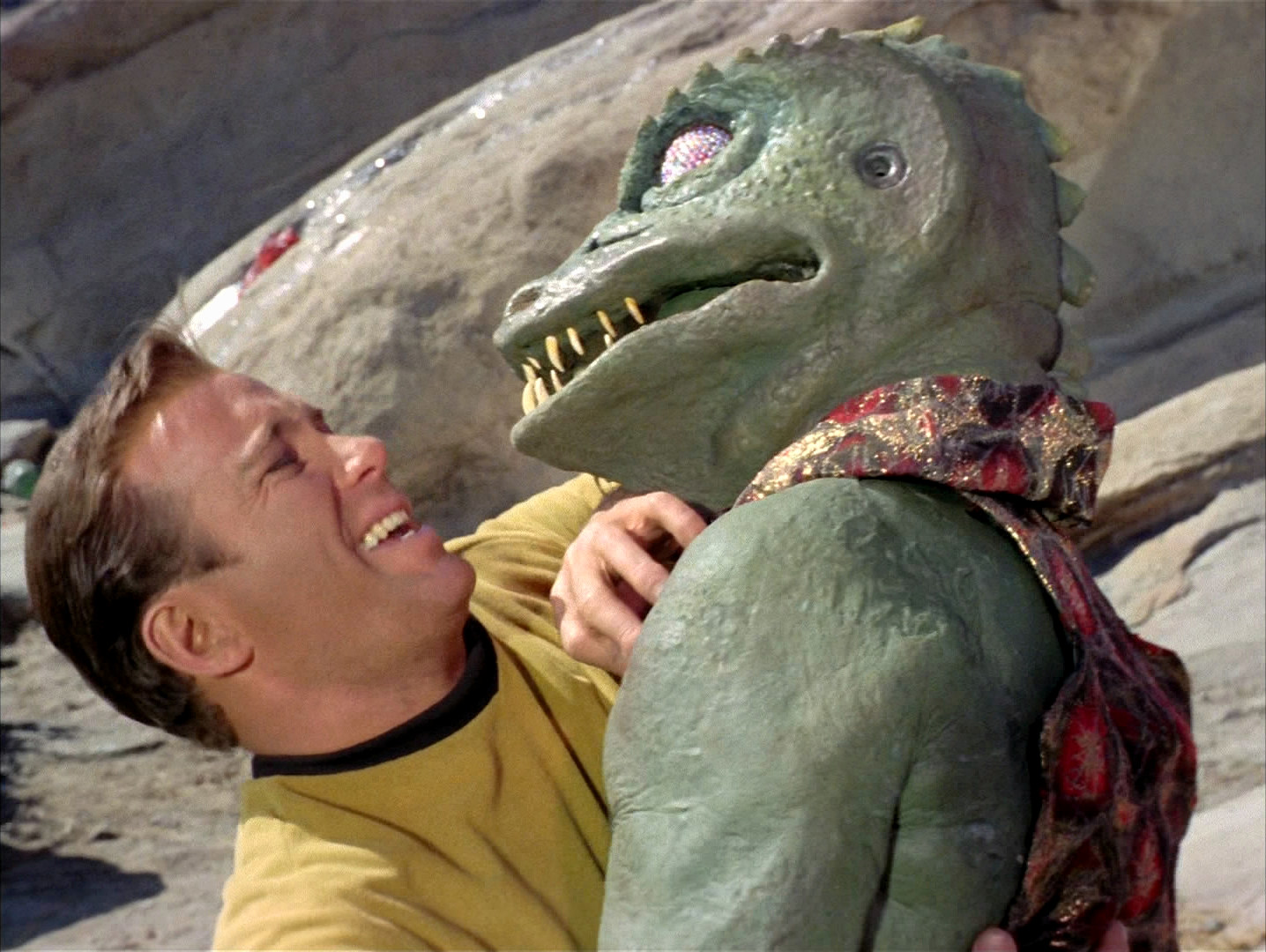
Stardate 3045.6: When Kirk, Spock and McCoy beam down to Cestus III, they find the outpost destroyed. There is only one survivor. The landing party comes under attack by an unknown enemy, and one of Kirk's men is killed. The survivors beam up, and Kirk orders to pursue the enemy vessel into an unknown region of space. The powerful Metrons, however, stop the two ships. They prevent the imminent battle and turn it into a duel on a barren planet between just Kirk and the reptilian Gorn captain. Kirk eventually disables the Gorn with a crude cannon built from raw materials from the surface. When Kirk refuses to kill the defeated Gorn, the Metrons release the Enterprise and the Gorn ship with the remark that there is hope for the human race.
Review
"Arena" is among the most popular TOS episodes still today, and this rank is well-deserved. The episode is visually powerful because it was shot at Vasquez Rocks instead of the cramped studio and because Kirk has an unusually formidable opponent, even though the Gorn costume looks cheap by today's standards. The episode is full of memorable moments too, such as Kirk's construction of a makeshift gunpowder cannon, or the Metron's remark that there is hope for the human race. "Arena" is well-directed and simply exciting to watch. But it does have a couple of flaws too.
The episode relays one of the key messages of Star Trek, that destroying the enemy at any cost should not be an option and that the defeated not only deserves mercy, but also respect. But in "Arena" Captain Kirk needs as much time as 40 minutes to arrive at this conclusion. After the outpost has been attacked and one of his crew has been killed, it is only understandable that Kirk is accordingly uncompromising. It is the right course of action to pursue the attackers. But as he cries "Invasion!", with the Enterprise being the only line of defense, and as he states that the attacker should never reach his home port, all against Spock's objections and perhaps against the rules of engagement, he loses my sympathies. Perhaps exactly this was the intention, to let his change of mind, as he eventually spares the Gorn's life, appear even more dramatic. But I think it is rather out of character. Once he has been transferred to the surface together with the Gorn captain, Kirk's reluctance to seek a peaceful solution continues. He has been provided with what is obviously a communication device. But he neither tries to argue with the Metrons, nor does he mind contacting the Gorn. Well, he may really think it is just a voice recorder, bearing in mind that he is surprised when the Gorn suddenly speaks to him. Still, he could have been clever enough to only try to do anything else but throwing rocks and building weapons.
Well, the role of the Metrons and their agenda are rather objectionable too. We may assume in their favor that it was their intention to teach the "primitive" races of humans and Gorn a lesson instead of really killing one of the two crews. Interestingly, in Gene L. Coon's script the Metrons would have lied about their intentions, and they would have destroyed the winner's vessel instead of the loser's. This wouldn't have shown them in a better light either but would at least have given the story an unexpected twist. Anyway, the Metrons actually appear as very hypocritical.
Firstly, the Metrons are not actually threatened but only annoyed by the presence of "violent" species in a region of space that they claim for themselves. If they were really highly evolved, it shouldn't disturb them. They could have let the two ships carry out their puny fight regardless, but they felt compelled to intervene. Exactly like a "primitive" species with sufficiently powerful technology would have done too. Secondly, their intervention is so presumptuous that it can only be called "playing god". The Metrons have created a scenario in which the two "primitives" conveniently fight out their conflict. They appear to be under the impression that this ordeal by battle would exonerate them from killing the loser. This is quite ironical because in medieval times an ordeal by battle was a human way to settle conflicts, with God allegedly making the judgment for them. Thirdly, the Metrons set up a scenario designed to incite a fight, rather than avoid it. They even provide the raw material for weapons. Their justification is rather pathetic: "We will resolve your conflict in the way most suited to your limited mentalities." The Metrons effectively promote what they say they despise most.
Annotations
- Nitpicking:
- Why would the Gorn bother sending a faked message to the Enterprise? And even a detailed instruction "Bring the tactical people"?
- When Kirk and Spock come under attack on Cestus III, why is no one sitting in the captain's chair? Why does Kirk have to give Sulu detailed orders about when exactly to fire weapons, when he doesn't even see who is attacking the ship, from where and how hard?
- The Gorn's forces are greatly exaggerated. The piece of rock he lifts with ease must weigh two tons or more, and he throws it at Kirk, who is standing at least ten meters apart. The Gorn should have easily crushed Kirk in the direct wrestling match.
- The Mythbusters have demonstrated that the improvised gunpowder cannon would not work the way depicted. Even if Kirk were able to mix gunpowder with sufficient yield in his hands and even if the bamboo barrel could withstand the explosion, it would perhaps kill the Gorn, but most likely Kirk.
- Remarkable quote: "Sparing your helpless enemy who surely would have destroyed you, you demonstrated the advanced trait of mercy, something we hardly expected. We feel that there may be hope for your kind. Therefore you will not be destroyed. It would not be civilized." (Metron)
- Remarkable trick: The Gorn send a feedback on Spock's tricorder's sensors to overload it. This is the first occurrence of a trick that would be used repeatedly in the 24th century, especially on Voyager.
- Remarkable weapon: We see photon grenades for the first and last time in TOS.
- Remarkable facts:
- The Enterprise can go to warp factor 8.
- The Metron who appears to Kirk is 1500 Earth years old.
- The Metrons move the Enterprise 500 parsecs through space in an instant.
- Remarkable background facts:
- The explosions in this episode left William Shatner and Leonard Nimoy with a tinnitus. DeForest Kelley reportedly suffered from tinnitus too for the rest of his life. Today Shatner works as a spokesman for the American Tinnitus Association.
- The "western fort" set used for the base on Cestus III was located in the immediate vicinity of Vasquez Rocks.
- Remastering: We see the Gorn ship for the first time in the remastered version, albeit just from a long distance. There are no changes about the Gorn's look except that he occasionally blinks.
- Crew losses: 2
Rating: 6
The Alternative Factor
Synopsis
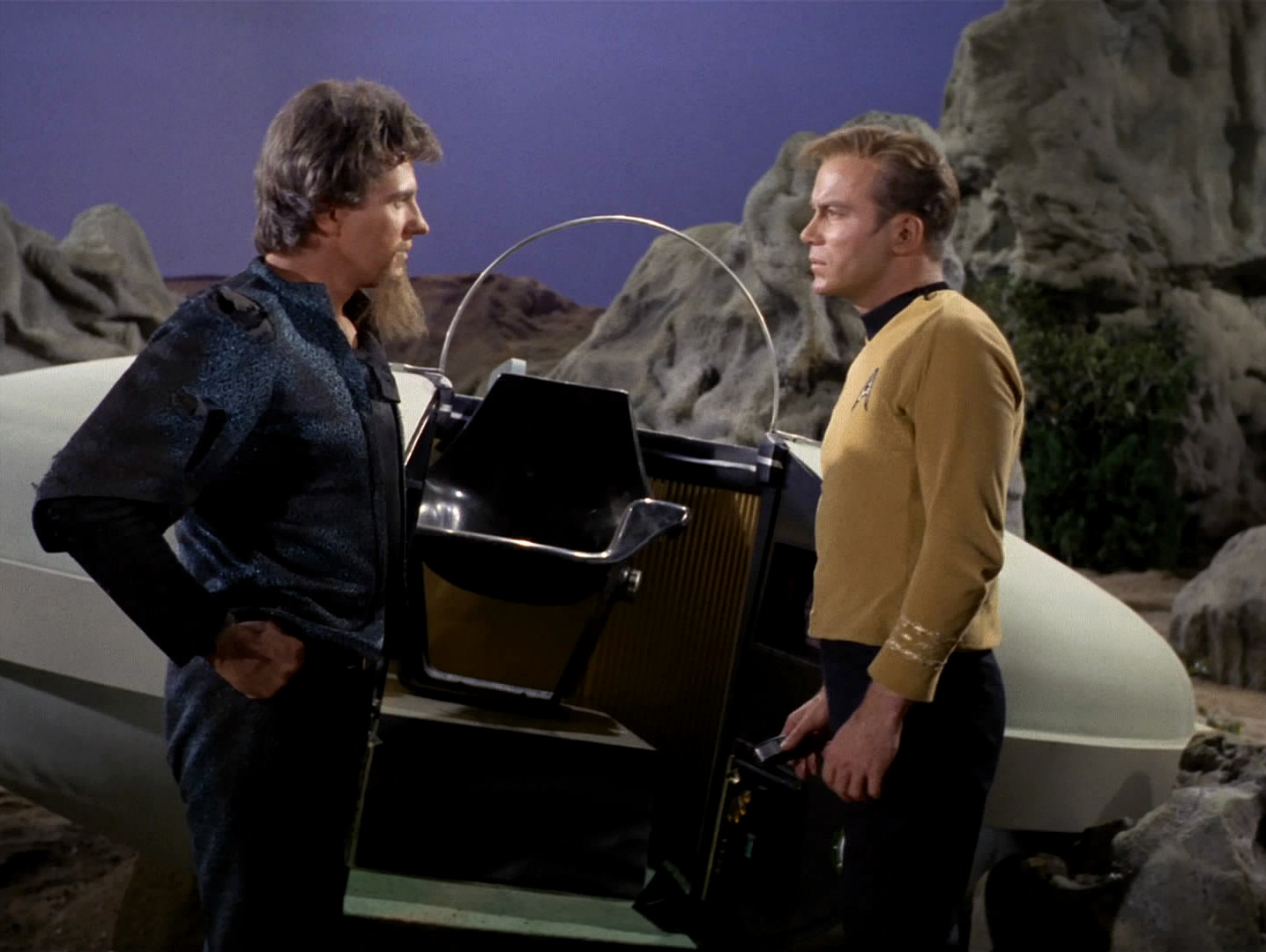
Stardate 3087.6: While the Enterprise is in orbit around an uncharted planet, the ship as well as regions throughout the galaxy are struck by a spatial anomaly that emanates from the planet. Starfleet Command suspects a pending invasion and orders Kirk to investigate the case. On the surface a landing party finds an obviously paranoid humanoid called Lazarus, who claims to chase an evil "thing" disguised as another humanoid that is out to destroy the universe. Once aboard the ship, Lazarus switches places with a doppelganger because of another anomaly, against his wishes and unbeknownst to the crew. This other person steals dilithium crystals from engineering and vanishes, leaving behind the already known Lazarus. This insane Lazarus too gets his hands on the ship's dilithium crystals and beams down to his ship. When Kirk follows him, he steps into the ship and is promptly transferred to a parallel universe. Here the other (sane) Lazarus, the "thing", is preparing another ship of the same type, using the dilithium crystals he took. He tells Kirk that the mad Lazarus must be stopped, because if the two ever met on one side of the safe corridor between the two universes, it would destroy everything that exists. So he sends back Kirk to our universe and prepares to enter the corridor one last time. Once he is back, Kirk pushes the mad Lazarus through the gate of his ship, and orders its destruction. The two are trapped in the corridor for all eternity, which saves both universes.
Review
I am frequently berated for paying too much attention to plot logic and "small mistakes" that, in the opinion of some people, lead me to put down otherwise great episodes. I don't think this is true. "The Alternative Factor" is the exception that proves the rule, the prime example that only incredibly bad logic can ruin the story in my book, the one episode that I find unbearable because nothing makes sense.
For decades, "The Alternative Factor" used to be the by far worst episode of the franchise. It takes us into a parallel Star Trek universe that is governed by anti-logic. While it has an incoherent plot with an awkward amalgamation of concepts to start with (rip in space, invasion alert, doppelganger confusion, time travel, antimatter universe), the abysmally bad screenplay and execution add insult to injury. The episode clearly suffers from rewrites of the story and from the fact that Lazarus actor John Drew Barrymore (that's right, Drew's dad) didn't show up for the shooting and had to be replaced with Robert Brown. This may explain at least a few of the countless things that have gone awry.
I don't know where to start my rant about this disaster of an episode, so instead of a well-rounded review here is essentially just a long list of plot holes and other failings in a roughly chronological order.
Act 1: In the beginning, when the instruments indicate that the planet and everything around the ship vanishes for a split second, wouldn't Spock suspect that the sensors were "blinded" or something like a shield was erected, rather than come to the absurd conclusion that it was really gone? Only after the Enterprise has received confirmation from Starfleet Command it is clear that there is really something wrong about the universe. What's more, it remains unexplained where this effect comes from. Even with the later knowledge that something like a gate to another universe is opened, where would everything vanish, and why would it be detected at all, because for that the Enterprise's and all other sensors would have to remain in normal space-time?
A bit later, Kirk asks whether the humanoid being that Spock has just located on the planet could pose a threat to the ship, and Spock confirms that. This is about the only time in all of Star Trek that a single humanoid is rated dangerous from the outset. And it is incredibly ironical in light of all the things that will still happen because no one ever bothers to watch over this "dangerous" individual. And then there's the "invasion". From where? By whom? Kirk and Commodore Barstow come to that odd conclusion even before it is discovered that they are dealing with a gate to another universe. If they had already discovered that gate, the assumption would make at least a bit of sense. But the way the idea of an invasion suddenly crops up is far-fetched and remains utterly gratuitous.
Spock says that Lazarus lied about that other creature. But Spock already conceded that Lazarus suddenly appeared on his instruments. Wouldn't that make his story a bit more plausible? And considering his visible insanity (that McCoy would be glad to attest if only someone bothered to ask him), wouldn't it rather be "hallucinating" instead of "lying"?
Act 2: Well, after calling him a liar, Kirk and Spock suddenly lend credence to Lazarus's story after a new occurrence of the phenomenon, during which Lazarus was hurt when he met the "thing" again. But once again, doesn't it occur to them that Lazarus is quite obviously insane and that he may have hallucinated seeing the "thing", and was simply injured when he bumped his forehead into a rock?
As already mentioned, Lazarus is rated very dangerous, but when he is aboard the Enterprise for his second treatment, he can just walk out of sickbay, without a security guard!
Sometimes the Enterprise and everything gets rocked when Lazarus and his counterpart switch places, and sometimes not and there isn't even a little anomaly recorded by Spock's instruments in the latter case. This constructed inconsistency is an unnecessary weakness of the story. But the most definite failing of the whole doppelganger plot is that Kirk and Spock always meet the one with the patch, even though they will both claim to have seen the other one too in the end. Moreover, other than discrediting McCoy, it doesn't even matter for the story which of the two Lazaruses is currently on the ship, because they act the same, they are both eager to get their hands on the dilithium and escape to their ship(s), only that the one with the bruise is talking more trash. Actually, if I'm not mistaken the one without the wound isn't seen talking anything to anyone!
When Lazarus leaves the bridge, the security officer follows him into the turbolift just three seconds later (we don't see Lazarus inside, but he would likely be in the left corner, hidden behind the door). But when Lazarus exits, he is alone again. Perhaps there was a second turbolift cab that was quickly put in place before the guard entered, but wasn't the whole point of the scene that someone followed the mad guy? Some time later security reports that Lazarus is missing, but if he disabled the guard, why wasn't it shown or hinted at? And Kirk says in his log and to Lazarus that "two of my crewman were attacked", by which he obviously means the two in the dilithium control room, not the guard.
When Kirk deploys a search team to locate the energy source on the planet, they leave Lazarus alone - again. And once again no one bothers to keep an eye on him, despite his attacks on the crew and although it was made a big deal that he must be the key to the problem! Well, nothing too bad happens after he is on his own again, but "only" another exchange with his counterpart, and because it's so much fun, he drops down the rocks - again. And he winds up in sickbay for no less than the third time. It is a quite visible pattern that strange or plain stupid occurrences repeat in this episode, as if they would make more sense that way. In the same vein, both Lazaruses manage to steal dilithium crystals from the ship.
Act 3: Lazarus previously lied about his civilization that was allegedly destroyed by the "thing". Lazarus now claims to tell the truth and says that he comes from the very planet down below and that he is actually a time traveler. The idea of time travel is totally gratuitous in this episode. But he may have been lying yet again, only that we never learn the truth.
McCoy's statement "Don't worry. He's not going anywhere. Not this time." foreshadows what would happen. He escapes yet again!!! That's the arguably biggest facepalm moment of the whole franchise.
As already mentioned, it remains unexplained why sometimes Lazarus gets drawn into the inter-universe corridor but Spock doesn't register anything unusual on his instruments. Moreover, the two don't always switch places. The third time that Lazarus is in sickbay (and the second time that he escapes from there) it is the one with the patch before as well as after the anomaly strikes. This is not inconsistent but pointless. It may have been possible to show it in a way that Lazarus is in sickbay but reappears at some other place on the ship, but as it looks he must have left through the door, as usual without anyone noticing.
When Kirk queries Spock about Lazarus's mental state (an assessment that he should have rather have requested from McCoy), Spock says: "One moment, paranoid, the next, calm, mild, rational. Almost as if he were two men." That statement totally misses the mark, because for all we have seen Spock has only personally encountered the mad Lazarus all the time, the one with the injury! I slapped my forehead because I never noticed that in all the years I know this episode. But it is true. Spock also explicitly mentions the injury that is occasionally gone, but all he could possibly know about that must be hearsay, such as McCoy's statement that Kirk did not believe and that he probably wouldn't have passed on to Spock.
Why do Kirk and Spock assume that the insane one of the two Lazaruses destroys civilizations? Irrespective of Lazarus's madness, wouldn't the very fact that an antimatter universe (accidentally) came into contact with our one entail enormous destruction, as they surmised just a few seconds earlier? Also, as already mentioned, the question whether any of the Lazaruses ever destroyed his own or any other planet and how exactly (without being killed himself in a matter-antimatter explosion) is never answered, although the issue is made a big deal throughout the episode.
Act 4: The sane Lazarus welcomes Kirk in "his" universe as if he knew the captain, but the two have evidently never met before (or this important encounter was not shown).
Why would the sane Lazarus's ship be destroyed too, if the Enterprise fires on the insane's ship? The two universes are entangled, just as the two Lazaruses are alike. But the fact that one is insane and the other one not proves that there is no inevitable symmetry. Also, the parallel universe planet looks different (for some reason it is a studio set as opposed to a real location), and there's obviously no Enterprise in the parallel universe, or a parallel Kirk that would visit our universe.
When Kirk returns from the parallel universe, Lazarus is still working on his ship, while Spock and two guards are standing there and *watching*. Perhaps Spock has ordered Lazarus to bring back Kirk, but it looks like they are just waiting, permitting Lazarus to carry on with whatever he wants to do with the Enterprise's dilithium crystals. Realistically Spock would have apprehended the obviously insane man and examined the transdimensional transporting device himself (which he could already have done much earlier on one of the many visits to the planet surface, by the way). - Realistically, in any other episode, Kirk would have locked up the mad Lazarus in the Enterprise's holding cell all the time, and since the exchange always materializes the other Lazarus in the very same place, neither of them would have escaped.
Annotations
- Other inconsistencies:
- A reverb was added to all of Kirk's shipwide announcements in this episode, although we see him make them on the bridge. This was done in a few more episodes, but is particularly annoying here, because he makes more than one announcement.
- Lazarus is clearly meant to be an alien, but has a quite human name.
- Barstow says that "all quadrants of the galaxy" were affected by the phenomenon and that he would evacuate all Starfleet ships within "100 parsecs of your position". Granted, the meaning of quadrants and the extent of the Federation space would be refined later, still he is talking of a huge space that can't possibly all belong to the Federation.
- Kirk tells Lazarus that the dilithium crystals are "the very heart of the power" of his ship and later that they are needed for the ship to "operate at full power", which is consistent with other TOS episodes. But in "The Alternative Factor" he also says that the crystals are crucial in finding the source of the unknown radiation as if they were the very sensors of the ship. What's more, Lazarus even believes that with their help he could set up a trap for the "thing". Well, while the transition to the other universe is accomplished with some sort of transporting device, the crystals may just power it. But the way the crystals are integrated into the small vessel's door, it looks like they are some sort of emitter when the sane Lazarus activates them. Anyway, dilithium crystals never had and will never have any other purposes than power generation.
- It is needless to note that it wouldn't need two identical *people*, one made from matter and one from antimatter, to annihilate one another. The very presence of the antimatter Lazarus on the Enterprise would make the ship blow up. And it wouldn't destroy "everything that exists, everywhere." So much was commonly known already in the 1960s but apparently not to the people who made this episode.
- The Enterprise's dilithium crystals (copper-colored plates of the size of a book) have exactly the right size and shape to fit into Lazarus's unknown alien ship!
- How can the two Lazaruses survive in the corridor between the two universes? And could they really survive forever?
- Remarkable effect: The special effects with the double exposure using the star background are unique but not very convincing. It doesn't feel like a transition to another universe. Instead of that, I could imagine something like a double exposure, using the same or similar footage, only shifted, or the mirror effect that would be used in "Mirror, Mirror", the far better parallel universe episode.
- Remarkable set: Why wasn't the standing engineering set used for this episode? Why was the new dilithium control area built that would never appear again?
- Remarkable location: The only redeeming value of this episode is that several scenes were shot at Vasquez Rocks.
Rating: 0
Tomorrow is Yesterday
Synopsis
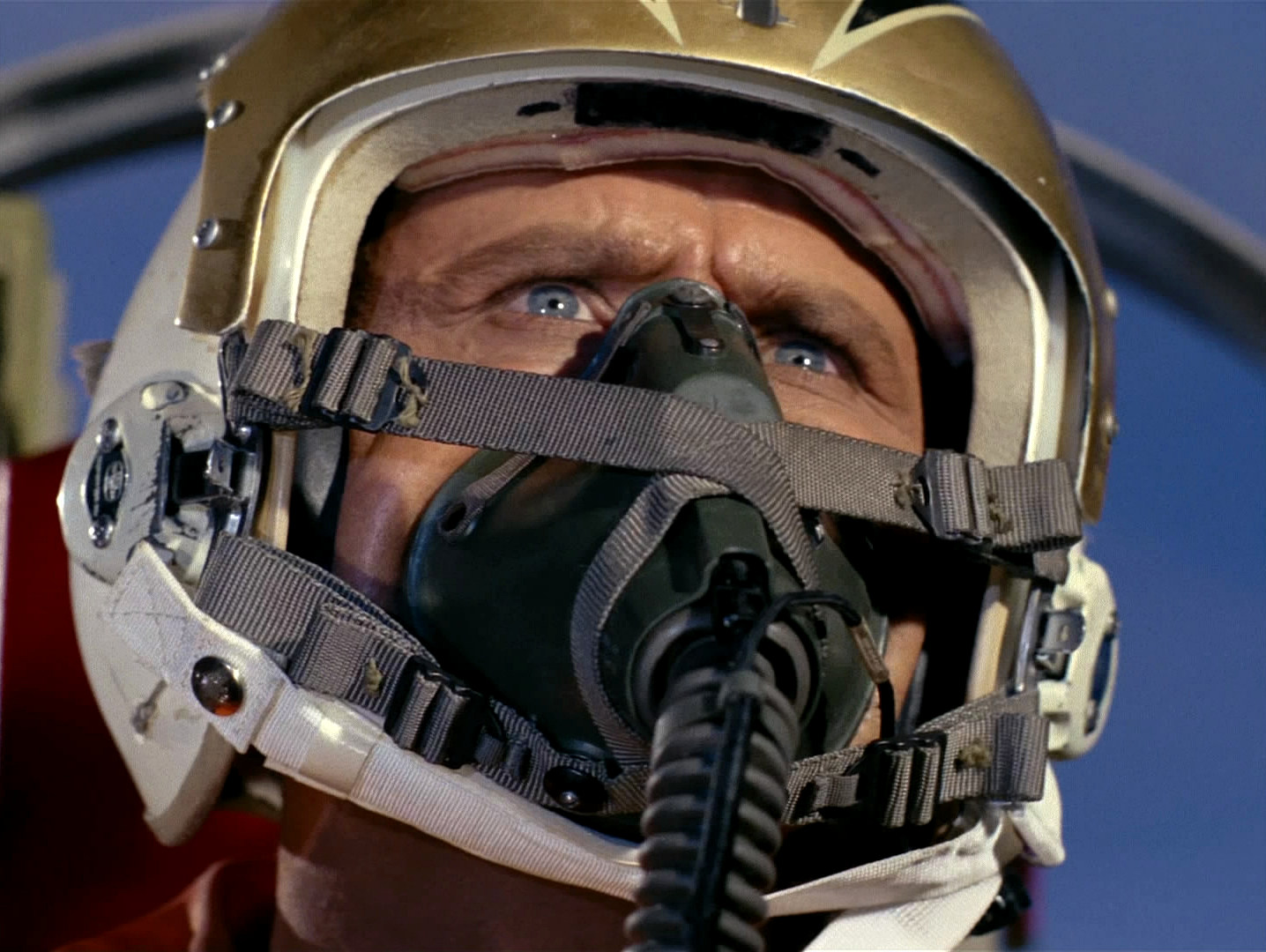
Stardate 3113.2: After pulling away from a black star, the Enterprise travels back to the late 1960s. US Air Force pilot Captain Christopher spots the ship in Earth's atmosphere. When the Enterprise's tractor beam tears his aircraft apart, there is no way but to beam out Christopher. Spock discovers that Christopher will have a son, who would lead the first Earth-Saturn mission, and hence must return to Earth in order to preserve history. Also, while a way to return to the 23rd century has not yet been found, Kirk and Sulu beam down to the Air Defense Command to steal the tapes and films with evidence of the "UFO" that is the Enterprise. But they are discovered and a security sergeant is accidentally beamed up to the Enterprise in their place, while Kirk stays behind and is being interrogated by Colonel Fellini. Spock beams down with Sulu and Christopher to free the captain, but Christopher grabs a revolver because he wants to stay on Earth. Spock disables him with a nerve pinch. In the meantime Spock has found a way for the ship to return and fix the time travel incident. The Enterprise accelerates toward the Sun, thereby initially traveling back in time until the ship breaks away from the Sun. With time now running fast forward, Christopher and the sergeant are beamed back to Earth at just the right instances before they can spot the intruders, while the ship continues its travel to the 23rd century.
Review
"Tomorrow is Yesterday" is still one of the most exciting time travel episodes, thrilling from the first to the last minute. It profits from a witty screenplay and careful directing, although both of them exhibit considerable logical deficiencies in the final five minutes. Captain Christopher is an unusually strong guest character with an attitude, who understands fast and who remains always on par with Kirk and Spock, unlike the bulk of the denizens of a primitive Earth or another primitive planet seen in future episodes. Well, I only dislike how he points the revolver at Kirk, trying to stay on Earth, saying that he would report everything, because this indicates that he hasn't understood as much as he previously appeared to.
There is also a good dose of trivia and humor in this episode. Although it is slapstick-like, I just love the scene when the sergeant is accidentally beamed up, staring at Mr. Spock and frozen in motion. Half a minute later McCoy comes and takes his revolver and communicator and he still doesn't move a muscle. Priceless. Only the re-programming of the computer by the matriarchic society on Cygnet XIV ("Computed, dear.") comes across as gratuitous and also as quite anachronistic sexism. But I like Captain Christopher's reaction to it: "Well, you people certainly have interesting problems. I'd love to stay around to see how your girlfriend works out."
Annotations
- Time travel inconsistencies (see also here):
- "Tomorrow is Yesterday" was originally meant to be a sequel to "The Naked Time" (where the time travel in the end became only a minor plot point). But as the two episodes were separated, it raises the question why everyone thinks the ship is trapped in the 20th century, although a method for time travel is already known.
- So the Enterprise goes back in time, and history is fixed by beaming Christopher back into his cockpit? How is this possible if he is already in there? It is the only time in all of Star Trek that such a "temporal re-integration" is performed, whereby the memory of the time after it is lost.
- What's more, after Christopher has been re-integrated, the Enterprise is suddenly gone. It seems that the most recent presence of the Enterprise in that time would erase the previous one. But if this were true, the ship would have to be gone already prior to that instant, because the Enterprise originally went back even further. So no one would have spotted the ship in the first place, and it wouldn't have been necessary to beam back Christopher and the sergeant, except to re-integrate them.
- If the Enterprise were heading toward the Sun at Warp 8, the ship would have to pull away after only one second at that speed, but it takes several minutes on screen. If it were really just one second, the correct timing of the slingshot would not be delicate but simply impossible.
- The transporter suddenly has a range of millions of kilometers and operates at high warp, considering that the ship is passing by Earth, and two people have to be beamed back one after another with a precise timing regardless of the distance and relative speed to Earth.
- The Enterprise moves to the future rather slowly after passing by the Sun, with a few hours translating to a couple of minutes. At that rate it would take years for the ship to arrive in the 23rd century, unless it were possible to use the engine to accelerate in the time warp. But the way it is shown, it takes just a minute before only 50 years are left to go without additional acceleration, and Spock counts down "40, 30,..." with ten years equaling one second.
- Other inconsistencies:
- Why is Christopher standing when he materializes? People always retain their latest posture, such as the guard later in the same episode.
- Spock reports to Kirk that the aircraft has broken up and asks whether he can turn off the tractor beam. What reason could there be to keep it on, and can't he make such an insignificant decision himself?
- When Kirk and Sulu beam down to 498 Airbase Group Air Defense Command to retrieve the tape and the film, everything is calm and only two technicians have just finished their work in the photo lab. But shouldn't the corridor be swarming with people investigating the case even at night time, considering that only a few hours earlier an aircraft was apparently shot down by an unknown enemy, with the evidence being right here?
- Remarkable quote: "We cannot return him to Earth, Captain. He already knows too much about us and is learning more. I do not specifically refer to Captain Christopher, but suppose an unscrupulous man were to gain certain knowledge of man's future? Such a man could manipulate key industries, stocks, and even nations. and in so doing, change what must be. And if it is changed, Captain, you and I and all that we know might not even exist." (Spock, somehow foreshadowing what would happen in VOY: "Future's End")
- Remarkable dialogues:
- "I made an error in my computations." - "Oh? This could be an historic occasion." (Spock and McCoy)
- "I am going to lock you up for two hundred years." - "That ought to be just about right." (Col. Fellini and Kirk)
- Remarkable facts:
- The episode first aired on January 26th, 1967 (the day before the Apollo 1 disaster would cost the lives of three astronauts). A radio broadcast in the episode announces the "first manned Moon shot" to be scheduled for a Wednesday in a year that is not further specified. The actual launch of Apollo 11 would take place on July 16th, 1969, a Wednesday.
- Kirk says about the Enterprise: "There are only twelve like it in the fleet." But with the more or less canon ship names of other Constitution-class vessels we arrive at a number of 17. Maybe Starfleet was already building more of them, and kept replacing the ones that were lost in the course of TOS.
- Kirk tells Christopher that the Enterprise operates for the "United Earth Space Probe Agency". At the time of the episode we may have surmised that Kirk simply makes up the UESPA in order not to confuse Christopher with the existence of aliens. On the other hand, Kirk freely admits that the ship comes from the future, and he doesn't do anything to hide Mr. Spock from Christopher's eyes. As late as in Star Trek Enterprise it will be canonically confirmed that the UESPA really existed at least in the 22nd century.
- This is the first episode to mention the slingshot effect for time travel.
- The "black star" in this episode was meant to be a black hole, but the nomenclature was not yet settled at the time.
- Remastering: "Tomorrow is Yesterday" is among the episodes that were remastered most extensively. And I have to say the new effects are superb. As already in "Miri", seeing the Enterprise in orbit of a realistic Earth is delightful, and the all-new effects of the Enterprise traversing the Sol system give a whole new significance to Christopher's awe of being in space. Christopher says, "I never thought I'd make it into space. I was in line to be chosen for the space program but I didn't qualify." Kirk replies: "Take a good look around, Captain. You made it here ahead of all of them." Now we finally have that look.
Rating: 9
The Return of the Archons
Synopsis
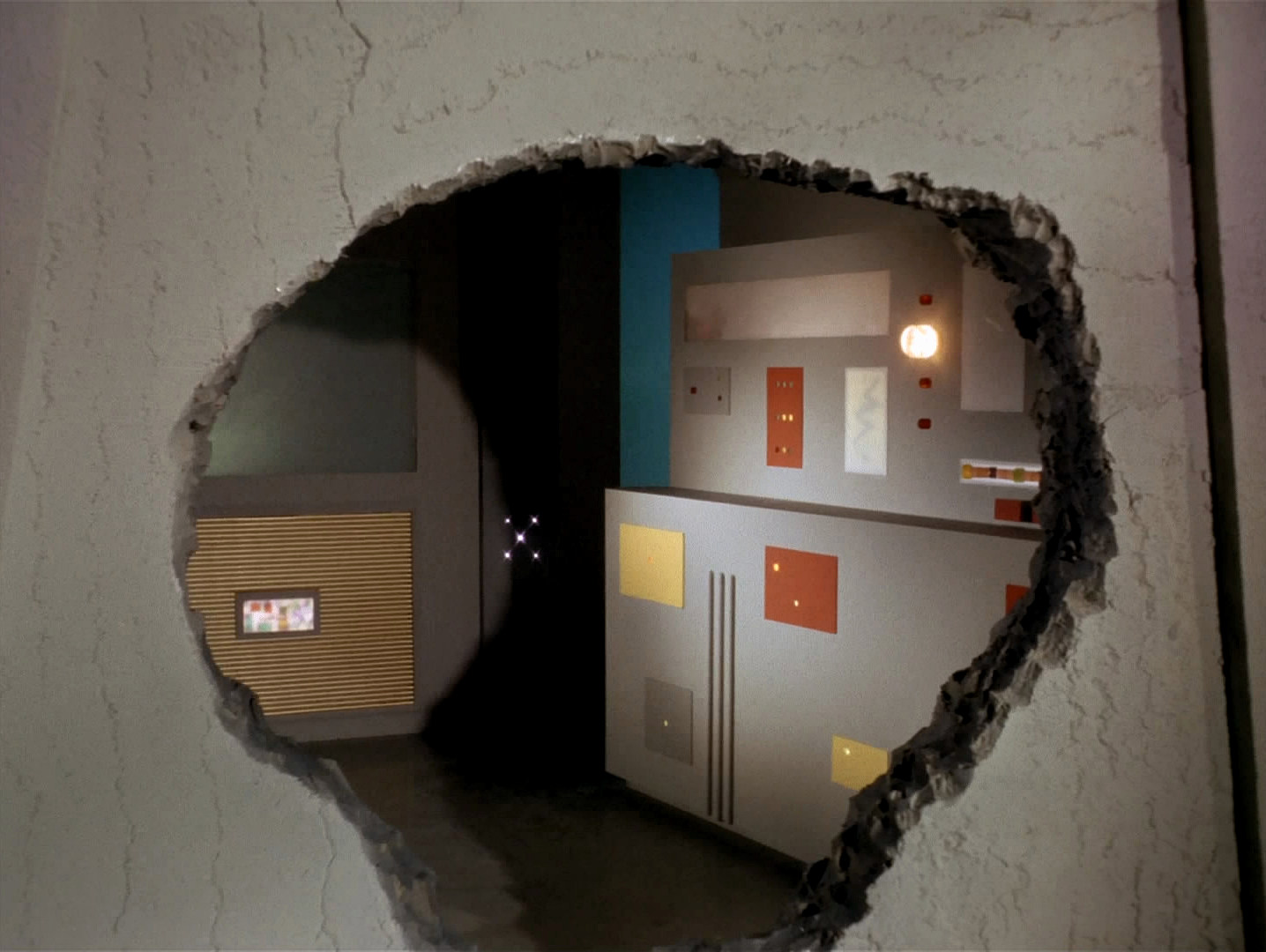
Stardate 3156.2: When Sulu is beamed back from the Earth-like planet Beta III, he is constantly smirking and talking about someone called "Landru" who has erected a paradise. Kirk, Spock and McCoy beam down with a bigger landing party to investigate. They run into the "Festival", actually a riot of the younger people in the streets, and seek shelter in a house together with three older men called Reger, Tamar and Hacom. Reger suspects that Kirk and company might not belong to the "Body" and might be "Archons" - obviously related to the ship Archon that visited the planet a century earlier and vanished. The next day Hacom appears with two hooded men, "Lawkeepers", who kill Tamar for disobeying Landru. Kirk and his men initially manage to escape with Reger, but are taken prisoners some time later, while Landru attempts to make the Enterprise crash with a tractor beam. Lawkeepers enter and take McCoy to another room, from where he returns "absorbed", just like Sulu and everyone else on the planet. Fortunately Marplon, who works in an underground movement with Reger, saves Kirk and Spock from being absorbed as well. He leads them to a room where they find Landru - a computer that was programmed 6000 years ago to maintain peace and that has been controlling the inhabitants of the planet ever since. Kirk argues that Landru has violated its own rules, whereupon the computer destroys itself.
Review
"The Return of the Archons" can't deny that it is taken from Gene Roddenberry's pool of Star Trek stories taking place on a parallel Earth, of the kind that he pitched to studios as early as in 1964 with the goal to suggest cost reduction through the use of existing sets. It is, however, only the second such episode in the first season after "Miri", with the bulk (and the worst ones) still to follow in season 2. "The Return of the Archons" has in common with "Miri" that no attempt is made to explain why the planet is a carbon copy of Earth. It is silently accepted as a galactic law that planets (and their inhabitants) are all alike for the most part, while the second season will come up with various rationales and theories why alien worlds are not really alien.
Most remarkably this is the first episode about a computer that supervises a whole civilization, and it shouldn't be blamed for the mistakes made in the various rehashes, much less for the fact that it would be rehashed in the first place. So if I try to keep an open mind and watch it like the 1960s audience, it is rather thought-provoking, a bit like Trek's version of 1984. Landru was created millennia ago with the laudable intention to maintain peace and order on the planet, to remove all bad thoughts. The inhabitants, however, are under mind control to that end; only during the so-called "Festival" they are allowed to let out their emotions. Sounds familiar? The Vulcan contrast between mental discipline and pon farr on the other hand, as it would be established in "Amok Time", is essentially the same concept. Just like the Vulcans, the inhabitants of Beta III, at least the young and vital ones, may need to let off steam occasionally, something that Landru anticipated and organized accordingly. Ironically, while Landru itself is a very sophisticated piece of technology, its creator condemned the population to a simple life like in Earth's 19th century. The idea that the amenities of modern life would spoil people and would give rise to envy and class struggle was popular in the 1960s, and peaceful counter-cultures seemed to prove it right. But I think that luxury and technology is only superficially the reason for human conflicts. Ultimately it would require to change the human nature to assure eternal peace and happiness. With his mind control Landru may have achieved the former, but I have doubts about the latter. In any case, even if everyone were happy with the mental conditioning (and Reger certainly isn't), it would still be wrong. Perhaps so wrong that Kirk has the right to break the Prime Directive to end the computer's rule, and not just to save his own men.
Regarding the course of the story, it is a letdown that already half-way through the episode Spock formulates his suspicion that the whole society is controlled by a computer, anticipating everything that would happen until the end: "Their reaction to your defiance was remarkably similar to the reaction of a computer when fed insufficient or contradictory data." On the other hand, because of this the conclusion is not quite as rushed as in most other TOS episodes, in which the secret of an alien world is unveiled in the final five minutes, and the discovery has no further impact. This episode at least attempts to outline what would become of the planet's inhabitants when Lindstrom reports to the captain in the end, although I would have liked to see at least a little bit of their recovery from Landru's brainwashing. Considering Lindstrom's apparent interest in Reger's daughter it would also have been a perfect opportunity to show her again in this episode that is dominated by male characters like no other. Furthermore, it is disappointing that once again the ship in orbit is in danger just as well as the landing party is captured. This is a quite common and unnecessary trope in TOS. There may have been other way to justify why Kirk and his people couldn't simply be beamed up. Overall, the episode is rather formulaic, even in a literal sense, as it attaches a bit too much importance to certain repeating phrases such as "Are you Archons?" or "You are not of the Body."
As for the guest characters, it is remarkable that the sociologist Lindstrom has more lines than only an occasional "Yes, captain". For instance, Lindstrom keeps reminding Reger that his daughter is in danger during the Festival, which is rather commendable. But later on, he gets annoying with his inexperience and ignorance when he wants to fire on the projection of Landru and when he does not understand Spock's explanation that hypersonic waves are the cause of his headache. Reger is a quite likable character and convincing as a man who frequently falters because he is both in awe of and afraid of Landru. Only his nervous breakdown when Kirk and Spock are going to meet and disable Landru is over the top. I would have hoped for him (and his daughter) to play a role until the very end. Well, that role goes to Marplon, a man who was working in the corridors of power, who operated the brainwashing machine and who still knew there was something wrong about it, only that it took the "Archons" to convince him to actively resist Landru. But he comes too late, and we don't learn anything about him that we wouldn't already know better of Reger. Still, even though the basic setting of a computer that has been controlling a planet for millennia is hard to believe, their resistance movement with just a spark of hope that their savior may return is quite plausible.
Annotations
- Nitpicking:
- Why does it take so long to beam up Sulu and O'Neil?
- And what happened to phasers on stun, when the hood guy was approaching Sulu?
- Why are Sulu and O'Neil wearing 18th century clothes, while everyone and everything else is 19th century style?
- When the Lawkeepers appear to Kirk and company, why does no one try to disable them? Again, what happened to phasers on stun? Why do they use them as late as they are being attacked by the mind-controlled villagers?
- When Reger unwraps the lighting panel (the proof that the planet once had asvanced technology), it is clearly visible that the light comes from somewhere else.
- Remarkable dialogues:
- "A marvelous feat of engineering. A computer capable of directing the lives of millions of human beings." - "But only a machine, Mister Spock. The original Landru programmed it with all his knowledge but he couldn't give it his wisdom, his compassion, his understanding, his soul, Mister Spock." - "Predictably metaphysical. I prefer the concrete, the graspable, the provable." - "You'd make a splendid computer, Mister Spock." - "That is very kind of you, Captain." (Spock and Kirk)
- "How often mankind has wished for a world as peaceful and secure as the one Landru provided." - "Yes. And we never got it. Just lucky, I guess." (Spock and Kirk)
- Remarkable scene: Kirk discusses the computer Landru to death, another of Kirk's various gifts that will frequently return.
- Remarkable fact: It is the first time that Spock explicitly refers to the "Prime Directive of non-interference". Interestingly, when talking to Landru about the computer's duties, Kirk speaks of a "Prime Directive" too, which should not be confused with the one of Starfleet.
Rating: 4
A Taste of Armageddon
Synopsis
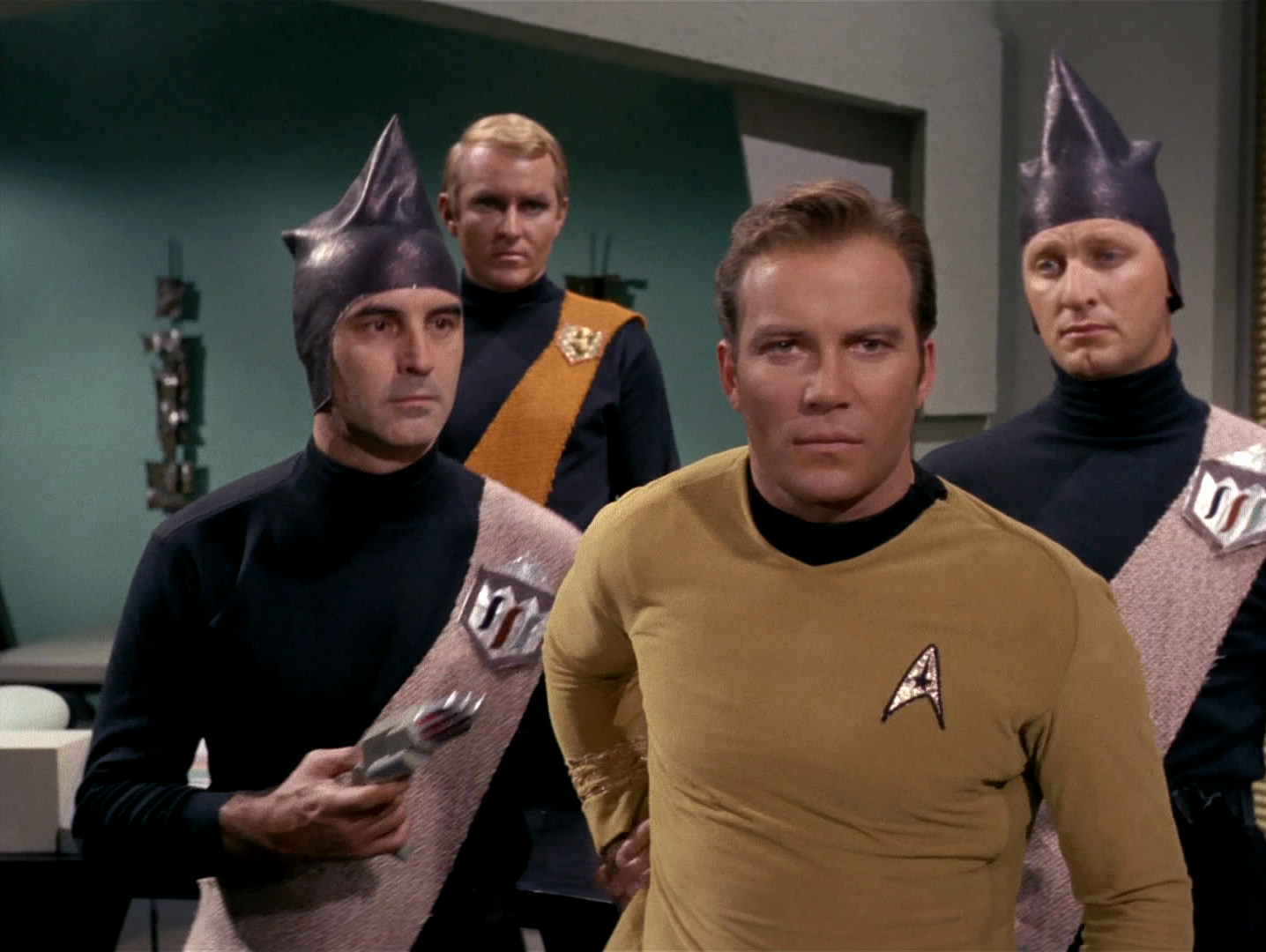
Stardate 3192.1: Ambassador Fox is on the Enterprise to establish diplomatic relations with Eminiar VII. The planet, however, has been at war with the neighbor planet Vendikar for centuries. It is a war with simulated weapons but real casualties among the citizens that, after an "attack", have to report to disintegration chambers to be killed. The Enterprise is declared "destroyed" too, and Anan 7 of Eminiar demands from Kirk that all ship personnel beam down for disintegration. The landing party with Kirk and Spock escape from their prison and destroy a disintegration chamber. When an attempt to deceive the Enterprise with a faked message fails, Anan orders to fire on the ship with planetary disruptors, but the deflector screens hold. Fox still believes in a purely diplomatic solution and orders Scott to lower the shields, but he refuses. When Fox beams down with his assistant, they are captured and promptly brought to a disintegration chamber, but Spock saves them and disables the chamber. In the meantime Kirk has brought the war room under his control, and he destroys the computer that controls the war, forcing the Eminians to begin peace talks with their enemies.
Review
Only two weeks after "Return of the Archons" (in the original airing sequence) here is another story with a computer-controlled planet, but this time one of a more intelligent kind. "A Taste of Armageddon" convinces as an overall well-constructed episode with an interesting premise. The writing does a very good job to build and keep up the mystery of the phantom attacks for the first ten minutes without protracting it too much. The revelation of the secret, that it is a simulated war but with real casualties, comes just at the right time for the consequences to unfold (and not, as so often in TOS, in the last few minutes when the action is over). Also, while the threats to the ship are often rather gratuitous in TOS, here we have an almost ironical situation that the Enterprise is already "destroyed" before it is physically attacked and before anyone is aware of it. The actions of the landing party on Eminiar make sense and are half-way credible, although it is not realistic that they could run around in the building unharmed for such a long time and eventually overpower a vast superiority of Eminian security forces. On the downside, there are some unnecessary clichés, such as another banal voice imitation when Anan fakes a message from Captain Kirk. But I like how Spock uses his telepathic powers to influence the Eminian guard to enter the room.
Eminiar and Vendikar are planets at war that chose to sacrifice the lives of their citizens in a "clean" fashion, rather than endangering the existence of their civilizations in the "messy business" (as Kirk puts it) of a war with real weapons. It is not hinted at how this agreement could possibly be forged in the first place, and I doubt that, at any point of any war, any side would be ready to switch to a simulated war. As a status quo, on the other hand, the situation of Eminiar makes sense indeed, in a logic that I find as fascinating as Spock.
My only criticism about the depiction of the Eminians is that, when they enter the disintegration machines, they all strike me as being extremely apathetic. It is certainly a part of the story that they have been prepared for their whole lives to die suddenly and prematurely, but realistically there would be something like a small ceremony. Perhaps they take drugs when they know their end is near? Anyway, Eminiar VII is actually the first alien world to play a role itself and not just a playground for Kirk - although once again he disables the computer and thereby radically changes the planet's society. I would have liked to see the other side, someone from Vendikar, at some point of the episode though.
Ambassador Fox is the first in a series of high-ranking Federation bureaucrats in TOS who utterly fail to fulfill their duty. We have many characters in TOS that are unlikable, stubborn, or incompetent. But Fox is everything in one person. As McCoy states, "Mister Fox, they faked a message from the Captain, they've launched an attack against our ship. Now you want us to trust them openly?" And still Fox insists on his carrying on with his awkward "diplomacy". What a jerk. I really wouldn't have pitied him too much, had he really been killed in a disintegration chamber. At least he eventually concedes that his approach was wrong, and he offers the Eminians his help to negotiate peace with the Vendikans when it is eventually the right time for diplomacy.
Annotations
- Inconsistency: One would suppose that a computer deemed so crucial for the survival of the Eminian civilization would have distributed backup systems and couldn't be simply destroyed with one shot.
- Remarkably stupid mistake: The power of the sonic disruptor fired at the Enterprise is stated by DePaul to be "decibels eighteen to the twelfth power". Oh my. The whole point of decibels is that it already is a logarithmic unit, +10dB difference equaling a tenfold power. 18^12 decibels is therefore totally ludicrous. If, however, DePaul meant to say 18*10^12 times the power of 0dB (usually the auditory threshold), then it makes some sense, but the resulting 133dB would be just the pain threshold and hence not all that high. In addition, we have to wonder how a sound wave can possibly rock a ship in the extremely thin air in orbit.
- Remarkable dialogue: "You mean to tell me your people just walk into a disintegration machine when they're told to?" - "We have a high consciousness of duty, Captain." - "There is a certain scientific logic about it." - "I'm glad you approve." - "I do not approve. I understand." (Kirk, Anan, Spock)
- Remarkable quote: "Diplomats. The best diplomat I know is a fully activated phaser bank!" (Scotty)
- Remarkably corny line: "Sir. There's a multi-legged creature crawling on your shoulder." (Spock, to an Eminian guard, just before applying the neck pinch)
- Remarkable facts:
- Eminiar VII is located in the star cluster NGC 321. In reality, however, NGC 321 is a distant galaxy.
- The ongoing war costs 1 to 3 million lives a year on Eminiar VII.
- The USS Valiant visited the system more than 50 years ago, and was likely destroyed in the conflict.
- Code 7-10 means that a ship has to stay away at any rate.
- General Order 24 means complete destruction of a planet's surface.
- According to Mr. Scott, the Enterprise is not capable of firing phasers at full power while the deflector screens are up, but could fire photon torpedoes.
- This episode is the first to mention the term "United Federation of Planets" in its entirety.
- Remarkable prop: The Eminian weapons are meant to be sonic disruptors, hence there is no light effect but just a piercing sound when they are being fired. They will reappear, with a few modifications, as the Klingon disruptors.
Rating: 6
Space Seed
Synopsis
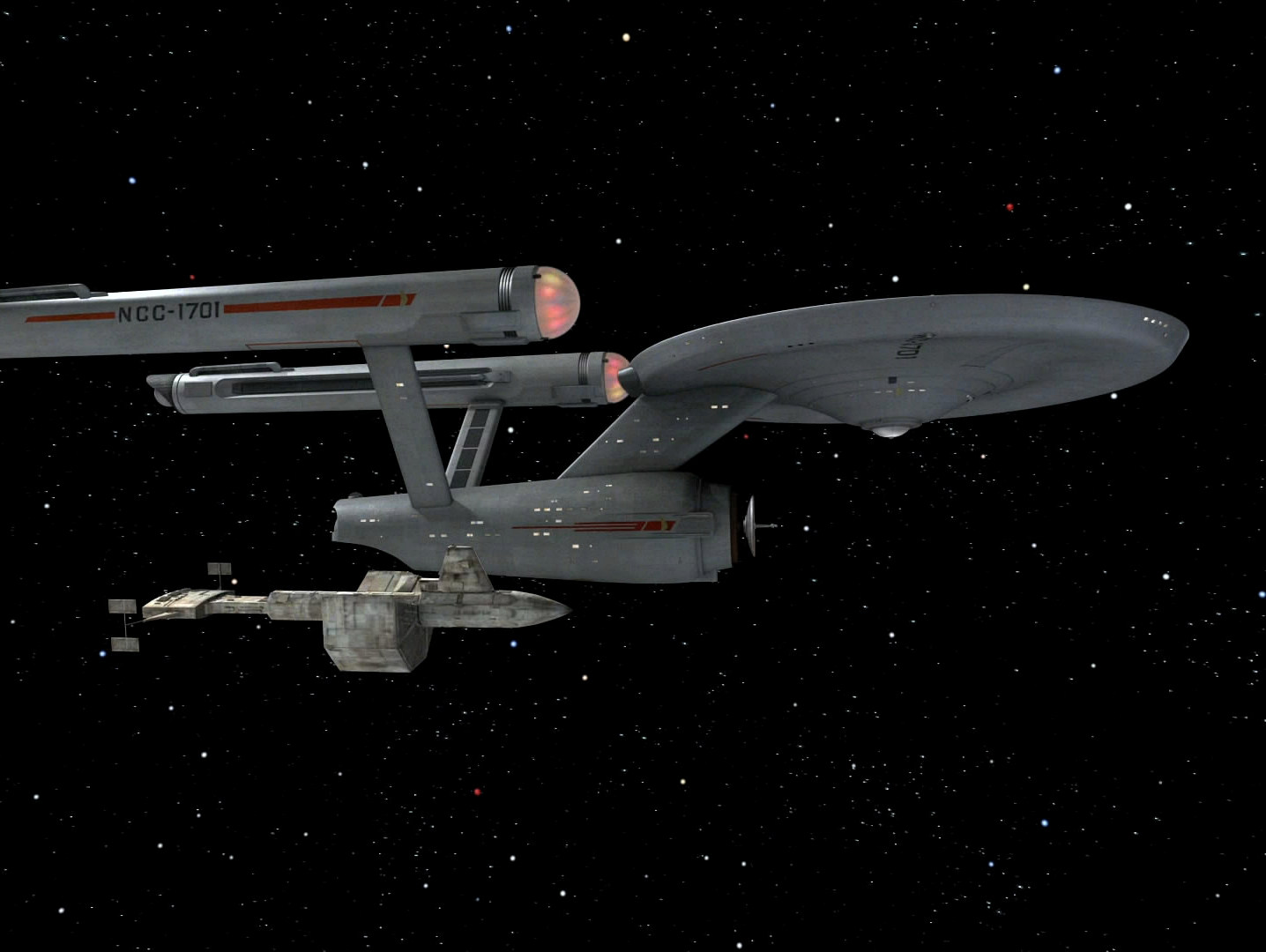
Stardate 3141.9: The Enterprise encounters the ancient Earth ship Botany Bay, whose crew is in suspended animation. A team from the Enterprise beams over and rescues one of the crew, whose sleeping chamber failed after waking him up. This man introduces himself as Khan. His actual identity is Khan Noonien Soong, the leader of a group of genetically enhanced people that once ruled a significant portion of Earth and were eventually overthrown. Khan escapes to the Botany Bay with the help of Lt. Marla McGivers, who is fascinated by Khan's charisma. There they reactivate the rest of the crew and take over the Enterprise. However, when Khan threatens to kill Kirk in a decompression chamber, McGivers steps in and frees the captain. After the takeover has failed, Kirk exiles Khan and his people, including McGivers, to the uninhabited planet Ceti Alpha V.
Review
This is undoubtedly one of the top episodes of the first season, and arguably the most enthralling one at latest as the fight for the control of the ship ensues. The idea to thaw the crew of an ancient ship was original at that time and its presentation is convincing. Unlike on many other occasions in TOS, when a crisis was resolved with almost playful ease, the threat to the Enterprise, and perhaps to a whole planet that Khan is going to conquer, is quite palpable.
Khan will be remembered as Kirk's strongest opponent ever, just because his mere physical and mental strength and his ruthlessness give him a clear advantage over the captain. He is neither mad like many other TOS villains nor just a puppet but acting on his own strong will and with much deliberation. We see a few demonstrations of Khan's powers, for instance when he opens the locked door to his quarters with ease, when he deforms a phaser or when he throws around Kirk in the engine room. We also notice how quickly he adapts to the situation of being in the 23rd century and how he learns how to operate the ship (although much of the information he was apparently able to obtain should have been classified).
On the other hand, we learn very little about his motivation. Khan appears to believe that the mere fact that he is blessed with superiority in the first place gives him the right and even the obligation to be a ruler. But he seems to have no vision that goes beyond having the power. In some way Khan is a limited person. Well, he certainly isn't the kind of guy who would bother to justify his existence and his deeds. Still, it is noteworthy that he only brings forward phrases without substance. And while it is a part of his scheme to appear as harmless, it is gutless how he evades any discussion about his past, if necessary with the remark that he feels fatigued. His otherwise insufferably condescending conduct foreshadows anyway that he is up to no good. Had the Enterprise crew not been so very kind to Khan and not vastly underestimated him, he would have accomplished nothing.
Speaking of insufferable conduct, the only thing I really hate about this episode is how effortlessly Khan manipulates Marla McGivers to betray her crew and even threaten their lives. With pick-up lines so inept that they should make women scream in terror: "A beautiful woman. My name is Khan. Please sit and entertain me." If this man's from the 20th century, he must be a virgin! The way that McGivers falls for him is so obnoxious. It is open sexism, although the opposite motive of male officers falling for exotic alien women is not uncommon in Trek either.
Annotations
- Nitpicking:
- Wouldn't McCoy recognize lifesigns from human bodies in suspended animation? Shouldn't he or Spock know about the practice to have the crew in suspended animation, considering that they are aware of the age of the ship?
- A ship from the 1990s has artificial gravity? Or were gravity field generators beamed over to the Botany Bay prior to boarding?
- When the episode was made, no one could anticipate that Star Trek would still be remembered 30 years later and that there may be no interplanetary travel and no genetic engineering until then. Read more about 21st Century Earth History.
- Kirk says that Khan has been sleeping for 200 years, but this should be more like 300 years. The probable reason is that the date of TOS was not yet nailed down at the time the episode was being produced.
- Remarkable quote: "Improve a mechanical device and you may double productivity. But improve man, you gain a thousandfold." (Khan)
- Remarkable set: We see the medical decompression chamber, which will reappear in TOS: "The Lights of Zetar".
- Remarkable facts: From 1992 through 1996, Khan was the "absolute ruler of more than a quarter of your world. From Asia through the Middle East." He was the last of the genetically enhanced tyrants to be overthrown.
- Remarkable sequel: Khan will return in "Star Trek II: The Wrath of Khan".
- Remastering: A detailed CGI model of the Botany Bay was built for TOS-R.
Rating: 7
This Side of Paradise
Synopsis
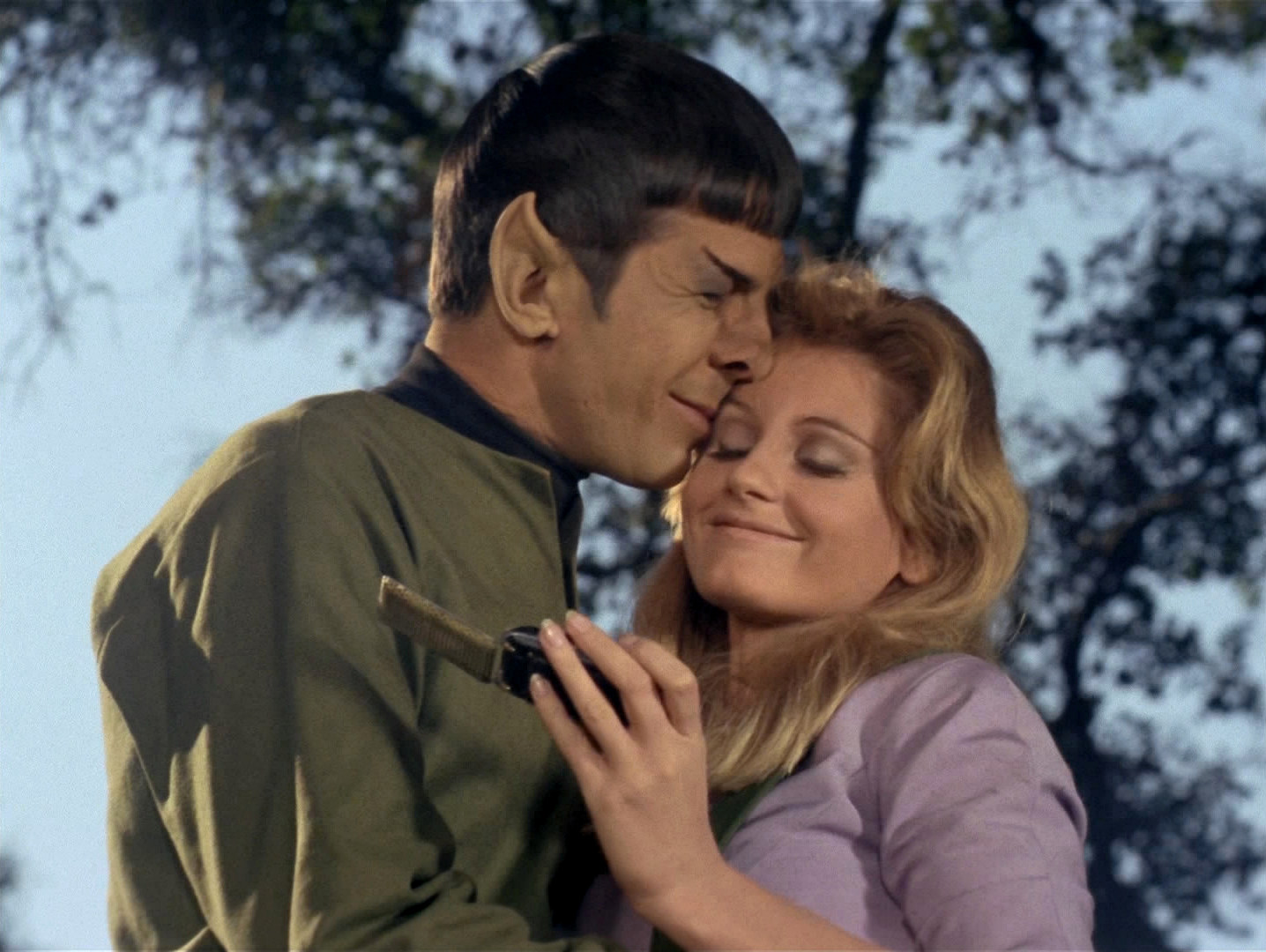
Stardate 3417.3: The Enterprise arrives at Omicron Ceti III, a planet whose colonists are believed to have died because of deadly Berthold radiation. But the group headed by a man named Sandoval is alive and in perfect health. Spock meets Leila Kalomi, who once fell in love with him although he couldn't return her feelings. She leads Spock to a plant that shoots spores at him, making him experience deep emotions but also lose his sense of duty. The spores are also the reason for the colonists' survival. Soon they keep spreading through the Enterprise's ventilation system, and all of the crew except for Kirk leave the ship to join the colony. Kirk asks Spock to beam up one last time. Insulting his first officer, he provokes such a strong rage in him that the spores lose their effect on Spock. The two modify the comm system to emit an infrasound that eventually accomplishes the same with the colonists and the crew by triggering quarrels among them. Sandoval now agrees with the relocation of his people.
Review
"This Side of Paradise" thrives on its strong emotions and the multi-faceted social commentary that are embedded into an overall credible story. However, while it only barely missed a place among my ten favorite TOS episodes, I think most fans tend to vastly underrate it. Perhaps they don't like the mere idea of Spock hanging from a tree and laughing. It is funny for a moment, especially as we look into Kirk's astonished face, but I can't find anything silly about it. In the same vein, Kirk's barrage of insults against Spock could have easily wound up as ludicrous, but I find Kirk's attempt to get his first officer off his trip totally convincing. Several other scenes walk a fine line between the depiction of unusual emotions on one hand and unintentional comedy on the other hand, and are saved by the considerate directing and the great performances especially of Shatner and Nimoy.
Regarding the social commentary, I have noticed only recently how definitely the episode puts Spock in the role of a dissenter, of a proponent of a counter-culture, of a hippie so to speak. This sort of anticipates the position that Spock will take in "The Way to Eden", in a story with much more blatant analogies to the hippie culture. Anyway, when Leila describes the effect of the plant spores as giving "live, peace, love", he refers to them as a "happiness pill", before actually experiencing that effect. And really, under the influence of the spores Spock behaves just as if he had done "a little too much LDS". And he practices civil disobedience in much the same fashion as it was customary in the 1960s.
The nature of the spores as giving peace and love, just as well as their negative side effects, couldn't be better demonstrated than on the example of Spock. He gains an emotional depth he has never experienced before, but he also represses his analytical mind just as he used to do with his emotions. Maybe Spock's transformation to a "happiness junkie" reveals the genuine flaw of the community on Omicron Ceti III better than Kirk's definite but too generalized statement that there has been no progress and that man needs challenges. I more simple words Spock, just like everyone else, would be better off without the drugs. Ultimately the paradise needs to be destroyed in order to save its inhabitants. This outcome gives the story an almost philosophical dimension.
I am fond of Spock, who still feels responsible for Leila after the effect on his mind has faded and though he has more important work on his hands. He is not able to return the love she feels for him any longer. But the way he tells her the truth (and thereby kills the effect of the spores on her) is quite gentle. I am tempted to say that Spock is still empathetic, perhaps even more than when he was under the influence of the spores.
There is rather little to criticize about "This Side of Paradise". I don't like the very idea that Kirk is the only one who is immune to the effect of the spores, a cliché established in "The Naked Time" that doesn't become credible just because it is reiterated. Also, the settlers on the planet are acting a bit too much like the people of Landru. Especially the big grin in Sulu's face is a déjà-vu. Finally, after Kirk and Spock have incited disorder on the planet, the resolution comes just too quickly. I think Kirk and Sandoval should have met up once again in the end, as well as Spock and Leila.
Well, and for what it's worth, Jill Ireland as Leila Kalomi is wearing the most unattractive women's clothing of the whole series in the form of that dark green bib overall (which may have been the reason to show close-ups of her face unusually often).
Annotations
- Remarkable dialogue: "Well, that's the second time man's been thrown out of paradise." - "No, no, Bones. This time we walked out on our own. Maybe we weren't meant for paradise. Maybe we were meant to fight our way through. Struggle, claw our way up, scratch for every inch of the way. Maybe we can't stroll to the music of the lute. We must march to the sound of drums." - "Poetry, Captain. Non-regulation." - "We haven't heard much from you about Omicron Ceti III, Mister Spock." - "I have little to say about it, Captain, except that for the first time in my life I was happy." (McCoy, Kirk, Spock)
- Remarkable quotes:
- "On pure speculation, just an educated guess, I'd say that man is alive." (McCoy, after meeting the colonists)
- "I have never understood the female capacity to avoid a direct answer to any question." (Spock)
- Remarkable log entry: "Captain's log, stardate 3417.7. Except for myself, all crew personnel have transported to the surface of the planet. Mutinied. Lieutenant Uhura has effectively sabotaged the communications station. I can only contact the surface of the planet. The ship can be maintained in orbit for several months, but even with automatic controls, I cannot pilot her alone. In effect, I am marooned here. I'm beginning to realize just how big this ship really is, how quiet. I don't know how to get my crew back, how to counteract the effect of the spores. I don't know what I can offer against paradise." (Kirk, all alone on the bridge, just before he is hit by a volley of spores too)
- Remarkable fact: This episode establishes that Spock's father is an ambassador, and his mother a teacher.
Rating: 7
The Devil in the Dark
Synopsis
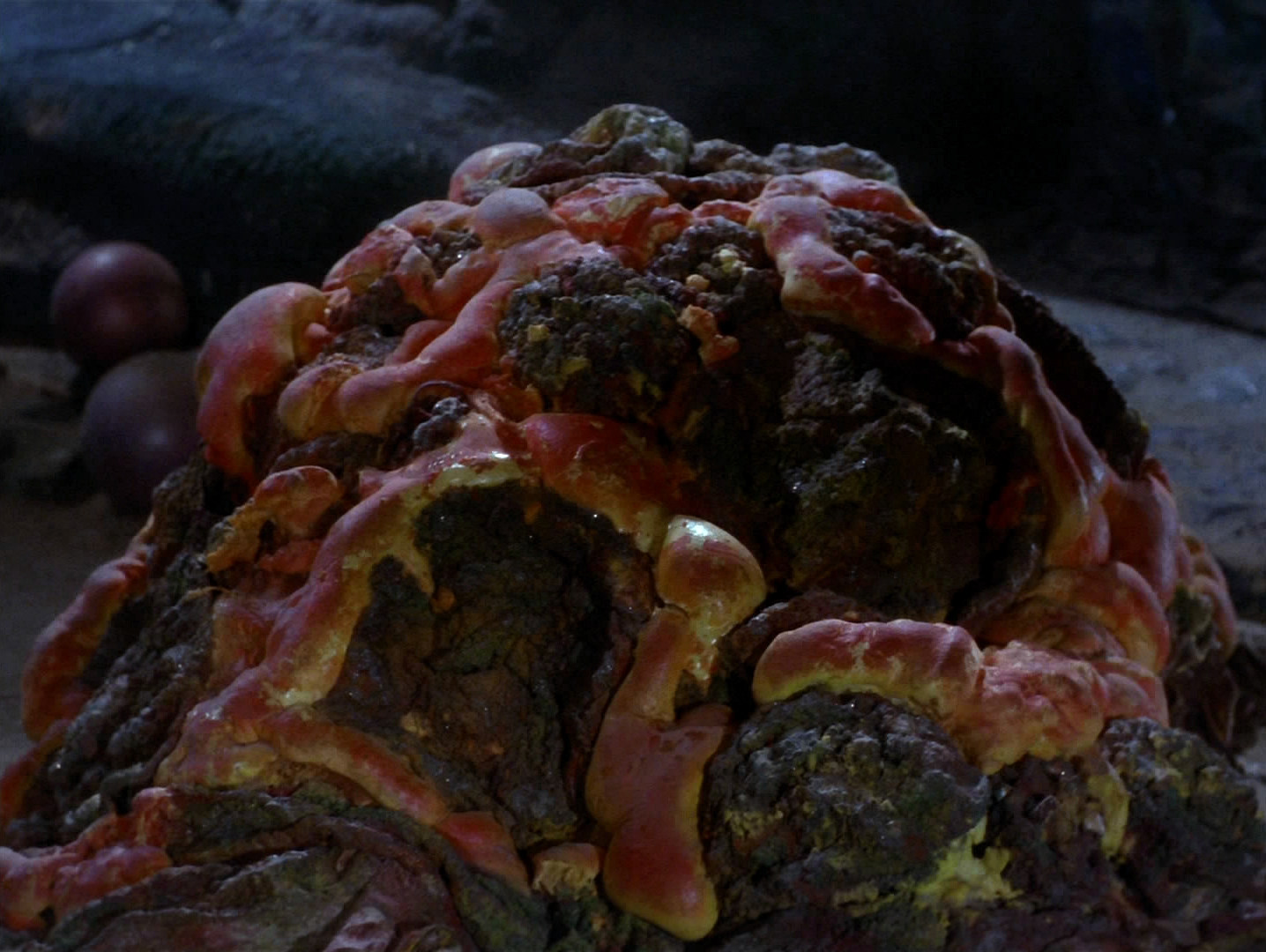
Stardate 3196.1: On Janus VI a "monster" has killed over fifty workers of a pergium mine, burning them to a crisp. Just as the Enterprise landing party has arrived, it strikes again and steals a vital pump from the colony's power plant. Spock suspects that the creature, which is capable of moving through solid rock, may be a lifeform based on silicon, and he advises against killing it. Then the creature appears right in front of him and Kirk. They shoot and severely hurt it before it retreats through a tunnel. Kirk pursues and finds the creature, but he discovers that it is afraid of the phaser and so he doesn't shoot. While McCoy treats the creature's "wound" with concrete and Kirk retrieves the pump, Spock finds out in a mind-meld that the Horta, so its name, is the last of its kind. The Horta was protecting the future generation in the form of silicon "eggs" that the miners have been destroying all along. The miners, led by administrator Vanderberg, appear on the scene to kill the creature. But Kirk holds them back, explaining that they could co-exist with the Horta in a peaceful way and to their mutual benefit.
Review
Star Trek has received much praise for its strong ethical principles, and deservedly so. One of the most important policies is that life has to be respected, even if it is so much different than life as we used to know it. Still, several TOS episodes fail this litmus test. Alien creatures are repeatedly hunted down mercilessly until the bitter end, and often without asking unpleasant questions. The respective circumstances may exonerate the crew, especially in obvious cases of self-defense. Still, it is a pity that comparably few TOS episodes have a significant turning point, a point at which both sides, at least if they are intelligent and sentient, recognize that they can either kill one another or choose a better alternative. A moment just like in "The Devil in the Dark", when Kirk points the phaser at the frightened Horta and hesitates. And when Spock mind-melds with the Horta that he still wanted to kill only a few seconds ago (although Nimoy's overacting in that scene makes it appear a bit silly).
The basic idea of the episode is brilliant because of its ethical impact and also because of the innovative concept of silicon-based lifeforms, which is still being considered by scientists as a (hypothetical) possibility of other forms of life. Unfortunately the course of the story is a bit bumpy. Spock's supposition that the creature may be composed of silicon, apparently intended to make him appear as smarter as everyone else, comes a bit too early. It could have been more exciting to reveal it at a later point. On the other hand, I appreciate that this time the most important discovery isn't deferred until the last few minutes of the episode, which is a recurring mistake in TOS episodes. Still, the conclusion of "The Devil in the Dark" is hasty as usual. Kirk just needs to tell the miners that the Horta was protecting her children, so they abstain from killing it and even co-operate with the previously hateful creature. Well, perhaps chiefly because the Horta may help them make more profit than ever before? Anyway, the conclusion just brims over with unwarranted optimism, and instead of some contemplative words the episode ends with an extremely lame "ear joke".
As already mentioned, I just love how it is Kirk who takes the first step at making peace with the Horta, after he previously disagreed with Spock's proposal to try to capture it alive. Yet, before this turning point effectively saves the episode, there is a big missed opportunity to show more of a conflict over the creature between Kirk and Spock. When Spock advises the crew to try to surround and capture it, this is clearly against Kirk's orders to kill it. Kirk is accordingly displeased about Spock's behavior that he could regard as insubordination. He wants to keep his first officer out of his way and orders him to join Scotty in the installation of the makeshift pump, with the weak justification that in no case he and Spock should both die. However, once again Spock defies Kirk's orders and insists on staying at the captain's side, reckoning that the probability that they could both be killed is very low. Their conflict is resolved much too quickly, and with inappropriate humor no less.
Annotations
- Nitpicking: Even if we believe that a yet unknown extremely strong acid could dissolve cubic meters of solid rock in a matter of seconds, the Horta would need to store many tons of that acid in its body.
- Remarkable quotes:
- "No kill I" (Horta's message etched in stone)
- "I'm a doctor, not a bricklayer." (McCoy, when he is expected to treat Horta with concrete)
- Remarkable coincidence: Horta's "eggs" have exactly the same shiny brownish, sometimes purple color as a thin silicon dioxide layer that would form around polished pure silicon. A mere coincidence or was someone of the production staff working in the semiconductor industry?
- Remarkable fact: Every 50,000 years, the Horta's complete race dies and leaves only the eggs behind.
- Crew losses: 1 (Enterprise crew only)
- Remastering: Besides the usual new shots of the planet in space, the remastered episode comes with a new digital model of the underground colony, following the lines of the original, and with a new effect of Horta entering through a wall.
Rating: 7
Errand of Mercy
Synopsis
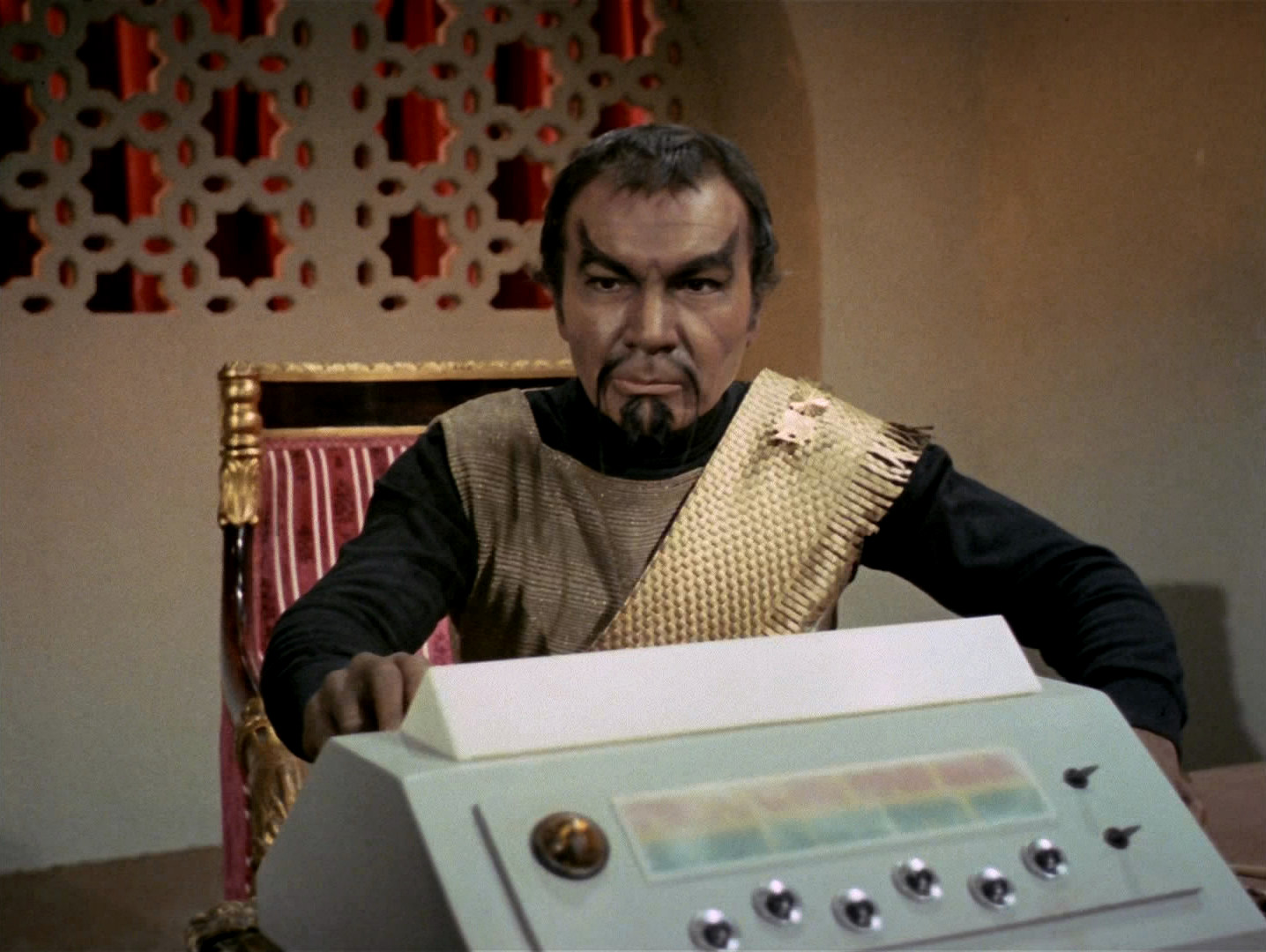
Stardate 3198.4: A war has broken out between the Federation and the Klingon Empire. Kirk and Spock beam down to the strategically important Organia, only to witness how the Klingons occupy the planet, without meeting any resistance from the strangely unconcerned population. Kirk and Spock, in disguise, do everything to convince the Organians to defend themselves, but they refuse, even as the Klingons execute hundreds of them. The Organian Chairman Ayelborne reveals Kirk's and Spock's true identity to the Klingon Governor Kor in order to save the two from being tortured. Eventually the Organians turn out to be non-corporeal beings who despise violence. With their powers they force the Klingons and the Federation to sign a peace treaty.
Review
"Errand of Mercy" does more than just introduce the Klingons. It is well written and well directed; everything fits together without plot holes. I have only a few points of criticism. The episode does not have definite highlights. Although there are some exterior shots, it feels a bit too much like a chamber play, considering that a war is raging. The idea that the Organians are non-corporeal beings was still fresh at the time, but other than that they act much like the Metrons in "Arena", only without the hypocrisy.
It is great how Kirk argues with the Organians, and how all his warnings fall on deaf ears with this apparent bunch of foolish old men. It is also a quite elegant exposition. We learn quite a few things about the Klingons (or rather, what the Federation and Kirk himself think of them) before we see them. Kirk later later tries to teach the Organians guerilla tactics, again completely in vain. And when Ayelborne even blows the whistle on his true identity, he is at a loss of proper words to describe this betrayal. Well, Kirk remains unusually composed throughout the whole episode, but I like to see him act like that for a change.
Kirk finds an unusually strong opponent in Kor, who is not a bat'leth-wielding cookie-cutter character like so many Klingons of the 24th century. At first Kor draws his strength merely from the superiority of his troops and the cruelty he does not hesitate to demonstrate. A cruelty, however, that is most purposeful and usually quite effective, only not in the special case of the Organians. Kor respects Kirk, and Kirk is not quite as hostile towards him as he could be. As both Kor and Kirk are utterly disappointed, even disgusted about the Organians' stubbornness, the two warriors are even close to allying themselves against the people who stand in the way of their war. As Kirk notes himself, "I was furious with the Organians for stopping a war I didn't want."
Annotations
- Remarkable dialogue: "Well, there it is. War. We didn't want it, but we've got it." - "Curious how often you humans manage to obtain that which you do not want." (Kirk and Spock)
- Remarkable quote: "I don't trust men who smile too much." (Kor)
- Remarkable prophecy: "Oh, eventually you will have peace, but only after millions of people have died. It is true that in the future, you and the Klingons will become fast friends. You will work together." (Ayelborne)
- Remarkable character: Kor (played by John Colicos) is the first principal Klingon character. He reappears in DS9: "Blood Oath", "The Sword of Kahless" and "Once More Unto the Breach".
- Remarkable absence: Dr. McCoy is not in this episode. Scotty is absent too.
- Remarkable Klingon props:
- We see a Klingon flip-lid communicator, similar to the Starfleet one.
- The Klingon disruptors are reworked from "A Taste of Armageddon".
- The Klingon munitions containers are nothing but colorful cardboard boxes.
- On the wall in Kor's office and on the Klingon proclamation we can spot what has to be an early Klingon emblem.
- Remarkable facts:
- This episode introduces the Richter scale of cultures (that would reappear in "Spock's Brain").
- Organia is initially rated as Class D-.
- This is the last episode in which the term "Vulcanian" is used to refer to Vulcans. Both "Vulcanian" and "Vulcan" are mentioned.
- Remastering: Besides new shots of the planet and the Organians themselves, the remastered episode shows the Klingon fleet for the first time.
Rating: 6
The City on the Edge of Forever
Synopsis
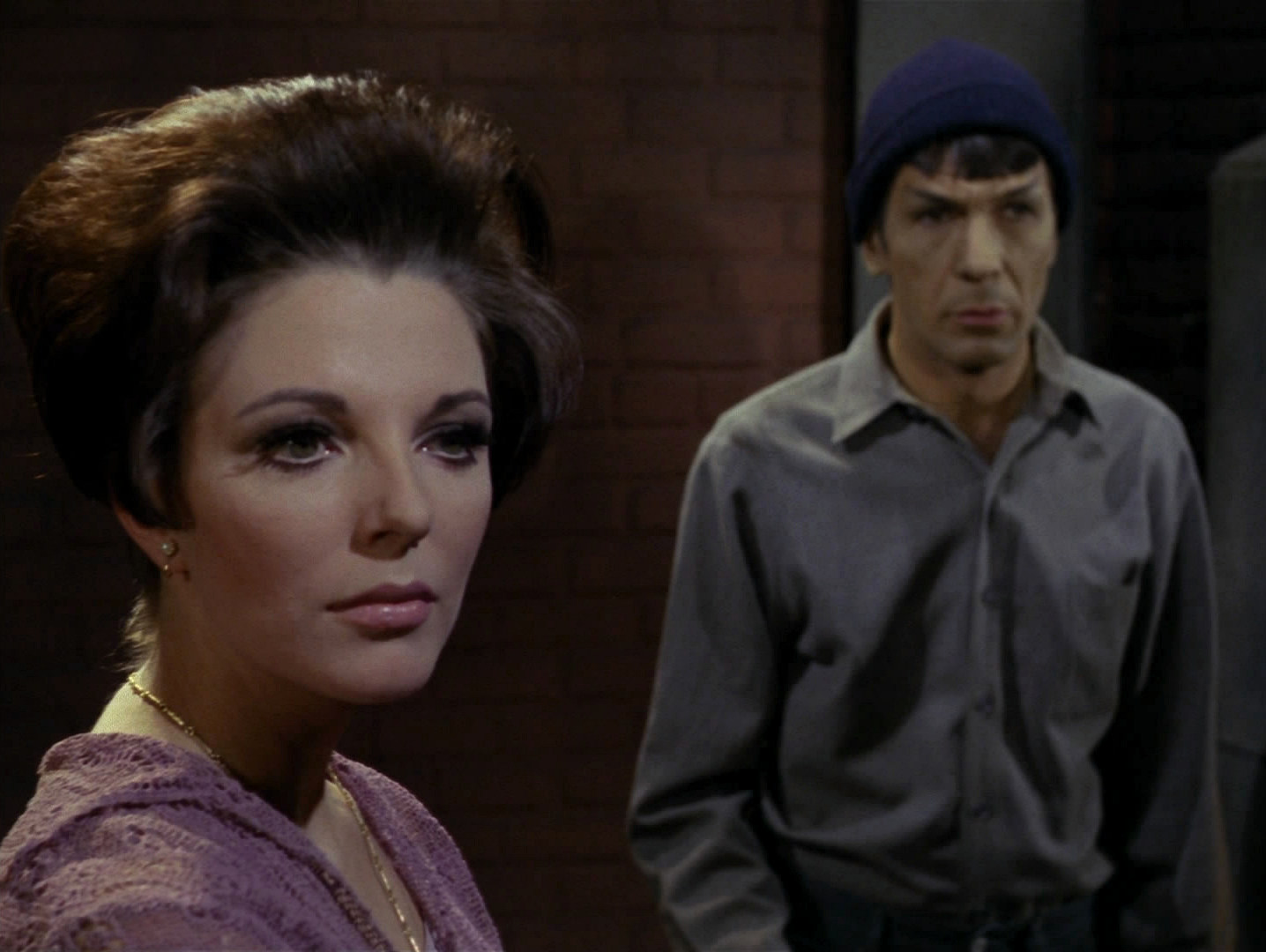
Stardate 3134.0: The Enterprise is in orbit of a planet with heavy temporal disturbances. When the ship is struck by a temporal wave, McCoy accidentally injects himself an overdose of cordrazine that drives him mad, and beams down to the planet. A landing party finds the doctor at a gateway to the past that calls itself the "Guardian of Forever". Spock manages to stun McCoy, but the doctor wakes up again and leaps into the gateway, thereby changing Earth's history. The Federation ceases to exist, the Enterprise is gone, and only the landing party is unaffected. When Spock and Kirk follow McCoy's trace, they end up in New York in the year 1930. They don't manage to locate McCoy, but find shelter in the 21st Street Mission that is run by Edith Keeler. Using makeshift equipment from the radio shop, Spock reads out the recordings from the tricorder and concludes that McCoy would save the life of Edith Keeler, who would otherwise die in a road accident. Keeler would later work for peace, delay America's entry in to the Second World War and allow Germany to win the war. In order to correct history, Keeler, who Kirk has fallen in love with, has to die. After a visit to the movie theater with Edith, Kirk is surprised to spot McCoy on the other side of the street. Edith Keeler follows him inattentively, and when a truck approaches and runs into her, he has to hold back McCoy, who was about to help her. History has been fixed, and the crew members are returned to their time.
Review
Each time I watch this episode, I am touched again by Edith Keeler's fate and the way Kirk feels about it. "The City on the Edge of Forever" is the greatest drama of TOS and it is unnecessary to use many words to describe it. The episode's time travel aspect is discussed here.
I like Edith Keeler as an extraordinarily strong guest character, especially since women are usually not depicted as very clever in old TV series. Only the prophecies in her speech are a bit too contrived, and I would have liked to learn more about her motivation. This could have been easily extended to a two-part episode. DeForest Kelley over-acts in his role as the mad McCoy. I think he could have got across the paranoia after the cordrazine injection with fewer grimaces and screaming. Well, what I enjoy is his moaning about 20th century medicine with "sewing people like garments" and, as he is recovering but does not find himself in the right place and time, the ponderings about being demented.
The nice archaic looking set on the Guardian's planet is supported by the score with the eerie "whistling wind" noise. While the episode is quite fast-paced and there is not too much talking about what needs to be done, the creepy atmosphere illustrates quite well that much is at stake.
Annotations
- Nitpicking:
- Kirk says that two drops of cordrazine can save a man's life and that McCoy injected himself a hundredfold overdose. Why was the overdose in the hypospray in the first place?
- When security on the ship is alerted because McCoy is on the run, why is there no guard at the transporter room?
- Why were the transporter coordinates set to the center of time disturbances, as Spock explicitly states? Did anyone seriously consider beaming down there, while the ship was being struck by the disturbances?
- Kirk is amazed by the opportunity to go back in time one day to avoid the accident with the cordrazine, using the Guardian. He says that like it were the first time he heard of time travel. But since "The Naked Time" and, even more obviously, "Tomorrow is Yesterday", time travel using the ship is already known.
- Why doesn't anyone bother to beam up McCoy after Spock has stunned him? Why is no one taking care of him anyway? Where's the medical staff among the landing party?
- There is no good reason why the tricorder wouldn't be capable of replaying what it has recorded. It would have been a much more plausible explanation for the tinkering if the device had been damaged and Spock needed the 20th century technology to fix it.
- The tubes and coils must have cost a fortune in 1930, definitely a lot more than the few dollars that Spock and Kirk could have earned in a couple of days.
- A landing party of six beams down, but seven (now including McCoy) are beamed up simultaneously in the end. The transporter platform, however, only has six pads.
- Remarkable dialogue: "My friend...is obviously Chinese. I see you've noticed the ears. They're actually easy to explain..." - "Perhaps the unfortunate accident I had as a child..." - "The unfortunate accident he had as a child! He caught his head in a mechanical...rice-picker. But fortunately, there was an American missionary living close by who was actually a skilled plastic surgeon in civilian life..." (Kirk and Spock, who try to explain Spock's ears to a police officer)
- Remarkable speech: "One day soon, man is going to be able to harness incredible energy, maybe even the atom. Energy that could ultimately hurl men to other worlds in some sort of spaceship. And the men that reach out into space will find ways to feed the hungry millions of the world, and to cure their diseases. They'll be able to find a way to give each man hope and a common future. And those are the days worth living for." (Edith Keeler)
- Remarkable scenes:
- The episode begins with Sulu's exploding console. If I'm not mistaken, this is the first of many accidents of this kind in Star Trek.
- Edith is about to fall down the stairs, Kirk holds her, and Spock thoughtfully looks at Kirk, because this could have been her predicted (and necessary) fatal accident.
- Remarkable facts: Spock states that the ruins are "ten thousand centuries" old. The Guardian of Forever claims that he has been awaiting questions "since before your sun burned hot in space".
- Remarkable medicine: Cordrazine is established as the strongest restorative (and will be still in use in the 24th century).
Rating: 9
Operation - Annihilate!
Synopsis
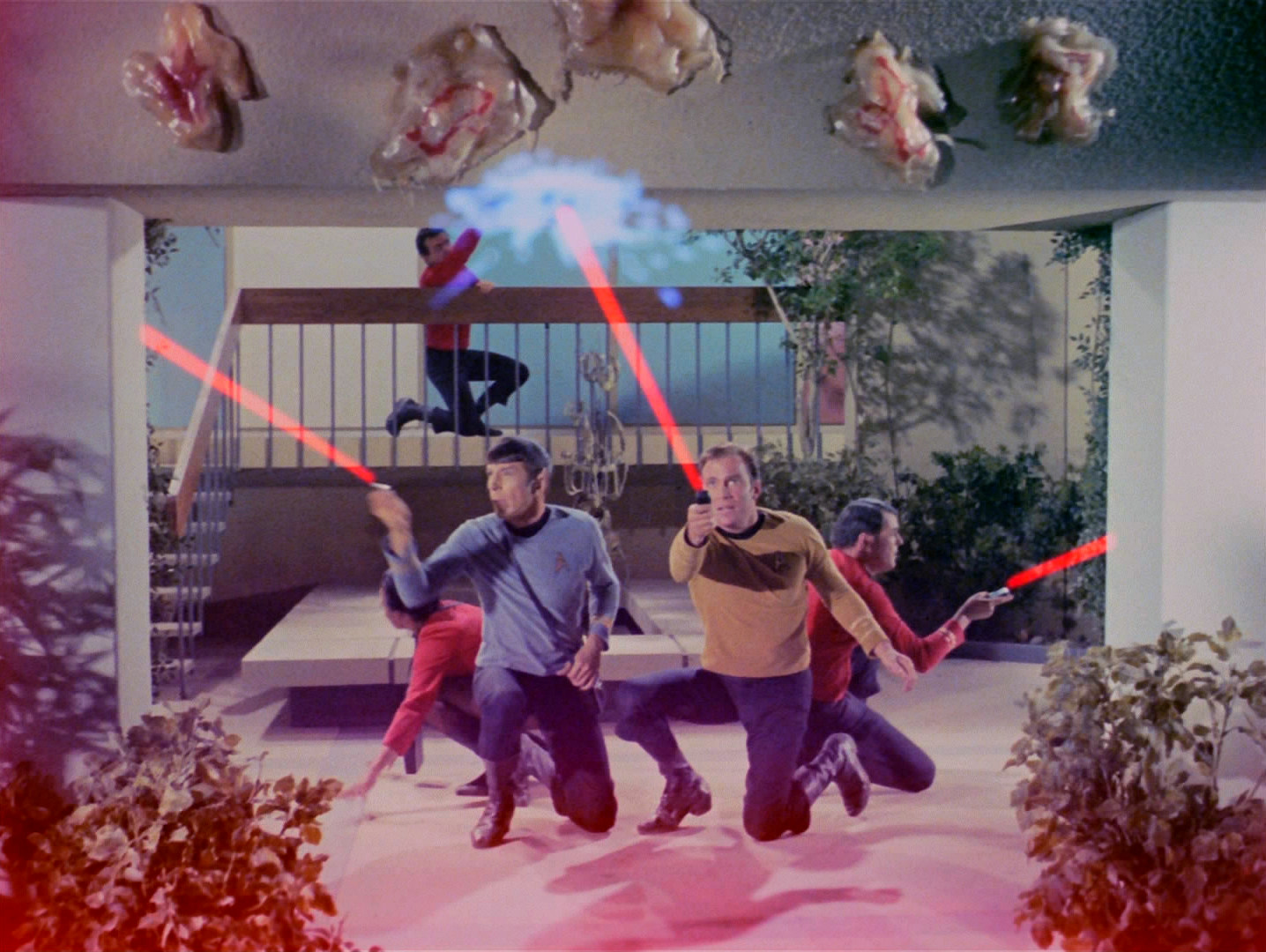
Stardate 3287.2: The Enterprise arrives at Deneva, a Federation colony where a so far unexplained mass insanity could have broken out, as on a couple of other planets before. The bridge crew witnesses how a Denevan heads directly for the system's sun, only to exclaim "I'm free!" briefly before his ship burns up. On the planet surface the landing party is attacked by inhabitants of the colony with clubs. Kirk's brother George, who is stationed on Deneva, is found dead. His wife Aurelan is taken to the Enterprise where she dies after fighting something in her body. Only Kirk's nephew Peter survives. The landing party finds unknown aliens in a building, one of which attacks and infects Spock. Back on the Enterprise Spock runs out of control but later manages to suppress the alien parasite successfully. McCoy devises a method to destroy the parasites on the planet with intense radiation of the kind that killed the one on the Denevan ship close to the sun. He exposes Spock to that light to test the procedure. Spock, who refuses to wear protective goggles because there are none on the planet either, loses his eyesight. Briefly later McCoy discovers that it would have been sufficient to limit the exposure of the parasites to UV radiation, so Spock's sacrifice was useless. UV satellites launched from the Enterprise clean the planet from the infection. In the meantime Spock's eyes have recovered. They were actually protected by an inner eyelid, a special Vulcan trait.
Review
The first season closes with an exciting episode and a fight against a truly alien enemy. And although the episode was made with rather crude special effects by today's standards and with aliens that look like pancakes, it is quite scary. Well, the neural parasites merely appear as "things" that need to be destroyed, rather than as possibly sentient entities with a right to live. But I agree that given the circumstances there is really no other way but to kill them.
There is huge personal involvement for Kirk in this episode, considering that he first finds his dead brother, then witnesses how his sister-in-law dies and still has to worry about his young nephew, who has lost his parents and who will suffer a great deal once he wakes up. It is a shame that the story totally neglects this part in the following. Kirk's nephew is never shown again once he is aboard the ship. We never learn what would become of the boy, while everyone is very much concerned about Spock's blindness after his melodramatic self-sacrifice, and accordingly happy when he regains his eyesight.
And while the plot is overall intelligent and rather plausible, the screenplay is rife with avoidable scientific and logical errors.
Annotations
- Inconsistencies:
- At the beginning of the episode it is only a theory that Deneva may have been struck by the phenomenon of mass insanity. It appears that contact with the planet was lost only recently. But Aurelan Kirk says that the parasites came to Deneva as long as eight months ago. This would mean that during all this time no one was in contact with the planet, neither with a starship nor via subspace radio. Or that any visitor who could have provided a thorough report immediately came under mind control as well. Is Deneva so awfully isolated? Furthermore, it would imply that the inhabitants must have been fighting the creatures in agony for the whole time. All this is hardly believable.
- Kirk surmises that the parasites must have come all the way from another galaxy. How? They need starships to cross even the "short" interstellar distances in our galaxy.
- Spock adds to Kirk's supposition that they may have come "from a place where our physical laws do not apply." With all due respect, just because the creatures are resilient to Federation weapons, this is a far-fetched assumption. Actually, the fact that they interact with the humanoid nervous system is solid proof that they must have evolved on a quite "normal" planet with a humanoid population.
- Based on the theory that something about the Denevan sun must have killed the neural parasite on the Denevan ship, McCoy says he has tried everything to destroy the creature, explicitly including all sorts of radiation. But then Kirk suggests that simple light might kill the parasites. Since when is light no form of radiation? And if McCoy tries out everything, wouldn't he start with exposing the creature to exactly the radiation (or light) levels close to the sun? Why should he even bother trying anything else than that? And ironically it even turns out that UV radiation kills the parasites. In other words, the most obvious form of radiation coming from a star.
- Spock and McCoy are well aware that the intense light they are going to bombard the planet with would do permanent damage to the inhabitants' eyes. Why does Spock agree to an experiment on him that would almost definitely leave him blind, if he could simply use goggles? And even if there were any use in his self-sacrifice, wouldn't one eye have sufficed?
- Well, Spock may have subconsciously relied on his inner eyelid. But why doesn't Bones know about this inner eyelid?
- When McCoy discovers that he wouldn't have needed the whole spectrum to kill the parasites, he makes it sound like the "blinding white light" blinded Spock, because the eyes are sensitive to it. However, rather than the visible light, the same intensity of UV would do permanent damage to a retina.
- So the UV satellites would create enough light to kill neural parasites on Deneva. But the parasites like to hide in the dark, as is even explicitly stated in the episode itself. The satellites can do absolutely nothing against the majority of creatures that are likely in dark cellars.
- Remarkable location: The surface of Deneva is represented by the futuristic headquarters of TRW in Redondo Beach, California. This is one of the most impressive location shoots in TOS, second only to those at Vasquez Rocks.
- Remarkable dialogue: "I said, please don't tell Spock I said he was the best first officer in the fleet." - "Why, thank you, Doctor McCoy." - "You've been so concerned about his Vulcan eyes, Doctor, you forgot about his Vulcan ears." (McCoy, Spock, Kirk)
- Remarkable appearance: William Shatner appears as the dead George Kirk.
- Remarkable fact: The mass insanity and therefore the neural parasites are traveling through the galaxy on an almost straight line. The first known incidence was in the ancient civilization of Beta Portolan. 200 years ago, Levinius V was struck, then Theta Cygni XII. The last was Ingraham B, two years ago.
- Remastering: In the remastered version we get to see the UV satellites for the first time.
Rating: 6