The Original Series (TOS) Season 2 Reviews
CatspawMetamorphosisFriday's ChildWho Mourns for Adonais?Amok Time
The Doomsday MachineWolf in the FoldThe ChangelingThe AppleMirror, MirrorThe Deadly Years
I, MuddThe Trouble with TribblesBread and CircusesJourney to BabelA Private Little War
The Gamesters of TriskelionObsessionThe Immunity SyndromeA Piece of the ActionBy Any Other Name
Return to TomorrowPatterns of ForceThe Ultimate ComputerThe Omega GloryAssignment: Earth
Catspaw
Synopsis
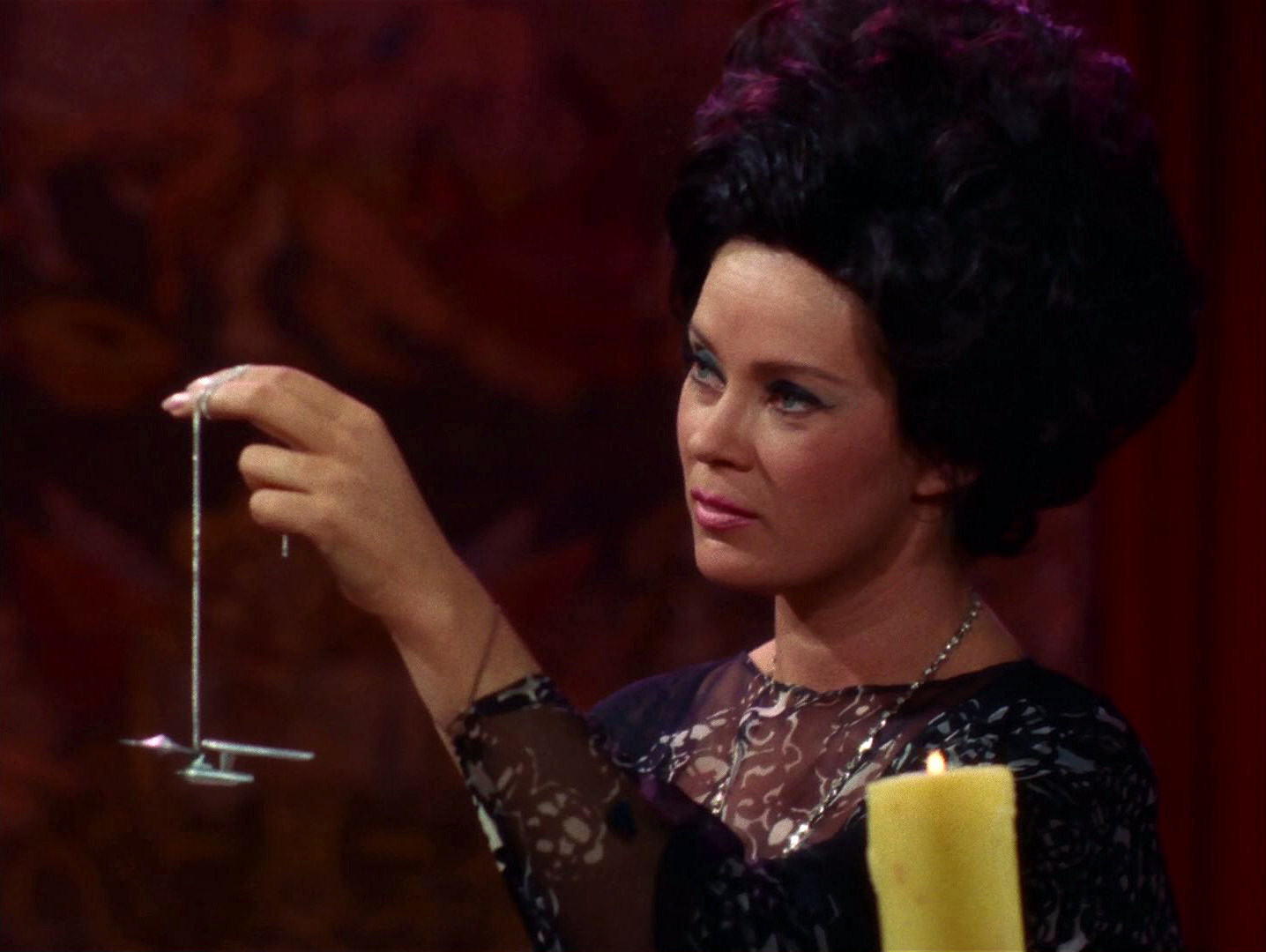
Stardate 3018.2: Two alien beings kill a crewman and hold Scott and Sulu captive on a planet. When Kirk, Spock and McCoy beam down, they enter a castle of horrors created to scare the human crew members. They soon become hostages likewise, guarded by Scotty and Sulu, whose minds are being controlled by the aliens. The aliens even threaten to destroy the ship. However, when their matter transmuter, a technological version of a magic wand, is destroyed, they turn out to be two tiny creatures not able to survive in the planet's atmosphere.
Review
Curses, witches, black cats, castles, dungeons, voodoo, magic wands, screams and mist. "Catspaw" does not seem to leave out a single horror stereotype. The episode was obviously intended to serve as Star Trek's contribution to Halloween (the only time such a holiday special was ever made). Moreover, after the still mostly original first season the episode marks the beginning of a series of plot pillaging. Its setting is essentially a rehash of "The Squire of Gothos". In both episodes we have powerful aliens play with the Enterprise for no apparent reason, in both cases they wind up as measly creatures, and both times the story takes place in a castle built to look like those on Earth. And perhaps most importantly, Trelane as well as Korob and Sylvia have been missing a few hundred years of human development. The idea of the mind-controlled crew is similar to "Return of the Archons", especially since it's Sulu yet again.
Although Crewman Jackson's death is supposed to create some suspense, the first ten minutes of the episode, with Kirk, Spock and McCoy investigating the planet and the castle are quite boring. Spock surmises that the castle of horrors was purposely created with everything that scares man most. But who was afraid of black magic in the late 20th century, and who would still be in the 23rd century? Kirk, McCoy and Spock are impressed just by the mere fact that someone took the pain of building all this. They could have been held captive in a high-tech prison just as well, with all kinds of gadgets that would intimidate them rather than a dungeon. Spock's later explanation that it may help Korob and Sylvia tap human minds through the subconsciousness is not conclusive either. Only his theory that the two must be extragalactic aliens who pose as humans makes sense in the following.
The only interesting conversation of the episode takes place between Korob and Sylvia, who have a disagreement about their new sensations as human beings. I would have liked to see that explored more consequentially. So rather than this episode, "By Any Other Name" will be remembered for its extragalactic aliens who struggle with their existence in human bodies, although "Catspaw" is the original. Well, at least it is a nice twist that Kirk's art of seduction fails on Sylvia, and that Korob is the one who eventually helps the crew, rather than her.
Overall, focusing on the superficial effects (although they are not very good anyway), science fiction elements are largely missing. Especially the final ten minutes of the episode are silly. Sylvia mutates to a giant black cat who chases the crew through the corridors of the castle? Come on! In the end, the transmuter's broken, the magic is over, the creatures are dead, that's it. We will never know who they really were and what they actually wanted besides the usual motive of conquering the galaxy. I only liked that, for once, a dead member was commemorated in the end instead of the usual inappropriate humorous remarks from Kirk, Spock and McCoy.
Annotations
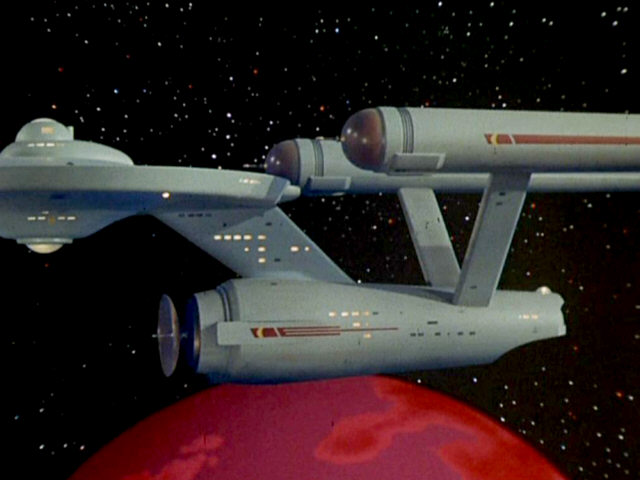
- Remarkable scene: While I generally don't care for all the mumbo-jumbo, I like the Enterprise miniature that Sylvia uses like a voodoo doll, heating up the hull by holding it over a burning candle.
- Remarkable character: Chekov appears for the first time, and he gets at least a few lines while most of his superiors are trapped on the planet.
- Remarkable set dressing: The refectory is adorned with what looks like two Prussian infantry flags, ca. 1800.
- Crew losses: 1
Rating: 1
Metamorphosis
Synopsis
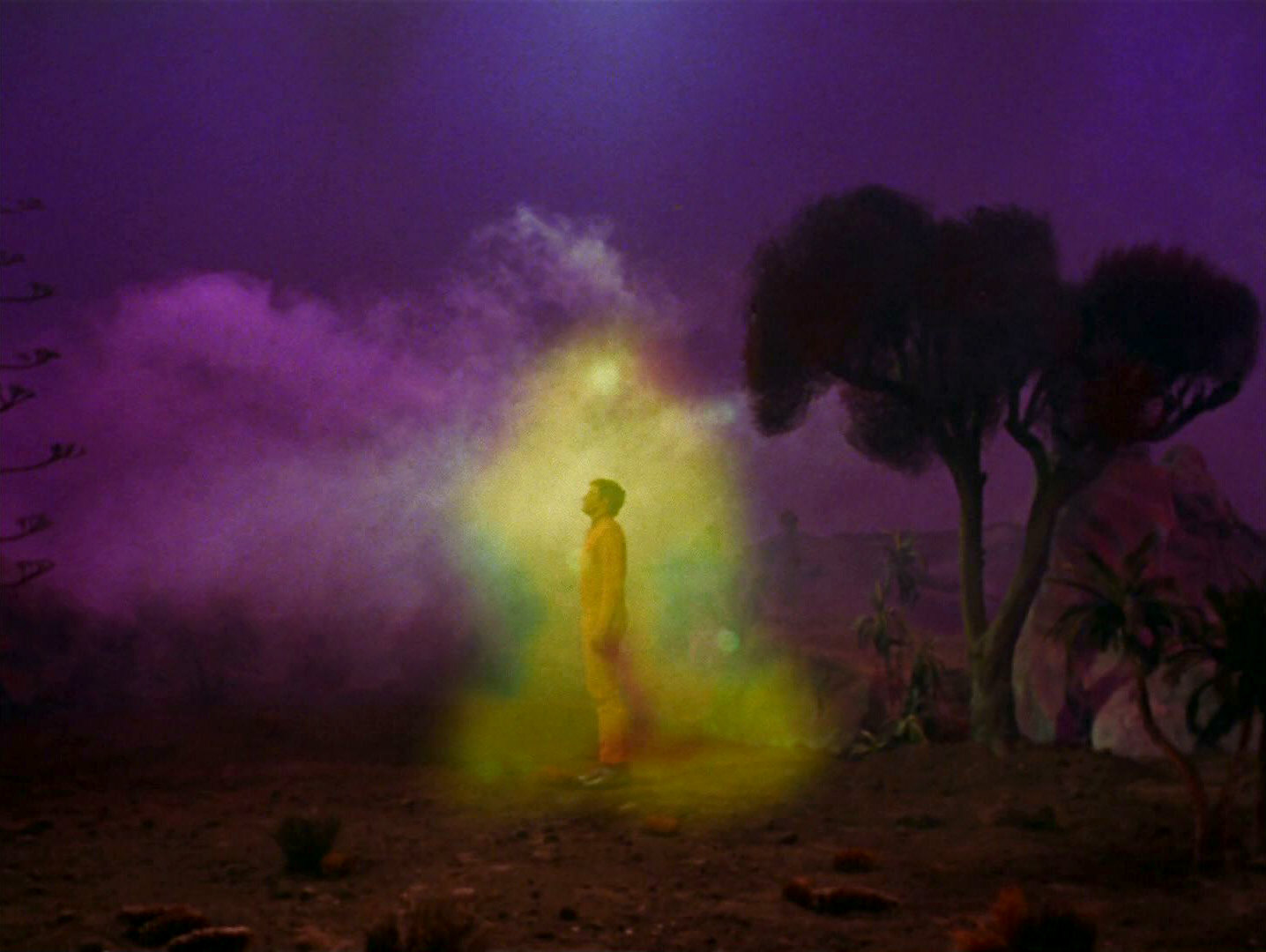
Stardate 3219.4: Kirk, Spock, McCoy and the Federation official Nancy Hedford, who suffers from Sakuro's disease, are on a shuttle, when they encounter a phenomenon in space that forces them to land on a planetoid. There they meet a man who has apparently been living there all alone, and who is reluctant to tell the whole truth. This man turns out to be Zefram Cochrane, the inventor of the warp drive who should have died a long time ago. The other inhabitant of the planet is the "Companion", a strange energy being, who lives in a sort of symbiosis with Cochrane. Kirk and Spock first attempt to fight against the Companion in vain, but then they manage to establish a communication using a modified universal translator. The Companion, who does not understand human emotions and desires, eventually takes over the body of Nancy Hedford, who was going to die. Since the Companion is unable to leave the planet, Cochrane decides to stay behind with her. Kirk promises that he will keep the whole story secret.
Review
I like how this story unfolds, in which Kirk and Spock first choose the wrong way and fight the Companion in vain. Then McCoy suggests to "try a carrot instead of a stick", which will prove successful with the help of the universal translator. This is the spirit of Star Trek. Also, it is interesting to see how the Companion fails to understand human emotions and motivations before she can actually experience them. Well, this is a frequently recurring theme especially in the second season, but it is shown here with the due profundity for the first time. Finally, the episode has a certain weight because it introduces Zefram Cochrane, although the story could work just as well without him being the inventor of warp drive. Although it is both delightful and touching in essence, I have a lot of issues with this episode. There are badly conceived characters, huge plot holes and serious ethical problems that are more than just oversights.
The character of Nancy Hedford is unlikable right from the start, and all she can do is complaining and lamenting. We may give her the credit of being very ill, but ultimately her whole annoying conduct is too obviously supposed to make her character easily disposable, to justify that the person is killed and only the body survives. Hedford has just one scene that shows her in a better light, when she regrets that she has never been loved ("I've been good at my job, but I've never been loved.") But even this is an insidious preparation for the death of her character, as if being killed and replaced with the loving and loved Companion would give her that fulfillment.
Zefram Cochrane was an old man when he arrived, but his body has been rejuvenated by the Companion. It almost seems that the Companion rejuvenated his mind even further, because at first he is naive as a little boy. Well, he seems to have lost his sense of reality during the 150 years with the Companion, which is no surprise, since he didn't have anything useful to do. The Companion provided him with everything he needed, but obviously nothing more, nothing that could have extended his mind. Kirk offers him the opportunity to escape, and after some pondering he grasps it. So far his character is consistent. Only when it is revealed that the Companion is female, something strange happens. As Spock predicts, "The matter of gender could change the entire situation." For one and a half century Cochrane has been quite content with the mysterious supernatural Companion taking care of him, but now that he can speak to it like to a human being and that he learns a possible reason he suddenly feels abused as "fodder for an inhuman monster". This is paradoxical, it just doesn't make sense.
The question is posed in the episode but is never really answered how an entity without substance such as the Companion can possibly be female. Only because the universal translator has been programmed to select an appropriate voice and has decided in favor of a female one? Perhaps this was not even based on real facts but only happened with just a probability of 1:2. "The idea of male and female are universal constants, Cochrane. There's no doubt about it. The Companion is female," as Kirk says. It is almost as if he talked to the viewers, rather than to Cochrane, giving a lame excuse to carry on with an absolutely implausible idea that the plot is built upon.
But the most problematic part of the episode is still to come. It is quite clearly Hedford's body and not her consciousness that is dying from Sakuro's disease. The Companion says that she can't help her, which may be the truth. Still, after removing Hedford's consciousness from the body, the latter is suddenly perfectly healthy again. Well, the Companion says that Nancy Hedford is still alive in some fashion (she refers to herself as "we"), but the facts disprove her, as the entity in Nancy's body suddenly speaks with the Companion's voice and does not behave at all like Nancy Hedford. In my opinion Nancy Hedford's consciousness is gone. In any case McCoy accepts this odd development without any protest, as if it were perfectly okay for alien entities to let human beings die and take over their bodies. Even if we explain Sakuro's disease as an incurable neural damage that may have left an otherwise curable body to be taken over by the Companion, it is the final step in the hypocritical scheme to introduce and then kill off an unpleasant character for the benefit of a more pleasant one. Also, there is the huge problem for Kirk and McCoy to explain why Nancy Hedford wouldn't return with them. It should have been addressed in some fashion, but the way everything is fine in the end and the disrespectful statement that "another woman somewhere" could do her work it only adds insult to injury.
There are still more questions pertaining to the actual nature of the metamorphosis that takes place in the end. So the Companion controls Hedford's body now. Is she all human? It seems so, because now the Companion begins to understand Cochrane, and the two are subjected to normal aging from now. But then why is it still impossible for her to leave the planet, because her "life emanates from this place"? And why is she still speaking with her reverberant voice instead of Nancy Hedford's? It all doesn't fit together.
Annotations
- Nitpicking: The set decorators didn't bother to relabel the shuttle, to account for its loss in "The Galileo Seven". It is still the Galileo NCC-1701/7.
- Remarkable quote: "There are certain universal ideas and concepts common to all intelligent life. This device instantaneously compares the frequency of brain wave patterns, selects those ideas and concepts it recognizes, and then provides the necessary grammar." (Kirk, explaining how the universal translator works), "Our species can only survive if we have obstacles to overcome. You remove those obstacles. Without them to strengthen us, we will weaken and die." (Kirk, to the Companion)
- Remarkable facts:
- Nancy Hedford was on a diplomatic mission to Epsilon Canaris III to prevent a war.
- Sakuro's disease is extremely rare. "The chances of anyone contracting it are literally billions to one," according to McCoy. Well, for some reason rare diseases are quite common in Star Trek.
- Remarkable misconception: Kirk's line "Zefram Cochrane, of Alpha Centauri" made many Trek fans erroneously believe for decades that he is an alien, although the episode clearly states that he is human.
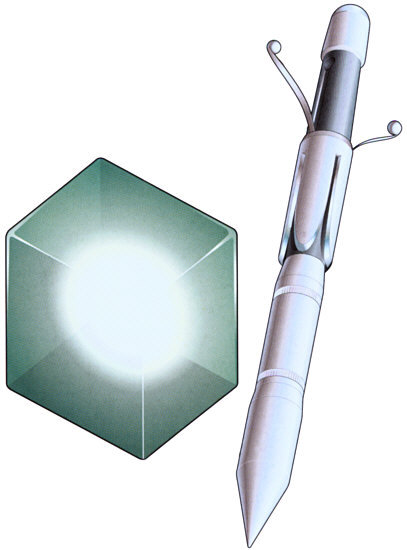
- Remarkable prop: the universal translator, seen here for the first and only time
Rating: 3
Friday's Child
Synopsis
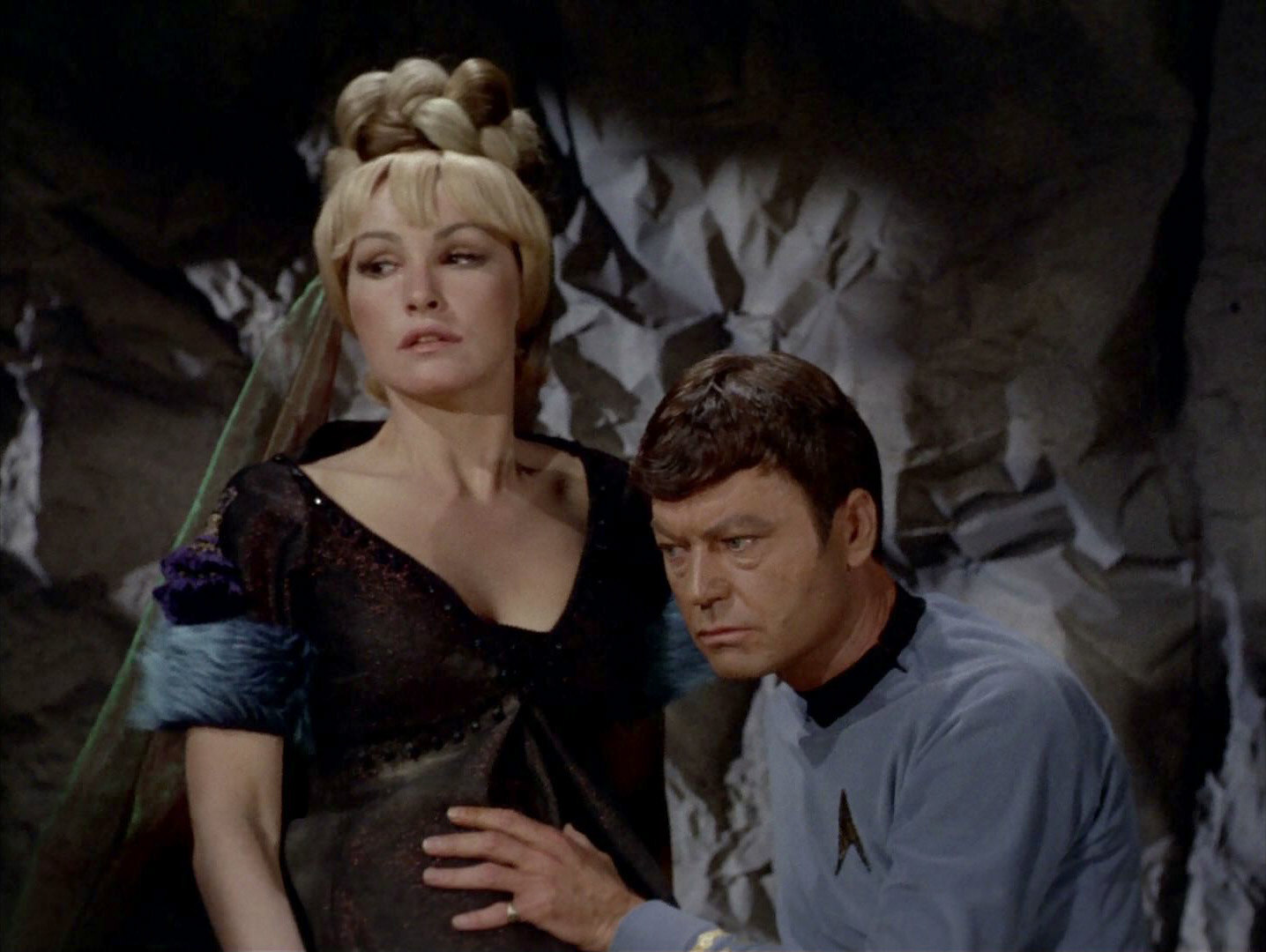
Stardate 3497.2: Kirk, Spock, McCoy and a security officer beam down to the planet Capella IV to obtain the mining rights for the mineral topaline from the indigenous antiquated warrior civilization. Upon their arrival, the security officer spots a Klingon among the Capellans, pulls his phaser and is promptly killed by a Capellan. Nevertheless the landing party hand out their weapons to the Capellans. In the following it becomes clear that, while Teer Akaar, the leader of the Ten Tribes of Capella, welcomes the offer of the Federation, his opponent Maab favors the Klingons. When a riot breaks out in the warrior camp, Maab kills Akaar. Akaar's pregnant wife Eleen has to die too according to the Capellan laws, but Kirk prevents her execution and is now condemned to die too for touching her. There is no help from the Enterprise that has been lured away from the planet with a false distress call. The three officers escape together with Eleen, who delivers a son in a shelter in the hills. But she runs away to her people, not willing to accept her baby. During another skirmish Kras, the Klingon, gets hold of a phaser and disintegrates Maab, whereupon he is killed by the Capellans. The Capellans now accept Eleen's new-born son, Leonard James Akaar, as their new teer and also sign a mining agreement with the Federation.
Review
Although it's a tad too much reminiscent of "Errand of Mercy", the basic idea of this episode isn't all that bad. The Federation needs the valuable mineral topaline that can be found on Capella IV. And since the Klingons have the same intentions, Starfleet may have bent some rules, perhaps even the Prime Directive, to obtain the mining license from the Capellans, although these people are obviously not ready to deal with technologically and culturally advanced aliens. I like the idea of the many taboos that govern the lives of the Capellans and that are in strong contrast to what is deemed rightful and common sense in the Federation, although the aspects of their culture could have been worked out still better. And while the three officers' escape with the pregnant Eleen winds up as occasionally rather clownish, the good deal of action, some nice cunning ruses and the shooting on location at Vasquez Rocks make up for this weakness to some extent.
I have major qualms with the guest characters, however. They strike me as being clichéd, purposefully weak and easy to elude. So Kirk takes an inexperienced security officer to a planet where it is clear that he would run into experienced warriors. The redshirt spots Kras, unwisely pulls his phaser and is promptly killed. Kras makes a good point with his snide remark, "I am unaware of any state of war between our peoples, Captain. Or is it your policy to kill Klingons on sight?" Maab is still the most convincing guest character, with his desire to keep up the traditions of his people by dealing with the aliens who he thinks understand his culture, while still trying to make the best bargain. But his role should have been bigger, and at some point he should have recognized that he has been pushed around by Kras all the time. And it is a letdown that he, like everyone else in the episode, is killed almost casually and without an emotional impact. Kras is a dishonest, sneaky and cowardly Klingon and is miserable enough as such. But he doesn't even fulfill a real purpose in the plot aside from erratically grasping opportunities to stir up trouble, with his words or with a phaser. Whether his function is rather that of a diplomat, a spy or a warrior, he totally fails in any of these. I think the episode would have worked better without him and with a conflict between Kirk and a stronger Maab on the planet, and between the Enterprise and a Klingon ship in space. With her naive obstinacy Eleen could have been quite entertaining but comes off as rather annoying. She is just a dead weight that the three Starfleet officers have to drag along (almost literally in the case of McCoy who is the only one allowed to touch her). And every situation involving her that starts off as serious winds up as inappropriately comical or cutesy.
Annotations
- Nitpicking: So McCoy was stationed on Capella IV, and if only for a few months. But what could he have done there, considering that the Capellans refuse medical aid for the weak? Perhaps he was just a covert cultural observer?
- Remarkable dialogues:
- "McCoy. Bring our child." - "Our child?" - "I'll explain later." - "That should prove very interesting." (Eleen, Kirk, McCoy, Spock)
- "Oochy-woochy coochy-coo. Oochy-woochy coochy-coo." - "Oochy-woochy coochy-coo, Captain?" - "An obscure Earth dialect, Mister Spock. Oochy-woochy coochy-coo. If you're curious, consult linguistics." (McCoy, Spock, Kirk)
- "The child was named Leonard James Akaar?" - "Has a kind of a ring to it, don't you think, James? " - "Yes. I think it's a name destined to go down in galactic history, Leonard. What do you think, Spock?" - "I think you're both going to be insufferably pleased with yourselves for at least a month, sir." (Spock, McCoy, Kirk)
- Remarkable quote: "We Klingons believe as you do - the sick should die. Only the strong should live." (Kras, to the Capellans)
- Remarkable fact: Sulu says the maximum speed of a freighter is Warp 2.
- Remarkable prop: Sulu's scanner that pops up in a quite interesting fashion from his console
- Crew losses: 1
Rating: 3
Who Mourns for Adonais?
Synopsis
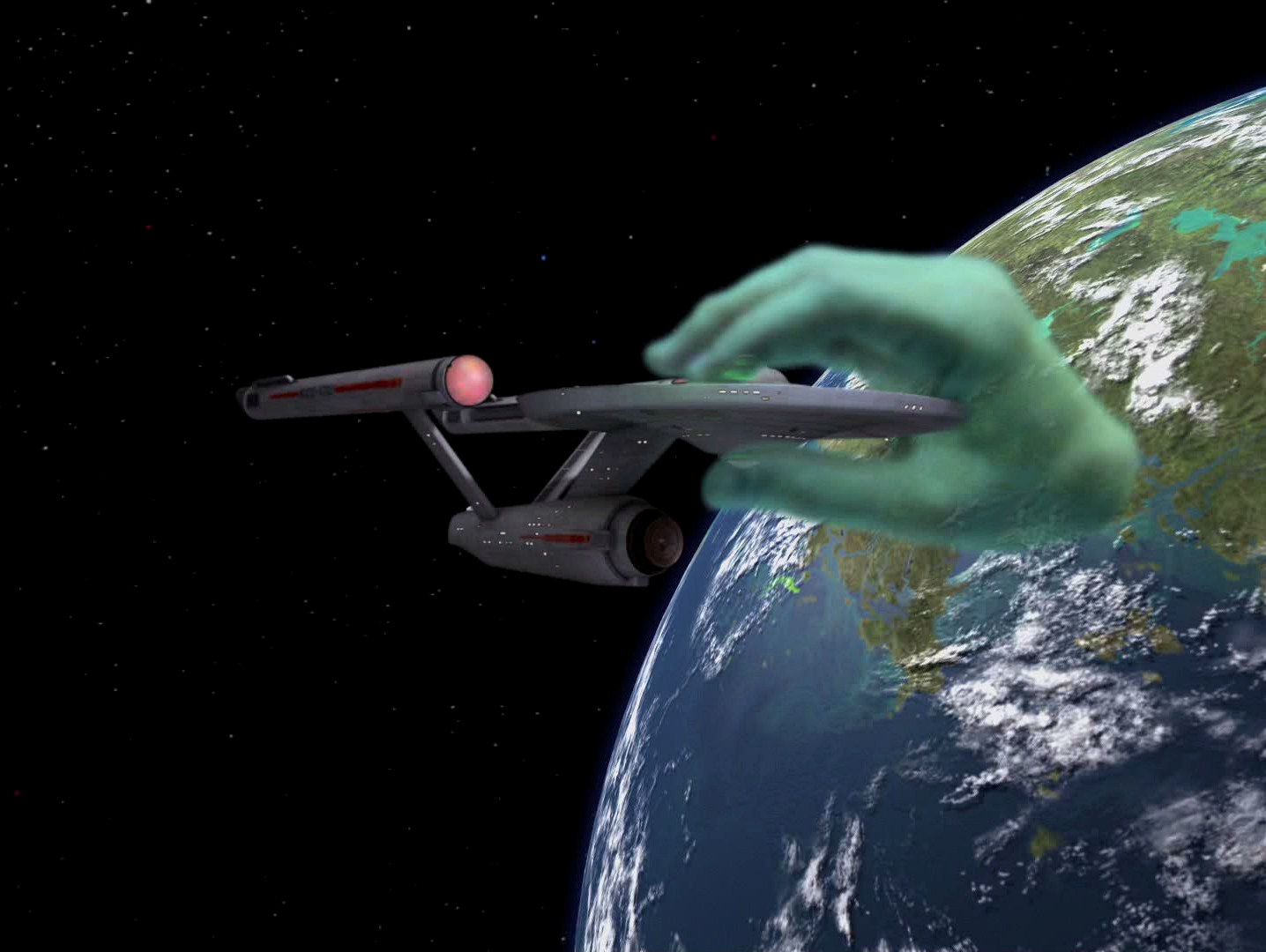
Stardate 3468.1: While approaching the planet Pollux IV, the Enterprise is stopped by a forcefield shaped like a giant human hand. The face of a humanoid appears on screen and invites a landing party to beam down. The man identifies himself as Apollo, member of a race that came to Earth thousands of years ago and was worshipped as gods in ancient Greece. He demands just that from the crew of the Enterprise too, which Kirk naturally refuses. Soon Apollo's interest focuses on the attractive Lt. Palamas, who reciprocates his feelings. Kirk puts straight that it is her duty to repel Apollo, while on the ship Spock has found a way to penetrate the forcefield and fire on the power source in Apollo's "temple". The desperate Apollo recognizes that his time is over and vanishes.
Review
"Who Mourns for Adonais" attempts to be visually powerful, as we have the hand-shaped forcefield and an alien whose body can grow to a huge size. But plot-wise there isn't much special about it. It is another incidence of the common TOS trope in which a supernatural being holds our crew as pets for their mere enjoyment but winds up as a pitiful creature in the end. In addition, the episode starts something like a "mini-arc" in the second season with gratuitous references to Earth's history on alien planets. Well, the worse installments of this kind are still to come, and the idea that Apollo's people, an unnamed alien species, once ruled as Gods over ancient Greece was not as hackneyed in the 1960s as it unquestionably is today. But ultimately it hardly matters whether it's really the god Apollo, someone who pretends to be Apollo or just any other supernatural being, perhaps one related to Trelane from "The Squire of Gothos". And speaking of a mini-arc, this episode marks the beginning of Scotty's streak of bad luck with women, which will continue in "Wolf in the Fold" and in "The Lights of Zetar" (as Mira Romaine will leave the ship without him).
I absolutely hate that Lt. Palamas almost becomes a second Marla McGivers ("Space Seed") - a woman who, in a stereotypically sexist notion, has a romantic desire to abandon her job to be with the next best macho that comes along. Dr. McCoy even sort of foreshadows this development in the beginning when he sees that Scotty feels attracted to her and notes: "And he thinks he's the right man for her, but I'm not sure she thinks he's the right man. On the other hand, she's a woman. All woman. One day she'll find the right man and off she'll go, out of the service." Even if he is not exactly talking of Palamas leaving and betraying Starfleet for an alien tyrant, isn't that a quite antiquated stance? At least Palamas creates an unexpected plot twist when she soothes Apollo and thereby foils Kirk's plan to provoke him and exhaust his energy. The actual resolution, that it's as easy as destroying the power source to disable the alien and bring the whole mumbo-jumbo to an end, isn't very original though.
What I like is the convincingly unhappy ending when Apollo has to admit that his time is over and vanishes into thin air. While I don't feel too sorry for the lost love of Lt. Palamas, I can understand Kirk when he regrets the destruction of important evidence of Earth's history.
Annotations
- Nitpicking: Apollo as well as Kirk speak of 5000 years since the "gods" came to Earth. But the ancient Greek culture that Apollo keeps referring to all the time didn't evolve prior to 800 B.C., so it should be more like 3000 years - unless he counts in the otherwise unmentioned Mycenaean civilization.
- Remarkable dialogue: "Your fathers knew me, and your father's fathers. I am Apollo." - "And I am the Tsar of all the Russias." - "Mister Chekov." - "I'm sorry, Captain. I never met a god before." - "And you haven't yet." (Apollo, Chekov, Kirk)
- Remarkable quotes:
- "...but do not bring that one - the one with the pointed ears. He is much like Pan, and Pan always bored me." (Apollo, about Spock)
- "If she fails us, we'd better get used to herding goats." (Kirk, about Palamas's loyalty)
- "Love you? Be logical. I'm not some simple shepherdess you can awe. Why, I could no more love you than I could love a new species of bacteria." (Palamas, somewhat reluctantly, to Apollo)
- Remarkable fact: The electric eel on Earth and the giant dry worm of Antos IV are among the creatures that can channel energy through their bodies.
- Remarkable background fact: According to The Star Trek Compendium, an alternative ending would have revealed that Lt. Palamas was pregnant by Apollo.
Rating: 3
Amok Time
Synopsis
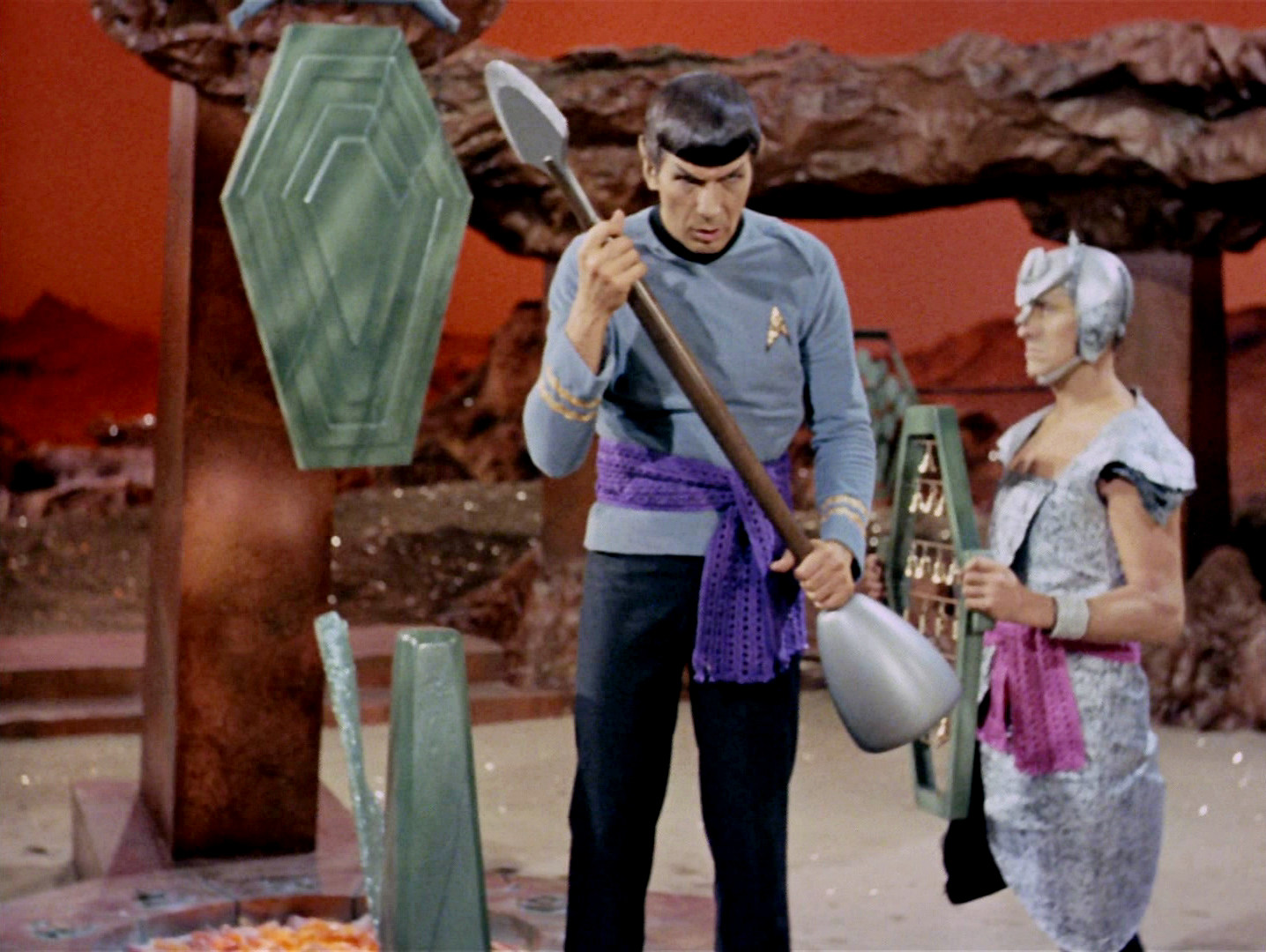
Stardate 3372.7: Spock is in a state of mental unrest and requests a shore leave on his home planet Vulcan to recover. Kirk, however, has orders to set course for Altair VI to participate in the inauguration ceremony of the planet's president. Spock eventually lets Kirk in on his condition. It is the pon farr, a phase of irrational sexual desire, that manifests itself as the plak tow, the blood fever. It requires him to return to Vulcan to be with his future wife. Otherwise Spock would die. Kirk decides to act against his orders and set course for Vulcan. He and McCoy beam down with Spock to an ancient ritual place. They are welcomed by T'Pau, an influential political figure on Vulcan and by T'Pring, Spock's fiancée. T'Pring, however, demands that Spock fight for her to the death according to the old koon-ut-kal-if-fee ritual - against Kirk. When Spock, still in the plak tow, is on the verge of killing Kirk, McCoy gives Kirk an injection that he says is a tri-ox compound to compensate for the thin air on the planet. But Spock wins the duel and apparently kills Kirk, who is beamed up together with McCoy. Correctly assuming that Spock wouldn't want her now that Kirk is dead, T'Pring is free to be with her new love, Stonn. Spock returns to the Enterprise, ready to resign his commission and be arrested, but is more than lucky to see Kirk alive. McCoy actually gave him a neural paralyzer that simulated the captain's death.
Review
"Amok Time" ranks among the most memorable Star Trek episodes. It leaves a lasting impression on fans and on casual viewers alike, if they were happy enough not to miss this central episode of the series. Most importantly, "Amok Time" provides profound insight into Spock's character and the Vulcan culture. The combination of logic on one hand and the completely irrational plak tow and koon-ut-kal-if-fee on the other hand, is hard to understand. However, after all Vulcan is supposed to be an alien civilization, and exactly this is impressively demonstrated here, as opposed to the many carbon copies of Earth that will still appear especially in this second season. Only Spock's shameful secrecy about his condition has been overdone in my view. At some point earlier in the episode, he should have let in either Kirk or McCoy on the pon farr, and if only to avoid the impression that he has become insubordinate or insane or both. But in a figurative sense Spock is just as embarrassed to speak about his condition as the television networks of the 1960s were to have someone on screen talk about sex.
The episode is certainly among the most exciting of TOS. Yet it starts off quite slowly, and overall the first half of the episode does not build as much tension as may have been possible. The see-saw with the frequent course changes to and away from Vulcan in the first 20 minutes and Spock's increasingly incomprehensible secrecy are even becoming tedious. And so this episode scores only 8 instead of 9 or perhaps even 10 points.
T'Pau, as a figurehead of this culture, somewhat xenophobic and the only person who ever turned down a seat in the Federation Council, is a truly impressive guest character. Celia Lovsky's Austro-German accent ("Dis is de Volcan heart, dis is de Volcan soul. Dis is our vay.") together with the antiquated "thee" and "thy" turns out a fitting contribution to Vulcan's being alien and her being distinguished.
Annotations
- Inconsistencies:
- In light of the long time that humanity already knows the Vulcans, and especially of the events in Star Trek Enterprise, it doesn't make sense that no one, not even McCoy, would be familiar with pon farr and plak tow, and that there would not even be anything in the database about it. But we really shouldn't blame the original episode for that problem, although arguably at least *something* should be known about Vulcan reproduction at that time, and if only sketchy.
- Also, the events on Vulcan should have political or personal consequences for Spock and Kirk because Vulcan is a Federation member planet. And since Kirk explicitly mentioned that he couldn't back out in front of T'Pau of Vulcan, wouldn't she be particularly annoyed that she was fooled, especially since it was her who requested the diversion of the Enterprise to Vulcan, thereby retroactively justifying Kirk's decision not to follow his orders to head for Altair VI? Alas, the pivotal events in this episode, which would have necessitated a follow-up, will never even be alluded to again.
- Remarkable error: T'Pau asks McCoy "And thee are called?", where it should be "thou", and repeats this error a few times.
- Remarkable quotes:
- "We shield it with ritual and customs shrouded in antiquity. You humans have no conception. It strips our minds from us. It brings a madness which rips away our veneer of civilization. It is the pon farr. The time of mating." (Spock)
- "Live long and prosper" (Spock says it for the first time)
- Remarkable absence: Scotty does not appear in this episode, although Spock refers to him as the one who would take over command from him.
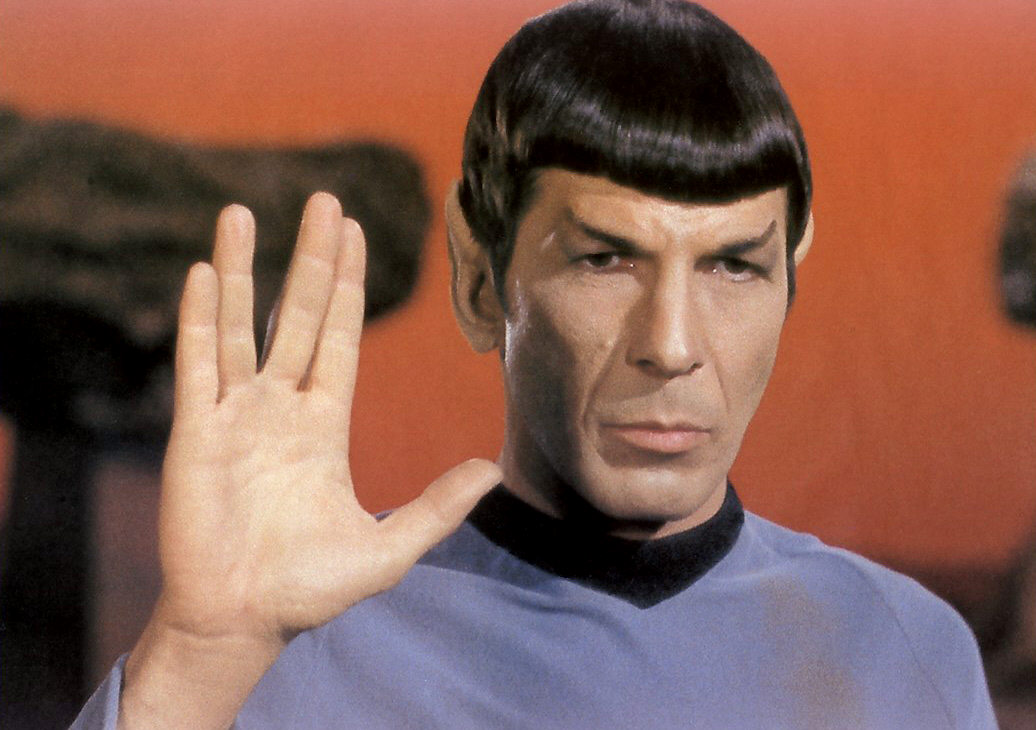
- Remarkable gesture: The famous Vulcan greeting shows up for the first time.
- Remarkable scene: We see Spock grin for about a second when he learns Jim is alive.
- Remarkable score: The somewhat eerie "Spock theme" with the bass guitar sound and the famous fight music first appear in "Amok Time". They would be re-used in a few more episodes.
- Remarkable props: Two ancient Vulcan weapons can be seen: the lirpa, a staff with a crescent-shaped blade on one side and a club on the other one, and the ahn-woon, straps with metal balls at their ends.
- Remarkable planet: Vulcan is established as a hot red world with thin air. This will remain more or less consistent throughout the movies and other series.
- Remarkable foreign language adaptation: The incentive for the complete alteration of the German version is not clear, it could have been to avoid the sexually related topic because Star Trek has always been regarded as a children's series in Germany and was aired in the afternoon. Anyway, in the dubbed version Spock is "space sick" and has terrible nightmares in one of which he is on Vulcan and kills Kirk in the fight. There is no pon farr, no actual stay on Vulcan, no actual fight. No need to mention this version is awful. Interestingly, I first saw the original and then the German version, and I was thinking that I was simply stupid and that I completely misunderstand the original for some time until I discovered what had been done to it.
Rating: 8
The Doomsday Machine
Synopsis
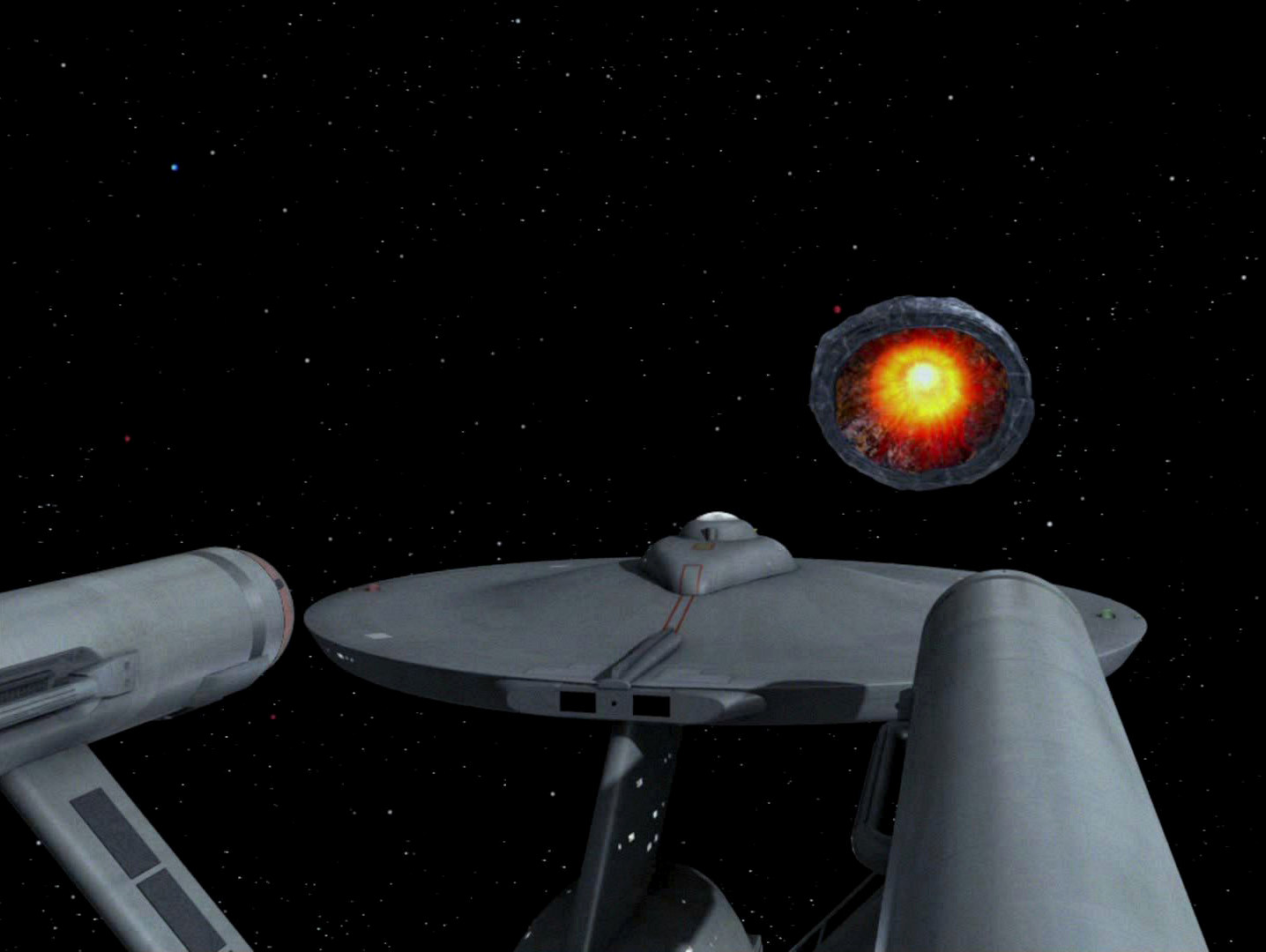
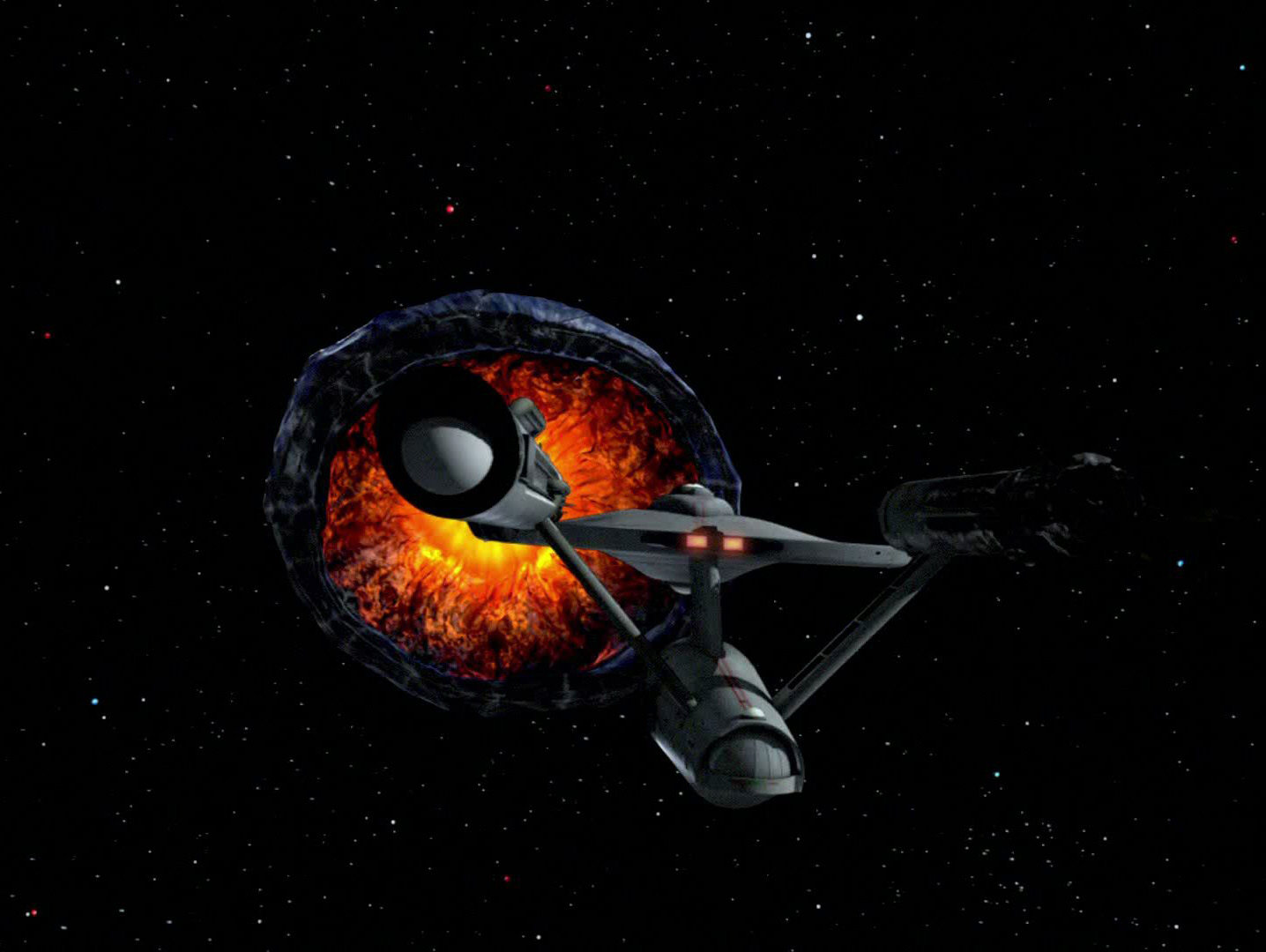
Stardate 4202.9: The Enterprise picks up a garbled distress call from the USS Constellation. After investigating the system L-370 that is completely gone, the missing ship is found adrift in the system L-374, of which only the two innermost planets are left. An enormous weapon has destroyed the planets and converted their matter to fuel. After a desperate fight against that machine only Commodore Decker is still on the crippled Constellation. He tragically beamed his crew down to the third planet that is now destroyed. Kirk, Scott and a repair team stay on the Constellation. Decker, however, is obsessed with taking revenge, takes over command and orders the Enterprise to attack the planet killer. Kirk watches helplessly from the damaged Constellation how his ship is almost drawn into the maw of the machine. As soon as communication is re-established, he orders Spock to relieve Decker of command. Decker is supposed to report to sickbay, but he hijacks a shuttle and steers it right into the planet killer where it blows up. When Sulu notices a drop in the planet killer's energy output right after the shuttle's explosion, Kirk sees a chance to destroy the weapon from inside by overloading the Constellation's impulse engines there. Scott sets up an explosive device with a delay of thirty seconds, and Kirk stays behind on the Constellation to arm it. As the Enterprise's transporter has a malfunction, he is beamed out just a second before the explosion successfully destroys the planet killer.
Review
Wow! This is still one of the most exciting thrillers in Star Trek's history. In particular the scene when Kirk waits for his beam-out from the Constellation that Scotty has turned into a flying bomb is breath-taking, emphasized by the most powerful and perhaps most memorable background music of the series. The plot is credible from the first to the last minute, the dialogues are appropriately brief and to the point in this tense situation, and the directing skillfully weaves together the events in the different locations on the Enterprise and the Constellation. It is also good to see a real space battle after far too many and often rather gratuitous boxing matches in the previous episodes, because of which Star Trek was on the verge of becoming some sort of Western imitation. "The Doomsday Machine" reassures us that Star Trek is science fiction, and this without a parallel Earth or a non-corporeal entity of the week and without a medical or a technical miracle. It stands out from a second season that has a few more great episodes, but will otherwise wind up as being full of such clichés.
Only one negative note: Although there are worse examples of high-ranking officers that go mad in TOS, Matt Decker is extremely irrational and unpredictable in his obsession to take revenge on the planet killer. I don't think that it would have been necessary, just to make Kirk look like a better captain. I think Decker would have been better conceived as someone who is eager to fulfill his duty and accept the ultimate consequences. But within the boundaries of how the character has been written, William Windom does a great job portraying Decker's borderline insanity. And I find it quite fitting that he retroactively redeems himself by showing up a possibility to destroy the planet killer. It is a worthy farewell to a truly tragic character..
Annotations
- Remarkable quote:
- "He gave his life in an attempt to save others. Not the worst way to go." (Kirk, about Decker)
- "Ironic, isn't it? Way back in the 20th century, the H-bomb was the ultimate weapon, their doomsday machine, and we used something like it to destroy another doomsday machine." (Kirk, about the fusion reaction in the impulse drive akin to an H-bomb)
- Remarkable absence: Lt. Palmer replaces Uhura at the communications console. Also, Chekov is not in this episode.
- Remarkable fact: Starfleet Order 104, Section B, Paragraph 1A allows Decker to assume command of the Enterprise. According to Section C Decker could be declared "medically or psychologically unfit", but only after a thorough examination.
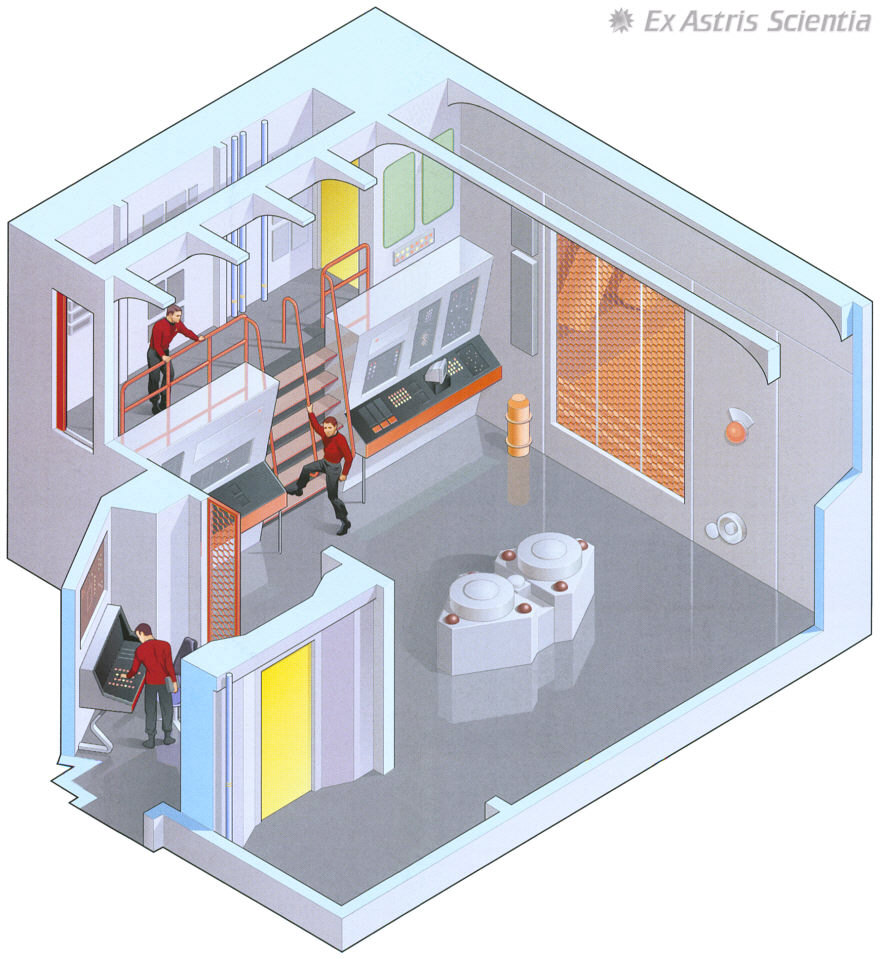
- Remarkable set: This episode is the first to show the redressed main engineering set, with the new dilithium chamber in the center, the ladder to the upper level and the big angular structures on the right side gone.
- Remarkable ship: the USS Constellation, actually an AMT plastic model kit maltreated with a soldering iron. Like every ship, it was replaced with a CGI version for TOS-R.
Rating: 9
Wolf in the Fold
Synopsis
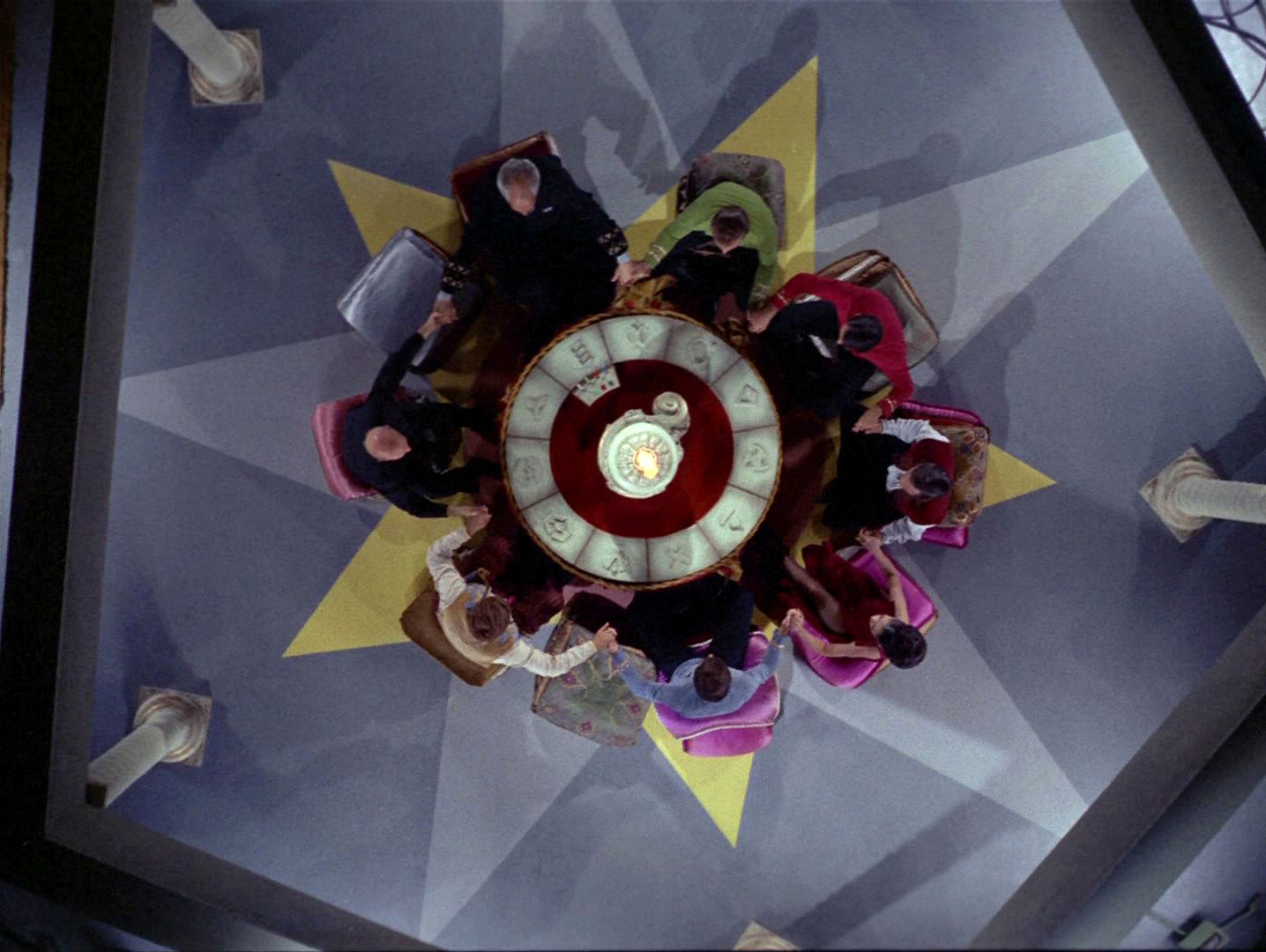
Stardate 3614.9: Scotty is found beside a brutally knifed woman on the hedonistic world of Argelius, but he can't remember anything. Kirk orders Lt. Karen Tracy to examine him with a psychotricorder, but she too is killed when the two are alone. The Argelian official Jaris proposes to find the truth in an ancient empathic ceremony, in the course of which the medium, his wife, is stabbed just as well. Kirk decides that the trial should be continued on the Enterprise. The computer-assisted interrogation and databank research comes to the conclusion that the actual murderer is named "Redjac" aka "Jack the Ripper", an alien entity that subsists on fear and that is traveling from planet to planet. It was hiding in the body of the local administrator Hengist, and now takes control of the ship's computer. With the help of an unsolvable puzzle and tranquilizers for the crew Redjac can finally be expelled from the computer. It returns to Hengist's body and is beamed out into space.
Review
I like the basic idea of the murder mystery, but not what the episode makes of it. The premise is awfully contrived to start with. So Scotty has a problem with women since an accident in which he was hurt because of the fault of a female crew member. The result is a "total resentment toward women", as McCoy puts it. Definitely a horrible trauma that warrants the best possible therapy! So Dr. Kirk and his assistant McCoy take Scotty to a brothel planet hedonistic world and get him a hooker open-minded native woman so he can fuck his frustration away be healed through the power of love. And now guess what happens. Scotty, the man who purportedly holds a grudge against women, kills one of them as soon as he is alone with her. And another one. And yet another one. Fortunately, before there are no women left on the planet and/or the ship, it is revealed that Scotty is as innocent as he looks and that everything is the work of an entity named "Redjac" that has a strange predilection for hearing always the same scream from different women.
Not only the premise, also the minutiae of the story are very sexist. Spock states that the "sensitivity of certain Argelian women is a documented fact", explicitly excluding the men from possibly having mental powers. He also says that Redjac probably "preys on women because women are more easily and more deeply terrified, generating more sheer horror than the male of the species." While Spock may be factually right on both accounts as the story is concerned, his statements reflect clichés of the 1960s. Just as the women's hysterical screams too.
Another thing that bugs me is that Scotty is ostensibly in the focus of attention, yet he is incapacitated almost all the time. Except for one or two level-headed statements he appears like a total jerk. What a waste. Overall the script rather seeks to advance the plot instead of working with the characters anyway. Kirk is the positive exception, as he is trying to defend his friend while heeding the local laws and customs for diplomatic reasons. McCoy provides little more than medical advice, and Spock just some facts that he more or less reads directly from the computer. Among the guest characters Hengist, who is possessed by Redjac, is ironically the most credible one. The attempt to sidetrack the investigation with the conflict between the father and the ex-lover of the first victim fails because it remains on the surface. And regarding Jaris, his wife has just been killed, and there is not the slightest sign of mourning or rage in his role.
Well, initially the idea of Scotty being subject to alien justice is still enthralling. But subsequently the episode hits one low point after the other. While we have seen stranger alien rituals, the séance is unconvincing and fails in being as creepy as it was probably intended to be. The revelation that actually an alien entity that came from Earth is responsible for the murders is not only corny, as we have already had many stories along these lines. It also replaces the novel approach of the murder mystery with a yet another lame story about an alien lifeform that takes control of the ship. In the end, when Redjac's devilish laughter could be heard all over the ship, while the crew (under the influence of McCoy's tranquilizer) was only giggling, I was glad this farce was over.
Three points for the good idea of doing a detective story, for a convincing Kirk and for some nifty details.
Annotations
- Nitpicking:
- When the first women, Kara, is killed, she cries just once. Kirk and McCoy start running. They arrive at the scene, only a few meters away and three seconds later. Kirk looks at the woman and says: "Stabbed. A dozen times." So Redjac must have stunned Scotty, stabbed the victim a dozen times and have run out of sight in these three seconds. Agreed, Redjac is an alien entity. But as Redjac is obviously using physical force, it should take much longer.
- On a related note, Redjac is assumed to subsist on fear. But if it's really that what Redjac wants, he definitely wouldn't kill his victims immediately but rather terrify or torture them.
- Remarkable quote: "Captain, you mean my neck is going to have to depend on some spooky mumbo-jumbo?" (Scott)
- Remarkable score: The "oriental" music in the Argelian café is the same as during Vina's dance in "The Cage". The whole scene looks much the same anyway. The mystery music during the séance is taken from "The Cage" as well.
- Remarkable technology: The psychotricorder provides a detailed account of everything that happened to a person during the last 24 hours. The device is never used in the episode though. Lt. Tracy is killed before she can do the recording, and back aboard the Enterprise Kirk only refers to it as a further option, before he changes his strategy.
- Remarkable facts:
- On Argelius it is custom to use flashing lights for applause, instead of clapping hands.
- The drella of Alpha Carinae V derives nourishment from the emotion of love.
- The mellitus, a cloud creature of Alpha Majoris I, is gaseous in its natural state, but solid at rest.
- Previous mass murders of women took place "in 1932, Shanghai, China, Earth: Seven women knifed to death. In 1974, Kiev, USSR, Earth: Five women knifed to death. In 2105, Martian Colonies: Eight women knifed to death. In 2156, Heliopolis, Alpha Eridani II: Ten women knifed to death. There are additional examples." The name Kesla was given to an unidentified mass murderer on Deneb II. Beratis was the name of a mass murderer on Rigel IV.
- Spock slows down the computer by giving it the priority task to calculate pi to the last digit.
- Crew losses: 1
Rating: 3
The Changeling
Synopsis
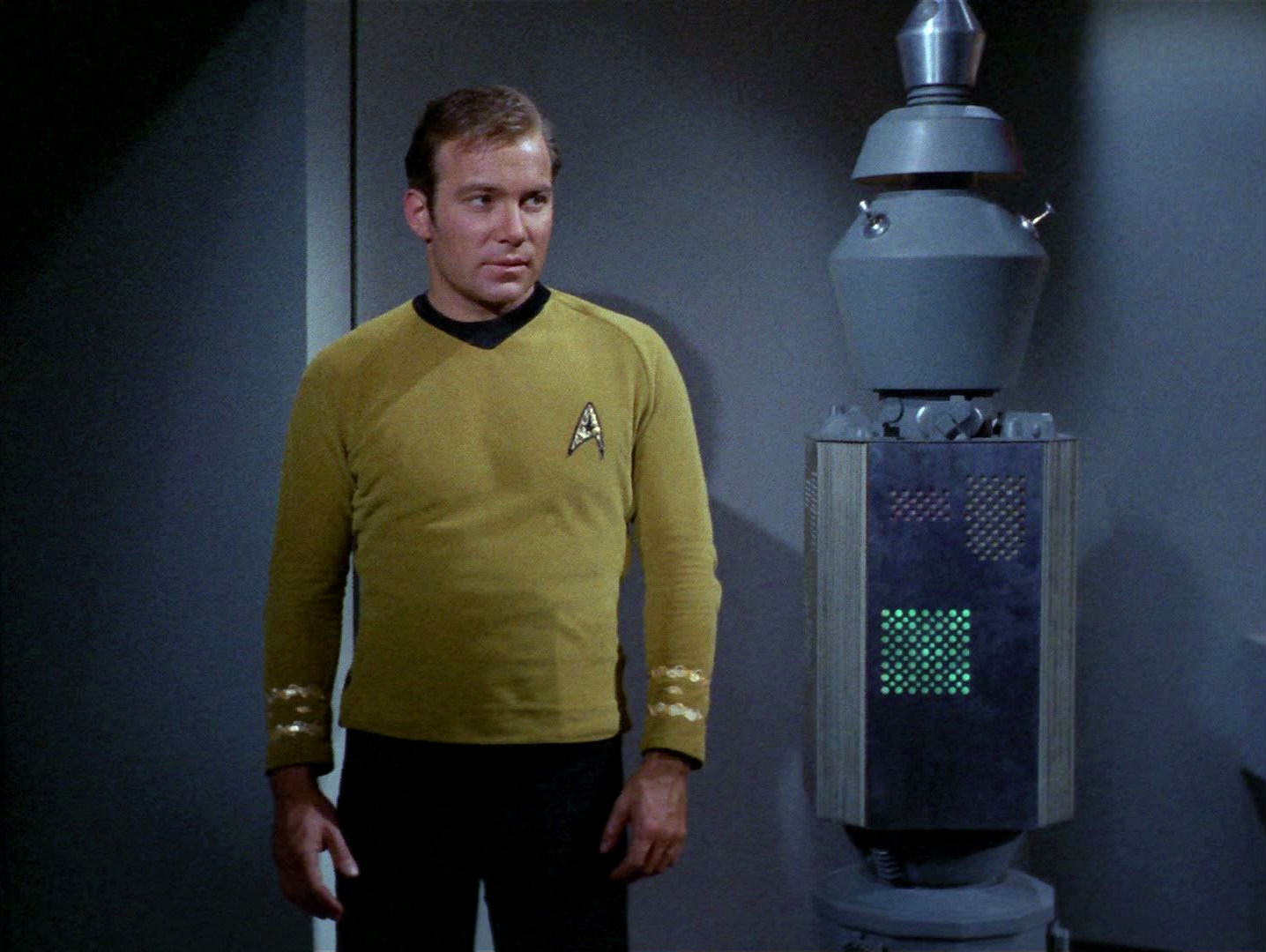
Stardate 3451.9: Contact with the Maluriuan system is lost, and it turns out that all life in that system has been wiped out, a population of four billion. Soon the Enterprise comes under attack too. Only when Kirk sends a hailing, the attacker, a small space probe, stands down and agrees to be beamed aboard. The probe named "Nomad" calls the human crew "primitive" but is of the opinion that Kirk created it. Spock looks up that Nomad was built by a scientist named Jackson Roykirk and was launched from Earth on a mission to seek out new lifeforms in the early 21st century. The probe was declared lost, but obviously survived with damaged memory banks, so it now mistakes "Kirk" for "Roykirk". In the meantime Nomad enters the bridge and erases Uhura's memory when it attempts to read her mind. It kills Scott, who comes to help her, but later successfully "repairs" the "Unit Scott". In a mind-meld Spock finds out that the damaged Nomad actually encountered a powerful alien probe called Tan Ru, built to sterilize soil samples, and somehow merged with it, and it gave itself the new programming to "sterilize imperfect lifeforms". The probe escapes from the holding cell, kills the security personnel and heads for the engine room where it boosts the power of the engines until Kirk tells Nomad to stop it. Kirk reveals to Nomad that he himself, the alleged "Creator", is a primitive lifeform too, which Spock labels as a "foolish mistake". But then Kirk goes even one step further and accuses Nomad of being flawed, for the probe mistook him for its creator. Using antigrav units, Kirk and Spock carry the probe to the transporter room and beam it into deep space, where Nomad carries out its mission to "sterilize imperfection" and destroys itself.
Review
Two damaged probes repair one another and thereby form a new, much more advanced device than either of them, with practically unlimited power supplies and practically unlimited abilities to manipulate technological and biological systems. And there are two somewhat awkward wordplays, that Nomad thinks that Kirk is its creator only because of a coincidence of name fragments, and that the missions to find new life (Nomad) and to sterilize samples (Tan Ru) merge literally to a new task to "sterilize imperfect life". I would have liked the plot to have a more credible basis, such as the one that would be used for "Star Trek: The Motion Picture", that the probe was upgraded by alien machines on purpose. But that really is my only complaint about this episode.
Anyway, "The Changeling" manages to create an uneasy atmosphere that already fascinated me as a child. Actually, it is my first definite memory of Star Trek how Nomad is hovering through the ship's corridors and everyone is afraid of it. This truly scared me and still does - quite unlike "Catspaw" earlier in this season, which attempted to be creepy with hackneyed "castle of horrors" effects. "The Changeling", in contrast, only needs a metal box to accomplish a lot more. It is like the Enterprise has the "Doomsday Machine" on board, a powerful device that could kill anyone who makes the slightest mistake and that could find out about its alleged creator's "imperfection" any time. The situation alone is frightening enough, but the suspense is gradually increased even after the preliminary culmination point when Scott is killed by Nomad and Uhura's memory is wiped out.
One might object that it is becoming tiresome how Kirk discusses a computer to death once again. But this time it really makes sense, as Nomad fails to fulfill its own criterion of perfection, unlike the computer's implausible "death" scene in "Return of the Archons", for instance. And although Kirk isn't the "Creator", it is some sort of personal matter for him to deal with Nomad his way, even against Spock's advice.
Annotations
- Inconsistencies:
- Nomad's first attack hits the Enterprise with "the equivalent of 90 of our photon torpedoes" according to Spock, yet the shields hold at 80%. Wow.
- Didn't Kirk implicitly order the "unit" Singh to keep an eye on the probe? But Singh goes on working as usual and doesn't even notice when Nomad exits the auxiliary control room. Well, that may have saved his life.
- Kirk neither warns the two security guards outside Nomad's holding cell, nor does he explicitly tell Nomad not to harm them. And so it is inevitable that the probe, once it tried to escape, would "sterilize" them. Well, he does tell Nomad not to harm the two following guards, and Nomad still kills them. But Kirk should have stayed with Nomad all along in order not to endanger his ship and his people.
- Uhura's memory was completely wiped out as stated by Nomad, yet it takes no more than a couple of days to re-educate her.
- Remarkable quotes:
- "Non sequitur. Your facts are uncoordinated." (Nomad, several times)
- "It functions irrationally." (Nomad, about the "Unit McCoy")
- "Creator, the Unit Scott is a primitive structure. Insufficient safeguards built in. Breakdown can occur from many causes. Self-maintenance systems low reliability." (Nomad, about the "Unit Scott")
- "That unit is defective. Its thinking is chaotic. Absorbing it unsettled me." (Nomad, about the "Unit Uhura")
- "This unit is different. It is well-ordered." (Nomad, about the "Unit Spock")
- Remarkable scene: Nomad kills the "Unit Scott", only to offer to "repair" it a few moments later. A fantastic twist.
- Remarkable fact: A very similar plot will be created for "Star Trek: The Motion Picture".
- Crew losses: 4
Rating: 8
The Apple
Synopsis
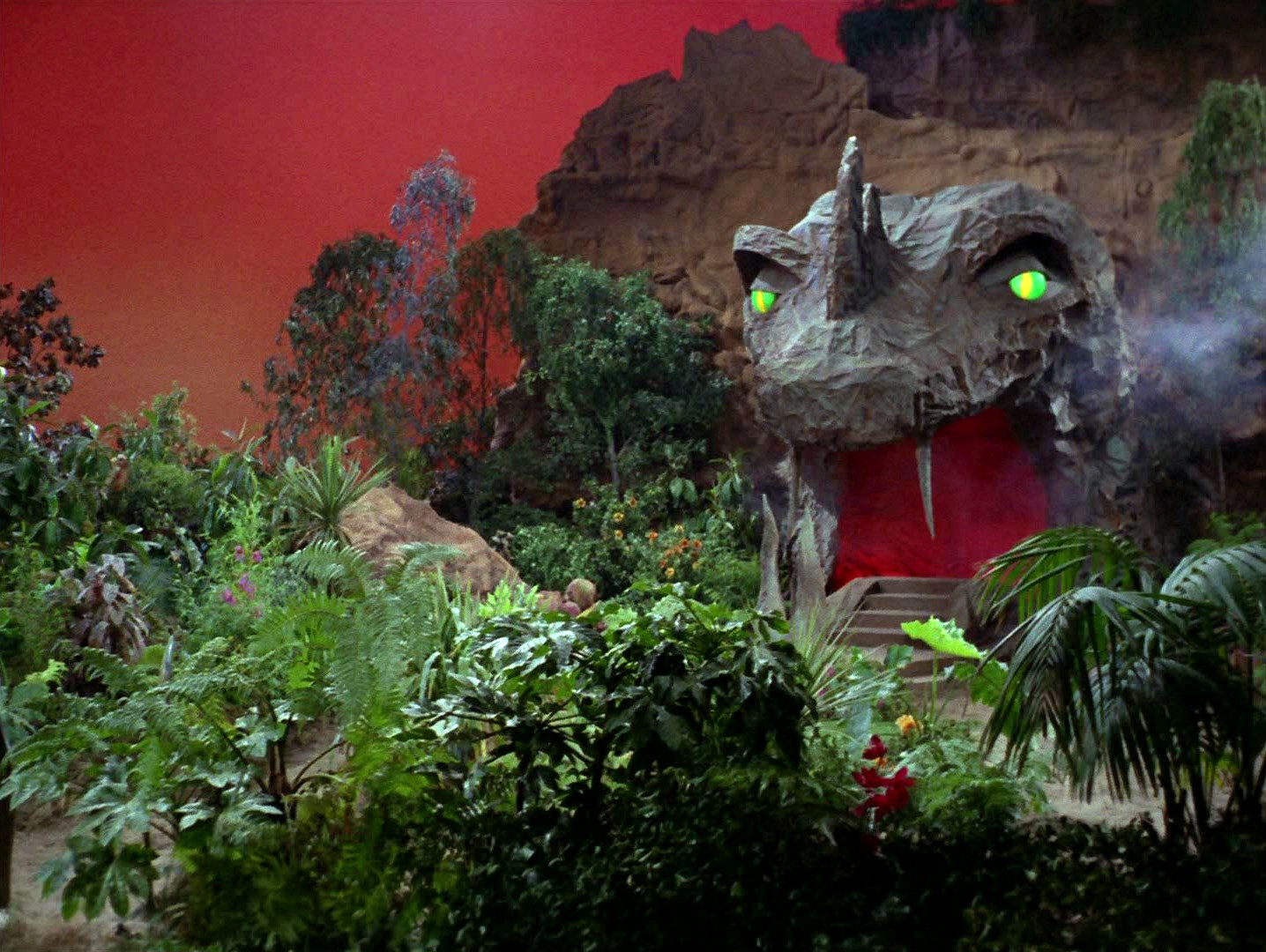
Stardate 3715.0: A landing party beams down to a planet with a rich nature, only to find that there are poisonous plants, sudden thunderstorms and explosive rocks that each kill one crewman as if the planet was defending itself. As the Enterprise is caught in a tractor beam, the landing party heads for a village, whose inhabitants worship and feed a creature named Vaal, obviously the machine that controls the planet. Because of Vaal there has been no progress in thousands of years, and the natives have no concept of love or sex either. While McCoy wants to end Vaal's rule to free those people, Spock objects that they are quite happy the way it is. But Vaal tells his people to kill the strangers, and they slay one more of the landing party. When the Enterprise does not manage to break free, Kirk tells Scotty to fire on Vaal's power source. Vaal is dead, and the people on the planet are free to develop their society on their own.
Review
Star Trek gets terribly repetitive with "The Apple", whose plot is essentially the same as "The Return of the Archons", with the motive of the poisonous paradise taken from "This Side of the Paradise" and the resolution of simply firing at Vaal being a carbon copy of the destruction of the temple in "Who Mourns for Adonais". A landing party is trapped on the planet while an alien force threatens to destroy the ship in orbit, we've all had it several times before. And even worse, redshirts keep dying all the time, while Spock survives the spores, the attack of the natives as well as the lightning, each of which killed one crewman. There is certainly some merit in the discussions between Spock and McCoy whether Vaal's people should be conceded the right to develop or rather the right to maintain their culture. But since this decision is ultimately governed by the primary goal to save the Enterprise, it remains largely pointless. The outcome is overly rushed and simplified, and all doubts about destroying a paradise are swiftly cast away. In many TNG episodes the interference into other cultures will entail bad side effects as well as, aside from the violation of the Prime Directive, a bad conscience for the crew. In contrast, everything seems fine at the end of this TOS episode, although the inhabitants of the former paradise will have a hard time coping with the consequences.
The impression is created that primitive cultures are only waiting to be granted the benefits of Federation lifestyle, in this case after a due time. But quite paradoxically computers and machines once again appear as evil things that hold back people and need to be destroyed. In this particular episode the computer in its role as a "false god" may have been an attempt by the atheist Gene Roddenberry to incorporate implicit criticism of religion without openly offending religious people or institutions. But if that was the intention, it comes out rather as technophobia, while the references to the biblical paradise are indeed rather conciliatory, as the end of the paradise was meant to happen in both cases and even for similar reasons. Kirk also makes clear in his glorifying speech towards the end that freedom is the highest good, which may have to do with the time of the Cold War when Star Trek was produced, rather than with criticism of religion.
I'm not sure if I should be really glad for the natives, but honestly I really don't care that much about them. The dumb na(t)ive people are merely used by both Vaal and the Enterprise crew as instruments. They are running around in silly costumes, make-up and hair, not able to do anything but what they are told. Luckily the actors have white skin color underneath their thick make-up, otherwise the episode would have had a racist undertone.
Annotations
- Inconsistencies:
- Kirk says that there is a village 17 kilometers away and later orders his people to head for that village. 17 kilometers through the wilderness by foot?
- Why does no one ever consider to send a shuttle down, once the transporter is offline?
- Scotty states the power generated by Vaal to be "100 to the 20th power Waltham units". Whilst it is laudable that no ludicrous value of an existing unit was given, the figure is very unwieldy. A Waltham unit has to equal as little as one nanowatt (give or take a few decades), if a power plant generates as much as 100^20 Waltham units.
- Remarkable dialogues:
- "It makes me homesick. Just like Russia." - "More like the Garden of Eden, Ensign." - "Of course, Doctor. The Garden of Eden was just outside Moscow. A very nice place. It must have made Adam and Eve very sad to leave." (Chekov and McCoy)
- "Jim, you're not just going to stand by and be blinded to what's going on here. These are humanoids, intelligent. They need to advance and grow. Don't you understand what my readings indicate? There's been no progress here in at least ten thousand years. This isn't life. It's stagnation." - "Doctor, these people are healthy and they are happy. What ever you choose to call it, this system works, despite your emotional reaction to it." (McCoy and Spock)
- Remarkable quote: "You'll learn something about men and women - the way they're supposed to be. Caring for each other, being happy with each other, being good to each other. That's what we call love. You'll like that a lot." (Kirk)
- Remarkable absences: Uhura and Sulu do not appear in this episode.
- Remarkable facts:
- Redshirts Kaplan (poisoned by spores), Hendorff (struck by lightning), Mallory (killed by explosive rock) and Marple (slain by natives) die in this episode. The planet frequently and selectively kills just the security personnel. Well, more redshirts will be killed in less diverse and less entertaining ways in other episodes...
- Kirk knows Kaplan's family, and Mallory's father helped him get into the Academy.
- The Prime Directive is called "non-interference directive" here.
- The fact that the discovery of sex, among other previously forbidden things, puts an end to the paradise is a quite remarkable and intentional parallel to the biblical Garden of Eden (with Kirk's crew in the role of the serpent). Hence the episode title.
- Crew losses: 4
Rating: 1
Mirror, Mirror
Synopsis
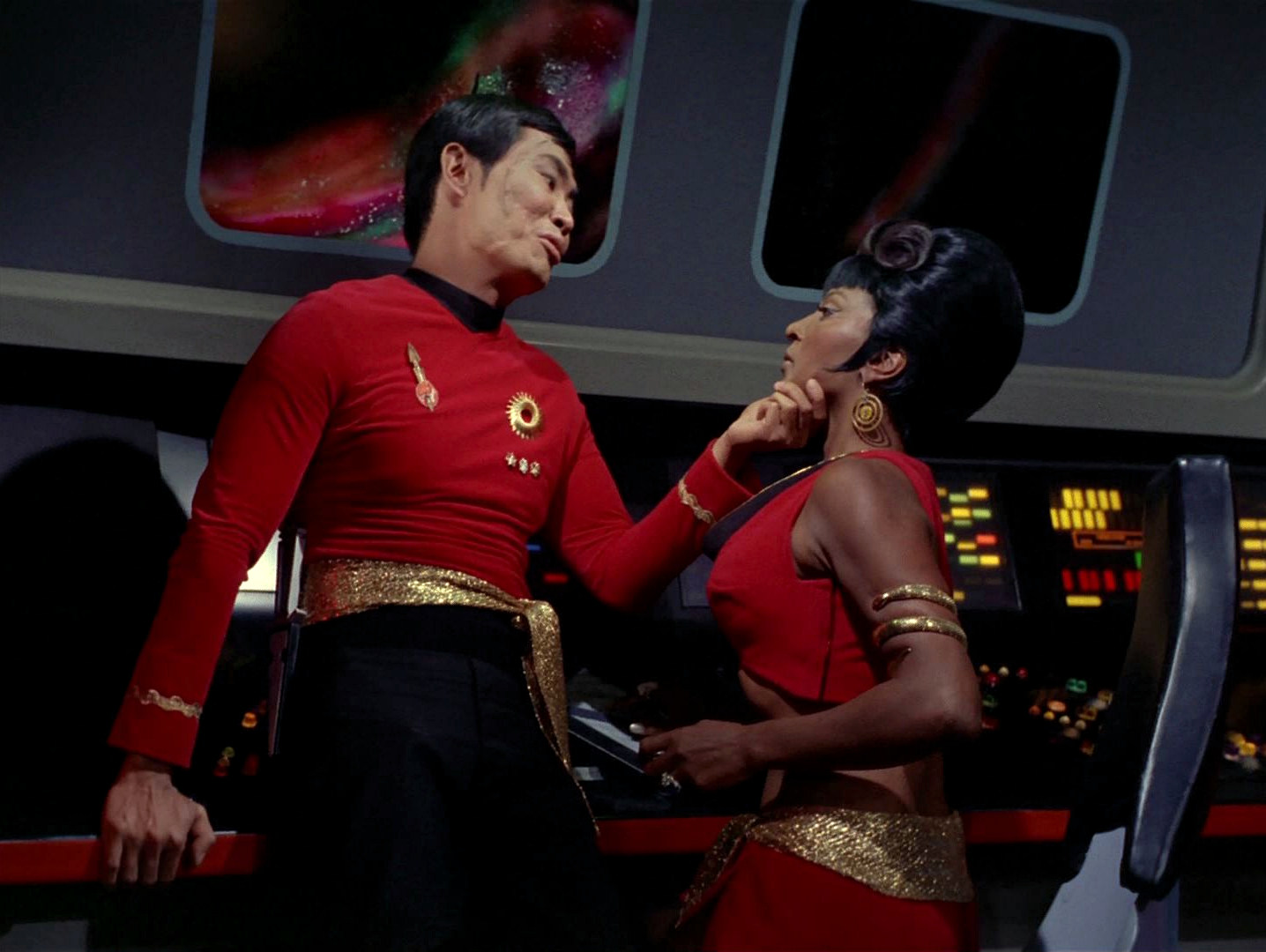
Stardate not given: After fruitless negotiations with the peaceful Halkans on dilithium mining rights on their planet, Kirk, Uhura, Scott and McCoy are beaming back to the USS Enterprise. But due to an ion storm they materialize in a parallel universe on the I.S.S. Enterprise, a nearly identical ship that is governed by brutality. Vice versa, their counterparts from this Mirror Universe find themselves aboard the USS Enterprise of our universe, where Spock quickly puts them under arrest. In the Mirror Universe, the four officers try to fit into their unusual roles on a ship where murder of superiors is an appropriate means to attain a promotion, as Mirror Chekov's attempted assassination of Kirk demonstrates. When Kirk refuses to destroy the planet Halkan, Mirror Spock warns Kirk that he has received orders to eliminate him. While Scott and McCoy are working in engineering on a procedure to return to their universe and Uhura distracts the ship's security officer Sulu, Marlena, obviously Kirk's mistress in this universe, shows Kirk how to get rid of his enemies using a device in his quarters called the Tantalus field. Mirror Spock learns the truth about the landing party through a mind meld with McCoy, and he decides to help them get back to their universe. Marlena, who prefers Kirk over his Mirror counterpart, has to stay behind. Kirk leaves with a plea that Mirror Spock should change something about his universe and points him to the Tantalus field that could allow him to achieve that goal. Back on his Enterprise Kirk meets a newly assigned lieutenant, who is no one else but the counterpart of Marlena in our universe.
Review
"Mirror, Mirror" is an episode with an intelligent story, brilliant directing and mostly exquisite acting. I love how everyone in the landing party contributes a great deal to the success of the mission to return to their own universe - even Uhura whose role is too often limited to delivering a few lines, leaving all the action to the three principal characters. I also like how Kirk, McCoy, Uhura and Scotty don't abandon their humanity and camaraderie and don't simply put up with the cruel ways of the Mirror Universe. This spirit of our, of the "better universe" can be found in the scenes when Kirk refuses to kill the Halkans or Chekov, but also in many smaller good deeds. For instance, when Uhura hesitates to go to the bridge of the Mirror Enterprise, Kirk encourages her and promises he would follow her soon. Kirk does not appreciate the strange idea of "loyalty" in the Mirror Universe, and so he shows his "gratitude" for the crewman who first mutinied with Chekov and then switched sides by punching him. When everyone else is only thinking of going to the transporter room to escape from the hostile universe, McCoy insists on treating the injured Mirror Spock.
I am willing to forgive this episode the problems that lie already in its very premise. It is anything but plausible that almost the same ship with essentially the same people could be at the same place in the same time in two different universes. For the premise to make any sense, we have to accept that there are strange ties between the universes that don't allow them to diverge too much and that defy even the second law of thermodynamics.
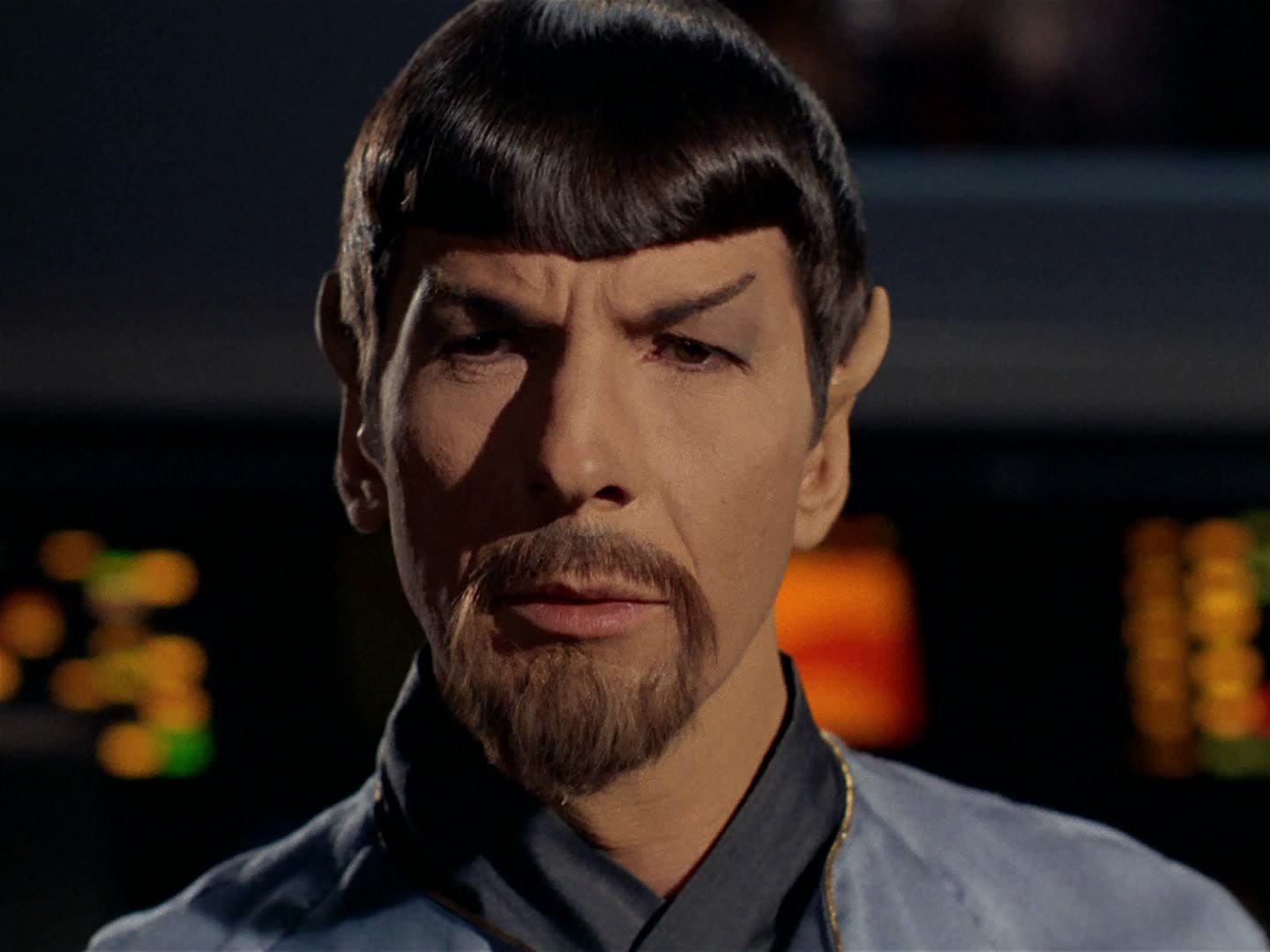
Once we look beyond the premise, "Mirror, Mirror" establishes a credible parallel world though, quite unlike in the trash episode "The Alternative Factor" where this idea was utterly wasted. In "Mirror, Mirror" the minimal dissimilarities in the looks and technology are in a strong contrast to the behavior of the characters, which couldn't be more different on the two sides. Again, this is anything but plausible, but this is exactly what the thrill is about. It is familiar, and at the same time it's not. I can understand that our Mr. Spock finds the experience of meeting the savage Mirror Universe counterparts of the crew "fascinating". And while Star Trek as a whole had a strong impact on pop culture, particularly "Mirror, Mirror" set the tone for countless parodies as well as half-way serious takes on the idea of a parallel universe where everyone and everything is slightly different, such as characters who suddenly have goatees.
Considering how much potential the parallel universe has, I only wonder why it took so long to revive it in DS9: "Crossover". In the DS9 episode we learn that Mirror Spock has indeed risen to power as Kirk suggested, but not to the Terran Empire's advantage. This way, more than 25 years later "Mirror, Mirror" has gained a new ironical twist in hindsight.
Annotations
- Oddities:
- The Mirror versions of the regular series characters have a strange gift to survive against all odds. When Chekov attempts to kill Kirk, the man who switches sides kills the two other mutineers, not Chekov. In the same vein, for some reason Marlena spares Sulu's life and eliminates only the three henchmen that are with him with the Tantalus field, although Sulu is still holding a knife and threatening Kirk.
- How did "our" Spock recognize so quickly that Mirror Kirk and his company are not the people he knows? I can't imagine that they started their riot already on the transporter platform but only after they had been arrested. I really would like to know what happened after their arrival in our universe.
- It looks like the Mirror crew was beamed back to their universe at the same instant as our crew arrived in our universe. How was this coordination possible, considering that there was no communication between the universes and, according to Scott, the transfer took place while the increasing field density still allowed it, not at a time when it hit a minimum? Well, this appears to be just one more instant of things that happen simultaneously in both universes although probability theory tells us they shouldn't.
- Remarkable quotes:
- "I'm a doctor, not an engineer." (McCoy)
- "You're a man of integrity in both universes, Mister Spock." (Kirk)
- "In every revolution, there's one man with a vision." (Kirk)
- Remarkable effect: The transition to the Mirror Universe is visualized by mirroring the shot of the Enterprise in orbit around Halkan. As usual, "our" Enterprise can be seen only from the starboard side in the episode, whereas the port side of the Mirror ship is shown. The port side of the model could not be illuminated, however. The effect was accomplished by filming the starboard side (stock footage from "Where No Man Has Gone Before"), reversing the image and reversing back the nacelle decals.
- Remarkable score: Mirror Spock's mind meld with McCoy is accompanied by a variant of the Spock guitar riff.
- Remarkable fact: "Captain James T. Kirk succeeded to command ISS Enterprise through assassination of Captain Christopher Pike. First action: suppression of Gorlan uprising through destruction of rebel home planet. Second action: execution of five thousand colonists on Vega IX..." (computer recounting)
- Remarkable sequel: The DS9 episode "Crossover" is based upon the events in "Mirror, Mirror". Mirror Spock would become the leader of the Terran Empire, but his reforms would weaken it so much that the Klingon-Cardassian Alliance prevails.
- Remarkable set: It is the first time that we see the emergency manual monitor on the upper level of main engineering.
- Remastering: In the remastered episode the Mirror Universe Enterprise is represented by a CGI model of the pilot version with all according detail changes.
Rating: 8
The Deadly Years
Synopsis
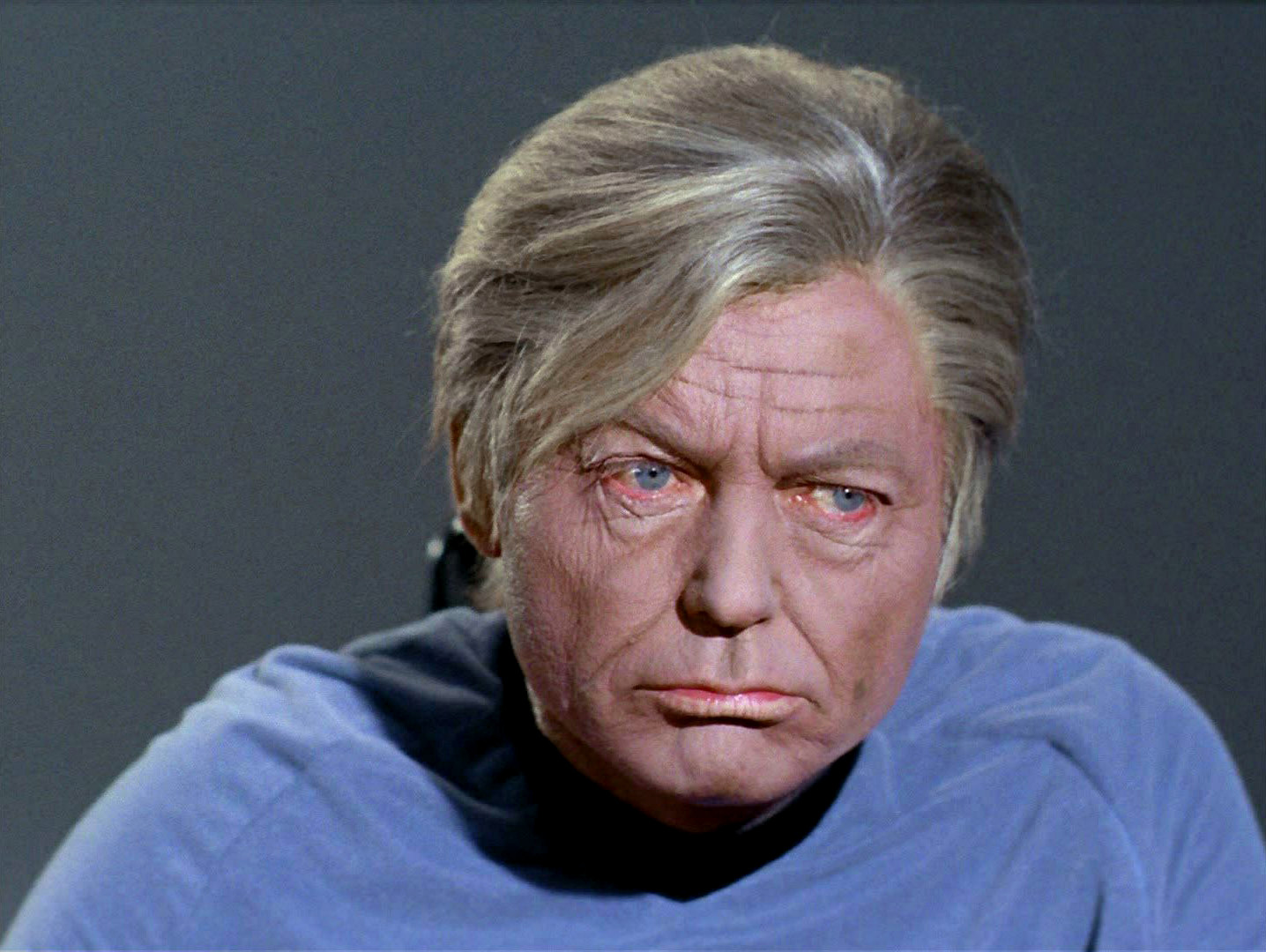
Stardate 3478.2: A landing party consisting of Kirk, Spock, McCoy, Scott, Chekov and Lt. Galway beams down for a routine visit to an outpost on Gamma Hydra IV. They find that the scientists there are dying of rapid aging. After their return to the ship the landing party soon shows symptoms of the disease too. Only Chekov is unaffected. Lt. Galway dies. Commodore Stocker, who is aboard to be transferred to Starbase 10, urges Spock to hold a hearing to investigate Kirk's ability to command the ship. It is found that Kirk, due to his senility, is unable to stay in command, which falls to Stocker. But Stocker makes an almost fatal mistake when he orders Sulu to set course for the Neutral Zone. In the meantime Dr. McCoy has an idea that adrenalin could help the aging crew members, as it probably saved Chekov, who was terrified when he stumbled across a dead body on Gamma Hydra. Spock and Dr. Wallace, an old flame of Kirk, develop a cure, which helps Kirk to save the ship that has been surrounded by the Romulans, repeating his "corbomite maneuver".
Review
"The Deadly Years" is certainly a classic that shouldn't be blamed for the many times that Trek would hark back to the theme of rapid aging or similar conditions that need to be cured with a medical miracle in a race against time. It is a fundamental weakness of any such story that the effect is not only stopped but even reversed in the end. In Star Trek there is a traditional "reset button" - the characters have to return to their original state each time, and all "hope" that a change might be permanent is disappointed.
In my view the episode could have been better, had it focused on the development of the cure, rather than on the melodramatic depiction of particularly Kirk's aging process. His senility comes across as a tad too artificial, when he repeatedly forgets his own commands and everyone is embarrassed about it. To add insult to injury, everything is reiterated ad nauseam in the hearing. I don't like the idea of the hearing anyway - it only wastes time, which is especially precious in this case.
The greatest weakness of the episode, however, is the involvement of two blatantly clichéd guest characters. Dr. Wallace is yet another of Kirk's countless former love affairs that keep cropping up out of the blue during TOS. And besides her assistance in developing the cure her more obvious purpose in the story is to pity the aging Kirk. Commodore Stocker is yet another high-ranking officer who proves to be totally incompetent and breaks down as soon as he has brought the ship into trouble. At least this failing enables a quite thrilling finale of the episode, but the same could have been accomplished in more decent fashion, without making the good commodore look like a total idiot.
There is one instance of clever writing in this episode that I am fond of. When the ship is surrounded by the Romulans, Kirk orders Uhura to send a message to Starfleet Command with Code 2, the one he knows has been deciphered by the Romulans, so he can make sure they would listen. In his senility he previously asked her to use this same code in error. He then mentions the corbomite device that has allegedly been installed on the ship, in reference to TOS: "The Corbomite Maneuver". This is one of the few instances of inter-episode continuity.
Finally, I just have to praise the great make-up work in this episode that is still impressive today.
Annotations
- Inconsistencies:
- So the cure does not just stop the rapid aging, it rejuvenates the patients, even in a matter of minutes. This raises the question why people in the 23rd and 24th centuries would need to age at all.
- The Romulans await the Enterprise, only minutes after the ship has altered the course, and only seconds after it has entered the Neutral Zone. This is incredibly fast to start with, and it is also evident that the Romulans must have been hanging around in the Neutral Zone all along, thereby violating the treaty in the first place.
- Remarkable quote: "No! Don't talk to me about rank! The man's a chair-bound paper-pusher. I order you to take command." (Kirk, to Spock, about Stocker)
- Remarkable facts:
- James T. Kirk is 34 years old (born 2233).
- Hyronalin is commonly used to treat all kinds of radiation sickness.
- Crew losses: 1
Rating: 4
I, Mudd
Synopsis
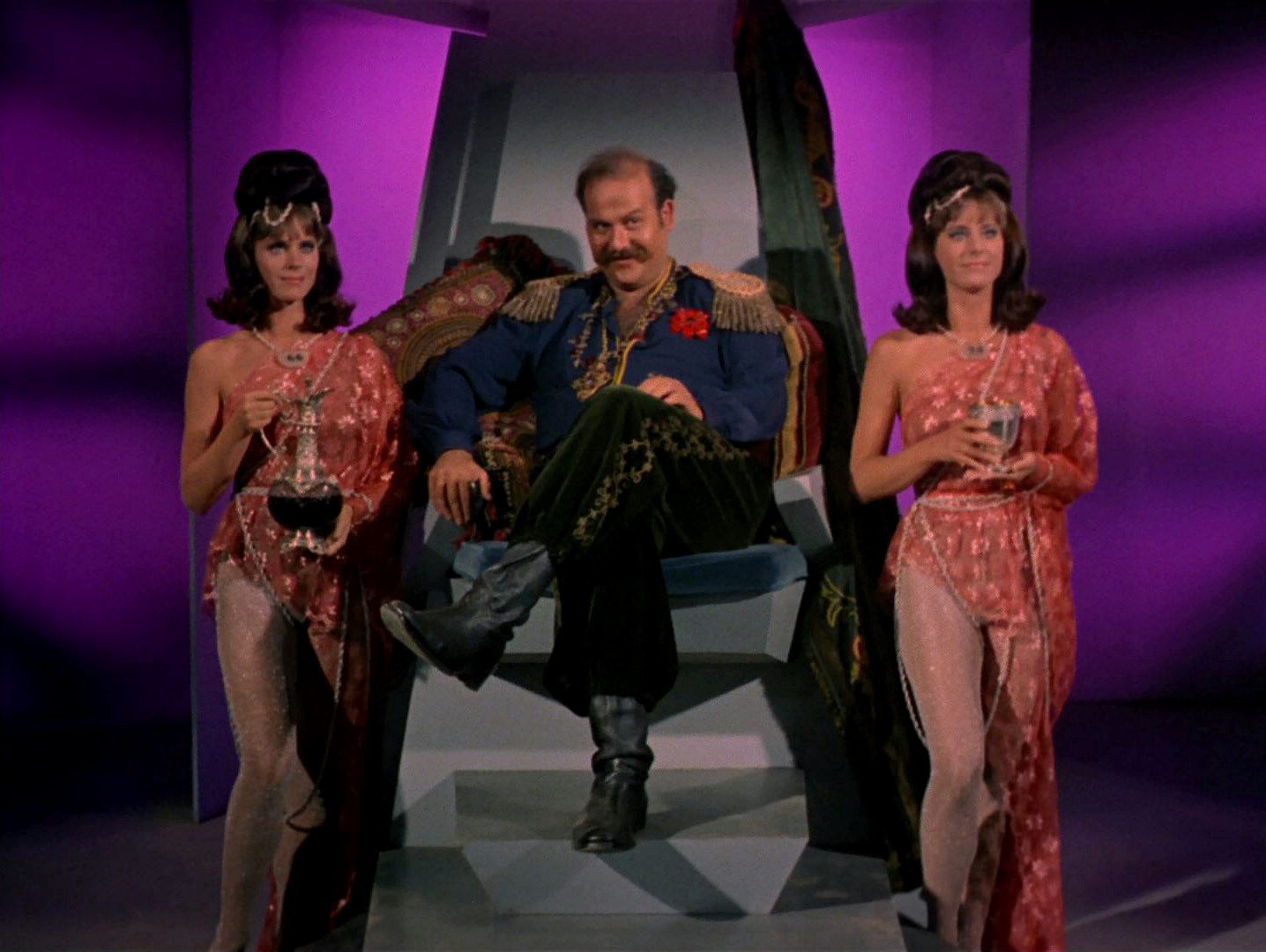
Stardate 4513.3: A new crew member named Mr. Norman turns out to be an android. He sabotages the Enterprise and alters the ship's course to an uncharted planet. After beaming down the landing party find themselves among thousands of androids, who are led by the only human denizen, Harry Mudd. It is Mudd's intention to leave the planet, and he has brought the Enterprise crew there as a replacement, because it is the androids' desire to serve. The androids, however, have other plans. They suddenly refuse to obey Mudd and plan to take over the human civilization, which would gradually become totally dependent on their services. The humanoids work together to disable them, using their best weapon, absence of logic. After they have found out that Norman is the control center, they focus their efforts on confusing him, playing absurd theater until he is finally disabled. Kirk allows Mudd to stay on the planet, but not before creating at least 500 new androids modeled after Mudd's wife, who keep nagging Harry.
Review
This may be the silliest episode of TOS, but besides the unattainable "The Trouble with Tribbles" it is also one of the funniest. It only needs a bit more than the usual suspension of disbelief to be enjoyable. We have to accept that the whole setting, a captivity of the Enterprise crew that would be unbearable under somewhat different circumstances, is designed to be farcical, as a platform for a plethora of jokes. And although it probably wasn't the intention, it may be regarded as some sort of parody that Kirk discusses a computer to death once again and we see androids crave power once again.
The episode jumps straight into action, as McCoy complains about Norman being strange right at the beginning, and Norman completes his takeover of the ship and reveals his true nature already in the teaser. It could have been subtly foreshadowed what would happen, to build up suspense. The way it is done is appropriate, however, since the takeover of the ship is not what the episode is really about. While the teaser was still dead serious, it becomes clear that we are watching a comedy as soon as we see Harry Fenton Mudd on his throne. Kirk and his people never take his threats really seriously because despite his strange ambitions Mudd is not the type of guy who would harm them. The only time that Kirk really gets mad at Mudd and grabs his throat (which he may have done much earlier had it been any other captor) is when he learns that his whole crew has been beamed down, leaving the Enterprise to the androids. But after this escalation the comical nature of the situation gains the upper hand again. Once again, as the androids suddenly refuse to obey Mudd any longer and Kirk recognizes "that threat the androids made about taking over all the humans in the galaxy is not very funny", it almost seems like the fun part is over. But the climax is still to come, in the form of the absurd stage play. And I admit that I enjoy it every time although it is totally over the top, such as Chekov's "Cossack" jumping on Kirk's order to stand still. And I like the reference to the good old Epimenides paradox that is apparently still powerful enough to confuse a highly advanced android mind.
Annotations
- Continuity:
- Kirk's crew knows Harry Mudd from TOS: "Mudd's Women". Kirk explicitly mentions the "affair on the Rigel mining planet". Only Chekov is correctly unfamiliar with him, and asks incredulously, "You know this man, Captain?"
- Alice tells Chekov: "We are programmed to function as human females, lord." Data will also paraphrase it as being "fully functional" in TNG: "The Naked Now" and again in "Star Trek: First Contact".
- Inconsistencies:
- How could Norman get aboard the Enterprise in the first place, and why did no one notice he was an android, even though he avoided to be examined by McCoy?
- In hindsight Spock's and Kirk's stance that computer systems have to be centralized and can be disabled destroying the central control is dated. On the other hand, their refined idea that "each android mind must be one component of a mass brain linked through a central locus" is more up to date, and it foreshadows the working principle of the Borg Collective.
- When Kirk and his people have disabled the androids, the ones on the Enterprise are likely out of order too, leaving the ship without control. Or they are not affected, and it would be impossible to regain the ship. Either way it would be pretty bad.
- Well, it is an ironic twist of fate that Harry has to stay on the planet with the replicas of his "beloved" wife. But what happened to orderly trials?
- Remarkable dialogues:
- "There is a word. Among us there is no corresponding meaning, but it seems to mean something to you humans." - "And what is that word?" - "Please." (Norman and Kirk)
- "Opportunity? Now, listen, Spock, you may be a wonderful science officer, but believe me, you couldn't sell fake patents to your mother." - "I fail to understand why I should care to induce my mother to purchase falsified patents." (Mudd and Spock)
- "Now you'll find yourself back among us illogical humans again." - "Which I find eminently satisfactory, Doctor, for nowhere am I so desperately needed as among a shipload of illogical humans." (McCoy and Spock)
- Remarkable quotes:
- "Spock, you're going to love it here. They all talk just the way you do." (Mudd)
- "This place is even better than Leningrad." (Chekov)
- "Next, we take the Alices on a trip through Wonderland." (Kirk)
- "Logic is a little tweeting bird chirping in a meadow. Logic is a wreath of pretty flowers, which smell bad. Are you sure your circuits are registering correctly? Your ears are green." (Spock)
- Remarkable facts:
- The surface of the androids' planet is "K-type, adaptable for humans by use of pressure domes and life-support systems", according to Norman.
- There are 297,809 androids on the planet.
- Humanoids once created the androids to serve them. The homeworld of the android makers became a nova, and only a few exploratory posts survived, but over the stretch of time the rest of the makers died too.
- Remarkable androids: Stella #1 throughout #500, all replicas of his "charming" wife, especially created by Kirk to "please" Harry
Rating: 6
The Trouble with Tribbles
Synopsis
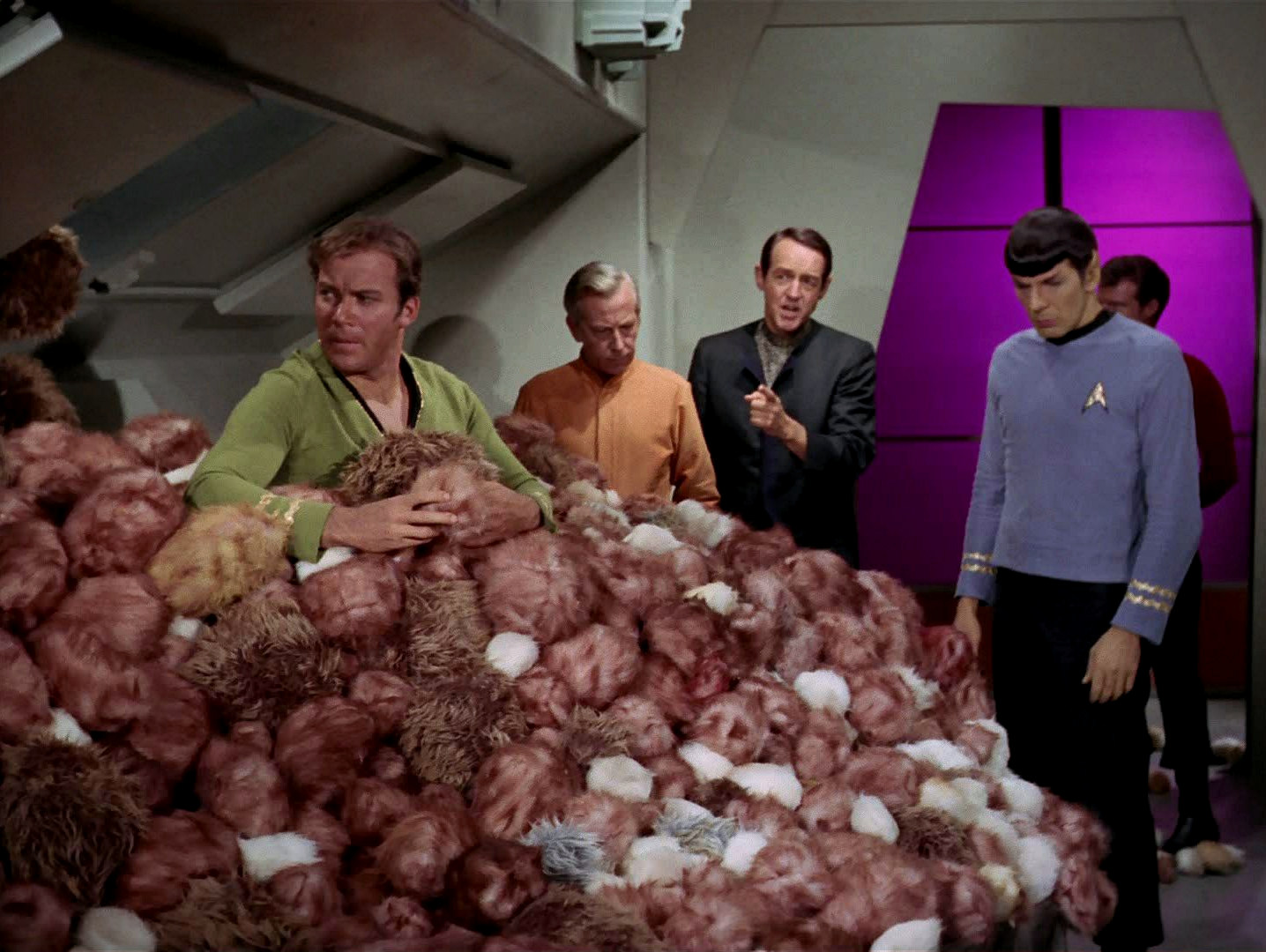
Stardate 4523.3: The Enterprise is summoned to Deep Space K-7 by Federation Undersecretary Baris to protect a shipment of quadrotriticale, the only Earth grain that would grow on Sherman's Planet. This planet is disputed between the Federation and the Klingons, and the Federation needs to hurry to develop it. A Klingon battlecruiser under Captain Koloth arrives, requesting shore leave on the station, whereupon a scuffle with the Enterprise crew ensues. In the interim, intergalactic trader Cyrano Jones has brought small furry animals called Tribbles to the station. Uhura takes one Tribble to the Enterprise, not knowing that it would breed rapidly. And so do the Tribbles on the station, thanks to the supply of quadrotriticale. When Kirk opens the storage compartment, the grain is gone, and it is swarming with Tribbles. Many Tribbles, however, are dead, as the grain has been poisoned. Kirk discovers that the Tribbles squeak in the presence of Baris's assistant Darvin just the way they do when they encounter Klingons. McCoy examines the man, who turns out to be a Klingon. A freighter is dispatched to deliver a new shipment of grain to the planet, and Scotty solves the Tribble problem on the Enterprise by beaming them over to the Klingon ship.
Review
"The Trouble with Tribbles" is an absolute favorite of avid fans and of casual viewers alike, and as such the probably best known Star Trek episode ever made. One reason for this overwhelming popularity is that the episode combines humor and suspense in an unprecedented fashion. There is not a single boring minute. "The Trouble with Tribbles" strikes a chord with the viewers, if they are ready to take the whole story with a small grain of quadrotriticale. Well, it could have been overall a tad more serious to comply with the general tone of the series. But most other TOS outings take themselves already too seriously, and in such a case it appears contrived or even inappropriate whenever a funny line is included.
Also, for the first time in the history of the series two plots (the proliferation of the Tribbles on one hand and the conflict with the Klingons on the other hand) are woven together, as it is customary in most modern TV series. Likewise, it benefits the story that it is not told solely from Kirk's or Spock's perspective, who are focusing on just one opponent. It is one of the few occasions with manifold character interactions and conflicts. Besides the usual mutual teasing of McCoy and Spock we have Kirk with his refreshing disregard for Baris, Scott with his fondness of the ship and the technical journals (but not necessarily of the captain), Chekov with his Russian trivia, Uhura in defense of the Tribbles, to name only a few. Although the episode is very complex for its time and involves an unusual number of places and characters, the story is largely free of inconsistencies. Furthermore, probably no other TOS episode is so full of neat details and trivia. I think I could watch it a hundred times and I would still discover something new. And speaking of trivia, it is clear that the cute Tribbles with all their remarkable abilities have contributed a lot to the success of the episode.
Annotations
- Continuity: Koloth explicitly refers to the Organian Peace Treaty from TOS: "Errand of Mercy".
- Remarkable dialogues:
- "How close will we come to the Klingon outpost if we continue on our present course?" - "One parsec, sir. Close enough to smell them." - "That is illogical, Ensign. Odors cannot travel through the vacuum of space." (Kirk, Chekov, Spock)
- "Of course, I'd say that Captain Kirk deserves his ship. We like the Enterprise. We... we really do. That sagging old rust bucket is designed like a garbage scow. Half the quadrant knows it. That's why they're learning to speak Klingonee." - "Mister Scott!" - "Laddie, don't you think you should... rephrase that?" - "You're right, I should. I didn't mean to say that the Enterprise should be hauling garbage. I meant to say that it should be hauled away *as* garbage." (Korax, Chekov, Scott, whereupon the brawl ensues)
- "Captain Kirk, I consider your security measures a disgrace. In my opinion, you have taken this important project far too lightly." - "On the contrary, sir. I think of this project as very important. It is you I take lightly." (Baris and Kirk)
- Remarkable quotes:
- "Secure from general quarters. And beam down two, and only two, security guards." (Kirk, with a priceless cut to Baris's petrifying face)
- "A most curious creature, Captain. Its trilling seems to have a tranquillizing effect on the human nervous system. Fortunately, of course, I am immune to its effect." (Spock, stroking a Tribble himself and earning incredulous glances)
- "I won't harm a hair on its head, wherever that is." (McCoy, who is going to examine a Tribble)
- Remarkable absence: Sulu is not in this episode. It appears that his scenes were rewritten for Chekov.
- Remarkable running joke: Kirk is the only one who does not know about quadrotriticale, and repeatedly refers to it as "wheat".
- Remarkable scene: the famous one with Kirk buried in a heap of Tribbles, among many other scenes
- Remarkable Russian trivia:
- Sherman's Planet was first mapped by the famous Russian astronomer Ivan Borkoff (actually by John Burke at the Royal Academy in "old Britain").
- Peter the Great once had a similar problem as the Federation with the Klingons.
- Quadrotriticale is a "Russian inwention".
- Scotch Whisky was "invented by a little old lady from Leningrad", at least if we believe Pavel Chekov.
- Remarkable lifeform: the one that squeaks when next to a Klingon
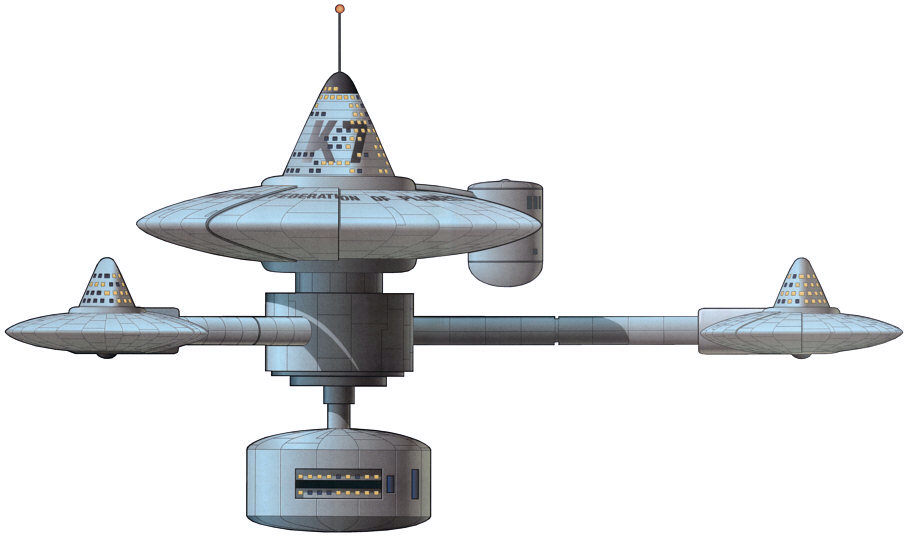
- Remarkable starbase: Deep Space K-7
- Remarkable facts:
- The Battle of Donatu V was fought near Sherman's Planet 23 solar years ago. Its outcome was inconclusive.
- A Code One distress call indicates a disaster.
- Remarkable sequel: As a homage to this episode on the occasion of Star Trek's 30th birthday, DS9: "Trials and Tribble-ations" will be based upon it.
- Remastering: The remastered episode shows us the Klingon battlecruiser for the first time, whose model did not yet exist when the original episode was being produced.
Rating: 9
Bread and Circuses
Synopsis
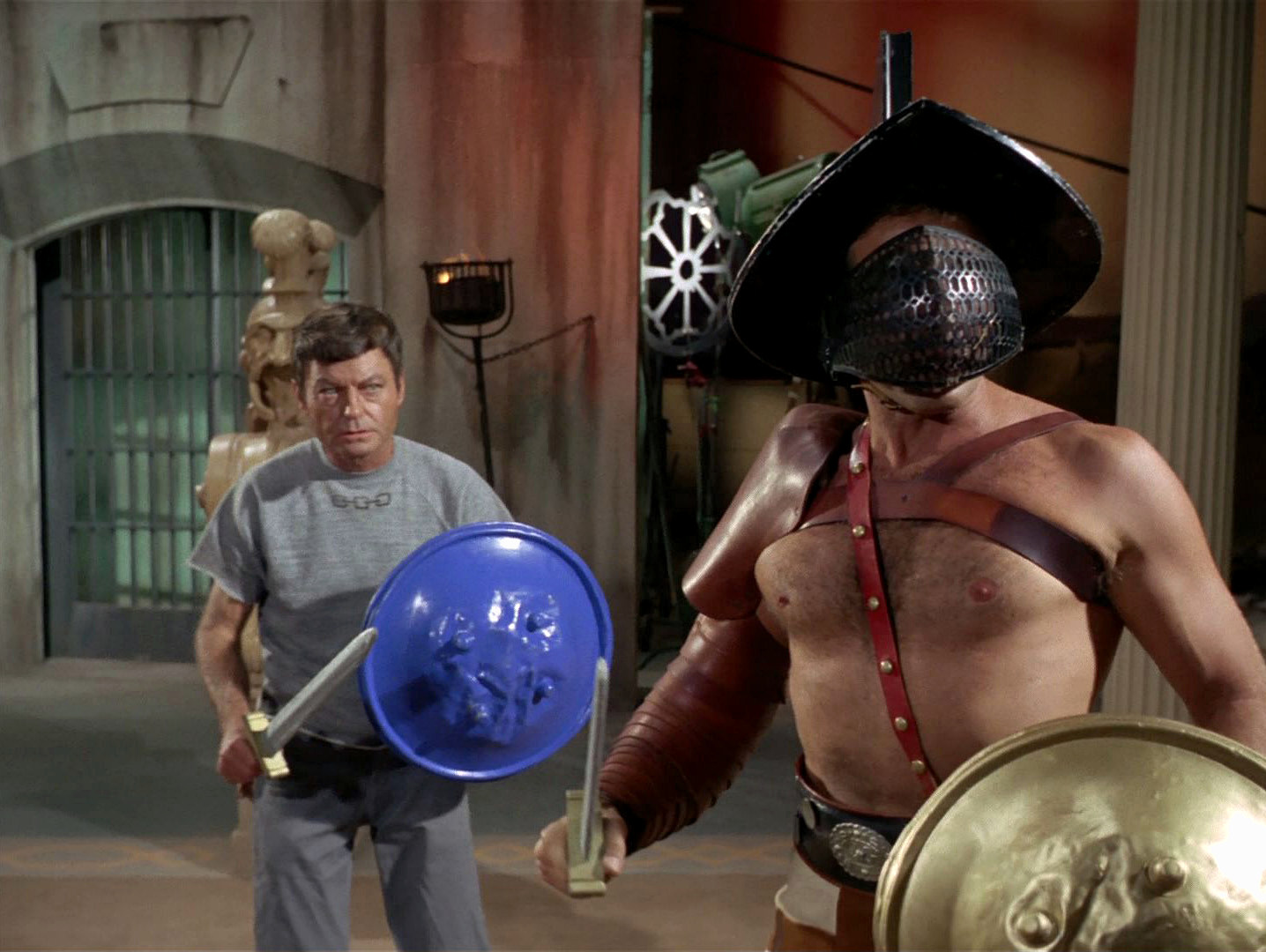
Stardate 4040.7: The Enterprise locates wreckage of the S.S. Beagle, a ship that disappeared six years earlier. Kirk, Spock and McCoy beam down to the nearby planet 892-IV with its astonishing 20th century version of a Roman Empire, where they hope to find survivors. They ally themselves with former slaves, the "Children of the Sun", who are hiding in the hills. But they are captured by the police and meet the First Citizen, who is no one else but Captain Merik of the S.S. Beagle, who now calls himself Merikus. When Kirk refuses to beam down his entire crew, Merik and Proconsul Claudius force Kirk to watch Spock and McCoy in a gladiator match on TV. Flavius, the "Child of the Sun" who was with them, is killed. Some time later the landing party are going to be executed too in a live show, but Scotty interrupts the planet's power supply. Merikus still attempts to switch sides and contacts the ship, but while Kirk, Spock and McCoy are beamed up, Claudius kills Merikus. Meanwhile on the ship, Uhura has found out that it is actually the "Children of the Son", the planet's version of Christians.
Review
"Bread and Circuses" is only the second episode set on a parallel Earth after "Miri". However, it is the first produced of a whole series from Gene Roddenberry's cost-saving pool of parallel Earth stories that dominate the rest of the second season. The other episodes are "A Piece of the Action", "Patterns of Force" and "The Omega Glory". All these episodes have in common that planets, which were remarkably Earth-like already before the arrival of any starships, were culturally or technologically contaminated by citizens of the Federation.
In contrast to "Miri", where it remained totally unexplained how an exact duplicate of Earth could possibly exist, the four episodes of season 2 all attempt to explain the phenomenon of a parallel Earth in some fashion. The reference to "Hodgkin's Law of Parallel Planet Development" in "Bread and Circuses" is the perhaps most notable approach. But it doesn't really help to make the existence of a 20th century Roman Empire any more plausible. On the contrary. The mystery of an exact duplicate of Earth in "Miri" should have been explored in detail and it is arguably more astonishing than a Roman Empire on an alien planet in "Bread and Circuses". But the latter is frequently referred to and hence becomes an essential part of the narrative.
In addition to the existence of a Roman Empire on that planet, more parallels to Earth's history are either discovered or swiftly postulated. Two of them are particularly detrimental to the story's credibility. The first is when Spock listens to the slaves and states: "Complete Earth parallel. The language here is English." The idea of explicitly mentioning that aliens speak English is a problem, as it breaks with a fundamental rule of the series. Because all aliens on all planets always talk English in TOS, and no one of the crew has ever any difficulties in understanding them. Only communication with non-corporeal aliens requires a universal translator or a mind meld. However, the worse failing is why the denizens of the Roman Empire should speak English at all, rather than Latin! Everyone of the crew makes a big deal of everything on the planet being as in Earth's history. McCoy, for instance, says about the religion of the "Children of the Sun": "Rome had no sun worshipers. Why should they parallel Rome in every way except one?" So it is unthinkable that these people could be sun worshippers, but absolutely plausible that they speak English?! This is so idiotic it hurts. Oh well, the aliens of 892-IV have to speak English to allow the misunderstanding that arises from the phonetic similarity of "sun" and "son". But this simple play on words merely serves to keep the existence of "Christians" on that planet a secret until the very end of the episode. And this fact, or rather that Christianity was bound to prevail some time, is the second implausible parallel to the development on Earth, and is utterly lame and gratuitous no less. I also wonder how Gene Roddenberry could possibly come up with a story that would be so supportive of a religion he condemns.
The discovery of the "Christians" does not manage to conceal that otherwise the story leaves plenty of open questions. We never learn anything about Merik's real motive to stay on 892-IV, which must have been so strong that he condemned his crew to death. Certainly it wasn't Claudius's kind request that the crew should not be allowed to reveal the existence of the planet to the outside world. Vice versa, what could Claudius gain by allying himself with an alien intruder? If he was really so concerned with saving his homeworld, he should have killed "Merikus" just as well. The two have an uneasy alliance, whose beginning, intermediate development and end never become clear. In addition, I would have wished for the landing party to commemorate Flavius in some fashion and to return to his people instead of the self-complacent prediction that they would prevail some day. Finally, were there really other survivors as Merik claimed, and what would become of them?
This episode is rife with all the usual clichés, in addition to mad captains and parallel Earths. For instance, Kirk knows Merik. We wouldn't have expected otherwise. He seems to know every human being who's out in space. Also, the landing party is apprehended immediately after beaming down and once again when they are approaching the city. And once again there is a beautiful scantily clad woman, who tries to infatuate our good captain, and only the captain.
The only special thing about this story is how it ironically comments on the practices in the TV industry on Earth. I especially like the sound generator for applause and boos. The episode specifically targets Star Trek's own struggle with dropping ratings. As the slave master tells the now too peaceful Flavius, "You bring this network's ratings down, Flavius, and we'll do a special on you." Well, and we may want to keep in mind that the even worse (slight) variations of the same theme "mislead Federation official violates Prime Directive on a parallel Earth" are still to come in "Patterns of Force" and "The Omega Glory".
Annotations
- Nitpicking: The Roman Empire is on a 20th century cultural and technological level. The "Children of the Son" may have only basic knowledge of astronomy and none of space travel. But why don't they pose questions as to where exactly on the planet Kirk and his people come from?
- Remarkable quote: "Do you know why you're not afraid to die, Spock? You're more afraid of living. Each day you stay alive is just one more day you might slip and let your human half peek out. That's it, isn't it? Insecurity. Why, you wouldn't know what to do with a genuine, warm, decent feeling." (McCoy)
- Remarkable technology: Spock mentions that the S.S. Beagle had "antimatter nacelles".
- Remarkable car: Jupiter 8, an actual study of what was considered a futuristic car in the 1960s
- Remarkable scenery: I like the shots on location that skillfully use the available long distances (of Bronson Canyon in Hollywood), with the "Children of the Sun" being almost 100 meters away from the landing party.
- Remarkable error: Spock vastly understates the death counts of the First World War (6 million instead of 15 million) and the Second World War (11 million instead of 70 million).
- Remarkable facts:
- We get a very good description of the Prime Directive: "No identification of self or mission. No interference with the social development of said planet. No references to space, or the fact that there are other worlds, or more advanced civilizations."
- 37 million died in the Third World War (if we still choose to trust Spock).
Rating: 2
Journey to Babel
Synopsis
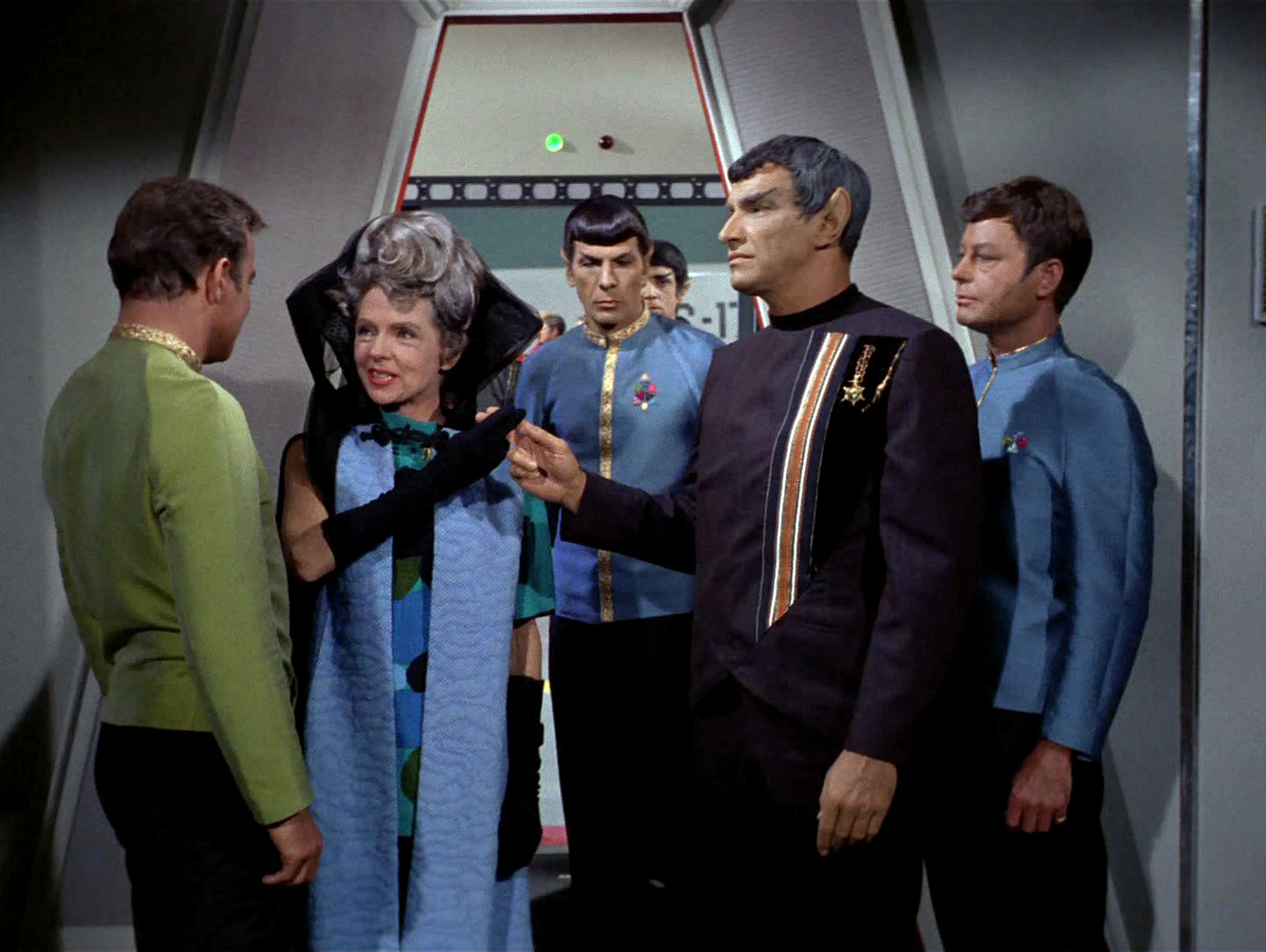
Stardate 3842.3: The Enterprise ferries delegates from several planets to a conference on the planetoid Babel, where they intend to decide about Coridan's admission to the Federation. The delegates include Spock's parents Amanda and Ambassador Sarek. Spock had a falling out with his father when he joined Starfleet instead of the Vulcan Science Academy. The Tellarite Gav is found murdered just after he has had an argument with Sarek. But Sarek himself suffers a heart attack, and only a complicated operation can save his life. To make things worse, Kirk is stabbed by the aide to the Andorian ambassador, and Spock must choose between donating blood for Sarek or taking command of the Enterprise in the emergency. Kirk, hardly able to command again, has just sent Spock down to sickbay to save his father's life, when an alien ship attacks the Enterprise. It turns out that this ship, as well as the assassin, who is a Rigelian in Andorian disguise, were sent on a suicide mission to derail the conference, which would benefit the Rigelians. After the successful surgery Spock and Sarek talk to one another for the first time in years.
Review
Here is a second episode with a focus on Spock besides "Amok Time". If we neglect for a moment that it may have had a greater impact if it had been mentioned before and that it doesn't make much sense in relation to "Amok Time", the father-son conflict of Sarek and Spock is worked out quite nicely. They don't talk with each other. They just do everything that is necessary at any time because they see it as logical. But neither of them notices that in their father-son relationship logic fails. As Kirk puts it quite early in the episode, they are stubborn, which Amanda promptly labels as a "human emotion". So it is only fitting that an emotional experience, when Spock helps saving Sarek's life, brings the two together again, though neither of them admits it.
"Journey to Babel" is an episode well above TOS average. Most importantly it is a great enrichment of the Star Trek Universe, because it gives Spock as well as the Federation as a whole a thorough background. But it is a bit overfreighted with plot complications: Spock's quarrel with his father, the disagreement among the diplomats, the spy/murder story, Sarek's heart attack.
The episode is very thrilling, with a fast but occasionally quite bumpy pace. For instance, just after Ambassador Gav has left the room after an argument with Sarek, we can see the dead Tellarite in a Jefferies tube. It would have been much better to insert another scene, and then cut to a crewman who walks through a corridor and stumbles across the body. Likewise, there is a cut from sickbay to Kirk suddenly fighting with the alleged Andorian Thelev.
Annotations
- Nitpicking:
- Spock's wedding in "Amok Time" was arranged by his parents when he was a kid and must have been planned for a long time. T'Pau was there, but for some unexplained reason Spock's parents were missing. Spock had a falling out with his father, but if Sarek doesn't even bother to come to his wedding, why would Spock care to become married at all?
- When Kirk suggests that Spock beam down to see his parents, Spock tells the surprised captain that Ambassador Sarek and Amanda are his parents. This can't have been a secret. We wouldn't expect Kirk to know all the personnel records of his crew by heart, but Spock is his first officer and Sarek is a very influential person in the Federation! There is no way he would never have read or heard about it, much less would he ever forget it.
- Also, isn't there a slight problem with Spock returning to Vulcan, or with Kirk dealing with a Vulcan official after what happened in "Amok Time" (where Spock appeared to have killed Kirk)? Their past dealings on the planet should at least have been mentioned in a casual note, but it is as if it were the first time they visited the planet.
- Remarkable dialogue: "And you, Sarek? Would you also say thank you to your son?" - "I don't understand." - "For saving your life." - "Spock acted in the only logical manner open to him. One does not thank logic, Amanda." - "Logic. Logic. I'm sick to death of logic. Do you want to know how I feel about your logic?" - "Emotional, isn't she?" - "She has always been that way." - "Indeed. Why did you marry her?" - "At the time, it seemed the logical thing to do." (Amanda, Sarek and Spock)
- Remarkable quote: "On Vulcan, the 'teddy bears' are alive, and they have six-inch fangs." (Spock, about his sehlat)
- Remarkable facts:
- Tal'shaya, breaking the neck, was considered a merciful form of execution on Vulcan in ancient times.
- T-negative is a rare blood type among Vulcans.
- Rigelian physiology is very similar to Vulcan.
- Coridan has large dilithium deposits but is underpopulated, which is why the planet may invite illegal mining activities without proper protection.
- Remarkable races: This episode introduces the Andorians and the Tellarites as two of the most important member species of the Federation.
Rating: 7
A Private Little War
Synopsis
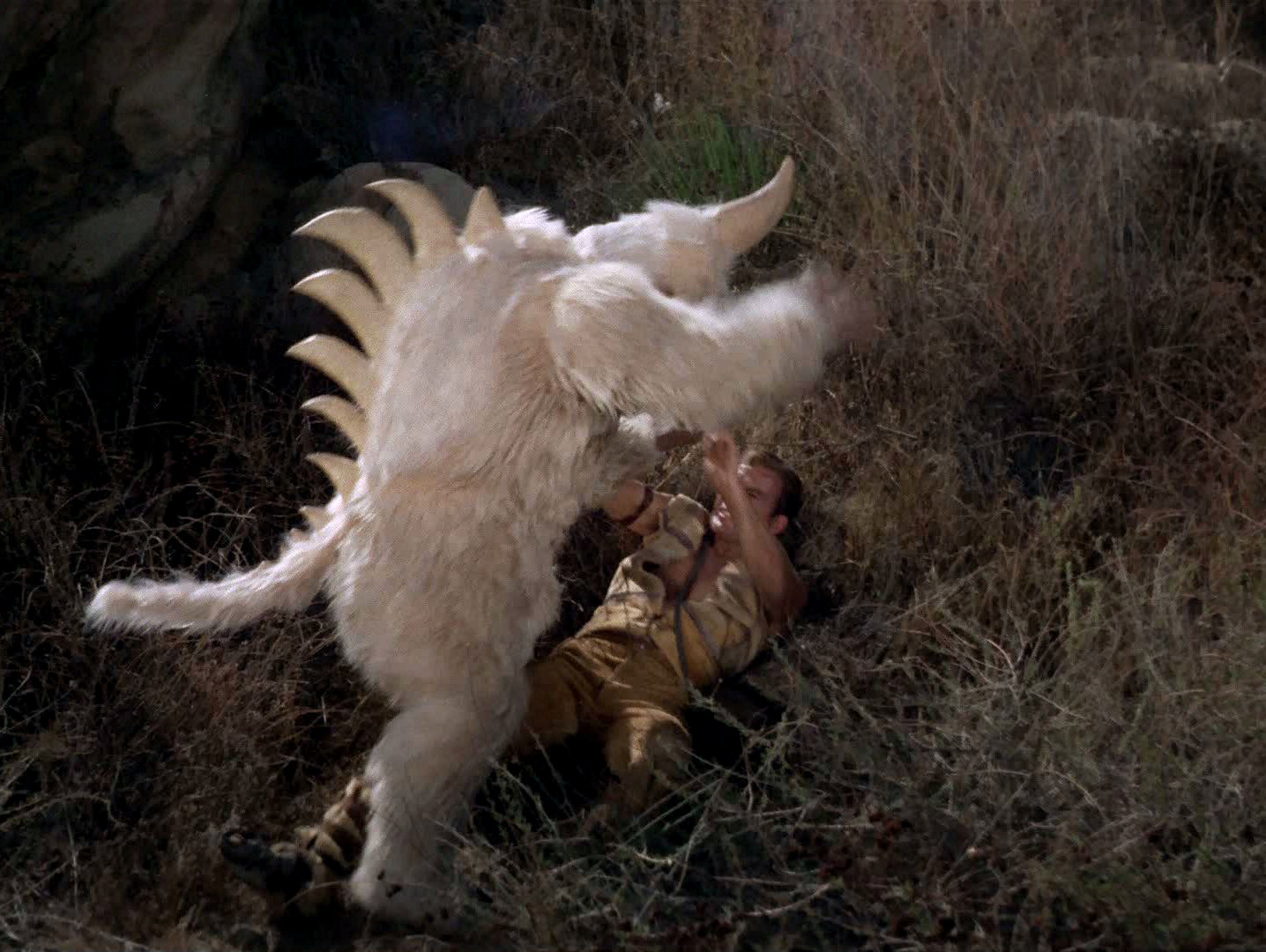
Stardate 4211.4: Kirk, Spock and McCoy beam down to a primitive planet that Kirk visited years ago. Suddenly villagers with flintlocks show up, although they shouldn't possess that technology, and attack members of the peaceful Hill People. Spock is hit by a bullet. With Dr. M'Benga taking care of Spock's severe injury, McCoy and Kirk beam down again, in order to find proof that the Klingons supplied the villagers with those weapons. But while the Enterprise is hiding from a nearby Klingon ship and out of reach, Kirk is attacked by an indigenous mugato. In his effort to save Kirk's life McCoy receives help from Kirk's old friend Tyree of the Hill People and his wife Nona, a kahn-ut-tu who knows to heal using herbs and also how to infatuate men. After Kirk's recovery, he, McCoy and Tyree find evidence for the Klingon involvement in the village. Kirk decides that the Federation has to supply the Hill People with the same type of weapons in order to maintain the balance of power. Tyree is reluctant and wants to avoid the confrontation. After another mugato attack, however, Nona steals Kirk's phaser and offers it to the villagers. When Kirk, McCoy, Tyree and his mean appear, the villagers kill Nona. Tyree is filled with hatred and ready for the fight now. In the meantime, Spock has recovered thanks to his Vulcan self-healing capabilities.
Review
Overall, for "A Private Little War" to be really interesting, its theme is too similar to the previous "destroyed paradise" episodes, such as "Return of the Archons", "This Side of the Paradise" or "The Apple". There are also several commonalities with "Friday's Child" where the Klingon way of infiltrating a primitive culture was shown before. There are a few unique qualities about "A Private Little War", however.
Kirk already has an impressive record of paradises that he destroyed or of planets that he left behind in disorder or disillusionment just because he felt it was the right thing to do. So far he always acted without much deliberation and without remorse. This time Kirk hesitates. He is familiar with the political and social situation on this world, and well aware that his efforts to save its people may destroy them. Even more importantly, he has a friend in Tyree. And now he condemns the peaceful Tyree to go to war against his conviction. Kirk is personally involved, which becomes obvious in his discussions with Tyree and McCoy, although especially in the latter he tries to justify his decision with objective reasons. In any case it is quite palpable that Kirk feels sorry about what he thinks he has to do.
But is there really no alternative? Two wrongs don't make a right. And just because McCoy doesn't know a better solution to the dilemma, it doesn't mean that Kirk's way is the only one. Kirk may have his orders how to deal with Klingon invasions of neutral worlds, but I doubt that there are instructions for a particular case like on Tyree's planet. It is Kirk's own idea to arm the Hill People to maintain the balance of power, and I tend to believe him that he wants to save them from extinction in the first place, rather than win new allies who would die for the cause of the Federation. Unfortunately the historical precedent of the Vietnam War that he cites insinuates also the latter.
"A Private Little War" is a diverse episode. It is full of action and it even has a nice B-plot dealing with Spock's recovery on the Enterprise. On the other hand, this all leaves relatively little time for the discussion of the key issue of whether supplying the Hill People with weapons to save them is ethical. And just as the episode reaches a point when Tyree and his people may have to reconsider their views and grudgingly accept their new situation, it is overshadowed by Tyree's jealousy, Nona's eagerness for power, her betrayal and her death on the hands of sex-starved villagers. This series of twists is a major letdown and clearly lowers the impact of the story, because it leaves the impression that the conflict is not imposed on the people by the two alien powers but has its actual roots on the planet itself. Ultimately the Klingons and even the Federation could claim to have just supplied better weapons for a conflict that may have broken out any time because of the social disparities on the planet and other self-destructive tendencies.
Annotations
- Remarkable quotes:
- "Lucky his heart's where his liver should be, or he'd be dead now." (McCoy, about Spock)
- "We once were as you are. Spears and arrows. There came a time when our weapons grew faster than our wisdom, and we almost destroyed ourselves. We learned from this to make a rule during all our travels, never to cause the same to happen to other worlds - just as a man must grow in his own way and in his own time." (Kirk)
- Remarkable scenes:
- Chapel grabs the hand of the unconscious Spock but quickly puts it down as M'Benga enters. Still M'Benga notices it.
- Chapel hits Spock as requested, to help him regain his consciousness, when Scotty enters the room...
- Remarkable facts:
- The "Brush Wars" are said to be a series of wars on the Asian continent in the 20th century, with two major powers indirectly involved. This clearly refers to the Vietnam War.
- The script calls the planet "Neural" and the Klingon officer "Krell". Neither name is mentioned in the episode, however.
- Remastering: We briefly see the Klingon battlecruiser in the remastered episode that didn't even exist at the time the episode was originally shot.
Rating: 4
The Gamesters of Triskelion
Synopsis
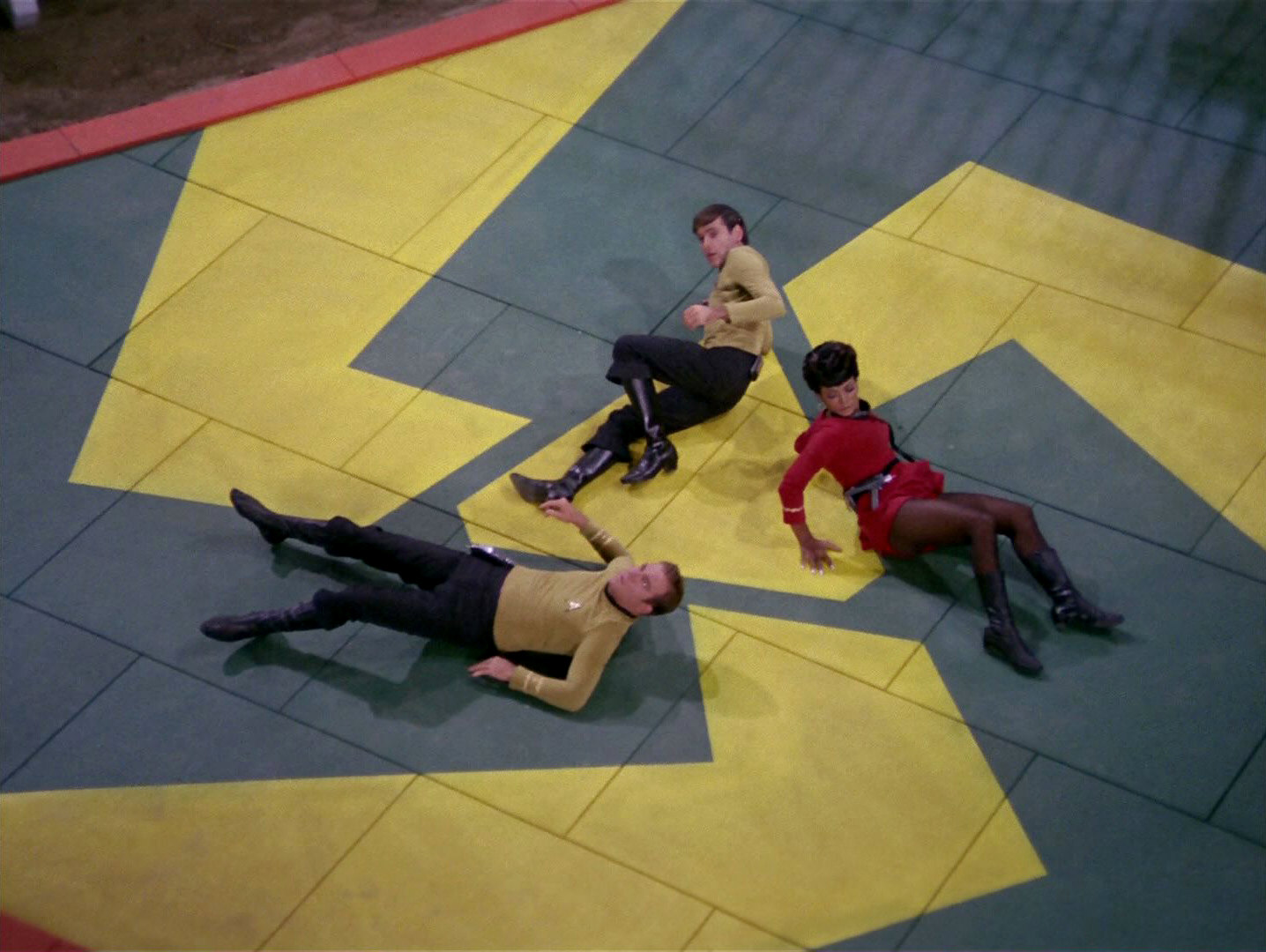
Stardate 3211.7: When they are just going to beam down to the planetoid Gamma II, Kirk, Uhura and Chekov suddenly vanish from the transporter platform. They find themselves as prisoners on the planet Triskelion. In the meantime, Spock has decided to follow an ion trail in order to retrieve the three officers, against the advice of McCoy and Scott. Kirk, Uhura and Chekov are supposed to fight against gladiators for the entertainment of the planet's rules, who place bets on their thralls. When the Enterprise arrives at Triskelion, the Providers disable the ship. Kirk, however, challenges the Providers, who are actually three brains that claim to be superior to humanoid beings. Winning a fight against three other thralls, Kirk regains the freedom of his crew and of all other slaves.
Review
We already know this cookie-cutter plot well: Our heroes are kept like pets for the mere enjoyment of their allegedly superior kidnappers, they are supposed to fight in an arena and when the Enterprise arrives to help them the ship is threatened with destruction. The development story is predictable, and the revelation that the planet is ruled by three brains is too familiar; they could have been computers as well, in which case Kirk would have discussed them to death. The only remarkable fact is that it isn't Kirk, Spock and McCoy this time who are captured, but Kirk and the two minor characters Uhura and "fresh face" Chekov. Uhura and Chekov don't play much of a role though, for the focus is once again on Kirk and his interaction with the charming drill thrall Shana (while Chekov gets the unattractive Tamoon). I like Kirk's discussions first with with Shana and then with the Providers about compassion, sense of responsibility and longing for freedom - virtues that the denizens of Triskelion seem to have abandoned or underestimated. Kirk has quite an enlightening debate with the three brains about their alleged superiority that has made them totally unproductive (much like already in "The Cage"). Alas, it comes as a disappointment that it all boils down to yet another fight. A fight in which Kirk gains his and everyone's freedom but which is sort of pointless because the Providers would have had the power to enslave or kill anyone of Kirk's crew anyway.
The perhaps more interesting part of the story takes place on the Enterprise, where Spock, McCoy and Scott are constantly discussing the right course of action to rescue the missing crew members. Their arguments are well-grounded, and overall their interaction comes across as quite realistic.
Annotations
- Trivia: The number three is quite prevalent all through the episode. The planet is called Triskelion, it is a trinary system, there are three Providers who are using triangular shapes and symbols all over the place, exactly three crew members were on the transporter platform in the beginning (a strange coincidence), they were about to beam down to Gamma II (third letter of the Greek alphabet), and in the end Kirk is fighting against three contestants.
- Continuity: After just hearing their voices, Kirk surmises the Providers are computers. It is obvious that the various prior experiences with computer-controlled societies leads him to this conclusion.
- Nitpicking:
- Kirk hands Shana the stainless steel tray as a mirror to show her how beautiful she is. It is like she is looking into a mirror for the first time, but how come she is wearing perfect make-up?
- Kirk's small blow would hardly suffice to knock Shana unconscious - especially since she should be used to taking some beating (although she doesn't look like that at all).
- Remarkable dialogues:
- "Mister Spock, the Captain, Lieutenant Uhura, and Chekov. They vanished!" - "I presume you mean they vanished in a manner not consistent with the usual workings of the transporter, Mister Scott." (Scott and Spock)
- "It's the custom of my people to help one another when we're in trouble." - [He kisses Shana.] - "And this. Is this also helping?" (Kirk and Shana)
- Remarkable quotes:
- "You're out of your Vulcan mind, Spock." (McCoy)
- "A species that enslaves other beings is hardly superior - mentally or otherwise." (Kirk)
- Remarkable absence: Sulu is not in this episode.
Rating: 3
Obsession
Synopsis
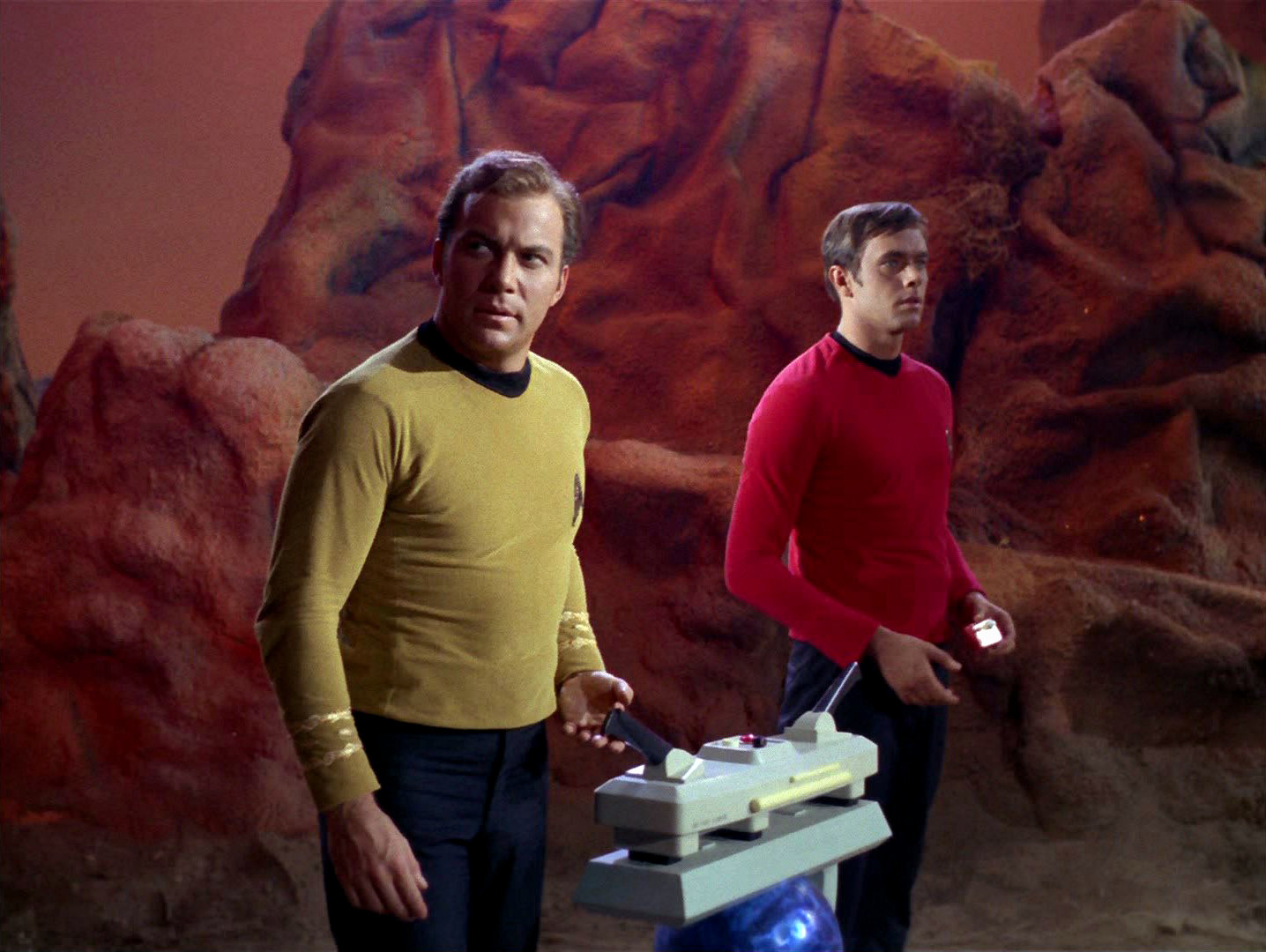
Stardate 3619.2: During the investigation of an alien planet Kirk smells what appears to be a familiar odor to him. He warns his men of a strange cloud that my show up. Briefly later, two of his landing party are dead and one is dying after something has drained all the red corpuscles from their bodies. Kirk orders the young Ensign Garrovick to beam down with another team, but again two men are killed. Kirk confines Garrovick to his quarters because of the ensign's failure. It transpires that eleven years ago Kirk encountered the cloud himself and did not fire on it in time, which he thinks cost the lives of 200 of the crew of the Farragut, including Captain Garrovick, the ensign's father. The cloud now heads out into space at warp and attacks the Enterprise, once gain killing someone. While Spock is talking with the young officer, it enters Garrovick's quarters through the ventilation. Spock shoves Garrovick away and is attacked but not harmed thanks to his blood's composition. The cloud leaves the ship. After it turns out that the creature can be destroyed with antimatter, rather than with phasers, Kirk orders to pursue it to its home planet Tycho IV, the place where Kirk once encountered it. He and Garrovick place an antimatter bomb on the surface and are beamed back just before the detonation that kills the creature.
Review
"Obsession" is the second episode after "The Doomsday Machine" to borrow motives from Herman Melville's Moby Dick. It takes elements from the other TOS episode too, such as the beam-out in the nick of time while the bomb is ticking, as well as the score of that scene. While "Obsession" is overall somewhat less exciting, Captain Kirk's personal involvement in the role of Captain Ahab makes the story more relevant than if it were another dispensable character such as Matt Decker. And so "Obsession" becomes a bit less of an action thriller and more of a tale about morality and about friendship. My favorite character in this episode is McCoy, as a medical officer and as a friend who is worried that something is wrong with Kirk.
I like how Kirk's obsession to hunt down the creature is developed in the episode and how the whole truth is gradually revealed. At first we only get subtle cues that Kirk has been in a similar situation before, when he literally smells the danger. He still cares a great deal about his crew at that time, and safety comes first in his actions and orders. Only when Garrovick fails to destroy the cloud, Kirk becomes increasingly agitated, up to the point when he counters the justified criticism of his crew, claiming they are conspiring against him. Garrovick must have reminded Kirk of his own alleged failure. A failure that he can't accept, neither with himself nor with Garrovick.
Kirk's conduct in the crisis is much the same as already in "The Conscience of the King" and totally in character as such. I would have expected Kirk to have learned a bit though. However, he repeats all his mistakes from the first-season episode when he does not let in anyone of the crew on his past encounter with the strange cloud, and when he relies rather on his feelings than on facts. Well, his intuition that the creature is heading "home" to Tycho IV finally helps him find and destroy it. But that is more rehabilitation for him than I think he deserves. McCoy is damn right to question his ability to command the ship based on the facts about the cloud and on the captain's behavior. But he already apologizes to Kirk when it turns out that the creature is alive and consciously attacks the ship. It is an overkill that in the end Kirk can even feel what the cloud is up to.
Unfortunately some other parts of the plot are quite contrived too. The most obvious one is that Garrovick's son is coincidentally a member of Kirk's crew. While Ensign Garrovick's presence makes it an even more personal matter for Kirk and hence fulfills its purpose, Kirk should at least have known that the man was aboard. It is the same problem as already in "The Conscience of the King", where Kirk was not aware that Kevin Riley was a fellow survivor of the Tarsus massacre. Also, like so many of Kirk's crew members Garrovick is rather touchy compared to the overconfident Kirk. Why can't there ever be a tough guy (or girl) among the lower ranks? The redshirt ensigns appear to be incompetent anyway, and some of them are killed too easily, which may not have been necessary. A possible yet insufficient excuse for their hesitation is that they are not simply frightened but rather stunned by the cloud, so they cannot pull the trigger in time. The fact that the cloud is out of time sync may explain why it is impossible to hit, but it does not absolve the scared redshirts. Finally, it is a rather lame idea that the Enterprise's actual mission would be delivering urgently needed medicine, as in so many other episodes.
Annotations
- Remarkable dialogue: "Monsters come in many forms. You know the greatest monster of them all, Jim? Guilt." - "Get to the point." - "Jim, when a young officer is exposed to unknown dangers for the first time, he's under tremendous emotional stress. Now we all know that." - "Ensign Garrovick is a ship command decision. You're straying out of your field, Doctor." - "Am I? I was speaking of Lieutenant James T. Kirk of the starship Farragut. Eleven years ago, you were the young officer at the phaser station when something attacked. According to the tapes, this young Lieutenant Kirk insisted upon blaming himself." (McCoy and Kirk)
- Remarkable scene: When Kirk and Garrovick are standing beside the antimatter bomb, Garrovick fears that Kirk, obsessed as he is about the creature, is about to commit suicide. He tries to disable the captain. Kirk notices that and makes clear that it's not his intention to die.
- Remarkable facts:
- The cloud is partially composed of dikironium, an element that so far was believed to be artificial.
- The cloud can't harm Spock because of his green (copper- instead of iron-based) blood.
- Crew losses: 5 (including Lt. Leslie, who is shown to be dead but miraculously recovers)
- Remastering: The remastered episode features new effect shots of the cloud in space and of the crater that remains after the explosion on Tycho IV.
Rating: 6
The Immunity Syndrome
Synopsis
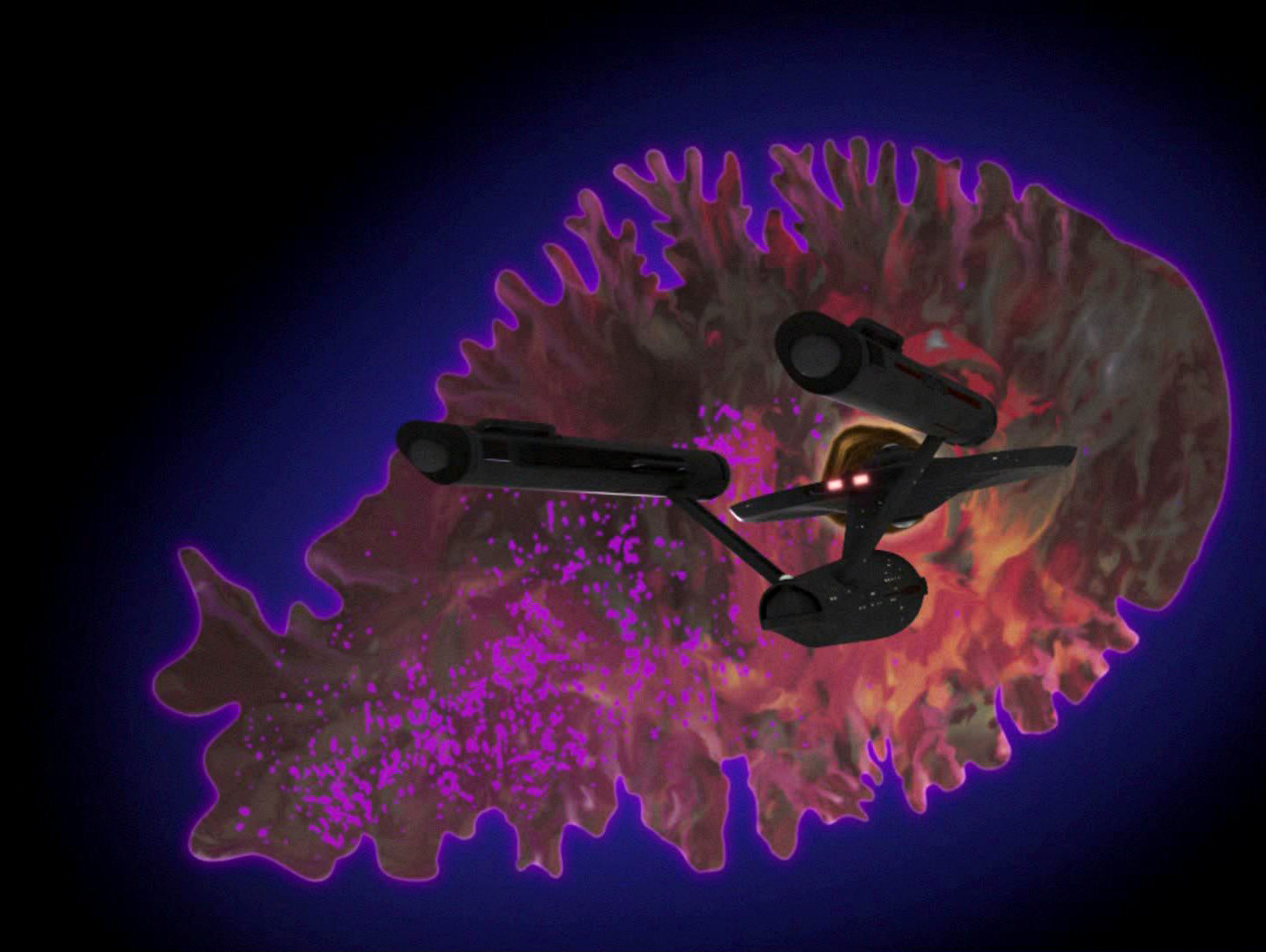
Stardate 4307.1: Starfleet loses contact with the USS Intrepid, and Spock senses that everyone on this all-Vulcan ship has been killed. Briefly later it is discovered that there is no life in the star system Gamma 7A any more. The Enterprise investigates and runs into a giant void, where energy is being drained from the ship's systems as well as from the crew's bodies. The origin of the phenomenon turns out to be a giant single-celled organism. When probes turn out to be inefficient, Spock volunteers to take a shuttle into the "amoeba", which would be a suicide mission. Spock suggests that the creature may be destroyed from within before the contact breaks off. Kirk takes the Enterprise into the amoeba and launches an antimatter probe. He orders to secure Spock's shuttle with a tractor beam, but suddenly there is no power left to escape. However, the probe explodes and ruptures the amoeba's cell membrane, thereby freeing the Enterprise and Spock's shuttle.
Review
The plot of "The Immunity Syndrome" certainly isn't the most original one, considering that the Enterprise has encountered various strange and dangerous machines or lifeforms before, of the kind that customarily needs to be blown up to save the lives of everyone on board and perhaps everyone in the galaxy. The episode always reminded me a lot of the unequaled thriller "The Doomsday Machine", and perhaps that was my chief reason to underrate "The Immunity Syndrome" so far. Only recently I discovered its special qualities.
Above all the episode is very thrilling. It draws suspense from a solid story, one that isn't sidetracked with something like unpleasant guest stars or missions to deliver some medicine in time. The story is a plain and simple race against the clock. But even more importantly, the episode draws suspense from excellent directing and good acting. Few episodes have such a smooth flow of the story, it is a pleasure to watch from the first to the last minute.
What I like too is the debate whether Spock or rather McCoy should take the shuttle on a suicide mission. Only superficially their argument is about vanity, about the questionable honor to be the person who dies investigating a scientific phenomenon. The more important driving force, as becomes clear between the lines, is their comradeship and friendship. They both want to save the ship above all, even if it means the ultimate sacrifice. The interaction between McCoy, Spock and Kirk in this episode is among the best of the whole series.
Annotations
- Nitpicking: Kirk concludes that, since the creature has created a negative (anti-)energy field, antimatter would be the right stuff to destroy it, rather than the phasers that would only feed it with energy. There are multiple fallacies in this idea. Firstly, the amoeba was consuming the ship's energy reserves all the time - consisting of antimatter for the most part. Secondly, why doesn't he consider using photon torpedoes? Thirdly, antimatter is not an analogy to anti-energy anyway.
- Remarkable dialogues:
- "Boundary layer between what and what?" - "Between where we were and where we are." - "Are you trying to be funny, Mister Spock?" - "It would never occur to me, Captain." (Kirk and Spock)
- "This is not a competition, Doctor. Whether you understand it or not, grant me my own kind of dignity." - "Vulcan dignity? How can I grant you what I don't understand?" - "Then employ one of your own superstitions. Wish me luck." [Spock leaves] - "Good luck, Spock." (Spock and McCoy)
- "Captain, I recommend you abandon the attempt. Do not risk the ship further on my behalf." - "Shut up, Spock! We're rescuing you." - "Why, thank you, Captain McCoy." (Spock and McCoy)
- Remarkable quote: "I've noticed that about your people, Doctor. You find it easier to understand the death of one than the death of a million. You speak about the objective hardness of the Vulcan heart, yet how little room there seems to be in yours." (Spock, to McCoy)
- Remarkable fact: Spock can sense the Intrepid's Vulcan crew has died, apparently across many light years.
- Remastering: The remastered episode comes with new shots of the ship in the "dark zone", of the shuttlecraft launch and of the inside of the "space amoeba".
Rating: 7
A Piece of the Action
Synopsis
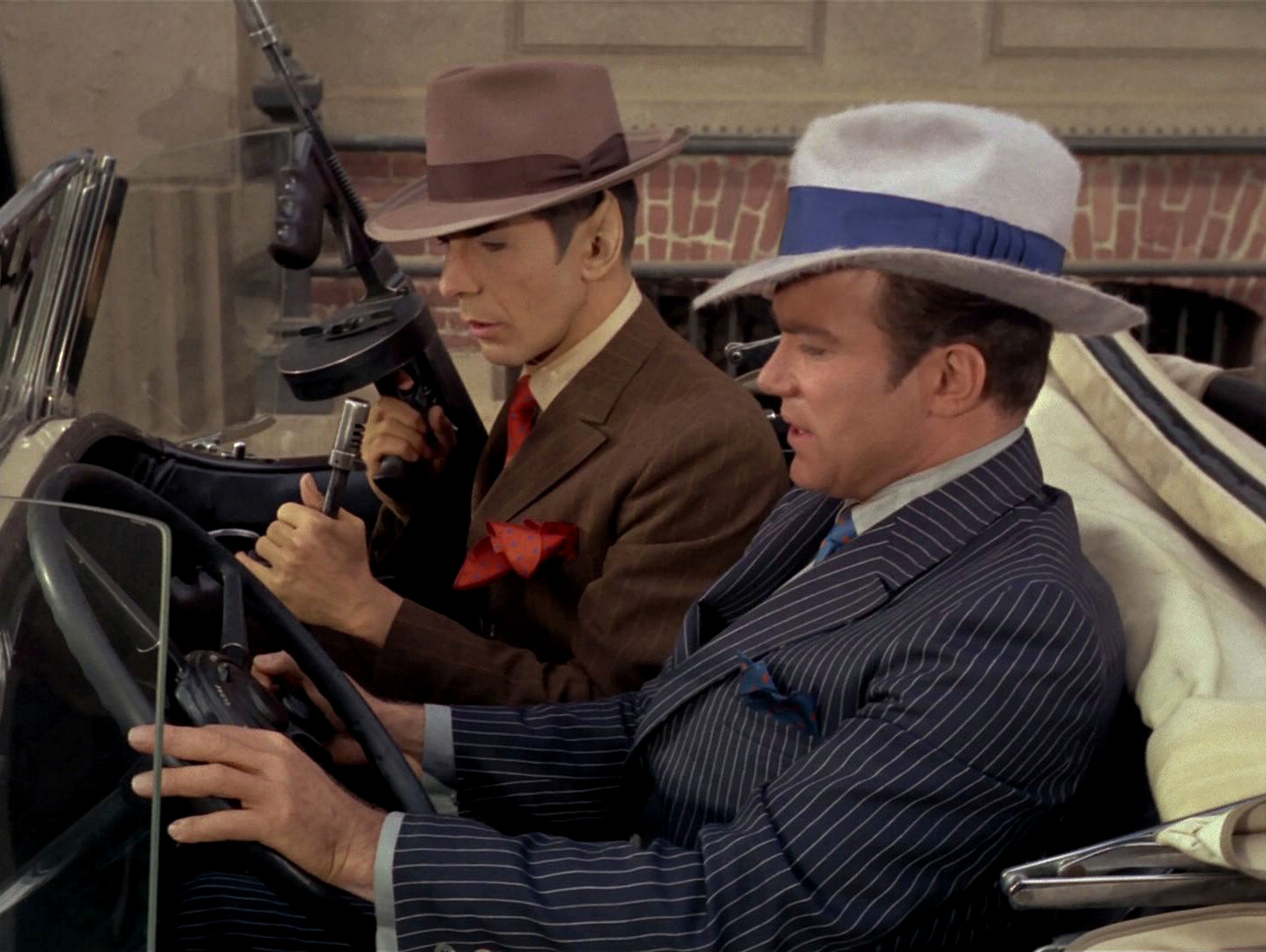
Stardate 4598.0: The Enterprise follows a distress call that was sent out by the starship Horizon a century earlier. When Kirk, Spock and McCoy beam down to the planet Sigma Iotia II, the last stop before the Horizon was destroyed, the planet's society is entirely based on a book called Chicago Mobs of the 20's that was left behind by the crew. Bela Okmyx, the biggest "boss" of the planet, captures the landing party and demands that Kirk delivers "heaters" (=phasers) so he can overpower his rivals. The three men manage to escape but are soon confronted with Krako, another boss, whose goal is to defeat Okmyx in the same fashion. Kirk then decides that it is time to play with rules that the Iotians understand. Scotty beams all the bosses to Okmyx's headquarters on Kirk's order, and when Krako's men "hit" the place, he demonstrates his power by stunning all the attackers with the ship's phasers. The bosses have no other choice but to agree with the Federation's takeover of their planet.
Review
This is clearly the best of the four "parallel Earth" episodes of the second season, although it makes essentially the same mistakes and perpetuates all the old clichés. "A Piece of the Action" can compensate for that with a good deal of humor. It is never gratuitous, however always on the verge of becoming inappropriately silly. We have to keep in mind that the goal is to save the planet from self-destruction and to save the lives of the landing party just as well. But what would this episode be without the famous fizzbin game or without Kirk's attempts to drive with the clutch? Another highlight is how Kirk gradually adopts the customs and the slang of the Iotians, and Spock follows suit when he puts his feet on the desk. I also like the cue Kirk gives to Scotty when he wants Krako to be beamed up: "He's standing about twelve feet in front of me, all ready to be our pal. Of course, Scotty, I'd like to show him the ship, just to show him that we're, er, we're on the level."
In this regard we may may forgive Kirk and Spock that they are quite careless in the beginning. Although there is no need at all to rush into action, they simply beam down without first investigating the planet from orbit. They have no strategy at all, and Spock does not care about McCoy's reservations that they could continue to contaminate the culture on Sigma Iotia. No one is concerned about the safety of the landing party either. The episode may have worked better if it had been less obvious from the start that the landing party would run into one trap after another, and that they would rather cause trouble on the planet than prevent it. Likewise, "A Piece of the Action" would have deserved a more considerate ending than a rushed truce that is very unlikely to persist more than a few days.
I quite like the refreshingly anachronistic guest characters. Especially Okmyx and Krako are proactive and also surprisingly versatile characters, although their backwardness and the slang they speak could have easily degraded them to mere comic relief. I have mixed feelings about that boy who is apparently keen on becoming a gangster with a machine gun and who helps Kirk and Spock to get access to Krako's headquarters. I think that a kid in the midst of a war wouldn't have been depicted in such a humorous fashion in modern Trek. I also wonder, does the boy get his promised "piece of the action"? A better screenplay would have shown him again and would have answered that question.
Annotations
- Nitpicking: Would Spock and McCoy let Kirk simply go when he wants to apprehend Okmyx single-handedly? It is a stupid idea, and so it is no surprise he is promptly captured again.
- Remarkable error: Bela's last name is consistently pronounced "Oxmyx", but on the posters with his face we can read that the spelling is "Okmyx".
- Remarkable dialogues:
- "Waddaya think, we're stupid or somethin'?" - "No, no, I don't think you're stupid, Mister Krako. I just think your behavior is arrested." - "I ain't never been arrested in my whole life!" (Kirk and Krako)
- "Nobody helps nobody but himself." - "Sir, you are employing a double negative." - "Huh?" (Okmyx and Spock)
- Remarkable quotes:
- "This is the contamination, Captain. Astonishing. An entire culture based on this." (Spock, looking at "The Book")
- "The most cooperative man in this world is a dead man." (Bela Okmyx)
- Remarkable scene: Kirk drives a car with gear shift, or at least tries hard to. Spock's judgment after the bumpy ride: "Captain, you are an excellent starship commander, but as a taxi driver you leave much to be desired."
- Remarkable card game: Fizzbin, a card game whose strange rules change with the time of the day and the day of the week that Kirk quickly makes up to confuse the mobsters
- Remarkable technology: It is the only time that the ship's phasers are set to stun (although this would have been an option on many other occasions).
- Remarkable nickname: Kirk calls McCoy "Sawbones" at one point in the episode.
- Remarkable facts:
- When the Horizon contacted the planet a century earlier, the "Non-Interference Directive" was no yet in effect.
- The Horizon only had a conventional radio transmitter, whose message took a whole century to arrive.
Rating: 5
By Any Other Name
Synopsis
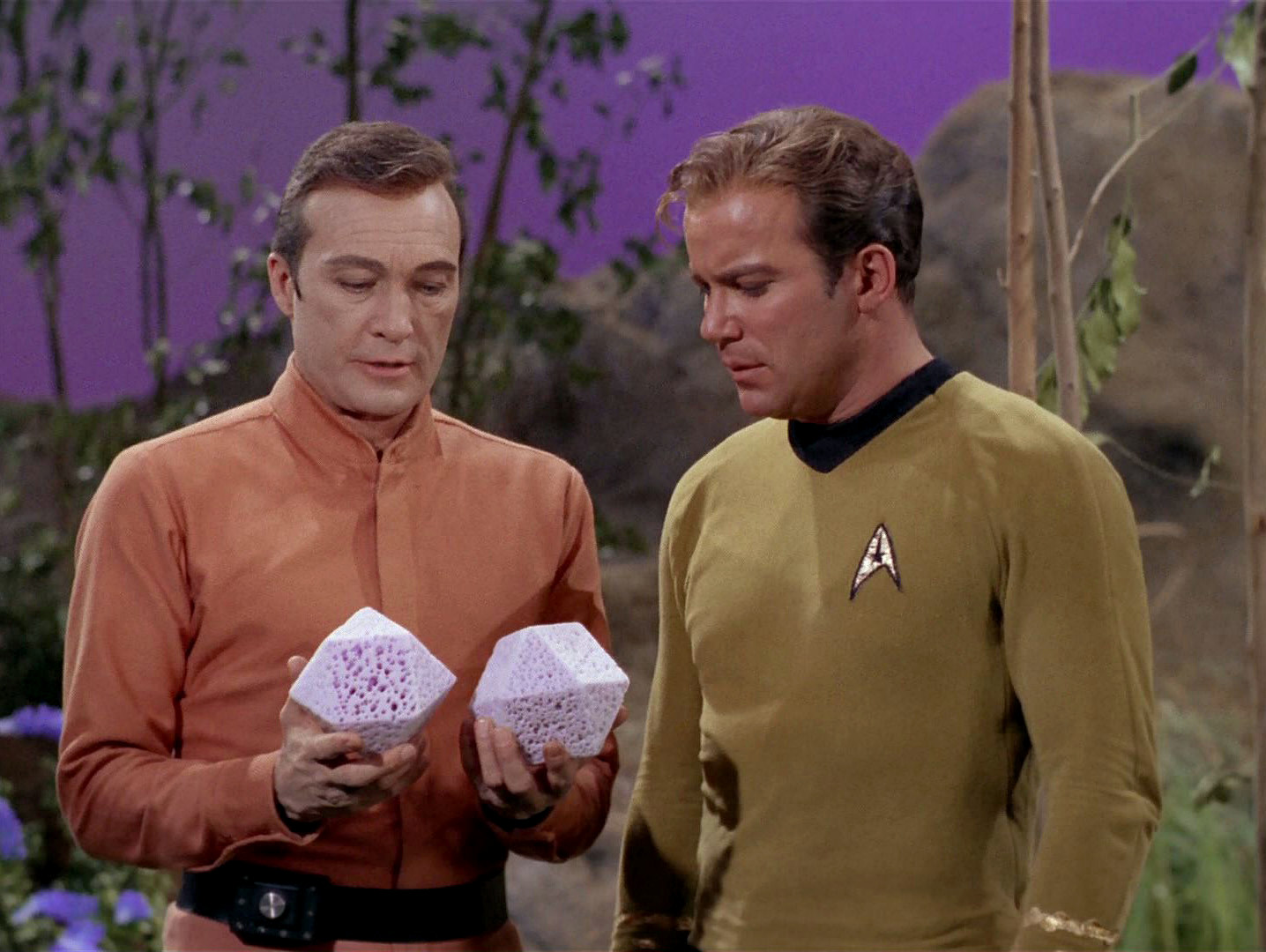
Stardate 4657.5: A small group of Kelvans capture an Enterprise landing party. They reduce two junior officers to small mineral packets, of which they crush one to demonstrate their power, thereby killing a female crew member. After capturing the ship the Kelvans transform most of the now unnecessary Starfleet crew to such mineral packets and head for their home in the Andromeda Galaxy. The aliens are not accustomed to their human bodies and emotions, a weakness that the remaining crew members Kirk, Spock, McCoy and Scotty successfully exploit. In control of the ship again, Kirk offers the Kelvans to settle down on an uninhabited planet.
Review
This is one of the better alien takeover plots. It somehow consists of two parts, one being dead serious and one rather light-hearted. In the serious part I like how the first attempt of the landing party to escape utterly fails, how Kirk wants to take the responsibility himself and how he mourns the death of the young yeoman. Several other TOS episodes are too easy-going from the start in similar situations, and here is a pleasant exception.
Nevertheless, this installment lightens up in the usual fashion as well, and not really to its advantage. Sure, the idea that hostile aliens are not used to human emotions in all their variations bears a lot of comical potential, which is successfully exploited here. Especially Kirk has the opportunity to combine business and pleasure. But although I enjoyed it, the circumstances are simply too grave for a fun episode. After all, the Kelvans have incapacitated almost the whole crew and are controlling the ship. They did kill one crew member and would do it again any time. Their goal is to conquer the whole Milky Way Galaxy some day. On the bright side, Star Trek shows once again that a conflict need not be solved with violence, however, it is not very credible that the aliens change their minds so quickly and so substantially. Understanding an opponent is the key to peace, but it is a tad too much simplified here.
On a side note, it is remarkable that back in the 60s no network official took offense by the naive and harmless depiction of Scotty's drinking orgy, something that may not have found the censors' blessing in more recent days.
Annotations
- Continuity: Kirk refers to the Great Barrier (TOS: "Where No Man Has Gone Before") and mentions to Spock the Vulcan mind probe he performed to trick the guard on Eminiar VII (TOS: "A Taste of Armageddon"). These are two of very few explicit references to events in previous episodes in TOS.
- Remarkable title: When Kelinda notes that crystalline structures similar to flowers grow on their world, Kirk quotes from Shakespeare's Romeo and Juliet: "[What's in a name?] That which we call a rose by any other name would smell as sweet."
- Remarkable quotes:
- "It's...it's green." (Scotty, about a bottle of unknown alcohol)
- "You thought I was taking your woman away from you. You're jealous. You tried to kill me with your bare hands. Would a Kelvan do that? Would he have to? You're reacting with the emotions of a human. You are human." (Kirk, to Rojan)
- Remarkable foreign language adaptation: It should be annotated that the first aired German version was shortened to exactly 45 minutes and didn't include the scene when the cube (the female yeoman) was crushed. Maybe this was the more appropriate variant, considering the onslaught of humor to come.
- Crew losses: 1
Rating: 5
Return to Tomorrow
Synopsis
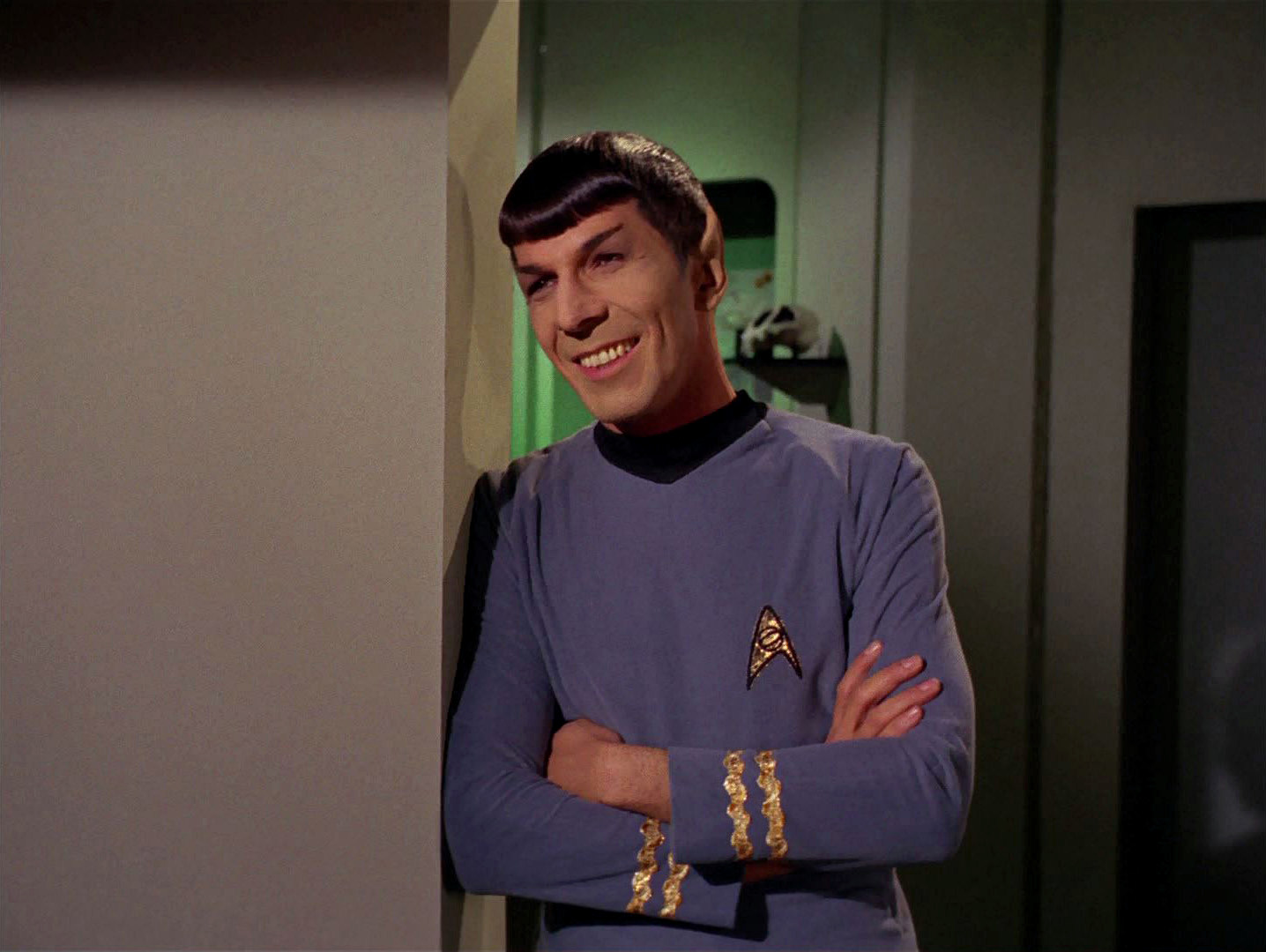
Stardate 4768.3: A voice speaks to the crew of the Enterprise and leads the ship to a planet. Deep beneath the surface the consciousnesses of Sargon, Thalassa and Henoch have survived the end of their civilization some 500,000 years ago. In order to be able to construct android bodies for themselves, the three occupy the bodies of Kirk, Dr. Ann Mulhall and Spock. Henoch, however, does not intend to leave Spock's body. He plots to kill Sargon, and Kirk with him. Spock's consciousness seems to be lost when Kirk destroys the globe in which it was stored, attempting to get rid of Henoch. While Sargon and Thalassa are hiding in the ship's computer, Henoch's consciousness is still in Spock's body. But Nurse Chapel administers him an injection that expels Henoch, who now has no place to go to and dissolves. Spock can be recovered, since his mind has been transferred to Nurse Chapel in time. Sargon and Thalassa recognize that they could not live among humanoids and decide to fade into oblivion.
Review
I don't care much for this episode. It certainly isn't a bad one. It does have its moments. However, for one thing, it consists of just too many well-known motifs or even clichés. It raises some interesting issues, but none that wouldn't have been discussed in more detail in previous episodes. Overall, "Return to Tomorrow" is much like an amalgam of "Space Seed", "Metamorphosis" and "By Any Other Name". Well, at least the idea that Sargon, Thalassa and Henoch transfer their minds into robotic bodies is only a side aspect here, otherwise I could probably add two more previous episodes that were pillaged to the list. Actually, I like how the story is being sidetracked by Thalassa and Sargon working on the robots.
Anyway, especially the depiction of aliens that experience human bodies is not very convincing. I think even the semi-comical take on this issue in "By Any Other Name" was more decent. "Return to Tomorrow", in contrast, is dominated by grandiose mumbo-jumbo. The three aliens that occupy the bodies of Starfleet officers are overdone and overacted. The many phrases about their superiority that only occasionally make way for serious talking (but then rather sentimental pondering). The overbearing tone of most of what they are saying. The echoes in the their voices that they keep even as they are in Kirk's, Spock's and Mulhall's bodies. The quivering as the mind transfer takes place.
One thing I like is the extensive discussion about the benefits and the risks of the mind transfer, as well as Kirk's stance that the decision has to be unanimous. Unfortunately he closes the consultation with a speech that is overblown, like so much else in the episode.
Other than that the episode was obviously seen as an opportunity to show unusual behavior of Spock, or more precisely, Henoch in Spock's body. It is amusing to watch him at first, but it takes only a minute before we see how Henoch plots to kill Sargon/Kirk.
Annotations
- Remarkable quote: "Then perhaps your intelligence wasn't so great, Sargon. We faced a similar crisis in our early nuclear age. We found the wisdom not to destroy ourselves." (Kirk)
- Remarkable speech: "They used to say if man could fly, he'd have wings. But he did fly. He discovered he had to. Do you wish that the first Apollo mission hadn't reached the moon, or that we hadn't gone on to Mars and then to the nearest star? That's like saying you wish that you still operated with scalpels and sewed your patients up with catgut like your great-great-great-great-grandfather used to. I'm in command. I could order this. But I'm not because, Doctor McCoy is right in pointing out the enormous danger potential in any contact with life and intelligence as fantastically advanced as this. But I must point out that the possibilities, the potential for knowledge and advancement is equally great. Risk. Risk is our business. That's what the starship is all about. That's why we're aboard her. You may dissent without prejudice. Do I hear a negative vote? Engineer, stand by to beam aboard three receptacles." (John F. Kirk)
- Remarkable facts: 6000 centuries ago Sargon's people colonized the galaxy, possibly leaving seeds for civilizations to emerge. His people began to destroy each other when they had developed god-like powers. The underground area was built about 500,000 years ago.
- Remarkable appearance: Diana Muldaur would return to Trek in "Is There in Truth No Beauty" and as Dr. Pulaski in TNG's second season.
- Remarkable names: All of the aliens' names are from Earth's mythology or history: Sargon of Akkad. Henoch, a biblical figure. Thalassa, primordial Greek sea goddess.
Rating: 3
Patterns of Force
Synopsis
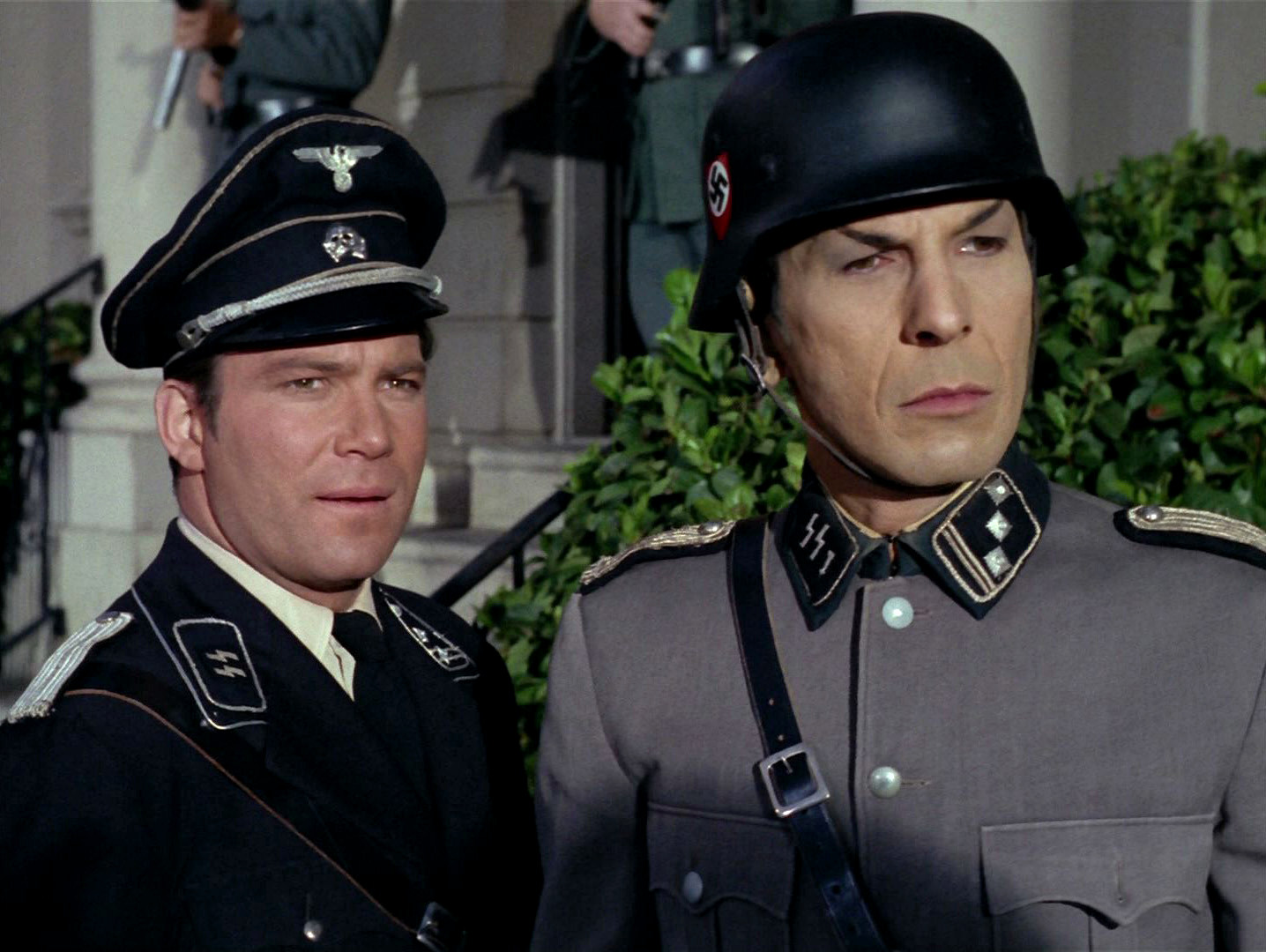
Stardate 2534.0: The Enterprise attempts in vain to contact John Gill, a cultural observer on the planet Ekos. When the ship approaches the planet, it is attacked with a rocket, a technology that the Ekosians shouldn't possess. Kirk and Spock beam down, to find that the planet is ruled by an exact copy of the Nazi regime that oppresses especially the immigrants from the neighboring planet Zeon. The "Fuhrer" is no one else but Gill! Kirk and Spock are imprisoned, but they manage to escape together with a Zeon named Isak. The Zeons have allied themselves with Ekosians who are opposed to the Nazi regime. With the help of an Ekosian women named Daras, Spock and Kirk gain access to the "Fuhrer Headquarters", from where Gill is making an important announcement. But Gill is on drugs. The true power lies with Deputy Fuhrer Melakon, who declares an open war against Zeon. With the help of a medication from McCoy and a mind meld with Spock, Gilll confesses that he had the good intention to improve the Ekosian society but that he made a big mistake by bringing the seeds of the Nazi ideology to them. Gill can still publicly denounce the traitor, whereupon Melakon kills him with a machine gun. Isak shoots Melakon. Daras and Eneg, another Ekosian official who was secretly working against the Nazis, pledge to build a new Ekos, for both Zeons and Ekosians.
Review
It is a questionable tradition of several American TV series to do one story with a Nazi theme, no matter how unsuitable or even absurd it is in the show's setting. Unfortunately Star Trek is no exception. Any appearance of Nazis in fiction that is out of the historical context, such as in a wrong era, in a wrong place or even on an alien planet, is utterly gratuitous. The inherent cruelty of Nazis, together with their terminology, uniforms and symbols that are hateful like nothing else on Earth, appeals to the lowest instincts of the viewers as it gives them someone to focus their hatred on. So it distracts from other issues that may be raised in the story, and in the case of "Patterns of Force" it sort of disqualifies it as a science fiction episode. As Kirk and Spock are fighting Nazis in this episode, we are only infrequently reminded of the fact that this is the future on an alien planet. Fortunately Star Trek's takes on Earth history are otherwise much more decent, but the comparison with other Trek episodes along similar lines only reinforces my objections to "Patterns of Force".
The depiction of the Ekosian Nazis is exactly the same as the stereotypes of German Nazis established in hundreds of WWII movies and series. One reason for the almost total analogy is the cost-saving potential of re-using as much as possible from Paramount's immense stock of Nazi uniforms and props. Still it should have been attempted to establish at least *some* visual difference, or alter the terminology. Most importantly it would have been more respectful of the victims of the Holocaust not to refer to the extermination of the Zeons as the "Final Solution". The horribly gratuitous "Jewish" names of the Zeons (=Zions) are already bad enough. Well, the Ekosians speak English instead of German, also in the written language we can see. And they shout "Hail Victory" instead "Sieg Heil" (the latter is only heard in the unmodified stock footage of real Nazi Germany). But other aliens speak and write English as well in TOS, so it is nothing that could set apart Ekosian from German Nazis.
Regarding the historical analogy, there is one particularly objectionable point. Right at the beginning, before it is even known that a Nazi regime exists on Ekos, Spock establishes the racist stereotypes that the Ekosians are rated as "warlike" as opposed to the "peaceful" and generally more civilized Zeons. Isak later reiterates Spock's statement with much the same words. On other occasions we may generously overlook such an assessment, and in case of the Klingons the classification of being "warlike" is even correct for all we are shown of them. In Isak's case it is only understandable that he wouldn't exactly defend the people who mistreat him for no reason (although he even sympathizes with them as we learn later). But since Earth's history is tied in, it gains a whole new significance. The fact that the Ekosians were classified as "warlike" from the outset calls Gill's later statement into question that any people, under certain circumstances, could be ready for or susceptive to the Nazi ideology. And even worse, it insinuates that Germans are intrinsically warlike just as well and caters to the anti-German sentiment in addition to the mere sight of Nazis. At least Daras and Eneg, who both work in the Ekosian resistance movement, shed a different light on their people.
Another thing that annoys me is how the episode upholds the old myth of Nazi Germany being a most efficient state. No half-way reputable historian or economist still claims something like that. The Nazi regime was built on terror, and no such regime in human history has ever survived more than a couple of years. Efficiency is nothing without a long-term perspective. Nazi Germany's economy worked on the basis of total exploitation. It used forced labor on an unprecedented scale. It wasted the retirement pays and other savings of the citizens, it confiscated Jewish property, and when this still wasn't enough there were other countries that could be plundered. Unfortunately the existence of advanced weapons on the once backward planet only corroborates the notion that the Nazi regime benefits the Ekosians, at least in certain areas such as research and production.
There is yet another assessment of history that the episode doesn't get right. Kirk says: "The problem with the Nazis wasn't simply that their leaders were evil, psychotic men. They were, but the main problem, I think, was the leader principle." But the leader principle doesn't really set apart the Nazi regime from other dictatorships. As Spock correctly notes, it was the same with "Ramses, Alexander, Caesar, Napoleon, Hitler, Lee Kuan". (Could the latter be the leader of the Eastern Coalition?) I would like to add Stalin as the arguably most paranoid leader of all times. Anyway, the fundamental failing of the Nazi ideology is that it classifies people as more or less valuable based on their "racial purity". The topic comes up especially when Melakon calls Spock a member of an "inferior race". But on other occasions in the story the true origin and nature of the Nazi ideology is watered down. In the end it appears that a Nazi regime can be installed anywhere and any time, without paying attention to the history of the place, and by just one person who poses as a "Fuhrer".
Racial hatred and oppression of minorities were the basis of the Nazi ideology, not its unfortunate outcome! In this regard we have to wonder what Gill possibly wanted to accomplish in the first place, how much of the Nazi ideology he himself imposed on the people of Ekos, and how much of it was Melakon's work. This question better remains unanswered. Realistically there can be no "benign" Nazi regime with the aspired "efficiency", because threats and violence were the essential driving forces of all its apparent efficiency.
Story-wise the only distinguishing mark of "Patterns of Force" is the Nazi theme, because the plot is much the same as in "A Piece of the Action" and "Bread and Circuses". I enjoy only a few minor aspects, such as Kirk and Spock's jail break, using a rubidium crystal to build a crude laser. This is one of the more intelligent makeshift uses of technology. I also like the clever idea of Kirk, Spock and Isak posing as a camera team with the "Hero of the Fatherland", to get access to the "Fuhrer Headquarters". Finally, the ending is quite conciliatory, and yet not too contrived, since it has become clear in the course of the episode that many Ekosians and Zeons give a damn on the Nazi ideology and that there may be well a common future for them. One point for the few things I like about it.
But one thing that I will always hate about "Patterns of Force" is how much obvious fun Kirk and Spock are having when they dress as Nazis, and how they are making inappropriate jokes all the time. William Shatner and Leonard Nimoy are both of Jewish descent, and it almost seems as if they are downplaying the bizarre roles they have to play here. It makes me shudder.
Annotations
- Nitpicking:
- The first time Spock and Kirk rush into action and masquerade as Nazis for no apparent reason, instead of trying to hide, contact the ship and locate the "Fuhrer Headquarters" from there.
- Spock and Kirk wonder why Eneg doesn't recognize them as his former prisoners. Isak later tells them that Eneg is an ally. Shouldn't Isak have mentioned that earlier? Someone might have done something stupid to escape Eneg.
- Remarkably cheesy lines:
- "That helmet covers a multitude of sins." (Kirk, to Spock-Nazi)
- "Yes, it's a shame yours isn't as attractive as mine." (Kirk-Nazi, to Spock-Nazi)
- "You should make a very convincing Nazi." (Spock-Nazi, to Kirk-Nazi)
- "Captain, I'm beginning to understand why you Earthmen enjoy gambling. No matter how carefully one computes the odds of success, there is still a certain exhilaration in the risk." (Spock, playing a Nazi illuminator)
- Remarkably cheesy names: Zeon --> Zion, Abrom --> Abraham, Isak --> Isaac, Davod --> David
- Remarkable score: I hate the "Nazi drums" in several scenes. This clichéd score only adds to the impression that we are watching a generic Nazi movie, rather than a Star Trek episode.
- Remarkable technology: McCoy equips Kirk and Spock with subcutaneous transponders.
- Remarkable reaction: This episode was never aired in Germany (except on pay TV). The probable reason is not the open display of Nazi symbols, because TV series or movies are generally exempted from the ban on Nazi symbols in Germany. It is true but no big deal that German viewers could feel offended by continuously being portrayed as Nazis. More likely the unsuitably humorous approach and the absurdity of "Nazis in space" were the decisive obstacles to showing it.
- Remastering: The remastered episode has a nice shot of Zeon, now with rings.
Rating: 1
The Ultimate Computer
Synopsis
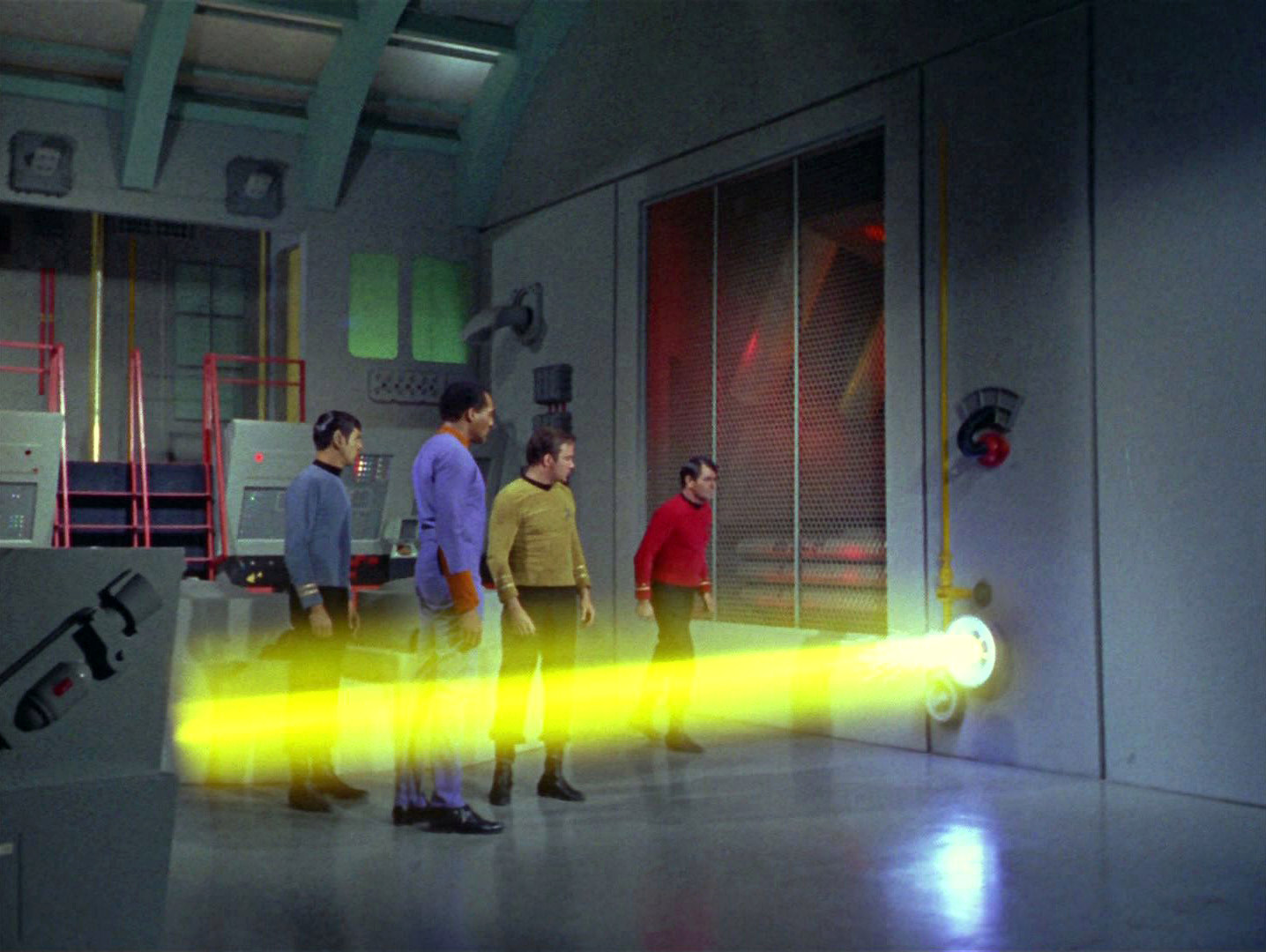
Stardate 4729.4: The Enterprise is summoned to a space station where Dr. Richard Daystrom installs his revolutionary computer M-5, to take control of all systems of the ship. The computer soon turns out to be superior to a human crew, in normal ship operations as well as in a simulated battle against another starship. Then, however, M-5 destroys an unmanned ore freighter, and a crewman is killed when he attempts to cut off the computer's power. Unbeknownst of the situation on the Enterprise, as M-5 has disabled any communication, a task force of four starships under Commodore Wesley continues the simulated attacks. M-5 takes the battle seriously, cripples the fleet and kills hundreds of crewmen. Daystrom has programmed M-5 with with his own engrams, and Kirk uses this knowledge to convince the computer that it is guilty of murder and has to shut down. Wesley is authorized by Starfleet to destroy the Enterprise but he breaks off the attack when he notices that the ship is dead in the water.
Review
It is the perhaps most remarkable technological vision of Star Trek that a computer manages many functions of the Enterprise from the beginning. The ship's conventional computer is seen as an every-day tool and is used without much pondering about it, rather than being an outlandish technology that would be extremely complicated to operate. The idea of computer automation was quite revolutionary in the 1960s, when computers were only known as simple data processing machines operating on tapes or punch cards! "The Ultimate Computer" takes this vision one step further and shows us the dangers of becoming totally dependent on computer technology. M-5 not only aids but first outperforms, then patronizes and ultimately makes the human crew totally expendable.
The menace that lies in the idea of giving a computer total control over a ship with deadly weapons is worked out quite well in the episode. Kirk's suspicion that something is wrong with M-5 should prove right in a tragical way. Even Spock has his doubts about Daystrom's brainchild, and as McCoy keeps teasing him, he makes it clear that he would never want to serve under M-5. On the other hand, Kirk, Spock's and everyone else's skepticism or, in the case of Scotty and McCoy, open defiance, seem to arise chiefly from the prospect of losing their jobs to M-5, ahead of safety considerations or moral concerns regarding the new technology. The discussion about M-5 in the first half of the episode suffers a bit from the crew's lamentation that it is taking away their jobs. It is odd anyway that everyone silently expects the starships of the future to have no human commander any longer and perhaps no crew at all. This would be absurd and can't be honestly Starfleet's goal, considering that humanity has a desire to explore strange new worlds, to seek out new life and new civilizations, to boldly go where no man has gone before. Starfleet would not leave that to unmanned probes, because it is not a simple question of efficiency. Or, as someone said 300 years earlier, new worlds are being explored "not because it is easy, but because it is hard". Daystrom is the only one who doesn't acknowledge that. Whatever his motivation is, in his opinion mankind should stay on Earth, he has developed M-5 so "men no longer need die in space". And everyone is a tad too much afraid of this one man's personal vision, which is ultimately the abolishment of a vision. Well, in some way Daystrom's stance anticipates the massive criticism that manned space travel would be facing since the 1970s, with reasoning such as "We can't spend billions on risky space programs while people are starving" that sounds a bit like Daystrom's objections.
It is a pity that the computer M-5 is a mysterious and menacing box with unknown functions that can't even be switched off. Computers will never behave like that. The outstanding movie "2001: A Space Odyssey", which was coincidentally produced at about the same time, is facing a similar problem. Yet, while there is at least an explanation for the malfunction of M-5, HAL's functions and capabilities are overall more credible than M-5's. While this technical issue is a minor flaw in the story, it is tiresome how Kirk manages to discuss the computer to death, for the fourth time or so, in much the same fashion as he already did with Nomad, and with way too much ease this time (with just two sentences!). I also don't like the depiction of Daystrom as a genius that winds up as a stereotypical "mad scientist", one who would rather protect his invention than the human life threatened by it.
The idea behind this installment is so attractive and was so brilliant at the time that it should have gone without the usual clichés. But aside from the few above issues "The Ultimate Computer" is one of the best TOS thrillers and a true classic.
Annotations
- Remarkable dialogues:
- "20? I can't run a starship with 20 crew." - "The M-5 can." - "And what am I supposed to do?" - "You've got a great job, Jim. All you have to do is sit back and let the machine do the work." (Kirk and Wesley)
- "Please, Spock, do me a favor and don't say it's fascinating." - "No. But it is interesting." (McCoy and Spock)
- Remarkable quotes:
- "Did you see the love-light in Spock's eyes? The right computer finally came along." (Guess who said that!)
- "All I ask is a tall ship, and a star to steer by." (from Sea Fever by John Masefield)
- "Fantastic machine, the M-5. No off-switch." (McCoy)
- Remarkable scene: As Scotty and a crewman are going to cut off the computer's power supply, M-5 establishes a new contactless link with the power coupling right through the body of the unfortunate crewman that is vaporized.
- Remarkable prop: We can see the engineering scanner with three nozzles of the disruptors from "A Taste of Armageddon".
- Remarkable facts:
- Wesley gives his regards to "Capt. Dunsel". Midshipmen at Starfleet Academy referred to a part which serves no useful purpose as "dunsel".
- At the age 24, Daystrom made the breakthrough in duotronic research that won him the Nobel Prize and Zee-Magnees Prize.
- Remastering: In TOS-R the footage of the K-7 type station was replaced with a new design, originally created by Masao Okazaki for The Starfleet Museum. Also, the appearance of the ore freighter was adjusted. It is now the same design as the robot cargo ship from TAS: "More Troubles, More Tribbles". Finally, the space battle is a bit more lively now, although I would have liked to see more shots in space.
- Crew losses: 1 (Enterprise only)
Rating: 7
The Omega Glory
Synopsis
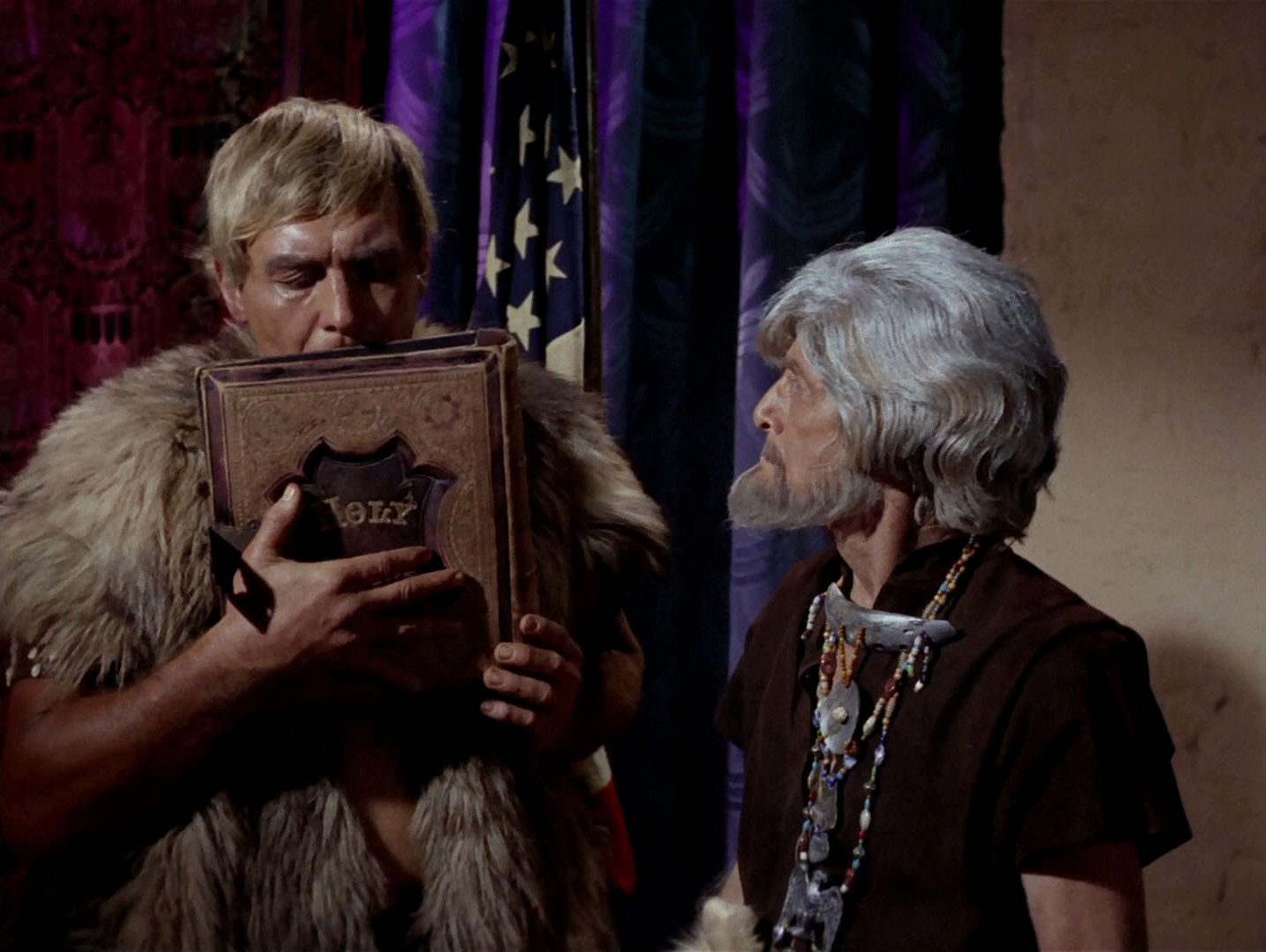
Stardate not given: Kirk beams over to the starship Exeter with Spock, McCoy and Lt. Galloway. They find that the whole crew has been reduced to crystals. Only Capt. Tracey has survived by staying on the planet Omega IV. The population of the planet is extremely long-lived and consists of peaceful villagers, the Kohms, and aggressive savages, the Yangs. Tracey sees the planet as a fountain of youth. Kirk, however, discovers that Tracey has interfered with the natural development on the planet and has killed many Yangs with his phaser, whereupon Tracey vaporizes Galloway and arrests the rest of the landing party. Kirk is imprisoned together with a Yang couple, who don't normally talk but who value freedom above all. He helps them remove the bars from the window of their cell, but the man, Cloud William, knocks Kirk unconscious and escapes alone with the woman. In the meantime McCoy has found out that there is no cure necessary because substances in the air and water have already accomplished an immunization. The Yangs and Kohms, on the other hand, live very long because it is part of their evolution after a war wiped out the civilizations that once existed on their planet. Kirk, Spock and McCoy are apprehended by the Yangs together with Tracey. It becomes clear that the Yangs ("Yankees") are descendants of an "American" civilization on the planet, while the Kohms are the former "Communists". Cloud William demands that Kirk speak the "holy words" of their people. He is unable to comply, so he has to fight against Tracey to bring about a decision which one of them is good and which one is evil. In the end Kirk prevails, and he gives the Yangs a lesson how to correctly interpret their "holy words", actually the United States Constitution.
Review
This episode is the last and worst one of the "parallel Earths" arc of the second season. "Patterns of Force" suffered from the dreadful Nazi theme, from historical fallacies and from loads of inappropriate humor, but at least it included some nice plot twists and a rather plausible ending. There is hardly anything original and absolutely nothing intelligent in "The Omega Glory". The episode merely rehashes ad nauseam what has been shown in the previous three "parallel Earth" installments of the season. Pertaining to the other plot points, nearly all of them are shamelessly recycled from "Miri" (crew stranded because they carry a disease that McCoy attempts to cure), "The Doomsday Machine" (the ship's reckless captain as the only survivor), "By Any Other Name" (human body reduced to minerals) and "A Private Little War" (villagers are being equipped with modern weapons to fight against "savages"), to name only some obvious examples.
The Prime Directive is made a big deal in this episode, but only because Tracey violated it so obviously. Since he is an insane criminal anyway and since Omega IV is incredibly Earth-like even without interference, the discussion never has as much weight as it could have had. The whole episode could have been so much better, had it shown a controversy between Kirk and a half-way decent other officer about the question whether the Federation should bend the Prime Directive for the benefit of millions (much like it would be done much later in "Insurrection"). Or whether the Federation shouldn't help the people on Omega IV to preserve what little is left of their civilization. But it just had to be yet another insane Federation officer and yet another series of fist fights for Kirk. Tracey's only good scene in the whole episode is when he points out to the Yangs that Spock looks like their idea of the devil and that he has no heart (at least none whose beating Cloud William could hear).
There is almost no need to comment on the utter rubbish that is produced in the final third of the episode, after Kirk, Spock, McCoy and Tracey have been captured by the Yangs. We see several Yangs, and their looks and rituals are much like those of Native Americans. So far the planet was still rather alien, at least by TOS standards, and it should better have remained alien. But the unfortunate trend of gratuitously tying in Earth's history continues vigorously. And so the true meaning of "Yangs" and "Kohms" is revealed in much the same fashion as it was done with the "Sun" and "Son" in "Bread and Circuses". The whole episode is built upon a lame play on words! As the Yangs solemnly carry a US flag that is in tatters, and everyone rises from their seats in reverence, this absurd form of "patriotism" is almost unbearable. When Kirk is supposed to speak the "holy words", he fails to say exactly what they want to hear, and so we're left with yet another fight of Kirk with Tracey (who has always won so far). This goes on for several minutes. I only like how Spock telepathically influences the Yang woman to contact the ship while everyone else is distracted. The encounter with the Yangs closes with Kirk's incredibly long monologue about how to interpret the US Constitution correctly. I admit I wasn't really listening to him any longer.
We better don't even try to explain how "Yankees" and "Commies" could possibly evolve on that alien planet. Any attempt to make any sense of it would be as futile as already with "Bread and Circuses". Still, one thing that bugs me is why the Kohms, as opposed to the allegedly freedom-loving Yangs, shouldn't be free. They appear to lead quite pleasant and peaceful lives, while the Yangs, in a way, are slaves of their own rituals and superstition and react to the word "freedom" more like a trained dog than someone who embraces the idea. What we see and hear of the two groups does not comply with the play on words that is intended to determine the roles the Kohms and Yangs in this story. And the racial composition of the Kohms, who are obviously all of Asian descent, while the Yangs are Caucasians, gives the whole story a racist undertone, rather than it would support the idea of (Chinese) "Communists" and "Yankees", respectively.
Annotations
- Nitpicking: The Yangs speak their "holy words" in a language that sounds like scrambled English. But everything else they say is real English, albeit a rather crude one. The Yangs would hardly change their "holy words" (their "Latin"), especially since they apparently haven't lost the ability to read, but rather their everyday language (their "English") would degrade in the course of the centuries. So the only explanation is that their normal language is not English (unlike on 892-IV), and that they are only understandable because of the universal translator, while the "holy words" are exactly what they sound like and are not translatable.
- Remarkable dialogue: "Pity you can't teach me that." - "I have tried, Captain." (Kirk and Spock, about the neck pinch)
- Remarkable errors:
- When Kirk is calling from the engine room through the comm system of the Exeter, several shots of different locations on the ship are shown, including an empty engine room!
- McCoy says that the human body is composed of 96% water, but it is more like 70%.
- Remarkable facts:
- The Exeter has four shuttlecraft.
- McCoy says: "The infection resembles one developed by Earth during their bacteriological warfare experiments in the 1990s. Hard to believe we were once foolish enough to play around with that."
- Crew losses: 1
Rating: 0
Assignment: Earth
Synopsis
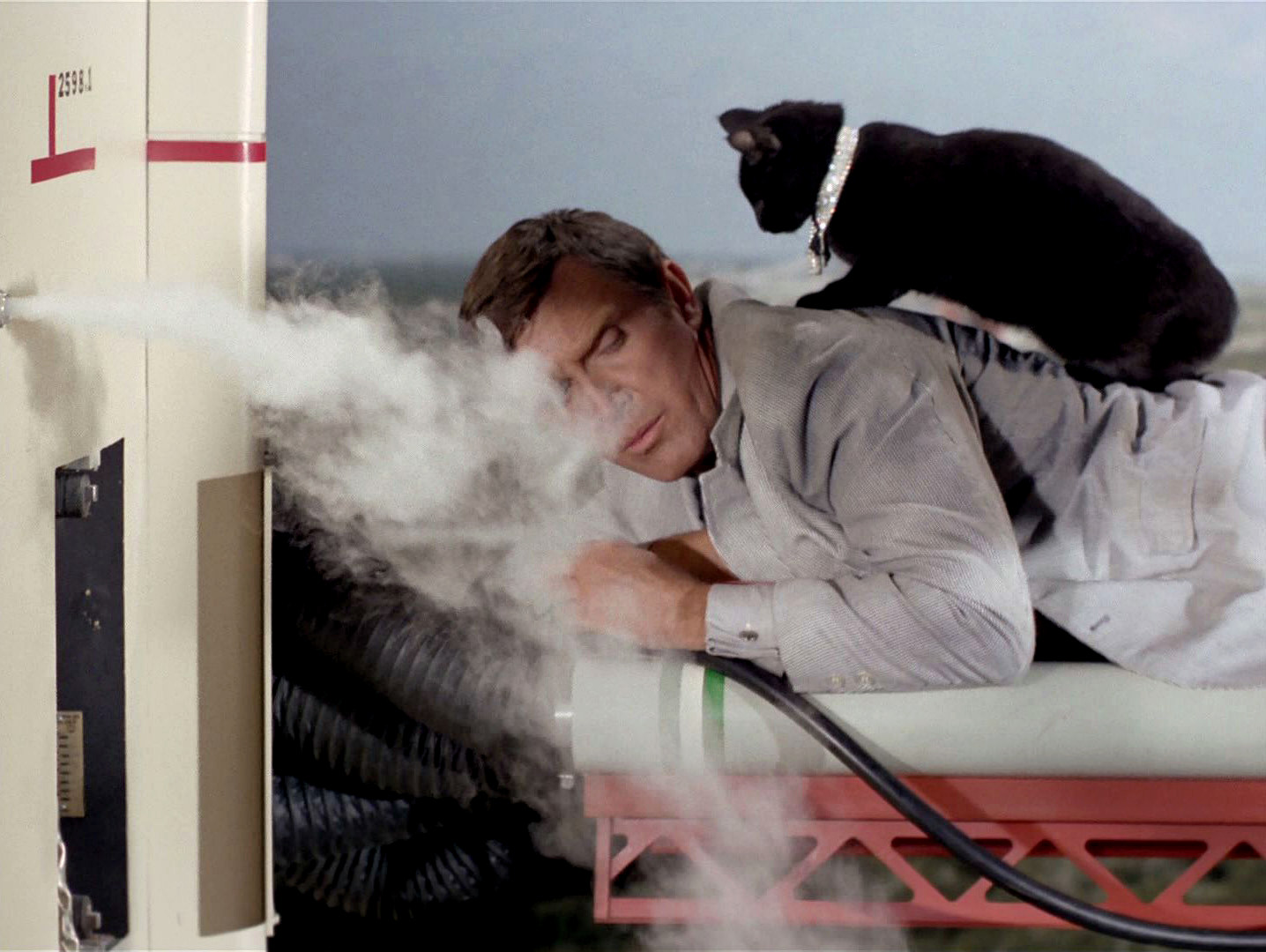
Stardate not given: The Enterprise is in Earth's orbit in the year 1968 for historical research, when the ship intercepts a transporter beam and a man named Gary Seven materializes on the ship. He claims to be a human being, sent by powerful aliens on a mission to save Earth from nuclear destruction. Gary Seven is taken into custody but escapes to his office on Earth, located in a building in New York. Kirk and Spock find his office, but Seven is already on his way to the McKinley base to sabotage the launch of a nuclear weapons platform. Kirk and Spock follow him but are arrested by the base's security. Scotty almost succeeds in beaming him up again before he can finish his work, but thanks to the unsuspecting secretary Roberta Lincoln, who activates his transporting device, Seven materializes in his office again. When Lincoln realizes that Seven has brought the rocket off course and activated its warhead, she tries to stop the agent. Kirk and Spock escape from McKinley and materialize in the office again. They have to trust Gary Seven that he is going to detonate the warhead in time before it can do any damage, but not without being a warning to humanity. The weapon goes off 104 miles above the ground, exactly as it was meant to happen according to historical records.
Review
While Star Trek was on the brink of cancellation in its second season, Gene Roddenberry devised the season finale "Assignment: Earth" as a pilot episode for a possible spin-off series of the same name. Fortunately Star Trek was prolonged for another season, and unfortunately the new series was never made. I would have liked to see it, because the idea proves to have a lot of potential.
Despite its double function or just because of it "Assignment: Earth" ranks among the best TOS episodes. It combines an interesting story, strong characters, suspense and a good dose of humor like few others. Especially the mutual mistrust between the Enterprise crew and Gary Seven is worked out well. Gary Seven (played by Robert Lansing) is conceded far more dialogue time than any other TOS guest star, and the story is partially being told from his perspective. In some fashion he has switched roles with the main cast. He is always one step ahead until the very end and Kirk never gains the upper hand. Seven's motivation gradually becomes clear, while the mission of the Enterprise remains mysterious. Also, his interaction with the wonderfully naive Roberta Lincoln (Teri Garr), who would probably have become a series regular, benefits this episode.
Annotations
- Inconsistencies:
- The Temporal Prime Directive obviously doesn't yet exist in the 2260s, seeing how careless it is to travel to Earth's past, especially in light of the experiences in "Tomorrow is Yesterday". The directive would obviously be devised for a good reason. The time travel aspect of "Assignment: Earth" and especially the obvious predestination situation is discussed here.
- It should have been clear when the episode was filmed that as of 1968 neither the USA nor any other country had any nuclear weapons platforms in orbit. But the story allows the interpretation that the test launch of a Saturn rocket for the Apollo program could have been used to cover up the true military nature of this mission. It only isn't fitting that in such a case the rocket would be launched from the (military) McKinley rocket base. Of course, all stock footage of launch platforms with Saturn rockets is actually from Cape Canaveral.
- Why in the world would Roberta, who is terrified by the alien technology, play around with Gary Seven's transporter? The plot needed the twist because Scotty spotted Seven before he could finish the work on the rocket, but Seven had to end up in his office again. Still, it could have been done in a credible fashion (the alien transporter could have activated itself, for instance, or Seven could have shown Roberta in time what she was supposed to do).
- Remarkable déjà-vu: It is a slight letdown that the slapstick humor, as we look into the dumbfounded faces of the police officers that were accidentally beamed up, is the same as in "Tomorrow is Yesterday". Even the score in the scene is the same.
- Remarkable facts:
- Kirk refers to the "light speed break-away factor" used to travel back to 1968, which is probably the same "slingshot effect" as in "Tomorrow is Yesterday".
- Supervisor 194, code name Gary Seven, and the other agents are "descendants of human ancestors taken from Earth approximately six thousand years ago. They're the product of generations of training for this mission." Agents 347 and 201, however, were killed in a road accident before they could complete their mission. Gary Seven is immune to the Vulcan nerve pinch.
- Gary's company, a cat/woman, is obviously a shapeshifter, but her real nature remains mysterious. It would have made more sense in the spin-off series, but her one-off appearance is quite gratuitous. Well, it is curious that Spock obviously likes the cat for reasons he can't explain and strokes her all the time... ;-)
- A nuclear race like the one on Earth almost destroyed the planet Omicron IV.
- Remarkable props: Gary Seven has a wide range of gadgetry that may have appeared in the planned series too. These include: the "servo", a multi-functional weapon disguised as a ball pen; "Beta Five", a computer terminal (actually a redress of the M-5 from "The Ultimate Computer"); the "exceiver", apparently a part of the computer system used to send, receive and manipulate data; a green cube as a remote interface to the computer; a typewriter with voice input; a transporting device acting like a "gate" to other places.
Rating: 8