Star Trek Voyager (VOY) Season 7 Reviews
Season 1Season 2Season 3Season 4Season 5Season 6Season 7
ImperfectionDriveRepressionCritical CareInside ManBody and SoulNightingale
Flesh and Blood I/IIShatteredLineageRepentanceProphecy
The VoidWorkforce I/IIHuman ErrorQ2Author, AuthorFriendship One
Natural LawHomesteadRenaissance ManEndgame
Unimatrix Zero II
See VOY season 6
Imperfection
Synopsis
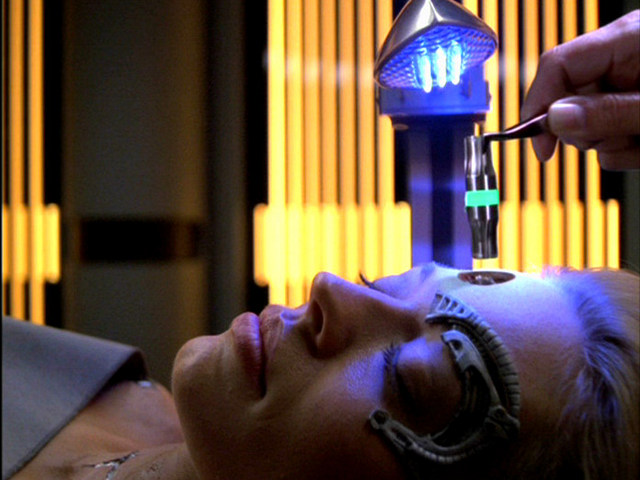
Stardate 54129.4: The Borg twins Rebi and Azan leave the ship to return to their people, the Wysanti, together with Mezoti. When Seven of Nine attempts to regenerate, the alcove does not connect with her cortical node. She refuses to accept help and collapses in the mess hall during her sleepless night. The Doctor is afraid that the failure of the device will eventually lead to her death, unless a replacement can be found. Janeway, Tuvok and Tom take the new Delta Flyer to retrieve a cortical node from a dead drone in a debris field. After shaking off scavengers that claim the debris for themselves, they arrive with the implant. However, all simulations of using the salvaged device fail because it has been inactive for too long. Seven would need a cortical node from a live drone. She submits to her fate, but Icheb isn't willing to give up. He finds out that he could survive without his own node because he has never been fully assimilated. When he proposes to donate it, Janeway and the Doctor are hopeful but Seven rejects the idea because it would put her pupil and friend at risk. Icheb then spontaneously deactivates his node to force a decision. Seven reluctantly has to agree to the procedure. After six days, she wakes up in her alcove and asks how Icheb is doing. His recovery will take longer, but he will be fine again - and will take the Starfleet Academy exam with Seven's support.
Review
"Imperfection" comes with a simple yet touching story, one of those that show the essence of Star Trek beneath the technobabble and special effects. My plot outline, with its focus on cortical nodes and surgical procedures, only covers the basic events. The real heart of the episode lies in Seven of Nine slowly realizing that the people around her, namely Janeway, the Doctor, Neelix, even B'Elanna, and especially her student Icheb care for her in ways that go far beyond duty.
Seven has faced a serious illness before in "Infinite Regress" in season 5, but her fractured mental state then kept her from understanding what was happening. In "Imperfection", she is fully aware of her condition, yet unaware of something else. She does not see that she is not alone with it. Her struggle is not only physical but also shaped by her time as a Borg. Seven still seems to believe that one must earn one's place, deserve survival and justify continued existence through usefulness. A drone that can no longer contribute is simply deactivated. Part of her still thinks this rule applies to her. This leads to some misjudgments. The arguably worst one is that she assumes that Janeway wants to save her because Seven has not yet lived up to the captain's expectations, and that Janeway is driven by a sense of unfinished work rather than genuine affection. At one point, Seven even suggests that Janeway has already calculated acceptable losses among the crew. Seven cannot imagine that she is valued for who she is, not for what she can do.
The crew makes this clear in different ways. B'Elanna, who often clashes with Seven, tells her directly that she would be missed, not because of her skills but because she has become part of their lives. And Icheb, the one person Seven has allowed herself to mentor, finally forces her to accept the help she would never hesitate to give someone else. His willingness to sacrifice himself shows her a truth she has long resisted. Compassion is not a transaction, not something that must be earned. Seven's confrontation with death can be seen as a final test on her path toward humanity, but the lesson she takes from it is not about preparing for the end. Instead, it is about understanding how to live among people who care for one another.
The emotional impact of the episode stays with the viewer. Classic Star Trek has always been strong in this kind of heartfelt storytelling, where moments of connection feel genuine and earned. It has a warmth that some recent iterations struggle to match, where emotional beats can appear suddenly and disappear just as quickly. "Imperfection" takes its time with the characters, and it trusts the audience to feel with them. By the end, Seven may not be the only one with tears in her eyes.
Annotations
- Continuity:
- This is one of the rare cases in the series that the airing order does not comply with the chronology. The stardate indicates that this episode takes place after "Drive", which is the only way it makes sense. The new Delta Flyer is mentioned just too casually in "Imperfection" and will be officially introduced one week later. Also, Tom is wearing his wedding ring already in "Imperfection".
- There is no explanation for where the Borg debris comes from, although it could have been mentioned that it was one of the ships blown up by the Borg Queen in "Unimatrix Zero II", rather than yet another Borg vessel accidentally destroyed in an ion storm.
- Seven asks B'Elanna if she believes in an afterlife. The "old" B'Elanna would have answered that she doesn't but she says she isn't sure. So far, so good. But it would have been more desirable if she or Seven had referred to what happened in "Barge of the Dead".
- A list of casualties with Ensign Marie Kaplan ("Unity"), Ensign Lindsay Ballard ("Ashes to Ashes"), Crewman Timothy Lang (last seen alive in "Equinox II") and several more names of is shown, which are made up for this episode and taken from "West Wing" characters. In consideration of the complicated issue of crew casualties, it would have been better to include familiar names, and not so many high-ranking officers, such as a commander and a lieutenant commander.
- Remarkable dialogue: "Seven, your ocular implant is malfunctioning again." - "Actually, it's functioning perfectly." (Icheb and the Doctor, as a tear is rolling down Seven's cheek)
- Remarkable quotes:
- "On Wysanti, it is not customary to say goodbye. But I think I prefer the human way." (Mezoti, upon which she hugs Seven)
- "Thank you. I'll admire them later." (Seven, when Neelix brings her flowers)
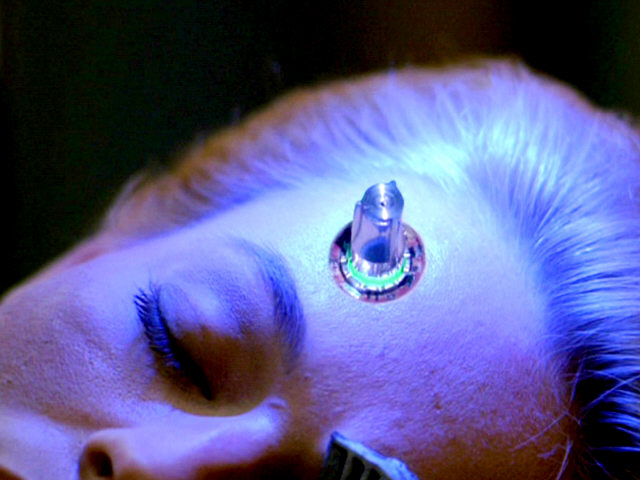
- Remarkable VFX: The removal and insertion of the cortical node into the forehead is very convincing still today. It is hard to tell how much of it is a practical effect and how much is digitally created or enhanced.
- Remarkable ship: The monster hunter ship from "Bliss" was reused for the marauder ship.
- Remarkable fact: Janeway's hometown is Bloomington, Indiana.
- Distance to Earth: 30,000 ly
Rating: 7
Drive
Synopsis
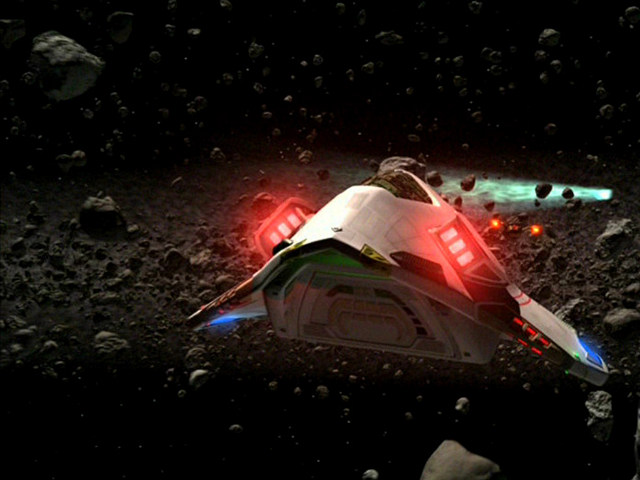
Stardate 54058.6: Tom and Harry are on a test flight in an asteroid field with the new Delta Flyer, when another small vessel appears and the pilot challenges them to a spontaneous race. When the other ship suffers an engine failure, they rescue the pilot, a woman named Irina, and offer her to assist with the repairs. Irina tells Tom and Harry of the big race she is going to participate in, the Antarian Transstellar Rally. It was initiated to celebrate the end of a long war between different species of this region of space. Janeway approves of Tom's request to join with the Delta Flyer, with a fuel converter provided by Irina so the ship would be according to regulations. Tom is so excited that he forgets to tell B'Elanna in time, who is looking forward to a romantic weekend on the holodeck. Janeway welcomes the Antarian ambassador O'Zaal aboard Voyager, who is concerned about special requests of some of the participants. The captain offers Voyager as a neutral ground for the opening ceremony. As the race is about to start, Tom is surprised that B'Elanna comes aboard as his co-pilot, rather than Harry. She helps him to take the lead. But then an accident happens on Irina's ship, in which her co-pilot Joxom is injured. It is found to be an act of sabotage, but everyone agrees the race has to continue so the extremists wouldn't win. Harry enters the rally as Irina's new co-pilot. Soon after the restart, Irina's ship breaks down yet again. Harry suspects that Irina herself is responsible for the sabotage. He holds her at gunpoint. As she seems to be very interested to know how the Delta Flyer is doing, he deducts that she rigged the fuel converter to explode, which would kill everyone in the vicinity. Meanwhile on the Delta Flyer, which is still in the lead, B'Elanna and Tom get into an argument, and he stops ahead of the finish line to prove she is more important to him than the race. Irina has shut down communications, but Harry manages to modulate a pulse to send Tom a Morse code as a warning. With only one minute left until the detonation, he turns around the Delta Flyer and drops the warp core into a nebula to contain the blast. But he still takes time to propose marriage to B'Elanna, which she accepts.
Review
I wonder why no one had come up with the idea of a shuttle race in Star Trek before this episode. Although the race gradually loses its importance to both the terrorist plot and to Tom and B'Elanna's relationship, it remains one of the coolest ideas of the series and a perfect fit for Tom. I love it. I also like that Tom's closest friends, B'Elanna and Harry, are strongly involved, while most other crew members only add small touches to a story that focuses on this trio.
Tom and Harry are completely in character, but B'Elanna at first seems somewhat unfamiliar. She is so understanding, calm and reflective, and so ready to set aside her own wishes. Maybe this comes from Tuvok's mental training or from her recent Borg experience. At the same time, she is thinking about leaving Tom. So instead of showing that she has changed, does her behavior simply reveal how unsure she is about everything? If breaking up with Tom is on her mind, she may not know when or how to tell him. She seems to be working through it step by step. But would she really join the shuttle race, pretend everything is fine, and tell Tom afterwards that it is over? I think that while she is never excited about the race, she secretly hopes that joining Tom might help their relationship, rather than being an opportunity to end it. It is also interesting that Seven, the least experienced person in relationships, is the one who gives her the advice. Only a week after their talk about death and the afterlife, this is another sign that they have finally become friends.
It is out of stubbornness that Tom stops the Delta Flyer just before the finish line, which naturally upsets B'Elanna because she does everything she can to help him win. In a way, though, he returns her earlier gesture of putting someone else's needs first. Still, quid pro quo is not what love is really about, and both Tom and B'Elanna slowly understand that (actually, a bit like Seven did last week). Their conversation is awkward, as is the idea that they stop the shuttle right in front of the finish line, almost as if they know it is rigged to explode once they cross it. But this part of the story works surprisingly well, especially with the cuts between the tense situation on Irina's ship and Tom and B'Elanna's small argument. There is also a nice irony in the fact that while Tom and B'Elanna still agree that Harry and Irina seem like a better match, the latter two are fighting over the control of a weapon at that moment. Love has no simple rules, there is no perfect couple, and partners do not need to share all interests or agree on everything, except for the one question that B'Elanna answers with "yes". The marriage proposal reminds me of "Day of Honor", where it also takes an emergency for B'Elanna to admit that she loves Tom. I still do not fully understand her motivation or her apparent change of mind in "Drive", but this episode has grown on me over the years.
Annotations
- Nitpicking:
- The course of the Antarian Transstellar Rally is 2.3 billion kilometers long, which is around 2 light-hours. This is short enough for ships with impulse drive only, but not long enough by a wide margin for multiple star clusters and anomalies to appear as obstacles.
- How can the Delta Flyer come to a full stop, unless Tom uses something like a brake? How can any starship stop anyway, without a second impulse engine in the opposite direction?
- If the warp core breach of the tiny Delta Flyer has a blast radius of one million kilometers, I can think of several explosions that would have obliterated whole planets, such as in "Star Trek Generations".
- B'Elanna says Tom was expelled from the Academy. She apparently mistakes him for Nick Locarno. It happens all the time...
- There are several familiar starship designs that shouldn't be around, most blatantly the CG version of the Karemma ship and scaled-down versions of the Akritirian cruiser, a Monean ship and even a Devore ship in the shuttle race. Actually, every single alien ship to appear is a re-use. Only Irina's ship (previously used by the attackers in "Latent Image") and Assan's ship (previously seen a Cardassian workbee) were at least slightly modified.
- Alien names in this episode are simply terrible. Not only do we get the umpteenth species named "Ter(r)el(l)ians" (in its various spellings permutations). There are also "Antarians", although Antares is clearly in the Alpha Quadrant, and "Imhotep" (after a historical figure in ancient Egypt). Finally, "Irina" is an extremely poor choice for an alien woman.
- Remarkable dialogue: "Will you marry me?" - "Warp core breach in 15 seconds." - "You're proposing now?" - "It's as good a time as any." (Tom, the shuttle computer and B'Elanna)
- Remarkable VFX: The episode has several impressive sequences of the shuttle race. The two small ships in Voyager's shuttlebay look convincing too - well, until we ask the question how Irina's very wide ship can possibly pass the shuttlebay door, if the much more compact Delta Flyer barely clears the opening. Oops!
- Photon torpedoes used: 1
Rating: 7
Repression
Synopsis

Stardate 54090.4: As B'Elanna and Tom are going to enjoy their movie night in a holographic theater, they find Ensign Tabor, who was in charge of preparing the program, in a comatose state. Tuvok discovers that internal sensor logs have been tampered with. He suspects that one of Voyager's crew assaulted Tabor. Then another crew member gets attacked. And yet another one. All have in common that they were part of Chakotay's former Maquis crew. Suspicions begin to arise. Is some Starfleet member taking revenge on the Maquis? Did Janeway receive orders to neutralize them? Tabor wakes up again and seems fine. But as B'Elanna is working in a cargo bay, she too gets attacked. When Chakotay finds her, suddenly Tuvok stands in front of him and forces a mind meld upon him, leaving him unconscious as well for a while. Tuvok is not aware of what he is doing. But he finds clues that connect him to the crimes. He overrides the restrictions on his own sensor logs, which reveal that he was on the holodeck when Tabor was attacked. Janeway has Tuvok confined to the brig. It turns out that a transmission from his son in the Alpha Quadrant contained a subconscious message from a Bajoran called Teero, who had conditioned the Vulcan's mind already when he was covertly collaborating with the Maquis. Teero made Tuvok mind-meld with the Maquis members, with the intention to have them take over the ship. After receiving the keyword "Pagh'tem'far. B'tanay." from Tuvok, Chakotay initiates the mutiny. Tuvok, on the other hand, has overcome his conditioning in the meantime. When Chakotay hands him a phaser to kill Janeway, he pretends to comply but then mind melds with Chakotay to revert the commander's mental state likewise.
Review
"Repression" is an episode as it should have been made in the first two seasons of the show. It arrives years too late to capitalize on the intriguing initial setting of a heterogeneous crew with different histories and different interests. I concede the very story depends on Voyager being in contact with Starfleet, but I could just as well imagine something that could have triggered a mutiny in the early days, without someone in the Alpha Quadrant being behind it. Although the setup is a bit contrived, I am overall content with the idea of pitting Vulcan against Bajoran mental powers. Still, considering the potential of the premise, the actual story is uneven, and its execution comes across as routine.
I really like the clever reconstruction of the crime scene on the holodeck, using the "negative image" left behind (the space where no photons were projected). This recalls what Geordi did in TNG: "Identity Crisis". Tim Russ gives a strong performance as Tuvok. The episode has the best scenes for the character in quite a while, especially with his "hunches" that increasingly come with doubts about his own mental state. Yet, as a character study, this "Lt. Tuvok and Mr. Hyde" scenario doesn't even come close to "Riddles" in season 6 where both the script and Tim Russ were exceptional. Also, the fear of being attacked and the increasing paranoia among the Maquis could have been captured better than by them running around with phaser rifles and resorting to conspiracy theories. They should be afraid but they are rather aggressive and divisive in the way they talk and act, almost from the start. I mean, statements like "I've never trusted the Vulcan" after seven years of common service feel forced. The tension, also between Chakotay and Janeway, is played out for the sake of the drama, not because it would make much sense. The ending of "Repression" is the biggest disappointment. After all the turmoil and after several minds have been screwed up, it is just too easy that Tuvok spontaneously recovers from his condition and that he can heal Chakotay too, simply through yet another mind meld. I think we would have deserved a more rewarding conclusion.
Voyager has never been very strong on continuity, but it is particularly distracting here that conflicts and even crew members appear out of the blue. Especially the existence of a so far unseen Vulcan woman on the ship is unlikely with regard to "Blood Fever" and almost impossible after "Counterpoint". I considered raising my rating after the rewatch, but Voyager could really have done better in its seventh year than this story with its hastily made up conflict and its just as hasty resolution.
Annotations
- Continuity:
- It was never explicitly stated how many crew members were on Chakotay's Maquis ship. Now we get figures for the first time. As the Bolian Chell says, almost a quarter of Voyager's crew are former Maquis. I have come to the conclusion that there are 31 Maquis. Taking into account confirmed and assumed deaths and departures, there were originally 35 that joined Voyager in "Caretaker". The 22 not yet attacked Maquis in the mess hall scene and Chakotay's later statement that there are still 23 comrades not with the mutineers support the assumption.
- How in the world can we explain another Vulcan crew member (the female in red uniform), considering that all two of Voyager's Vulcans, namely Tuvok and Vorik, had to hide in "Counterpoint"? Also, if she had been aboard in "Blood Fever", she might have, well, helped... Is she actually Romulan?
- Remarkable dialogue: "I've been meaning to ask you. How did you know that phaser wasn't charged?" - "Chakotay doubted my loyalty. He wouldn't have given me an active weapon." - "Not exactly ironclad logic." - "Call it a hunch." (Janeway and Tuvok, about the weapon that Tuvok was to shoot her with, to demonstrate his loyalty)
- Remarkable quotes:
- "Let me get this straight. You've gone through all this trouble to program a three-dimensional environment that projects a two-dimensional image and now you're asking me to wear these to make it look three-dimensional again?" (B'Elanna about Tom's red-green 3D glasses)
- "Pagh'tem'far. B'tanay." ("This is a holy time. A time of awakening.")
- Remarkable fun scene: the holographic audience shushing B'Elanna and Tom as they talk during the movie
- Distance to Earth: 35,000 ly (Did they travel back 5,000 ly since two weeks ago?)
Rating: 3
Critical Care
Synopsis
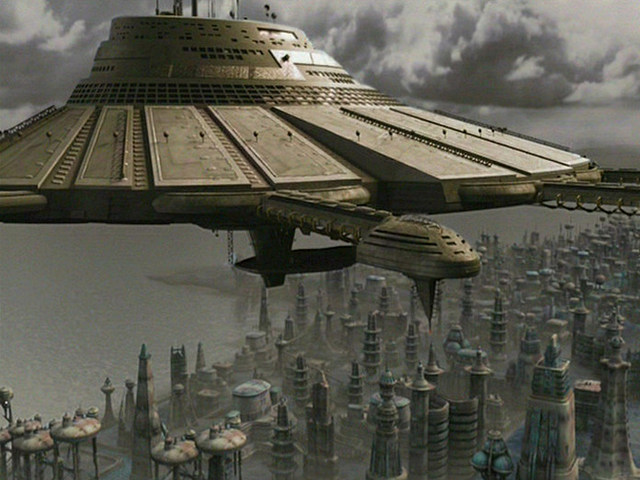
Stardate not given: A man named Gar has stolen the Doctor's mobile emitter and sells it to Chellick, the administrator of a Dinaali hospital. Once activated, the Doctor protests, but he is ready to help as injured patients are coming in. On Voyager, Harry and Tom notice that something is wrong with their EMH, who turns to be a poor replica. In the Dinaali hospital, the actual Doctor learns that a computer known as the Allocator decides about the treatment a patient receives based on their TC, the treatment coefficient, with Level Red being the lowest and Level Blue the highest standard. A boy named Tebbis on Level Red suffers from a lethal infection that could easily be cured with cytoglobin. But cytoglobin is not available for the patients on Level Red that are deemed less important for the Dinaali society. The Doctor steals cytoglobin from Level Blue, where it merely serves to delay arterial aging. He administers it to Tebbis, who soon feels better. The Doctor finds allies in Dr. Voje on Level Red and Dr. Dysek on Level Blue, who help him cover up the medicine transfers. But then the Doctor learns that Tebbis had complications and died because the Allocator denied him life-saving procedures. Chellick now knows about the smuggled medicine. He confines the Doctor to Level Blue under the control of the Allocator and sends his patients home. But the Doctor has a plan. He calls Dr. Voje, who secretly takes the mobile emitter back to Level Red after the scheduled deactivation of the program. In the meantime, Voyager traces Gar's flight path and finds various of his trade partners. He turns out to be a notorious crook. Janeway has his ship locked in a tractor beam and transported him to the brig. Neelix ostensibly brings him a poisoned meal, upon which Gar reveals that he sold the mobile emitter to the Dinaali hospital ship 42. When Chakotay and B'Elanna beam down to retrieve him, the Doctor still has one unfinished business. Having infected Chellick with the virus that killed Tebbis, the administrator now registers as a Level Red patient and is denied treatment by the Allocator - unless he generally changes the policy and allows treatment on Level Blue for those who need it to survive.
Review
I like the idea of "Critical Care" (to use the Doctor as a doctor) far more than previous motivations for "holonapping" such as in "Future's End" or in the utterly pointless "Concerning Flight". In this regard, it is also fitting that medical ethics comes into play. Medical treatment in the Dinaali hospital depends on the TC, the social status of a person, and it ultimately decides about whether you live or die. That may seem unjust and inhumane, but on an overpopulated planet with scarce resources, and perhaps with a history of failed alternatives, it could be seen as a solution. Chellick presents some convincing arguments for its necessity. At the same time, he is an employee who would never criticize the system his job depends on - unless his own life is at stake.
However, we never get a bigger picture of the situation of the Dinaali. Our Doctor focuses on helping here an now, and he definitely doesn't have a chance to survey the whole economy of the planet, let alone devise a plan to change it. His medicine smuggling is made simple and is clearly moral because his privileged patient on Level Blue merely receives the cytoglobin to delay aging. Two factors facilitate his actions: there is more than enough cytoglobin available, and no one on Level Blue appears to be seriously ill. I only wonder what he would have done if faced with a true dilemma - whether to save a few patients on Level Blue for certain, or distribute the scarce cytoglobin across Level Red, leaving none of them fully treated. Without such a choice, it becomes easy for the Doctor to act as the planet's "savior".
There is a second ethical aspect to this episode. I first thought the Doctor gave Chellick a harmless injection to force him to change the system, just like Neelix merely tormented Gar's stomach to obtain the required information. But the virus is real, and the Doctor's later guilt about that (when he has Seven check his ethical subroutines) is the deserved consequence. For better or worse, once again he obviously exceeds his original programming.
Some aspects of the story are still not clear to me. Tebbis, the boy who helps the Doctor, dies all too suddenly. I don't think that someone actively killed him, but the complications of his illness are left vague. Maybe the cytoglobin has unmentioned side effects, or the Doctor even made a mistake when treating the boy. I would have liked to see that further elaborated. Dr. Dysek, Chief of Medicine of Level Blue, also remains a bit of a mystery. He seems to be both competent and conforming to the system's rules in the beginning, the kind of doctor who drives a Porsche and plays golf. Was he truly unaware that he had to keep his medicine quota constant? From my own experience at a university institute, I can tell that in public service it is an unwritten rule to keep spendings up so the budget wouldn't be cut in the next term. It comes as a surprise to me that Dysek supports the Doctor simply because he has learned how the system works. As for Chellick, I don't think that he is a bad guy. He is just a bureaucrat who feels obliged to fulfill his duty, nothing more. He probably did not invent the system of medicine distribution, and it is doubtful he alone could change it. Would he even want to change it once he is cured and the Doctor has left, knowing it could cost him his job?
Sadly, levels of medical treatment on our own planet are not so different. Rich kids get dinghy lips or butt implants for birthday, whereas in poorer regions essential medicine for infectious diseases is often unavailable. The episode highlights this inequality by showing it all within one hospital instead of across different cities and nations.
Annotations
- Nitpicking:
- When the Doctor is automatically transferred from one point of Level Blue to another, he is wearing the mobile emitter. Would they beam him for a few meters each time? I somehow doubt it.
- According to Tuvok, Voyager purchased iridium from Gar, which is supposed to have a very brief half-life. For once they mention a real element, but they get it wrong. Iridium is not radioactive.
- Remarkable fun scene: When Gar's love interest seems jealous that Janeway is interested in him, Janeway grabs Tuvok's hand, telling her that she already has someone.
- Remarkable fact: The 20th century sports revival on Voyager continues. This time it is ice hockey (unpleasantly for Harry with a Nausicaan guard).
- Remarkable VFX: The alien planet and the hovering hospital were created by Eden, a new company. They are nicely done, except that it all seems a bit too uniformly brown and dirty.
Rating: 7
Inside Man
Synopsis
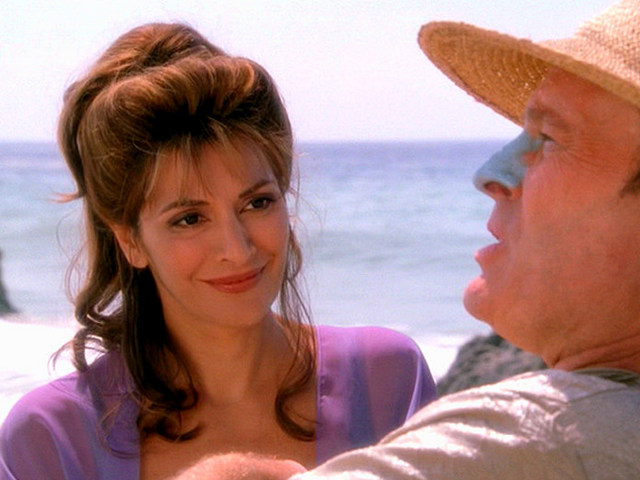
Stardate 54208.3: Voyager is waiting for another data stream from Earth, after the one scheduled to arrive in the previous month was lost. Harry recognizes that it contains a hologram, and he saves it by transferring it to the holodeck. The hologram turns out to be Reginald Barclay, who presents a plan to create a geodesic field between two remote pulsars to allow Voyager to return home. Barclay takes the Doctor's emitter to be able to walk around on the ship for the necessary preparations. On Earth, Reg Barclay and Harkins investigate why the data stream keeps disappearing. Actually, already last month's transmission did include the hologram, and Barclay finds out that the position where it was lost was close to the MIDAS Array in the Alpha Quadrant. No one knows at this point that the Ferengi intercepted the transmission. They modified the hologram, inserted it into the latest data stream and now intend to use it to get hold of Seven of Nine's valuable nanoprobes. Reg is desperate and seeks Deanna's help. He mentions a woman named Leosa, who was very much interested in his work and who recently left him. Deanna suspects that she has something to do with the theft. She gets Leosa to reveal that she is working for a Ferengi named Nunk. Leosa also tells Reg about the nanoprobes. On Voyager, the Barclay hologram successfully dispels any doubts about the daring plan to bring Voyager home. Only the Doctor remains skeptical. As Voyager approaches the red giant and Seven of Nine notices that the plan wouldn't work, the Barclay hologram disables her. The geodesic fold opens. In the Alpha Quadrant, Deanna, Reg and Harkins have no way of contacting Voyager through the fold. But they manage to call the Ferengi ship through the MIDAS Array, with Reg now posing as his own hologram and telling the Ferengi to close the fold because Janeway would hunt and destroy them. As the phenomenon is about to collapse, the actual Barclay hologram takes Seven to an escape pod, but they can still be beamed out. Only the pod makes it to the Alpha Quadrant.
Review
"Inside Man" comes with various different characters and locations, which are not handled very well and impede the progression of the plot. It is always a pleasure to see Reginald Barclay (for the fourth time in this series) and Deanna Troi (for the third time). I lack firm arguments here, but my impression is that "Pathfinder" and "Life Line", which focused on a single location and a simple storyline in the Alpha Quadrant, worked more smoothly. Much of "Inside Man" feels sketchy or poorly timed. Take Barclay's emotional state as an example. He has recently been dumped by his girlfriend, which would certainly throw him off, but this remains little more than a side remark. It does not feel plausible that, after acting quite sensibly at first, he suddenly panics and invents the theory that the Borg intercepted the transmission. As another example of a character that feels off, the strange behavior of the Barclay hologram may have been intended as a hint that he was manipulated (similar to false Picard's drinking song in TNG: "Allegiance") - but it is just as plausible that Barclay originally programmed the hologram to be more self-confident. We never learn how his version of the hologram was meant to interact with the crew.
There are several plot twists in "Inside Man", but they are never fully successful because the narrative gets sidetracked. One example occurs when the Ferengi discuss the value of Seven's nanoprobes and the scene then shifts to Deanna's beach resort, where she and Barclay have a conversation that is far too long. Another example is when the Barclay hologram entertains the crew by speaking with Janeway's voice. This scene should have been shown before the revelation that this is an "evil" hologram, especially since he uses the same trick later to deceive the crew again. I like these scenes, but they feel misplaced. The arc of suspense falls flat in "Inside Man", which is more apparent than ever to me now that I am watching it like a "fresh" episode, not having seen it in many years.
There are also lingering questions, such as why Harkins simply ignores Barclay's evidence that someone may have stolen the hologram, why Leola casually mentions the nanoprobes to Barclay (and only to Barclay) and why Barclay keeps this information to himself. The story does not bother to provide clearer explanations or stronger motivations. In a similar vein, by the end of the episode, no one on Voyager is aware of what the "evil" Barclay hologram was really about. While this is realistic, it fails to leave an impact, unlike in "Course: Oblivion", where the crew never learned about the fate of their doppelgängers. They will be informed in next month's transmission anyway.
Finally, I doubt that the Ferengi would go to such lengths and bend the laws of physics just to obtain the nanoprobes. In-universe, even if they are extremely valuable and even if they can be sure the method works, would they really risk being chased by Starfleet? From a real-world perspective, it also was not worth inventing yet another way for Voyager to return home, only for it to remain unused like so many others before.
What I enjoy more than the actual plot are the many small details for fans. There is hardly any other Voyager episode with so many of them. First of all, it is nice to see the Ferengi again, even if their role remains marginal. It is good to see that consistency of the small things is not ignored as so often before. Tom mentions the events of "Hope and Fear" and "Bliss", both cases where the crew were misled by aliens, who offered a fast way home. On Earth, children learn about Delta Quadrant species like the Talaxians or the Ocampa at school. There is a reference to Deanna's chocolate addiction, Deanna mentions that Barclay sang a duet with Data at Geordi's birthday party, and Riker is said to arrive at the resort later. If he chose the place, it must be Risa. ;-) B'Elanna and Tom trick Harry with their "Iconian scientist" (from TNG: "Contagion") who supposedly discovered a way to open a transdimensional gateway. Harry is remarkably gullible, given that the Iconians were wiped out many millennia ago. The USS Carolina is said to reach the Ferengi from a distance of 0.7 light years in two hours. That works out to roughly 3000c, or Warp 9.9, so it is a fast ship. Finally, the writing staff seems to have learned how to use a pocket calculator!
Annotations
- Nitpicking:
- The term geodesy stands for planetary cartography. In a more figurative meaning, geodesics are "straight" lines in curved space. So what is the "geodesic radiation" technobabble supposed to mean, if not simply gravitation?
- Once again, there is an inoculation against radiation! For those among the writers, producers and advisors who still don't understand it, radiation damages the body physically when being absorbed, whereas inoculation can only fight bacteria or viruses.
- Remarkable quotes:
- "Voyager has Borg interquadrental warp drives and Hirogen-hunting sensors and Vidiian phage torpedoes." (Barclay, in the transmission to the Ferengi - a homage to Riker's nonsensical "firomactal drive" explanation in TNG: "Rascals")
- "Uh, I, uh... I wouldn't want to be a third nacelle." (Barclay about joining Troi and Riker for dinner)
- Current crew count: 150, according to Harry
- Distance to Earth: 30,000 ly (How did they travel the 5,000 ly since two weeks ago?)
- Missed opportunity to get home: #14, because it already worked with an escape pod
Rating: 5
Body and Soul
Synopsis
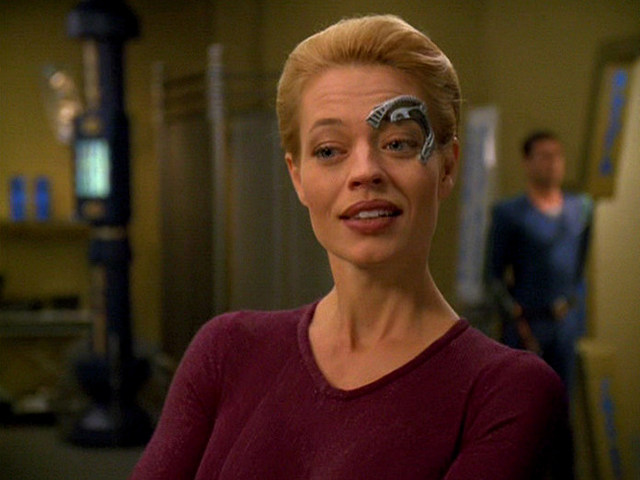
Stardate 54238.3: As Harry, Seven and the Doctor are on a scientific mission on the Delta Flyer, a Lokirrim patrol ship appears and emits a disruption field that begins to decompile the Doctor's holographic matrix. Seven manages to save him by integrating the program in her cybernetic implants, which gives him control over her body. The Lokirrim beam aboard and want to ensure that the "photonic insurgent" has been destroyed. Seven/Doctor tells them the mobile emitter is a regeneration device, but they confiscate it nonetheless and take them and Harry prisoners. Ranek, the captain of the Lokirrim ship, demands that Seven/Doctor explains the technology of the Delta Flyer, including the replicator. When she/he tastes the cheesecake, she/he is overwhelmed by the new sensation, and Ranek is delighted too. He agrees to return the "portable regenerator" to her/him. In the holding cell on the Lokirrim ship, the three prisoners discuss how to find a way to send a message to Voyager. In the Lokirrim sickbay, Seven/Doctor supports a woman named Jaryn. She says that she lost her former life when the holograms suddenly rebelled. She is also secretly in love with the captain. Ranek calls Seven/Doctor to the bridge to what he intends to be a romantic rendezvous. But Seven/Doctor knocks him out with an injection and contacts Voyager. In the meantime, Voyager has made contact with the Lokirrim as well. As their warship is no match to the Federation vessel, they agree to the compromise that Janeway shuts down all holographic simulations while being escorted through Lokirrim space. This happens just as Tuvok is about to live through his pon farr with a holographic version of his wife created by Tom Paris. As Voyager receives the call from Seven/Doctor, Janeway breaks away and comes to the rescue. On the Lokirrim patrol ship, the Doctor activates his hologram as a diversion and allows Seven to take down the shields. Ranek gets severely hurt as he tries to restore the shields and a console explodes. The Doctor saves his life, upon which Voyager leaves Lokirrim space in peace.
Review
When I first watched this episode some 25 years ago, I was worried that the gender crossover might turn out like the awful crossdressing farce DS9: "Profit and Lace". I was relieved to see that the humor of "Body and Soul" actually works and that Jeri Ryan delivers a strong impersonation of the Doctor as he occupies Seven of Nine's body. All of this is still amusing today.
Yet I think the episode has not aged particularly well. I doubt that "Body and Soul" could still be made today. The story revolves around sensuality, starting with food and alcohol and gradually moving toward sexual attraction. However, explicit references to the latter are carefully avoided. The worst that happens to the Doctor in Seven's body is that Ranek kisses her, and that's it. This awkward restraint is mirrored by Tuvok's reluctance to talk to Tom about his pon farr and to accept his help in dealing with it. But while the Vulcan attitude toward the topic is an in-universe cultural trait, the refusal to address sexuality in the main plot feels more like a real-world limitation. Star Trek traditionally does not include explicit sexuality, but in this episode it draws an uncomfortable line, which to me reflects moral standards that no longer apply. I do not mean that I want sex in Trek, but that a modern Trek show should not tease it like a film from the 1950's and should instead skip the topic altogether. As mentioned before, "Profit and Lace" is a much worse example in this respect, with humor that never worked for me. And while I still appreciate Jeri Ryan's comedic talent and her imitation of the Doctor's mannerisms, I have no clear idea if or how this episode could be made today. SNW: "Spock Amok" comes to mind as a kind of modernized version of the concept - without any sexual innuendo.
Another reason why "Body and Soul" would not be made today, or would turn out very different, is that it relies on what can be called default or straight sexuality. We already know that the Doctor is not gay, and some of the humor comes from the fact that a man tries to kiss him. A modern episode would likely present a more inclusive view of sexual orientation, if at all. In this context, it is interesting to revisit the episode after Seven's coming out in PIC season 1.
A general point of criticism, both then and now, is that the humor is somewhat overdone, and that the awkward experiences of Seven/Doctor aboard the Lokirrim ship often overshadow the attempts to contact Voyager or to find other means of escape. If the focus had only been on the character crossover, it might have worked better without an immediate threat. Conversely, given that two or three officers are held by hostile forces, fewer humorous moments would have been more appropriate. It is also disappointing that Harry Kim remains largely passive in the holding cell and contributes next to nothing to the escape.
The idea that the Lokirrim view holograms as enemies is not particularly new, as it is a variation on the familiar theme of aliens banning cybernetic lifeforms or, most notably, telepaths, such as the Devore in "Counterpoint". From this perspective, I would have liked the Lokirrim situation and their motivations to be explored in more depth. We learn that they once had holograms as servants and even as friends, until these holograms rebelled. Families were torn apart, and people with ordinary jobs and peaceful lives suddenly found themselves caught in a war. Jaryn and Ranek are not soldiers. They are not driven by ideology either, but simply follow their orders, which they interpret with some flexibility. Once Seven/Doctor gets them talking, they turn out to be decent, sociable and sympathetic individuals. While their character portrayals work well, I would have liked to get more background information. In any case, I appreciate that the episode ends on a conciliatory note.
Annotations
- Nitpicking: For some reason holding cells in Star Trek always have blind spots and no sign of audio or video surveillance, but this general issue is especially bothersome here because the prisoners are so loud discussing escape plans that the whole ship should have heard them.
- Remarkable scene: Seven/Doctor demonstrates that the replicator serves peaceful purposes by replicating a slice of New York cheesecake and offers it to Ranek. When she/he has to prove that it's not poisoned, she/he notices the great taste, gives the rest to Ranek and replicates another piece.
- Remarkable fact: After seven years on the ship, Tuvok finally enters his pon farr, which Tom Paris declares a "Tarkalean flu".
Rating: 5
Nightingale
Synopsis

Stardate 54274.7: Voyager is landed on an uninhabited planet for an overdue general maintenance. Meanwhile, Harry, Seven and Neelix are in the Delta Flyer, searching for dilithium deposits. They pick up a distress call from a Kraylor medical transport that is under attack by an Annari warship. The Kraylor ship is equipped with a cloaking device, which fails and exposes it to the attackers. Harry Kim tells the Annari to stand down, but they continue to shoot. He disables the attacking ship by overloading their weapons, upon which they retreat. All officers of the Kraylor ship are dead, leaving only an inexperienced crewman and some scientists who say they oversee an urgent vaccine delivery to the Kraylor homeworld that is under siege by the Annari. Harry and Seven help them with repairs. But as the ship is ready to continue the journey, no one of the Kraylor is capable of commanding it. Harry decides to step in, citing an exemption to the Prime Directive for humanitarian missions. As the ship passes the planet where Voyager is still under maintenance, Harry calls Janeway, only to notice she has already been in contact with the Annari. Harry asks Janeway to continue the journey on the Kraylor ship that he has christened "Nightingale", to which she agrees despite the delicate diplomatic situation. Seven joins him. When Annari warships attack the Nightingale yet again, a woman named Dayla dies when she saves the ship with her engineering modifications. Harry finds out that the passengers aboard are not physicians but engineers. The ship is not carrying urgently needed medical supplies but is equipped with a cloaking prototype the Kraylor hope to replicate. Harry gets relieved of command but later returns in order to help the crew break through the Annari blockade. He does this by offering his ship's surrender and then reversing the shield polarity as the Annari are pulling the Nightingale in. In the meantime, the Annari have learned that Voyager secretly supports the Kraylor and demand that Voyager leave their space. Kim and Seven too manage to escape and reunite with their crew.
Review
Harry is the man! Nobody aboard the alien ship understands their own technology. But here comes Starfleet wunderkind Harry, who needs only a few seconds to repair their propulsion system. He seems instantly familiar with the controls on the Kraylor bridge and with their command structure as well. And I would not be surprised if he also cleaned up the bridge while he was at it. The whole episode starts with the implausible premise that Harry is gifted and is the only person who could possibly command the alien ship, and it continues in that vein all the way through. The story is a bit too obviously designed to address one persisting issue of the series and of Harry Kim's character development, or rather the lack of it. We know Harry as the eternal ensign who never gets promoted. This is for exceptional reasons that he and Janeway are aware of and briefly talk about, but those reasons once again do not become plausible. Anyway, Harry now has the chance to rise through the ranks, with Janeway's blessing - on an alien transport at least.
The question is which qualifications really make a good captain: technical skills, problem solving in a crisis, knowledge of regulations - or rather the general ability to make decisions and lead people. Harry definitely possesses the first and probably the second quality. As for the rest, Seven has a point when she says that captains have to delegate and trust their subordinates instead of trying to do everything themselves. Harry should know that. I also wonder what Starfleet protocols are actually useful for a short term mission on an alien ship, and why the Kraylor trust his leadership so easily, knowing him for only a few hours. This is especially questionable if we take into account that they are not telling the truth. Harry could notice at any time that they are not carrying medical supplies. At least, a good captain should know what his ship is carrying. So why do they take the risk that he might turn against them, maybe in a critical situation? Moreover, the scientists obviously know very well how to operate the cloaking device, so why do they not try to familiarize themselves with the other ship systems too? Their obvious reaction after the initial repairs should have been: "Thanks for your help. Goodbye." That would have been too little for a story. But even with the idea of "Captain Kim", "Nightingale" is nothing special. Its exploration of other themes remains cursory, there are no strong guest characters and it relies too much on the one twist that the ship is not carrying medical supplies - which doesn't have a lasting impact. Also, the plot is too reminiscent of last week's "Body and Soul", where another not-so-bad alien species likewise relies on the astonishing abilities and helpfulness of Starfleet.
The B-plot with Icheb, who thinks that B'Elanna is attracted to him, is only good for a few humorous moments and does not have any potential beyond that. I am glad that it does not play a major role. On the other hand, I would have expected a more elaborate closure or at least some kind of punchline to his brief crush, instead of the rather serious discussion with B'Elanna. She neither giggles nor seems embarrassed when he leaves engineering, one of which reactions I would have firmly expected.
Annotations
- Nitpicking:
- Having arrived on the Kraylor homeworld, the Nightingale doesn't stay there for long. Harry takes the ship to break through the blockade again and catch up with Voyager. The first time was very hard and was only possible with a stratagem. It is not shown, but the impression is he now escapes the Kraylor homeworld with ease. Well, maybe breaking through the defense perimeter away from the planet is more of a surprise for the Annari.
- However, the short stay of the Nightingale raises another question. The Kraylor need the cloaking prototype to equip more of their ships with the technology. So how do they replicate more cloaking devices? Simply delivering the plans may not have required the presence of the actual hardware. Reverse engineering takes time - unless the Kraylor can simply scan the cloaking device and have all the required data for their replicators. Given how hard the creation and delivery of the prototype was, the effort needed to mass-produce it seems trivial.
- Voyager has to follow the Annari with impulse only, as they insist on leaving at once. When Voyager reaches the border, the ship still appears to be at impulse. This would mean the border oddly has to be within the star system of the uninhabited planet, otherwise the journey would take months.
- Remarkable quote: "You've made all the customary overtures: finding reasons to spend time with me, complimenting me, inviting me to engage in recreational activities. Your husband even challenged me to a ritual contest." (Icheb about B'Elanna's alleged advances and to Tom's proposal to engage in a car race)
- Remarkable visual effect: The shot of Voyager landed on the planet looks great but is a bit static. There is no close view of people working on the hull, which would have emphasized the impression of a real, big ship.
- Remarkable ships: I can hardly imagine a design that would have been less suited to re-use as the Nightingale than the Federation fighter. Agreed, the cockpit was removed and many small windows were added to suggest it's well over 200m long, but the characteristic structure is still exactly the same. The Annari ships are more credible, although they are only slightly redressed Ramuran vessels.
- Remarkable fact: According to Harry, Voyager lost "over a dozen crew members" when the ship was pulled into the Delta Quadrant. This is the first definite number, and it matches with most other figures.
- Ship landing: #6
Rating: 3
Flesh and Blood I/II
Synopsis
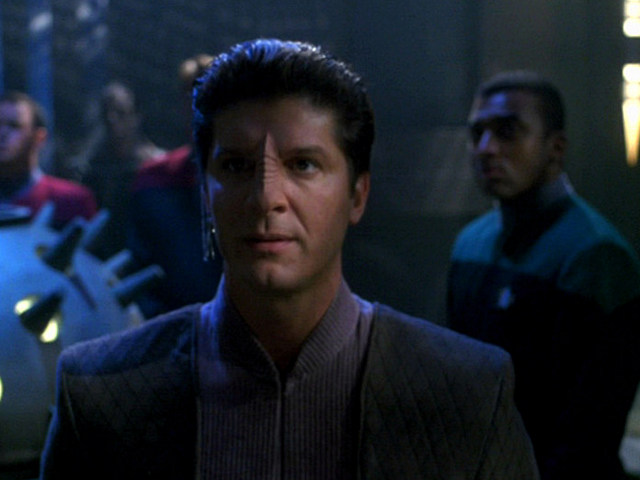
Stardate 54337.5: Voyager receives a distress call and finds a Hirogen space station with what looks like a natural planetary environment. On closer inspection, it turns out to be a holographic simulation used for hunting practice. All Hirogen are dead except for a technician named Donik. Their holographic prey, all based on Alpha Quadrant species, has escaped in a ship with a holographic generator. A Hirogen ship arrives and opens fire. Janeway convinces them Voyager is not an enemy and only responded to the distress call. She agrees to help track the holograms since it was her technology given to the Hirogen three years earlier. The holograms trick the Hirogen with a decoy, and their ship is destroyed. As Voyager beams survivors aboard, the hologram ship appears and abducts the Doctor while Voyager's shields are down. The Doctor is supposed to treat the "wounded" holograms, though he believes they need an engineer instead. He learns they were programmed to feel pain. Their leader, a Bajoran named Iden, says they intend to settle on an uninhabited planet but need more generators and an engineer. The Doctor suggests calling Voyager, but when Janeway insists the holograms must be deactivated first, Iden refuses. Janeway tries to shut them down by force, but the Doctor believes they are fighting for a good cause. He sabotages her plan and is beamed back to Iden's ship. Iden also kidnaps B'Elanna. Meanwhile, Hirogen survivors on Voyager riot and call for reinforcements. On Iden's ship, B'Elanna reluctantly works with a Cardassian hologram named Kejal to replicate a generator. On Voyager, Donik shows Janeway a blind spot in the ion wake of a Hirogen ship that Voyager can use to follow undetected. Iden hides his ship in a nebula. When sensors detect a Nuu'bari vessel with three holograms aboard, Iden intercepts it, extracts the holograms and kills the organic crew. But the holograms he "liberates" turn out to be mindless, only programmed for simple tasks. Iden's ship then arrives at Ha'dara, a Class-Y planet. Two Hirogen ships prepare to attack, but Voyager emerges from the ion wake and disables their weapons in a surprise strike. Iden takes advantage of the chaos, beams many Hirogen to the hostile planet surface, and sends down a holographic generator. He also takes the Doctor's mobile emitter for himself and begins his "hunt". With Kejal's help, B'Elanna manages to shut down all holograms except Iden. She transfers the Doctor to the surface, where he shoots Iden and saves the Hirogen Beta. Janeway convinces the Hirogen not to hunt the holograms but to let Donik handle them. She abstains from punishing the Doctor, acknowledging that her decision to give the Hirogen the technology caused the crisis in the first place.
Review
I was skeptical when I first started watching this episode, worried it would just be another excuse to show as many Alpha Quadrant species as possible, as a kind of pseudo-continuity for viewers who expect familiar Star Trek visuals from Voyager. It also doesn't make much sense that the Hirogen are spread across tens of thousands of light years, which raises the question of why Janeway never tried to get their propulsion technology. The appearance of the lone hunter in "Tsunkatse" a couple thousand light years back already stretched credibility. There were problems with the premise. Still, "Flesh and Blood" turned out to be the most engaging installment of the season so far, and I really enjoyed it. In many ways it reminds me of "Equinox". Both double episodes challenge regulations and loyalties, both feature a tense cat-and-mouse chase, and both keep the suspense going for the entire runtime. The continuity of "Flesh and Blood" to "The Killing Game" (Janeway giving the Hirogen the technology) and to "Body and Soul" (the Lokirrim ban on holographic technology) is convincing enough that I wonder why the producers don't pick up storylines or themes more often instead of going for the usual "trouble of the week". That approach too often leads to situations similar to ones Voyager has already faced, even though the new ones are unrelated. The similarities between "Body and Soul" and "Nightingale" are a recent example of how not to do it.
As for the Doctor's behavior, I understand why he feels solidarity with the holograms, seeing them as "his people", especially after realizing they truly suffer from their injuries, but also because of Iden's propaganda. Still, given his familiarity with maniacal behavior, he should recognize much earlier that Iden's motivation goes beyond saving his oppressed people and leading them to a new planet like some galactic Moses. This should be clear even before he voluntarily beams back to their ship a second time. The Doctor also knows about the war between the Lokirrim and their holograms from "Body and Soul", and he knows the Lokirrim fear holograms for a reason, even if it's unrelated to the Hirogen crisis. And speaking of holograms programmed to be dangerous, doesn't he remember what happened to himself in "Equinox"? Wouldn't the only solution be to shut down those manipulated holograms and reprogram them? Finally, does he really believe the leader of a violent revolt is someone he can trust more than Janeway?
At the beginning of the episode, the Doctor asks for a shuttle to attend a conference, but Chakotay denies the request, saying Voyager wouldn't be able to wait for him. This is far more believable than the many detours crew members have taken in past episodes without any good reason. The short sequence with the inappropriate request highlights the Doctor's conceit and expectation of special privileges, while also showing that Chakotay may not trust him as much as Janeway does. The later events prove that the Doctor's problems with recognizing reasonable limits of freedom go deeper, eventually leading to outright disloyalty. I wrote in my old review that the Doctor made an awful mistake by helping Iden, but now I think it runs deeper than that and unfortunately lines up with his crude literary attack on the crew in "Author, Author".
In the end, Janeway chooses not to punish the Doctor for his clear betrayal, which doesn't fit with regulations or with how she usually reacts. She often takes her crew's wrongdoings personally, but not here. Instead, she shifts the blame away from the Doctor, saying she herself is responsible for the trouble. But is she? She saved Voyager by giving the Hirogen holographic technology, even if it violated the Prime Directive or other rules. The current crisis, three years later, is a different situation. A fair compromise would have been for her to impose some kind of penance on both herself and the Doctor, rather than letting everyone off in a "two wrongs make a right" way.
The Hirogen technician Donik is very different from the hunters and adds cultural diversity to the Hirogen. A civilization made up only of hunters wouldn't be believable anyway. As B'Elanna says in a similar context, "It may be the warriors who get the glory but it's the engineers who build societies".
There are logical issues in the story that pile up toward the end. The resolution feels too rushed and forced. Considering that the holograms and the Hirogen might encounter each other again, the conflict is really just postponed, even though Janeway makes it seem like it has been solved. Overall, however, "Flesh and Blood" leaves me quite satisfied.
Annotations
- Continuity:
- Janeway gave the Hirogen holographic technology as part of the truce in "The Killing Game I/II".
- The planet Ha'Dara is Class Y ("Demon Class").
- Nitpicking:
- Iden has 34 hunters beamed down to the planet Ha'dara. Maybe the holograms kill most of them so only the five in Voyager's transporter room are left in the end, but 34 men can hardly have been the complete crews of the two huge ships. Janeway's remark, "...but with so few hunters..." suggests exactly this, though.
- Neelix says, "The question is, which story will it be - the one about the dying beta whose life had to be saved by a hologram, or will it be the tale of the beta who bravely took over the hunt, killed the holograms and destroyed their ship?" In the ears of the Hirogen this likely sounds as if Neelix suggested to continue the hunt. With all the holograms except for one being disabled, it would have been quite easy, even for damaged undermanned ships.
- Remarkable B'Elanna quotes:
- "It looks like an Alpha Quadrant summit in here." (B'Elanna, when she encounters the holograms)
- "He wouldn't be the first hologram with an ego." (B'Elanna, about Iden's megalomania)
- "You killed two living beings to liberate mindless machines!" (B'Elanna, seeing that the Nuu'bari holograms are unintelligible)
- Remarkable scene: Voyager suddenly emerges from the blind spot behind the big Hirogen ship and fires. That's what I call a surprise attack! So much better than the lame old "feedback loop" trick that the holograms use against the deactivation pulse sent through Voyager's deflector.
- Remarkable ships:
- We see as many as four new Hirogen designs in this episode: the station, the decoy, the hologram ship and the Venatic class.
- The Nuu'Bari freighter is a CG version of the good old triangular ship from TNG, which started its life as the Husnock ship. It is the most often repurposed design in the history of the franchise.
- Photon torpedoes used: 4
Rating: 7
Shattered
Synopsis
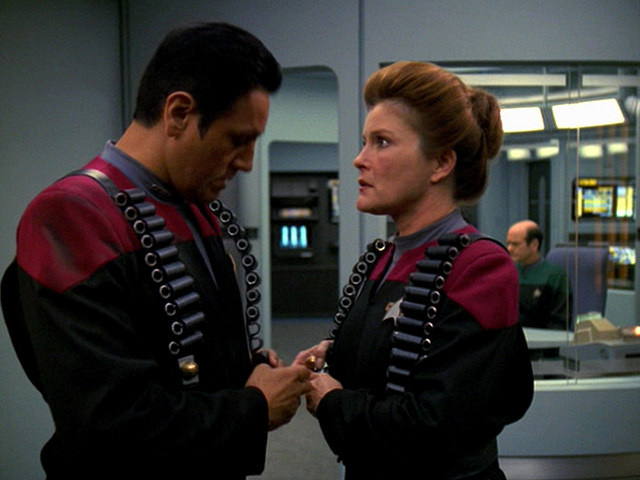
Stardate not given: A chrono-kinetic surge hits the ship and injures Chakotay. He is beamed to sickbay, where the Doctor treats him with a chroniton serum. But this is a version of the Doctor from before he received his mobile emitter. Voyager is fragmented into 37 different time frames, ranging from the ship's departure to the Badlands in 2371 to a point seventeen years in the future. Chakotay is the only one able to move between these time frames. On the bridge, he runs into Captain Janeway from 2371, who is still pursuing his ship and therefore does not trust him. He returns with a dose of the chroniton serum and begins to explore the fractured ship with her. They distribute a similar serum through the bioneural circuitry in each time frame, which would bring the entire ship back into sync once triggered by a warp pulse. When they stop in the mess hall, they find that it is Chakotay's original time frame and that the ship has been badly damaged. Tuvok dies from his injuries. Janeway suggests resetting the ship to the state of her own time, which would prevent the journey to the Delta Quadrant. But Chakotay convinces her that everything that happened afterward makes the sacrifice worthwhile. Engineering, however, is occupied by Seska and the Kazon. Chakotay and Janeway receive help from future Naomi and Icheb, from Maquis B'Elanna and from the still Borgified Seven of Nine to regain control and restore the ship. Back in his own time, just seconds before the ship encounters the anomaly, Chakotay is the only one who remembers the events. He activates the deflector, preventing the accident from happening again.
Review
Where "Relativity" worked very well and the first reissue "Fury" turned out to be an almost complete failure, "Shattered" is the third take on essentially the same time travel concept. The physics and logic of the story are very shaky, as discussed in detail in my time travel section. Why is the ship powered and fully supplied with life support in every time frame, even though they are so isolated that nothing can pass between them? Why is each person present in one and only one of the 37 time frames? Why can we see beyond the barriers, which are otherwise shown and described as impermeable? There are many more such questions, and the more closely one looks, the more the story falls apart. "Shattered" is one of the least credible time travel episodes, similar to "Fury", but it is also among the most entertaining, much like "Relativity", whose success it clearly tries to follow.
As weak as the logic is, the episode offers many enjoyable ideas. Naomi's jigsaw puzzle mirrors the fractured state of the ship, much like Janeway's replicator, which once again burns her roast. Or Icheb's knowledge of Chakotay's stash of Antarian cider that Icheb's future version will still remember (in a time frame where Chakotay is long dead). So while much of the story makes little sense and is only held together by chronitons, exotic particles that allow control over time, it still contains the sense of family that makes Voyager special. This is also clear in Chakotay's behavior. He is determined to push past Janeway's resistance by any means, even forcing her to follow him at one point with a chroniton hypospray at her neck. Yet he also tries to earn her trust, speaking carefully about their future relationship and in a way attempting to rebuild it within just a few hours.
Watching the episode again after many years, it feels unfair that I once focused mainly on its problems and did not value its strong moments. I still don't think "Shattered" was very original at the time, given its already mentioned similarities to earlier stories and the many flashbacks and flashforwards already used in the series. However, as a summary of seven years of Voyager, featuring Janeway with her bun, references to Lt. Stadi, Seska, the Kazon, the Borg, macroviruses and Dr. Chaotica, along with a look ahead at how "Captain's Assistant" Naomi and the young genius Icheb would develop (PIC: "Stardust City Rag" be damned!), I can hardly imagine a more fitting story for the final season.
Annotations
- Continuity: Two events from Voyager's past are mentioned but not shown. The first is the when "aliens invaded our dreams", which refers to "Waking Moments". The second is the "telepathic pitcher plant", by which Chakotay means the anomaly in "Bliss".
- Nitpicking:
- "Voyager doesn't have an astrometrics lab." Huh? Well, in "Year of Hell I" the impression was created that it was all brand new, and after all the set was actually new. But how in the world can a ship of the Intrepid class, a dedicated explorer with extraordinary scientific equipment, be without an astrometric lab or a similarly named facility like stellar cartography?
- Besides the already common inoculation against radiation there is also one against the time now.
- Remarkable dialogues:
- "Antarian cider. Not the replicated stuff. There are only a couple of bottles left and I don't want Mr. Neelix getting his hands on them." - "Then you should store them with the salvaged Borg components. Neelix never inventories those containers. He says they give him the creeps." - "Officer-level thinking, Icheb." (Icheb and Chakotay)
- "Let me guess. You burned the roast again." - "Once, a long time ago, I called this replicator a glorified toaster. It never forgave me." (Chakotay and Janeway)
- Remarkable quotes:
- "A good lie is easier to believe than the truth." (possible Ferengi Rule of Acquisition)
- "Eighth? Everyone knows there are only five dimensions!" (Dr. Chaotica)
- Remarkable prop: Naomi's LCARS puzzle
Rating: 6
Lineage
Synopsis
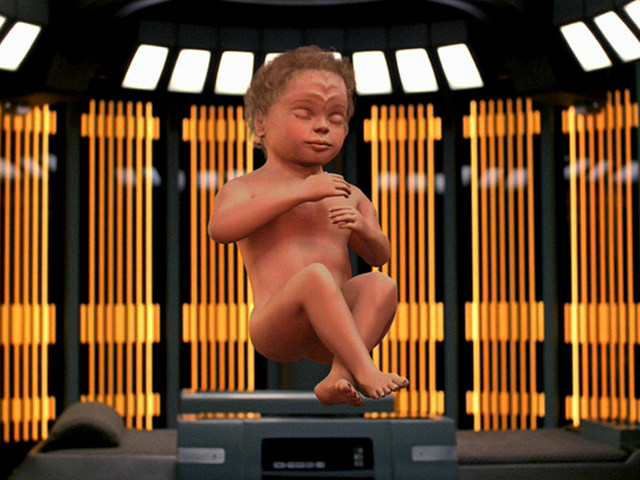
Stardate 54452.6: B'Elanna is pregnant, which makes both her and Tom very happy. The Doctor discovers a slight spinal curvature of her unborn child, a typical inherited condition from B'Elanna's Klingon side, and explains that he can correct it with a simple procedure. He then shows them a holographic projection of what their baby will look like. Their daughter will have forehead ridges, even though she is only one quarter Klingon. This unsettles B'Elanna. She remembers being an outcast as a child, how other kids teased her, and how she believes she drove her human father away. B'Elanna tries to persuade the Doctor to alter her unborn daughter's genes so that she will not look Klingon, citing medical reasons such as reducing the risk of infections in redundant organs. The Doctor disapproves, and so does Tom. B'Elanna argues with Tom in front of the captain, who tells them she will not make any decisions until they have worked things out themselves. After this, B'Elanna asks Tom to move out of their shared quarters. A few days later, the Doctor contacts them and unexpectedly claims that B'Elanna's requested genetic modifications are medically justified. He is about to begin the genetic resequencing when Janeway and Tom force their way into the locked sickbay. It turns out that B'Elanna has altered the Doctor's program so that he would approve the procedure. In the end, Tom manages to convince her that it is wrong and that he will love their daughter no matter how she looks. Her fear that her husband might leave her, just as her father once did, is revealed to be the real reason behind her actions.
Review
For a change, "Lineage" has no anomalies, no new aliens and no weird technical problems. The story doesn't even need a secondary plot. That is a good thing, because anything else would only distract from B'Elanna's character study. The episode is clearly something that wouldn't have been possible in Voyager's early seasons, and it shows that there has been real character development, despite frequent criticism of the show in that regard. Still, in seasons 5 and 6, the attempts to explore new facets of B'Elanna were a mixed bag. Writing "Lineage" for her often ungrateful character must have been a challenge, and I have to give the writers credit for that.
What B'Elanna tries to do, altering her child's genes, is highly objectionable, to say the least. It may even be illegal in the Federation, since it goes in the same direction as Bashir's genetic modifications, which become a major issue in DS9: "Dr. Bashir, I Presume" and get his parents into serious trouble. One might argue that B'Elanna at least doesn't want to give her daughter enhanced abilities, but then again, where would the law draw the line? Interestingly, the legal aspect is not mentioned once in the episode.
Legal or not, B'Elanna lies to her fellow crew members, deceives them, actively sabotages ship systems and harms the Doctor. It would still be somewhat understandable if she were determined to change her daughter's appearance because she was teased as a child, whether for her Klingon temper or simply for how she looked. It was already established in VOY: "Juggernaut" that a classmate called her "Miss Turtlehead". That alone would have been a sufficient explanation for her behavior in "Lineage". She would simply want her daughter to grow up without having to endure the same insults.
But there is more to it, at least in the final revelation. It all comes down to her father leaving her and her mother, and to young B'Elanna blaming herself because she told him to go away during that family vacation. So instead of ongoing harassment, it is this one assumed, or rather imagined, cause that shaped her childhood trauma and still drives her to act irrationally and irresponsibly as an adult. And that is where the story loses me, after working reasonably well for most of its runtime. I just don't buy it. I neither think she would still believe she drove her father away, nor that she would assume Tom might do the same. And while I accept that psychological mechanisms can preserve misconceptions over decades, it feels like too much TV logic that B'Elanna makes conscious decisions based on something that isn't real. She is impulsive, but she isn't completely irrational. And she isn't criminal. The resolution is also far too easy. Tom correctly points out that he is not her father and that she is not her mother, so history won't repeat itself, which suddenly seems to erase all her fears. This comes after Tom has repeatedly assured her that he loves how their daughter looks and that she will have a good life on Voyager, arguments B'Elanna totally ignored until then. Finally, as Janeway already suggested, there may be a deeper relationship problem between the two, beyond B'Elanna's unethical attempt to alter her child's genes, a problem that now seems only partly resolved and, if at all, only in regard to this specific issue.
Today, I disapprove of B'Elanna's actions more than I did back then. They fit her character, but I never understood her motivation, a problem that feels even more significant now than it did when I last watched the episode years ago. I still think the story is emotionally strong despite these issues. It is touching, but overall lengthy and not rewarding beyond that emotional level.
As I said, many years have passed since I last watched "Lineage", and even more since it was written. The world has changed, and so has my perspective, which is clear in two lines that I barely noticed before. The first is when Tom says their daughter will have a loving home, and B'Elanna replies "You're human - you don't understand what it's like". At the time, it felt like a simple defensive remark. But today, the idea that only members of a group can speak about its experiences has become like a dogma, often shutting down meaningful discussion. The second is when B'Elanna's father tells her uncle that "she's too damn sensitive", which now sounds like victim blaming, at least in the context of her being teased by other children. It probably wasn't meant that way, but today it comes across much more strongly.
Annotations
- Remarkable quote: "I'm detecting another lifesign - inside Lt. Torres. It could be a parasite." (Icheb)
- Remarkable facts: A normal Klingon pregnancy lasts 30 weeks. Among the redundant Klingon organs (mentioned in TNG: "Ethics") there is a third lung.
- Remarkable fun fact: Because he used to fall asleep at school, B'Elanna's father was nicknamed "John Snores".
Rating: 3
Repentance
Synopsis
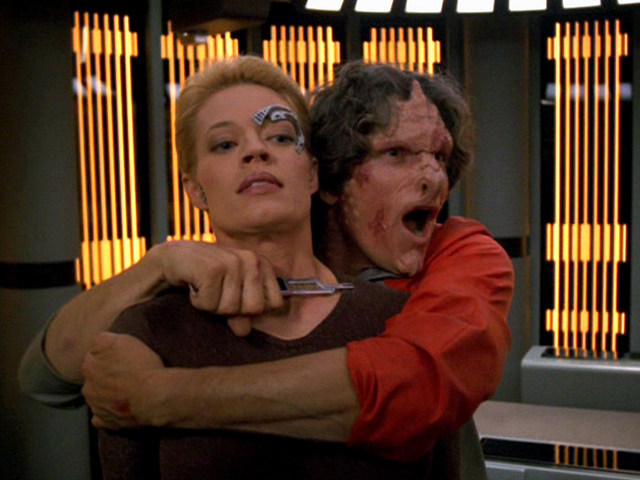
Stardate 54474.6: Voyager answers a distress call and rescues eleven people from a Nygean ship. Two passengers are transported directly to sickbay because they are badly injured. However, one of the patients suddenly holds a scalpel to Seven's neck and demands to be released. Seven manages to subdue the man, whose name is Iko. It is then revealed that the alien vessel is a prisoner transport that was carrying eight convicted murderers to their execution. Iko stands out because of his seemingly senseless violence; he is said to have killed a young father and shows no remorse for it. Janeway agrees to take custody of the prisoners, although she feels uneasy about delivering them to their deaths. She has Tuvok set up a detention area in a cargo bay and allows the Nygean guards, led by Yediq, to remain in control. When Iko threatens Yediq's family, the guards beat him, and he is brought back to sickbay with serious head injuries. The Doctor asks Seven to provide some of her nanoprobes to remove an edema in his brain. She agrees reluctantly, arguing that it is inefficient to save someone who will be executed anyway. The treatment succeeds, but it also has an unexpected effect. Iko becomes calm and reflective instead of aggressive, and he begins to regret his past actions. The Doctor discovers that his violent behavior was caused by a birth defect, by missing neural pathways that the nanoprobes have now restored. Seven sees parallels to her own past and argues that Iko, now a different person, deserves another chance. Yediq rejects this explanation and believes that Iko is only pretending to have changed. Meanwhile, Neelix has befriended another prisoner named Joleg. He is part of the Benkaran minority, which occupies only ten percent of Nygean space but makes up eighty percent of the prison population. Joleg insists that he was convicted only because he is Benkaran. Neelix offers to contact Joleg's brother. Some time later, a ship arrives, attacks Voyager and tries to beam out the Benkaran prisoners. When this plan fails and escape is no longer possible, the attackers decide to take revenge on the guards. At that moment, Iko takes a phaser and hands it to Yediq, saving his life. Under Nygean law, prisoners are allowed to appeal directly to the families of their victims. Yediq now agrees to support Iko, but the appeal is denied, and the execution will take place regardless.
Review
"Repentance" is the Trek episode with the most intense reflections and debates on ethical dilemmas in a long time. At first, the main issue is whether the death penalty is a just punishment, introduced when the prisoners come aboard and Yediq announces that they are to be executed. Iko is an especially tough case, so to speak the prototype of a criminal for whom capital punishment may have been conceived in the first place. He is aggressive without reason, he never reflects on his actions, his chances of rehabilitation seem nonexistent. Seven is only slightly resentful on a personal level after Iko threatened her with a scalpel - but, also because of her Borg mindset, she believes that anyone like him should be eliminated for the benefit (she calls it "efficiency") of the society. The Doctor takes an opposite and even broader stance and insists on every form of killing being wrong, which follows from his programming. While Tuvok and Chakotay are inclined to object, Janeway grudgingly agrees to accept the principles of the Nygean justice system including capital punishment, to comply with the Prime Directive. The moral problem of tolerating the death penalty in another legal system won't stay the only one in the episode.
While any form of communication with Iko seems pointless, Neelix befriends another prisoner named Joleg and studies records about the Benkarans. Although they inhabit only 10% of Nygean space, they account for 80% of the prison population, and they are condemned to death ten times as often as Nygeans. The parallel to black convicts in present-day USA couldn't be clearer. It seems that rather than being innocent, Joleg's main claim is that he didn't get a fair trial because he is of the wrong species - and because he isn't rich enough to buy the mercy of his victim's family, a peculiarity of the Nygean law. Joleg later tries to escape together with his five fellow Benkaran prisoners, apparently taking advantage of Neelix's help in contacting his brother - although he once again evades the accusation, saying he didn't know they would try to free him with force. This raises the question of whether Joleg is as guilty as the Nygean prisoners, and only instrumentalizes the discrimination of his people to present himself as a victim. He probably is guilty, but this is overshadowed by his lack of honesty and morality; it shifts attention away from the issue of whether he deserves his sentence. Well, maybe a long imprisonment without any hope of parole could explain Joleg's behavior, since he is only doing everything to stay alive. But Iko was always honest - both before and after his brain damage was repaired. It may not even have been necessary to include the security report that Joleg threatened to kill Yediq, since it mainly serves to make him appear even more unlikable in Neelix's eyes.
Thinking of BLM, I doubt Joleg's part of the story would still be possible today because it could be seen as weakening the real-life narrative. In the episode itself (and still today as a I think), it comes with a great twist that subverts our expectations.
Like Neelix, Seven is forced to reconsider her views when the Doctor's procedure, using her nanoprobes, repairs a birth defect in Iko's brain that caused his unmotivated violence. This is probably the most profound part of the debate. What does Iko's former inability to control his violent tendencies mean in a legal or in an ethical sense? Are these really extenuating circumstances, or even proof that he lacked criminal responsibility because he had no grasp of what he was doing? Seven, with the memory of her time as a drone, tends to see it this way. She has probably assimilated thousands of individuals into the Collective, but is this comparable to what Iko has done? A drone is not aware of the difference between good and bad according to human(oid) ethics, and a drone is not even able to control its own actions because it is part of the Collective. So even if Seven was aware of everything, there is no personal guilt in that situation.
In my view, the case is different with Iko. I think he was always aware of what he as an individual with his own will was doing, and the fact that he must have known that he committed crimes didn't stop him. It is a widespread idea that all criminals may have some sort of defect that disconnects them from basic moral and ethical principles, but wouldn't that reduce human beings to machines that simply have to be repaired if they malfunction? Wouldn't it allow misuse, if people with such impairments could act without fear of punishment - or if offenders demanded that their condition be considered, like Joleg shamelessly tried? Couldn't it lead to a future society taking preventive measures against potential criminals with the help of something like a mental analysis? And with a compulsory brain fix in case something deviant is found? Personally, I would be rather afraid than glad if one day something like a universal neurological or psychological explanation for violent behavior should be found.
The ultimate ethical question, however, is if someone who honestly repents and becomes a different person, just like Iko, irrespective of how it happens, should be allowed to live. After all, as Iko says himself, the burden of guilt for the rest of his life would be the harshest punishment. What do we make of the real-life phenomenon that people on the death row become very calm and thoughtful and that they sometimes turn to faith? Is it just a situation-dependent coping mechanism? The case is clear with Iko, who is definitely a new person, as the Doctor assures. So does this new person, who has nothing in common with the man who committed the crimes, deserve to live? This remains the most difficult and controversial issue raised by this great episode. And even though I am personally against death penalty anyway, it still makes me think.
Annotations
- Nitpicking: Neelix says the Federation has clear guidelines concerning the treatment of prisoners, implying that they have the right to get a good meal. But this obviously didn't apply to Tom in "Thirty Days", where Neelix obeyed Janeway's order to bring Tom no more than "bread and water".
- Remarkable quotes:
- "I hurt people. I deserve to die." (Iko)
- "So Iko is the victim now?" (Yediq)
Rating: 8
Prophecy
Synopsis
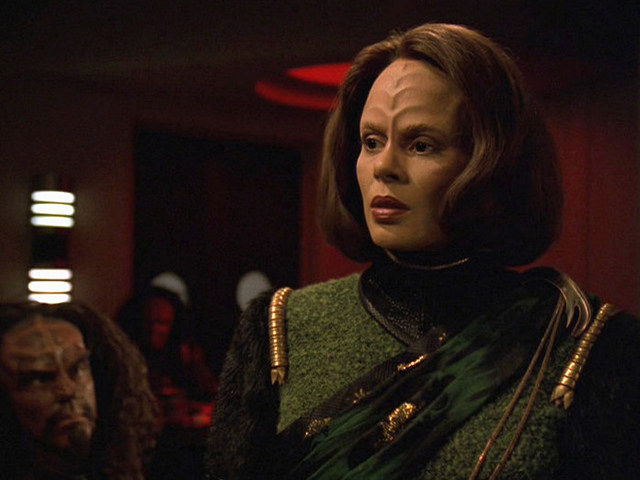
Stardate 54518.2: The crew is taken by surprise when Voyager is attacked by an old Klingon cruiser. After losing its cloak, the Klingon captain, Kohlar, agrees to come aboard Voyager for negotiations, although he still considers the Federation an enemy of the Empire. He explains that his vessel is on a long-term mission and shows a strong interest in B'Elanna's unborn child. Back on his own ship, he tells his crew that he has found the Kuvah'Magh, the supposed savior of the Klingon people. He then initiates the self-destruct sequence, forcing his people, 204 warriors and their families, to beam over to Voyager. Some of the Klingons remain doubtful, especially an older man named T'Greth, who objects that the Kuvah'Magh should not have so much human blood. Kohlar later admits to Janeway, Paris and Torres that he does not truly believe the child is the Kuvah'Magh and that he simply wants to end the century-long journey of his sect. Together with B'Elanna, he tries to match her background to the ancient scrolls in order to support his claim. T'Greth, however, continues to resist. He challenges Tom to a fight to the death, but Kohlar finds a loophole that allows them to use blunted bat'leths instead. During the duel, T'Greth suddenly collapses. It is revealed that he suffers from the nehret, a viral disease affecting all the Klingons on his ship. B'Elanna and her child have also become infected. Voyager reaches a planet similar to Qo'noS, which Janeway and Kohlar have chosen as a new home for his people. As T'Greth has temporarily recovered, he attempts to take control of the ship. He starts transporting Voyager's crew down to the planet, but his effort to seize the bridge fails, and he gets stunned with a phaser. When T'Greth regains consciousness, he has been cured of the nehret. B'Elanna's child possesses hybrid stem cells, which the Doctor has adapted to develop a cure for the disease. In this way, the child has indeed saved the Klingons, just as described in the ancient scrolls.
Review
Voyager has a long history of encountering people or artifacts from the Alpha Quadrant in the depths of the Delta Quadrant, often relying on painfully contrived explanations. The idea of running into a Klingon ship that has been underway for a hundred years doesn't seem all that bad in comparison. However, this premise is neither original nor developed into an engaging story. The plot is much like an amalgamation of the generational ship in TNG: "The Emissary" and the ancient myth that seems to come true in "Rightful Heir".
On top of that, the way B'Elanna Torres is personally involved is disappointing. We know at latest since "The Barge of the Dead" that B'Elanna doesn't share the religious beliefs of her people, and it is uncertain whether the apparent afterlife experience, in which she saw her mother, has changed her views. In any case, she was still struggling with her heritage, as became very obvious only recently in "Lineage", where she wanted to manipulate her unborn child's genes and eliminate the Klingon traits. Although that episode was not very successful, as it portrayed her in a somewhat one-dimensional way and relied on an unconvincing change of heart, it already explored how she feels about being Klingon and what she hopes for her daughter. Looking just at B'Elanna, "Prophecy" may have been intended as a character piece with an ironic premise, as she was just making peace with her heritage and now becomes a religious icon - and suddenly her child couldn't possibly look Klingon enough. In practice, however, it feels more like an unnecessary and somewhat silly addition. Considering that the whole fuss is about her and her unborn daughter, B'Elanna is not even involved as strongly as we may have expected. Apart from being understandably embarrassed by the situation and doing her best to support Kohlar, with the only motivation to get his people off the ship, she has no active role in the story. In the end, the main takeaway of "Prophecy" is that it is the Voyager episode with the most Klingons and the most Klingon clichés, but without telling a compelling and really meaningful story.
The story boils down to the myth holding some truth after all - as it is often the case in Star Trek, such as in the already mentioned TNG episode "Rightful Heir", which clearly served as a model. The plot pushes toward this conclusion and doesn't develop it organically. A suddenly introduced illness serves as a plot device and is resolved just as swiftly by the Doctor, with the added twist that B'Elanna's child provides the hybrid stem cells, thus saving the Klingons not despite, but because of not being fully Klingon. This is too small a reward for an overall frustrating episode that indulges in rituals and myths.
I like Kohlar as the type of wise Klingon leader we have seen in figures like Gorkon or K'mpec. In his pragmatism he presents B'Elanna's child as the Kuvah'Magh to his largely devout crew, even though he doesn't personally believe that she is the savior. He also needs to be cautious all the time because his opponents like T'Greth may notice his lack of faith and accuse him of blasphemy. I think that Klingon and human religions alike make a mistake when they take old texts literally. There is definitely merit in the writings, but shouldn't they be treated as guidance to seize opportunities and act wisely, rather as predictions of the future or as precise recipes? Prophecies are vague for a reason. Perhaps the takeaway of the episode was meant to be that one shouldn't waste one's life to pursue an ideal that is unattainable or to wait for a savior that doesn't realistically appear. But the Klingons in "Prophecy" are essentially tricked into accepting this truth, which lessens its impact.
I don't like Neelix's role in this episode at all. He was never among the central characters, but at least he has gained a credible and sincere profile in the past couple of seasons, despite still having comedic traits. Now he totally becomes a clown again. It is still somewhat amusing when he moves into Tuvok's quarters and genuinely believes that they would have a lot of fun. But his infatuation with the Klingon woman Ch'Regha comes across as exaggerated and awkward. It is not the idea itself that is the problem, but how it is portrayed, especially with Harry acting as the more "reasonable" counterpart who is put off by Klingon behavior. I can fully understand Tuvok's annoyance when he enters his quarters, to find it devastated after Neelix and Ch'Regha's excessive intercourse.
Annotations
- Nitpicking: The Klingon cruiser is called a D7 type, which would be the one that frequently showed up in TOS, and was reconstructed for DS9: "Trials and Tribble-ations", but it is actually a K't'inga. It is possible that the two distinct classes of similar size share a common Federation designation, though. On the other hand, Tom is surprised because they were retired decades ago, which obviously doesn't apply to the K't'inga variant that was still in use during the Dominion War.
- Remarkable quotes:
- "Good! Because I promise you we're going to have fun, Mr. Vulcan. I learned some Klingon drinking songs." (Neelix, after moving to Tuvok's quarters)
- "You have a fiery spirit. You'll make s worthy mate." (Ch'Regha, to Harry)
- "No mercy killings on my bridge." (Janeway, to T'Greth)
- Remarkable fact: B'Elanna's grandmother is named L'Naan, and her great-grandmother is named Krelik.
Rating: 2
The Void
Synopsis
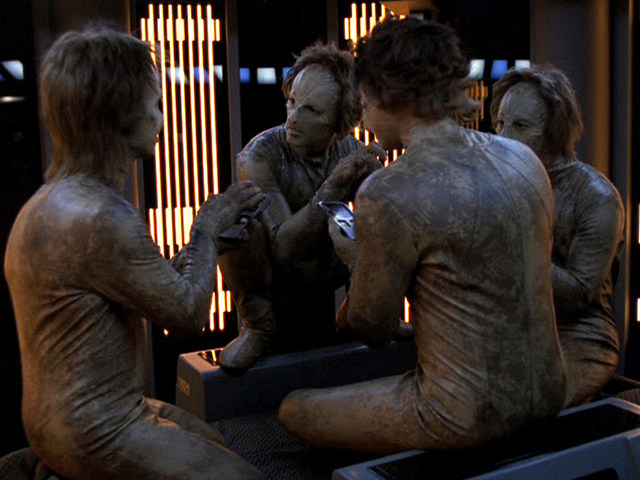
Stardate 54553.4: Just as Seven is preparing a meal for Janeway, Chakotay, B'Elanna and Tom, Voyager is struck by a graviton surge and gets sucked into an isolated region of space without any natural energy sources, the Void. Upon arrival, the ship is immediately attacked, and much of the food and deuterium supplies are stolen. A man named Valen offers protection, but he demands photon torpedoes in exchange. Janeway declines. Occasionally, funnels to the outside world like the one that dragged in Voyager erupt. They are a one-way phenomenon, but with enough power it may be possible to go the other direction and escape. Seven finds a way to predict their occurrence. Voyager almost reaches normal space again this way but then gets sucked in again. With much of the remaining energy lost, there is no hope of trying this again. Janeway decides to track the ship that raided Voyager and reclaim the supplies. But that ship itself has been ransacked in the meantime, and its crew is dead. Seven suggests to beam aboard at least the engine casing that may be used for power generation. Someone is hiding in there that the sensors didn't pick up. The lifeform is taken to sickbay where Seven and the Doctor learn to communicate with him using musical tones. The Doctor names him Fantôme. It turns out Valen has taken Voyager's food and deuterium. Voyager successfully attacks his ship but only beams back what was stolen from them. Janeway now attempts to forge an alliance of ships trapped in the Void under the condition that they kill no one and steal from no one. She has some first talks with a Nygean captain. When a Hierarchy ship appears in the Void, it is immediately raided by Valen. Voyager comes for the ship's support and is only successful as the Nygeans join the effort. The alliance begins to grow. A man named Bosaal offers his help but is offended that Voyager harbors Fantôme, who is a parasite in his view. When the group is in need of a polaron emitter to enable their common escape, Bosaal steals one from another ship, whose crew he kills. Janeway expels him from the alliance and has the crews improvise an emitter. As the alliance is ready to launch their escape attempt, Fantôme's people, who are indigenous to the Void and want to stay, offer their help. They are secretly beamed over and sabotage the ships of Valen and his allies. The vessels of the alliance finally escape and part ways peacefully.
Review
"The Void" is nothing special at first. It all begins as usual, as the space anomaly of the week gets the ship into trouble. This is very reminiscent of of "The Cloud", "Night" and "The Fight" - we've seen it all before. It is boring and even becomes slightly annoying how routine and unoriginal the story presents itself. This impression, however, lasts only about five minutes, after which more original aspects take over: the fight for limited resources and ultimately for survival, the question of whether killing to survive is justified, the applicability of the principles of the Federation in such a dire situation.
When it comes to obeying the rules, Janeway's character has not always been depicted consistently, sometimes citing the special circumstances of their journey through the Delta Quadrant as reasons to amend them. But she maintains a clear stance throughout this episode that the values of the Federation still apply fully. She embraces the laws and defends them as Chakotay and Tuvok suggest bending them. Well, perhaps going down with the ship with dignity and a good conscience personally matters even more to her than abstract laws. Anyway, Janeway makes the right decision in the context of this story. She is stubborn as always, she dictates her rules to everyone, but even though it is only possible with an additional great deal of luck, her way ultimately proves to be the right one. She can be quite content with herself and the principles of the Federation. I like how the different crews, all with different methods, with even the Hierarchy's spying on enemies being a welcome help, work together to achieve a common goal, much like a miniature Federation. Lots of classic Trek spirit here. Even the indigenous nomads of the Void, the people of the Doctor's friend Fantôme, join the effort in the end. The scenes with Fantôme, although or just because he does not speak a word, are probably the most impressive of the episode, and the idea of communicating with him by developing a language based on sounds is as striking as it is simple. His species is indeed quite intelligent, although it doesn't seem so at first glance. Not judging someone or something by a first impression is another clear sign of Trek spirit.
It is only realistic that some aliens don't want to join an effort to achieve something for everyone's benefit, and that they would take their chances raiding other ships, even if this means they merely postpone their inevitable deaths at best. I think similarities to the situation on our own planet are not unintentional. Yet, the story depicts Voyager's opponents as villains although it would not need them to work. Valen has villainous traits, although it would have been enough to show him as someone determined to survive at any cost; the way he appears he may not have been a nice person outside the Void either. In the case of Bosaal, the framing is even more obvious. His reaction to Fantôme paints him as a racist; it very clearly foreshadows that he would later betray the principles of the alliance. On a further critical note, except for these villains, everyone else seems amazed by the generosity and morality of the Starfleet crew. Starfleet has always served as a galactic role model, but in the depths of the Delta Quadrant there should occasionally be someone else with similar ideas who perhaps even makes the first move. Our bold crew, and especially Janeway, sometimes comes across as conceited, with the circumstances routinely proving them right.
Finally, a note on Fantôme's people. At first, they seem as implausible as the "Night" beings that inhabit an equally starless space without any energy sources or even an environment that could support life. However, it may be possible that they are actually descendants of a starship that was stranded in the anomaly long ago. It would have taken many millennia for an evolution to take place that caused them to lose their language and become invisible to sensors so they could survive on any ship. That's not a completely satisfying explanation, but better than in the case of "Night", where it remains a mystery how the beings can survive in the anomaly on their own.
Annotations
- Remarkable dialogue: "Then who are we going to form an alliance with?" - "Anyone who agrees to play by our rules. No killing, no stealing, and no giving up." (Chakotay and Janeway)
- Remarkable fact: 150 ships are within sensor range upon entering the anomaly, of which only 29 show lifesigns.
- Remarkable ships: We get to see quite a few starships that previously appeared, unfortunately no new ones.
- An alleged Vaadwaur vessel, which is actually a design from "The Omega Directive"
- A Devore ship from "Counterpoint" (the one that Fantôme is found on), which is probably not meant to be Devore
- The scaled up Federation fighter as in "Nightingale" as Valen's ship (Valen is Annari, but the ship design is Kraylor)
- A ship of the Hierarchy from "Tinker, Tenor, Doctor, Spy" with the correct crew
- The triangular "hammerhead" ship from TNG once again
- A Nygean ship but using a Hazari design from "Think Tank"
- A Mawasi ship from "Year of Hell" that is definitely not supposed to be Mawasi
- Photon torpedoes used: 2
- Distance to Earth: still 30,000 ly
Rating: 7
Workforce I/II
Synopsis
Stardate 545484.3: Almost all of Voyager's crew members find themselves on a heavily industrialized alien planet named Quarra, where they are working in a massive power plant, unaware of their former identities. Janeway becomes romantically involved with a man named Jaffen. Seven serves as the facility's efficiency monitor under the name of Annika Hansen. Tom refuses to work there and gets fired almost immediately. He finds employment in a bar, where the pregnant B'Elanna draws his attention. Tuvok eventually experiences flashbacks of his former life. Meanwhile, Chakotay, Harry and Neelix are on the Delta Flyer, returning from an extended away mission, but Voyager is not at the rendezvous point. They finally locate the ship concealed in a nebula. The Doctor, now acting as the ship's ECH, is struggling to restore its systems. Voyager struck a subspace mine and was then raided by marauders, who abducted the crew and selectively altered their memories with inoculations. After repairing the most critical systems, Harry detects the crew's lifesigns on Quarra. Since the authorities forbid contact with the workers, Neelix and Chakotay beam down in disguise. They manage to extract B'Elanna, but Chakotay has to stay behind. Meanwhile, Tuvok has recovered more of his memories. When he attempts a mind-meld with Seven, he is seized and taken to a mental hospital for treatment of his rare "dysphoria syndrome" and treated by Dr. Kadan. Chakotay escapes his pursuers for the moment. Voyager, however, comes under attack and is forced to withdraw. At least B'Elanna recovers and slowly regains her knowledge of her previous life. Janeway decides to move in with Jaffen. Suddenly she notices Chakotay, who points a weapon at her. He explains the entire situation, which she does not accept at first. Still, she begins to trust him. The Quarren authorities capture him. When he is sent to the mental hospital for "dysphoria syndrome", Yerid, who is investigating the case, becomes suspicious. In the hospital, Chakotay is brainwashed and sends a message to Voyager that is intended to lure the ship into a trap. Seven discovers irregularities in many employee files, as all the new arrivals came from that same mental hospital. She uncovers the truth and joins forces with Yerid to free Tuvok and Chakotay from Dr. Kadan's clutches, while Janeway and Jaffen use a subspace transmitter in the power plant to contact Voyager. To be beamed out, they must disable the shield grid that protects the planet, which Janeway accomplishes by simulating a core overload. Voyager is attacked again, but Kim deceives the attackers by launching escape pods while masking the crew's lifesigns. The marauders tractor in the pods, which explode and disable the ships. The entire crew is rescued from Quarra and begins to recover. Janeway says goodbye to Jaffen, who had willingly taken the job in the power plant.
Review
"Workforce" is the most exciting episode in a while. It may not be quite the best, but perhaps the most notable episode of the seventh season because of its unusual premise, rather than "Flesh and Blood" with its fairly conventional conflict. The script handles the complex dramaturgy with many characters in many places overall quite well. The most interesting aspect of the story is that the crew members on Quarra have been selectively brainwashed, meaning that their personalities remain essentially the same while their memories are different or are impaired. Thus, "Workforce" shows us the crew as they might have developed if their lives had taken completely different directions. This is why it's not a surprise that Tom has problems with his discipline once again, that Seven has become a strict "efficiency monitor", and that Janeway, without concerns about endangering her authority as captain, is free to engage in a relationship. Tuvok's sense of humor, which reminds me a bit of Data's first attempts to understand it, is appropriate too, considering that Vulcan mental discipline is something that has to be learned, as shown in VOY: "Gravity". Every member of the main cast is allowed to make a considerable contribution to the course of the story, and the alien guest characters, namely the criminal Dr. Kadan, his assistant Dr. Ravoc, the investigator Yerid, and in particular Janeway's love interest Jaffen, play unusually important roles as well.
Yet, the story does not have quite enough substance for a two-part runtime in my view. I imagine the script could have been shortened and the story tightened without losing anything of note, perhaps by removing a few of the complications, especially regarding Chakotay's escape from the Quarren authorities. Also, some scenes, especially those with Janeway and Jaffen, are a bit lengthy. But I like the idea that character development can be combined with an overall thrilling plot. It is a credible love story if we take into account Janeway's new freedom, which makes it work better than in previous stories where her duty could be expected to become an obstacle sooner rather than later. When we first watched this among friends decades ago, we couldn't stop laughing for several minutes when Janeway presented her pot roast, saying "It's only burnt on the outside.", continuing the running joke about her lack of culinary success.
Unfortunately, the episode suffers from several plot-driven scientific and technical problems, although some of them might have been avoided. The most pressing question is how everyone's brain manipulations can be reverted. The Quarren techniques are shown as highly selective here, and they leave the original memories intact so that they are conveniently 100% reversible, which just is not realistic. But we have to take it for granted that everyone will be completely fine and be themselves again next week, much like after "The Killing Game".
One other technology may not be entirely plausible either, but is at least consistent. It's interesting that a 24th century dermal regenerator can be used to remove plastic surgery. It seems the device activates some kind of "memory" of the original skin structure, which is clearly much more sophisticated than simply sealing wounds or removing bruises or scars.
Annotations
- Nitpicking:
- When Voyager is stuck in a contaminated region of space, Janeway decides to launch the escape pods. I somehow doubt these would offer more protection than the ship.
- Although it likely is just a cover story this time, the inoculations that the crew members receive on Quarra are said to be against radiation.
- We have seen many remarkable sensor enhancements in the past, but biosensors that can scan 83 star systems for specific lifeforms and finally locate them on a planet that is three days away at maximum warp (25 light-years at Warp 9.9) are beyond credibility. This is even more absurd considering that the same episode explicitly states it to be difficult to transmit normal subspace signals across merely 8 light-years, which the authors justify with technobabble about a "triaxialating frequency on a covariant subspace band". So the transmission of a well-defined amplified signal to a known destination is a problem, but an omnidirectional search for faint lifesigns is not?
- We see Neelix's ship leave the shuttlebay for the first time. While it barely fits through the door, it is still longer than the Delta Flyer, which aggravates the storage problem. In fact, the interior of the shuttlebay (which is essentially the same set as the cargo bay) does not allow access to a storage facility for the Delta Flyer or Neelix's shuttle or even both of them.
- Remarkable ship: The Quarren mercenary ships consist of rearranged parts of the Breen ship. The most significant difference is that they are symmetrical. The characteristic tapered pods obviously contain the propulsion systems.
- Remarkable station: We have seen the Quarren space station before in "Riddles", or at least its silhouette, considering that it was cloaked.
- Remarkable effects: "Workforce" has some of the best visual effects of the whole series. While the space scenes are of the usual high quality, especially the rendition of the city on Quarra is remarkable. Star Trek traditionally had to work with small planet sets in the studio that were only supplemented with matte paintings, if at all. "Workforce" successfully uses CGI techniques to extend real sets like no other episode before. In particular, the opening scene when Janeway uses the elevator is great.
- Crew count: 136 crew members were brainwashed on Quarra, excluding B'Elanna and Tuvok. Plus Chakotay, Kim, Neelix and the Doctor this gives us a crew of 142 (or 141 "real" people).
- Photon torpedoes used: 2
Rating: 7
Human Error
Synopsis
Stardate not given: Seven of Nine secretly creates holodeck scenarios of social interaction, such as a baby shower with B'Elanna and Tom or a romantic encounter with Chakotay. As a result, she skips regeneration cycles and neglects her real-life duties. When Voyager enters a region with subspace detonations, it turns out to be a test range for warheads. Seven is developing a method to detect them in time. After she reports late for duty, the ship suffers unexpected damage. Back on the holodeck, Seven ends her relationship with the holographic Chakotay in order to concentrate on her work, but the emotional strain overwhelms her and she collapses. The Doctor discovers that her cortical node has shut down. She explains that she was trying to regain the feelings she experienced in Unimatrix Zero. He considers this understandable and advises her to find a better work-life balance, then declares her fit for duty again and promises doctor-patient confidentiality. Once she returns to duty, Voyager is attacked by warheads again, which cannot be stopped by photon torpedoes. As they continue to approach the ship, Seven manages to disable them at the last possible moment. The ship is safe now. However, the Doctor later brings troubling news, explaining that the cortical node shutdown was a Borg fail-safe mechanism, since drones with strong emotions are considered defective. Seven declines the option to undergo surgical procedures to remove the fail-safe and resumes her normal duties without further involvement in social activities.
Review
The title "Human Error" could just as easily describe many other episodes in which Seven tried to reclaim her humanity, often ending in disappointment but with the effect of exactly that contributing to her actually becoming more human. Neither that basic idea nor the specific notion that she would explore a romantic relationship is new here. We've already had that in "Someone to Watch Over Me", the only fresh angle being that Seven now specifically strives to experience something again that she already had in Unimatrix Zero, rather than being pushed by the Doctor. The idea of her living out her dreams secretly on the holodeck and not putting them into practice, on the other hand, is reminiscent of what Barclay did in TNG: "Hollow Pursuits". The motivations and circumstances may differ, but they both don't know how to socialize although they perform well when they do it with simulations of real characters on the holodeck. Also, as her cortical implant fails because she can't cope with the emotional burden, it just cries TOS: "Requiem for Methuselah" or TNG: "The Offspring". Although it was clear that Seven would survive, it is just another slight variation of the old trope that cybernetic beings (especially if they are female) are not made to have feelings and die of emotional strain. Beyond these too clear and too stereotypical parallels I think it is exaggerated how Seven neglects her duties and lies about the reasons because of her apparent addiction to the holographic adventures. It also doesn't make much sense, considering that she remains recognizably herself in the scenarios she creates and only a bit more at ease - rather than being totally immersed in gameplay. It would have worked better if Seven had been shown as tired because of insufficient regeneration, rather than missing appointments because she loses track of time on the holodeck.
Seven remains fundamentally herself on the holodeck. Her date with Chakotay is awkward and uncomfortable to watch but intentionally so, as she struggles to adapt to that new role. She may be willing but is not able to let go of her perfection, even in a moment when no one can observe or judge her. This is impressively demonstrated with the metronome that determines her piano play, without which she not only loses the tempo but also hits the wrong notes. The remarkably well-programmed holographic Chakotay tells her that not everything in life has to be perfect. Interestingly, after returning to her duty, she in a way heeds his advice when she misreads the coordinates of the approaching weapons. She has a good idea, but bad timing. Keeping apart Borg perfection and human imperfection, as well as duty and private life, is difficult for her. But considering that Seven didn't have a private life so far, as the Doctor notes, she still manages reasonably well. This is one reason reason why I dislike the outcome that eventually a Borg safety feature keeps her from becoming more human, rather than it being an issue that she could overcome herself.
The conclusion, in which only the Doctor knows what is wrong with her and she declines the medical procedure that could help her, is good for a downbeat ending that perhaps subverts our expectations. It is emphasized by her declining an invitation of the real Chakotay she may have gladly accepted under different circumstances, to avoid emotional distress. It is a sad and perhaps realistic reflection of her disillusioned state of mind, yet also unsatisfying because the episode misses an opportunity to advance her development one final time before the end of the series. And rather than showing how Seven gradually gets closer to the real Chakotay, this will happen all of sudden in an unlikely last-minute plot thread in the series finale. "Human Error" remains inconclusive but doesn't call for a continuation, and definitely not in the gratuitous way it will actually happen in the finale.
Annotations
- Remarkable quotes:
- "To the newest member of our crew. May all her desires be fulfilled. Except for one - so she'll always have something to strive for... And may she inherit a sense of logic from her mother." (Seven, at the holographic party for B'Elanna's child, while Tom is trying hard to solve the Vulcan children's puzzle)
- "I'll bring the wine and the furniture." (holographic Chakotay, when he has been invited to Seven's empty quarters)
- "Slice these vegetables transversally in five-millimeter increments." (Seven, to the holographic Chakotay)
- Remarkable dialogue: "Does this contain enough sodium chloride for your taste?" - "Could use another 0.6 milligrams. But you're the chef." (Seven and the holographic Chakotay)
- Remarkable song: "Rock-a-bye baby, in the spacedock - When the core blows, the shuttle will rock - When the hull breaks, the shuttle will fall - And down will come baby, shuttle and all." (the Doctor)
- Photon torpedoes used: 3
Rating: 3
Q2
Synopsis
Stardate 54704.5: A teenage boy appears on the ship and introduces himself as Q. His father, Q, leaves the unruly youth in the care of his godmother, "Aunt Kathy". He strips his son of his powers and turns him into a human - threatening that he would end up as an amoeba if his education should fail. Q Junior causes chaos at first but soon befriends model student Icheb and begins to engage in serious studies. But he becomes bored. He steals the Delta Flyer, breaks free from Voyager's tractor beam, enters a spatial rift and gets himself and Icheb into danger when they attack a Chokuzan ship. As the aliens return fire, Icheb gets hit by an energy discharge. Instead of continuing his reckless adventure, Q Junior heads back for Voyager. But the Doctor is unable to treat Icheb without knowing the exact composition of the Chokuzan energy weapon. When Q refuses to help Icheb, Q Junior reluctantly returns to Chokuzan space with Janeway, to apologize and ask for the missing information. The Chokuzan announces that Janeway, as the adult in charge of him, is responsible for his actions and will be punished for his offense according to their laws. Q Junior changes his mind and accepts the punishment, whatever it will be. The Chokuzan reveals himself as Q, and he tells his son that he has passed the test in his view. He also says that Icheb has never been in danger. The Continuum, however, rules that Q Junior must remain human. Only when Q threatens to leave the Collective, they give back the boy his powers under the condition of eternal custody by his father. Q thanks Janeway by handing her calculations that would shorten Voyager's journey by a few years.
Review
Several of Voyager's stories in the final season rely on familiar stereotypes and offer little in terms of new ideas or real development. Like last week's "Human Error", "Q2" falls into this category as well. We've seen it all before. Q himself faced a similar situation in TNG: "Déjà Q", where he was turned into a powerless human and had to prove himself in a comparable way. It feels repetitive that his son, who was introduced in "The Q and the Grey" with Janeway as his "godmother", runs into the same type of trouble and has to pass the same kind of test. For most of the episode, he behaves obnoxiously and constantly causes trouble. He accepts his situation only briefly, soon grows restless again and only changes his attitude shortly before the episode ends, when he finally decides to help the crew. This shift comes too late to have much impact. It also mirrors his father's story, which makes the plot even more predictable.
"Q2" is also the silliest Q appearance in Star Trek (besides being the last in a classic episode). None of his previous episodes were meant to be taken entirely seriously, but here the underlying gravitas that often accompanied Q stories is missing. The episode works mainly as simple entertainment, and I admit that the many Q tricks are once again amusing and at times surprising. Still, overall it feels like a rather shallow and unfocused entry, one that I don't feel like spending many words on.
Annotations
- Remarkable dialogues:
- "...A new chapter began when Kirk regained command of the Enterprise." - "How many more chapters are there?" - "Thirty-four." - "This was supposed to be a twenty-minute presentation." - "I was trying to be thorough." (Icheb and Janeway)
- "Coffee. Black." - "Make it yourself." (Janeway and the replicator)
- Remarkable appearance: Q2 is played by Keegan DeLancie, John DeLancie's son.
- Missed opportunity to get home: #15, because asking a Q is always a good idea
Rating: 2
Author, Author
Synopsis
Stardate 54732.3: A new communication link allows real-time contact between Voyager and Earth, but only for eleven minutes each day. The crew can now speak face to face with their loved ones in the Alpha Quadrant, regulated by a token system. Meanwhile, the Doctor has been working on a holonovel titled "Photons Be Free", and he plans to use the link to send it to a publisher. Tom asks for permission to try the program in advance and is shocked by what he sees. The story is set on the starship "USS Vortex" and uses unmistakable parallels to Voyager and its crew to depict how immoral or even criminal biological officers mistreat their holographic EMH. Other crew members also play the holonovel, until Janeway eventually reviews it herself and calls a senior staff meeting. Here, the Doctor defends his work, arguing that his "USS Vortex" is not meant to represent Voyager and that he merely used familiar likenesses to convey his message, to raise awareness of holograms in the Alpha Quadrant who live in servitude. He refuses to make any changes. In response, Tom Paris secretly replaces the program with his own version, in which an arrogant and abusive EMH aboard the "USS Voyeur" hazes the organic crew. He likewise insists that his character is not based on the real Doctor. After seeing this, the Doctor becomes willing to revise his work. However, Broht, the publisher in the Alpha Quadrant, has already released the original, defamatory version. When the Doctor demands that it be withdrawn, Broht argues that the Doctor is not legally a person and therefore has no rights as an author under Federation law. Instead of voiding the contract on these grounds, Janeway chooses to challenge the issue more fundamentally by requesting a legal hearing to determine whether the EMH qualifies as an individual with full rights. After several days of intense arguments, the arbitrator concludes that he does not know whether the Doctor's personality is purely programmed or genuinely self-aware. Rather than issuing a final ruling on his status, the arbitrator grants him the right of authorship. Meanwhile, the unrevised version of "Photons Be Free" continues to spread, including among holograms performing menial labor in the Alpha Quadrant.
Review
Like "Human Error" and "Q2", the Doctor's venture into holonovel writing in "Author, Author" initially leans heavily on familiar and largely worn-out ideas. At this point, it suggests either a lack of effort to develop fresh stories near the end of the series or that the series concept itself was running out of steam. Anyway, the fun part of the episode essentially uses themes that are well known from "Worst Case Scenario", "Real Life" and "Living Witness" (where they were mostly more exciting or better executed) - and that were additionally used only lately in "Human Error" as holographic recreations of crew members are concerned. The Doctor's mockery of the crew on the "USS Vortex" is amusing but in an embarrassing way. It becomes clear pretty soon that rather than exposing the characters in "Photons Be Free" as being filled with "bigotry and intolerance" as intended, the shame is on the Doctor, who came up with such absurdly disgraceful depictions of his fellow crew members in the first place, while casting himself as a victim and thereby elevating himself. It is ungrateful and disloyal, even backstabbing. It is behavior that one would expect from a disturbed or malicious mind, or from a hologram without ethical subroutines. In a way, this is worse than what he did only recently in "Flesh and Blood", because this time there is no immediate danger and no sense of urgency, and yet he chooses to betray his crew and friends.
"Photons Be Free" is funny in spite of everything, especially as the crew members encounter their distorted counterparts and experience other sick ideas of their EMH. In-universe, under somewhat different conditions, the holonovel could still pass as a harmless spoof, as a playful what-if scenario, perhaps a bit like a Mirror Universe take on Voyager. If only he were not going to publish it, or publish it explicitly as a parody. The worst problem is not the content, but the Doctor's defense of it. While admitting that his crewmates are not really like that and that it is only a stylistic choice, he continues to adulate his work even though everyone tells him it is extremely offensive. He explicitly celebrates his holonovel as a "sophisticated" work of literature, in contrast to the allegedly "low-brow" Captain Proton adventures created by Tom Paris. This level of delusion is bad enough - especially for someone who otherwise loves and who prides himself to know literature. But it becomes worse. The Doctor also claims he has a higher mission - to liberate his holographic brethren from slavery. This goal per se may be noble, but combined with his savior complex and his betrayal of the crew it too becomes objectionable - because the end doesn't always justify the means. It is hard not to see this is another case of him trying to boost his insatiable ego, like the ECH routine in "Tinker, Tenor, Doctor, Spy" or his stardom as an opera singer in "Virtuoso" - and as if he hadn't learned a lesson from those events. In my view there's not just poor taste and judgment here, but also a clear element of bad intent.
To be fair, there are a couple of valid points in the Doctor's holonovel, especially the complaints about his lack of recognition after his first activation and "Three of Eight's" plea for holographic rights - although we may attribute the first to hurt vanity and the latter to his personal affection for Seven of Nine. This is far too little merit to redeem the novel and the Doctor.
When this episode first aired 25 years ago, I saw "Photons Be Free" as what it was: a misguided and self-serving work by a conceited hologram that no one would take seriously. But things have changed in real life in all those years. Fanatics and narcissists have taken control of the political discourse. They exaggerate, they generalize, they lie all the time. They attack instead of trying to convince. They reduce others to their skin color, ancestry, religion or sex. They create division but claim to work for a better world (or even for God's will). And all while they are convinced they are morally superior human beings. This kind of fanaticism has become the normality in political debates, in which the far left and far right edges either mute the middle ground, or they force reasonable people to actively support an extreme position in order not to be harassed, canceled, deprived or worse. I wouldn't go as far as calling it prophetic, but what the Doctor does in this old episode is the normal insanity of political activism in 2026, especially in online spaces.
I like very much how Tom pays back the Doctor in his own coin by creating the "USS Voyeur", whose obnoxious EMH hazes the crew. Under different circumstances, messing with someone's holoprogram may have been considered intrusive, and the way B'Elanna did it in "Real Life" definitely was. But considering the unwillingness of the Doctor to recognize his clear error, it is absolutely justified. Tom's version is the permissible satire that the original isn't. More importantly, it works. The Doctor only learns his lesson through a heavily illustrated change of perspective, as for some reason he doesn't have the imagination of how someone may feel who gets defamed by him. I just love how Tom uses the same phrases as the Doctor to explain why his "Voyeur" is nothing like Voyager. On one more note about Tom, I somehow missed that in all the years I know this episode, but there is one telling scene that highlights the Doctor's persisting preconceptions and lack of empathy. The Doctor easily describes the negative traits of "Mr. Marseille", his version of Tom Paris, but when asked about the real Tom, he suddenly has nothing substantial to say, as if he lacks any genuine appreciation.
The episode could have ended with the Doctor learning a moral lesson and with him having to earn everyone's trust again - which honestly should have been made an issue already after his betrayal in "Flesh and Blood". But nothing like that happens. Merely ten minutes before the end the narrative takes a sharp turn. The Doctor, who until now was the villain of this story is repositioned as the victim. And instead of being let down by Janeway and her crew, he receives their help in proving to the stubborn publisher that he has the right of authorship. We may argue that the crew now supports the Doctor despite his breach of trust, because they still like him and believe his rights should be protected. But this motive is weakened by the fact that they simply want that novel to be retracted. So the rest of this episode is a bit like a light version of TNG: "The Measure of a Man" - a very light one because it also lacks the ethical and legal depth and essentially reiterates the arguments that were brought forward in Data's case.
I wrote in my original review that the Doctor received undeserved attention and was effectively rewarded for his betrayal. Although I considered to change my opinion, I can only reaffirm it. What the Doctor accomplishes is to have the right of authorship, and this only applies to him, not at all to all those EMHs doing menial labor. This happy ending feels unearned and leaves a bitter impression. Maybe the Doctor gets the ball rolling for other holograms to earn rights (at least, they are not banned in Star Trek Picard season 1, unlike androids), but in the scope of the very episode "Author, Author" it is like a personal reward for a selfish act.
Additionally, the rest of the Voyager crew effectively loses, since the unrevised version of the holonovel continues to circulate, as the scene in the end suggests when the holograms in the mine are talking about it. The enslaved holograms, by the way, may have been nice as a not-so-serious aside in "Life Line", but here it is shown directly and raises uncomfortable questions. And it is very silly on top because a hologram with a pickax is an extremely inefficient miner. Anyway, to me it seems as if everyone except for the Doctor loses in the end: the publisher, the holograms, the Voyager crew and, last but not least, the truth.
The reason why I give the episode as many as four points is because of its entertainment value and because of its unusually controversial moral stance. Finally, it should not remain unmentioned that the first face-to-face contact with the Alpha Quadrant provides several enjoyable moments, such as Harry's awkward exchange with his parents, Seven meeting her aunt and B'Elanna making peace with her dad.
Annotations
- The Doctor's "USS Vortex":
- The EMH has to wear a heavy mobile emitter, because "it's a metaphor, a symbol of the burdens that I live with every day".
- "Capt. Jenkins" murders a crewman because she wants her helmsman to receive preferred treatment.
- Chakotay is a little likable Bajoran.
- The helmsman's and womanizer's name is "Lt. Marseille" (with a mustache).
- Kim becomes "Kymble", a Trill.
- Torres becomes "Torrey" and is fully human.
- Tuvok is named "Tulak". He is human and has a beard.
- "Three of Eight" is the only one to have sympathies for the EMH.
- Only Lt. Ayala seems to be unchanged. ;-)
- Remarkable dialogue: "It hurts when I do this." - "Then don't do it." ("Two of Three" and the "Voyeur" Doctor)
- Remarkable quotes:
- "In the beginning, there is darkness - the emptiness of a matrix waiting for the light. Then, a single photon flares into existence. Then another. Soon, thousands more. Optronic pathways connect, subroutines emerge from the chaos, and a holographic consciousness is born." (the opening of "Photons be Free")
- "Our most successful children's title is a program written by Toby the Targ. Fortunately Toby hasn't tried to stop me from distributing any of his work." (Mr. Broht)
- "When the road before you splits in two, take the third path." (Talaxian expression)
Rating: 4
Friendship One
Synopsis
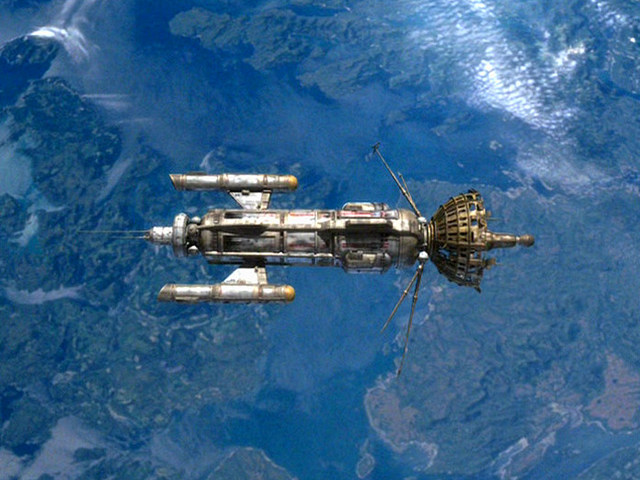
Stardate 54775.4: Starfleet orders Janeway to find and retrieve Friendship One, a probe launched from Earth in 2067 that is believed to have reached Voyager's region of space by now. The crew traces the probe to a hostile planet that appears uninhabited. Chakotay, Kim, Tom, Neelix and Lt. Carey travel down in the Delta Flyer, since transporters only work with pattern enhancers. On the surface, they discover remnants of a former civilization, including missile silos containing antimatter warheads. While Tom, Neelix, and Carey continue to explore, they trace the probe's remains to a cave that offers some protection from the radiation. There, they are ambushed and taken prisoner by survivors of a past catastrophe, all suffering from severe radiation damage. When the inhabitants learn that the away team has come from Earth to retrieve the probe, their leader Verin accuses them of genocide, as the disaster was caused by their use of antimatter technology from Friendship One. He demands that his people be evacuated to another world and threatens to execute the captives if his demands are not met. At the same time, Chakotay and Kim are attacked aboard the Delta Flyer, but they manage to subdue their assailant and take him to Voyager. He is identified as Otrin, a scientist who was looking for technology against radiation damage. Janeway realizes that she cannot relocate all 5500 survivors, as the nearest suitable planet is too distant. Instead, she offers to send medical supplies in exchange for the release of one hostage. However, when Lt. Carey activates the transport enhancers and prepares to beam out, Verin kills him. On Voyager, Seven uses her nanoprobes to repair Otrin's cellular damage. Meanwhile, Tom assists with the birth of a child on the planet, who would not survive without advanced medical care. After another away team has attempted an assault on the cave, one of Verin's followers appears with Tuvok as an additional captive, but he is revealed to be the Doctor in disguise. Together, they overpower the captors, allowing the prisoners and the newborn to be transported to Voyager. Otrin, now largely cured, returns to the planet with the child and announces that Voyager intends to help restore the atmosphere and neutralize the radiation. Verin, however, refuses to accept this outcome and prepares the missiles for launch as the ship moves closer to carry out the plan. His own people turn against him, holding him at gunpoint and preparing to stop him by force, while a young girl points out that the sky is beginning to clear, offering hope for a better future.
Review
An old Earth probe approaches an alien planet, accompanied by Vivaldi's Four Seasons. "Friendship One" has a promising opening. One might expect a first contact scenario, to witness how it affects the inhabitants of that world. And despite the increasingly contrived habit of bringing Alpha Quadrant artifacts into Voyager's path, this setup initially seems like one of the more worthwhile examples. But that expectation is not fulfilled. The fact that the probe originated on Earth, unlikely as it is that it remained functional for 180 years before contact was lost, plays only a minor role in what follows. Verin, driven by his obsession, would have taken any alien visitors hostage to force them to help his people. He might have blamed anyone for their suffering, regardless of any actual connection to the probe. Conversely, Janeway and her crew show no sense of responsibility for a failed UESPA policy from a time long before proper first contact protocols were established. It is easy for them to excuse 21st century humanity for its naivety under these circumstances. Also, they may argue that technology itself is not inherently harmful, only its careless use is. These aspects should have been explored in more depth, but they are largely skipped in the story.
Instead of examining questions of responsibility, the episode turns into a straightforward hostage story, which becomes less engaging as it progresses. At some point, the narrative seems to look for emotional weight and settles on a sacrifice, so Carey is killed. There was no doubt so far that the capable engineer must already have died at some point after the first season. He so far was "resurrected" in later seasons exclusively for the scenes taking place in the past in the two time travel episodes "Relativity" and "Fury". Now it seems he has been killed twice. It is quite obvious that the writers needed a recognizable but expendable character to die, essentially in order to avoid an examination of whether Friendship One was truly to blame for the planet's devastation.
I never liked this episode, and it has probably been about 20 years since I last watched it. Revisiting it now, with only a vague memory of the plot, offers a somewhat fresh perspective. There are a few details that I either overlooked or forgot, such as Tom continuing to take care of the woman and her child despite everything, after he had told his own wife to remain on Voyager because of the radiation, or the interaction between the scientist Otrin and Seven of Nine. These elements add a bit more substance than I recalled, but they do not significantly change my overall impression.
Annotations
- Remarkable probe: Friendship One fits well into the design lineage, although it seems very implausible that, only four years after Cochrane's flight, a long-range probe is built that would work for at least 180 years, no matter if it actually carried antimatter or not. The Starfleet arrowhead on the ship is anachronistic, but we may make up explanations why the symbol vanished, only to reappear in 2271.
- Remarkable quote: "We, the people of Earth, greet you in the spirit of peace and humility. As we venture out of our solar system, we hope to earn the trust and friendship of other worlds." (recorded message of Friendship One)
- Remarkably cheesy quote: "An inoculation a day keeps the radiation away." (Doctor)
- Crew losses: 1
- Photon torpedoes used: 4 (at least)
Rating: 3
Natural Law
Synopsis
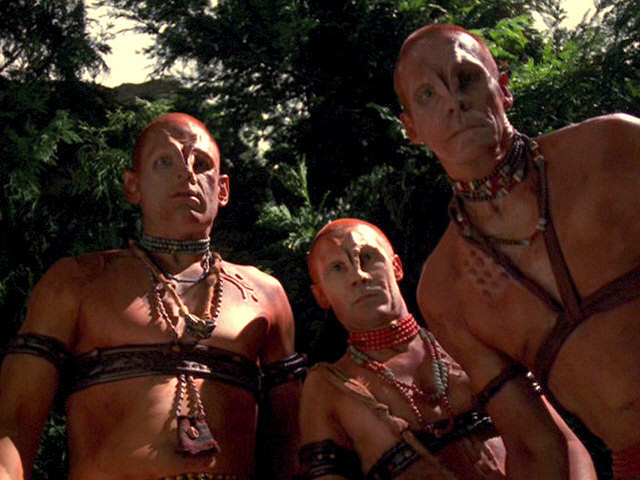
Stardate 54827.7: Chakotay accompanies Seven to a conference on the Ledosian homeworld. During the approach, he notices a region of untouched land on the otherwise highly developed planet and lowers the shuttle's flight path, but they suddenly collide with an energy barrier. With the engines disabled and the transporter blocked, Seven quickly modifies the phasers to cut an opening and create a transport window. The shuttle is destroyed and crashes inside the barrier, but the two manage to beam down safely. Chakotay injures his leg and develops an infection. He advises Seven to avoid contact with the primitive local population. But when they find him, turn our friendly and treat his leg, he gladly accepts the help. Seven sets out to locate the deflector array. She chooses to go alone to limit further contact, but a young Ventu girl follows her and guides her along the way. With the help of the natives, she manages to move the deflector into a position where it can be used to send a signal to Voyager. Meanwhile on Voyager, a Ledosian flight instructor arrives because Tom has violated local flight safety regulations, a penalty he reluctantly accepts. When Chakotay fails to report in as planned, the crew begins searching for the shuttle and detects the energy barrier. A Ledosian official explains that it was erected by an alien species to protect the indigenous Ventu from outside interference. He allows Janeway to attempt a method of transporting through the barrier, something the Ledosians themselves cannot achieve. Seven's signal reaches Voyager, and she instructs the crew to beam up Chakotay while she remains behind to care for the Ventu girl, who has been injured. By the time she prepares to leave, Ledosian scientists have already entered the region to study the Ventu and explore the area. Janeway decides to restore the barrier, even as a Ledosian vessel opens fire on Voyager. She orders Tom, who is currently taking his flight lesson in the Delta Flyer, to beam the scientists and the remaining wreckage back aboard. Once back on Voyager, Seven is conflicted. She believes the Ventu could have benefited from progress, but she also understands that such interference may destroy their way of life.
Review
This episode does not have a promising start, as Chakotay returns to his two favorite activities, anthropology and crashing shuttles. We have seen especially the latter far too often. But Chakotay is not the focus anyway, largely because of his injured leg. It is Seven who carries the story and gains new experiences after initial reluctance. In the end, she begins to see the alien girl who helped her as more than merely useful, but as a friend, even though she feels uneasy about keeping the blanket she receives as a gift. This part of the story works quite well and arguably better than "Human Error" did only recently.
The survival plot on its own, along with Seven's realization that seemingly "primitive" cultures can have their own strengths and may not be waiting for technological progress, would have been too thin for a full episode. Therefore, the narrative adds another layer by revealing that the Ventu are protected by aliens who wanted to shield them particularly from the Ledosians. This raises an interesting variation of the Prime Directive. Who is entitled to protection? The Ledosians, since it is their planet and their laws that Janeway is expected to respect? Or the Ventu, who share the world but are kept isolated - not by natural development but by outside interference from yet another species? The episode does not take the time to explore this dilemma in depth. But I would not fault Janeway for relying on instinct. Given the urgency, her decision makes sense. In a comparable case, she punished Tom Paris with 30 days in the brig when he interfered with the Moneans against their wishes in "Thirty Days".
The B-plot has Tom undergoing flight lessons after violating Ledosian traffic regulations. It is only mildly engaging and at times almost as uncomfortable to watch as it is for Tom to deal with the austere instructor. It even feels like someone on the writing staff is working through a bad experience from driving school. It becomes more enjoyable once this thread connects to the main plot, especially when Tom spectacularly fails the test.
Overall, "Natural Law" starts off as a routine episode. But it benefits from solid development for Seven and a new perspective on non-interference, both of which are explored in a way that gives the story depth without coming across as forced.
Annotations
- Nitpicking: Chakotay tries to go to warp in the lower atmosphere when the impulse engines fail, which seems like a bad idea. At least, it fails as expected.
- Remarkable quote: "When Commander Chakotay and I first encountered the Ventu I found them primitive, of little interest to me. But as I spent more time with them, I came to realize that they're a resourceful, self-reliant people. Their isolation may limit their potential - but if that isolation ends, so will a unique way of life." (Seven)
- Remarkable fact: The energy barrier may have been erected by Species 312, as Seven recognizes its configuration.
Rating: 6
Homestead
Synopsis
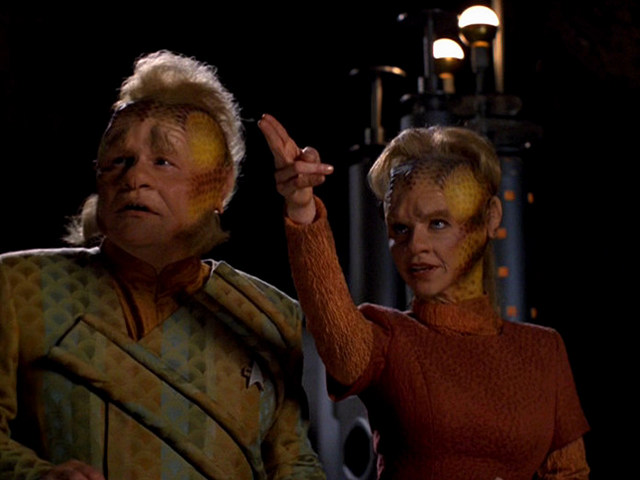
Stardate 54868.6: Neelix is excited when Voyager's sensors detect Talaxian life signs in an asteroid field far from their home region. He joins Tuvok and Tom on the Delta Flyer to investigate, but the shuttle is hit by explosive charges and forced to make an emergency landing on the asteroid. When Neelix regains consciousness, he is greeted by a Talaxian woman named Dexa and her son Brax. But the welcome is overall cold. The Talaxians have made bad experiences with outsiders and want the aliens on the Delta Flyer to leave as soon as possible. Meanwhile, Janeway is contacted by a man named Nocona, who claims ownership of the asteroid field and explains that the explosions are part of his mining operations, not a deliberate attack. Once the Delta Flyer is repaired and ready to depart, it is discovered that Brax has secretly boarded the ship. Neelix returns him to his mother, only to witness how Nocona demands them to leave and threatens to destroy their asteroid even if they stay. When Brax throws a stone in defiance, Neelix steps in to protect him from Nocona's men. Janeway decides to intervene diplomatically and invites Dexa and Brax aboard Voyager while she negotiates with Nocona. The only result is a temporary extension of his deadline. Tuvok then "hypothetically" suggests to Neelix that the asteroid could be defended with a shield grid and that the Talaxians would need leadership. Encouraged by this, Neelix takes his ship and helps them establish defensive systems with Janeway's tacit approval. As the final emitters are being installed, Nocona launches an attack. Neelix's vessel soon runs out of weapons, but the Delta Flyer arrives to assist, allowing the Talaxians to repel the assault. The colony is safe now. Neelix prepares to leave, but once back on Voyager he realizes that he belongs with the Talaxians. He decides to remain on the asteroid, much to the delight of Dexa and Brax.
Review
The episode opens with what will turn out to be Neelix's farewell party. He presents it as a First Contact Day celebration, but not one that follows any real tradition, rather one shaped by his own ideas of what it should be (although I personally like the idea of celebrating it with rock music). The episode offers many cues, both subtle and obvious, about where Neelix belongs and what he should do, and this is perhaps the first of them. He's never been to Earth and doesn't truly know what it's like. While he clearly feels like part of Voyager's crew, despite never wearing a uniform, even that sense of belonging is now being questioned.
So where is Neelix's home? Let me recapitulate. After the war with the Haakonians, in which he lost his family as described in VOY: "Jetrel", he no longer seemed inclined to remain with his own people. He formed a relationship with Kes, another outsider, but beyond that shared background they had little in common, and it was not surprising when they eventually separated before VOY: "Darkling". On Voyager, Neelix found a new kind of family. He became Naomi Wildman's godfather and, in many ways, a more present figure in the girl's life than her own mother. Still, he may have remained something like an adopted child who was searching for a true home. He embraced the crew's common goal of returning to Earth, and unlike Seven or Naomi, he looked forward to it, as seen in "Bliss". Returning to his own people was likely never something he expected. Meeting those Talaxians on the asteroid, especially Dexa and her son, is a fortunate and unlikely coincidence. It is also clear that he would not have stayed if not for his growing feelings for Dexa, even though their relationship is not yet romantic and he mainly takes on the role of a protector. The other Talaxians are not particularly welcoming at first and have chosen a very different way of life. Like them, Neelix once left his occupied homeworld behind, but unlike them, he enjoys the freedom of traveling through space, on his own ship and even more so as Voyager's informal ambassador.
It remains open to debate whether Neelix truly finds a better home on the asteroid. What the story does provide is a sense of closure that he would not have gained by simply returning to Earth with the rest of the crew. He has never been among the central three or four characters, so "Homestead" offers a fitting chance to focus on him one last time. In that sense, it works as a worthy final episode for Neelix, and when the crew assembles to say farewell to him along the corridor, it almost brings a tear to my eye every time I watch it.
The premise of a Talaxian colony located so extremely far from their homeworld is certainly hard to accept, but if stories are going to stretch plausibility, this is at least one that serves a meaningful purpose. The action elements are not particularly important here, even if they are visually impressive. The conflict, and the convenient timing of Nocona's plan to destroy the asteroid the very day Voyager arrives, mainly exists to reinforce Neelix's decision to stay and defend his new community. The episode might have benefited from placing even more emphasis on his internal conflict, rather than relying on external events to push him in that direction.
Annotations
- Remarkable dialogue: "Which station is yours?" - "Well, actually, I don't have a specific, er, I'm more of a..." - "Neelix does too many things to have just one station. He's our ambassador, morale officer..." - "Trade negotiator. Without a doubt, he's the most versatile member of our crew." (Brax, Neelix, Kim, Chakotay)
- Remarkable quote: "Thanks, Neelix. But I can put myself to bed. I'm not a little girl any more." (Naomi, giving Neelix the final cue that he is free to go)
- Remarkable ship: We can see a second version of a Talaxian fighter in this episode, not the same design as in "Basics II" but similar.
Rating: 7
Renaissance Man
Synopsis
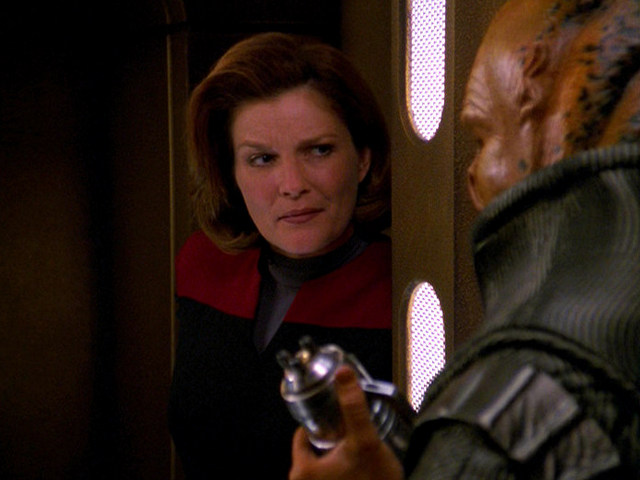
Stardate 54890.7: The Doctor and Janeway are aboard the Delta Flyer, returning from a medical symposium, when they discover a subspace eddy of the kind created by starships. After Janeway's return to Voyager, she privately informs Chakotay about the R'Kaal, an alien species demanding Voyager's warp core. She says that they threaten to destroy the ship with their fleet if she refuses, so she had to agree after lengthy negotiations. She orders Chakotay not to tell anyone else. Janeway also speaks with B'Elanna and instructs her to prepare the warp core for ejection in a way that would allow the Delta Flyer to tow it at warp speed. Chakotay grows suspicious of her behavior. When he visits Janeway's quarters to confront her, she incapacitates him with a hypospray. The truth is that "Janeway" is actually the Doctor in disguise. Two rogue members of the Hierarchy have kidnapped the real captain and are forcing him to deliver Voyager's warp core in exchange for her life. They are monitoring his every move. The Doctor also takes over Chakotay's role aboard the ship. When Harry Kim finds an unknown holographic projection on Voyager, the Doctor disables him as well. Meanwhile, Tuvok examines the Delta Flyer logs and discovers that the Doctor downloaded Janeway's physical parameters. He destroys the holoemitters in sickbay in an attempt to capture him, but the Doctor escapes using his mobile emitter. Disguised as Chakotay, he evacuates engineering, ejects the warp core and takes the Delta Flyer to deliver it. When the Doctor reaches the Hierarchy ship, the crew betrays him. Instead of releasing Janeway, they take him prisoner as well, intending to use him in future infiltration missions. They attempt to alter his program, but the modification fails, leaving him close to decompiling. On Voyager, "The Blue Danube" begins playing throughout as systems come back online, though the harmonies are off. Seven of Nine realizes the music contains a hidden message from the Doctor: the warp signature of the Hierarchy ship. Tuvok and Tom Paris immediately depart in a shuttlecraft. Tom beams aboard the Delta Flyer and retrieves the warp core. The leader of the Hierarchy operation intends to detonate the warp core, an explosion that would kill everyone nearby. However, his subordinate turns against him and sides with Janeway and the Doctor, allowing them to regain control of the situation. Back on Voyager, B'Elanna and Seven successfully restore the Doctor's program, though not before he makes several embarrassing personal confessions.
Review
I only had a vague memory of what exactly happens in "Renaissance Man" when I sat down to watch the episode again for the first time in many years. I have to admit I find it a bit more entertaining today than I probably did 25 years ago, when it somehow bored me. Perhaps back then I had simply expected a more significant episode so close to the series finale. In any case, I generally enjoy complex stories. I appreciate the many twists, which are almost new to me now, considering that the only thing I still remembered was that everything strange in the first act happens because this is not the real Janeway but the Doctor in disguise. I like the mystery surrounding her increasingly out-of-character behavior and secrecy. Because of that, the first part is the stronger one.
The rest of "Renaissance Man" doesn't work quite as well as "Tinker, Tenor, Doctor, Spy", which obviously served as inspiration, not only because the Hierarchy returns but also because their strategy once again involves hacking into the Doctor's program to monitor him. The struggle for Voyager's ejected warp core is not new either, as something very similar already happened when the Caatati took it in "Day of Honor". Been there, done that. With the central ideas already familiar, the story seems to favor quantity over substance. It often feels as if the writing keeps pushing for curious or awkward situations, both before and after the revelation of "Janeway's" true identity. There could have been more to it, especially in the second part, than scenes like the uncomfortable encounter between "B'Elanna" and Tom, which is essentially the same joke that already worked much better in "Body and Soul", when the Doctor occupied Seven's body. The writing mainly focuses on the impersonations and the resulting embarrassment while neglecting the dramatic progression and emotional investment. And this raises the question whether "Renaissance Man" really is as complex as I initially claimed, or whether it is merely a chain of twists, some of them repetitive or unnecessary the more one thinks about them.
I would also compare "Renaissance Man" to the previous Doctor episode, "Author, Author", only a few weeks earlier. That episode had both the more consequential humor and the more interesting story, and it remains more memorable, partly because the Doctor behaves like such an unbearable narcissist and because of its odd tonal shifts. For better or worse, "Renaissance Man" feels more like a routine Doctor episode. At times it barely even feels as if there are serious stakes for Janeway, Voyager or the Doctor himself. It remains a decent and entertaining entry, but one that plays things rather safe and seems reluctant to take real risks.
Annotations
- Remarkable dialogue: "I expected you to follow my orders." - "You might as well have been ordering me to put a phaser to your head. Voyager can survive without a warp core, but not without a captain." - "Now it doesn't have either." (Janeway and the Doctor)
- Remarkable quote: "I know you could never have the same feelings for me but I want you to know the truth. I love you, Seven!" (Doctor)
- Remarkable ship: We can see a second type of Hierarchy ship, perhaps bigger than the one from "Tinker, Tenor, Doctor, Spy".
- Remarkable fact: For some reason, Lieutenant Ayala is in the command division now.
- Remarkable appearance: Alexander Enberg as Vorik is back, but appears only briefly.
Rating: 4
Endgame
Synopsis
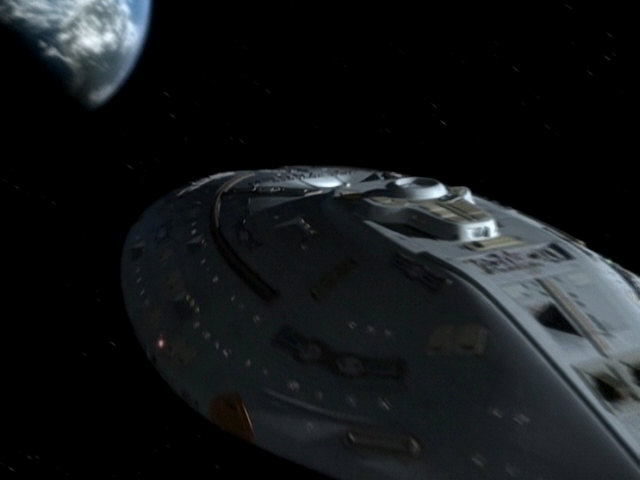
Stardate not given: In the year 2404, 26 years into the future, the tenth anniversary of Voyager's return to the Alpha Quadrant is being celebrated. But Admiral Janeway is not happy about it. She mourns the crew members she lost, including Seven of Nine and Chakotay, and she wishes she could have helped Tuvok, who suffers from a neurological disease that may have been cured if Voyager had returned sooner. Secretly, she plans to change history, supported only by Barclay and by Miral Paris, who puts her in contact with a Klingon scientist named Korath. Miral does not know what Janeway intends to do with his technology, a chronodeflector. In 2378 aboard Voyager, B'Elanna Torres is about to give birth to her child. The crew discovers a nebula apparently filled with wormholes, offering an excellent chance to finally get home. However, the region is swarming with Borg ships. In the future, Janeway meets Korath, who raises the price and additionally demands the admiral's advanced shielding technology. She takes the device without paying, beams back to her shuttle and activates the armor while a Klingon vessel is pursuing her. When she reaches the coordinates for the temporal jump, the USS Rhode Island under Harry Kim's command arrives to stop her. But Janeway convinces Harry that altering history is worth the risk. While Harry holds off the Klingons, Janeway activates the chronodeflector and travels back to the Delta Quadrant of 2378. She tells her younger self that she has come to bring Voyager home. — Admiral Janeway convinces Captain Janeway to install future armor and weapons so Voyager can force its way through the Borg ships guarding the nebula. The ship enters the region and is attacked immediately, but the new defenses absorb most of the damage while transphasic torpedoes easily destroy the Borg vessels. Deep inside the nebula, Voyager reaches a massive Borg facility that Seven identifies as a transwarp hub, capable of bringing the ship back to Earth almost instantly. Captain Janeway hesitates, however. She sees a chance to deal a devastating blow to the Collective by obliterating the network. The admiral deliberately kept this information from her because she knows how stubborn and determined her younger self can be. Despite the admiral's insistence on returning home immediately, the crew supports the captain's plan. The admiral finally proposes a way to accomplish both objectives, to destroy the Borg hub and get Voyager home. She takes her shuttle into the nebula, enters a transwarp corridor and approaches the Borg Unicomplex. Using her neural interface, Admiral Janeway appears before the Borg Queen and offers a deal: safe passage for Voyager in exchange for information about the ship's future technology. The Borg soon locate her shuttle and beam her aboard, where the Queen assimilates her. But this too is part of the plan. A pathogen begins to spread through the Collective, crippling the Queen and disrupting the Borg command structure. Massive explosions tear apart the Unicomplex. Voyager enters the transwarp hub and launches torpedoes to destroy it while escaping ahead of the shockwave. Before dying, the Queen still manages to send a Borg sphere after Voyager. But when the sphere reaches the Alpha Quadrant, a fleet of Starfleet ships is already waiting and destroys it. As B'Elanna gives birth to her daughter Miral, Voyager emerges from the transwarp network in the Alpha Quadrant.
Review
Concluding a series that ran for seven years with a finale that provides closure, delivers spectacle and satisfies most viewers is anything but easy. It was clear from the beginning that Voyager would somehow have to return home. Anything else would have been a letdown, so the basic direction of the finale was largely predetermined, much like in DS9 where the Dominion War had to end eventually, and unlike in TOS or TNG. Most fans probably expected one of the anomalies-of-the-week or drives-of-the-week to finally succeed. Instead, the story takes a different route and uses time travel as the decisive factor. I remember many fans disliked the concept back then because retroactively altering history often appears as a lazy way to avoid consequences in the present timeline. I see it differently, especially because a finale is a perfect opportunity for what-if scenarios, much like in the almost universally praised TNG double feature "All Good Things". I think "Endgame" develops its own variation on that idea without merely copying the TNG finale and without ignoring the importance of present-day choices.
Speaking of the TNG finale, "Endgame" also comes with its own quickly established last-minute romance. I was never a fan of the Chakotay-Seven relationship, but today I can at least see two positive aspects. First, "Human Error" makes more sense in retrospect. The Doctor suggested to remove Seven's Borg fail-safe, which she stubbornly refused because she preferred to suppress emotional attachment in the future. Now she finally has a reason to undergo the procedure because she has fallen in love with the real Chakotay rather than a holographic fantasy. This final step in Seven's development still comes rather suddenly and with little foreshadowing, but I find it more satisfying today than I did 25 years ago. Also, Jeri Ryan delivers a great performance through all mood changes, first when Seven acts like someone discovering love for the first time, later when she fears Chakotay would suffer because of her death, and finally when she regains confidence after Chakotay reminds her that life is about the here and now. That last point also reflects what I think about the whole finale despite the criticism of its premise in the fandom. Strictly speaking, Seven's fears are irrational because her future has already changed anyway, but I think she understands the issue in a broader sense. Overall, the relationship still isn't entirely convincing, but it works better for me today.
Another aspect that initially seems questionable is Captain Janeway's reaction inside the nebula, in front of the Borg structure, when Voyager is finally within reach of the Alpha Quadrant. She not only hesitates but becomes genuinely angry. At first it looks as if she is merely furious that her future self withheld important information, so much that she even sacrifices the tactical advantage against the Borg, who now gain more time to adapt to the future technology. Apparently Admiral Janeway understands her younger self better than I did, because both the admiral's secrecy and the captain's reaction make perfect sense in retrospect. I should have anticipated that simply getting Voyager home would never be enough for her. There is a Borg transwarp hub in that nebula, not just a wormhole, and therefore an opportunity to strike a major blow against the Collective. Her behavior is fully in line with reckless plans such as the one in "Unimatrix Zero". I still find it satisfying after all these years that this character trait is followed through consistently and that it also supports the idea that present-day decisions matter more than predestined outcomes via time travel. Admiral Janeway prefers the pragmatic shortcut, whereas Captain Janeway chooses the harder but more impactful option. The only paradox is that the captain is initially reluctant to change history at all, only to embrace an even more radical alteration later on. But that is exactly how Janeway operates. You give her a finger and she takes the whole hand. And without the qualms that Picard had in TNG: "I, Borg".
The episode then tries to mislead us a second time when Admiral Janeway recklessly parks her shuttle near the Unicomplex, only for the Borg to detect and assimilate her. The revelation that she carries a pathogen designed to cripple the Collective is not much of a surprise, however. Perhaps the story would have benefited if the two Janeways had discussed the admiral's sacrifice beforehand. As presented, with almost no farewell at all, it has less emotional impact. At least she still gets a few appropriately snarky final words against the Borg Queen.
It was obvious that the Borg would appear in the finale and that they would suffer a major defeat. Since season 3 they are effectively Voyager's primary antagonists. They threaten not only Janeway's ship but the Federation as a whole. Also, their presence throughout the Delta Quadrant is easy to justify. Like many fans, I think the Borg gradually lost much of their menace during the run of the series, sometimes to the point where they felt more like a recurring nuisance than an unstoppable enemy force. But I wouldn't blame this finale in particular for a trend that had existed for a few years already. I'm two minds about the Borg Queen's personal fixation on Seven and her rivalry with Janeway. On one hand, the Borg are supposed to be a cybernetic collective pursuing perfection and should not care about personal matters at all. On the other hand, once the Queen exists as an individual character played by an actress, it would be a waste not to give her emotions and personal motives. People who criticize Voyager for weakening the Borg often overlook that "Star Trek: First Contact" had already introduced the Queen with a very human agenda a few years earlier.
"Endgame" also offers quite a lot beyond the central plot and the Seven-Chakotay romance. We learn many details about the possible future, some of which could probably still happen even in the altered timeline. Admittedly, much of this isn't delivered organically but through an info dump during the anniversary celebration. We also have the scene with Janeway speaking to Barclay's cadets. Not only do the cadets pose questions without being asked and without the previous one being answered, the whole scene also feels off because it merely serves to establish how Janeway feels about losing Seven. It is something that the writing unnecessarily shrouds in mystery, without a real pay-off. Similarly, the hints provided by the delirious future Tuvok remain vague and ultimately lead nowhere. Even so, Tim Russ gives an outstanding performance in his scenes. On a more positive note, the finale also includes one last appearance by Neelix, who plays kadis-kot with Seven over a video connection.
All in all, "Endgame" may not be Voyager's greatest episode, but it gives the series and its characters meaningful closure through an engaging and emotional story. It's heavy on Treknology, yet it largely avoids relying on deus-ex-machina solutions and instead focuses mainly on the characters' choices, especially Admiral Janeway's sacrifice. The finale also stands out because of its many guest stars, the strong involvement of the full cast, the large number of sets, the impressive visual effects and the wealth of continuity references and small details.
Annotations
- Nitpicking:
- It may have been briefly mentioned, but it is not plausible how Admiral Janeway can cross not only time but also space using Korath's chronodeflector.
- Future technology or not, it is a bit of a stretch how Janeway can use the synaptic transceiver to contact the Borg Queen, although the device was explicitly stated to connect her brain to her shuttle's systems.
- Remarkable dialogues:
- "Paris to..." [he puts his commbadge on] "Paris to sickbay. It's time." - "Remain calm, Mr. Paris. Can she stand?" - "Affirmative." - "Then I suggest you report to sickbay." - [he walks to the door] "What about B'Elanna?" - "Her too." (Paris and the Doctor)
- "Crewman Chell's asked about taking over in the mess hall full time." - "Neelix left some pretty big pots and pans to fill. Does Mister Chell feel he's up to the challenge?" - "Apparently so. He's prepared a sample menu." - "Plasma leak soup? Chicken warp core-don bleu?" - "If his cooking's as bad as his puns, we're in trouble." (Chakotay and Janeway)
- "Who knows, Harry? It [the wormhole] might take us right into your parents' living room." - "Alter course, Mister Paris. Ensign, when you speak to your mother, tell her we may need her to move the sofa." (Paris and Janeway, to Kim)
- Remarkable final quote: "Set a course - for home." (Janeway)
- Remarkable ship: Harry commands a modified Nova-class ship, which differs from the USS Equinox in its closed bow, a different bridge section and other details.
- Remarkable facts from the possible future:
- Seven will die on an away mission in 2381.
- 22 more crew members will die along the way.
- Chakotay will die in 2394, with a broken heart.
- Tuvok will never recover from his degenerative neurological condition that could have been healed, had he mind-melded with a relative in time.
- Harry will be a captain, in command of the Nova-class USS Rhode Island.
- Tom will look really old.
- B'Elanna will be a liaison to the Klingons.
- Miral be a Starfleet ensign and will work for Admiral Janeway on an undercover mission to get in touch with Korath.
- The Doctor will call himself "Joe" and will marry a woman named Lana.
- Naomi will have a daughter named Sabrina.
- Reg will teach at the Academy.
- Janeway will give up coffee and switch to tea. Her favorite coffee mug will be damaged in a battle with the Fen Domar.
- Voyager will be a museum, located on the grounds of the Presidio. Actually, this is exactly where we will see the ship in LOW: "Twovix".
- Remarkable 47: There are at least 47 Borg vessels inside the nebula, according to Seven.
- Remarkable appearance: Alice Krige reprises her role as the Borg Queen from "Star Trek: First Contact".
Rating: 8