


Treknology Encyclopedia - P
PADD Acronym for Personal Access Display Device, hand-held computer or access terminal to a larger computer system. PADDS are outfitted with a display and touch sensitive areas and have limited built-in memory and computing capability. Apart from Starfleet, PADDs are used by most other advanced civilizations in the 24th century (generic).
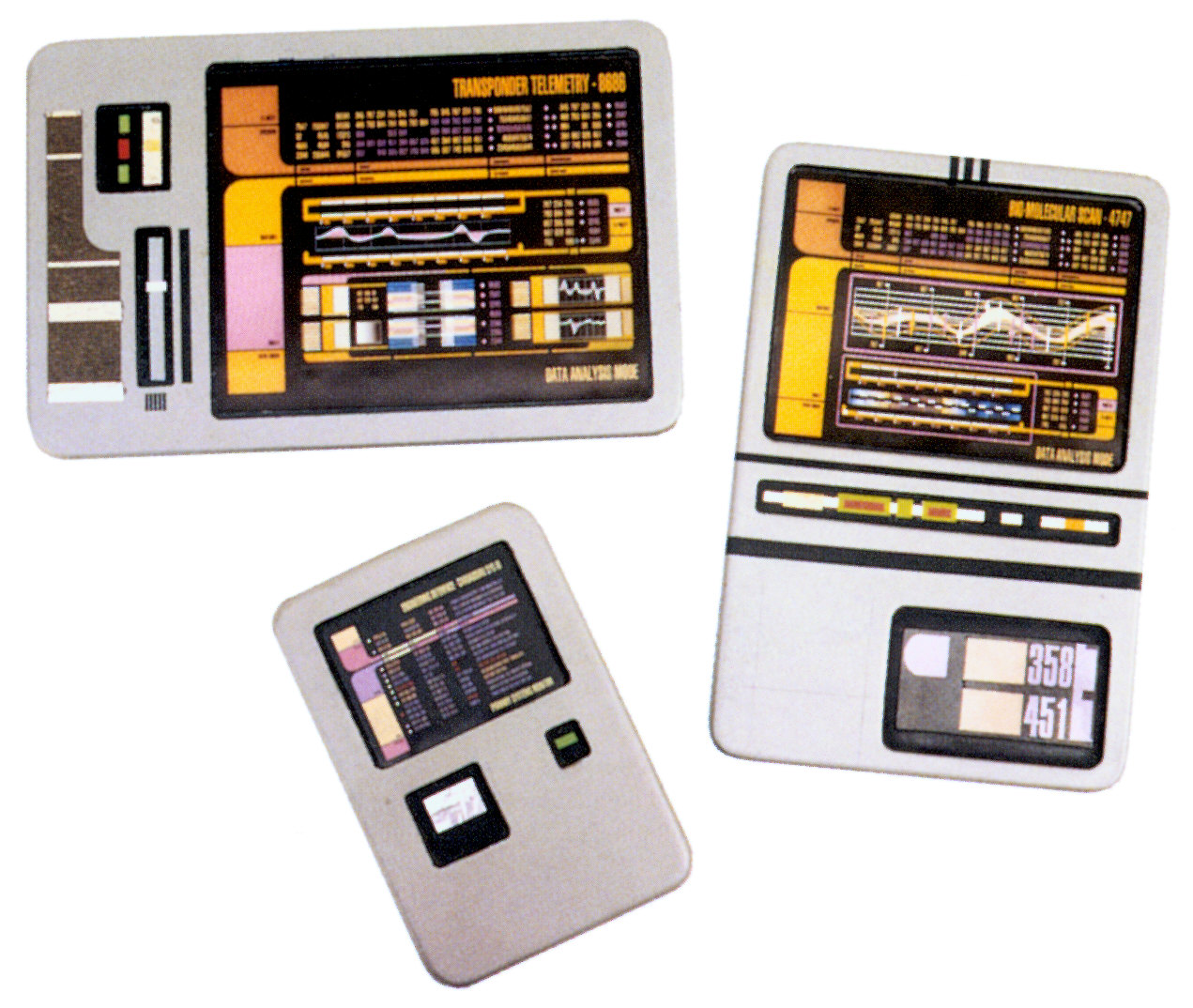
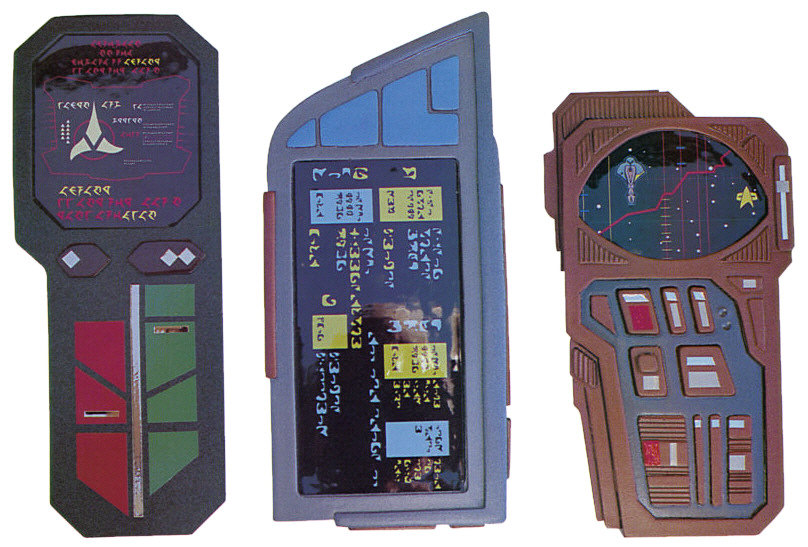
The TNGTM states that they can establish uplinks and downlinks to computer systems and may also serve as transporter locks-ons. Since it is a non-expensive prop, different PADD designs exist for virtually every civilization in Star Trek. Still, the user interface is similar for all of them, indicating that a common standard may have been found for ergonomic design. This might help rationalize why no one has ever difficulties in using alien PADDs, let alone reading their letters.
Painstik Klingon ritual weapon. Painstiks are used in the Age of Ascension ceremony, the initiation of a young warrior. They also serve to confirm the death of a Klingon chancellor in the Sonchi procedure. Finally, the usage of painstiks is also a part of the Day of Honor (TNG: "The Icarus Factor", "Reunion", VOY: "Day of Honor").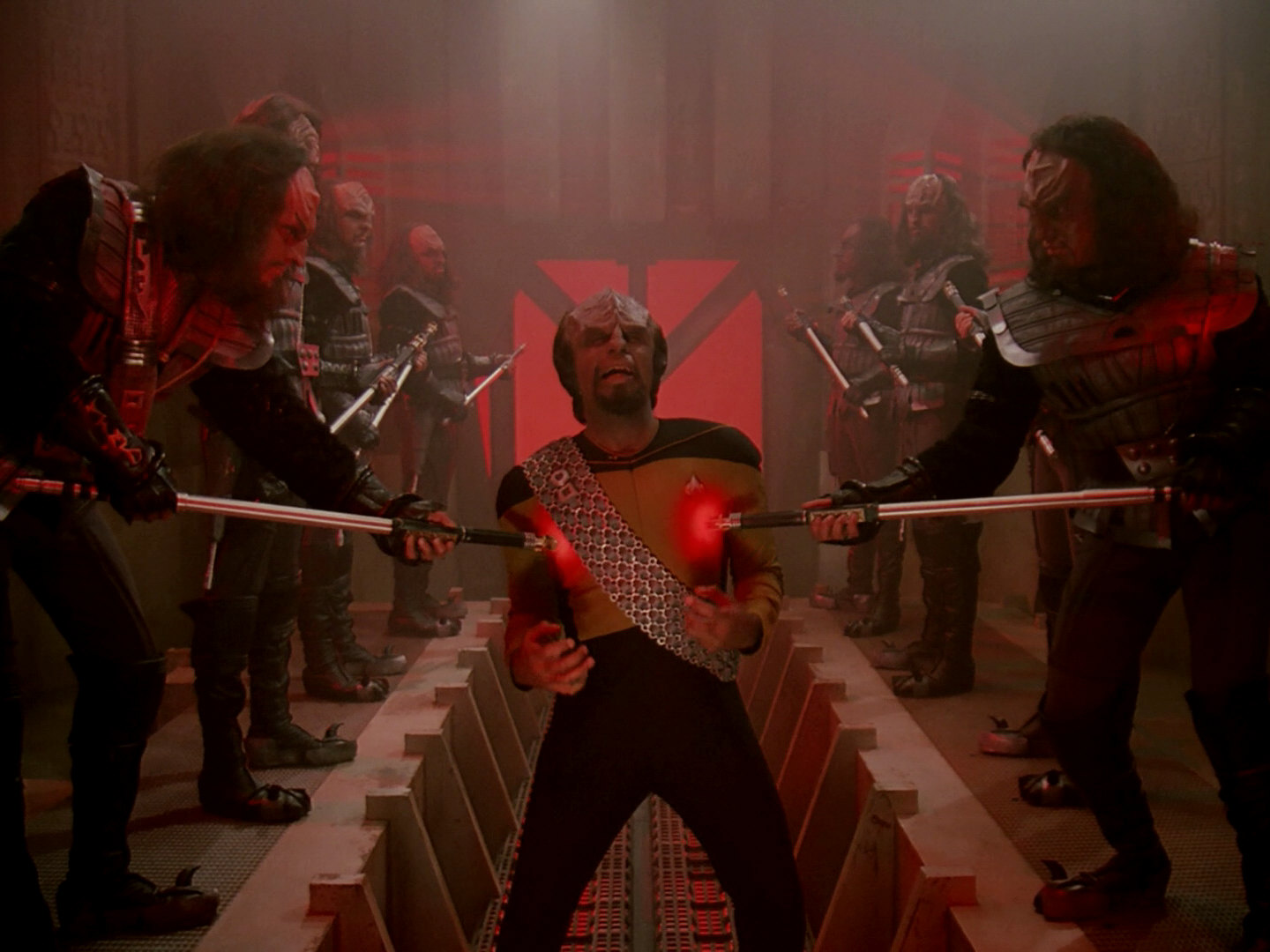
According to the scripts of the TNG episodes, "painstik" is the correct spelling.
Parallel universe Any universe existing outside our normal four-dimensional space-time (generic).
The Mirror Universe featured in TOS: "Mirror, Mirror", several DS9 episodes and ultimately in ENT: "In a Mirror, Darkly" is and has probably always been akin to ours, but not quite the same. Normally, the second law of thermodynamics would not allow the two universes to develop in a similar way once there are differences established, for instance the totalitarian Earth Empire contrary to the democratic UFP. Nevertheless, there seems to be a possibly bi-directional connection between the two universes that keeps the development in sync so as to provide the same characters on both sides for dramaturgic reasons. The manifold parallel universes in TNG: "Parallels", however, have a (hypothetic) scientific background. Elementary particles do not fit into a deterministic view of the world, since their behavior is unpredictable. It is not determined in the Quantum Theory whether a particle crosses an energy barrier or not, making it an apparent random process. In order to maintain determinism, there is a theory assuming that the particle actually goes both ways, and each time a new universe is created. Worf travels from one of those quantum universes to another in the TNG episode. The number of potential quantum universes would be equal to the number of quantum transitions since the Big Bang or, in other words, quasi-infinite.
Paralysis field Weapon that blocks nerve impulses, hence paralyzing a person. Used by the Kelvans (TOS: "By Any Other Name").
Parametric scanner 22nd century engineering tool (ENT: "Singularity").
Parthenogenic implant Medical implant such as an artificial heart (TNG: "Samaritan Snare").
A possible in-joke: In real life, "parthenogenic" refers to asexual reproduction.
Particle fountain New mining technology that was being tested in 2369. The system involved a field generator orbiting the planet or asteroid to be mined (TNG: "The Quality of Life").
Particle synthesis Advanced alien matter replication technology, purportedly superior to Federation replicators. Particle synthesis is mastered by Arturis's people and by Species 8472 (VOY: "Hope and Fear", "In the Flesh").
Passive scan Sensing technique taking advantage just of incoming radiation, as opposed to an active scan ("Star Trek: The Motion Picture").
Passive scans are less powerful but also less intrusive. They may be advantageous if the captain wants his starship to remain undetected, or if an active scan could be mistaken as an attack.
 Pattern interrupter 32nd century technology to block both transporter and communication signals, erected around the prison complex of Radvek V and also used on Book's ship (DIS: "The Examples", "Coming Home").
Pathway drive New propulsion system in the 32nd century, as an alternative to the spore drive. A prototype of the pathway drive was going to be installed on USS Voyager. The USS Mitchell as well as a shuttle are equipped with the fully operational drive (DIS: "Kobayashi Maru", "Life, Itself").
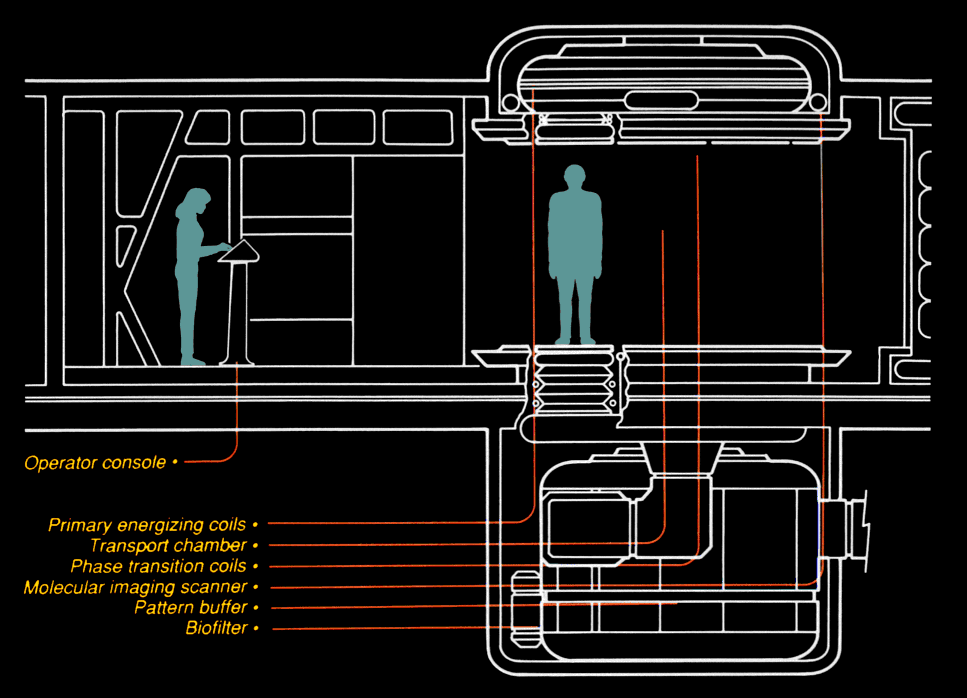
Scotty survived 75 years within the pattern buffer that was set to a continuous diagnostic cycle (TNG: "Relics"). Normally, the signal decay is too fast to allow storage for more than a few seconds. The TNGTM tells us that the buffer is usually located on the deck below the transporter platform. The pattern buffer is used for storage of the matter stream, thereby providing a delay necessary to compensate for relative movement (Doppler compensator), to filter out hazardous organic matter (biofilter) or to transfer the pattern to another pattern buffer in case of a transporter malfunction.
Pattern enhancer Device that improves transporter pattern recognition in case of electromagnetic disturbances. The pattern enhancer is a cylinder with a length of approx. 1m and was introduced in Starfleet around 2369. Usually three pattern enhancers are employed in a triangular formation around the object or person that is supposed to be beamed (TNG: "Power Play", "Ship in a Bottle", "Frame of Mind", "Inheritance", VOY: "State of Flux", "The Omega Directive", "Once Upon a Time", "Counterpoint", "Dark Frontier", "Friendship One").
Peak transitional threshold Initial power necessary to achieve an integer warp factor. The peak transitional threshold is much higher than the power to maintain the respective velocity (ENT: "First Flight").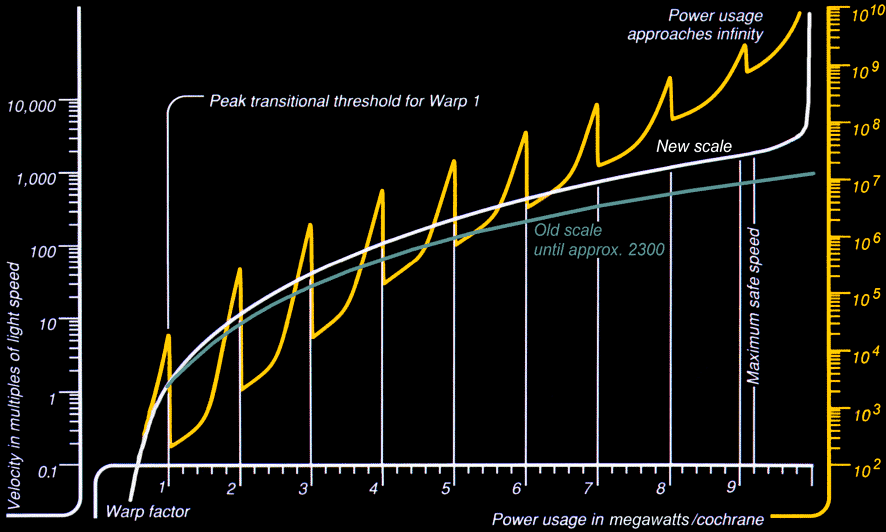
The introduction of the peak transitional threshold obviously serves to justify the strange warp scale, where the warp factor is not simply WF=v/c or WF=log(v/c), but WF=(v/c)^1/3. For this purpose, the power to maintain a subspace field is designed to exhibit significant peaks which are sequentially numbered and designated as warp factors. A simple explanation (which is also corroborated by the extensive theory on Jason Hinson's website) is that this behavior is attributed to the subsequent activation of additional warp field layers for higher velocities, which is accomplished by a suited warp field activation sequence. Eugene's limit can be included into this theory in a way that more than 9 layers are not efficient to facilitate high-warp propulsion, so the complete remaining speed range is compressed within the range between Warp 9 and Warp 10. Hence, the latter equals infinite speed. In fact, the official diagram of power expenditure shows that the power saving after the peak transitional threshold decreases from 100 at Warp 1 to 2.75 at Warp 9, suggesting that this factor would be still smaller at another (imaginary) threshold. It is possible that Eugene's limit has been found as late as in the 24th century, so previous warp tables assumed 10 or more layers to be useful. The original diagram in the STTNG Technical Manual confused power and energy ("power usage in megajoules/cochrane"). Assuming that, unlike Newtonian propulsion, warp propulsion needs continuous power supply, I have corrected this error. Read also Warp Propulsion - 3.2 Subspace Models.
Personal transporter Further development of the transporter, which is located inside the Starfleet badge in the 32nd century. The personal transporter is capable of beaming itself along with the wearer (DIS: "Scavengers").
Phase cannon Particle weapon, precursor of a phaser array, used on 22nd century Earth starships since 2151 (ENT).
The phase cannon is the larger equivalent to a phase pistol. Both fire continuous beams, as opposed to the light bolts of plasma or EM weapons.
Phase cloak See interphase generator.
Phase discriminator Device that can be used to detect, to shield against or to penetrate waves of a certain phase. Phase discriminators are parts of the positronic brains of Soong-type androids as well as of Starfleet emergency transporter armbands (TNG: "Time's Arrow", "Timescape", VOY: "Deadlock", ENT: "Shockwave").
Phase pistol Particle weapon, precursor of a phaser, used in the 22nd century (ENT).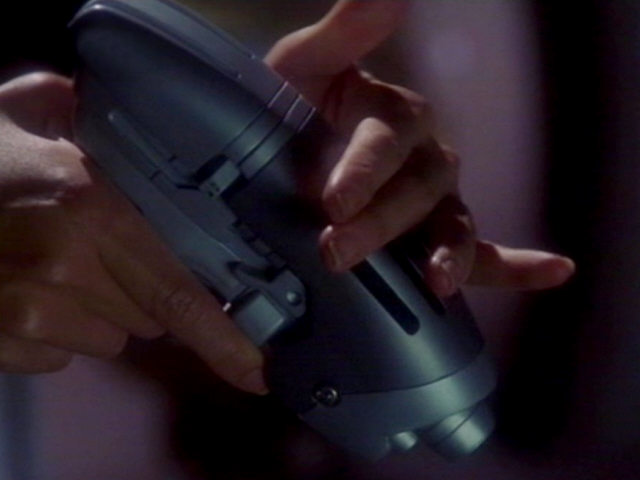
The capabilities of a phase pistol are indistinguishable from those of a phaser used more than a century later. There is also no plausible explanation why Starfleet should return to lasers, as shown in "The Cage".
Phase shift Generic term for a movement to a state outside the normal space-time continuum (TNG: "The Next Phase", "The Pegasus", "Time's Arrow", "Timescape", "Phantasms", VOY: "Distant Origin", "Year of Hell").
Phase shifts are frequently created in Star Trek using either an interphase cloaking device (TNG: "The Next Phase", "The Pegasus"), a phase discriminator (e.g. TNG: "Time's Arrow", "Timescape"), an unknown type of phase shifter (VOY: "Distant Origin") or a chroniton-based device (VOY: "Year of Hell"). Usually phase shift seems to be an essentially temporal displacement, while the interphase generator might be based on a spatial shift or parallel space.
Phase transition coil Part of a transporter system, also called phase coil. The coils accomplish the actual transition from a matter to a matter stream state (TNG: "Data's Day", "The Mind's Eye", VOY: "Eye of the Needle", ENT: "Singularity", "Babel One").
This sounds like it could be the same as the 23rd century ionizer (although then it would have been a good idea to call the coils ionizers in ENT too).
Phased ion cannon See ion cannon.
Phased matter Intermediate state between matter and energy (generic).
The term is used for the matter stream generated in the transporter as well as for excited matter produced in the warp and impulse reactors, where it seems to be the same as plasma.
Phaser Acronym for PHASed Energy Rectification, energy discharge weapon used by the Federation. Energy stored inside the phaser is released within a short time and directed towards the target, unlike the usually constant energy output of lasers. Shipboard phaser banks are attached to the outer hull of a starship in form of small apertures or domes in the 23rd century that are extended to segmented strips and finally rings in the 24th century. Phaser beams travel at light speed, and the maximum efficient operation range is approximately 300,000km. Hand-held phasers are available in different sizes, ranging from small pocket phasers (type 1) and pistols (type 2) to phaser rifles (generic).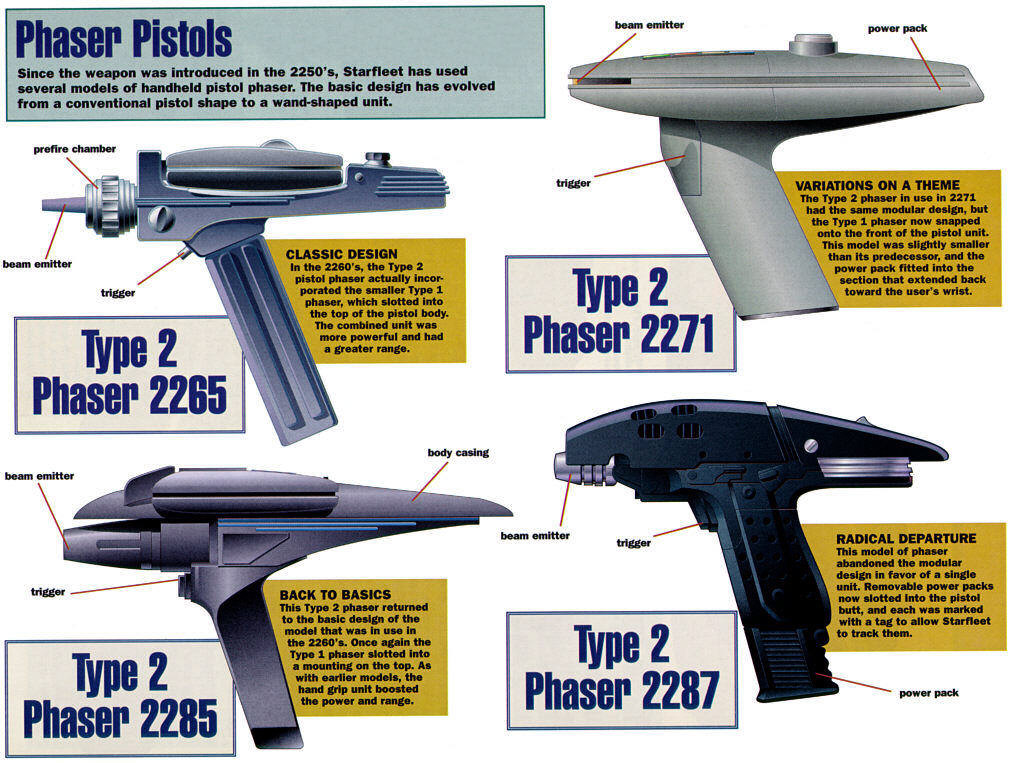
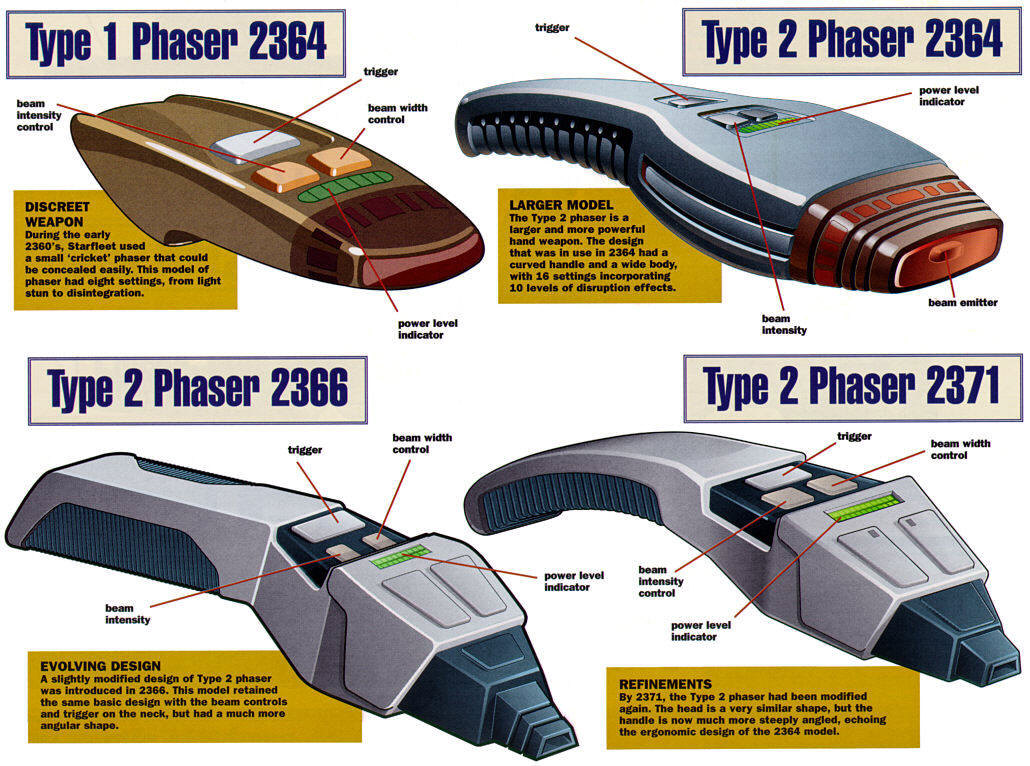
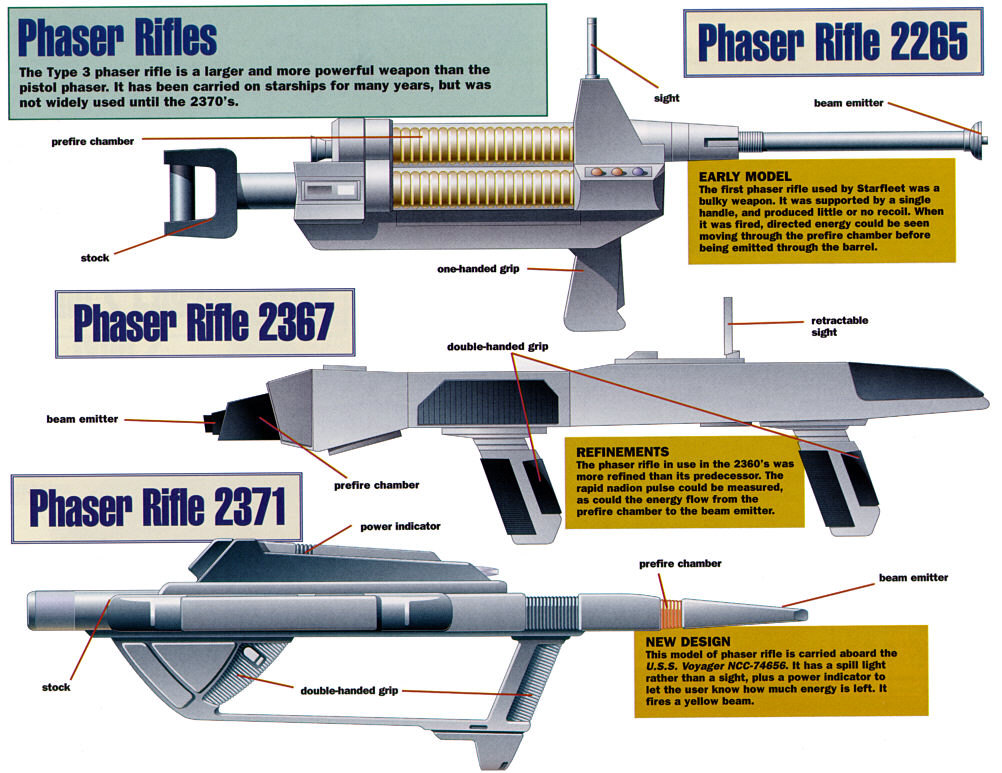

The phaser's function is based on the rapid nadion effect, where nadions are subatomic particles that allow to liberate strong nuclear forces (TNGTM). Since phasers have to be recharged, it is obvious that continuous firing is not possible, neither with a hand-held device nor with the shipboard phasers. This makes space battles similar to ancient sea battles where it was decisive to wait for the right instant to fire a broadside.
Phaser array power cell Disposable component of a starship's phaser array (DS9: "Behind the Lines").
Pheromonic sensor Device able to sense pheromones and to recognize a particular species. Used by Flaxian assassins (DS9: "Improbable Cause").
Photon grenade Short-range explosive weapon for planetary operation. At their lower settings photon grenades produce an electromagnetic pulse capable of stunning humanoids (TOS: "Arena", TNG: "Legacy", VOY: "Living Witness", "Gravity").
Photon torpedo Matter/antimatter annihilation weapon used by Starfleet and by the Klingon Defense Force. A Starfleet photon torpedo contains deuterium and magnetically constrained antideuterium tanks, target guidance and a warp sustainer engine. In contrast to phasers, photon torpedoes can be used at warp speed (generic).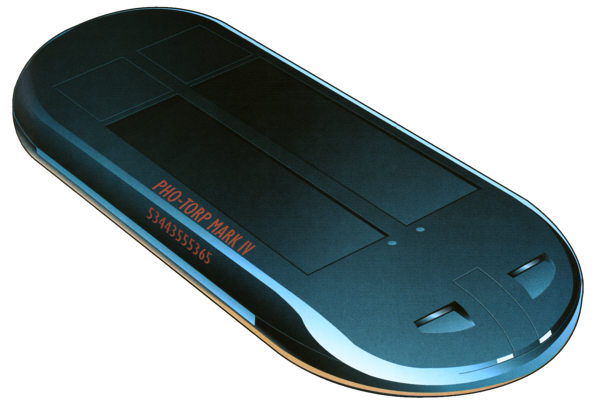
Since photons are involved as late as the device explodes, the term "photon" torpedo is very inaccurate and could apply to a nuclear weapon as well. Of course, realistically FTL photon torpedoes cannot be tracked with the eyes, although this was possible in many episodes and in "Star Trek: The Undiscovered Country". Enterprise NX-01 received "photonic torpedoes" in ENT: "The Expanse". Since they look and function exactly like photon torpedoes, we may assume they are the same type of devices.
Photonic bomb Explosive device that was developed in the 22nd century and is accordingly anachronistic in the 2st century (SNW: "Tomorrow and Tomorrow and Tomorrow").
Photonic cannon Non-existent weapon of mass destruction made up by Voyager's EMH in his position as the ship's "Emergency Command Hologram" (VOY: "Tinker, Tenor, Doctor, Spy").
Photonic missile Weapon of Borg design, installed aboard the Delta Flyer (VOY: "Extreme Risk").
Photonic torpedo 22nd century weapon with an antimatter warhead, more advanced than a spatial torpedo and a precursor of the 23rd/24th century photon torpedo (ENT).
It looks like a photon torpedo, it works like a photon torpedo, it is almost named photon torpedo. Strictly speaking, there is no reason why the photonic torpedo could be really less advanced, except that it has to be to make sense. Otherwise there would have been no technological progress in over one hundred years.
Phoretic analyzer Medical device used to analyze complex molecular structures (DS9: "Dramatis Personae").
Physiostimulator Medical device used to elevate metabolic functions in an impaired individual (TOS: "The Enterprise Incident").
Planetary classification system Method to label planets with letters according to their atmospheric conditions, including Class-M for Earth-like planets (generic).
See the canon planet classes in detail.
Plasma Ionized gas, often regarded as the fourth state of matter besides the solid, fluid and gaseous state. Consisting of charged particles, plasma is electrically conductive. Due to this property and the fact that the excited electrons in a plasma are on higher energy level than bound electrons in other forms of matter, plasma is suited to transport energy. In particular, plasma is employed to provide the necessary power for the warp drive and other systems of a starship. The EPS serves to carry plasma through the ship. The continuously occurring relaxation of excited electrons from a higher to a lower energy level becomes obvious in a characteristic glow (generic).
Plasma is not a fiction, but is actually utilized in several industrial production processes.
Plasma canister Special containment module designed to carry warp plasma (VOY: "Fair Trade", ENT: "Dead Stop").
Plasma charge Explosive device used by Starfleet and by the Bajoran Resistance (DS9: "The Darkness and the Light", "Hippocratic Oath", VOY: "Collective").
Plasma coil Engineering component (TNG: "Birthright, Part I", "Star Trek Generations", DS9: "Life Support", "Our Man Bashir", ENT: "Harbinger").
A thing whose origin or purpose was never in any way defined. Essentially just something to fill the placeholder "[tech]" in screenplays in the absence of a technical advisor.
Plasma conduit See EPS.
Plasma coolant Highly corrosive liquid coolant used for the warp core of a Sovereign-class vessel ("Star Trek: First Contact").
Plasma injector Part of the warp drive of a Federation starship. Regulates the plasma flow inside the warp nacelles. Similar devices can be found in the engines of alien vessels (DS9: "Captive Pursuit", "Crossover", "The Ship", VOY: "Warlord", "Favorite Son", "Nothing Human", "Collective", ENT: "A Night in Sickbay", "Horizon", "Damage").
Plasma manifold Part of a starship's EPS (generic).
Plasma regulator Part of a starship's EPS (DS9: "In the Hands of the Prophets", "In the Cards", "What You Leave Behind", ENT: "In a Mirror, Darkly, Part II").
Plasma relay Part of a starship's EPS (generic).
A plasma relay may be the same as a plasma manifold.
Plasma torch Engineering tool that employs a concentrated plasma stream to cut through solid objects (VOY: "Equinox", ENT: "The Forgotten").
Plasma torpedo Powerful Romulan weapon in the 23rd century, firing packages of plasma. Sometimes simply referred to as plasma weapon (TOS: "Balance of Terror", "The Deadly Years", DS9: "Image in the Sand", "Shadows and Symbols").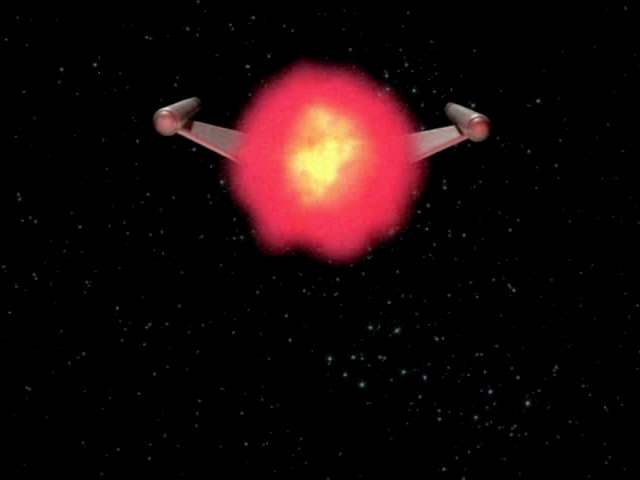
While the Earth plasma rifles and plasma cannons of the 22nd century are obviously less advanced than phase weapons, the Romulans will possess a much more powerful plasma weapon in the 23rd century (TOS: "Balance of Terror"). The DS9TM insinuates that they are still using the same basic technology in the 24th century.
Plasma weapon Common type of weapon in the 22nd century, firing packages of plasma. Can be built as pistols, rifles or as shipboard cannons (ENT).
In ENT: "Storm Front" we can see that the Nazis are using plasma weapons too, thanks to their alien allies.
Polaric power Concept for power generation prohibited by the Federation in 2268, because of its high risk to burn a planet's entire surface in a chain reaction (VOY: "Time and Again").
The unnamed alien civilization in VOY: "Time and Again" did use polaric power, and the result was disastrous in an alternate timeline.
Polarized hull plating See hull plating.
Polaron modulator Device that may be used to reinforce the deflector shields of a starship. Not many ships carry polaron modulators (VOY: "The Void").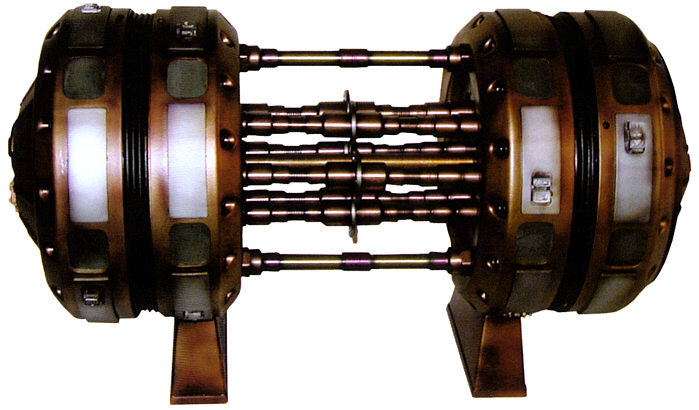
In VOY: "The Void" we saw the polaron modulator of a Kinjal frigate. After the Kinjal switched sides, a modulator was improvised on Voyager.
Portal weapon Device that allows to build a spatial connection similar to a wormhole across short distances. The portal weapon causes gravimetric distortions and must be kept out gravity wells (PIC: "The Next Generation", "Seventeen Seconds").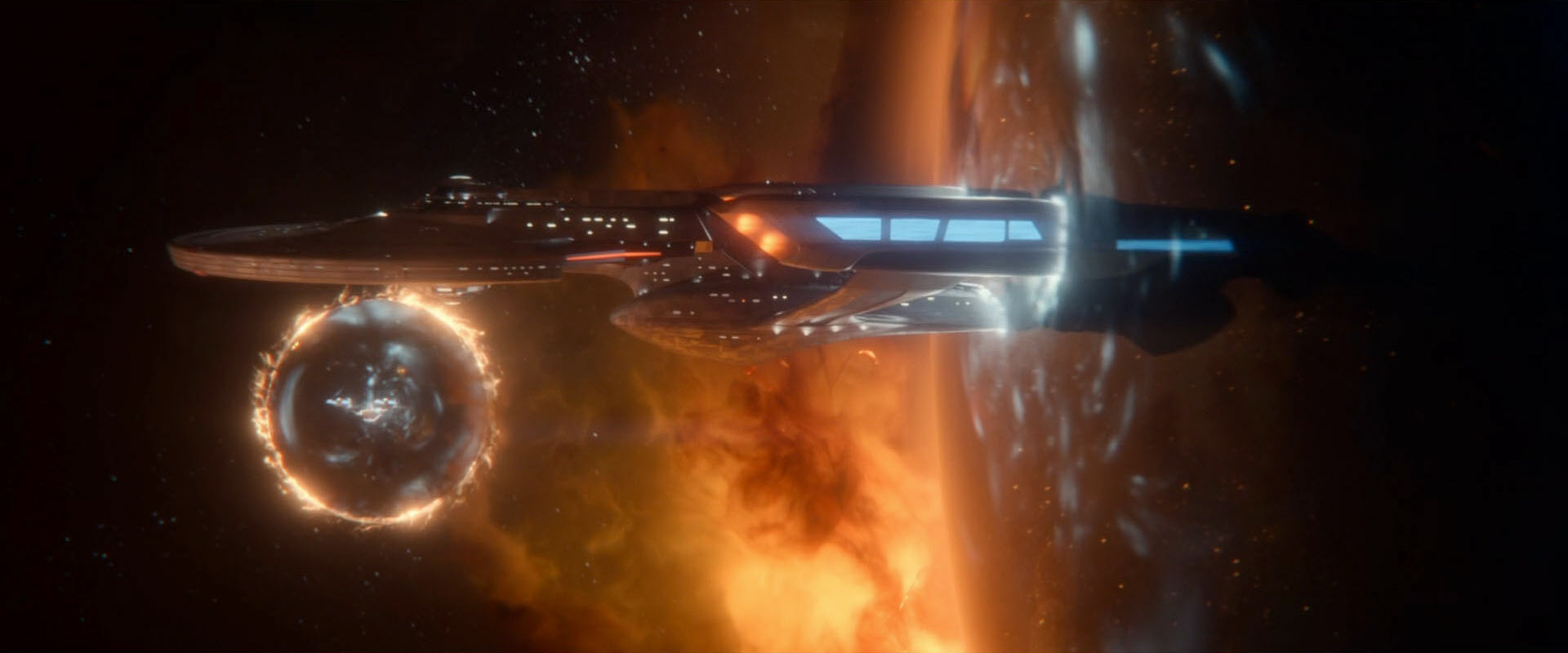
The technology is said to be based on quantum tunneling, which is an effect that exists in the real world for elementary particles (and can be exploited such as in flash memories), but not in the macroscopic world.
Positronic brain Neural network type acting as central processing units in androids of the Soong type like B-4, Lore, Data, Lal (TNG, TNG movies, PIC).
Considering that positrons are actually antimatter, it is highly improbable that these particles are employed in the positronic brain. The concept was suggested by Isaac Asimov in the 20th century, and he definitely didn't mean antimatter.
Power grid See EPS.
Power transfer conduit (PTC) High-volume plasma conduit that transfers warp plasma from the warp core to the nacelles (generic).
Prefire chamber Component of a Starfleet phaser weapon (TNG: "The Mind's Eye", DS9: "Soldiers of the Empire").
Probe Device fitted with a number of general-purpose or mission-specific sensors. Probes can be launched from a starship for closer examination of celestial objects or for reconnaissance. Most Federation probes are about the size of a photon torpedo, and some of them actually use a torpedo casing (generic).
Probes are a logical consequence considering that the resolution of the built-in long-range sensors is limited and that there is a signal decay over long distances. More about the known types of Federation probes.
Progenitor technology Collective (and inaccurate) name for a number of highly advanced technologies that are available in a realm that exists outside space and time. More specifically, the technology includes the ability to create life and to do that without the constraints of normal space-time, which can also be regarded as some sort of weapon. Though rumored, it is not possible to revive someone who has died in a way to preserve the conscious mind. Ultimately the realm itself with access to countless worlds or habitats is the technology. It was not created by the Progenitors, who lived 4 billion years ago, but predates even them (DIS: "Life, Itself").
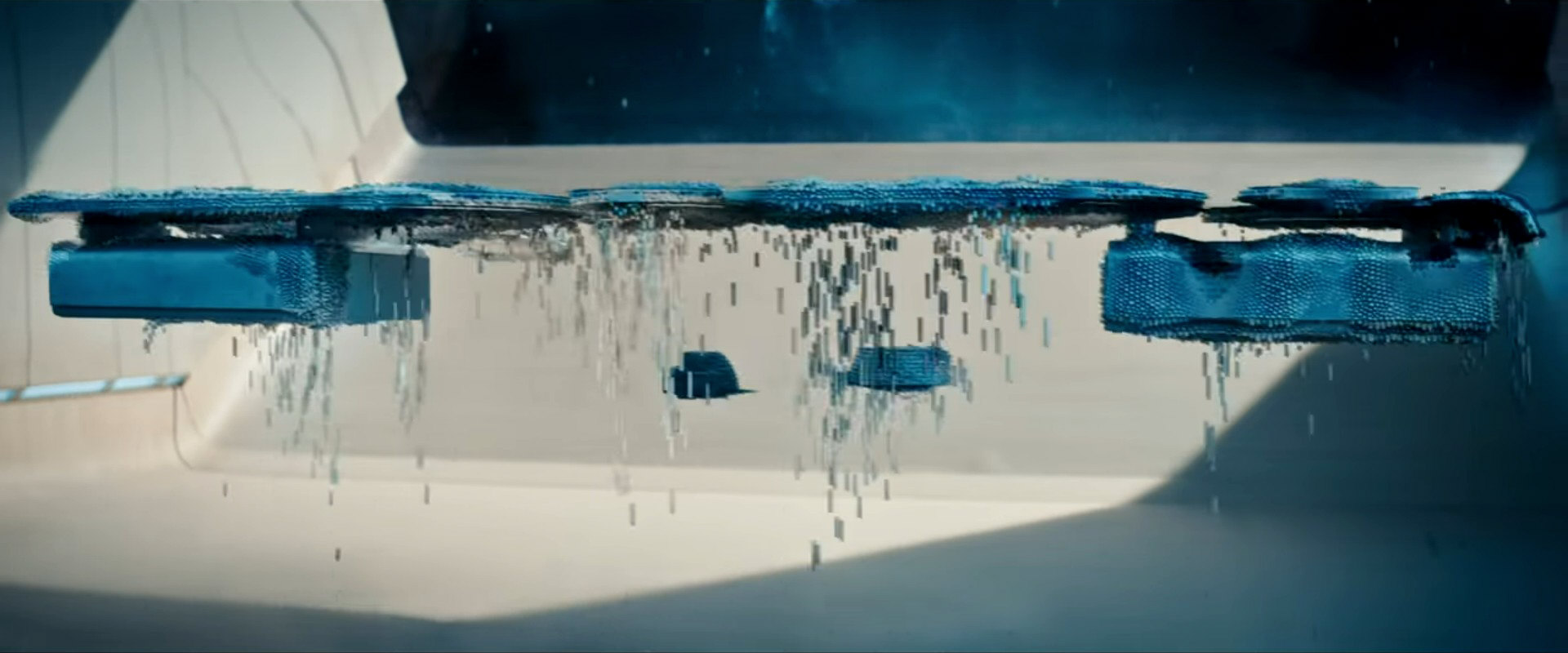
Programmable matter 32nd century technology to quickly change the shape of an otherwise solid object. Programmable matter is used to restructure everyday objects, for computer interfaces and to modify even large structures such as starships. During an away mission, equipment such as phasers can be replicated, morphed and dereplicated on the fly (DIS: "That Hope Is You, Part 1", "Far From Home", "Scavengers", "Red Directive", "Jinaal").
Progressive memory purge Computer procedure that is capable of restoring damaged memories (TNG: "A Fistful of Datas").
Projectile weapon Generic name for any kind of weapon that uses a projectile instead of a particle or energy beam or a plasma charge (generic).
Projectile weapons are generally outdated in the 24th century, but the TR-116 (DS9: "Field of Fire"), designed for environments in which phasers are useless and probably with the Borg in mind too, is a formidable weapon. It was modified by an assassin with a built-in transporter for the projectile, thereby rendering it even more dangerous. Projectile weapons even kill Borg if they can't adapt ("Star Trek: First Contact").
Protected memory Part of a computer core that is impervious to deletion (TNG: "Ship in a Bottle").
Protective shielding Shielding that is deployed to protect the viewports of a ship or shuttle in the 32nd century (DIS: "All Is Possible", "Rosetta").
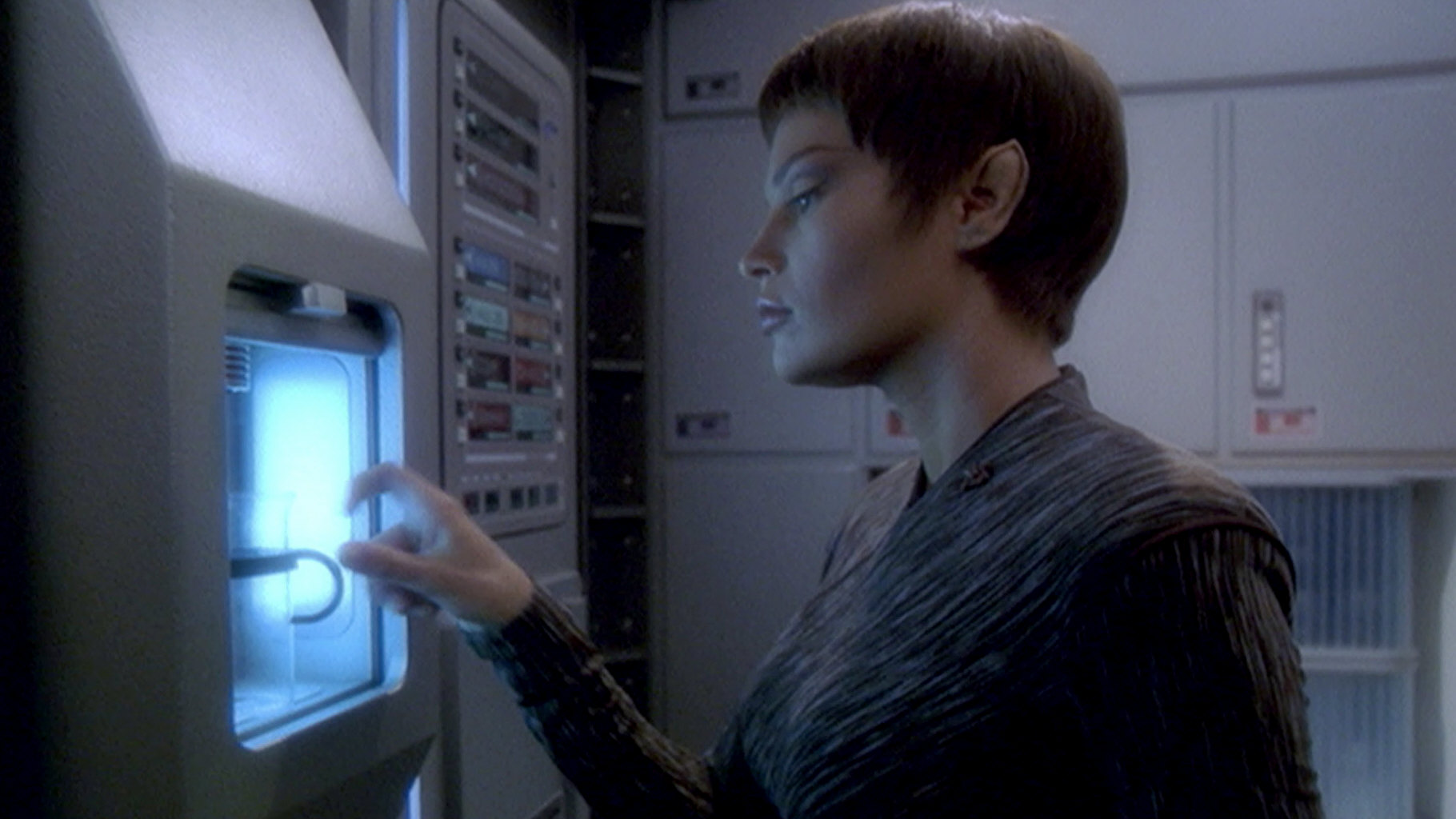
Basically, this is like a simple replicator.
Protodynoplaser Medical treatment to stabilize a patient's immune system (TNG: "Transfigurations").
 Protostar drive
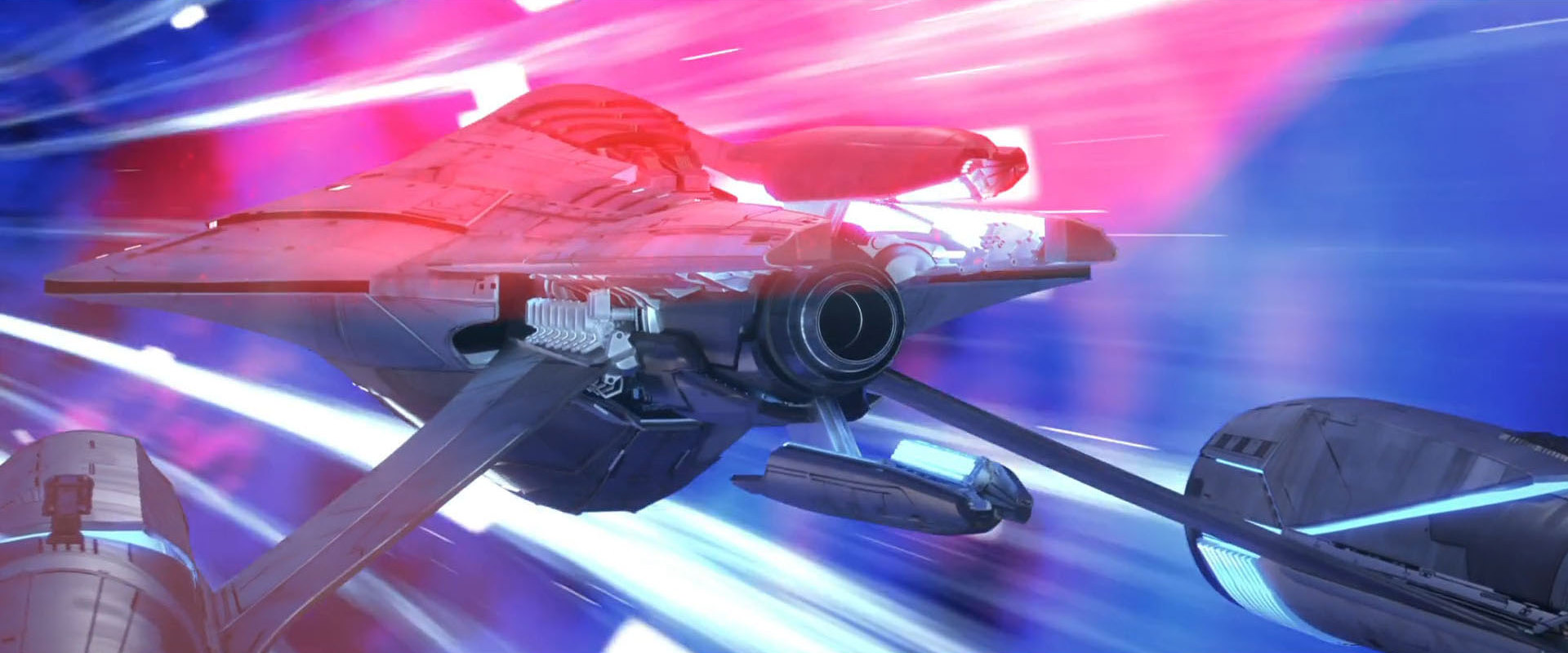
Experimental propulsion system of the late 24th century, powered by a protostar in confinement, allows a speed considerably in excess of conventional warp drive. A prototype of the engine is installed on the USS Protostar. When activated, the nacelle configuration of the ship changes, and part of the engineering section is exposed to space (PRO).
Protostar drive
Experimental propulsion system of the late 24th century, powered by a protostar in confinement, allows a speed considerably in excess of conventional warp drive. A prototype of the engine is installed on the USS Protostar. When activated, the nacelle configuration of the ship changes, and part of the engineering section is exposed to space (PRO).
Proximity transceiver Borg implant that allows the Collective to locate and retrieve drones that have gone astray (VOY: "Drone").
Psionic resonator Ancient Vulcan weapon, capable of killing by amplifying telepathic energy. However, wrong usage may hurt the person who uses the resonator. One of these weapons, the Stone of Gol, was rediscovered in 2369 (TNG: "Gambit").
Psi-wave device Subdermal implants used by Prytt interrogators to have access to a person's thoughts (TNG: "Attached").
Dr. Crusher and Picard noticed that, as a side effect, they could read one another's thoughts when they escaped from the Prytt prison.
Psychotectic therapy Psychotherapy performed on the J'naii planet to suppress feelings of gender identity (TNG: "The Outcast").
Psychotricorder Medical diagnostic instrument that is capable of recording memories, especially in cases of amnesia (TOS: "Wolf in the Fold").
The prop was the same as the standard tricorder.
Pulmonary scanner Medical instrument used to examine the respiratory system of a patient (VOY: "Phage").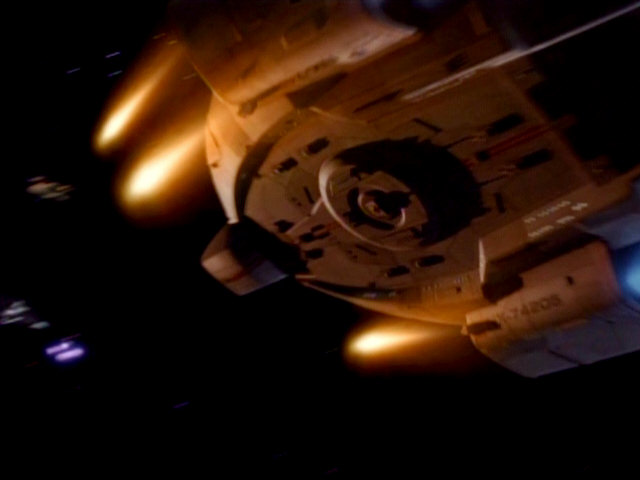
Pulse gun Type of weapon carried by Akritirian prison guards (VOY: "The Chute").
Pulse phaser cannon Phaser weapon available on Defiant-class starships. The ship has four of them, mounted at the forward end of the nacelles (DS9, "Star Trek: First Contact").
The pulse phaser cannon is obviously more powerful than a conventional phaser.
Pulse wave torpedo Ship-mounted projectile weapon, used on older Vulcan vessels (DS9: "If Wishes Were Horses").
Pulse weapon Common type of weapon in the 22nd century, firing short light bolts.
"Pulse weapons" may be an alternative name for plasma weapons which are visually identical.

Back to Treknology Encyclopedia index


