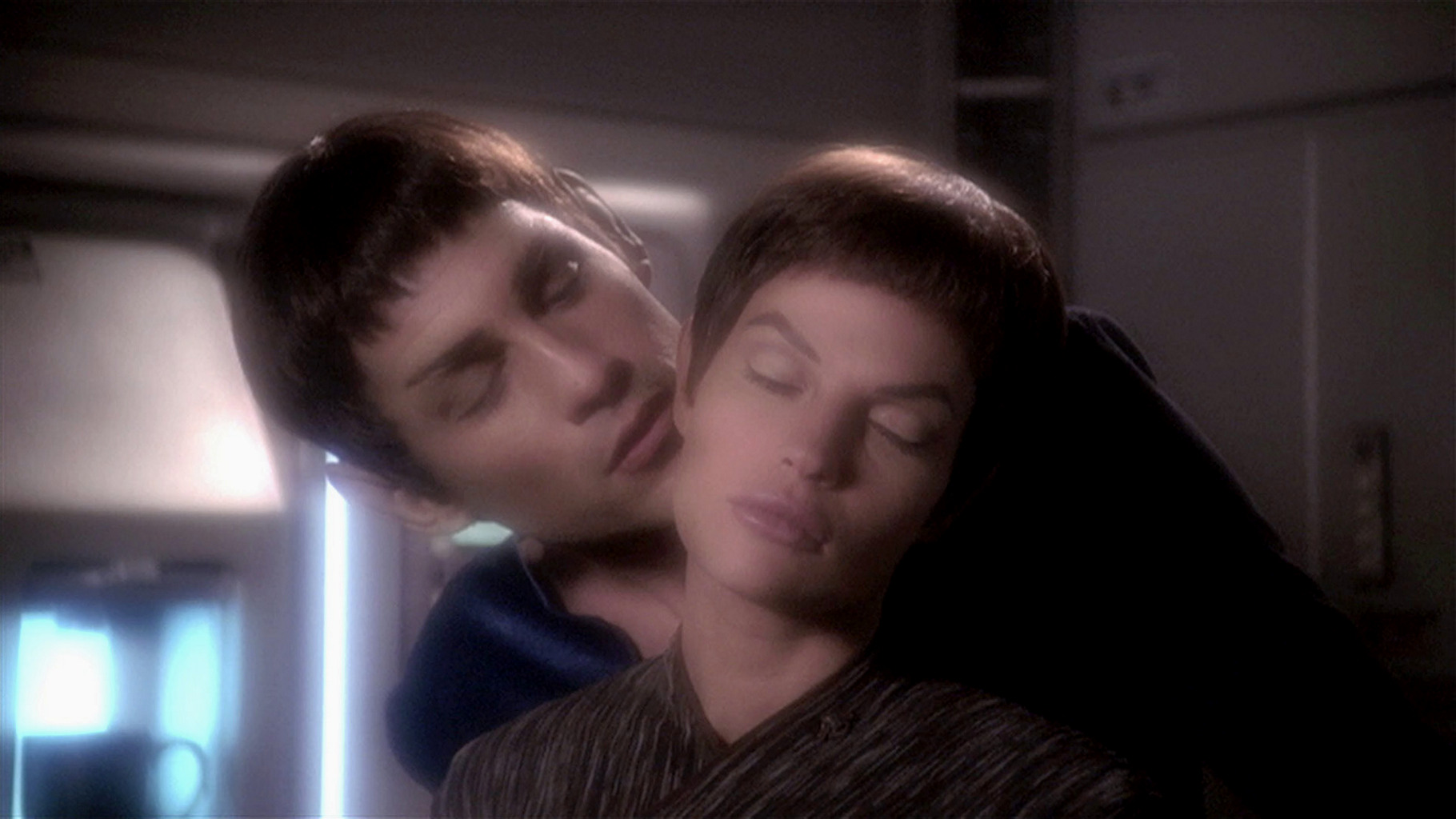
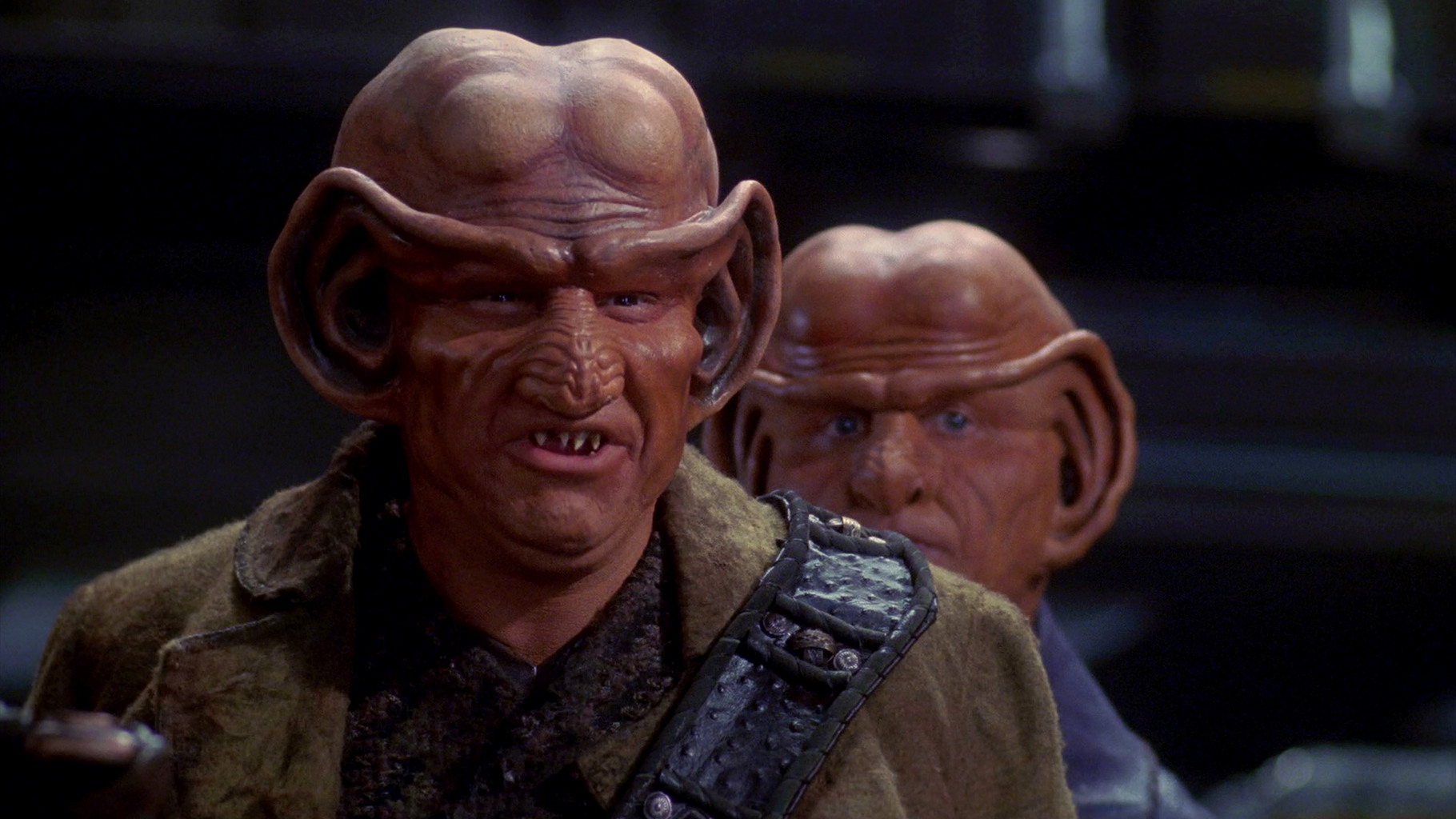
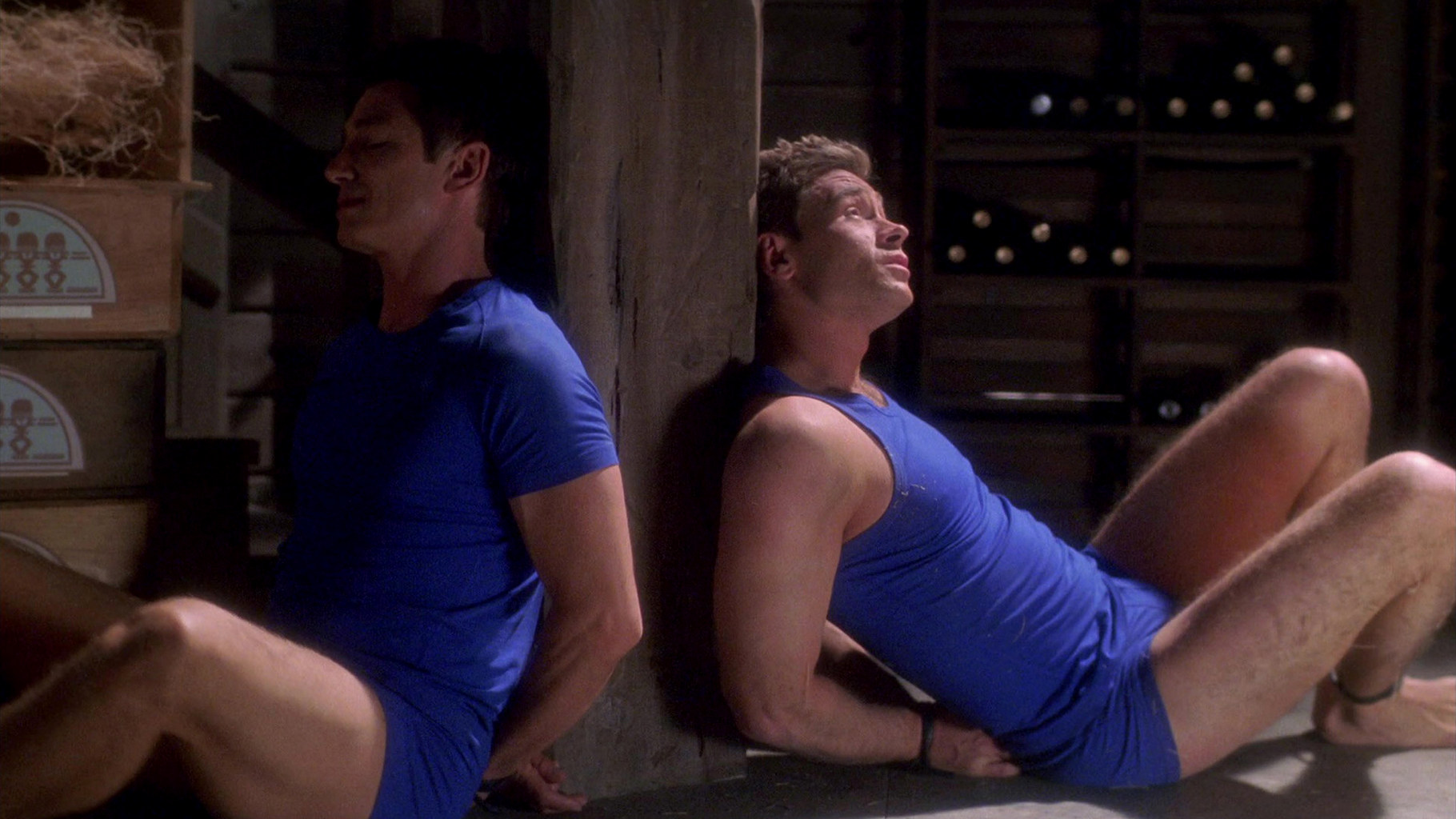
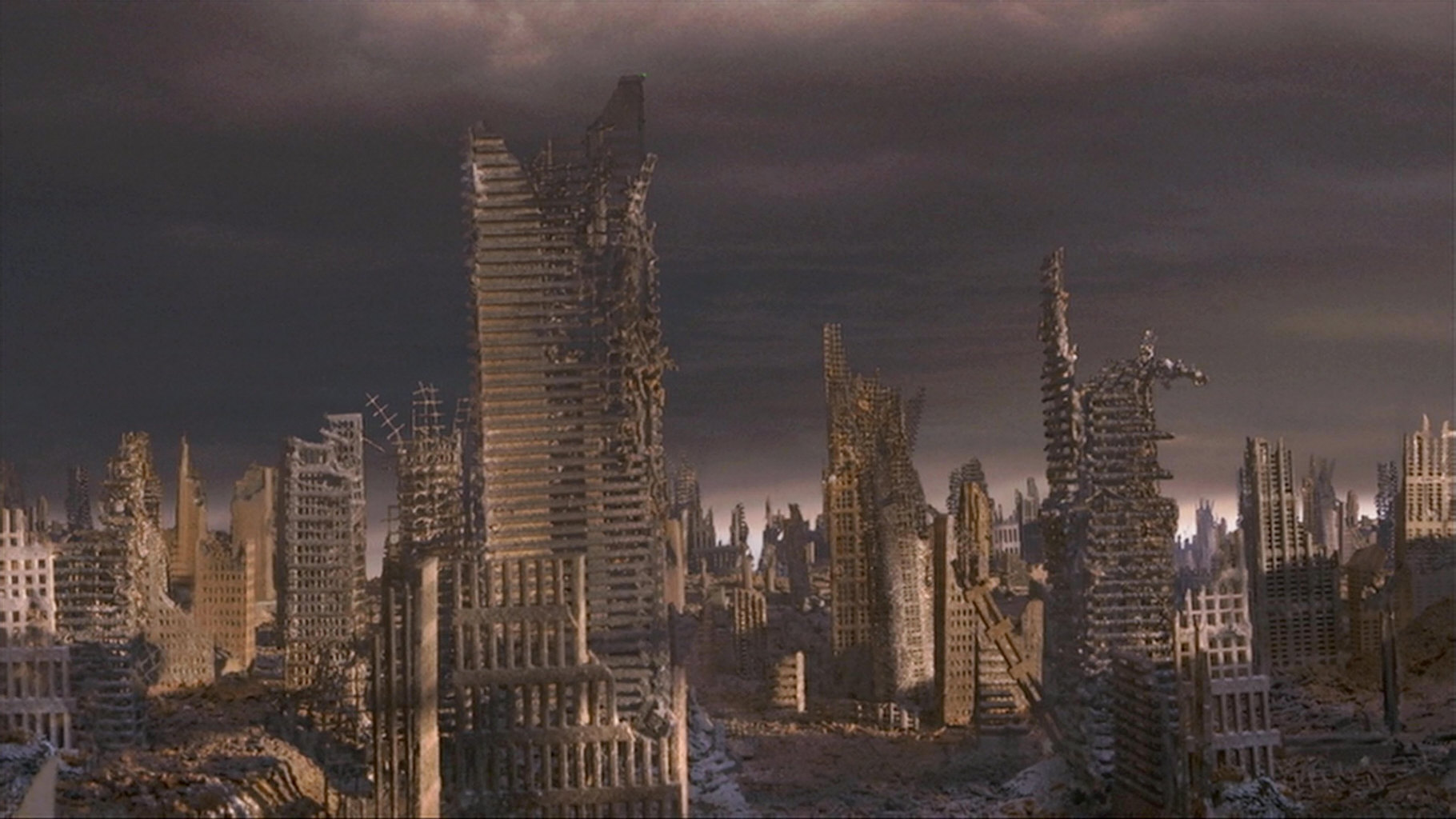
Star Trek Enterprise (ENT) Season 1 Reviews
Season 1Season 2Season 3Season 4
Broken BowFight or FlightStrange New WorldUnexpectedTerra NovaThe Andorian Incident
Breaking the IceCivilizationFortunate SonCold FrontSilent EnemyDear DoctorSleeping Dogs
Shadows of P'JemShuttlepod OneFusionRogue PlanetAcquisitionOasisDetained
Vox SolaFallen HeroDesert CrossingTwo Days and Two NightsShockwave I/II
Broken Bow
Synopsis
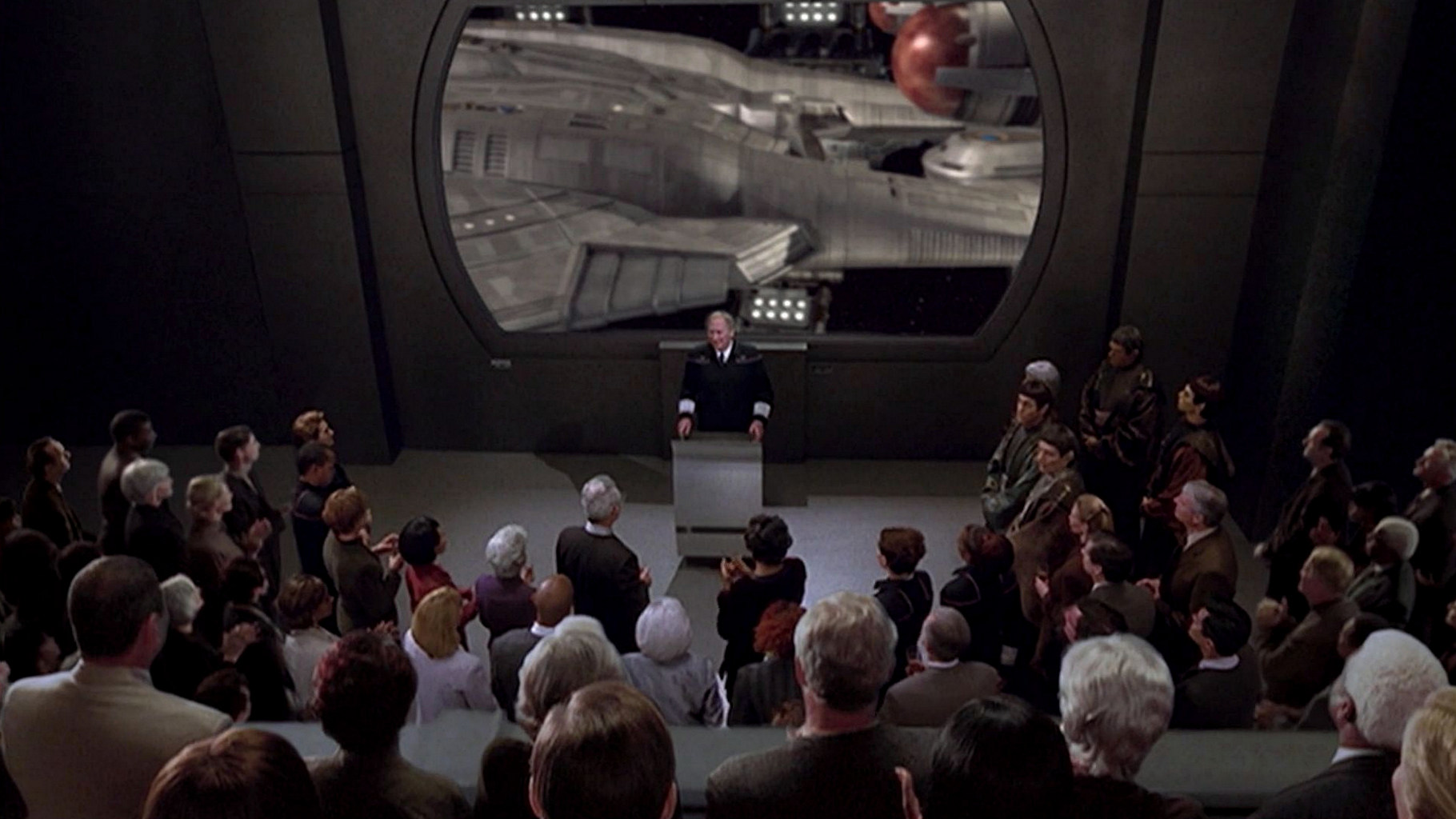
April 16th, 2151: The Klingon Klaang crash lands on Earth in Oklahoma, chased by two Suliban. One of them easily squeezes through the narrow gap in the door of a grain silo. Klaang destroys the silo, killing both pursuers, only to be shot by a farmer. The Vulcans, led by Ambassador Soval, intend to take care of this interstellar matter their way. However, Starfleet Admiral Forrest decides to return the Klingon to his homeworld using Earth's new Warp 5 starship, Enterprise. Captain Jonathan Archer, whose father designed the engine but didn't live long enough to witness the launch, assembles his crew ahead of schedule, including the Denobulan physician Phlox. Vulcan science officer T'Pol is assigned to the mission to supervise the inexperienced humans, much to the dismay of Archer and Chief Engineer Charles "Trip" Tucker. Enterprise launches successfully, and linguist Hoshi Sato begins establishing communication with the injured Klingon. However, while en route to Qo'noS, the ship is boarded by Suliban agents who abduct Klaang. T'Pol recommends aborting the mission, but Archer decides to continue and follows a lead to Rigel X. A landing party consisting of Archer, Tucker, T'Pol, Reed, Mayweather, and Sato travels by shuttlepod to a large trading outpost on the planet. There, Archer learns from a Suliban operative named Sarin that a faction known as the Cabal has been genetically enhanced and supplied with advanced technology by an unknown benefactor from the future as part of a "Temporal Cold War". Their mission is to trigger a Klingon civil war, and Klaang carries evidence that could expose the conspiracy. Sarin offers to help the Enterprise crew but is killed by the Cabal. Pursued by the Cabal, the landing party escapes to the roof of the complex where the shuttle awaits, though not before Archer is wounded. T'Pol assumes command. But she honors Archer's wish to continue the mission and devises a method to track the Suliban ship to a space station hidden inside a gas giant's atmosphere. Once Archer recovers, he resumes command. Enterprise is outgunned by an swarm of small Suliban vessels, but the crew uses the ship's grappler to catch one of these cell ships. Archer and Tucker use it to infiltrate the space station, the Helix, and free Klaang. Archer activates a device that unlocks the magnetic docking mechanism of the Helix. He is successful but has to stay behind on the station, where he faces the leader of the genetically altered Suliban, Silik. Just as Silik is about to kill him, Archer is rescued by the ship's newly installed transporter. After Enterprise successfully delivers Klaang to Qo'noS, the Klingons extract the information encoded within his blood cells. Impressed by this success, Starfleet authorizes Enterprise to continue its exploration mission. T'Pol also chooses to remain aboard the Earth vessel as part of its crew.
Review
This is a 2026 update of the review that I wrote in 2001, shortly after "Broken Bow" had aired. Back then, I was dismayed by the series premise. I thought the character concepts were bland, and I doubted that the writers could successfully handle the self-imposed restrictions of a prequel, in which much of the advanced technology of the TNG era realistically should not exist yet. I was also disappointed by the "Akiraprise" design. After watching the pilot in 2001, however, I found that I liked it. It came with a good story and was unmistakably Star Trek. At the same time, it confirmed several of my apprehensions. My overall opinion on story and characters has not changed all that much between 2001 and 2026.
Let me begin with the characters. First of all, we have Jonathan Archer, the only one whose background is explored to any significant extent. His feelings toward the Vulcans date back to his childhood, when he realized that his father's project was progressing more slowly than it could because the Vulcans were withholding technology. As T'Pol herself says about Enterprise's sensors, "Vulcan children play with toys that are more sophisticated." Archer embodies the inferiority complex that many humans must have felt in the 22nd century. He compensates with a certain underdog pride for his father's and his own accomplishments, that they managed to build their starship on their own, even if it took over 30 years. Archer believes that the Vulcans are not merely cautious but fundamentally arrogant. Unfortunately, they prove him right on nearly every occasion. Archer's response is a form of arrogance of his own; he constantly strives to provoke them. He seems to take pleasure in behaving exactly like the caveman the Vulcans see in him: acting on instinct and emotion, using rude language and deliberately doing the opposite of what he is advised to do. And, of course, eating a large steak in front of the vegetarian T'Pol. He also enjoys pointing out every Vulcan mistake. Overall, he is full of prejudice and defiance and is by far the least skilled diplomat among the Star Trek captains we know. There is clearly plenty of room for development in "Broken Bow", and that development would indeed take place over the course of the series, leaving me very satisfied in hindsight. It is also a nice touch how the flashbacks to Archer's childhood and his model starship mirror the present-day story and illustrate that one should have confidence in oneself rather than relying on, or blaming, others.
T'Pol, like her two fellow Vulcan characters in the episode, comes across as overly smug, unlike Spock or Tuvok, who are generally polite and respectful in both word and deed. Although Archer and T'Pol constantly criticize each other, I feel they are more alike than either would care to admit. Both seem determined to prove the other wrong and fail to realize that they often argue merely for the sake of arguing. For example, I simply don't believe it would be logical to eat grissini with a fork and knife, yet T'Pol does exactly that because she feels compelled to make a point. I can only describe the behavior of both Archer and T'Pol as childish. When I first watched the episode 25 years ago, I did not see T'Pol as having much potential to become the ship's darling in the tradition of Seven of Nine, although she would eventually undergo a similar development. The way she softens during the course of the pilot is a start, but I still do not really understand why she suddenly changes her mind and continues the mission according to his wishes while Archer is incapacitated. Nor do I see a convincing reason for her decision to remain aboard Enterprise. The story doesn't develop these points sufficiently, making them feel somewhat gratuitous.
Charles Tucker is the third most prominent member of the cast, yet we gain surprisingly little insight into his character. Most of the time, he simply echoes Archer's opinions, especially during his numerous disputes with T'Pol. In 2001, I found Dr. Phlox disappointing, describing him as a sort of hybrid of the EMH and Neelix. I expected him to serve mainly as comic relief throughout the series. Today, I see him differently. In "Broken Bow", Phlox consistently encourages people not to take matters too seriously or personally. He acts as a mediator of sorts, despite rarely interacting directly with T'Pol. My 2026 self finds Phlox far more agreeable than the three constant squabblers.
Hoshi Sato is clearly the most pleasant character in the pilot. In hindsight, I probably overrated her potential in 2001, imagining that she would become a fan favorite rather than T'Pol. Nevertheless, she represents the positive side of humanity in the 22nd century. Unlike Archer and Tucker, she is fully aware of both her strengths and weaknesses and feels no need to pretend otherwise. Despite having relatively few lines, she makes several noteworthy contributions, although the perhaps most memorable one is a casual remark: "You might think about recommending seat belts when we get home."
The contributions of "space boomer" Ensign Mayweather are minimal, and I certainly did not anticipate in 2001 that this would remain true, with only a few exceptions, throughout the series. Malcolm Reed likewise contributes little beyond occasional reports about whether the weapons are or are not ready.
There is one thing that bothered me 25 years ago and still today. There hardly seem to be any crew members aboard besides the main characters. A few people can be seen in the corridors and engineering, and one crewman is attacked by the Suliban in sickbay. Nevertheless, considering that Enterprise is supposed to be more crowded than ships such as the Enterprise-D or Voyager, the extras are remarkably inconspicuous, almost as if they were cloaked. I also wonder who is actually in command of the ship while the entire senior staff is down on Rigel X.
Let me come back to the depiction of human-Vulcan relations. The clashes between Archer and Tucker on one side and T'Pol on the other are presented as almost disastrously severe. In my view, the argument at Starfleet Medical early in the episode would have been enough to establish the tension between humans and Vulcans. Yet Archer, Tucker, and T'Pol never seem able to leave the issue alone. Nearly every conversation highlights the cultural divide between the two species, even when far more important matters should be under discussion, such as the mission itself. The constant bickering becomes especially irritating because it is so repetitive. T'Pol criticizes human impulsiveness again and again, while Archer and Tucker complain about Vulcan arrogance all the time. At some point, any reasonable human or Vulcan should have concluded that everything worth saying had already been said. I still don't understand why so much attention is devoted to this conflict. The absence, or rapid resolution, of long-term interpersonal conflicts was frequently criticized in Voyager. I have always found that criticism strange because Star Trek never really needed them before, and Gene Roddenberry actively discouraged them. TOS had the famous disagreements between Spock and McCoy, but those were usually little more than good-natured personal friction and often humorous. TNG attempted, with limited success, to recreate such a dynamic between Data and Pulaski. DS9 came with so many organic tensions among its characters that none of them ever became tiresome.
We are already familiar with "smug Vulcans" from "Take Me Out to the Holosuite" in the final DS9 season, in which Captain Solok challenges Sisko to a baseball game with the only purpose to demonstrate Vulcan superiority. In some respects, the constant verbal sparring between Archer, Tucker, and T'Pol serves as a precursor to that display of bad spirit on both sides two centuries later. I certainly don't appreciate this kind of "consistency". These are simply not the Vulcans I know from characters such as Sarek, Spock and Tuvok, whose logic and manners set a much higher standard. Star Trek should not undermine itself by casting its two most important founding races in such an unflattering light. I think it is inappropriate still today, and it is hardly an excuse that some of the post-2017 Trek continued in the same vein. "Broken Bow" would have benefited from less human-Vulcan conflict, or at least a much more restrained portrayal of it.
The story of "Broken Bow" is not especially cerebral, but it's convincing. The plot develops slowly yet effectively. Some elements, however, become repetitive, most notably the constant Vulcan-human arguments. As already mentioned, the ending does not entirely work for me. Archer and T'Pol spend most of the episode insulting one another, and then, once the mission succeeds, everything suddenly seems fine. Archer admits that he may have misjudged T'Pol, while T'Pol becomes noticeably more cooperative and even expresses a desire to remain aboard the ship. I find it difficult to believe that either of them could have gained so much insight in such a short time. There is an illogical gap in the narrative. It would have been more convincing if they had either reached some understanding much earlier or if T'Pol had ultimately been ordered to stay aboard against her wishes.
When I wrote my original review, I also complained that locations such as Rigel X, the Suliban station, the corridors of Enterprise, the decontamination chamber and Qo'noS were excessively dark. That was before darkness became the visual standard on Discovery and Picard. Likewise, I disliked some of the more overtly "scary" moments, such as the Suliban infiltration scenes. These work considerably better for me today.
"Broken Bow" introduces a number of new alien species, all of which we never see again in later centuries - well, with the exception of some Denobulans in Lower Decks. It's also one of those "historical event" stories that a series can realistically afford only once or twice per season. The pilot is filled with firsts: first contact with the Klingons and Suliban, the launch of the first Warp 5 ship, the first phase pistols, the first transporter use, and more. In 2001, and still to some extent in 2026, I found it slightly frustrating that so much supposedly new material was introduced all at once. In this accumulation, it tends to weaken rather than strengthen continuity.
"Broken Bow" also confirmed my concern that Enterprise would portray "Americans in space" rather than a united humanity exploring the unknown together. Almost everything about the series, from the characters and locations to customs and attitudes, is designed as distinctly American. The only notable exceptions are the Amazon University and Malcolm Reed's British accent. This raises the question of why the organization is called Starfleet rather than something like "US Space Navy", since the rest of humanity has to stay at home anyway. Even the otherwise excellent opening credits display a pronounced American bias in their depiction of human achievements, with the exception of the H.M.S. Enterprize.
I'm still a sucker for the Enterprise opening credits. When I first watched "Broken Bow", I rewound the media player several times just to see them again. I understand that not everyone would immediately embrace a Rod Stewart song (performed by Russell Watson here) instead of a traditional orchestral theme, or a montage of exploration history instead of purely space-oriented imagery. Nevertheless, it is strange that, immediately after "Broken Bow" aired, so many fans were annoyed by the title song and demanded it to be replaced by a new theme, or at least an instrumental version, as if this were the most important issue about the series, rather than the setting, stories or canon concerns. In my view, despite or just because of the lyrics that fit perfectly, Enterprise couldn't have a better title theme.
"Let's go!" - "Broken Bow" depicts an adolescent humanity venturing into deep space while being critically monitored by its Vulcan mentor civilization. It is enjoyable to witness this historical milestone, much as it was to watch Cochrane's first warp flight in "Star Trek: First Contact". The pilot also demonstrates how the crew make mistakes, how their technology falls short of their expectations and how their judgments are sometimes clouded by prejudice. Unfortunately, although these themes would have worked perfectly well if they had simply been shown rather than repeatedly explained, they are overshadowed by the obtrusive human-Vulcan conflict, which at times seems more important than the mission itself. Instead of yet another action sequence or yet another argument, the episode might have benefited from scenes showing more of how the ship operates, or perhaps a small subplot for underused characters such as Mayweather or Reed. Despite its weaknesses, however, "Broken Bow" has become something of a classic.
Annotations
- Nitpicking:
- Enterprise, traveling at Warp 4.5, can apparently reach Qo'noS in just four days. This would place the Klingon homeworld only about one light-year from Earth, which is clearly an error.
- The old Rigel problem appears in a new light. Sato assumes that Rigel is a Klingon name for a star system, and Archer does not refer to it as Rigel until T'Pol tells him about it. This is a rather clumsy writing mistake, probably born of ignorance, because Rigel is a real star that humans should certainly know about. However, we can now assume that the Rigel of this episode, and of Star Trek in general, is not the actual star. Otherwise it would be far beyond the reach of NX-01 and even the NCC-1701. Case closed.
- Not solved, however, is the question of how Enterprise can cover the 15 light-years to Rigel so quickly. According to T'Pol, the journey should take only a short time, whereas it ought to require as long as 60 days at the ship's stated maximum speed of Warp 4.5. This is essentially the same speed problem as with Qo'noS. Enterprise relies on the good old plot drive more heavily than any previous Star Trek series and somehow manages to visit at least one inhabited planet every week.
- When attacking the Suliban, Enterprise fires from four points in the bow where there is nothing that remotely resembles a beam emitter.
- Klingon "Warbirds" is an awkward mix-up with the Romulan ship type.
- Why does the capital on Qo'noS look completely different from how it will appear 200 years later? Perhaps the Klingons relocate their capital at some point. Alternatively, this may simply be another of the many cities on the planet.
- Starfleet and Archer establish extensive contact with the Klingons. In the TOS era, humans seemed to know next to nothing about them. Their customs and even their anatomy were still a mystery to Starfleet in "The Undiscovered Country". Even at the time of TNG, some aspects of their culture remained unfamiliar. "Broken Bow", however, shows Klaang receiving intensive treatment at Starfleet Medical and Archer's crew visiting the Klingon homeworld. Were all records of this encounter erased?
- Moreover, in TNG: "First Contact" (the episode, not the movie), Picard states that first contact with the Klingons was disastrous and led to a prolonged period of hostility. Nothing in "Broken Bow" resembles such a scenario. Even if the High Council was less than welcoming, they must have appreciated the fact that humans saved Klaang and preserved the evidence he carried. It is hard to imagine a more successful first contact.
- More things I dislike:
- Enterprise NX-01 looks rather awkward when viewed from below, in contrast to the cool "Akiraprise" profile from above. The redesign by Doug Drexler would eventually address this issue and has become canon through Star Trek Picard season 2.
- The phase pistol fires visible energy bolts and is clearly a particle weapon, arguably more advanced than the lasers seen in "The Cage". It already possesses the ability to stun. Likewise, the transporter does not appear significantly less advanced than the one aboard the original Enterprise. It is not slower; only its capacity seems limited to a single person at a time. The problem is that both the phase pistol and the transporter are technologies whose operation is virtually indistinguishable from their counterparts 100 or even 200 years later.
- Another issue is the apparent use of faster-than-light communication when Enterprise, still near Qo'noS, receives a message from Starfleet.
- A minor but interesting detail concerns the door controls. Why are doors not fully automatic, as many already are today? And why are the buttons mounted beside the doors rather than on them, forcing people to reach for the controls?
- The decon chamber is more like an excuse to have characters rub each other's backs than something that really makes sense.
- Why does the Rigel system need yet another inhabited planet? We already know that Rigel II, IV, V, VII and XII possess breathable atmospheres, and now Rigel X is added to the list for no obvious reason.
- More things I like:
- I was not particularly fond of the set design, especially the bridge, when I first saw it in 2001. My opinion has changed considerably. While I still think the overall layout could have been more cramped, more submarine-like and more distinct from later starships, I now believe the set works well as an earlier stage of starship development. I especially like the push-button consoles, the metallic finish of the surfaces and the sturdy doors.
- T'Pol uses a viewing box reminiscent of the one Spock frequently employed.
- The ship's corridors, complete with their bulkheads, are very well designed.
- I also appreciate the labels attached to consoles and hatches, which resemble the identification plates found on present-day engines and industrial equipment.
- The crew use flip-open communicators, and communication stations are built into the walls just as they are in TOS.
- The shuttlepods look considerably better with their wings extended. Many fans complain that they appear too modern compared to the TOS shuttles, but it makes perfect sense that a less advanced craft designed for atmospheric flight would be more streamlined to minimize air friction.
- I have never cared very much about uniforms, but the crew's jumpsuits feel convincing as an earlier style and provide a welcome contrast to the shirts and pants of later centuries.
- Another pleasant surprise is the grappler, a completely mechanical predecessor to the tractor beam. In fact, it is one of the few technologies that is visibly distinct from its 24th-century equivalent.
- Reed mentions the deflector as an essential system that prevents particles from damaging the hull.
- The "sweet spot" Mayweather shows Tucker is another clever idea. It is entirely plausible that gravity generators would not produce a perfectly uniform field.
- Archer mentions a speed of 30 million kilometers per second, which is roughly correct, corresponding to about one hundred times the speed of light, or approximately Warp 4.6.
- Remarkable dialogues:
- "Do you know how to tell him to shut up?" - "SHUT UP!" (Archer and Sato, about the Klingon)
- "Chugdah heg:h, volcha va." - "I'll take that as a thank you." - "I don't think they have a word for thank you." - "What'd he say?" - "You don't want to know." (Klingon Chancellor, Archer, Sato)
- Remarkable quotes:
- "Volatile? You have no idea how much I'm restraining myself from knocking you on your ass." (Archer, to T'Pol)
- "Today we're about to cross a new threshold. For nearly a century, we've waded ankle-deep in the ocean of space. Now it's finally time to swim." (Admiral Forrest)
- "Imagine it. Thousands of inhabited planets at our fingertips. And we'll be able to explore those strange new worlds, and seek out new life and new civilizations. This engine will let us go boldly where no man has gone before." (Zefram Cochrane)
- "If you're going to try to embrace new worlds, you must try to embrace new ideas." (Dr. Phlox)
- Remarkable scene: Reed tells Mayweather, "Didn't you read the profile report on these Klingons? Apparently, they sharpen their teeth before they go into battle." Mayweather smiles in disbelief, only for his expression to freeze a moment later.
- Remarkable decoration: Archer's ready room features images of the sailing ship Enterprise, the aircraft carrier of the same name, the space shuttle Enterprise and NX-01. He also keeps a statue of Zefram Cochrane, evidently modeled after the one in Montana, along with a water polo ball.
- Remarkable dog: Archer's dog, Porthos, is a beagle.
- T'Pol recall count: #1
Rating: 8
Fight or Flight
Synopsis
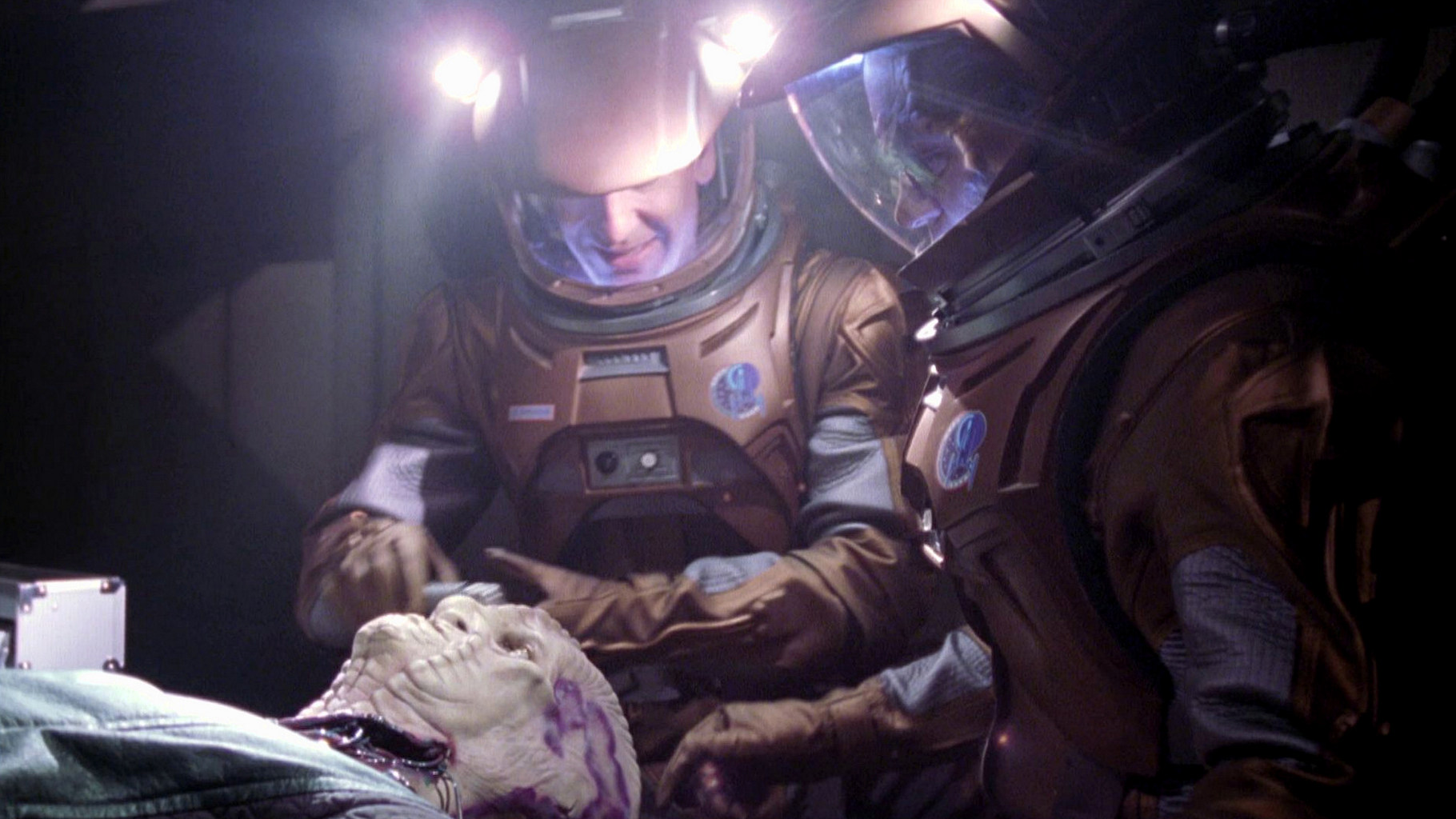
May 6th, 2151: The crew is growing bored after two weeks without encountering any intelligent life. Hoshi Sato is concerned about an alien slug they picked up on a planet, which is not doing well in its new environment. Malcolm Reed uses the downtime to work on calibrating the targeting scanners for the ship's spatial torpedoes, but without success. The sensors then detect an alien vessel adrift in space. When hails go unanswered, Archer decides to investigate despite T'Pol's objections. He, Reed and Sato take a shuttlepod to the ship and discover its crew dead, their bodies connected to a network of strange pumps. Since there is nothing they can do for the victims, Archer follows T'Pol's advice and resumes the original course. Meanwhile, Hoshi begins to doubt whether she is suited for the hardships of space exploration and considers resigning from Starfleet. As Enterprise gets underway again, Archer changes his mind. He feels he owes it to the dead crew to find out who they were and who killed them. Enterprise reverses course, and Archer returns to the alien vessel, this time accompanied by Phlox, Tucker and Sato. Phlox determines that the crew were murdered for the triglobulin extracted from their bodies. Hoshi manages to decipher the basics of the aliens' language and sends out a distress call. Shortly afterward, the unknown attackers return with a massive ship. The shuttlepod barely makes it back into Enterprise's launch bay before the enemy opens fire, disabling the warp drive. It soon becomes clear that the attackers have identified Enterprise as their next source of victims. Reed's torpedoes prove ineffective against the larger vessel. A second ship arrives, one with a configuration similar to that of the derelict vessel and evidently responding to Hoshi's distress call. Its captain initially misunderstands the translation matrix, prompting Archer to ask Hoshi to speak directly with him, despite her limited knowledge of the language. She eventually succeeds in communicating the situation, and the alien captain attacks and destroys the hostile ship. Together with the friendly aliens, the Axanar, the Enterprise crew recovers the bodies of the victims. Phlox and Hoshi also manage to find a new home for "Sluggo".
Review
When they announced the series in 2001, Berman and Braga promised that Enterprise would show us the dawn of space exploration, a "developmental stage" in Starfleet history. If that was the goal, they had to reconsider the formulas of Voyager and approach familiar story concepts differently. "Fight or Flight" accomplishes this clearly better than most episodes of the series. It presents the crew as inexperienced and uncertain. They make mistakes and second-guess themselves. They also can't rely on the advanced technology of the TNG era. The concept works remarkably well here. In a sense, "Fight or Flight" justifies the very existence of the series. If you are going to make a prequel, it should feel different from what came before. Nobody needs stories that are merely recycled from Voyager. Unfortunately, a number of those would still follow in the first two seasons.
Where "Broken Bow" took the human-Vulcan conflict too far, however, "Fight or Flight" emphasizes human weakness and uncertainty too much. Reed's late reaction when the torpedo he fired is looping back toward his own ship is still amusing, but it also makes him look rather incompetent. Archer becomes increasingly agitated after leaving the alien corpses behind and begins to direct his frustration at T'Pol and Tucker for circumstances they cannot possibly change. I understand his motivation. He feels guilty about abandoning the victims, wants to do the right thing and needs some sort of confirmation. Still, there is a fine line between leadership and pressuring others into agreeing with him. On the other hand, this leads to one of the episode's strongest moments, quite literally a turning point, when Archer orders Enterprise to reverse course. He commits himself to a course of action that will define his command style and, in many ways, the future philosophy of Starfleet.
Then there is Hoshi. On the one hand, she is terrified by the sight of the corpses hanging from the ceiling of the alien vessel. On the other hand, she generally doubts her ability to cope with the hardships of deep-space exploration and is uncomfortable wearing a spacesuit. I already mentioned in my review of "Broken Bow" that Hoshi feels particularly human because of her vulnerabilities. In "Fight or Flight", however, the accumulation of insecurities is almost excessive. By the end of the episode she gains confidence after establishing communication with the Axanar, something neither Enterprise's technology nor anyone else aboard could have accomplished. Yet this achievement concerns linguistics, which is her core competence anyway. It doesn't suddenly make her less fearful of danger or the unfamiliar environment of deep space. Her development is believable, but perhaps a little too fast.
Nevertheless, "Fight or Flight" is an uplifting and heartening episode. It demonstrates the values that make Star Trek special, just because the characters have not fully embraced them yet. Hoshi experiences meaningful growth. Archer makes an important decision, one that eventually becomes part of Starfleet's philosophy - "we care". The episode also depicts the first successful contact with an alien species under difficult circumstances. I wouldn't have minded learning a little more about the Axanar, but leaving the rest to our imagination is acceptable.
As an early episode, "Fight or Flight" benefits greatly from the fact that the "space rookies" premise is still fresh and used to its fullest advantage. At the same time, it becomes clear that the series cannot rely on this forever. The crew must gradually gain confidence, experience and routine. Once again there are numerous horror elements, and once again they work reasonably well because they serve the story rather than merely to frighten the audience. Even so, Enterprise should not have continued down that path. Too often, horror would be used as a substitute for meaningful story development. So "Fight or Flight" is an excellent example of how to use the basic premise of the series effectively, but it should not be overrated as a template for the show.
One aspect I particularly like is the fact that Enterprise spends two weeks without encountering any intelligent life. Admittedly, this raises the question how thats fit with the claim in "Broken Bow" that Qo'noS is only four days away. And Rigel X even less. Still, when I first watched "Fight or Flight", I appreciated the implication that space is vast and sparsely populated. I thought the series might maintain a degree of realism by not encountering an inhabited planet every week. Reality turned out somewhat differently. At least, gross violations such as instantaneous interstellar travel will remain rare.
The episode also features several pieces of technology that feel refreshingly realistic. There is the docking arm that physically pulls the shuttlepod into the launch bay, the well-designed environmental suits, and above all the difficulty of opening the hatch on the alien vessel. Earlier Star Trek series generally assumed that docking ports throughout the galaxy were somehow standardized and universally compatible.
Annotations
- Nitpicking:
- To enable Reed's target practice, Archer orders to drop out of warp and find something to blow up. He does that out of the blue, apparently without knowing whether there is actually a nearby asteroid field the ship could reach on impulse.
- When the torpedoes hit the alien ship without effect, why doesn't Reed try the beam weapons?
- Remarkable quotes:
- "We've been out here for two weeks and the only first contact we've made is with a dying worm." (Tucker)
- "My people don't share your enthusiasm for exploration." (T'Pol)
- If I'm not mistaken, they are preparing to mate. Do you think they might let me watch? (Phlox, about two crew members, to Tucker)
- Remarkable species: The Axanar are androgynous and live for 400 years.
- Remarkable fact: According to T'Pol, only one out of 43,000 planets supports intelligent life.
Rating: 7
Strange New World
Synopsis

Date not given: Enterprise arrives at a beautiful Earth-like planet covered with lush vegetation. T'Pol recommends following standard procedures and conducting a probe survey before anyone lands on the surface. Archer, however, decides to lead an away team personally. Accompanied by T'Pol, Tucker, Mayweather, Cutler, Novakovich and Porthos, he lands on the planet to begin the exploration. After Archer and Porthos return to Enterprise aboard the shuttle, the rest of the team remains on the surface overnight. When a storm forces them to seek shelter in a cave, strange things begin to happen. The crew members start seeing people, creatures and even moving rocks. Novakovich becomes so terrified that he flees the cave and disappears, leaving the others unable to locate him. Meanwhile, Archer attempts unsuccessfully to land the shuttlepod through the worsening storm. Eventually, Novakovich is beamed back to Enterprise, but a malfunction causes plant material to become embedded in his skin. Fortunately, Phlox is able to treat the physical injuries. He also determines that Novakovich's hallucinations were caused by tropolisine, a psychotropic compound naturally present on the planet, and initially concludes that the effects will wear off within a few hours. What Phlox fails to realize is that the compound breaks down into a toxic substance. As Novakovich's condition rapidly deteriorates, Phlox works to develop a cure based on inaprovaline injections. Time is running out to save the landing party, not only because of the poisoning but also because the situation escalates. Convinced that T'Pol is conspiring with alien lifeforms on the planet, Tucker pulls a phase pistol on her. In a desperate attempt to defuse the situation, Archer pretends that Tucker's delusion is true. He claims that the mission is a classified operation to establish contact with a silicon-based lifeform known only to T'Pol, but insists that Tucker must lower his weapon so she can communicate with the "rock people". The ruse works. As soon as Tucker lowers his guard, T'Pol stuns him. She then retrieves the antidote that has been beamed down and administers it to the affected crew members, saving their lives. Novakovich eventually recovers as well.
Review
"Strange New World" has a promising start. Enterprise arrives in orbit of a beautiful planet, the eponymous strange new world. It feels as if the episode could continue along the lines of "Fight or Flight", exploring the unknown through the eyes of an inexperienced crew equipped with comparatively primitive technology. At this point, I don't even mind another argument between Archer and T'Pol. She, of course, wants to follow protocol and conduct a survey with probes. He, of course, wants to take a shuttlepod down and be the first one to set foot on the planet. Well, Porthos will beat him to it. The setup is engaging, and for a while we are left wondering what surprising discoveries await the crew and how they will deal with them.
After about nine minutes of pleasant anticipation and lighthearted banter, however, we get a taste of the direction the story will actually take. Around a campfire, Mayweather shares a ghost story. And really, though unrelated and harmless in itself, this sets the tone for what will follow: a violent storm, a creepy cave and eventually unsettling hallucinations - ghosts. The crew begin seeing all sorts of apparitions, from people to mysterious rock creatures. The explanation is alien pollen. Unfortunately, the effects don't stop here. The affected crew members also lose their grip on reality. Novakovich flees in terror. Tucker completely freaks out and spends the rest of the episode threatening T'Pol with a phase pistol. Meanwhile, T'Pol, much like Spock in the days of TOS, remains largely immune and ultimately saves the day. The logic behind it is sound enough, but do we really need to revisit these old stereotypes once again?
There is remarkably little that stays with me after the episode is over. Tucker pointing a weapon at T'Pol for like half of the time is more exasperating than suspenseful. There is almost no character development because none of the affected crew members are acting of their own free will. Or are they? Tucker's resentment toward the Vulcans resurfaces vehemently once the hallucinations take hold. One could argue that the psychotropic compound only reinforces a sentiment that is already in him. Perhaps he secretly wants to harm the Vulcan who keeps patronizing him? But does it really matter? Hallucinations and paranoia of real-life patients don't make sense, and stories built around them often suffer from the same problem. I don't dislike the concept in principle. There are excellent stories about delusions in Star Trek. TNG: "Frame of Mind" remains one of the franchise's most effective explorations of a character questioning his own sanity. "Strange New World", by contrast, is more about exploiting the situation for easy thrills than about examining the characters themselves. It's an example of how not to approach this type of story.
Speaking of exploitation, the horror elements are technically well executed. The eerie creatures and the moving rocks look convincing. The problem is that they feel largely unmotivated within the narrative. They are exactly the sort of thing I mentioned in last week's review: horror effects and jump scares used as a substitute for genuine story development. Instead of learning something interesting about the planet, the crew or the larger setting, we spend much of the episode watching people lose their minds in increasingly dramatic ways.
One redeeming quality of "Strange New World" is that it is the first episode to involve crew members other than the lead officers. Cutler and Novakovich get quite a bit of screen time. For a while, I was concerned that Novakovich would become the series' first redshirt, dying solely to demonstrate how dangerous the planet is for the main characters. Fortunately, the story avoids at least this one cliché.
Annotations
- Continuity: In his attempt to appease Tucker, Archer says: "Starfleet sent us here to make contact with a silicon-based lifeform." Over 100 years later, the very concept of the silicon-based Horta will be unknown in TOS: "Devil in the Dark". How can Archer make up such a lifeform if none is known yet? Well, rather than being a visionary, he may simply have read about theories that such lifeforms may exist.
- Nitpicking:
- It is irresponsible to leave the survey team behind on the planet without a means to be evacuated fast when needed.
- Phlox explains Novakovich's toxication with "a stray neutron", as if he were a physicist and not a physician. He also says the stray neutron can be found in each "tropolisine atom", which makes no sense at all because it is a complex compound composed of many different atoms.
- Remarkable quotes:
- "Where No Dog Has Gone Before." (Tucker's comment after Porthos is the first survey team member to leave the shuttle)
- "Challenge your preconceptions or they'll challenge you." (advice from Mr. Velik, Tucker's Vulcan teacher)
- Remarkable facts:
- Ensign Cutler's special field of expertise is entomology.
- The sky on Vulcan is occasionally blue, according to T'Pol.
- T'Pol has been to 36 Minshara-class planets before. Minshara is a Vulcan designation unknown to humans at this time - and a nice homage to what will be known as Class M.
- Inaprovaline is already in use as a multipurpose medicine.
- Enterprise has a crew complement of 82.
- Remarkable appearance: Ensign Cutler is played by Kellie Waymire (1967-2003), who already appeared as Layna in VOY: "The Muse".
Rating: 3
Unexpected
Synopsis
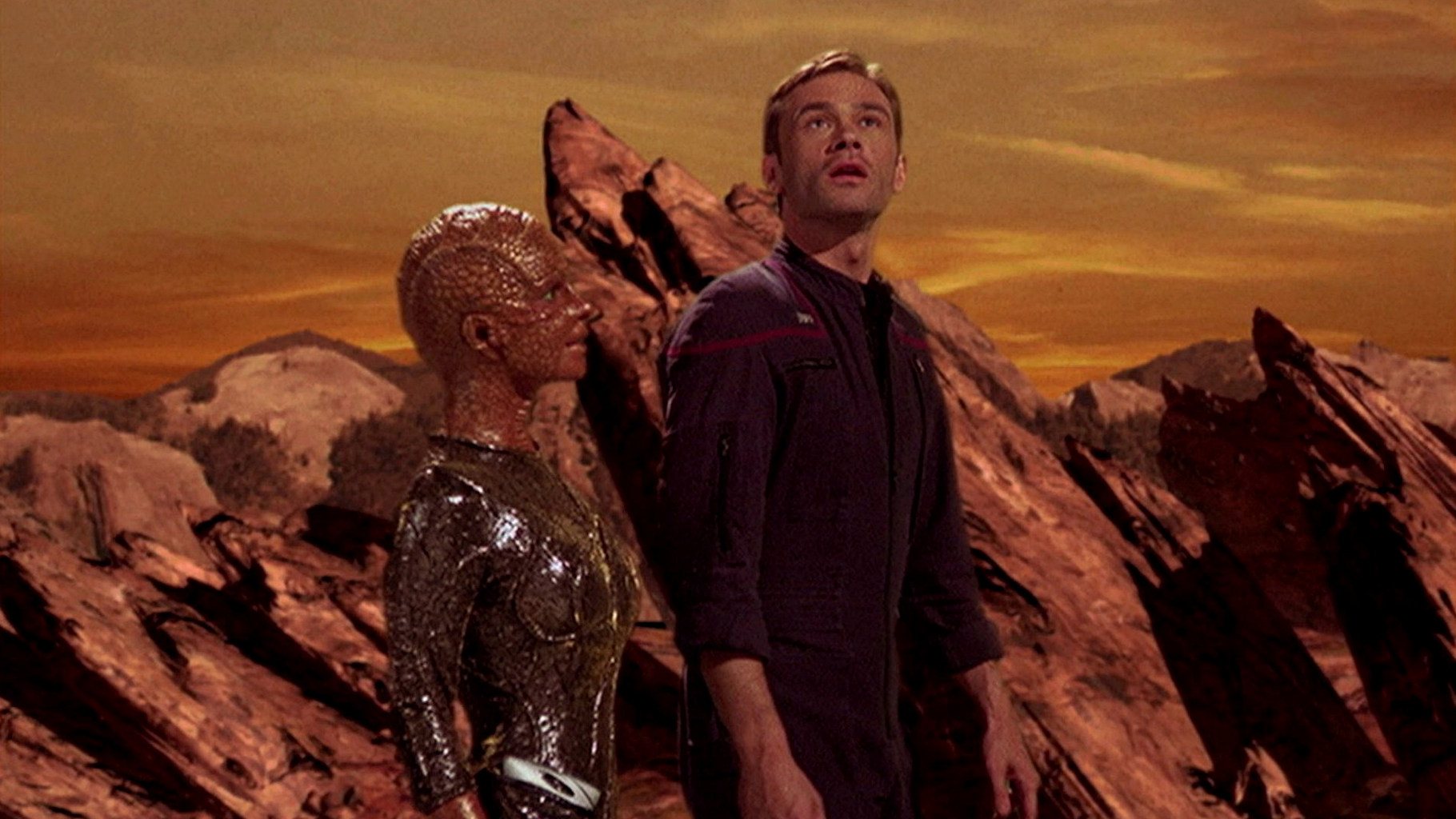
Date not given: Systems begin to malfunction across Enterprise. Artificial gravity fails while Archer is taking a shower, T'Pol's carbonated water turns into syrup and eventually the engines fail. The cause turns out to be a cloaked Xyrillian vessel hiding in Enterprise's warp wake behind the nacelles. After making contact, Archer sends Trip Tucker to help repair the aliens' damaged engines. Struggling to adapt to their unusual environment, Tucker is ready to give up until Archer encourages him to follow the Xyrillian captain's advice and simply get some sleep. The remedy works. Tucker teams up with engineer Ah'len to fix the engines. He later explores a holographic simulation chamber with her, where they perform a ritual involving a bowl of pebbles that telepathically links them. Back aboard Enterprise, after the ships have parted ways, Dr. Phlox discovers an unusual growth on Tucker's arm and delivers a startling diagnosis: Trip is pregnant. It must have happened during the telepathic bond. While Tucker is less than thrilled, Archer sets out to find the Xyrillian ship again. They eventually locate it hiding behind the nacelles of a Klingon battlecruiser. When the Klingons immediately attack Enterprise, Archer asks them to hear him out and imprudently reveals the Xyrillians' presence. The Klingon captain intends to kill them, upon which T'Pol appeals to their honor and argues that they owe Archer a favor after his role in exposing a plot against the Empire. The captain relents only after learning that the Xyrillians possess holographic technology of considerable interest. When the Klingons insist on examining the ship alone, Tucker is forced to reveal his pregnancy, much to their amusement. In the end, the Klingons acquire access to the holographic technology, while the Xyrillians transfer the embryo from Tucker to a Xyrillian male, as the species' men are the ones who carry children.
Review
A lot has happened in the real world since "Unexpected" first aired 25 years ago. In my original 2001 review, I joked about the idea of a male pregnancy and objected that Arnold Schwarzenegger beat Trip to it. Today, that part of the story may not land with everyone any more, given that in some countries a pregnant person can legally be recognized as a man. Even so, I still find the premise amusing. What has changed more is my opinion of the course of the episode. Today, I appreciate the serious first half far more. Like "Fight or Flight", it is about a crew venturing into the unknown and encountering a truly alien civilization. It captures what Star Trek has always been about, as seen through the lens of Enterprise as a prequel. I find Trip's whole visit to the Xyrillian ship captivating. The atmosphere in the airlock is mysterious and slightly unsettling. When he enters the bridge, he struggles to breathe normally. In light of his continuing difficulty to adapt to the aliens' environmental conditions, he is ready to give up. It is a display of human weakness that 24th century Star Trek perhaps showed too little of. Archer's advice to simply take a nap and see what happens feels refreshingly human as well, and it works.
In my review of 2001, I criticized aspects of this storyline. For instance, why doesn't Trip simply take a spacesuit? Looking back, I think the hardship is worth showing because it emphasizes how alien the Xyrillians really are. Their ship is wonderfully strange. Food grows on the walls, their technology feels unfamiliar, and their scaly appearance is genuinely different from most Star Trek aliens. Up until Trip returns to Enterprise, the story is quietly charming. It is not particularly exciting, but it is warm and engaging as Trip gradually builds a connection with the Xyrillians, especially the likable engineer Ah'len.
Then comes the second half, and the comedy begins with Phlox's diagnosis that the strange growth on Trip's arm is - a nipple. As I mentioned, the humor still works for me. What I like less today is the abrupt tonal shift. The episode begins as a serious first contact story about the challenges of dealing with a truly alien species. Then, without warning, it turns into a comedy about nipples, mood swings, covering up a baby belly and eventually Klingons laughing at the sight of Trip's condition. The problem is not that these scenes are unfunny. Rather, the entire second half is built around an extended joke of male pregnancy. The moment in which Trip reveals his condition to the Klingons of all people still gets a laugh, but today it no longer feels like a particularly satisfying conclusion to the stronger story that came before it.
If I were to rate them separately, I would give the first half eight points and the second half four. That still leaves "Unexpected" at six points on average, exactly where I placed it 25 years ago. It remains a decent episode and, for the most part, a heartwarming one.
One complaint, however, is the same as it was back then: T'Pol's reaction to Trip's condition. Rather than giving him the benefit of the doubt, she immediately assumes he had sex with a Xyrillian female, with his predicament being his own fault. Her attitude comes across as unnecessarily harsh and dismissive. A little more tact would have been appropriate.
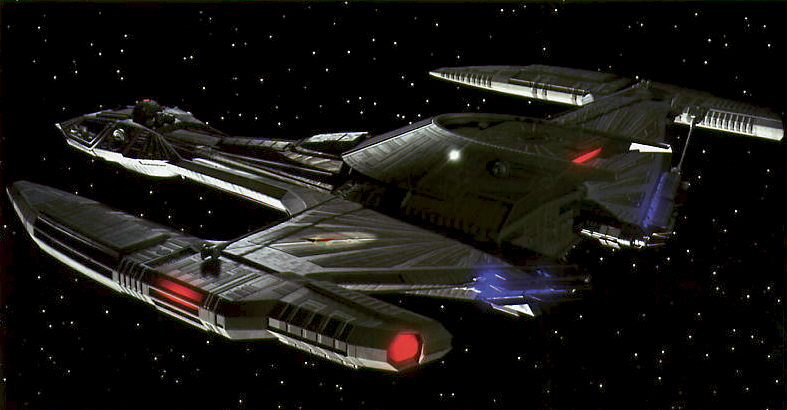
As for the two anachronisms, they bother me less than they once did. The appearance of a Klingon K't'inga-class battlecruiser, a design that would still be in service two centuries later, has long been explained by production realities. The intention was reportedly to use a less advanced vessel design that was not completed in time. Likewise, the idea that the Klingons gain access to holographic technology two hundred years before the Federation may be rationalized. Technologies can be forgotten, abandoned, classified, or they simply fail to spread beyond a limited context.
Annotations
- Continuity:
- The Xyrillian ship is equipped with a fully functional holodeck, the only apparent limitation being that it may not allow the creation of interactive characters. Other than that, it does not seem to be any less advanced than what we know from TNG, despite not existing in the Federation for another 200 years. This may not seem like a major continuity issue if the technology remains a secret of the Xyrillians, a race we won't see again and whose ships are normally cloaked. However, it becomes a problem when the Klingons get their hands on the holographic generator. It is even more implausible considering that holodecks will not exist on Klingon ships even in the 24th century. We may make up excuses that it was just for the personal enjoyment of the Klingon captain and was never commonly accepted by the Klingons, or that his ship was destroyed along with the technology. It can be explained, but it still leaves an aftertaste that it took the writers and producers just four episodes to show the signature innovation of the 24th century in all its glory.
- The other continuity issue is the K't'inga-class battlecruiser, a design whose service life is now at least 225 years! The defense that Klingons are warriors and not engineers is a cheap excuse in my view. Warriors frequently need new weapons. Even the good old bat'leth may have been improved several times using new alloys, and the same should apply to ship hulls. The Klingons are not Hirogen; they want to win battles and do not fight merely for the thrill of traditional hunting rituals and weapons. They are also eager, in the same episode, to acquire the new holographic technology, just as they will quickly adopt cloaking devices a hundred years later, so there is no reason why their ship designs should always stay the same. There's also the fact that Klingons are constantly at war. They frequently need to replace ships, far more often than an organization dedicated to peaceful exploration. No one can tell me the Klingons wouldn't come up with improved designs if they need new ships anyway. We now know that the inclusion of the K't'inga was due to a lack of production time and that it was indeed the intention to show a newly designed D4 cruiser sketched up by John Eaves.
- Nitpicking:
- No reason is given as to why Trip doesn't simply take a spacesuit instead of painfully adapting to the environmental conditions on the Xyrillian ship. We may argue that working in the narrow space of the engine room would not have been possible in a spacesuit, but he could at least have considered some sort of breathing apparatus.
- There is no good reason why Trip would be more qualified than any of the Xyrillians to repair their engine, which is so unlike the technology he is familiar with.
- Why don't the Xyrillians have water in liquid form anywhere, relying only on the clear jelly cubes?
- Remarkably bitchy quote: "Three days. You were there only three days and you couldn't restrain yourself." (T'Pol)
- Remarkable scene: The episode teaser in which gravity fails in Archer's shower is just too cute.
- Remarkable facts:
- Archer's quarters are on E-deck.
- Trip Tucker entered Starfleet 12 years ago. He has known Archer for eight years. Four years ago, Archer saved his life. The latter could refer to the spacesuit training exercise mentioned in "Strange New World".
Rating: 6
Terra Nova
Synopsis
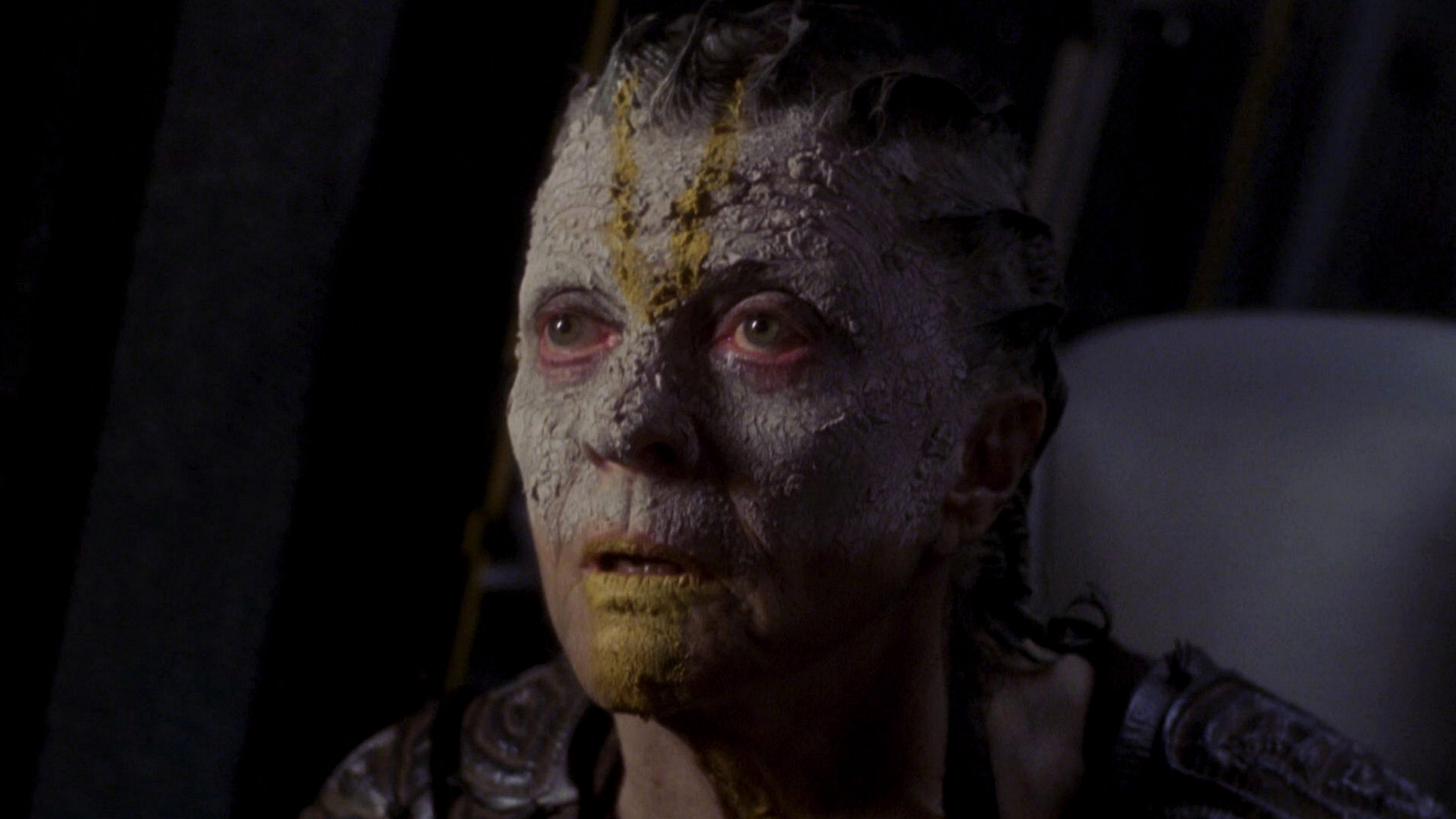
Date not given: Enterprise arrives at Terra Nova, Earth's earliest extrasolar colony. Contact with the settlement was lost 70 years ago, and Enterprise is the first ship sent to investigate what became of the colonists. Archer, Mayweather, Reed and T'Pol take a shuttle to the surface. They discover that the colony is abandoned. There are traces of radioactivity. When a mysterious figure appears, the landing party follows them into a cave system. The encounter ends badly when unseen attackers open fire with machine guns, wounding Reed's leg and forcing the rest of the team to retreat. T'Pol tells Archer that, according to her sensor readings, the attackers are not alien but human - obviously descendants of the original colonists. Determined to free Reed, Archer returns to the surface with Phlox and makes contact with the attackers, who now call themselves Novans. Reed is alive and being held by them. Phlox also examines the Novans and finds that one of them, an old woman named Nadet, is suffering from lung cancer. She agrees to be treated aboard Enterprise along with her son Jamin, under the condition that Reed has to stay behind as a hostage. While on the ship, Phlox cures her illness and discovers that the Novans' water supply is contaminated. Enterprise's records also reveal that Nadet is actually Bernadette, the daughter of one of the settler families. 70 years earlier, an asteroid impact caused the radioactive contamination. The adults perished, while the surviving children took refuge underground. Remembering only a bitter dispute between the colony and Earth that preceded the disaster, they came to believe Earth had deliberately attacked them. Archer concludes that the Novans may need to return to Earth, even against their wishes. T'Pol argues that they have developed their own culture and should decide their future for themselves. When Archer returns Nadet and Jamin to the surface, their shuttle crashes into a cave system. After escaping the wreckage, Archer and Jamin work together to rescue an injured Novan, strengthening the fragile trust between the two groups. In the end, Nadet convinces her people to accept relocation to caves in Terra Nova's safer southern hemisphere. With access to caves and clean water but also reduced radiation levels, the Novans can preserve their way of life with the option of returning to the surface some day.
Review
"Terra Nova" shares a surprising number of similarities with "Strange New World". Both episodes begin with what appears to be a paradise waiting for human settlement, only for that paradise to turn out toxic. In both stories, caves provide shelter and serve as the setting for much of the action. Both involve hostage situations. And in both cases, the worlds are ultimately abandoned as candidates for human colonization. The idea of a poisonous paradise, of course, has a long history in Star Trek, dating all the way back to TOS: "This Side of Paradise". Still, I find it unfortunate that a variation of the same theme appears in two of Enterprise's first five episodes. The story also bears an uncanny resemblance to VOY: "Friendship One", which already showed us how a society survived underground on a poisoned world, took hostages and blamed humanity for its suffering. It also traced the predicament back to an early deep space mission gone wrong. The only major difference is that the victims in the VOY episode were aliens, rather than human settlers. In a broader context, the notion that humanity's 21st century interstellar ventures all ended in catastrophe is a recurring and rather depressing theme in Star Trek, with some more examples still to come.
Returning to the comparison with "Strange New World": despite its many flaws, that episode derived most of its suspense from a single confrontation that remained consistent throughout the story. Once Trip pointed a phase pistol at T'Pol, the situation stayed tense until the resolution. "Terra Nova" takes the opposite approach. Instead of developing one strong central conflict and exploring how the characters deal with it, it piles on revelation after revelation and twist after twist, all designed to make the plot work. Take the aspect that the Novans believe Earth attacked them. The episode constructs an increasingly elaborate chain of events to make that misunderstanding plausible. It then introduces several further complications in the present to force cooperation between the Novans and the Enterprise crew. The shuttle crash and the rescue of the injured Novan are particularly contrived examples. Rather than emerging naturally from the characters and circumstances, much of the story feels engineered to justify the backstory and push the plot toward a predetermined conclusion.
The depiction of the Novans is another weak point. They present themselves almost as an alien species, yet they are simply descendants of human settlers with painted faces. They should have realized long ago that they are human and share a common origin with the people from Earth. The episode attempts to explain their false beliefs through misinterpretation, isolation and lost history, but the result never becomes entirely convincing. Even the eventual reconciliation feels less like a logical realization on the Novans' part and more like the result of the writers introducing one plot device after another until everyone arrives at the desired ending. The characters don't uncover the truth through their own reasoning.
The Prime Directive doesn't yet exist at this point in Star Trek history. In fact, its earliest precursor will take shape in "Dear Doctor", a few episodes later. Since the Novans are human descendants rather than an alien civilization, the Prime Directive would not apply to them anyway. In that regard, the debate between Archer and T'Pol is one of the episode's more interesting elements. Yet I find their positions strangely inconsistent. At first, Archer is reluctant to relocate the Novans by force, while T'Pol seems to advocate intervention. Later, when Archer argues that the Novans should reconnect with their human heritage because it is their birthright, T'Pol suddenly becomes the one arguing for restraint because they should be given the chance to preserve their culture. The reversal is not adequately explained and makes their debate feel less coherent than it should.
Overall, I still find "Terra Nova" disappointing, but I raise my rating from two to three points. Although the episode is derivative, overengineered and often unconvincing, I do not think it is any worse than "Strange New World". That is hardly a compliment, however. Both episodes begin with solid premises and end up wasting much of their potential.
Annotations
- Nitpicking:
- It doesn't make sense that Enterprise has no more than two shuttles. As a starship without a transporter as a regular means of transportation, Enterprise would have to rely heavily on the shuttlepods, each of which can transport only six people. And what about cargo? I doubt they would beam large amounts of food supplies. So what happens if one shuttle is out of service and the other one is already on a mission?
- I anticipated that the phase pistol would have more than just the stun and kill settings, contrary to what Archer said in "Broken Bow". The third of the two settings is a continuous beam for cutting. This alone is not an error (after all, something like that would even be possible with a present-day laser), but it undermines the self-imposed restriction after only four episodes.
- The statement that Terra Nova is the only inhabitable planet within 20ly of Earth contradicts the idea that there is one in the Alpha Centauri system (4ly away), which is mentioned several times as a Federation world (either a human colony or an alien civilization). There may be two possible explanations. Either Alpha Centauri was already known to humans as the home of an alien civilization and therefore wasn't taken into account, or it was made inhabitable through terraforming at a later date. In the latter case, however, it is unlikely that Zefram Cochrane ever lived there.
- T'Pol gives the radiation level on the planet as "less than 800 millirads" and says that "a few hours of exposure shouldn't pose a risk". The rad, however, is a unit of absorbed dose rather than a measure of radiation intensity.
- Remarkable language: The Novans use some colorful language (reminiscent of the Vori in VOY: "Nemesis"), such as "before families" = ancestors, "skyship" = starship, "overside" = surface, "underside" = underground, "belly hollow" = hungry, "to gut" = to poison, "to rot" = to die, and "shale" = lie.
- Remarkable dialogue: "Terra Nova?" - "I'm surprised you've never heard of it." - "I'm not familiar with the early years of human space exploration." - "Really? Every school kid on Earth had to learn about the famous Vulcan expeditions." - "Name one." - "... ... History was never my best subject." (T'Pol, Archer, Tucker)
- Remarkable facts:
- It is mentioned for the first time that Phlox is a Denobulan.
- Terra Nova is the only inhabitable planet within a range of 20ly from Earth. The journey of the colony ship Conestoga took nine years. It was disassembled to form the foundation of the colony. After the first five years, contact with the settlers was lost. The reason was that an asteroid struck the planet and the resulting dust cloud made communication impossible. Only the children survived the disaster and retreated into the caverns. That was 70 years ago.
- Remarkable ship: The Conestoga can be seen briefly on a display. It fits well into the design lineage and resembles the conjectural S.S. Valiant as depicted in the Star Trek Encyclopedia I.
Rating: 3
The Andorian Incident
Synopsis
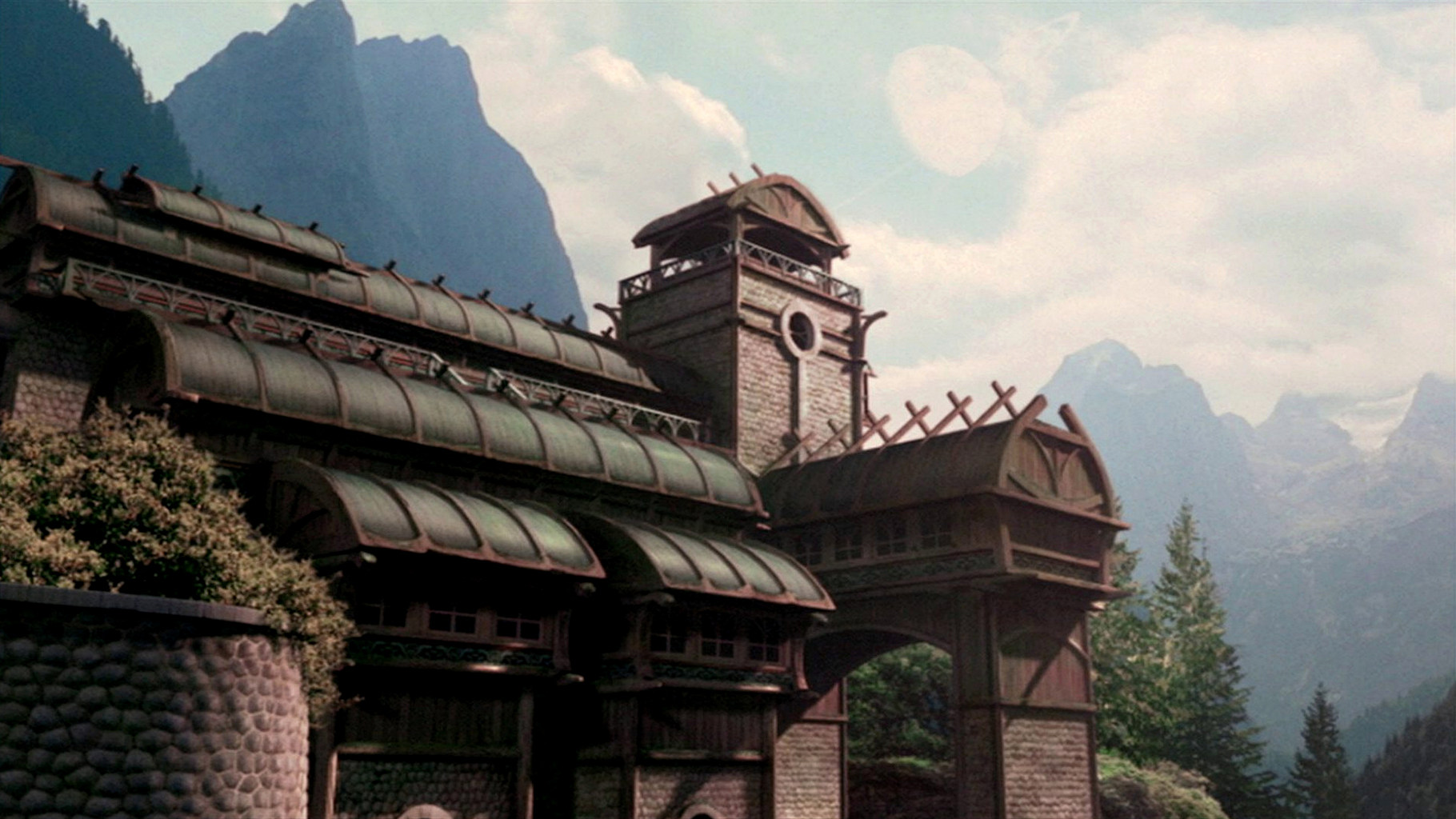
Date not given: Seeking a better understanding of Vulcan culture, Archer asks T'Pol to arrange a visit to the remote ancient monastery of P'Jem. Although reluctant, she agrees. Archer, Tucker and T'Pol travel there by shuttle, without being able to make prior contact as the monks reject modern technology. They are greeted by a Vulcan elder, who tells them it is a inappropriate time for a visit because the monks are in kolinahr. But something seems wrong. The monastery is in disarray, and the landing party catches sight of someone hiding from them. The intruders turn out to be Andorians, a species previously unknown to humans. Led by the fierce Shran, they take Archer's group hostage, just like the monks before them. Shran claims that the Vulcans are using the monastery as a cover for a secret surveillance station spying on the Andorians. Convinced that the "Pinkskins" are allied with the Vulcans, he repeatedly interrogates and assaults Archer, demanding information the captain simply does not possess. Archer wants to contact the ship, although T'Pol argues against a violent rescue attempt. Tucker manages to activate an old transmitter hidden within the monastery's catacombs and secretly contacts Enterprise, telling Reed to stand by. Archer, meanwhile, has discovered a secret passage that leads straight into the room where the Andorians are assembled. Using this advantage, a landing party led by Reed beams down and launches a surprise assault. The hostages overpower their guards, but Shran escapes to the catacombs. During a firefight, a hidden door is uncovered deep within the catacombs, revealing a vast surveillance complex concealed beneath the sacred site. The discovery proves that the Andorians' suspicions were correct. Archer provides Shran with evidence of the installation, allowing the Andorian commander to expose the deception.
Review
Ever since I considered revisiting my old Enterprise reviews, there were a couple of episodes whose ratings I firmly expected to raise. "The Andorian Incident" was one of them. Back in 2001, I seemed to be the only person who disliked the episode and gave it a measly two points. But my reasons were quite clear. First, it was the third hostage situation in only six episodes, and that premise was becoming repetitive. Second, Shran struck me as little more than a one-dimensional fanatic without much potential. Third, the episode presented the Andorians as violent and the Vulcans as deceitful, and ultimately argued that the latter somehow justified the former. I didn't accept that argument back then, and I was curious whether I would see things differently today. Over the years, I rewatched the episode a few times, but never with the intention of reassessing it in the broader context of Enterprise. This time, I was fully prepared to revise my opinion.
However, rather than jumping straight to the conclusion, it's worth looking at the story chronologically, which I neglected to do in my old review. The episode begins with Archer's desire to learn more about Vulcan culture. He asks T'Pol to arrange a visit to the ancient monastery on P'Jem. The trip isn't intended as shore leave for the crew but as an opportunity for Archer and Tucker to gain a deeper understanding of the people who, in their view, have been guiding and frustrating humanity in equal measure. Once they arrive, they discover that something is wrong. The monastery is in disarray and the Vulcan elder attempts to maintain the illusion that the monks are peacefully engaged in kolinahr. Archer keeps asking nagging questions, which is awkward because he behaves exactly like the insolent and nosy human T'Pol may have feared he would be. Anyway, it brings the truth to light. A group of Andorians has seized the monastery in search of a secret Vulcan listening post.
The Andorians are portrayed as obsessed. And they are violent, which is in line with how Shras describes his people in TOS: "Journey to Babel". Well, Archer and Tucker initially attack an intruder, but it is the Andorians who arrive armed, take hostages and repeatedly resort to force. Archer is beaten several times during the episode. Shran and his men are determined to locate the surveillance installation and are willing to hurt and kill to achieve their goal. 25 years ago, I viewed Shran as the leader of some extremist faction, essentially a terrorist. We now know that the Andorian Imperial Guard is the regular military of the Andorians. That realization actually makes the episode more troubling to me, not less. We're not looking at a rogue group conducting an unauthorized operation. It's effectively a military incursion into Vulcan territory.
Anyway, the core of the story, for most of the runtime, is the hostage situation and the question of how to resolve it. The plot is constructed in such a way that overwhelming the Andorians is difficult because calling for help is only possible via an old transmitter that may not even work and requires Tucker's engineering expertise. Also, we're told that a rescue team using the transporter would immediately be detected and shot. The second problem doesn't really work for me. There would be numerous places where Reed and his team could beam down without being discovered at once. Yet the episode treats this as an insurmountable obstacle and builds what it presents as a clever solution around it. Archer notices that three openings in the catacombs correspond to the eyes and mouth of a relief in the room where Shran and his men are stationed. He then allows himself to be beaten up yet again, only to drop a figurine through the mouth so Tucker can confirm that both locations are connected. In my view, it's a rather lame twist and an excuse for more violence, and to give Reed an opportunity to blow something up, in this case the face in the wall.
The episode eventually reveals that the Vulcans are indeed operating a covert listening post beneath the monastery. But I remain unconvinced that this discovery justifies the Andorians' actions. Does uncovering espionage legitimize an armed assault? Does it justify taking civilians as hostages? I don't think so. The story seems to assume that once the listening post is discovered, the Andorians are automatically exonerated. That is precisely the moral argument I rejected in 2001, and my opinion on it hasn't changed. I also find Archer's role in the resolution difficult to accept. By the end of the episode, he effectively sides with Shran and provides him with evidence of the secret installation. Archer has only just learned that the Andorians exist. He has virtually no understanding of Andorian-Vulcan relations, the relevant treaty obligations or the broader political situation. Yet he suddenly acts as though he is qualified to judge the dispute and determine that the Andorians have a right to the evidence. Perhaps he learned more off-screen, but the episode doesn't do enough to justify Archer's confidence in making such a consequential decision. Archer also ends up reinforcing his prejudices rather than gaining a better understanding of the Vulcans, which was the entire purpose of the visit in the first place. That makes the outcome even more depressing.
To be fair, there are several things the episode does well. Most notably, it introduces the redesigned Andorians. The animated antennae remain one of Enterprise's most impressive makeup achievements. While the added forehead ridges were probably unnecessary, the overall redesign is an excellent example of how to modernize a classic species while preserving visual continuity. The Enterprise makeup department deserves credit for getting the look exactly right. There is also Shran himself. Within this episode, I find him fairly one-dimensional, as already mentioned. He is memorable largely because Jeffrey Combs brings so much charisma to the role. The full potential of the character would only emerge in later appearances, making his introduction more significant in hindsight. The design of the Vulcan monastery is another strength. Both the exterior location and the interior sets create a distinctive atmosphere and help establish Vulcan culture as something ancient and spiritual. Visually, P'Jem is one of the most memorable locations of the first season.
"The Andorian Incident" is undeniably important to Enterprise. It introduces the updated Andorians, establishes Shran, expands the political landscape of the Alpha Quadrant and lays the groundwork for future stories. Many viewers would therefore argue that it deserves a respectable rating, perhaps six points or even more. I understand that argument, but I can't bring myself to raise the rating significantly. Despite its significance for the series, I still find it more repelling than compelling.
Annotations
- Nitpicking:
- If the Vulcans and Andorians are from neighboring star systems as T'Pol explains, why would the Vulcans use a sensor array on a remote planet to spy on them?
- Why doesn't anyone of the human Enterprise crew know anything about the Andorians, who are neighbors and rivals of the Vulcans, although Reed and Sato have permanent access to the Vulcan database?
- The topology of the listening post is impossible. As seen from the door that Archer opens, the facility extends upward across many levels, even though the landing party descended only a few meters into the catacombs at most. Moreover, the monastery itself seems to be smaller than the vast complex revealed beneath (and above!) it and is situated on top of a steep cliff. The sheer size of the installation raises further questions about how it could have been constructed and operated without anyone noticing. There would have to be some kind of main access route for personnel and equipment, unless everything was beamed in and out. Also, where does the power come from, and wouldn't the Andorians be able to pinpoint where power is generated or consumed?
- Remarkable quotes:
- "So if anyone has any suggestions, I'm all ears. No offense." (Archer, to the Vulcans)
- "We're in your debt." (Shran to Archer, foreshadowing his return)
- Remarkable make-up: The new Andorian make-up looks great. It is a careful improvement of what we have seen in TOS, and the moving antennae are a fantastic idea. Only the forehead ridges are completely unnecessary.
- Remarkable building: The Vulcan monastery is actually the first Vulcan building we see in 35 years of live action Star Trek.
Rating: 3
Breaking the Ice
Synopsis
Date not given: Enterprise encounters a large comet with deposits of the rare mineral eisilium. Archer decides to investigate and take samples. A Vulcan vessel, the Ti'Mur commanded by Captain Vanik, is also present, with the intention to monitor Enterprise, rather than the comet. Archer invites Vanik to dinner in an attempt to improve relations. The meeting proves awkward, as Vanik shows no interest at all in socializing. On the comet, Reed and Mayweather plant explosive charges to reach the eisilium. The operation succeeds, but it also alters the comet's rotation, causing parts of the surface to turn toward the sun and become increasingly unstable. Meanwhile, Trip has discovered encrypted communications between T'Pol and the Vulcan ship. Suspecting that she may be secretly reporting on Enterprise, Archer authorizes him to decode the messages. When Trip learns that the correspondence is personal rather than official, he informs her that he knows about it. She is supposed to return to Vulcan for an arranged marriage, a decision that would require her to leave Enterprise permanently. Trip offers advice, encouraging her to make her own choice, but his distinctly human perspective is of limited comfort. On the comet, conditions rapidly deteriorate. Mayweather injures his leg, cracks begin spreading through the ice and their shuttlepod crashes through the surface. Archer orders to use the grappler to pull the shuttle free, but the attempt fails. Reluctant to accept assistance from Vanik, he wants to try it again. Ultimately, Trip and T'Pol convince him that pride is a luxury he cannot afford. The Vulcan ship uses its tractor beam to free the shuttlepod and rescue the stranded crewmen. T'Pol makes a decision about her future. Rather than returning to Vulcan, she chooses to remain aboard Enterprise.
Review
Just one week after "The Andorian Incident", Enterprise returns to the subject of human-Vulcan relations in "Breaking the Ice". That in itself is not a problem, but I find it unfortunate that the events of the previous episode are not referred to at all. Archer has just exposed a secret Vulcan listening post to the Andorians, an act that could easily have provided a compelling reason for the Vulcans to observe his every move, which isn't considered here.
Anyway, the episode opens with Enterprise investigating a massive comet, larger than any ever observed by humans. Nearby is a Vulcan vessel commanded by Captain Vanik, whose presence quickly becomes a source of irritation. Rather than in the comet itself, the Vulcans seem to be interested solely in monitoring Enterprise and waiting for the human crew to make mistakes.
Archer invites Vanik to dinner, but the encounter is a disaster. The Vulcan captain has already eaten aboard his own ship, refuses to engage in conversation, shows no interest in a tour of Enterprise and rebuffs every attempt Archer makes to establish some kind of relationship. He is extremely dismissive, even by Vulcan standards. Of course, one could argue that Archer approaches the situation entirely from a human perspective and makes little effort to understand how a Vulcan might prefer to interact. Perhaps he should have consulted T'Pol beforehand or adjusted his expectations. Nevertheless, I can understand Archer's growing frustration. When Vanik explicitly states that he has no interest in humans, Archer's blunt demand to know how long the Vulcans intend to spy on his ship may be undiplomatic, but it is also understandable.
The central plot, at least in a superficial view, concerns Reed and Mayweather's mission to collect the rare mineral eisilium from the comet. In the process, they accidentally alter the comet's rotational axis, exposing the surface to sunlight. The ice begins to crack, their shuttle falls into a crevasse and they find themselves trapped beneath the surface. Yet the episode is not really about the action, which is only mildly thrilling anyway. Rather than that, the resolution carries a lesson for Archer. He prefers to solve the problem himself with Enterprise's grappler. When the attempt fails, he wants to try again rather than ask for help. Pride is clearly a factor. Only after considerable urging from both Trip and T'Pol he sets aside his stubbornness and accepts Vulcan assistance. Vanik saves the day, and Archer is forced to acknowledge that his determination to prove humanity's independence can sometimes become a liability. But I feel this realization is a bit thin as a takeaway.
The perhaps more interesting human-Vulcan storyline involves T'Pol and Trip. After Trip discovers and decodes a message that turns out to be private correspondence, he learns that she has been called back to Vulcan for an arranged marriage to a man named Koss. Feeling guilty about the invasion of her privacy, he attempts to apologize, but the conversation quickly turns into mutual reproaches. Trip cannot understand why she encrypted the message when unencrypted communications would not have been monitored or read by anyone aboard Enterprise. A little later, T'Pol confides in him, but only reluctantly. She even admits that he would not have been her first choice, but he is the only person aboard who knows about the situation. Trip's advice does not come from a Vulcan perspective. He offers a modern human viewpoint: decide what you want, not what others expect of you. It is a simple idea, but one that feels alien to T'Pol, so much that she initially dismisses it. By the end of the episode, however, she chooses to remain aboard Enterprise, suggesting that she has begun to consider her own desires as distinct from her obligations. I don't know whether she fundamentally changed her mind and whether Trip really had a decisive role. In any case, the story presents this as the moment when the ice begins to break between T'Pol and the crew, and especially between T'Pol and Trip. We know where that relationship will eventually lead.
"Breaking the Ice" also includes a delightful side story involving questions submitted by school kids on Earth. While not of further relevance to the main plot, these scenes add a charming touch. Archer eagerly answers the first question himself, explaining how the protein resequencer produces food. Another one concerns dating aboard the ship, prompting him to explain that relationships are permitted, though the limited space can make things complicated. When asked how humans communicate with alien species, Archer turns to Hoshi, who explains the universal translator and the occasions when she must step in personally. Then comes the most curious question of all: what happens when you flush the toilet? Because it is "an engineering question", Archer immediately turns to Trip, who suddenly realizes he is expected to answer. The moment is wonderfully played. He awkwardly pauses the recording and mutters about the "poop question" before trying to formulate a suitable explanation. It is difficult to imagine a TNG dialogue with the word "poop", which makes the scene feel refreshingly down-to-earth. Another question is directed at Phlox, who launches into a lengthy and enthusiastic discussion of germs in space. Archer eventually cuts him off before he can continue for several more minutes. While the interruption is amusing, I feel a little sorry for Phlox. It is not exactly polite.
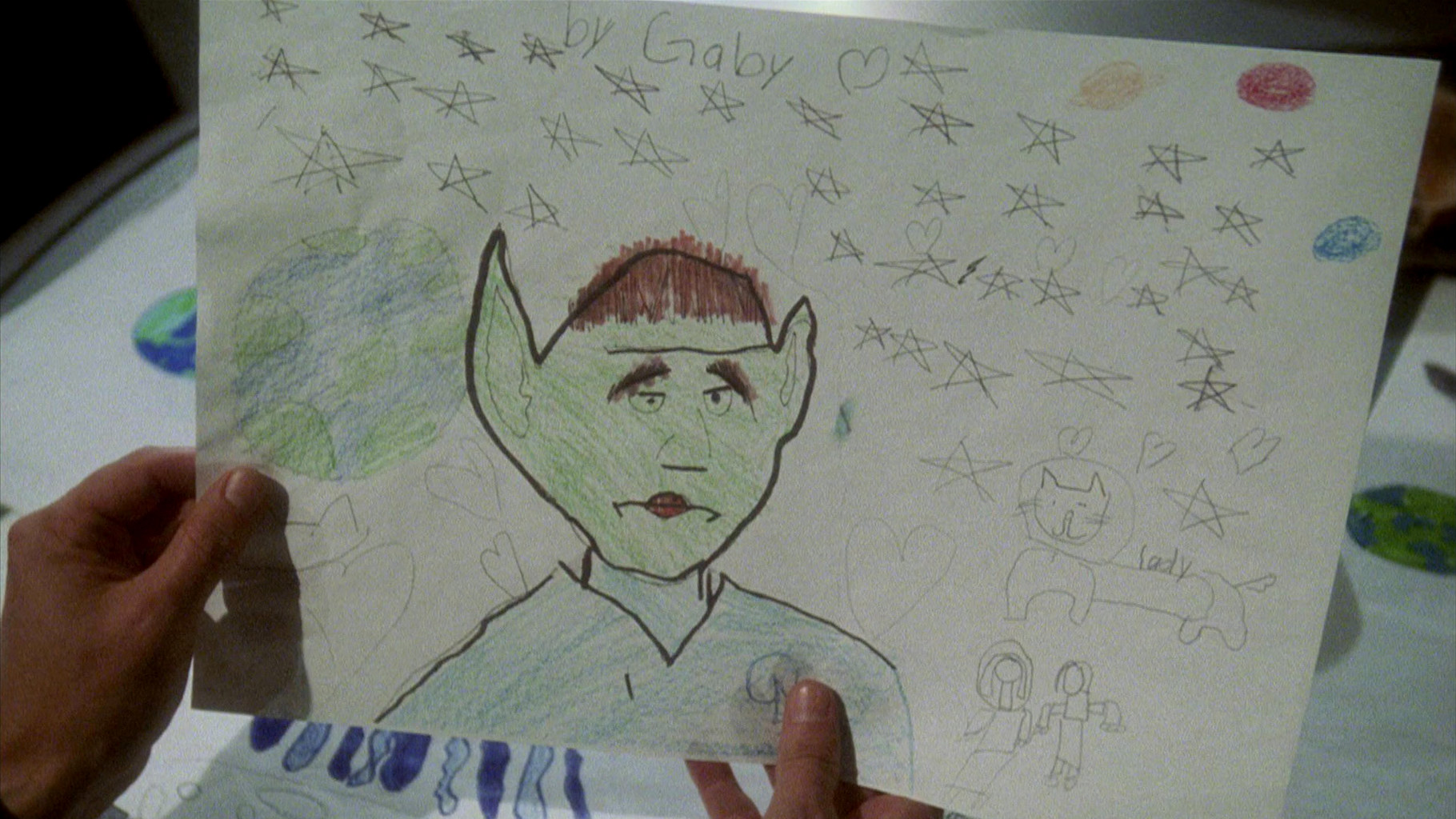
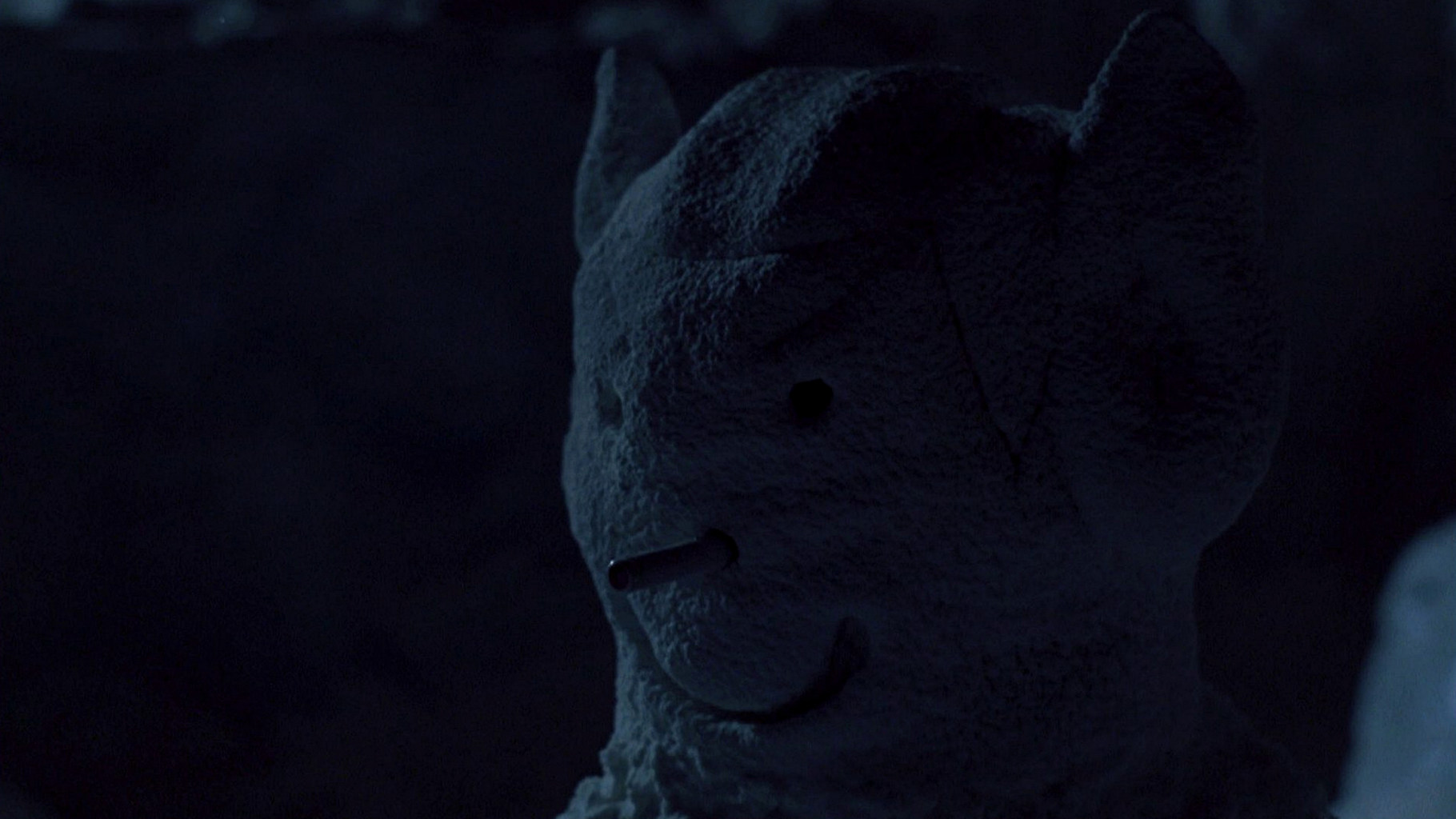
I also enjoy the children's drawings shown at the beginning of the episode. In particular, I love the picture of T'Pol with oversized ears. The joke is mirrored later on the comet, where Reed and Mayweather build a snowman with Vulcan ears of its own. Small moments like these give the episode a good deal of charm.
Overall, "Breaking the Ice" is a bit mistimed just one week after "The Andorian Incident". It combines a straightforward adventure with meaningful character development. The comet plot reinforces the unfortunate theme of Vulcans patronizing humans, but both Archer and T'Pol take important steps to understand the other side, independently of each other. Combined with the humorous school kids subplot, the result is a fair episode, even if it never quite becomes a really good one.
Annotations
- Nitpicking:
- We learn how the protein resequencer (for food) and the biomatter resequencer (for waste) work, and it sounds a lot like the replicator in TNG, which also works on a molecular basis. This is anachronistic, but at least the device on Enterprise doesn't seem to be able to handle inorganic materials.
- I wonder how a comet can have an acceleration of approximately 1g. Its density would have to be enormous for that.
- It is strange that this is supposed to be the largest comet ever encountered by humans. There should be many rocks of this size in the Oort belt at the outer rim of our solar system (that fortunately don't come close to the Sun or the planets).
- The mineral eisilium is unknown to humans, but why have the Vulcans given it a German/Latin(ized) name?
- Why is T'Pol supposed to marry so late? She is 65 years old. Spock was in his early 30's in TOS: "Amok Time", and even Tuvok, who got married after his first Starfleet career, was under 40. So there must have been many deferments to T'Pol's marriage already. Perhaps it is suddenly urgent for biological reasons?
- Remarkable quote: "Your inexperience and your arrogance are your enemies, not us." (Capt. Vanik)
- Remarkable facts:
- Dr. Phlox is from the star system Denobula Triaxa.
- Trip Tucker had three relationships prior to the episode (not sure if he counts in the one from "Unexpected" ;-)).
- T'Pol's fiancé is named Koss, and he's an architect.
- Remarkable starship facts:
- The Ti'Mur is a Surak-class ship (although "Suurok" as in the closed captioning seems to be more generally accepted by now). It has a top speed of Warp 6.5.
- Captain Vanik has been in command of this ship for 15 years. He has been serving in the space program for 76 years altogether.
- Archer has once been to a Vulcan vessel, the Maymora-class ship Yarahla, headed by Captain Tok.
- T'Pol recall count: #2
Rating: 5
Civilization
Synopsis
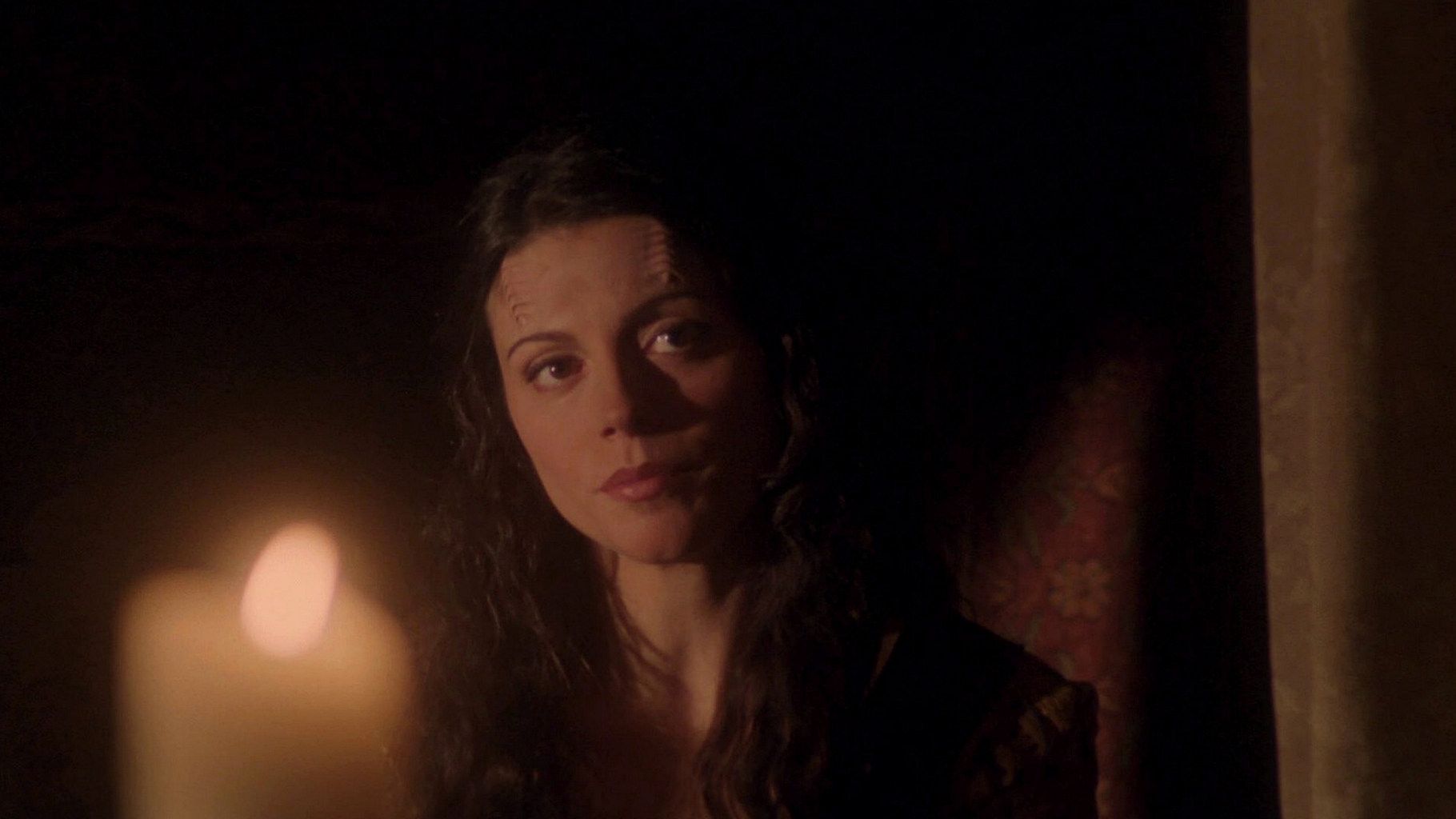
July 31st, 2151: Enterprise discovers a Minshara-class planet with a population of roughly 500 million. There are no EM emissions, which points to it being a pre-warp civilization. However, T'Pol detects neutrino emissions that should not exist on a world at this stage of development. Archer decides to investigate. After Hoshi has learned enough of the local language to program the universal translator, she, Archer, Tucker and T'Pol travel to the surface in disguise. The inhabitants, known as the Akaali, are physically similar to humans, allowing the landing party to blend in with some make-up. They trace the neutrino emissions to an antiques shop. Archer and Tucker break into the building at night but don't get past the forcefield that protects the antimatter reactor. They are discovered by a woman named Riann, but T'Pol stuns her. The captain stays with Riann. He learns that she is an apothecary and has been conducting an investigation of her own. She suspects that the business owner, a man named Garos, caused a series of deaths through poisoning among the Akaali, among them her brother. The following day, the landing party finds out that Garos is an alien. In the night, Archer and Riann observe how suspicious deliveries are transferred into a shuttle using a tractor beam. They get into a fight with beam weapons with a man who turns out to be a reptilian alien. Archer finally has to reveal the truth to her: he is not from her world but from another planet. Using a security key taken from the unconscious alien, they gain access to the underground installation where Malurians mine a valuable veridium isotope and are using a chemical lubricant called tetracyanate 622, which is contaminating the water supply. As Archer and Riann attempt to shut down the reactor powering the installation, they trigger a security mechanism and become trapped inside the facility. Meanwhile, Enterprise comes under attack from a well-armed Malurian vessel that has been hiding on the far side of the planet. The crew devises a plan. Once Archer and Riann manage to deactivate the facility's forcefield, Enterprise transports the reactor into space and detonates it near the Malurian vessel, which also disables the ship. Before leaving, Archer asks Riann to keep the existence of extraterrestrial visitors a secret. She agrees, noting that no one would believe her anyway.
Review
"Civilization" is one of those Enterprise episodes that somehow fly under the radar. It is neither a fan favorite nor a failure. Looking back at my original review from 25 years ago, I think I underrated it. At the time, I regarded it as little more than a slight variation of a familiar Star Trek formula. Part of that impression came from the story's similarities to TNG: "Thine Own Self", in which Data inadvertently contaminated a pre-industrial society. Here, the contamination is calculated rather than accidental, but the parallels are hard to overlook. What I appreciate more today is the way the episode adapts those traditional themes to the setting of the 22nd century.
T'Pol warns Archer that simply visiting the underdeveloped planet carries risks for them. The Vulcans already have some sort of Prime Directive, humans don't. Archer is eager to investigate and make contact, while T'Pol is aware of the potential cultural consequences. In that sense, "Civilization" explores ideas that would become fundamental in later centuries, in a period when they are not yet fully developed. There are also some nice touches that emphasize we're in an early era. Before the landing party can visit the surface, Hoshi must spend time learning the local language of the city and program the universal translator. Phlox can be seen disguising Hoshi with what is quite literally make-up. The process is clearly less advanced than it would at the time of TNG. Phlox comes across as an in-universe version of Michael Westmore, carefully applying prosthetics before the mission can begin.
Once the story moves to the surface, however, some of my original criticisms remain. Much of the plot unfolds a little too conveniently. Archer and the others quickly encounter Riann, who already suspects that something is wrong with the shop. Together they identify the source of the contamination, obtain the key to the facility and eventually defeat the aliens responsible. The investigation proceeds smoothly but also a bit predictably. Archer's decision to reveal his true identity to Riann feels inevitable from a storytelling perspective. Had he maintained the deception, much of the emotional impact of the episode would have been lost. Still, it is another example of the plot taking a straightforward route to its destination.
I think the chemistry between Archer and Riann works well, and I wonder whether their romance should have been more in the focus of the narrative. One of my favorite moments comes when the universal translator fails, leaving Archer unable to understand a word Riann is saying. He has to gain time to fix the device, and so he kisses her. In the end, when Archer kisses Riann goodbye, she asks whether his universal translator is malfunctioning again. It is a funny callback and a fitting conclusion to their brief relationship. Moments like these give the episode a warmth that I didn't miss but somehow failed to appreciate when I first watched it. Looking back, I also find Riann herself more interesting than I once did. She is intelligent, curious and proactive.
At the same time, I still think the episode misses some opportunities. It could have explored the cultural implications of first contact in greater depth. It could have addressed the question at which point helping becomes inadmissible interference. The latter will happen for the first time just a couple of episodes later, and unfortunately in an awkwardly constructed and scientifically dubious story in ENT: "Dear Doctor".
All in all, "Civilization" is a good episode rather than a great one. It combines a detective story, an alien encounter, a little romance and some action, but it never fully develops any of those elements. Nevertheless, I now think it is considerably better than I gave it credit for in 2001, when I described the episode as one-dimensional. My rating rises from four points to six.
Annotations
- Continuity: A technology that I like in this episode is the transporter. After beaming it up from the surface, it is necessary to materialize the antimatter generator on the transporter platform first before it can be beamed out in space. In other words, there is no site-to-site transport yet.
- Nitpicking: How can "acoustic relays" pick up voices from a planet's surface through the vacuum of space?
- Remarkable quote: "Starfleet could have sent a probe out here, to make maps and take pictures, but they didn't. They sent us - so that we could explore. With our own senses." (Archer)
- Remarkable scene: When the translator fails and Archer hears Riann speak in her native language, he gives her a passionate kiss while trying to fix the translator. Although Riann seems to be pleased, he excuses his behavior. He claims that someone walked by and that he thought it would have been the best disguise to pretend they were a couple. Later, when Archer gives her a goodbye kiss, Riann wryly asks, "Is your translator broken again?" - obviously she is smarter than he thought.
- Remarkable facts:
- The planet Akaali is 78ly from Earth and is inhabited by roughly 500 million people. The lack of EM emissions is a clear sign of a pre-industrial culture.
- Garos, on the other hand, is from the Malurian system. This may be the same system in which Nomad will wipe out all life (TOS: "The Changeling") 100 years later. Garos says that he came to Akaali 18 months ago. He appears to know the Tellarites, and it sounds as if Tellarites are involved in his mining project (and that we will see them later in the series). :-)
- The alien look of the crew is simple make-up and not yet some sort of plastic surgery. Dr. Phlox may have objected, "I'm a doctor, not a make-up artist" but he seems to have fun with this new role.
Rating: 6
Fortunate Son
Synopsis
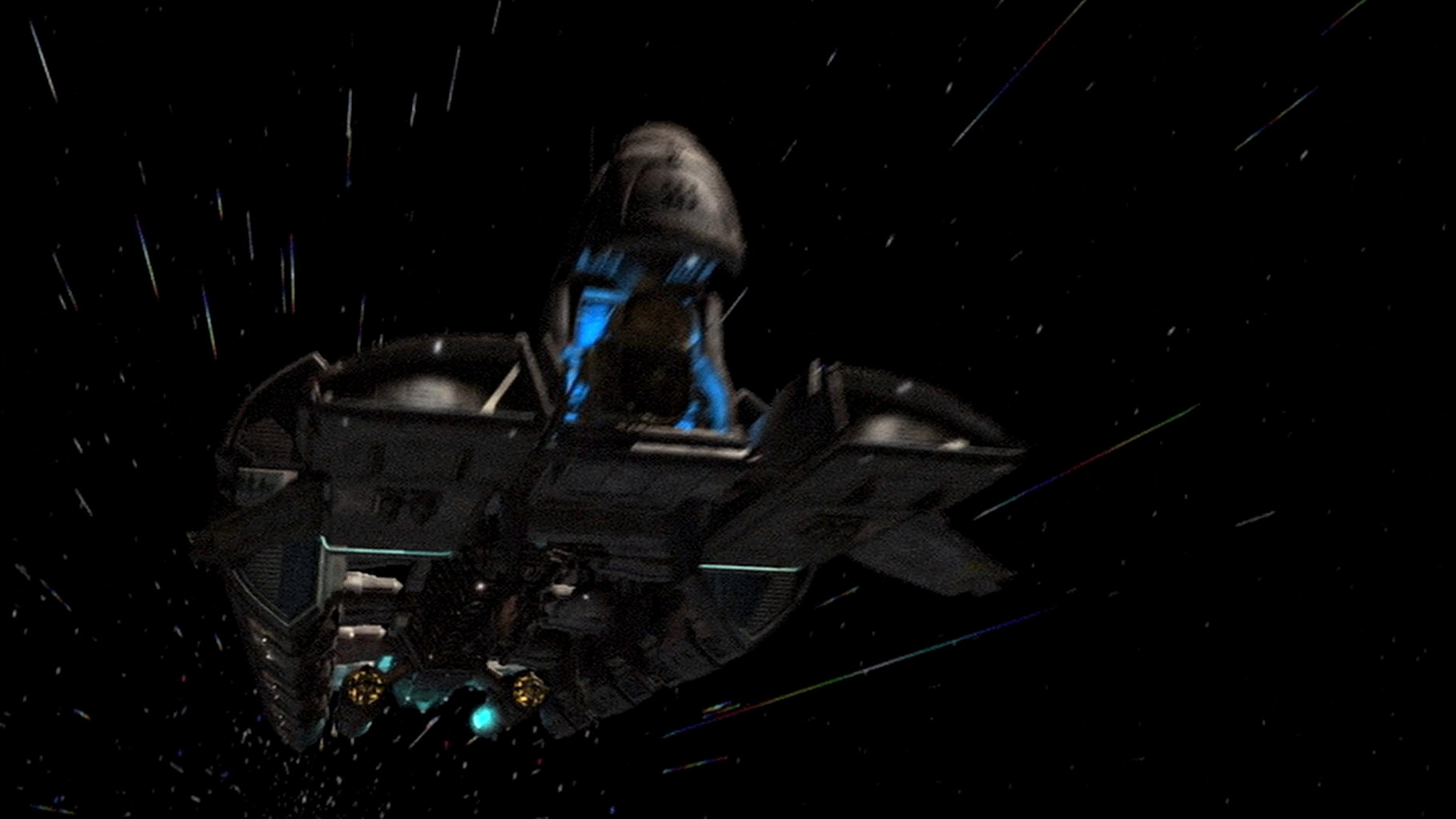
Date not given: Enterprise receives orders from Admiral Forrest to respond to a distress call from the ECS Fortunate, an Earth cargo ship. When Enterprise arrives, the freighter is damaged and surrounded by debris. Aboard the Fortunate, Archer's team is greeted by Matthew Ryan, the ship's first officer. Captain Keene was seriously injured when Nausicaan pirates boarded the ship, leaving Ryan in command. Phlox examines the captain and finds brain damage that will take time to heal. Ryan is defiant and insists that his crew can handle the situation without Starfleet assistance but eventually agrees to have the Fortunate's systems repaired and upgraded. As the repairs are almost finished, T'Pol detects a non-human lifesign aboard the freighter. It turns out Ryan has secretly taken one of the Nausicaan attackers prisoner and intends to use him to get past the defenses of the pirates responsible for the assault. Archer orders Tucker to remove everything newly installed on the Fortunate to force Ryan to cooperate. Ryan appears to give in and agrees to show Archer the prisoner. But he leads the Enterprise landing party into a different cargo pod, traps them inside, breaches the hull with an EM pistol, jettisons the pod and goes to warp. Enterprise must rescue Archer and his team before it can pursue the freighter. Obsessed with revenge, Ryan tracks the Nausicaans to an asteroid outpost where the ship that attacked the Fortunate is hiding. But there are also two other Nausicaan ships, so the Fortunate is outgunned. The Nausicaans board the Fortunate in an effort to recover their captured crewmate. Enterprise follows the freighter's warp trail and arrives in time to intervene. Archer attempts to negotiate, but the Nausicaans refuse to stand down. Reed fires spatial torpedoes to convince them, upon which the Nausicaans agree to leave if they get back their crewman. In the end, Mayweather, who is a "space boomer" himself, convinces Ryan that revenge will only lead to more bloodshed. Ryan releases the prisoner. After his recovery, Keene degrades him to able crewman, and the ships part ways.
Review
"Fortunate Son" is another pivotal episode in Enterprise's first season. Like "The Andorian Incident", it is essential for the worldbuilding. Like "Fight or Flight", it becomes very clear we are not in the 24th century yet. Space is vast and humanity's interstellar infrastructure is still in its infancy. Freighters spend years traveling between worlds at Warp 1.8, and an entire culture has developed around that way of life.
The episode is also notable because it finally gives Ensign Travis Mayweather something substantial to do. Up to this point, he has mostly remained in the background, but his experience growing up aboard a cargo ship becomes important in "Fortunate Son". Through his eyes, we get our first look at the "boomer" culture as it already existed before Starfleet began pushing deeper into space. Much of the episode's strength comes from the relationship between Mayweather and Matthew Ryan, the acting captain of the ECS Fortunate. Ryan is a man who has worked hard for his position and who shares many of Mayweather's experiences. The two men chat about life aboard freighters, including the art of turning nutri-paks into something edible.
We then learn that Ryan's parents were aboard another freighter, the North Star. He doesn't have to give Mayweather more details because it seems to be common knowledge that some kind of disaster, perhaps an accident but more likely an attack, claimed their lives, with Ryan himself being one of the survivors. This may help explain some of the anger he carries with him. After the revelation, it becomes clear that they have chosen very different paths. Mayweather joined Starfleet and embraced the future. Ryan stayed with the freighters and resents Mayweather for leaving what he considers his own people. Well, the ensign is trying a bit too hard to sell him on Starfleet life and on progress. Ryan, on the other hand, defiantly insists that warp 1.8 is enough for him. He would rather spend years traveling between worlds than make the same journey in months. From a logical perspective, this is absurd, but perhaps that is exactly how deeply rooted the freighter culture is.
The central conflict arises from the Nausicaan attack on the Fortunate, but it is not the one with the Nausicaans. With the captain injured, Ryan assumes command. He has taken one of the attackers prisoner, whom he hides on the ship. This is where the culture clash between the space boomer and Starfleet becomes an open conflict. Watching it today, I find myself a bit more sympathetic to Ryan than I was 25 years ago. Archer is appalled when he discovers the captive and immediately demands an explanation. Yet from Ryan's perspective, the situation is not so simple. He travels through a region of space where there is no law enforcement, no nearby Starfleet patrol and no one else who would protect his ship. Taking a prisoner after an unprovoked attack does not strike me as unreasonable. In fact, one could argue that he has every right to do so.
The real problem is that Ryan goes beyond self-defense and turns the situation into a quest for revenge. He deceives Archer, traps the Enterprise team in a cargo pod and pursues the Nausicaans on his own. At that point, he clearly crosses a line. What began as a desire to protect his people becomes a personal vendetta. Still, I think the episode benefits from allowing us to understand why Ryan acts the way he does. We sure can support Archer's position, and we have to after Ryan puts revenge above reason. But we also have to consider that Archer may be willing to repair Ryan's ship, but he has no intention of confronting and intimidating the Nausicaans before Ryan forces him to. To be clear, I'm not defending Ryan's actions. Revenge is not justice, and the episode is right to show the consequences of his actions. Nevertheless, I appreciate that the story allows room for his perspective rather than portraying him as a simple villain.
The resolution is that Mayweather finally reaches him. Ryan would not have listened to Archer. But he does listen to someone who comes from the same world he does. Despite Ryan's accusation that Mayweather abandoned his people, Mayweather is still one of them in many ways. Yet the scene is slightly contrived, as Ryan ultimately accepts arguments that are not really new and that he must have considered before. Even so, the emotional logic works because of who delivers them.
Beyond its themes, the episode is simply entertaining. It is exciting, meaningful and occasionally heartwarming. There is also a pleasant near-future charm to the depiction of humanity's early expansion into space. The freighters, the crews and their families and their way of life all contribute to making the setting feel distinct from later Star Trek.
One small disappointment comes during the climax. Enterprise confronts the Nausicaans, but the space battle happens off-screen. We hear about what is happening more than we actually see it. Whether this was a budget issue or a production decision, it leaves the final confrontation feeling somewhat less dramatic than it could have been.
Nevertheless, "Fortunate Son" remains one of the strongest episodes of the season. It expands the setting, develops Mayweather, presents a conflict with genuine moral complexity, and offers an interesting look at a part of humanity's spacefaring culture that later Star Trek largely leaves behind. I gave the episode seven points when it originally aired. Today, I raise that rating to eight.
Annotations
- Continuity: Travis Mayweather's parents, his sister and her husband are still on the Horizon. We will see the ship in "Horizon" but not his sister, who somehow will be replaced by a brother Mayweather doesn't have yet.
- Nitpicking: FTL communication between the ship and Earth is possible in real time. There is not the slightest delay when Archer and Admiral Forrest talk with each other. I am aware that TNG was inconsistent about FTL communication speed too (which was usually real-time but sometimes took hours). The Enterprise producers and writers missed a clear opportunity to let their technology appear less advanced and to make interstellar communication at least a bit more plausible. They should have shown the real-time talk after the release of the first subspace amplifier, not before.
- Remarkable quote: "They say that, for a split second, you can actually feel yourself at both places at once." (Ryan, about the transporter)
- Remarkable scene: As some children are playing hide-and-seek on the Fortunate, T'Pol finds the only girl behind a hatch, who signals her to remain silent. When a boy asks, "Have you seen Nadine?", T'Pol replies, "I'm sorry, I don't know which child is named Nadine." She just told him the truth. ;-)
- Remarkable starships:
- The ECS Fortunate is a Class-Y freighter with eight cargo modules, a crew of 24 and a maximum speed of Warp 1.8.
- The ship Ensign Mayweather was born on, the Horizon, is a smaller Class-J ship.
- Ryan, on the other hand, lost his family on the freighter North Star that was destroyed. It is not revealed if it was an accident, or if the North Star was attacked.
- Remarkable fact: The Nausicaans are back with a somewhat different make-up, and they are as unpleasant as TNG: "Tapestry" showed them. Their home planet is called Nausica.
- Remarkable 47: Travis tells Trip he should try to bypass circuit L-47.
Rating: 8
Cold Front
Synopsis
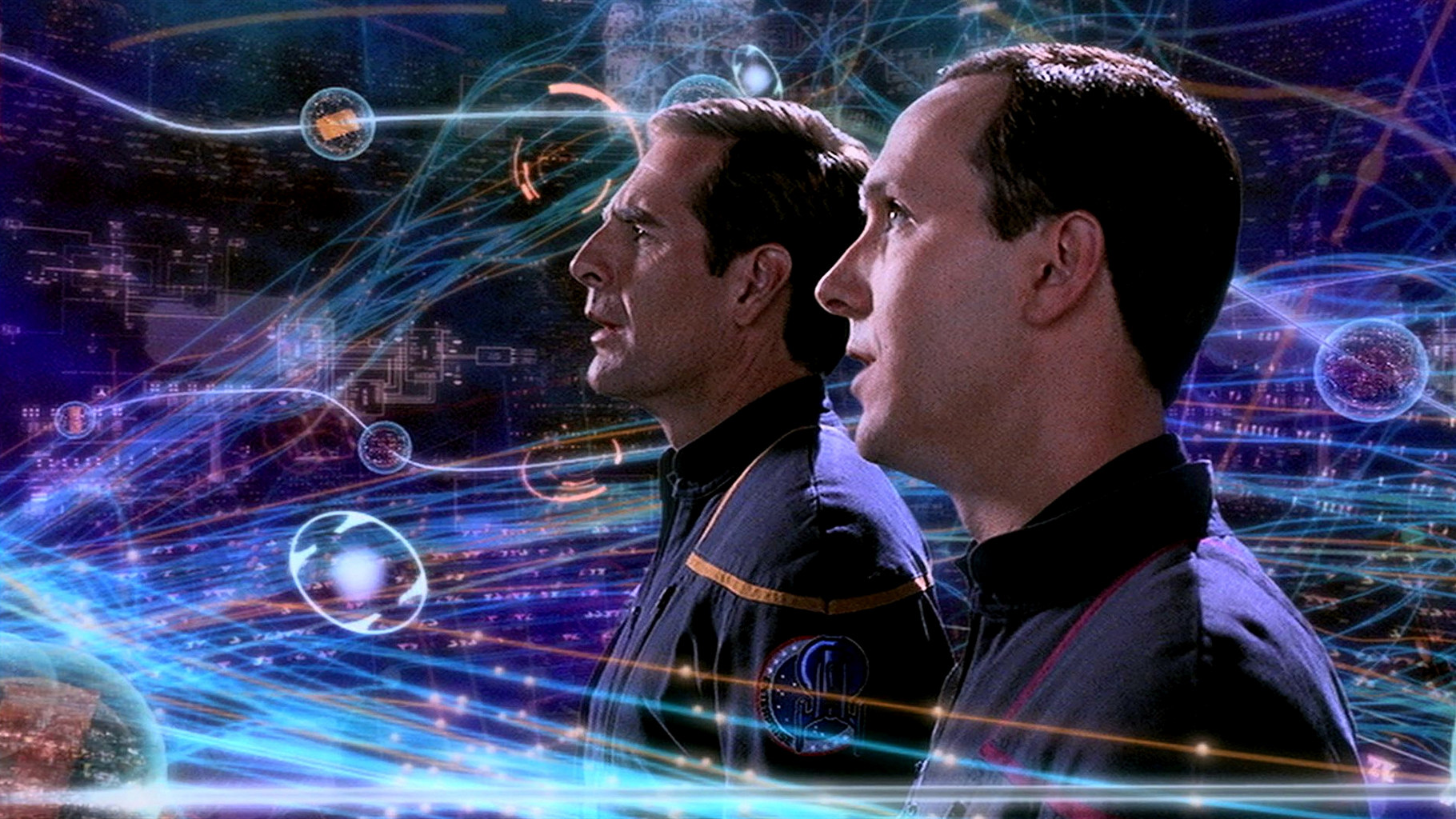
Date not given: Suliban agent Silik receives a new assignment from the mysterious figure from the future. Meanwhile, Enterprise encounters a civilian vessel on the edge of a spectacular stellar nursery. Its captain, Fraddock, reluctantly agrees to Archer's request for contact. His passengers are pilgrims who have traveled there to witness eruptions known to them as the "Great Plume of Agosoria". The captain welcomes them aboard Enterprise, where they are given a tour of the ship, including engineering and sickbay. The ride closer to the stellar nursery gets bumpy because of plasma storms. Suddenly, an antimatter cascade begins spreading through the warp engine. The cascade, however, unexpectedly stops before it reaches the warp core, narrowly averting the destruction of the ship. Shortly afterward, one of his men named Daniels reveals a startling secret to Archer. He is not an ordinary crewman but a temporal agent from roughly 900 years in the future. Daniels explains that a Temporal Cold War is being fought in the 22nd century. While he himself can physically operate in this time, his opponent, the mysterious Future Guy, is from an earlier time and can only communicate with his agents as a holographic apparition. Daniels warns Archer that Silik is a danger, although it was him who anticipated and stopped the antimatter cascade. He also demonstrates technology from the future, including a device capable of monitoring events across time. Archer decides to believe him. He informs T'Pol and Tucker of Daniels' true identity and asks them to help locate Silik, who can alter his appearance. When the pilgrims return to Enterprise to observe the Great Plume of Agosoria, Silik appears in Archer's quarters and disables the captain. Daniels confronts Silik in engineering but gets shot and seems to die. Silik escapes. After regaining consciousness, the captain remembers a futuristic device Daniels had shown him, one that allows its user to pass through solid walls. Using it, he continues the pursuit and eventually follows Silik into the launch bay. Silik opens the bay doors, triggering an explosive decompression. Archer narrowly avoids being blown into space, while Silik escapes aboard a cell ship waiting outside Enterprise. With both Daniels and Silik gone, Enterprise is left with more questions than answers. Unsure what advanced technology Daniels may have left behind, Archer orders his quarters sealed.
Review
One thing Enterprise has done surprisingly well so far is establishing that we are in an earlier era of space exploration than in previous Star Trek series. The technology is mostly less advanced, the crew is less experienced, and although the NX-01 itself looks too sophisticated, the overall atmosphere feels distinctly different from the 24th century. Add to that Archer's and Tucker's frustrating relationship with the Vulcans (which sometimes gets frustrating for the viewers too), and the series has developed an identity of its own. To me, that is its greatest strength at this point.
Besides the theme of early space exploration, however, there is another storyline we have not heard about since the pilot: the Temporal Cold War. "Cold Front" brings it back into focus, but not very successfully in my view.
We learn very little about Silik or his benefactor. We still don't have the slightest idea what Future Guy is actually trying to achieve. Of course, that is partly the nature of timeline manipulation. Almost any action can later be justified as serving some larger purpose that the audience simply doesn't understand yet. The episode relies very comfortably on that advantage. In the pilot, Silik wanted Archer dead. Here, he apparently saves Enterprise by preventing the antimatter cascade from destroying the ship. Or does he? Perhaps he caused the crisis in the first place so he could stop it later. We simply don't know. Maybe everything makes perfect sense from the perspective of the future timeline. Maybe it doesn't. We are deliberately left in the dark.
That uncertainty also becomes Archer's dilemma. Should he trust Silik, who has just saved his ship? Or Daniels, who has spent a long time pretending to be an ordinary crewman before suddenly revealing that he comes from 900 years in the future? Archer ultimately sides with Daniels, perhaps because he is human, but objectively he has little reason to trust either of them. T'Pol and Trip are even more skeptical. Neither of them really believes Daniels' story about time travel, yet they follow Archer's orders and help him locate Silik anyway. There is actually quite a bit of potential for conflict here. The crew is confronted with implausible claims, conflicting loyalties and technology beyond their understanding. Yet surprisingly little is made of these opportunities.
By the end of the episode, Daniels appears to be dead while Silik escapes once again. There is no real conclusion. Looking back with the benefit of later episodes, I am not even convinced the writers themselves ever had a coherent explanation for what happens here and why. Daniels will eventually return, but whether it is literally the same Daniels or another version of him from a different point in the timeline hardly matters. This is ultimately my biggest problem with "Cold Front". The episode relies heavily on mystery. It wants the audience to wonder what is really happening, who is manipulating whom and what the future holds. But it has no intention to resolve anything - neither now nor in a future episode. The ominous music and the sealing of Daniels' quarters (with the clear prospect that this "Pandora's box" will be opened again) aim for an X-Files-like atmosphere. But that kind of storytelling doesn't work particularly well in Star Trek.
My favorite aspect of the episode has little to do with the Temporal Cold War. I really like the group of pilgrims visiting Enterprise and, in particular, Phlox's interaction with them. He does not share their beliefs, but he genuinely appreciates their spirituality and enjoys learning about their customs. It's a small subplot about intercultural bonding, yet its charm compensates a bit for the weaknesses of the main storyline.
Overall, the setting of "Cold Front" is appealing and the atmosphere works. But the central story takes too much pleasure in leaving questions unanswered while not exploring possible conflicts. After all the buildup, the payoff amounts to little more than Archer walking through a wall and surviving the explosive decompression of the launch bay. What remains is a rather thin plot wrapped in layers of mystery that ultimately lead nowhere.
Annotations
- Continuity:
- It is remarkable that, for the first time in Star Trek, human religions are explicitly mentioned as still being practiced. Dr. Phlox says he visited a Tibetan monastery and that he attended a mass at St. Peter's Square.
- Many years later, Daniels will return in the series finale of Discovery.
- Nitpicking:
- "Gravimetric field displacement manifold" is bad technobabble. I would never have guessed that it is another word for the warp reactor. What does the matter/antimatter reactor have to do with a gravimetric (which is Trek writer speak for "gravitational") field?
- When Silik is on the run after shooting Daniels, Tucker and T'Pol don't care to issue a security alert. Archer does that himself it when he wakes up, several minutes later, without even knowing that no one is looking for Silik yet.
- Silik jumps down through the open launch bay doors, although there realistically can't be a gravity field in this region. It is possible that a special "reverse field generator" is mounted overhead, also to facilitate the release of shuttles. Or it is the escaping air that pushes Silik out.
- Remarkable dialogue: "Have you learned how it works?" - "Not a chance." (T'Pol and Archer, about the alien clock he received as a gift, although it just as well refers to the story on the whole)
- Remarkable quote: "Tell chef to prepare... something." (Archer)
- Remarkable facts:
- Engineering is located on C-deck.
- The Enterprise database has 50,000 movies, among them such masterpieces like "Night of the Killer Androids".
- At the time of this episode, Enterprise has been underway for four months, three weeks and six days.
Rating: 4
Silent Enemy
Synopsis
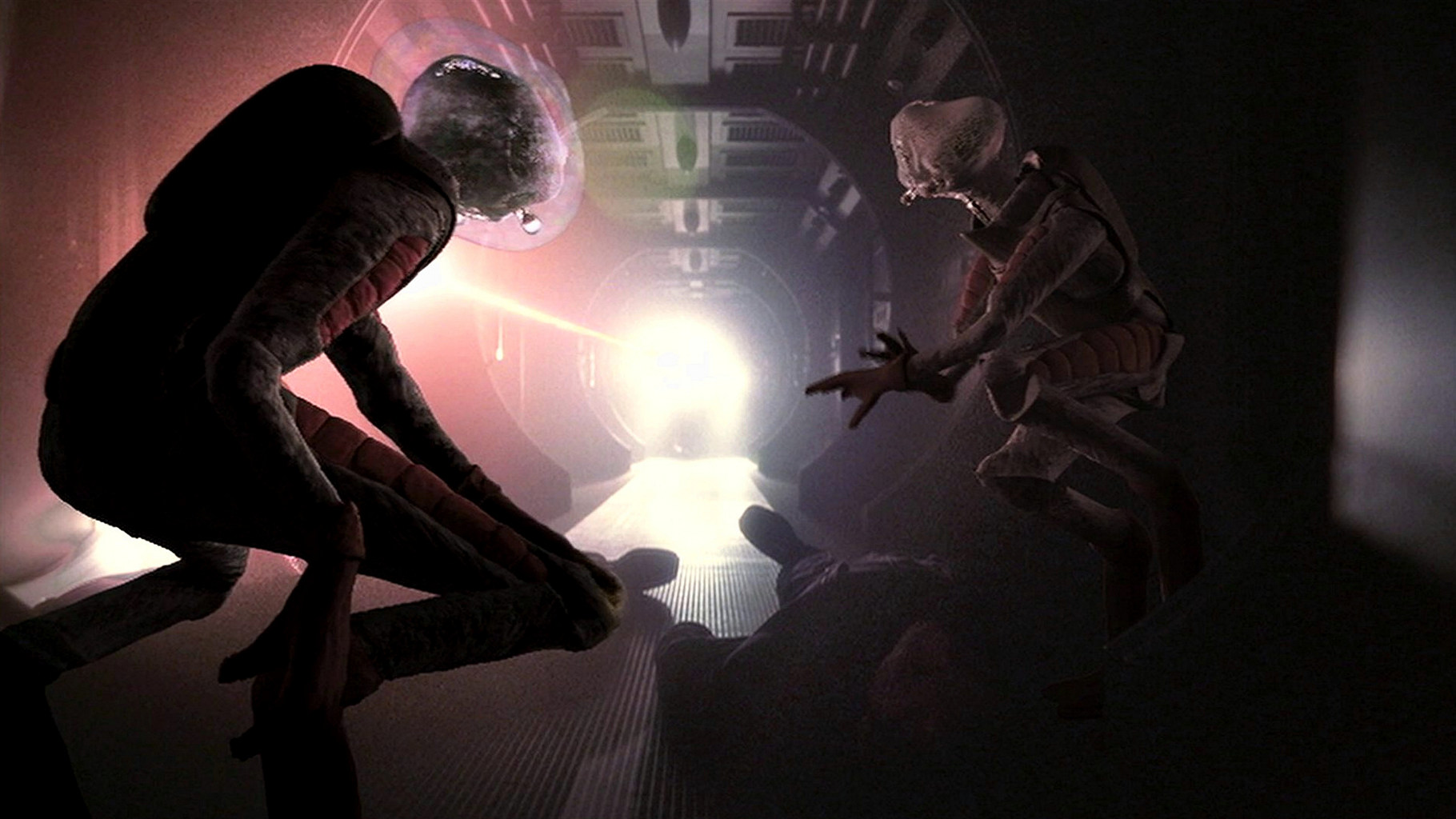
September 1st, 2151: Enterprise deploys its second subspace amplifier, extending the ship's communication range with Starfleet. Shortly afterward, an unidentified alien vessel appears. The ship is impervious to scans, ignores all hails and vanishes as suddenly as it arrived. A short time later it returns, attacks Enterprise without warning, inflicts moderate damage and disappears again at warp. Realizing that Enterprise is outmatched, Archer decides to return to Jupiter Station to have the phase cannons installed. The ship had left spacedock ahead of schedule, before the new weapons were ready. Before Enterprise can reach the Sol system, however, the alien vessel attacks again. This time it disables the ship's main power and sends a boarding party aboard. The intruders perform invasive scans of two crewmen before withdrawing. Unable to contact the Vulcans for assistance and discovering that both deployed subspace amplifiers have apparently been destroyed by the attackers, Archer abandons his plan to return home. Instead, he orders Tucker and Reed to install the phase cannons themselves using the components already aboard Enterprise. Working around the clock, the engineering team successfully assembles the first two cannons. During a test firing, however, bypassing the power relays causes an overload. The shot triggers a massive explosion on the planetoid that serves as the target, and the power conduits have to be repaired. The alien ship returns once more and demands Enterprise's surrender. Archer refuses and orders the phase cannons fired. Their normal output has little effect, so he takes the risk of overloading them again despite the danger to Enterprise's own systems. The powerful blast takes down the enemy's shields, which allows to disable it with spatial torpedoes. Having successfully installed the phase cannons without returning to Jupiter Station, Enterprise resumes its mission and deploys another subspace amplifier, now much closer to Earth. Meanwhile, Malcolm Reed's birthday is approaching. Since he never shares personal details about himself, Hoshi Sato makes it her mission to discover his favorite food. After an elaborate investigation, she learns that Reed takes medication to counter an allergy to bromelin, an enzyme found in pineapples. To Reed's pleasant surprise, the senior crew celebrates his birthday with a pineapple cake.
Review
"Silent Enemy" is one of those episodes that I simply enjoy watching. If I judged it solely by my usual standards, I should probably like it much less. On paper, it is remarkably unoriginal.
Once again, Enterprise encounters creepy hostile aliens who refuse to communicate. They board the ship, remain anonymous and disappear without explanation. We never learn who they are, what they want or why they are interested in the crew. That immediately raises the question: why introduce yet another species instead of simply reusing the bodysucker aliens from "Fight or Flight"? Or, for that matter, why not the Suliban? They already infiltrated Enterprise in "Broken Bow" using very similar tactics. Instead, we get another mysterious species that never returns. From a storytelling perspective, that's rather unsatisfying. Yet the episode wisely uses the aliens only as a catalyst. The real story is not about them but about Enterprise itself.
For the first time, Archer becomes cautious and considers turning back. Throughout the season so far, he has consistently pushed farther into deep space, determined to prove to Starfleet Command, to his watchdog T'Pol and to himself what humanity can accomplish. Here, however, he reaches a different conclusion. Enterprise is not ready. The ship was launched before its phase cannons could be installed, and after encountering a clearly superior opponent, Archer decides the sensible course of action is to return to Jupiter Station and let the engineers complete the work. I like that decision because it shows a side of Archer we have not seen very often. He is willing to admit that the mission may have begun prematurely and, at times, even that he himself may not be ready.
He only changes his mind when the aliens attack repeatedly and retreat is no longer an option. Faced with having no other choice, Archer orders Reed, Tucker and their teams to install the phase cannons themselves. The crew rises to the challenge and succeeds. There is not a great deal of interpersonal conflict here, but there is meaningful character development. The story is about the crew growing into its role. By successfully completing a task they initially believed required Starfleet's specialists, they prove to themselves that they are capable of handling situations on their own. Even though we may criticize that their success ultimately comes in the form of a military victory, it is still an important confidence boost. For the first time since Enterprise left Earth, they win a battle through their own efforts.
The aliens themselves are little more than the "monsters of the week". But I don't mind that very much. They are dangerous, creepy and serve their purpose well, even if they remain completely unexplained.
The B-story is considerably lighter. Hoshi decides to find out Malcolm Reed's favorite food for his birthday, which is difficult as the armory officer keeps duty and private life strictly separate. Archer elevates this trivial investigation to a top priority, almost as if it were more important than Hoshi's actual duties. That is admittedly exaggerated. Malcolm's unwillingness to talk about personal matters, on the other hand, fits his character perfectly. He is socially awkward and reserved. He is not someone who easily confides in others. He is much more comfortable working alongside competent colleagues than forming close personal relationships.
One particularly amusing moment comes when Hoshi invites him to dinner in the hope of learning more about his food preferences. Reed completely misunderstands the situation and assumes she is asking him out. It is not laugh-out-loud funny, but it is a delightful character moment that highlights just how uncomfortable Reed is with social interactions and how determined Hoshi is to solve the little mystery.
Overall, "Silent Enemy" is a good episode. It may not address major themes or significantly change the course of the series beyond giving Enterprise its phase cannons, but it tells its straightforward story mostly well. It is entertaining and satisfying from beginning to end.
Annotations
- Nitpicking:
- "It's rated for a maximum power output of five hundred gigajoules." That's energy, not power.
- There is a problem with the crew complement. In "Strange New World", it was 82. Daniels left in "Cold Front", but now the crew is said to consist of 81 humans, one Vulcan and one Denobulan (plus one dog). Maybe the figure was supposed to include only the human crew in "Strange New World"?
- Remarkable dialogues:
- "Maybe they checked us out and decided we were not very interesting." - "Us - not interesting?" (Mayweather and Reed)
- "This time we won't be leaving before we're ready." - "Are your ears a little pointier than usual?" (Archer and Tucker)
- Remarkable facts:
- The two subspace amplifiers, Echo 1 and Echo 2, are destroyed by the unknown aliens. Enterprise prepares to launch another one, apparently closer to Earth, in the end.
- Enterprise is designed to have three phase cannons, two facing forward and one aft.
- Duval, a friend of Archer's and Tucker's, has been promoted to command the Shenandoah.
- Tucker's ex-girlfriend Natalie lives in Pensacola.
- Malcolm Reed's birthday is September 2nd. His parents currently stay in Kota Baharu, Malaysia. His relatives include a sister, an uncle and two spinster aunts. Grandfather Reed served in the Royal Navy. Malcolm suffers from allergies to dust mites, oak pollen, tropical grasses and various plant enzymes, including bromelin, as found in pineapples, which happen to be his favorite fruit.
Rating: 6
Dear Doctor
Synopsis
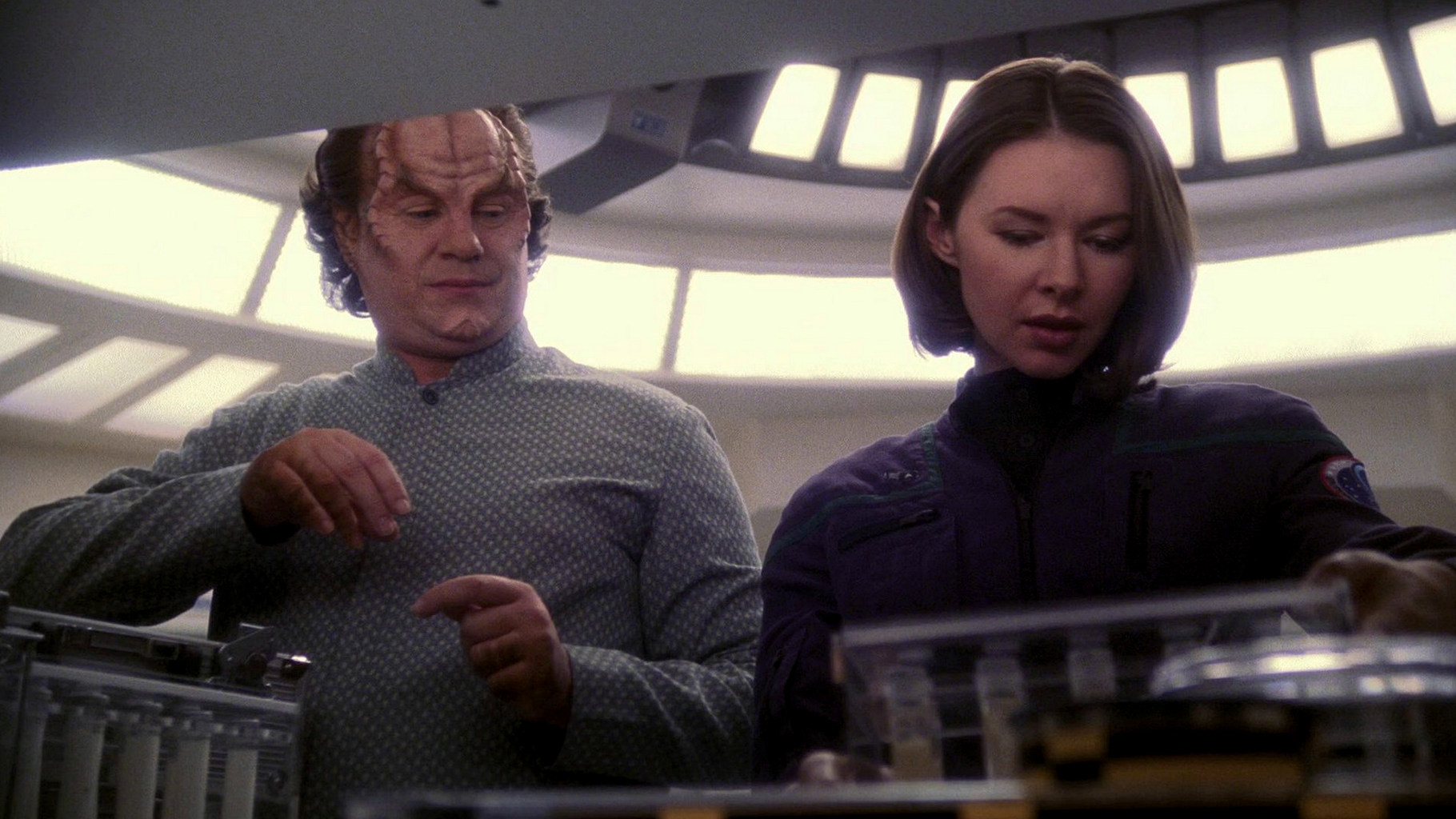
Date not given: Dr. Phlox is in a correspondence with Dr. Lucas, a human physician serving on Denobula as part of the Interspecies Medical Exchange. Through their exchanged voice messages, Phlox reflects on the challenges and rewards of living among humans. Enterprise encounters a sublight vessel less than one light year from a nearby inhabited planet. The crew discovers critically ill humanoids aboard and learns that they are Valakians, whose civilization is being devastated by a deadly disease. Archer agrees to help and takes Enterprise to their homeworld, where Phlox works alongside the planet's physicians in search of a cure. Phlox discovers that the illness is not infectious but a genetic defect inherited by every generation. Left untreated, it will drive the Valakians to extinction within two centuries. During his investigations, he also studies the Menk, a second humanoid species living peacefully alongside the Valakians but considered less intelligent and largely limited to menial work. The Menk are completely immune to the disease. Hoping their biology may provide the answer, Phlox visits a Menk village and collects scans and blood samples. At first, however, he fails to find a cure. Meanwhile, the Valakians ask Archer to share warp technology so they can seek help from other civilizations. Archer hesitates. Phlox eventually succeeds in developing a cure but comes to a startling conclusion. Because the disease is part of the Valakians' genetic makeup, he believes that allowing them to survive would interfere with the natural evolution of the two species. In his view, the Menk are destined to become the dominant civilization on the planet. He tells Archer that he will administer the cure if ordered to do so, but strongly advises against it. After much deliberation, Archer accepts the doctor's reasoning. Rather than giving the Valakians the cure, Enterprise provides them only with medication to relieve the symptoms of the disease, leaving the future of both species to take what Phlox believes is its natural course.
Review
"Dear Doctor" was among the Enterprise episodes I knew I would have to revisit with special attention to detail. It deals with unusually complex and unusually impactful questions of genetics, medicine, politics, sociology and ethics. It recommends itself as the philosophical foundation of what would become the familiar Prime Directive. Almost 25 years ago, I criticized the story heavily. I did not expect my opinion to change much, but I wanted to see whether hindsight and newly discovered aspects would alter my perspective. In a nutshell, my original criticism was twofold. First, "Dear Doctor" fundamentally misunderstands evolution. Phlox presents it as a predetermined process: one species has "bad genes" and is therefore meant to die out, while another has the "better" genes and is destined to inherit the planet. That's simply not how evolution works. Second, the episode presents Archer's decision as an early version of the Prime Directive. Yet if we compare the situation to what the Prime Directive actually means throughout Star Trek, the justification does not fit. The Valakians are not an isolated civilization that needs protection from outside influence. Quite the opposite: they have actively sought contact with other spacefaring species in the hope of finding help.
The beginning of the episode is lighthearted. It takes almost ten minutes before the Valakians even appear. Instead, we spend the opening act listening to Dr. Phlox's correspondence with Dr. Lucas on Denobula. The structure deliberately recalls "Data's Day", replacing Data's diary entries with Phlox's voice messages. I like this framing device, although we don't learn anything essentially new about our doctor. It reinforces Phlox's fascination with humanity and his habit of observing human behavior almost as a scientist studying an interesting experiment. Whether that curiosity translates into genuine empathy is another question, one I will return to later.
When the Valakians finally arrive, the story becomes more engaging. Their situation is desperate. Their people are dying in large numbers, hospitals are overflowing, and even the crew they sent into space is close to death. We also learn that Enterprise is not their first hope. They have already sought help from other species, including the M'Klexa and even the yet unknown Ferengi.
Phlox initially approaches the problem as a physician should. He searches tirelessly for a cure and discovers pretty soon that the illness is genetic rather than infectious. So far, everything makes sense. But about twenty minutes later, his argument is suddenly completely different, although the facts haven't changed. What first appeared to be a medical diagnosis becomes an ethical justification for doing nothing. Because the disease is genetic, Phlox now concludes that the Valakians are somehow supposed to become extinct while the Menk are destined to replace them. That leap simply does not follow. A genetic disorder isn't evidence of nature's intentions. Phlox effectively argues that evolution has a goal and that the Menk are genetically coded to become the dominant species. This is a crude misunderstanding of Darwinian evolution, which has no predetermined direction and certainly no moral purpose - unless we evoke a creator. Watching the episode today, this still strikes me just as strongly as it did 25 years ago.
Archer initially reacts exactly as I would expect. He is shocked by Phlox's conclusion. They came here to help, and now his chief medical officer argues that they should withhold a cure they are capable of providing. The captain says, "My compassion guides my judgment." Yet before long he reverses his position and accepts Phlox's reasoning. He merely provides the Valakians with medicine that eases their symptoms. That change of heart feels abrupt and insufficiently justified. To make the decision sound more profound (to the audience, rather than in-universe), Archer begins speaking in terms that conspicuously include the word "directive". But this is where the narrative loses me. The Prime Directive exists to prevent the Federation from interfering with other cultures that are not ready for the contact (just like the Mintakans in TNG: "Who Watches the Watchers"). In a broader sense, non-interference would apply to all alien civilizations that didn't seek contact or ask for help, be they warp-capable or not (just like the Malcorians in TNG: "First Contact" and perhaps even the Klingons in TNG: "Redemption I"). None of that applies here. The Valakians already know about alien civilizations. They have actively contacted them. Even though it is understandable Archer wouldn't give them the requested warp technology, refusing medical help is the opposite of what later Starfleet principles would require (maybe with the notable exception of TNG: "Homeward" that takes a similarly cold-hearted approach but where we may argue that it actually is governed by the Prime Directive). Calling this incident the birth of the Prime Directive simply does not hold up.
Regarding the "not playing god" argument, there is also Phlox's comparison with Earth's history, which gave me pause for a moment. He argues that if an advanced alien civilization had intervened to ensure that Neanderthals survived instead of Homo sapiens, history would have taken a different course. It sounds persuasive at first, but the analogy falls apart upon closer examination. Neanderthals did not disappear because they had "bad genes". Their extinction was almost certainly the result of environmental change, competition with Homo sapiens or a combination of many factors. It was not some built-in expiry date. The comparison therefore fails to support Phlox's argument. A more appropriate modern analogy might be the trolley problem. Is it morally acceptable to intervene and "switch the tracks" by saving the Valakians, even if that changes the future development of the Menk? My answer is clearly yes. The Menk are not being threatened with extinction. They are not significantly harmed if the Valakians survive. At most, they are denied what Phlox believes to be their "natural" destiny, a concept I reject in the first place. For that reason, I still cannot agree with the ethical conclusion the episode reaches.
There's one aspect of the episode that strikes me as cynical, and it is something I already pointed out in my original review. Phlox's entire argument rests on the idea that the Valakians' fate is "natural". They suffer from an inherited genetic defect, and because it is part of their evolutionary history, he concludes that they should not be saved. Their extinction, in his view, is simply nature taking its course. Now consider a thought experiment. Suppose the Valakians had caused their condition themselves. Perhaps through reckless genetic experiments, environmental pollution or even the aftermath of a nuclear war. In that case, would Phlox still argue that Enterprise should stand aside? I don't think he would. I suspect he would look for a cure, because the disease would no longer be seen as an inevitable part of evolution but as a preventable disaster. If that is true, then the episode creates a deeply troubling dichotomy. A civilization that is responsible for its own suffering deserves help, while one that is simply unlucky enough to inherit a genetic disorder does not. I realize this is not how the writers intended the story to be understood, and I am sure many fans disagree with this interpretation. But it follows logically from Phlox's reasoning. I always saw that as the episode's most disturbing implication, and I still stand by that criticism today.
One additional detail struck me that I had never noticed before. The crew of Enterprise initially expresses surprise that the Menk even exist. The very idea that two intelligent species could evolve side by side on one planet seems unusual to them. In contrast, when Archer, T'Pol and Phlox meet the Valakian physician, he casually assumes that Archer and T'Pol may be two different species from the same world. To him, that is perfectly normal. This, in my view, becomes important later. When Phlox argues that the Menk are destined to replace the Valakians, he implies coexistence was not the natural way. The story never seriously addresses the alternative that both species might continue to develop together. Instead, it implicitly treats the disappearance of one of them as an imperative natural endpoint of evolution, providing a reason why the Valakians have "bad genes", and ultimately supporting a creator or "intelligent design". Looking at it today, "There can only be one" as a natural law adds another troubling layer to the story, one that I completely reject. And this takes me to another thought experiment. What if, instead of peaceful coexistence, the Valakians had wiped out the Menk? By his own logic, Phlox would have to help the only intelligent species that was left. Finally, I would like to add that many modern-day geneticists suggest that there may be no evolution in future humanity at all since we are dealing with a worldwide population of humans, as opposed to isolated groups and habitats. There may be no natural selection any longer that would favor certain traits under certain environmental conditions, as humans shape their environment, rather than vice versa. The same should apply to Valakians and Menk with their planet-wide culture, and it makes the whole genetic argument additionally pointless.
That said, "Dear Doctor" does have redeeming qualities, and I think I overlooked some of them in my original review. The framing device with Phlox's letters works well, and the Valakians and Menk themselves are likable and believable. Yet they are almost completely sidelined. The Valakians ask Enterprise for help, they are desperate to find a cure, and yet none of them emerges as a memorable character. I don't remember their names or any particularly meaningful moments involving them. They remain bystanders in their own tragedy. Instead, the episode focuses almost entirely on the Enterprise crew. Of course, this is meant to build toward the final ethical decision, but it comes at the expense of the people affected by it. The episode spends its first ten minutes on the lighthearted framing story with Phlox's letters rather than developing the Valakians. As much as I like those opening scenes, in hindsight they consume valuable screen time that could have been used to make the moral dilemma more personal. Imagine if one of the Valakians had formed a genuine friendship with a member of the Enterprise crew, or if we had learned more about the culture of the Menk beyond the realization that they are more intelligent than it initially seemed.
There is one point where I think I was too harsh in my original review. Back then I accused Phlox of playing with Ensign Cutler's feelings. Looking at it again, I no longer think that assessment was fair. In a sense, Cutler treats Phlox much like he treats humanity. She is fascinated by someone so different from herself. As mentioned in the episode itself, humans are naturally curious about the strange and the unknown. She is exploring an alien culture just as Phlox enjoys studying human behavior. The curiosity is mutual. Nor does she seem particularly heartbroken when Phlox tells her that he is already married to three wives, together with two other husbands. She appears to accept it with good humor. Perhaps friendship was all she wanted in the first place. On this point, I think I have to revise my earlier opinion.
I have also reconsidered my opinion of Phlox himself. 25 years ago I simply did not like him very much. Today I see him as a genuinely kind person whose scientific curiosity often shapes the way he approaches his human crewmates. He sometimes may be interested more in studying people than in the people themselves, but he is not cold or manipulative. He is simply fascinated by other cultures and species, sometimes to a fault. That makes him a more interesting character than I originally gave him credit for. There is only one aspect about Phlox that I dislike in "Dear Doctor", irrespective of his being wrong with his stance: He says, "I came very close to misjudging Jonathan Archer, but this incident has helped me gain a new respect for him." In other words, had Archer not changed his opinion in Phlox's favor, Phlox wouldn't respect him.
There is another aspect of the episode that I also appreciate more today. When Cutler observes that the Menk perform only menial labor while the Valakians occupy the key positions in society, she instinctively judges the situation from a human perspective and finds it unfair. Phlox, however, refuses to make that judgment. He says, "Their culture is different. It's their way." At first glance, this seems inconsistent with his later decision to withhold the cure from the Valakians. I saw it as a contradiction in 2002. I now think it fits his worldview remarkably well. I know I'm repeating myself, but Phlox consistently believes that he should not interfere with what he considers the natural course of another society. If the Valakians currently dominate the Menk, then that is simply how their civilization has developed. Likewise, if evolution now favors the Menk, he believes that this outcome should not be prevented either. As deeply flawed and oversimplified this understanding of Darwinian evolution is, at least his logic is internally consistent.
One thing I do miss, however, is hearing T'Pol's perspective. As the other alien member of the senior staff, she should have had something valuable to contribute to this debate. Yet Archer never asks for her opinion, nor does Phlox consult her. Instead, her main role in the episode is to offer Phlox rather awkward dating advice while he is treating her teeth. It is an amusing scene, but it feels like a missed opportunity. A Vulcan perspective on the ethical dilemma at the heart of the episode could have made the discussion considerably richer.
"Dear Doctor" could have become a classic. Its underlying intention is to tackle genuinely difficult ethical questions and to put Archer in a situation where there is no easy answer. The intended lesson is that humans should not "play god". But the more I think about it, the more this good intent falls apart because of bad science and flawed ethics. That inevitably pulls the episode down. I cannot give seven or eight points to a story that gets its own central message wrong. Even if we set aside the fact that Star Trek has never been particularly good at genetics and theory of evolution, the episode's ethical argument simply does not hold together. The second major problem is its supposed connection to the Prime Directive. I just do not see it. This is not a story about non-interference with an unaware or vulnerable civilization. The parallel to the Prime Directive is therefore forced, especially since earlier episodes this season, such as most notably "Civilization", already explored the idea of non-interference in a way that resembles the later Federation principle much more closely.
Summarizing, my overall opinion of "Dear Doctor" has changed comparably little over the past 25 years, although I see several details differently. There are still many things to like. As mentioned, I enjoy the lighthearted opening, the framing device with Phlox's letters and the interactions between the characters. But as ambitious as the story is, its flawed conclusion undermines what could otherwise have been one of Enterprise's strongest hours.
Annotations
- Remarkable quote: "Some day, my people are going to come up with some sort of a doctrine, something that tells us what we can and can't do out here, should and shouldn't do. But until somebody tells me that they have drafted that directive, I'm going to have to remind myself that we didn't come out here to play god." (Archer)
- Remarkable scene: It's movie night, and "For Whom the Bell Tolls" with Ingrid Bergman and Gary Cooper is playing. Phlox notices that Trip has to weep, but the chief engineer claims there is something in his eye.
- Remarkable facts:
- Dr. Phlox writes letters to Dr. Lucas, a human doctor who is working with the Denobulans.
- Marriages with three men and three women are common among Denobulans.
- Denobulans need little rest, except for their hibernation cycle of six days.
Rating: 4
Sleeping Dogs
Synopsis
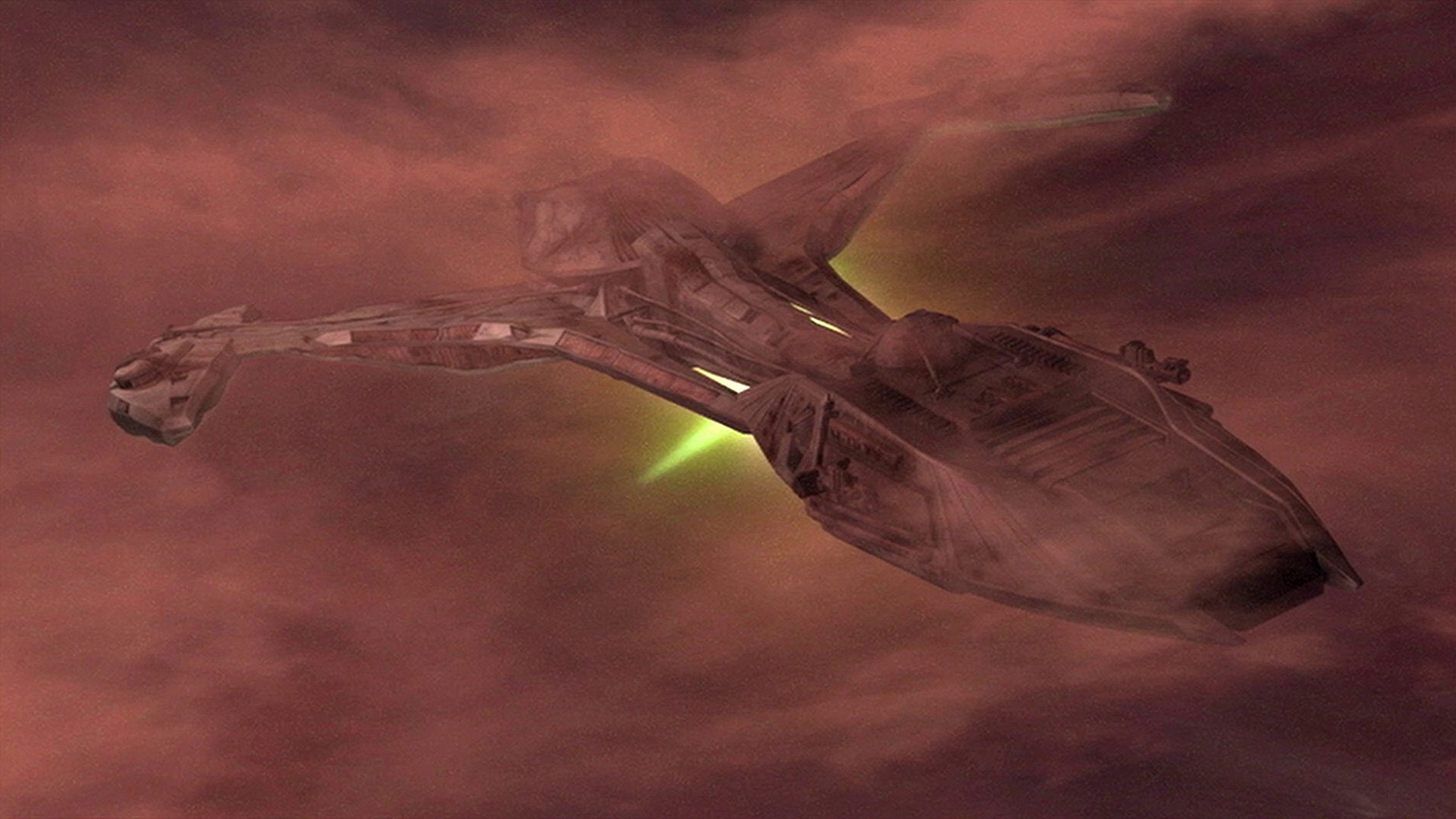
Date not given: Enterprise approaches a Class-9 gas giant that Archer wants to explore. The crew detects a disabled vessel slowly descending into the planet's dense atmosphere, where it will eventually be crushed by the enormous pressure. Reed, Hoshi and T'Pol take a shuttle to investigate. After docking, Hoshi identifies the writing aboard the ship it as Klingon. The landing party proceeds cautiously with phase pistols drawn. They find the entire crew unconscious, but are suddenly attacked by a Klingon woman. She steals the shuttle and leaves the three Starfleet officers stranded aboard the crippled vessel. As the shuttle flies past Enterprise without responding to hails, Archer orders it captured with the grappler. The Klingon woman, Bu'kaH, is subdued and taken to sickbay. Phlox determines that she and the rest of her crew are suffering from an infection they most likely contracted while raiding a Xarantine outpost. After receiving an antidote, Bu'kaH recovers, but she remains unwilling to cooperate with Archer. Meanwhile the Klingon ship continues to sink deeper into the gas giant's atmosphere. Contact with Reed, Hoshi and T'Pol is eventually lost. Archer makes a rescue attempt by taking Enterprise down, but the increasing pressure forces him to abort the mission. Aboard the Klingon ship, the stranded officers are unable to restart the engines. They use photon torpedoes to create shockwaves that might push the vessel back toward higher orbit. When the first attempts prove insufficient, Hoshi suggests firing all remaining torpedoes simultaneously. The combined explosion finally provides enough lift. Archer and Bu'kaH descend in a reinforced shuttlepod, dock with the Klingon vessel and help complete the repairs. The Klingon crew recovers, and their captain regains consciousness. Rather than thanking Enterprise for saving his ship and crew, however, he demands that Archer surrender his vessel. Archer calmly points out that the Klingons are in no condition to fight, with a heavily damaged ship and no torpedoes left. The two ships then part ways peacefully.
Review
"Sleeping Dogs" is essentially a straightforward action adventure: a ship in distress, an unexpected confrontation with aliens, rescuers who get into trouble themselves and a race against time. It is all reminiscent of what happened in "Fight or Flight" and has already become a familiar theme in Enterprise. This time, the aliens in distress happen to be Klingons, but the story is not really embedded in the larger context. At this point in the series, Archer's relationship with the Klingons is still ambiguous. He has encountered them twice before. In "Broken Bow", he arguably prevented a Klingon civil war, yet received little gratitude in return. In "Unexpected", he helped bring about a truce but also stood in the way of a Klingon captain's desire for revenge. None of that really matters here, though. The episode simply presents the Klingons as Klingons: proud, stubborn and unwilling to make friends. That is exactly what we would expect, irrespective of previous events.
There are a few small character moments worth noting. Hoshi is noticeably more confident than she was in a similar situation in "Fight or Flight", where she struggled with fear during a dangerous mission. This time, she even volunteers for the trip to the alien vessel, eager to make up for her previous weakness. It is a subtle reminder that the crew has grown over the course of the season, even if the episode does not make a major point of it.
Beyond that, there simply is not much to analyze. I like how we see the interior of the Klingon ship through the eyes of the 22nd century officers who are not yet familiar with the species. The plot is well paced, the action is entertaining and the various twists feel plausible. Everything fits together well enough. Perhaps the ending could have been a little more rewarding. It might have been nice if Bu'kaH had appeared again at the end, but her character was never developed beyond the initially reluctant cooperation she provided. On the other hand, the fact that the Klingons simply do not change is something I cannot really fault the episode for.
The small subplot about Reed's cold provides some comic relief. Throughout the mission, he is almost grateful that his blocked nose spares him the stench aboard the Klingon vessel. At the end of the episode, Reed, Hoshi and T'Pol linger in the decontamination chamber a little longer than necessary, quietly enjoying the complete absence of any smell. It is a simple but effective closing scene.
Like "Silent Enemy" only recently, "Sleeping Dogs" is content to tell a solid, self-contained adventure. It is not particularly ambitious, but it does exactly what it sets out to do, and it does it well. Sometimes that is enough.
Annotations
- Remarkable dialogue: "Do you smell that?" - "I don't smell anything." - "Exactly." (Sato and T'Pol)
- Remarkable ship: After the unsuitable K't'inga-class cruiser from "Unexpected", we now see a reasonably different Klingon ship. What I can't understand is that T'Pol or anyone else doesn't recognize this ship as Klingon, even if the class is not familiar. Provided that the Vulcan database is available all the time (as it seems to be the case in "The Andorian Incident"), I also wonder why Reed, for instance, didn't bother studying what little the Vulcans know about their technology. I certainly would have done so.
Rating: 6
Shadows of P'Jem
Synopsis
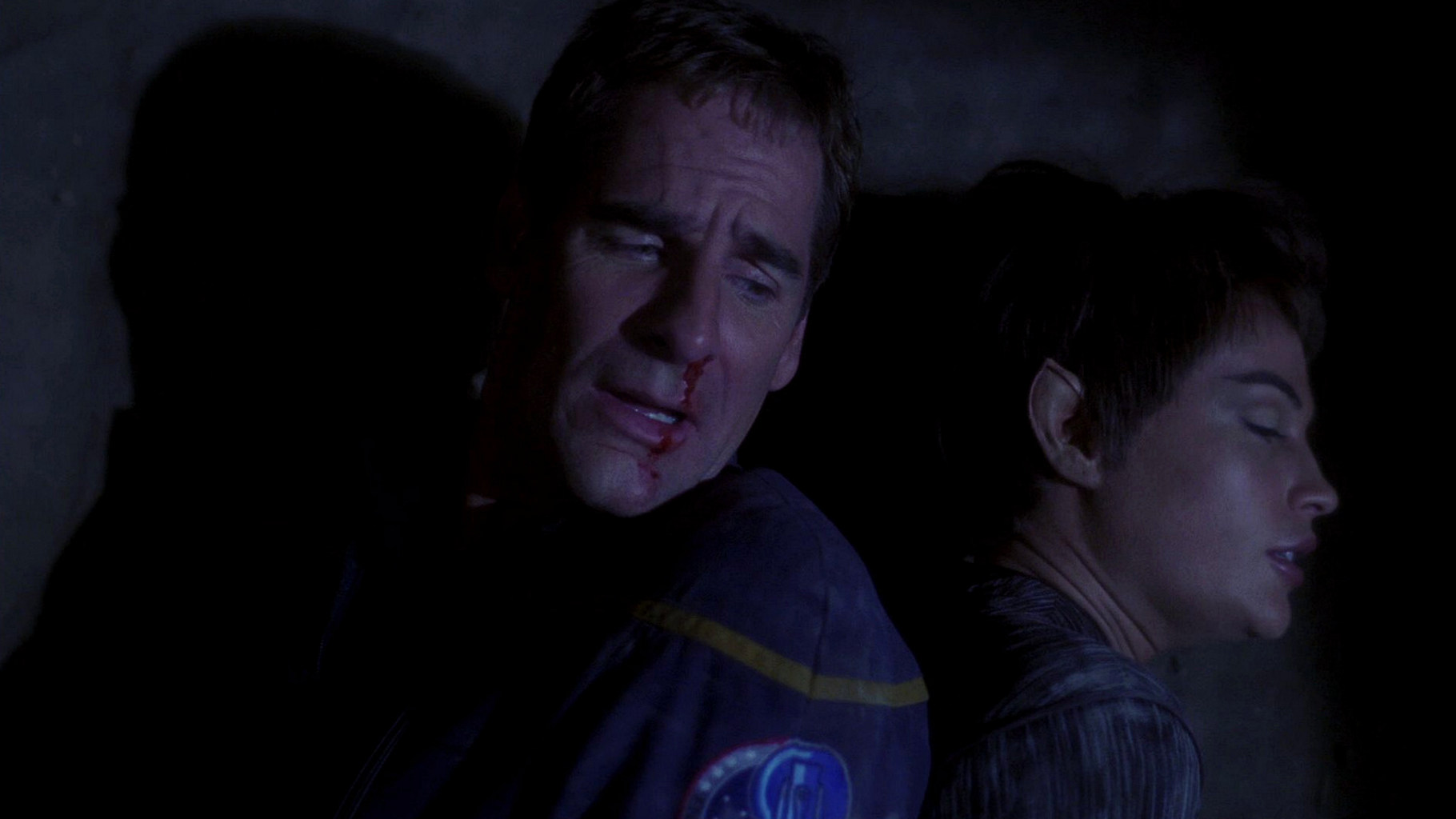
Date not given: The Andorians have destroyed the monastery of P'Jem, which the Vulcans used to hide a listening post. Ambassador Soval complains to Admiral Forrest about Enterprise's role in exposing the hidden Vulcan installation and suspends Vulcan's joint fleet operations with Starfleet. Meanwhile, Archer prepares for a diplomatic visit to Coridan, intending to take Trip with him. Before departure, however, he learns that T'Pol has been recalled to Vulcan, apparently to take the blame for the P'Jem incident. Determined to support her, Archer changes his plans and asks T'Pol to join him. As their shuttlepod approaches the surface, it is attacked by a fighter craft and shot down. They are captured by Coridanite rebels, who oppose their government and accuse it of being nothing more than a puppet regime of the Vulcans. Aboard Enterprise, Trip receives the rebels' ransom demand: they will release the hostages in exchange for 40 phase pistols - but Enterprise carries only 15. At the same time, the Vulcan cruiser Ni'Var arrives under the command of Captain Sopek. He announces to launch an immediate assault on the yet unknown place where Archer and T'Pol are being held. Trip urges caution, but Sopek refuses to cooperate, and Enterprise begins its own rescue mission. Trip and Reed take a shuttlepod to the surface, to a place where they suspect the other shuttle could be located. Instead, they are captured themselves. The captors turn out to be Shran one other Andorian. Shran agrees to work with the Enterprise officers to rescue Archer and T'Pol. Back at the rebel camp, Archer and T'Pol have already made one unsuccessful escape attempt. Archer eventually discovers a small transmitter hidden in his meal, smuggled in by one of Shran's agents, informing him that help is on the way. As the Andorians infiltrate the camp with Trip and Reed, the Vulcans launch their own attack, triggering a firefight. Shran manages to free Archer and T'Pol, declaring that he has now repaid the debt he owes the captain for exposing the listening post. The rescue soon turns into another confrontation, now between Vulcans and Andorians. During the standoff, one of the wounded rebels grabs a rifle and fires at Captain Sopek. T'Pol instinctively jumps into the line of fire, taking the plasma blast intended for the Vulcan captain. Back aboard Enterprise, T'Pol receives medical treatment. Although her injuries are not life-threatening, Archer exaggerates their severity when speaking to Sopek and asks him to restore T'Pol's reputation by reporting that she was wounded while saving his life. Sopek says he will consider that. T'Pol eventually recovers and stays on Enterprise.
Review
I like how "Shadows of P'Jem" explores the political ramifications of "The Andorian Incident", the subsequent destruction of the P'Jem monastery and the Vulcan-Andorian conflict in general. Enterprise establishes another story arc, and in hindsight I appreciate that more than I did in 2002. At the time, I strongly disliked the previous episode because I felt it was not in the spirit of Star Trek. "Shadows of P'Jem" continues along the same path, but at least it acknowledges that Archer's actions have consequences instead of simply moving on to the next adventure.
The episode begins with Ambassador Soval and Admiral Forrest discussing the consequences of the P'Jem incident. Soval appears for the first time since "Broken Bow", but it will not be the last time he harshly criticizes Archer for his impulsiveness and tries to thwart Enterprise's mission, and perhaps human deep-space exploration in general. He blames Archer for exposing the Vulcan listening post, which ultimately led to the Andorians destroying the ancient monastery that served as a cover. While I don't share Soval's general opinion that humans are not ready and need to be supervised, I think he is right in this particular case. Archer had no prior knowledge of the conflict, and one could argue that he betrayed Earth's allies just because he quickly concluded that spying on a neighboring civilization was wrong. Perhaps he also unconsciously seized the opportunity to pay the Vulcans back, since he already disliked them. As Archer is a Starfleet officer and therefore beyond Vulcan jurisdiction, they cannot punish him directly. Instead, T'Pol becomes the convenient scapegoat and is ordered back to Vulcan.
So far, the political situation is handled well - even though, in hindsight, it becomes a repetitive pattern that T'Pol is threatened with being recalled to Vulcan, only to find a way to remain aboard Enterprise. This is already the third time in the series, and several more will follow.
Anyway, beyond this promising beginning, the story itself is fairly simple. Enterprise visits Coridan, a world previously mentioned in TOS: "Journey to Babel", where it would eventually seek admission to the Federation. Since Coridanites were never identified in that episode, Enterprise was free to establish their appearance. None of that matters here, though. The Coridanites themselves never play a role, and their planet merely serves as the stage for what is effectively a proxy conflict between Vulcan and Andoria. As interesting as that premise sounds, with its possible real-world parallels, the episode fails to develop it. Much of the running time is spent on the hostage situation - yes, yet another one. Archer and T'Pol are tied up together and, after a failed escape attempt, end up separated and restrained even more tightly. They discuss T'Pol's predicament as the chosen scapegoat, and Archer reassures her that she should not blame herself. If anyone is responsible for the diplomatic disaster, he argues, it is him. That is certainly honorable, but the conversation itself cannot solve anything. At most, he can reassure her of his support. T'Pol, in turn, sort of returns the favor by posing as the ship's captain and claiming that Archer is merely a steward, hoping to draw attention away from him. Her ruse is admirable, but it also leads nowhere, except for causing an amusing moment of confusion on Enterprise when the rebel refers to the hostages as "the captain and the steward".
Meanwhile, the Vulcans prepare a straightforward military assault, while Trip and Reed attempt a more cautious rescue mission of their own. The unexpected twist is the return of Shran. Jeffrey Combs is once again immensely entertaining, but I still find Shran rather one-dimensional at this stage of the series. In "The Andorian Incident", he was driven by his obsession with exposing the Vulcan listening post. Here, his defining motivation is repaying the debt he believes he owes Archer. That sense of liability remains an important aspect of his character throughout the series, so it is at least consistent. Still, I struggle with his decision to help. The Vulcans remain his enemies, and from his perspective the "Pinkskins" are still little more than Vulcan allies. The Coridan rebels are arguably much closer to serving Andorian interests than Enterprise is, as the enemy of his enemy. Without his desire to repay Archer, there is no reason for him to become involved.
The final confrontation also feels rather convenient. Tensions between the Vulcans and the Andorians are at their highest. Both are established as trigger-happy, yet instead of one side firing on the other and risking an outright disaster, one of the anonymous rebels conveniently grabs a weapon and shoots at Captain Sopek. T'Pol throws herself into the line of fire, saving the Vulcan captain and thereby restoring her own reputation. The conflict is resolved, or at least postponed, remarkably easily. A confrontation that has been building throughout the episode, and indeed ever since "The Andorian Incident", ultimately ends without either side having to make any drastic decisions.
I disliked that conclusion in 2002, and I haven't really changed my opinion. The episode deserves credit for continuing the political storyline and giving the first season a welcome sense of continuity. I can accept the Vulcan-Andorian conflict today. But after all the build-up and a mostly uneventful middle section, the resolution feels effortless and not particularly rewarding. "Shadows of P'Jem" is not as bad as I once thought, but I still don't find much more to appreciate today. My rating rises from one point to only two.
Annotations
- Remarkable quotes:
- "They've been in space for six months and they've already destabilized an entire sector." (Soval, about the crew of Enterprise)
- "You're awfully trigger-happy for someone who's repressed his emotions." (Trip, to Sopek)
- Remarkable facts:
- Coridan has a population of 3 billion. It is home to the largest shipyards of the sector, with Coridanite ships supposedly reaching Warp 7 (at least that's what Archer tells Tucker ;-)).
- Aside from the ones on the shuttlepod, there are 15 phase pistols on Enterprise.
- T'Pol recall count: #3
Rating: 2
Shuttlepod One
Synopsis
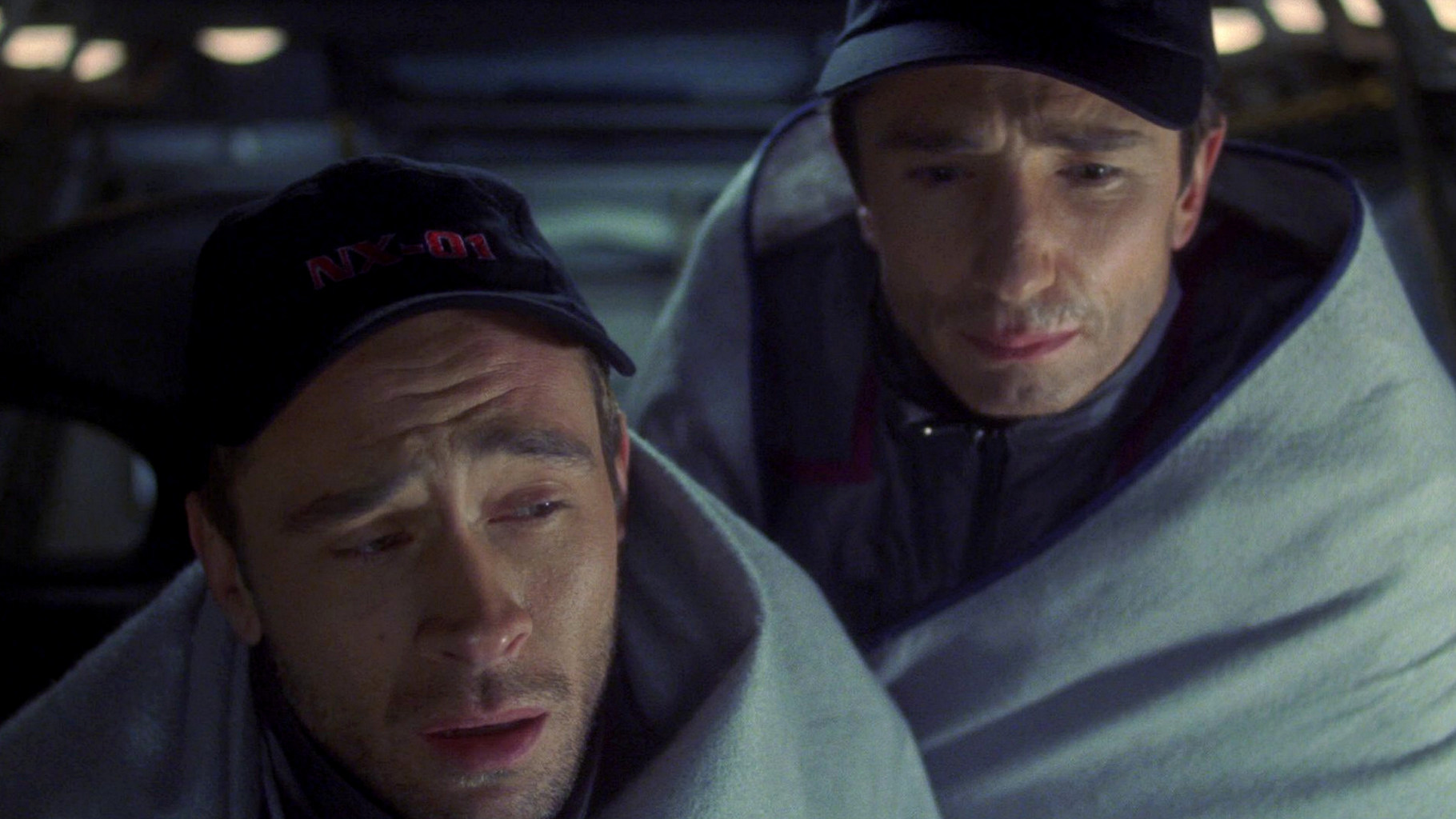
November 9th, 2151: Trip Tucker and Malcolm Reed are returning early from a survey mission in an asteroid field because their shuttlepod suffers multiple system failures. Their sensors, communications and navigation are down. When they arrive at the prearranged rendezvous point with Enterprise, there is no trace of the ship. Instead, they discover large amounts of debris, including Enterprise's launch bay door. With no functioning sensors to investigate further, they conclude that Enterprise has been destroyed. They don't know that in reality Enterprise rescued a Tesnian ship, and an accident happened when that ship approached Enterprise and rammed the launch door, upon which the alien ship crashed on the asteroid. Enterprise is now taking the Tesnians back to their homeworld. T'Pol suspects that micro-singularities caused the accident, but Archer dismisses the idea as little more than a Vulcan myth. Meanwhile, aboard the shuttlepod, Trip and Malcolm assess their situation. With only impulse engines, no navigation and no way to contact Enterprise or the nearest subspace amplifier, they have no realistic hope of reaching safety. Their air supply will last only ten days. The two officers cope with their predicament in very different ways. Malcolm begins recording farewell messages, believing it is better to face the inevitable with dignity. Trip refuses to give up hope and spends his time trying to repair the damaged systems. Their opposing attitudes soon lead to conflict. The situation becomes even worse when a micro-singularity punctures the shuttle's hull, including the oxygen tanks. Their remaining air supply drops to less than two days. They decide to shut down the heating to gain a little more time. Back aboard Enterprise, T'Pol confirms that the mysterious singularities are indeed real. Realizing that the shuttlepod lacks the protective hull plating of Enterprise, Archer becomes concerned for Tucker and Reed and finally attempts to contact them. By then, Trip has at least managed to repair the shuttlepod's receiver. They pick up Hoshi's call and learn that Enterprise is on its way, but will not arrive for another two days, too late to save them. As a desperate last resort, the two officers detonates the shuttlepod's impulse engines, creating a massive explosion that Enterprise detects from a distance. The ship changes course, locates the shuttle and rescues Tucker and Reed. Although both are suffering from severe hypothermia, they recover fully.
Review
"Shuttlepod One" is another review that probably won't win me friends. I know many fans appreciate the episode because of its character moments. It contrasts Malcolm Reed's fatalistic outlook with Trip Tucker's refusal to give up hope. Reed is determined to face death with dignity and be remembered the right way. Tucker wants to keep living and, if possible, fighting until the very last moment, rather than worrying about what he leaves behind.
That conflict is the heart of the episode. It is amusing at first and certainly reveals something about both characters. But after a while, it begins to wear thin. Trip and Malcolm keep having essentially the same argument over and over again while their situation steadily worsens. The dialogue varies, but the underlying conflict hardly develops. Yes, they come to some sort of common understanding, they eventually reconcile as we would expect in such a buddy episode, but the impact is lessened because it happens under the influence of alcohol and the freezing conditions. For me, there simply isn't enough story here. As well as Connor Trinneer and Dominic Keating play their roles, and as emotionally effective as some scenes are, it all eventually becomes repetitive and boring.
Malcolm and Trip also get into a Europe-versus-America argument while on the shuttle, before their situation turns desperate. I have criticized the American bias of the series before, but it becomes especially apparent when Trip claims that warp drive was built by Americans alone: "No Brits, no Italians, no Serbocroatians." Well, yes, it's consistent with the impression given in "Star Trek: First Contact", but it simply doesn't feel right. The writers view technological progress through an American lens, overlooking the international nature of scientific research, where major achievements are typically the result of collaboration across many nations rather than the work of one country alone. Trip's reference to "Serbocroatians" is particularly strange. It is presented as if it were the name of a people or nation, even though "Serbo-Croatian" historically referred only to a language. Not even when Yugoslavia still existed were its inhabitants known as "Serbocroatians". It also raises the questionable implication that Serbs and Croats would eventually merge into a single nation, while excluding Bosniaks altogether. It is a strange choice of words and an unnecessary historical and geographical blunder. Dear makers of Star Trek, please remember that there is a world outside the USA, and if you graciously choose to portray it, take the time to get it right.
The rest of the plot offers next to nothing. Enterprise rescues a group of Tesnians after an accident, which happens off-screen. Of course, this is meant to keep up the mystery for the audience for a couple of minutes after Tucker and Reed spot the debris and think Enterprise has been destroyed. There are only a handful of brief scenes aboard Enterprise establishing that the ship is taking the unseen guests of the T-Race home. Everything else, 95% of the episode, revolves around the predicament on the shuttlepod, which no one aboard Enterprise knows about.
That brings me to the episode's biggest issue. Let's recap the situation. Reed and Tucker are on a shuttle mission that was originally supposed to last longer than it does. Their sensors, communications and navigation systems fail, presumably because of the micro-singularities later identified by T'Pol. Unable to contact Enterprise, they return to the rendezvous point and discover wreckage, including Enterprise's launch bay door. Naturally, they conclude that Enterprise has been destroyed. Given the evidence available to them, every assumption they make is perfectly reasonable.
The problem lies on Enterprise's side. The crew knows Tucker and Reed are out there. After the accident, Archer decides to take the Tesnians home first because they don't expect the shuttlepod to return so early. Fair enough. Perhaps there are reasons why they cannot quickly retrieve the shuttle, which at this point may be 60 million kilometers away, as stated earlier. Perhaps they try to call them in vain off-screen but it was known in advance that communication would pose a problem because of interference in the region. The episode never explains this, but we can still speculate in favor of the crew of Enterprise at this point. What cannot be excused is what happens next. We learn that no one has even attempted to contact the two officers for days. Only after T'Pol confirms the existence of the dangerous micro-singularities does Archer suddenly order that they should check on the shuttle. So that is quite obviously the very first time anyone has even tried to hail them. This is an enormous plot hole. Of course the shuttle cannot respond because its comm array is damaged, but Enterprise has no way of knowing that. The crew simply never checks on Reed and Tucker, who are alone in a tiny spacecraft for days. Not once. I simply cannot accept that.
In the end, when Reed and Tucker are finally rescued, it feels as though Archer should apologize by saying, "Welcome back. Sorry we never bothered to check on you."
While I'm at it, let me address the other elephant in the room: Reed's dream sequence. He wakes in sickbay, and T'Pol suddenly appears affectionate and seductive, calling him a hero. I found it painfully awkward when I first watched the episode, and I still do. The whole scene is pure cringe. In hindsight, it almost foreshadows "A Night in Sickbay", where Archer has similarly embarrassing fantasies about T'Pol. Both moments feel less like character development and more like the writers indulging in wish fulfillment.
Overall, I dislike "Shuttlepod One" even a bit more than I did in 2002. I can appreciate what the episode is trying to achieve. It aims for an intimate character study rather than an action story. But the central conflict becomes repetitive, the premise depends on a massive lapse in logic and the dream sequence is simply embarrassing. For me, this remains one of the weakest episodes of Enterprise's first season.
Annotations
- Continuity: This episode has the first mention of the popular 602 Club, which both Malcolm and Trip used to visit. We will actually see the club in ENT: "First Flight".
- Remarkable dialogue: "I don't suppose you have a sextant handy." - "I left it with my slide rule." (Reed and Tucker)
- Remarkable homage: The idea to detonate the impulse drive as a beacon is a clear homage to TOS: "The Galileo Seven", where Spock ignited the remaining fuel to get the attention of the Enterprise.
Rating: 2
Fusion
Synopsis
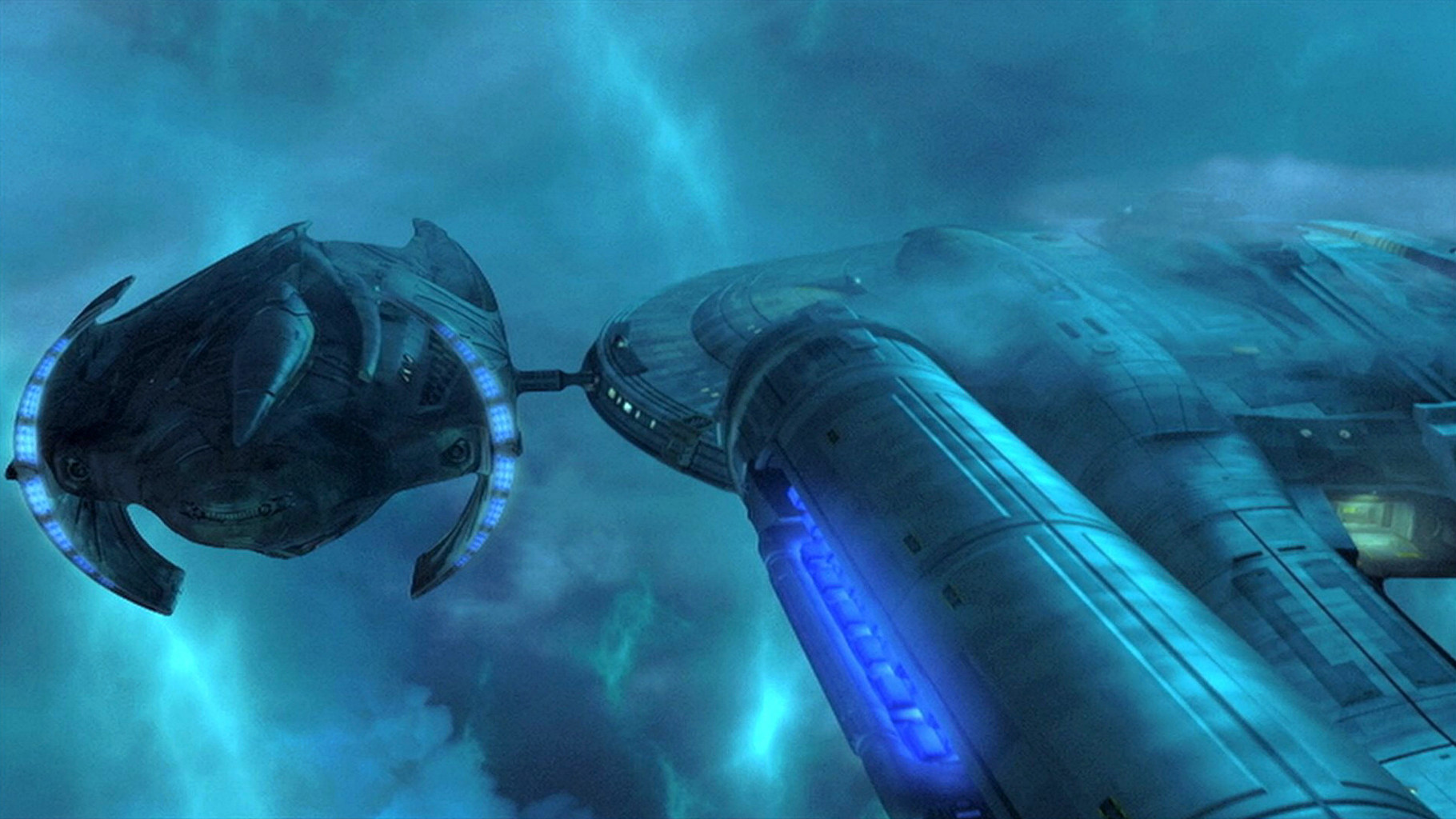
Date not given: As Enterprise prepares to explore the Arachnid Nebula, it encounters the Vahklas, an old Vulcan ship with an unusual crew. Its captain explains to Archer that they follow a more flexible philosophy than mainstream Vulcan society. They are still guided by logic but embrace rather than suppress their emotions. T'Pol deems this approach dangerous. Trip is assigned to provide Kov, the engineer of the Vahklas, with spare parts, while T'Pol reluctantly joins the Vulcan vessel to chart the nebula together with the scientist Tolaris. The scientist encourages her to skip her evening meditation, and the resulting emotional imbalance causes T'Pol to experience a vivid and unsettling dream. Later, Tolaris introduces her to an ancient Vulcan practice known as the mind meld. T'Pol has never experienced one before and agrees. What begins as an intriguing experiment soon becomes terrifying. Although she tells Tolaris to stop, he continues against her wishes until she finally breaks the connection by force, leaving her traumatized. Meanwhile, Archer learns that Kov's father is seriously ill, yet Kov refuses to contact him. At Archer's request, Trip persuades the engineer to contact his family. This conversation reveals that his father's condition has unexpectedly improved and that he may still have several years to live. Archer confronts Tolaris over the mind meld incident, to which the Vulcan responds with violence. The captain then orders the crew of the Vahklas to leave Enterprise. T'Pol slowly recovers from her experience.
Review
There are two questions I especially wanted to revisit in my new review of "Fusion". One concerns the history of Vulcan mind melds, which takes the first of three unexpected turns in this episode. The second issue is whether the involuntary mind meld depicted here can reasonably be interpreted as the equivalent of a rape. I expected my opinion to evolve on both topics. Before getting to that, though, let's look at the story itself.
For once, Captain Archer encounters a group of Vulcans that he genuinely likes. Unlike the rigid and reserved officials he has dealt with so far, the crew of the Vahklas embraces emotion instead of suppressing it. They are not prone to emotional outbursts (at least not yet), but they are open, friendly and eager to engage with other cultures. Like space hippies with pointed ears. That willingness to seek new experiences, in both ways, becomes the guiding theme of the episode.
Trip is paired with the engineer Kov to help repair the Vahklas. Kov may be the least Vulcan-like Vulcan we have ever met. He is short, overweight, talkative and enthusiastic about learning everything about humans. He constantly asks questions and approaches everything with childlike excitement. At times he becomes a bit of a nuisance, but in an endearing way. Beneath that cheerful exterior lies a sad personal story. He has been estranged from his family for years because Kov rejects the traditional Vulcan way of life. Eventually, Trip persuades him to contact his father, who is seriously ill. The reconciliation turns out to be one of the episode's most heartwarming aspects, although it happens off-screen.
T'Pol's story is considerably more serious. She initially keeps her distance from the Vulcan visitors because they are regarded as dissenters. As an officer serving both Starfleet and the Vulcan High Command, she probably feels that anything beyond official contact would be inappropriate. Yet there also seems to be a more personal reason for her reluctance. She is quietly fascinated by these people. Like almost every Vulcan, she suppresses her emotions, but perhaps she wonders whether there really is another way to live. She herself insists that abandoning emotional discipline is impossible, yet curiosity gradually overcomes caution.
Tolaris first persuades her to skip her evening meditation. The result is a vivid dream, something perfectly ordinary for humans but unsettling for T'Pol. She dreams of an actual visit to a nightclub in San Francisco, an experience that was exciting precisely because it was forbidden. Despite the suggestive soft jazz music, there is nothing overtly romantic or sexual about the dream. Rather, it is about the thrill of allowing herself to experience emotions she has spent her entire life suppressing. It unsettles her, but perhaps it also awakens a desire for something more. T'Pol then takes the next step and agrees to participate in a mind meld with Tolaris, not really knowing what the experience entails. This becomes important not only for the rest of the episode but also for later Enterprise continuity. At first she consents, but once the meld becomes frightening, she tells Tolaris to stop. He ignores her wishes and continues until she finally breaks the connection by force. We do not actually witness the full aftermath. We merely see her collapse in her quarters and call sickbay before the story shifts to Archer confronting Tolaris. In this case, however, the episode's decision to imply rather than show the trauma works well.
Looking back today, I have changed my opinion about the key scene. It is immediately obvious from the way Tolaris first looks at T'Pol that he is attracted to her, at least by human standards. He encourages her to skip her meditation and later suggests the mind meld. She voluntarily agrees to both. But once she withdraws her consent, he ignores her and continues regardless. By today's standards, and thankfully so, "no" means "no". From that perspective, the involuntary continuation of the mind meld is difficult to interpret as anything other than the equivalent of mental rape.
What troubles me still today is not what Tolaris did as much as the way the episode attempts to corroborate his guilt. Back in 2002, I partly excused his behavior because the script goes out of its way to portray him as generally unstable. Archer confronts him aggressively, Tolaris lashes out physically, and the violence (that Archer even expected to provoke) seems intended to confirm that he is simply a bad person. But that logic does not really work. Becoming violent during an argument does not prove that someone previously committed another crime. Archer shouldn't need Tolaris to attack him before believing T'Pol's account. Her testimony alone ought to be sufficient for him to conclude that a serious violation may have taken place and to order the crew of the Vahklas to leave. It almost looks as if he doesn't trust her enough.
In the story itself, the decision to portray Tolaris as both morally corrupt and physically violent (rather than as someone who made a mistake) is also unfortunate because it sort of cancels some of the cultural exchange that has taken place. But it is significant on a more general level than only in this particular story. More broadly, it sort of restores the familiar Vulcan order, suggesting that violence resurfaces if mental discipline gets neglected. All this complies with TOS, where Spock repeatedly referred to the destructive tendencies of ancient Vulcans. We should not be surprised that they are wolves in the fold. So I should be fine with the outcome. Yet it feels forced because the Vulcan nature is presented like a "dark secret" and like a dichotomy: either discipline or violence. It doesn't fit with Captain Sopek just two episodes earlier, who was openly aggressive despite being an entirely conventional Vulcan. It also doesn't fit with the evolution of humans in Star Trek, who overcame their conflicts by building a better society, rather than needing meditation or other specific treatment.
The episode adds another chapter to the storyline of Archer and the Vulcans, one that reaches a different conclusion than the opening would lead us to expect. Of all people, it is Archer, who usually harbors the strongest prejudices against the Vulcan establishment, who comes to realize (although he never says so explicitly) that T'Pol's and other Vulcans' emotional discipline may not be such a bad thing after all. This does not necessarily make the Vulcans more likable in his eyes. If anything, it may reinforce his resentment toward the species as a whole. But seeing what the Vulcans might have become without that discipline also gives him a greater appreciation for the path most of them have chosen.
The more complicated issue, but only in hindsight, is the way the episode introduces mind melds. In TOS: "Dagger of the Mind", Spock describes it as an ancient Vulcan practice. The dialogue implies that humans are unfamiliar with it, but not that it has disappeared from Vulcan society. "Fusion" offers a different explanation. It suggests that only a small number of dissident Vulcans even know that mind melds exist, while mainstream Vulcan society has forgotten the practice altogether. Back in 2002, I found that explanation questionable but acceptable. It only changed when later Enterprise episodes introduced Pa'nar Syndrome and it was explicitly stated in "Stigma" that only a small percentage of Vulcans were genetically capable of performing mind melds. That explanation completely lost me. Mind melds always used to be a defining aspect of Vulcan culture rather than a rare genetic mutation. I wrote an essay on mind melds arguing exactly that. Fortunately, the Vulcan trilogy in the fourth season repaired much of the damage by revealing that the Vulcan High Command had deliberately suppressed knowledge of mind melds and other ancient teachings. In retrospect, that restored continuity rather well. Even so, "Fusion" was the episode that set this whole problematic storyline in motion.
The strongest aspect of "Fusion" is T'Pol's struggle with her emotions, which she does in the restrained way we would expect until it finally becomes too much for her. It is shown as both enjoyable and unsettling for her. I have found Jolene Blalock convincing ever since the series began, a real surprise even among the very good cast, but this episode is definitely a highlight and deserves extra praise for acting. For once, the series' recent tendency to place her in situations clearly designed to appeal to a predominantly male audience actually serves a genuine dramatic purpose.
Annotations
- Continuity:
- T'Pol doesn't know mind melds. At the time of "Fusion", this is acceptable because the practice will still be fairly unknown in TOS: "Dagger of the Mind" when Spock first performs it. Only "Stigma" creates a real dilemma because not only are mind melds practically unknown, but only a few percent of all Vulcan would be able to perform it in the first place. This clashes with how common the practice will be in the 24th century. The Vulcan trilogy in season 3 will explain this as a lie of the High Command.
- A minor issue is that Tolaris rejects T'Pol's objections to a life with emotions as "propaganda from 5000 years ago", although Surak's teachings date back only 2000 years. There may have been an earlier movement, maybe one that led a sect to erect the monastery of P'Jem 3000 years ago.
- Remarkable dialogue: "Where'd you hear that?" - "A Vulcan anthropologist told me he'd seen the ritual during an Earth expedition." - "They're not trying to kill the quarterback. They're just trying to keep him from throwing the ball and running with it. It's only a game. Not a... fight to the death." - "I see." (Trip and Kov)
- Remarkable facts:
- "Admiral Johnny Archer" has the book Laura Danly - Cosmos A to Z since his eighth birthday. The book lists a diameter of 6.5 billion km for the Arachnid Nebula, but it is actually 8 billion km.
- Nearly a third of Enterprise's crew are female, according to Tucker.
- Remarkable ship: I like the design of the Vahklas with its partial ring engines a lot. Unfortunately, T'Pol says that the ship type hasn't been used for a long time, although we can be sure that the design will be re-used.
Rating: 5
Rogue Planet
Synopsis
Date not given: Enterprise discovers a so-called rogue planet, a world that has left its orbit. Surprisingly, the planet still supports life because geothermal activity keeps its surface warm. As the crew prepares to explore it, they detect a ship on the surface, but repeated hails go unanswered. A landing party investigates and eventually runs into two cloaked humanoid aliens. They belong to a species called the Eska, who have used the rogue planet as a hunting ground for generations because of its abundant wildlife. Curious about their cloaking technology, Reed asks to accompany the Eska on their next hunt, and they agree. Archer begins seeing the apparition of a human woman. Convinced that she is real rather than a hallucination, he follows her, but she repeatedly disappears before he can reach her. Meanwhile, the hunt takes an unexpected turn when one of the Eska is attacked by what appears to be a drayjin, a creature similar to a wild boar. The injured hunter is taken to Enterprise, where Phlox discovers unusual cells on his body that are undergoing chromosomal flux, suggesting that the animal is not what it seems. Archer encounters the mysterious woman again. She tells him that her people need his help because he is different from the Eska. He eventually learns that the Eska's true prey are shapeshifting beings known to them as Wraiths. One Wraith has assumed the appearance of a figure from Archer's childhood, inspired by a poem he once knew, in order to communicate with him. Since the Eska have no intention of giving up their hunt, Phlox develops an agent that interferes with their ability to detect the Wraiths, allowing the shapeshifters to evade their hunters more easily in the future.
Review
Let's keep this review brief because I don't have much to tell about "Rogue Planet". It is one of those episodes that leaves unusually little impression on me. Very little actually happens. Archer spends most of the time marveling at a mysterious woman who is obviously not human, yet somehow real. He keeps trying to understand what she is, but the story makes no progress for long stretches. The same questions are raised repeatedly, with one filler scene following another - mostly consisting of running through the woods or small talk at the camp fire. This also leads to the question where the B-plot is when we need one. Reed's hunting expedition with the Eska could have filled that role, but it never develops into anything meaningful.
The eventual revelation is that the woman is one of the Wraiths, the shapeshifting beings hunted by the Eska. Unfortunately, that twist does not strike me as original at all. Shapeshifters are a common theme in Star Trek, and here we simply get yet another one, only a century earlier. To the episode's credit, it handles Archer's limited perspective well. Since humanity has never encountered a shapeshifter before, he has no framework for understanding what he is seeing. He only knows that the woman somehow cannot be real, yet unmistakably is. That uncertainty is conveyed effectively, but it is far from enough to sustain the episode. He also acts more like a child who is stunned by the experience than like a scientist who is eager to investigate the phenomenon.
The resolution is equally unconvincing. The Eska are revealed to use the rogue planet as a hunting ground specifically for the Wraiths. The Wraiths ask Archer for help simply because they recognize that he is different from their pursuers. Rather than leading to a genuine moral dilemma or a confrontation with the hunters, the problem is solved almost effortlessly. Phlox develops an agent that makes the Wraiths undetectable to the Eska, despite knowing neither the Wraiths' biology nor the Eska's sensing technology. It is an implausibly convenient miracle solution that sidesteps a realistic confrontation. In fairness, the ending is at least consistent with Star Trek's optimistic tradition of resolving conflicts without violence. The problem is not that the story finds a peaceful solution but that it feels far too easy. The Eska simply lose their prey, the Wraiths are safe, and no one has to make a difficult decision or confront meaningful consequences.
I actually liked "Rogue Planet" a little more back in 2002. Revisiting it today, I find it sluggish, repetitive and empty. The atmosphere is pleasant enough, but atmosphere alone cannot carry a story. For me, this is the clearly weakest episode of Enterprise's first season so far. I won't go as far as giving it zero points, but it earns only one.
Annotations
- Remarkable dialogues:
- "Do Vulcan captains have their portraits hanging at the High Command?" - "Vulcans are revered for their accomplishments, not for the way they look." - "Except for the really important ones - who get mummified." (Archer, T'Pol, Tucker, the latter referring to what he saw at P'Jem)
- "Follow me." - "Why don't you let me play Captain for a while, Malcolm?" (Reed and Archer)
- Remarkable prop: Tucker is using a digital camera, which doesn't look any more advanced than the ones that were common in 2002.
- Remarkable appearance: The mysterious woman is played by Stephanie Niznik (1967-2019). She also appeared as a Trill named Kell Perim aboard the Enterprise-E in "Insurrection".
Rating: 1
Acquisition
Synopsis
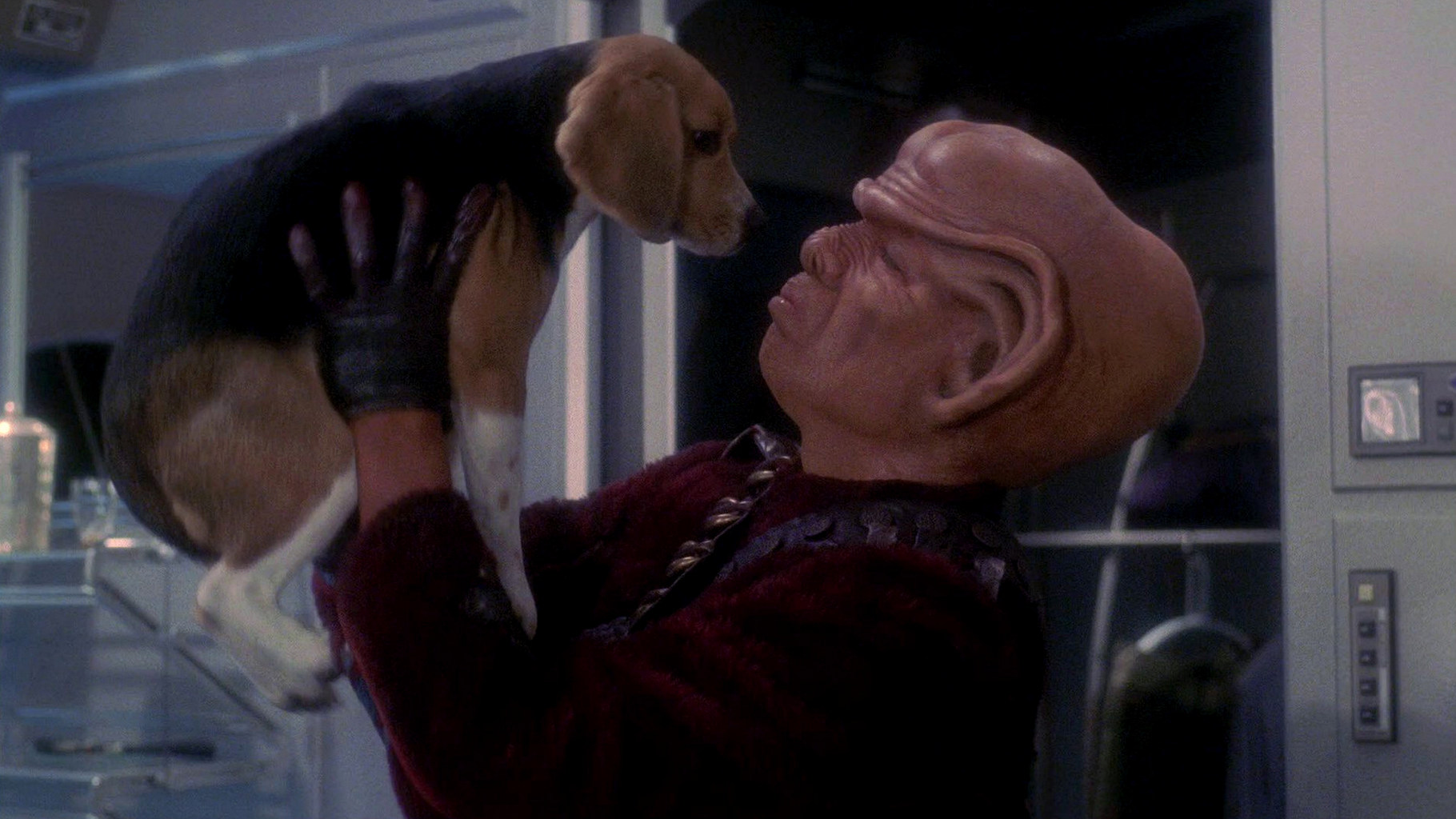
Date not given: A Ferengi ship docks with Enterprise. After opening an artifact that Trip brought aboard, the crew are all unconscious. The Ferengi begin searching Enterprise and taking anything they consider valuable. Trip wakes up in the decon chamber before the others and hides while watching the intruders. The Ferengi wake Archer and demand to know where the ship's vault is. Archer insists that there is no vault, but when they threaten to enslave the female crew members, he begins negotiating with them. Krem, the lowest-ranking Ferengi, is ordered to have Archer carry equipment over to their ship. Archer later asks Krem to bring him some food and uses the opportunity to secretly communicate with Trip. Trip wakes T'Pol with the only hypospray he has available. She and Trip begin working on a plan to overpower the intruders. They first create mistrust among the Ferengi by placing scanners they shared into a bag belonging to one of them. A Ferengi named Muk then spots Trip and chases him through the ship. Trip manages to disable him, but his accomplices capture Trip. They again threaten to enslave the women, and Trip finally agrees to show them the vault. Archer pretends to be furious at him, and the two stage a fight to make the Ferengi believe they are genuinely arguing about the location of the vault. Trip then leads the Ferengi through various corridors and crawlways, keeping them occupied while Krem leaves Archer behind and returns to the Ferengi ship, where T'Pol is waiting for him. She uses the Vulcan nerve pinch to incapacitate him. She then waits in the supposed vault for the other Ferengi and stuns them with a phase pistol. With all the Ferengi overpowered, Archer forces them to return the equipment they have taken from Enterprise. He warns them never to come near his ship again. Before they leave, Archer puts Krem in command of the Ferengi ship, making him its new captain to his delight.
Review
When I wrote my first review of "Acquisition" in 2002, my anger about bringing in the Ferengi 200 years too early may have overshadowed my opinion of the episode itself. I have discussed the continuity issue in more detail elsewhere, and I don't want to focus on it here. Instead, let's look at the story on its own terms.
Once we leave the continuity problem aside, "Acquisition" begins quite promisingly. The Ferengi speak their own language without subtitles, and we don't hear a word of English until about five minutes into the episode, when Trip wakes up. It creates a certain sense of mystery. Of course, it is fairly obvious that the pirates are going to pillage the ship, but exactly what they are doing and what they are looking for isn't immediately clear. We also don't know yet how the crew was knocked out. That keeps the opening interesting. Even without understanding anything, we quickly learn that Krem is the underdog among the intruders and that Muk is a particularly fierce and unpleasant guy. The Ferengi are not just interested in valuable technology. They take the bridge chairs, plates with cake and people's boots. It is all rather curious, and the episode takes its time establishing the situation. The slow pace actually works at first. After a while, this part of the story is exhausted. The intruders have searched the ship, the character dynamics have been established and something really needs to happen.
When the Ferengi question Archer, he quickly realizes that they aren't particularly interested in Enterprise's technology. They are looking for valuables, preferably gold or latinum or gold-pressed latinum, none of which the ship has to offer. The aliens then speak of enslaving the female crew members, which becomes one of the recurring themes of the episode. This initially works as both a serious threat and an amusing idea that fits with the sexism in their culture still 200 years later, but the more often it is repeated, the less interesting it becomes. Archer also starts playing along with the Ferengi's way of capitalist thinking. He confirms that Enterprise does indeed have a vault and then tries to negotiate a fifty-fifty split. That is actually a nice moment the first time around because the captain has realized that the best way to deal with these people is to speak their language, so to speak. But when he and Trip essentially repeat the same trick later, it has already lost its novelty. The same is true of Archer's attempts to manipulate Krem, the lowest-ranking pirate, whose cousin owns the ship. Archer repeatedly tries to persuade Krem to turn against the others or otherwise help him. There is some fun to be had in watching Archer figure out how the Ferengi hierarchy works and exploit Krem's position within it. But again, the idea is used over and over without any real progress.
And this is becoming the main problem with "Acquisition". The threat against the women, the imaginary vault and Archer's conversations with Krem are all reasonably entertaining the first time. But the story keeps returning to the same situations without adding to them. What initially feels like a slow-burning and rather unusual "alien takeover" plot gradually starts to feel repetitive.
There is another problem with the way Archer and Trip deal with the situation: they repeatedly miss opportunities to overpower the Ferengi. When Archer first spots Trip, what does he do? He has Krem fasten him to a handle with cuffs. And this is something our captain does repeatedly throughout the episode. He gets Krem to cuff him somewhere, taking away his chance to get the upper hand. But why? When Archer sees his engineer is on the loose, why doesn't he use the opportunity to surprise Krem and overpower him together with Trip? The two of them could have done that very easily. This is only the first of several situations in which the captain and the others seem strangely reluctant to take out at least one of the intruders when they have the opportunity. Their ship has been taken over by aliens, and realistically their first priority should be to regain control of it. After Trip has freed T'Pol, they still don't seriously consider approaching the Ferengi one by one. And even if several of them were together, Archer, Trip and T'Pol should have a reasonable chance of overpowering them. Instead, the characters seem determined to find a more elaborate solution. Sure, this is designed as a light-hearted episode, but that shouldn't mean that no one would want to fight to take back the ship.
At least their next idea is more interesting. T'Pol takes some of their scanners and puts them into one of the Ferengi's bags, hoping the others will think that he has stolen them. This creates some mistrust between the intruders, and they start quibbling with each other. It is a reasonably clever idea, but again it doesn't really lead anywhere. The Ferengi already spend much of the time arguing with each other, so the additional mistrust doesn't change the situation. It becomes another idea that is initially shown as a big deal but then falls flat.
Eventually T'Pol and Trip come up with a trap that can actually solve the problem. They lead the Ferengi to the supposed vault and arrange for them to go inside, where T'Pol can surprise them with a phase pistol. That part seems genuinely clever. The problem is that the plan only works because a number of things happen to go exactly as required. Krem has to end up with T'Pol so that she can disable him and take the weapon. The other Ferengi have to trust Trip enough to follow him to the supposed vault. And Archer, who cannot communicate with either Trip or T'Pol, somehow has to understand what is going on and play his part at the right moment. None of them can coordinate the whole operation. So the trap looks like a great idea once it has worked, but only because of a good deal of luck.
I like a couple of scenes because they have a touch of irony. For instance, when Krem tries to open a door while carrying two boxes, he demonstrates just how impractical the door openers are. On another funny note, we might regard T'Pol's encounter with Krem as the foundation of the infamous novel "Vulcan Love Slave". The little bits, such as the Vulcan nerve pinch, the Ferengi whip and a few other ideas, are amusing.
Overall, for roughly the first half of the episode, "Acquisition" is a real slow burner. The atmosphere works, the Ferengi are amusing enough and there is some curiosity about what exactly they are doing. But the story takes a long time to get anywhere. The second half is a different problem. It becomes a game of missed opportunities. The crew repeatedly comes up with ideas that either have little effect or could have been replaced by much simpler ways of dealing with the Ferengi. Perhaps some of this could be considered realistic: when you face an unfamiliar situation, not every plan is going to work. But because the story keeps doing it, it comes across as awkward rather than convincing.
And then there is, of course, the continuity problem. The word "Ferengi" is never spoken once in the entire episode. It is pretty obvious that this was done on purpose, so that nobody could point to the episode and say, "But the Ferengi were supposed to be unknown to humanity for another 200 years." I call this the Rumpelstiltskin trick: you're safe as long as no one speaks out your name. But it is only a name. Archer and his crew encounter these aliens, record their appearance, scan their ship and presumably have access to their database, providing lots of data about the species. Also, this is all happening in Earth's immediate vicinity by 24th century standards, within roughly a 100-light-year radius by this point in the series. The idea that the species could simply remain unknown for another 200 years doesn't work.
Having now looked at the episode again without allowing that issue to dominate the review, I can also see that it isn't the only thing wrong with it. While I identified some of the other issues already in my old review, I now understand better why I disliked it in the first place. "Acquisition" has a promising opening, but it later is dominated by repeated ideas, missed opportunities and a convoluted plan that succeeds largely through luck.
Annotations
- Nitpicking:
- How could only one container with gas contaminate the air in the whole big ship?
- How could the four Ferengi find and empty all fourteen weapons lockers so quickly?
- Why was exactly one dose of hypospray left for T'Pol? And why didn't Trip try to wake Dr. Phlox instead?
- Remarkable quotes:
- "Trust me. She's got no sense of humor. She's always complaining." (Archer, to Krem, about T'Pol, not knowing she is awake)
- "What's a wife worth? Five bars of gold, maybe six? Let them take Hoshi and I'll give you ten." (Archer, to Tucker)
- "If you come within a light year of any one of our ships, you won't know what hit you." (Archer)
- Rules of Acquisition:
- "Never allow family to stand in the way of profit." (#6)
- "Nothing is more important than your health - except for your money." (#23)
- "Expand or die." (#46)
- "A man is only worth the sum of his possessions." (no number given). There are only 173 rules altogether at the time.
- Remarkable appearances:
- Ethan Phillips as Ulis
- Jeffrey Combs as Krem
- Clint Howard as Muk
- Matt Malloy as Grish
Rating: 3
Oasis
Synopsis

Date not given: D'Marr, an alien guest on Enterprise, tells Archer where to find supplies for repairs. He says there is a crashed ship on a planet with no lifesigns, although he saw a crew there. Enterprise arrives at that planet, and Archer, Travis, Trip and T'Pol take a shuttle down to investigate. They find the systems powered down but discover that the dilithium is still in perfect condition. They soon realize they are not alone. After breaking through a hatch, they find themselves in a well-maintained garden. They run into aliens carrying weapons, who explain that their ship was attacked three years earlier. They did not send a distress call because they did not want to alert their attackers. They say they want to remain on the planet even though Trip offers to restart their engines. Trip befriends a woman named Liana. The aliens ask him to repair their advanced computer with optronic relays, so he has to return to Enterprise to obtain spare parts. They reluctantly agree to let Liana accompany him. Reed is skeptical of their story. He finds no scorch marks on the ship's hull, suggesting that it was not attacked, and determines that the hydroponics bay would not be large enough to support the entire crew. The corrosion of the hull also suggests that the ship has been there for about 22 years rather than three. Enterprise captures an escape pod launched from the alien ship and finds a dead man inside who is identified as one of the crew members currently alive on the planet. Upon his return, the aliens apprehend Trip and force him to continue the repairs. Archer, Mayweather and Reed set up a rescue and board the alien ship. Their phase pistols prove useless because the beams pass straight through the aliens. Liana helps them by removing program modules, causing them to vanish one by one. They are just holograms. The only real people on the ship are Liana and her father, the engineer Ezral. The true story is that an ion storm caused the ship's conduits to overload. Plasma burned through the hull and threatened to kill everyone. Ezral abandoned his station to save his daughter, making the two of them the only survivors. After some time, he created a holographic crew so they would not be alone. He eventually decides to leave the planet, but wants to do so in his own ship, with the holographic crew helping him repair it.
Review
"Oasis" is not quite the worst episode of season 1, but perhaps the least inspired one. The plot is essentially recycled from the DS9 episode "Shadowplay", where the people on a planet likewise turn out to be holograms, for much the same reason: an old man who was exiled did not want to be alone. The situation is almost identical here with Ezral, except that his daughter Liana is still real. The revelation was a big letdown when I first watched "Oasis".
Additionally, this is the second occurrence of holograms that appear perfectly real in "Enterprise", even though the holodeck is the defining technology of the 24th century, so the show is introducing it roughly 200 years too early. What makes it worse is how casually this technology is treated. When the Enterprise crew discovers what is going on, there is no real sense of wonder or even surprise. "Okay, they are holograms." The characters accept it with ease, the way Picard's crew might have done. Instead of presenting the technology as something extraordinary, the episode uses it for a dull meta joke when Trip points out that Ezral would have to create a holographic doctor if Liana is injured.
Then there is the familiar trope of shipwrecked people who, of course, are hiding a secret because they always do. Obviously there has to be some kind of mystery, because otherwise there would not be much of a story. But it turns out to be a rather boring path leading up to a lame resolution. The writers also try to give the story a horror angle, with a haunted ship and apparent ghosts wandering around, but that doesn't really work either. Taken as a whole, the plot offers one disappointment after another.
The characters don't fare much better. We of course have René Auberjonois as Ezral, who cannot really save such an uninspired story. His character is also somewhat stereotypical, a little like Rurigan in DS9: "Shadowplay" or Mullibok in DS9: "Progress": the stubborn old man who may have his reasons for behaving the way he does, but who should probably come around sooner. Liana isn't really more interesting. When she first appears in the airponics bay, it almost looks as if Kes has returned. Plot-wise, however, the more obvious parallel is Vina in "The Cage". Liana herself is not particularly memorable, and her relationship with Trip doesn't work quite as well as it could have. They could have developed it further, or perhaps simply left out the little touch of romance altogether. As it stands, it never becomes particularly convincing. As for the Enterprise characters, this could at least have been an opportunity to give some of them, most of all Mayweather, something to do again. Instead, it turns out to be yet another Archer-Tucker show.
There is actually one very funny scene. When T'Pol notices that Tucker likes Liana, she can't resist reminding him of his "affair" on the Xyrillian ship in "Unexpected": "I'm simply noting that last time you found someone this competent you wound up carrying her child." Liana walks in and asks, "Am I interrupting?" T'Pol replies, "Not at all. Commander Tucker and I were just discussing his previous repair experience." Last week Archer still claimed that T'Pol had no sense of humor. ;-)
Other than that, there isn't much that I find noteworthy. Even after the mystery has been resolved, the story has trouble knowing when to stop. Once Ezral tells the whole truth, you would expect everything to wrap up within another minute or two, because there isn't really much left to say. Instead, it drags on for several more minutes.
Overall, "Oasis" feels like a story assembled from familiar pieces without much inspiration behind them. The plot is recycled, the technology is anachronistic, the characters are mostly familiar types and even the resolution is stretched out longer than necessary.
Annotations
- Unremarkable ship: The crashed ship is the good old "hammerhead" freighter that appeared several times in TNG, very often as a Bajoran ship in DS9 and also in the Delta Quadrant. Now that there is a CGI model of it, we can "enjoy" the design in Enterprise too.
- Remarkable appearance: Annie Wersching (1977-2023) appears as Liana. She also played the Borg Queen in PIC season 2.
Rating: 2
Detained
Synopsis
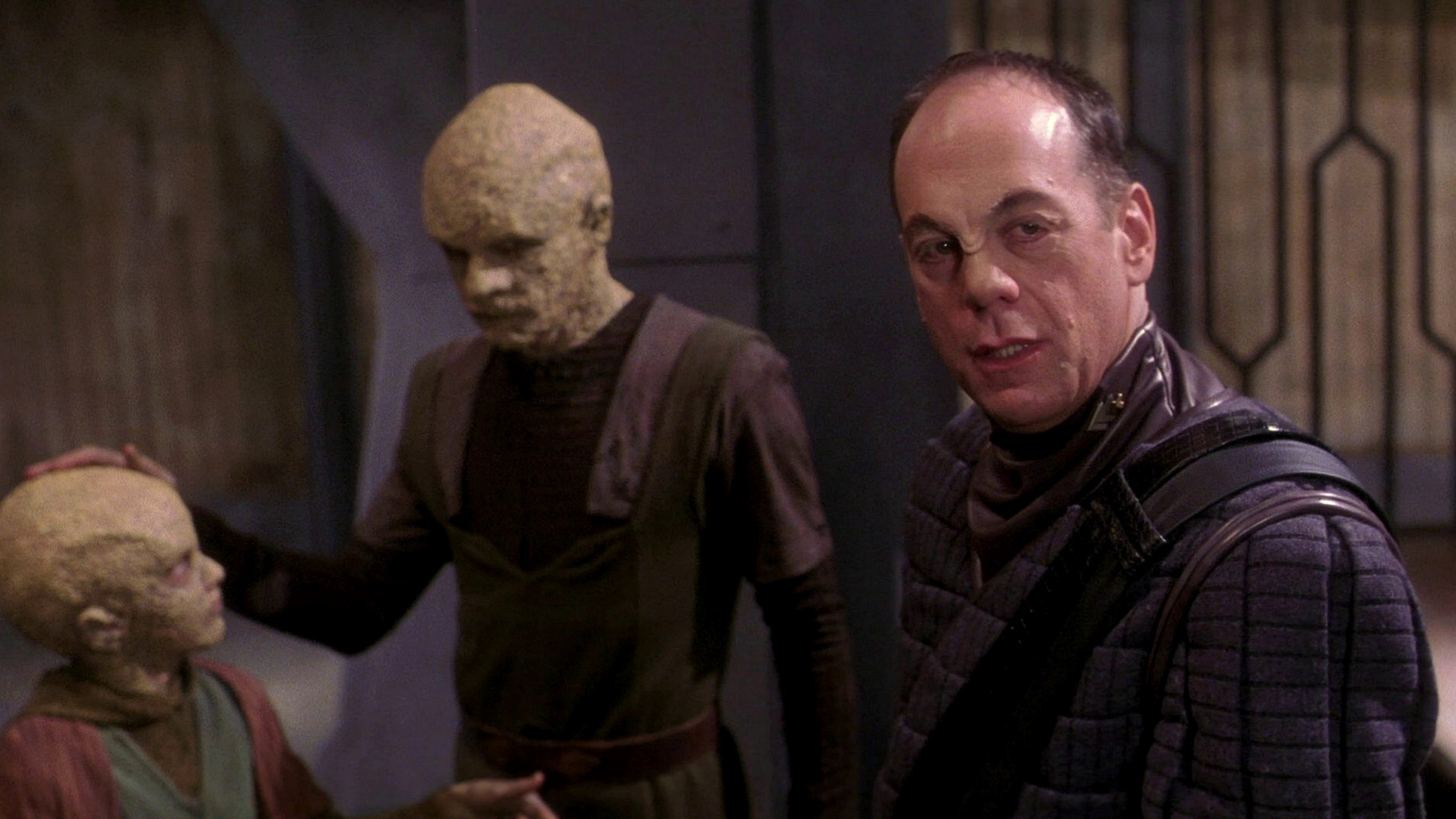
Date not given: Archer and Mayweather find themselves in a Tandaran detention camp. They are told that they entered a military zone with their shuttle. Colonel Grat, who runs the camp, refuses to let Archer contact his ship, saying that regulations don't allow it. He announces that there will be a hearing about the case on the Tandaran homeworld and tells Enterprise to proceed there. Most of the prisoners in the camp are Suliban because the Tandarans are at war with the Cabal. However, Archer learns that the 89 imprisoned Suliban, including entire families, have no connection to the Cabal and are being held simply because of their species. He befriends a father and his daughter and becomes determined to help the prisoners. Grat demands intelligence about the Cabal from Archer. When the captain refuses to cooperate, he postpones the hearing for several weeks. T'Pol eventually authorizes a rescue mission. Enterprise traces the camp's location and beams down a communicator. Archer tells his crew not to rescue them yet, as he wants to free the Suliban as well. The Tandarans discover the communicator, assault Mayweather and place Archer in isolation. While T'Pol's crew jams the Tandaran communications and sensors, Malcolm Reed infiltrates the camp in Suliban disguise and brings weapons and explosives. Enterprise launches its rescue operation and fends off Tandaran fighters in orbit. Trip takes a shuttle and disables the camp's defenses, while Reed blows a hole in the perimeter wall, allowing Archer and Mayweather to retrieve their shuttle in the facility's launch bay. The Suliban too escape to their ships, although their prospects once they leave Tandaran territory remain uncertain.
Review
The past couple of episodes have been rather uninspiring, mainly exploiting familiar tropes without giving them much of a new spin. At first, "Detained" does not seem to promise anything different, as Archer finds himself captured yet again. For some reason, this happens all the time on Enterprise, so the beginning does not exactly bode well. However, what develops over the course of the episode comes as a positive surprise. "Detained" turns out to be one of the more intriguing imprisonment stories in the series. It also has a real-world dimension, as it critically addresses racism and, in particular, the practice of holding an entire race or, in this case, a species responsible for the actions of a guilty minority. The direct reference to the internment of Japanese Americans during World War II might not have been necessary to relay just that, but it is certainly fitting. The premise is interesting enough, and the writing handles it with care.
One of the strengths of the story is that both sides have their prejudices, humans against Suliban and Suliban against Tandarans (or similar looking humans). This becomes apparent in the relationship between Archer and Danik. Initially, the captain accepts Colonel Grat's claim that the prisoners are members of the Cabal. When he meets Danik and sees his daughter, Archer assumes that she has been drawn into the Cabal against her will. It soon becomes clear, however, that he is mistaken. Archer is guided by his own preconceptions, based on his previous encounters with Silik and his soldiers. He therefore finds it difficult to imagine that ordinary Suliban families could have nothing to do with it. The episode also illustrates the reverse situation through the initial culture clash between Mayweather and Sajen, another Suliban prisoner. Mayweather eventually admits that he was afraid of the Suliban at first, while Sajen seems to have been of the impression that the similarly looking humans must be allies of the Tandarans and hence only slowly begins to trust the Starfleet ensign. Both encounters demonstrate how easily prejudice can distort one's judgment, even when there is no deliberate intention to discriminate.
The dynamic between Archer and Colonel Grat is another highlight. Grat is played by Dean Stockwell, best known to viewers as Al from Quantum Leap. Given Stockwell's shared acting history with Scott Bakula, their scenes have an additional appeal, and there may even be deliberate ironic nods to their earlier series. Grat is a credible character in his own right. He presents himself as a reasonable and sympathetic man who understands that the situation is unpleasant for everyone, but insists that he is merely following orders and regulations. He represents the familiar type of military official who claims to be a decent person and perhaps is one in a private environment, yet continues to uphold an oppressive system. This makes him more interesting than a straightforward villain, at least initially. One particularly good moment comes at the end when Archer raises his arm to hit the visibly frightened Grat with a weapon but ultimately refrains. The gesture conveys Archer's anger and frustration without having him resort to violence. As a resolution to their conflict, however, it is somewhat unsatisfying. Grat is being deconstructed but never really explains himself. I would have welcomed a little more insight into his character.
The Tandarans (yet another T-Race) themselves are not nearly as interesting as the central conflict might suggest. We learn that they are at war with the Cabal and that there are racial tensions involving Suliban living in their territory. However, these elements remain hearsay. The Tandarans are represented exclusively by military personnel, with Grat playing the good cop and Major Klev the bad cop. Beyond this, we learn very little about Tandaran society, its government or the reasons behind its attitude toward the Suliban. Perhaps I expect too much from an episode that is primarily concerned with the prisoners, but this aspect of the story falls a little flat. The Tandarans remain more of a backdrop for the moral conflict than a civilization in its own right.
The story takes a decidedly Trek-like turn when Enterprise could simply beam Archer and Mayweather out of the camp, but the captain insists that they cannot just leave the other prisoners behind. He wants to help the Suliban as well, and this decision gives the episode a greater purpose than a straightforward escape story. The situation is no longer just about getting the two Starfleet officers to safety, but about doing what they can for people who are being unjustly detained. This is where "Detained" really distinguishes itself from a standard captivity plot. Another welcome development is that Travis Mayweather gets something meaningful to do. We have not seen much of him during the first season, and it is refreshing whenever he gets to contribute more than a brief acknowledgment of the captain's orders.
Ultimately, "Detained" is a pleasant surprise in the first season of Enterprise. It takes a fairly standard situation and turns it into something more meaningful, unlike "Shadows of P'Jem", which doesn't develop the familiar elements to the same degree. "Detained" has grown on me over time. Most importantly, it reveals another side of the Suliban. They are not merely the temporal soldiers of the Cabal, who are obsessed with genetic enhancement. They are also ordinary people with families, including children, who want to lead normal lives but are denied that opportunity by societies like the Tandarans. This perspective makes the conflict more tangible and the Suliban more relatable.
There are a few shortcomings, but "Detained" is an engaging imprisonment story with a clear moral point, overall one of the better episodes of the first season.
Annotations
- Nitpicking:
- I am surprised to see that the shuttlepod is suddenly armed with what appears to be a phase cannon, judging from its continuous beam.
- It is a stretch that the damaged Starfleet shuttle as well as the Suliban ships are all fueled up and ready to depart immediately.
- The oddity of the week is that the Tandarans obviously have a racist slogan with a rhyme even in the English translation. ;-)
- Remarkable quote: "They call this a proper meal? I should save it for Commander Tucker. It'd make a good valve sealant." (Travis)
- Remarkable facts:
- The Suliban homeworld became uninhabitable 300 years ago.
- The Cabal started their attack on the Tandarans eight years ago, prompting the Tandaran government to detain Suliban living on their planets, "for their own safety".
Rating: 6
Vox Sola
Synopsis
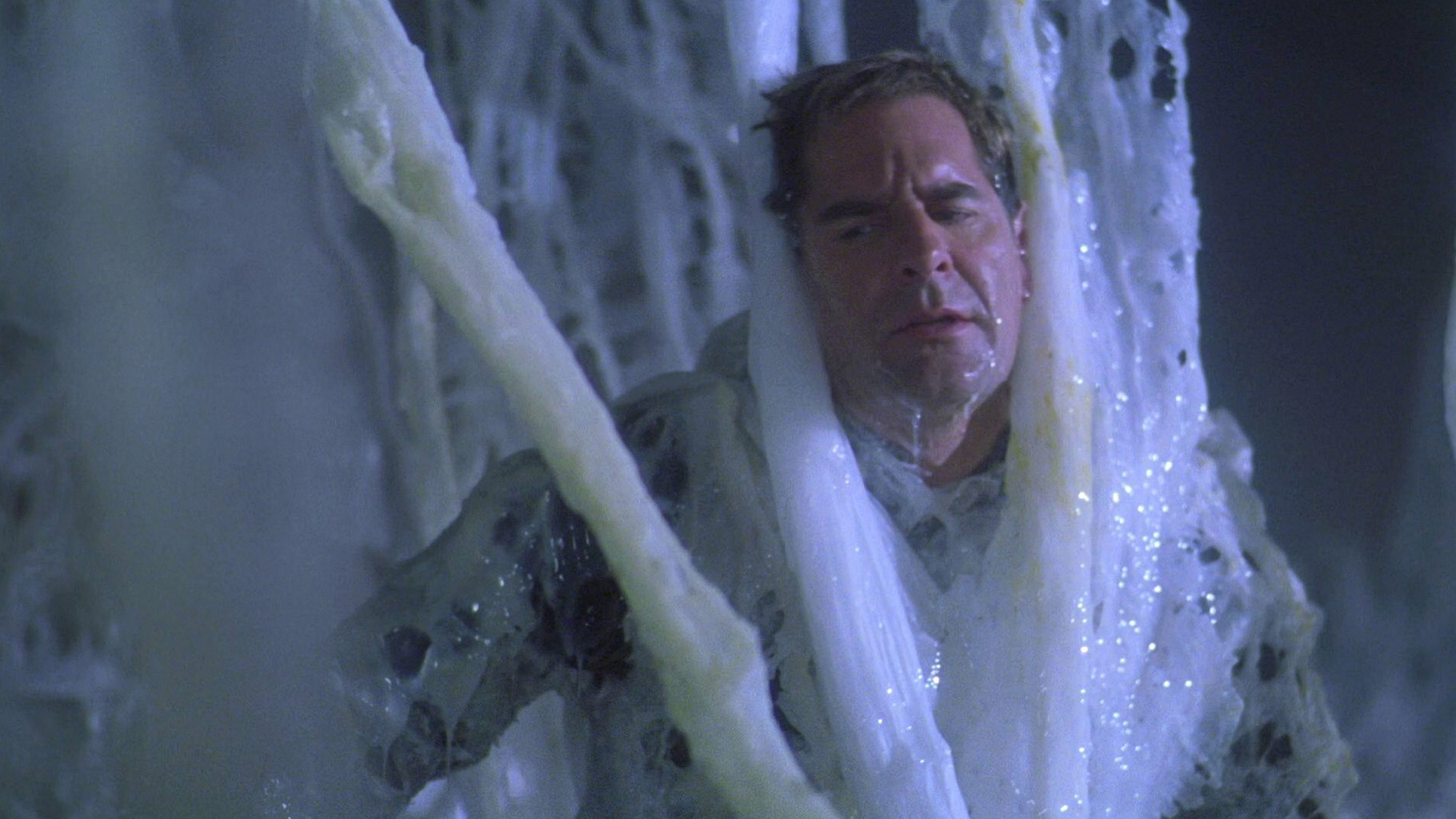
Date not given: A Kreetassan delegation visits Enterprise but quickly leaves offended by an unknown breach of their cultural norms. As the Kreetassan ship undocks, an alien organism secretly crawls aboard Enterprise. Communication interference initially seems minor, until two crew members discover the slimy creature in the cargo bay and are absorbed into it. When Archer, Tucker and another crewman investigate, they are also captured by its tendrils, while Reed narrowly escapes. Phlox examines the appendage severed when the door closed and discovers that the organism is both alive and intelligent. T'Pol decides there is too little time to establish communication as suggested by Hoshi, and instead decides to exploit the creature's photosensitivity. Reed's team uses photo emitters to force it to release the captives, but the attempt causes them pain because they have become connected to a common nervous system. The rescue attempt has to be terminated. The captives begin sharing their thoughts, but they also gradually lose consciousness as the creature integrates them, leaving the crew with little time to act. T'Pol assigns Hoshi to decipher the organism's language, while Reed proposes using a forcefield to allow communication without risking further captures. He wants to test the field on the severed appendage, but Phlox objects to experimenting on a sentient being. Meanwhile, Travis contacts the Kreetassans and learns where they picked up the organism. He also discovers the reason for their earlier offense: the Enterprise crew ate in their presence, an act considered as inappropriate as mating in front of them. With the forcefield in place, Hoshi establishes communication with the organism and obtains the exact coordinates on its homeworld. The creature releases the captured crew members, and Enterprise transports it home, where it reunites with the rest of its species. Phlox theorizes that the captured crew served as a surrogate for the lost contact with its own kind.
Review
The episode begins on a curious note when the Kreetassans leave Enterprise in a huff because they feel insulted by the crew. Hoshi translates their complaint as "You eat like you mate", but nobody has any idea yet what this is supposed to mean. The little mystery is resolved later when we learn that they do not eat in the presence of others. This is a rather amusing misunderstanding, although it is really just a side note in the story. We will see the Kreetassans again in the notorious "A Night in Sickbay", when Archer has to apologize to them once more.
The main story, however, concerns first contact with another species, one that the Kreetassans unintentionally bring aboard Enterprise. It is a white, slimy creature with numerous tendrils. We have seen similar things before. Among the classic examples from The Original Series are "The Devil in the Dark" and "Operation - Annihilate!". In the former, Spock eventually manages to establish peaceful communication with the Horta, whereas in the latter, the hostile "pancakes" are destroyed with ultraviolet radiation. "Vox Sola" clearly benefits from following the example of "The Devil in the Dark". The crew eventually realizes that understanding and communication are preferable to simply killing the creature, although the possibility of doing so is considered during the episode. This provides a familiar but solid foundation for the story.
Admittedly, it looks a little silly when Archer and the other crew members are engulfed by the creature's slimy tendrils. However, the acting makes up for the somewhat ridiculous appearance of the situation. The episode is also directed well enough that it never creates the impression that the predicament could be funny.
An aspect that distinguishes the creature from many familiar science fiction monsters is that it neither directly kills its victims nor sucks out their life force in the way that happens so often in this genre. Instead, it is looking for company and attempts to unite with the human crew members it has captured. From the organism's perspective, what it is doing may not be an act of aggression in the usual sense. It simply wants to establish a connection with other living beings, without understanding what this means for them. This gives the conflict a different dimension, as the creature is dangerous without necessarily being malicious. It also reinforces the central idea that communication is the key to understanding.
The careful use of horror elements is another strength of the episode. I am certainly not opposed to horror in Star Trek, but there is a difference between genuine suspense and a succession of superficial effects. "Vox Sola" understands this distinction. It concentrates on particular moments that make the situation unsettling. One especially effective example is the scene in which Reed, Hoshi and the others are separated from the creature by a forcefield, while its appendages reach out and touch the barrier. The danger is immediately apparent, and the possibility that the creature might get through the field creates tension without the need for excessive scares or grotesque imagery.
Another aspect of the episode that deserves praise is the way it distributes the action among the characters. It is only natural in a series that different characters work together in different combinations from time to time. Archer and Tucker being incapacitated is actually an advantage here, because they are so often at the center of the action. Their absence gives the other characters an opportunity to make decisions and take responsibility for solving the problem themselves, and to experience different character dynamics than usual. The pairing of T'Pol and Hoshi is especially interesting in this regard. T'Pol repeatedly presses Hoshi to find a solution, asking why she has not made more progress and urging her to work harder. Hoshi interprets this as a sign that T'Pol does not trust her abilities, and she becomes defensive. In reality, however, T'Pol is simply behaving according to her own nature. She does not feel the need to soften her demands with pleasantries. Her directness is not intended as an insult but as encouragement, and she knows perfectly well how capable Hoshi is. She may even recognize that Hoshi needs some pressure to perform at her best, which ultimately proves to be true.
Travis Mayweather also gets something meaningful to do, as he did in the preceding episode. He is largely alone on the bridge when the Kreetassans contact Enterprise, and he has to handle the conversation himself. He does more than simply greet them, as he also delivers the apology for the crew's behavior. This is an unusual situation for Mayweather, who does not have the same experience in dealing with diplomatic encounters as some of his colleagues. Nevertheless, he handles it quite well, while we can feel how nervous he is.
So what do we ultimately take away from "Vox Sola"? At its core, it is once again a fairly standard Star Trek situation: an alien creature finds its way aboard the ship, endangers the crew and forces them to decide how to respond, with violence being their first choice. This is a familiar idea, and "The Devil in the Dark" remains the obvious precedent. Nevertheless, "Vox Sola" gives the old trope a sufficiently fresh spin through the nature of the creature, the suspenseful situation aboard Enterprise and the way the various characters contribute to the solution. All things considered, I am satisfied with "Vox Sola", although it is hardly innovative.
Annotations
- Nitpicking:
- Reed casually perfects the forcefield and therefore introduces yet another technology that better should not exist for another one hundred years or at least a couple of decades. As with the transporter too, the remark that the improvised device still needs refinement does not excuse that it is already indistinguishable from the advanced routine technology used 200 years later.
- It is not evident why the presence of Hoshi, and therefore of the forcefield, was required in the first place as she attempted to talk with the alien creature. Once she was behind the forcefield, it reacted to the sound she produced, rather than to her physical presence.
- I am surprised that suddenly a phase rifle shows up (with the same visual effect as the phase pistol) that has never been mentioned before and probably didn't exist so far, as especially "Blow-it-up" Reed should have preferred this more powerful weapon over the pulse rifle on previous occasions.
- Remarkable dialogue: "Why don't you stay for the movie tonight?" - "What's playing?" - "Uh... 'Wages of Fear'. Classic foreign film." - "Hmm." - "You'll like it. Things blow up." - "Hmm. Sounds fun." (Travis and Malcolm)
- Remarkable quote: "When Zefram Cochrane talked about new life and new civilizations, do you think this is what he meant?" (Tucker, as he is incapacitated by the alien organism)
- Remarkable fact: The Kreetassans don't eat in the presence of others, which they consider equally indecent as mating in the public. This was the actual reason why they took offense when they entered Enterprise's mess hall. This cultural peculiarity may also explain why their words for "eat" and "mate" are similar, as Hoshi finds out.
- Note on the episode title: Vox sola means "single/solitary/lonely voice".
Rating: 6
Fallen Hero
Synopsis
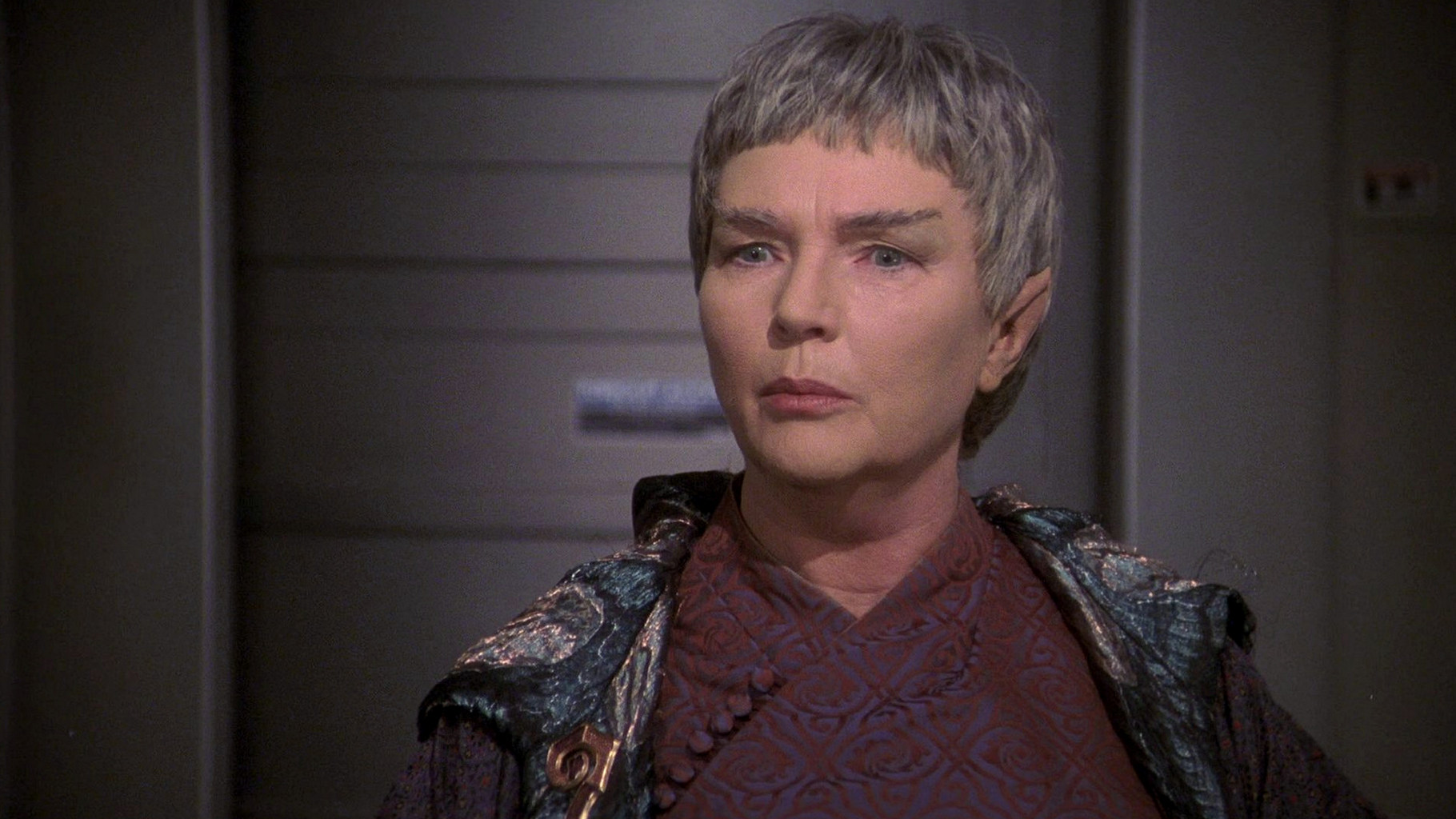
February 9th, 2152: The crew looks forward to a brief vacation on Risa, but Archer receives orders to transport Vulcan Ambassador V'Lar from the planet Mazar to a rendezvous with the Vulcan ship Sh'Ran. After she has come aboard, a Mazarite vessel catches up with Enterprise, whose commander demands V'Lar's extradition, claiming she has committed a crime. The Mazarites jam communications and open fire. At Reed's suggestion, Archer drops to impulse so the armory officer can use the phase cannons to bring down the shields and damage the ship with spatial torpedoes. Archer asks V'Lar what she is accused of, but she refuses to tell him. She eventually confides in T'Pol, who once made a lasting impression on her, just as T'Pol was inspired by the ambassador. T'Pol asks Archer not to extradite her. Enterprise resumes course toward the rendezvous, but three Mazarite ships pursue them. Archer increases speed to Warp 4.8, then 4.9 and finally Warp 5, yet the pursuers continue to close in. The ships' engines begin overheating. Hoshi cannot penetrate the jamming field, but V'Lar shows her a diplomatic frequency that allows to contact the Vulcans. The Mazarites hit Enterprise's starboard nacelle, as the Sh'Ran is still ten minutes away. Archer tries to buy time by allowing the Mazarites aboard. They are told V'Lar is in a regeneration chamber recovering from injuries. The Mazarites fire on the chamber, but it turns out the ambassador is not inside. When the Sh'Ran arrives, the outgunned Mazarites are forced to surrender their weapons, and V'Lar safely transfers to the Vulcan vessel. The actual reason why the Mazarites wanted to get hold of her was that she has knowledge of organized crime and corruption in the government.
Review
"Fallen Hero" opens with Tucker looking forward to a visit to Risa. T'Pol suggests that sex might help relieve the tensions among the crew, offering the advice quite matter-of-factly. This calls to mind her customary bluntness, which will still play a role in the following.
However, the vacation to Risa needs to wait. Instead, Archer receives orders to transport Vulcan Ambassador V'Lar from Mazar to a rendezvous with a Vulcan ship. T'Pol explains the elaborate protocol the crew must observe in the ambassador's presence. They are not to address V'Lar unless she speaks to them first, shake her hand or laugh in front of her. Her quarters must also be kept spartan. It is not entirely clear whether these rules reflect standard Vulcan diplomatic procedure or T'Pol's personal recommendations, since she later reveals that she has met V'Lar before. In any case, we can already anticipate that the ambassador will not conform to these expectations. Sure enough, she arrives in a friendly manner, shakes hands with the crew and seems perfectly comfortable with people laughing in her presence. She even makes a humorous remark. She would probably appreciate more comfortable quarters as well. V'Lar is clearly not the kind of Vulcan we have been led to expect, at least not according to T'Pol's description.
This part of the story is not merely about an ambassador who defies expectations, however. It also offers a study of Vulcan character, which is welcome because Vulcans in Enterprise have so far tended to be rather one-dimensional, austere or arrogant. There have been exceptions, such as the dissenters in "Fusion", who seek out pleasure but turn out to be unstable in a lack of mental discipline. V'Lar seems more like the kind of reserved but open-minded Vulcan we know from TNG, rather than the rigid and often condescending representatives we have encountered so frequently in Enterprise. Of course, by now we are able to say much the same about T'Pol, so it is worth looking more closely at the differences between the two before drawing any conclusions.
At first, V'Lar comes across as unusually approachable. As already mentioned, she seems comfortable with conforming to human cultural norms. These are small gestures, but they set her apart from the Vulcans we have come to know in this series. As the story progresses, though, a different side of her emerges. She does not trust Archer and appears generally distrustful of humans according to her own statement. The only person she confides in is T'Pol, a fellow Vulcan whom she met many years ago and still remembers as being particularly blunt and honest. V'Lar is not as quick to trust as her initial friendliness might suggest. This is not necessarily a contradiction. On the contrary, it gives her a more realistic range of traits and helps dispel the impression that Vulcans must either be either uniformly austere or unusually eager to embrace unfamiliar people and experiences. V'Lar occupies a middle ground, as does T'Pol, although they approach it from different directions. T'Pol initially seemed just as reserved as her fellow Enterprise-era Vulcans, despite having spent years among humans. Over time, however, she has learned to trust Archer and appreciate the people she serves with. V'Lar, by contrast, has retained her skepticism of humans despite her long career, in which she has dealt with many different species. In this respect, the two women complement each other: what V'Lar lacks in trust towards humans, T'Pol has gradually acquired through experience. This contrast is developed well and gives the episode more substance than its basic plot might suggest.
The bare diplomatic and espionage story is less compelling. It revolves around V'Lar and the Mazarites, who first want to get rid of her and later attempt to arrest or possibly kill her because she knows too much about the secret power structures on their planet. The underlying conflict remains blurry and is not particularly engaging in itself, and the Mazarites never become especially interesting antagonists. What makes the episode work better is the space action, which creates tension without disregarding the technological limitations established for Enterprise. The Mazarites can catch up with Enterprise because the ship is not initially traveling at maximum warp. Also, the ship cannot use its phase cannons while at warp, giving the pursuers a tactical advantage. It is appealing to see such restrictions, especially if they still matter two hundred years later, rather than having the script conveniently ignore them whenever the plot seems to require it. The subsequent chase is another highlight. With three Mazarite vessels closing in, Archer eventually pushes Enterprise to Warp 5, while the engines begin to overheat. The ship was designed to operate at Warp 5, and there is no engineering miracle that helps Trip overcome this limitation, which keeps the story tense and credible.
"Fallen Hero" is clearly one of the best episodes of Enterprise's first season. Its basic diplomatic plot is not particularly memorable, and the Mazarites themselves remain underdeveloped. The strong elements are the nuanced portrayal of Vulcans, especially in the comparison between V'Lar and T'Pol, and the suspenseful space action, which respects the technological constraints of the series. These aspects make the episode more satisfying than its central premise might suggest.
Annotations
- Remarkable quote: "I sense a great bond between you. A bond of... trust and respect. But also... a bond of friendship. I think it bodes well for the future relations of our two people." (V'Lar)
- Remarkable facts:
- The Vulcan combat cruiser Sh'Ran has a top speed of Warp 7.
- Enterprise, on the other hand, reaches Warp 5 for the first time.
Rating: 7
Desert Crossing
Synopsis
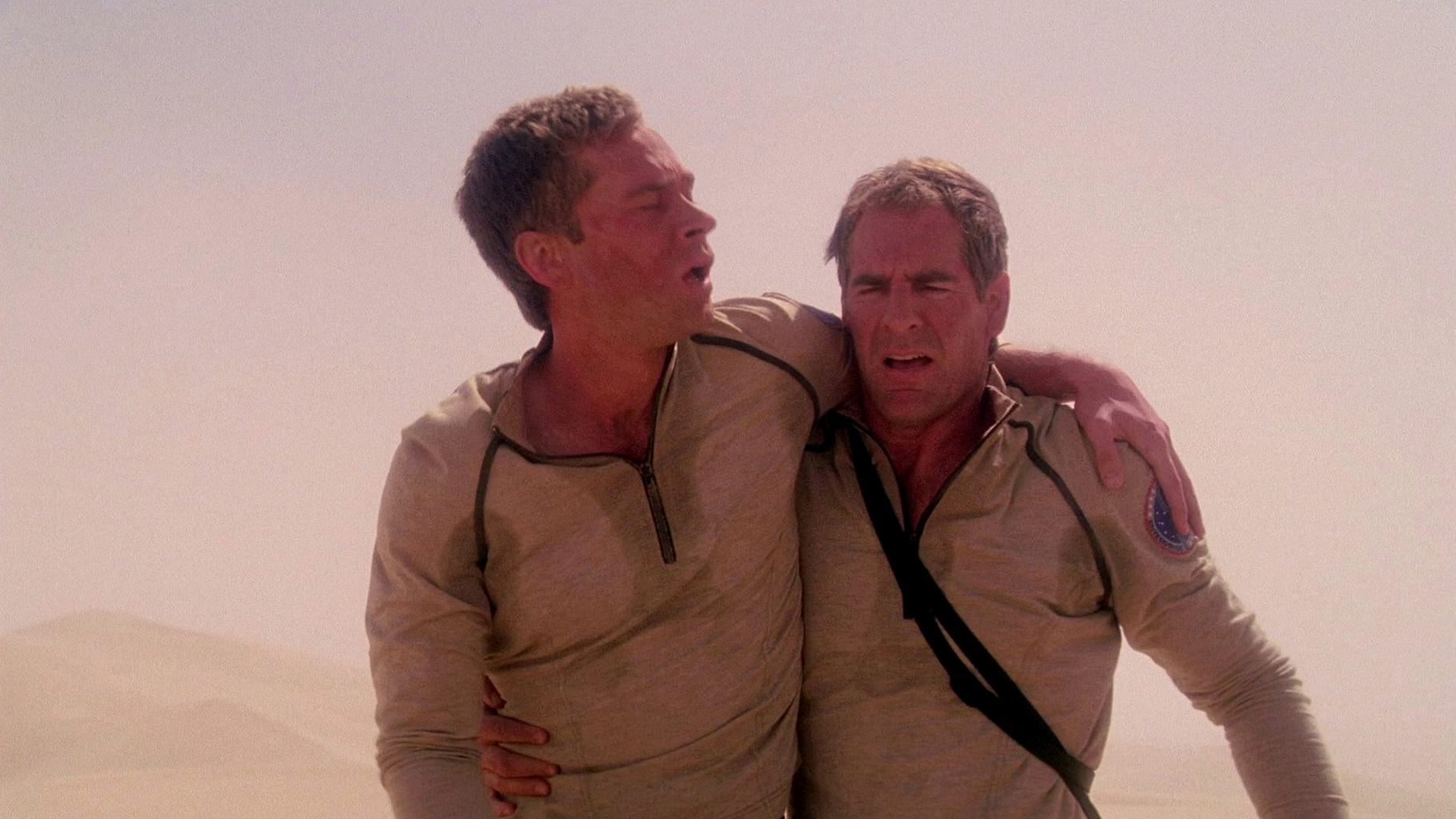
February 12th, 2152: The crew is still looking forward to visiting Risa when Enterprise receives a distress call. Tucker helps a man named Zobral repair his shuttle, and the alien invites the captain and the chief engineer to visit his planet. At his desert camp, their host welcomes them warmly, offering an exotic meal and gifts and encouraging them to join in recreational activities. However, the Torothan authorities contact Enterprise and warn that Zobral is a terrorist and that Archer and Tucker are helping him. T'Pol relays the message to Archer, who decides to leave. Before they can depart, however, the Torothans attack the camp. Archer and Tucker take shelter, but the buildings are destroyed, forcing them to flee into the desert. The daytime heat becomes unbearable, Tucker grows dangerously weak and their water supply dwindles. Eventually, they find refuge in an abandoned outpost. Meanwhile, Zobral comes aboard Enterprise and explains that he sought Archer's support after hearing how he had helped the imprisoned Suliban. He agrees to exploit a gap in the planet's shields to search for the two officers, accompanied by Reed and T'Pol. By the time they locate Archer and Tucker, the Torothans are firing mortars at their position. The shuttle finds and destroys the mortar emplacement, then rescues the two officers. Enterprise and Zobral subsequently part ways peacefully.
Review
Sad news: the vacation has to be postponed once again. This time, the reason is a man named Zobral, whose shuttle has broken down and who receives help from Commander Tucker. Zobral invites Archer and Tucker to visit his home planet, where he lives in a desert camp. The temperature is 41°C, but their host makes them feel welcome. He is very forthcoming and treats the two officers as honored guests, offering them more or less delicious food food and gifts and inviting them to take part in a game of geskana. The whole thing is nicely arranged, especially thanks to the location shots, but overall it never becomes particularly interesting.
Geskana is some sort of Lacrosse but totally a men's thing on Zobral's planet. There may have been women around, but I do not remember seeing any. The first half of the episode leans heavily on celebrating manliness in a way that probably wouldn't be possible today. Instead, we might get an equally obtrusive promotion of diversity. I do not like either approach. There's no need to turn the story into such an overt endorsement of any particular ideal. That is essentially the first half of the episode, and not much has happened. Then we learn that the planet's government considers Zobral a terrorist, and the story finally begins to move forward.
When the Torothans attack the camp, Zobral shoves Archer and Tucker into a shelter, but the buildings are destroyed, forcing them to flee into the desert. For some reason, none of Zobral's people are anywhere to be seen. The second half thus turns into a survival story, with the two officers struggling against the extreme heat and their dwindling morale. Trip cannot cope with the conditions and repeatedly collapses, yet he still tries to mobilize whatever forces he can. Archer's concern for his friend is touching, and the scenes are nicely filmed and acted. Nevertheless, I find this part of the episode boring, as there is not much of a story to sustain it. It feels as though something more should happen, as though the episode needs a more meaningful takeaway beyond their survival.
Eventually, Zobral reveals that he had already heard about Archer's past achievements, specifically his role in helping the Suliban escape from the detention camp in "Detained". He now seeks to recruit Archer for his own fight against the government. This introduces a basically interesting idea: your reputation precedes you, and people may form expectations of you long before they meet you. There's also a "never meet your heroes" aspect to this. Zobral has built up an image of Archer based on hearsay, and realistically, he would have been disappointed sooner rather than later. Archer is neither the superior military leader he seems to imagine nor someone who would fight another person's war. This could have made for a more meaningful story, but the episode does little with the idea beyond revealing Zobral's unrealistic expectations in retrospect.
As presented, the revelation is not much of a surprise and has little impact on the plot. In the end, Zobral helps the Enterprise crew locate Archer and Tucker, who are rescued just as the Torothans are firing mortars at their position. Tucker is barely conscious when they are found, and the ordeal is finally over. The characters then part ways, with nothing else to take away from the experience.
Ultimately, "Desert Crossing" leaves me with very little. The first half provides a pleasant setup, with attractive location shots and a welcoming host, while the second offers a well-filmed survival trip. The aspect of Archer's reputation preceding him could have given the story a more interesting point, but it remains largely undeveloped. The episode never turns its premise into anything particularly memorable. I'm really looking forward to the crew's vacation on Risa, because it can only be more captivating than this desert trip.
Annotations
- Nitpicking:
- I wonder if someone made up their mind about the shuttle's weapon. After it (erroneously?) had a phase weapon in "Detained", it is now equipped with what looks like a pulse cannon.
- The question of the week is what happened to the shuttlepod that Archer and Tucker abandoned. Even more so than on Voyager, it should be hard to replace shuttles, and Enterprise allegedly has only two of them.
- I also wonder why Archer and Tucker went into the desert in the first place when they could have used the shuttle to escape. It had not been hit in the bombardment, and I think they would have had a good chance to outrun the projectiles.
- Remarkable quote: "The galaxy could use more people like you." (Zobral)
Rating: 3
Two Days and Two Nights
Synopsis
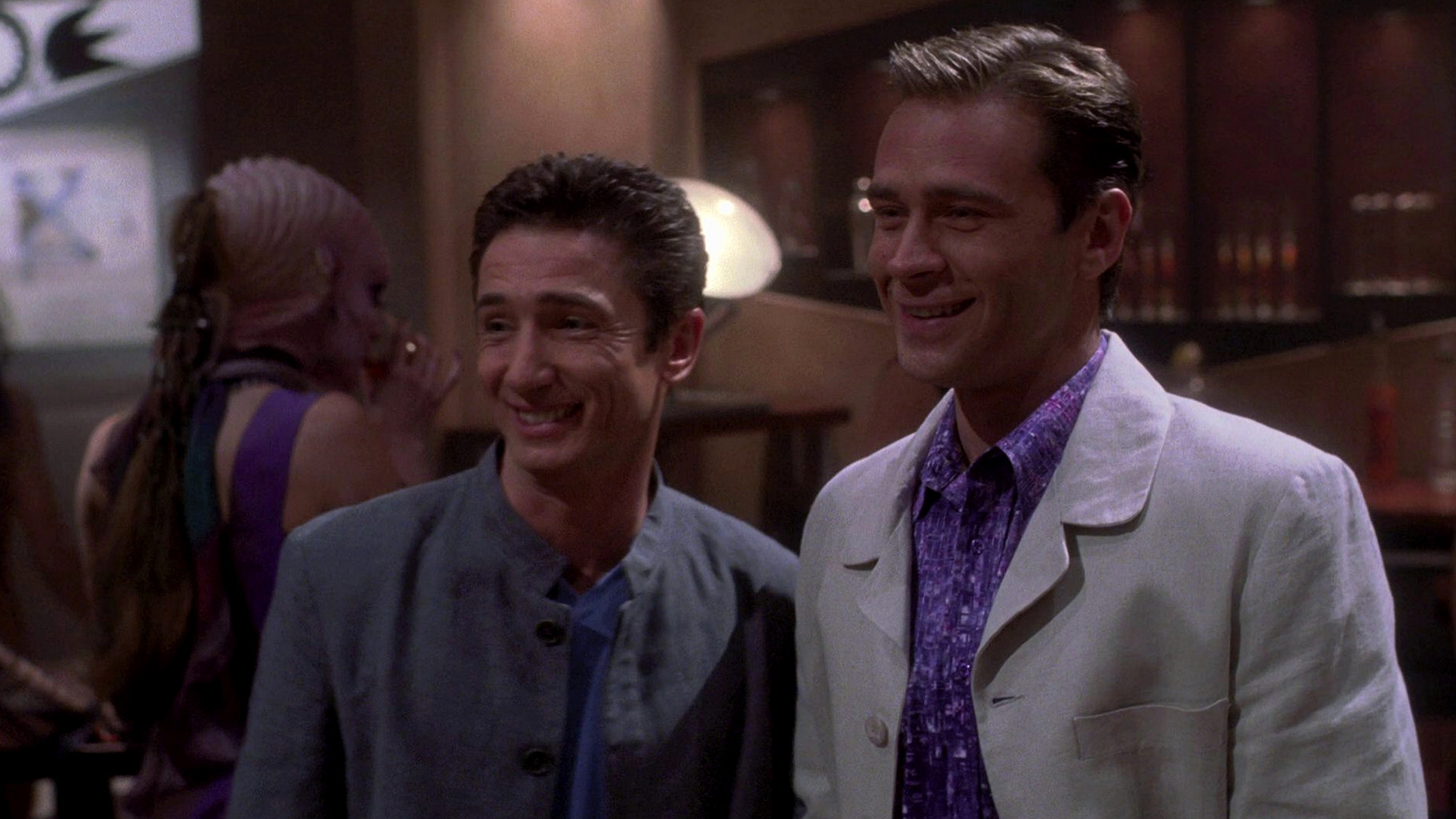
February 18th, 2152: Part of the crew finally take their deserved vacation - two days and two nights on a pleasure planet called Risa. Trip and Malcolm are seeking company in a bar, but the two attractive girls turn out to be thieves. Hoshi meets an alien man, and they soon find more interesting activities than only learning each other's languages. Travis engages in rock climbing and breaks his leg, and Dr. Phlox has to be interrupted in his hibernation to tend to an allergic reaction due to a medication on Risa. Captain Archer, finally, meets a woman, but he eventually finds out that she is a surgically altered Tandaran spy who tries to find out where the Suliban helixes are located.
Review
Th synopsis of "Two Days and Two Nights" reads like a "Love Boat" episode - and that's what it is. The setting is only slightly different. The way of storytelling, with multiple light-hearted plot threads about the adventures and problems of the guests, is much the same.
It is a fun episode overall, something for the viewer to relax, quite as the characters intended to do. Irony is in the plot itself, and in many single lines. All our brave crew wants is relaxation but what they get is excitement and/or trouble. Hoshi is a bit miffed about Trip's and Malcolm's apparent intentions to meet aliens of the opposite sex, but in the end it is her who ends up in bed with an alien - whereas Trip and Malcolm are robbed. Travis is overly confident about how he can climb rocks with ever changing steepness, which conjures up his accident. Archer just wants to take a break from interstellar politics for two days, but has to realize that spies would not respect his wish to relax. Even Phlox is interruped in his hibernation because of adverse circumstances.
Since nothing with serious consequences happens in "Two Days and Two Nights", nothing should be taken too seriously. Nevertheless, the episode with its countless references to previous heroic deeds or mishaps may have the best intra-series continuity. Unfortunately, this applies to the plot vehicles likewise. Even though it has an ironic undertone here, seeing that everyone of the crew is being knocked out in one way or another adds to the overall awkward and naive impression that has been created of them over the first season. The fact that that Malcolm and Trip are once again fettered and in their underwear is just the icing on the cake. As much as I enjoyed it, it has become hard to take the crew seriously as characters any longer because the same already happened in serious stories. In other words, the potential that may have been in a one-time comical look at the crew's misfortunes has already been wasted throughout the season. By now, it is rather a self-ironic look at the series as a whole.
Another issue is that, except for Hoshi's long conversations in alien languages (I don't remember any sub-titled scenes that long in Star Trek), Risa is not very alien. Well, there are (at least) two moons and Horgahn-shaped door buttons, but that's it for the specifically Risan setting. Looking back, it would have been more interesting to see the crew getting into trouble because of the special customs, laws or environmental conditions or anything else intrinsic to the planet. Only Travis's allergic reaction to the treatment on Risa falls into this category but remains a side note. The way the story unfolds, the episode could have taken place in Florida as well.
Speaking of Florida, who else thought that especially the bar scene with Trip and Malcolm borrowed a lot from the 1980s? The synth-pop music, colorful hairstyles and finally Trip's and Malcolm's Crockett & Tubbs outfits.
Annotations
- Nitpicking: Archer mentions a couple from "Vega Reticuli". This star designation makes no sense. He may have meant Zeta Reticuli.
- Remarkable scene: When Cutler and T'Pol wake up Phlox, I can fully understand his disorientation. I feel like that every morning!
- Remarkable dialogues:
- Reed: "Well, supposedly Risa is very cosmopolitan. There are species visiting from all over." - Tucker: "Malcolm and I, uh, plan to broaden our cultural horizons." - Hoshi: "Is that all you two think about?" - Tucker: "Well, how we choose to relax is our own business."
- Tucker: "I saved the captain's life." - Alien "women": "I thought you were the captain." - Tucker: "We rotate." (pointing at Reed) "He's captain next week."
- Mayweather, to T'Pol: "Have you ever been to an alien hospital?" - T'Pol: "Yes. In San Francisco."
- Remarkable quote: "As a matter of fact, I learned several new conjugations." (Hoshi, on her "language studies")
- Quote of the week: "Malcolm, bearing 1-8-0." (Tucker, when he spots the two women behind him)
- Remarkable facts:
- Dr. Phlox usually hibernates six days per year, but two should suffice.
- Hoshi had learned 38 languages before she left Earth.
- Earth is 90ly from Risa. This is the farthest any human being has ever gone, according to Archer.
Rating: 5
Shockwave I/II
Synopsis
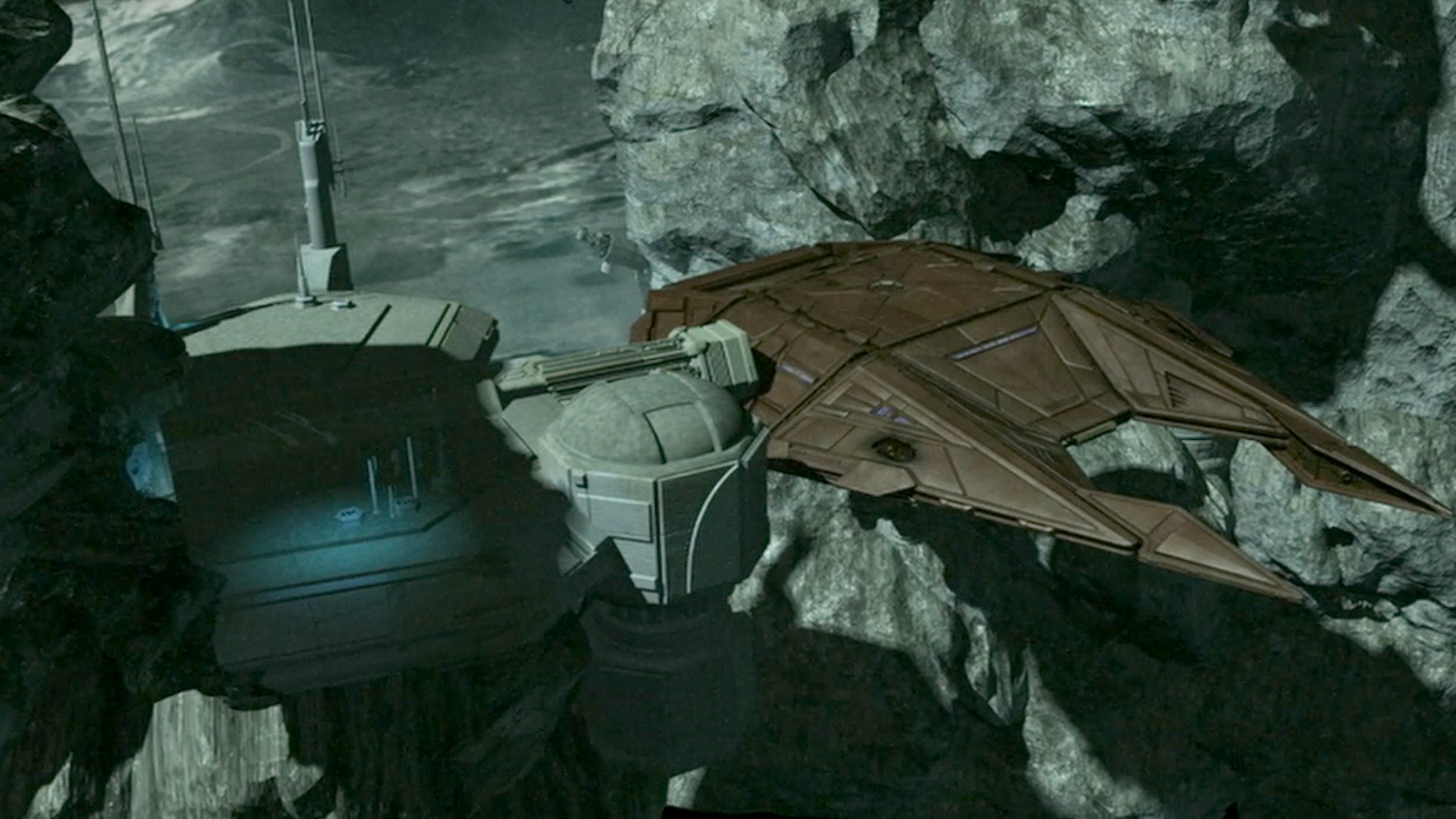
Date not given: An Enterprise shuttle seemingly causes the ignition of gases in an atmosphere, costing thousands of lives on the planet below. Admiral Forrest has no choice but to cancel the mission and call Enterprise back to Earth. Daniels, the time traveler from the 31st century, however, knows that the Suliban are responsible for the disaster by planting a device on the shuttle's hull. He sends Archer on a mission to track down a Suliban stealth cruiser, disable it and steal the evidence. But on the way back Enterprise is surrounded by Suliban vessels. In an attempt to correct history once again, Archer is transferred to the 31st century, but his absence triggers a development in which Earth is being devastated. Without any time travel equipment, Archer and Daniels are trapped in the 31st century, while Enterprise is facing a battle against a fleet of Suliban ships... Daniels and Archer find out that the Federation never existed in the current version of the 31st century, and that it must have to do with Archer's disappearance from the 22nd century. Searching for Archer, the Suliban have boarded Enterprise and confined the crew to their quarters. Archer and Daniels manage to send back a message through time to the Enterprise crew. Reed finds a time travel device in Daniels's former room, but Silik takes it, and Archer is returned from the 31st century to the Suliban Helix. In the meantime, having faked a warp core breach, Enterprise breaks free from the Helix. Archer manages to take Silik hostage and get back to Enterprise. The mission is allowed to continue.
Review
"And now the confusion...". I usually don't review two-parters separately, but this one would receive 8 points for part one and only 3 for part two. The first part of "Shockwave" makes several promises the conclusion doesn't keep. While the cliffhanger leaves several options as to how the temporal mess may be explained and fixed later on, the second part absolutely fails in doing either of that. The time travel aspects are discussed on a separate page, but they are not the principal problem. Among many weak points about the logic I am especially annoyed that there is no other interpretation possible except that Daniels must have abducted Archer against better knowledge that this would necessarily change history and might lead to exactly the disaster that happened. How stupid of him! The successful attempt to fix the whole situation by creating a temporal transmitter with a few extremely simple modifications to Archer's communicator and scanner is another major annoyance. The device suddenly even has a holographic imager! As if it would only take a good 21st century engineer to turn a 19th century telegraph into a modern cell phone. This is the most ludicrous engineering nonsense in Star Trek in a long time! Without any change to the plot, Daniels could have taken one of his own advanced devices or modified parts of his protection suit to send the message, which may have already been difficult enough.
There are several more errors and plot holes, which show up massively in the second part. Was it part of the plan that Silik would take away Daniels's device from Reed and that Archer would be trapped on the Helix upon his return? It almost seems so since no one backed Reed while he broke into Daniels's quarters. And did Silik really think he had any chance to contact Future Guy with a device he had not the slightest idea how to operate? Silly Silik! Why is Silik so awfully important that his soldiers stop the attack when he is taken hostage? Why didn't Archer simply keep Silik as a prisoner? And finally, since when can Enterprise fire phase cannons at warp?
The second part also compares badly to the first one in that some of the tasteless Enterprise clichés show up again. T'Pol tortured in underwear, Hoshi losing her shirt, Reed beaten until he bleeds by Silik. Braga and Berman should finally start thinking about which kind of audience they are aiming at. But what I actually like least about the second part is that everything said about Archer's mission in particular and human-Vulcan relationships in general exactly echoes what has been stated so many times before. Especially the final five minutes with the stereotypical statements by Archer, Tucker, Forrest, Soval and T'Pol are perfectly interchangeable with "Broken Bow", "The Andorian Incident" or "Shadows of P'Jem". Of all people involved, only T'Pol may have changed her mind, but this became apparent as soon as in "Broken Bow". I really wonder when the whole human-Vulcan story arc will finally see an advancement. While it is certainly realistic that such things don't fundamentally change in the course of only one year (I would be the last person to contest this), I simply expect more from a story arc than hearing the same statements and discussions all over again.
There are certainly a number of things I really like in both parts of the episode. First of all, the disillusion of the crew in the first part is quite credible. The failure of Archer's mission in one case may have endangered the whole space program and the future of the human race. Once again, Enterprise establishes a palpable difference to the saturated and secure 24th century. The crew's efforts to regain control of the ship are quite witty, including Tucker's modification of the comm system (which was a lot more credible than what Daniels did with Archer's communicator) and the faked warp core breach. What an improvement compared to the half-hearted actions in "Acquisition"! The special effects, like the explosion in the planet's atmosphere or the battle between Enterprise and the Suliban, are outstanding.
One interesting observation (thanks, Martin!) is that, while the future was in ruins, Silik had no possibility to contact the guy from the future. This may be taken as a hint that this guy is actually human, or that his future was affected as well, so he either didn't exist or had no interest in waging a "Temporal Cold War".
Annotations
- Remarkable quote: "As I told you, the Vulcan Science Directory has concluded that time travel is impossible." (T'Pol)
- Remarkable dialogue: Archer, looking at a book in the shelf of the derelict library: "The Romulan Star Empire? - What's that?" - Daniels: "Maybe you shouldn't be reading that."
- Remarkable fact: Archer reads "Romulan Star Empire" on a book. This may be a predestination paradox, in that he may give the Romulans their name based on that. We'll have to wait and see.
Rating: 6