Star Trek Enterprise (ENT) Season 3 Reviews
Season 1Season 2Season 3Season 4
The XindiAnomalyExtinctionRajiinImpulseExileThe Shipment
TwilightNorth StarSimilitudeCarpenter StreetChosen Realm
Proving GroundStratagemHarbingerDoctor's OrdersHatchery
Azati PrimeDamageThe ForgottenE²The CouncilCountdownZero Hour
The Xindi
Synopsis
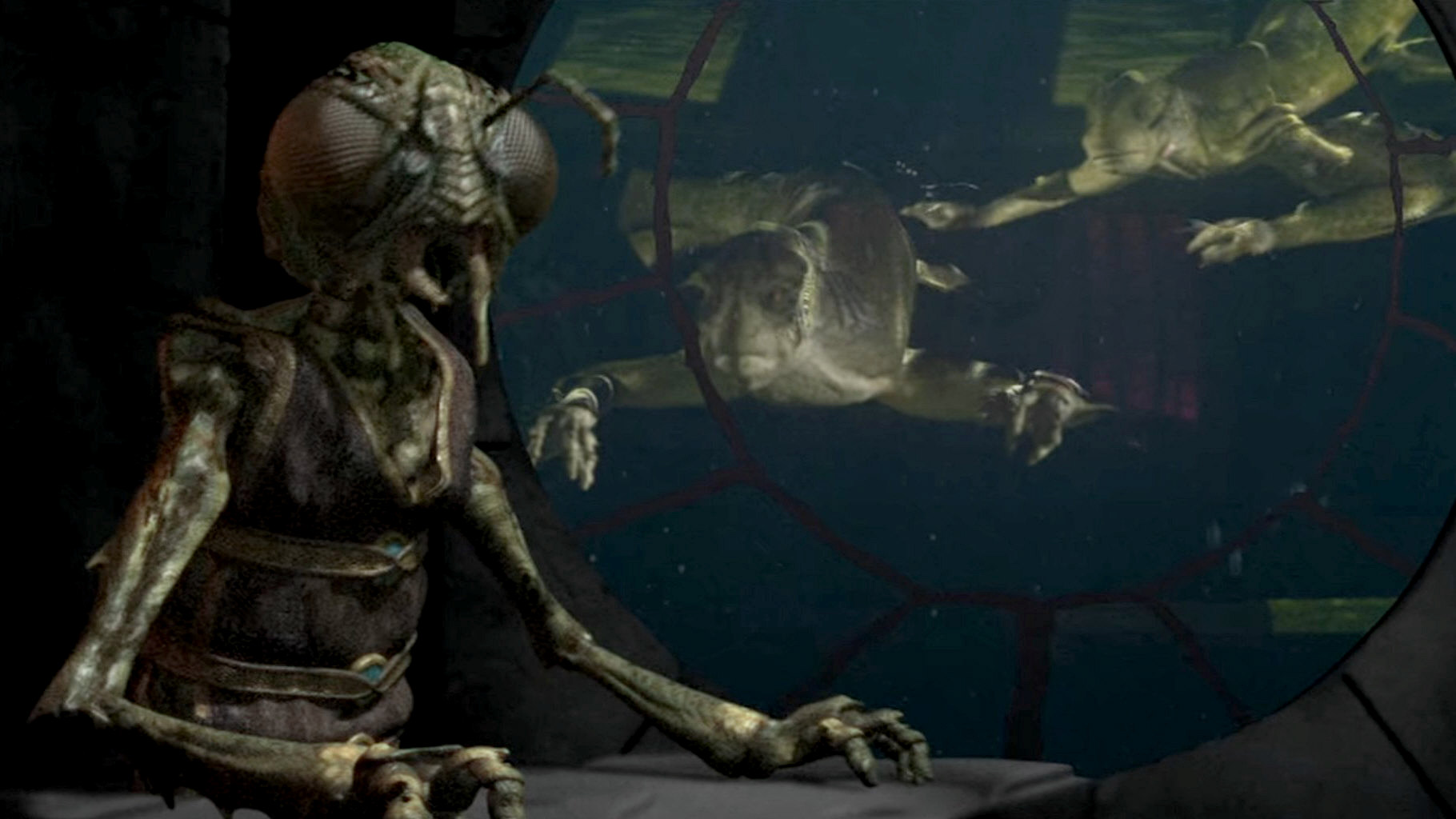
Date not given: The Xindi Council, consisting of five distinct species, debates about the weapon to be built and possible measures to be taken against the alleged invasion of humans. Meanwhile on Enterprise, the first spatial anomalies show up after entering the Expanse. Archer and Tucker arrive at a mining colony where they are supposed to find a Xindi. When the administrator of the colony traps them together with the Xindi, they attempt to escape, but are captured. The MACOs succeed in freeing them, however the Xindi is killed. Briefly before his death, he leaves Dr. Phlox the alleged coordinates of his homeworld, but at that location Enterprise finds nothing but debris of a formerly inhabited planet. Archer orders a course deeper into the Expanse.
Review
"The Xindi" fulfills my expectations in both a positive and a negative way. Notwithstanding my objections to the general "new direction" that I outlined in the review of "The Expanse", the season opener is based on an acceptable yet hardly enticing idea, and was turned into a mostly entertaining episode. In other words, with all errors already made in "The Expanse", I can be rather lenient about "The Xindi". The premise and several details of the episode remind me of the still unsurpassed "Broken Bow", where Enterprise faced the unknown likewise. Some of the spirit of the pilot episode, especially the crew's anticipation, is palpable again in "The Xindi".
But overall, the episode maybe tries too hard to have a little bit of everything, and it ends up as an amalgam of things that have been done better before. That said, the aftermath of Tucker's mourning about his sister's death is inappropriate for the story once again. Especially since it is nothing but an excuse for the awfully gratuitous "T'Pol topless" scene that I choose not to further comment on.
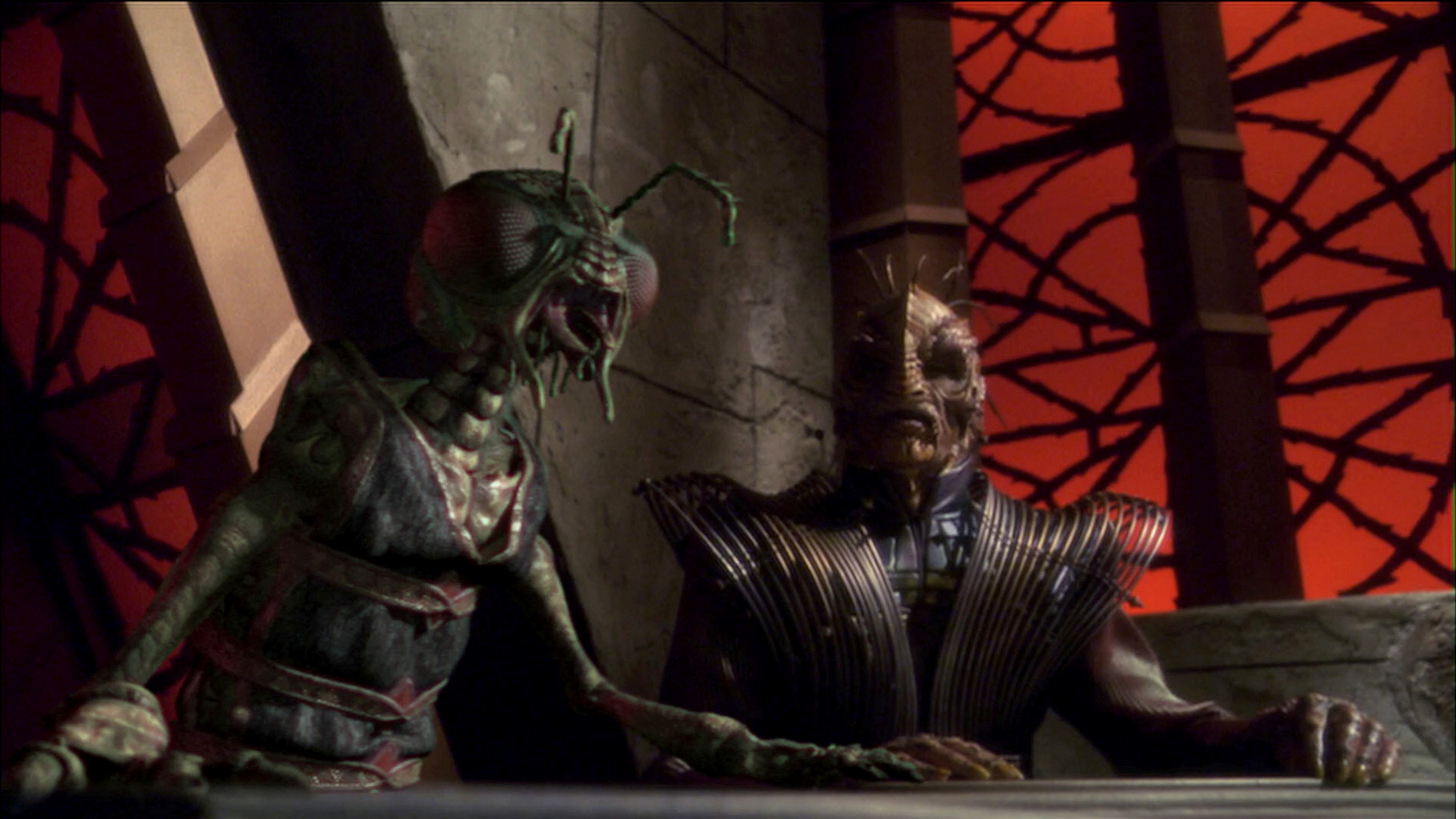
"The Xindi" begins with the introduction of the Xindi as the new enemies. It is a quite stereotypical, even dull "bad boys gathering" of the kind we have seen them so often before, usually featuring Silik and "Future Guy". Well, the incredibly cool new creatures, especially the insectoid Xindi, for once managed to make up for the weakness of the screenplay. Speaking of good visual effects, I like the scene with the moving cargo too, also because it is a decent foreshadowing of the anomalies that are obviously still to come. Most of the episode is dark, visually and figuratively. And it comes with too much violence. I have never seen such violent scenes on Star Trek except in "First Contact", and I don't even think it is necessary here, except perhaps to underline that the MACOs are much tougher guys and girls than the crew of Enterprise.
Speaking of the MACOs (Starfleet Marines are canon eventually?), they quickly become an annoyance to me, not so much because of the violence, but because it is an obviously all-American unit. They do have some token ethnicity (Latin and Asian), but ultimately the MACOs are made up of people who have no better topics to talk of than American provincial cities and their dialects. What a remarkable narrow-mindedness on a United Earth ship. Especially in this post-9/11 scenario it would have suited the series well to outline a future in which America is not the only military, political, moral and cultural authority of our world.
Something else I dislike is the score of the episode. It is too loud most of the time, and too "militaristic" even during the otherwise silent passages. Music like this may have been fitting in "The Best of Both Worlds" or "Dark Frontier", but this story is itself too little dramatic to justify such a dramatizing music. Speaking of music, something I will never understand is why it was deemed useful to change the title theme. The new opening is visually identical, has exactly the same length and the same pace. But what used to be a romantic guitar rock ballad was turned into a run-of-the-mill pop song. To what end? Those who always liked the old opening credits are appalled now; those who always wanted an ostentatious anthem will not like the new version either.
Annotations
- Nitpicking: There is one scientific error or at least a silly detail. Why would the administrator of the colony insist on liquid platinum? Platinum is a real metal which is solid at room temperature and has a melting point of 1772°C. Why would he want a specially isolated can with molten platinum instead of a much more practical cold and solid bar? It is possible that the authors were awfully mistaken about something and actually meant "latinum", an exotic material that, as they might have remembered, is liquid at room temperature.
- Remarkable quote: "Delicate is not a word I associate with Mr. Tucker." (T'Pol)
- Remarkable facts:
- T'Pol has no siblings.
- There is a Benzite among the miners.
- The mined substance, Trellium-D, is unknown to humans, but is used as insulation in interstellar ships.
- The hull of Enterprise is made of duranium.
- Remarkable species: The Xindi are made up of five distinct but genetically related species: reptiloid, humanoid, sloths, insectoid and cetacean.
Rating: 4
Anomaly
Synopsis
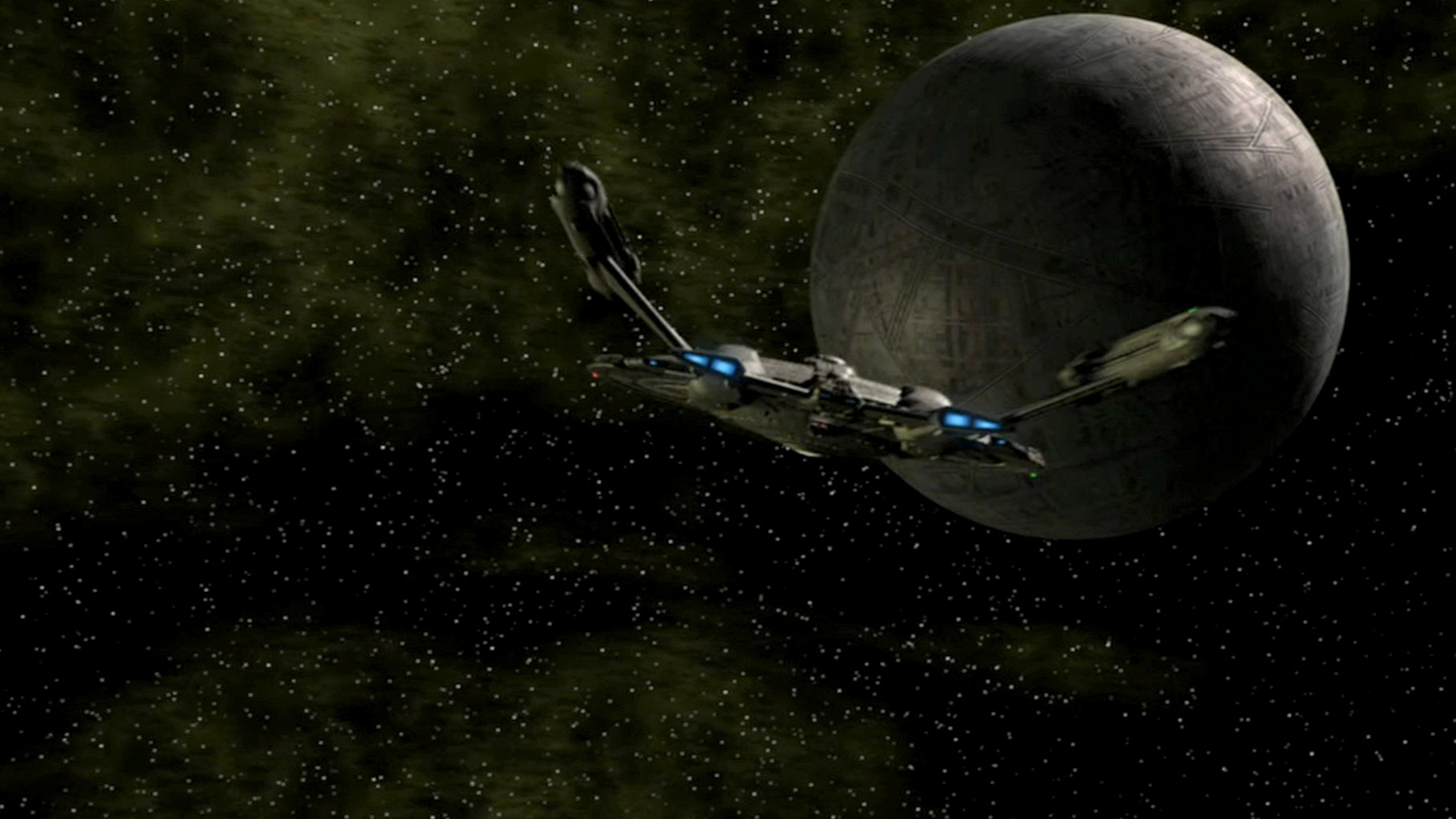
Date not given: Spatial anomalies keep plaguing the ship, when Enterprise runs into an alien vessel that has recently been raided, its crew murdered. Then Enterprise is attacked as well and essential supplies are stolen. One crewman is killed by the aliens whom Phlox identifies as Osaarians. Their ion trail leads to a huge artificial sphere hidden beyond a cloaking field. The Enterprise crew retrieve their stolen cargo. Hoshi identifies some signs as being of Xindi origin, whereupon Archer lures the pirate ship into a trap in order to download their whole database, with a code provided by a captured Osaarian.
Review
Just as last week's episode was reminiscent of "Broken Bow", "Anomaly" is a bit like a déjà-vu of "Fight or Flight". Maybe this is because the scenes with the raided vessel are similar and because Hoshi saves the day again after a long hiatus. Speaking of neglected characters, this is one of the very few episodes in which everyone has a couple of useful lines or is otherwise valuable for the story development. But most of all it is a solid action episode with a few nice twists, unlike the too predictable "Archer captured by mean aliens once again" thing last week.
Nonetheless, there are several similarities between the two first episodes of season 3, tying them and what will follow together to a true story arc, as we have last seen it on DS9. As much as I still dislike many aspects of the "new direction" of Enterprise, I'm eager to see more of it. In light of the new direction even the most noticeable common style element, the obtrusively militaristic score, becomes more tolerable - and I find it more fitting this time, simply because more is happening in "Anomaly".
As another dejà vu from Star Trek's history, VOY: "The Void" comes to my mind. The setting inside the Expanse is very similar. Unfortunately, unlike in the Voyager episode the bad aspects the of the desperate situation prevail, as the Osaarian crewman exemplifies a seemingly predetermined development from a civilized people to a ruthless pack of predators. Much worse, Archer is on the verge of becoming just like that. Ironically, while Janeway was unusually cooperative in "The Void", here Archer's behavior is Janeway-ish - erratic, self-righteous and subject to be revise his ways every few weeks. What I specifically allude to is the scene where Archer puts the alien into the airlock just like Janeway was ready to have the Equinox crewman killed. Unlike Janeway with her uncompromising yet always changing canon, Archer has arrived at decisions with almost adolescent naivety so far. Even if that sometimes made him a bad captain (and caused him more trouble than any of his future colleagues), it was a clear distinguishing mark. I wonder why every character development needs to take a direction in which the character freaks out or becomes obsessed with something. It didn't work with Trip and the rage about his sister's death either (the Vulcan neuro-thing fortunately being only a side note here).
Annotations
- Inconsistencies:
- The doors of the sphere and the Osaarian ship's hull are both said to be made of polyduranium, as if there were a logical connection between them. But the sphere is 1000 years old and was definitely not built by the Osaarians. Well, it may simply indicate that the Osaarians built the door into the sphere.
- The second strange observation is that Archer orders to fire at the sphere in order to lure the Osaarian ship back from the cloaking field. Did he expect that they could scan through the field?
- Remarkable quote: "Considering all the hostile aliens we have met, I suppose it's fortunate we haven't lost more people." (Reed)
- Remarkable facts:
- The Osaarians have a large merchant fleet, but there are no records of piracy. The hull of their ship is made of polyduranium. In addition, they have a Trellium-D coating, which we learn is necessary to cope with the anomalies.
- We also get to see something that is identified as stembolts, but looks quite different than what was seen on DS9.
- Remarkable station: The sphere is said to be 19km across, entirely of a single alloy, about 1000 years old. It has seven fusion reactors, each 12km long, only three of them are still operational. The portholes are made of polyduranium. It is also emitting "massive amounts of gravimetric energy" (in other words, it's heavy).
- Crew losses: 1, Fuller, torpedo expert (Wasn't there a female crew member called Fuller?)
Rating: 6
Extinction
Synopsis
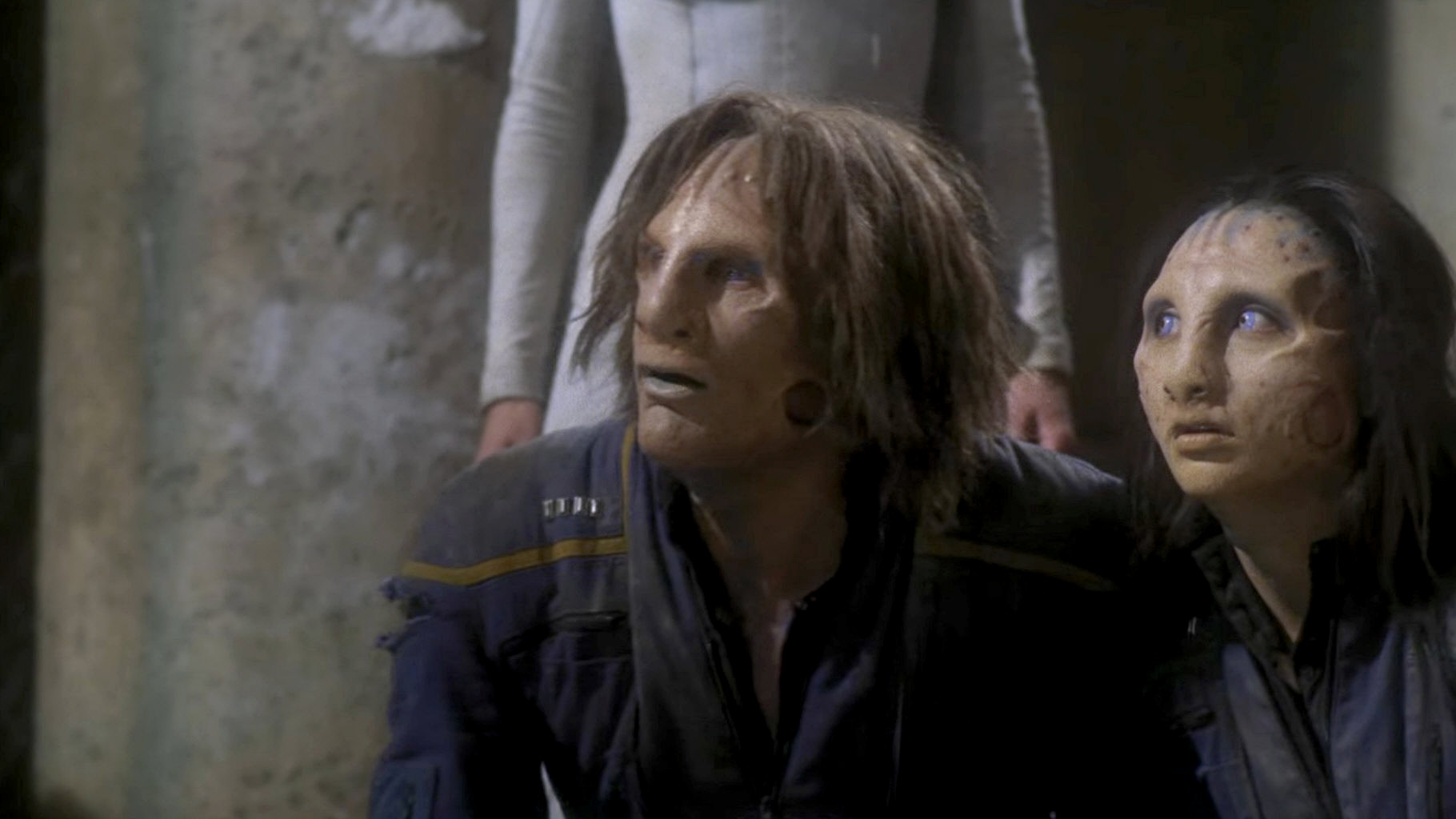
Date not given: The Xindi are tracked to an apparently uninhabited planet, where a landing party composed of Archer, Reed, T'Pol and Hoshi find a Xindi shuttlepod and a corpse that is initially found to be not Xindi. Soon the three human members of the team mutate to a different species and begin to seek a place called "Urquat", while T'Pol is only slightly affected. They are victims of a mutagenic virus, long ago created by the now extinct Loque'eque in an effort to preserve their species. Urquat is now in ruins. Two starships appear in orbit and an alien announces that they would kill any mutated individual. After fighting against the extermination team, the mutated crew members can be restored to their human form using an anti-virus produced in T'Pol's body. Phlox gives the anti-virus to the aliens. Archer, however, insists on keeping a sample of the virus as a last reminder of the Loque'eque.
Review
Welcome to the first episode of Star Trek Enterprise! The title change was apparently deemed useful to strengthen the ties of Enterprise to previous Star Trek series. But this is only a superficial detail that won't really help the series to obtain more acceptance.
Although "Extinction" strives to make an ethical statement, it is mostly unremarkable and unnecessarily digresses from the vital mission to find the Xindi. It is a bit of a disappointment when the initially scary atmosphere (when we first see Reed's mutated face) quickly turns into a standard situation. We have had very similar stories already in TNG: "Identity Crisis" as well as in the maligned VOY: "Threshold" and in VOY: "Favorite Son". The only original twist in "Extinction" is that the very purpose of the mutation is futile here, considering that the Loque'eque civilization ironically ceased to exist a long time ago. And even this idea of a long dead civilization taking late revenge is a very common theme in Star Trek, just like seen in TOS: "Miri" or TNG: "Masks", to name only two of a dozen examples. A lot of the screen time is spent on showing how T'Pol tries to chum up with the three aliens that used to be her shipmates, and to communicate with them. On a side note, she is amazingly open-minded, and I could hardly imagine any other Enterprise-era Vulcan to have that much patience with them. But whilst it may have been a challenge for the actors as well as to the make-up artists, I don't really see the point of showing the crew as savage aliens with erratic behavior. It neither tells us anything about their personalities as human beings (it is possible that that Archer-Loque'eque would have used the rock to kill the flamethrower alien if T'Pol hadn't stopped him), nor do we learn about the true Loque'eque from that.
This takes me to the point why they have to become savage at all. The Loque'eque clearly weren't savage, considering that they managed to build cities and construct the virus. Maybe the victims are intentionally reduced to the mental state of toddlers to facilitate their integration? So does the transformation mutilate their brains in a way that they would lose all their skills and knowledge? This is obviously not the case, since they are all fine in the end. Clearly Enterprise is not the first series facing such a logical dilemma. But bearing in mind that we have the right to expect medical technology to be less advanced, it is sad how fast and easily Phlox once again manages to develop a cure, as if he were Voyager's EMH.
As already mentioned, the episode attempts to make an important point in the end, when Archer insists on keeping a sample of the virus in order to remember of the Loque'eque. But this part of the story is a complete failure. Archer's reasoning reminds me unpleasantly of his "playing god" speech in "Dear Doctor", which he used to justify his verdict to let the Valakians die, awkwardly deriving their "natural" fate from the not yet existing Prime Directive. In "Extinction", on the other hand, Archer links the preservation of the Loque'eque virus to the mission of Enterprise to save Earth from the Xindi, as if this had anything to do with one another. After all, it's only a virus that he is going to save, something artificially created with cruel intentions that is not even really alive. If he wanted to preserve anything valuable of the Loque'eque, why not something positive like the ruins or some artifacts that may still be found in their city? Agreed, the hostile aliens are giving him no choice but to leave the scene quickly. But, in a crude analogy, it is like some alien in a far future would want to preserve atomic bombs as a monument of an extinct species called humans. Finally, and this really makes me ponder about his state of mind, Archer's decision is in strong contrast to the one in "Dear Doctor". He denied the Valakians, who were never going to harm anyone, the right to live. But, against all security considerations for his own crew, he is concerned about a nasty virus created by the ruthless Loque'eque who were not better than the Borg with their unethical methods to save their civilization. His stupid stance also reminds me a lot of Neelix in VOY: "Memorial", who insisted on permitting himself to be tormented, only to be reminded of a long ago war that was none of his business. Such a masochism clearly doesn't help anyone and shouldn't be shown as an ideal.
Notwithstanding the unrealistic "miraculous healing" plot, there are two pleasant surprises in the episode. For once, the Xindi data were hard to analyze, because Archer needed to figure out how they plot coordinates. This is unlike in the many cases where the computer simply displayed clearly understandable data taken from previously unknown aliens. The second observation is that the transporter is considered an option to save the transformed crew members, but is not used, because there is no possibility to contain the virus. In other words, the author (Treknology expert Andre Bormanis) kept in mind that there is no biofilter yet.
Annotations
- Remarkable quote:"This was created as a final effort to preserve a civilization, a people. That species we became, they cease to exist the moment this virus is gone." (Archer)
Rating: 3
Rajiin
Synopsis
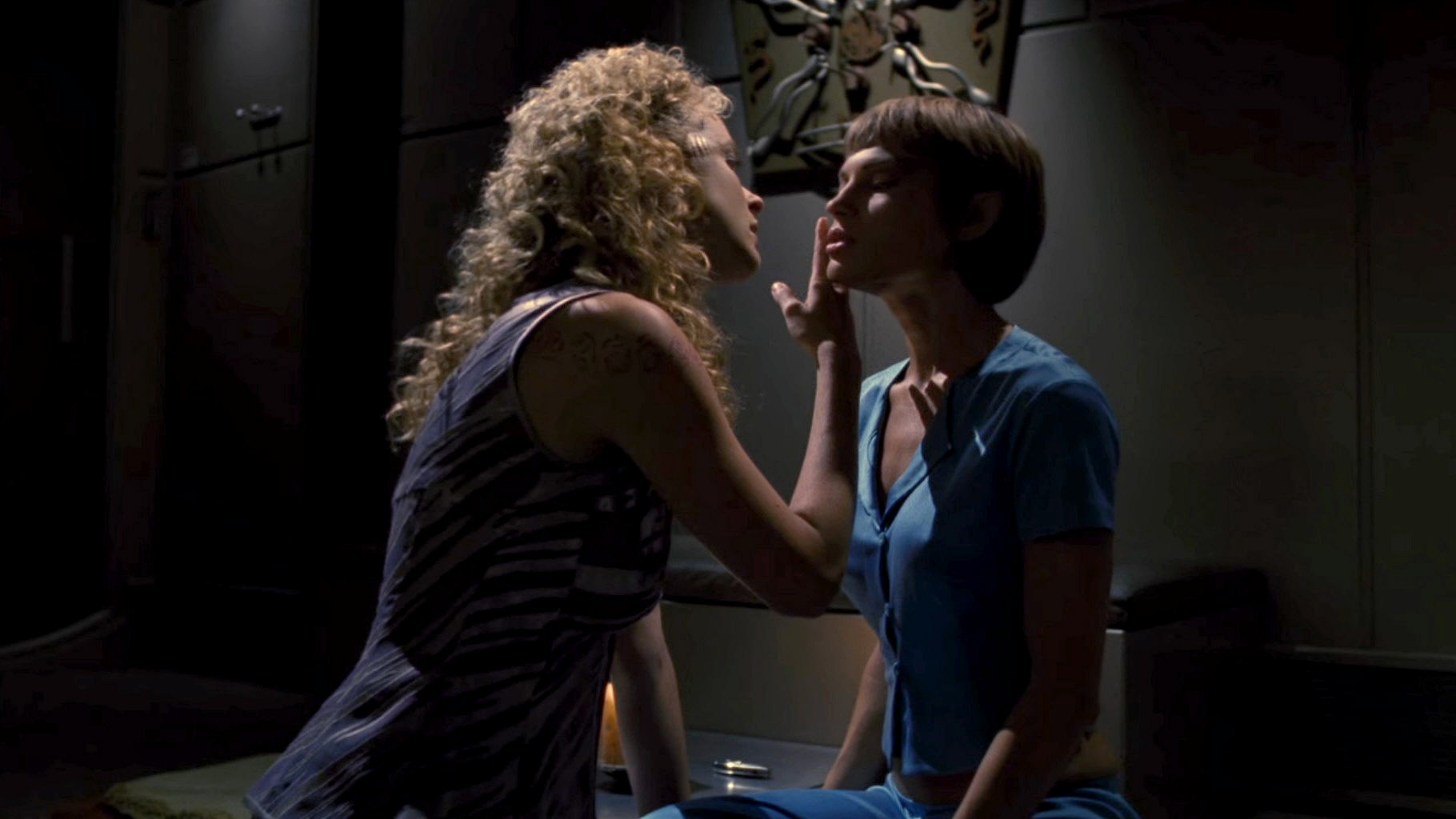
Date not given: When a landing party is seeking information about Trellium-D and about the Xindi, a woman runs away from a slave market and is granted asylum by Archer. Tucker and T'Pol unsuccessfully attempt to synthesize Trellium-D. Meanwhile the woman, Rajiin, is trying to transmit a message to someone, but her actions are discovered and she is put into the brig. Two Xindi ships appear. After breaking into the ship, the Xindi manage to free Rajiin, who was going to collect information about humans for a bioweapon that the Xindi are about to build.
Review
The first half of "Rajiin" is rather boring, the second half has just the deal of violent action that we are used to from so several previous Enterprise episodes. As hard as I may try, I can't discover anything special about the story. The gathering of the Xindi at the beginning looks like it is repeated from "The Xindi". T'Pol's and Trip's "massage" scene is indefinite too, with its trivial outcome that there was gossip about the two officers. Like so many times before, a landing party is running around, seeking for information.
On the visual side, the CG opening shot of the water city is impressive, but set design of the episode clearly falls short of that. The scenery on the alien world, with the usual colorful oriental bazaar atmosphere and a variety of exotic aliens is something we have seen so many times before - maybe also because something like this is easier to arrange than a consistent "alien"-looking style. I am particularly disappointed that we don't get to see any more CG shots of the water city.
The further development of the story winds up as a disappointment. It is blatantly evident that Rajiin is not the innocent slave girl she pretends to be. But as the fighting ensues and is taking over the plot, no big deal is made about her "Mata Hari" role any longer, and her remorse about deceiving people who would have done anything for her remains superficial. On the other hand, it is quite realistic that she only tries to save her own life - although I have the impression that she wouldn't survive anyway at the end of the episode.
It also irks me a bit that it does not become transparent what kinds of powers Rajiin is using to "enchant" the crew. Not even a crude attempt is made to explain them. That being said, Rajiin could have fulfilled her mission without unnecessarily exotic tricks. The story could have easily been told without all the sexual allusions and the effect of Rajiin penetrating Archer's and T'Pol's skin (which I think is only an illusion anyway). Instead of this awkward attempt to bring in one more sci-fi element, it may have been *a lot* more interesting for her to be actually romantically involved with someone of the crew. Summarizing, I neither care much for her character nor for the story built around her.
All that I like about the episode lies in some little details. There is very good continuity with "Extinction", seeing that Archer is still suffering from the genetic transformation and has dreams about the alien city. I also like that Crewman Cutler is at least mentioned (she broke her arm when an anomaly hit the ship). Another nice detail is the costumes of the female slaves, just as if the good William Ware Theiss of TOS fame had created them. It is a good idea that Trip and Reed are trading spices for the Trellium-D recipe, after all these should be a really unique commodity of a planet. Finally, the Xindi "spore" weapon is a cool idea - maybe a predecessor to the bioweapon the Xindi are going to build. I wonder if it was lethal, but no human casualties are mentioned.
Annotations
- Nitpicking:
- Reed is surprised that Trellium-D has to be synthesized in its liquid form. It is annoying that once again after "The Xindi" the authors make a big deal about something that is merely a different state of the same material and that they obviously don't know that hardly any chemical reaction takes place in the solid state.
- The second example of bad writing is that Reed mentions "the smaller [Xindi] ship". But both are evidently the same size. Clearly the modelers might have created two different versions with a bit more budget, but the writers should have anticipated that they would end up using the same model twice.
- The third isn't really a new problem, because we already know that the Xindi probe in "The Expanse" appeared from a vortex. But thinking further about this technology, it is absurd that Starfleet shouldn't have acquired it until the 24th century.
- Remarkable quote: "Some of our calculations may have been slightly off." (T'Pol, looking at the exploded lab setup)
- Remarkable fact: Trellium-A is very common, but Trellium-D is hard to synthesize and unstable in its liquid form.
Rating: 3
Impulse
Synopsis
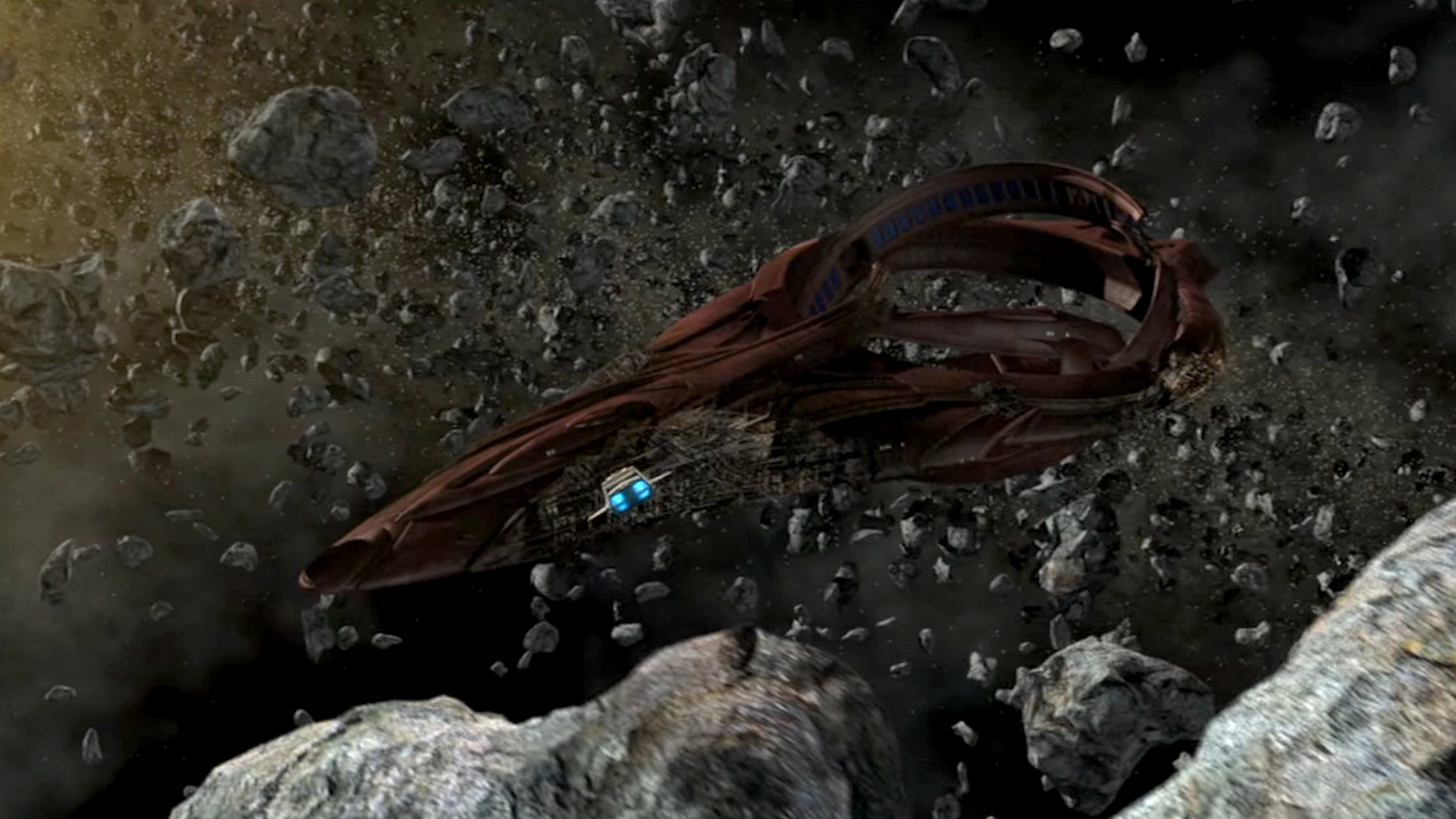
Date not given: Enterprise picks up signs of a Vulcan ship in distress. The Seleya is adrift inside an asteroid field with high Trellium concentration. When a team boards the ship, they discover that the crew have gone insane. The boarding party is cut off from the shuttle by the ravaging Vulcans, and T'Pol soon exhibits the same symptoms. In the meantime Phlox has analyzed their condition and determined Trellium-D as the cause. After their return, he manages to restore T'Pol's synaptic pathways.
Review
First of all, I have to admit that I was not really willing to give this episode a chance in the first place. I'm not a fan of graphic horror. A plot that mainly relies on zombies running around, trying to kill everyone without uttering a single comprehensible word is not what I expect to see in Star Trek. Even "Return of the Archons", a little inspiring TOS episode (that coincidentally aired on German TV an hour before I sat down to watch "Impulse"), had a story behind the zombies, but here there is none but the simple finding that an exotic substance turned the crew into brainless creatures. With so little input, there is simply no way for it to evolve to a good drama. What makes the poor premise even worse, is that it's once again the Vulcans who have to suffer, the once enlightened and revered species that has been degraded to morons-of-the-week in the fifth Star Trek series. They are not even a bit creepy, but only silly. The impression given by the zombies is clearly not typical of Vulcans in general. Still it adds to the overall devastating image. The fact that for once Vulcans are not superior to humans (as humans are not affected by Trellium-D) is at least one pleasant side note, but can't really comfort me.
In "Impulse", everything turns out still less inspiring than I was prepared for. The screenplay is composed of all kinds of clichés that are not only overused, but even showed up lately. We've already had a dangerous flight through an asteroid field in "Singularity", the asteroid/comet landing trick with spacesuits is very reminiscent of "Breaking the Ice", the crew is trapped on an alien ship just like in "Sleeping Dogs", T'Pol is running berserk as we have recently seen in "Bounty", T'Pol's paranoia exactly mirrors Trip's in "Strange New World", and the last miracle healing dates back only two weeks. What adds to my annoyance is the dialogues that consist of nothing but phrases, except for the very beginning and the humorous ending. And I'm not fond of the fashionable dramatic tricks either, to continue with "One day earlier" only to have a more exciting teaser, and to artificially prolong the action phase with T'Pol's dream sequence, like in cheap horror flicks. To conclude my rant, isn't it convenient how the Vulcan ship suddenly blows up (after staying intact for months!), just to allow Enterprise to leave the now toasted zombies without remorse? Blame me for not allowing myself to see anything good in it, but my impression is that the episode didn't want to give itself a chance either. It is just hokey writing. I think I have turned down fan fiction that was still better conceived.
On the bright side, we have at least a lot of eye candy in this episode. The beam-up of the Trellium with careful spark formation and the flights through the asteroid field, for instance - although the latter is vastly exaggerated, as there would hardly be a window to maneuver at all. And the story is still somewhat thrilling despite all the obvious deficiencies. What I like too is the continuity, as the Vankara is mentioned, the ship whose crew was shown as insane already in "The Expanse". Also, there is a little Vulcan history lesson from T'Pol. In fact, Jolene Blalock once again manages to preserve a little bit of decency in a ridiculous story. Well, there is nothing new in what she says. Just that the Vulcans were once violent and about to destroy themselves, until they learned to suppress their emotions. At least, it is a careful homage in an episode that otherwise isn't nice to the Vulcans.
Annotations
- Continuity: In "The Xindi" Archer and Tucker have obviously never heard of Trellium, with or without a letter suffix. But Trellium is mined in large amounts on the outpost, it is said to be "quite common" in "Rajiin", and here is an asteroid field with a high concentration of the compound (one kilogram in a small piece rock Trip can carry with ease). How can it be that Trellium is that common inside the Expanse, and does not seem to occur outside? Clearly the material has a special significance here, but if it existed outside, wouldn't the mineral be familiar to humans (at least known to people who had a couple of chemistry lessons)? It has to be something that human science already knows.
- Remarkable quote: "Part of the fun of a mystery is trying to solve it before it ends. Using logic. You of all people should appreciate that." - "Then use logic more quietly." (Trip and T'Pol, during the movie show)
Rating: 1
Exile
Synopsis
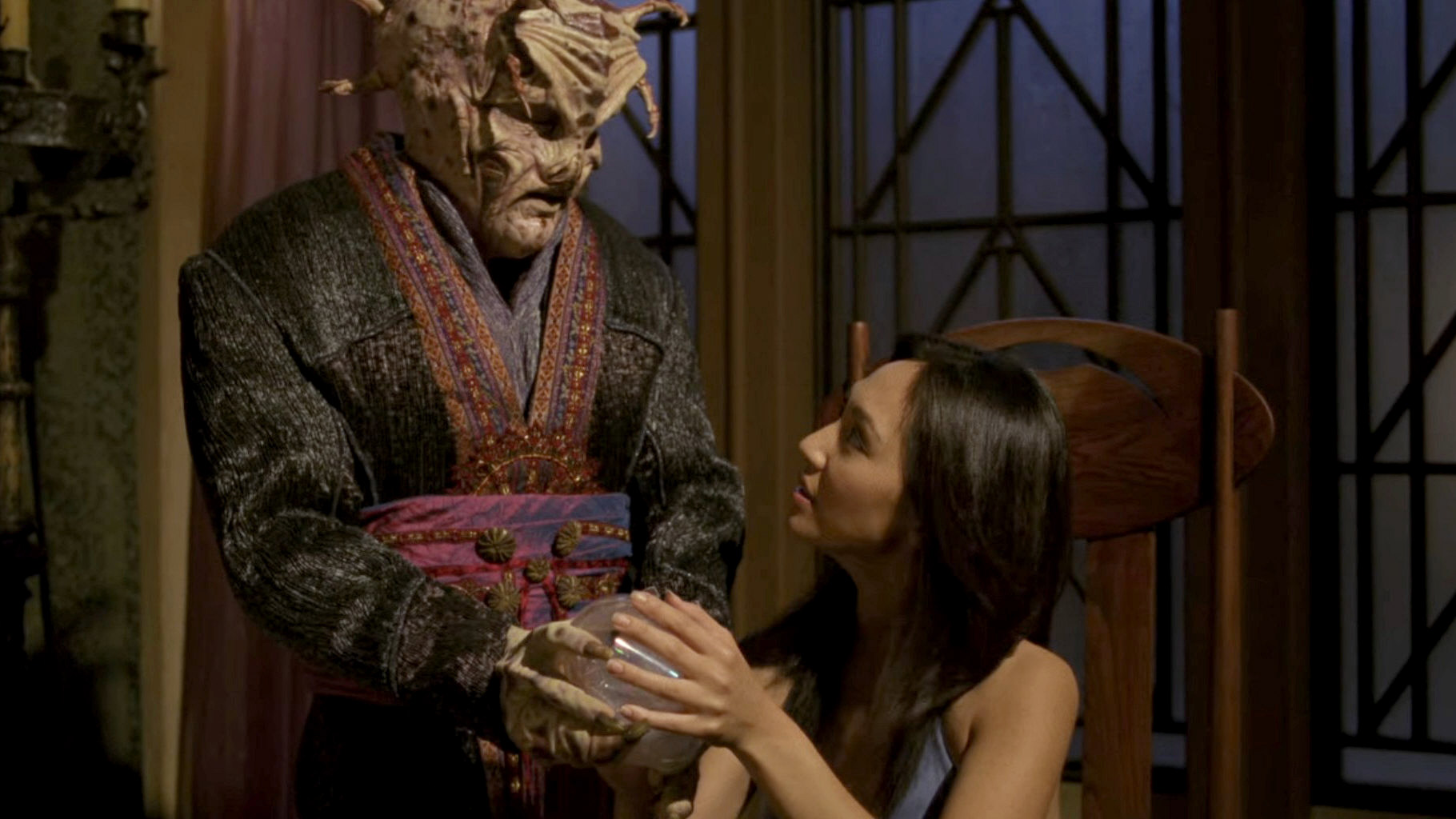
Date not given: Hoshi is plagued by hallucinations that turn out to be messages from Tarquin, a telepath who has been exiled to a lonely planet because his people were afraid of him. While Enterprise is investigating a second cloaked sphere, Hoshi stays with Tarquin, who has promised to provide information about the Xindi in return. But the true intention of the long-lived Tarquin is to keep Hoshi with him, like four other companions before her. Only when Hoshi threatens to destroy his telepathic amplifier, he agrees to release her and gives her the coordinates of a Xindi colony where parts of their weapon are being built.
Review
This episode has commonly been dubbed "The Beauty and the Beast", but what strikes me even more is that the plot is almost the same as a combination of VOY: "Think Tank" and VOY: "Alter Ego". And aside from that, it shamelessly borrows elements from other, often hermit-themed Trek episodes, beginning with TOS: "The Squire of Gothos" and TOS: "Who Mourns for Adonais" over Troi's numerous telepathic ordeals to the appalling TNG: "Sub Rosa".
Yet, all the aforementioned episodes were rife with sexist stereotypes as they fortunately don't appear in "Exile". Hoshi's actions and characterization are clearly to the episode's credit. All the way through the story she stays strong and eventually gains the upper hand, without falling for psycho tricks like Troi or losing all her reason like Beverly. Also, Tarquin has to concede that love cannot be enforced, like at least Marayna in "Alter Ego" before him, whereas other opponents of the same archetype used to be villains who would fight for what they want to have with the stubbornness of children in the sandbox. At least in these respects, television has matured since the 60's with its sexist clichés and also since the 80's, when the principal goal was having the conflict last as long as possible. Yet, Hoshi's running around in a night gown is left as a slight sexist nuisance, along with other typical horror clichés like the castle, the squeaking doors, the wind sounds and the omnipresent candles. Only a black cat was missing. Something that I like about the horror part is the camera pans half-way around Hoshi. It would have been great to see even more of them.
Overall, while the episode is lacking a lot in terms of plot originality and could have gone without that little bit of horror, it is pleasant watching. Besides Linda Park's performance as Hoshi, which I will always appreciate, I also enjoy that the shuttle suddenly left without Trip and Archer. This is a nice addition to the small list of things that definitely wouldn't go awry in the 24th century, but do on Enterprise (since the pilot episode when Trip scratched the paint of the ship). Furthermore, "Exile" fits well into the storyline. The Xindi arc is still unfolding slowly (as we know it from DS9 too, so I'll stay patient), but the revelation that the spheres are actually responsible for the anomalies keeps things going.
Annotations
- Remarkable quote: "Did you bring a phase pistol?" - "I'll keep it under my pillow." (Archer and Hoshi)
Rating: 4
The Shipment
Synopsis
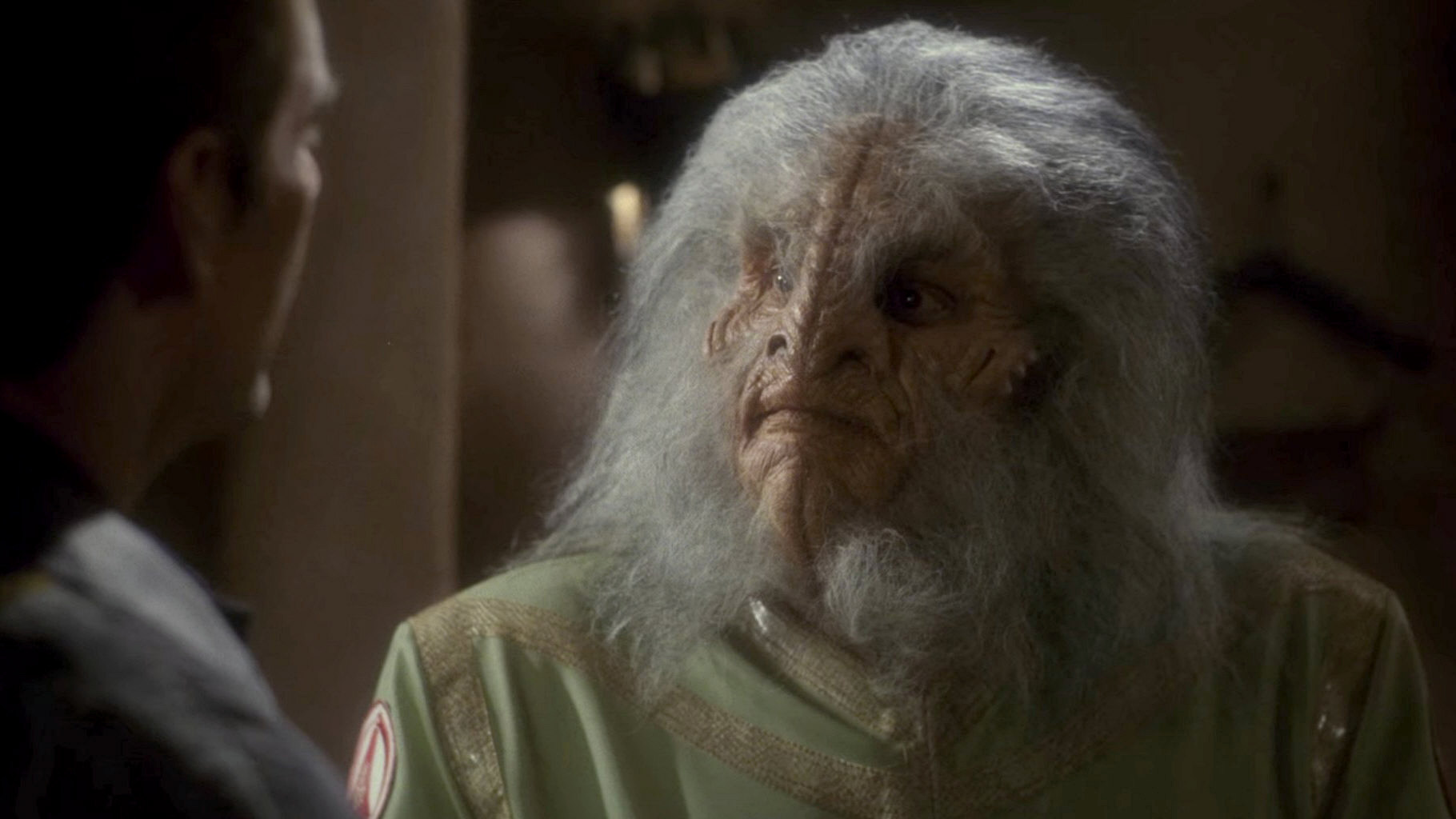
Date not given: Archer, Reed and Major Hayes prepare to blow up a kemocite refinery run by the Xindi. Kemocite produced there was evidently part of the weapon used in Florida. They capture the chief engineer, a Xindi-Arboreal called Gralik. When Gralik is confronted with the purpose of the kemocite he produces, he changes his mind and decides to help the landing party. The plan is now to prepare the material so that the shipment can be tracked to its destination. However, the ship of the customer, Degra, vanishes in an energy portal. Still, Archer leaves with the knowledge that not all Xindi are his enemies.
Review
"The Shipment" is a very conventional story without any particular highlights. Still, it leaves me rather content. The only twist is a well-known cliché: the one hostile alien who suddenly changes his mind and ends up helping the crew. Unfortunately this idea is overused since Voyager, but here for once it is quite fitting and also overdue at this time, considering that the Xindi might otherwise have appeared as villains acting like one mind.
Gralik, who was previously thought to be a ruthless minion of the Xindi leaders, changes his mind when he learns that seven million people were killed with a weapon he had contributed to. And even more than the mere knowledge about the possible application of the kemocite it is Archer's personality that eventually convinces him. After all, Archer could have been lying to him all the time. Ironically it has never been Archer's intention to find an ally on the planet in the first place, and he doesn't act like finding one when he first meets Gralik, pointing phase pistols at him. But there must be something in Archer's determination telling Gralik that the captain is right. Archer, on the other hand, seems to undergo an even harder process of reconsideration. At first, he takes into account the Xindi who would be killed in the scheduled explosion only in a side note. Then he gradually learns that gaining Gralik's trust is the preferable option over simply blowing everything up. The latter would only have proven that humans are as ruthless as some Xindi keep disseminating. This is a story of mutual trust, worthy of Star Trek in every respect.
The latent racism in the episode is problematic, though. As much as Gralik comes to respect his new human allies, he openly shows his contempt of the other Xindi species, both in his recount and when he deals himself with the "ape-like" Xindi-humanoid and the frightening Xindi-Reptilian. This animosity among the Xindi is something that ought to be handled with more care in the future. We already know how the Insectoid Xindi are always pressing to extinguish the humans, and how the Reptilians are more than willing to fight with or for them. Hopefully it will not be getting one-sided again with certain Xindi species who are still depicted as completely villainous.
What I like too about the episode is the secondary plot, in which Tucker, Phlox and T'Pol are investigating the Xindi weapon with its biological components. It is the only exciting moment of the otherwise unspectacular episode when Trip activates the rifle and the viewer already knows that it will overload a second before he realizes that. It doesn't really contribute a lot, but as of late these little tidbits in stories are well-conceived, considering how easily they may have become silly.
Annotations
- Nitpicking: Not everything in the episode is quite plausible. But something that strikes me most is that no one anticipates that the Xindi ship might be capable of opening a spatial vortex (which is why the kemocite can't be tracked in the end). Not only the Xindi sphere, but also the previously encountered ship (in "Anomaly") of the same type as here could accomplish that. Moreover, it is called an "energy portal" here, which sounds rather awkward compared to "vortex", as if the effect were just observed for the first time.
- Remarkable fact: We learn a great deal about the Xindi here, that they once consisted of six species, also including the Xindi-Avians. But the Avians were exterminated in the course of the century long war that ended when the Xindi-Reptilians and Insectoids blew up their home planet (obviously the one whose debris was found in "Anomaly").
Rating: 5
Twilight
Synopsis

Date not given: When an anomaly strikes the ship, Archer is infected with parasites that frequently erase his short-term memory. 12 years later, he doesn't remember how T'Pol took command of the ship, how the Xindi destroyed Earth, and how the few surviving humans settled on Ceti Alpha V. In the meantime, Phlox has devised a therapy to destroy the parasites, which exist outside normal space-time, using a subspace implosion in a special chamber. The device is installed on Enterprise, now commanded by Captain Tucker. But the Xindi have located the human settlement and are attacking the system. Phlox finds out that the eradicated parasites don't only vanish in the present, but also in the past. When the chamber is damaged in the attack, Archer, Phlox and T'Pol set the warp core to overload to create the ultimate subspace implosion. The ship explodes, and the past is changed.
Review
I think "Twilight" is the best Enterprise episode since "Broken Bow" mostly because it brings back the excitement. I just like this type of stories, I only don't like to explain everything about it. ;-) This time I don't care that much that we have seen similar stories before and that even several plot minutiae seemed to be déjà vus. The captain, suffering from a disease that causes him to run around confused, not remembering anything? TNG: "All Good Things". A strange temporal bond that is finally broken with someone's death? DS9: "The Visitor". A chamber to treat a biotemporal disease? VOY: "Before and After". A weird effect that travels back through time? All of the above. Anyway, the weirdness is handled with care in "Twilight", although it glosses over the paradox that should occur. It remains somewhat plausible as it is neither impaired by heavy technobabble like in the TNG episode nor shown as an inexplicable destiny like in the DS9 episode.
The only slight criticism about the plot of "Twilight" is a more general one. Episodes taking place in the future, in a hallucination, on the holodeck or in a parallel universe come with a built-in reset button. Trek authors are quite fond of "what if" scenarios, and they don't need to make them plausible, as everything will be fine in the end anyway. So they allow their fantasy to go crazy, kill off everyone and let the VFX people blow up everything. Well, who am I to complain about that, considering that "Year of Hell" with the most powerful reset button of Trek history ranks among my all-time favorites. But in a direct comparison, I come to the conclusion that the Voyager episode was still more intelligent and more profound, as it showed two sides of the medal, had much more diverse character interaction, ended with an ingenious twist and also because of its strong symbolism. In this regard I don't know if it is good that "Twilight" will always be remembered as the episode where they blow up Earth (and Enterprise too, but that we already know from several previous instances in other series). Maybe the episode could have done without these stunts, and could have focused more on the characters besides T'Pol and Archer. But speaking of symbolism, I find it quite worrying to see how Archer kills the Xindi-Reptilian with his Cochrane statue.
For the reasons mentioned above, we are not supposed to lend too much credence to what will happen between the characters in the future, but I find T'Pol's change (not only to her hair) quite plausible. Ironically, in the future it is Archer who is unable to feel anything for T'Pol because he still sees her as his first officer. They definitely switch roles. Future T'Pol is clearly more than only sorry for humanity and for Archer. When she talks to Phlox about that, she turns away to a panel and has a sad expression on her face like she was going to cry. Although it seems insignificant, this is one of the best scenes in the whole episode. Still I am glad that the actual future T'Pol won't be like that and will perhaps be more Vulcan.
Annotations
- Continuity: It usually makes me frown how Enterprise authors frequently try to please the fans with excessive namedropping. But this time almost all references and homages are well-considered.
- Human colonies are located on Mars, Alpha Centauri (Cochrane!) and the previously mentioned Vega colony.
- We see the two Starfleet ship types from "The Expanse" again, and the authors didn't even forget that the lead ship was the Intrepid with Captain Ramirez (Malcolm replaced him).
- There are also freighters of the Y-Class and J-Class in the human fleet.
- The survivors settle on Ceti Alpha V, which we are familiar with from "Star Trek II".
- We also see an Yridian, and for once an alien species on Enterprise corrects a mistake in another Trek series, namely the idiotic notion that Captain Ransom of the Equinox should have discovered them, although they were already well-known at the time of TNG.
- Finally, Shran is mentioned to have helped the humans and Soval has an appearance, and although he just utters his usual preconceptions, it is quite useful to tie everything together.
- Remarkable dialogue: "How do you feel?" - "Like a shuttlepod landed on my head." (Phlox and Archer, in both timelines when Archer wakes up in sickbay)
- Remarkable quote: "I suppose there's not much point in thanking me. A few hours from now I won't remember." (Archer, to T'Pol)
- Remarkable fact: The night before Archer graduated from Starfleet, he asked his girlfriend Margaret Mullen to marry him. But she declined, because she didn't want to become a Starfleet widow.
Rating: 8
North Star
Synopsis
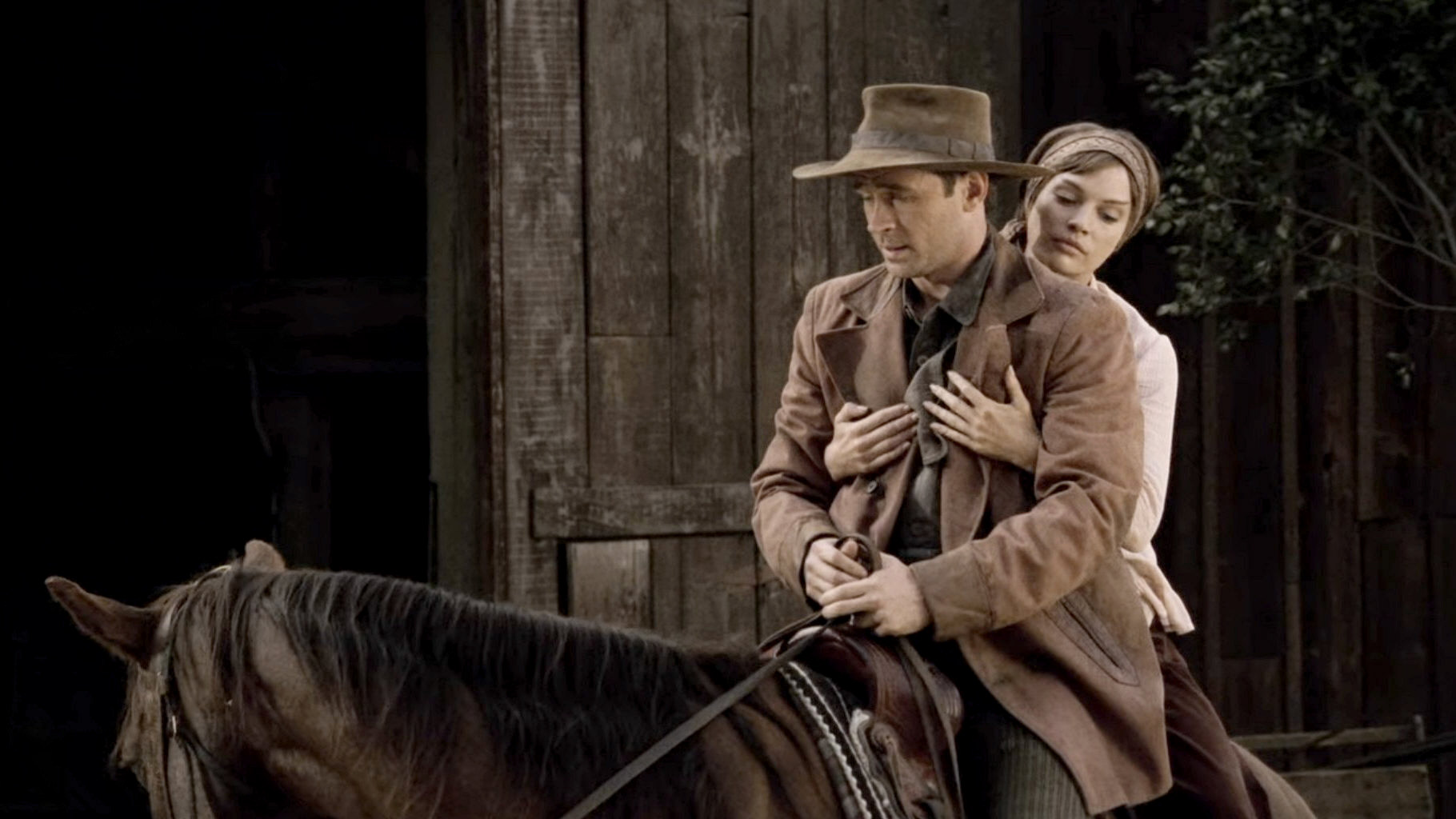
Date not given: Archer, T'Pol and Tucker investigate a human Western-style settlement on an alien planet. The ancestors of the humans living there were abducted from Earth almost 300 years ago but they later defeated the aliens. Members of the alien race, the Skagarans, are living on the planet too, now deprived and subject to the arbitrary justice of the ruthless Deputy Bennings. Only the teacher Bethany is helping the Skagarans, although it is illegal. Archer accompanies Bethany to the Skagaran camp where she is arrested by Bennings. Archer frees her from jail, and returns with a landing party. After overwhelming Bennings and his people they leave with the impression that a first step has been made to re-integrate the inhabitants into human society and to overcome their intolerance.
Review
This episode was announced like it was a homage to TOS episodes like "Spectre of the Gun", but the actual similarity is very superficial. Plot-wise there is a much more obvious parallel to VOY: "The 37's", where humans were abducted by aliens likewise and later defeated them. Only that history takes another direction here, so different that "North Star" could be even regarded as an antithesis to the success story in the Delta Quadrant. If we neglect the stereotypical setting, "North Star" may be even the more realistic version. Instead of making progress and working on a better society (which left the Voyager crew impressed), these people are still living in the Wild West with all its lack of justice and uncivilized customs, even if these are just stereotypes created by Hollywood.
With regard to parallels between "North Star" and real-world developments, different interpretations are possible. Most obviously it could reflect the treatment of native Americans, whose land was taken from them and who became victims of lacking education and of alcohol. But also Apartheid or any other form of racial discrimination that was always a part of human history and surfaced most violently back on on Earth after the alien abduction. Finally, considering how the human settlers are overly vigilant not to let the aliens endanger their way of life, it may be a hidden criticism of the policy of the Bush government. It would be far-fetched to assume this was the writer's intention though. Most of all, it is becoming of a Star Trek episode to show that humanity is not a perfect homogeneously benevolent society, but that there is hope that one day this dream may come true.
One aspect I don't like (and I ultimately disapprove of) is the fact that Bethany is part Skagaran. This has absolutely no consequences for the plot in the following, except for insinuating that the reason why she is the only person to support the Skagarans is because of family ties or even genetics, rather than human compassion. This makes the other human settlers look even worse.
Annotations
- Nitpicking: We may accept it as a symbolic part of the setting, but I find it quite unrealistic that the setting is exactly like a Western town without any sign of either progress or degeneration or of alien technology. Also, these people had guns and other devices, but even with all raw materials available, a 19th century society with a total population of only 6000 could hardly sustain a steel industry, for instance. And where does the coffee come from in such an arid prairie?
- Remarkable fact: Archer was born in up-state New York and spent most of his life in San Francisco.
Rating: 5
Similitude
Synopsis
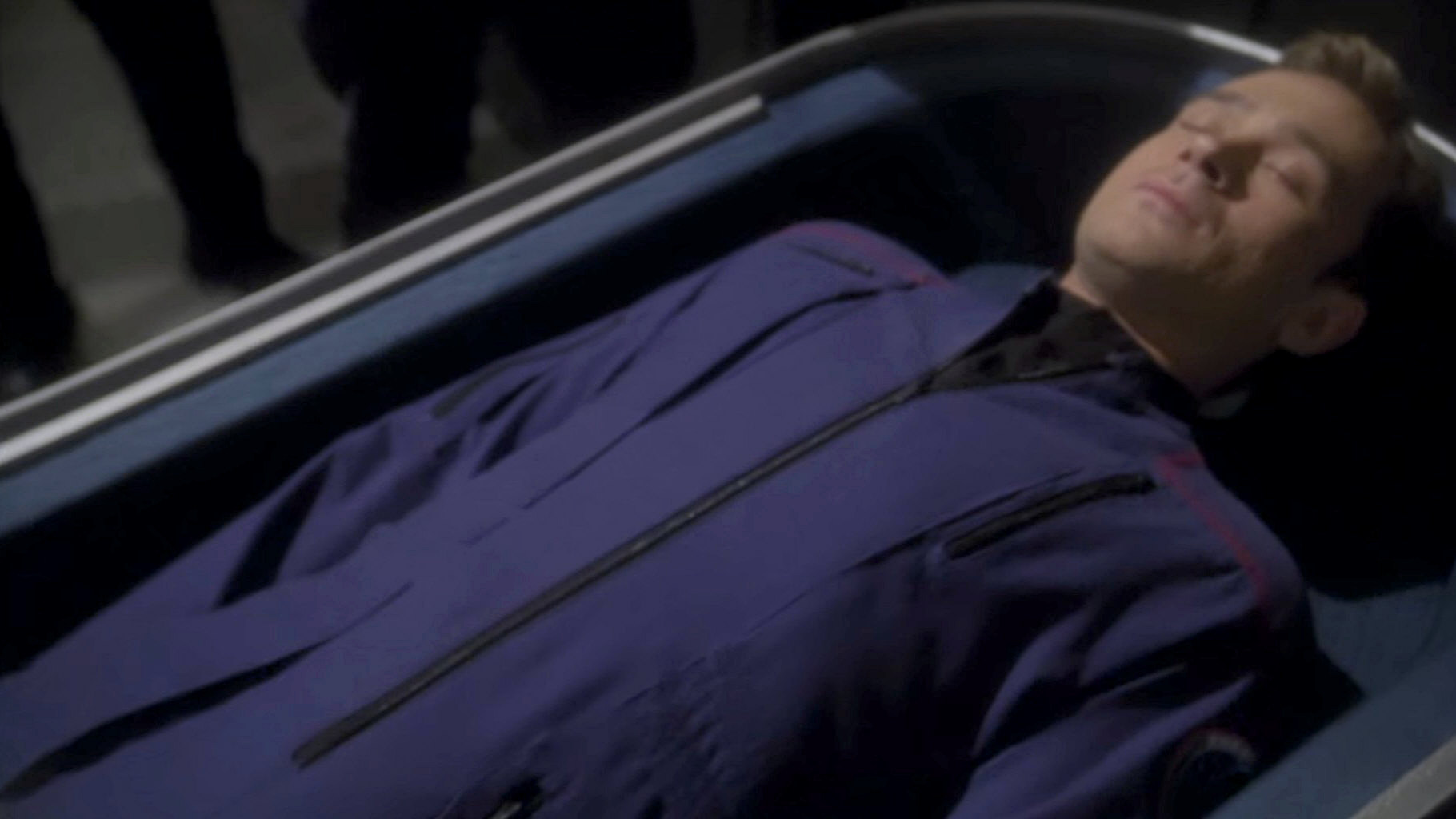
Date not given: When the ship's drive is disabled by a polaric field, Trip is injured and falls into a coma. Following Phlox's suggestion, Archer approves of using a Lyserian mimetic symbiont to grow a clone that would stay alive for 15 days, just long enough to provide neural tissue for Trip. Sim, as the clone is called, grows up quickly as expected, but he also inherits Trip's memories and develops a personality of his own. It turns out that Lyserian scientists have been working on an illegal enzyme to prolong a clone's life span, but eventually Sim grudgingly agrees to sacrifice himself for Trip.
Review
I expected a lot from "Similitude" and it fulfilled my expectations for the most part. Knowing that it was supposed to be something about cloning Trip, I am quite lucky that it didn't come out as yet another silly doppelganger story along the lines "Who is the right one?" I also appreciate that all technical matters are of secondary importance and that the ship was safe prior to the decision whether to save Sim or Trip. Already the teaser with Trip (actually Sim) in the coffin is an admirable introduction - although I usually dislike spoilers that anticipate later events and although Archer's phrasing could have been toned down a bit. Overall, the episode leaves me quite impressed, but also disturbed, as I am still struggling with the controversies raised in it. But that's what good Trek episodes are made of.
The relevance of the story becomes clear regarding the ongoing discussion in the real world about growing stem cells to regenerate human tissue, often even suggested as a precaution for a possible accident. But while creating a complete clone for harvesting organs is still a hypothetical idea in our days, it is possible in the 22nd century. So the problem is not only "Are we allowed to tamper with what nature has given us?" but also "Can we deny so created 'unnatural' lifeforms the rights that should apply to any sentient being?" Starfleet or Star Trek do not really have an answer to the latter question. This uncertainty complicates the episode, as it adds to the general problem of allowing cloning in certain limited cases, for reasons that are swiftly made up by Phlox and Archer here. Cloning has been outlawed by the Lyserians, probably because their simple procedure (which obviously requires little to no technology) has been subject to extensive misuse. Cloning, like any kind of genetic tampering, has been almost consistently condemned for several reasons in Star Trek so far. But the discussion usually boiled down to rather practical and superficial questions of cloning. Moreover the clones themselves, just like various other types of doppelgangers, were depicted as a threat, such as in TNG: "Up the Long Ladder" or DS9: "A Man Alone". This one-sided impression is eventually corrected in "Similitude" by letting the clone speak for himself.
Quite obviously the problem that Archer faces echoes Janeway's dilemma in VOY: "Tuvix". It doesn't matter that much that Tuvix was accidentally created, whereas Sim is supposed to serve as a spare part provider from his very inception. Both exist here and now, and both are denied their right to go on living because they would do it at the expense of someone else, of friends of the crew. In both cases the situation is complicated through the discovery that the "unnatural" being isn't as mindless as expected, but is even more intelligent, somehow "better" than the original. This is an aspect I have a strong dislike for. It looks like some little accident or illegal tampering with genes could only help improve ourselves. Moreover, the impression is created that we should take into account an individual's abilities when their life is at stake. I would rather have been interested to see how they would have treated a different Sim who was barely self-aware, and not the engineering genius who can do everything like Trip, only better. Compared to that, the impact of the second twist, that there may be hope that Sim's lifespan could be extended, is much weaker. I think the narrative could have done without it, especially since Archer correctly (and laudably!) objects that the life expectancy doesn't matter when someone is killed.
But the fundamental question is still which person would "deserve" to live, if the chances of survival are about equal. In the case of Tuvix, the fact that no one ever wanted to let him come to life may speak in favor of Janeway's decision to sacrifice him for Tuvok and Neelix, who never had a chance to express their individual opinions once they were merged. On the other hand, the argument that they live at the expense of others may be used to get rid of various other forms of unwanted life. So the possible ethical failure in "Similitude" may not have been cloning Sim in the first place, but rather consciously killing him, even if this was the original intention. In this light, Sim's remark that he was meant to die just like Trip was meant to be an engineer and Archer a captain leaves a bad taste. It sounds like false heroism out of a false sense of duty, and this is unfortunately bolstered by Archer's speech at the funeral. Not that Sim wouldn't deserve to be honored this way, but it obviously serves to alleviate the matter after it has previously been complicated by the discovery of the enzyme that might prolong Sim's life. Even without the enzyme Sim would have deserved to live his whole life of 15 days, as Archer quite correctly recognized. Whether self-sacrifice for a greater benefit should be praised at all, is still another question. Especially American TV and movies are prone to glorify that instead of posing critical questions how the situation that led to the sacrifice could have been avoided in the first place. Not that I have any suggestion how to avert Trip's accident (or crime or war) once and for all, but generally we should at least try to understand the problems instead of fixing them with causing new ones.
I like almost everyone's performance in this episode. First an foremost Connor Trinneer as Trip and Sim is extraordinary - once again. Although I still wonder if they shouldn't have made Sim a dull child-like person, Trinneer proved quite successful in giving us the idea that Sim was someone with generally the same nature as Trip, but with a different perception and perspective that makes him react differently - most obviously when he confesses to T'Pol that he and/or Trip are in love with her. I was a bit irritated when T'Pol kissed Sim. Not only because I'm not sure if it would befit a Vulcan woman, but also because authors routinely treat "unreal" characters (time travel, parallel universe etc.) in such a fashion, knowing that it would have no effect on their "real" counterparts. But I think out of reverence to a person who is going to die the kiss is acceptable. Phlox is in character as usual, considering how promptly he comes up with the idea to clone Trip and how much pleasure he takes in raising young Sim. Once again his nonchalance helps him to make or accept tough decisions with ease. At least that's what he lets it look like. His role in the story wouldn't have worked with McCoy or any other Trek physician. Archer, on the other hand, is pondering throughout the whole episode whether it would be warranted to discard medical ethics just to save his friend's life. Trip's importance for the mission of Enterprise is only a half-hearted excuse, and Archer is aware of that.
Annotations
- Science & technology:
- The one clear weak point of the episode is that Sim has inherited nearly all of Trip's knowledge (Sim is a skilled engineer after all), although only a DNA sample has been transferred to the mimetic symbiont. How is this possible? The explanation given in the episode is that some species pass on their cultural memories genetically, and that humans might have this ability too. Yet, there is clearly more about it in Sim's case. How could a huge memory be comprised in a tiny DNA sequence? If this were so, wouldn't that make our brain woefully redundant? Then why do we have to learn anything, if we could just rely on our parents' memories? Also, wouldn't our DNA be subject to continuous change?
- A possible problem occurs when the two shuttles, with fully powered engines, don't manage to move the ship at all. But as the ship is covered with the magnetic stuff, of which a lot more is floating around, there may be an initial momentum to overcome, as opposed to open space. Yet, after they have escaped from the field, suddenly the stuff isn't magnetic any longer and just falls off the hull.
- Remarkable fact: Trip once had a big dog called Bedford. His father wanted Trip to become an engineer, while his mother would have liked to see him study architecture.
- Remarkable ship: Sim plays with Archer's model ship from "Broken Bow", and he accidentally breaks off a nacelle.
Rating: 7
Carpenter Street
Synopsis

Date not given: Three Xindi-Reptilians have traveled to Detroit, Michigan in 2004. They have hired an employee of a blood bank to abduct individuals of different blood types, as they are going to build a bioweapon based on that. Only samples of AB positive and B negative are still missing. Daniel sends Archer and T'Pol back in time to stop the Xindi. After getting hold of the man who helped them, they manage to kill the Xindi just before they can release the poison.
Review
The weakness of this episode already lies in its premise. Although it is somewhat exciting, the underlying crude plot can hardly justify Star Trek's umpteenth time travel to 20th/21st century USA (as if human history had not taken place at any other place or time, but I think I have ranted enough about that on previously occasions). As soon as during the first few seconds of the episode an abundance of time travel and "ancient Earth" clichés of Star Trek were running through my head, and I was already alarmed that it could turn into a second "11:59". Although it is not quite as pointless as the Voyager episode (that was filmed in the same street set), "Carpenter Street" turns out almost equally mindless. There is not really a need to discuss any aspect of the plot, which is action-driven and devoid of any incentive of discussion. Well, except for Archer's once again overly violent conduct. As if a character that is otherwise supposed to be likable would become edgier and hence more interesting just by showing inappropriate hostility.
In addition, it becomes clear too fast what the whole episode is about. The first ten minutes (before anyone of the Enterprise crew appears), may have been supposed to be mysterious. Yet, it is just too obvious already then what the Xindi are doing - pursuing their usual plan to extinguish humanity, this time with a bioweapon. Even the decisive clue - that the guy is looking for different blood types - is given away during that early stage. All Archer and T'Pol still have to accomplish is to stop them, and they manage to do so without much pain and without any major complication. The course of the plot is just too clear-cut, and the usual allusions how primitive present-day humanity is don't really cheer up the story either. There were plenty of more hilarious and more original gags about people from the future trying to adjust to the rough customs of our time in previous episodes. Only the drive-in scene is something to remember, as it shows absurd comedy without exaggeration - just what it could really be like if someone from the future came to our crazy time.
Some time travel details on a separate page are worth a closer look. Aside from that, there is a bit of trivia about Archer and T'Pol and Earth's history. Overall, save Archer's aggressiveness there is nothing about "Carpenter Street" that I really dislike. Still, it is among the least inspiring episodes of the whole series.
Annotations
- Remarkable fact: Archer's blood type is B negative.
Rating: 2
Chosen Realm
Synopsis
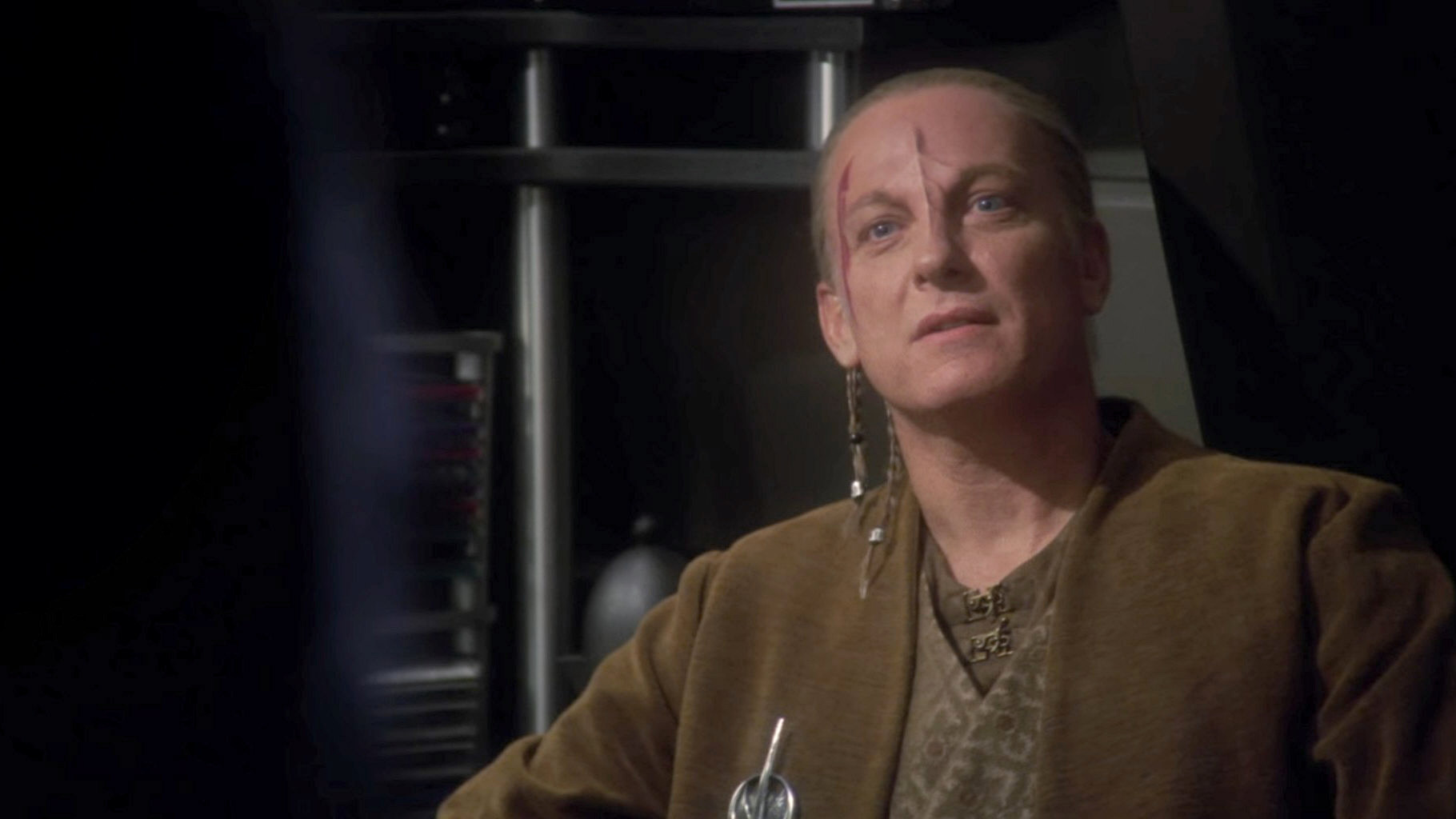
Date not given: Enterprise rescues a small ship from an anomaly near one of the large spheres. But the alien crew, all members of a religious group from the planet Triannon led by D'Jamat, take over the ship, ready to perform suicide attacks with organic explosives. D'Jamat wants to execute one Enterprise crew member for desecrating their "holy" sphere. Archer volunteers, and using the transporter he pretends to have his molecules dissolved. He organizes resistance against D'Jamat, getting help from Yarrick, one of the hijackers who does not agree with D'Jamat's extreme views. After the terrorists have been overwhelmed, they arrive at Triannon to see that the planet has been devastated by the war between the religious groups.
Review
"Chosen Realm" is successful as a solid action plot that addresses the problem of real-world religious fanaticism and its motivation . The outcome is outspokenly anti-religious like few Trek episodes before, most prominently TNG: "Who Watches the Watchers?".
It is obvious how "Chosen Realm" is a homage to the classic anti-racist TOS episode "Let That Be Your Last Battlefield". This is accomplished by carefully citing from or alluding to the original, without imitating or even devaluing it. The rationale for D'Jamat's jihad is as dull as the one in the TOS episode. From an objective viewpoint no one would give a damn if the Chosen Realm was created in nine or in ten days, but fanatics thrive on what little distinctiveness they can establish for their faction. And like the "scientific" arguments of racists, such religious peculiarities are usually made up due to a lack of better ideas. In the only glance we get of a "heretic", we even see that he has his facial mark on the other side, just like the facial colors of Bele and Lokai in the TOS episodes were switched. Triannon also goes up in flames in the same way as Cheron.
The second inspiration for the episode is almost as evident as the first one. The conflict Archer vs. D'Jamat seems much like the one between Bush and bin Laden. We know that bin Laden is a stinking bastard, merciless and inhumane. Bush may have bad habits and sometimes questionable intentions, but first of all he is the leader of a free and democratic country. In light of these roles it is no question that we are supposed to sympathize entirely with Archer, despite his failings (the airlock incident in "Anomaly"), which D'Jamat points out with pleasure.
But there is a problem with Archer's stance. In two or maybe more remarks throughout the episode, Archer explicitly blames the faith for D'Jamat's misdeeds. Rather than his enemy's inflexibility or fanaticism, he attacks the very basic idea of his religion without knowing anything about it. There is no other option but to believe the captain, witnessing how Archer is right about everything else and how D'Jamat is evil all over (he even claims to be merciful when he says he would kill only one crew member for the crime of desecration). The outcome of the episode is that, instead of keeping up a bit of a controversy, we are readily served a preconception that any religion will ultimately end up in conceit and in discrimination of "heretics". While there is some truth in that stance regarding the history of Christianity or Islam, neither religion is based on intolerance or hatred. It is actually quite the contrary, and only ruthless leaders have misused faith for their own purposes. Millions or even billions of religious but peaceful human beings prove that there is nothing intrinsically wrong about their religion. D'Jamat repeatedly makes silly claims that his "truth" should be the only one, but Archer's stance that there must not be anything besides science is not really that much better. Well, it is easy to appear as ethically right when someone points a phase pistol at your head.
Annotations
- Random observations:
- Where is Hoshi? After a brief appearance in the beginning I don't remember seeing her again.
- Mayweather has a few lines!
- Well, the old cliché: One of the evil aliens ends up helping the crew...
- There is one logical problem, considering that D'Jamat had access to all the specs of the ship. The transporter would almost definitely have caught his attention, and Archer couldn't have made him believe that it is used for waste disposal and even for occasional executions.
- Remarkable dialogue: "These people you're fighting, what makes them heretics?" - "We believe the Makers created the Chosen Realm in nine days. They say it took ten." (Archer and Yarrick)
- Remarkable quote: "When you begin sympathizing with the enemy, you risk to become the enemy." (D'Jamat)
- Remarkable facts:
- Triannon is a planet 6.2 light years away from the particular sphere.
- D'Jamat deletes 14.3 XB of data about the spheres (exabytes?).
- Crew losses: 1
Rating: 5
Proving Ground
Synopsis
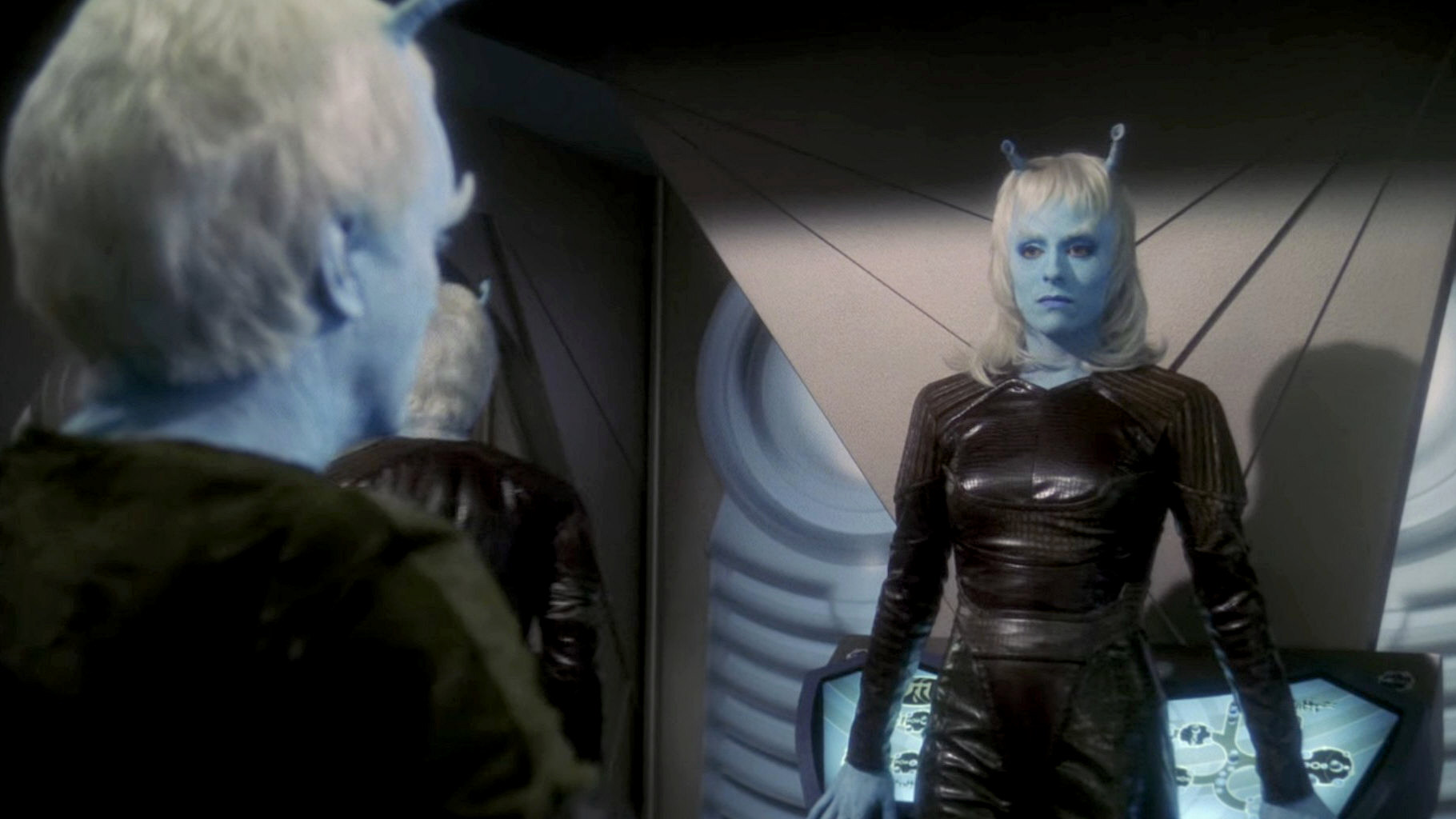
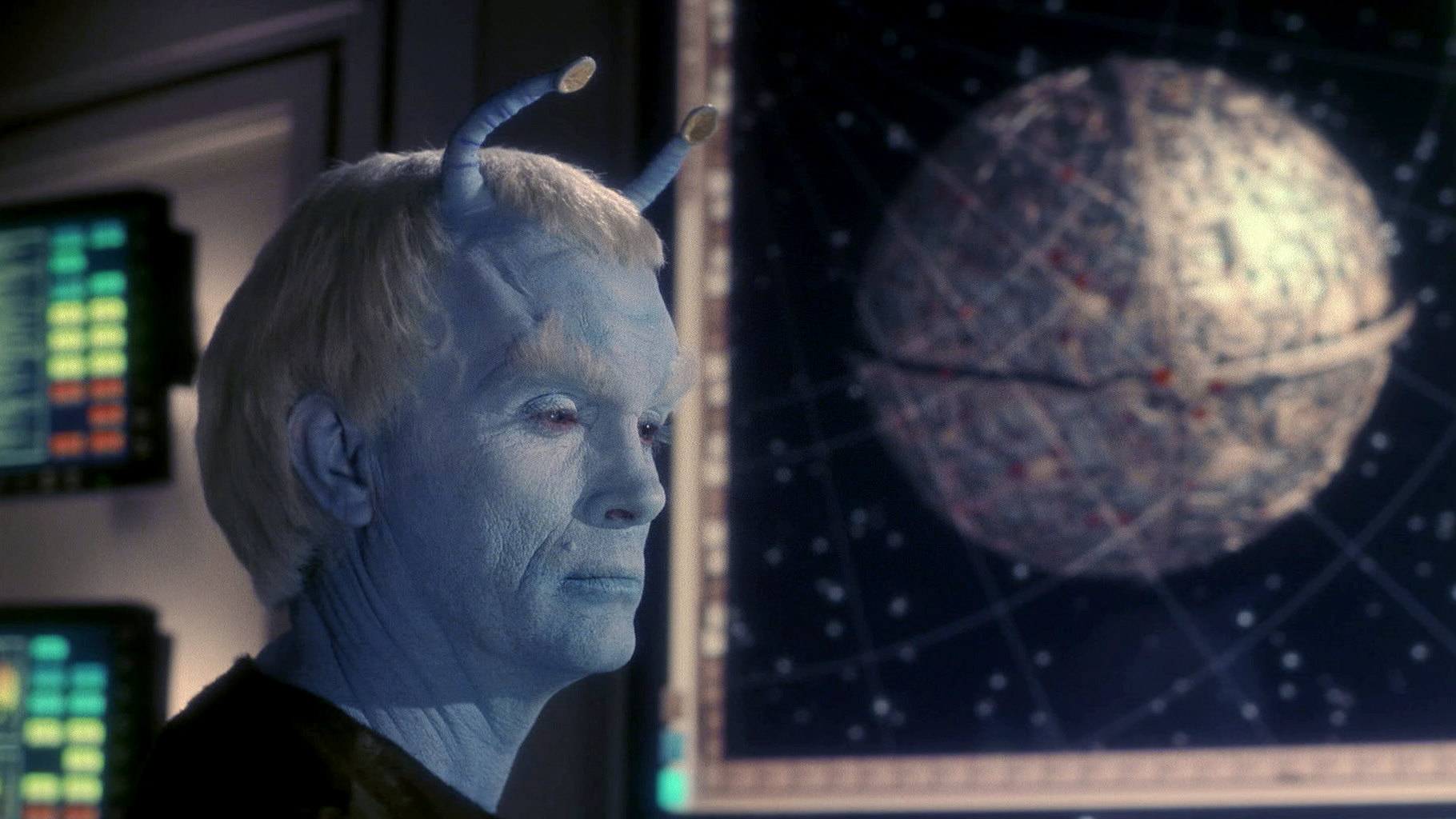
December 6th, 2153: Hoshi and T'Pol have retrieved 30% of the computer data that had been erased by the religious fanatics, when Enterprise runs into an anomaly. An Andorian ship commanded by Shran comes to the rescue. Following traces of the tagged kemocite shipment and with the help of Andorian sensors, the testing range for the Xindi planet killer weapon is found. The two ships join in an endeavor to get their hands on the prototype. However, under orders of the Andorian Imperial Guard, who say they need it to deter the Vulcans from invading Andoria, Shran grudgingly betrays Archer and keeps the weapon in his ship's cargo hold. With the help of the activation code his crew has been able to retrieve, Archer forces Shran to release the weapon, which then detonates not far away from the Andorian ship. Still, someone among the Andorians has made detailed scans of the device and sends them to the Earth ship in an encrypted message.
This was the second best episode of the season so far, only second to "Twilight", which impressed me still a bit more. "Proving Ground" appears to be a quite conventional action story at first, with Shran's betrayal being the only twist. Still, it comes with a great deal of character interaction, it ties together the Xindi and the Andorian story arcs, and it may prove invaluable for both of them. The continuity to "The Shipment", to "Chosen Realm" and to the previous Shran episodes is remarkable. Moreover, it is simply exciting to watch.
But the highest praise must go to Jeffrey Combs as Shran. It is his outstanding performance that turns this episode into something special. His facial expressions and his intonation give Shran's character an intensity like no other guest in the series and like only two or three of the regular cast. As glad as I was that his character changed after "The Andorian Incident" where he was nothing more than another predictably sadistic Weyoun clone to me, as much I appreciate that he doesn't ultimately become Archer's best buddy here. And that there are limits to his effort to forge an alliance between his people and the "pinkskins". Shran is palpably sorry that he has to betray Archer, but in his pride he doesn't admit to him that he is only grudgingly following his orders. The female Andorian officer Talas is another positive surprise, as it is the first time that another member of this race has more than a few lines and gives us a personal account. Most importantly, the Andorians provide us with some insight into their vital desire to protect their planet. I appreciate that, even if it shows the Vulcans in a bad light once again.
Quite contrary to Shran and his people, the Xindi remain one-dimensional. There is nothing to learn from their customary Council of Evil scene except what we already knew. The Xindi once again fail to reveal more of their motivation, it is all about boring schedules - about as enthralling as the monthly meeting of marketing people of a company who have no idea of the actual products.
Annotations
- Remarkable quote: "We are looking for a rare element - Archerite." (Shran, to the Xindi)
- Remarkable scene: We see the back of Archer's head in front of the viewscreen, so that it looks like antennae were attached to it when Shran appears on the screen.
Rating: 7
Stratagem
Synopsis
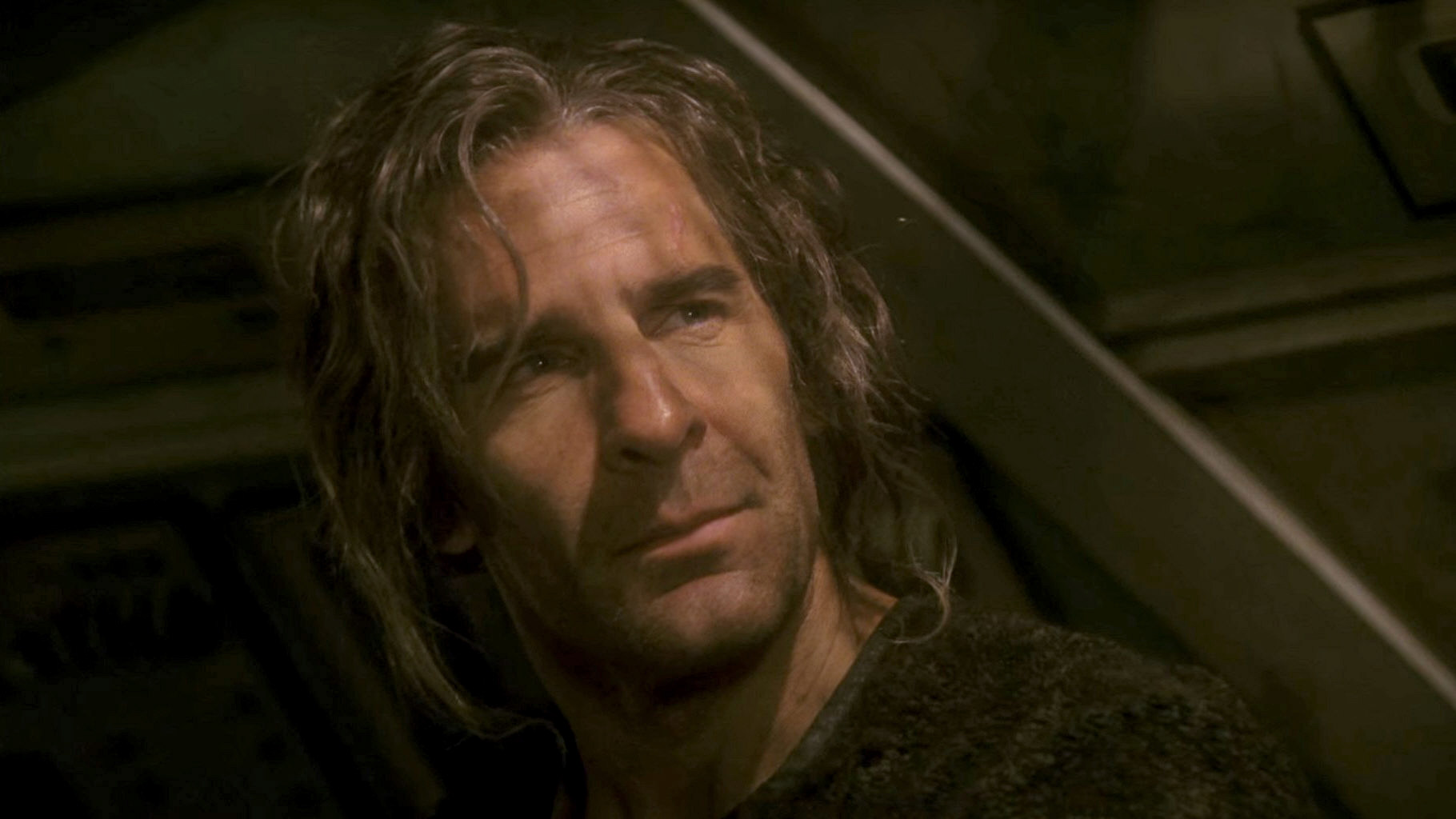
December 12th, 2153: After capturing Degra, the designer of the Xindi weapon, Archer has Phlox wipe out his short-term memory and has Trip and Malcolm create a scenario in which the Xindi-Humanoid would reveal the whereabouts of the weapon. Degra finds himself on a shuttle, escaping from an Insectoid prison after three years he allegedly spent together in one cell with Archer. He is tricked into setting a course to the building site at Azati Prime, but then he notices that the scenario is a ruse. Since the way there would take three weeks at maximum warp, the Enterprise crew create another fake setting in which Enterprise arrives at the star system, and Degra has to confirm that it's the right place.
Review
At the beginning, and even still some time after the teaser, it almost looks as if this episode were shamelessly repeating the stunt of "Twilight", something that can definitely be done only once or twice in a whole series run. Earth has been destroyed, Archer is deranged, only that it's now Degra who is suffering from amnesia. The Archer of our timeline couldn't know anything of the events in "Twilight", so there is neither a particularly good continuity, nor a continuity breach in "Stratagem". It just appears as repetitive, although it is quite obvious that it wouldn't turn out to be the result of yet another time travel. I have to concede that the story plays with this overused plot idea as well as with the "Archer captured once again" trope, which are both ironically alluded to. But exactly in this idea lies a weakness of the episode. After fifteen minutes the "we're in the future" hoax is exhausted, as any viewer should have a clear idea by now what is really going on. But instead of re-invigorating the plot, the switch to the real world outside the shuttle and then to the past has the opposite effect: The pace falters even more. In my view it would have been far more appealing to tell the whole story in chronological order, showing the preparations for the scenario and how everyone outside reacts as Degra is about to find out the truth. This could have built up suspense gradually, and would have been better than exploiting what little mystery potential it has to see Archer with messy hair and together with his enemy in a shuttle.
The rest of the episode after Archer rejoining Degra in the shuttle makes up for this mistake to some extent. Speaking of clichés, another one alluded to is the customary "drive-of-the-week" concept of a familiar Starfleet ship 220 years later. Archer discusses the possibility of creating a spatial vortex with Tucker as if he really intended to try that and as if a small firmware update were sufficient. Fortunately it's not as easy as on Voyager, and everything is faked to trick Degra yet another time. Yet, here lies another deficiency. It is just too obvious that the final five minutes, with Archer asking the Xindi engineer for help while the ship is rocking, all shown from the Xindi perspective, must be yet another ruse. Once again, it would have been more suspenseful, had we witnessed the preparations from the point of view of the Starfleet crew.
The simulator is quite credible as a predecessor of the holodeck. Unfortunately, it is susceptible to the same kind of malfunctions. When the ship is bombarded by radiation from the debris field, the simulator goes nuts due to the inevitable power overload, and it doesn't seem like one could simply pull the plug.
Annotations
- Remarkable quotes:
- "The red giant may be a red herring." (Trip)
- "These overgrown grasshoppers..." (Archer)
- Remarkable facts:
- The Xindi Council was created to find a new homeworld for all the Xindi species. But a unification never took place.
- The neural pathways of Xindi-Insectoids and Xindi-Humanoids are nearly identical.
Rating: 5
Harbinger
Synopsis
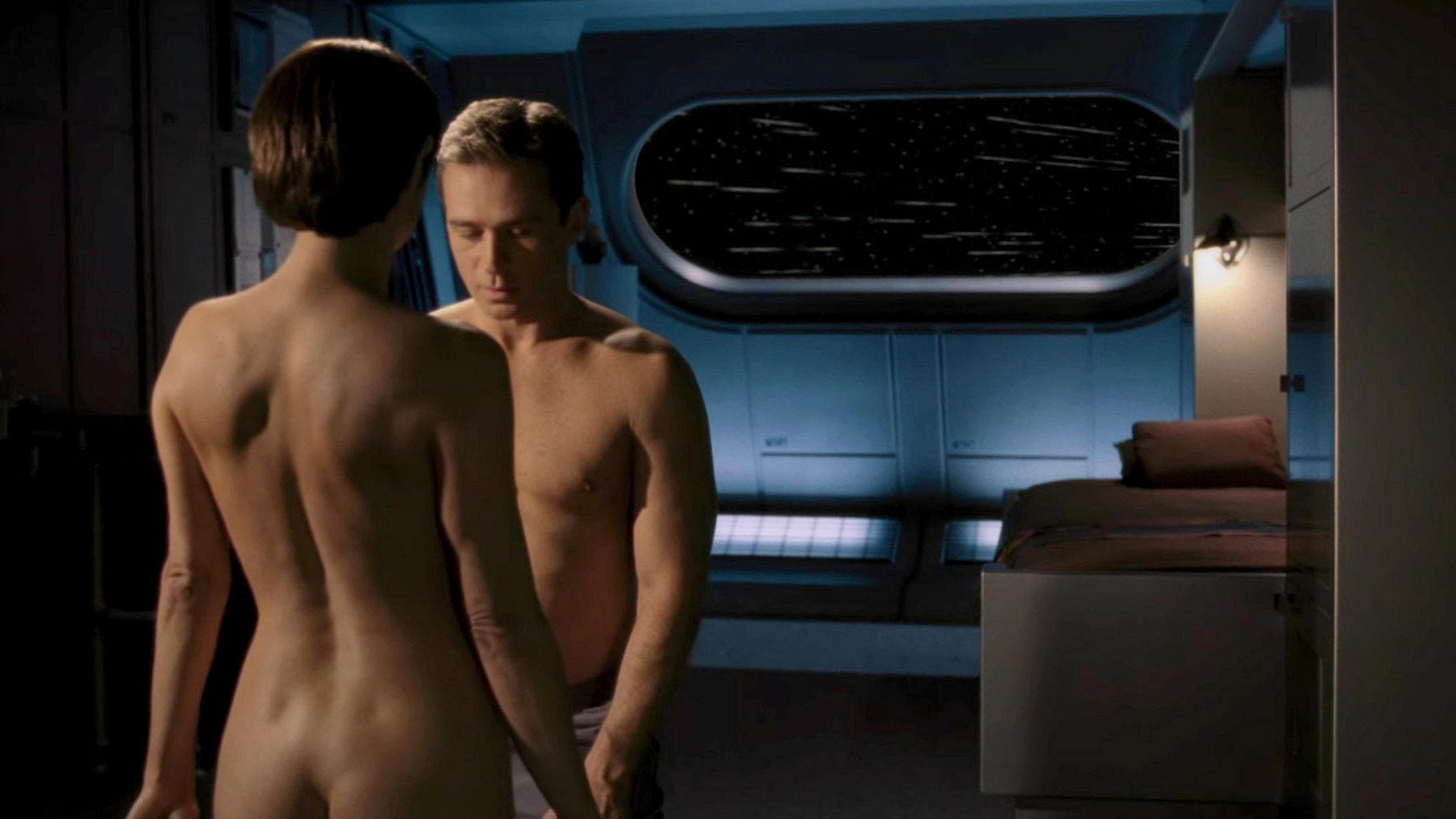
December 27th, 2153: While investigating a cluster of shifting stars, Enterprise encounters a convergence of spatial anomalies. A weak transmission leads them to a small pod containing an alien. As they extract the pod, the anomalies expand and briefly engulf the ship, causing system disruptions and atmospheric instability. Enterprise escapes with the pod, and the humanoid alien of an unknown species is brought to sickbay. Dr. Phlox begins treatment while T'Pol analyzes the anomaly's location at the center of five spheres. Archer suspects the spheres are responsible for the disturbance and theorizes the alien may be a test subject placed there intentionally. Meanwhile, tensions rise among the crew. Trip Tucker performs Vulcan neuropressure sessions with Corporal Amanda Cole, which stirs up jealousy in T'Pol. She later conducts a session with Cole herself, awkwardly probing her feelings for Trip. Eventually, T'Pol admits her own attraction to Trip, culminating in a romantic encounter. Friction escalates between Lieutenant Reed and Major Hayes over MACO training protocols. Their rivalry intensifies through combat drills and culminates in a fist fight, prompting Archer to demand resolution. Back in sickbay, the alien deteriorates rapidly and begins phasing through walls. He disables systems and destabilizes the warp core before being repelled by reversing the field coil polarity. The alien later reveals he comes from a trans-dimensional realm and hints that his people are involved in the Xindi plan to destroy Earth. He dies shortly after, disintegrating completely. Trip and T'Pol agree to keep their intimacy private, while Reed and Hayes confirm to Archer their conflict is settled.
Review
I knew that this day would come, and I was hoping for the authors to treat Trip and T'Pol's delicate relationship with the due decency. The two would have deserved it because I am fond of their characters. I don't mind the gratuitous glance at T'Pol's bare backside. I also don't mind the coincidence that Amanda Cole was a high school girl from Trip's home state Florida and that she is way too cute for a MACO. (BTW, didn't play Jolene Blalock a Marines chick with a tattoo on her butt on JAG?) Rather than these details, it makes me cringe how Berman and Braga, along with Manny Coto, developed the story and the characters. In "Harbinger", Trip, T'Pol, Amanda, Reed and Hayes are written through a strikingly adolescent lens, indulging in juvenile fantasies and petty rivalries that clash with their roles as trained officers on a high-stakes mission. Romantic entanglements unfold with the emotional maturity of a high school drama, while professional disagreements devolve into fist fights over bruised egos. The episode's underlying theme is vanity, with two subplots in which the characters defend their pride against perceived rivals or threats. What should be a tense, character-driven exploration of feelings instead slips into a soap opera.
Although I have to concede that real-life exchanges between lovers or rivals are often clumsy or poorly worded, I don't remember listening to such cheesy and superficial dialogues as between the above five characters in a long time. Even the much-maligned "A Night in Sickbay" had better lines than "Harbinger", although its plot was still a tad more pointless. Also, the two plot threads about Trip & T'Pol on one hand and Reed & Hayes on the other hand are cobbled together in an awkward fashion, and the frequent switching between them usually takes away what little suspense can be built up in either of them. But the worst of all is the unnecessarily cruel and downright obnoxious school yard fight between the two idiots Reed and Hayes. I fully understand Archer's anger about them, although he does not always strike the right chord either. His own involvement in the episode is not very laudable, seeing how little he cares for the life of the injured alien ("...bend a few ethics") even before the guy turns out hazardous. I don't think that I should praise Archer merely because his subordinates are more annoying.
The plot thread about the alien is about the only thing that reminds me of Star Trek but it doesn't manage to save the episode. First of all, the idea of the mysterious alien, who holds a secret and hides his powers, has been done to death in the four previous incarnations of Trek, and it is just too obvious that he isn't what he pretends or appears to be. Secondly, the plot thread is thin and is conceded less than a third of the screen time. It is uninspiring because it relies on clichés that are only casually used instead of sufficiently exploited, like the ubiquitous anomaly-of-the-day that plays no role in the following, or aliens with genetic(?) improvements (like the Suliban), or the ability to penetrate walls (like Daniels). Thirdly, letting the alien vanish without revealing anything of his origin, mission or motivation is an unsatisfactory ending for this episode. We only learn as much as that he claims to be a prisoner, who volunteered for an experiment. But in the end, he turns out to be just another bad guy in a long line that want to destroy humanity.
Although there are several problems with it, the Xindi story arc has grown on me because it is overall very consistent. In this vein, I like it whenever a little mystery remains at the end of a good episode - of an episode that tells a story or adds to one, as opposed to "Harbinger". Without knowing about the upcoming "Azati Prime", perhaps the strange guy and his intentions will still have relevance, also because of the episode title "Harbinger". I don't rule out that it may still make a little bit of sense in hindsight why the Xindi or anyone would set up a complicated trap like this one, if they could simply openly attack Enterprise. Anyway, it was counter-productive to throw away the potential of the trans-dimensional alien. I was waiting for something to reconcile me with this non-story, but all I got was a cheap sneering remark from the alien in the end.
Annotations
- Remarkable threat: "When the Xindi destroy Earth, my people will prevail." (the unknown alien)
Rating: 1
Doctor's Orders
Synopsis
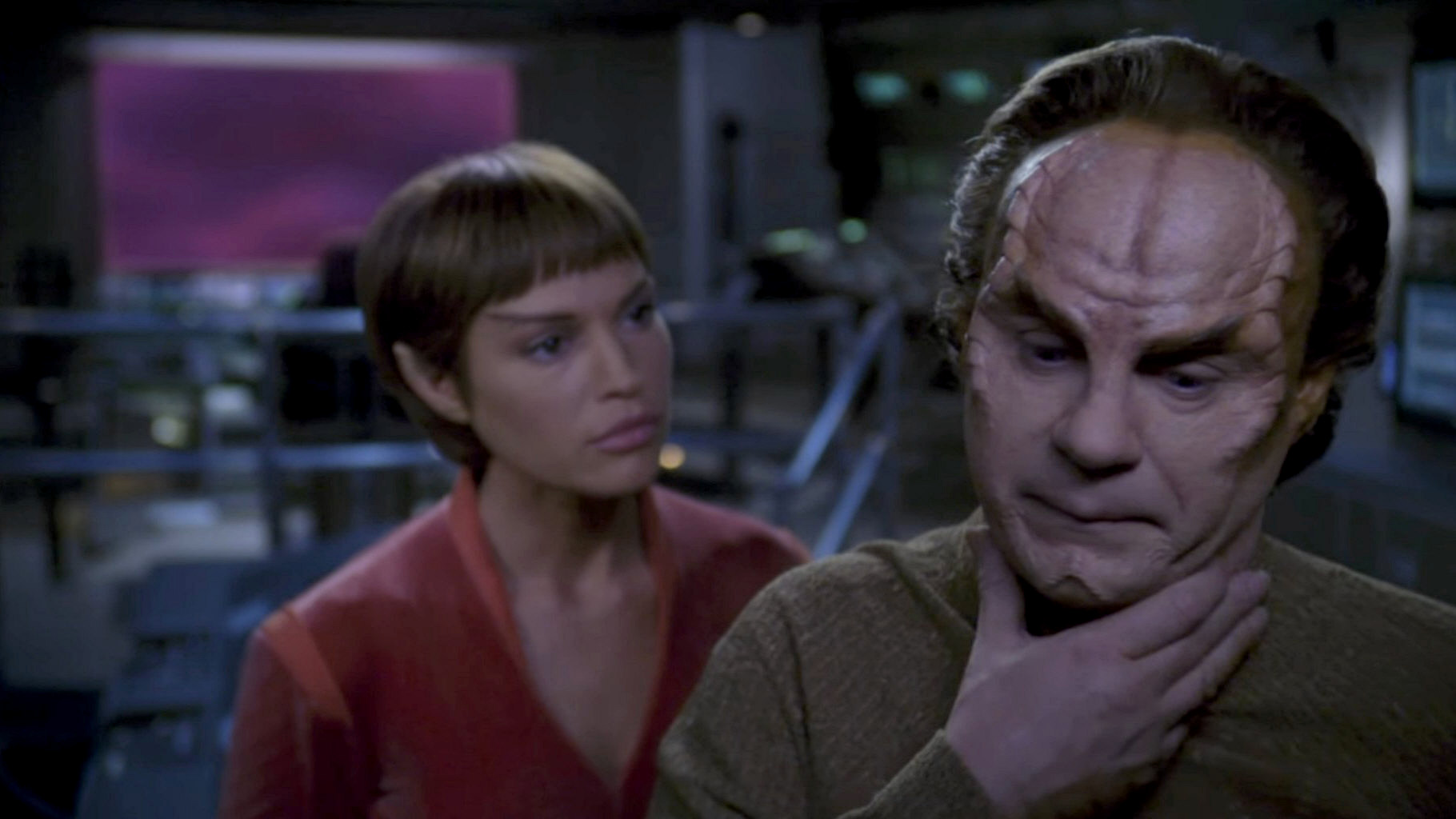
Date not given: An anomaly is building in the flight path to Azati Prime. Tucker advises against going to warp inside the phenomenon, so the ship has to traverse it at impulse speed. Whereas the Denobulan brain will likely not be affected, Dr. Phlox has to shut down the human and Vulcan crew's neocortices by placing them in a comatose state. He gets a crash course in how to monitor the functions of the ship. After a while, however, the doctor begins to hallucinate. He repeatedly imagines that crew members are awake and even sees an intruder, a Xindi-Insectoid. But none of this is real. What Phlox doesn't hallucinate is that the edge of the anomaly is further away than expected because it is expanding. As the time approaches to wake up the crew before they suffer permanent brain damage, he sees no other way but to activate the warp engine against Tucker's advice, with T'Pol assisting him. After the ship has cleared the anomaly, Phlox notices that T'Pol was asleep all the time, and that he only hallucinated her presence.
Review
When I first watched "Doctor's Orders", it was after a ten-hour work day, and it was in fact the first time that I almost fell asleep watching Star Trek. The more Phlox was fighting his hallucinations, the more I had to struggle myself to keep my eyes open.
I used to care a bit more for this episode in 1998 when it was still called VOY: "One" and when Phlox's name was Seven of Nine. Both are members of a species that is afraid of the solitude and both become delusional when they watch over the empty corridors as the rest of the crew is asleep. Even the reasons for the situation are exactly the same. The ship is crossing an anomaly that would damage the human brain, and since there is no inoculation against it, everyone has to go into suspended animation, with our resident alien being the only one immune to it. This rehash is as blindingly obvious as hardly ever before in the series. It adds to my frustration that a very similar episode with the old "only and exactly one of the crew is unaffected" trope, "Singularity", was on air just a year ago. Not to mention T'Pol's recent paranoid delusions in "Impulse", which were a lot like Phlox's are here. It is clear from the start that much of what happens in "Doctor's Orders" is not real, so the appearance of the Insectoid didn't frighten me at all (also because we could expect the Xindi to take a break after a couple of episodes of action). When I first watched, I was hoping for an unexpected turning point, but it simply didn't happen. The episode draws its little bit of suspense solely from the simple hallucinated horror.
Only at one point the story surprised me. But although it was supposed to be an interesting twist, I felt rather cheated than amazed when Phlox recgnized that "his" T'Pol was only an illusion. It is a deception in bad style in my view because fake T'Pol is acting independently all the time, not like a dream image that would appear or disappear erratically and that would say or do things that don't make sense. Phlox's perception of T'Pol is just not how illusions should be depicted in a TV series. Even if we try to excuse T'Pol's pseudo-authentic presence presuming that a Denobulan hallucination might actually be very lifelike, it is not the way they can be credibly presented, because it crosses the line to being perfectly real to a perfectly aware (yet quite sleepy in my case) human audience. Just like "Bobby in the shower" a long time ago.
Furthermore, revealing the fact that T'Pol was only an illusion renders the episode even more pointless than has been anyway until then. In this regard I only wonder why the two don't have a little affair or why there isn't an embarrassing disclosure of a secret while they are alone, as this is what the writers would customarily do with characters who are not bound by the laws of the real world. Perhaps I should be glad they could forgo the temptation, although their abstinence ultimately doesn't help save the episode. On the contrary, the only thing that may have caught my interest within the boundaries of the boring plot would have been to know why of all crew members T'Pol was in Phlox's dream all the time!
I admit that Phlox has never been never among my favorite characters, and I may have found the episode a bit more appealing, had it either focused on another character, or had it been more about the real Phlox and not about the delusional version. And seeing Phlox naked is definitely something I never asked for, especially not one week after T'Pol's butt exposure.
While it is a bottle show anyway, "Doctor's Orders" additionally turns out to be a filler episode that may be skipped without missing out on anything. I initially gave it zero points, but in hindsight this episode is just uninspired and boring, rather than annoying.
Annotations
- Nitpicking: One question remains unanswered. Didn't anyone care about the Xindi? From what we know they could appear and attack everywhere, and inside that anomaly the ship would have been absolutely helpless. Especially since the anomaly was popping up from nothing, it would have seemed obvious that somewhere inside the Xindi or the Sphere Builders may have just been waiting for Enterprise.
- Remarkable fact: A chart that Phlox accesses correctly shows the warp drive's peak transitional thresholds up to Warp 4.
Rating: 1
Hatchery
Synopsis
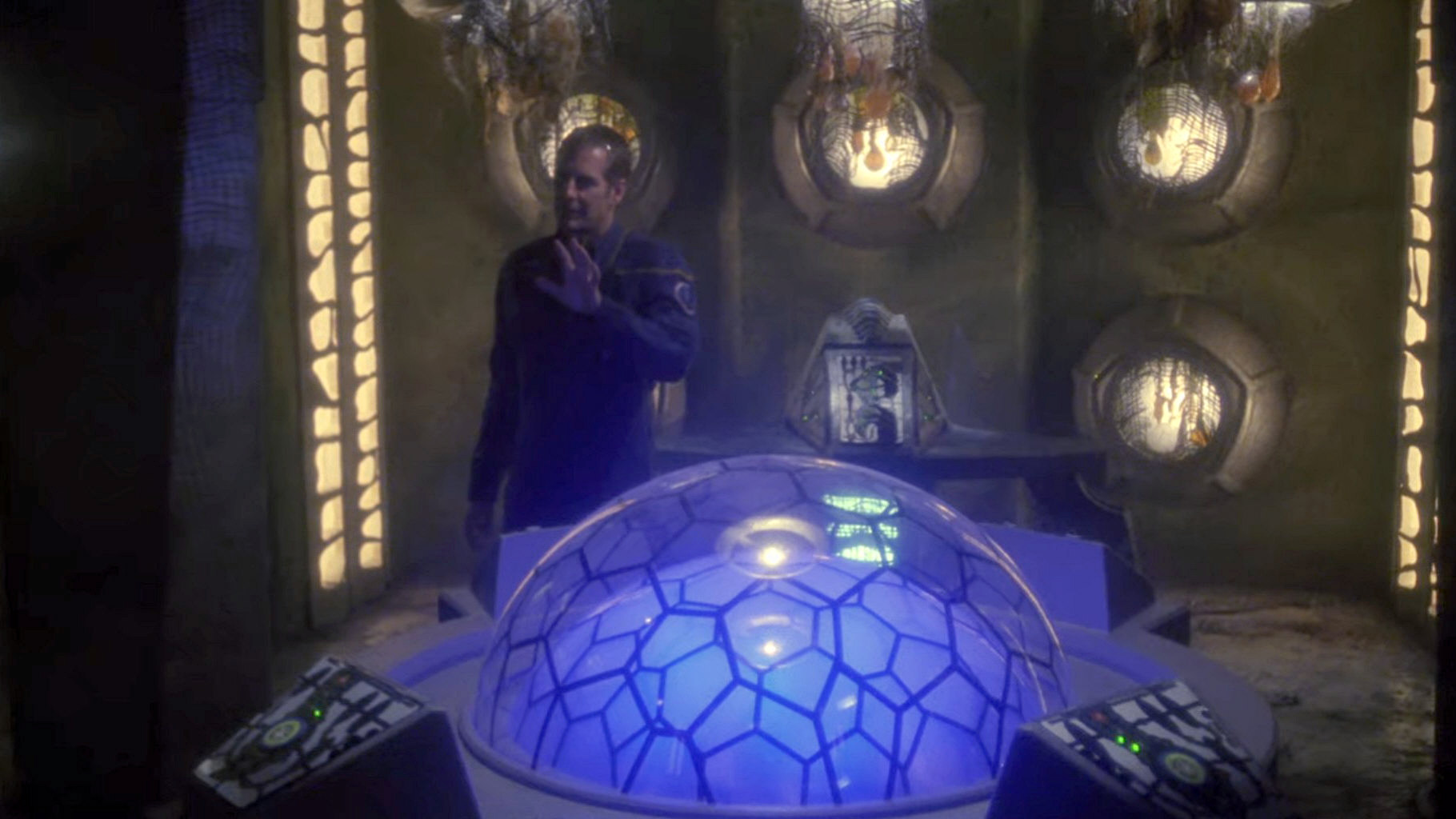
Date not given: Enterprise discovers a crash landed Xindi-Insectoid vessel. A landing party finds a dead crew and a hatchery whose life support will fail soon. After coming into contact with an egg, Archer strives to save the hatchlings at any rate, and he even orders antimatter supplies of Enterprise to be sacrificed to power the hatchery. While T'Pol and later Reed are relieved of duty for acting against him, Hayes is left as the only officer to stick by the captain. The rest of the senior crew unite in a successful mutiny. Phlox finds out that the egg contained a sophisticated neurochemical that made Archer develop a father instinct for the hatchery.
Review
We should be concerned about Archer's state of mind. The man who let a whole race die because of rashly made up personal ethics, who almost killed a man who had no business with his true enemies and who saved a bioweapon from extinction now does everything to foster a bunch of nasty insects, at the expense of his crew's lives and of all life on Earth. It certainly wasn't quite like that in "Hatchery", but there were moments when I thought that Archer was all serious about it instead of going with the more plausible (at least in the Trek Universe) explanation that someone or something alien was controlling his mind. I'm still undecided whether I like the rather comforting explanation or whether we should have better attributed it to Archer's tendency of erratic behavior.
We've already had plenty of "mind control" episodes in Trek before and several of them only recently, so I don't care much for this part of the story. Likewise, the idea of a mutiny to get rid of an irrational captain is nothing new either. What is interesting to me is the timing of the episode. The story arc is taken to an extreme that we wouldn't have expected at this time. It is totally counterproductive in a positive way and in the best tradition especially of Deep Space Nine for Archer to change his mind. Archer, who was always obsessed with tracking and fighting the Xindi suddenly finds himself playing their nurse, thereby trying to be Trekkier than Roddenberry could have ever imagined.
On the other hand, the ethical aspect gradually loses importance in the following. Archer makes a very good point in the beginning when he notes that the crew would probably come to the help if they had found infant Xindi-Primates. So why shouldn't doing the same for the Insectoids be possible and adequate? Just because humans have a natural instinct to hate everything with more than four legs? The episode still owes us an answer to this question. Yet, maybe we really don't want to know if intelligent insects could ever be sentient too.
Annotations
- Remarkable set: The hexagonal shapes were the obvious choice for an insect ship, but overall they reminded me too much of the Suliban design. Some of the structured hatches even looked exactly like on Suliban vessels.
- Remarkable fact: Xindi-Insectoids are genderless and they reproduce asexually. Their usual life span is twelve years.
Rating: 4
Azati Prime
Synopsis
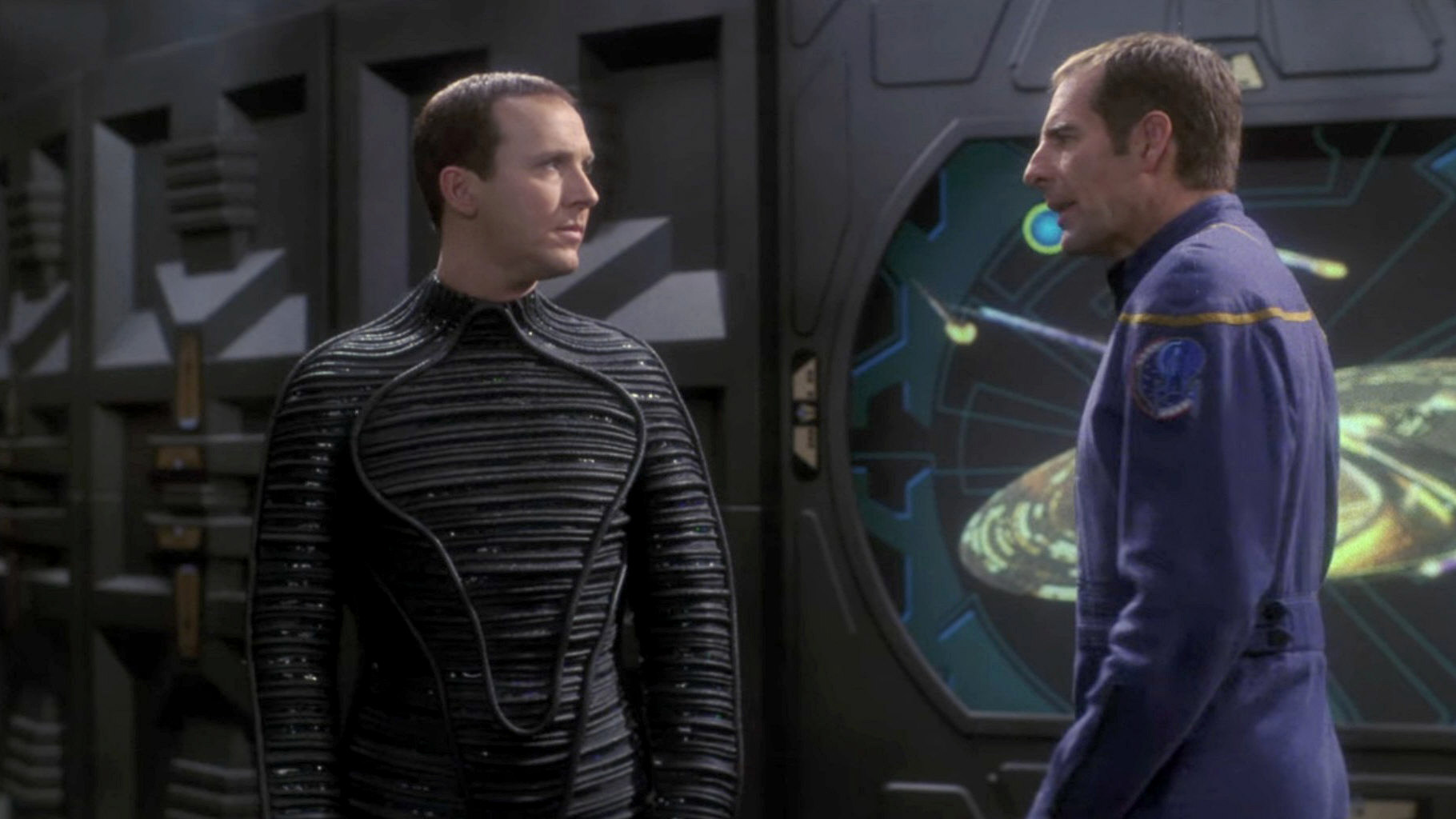
Date not given: Upon their arrival at Azati Prime, Tucker and Mayweather take the captured Xindi shuttle to cross the detection grid erected by the Xindi. They find the superweapon submerged in an ocean, almost ready to launch. Daniels transfers Archer to the future and tries to explain to him that the Xindi were tricked into the war by the Sphere Builders, a future enemy of the Federation. But Archer takes the shuttle on a suicide mission to blow up the weapon. The mission fails, and he is captured by the Xindi-Reptilians. Although Archer almost succeeds in convincing Degra of humankind's true intentions, the Xindi begin a devastating attack on Enterprise...
Review
I like the episode simply because it is exciting to watch, like already "Twilight" earlier this season. No matter if a reset button is pushed in the end (which is still open at the time I'm writing this), it is possible to make such an extremely action-heavy episode at most twice per season. In addition to the problem of its budget consumption, there is nothing that wears out faster than plots that go to extremes. I don't think this opportunity was wasted here. Still, I might have several reasons to dislike "Azati Prime".
War shows its ugly face in the episode when Archer and Tucker refuse any attempt to seek the diplomatic solution proposed by Daniels and T'Pol, and particularly when Archer orders the helpless Xindi outpost to be eliminated. One might say that this is only pragmatic, to kill a few for the sake of many others. But isn't this exactly how the ruling class and the military have always justified their course of action through human history? To paraphrase Picard, how many collateral damage does it take before it becomes wrong? The perhaps worst part of the story is that I was not even shocked that of all Starfleet captains Archer was capable of consciously killing innocent people (although Sisko's poisoning of the Maquis planet in DS9: "For the Uniform" was even more appalling). Fortunately Reed's and T'Pol's upset facial expressions demonstrate that the episode is not meant as a plea for preemptive strikes, but overall their protest could have been more determined.
In addition, I have an issue with the overt racism in the episode. Archer's reaction to the Reptilians who have captured him may have been understandable, but his racial slurs (for instance, about the brains of the size of a walnut or about the turtles served in his favorite restaurant) are by far the worst ever uttered in a Star Trek episode. We always have to bear in mind that the conflicts between the species in the Trek Universe were always intended to be an allegory to the national and racial struggles on present-day Earth. What adds to the impression of racism is that in the end the humanoids or primates, those who are visually similar to each other, more or less unite against those who are very different, namely the Reptilians and Insectoids (the latter do not appear themselves, but their ships are seen). Although this outcome may seem realistic, it is clearly not Trek-like to form alliances out of racial preference. If this is supposed to tell us that the 22nd century still has to evolve to the place we know from the future, it may be acceptable to show these obvious throwbacks. Yet, I have a problem with a Trek series that occasionally abandons fundamental morality with the excuse that it's not yet the time for it.
Concerning T'Pol's emotional state, I am not sure if it was the right time to let her emotions surface in the form of an obvious illness. That is, if it is an illness and not a sudden and inexplicable affection for Archer, which I think would be an awful idea, considering that the attempt to introduce some sort of jealousy went awry already in "Harbinger". Anyway, there may have been a better time than one when everyone was on edge anyway.
I have come to appreciate the Xindi story arc, and "Azati Prime" is definitely an exciting culmination point. Still, the more I think about it, the fewer genuine ideas can I find in the episode. The most important part of the story is definitely what Daniels tells Archer, although Archer's repeated time travels have become boring by now. And, for what it's worth, the destruction of the Xindi outpost is something we haven't seen before. Most of the rest of "Azati Prime" is a composition of facts and motives we already know too well. Just like the trick with the alien shuttle ("Broken Bow"), the diving stunt (VOY: "Thirty Days"), not to mention the exhausted "Archer captured by evil aliens" cliché. And the imminent destruction of the ship screams "reset button", just like in "Twilight". But we'll see what happens next...
Annotations
- Nitpicking:
- The time travel aspects of the episode are analyzed on a separate page.
- Aside from the usual logical problems of time travel I wonder when and how the Sphere Builders pursue which goal and why. They are transdimensional, they want to rebuild our space to suit their needs, they can scan the timeline, that much we know. But it all doesn't seem to make much sense. In "Anomaly" the spheres were said to be at least 1000 years old, so are they transforming space for so long a time? If this were true, why don't we ever hear of an ever expanding Expanse in TOS or TNG? If it's all a parallel timeline and the spheres are not supposed to exist in the Trek universe we used to know, why would the Sphere Builders involve the Xindi who are quite obviously utterly unreliable allies? If they could go back in time and build the spheres, couldn't they wipe out Earth some time further in the past while they were at it?
- Remarkable ships: In the 26th century, we not only get a glimpse of the Enterprise-J, but also of some familiar designs, such as the Prometheus and the Dauntless. However, it is questionable if exactly these very classes really exist in the far future.
Rating: 7
Damage
Synopsis
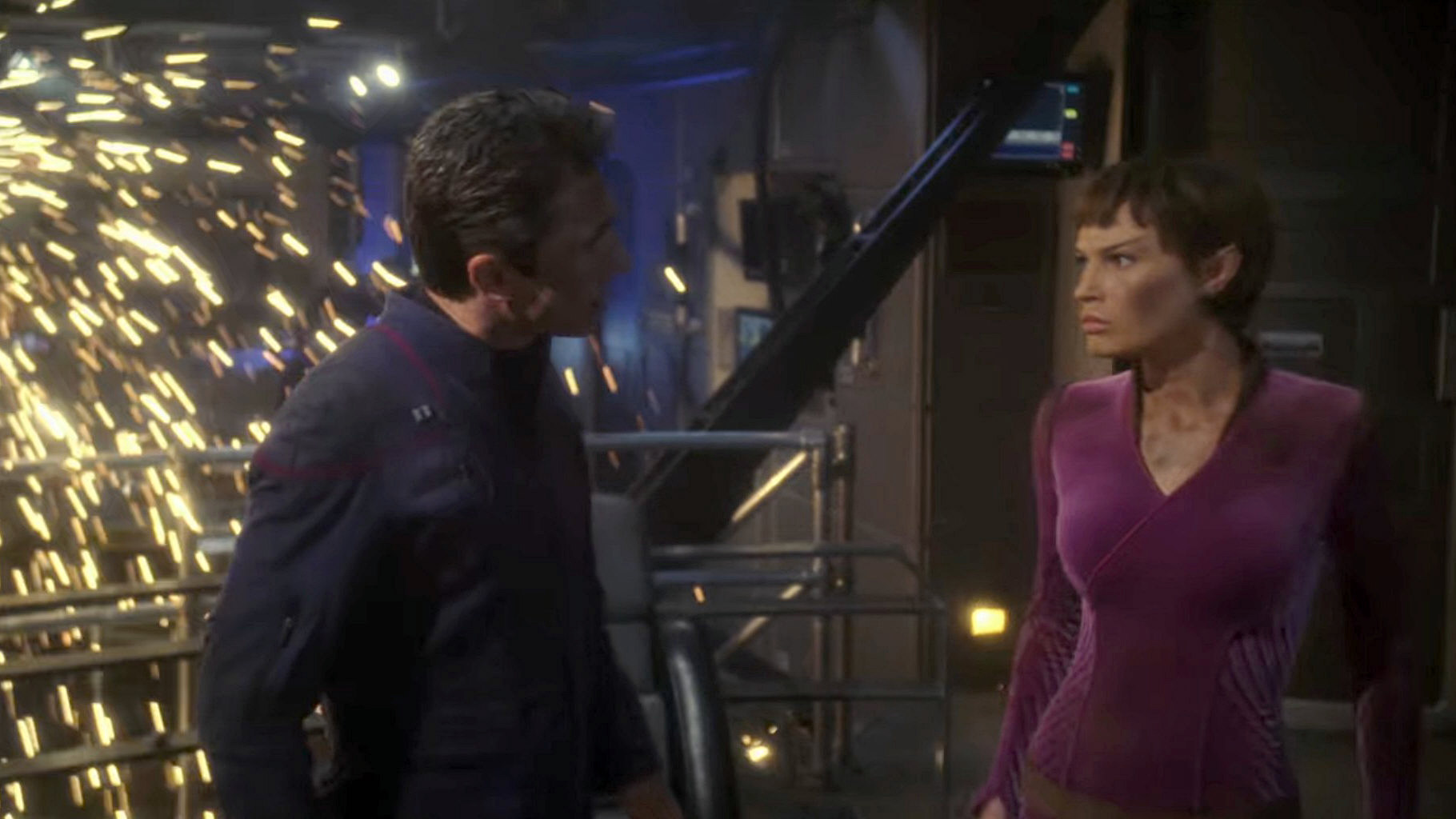
Date not given: The Xindi break off their attack thanks to Degra's intervention, leaving Enterprise crippled and with at least 14 of the crew dead. The captain is found in an escape pod from a Xindi-Aquatic vessel. Archer hopes that he may trade a warp coil from a damaged alien vessel, but the aliens refuse. In the meantime, T'Pol confesses to Phlox that she has become addicted to Trellium-D, which evokes strong emotions in her. Archer decides to take unethical actions and orders to take the warp coil from the alien ship by force. The mission succeeds, and soon Enterprise can warp on.
Review
While "Azati Prime" is an overall good drama with many interesting points to discuss, "Damage" falls short of it in many regard. I see "Damage" as a visually impressive yet story-wise half-hearted conclusion to "Azati Prime". "Damage" neglects to tie most of the loose ends together and to offer new perspectives. Not everything can be postponed eternally, even in a story arc of one season or longer. Still, only the most obvious and immediate problems are picked up from the previous episode at all, the rest such as the involvement of the Sphere Builders and of Daniels, as well as the quarrel between the Xindi factions is not or hardly further developed here. The Aquatics are given a visually awesome appearance, only to utter a single insignificant phrase. Instead of exploring all the possibilities of the new situation (such as peace), Enterprise is once again left on its own, seeking for some Xindi asses or equivalent parts of their body to kick.
I admit that immediate peace may not have been realistic, but who says that the sudden end to the attack on Enterprise is? The only difference to the situation in the season so far is that the ship is now badly damaged. But even this opportunity is not really sufficiently brought into play. Phlox in his decent grief is the only one who acts as we would expect it from a human being in such a crisis. Archer once again proves to be a reckless maniac (whose ability to command a ship is impaired), and junkie T'Pol is out of her Vulcan mind anyway. Why should we care much for how they act and what they say? The rest of the crew are much like mindless repair robots. At least the ongoing repairs are likely to remain an important point in the following episodes, for continuity's sake.
But more damage than to the ship is done to the spirit of Star Trek. It obviously isn't enough that one character makes a very bad decision. Why does it have to be Archer with his ruthless looting as well as T'Pol with her irresponsible drug addiction in one episode? Star Trek was always about human beings who have improved or who strive to improve themselves, as unattainable as this may seem at times. We may accept the crew crossing the line once in a while, but not so often as recently. I have the impression that the writers have forgotten that Archer already ordered the helpless Xindi outpost to be eliminated in "Azati Prime". Or how he almost killed an alien who had no business with the Xindi at the beginning of the season. Now he acts brutally once more, but it is almost like he pretends it's the first time when he talks to Phlox about crossing the line to unethical conduct. Although it's just a matter of intra-series continuity in the first place, I think that forgetfulness about one's own misdeeds is just as bad as the misdeeds themselves.
Annotations
- Nitpicking: Wrong Treknology gives the episode an additional bad taste. Not only is the alien technology miraculously compatible with Enterprise's needs. The episode even manages to completely redefine what a warp coil is. On any Federation ship, a warp coil is and always was a huge component inside a nacelle, and there are quite a lot of them necessary to propel the ship. But now it suddenly becomes a small part in engineering that can be easily transported out. This utter misconception may be in the tradition of Voyager's many "drives of the week" and particularly the so-called "transwarp coil" in "Dark Frontier". But even Voyager got the basic Treknology right in "Nightingale", where the nacelles were disassembled to service the *true* huge warp coils. The gross error could have been effortlessly avoided by calling the component that Trip needed a dilithium matrix or something along these lines.
- Remarkable fact: Phlox has been a doctor for 40 years. He thinks that he has twice acted unethically.
- Preliminary crew losses: 14 (confirmed) + 3 (unaccounted for)
Rating: 3
The Forgotten
Synopsis
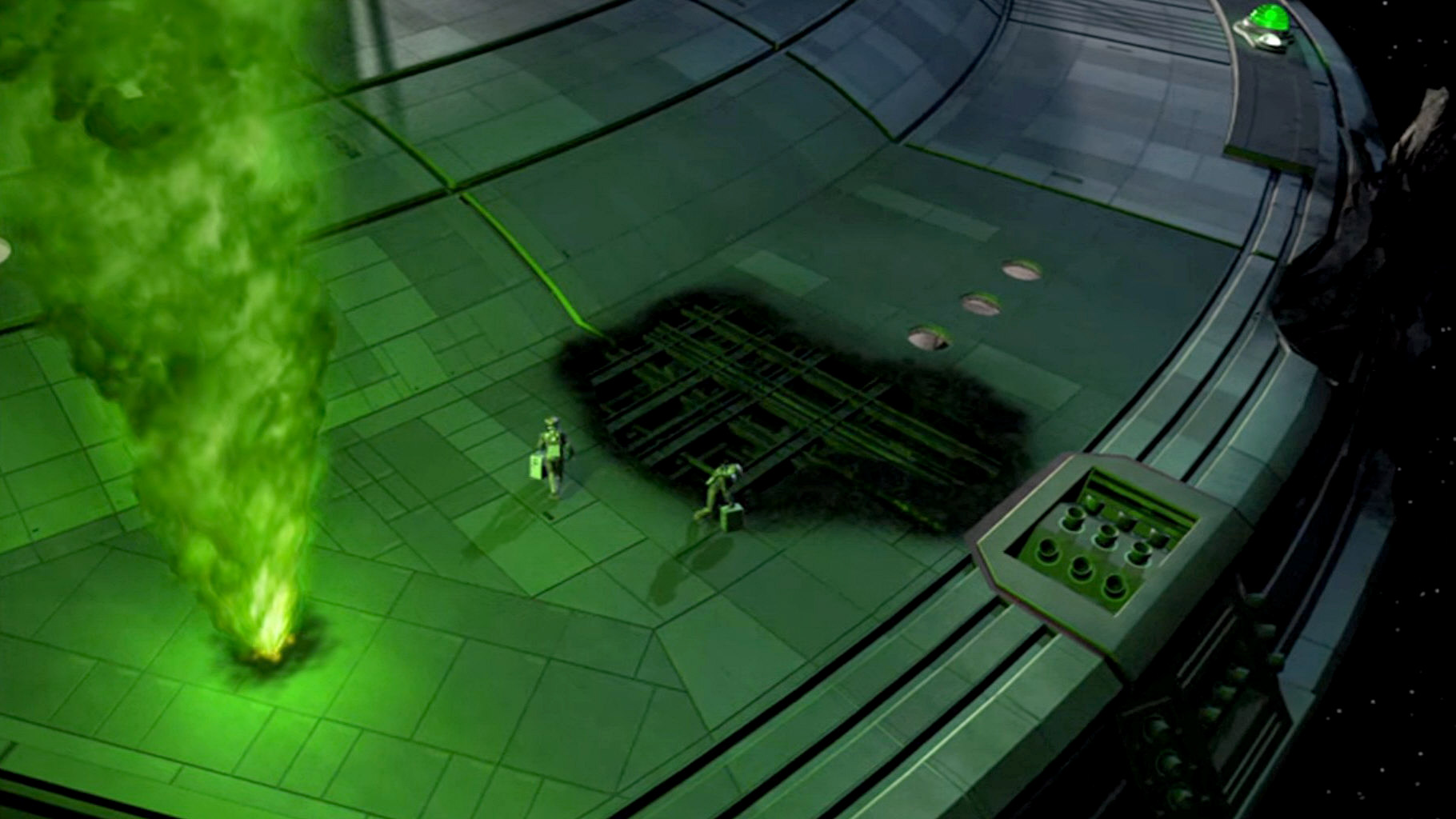
Date not given: The battered ship meets with Degra's vessel, who demands evidence for the secret activities of the Xindi-Reptilians and the Sphere Builders. In the meantime, Reed and Trip have to seal a ruptured plasma conduit that is dangerously close to the reactor. Archer has Trip write a letter to the parents of the dead female Crewman Taylor. Trip's grief about his sister's death resurfaces, and provokes hostile reactions to Degra. The Xindi-Primate, however, assists Enterprise by destroying a Xindi-Reptilian ship, and he suggests that Archer speak in front of the Xindi Council to make his point.
Review
"The Forgotten" is a bit like a toned down version of "Damage". I would even go as far as suggesting that I might forget about "Damage", where everything that happened had a negative impact, or none at all. I wouldn't miss anything if "Damage" had not existed, except it would have to be explained how Archer got back to the ship.
Having less of the "Now we're evil" feel, the new episode "The Forgotten" is clearly a tad more Trek-like again. Still, a good deal of it is again spent to show a fight and people keen on fighting. This new direction of Enterprise lately is where very different expectations and very different opinions of fans collide. There are the ones who want so far typical Trek stories where problems are solved with wit and wisdom, even if this appears unrealistic and makes the story overly figurative. On the other hand, there are those fans who enjoy keeping up the conflict and military action, just for the thrill of it. I don't deny that the latter can make for fine stories as well, but it's not what I want to see on a permanent basis.
I like Trip's hostile reaction to Degra, not because he is right about it but because it is very human. Only that I contest that it was required to "resurrect" his sister to that end and additionally trigger the sentiment with his thoughts about Crewman Taylor's death. The impression is created that Trip has completely forgotten (as the episode title says) about Lizzy all the time, which sheds a strange light on his emotional state, be it influenced in that direction by T'Pol's Vulcan neural pressure or not. As for Degra, probably nothing could really explain his swift change of mind, and the fact that he suddenly fights his own race, even if from his point of view Archer may be the lesser evil. But at least Degra's deliberation is a sign that there may be a consensus in the end - something that we honestly wouldn't expect to be achieved by Archer even if he gained the upper hand and could afford to be lenient.
The first thing that really annoys me in "The Forgotten" is the "interactive hallucination" of Crewman Taylor that appears in Trip's dream. "You're not real." How often have we heard this little sentence on Star Trek and especially on Enterprise lately (and to be fair, on other scifi or mystery shows likewise)? This contrived trick is what the writers routinely apply whenever they have no better idea how to bring emotions to the screen. As if dreams were in true color and widescreen format, and as if it were still exciting to wonder whether it's a dream or rather an alien shapeshifter, time travel, holodeck deception or something else along these lines. It's also a pity to use a talented actor like Connor Trinneer like that. At least he could make up for this failing in his other scenes. The closing scene with him reading the now final version of the letter to the Taylors is a more than worthy ending to an overall average episode.
Likewise, I don't care at all for T'Pol's difficulties to cope with her new emotions. As a matter of fact, we have seen her in so many similar situations before, which were always deemed totally new and absolutely exceptional, like in "Fusion" (mind meld), "Stigma" (illness), "Bounty" (Pon farr) and "Impulse" (Trellium-D). Neither Spock nor Data and not even Seven were exploited so often like that in such a short time. Now it's Trellium-D that she's been taking on purpose, but it can't really show us anything interesting except that Jolene Blalock is a good actress.
Finally, I don't like the flashback overkill. Not only does every recent episode have a recap, "The Forgotten" furthermore has Trip's already mentioned dream sequence about his sister and, in addition, Archer explains everything that has happened to Degra, which is done just too thoroughly through the fourth wall, as if infrequent viewers had to be kept updated in the first place.
Annotations
- Remarkable quote: "Have a seat. I have to use a hand scanner. The imaging chamber is still offline. Commander Tucker reassigned the repair team that was working here. He said the armory was a higher priority. You'll see how low a priority I am next time he burns his fingers on a plasma conduit." (Phlox)
- Crew losses: 18 (which may include Fuller from "Anomaly" and the dead crew member from "Chosen Realm", excluding Taylor who was not yet confirmed dead at that time)
Rating: 5
E²
Synopsis
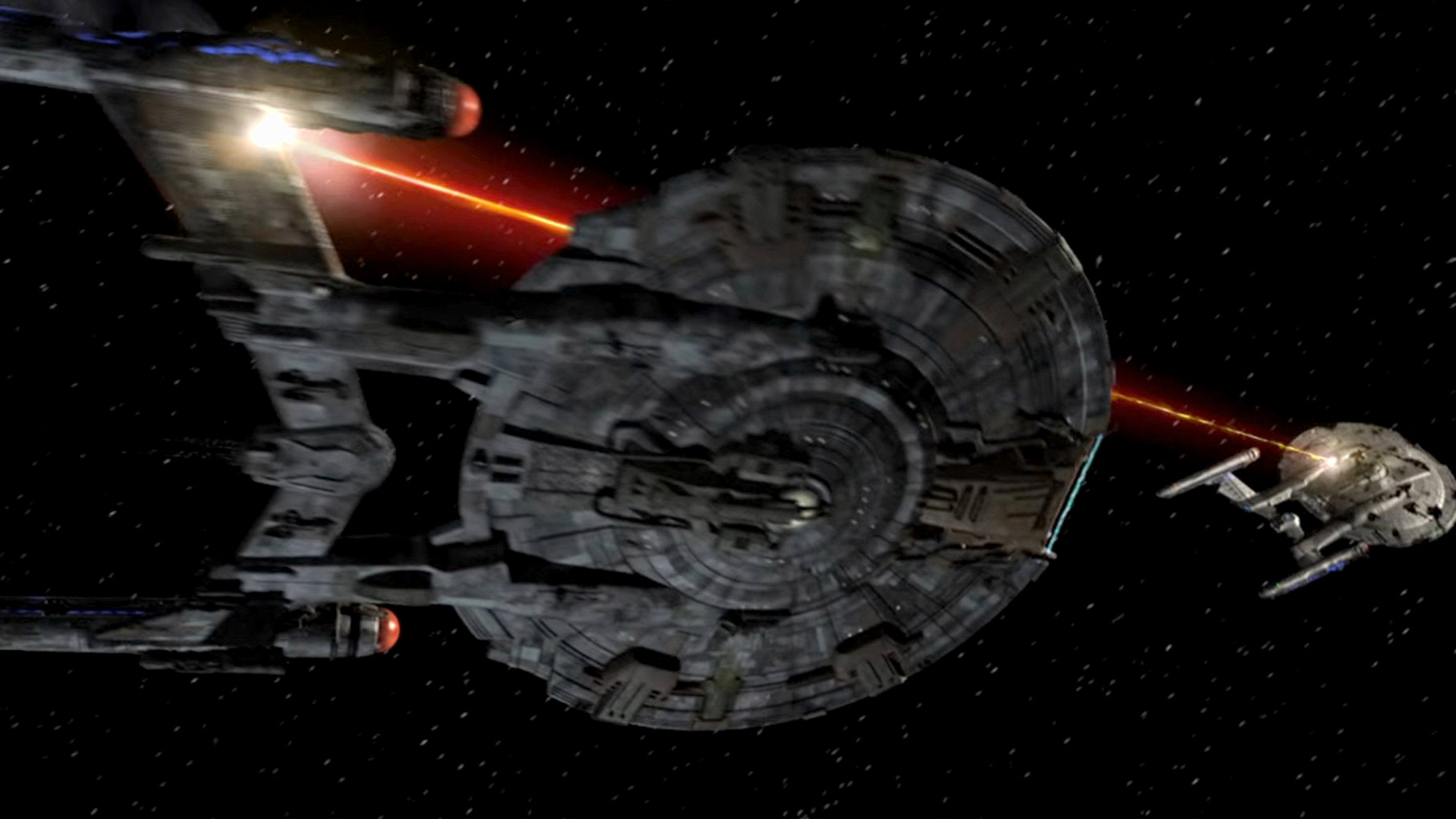
Date not given: Outside a subspace corridor that would be a shortcut to the meeting with Degra, the ship stumbles upon another Enterprise NX-01. This Enterprise 2 had been thrown 117 years into the past inside that corridor. The ship's crew, all descendants of the present Enterprise 1 crew, are determined to stop the Xindi. Captain Lorian, the son of T'Pol and Trip, proposes to modify Enterprise 1's engines to increase the ship's speed to Warp 6.9. But T'Pol 1 as well as T'Pol 2, who is still alive on E2, advise against it. Lorian feels guilty that he already failed to avert the first Xindi attack on Earth. He takes the chance, steals the warp injectors from E1 and attempts to escape with E2 to reach Degra in time. Archer has to stop Lorian by force. They come to a truce and join forces on their way through the corridor and the hostile Kovaalans waiting there, with modified impulse engines to avert the time travel. This time E1 leaves the corridor in the right time, but E2 stays behind. It remains unknown what happened to the second ship.
Review
It may have been an improper time for an accidental time travel (without Daniels or any future guys involved) at the climax of the story arc. Still, I like this episode. "E²" is basically a variant to the well-known theme from DS9: "Children of Time". We meet our descendants, and we learn what would be if we commit a certain error or avoid it, depending on the point of view. But "E²" is anything but a remake because the overall situation is very different here, as is the moral dilemma and even the logical implications of the time travel, which are discussed on a separate page.
Personally I appreciate that this time there is no sentimental argument along the lines "Look at these cute children. We have to sacrifice ourselves, otherwise they will never have existed". I found this twisted reasoning of the DS9 episode always sickening because it didn't work out at all logically, least of all as a justification for Sisko's decision to save the allegedly predestined future of the crew at the expense of their families and their free will. The elegant solution not to care about this question by making a mystery of the destiny of E2 seems to me like the correction of an old error.
I only wonder why not even Lorian or T'Pol 2, who would have had all the time to ponder about it, take into consideration the possibility that their ship might eventually vanish from time. And if they still don't expect anything like this, why don't they transfer at least their children to E1, if this ship is rather meant to survive in Archer's and Lorian's plan (we actually don't know, though)?
Aside from that, there is only one notable plot hole. What would Lorian have saved by only destroying the first probe when it was launched, without further "contaminating", as he expressed it, the timeline? Without him telling anything to the authorities on Earth, the Xindi would have had all time in the world to built another probe without meeting any resistance on their next attack. Moreover, isn't it likely that the crew of E2 with their technological and genetic cocktail contaminated the timelines of other species to the same extent as they would have done with Earth's?
The characters on E2 overall don't strike me as particularly interesting, they seem too "synthetic" to me, and only old T'Pol and Lorian are conceded more than a few lines anyway. Old T'Pol is just like we could expect her to be, a bit wiser, a bit more human. The only surprise is her strong affection for Archer, although she had been involved with Trip. Lorian, on the other hand, seems familiar to me from the beginning, and not primarily because his appearance is quite obviously similar to Trip's. When he ruthlessly went to steal the warp injectors from the other Enterprise exactly like Archer did in "Damage", it came to my mind that he was not only acting like Archer on this one occasion, but the whole time. His obsession to fulfill his mission, his remorse about not being determined enough, his pondering and hesitation, it was all as if he were rather Archer's son.
Interestingly, the battle with the two Enterprises, the alien ships and the anomaly bears a astonishing similarity to the one in TNG: "Yesterday's Enterprise". I could imagine that this is a quite intentional homage. Another thing is probably not meant as a homage, but rather a perpetuated misconception from Voyager: just make a few minor modifications to your warp engine, and it will go a lot faster with this "drive of the week". Fortunately the improved drive is neither used nor plays a major role anyway. But we need to wonder how much of the improved technology will stay on Enterprise.
Annotations
- Remarkable quote: "Are you suggesting that the other Enterprise never existed? If you're right, then why would we remember them?" (T'Pol)
- Remarkable facts: Enterprise 2 spent 117 years in the Expanse, preparing to stop the Xindi. They exchanged technology and also procreated with several different species. Dr. Phlox also found a way to combine the human and the Vulcan genome. Lorian is the son of Trip and T'Pol. He was 14 when his father died. The first officer is Karyn Archer, a great-granddaughter of Jonathan Archer. When everything failed to stop the first Xindi probe from being launched, there was still the chance to set a collision course. Lorian says that he hesitated because his emotions took over. E2's permanent presence may be the reason for the Xindi wanting to know how many other Earth ships are in the Expanse.
- Remarkable homage: NX-02, the ship under construction seen in "The Expanse", is going to be named Columbia.
Rating: 7
The Council
Synopsis
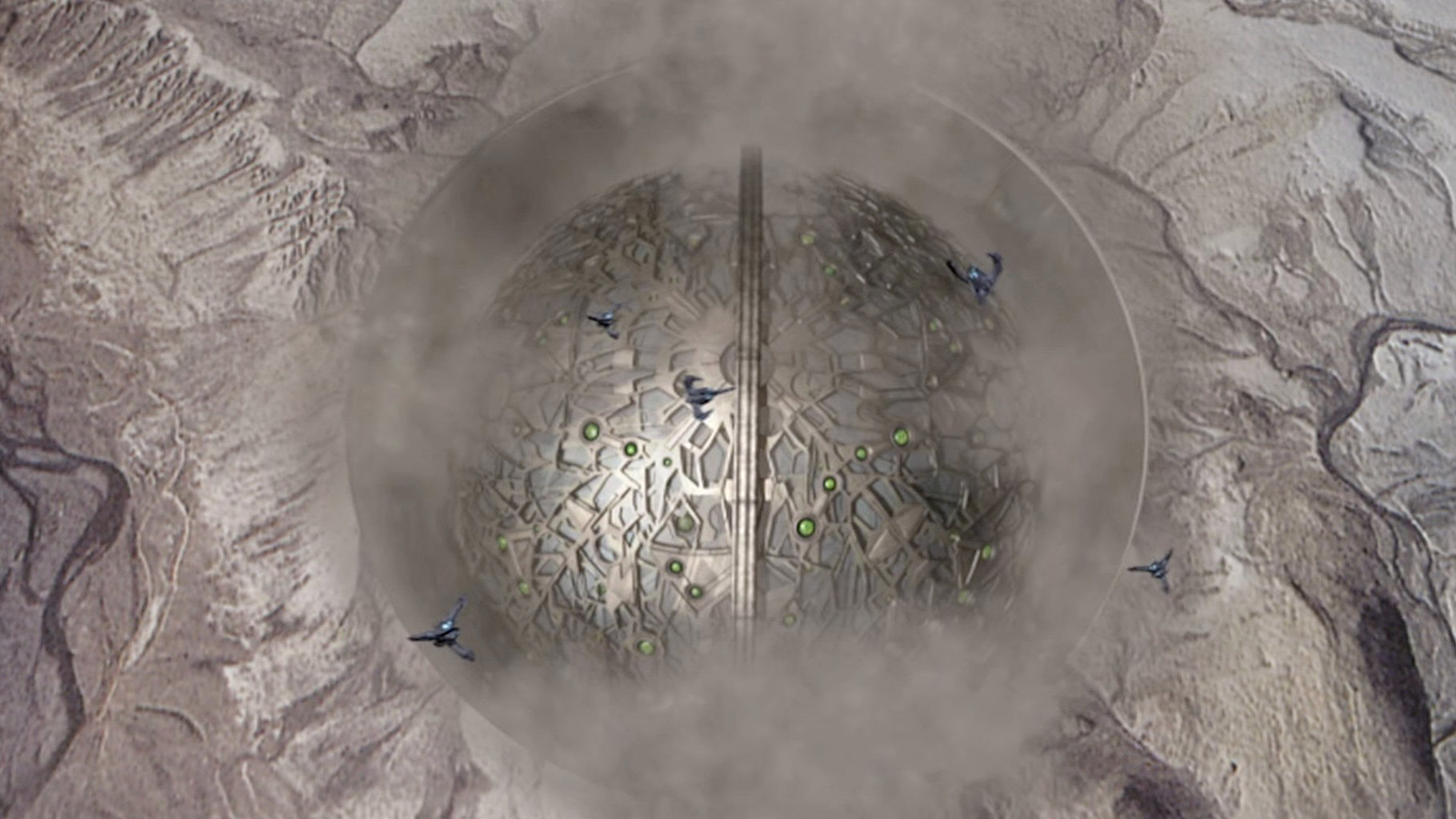
Date not given: While a team in a shuttlepod is examining the interior of a nearby sphere, Degra has finally arranged for Archer to speak at the Xindi Council. The Humanoids and Arboreals trust him, and the Aquatics are beginning to doubt the words of the Sphere Builders whom the Xindi call "Guardians". After a second meeting the Reptilians agree with postponing the weapon's launch. But this is only a ruse to gain time and get rid of Degra, who is killed by Reptilian leader Dolim. The Insectoids and Reptilians launch the weapon from beneath the planet's surface, but they would need another one of five codes to activate it. Enterprise, Primates and Arboreals engage the Insectoids and Reptilians, but these manage to escape with the weapon into a subspace vortex, after kidnapping Hoshi...
Review
Archer's much-anticipated appearance at the Xindi Council could have been more exciting. To me it seems a lot like a TV courtroom drama where amateur actors re-enact with exaggerated emotional behavior what has or would have been a dry presentation of evidence in reality. Archer already said everything of importance when he explained his point to Degra in "The Forgotten", and already at that occasion it was a mere recap of events. There wasn't really anything to add this time, and the swiftly made up "holographic evidence" of the Sphere Builder honestly looked much like the cheap deception the Insectoids thought it was. Maybe this impression of awkwardness in Archer's testimony is even appropriate for the situation, seeing how futile it lets his effort look. It is unfortunately not the time to convince anyone or even gain a new ally. At most he could say something like "Here I stand and pledge I'm not your enemy". But maybe it is just this attitude, rather than the debated evidence, that makes the Aquatics reconsider their position?
Archer has noticeably chilled out after his excessively violent and criminal outbursts in the past few episodes. On the other hand, this makes his character predictable and less interesting here. Hoshi and Phlox have a few nice scenes. But most of the again praise goes to Trip as a character. Trip's conflict with Degra resurfaces, but he manages to overcome it by just working with the Xindi-Primate for a while, which gives the episode some Trek-like moments. For a last time Degra can convince as someone who has changed his mind and is uncertain how to deal with his former enemies for whose welfare he feels responsible. It's quite the contrary with Dolim, who promises to the dying Degra, "I am going to find your wife and children...and do the same to them. Your traitorous bloodline will end at the tip of my blade." This is simply disgusting, but apparently what a true villain is expected to say, even in Star Trek.
Despite the obvious deficiency of mostly showing standard situations as we have seen them so often this season, this episode is extraordinarily exciting, maybe even more than "Azati Prime". I can't really tell why, but there is an impression of the story really moving on, even before the weapon is actually launched in the end. Degra's death and Hoshi's abduction contribute to this impression, as well as the superb visual effects. Above all the fight against the robot arm (a drone or robot being something very seldom used in Star Trek without a good reason) and the mountains of the Council planet were well-done. Only the visuals of the weapon launch seem a bit lacking, it looks too artificial and toy-like. The Sphere Builders are another disappointment. They remind me too much of Founders dressed as Borg Queens in a Bajoran Wormhole environment. They would have deserved something radically different from the familiar looks.
Annotations
- Remarkable homage: T'Pol quotes the old Vulcan saying, "The needs of the many outweigh the needs of the few."
- Crew losses: Reed speaks of 23 men and women lost so far on this mission, 1 in this episode (Corporal Hawkins).
Rating: 7
Countdown
Synopsis
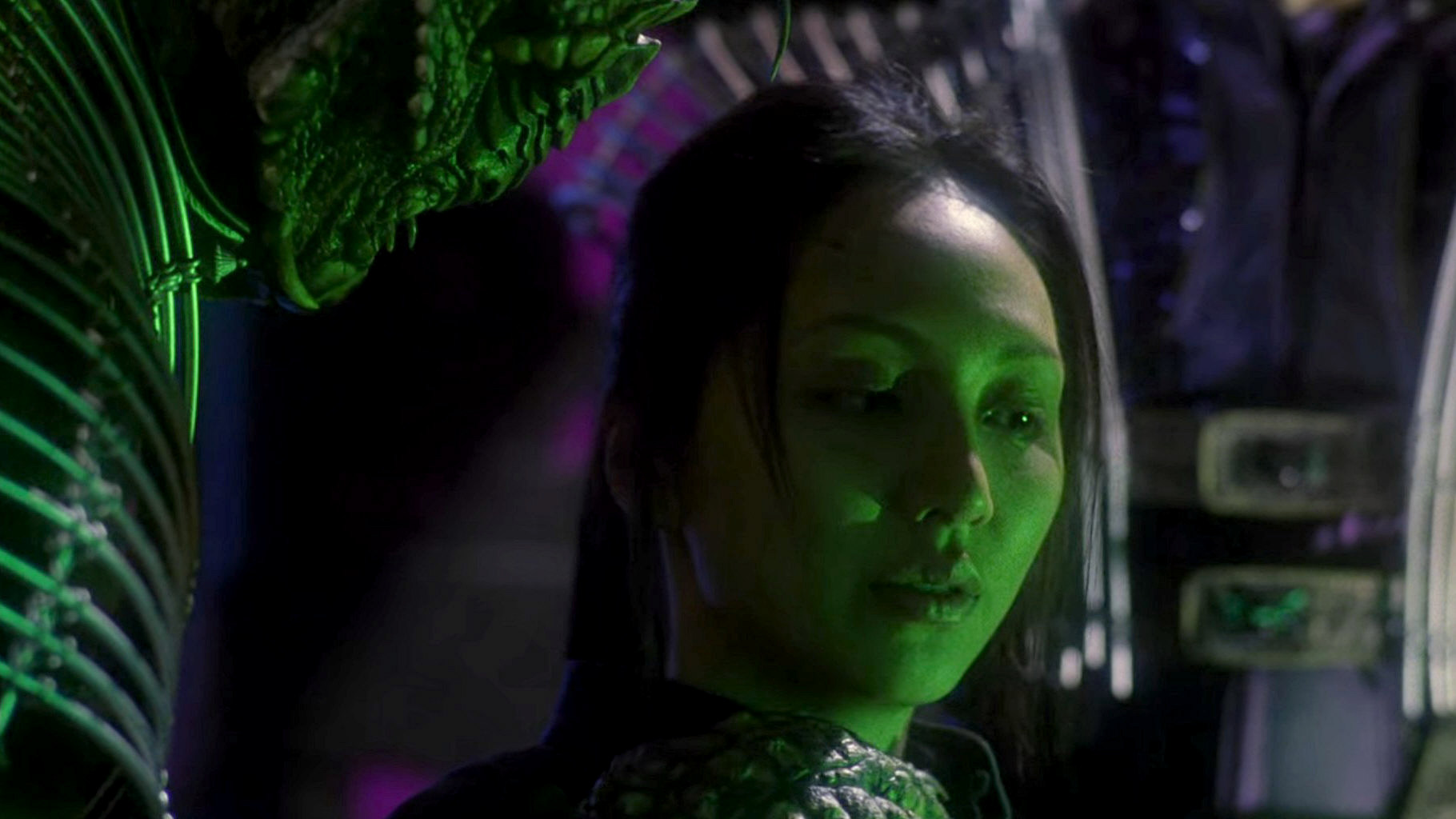
February 13th, 2154: Hoshi is supposed to crack the missing launch code of the weapon, for which purpose Dolim infects her with a neural parasite. While Trip and T'Pol are still analyzing the data gathered on the spheres, Archer meets with the Xindi-Aquatics and promises them he knows a way to disable the spheres, whereupon they agree to intercept the weapon. After her resistance has been broken, Hoshi decrypts the third launch code. A fleet of Aquatics, Primates, Arboreals and Enterprise enters a subspace vortex and runs another attack on the weapon. Hayes and his team free Hoshi, but he himself doesn't survive. The Sphere Builders interfere and create an anomaly that allows the Reptilians and Insectoids to escape with the weapon. But the Insectoid leader has become suspicious because the emerging anomaly was evidence for Archer's assertion - that the Guardians are actually the Sphere Builders. Dolim has the Insectoid ship destroyed. In the meantime, a team with Archer and Reed leaves Enterprise and switches to Degra's ship on a suicide mission to board and destroy the weapon.
Review
"Countdown" is the most thrilling installment of Enterprise so far. Even though I usually dislike episodes that pick up a cliffhanger only to close with another one, it was worth the venture this time, because "Countdown" turns out spectacular from the first to the last minute.
Much of that impression comes once again from fantastic visual effects. I'm generally skeptical about excessive use of VFX because they have often been used to distract the fans from boring writing. Here, however, the ships and probes (the CG characters of the Insectoids and Aquatics anyway) contribute to the story as if they were additional actors. Only the pathetic ploy not to mention that Enterprise was hiding inside the huge Aquatic vessel and suddenly open the gates was definitely dispensable. It was previously given away anyway because one could see through a window in the dining room that Enterprise was not in space.
There are a few touching and a few cruel scenes in the episode, but in neither direction it is taken too far. I am particularly glad that we can see relatively little of Hoshi's ordeal. With Major Hayes's death the series suffers another great loss after Degra. This is more evidence that the arc is supposed to end very soon. It is interesting to note that Hayes makes his peace with Reed before he dies, just like Trip and Degra. Well, it is already a cliché: Don't come to terms with a rival too quickly in a Trek series - you might not survive it. Back on the topic of visual effects that were more than just supporting, the destruction of the Xindi-Aquatic vessel is just as touching to me as the death of a "real" character.
A critical remark should be allowed, though. The final chapter of the Xindi arc in general and "Countdown" in particular lacks the complexity that has been part of all newer Star Trek incarnations. As opposed to the final chapter of DS9 (an obvious choice for a comparison), we notice that Enterprise has usually only two or at most three plot threads, and each of them is straightforward. The plot twists of the Xindi arc (at least until after "Countdown") are not necessarily predictable, but they all lie within the range of the military premise, meaning victory, stalemate or defeat. As explained earlier, it isn't boring at all and it doesn't strike me as overly militaristic either. Still, it is simplified Star Trek with a tendency to focus on action instead of more "cerebral" qualities.
A final remark: How much beatings can our brave ship still take? It isn't really in one piece anymore since "Azati Prime". Nonetheless, it has been in combat in all of the five following episodes. Without replicators, I wonder how any major system can still be kept operational.
Annotations
- Remarkable ship: We see the interior of the large weapon for the first time, and it is somehow reminiscent of a Death Star - yet skillfully modeled. The reactor core is a re-used Romulan mine from "Minefield"!
- Crew losses: at least 1 (Major Hayes)
Rating: 8
Zero Hour
Synopsis
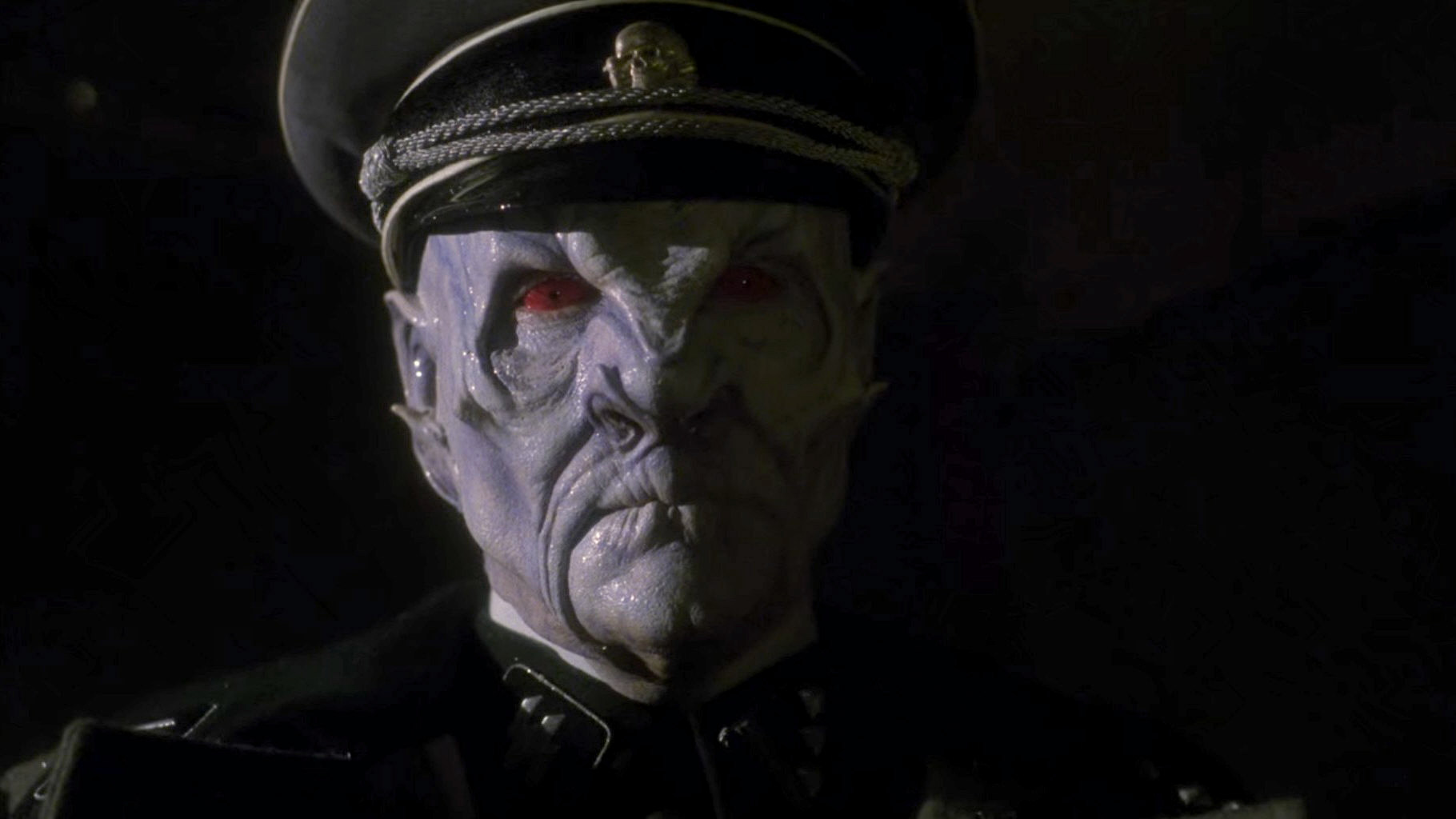
February 14th, 2154: The Xindi weapon and Dolim's ship exit the subspace conduit near Earth, pursued by Archer's team on Degra's ship. Another vessel arrives at high warp to aid them - it's Shran. Archer, Hoshi, Malcolm and the MACOs beam over and begin to disable the weapon. Meanwhile on Enterprise, the attempt to destroy Sphere 41 turns into a race against time, as the ship needs to enter the transdimensional realm for that and is boarded by the Sphere Builders. But the venture succeeds and the sphere network is obliterated. On the Xindi weapon, Archer sets the final sequence to destroy it, but is challenged by Dolim. The sphere explodes before he can be beamed out. When Enterprise arrives back at Earth, there is no sign of Starfleet Headquarters, but the shuttle of Trip and Travis is attacked by ancient U.S. Air Force fighters. Archer is alive and finds himself surrounded by ugly German Nazis - and an alien dressed as a Nazi...
Review
A writer needs an unusually bad instinct to wreck an otherwise decent episode in its very last second. B&B may have thought that it was about time to revive the tradition of the Nazi fetish in Star Trek. Although I was prepared for the ending thanks to the inevitable spoilers conveyed to me, I was still shocked to see the alien in the SS uniform. The setting of TOS: "Patterns of Force" of 1968 was absurd enough, but may be still excused as a one-time mishap. Ironically this first and rather naive take on the Nazi issue was the only one with a clear statement against totalitarianism and racial hatred. Moreover, only some 20 years after WW II and with most veterans still alive it was understandable that Star Trek would come up with a Nazi episode, something that other US TV shows had too. In 1997, Brannon Braga opened a new chapter of the Space Nazi arc with VOY: "The Killing Game", the Hirogen travesty show. No doubt this installment was better written and executed than the cluttered TOS episode. But looking back, I must say that my criticism was extremely restrained in 1997, although on Voyager the Nazi theme served as nothing more but a platform for action and violence, the reflection about which came much too rashly in the very end.
Now it is 2004, and we get yet another installment of alien Nazis. I can already hear the protests about me being picky. Yes, it's only three episodes out of 600, but that's three too many. This abomination of an episode cliffhanger needs to be continued along the same lines and will go on for at least another 45 minutes. How often does Hollywood still want to defeat Germany? How bizarre does a setting have to be that an author couldn't throw in a few Nazis? How far can falsification of history go? Someone who includes a Nazi in a sci-fi show for an extra thrill should think of going the whole way and turning him into a naked alien Nazi domina with high boots and a whip. But American television has a well-working censorship for many things and above all for everything related to sex. On the other hand, the vilification of a foreign nation and the implicit desecration of the victims of the Holocaust just for the fun of it are deemed acceptable. It's sickening that something like this is possible and that it does not entail serious protests. Shame on you, Mr. Berman! Shame on you, Mr. Braga!
This is the place for my view on the issue and not a place for discussion. Still, I will try to anticipate a few objections. I am German. As opposed to apparently the vast majority of US citizens and in accordance with most of my fellow countrymen I'm not proud of my country. But I feel like defending us where we are being treated with unjustified contempt. Where is Germany in Star Trek? Aside from extremely rare casual references there has never been anyone or anything German on Star Trek. Well, with the striking exception of those three Nazi episodes (and an upcoming fourth one). So is it that we should feel honored to be featured more often than other nations that have no place in an all-American Trek universe? Germany has a recorded history more than four times as long as the USA, it has been the home to countless world-famous philosophers, authors, composers, inventors or physicists. Reducing all this to the twelve years of one barbarian regime completely misses the mark. It was a long enough way to overcome the years of 1933-1945 that had brought insufferable pain upon Europe. Germany is grateful for the support that it has received to recover after the war, in spite of the German war crimes that were naturally present in the minds of the former enemies. Today Germany is a country with people of all flavors who want to and who have a right to live their lives in peace and without being treated as if they were all latent criminals.
But some wartime traditions last much longer than they can be helpful, and the anti-German propaganda of Hollywood is among them. It doesn't seem to matter that present-day Germany has a toothless self-defense army and is scorned for its cowardice not to boldly follow Uncle Sam into the Iraq War. On the contrary, some people in the U.S. seem to be out to disparage our for whatever reason. I may be over-sensitive and biased in this particular respect, but I can't help the impression that old (Nazis) and new (Old Europe) preconceptions about Germany stimulate each other. It would go too far to assert that exactly this, jumping on the bandwagon, was B&B's motivation. But there is a proven recipe "Need villains - take Germans" in Hollywood (with Japanese and Arabs being temporary "rivals" for the top position of Hollywood's Most Hated). The German movie villain stereotype has been consistent and self-sustaining in Hollywood as long as since the early years of WW I (One!), when the US Government funded anti-German propaganda movies to prepare their citizens, many of them of German descent, for a crusade against Evil Germany.
Specific animosities aside, Hollywood's goal to entertain at all cost is another aspect of the problem. There is no doubt that every entertainment industry in any country does not mind aiming at the lowest instincts of their audience, be it with porn, with dreadful reality shows or with poking fun at certain social groups or nations. The televised trash polarizes at best, but at worst it offends groups that often don't can defend themselves against it, at least if they don't fall under the protection of "political correctness". Even a revered director like Spielberg couldn't help resorting to stereotypically dull Movie Nazis and Germans in his "Indiana Jones" movies and the TV series. But he made up his mind and, besides his work with the Shoah Foundation, created "Schindler's List", a remarkable history lesson against the tendency to forget, a testimonial of humanity amidst an inhumane regime. (I have mixed emotions about "Saving Private Ryan", which is still too much of the against-all-odds American Hero drama to me, although it doesn't fail to condemn war.) It would be arrogant of me to demand that 45 minutes of Star Trek could or should only try to accomplish the same as "Schindler's List". But where it is not possible to show the horror of war and genocide with the due decency, it should not be attempted at all. It must remain our goal to remember what atrocities human beings were capable of doing and may do again if we are not aware of the beginnings - not just in Germany. The absurdity of aliens cross-dressing as Nazis is anything but helpful.
I didn't completely focus my attention on that alien Nazi, I actually watched the whole episode. There are a couple of good ideas in the story. Such as the Reptilians who each eat a mouse (a mammal) in their opening scene, which may be easily taken as a symbol for the imminent destruction of the human homeworld. The nifty scene featuring the foundation of the Federation with Archer playing an important role is a bit out of place, still I like it. I also like how the transdimensional beings tamper with Enterprise's systems by just penetrating them with their hands. On the downside, the episode is full of already overextended clichés, like the dull twist with the skin damage and a slight variant of the inoculation against radiation (the neuroleptic compound), like the modulation of the weapon frequency to be able to hit the enemy, like the inevitable battle of Good vs. Evil on a dying ship. But most of all I am annoyed that once again a distributed system is physically destroyed in a chain reaction, (like Earth's power system, the Hirogen comm network, the Borg transwarp conduits). Should we be worried about the internet?
Overall, this is a decent action episode that resolves the Xindi arc to my satisfaction. Perhaps, if I rewatch it in a couple of years, I will be more forgiving regarding the alien Nazi.
Annotations
- Remarkable quote: "Go! And tell Archer we're not even anymore. He owes me." (Shran)
- Remarkable facts:
- The United Federation of Planets is founded in 2161, with humans, Vulcans, Andorians and Tellarites being the founding members. Until this episode, this was generally accepted but never actually mentioned in canon.
- T'Pol is 65 years old.
Rating: 3