The Next Generation (TNG) Season 2 Reviews
Season 1Season 2Season 3Season 4Season 5Season 6Season 7
The ChildWhere Silence Has LeaseElementary, Dear DataThe Outrageous OkonaThe Schizoid Man
Loud as a WhisperUnnatural SelectionA Matter of HonorThe Measure of a ManThe Dauphin
ContagionThe RoyaleTime SquaredThe Icarus FactorPen PalsQ WhoSamaritan Snare
Up the Long LadderManhuntThe EmissaryPeak PerformanceShades of Gray
The Child
Synopsis
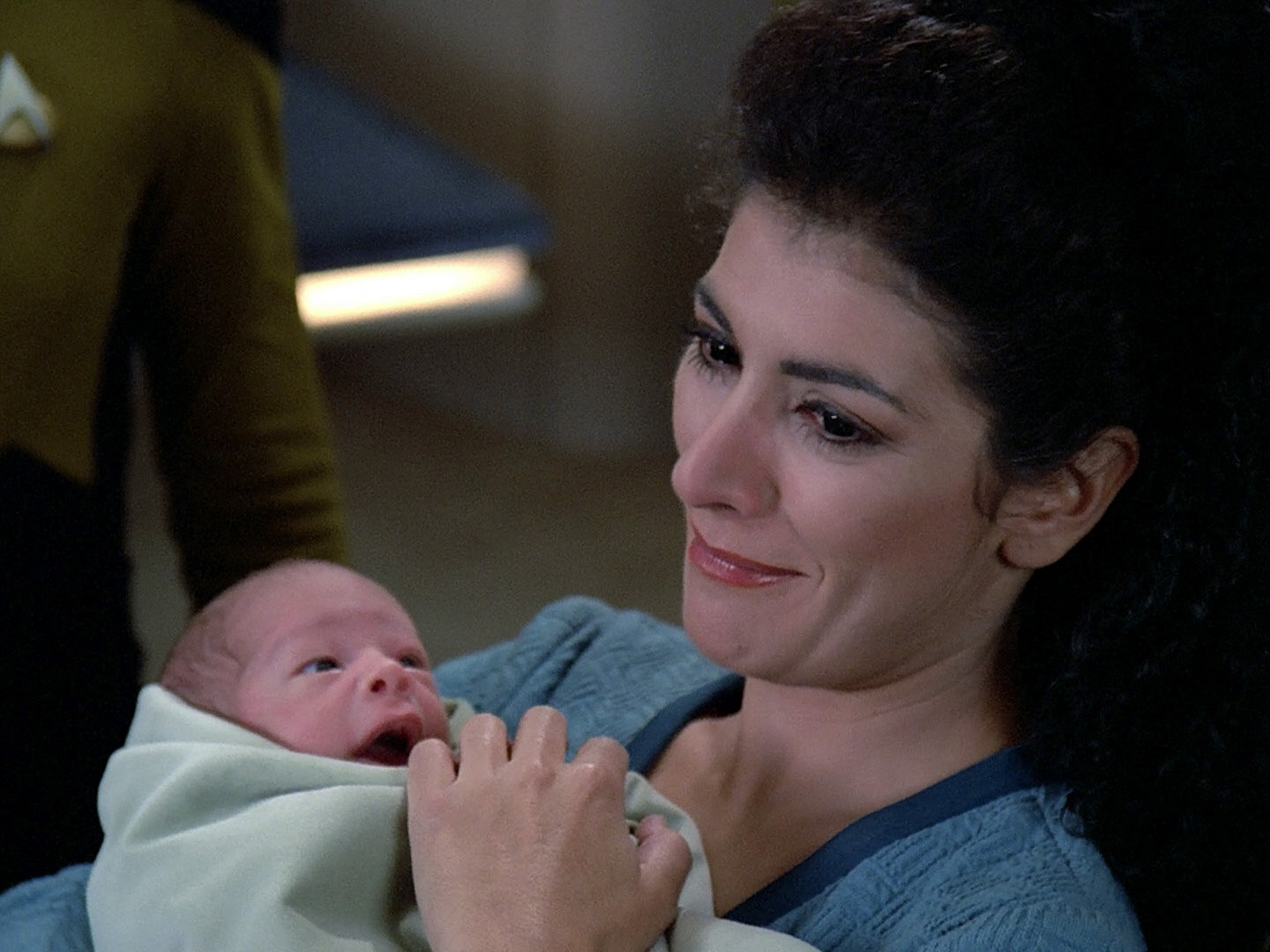
Stardate 42073.1: The new chief medical officer, Dr. Katherine Pulaski, assumes her position, and Geordi La Forge is promoted to chief engineer. While the Enterprise is ferrying samples of a deadly plasma virus to a research station, Deanna is impregnated by an alien lifeform during her sleep. To Dr. Pulaski's surprise the embryo grows at an incredibly fast rate. After only 36 hours Deanna gives birth to a boy whom she names Ian Andrew after her late father. The boy continues to grow rapidly and begins to talk, but does not yet reveal his origin and the purpose of his visit. Meanwhile some virus samples begin to grow and a breach of the containment module is imminent. Ian recognizes that his presence is the reason for the impending disaster, so he decides to end his existence as a human being. His intention was to experience birth, life and death of humanoids.
Review
Season 2 brings several changes for the crew, of which the most significant is Beverly Crusher's sudden departure. Gates McFadden purportedly left the series for much the same reasons as Denise Crosby, because she was not content with the development of her character. Star Trek veteran Diana Muldaur (TOS: "Return to Tomorrow", "Is There in Truth No Beauty?") takes her place as the ship's CMO, in the role of Dr. Katherine Pulaski. Although Pulaski is embedded into the story just as well as Crusher would have been, there are some hints that Pulaski is a character that is in some ways contrary to the modern and open-minded woman that is Beverly Crusher. Most notably Pulaski is reluctant to accept Data as a lifeform; she speaks of him as the "cold hand of technology" and she doesn't mind pronouncing his name correctly (calling him "Dah-ta" instead of "Day-ta"). Her quibbling with Data will continue in future episodes. Overall, Pulaski is not the type of character that is easily integrated, that may become part of the "family". Perhaps that is the reason why Diana Muldaur doesn't appear in the opening credits but is credited with "Special Appearance"?
Regarding the story, "The Child" (like the fourth-season episode "Devil's Due" too) was originally written for Star Trek Phase II, the never produced TOS sequel of the 1970s. In the original story Ilia would have been the woman that was impregnated by the alien lifeform. The story works very well with Deanna too. Well, Deanna was the obvious choice because she was the only woman left amongst the main cast, because the emotional story becomes her and because she could use overall some more involvement and development. In any case "The Child" is an emotionally strong and somewhat exciting episode with very strong acting and directing. It isn't let down by the cookie-cutter B-plot about the plague, although I would have wished to see a bit more of Ian Andrew Troi growing up and less of the rather uninteresting efforts to contain the dangerous specimens.
The episode also has some superb visual effects. At the beginning there is a great shot of a Type-7 shuttle leaving the shuttlebay. Picard has a holographic display on his desk much like the one in "The Last Outpost". There are various new shots of the Enterprise in space and in orbit from various angles. The new Ten Forward set is shown from the outside, as Wesley is staring out of the window. And we see the ship go to warp from inside Ten Forward, as Wesley in standing at the window with Guinan.
My impression is that the score of "The Child" marks a new direction in TNG. It is less "spacey" and more symphonic than in the first season, and overall less like in TOS. I like the music very much (for which the episode was nominated for an Emmy Award).
Annotations
- Nitpicking:
- Pulaski is surprised that Ian Andrew put his finger into the hot soup: "He allowed himself to be burned." Picard states: "For the experience." But isn't this try-and-error approach exactly how normal children get to know their environment too?
- When the specimens begin to grow, why can't they jettison the module as Riker suggests? Dealt says "It will go into a spore and remain until it comes in contact with a planet or another ship." But how slim is that chance if they do it in open space? And once jettisoned, it would be possible to destroy the container with a phaser blast.
- Remarkable dialogue: "And who will tuck him in at night?" - "Come on, Commander." - "I will accept that responsibility." (Riker, Wesley, Worf)
- Remarkable scene: The meeting in the observation lounge to discuss Troi's pregnancy is a highlight of the episode. It is telling how Deanna takes a seat at the far end of the table, leaving one chair empty between herself and Riker. Then Picard, Riker, Data, Worf and Pulaski discuss whether the embryo shouldn't be aborted, without asking Deanna. We listen to this debate through Deanna's ears (actually, through a low-pass filter with added noise that makes it sound remote).
- Remarkable in-joke: Data mentions cyanoacrylates as a possible source of Eichner radiation. Cyanoacrylates are the main components of instant glues.
- Remarkable changes:
- Some time prior to this episode, following his temporary assignment after Tasha Yar's death, Worf became head of the security department. He accordingly switched to the yellow uniform of the operations division and wears a silver baldric for the first time.
- Geordi La Forge is promoted to lieutenant and becomes the ship's chief engineer, which is only logical considering how often Geordi tended to engineering in the first season, apparently whenever the chief engineer of the week was off duty. Geordi too wears a yellow uniform now.
- Wesley is wearing his gray "acting ensign" uniform for the first time. At the end of the episode Picard allows him to stay on the Enterprise and he becomes the ship's regular conn officer.
- This episode marks Guinan's first appearance.
- It is the first time that we see Riker with a beard (that he would eventually shave off in "Star Trek: Insurrection").
- We can see Ten Forward for the first time. This is the most notable of several set modifications.
- Remarkable facts:
- The normal gestation period for a Betazoid is ten months.
- Deanna names her son after her late father, Ian Andrew Troi.
Rating: 7
Where Silence Has Lease
Synopsis
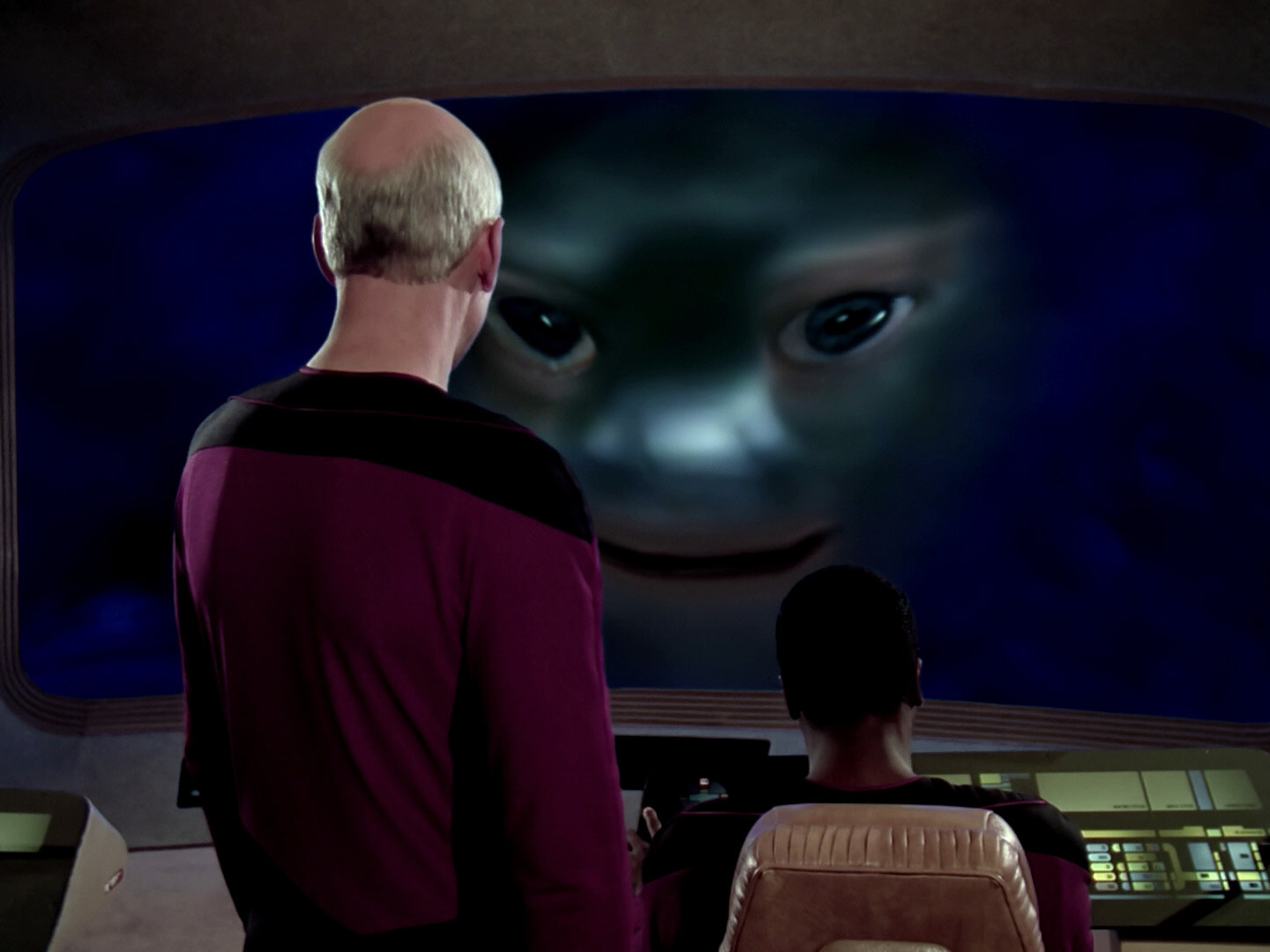
Stardate 42193.6: In an unexplored region of space the Enterprise approaches a "hole in space" and becomes trapped within the phenomenon. A Romulan Warbird attacks, but turns out to be an illusion. Then the Enterprise's sister ship USS Yamato appears. Riker and Worf beam over, to find that it too is an illusion. The whole scenario is part of a plan of an alien named Nagilum, who wants to study human reactions to death. When Nagilum kills a crew member and announces that half of the crew will die in further experiments, Picard orders the ship's self-destruct. He calls off the procedure in the last seconds of the countdown. Nagilum appears again, stating that it has learned enough by just watching the crew's preparations to die, and releases the ship.
Review
The first half of "Where Silence Has Lease" is quite enjoyable, although it heavily relies on some TOS clichés. In Worf's fight scenario on the holodeck we have a setup, choreography, opponents and a background music that are conspicuously like in TOS, a clear homage if you ask me. The appearance of the false Yamato is reminiscent of the Defiant in TOS: "The Tholian Web", the ship even begins to dissolve while the away team is still there in a very similar fashion. And it isn't exactly the first time either that an Enterprise is caught in some "hole in space", although Data states nothing remotely similar has ever been recorded. Anyway, overall the TOS references don't detract from the pleasure to watch how the crew deals with their unusual and unusually illogical situation.
Nagilum doesn't appear until well into the second half of the episode and rather comes as a disappointment. The storyline of a self-righteous alien being that turns the crew into guinea pigs only to confirm its own superiority is anything but new. We have seen various slight variations of such plots in TOS. Lately in TNG Q has put a fresh spin on this old idea by giving it a somewhat humorous direction. In this regard the sobriety and inflexibility of Nagilum is like a setback. The tests it sets up for the crew are still creative as already mentioned, but Nagilum's attempts to get Picard to cancel the self-destruct are almost pitiful. Well, this gives rise to Picard's surreal discussion of death with a false Data and a false Troi, one of the best scenes of the episode.
Anyway, while Nagilum may believe a superior entity does not have to justify anything to primitive lifeforms, the bit of reasoning that it puts forth is quite poor. Nagilum tells Picard something like "You are selfish, aggressive, militant, yadda, yadda, yadda..." And all this comes from an entity that killed a crewman out of a questionable scientific curiosity (or pure sadism?), and that would likely have killed more. Q customarily voices much the same accusations; on the other hand he also gives the crew the chance to make choices, to prove their worthiness, to evolve eventually. I can understand very well that in the end Picard is not interested in further debates with Nagilum, whose absolute power has obviously absolutely corrupted it. Overall Nagilum is very uninteresting as an opponent, and I too would have refused to talk to it under such preconditions.
Regarding the characters, this is the second time that we get some insight into Worf's Klingon side - for some reason Worf often has the semblance of a hybrid, although he is full Klingon, genetically speaking. Worf is in a bloodlust in his fighting program, he almost attacks Commander Riker and seems to recover only slowly from this condition. For much of the rest of the episode it looks like he retains some of his fierceness and perhaps dumbness too. Back on the Enterprise, Worf makes useless proposals to attack the anomaly and then hesitantly speaks to Picard about a Klingon legend of a hole in space. Later, on the illogically convoluted bridge of the false Yamato, he doesn't manage to restrain himself either. It appears that later in TNG and DS9 Worf will become overall more composed, although in a battle he is always all Klingon.
Annotations
- Remarkable dialogues:
- "Yes, well, there are minor differences. I'm what we call a female." - "I understand. The masculine and the feminine." - "It is the way in which we propagate our species." - "Please, demonstrate how this is accomplished." (Pulaski, Nagilum, Picard)
- "...Destroy the Enterprise." - "Isn't that a little like curing the disease by killing the patient?" - "It's better than standing around helplessly." - "Why do get the feeling this was not the time to join this ship?" (Picard and Pulaski)
- "Abort auto-destruct sequence." - "Riker, William T. - Do you concur?" - "Yes! Absolutely! I do indeed concur wholeheartedly!" (Picard, Computer, Riker)
- Remarkable facts:
- The Yamato, another Galaxy-class ship, has the registry NCC-1305-E. At least that's what Riker reads. The registry will be retconned for "Contagion".
- The walls of Federation ships are made of tritanium.
- Crew death: Ensign Haskell is killed by Nagilum.
Rating: 4
Elementary, Dear Data
Synopsis
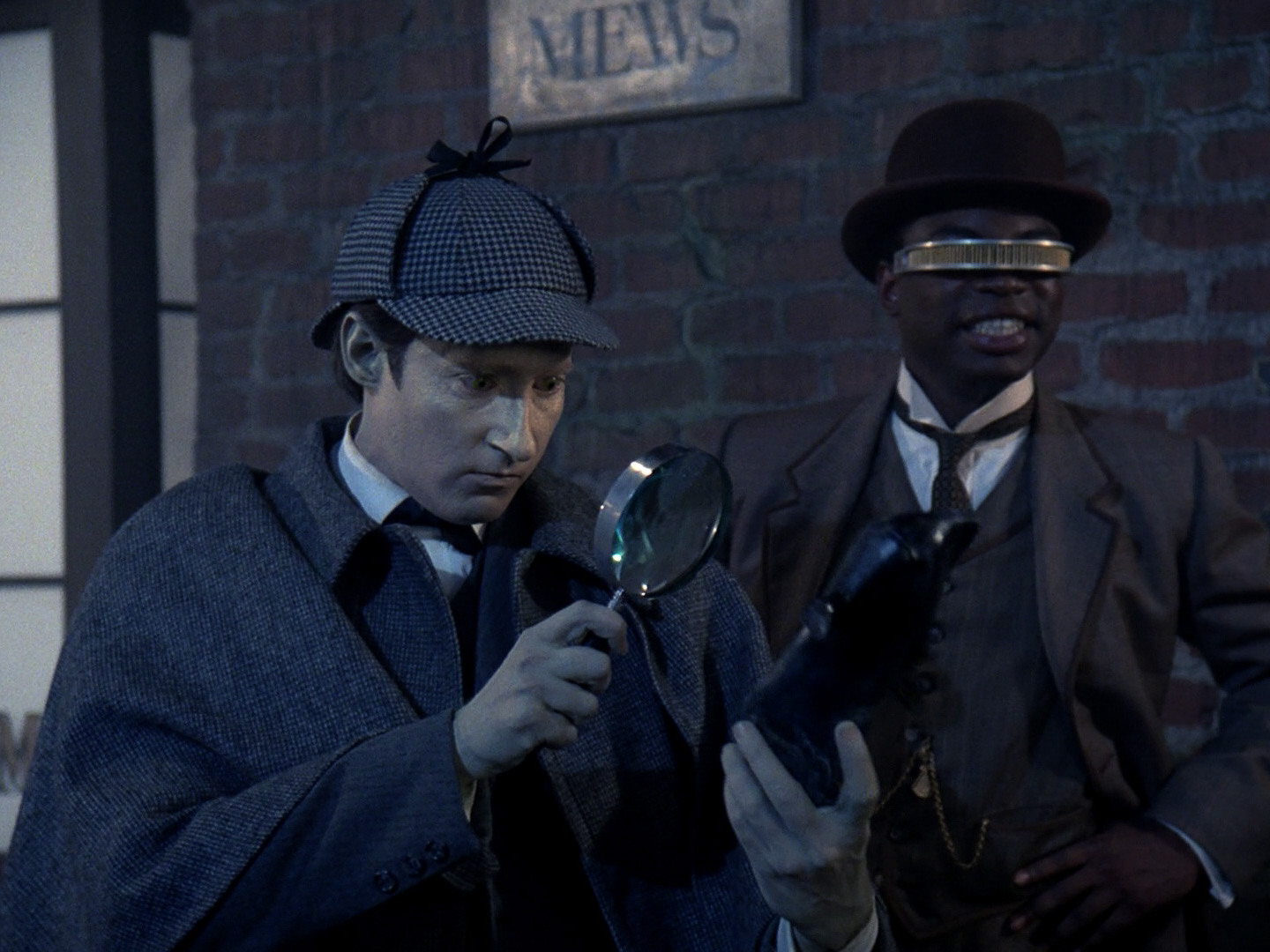
Stardate 42286.3: Data and Geordi are playing in a Sherlock Holmes simulation on the holodeck. Geordi, however, quits when Data solves a case immediately because he knows the novel, instead of applying logic. Dr. Pulaski challenges Data by creating a new Holmes-type story, but being just a combination of two novels, Data quickly solves this one too. Then Geordi has the computer create an opponent as a match for Data. Unbeknownst to anyone, the computer gives this opponent, Dr. Moriarty, self-awareness as well as access to the holodeck controls, so he would be able to beat Data as requested. Moriarty kidnaps Pulaski and even gets his hands on the Enterprise's attitude control. Geordi prepares a particle beam that would destroy every holographic creation but also Dr. Pulaski. Picard resolves the situation when he explains to Moriarty that he is only a computer program and that he won't be able to leave the holodeck. Before Moriarty is stored, Picard agrees to reactivate him once a method to convert him to a corporeal form is found.
Review
"Elementary, Dear Data" is clearly a follow-up to Data's discovery of Sherlock Holmes stories in "Lonely Among Us", but is apparently primarily inspired by "The Big Goodbye", where Picard lived his holodeck dream just as Data does here. I think that "Elementary, Dear Data" doesn't quite live up to the latter original. I like the very idea of a holodeck character becoming self-aware, something that would happen almost routinely on Voyager and that still has the air of being something unprecedented here. I would have wished for this phenomenon to be explained and its possible implications to be commented on, but I may have expected too much from an episode that thrives rather on the charm of 19th century London than on scientific or ethical issues.
Speaking of ethical issues, I am pleased that Professor Moriarty doesn't become a monster once he gains self-awareness and all kinds of miraculous powers when he talks to "Mr. Computer". Considering that he is Sherlock Holmes's mortal enemy in the novels of Sir Arthur Conan Doyle, the obvious ending may have been a big showdown, in the course of which the holographic Moriarty gets destroyed in a big photon burst, just as Geordi suggested. Actually, my idea of how "Elementary, Dear Data" could have ended almost hits the nail, as I will elaborate further down. Anyway, the way he appears in this episode Professor Moriarty, TNG-style, is a pleasantly atypical villain who isn't spoiled by all his power and who remains open to reason. Rather than plotting evil plans, he just strives to explore the new universe that he is suddenly aware of. And while the actual ending isn't very exciting, it suits the decent tone of the episode and of its villain.
I'm a bit disappointed about Data's role in this episode, although he is the eponymous hero. As strange as it may sound, I don't think we even hear and see very much of Data here. My impression is that much of the time people such as most notably La Forge and Pulaski are talking about him rather than with him. Also, Data's involvement in the story inside the story is overall too formulaic. Being an android, Data's impersonation of Sherlock Holmes is so much to the point that the viewer's association "Here is an android from the 24th century playing a fictional character on ancient Earth" is lost. Well, kudos to Brent Spiner's performance as Data as Sherlock Holmes, but I think it is at the episode's disservice. But my main gripe with Data is that he remains too passive in the end. I would have hoped for him to clean up the mess for which he may not be personally responsible but which was created in his name after all. It is a letdown that Picard appeases Moriarty single-handedly.
Well, and speaking of this disappointment I was somehow always aware that the ending is anticlimactic. Where is the customary moral commentary or the punchline, where is the unexpected twist? "Elementary, Dear Data" ends with everyone walking out of the holodeck and with an epilogue in which Picard admires Geordi's model ship. That's it. Something is missing.
There is indeed something missing. The script underwent some major changes. I talked to Brian Alan Lane, who wrote the episode. According to the original script, Geordi would have activated the particle beam, thereby killing Moriarty and Picard in a similar fashion as in the The Final Problem (where Sherlock Holmes and Moriarty appear to have died in the Reichenbach Falls). But Picard secretly snuck in a hologram of himself that was destroyed together with Moriarty. Apparently there was a misunderstanding between Maurice Hurley and Gene Roddenberry about whether Picard would cheat Moriarty like this. So Lane was required to rewrite the script in a way that Data would take Picard's place and survive the particle beam, while Moriarty would still perish, with the rather lame justification that the android could somehow withstand the beam that would dissolve a human body. Anyway, briefly prior to the shooting it was decided that Moriarty should survive the episode to preserve his character for a future installment, so the showdown was replaced with Picard's successful appeasement of Moriarty. In some fashion the plot was split in two, postponing the part in which Moriarty would be tricked. In the sequel, "Ship in a Bottle" Picard will deceive Moriarty in a similar fashion as originally intended in "Elementary, Dear Data", but without killing him.
Annotations
- Continuity: Data is an accomplished violinist. He will play the violin in "Sarek" and "Tin Man" too.
- Nitpicking: A small piece of dialogue too was omitted from the episode. It would have commented on the sheet of paper (with Moriarty's drawing of the Enterprise) that continued to exist outside the holodeck. If it was possible for the paper, Moriarty should be able to leave the holodeck as well, but Picard neglected to mention that in the aired version. Had the dialogue been included, we could conclude that for some reason and in some fashion the computer created Moriarty as a permanent character and not as the usual "holomatter" creations such as the mobsters in "The Big Goodbye". In "Ship in a Bottle", however, it will become clear that Moriarty is really not able to leave the holodeck. So the ultimate explanation is that the sheet of paper was replicated, while characters (such as Voyager's EMH too) are generally holographic projections that can't exist without projectors.
- Remarkable set: 19th century London was built entirely in the studio, arguably one of the most extensive indoor sets of TNG.
- Remarkable ship: We can see Geordi's wonderfully detailed model of the H.M.S. Victory, as well as the USS Victory, Constellation class.
- Remarkable fact: Usually a "mortality failsafe" prevents the holodeck from creating something dangerous. This is obviously the same as the later "safety protocols". It fails for the second time after "The Big Goodbye" when a real bullet was created, albeit yet without a conclusive explanation how this was possible.
Rating: 5
The Outrageous Okona
Synopsis
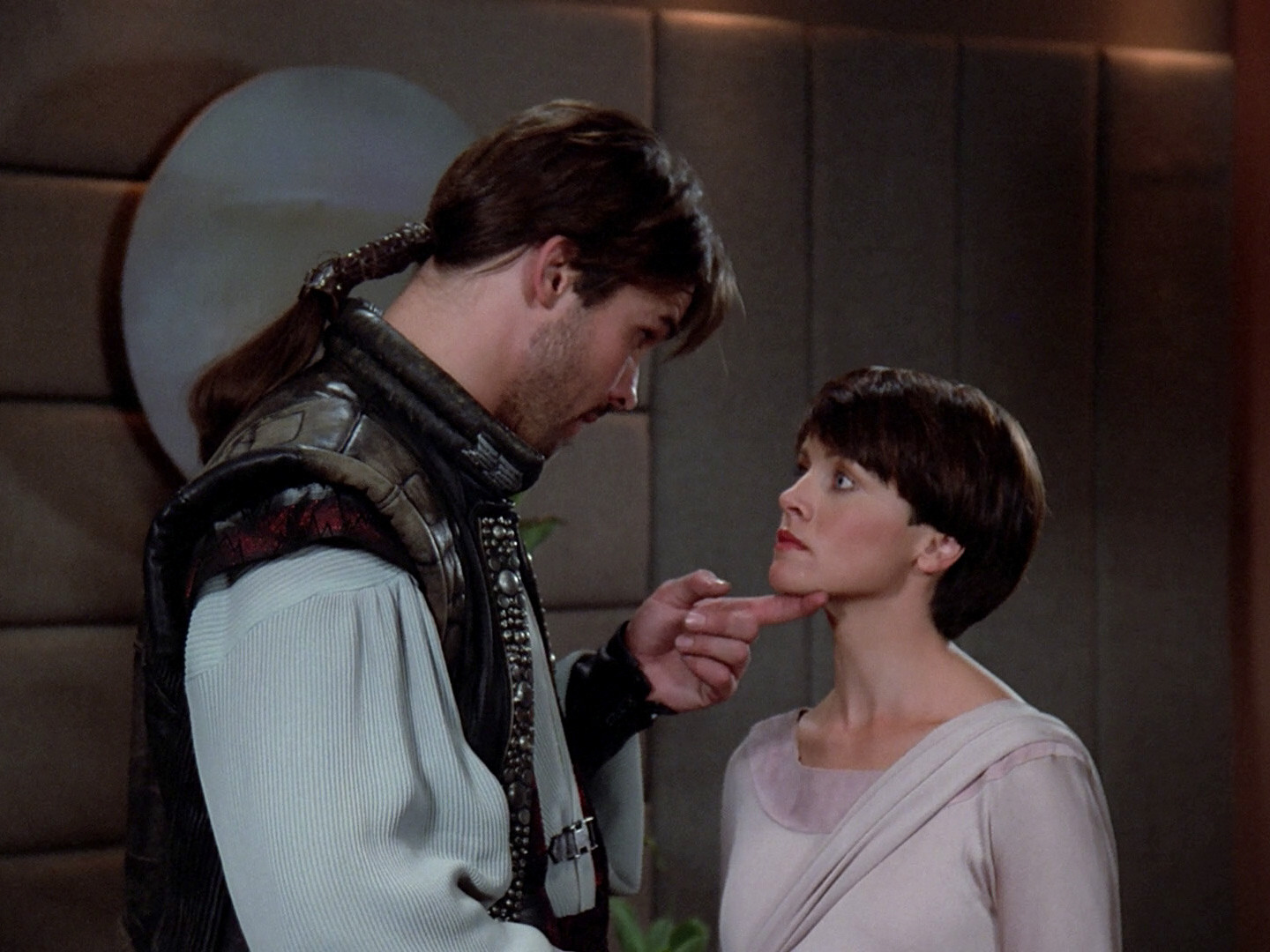
Stardate 42402.7: Charming Thadiun Okona is lucky that Geordi repairs his ship while he is free to make friends among the female Enterprise crew members. Picard, however, faces a small dilemma when two ships from the planets Atlec and Straleb appear and both demand Okona's extradition. Kushell, Straleb's ruler, accuses Okona, who used to be a friend of his son Benzan, of stealing their sacred Jewel of Thesia. Atlec's Debin raves that Okona impregnated his daughter Yanar. Picard calls a meeting of the struggling factions where Okona persuades the children of the leaders to tell the truth. Yanar is carrying Benzan's child, and the two used Okona only as a go-between because they were afraid their families would never agree with their relationship.
Review
Captain Picard calls the quibbling between Debin of Atlec, Kushell of Straleb and Okona an "ancient morality play". He may try to stay somewhat diplomatic but his words are just too kind. Rather than "Romeo and Juliet in Space", this whole episode can be labeled as "Star Trek - The Weekly Soap". It is clichéd beyond reason to start with, combining a cookie-cutter Trek plot of two struggling planets on one hand with typical motives of romantic comedies on the other hand. Well, and there are several elements of sitcoms in it. Not only Data's performance as a comedian but also and especially the scene with Okona, the Straleb and the Atlec in the conference room is so farcical, only the canned laughter is missing.
I also hate how Okona turns the Enterprise into a brothel. Agreed, I often complain that sex has no place in Star Trek, least of all outside a relationship, but it doesn't help that this story goes to the other extreme. It shows the women on the Enterprise in a bad light when they succumb to Okona's seemingly irresistible charm by the dozen. Likewise, we can't take Okona seriously as a character either, seeing that he is just seeking pleasure while Geordi is repairing his ship. Highlighting Okona's boundless libido may work as a red herring, to insinuate that he just has to be the father of Yanar's child. As a hint that 24th century sexual moral is more permissive it definitely fails, because the otherwise prevalent decency and this odd promiscuity don't mix and don't average out.
I care a bit more for the B-plot with Data's attempts to understand humanoid humor and his interaction with Guinan. There is one particularly good moment in it, when Data notices that it doesn't matter what he is doing, the audience would always laugh because it is programmed to do so. This is essentially the same kind of disillusionment as already with Data solving his Sherlock Holmes cases all too quickly, although Data didn't recognize in "Elementary, Dear Data" what was wrong about him cheating the program. Still, this plot too suffers from too many clichés. For instance, as already a couple of times in the first season, Data repeatedly recites thesaurus entries of words he isn't familiar with, which gets rather annoying. And honestly, hasn't he ever heard the word "rogue" in all of his time among humanoids?
Annotations
- Remarkable dialogue: "Data, you spoiled the joke. It could have been your timing." - "My timing is digital. [Guinan giggles] What?" - "That's funny." - "Why?" - "It would take too long to explain. Tell me another joke." (Guinan and Data)
- Remarkable ships: We can see the first re-use of the Merchantman as the Atlec ship, another re-use of the Batris as Okona's ship and a then new model for the Straleb vessel.
Rating: 1
The Schizoid Man
Synopsis
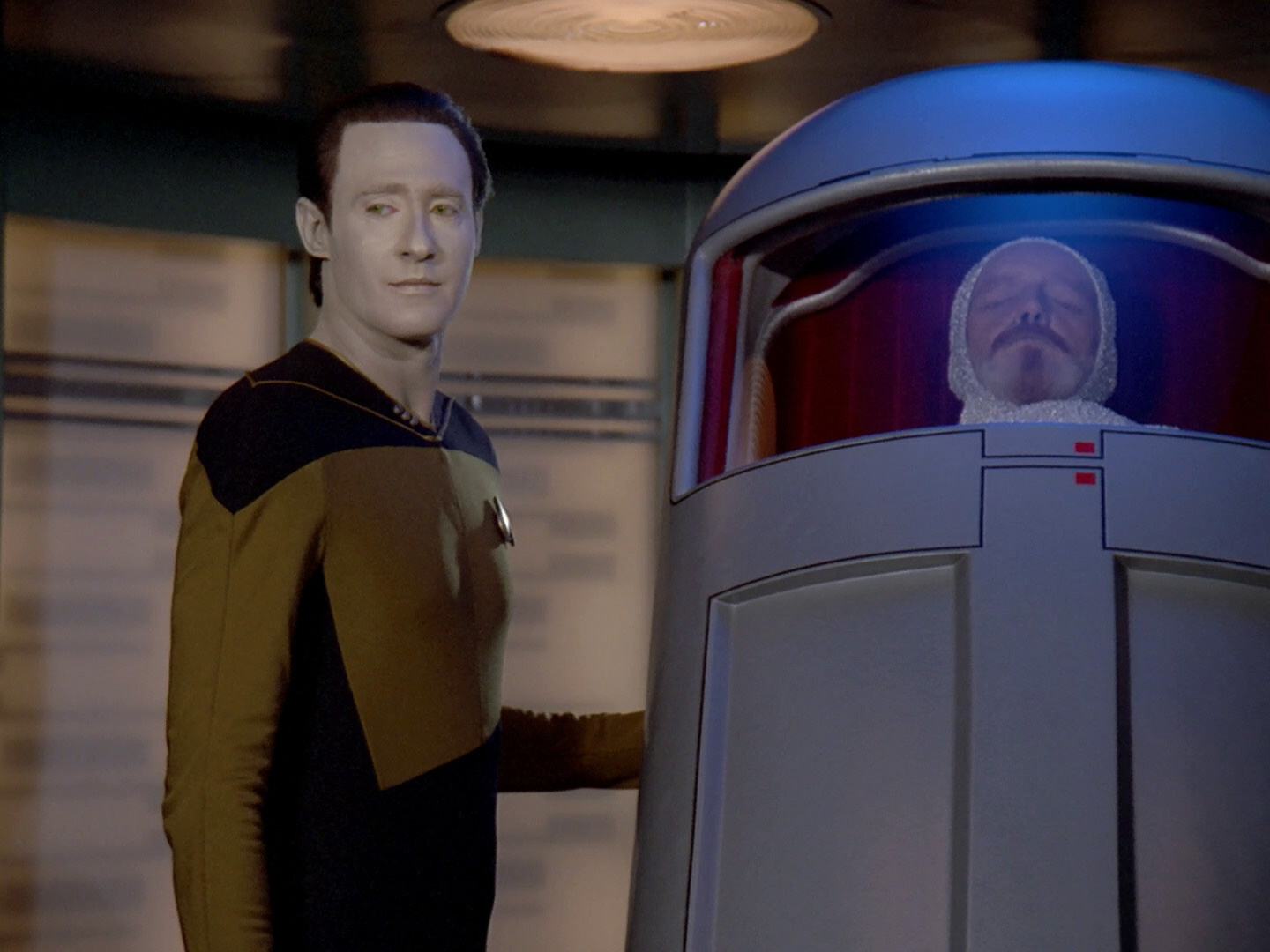
Stardate 42437.5: The Enterprise receives a distress call from Dr. Ira Graves, who turns out to be terminally ill. Graves was Soong's mentor and is sort of Data's "grandfather." Data spends some time alone with the dying man, who shows him a device capable of transferring his personality into a computer. Briefly later Data announces Graves's death. When he is back on the Enterprise, Data begins to exhibit unusual behavior, arrogant and egocentric. Deanna finds out that there are two personalities in Data; the second one has to be Graves as Picard surmises. Graves refuses to leave Data's body and even becomes violent against Geordi and Picard who try to stop him - until he finally resigns and transfers himself into the ship's computer.
Review
An overbearing genius in cybernetics lives on a planet all alone with his attractive blond assistant and becomes jealous when she spends time with the Enterprise's captain. Sounds familiar? It should, because this already happened in TOS: "Requiem for Methuselah". An alien consciousness, whose own body is dead, takes over the body of the most intelligent crew member and enjoys his new home so much that he wants to stay there at any rate? This is the outline of TOS: "Return to Tomorrow". I don't care for the plot of "The Schizoid Man", which is essentially just a blend of the two TOS episodes, with hardly any new aspects.
"The Schizoid Man" could have been interesting despite the cookie-cutter plot if only there were a conscious decision in the screenplay between showing the events either from Graves's perspective, or from everyone else's. The way the story actually unfolds, however, we know for sure from the first time that Data acts strangely (perhaps from the very moment that he announces Graves's death) that Graves has transferred his consciousness to him, because Graves gave us broad hints. Thus it becomes increasingly tedious to witness through the eyes of the crew how Graves's personality resurfaces and still no one recognizes what is going on. After the spoiler it should have been shown more from Graves's perspective how he gradually takes over Data's body and mind. It would also have helped to emphasize his motivation to live forever. But the way he is portrayed, as a parasite in Data's body, Graves is no more than a stereotypical villain who is corrupted by the power he has gained, who has lost his judgment and resorts to violence.
On a positive note, Picard's role in this story resonates with me. It is exceptionally considerate even by his character's standards. He always listens to everyone, he doesn't rush anything and he makes exactly the right decisions at the right time. And it is good to see that Troi gets more to do than the usual quick assessment of an emotional state along the lines of "He isn't honest" or "I feel great pain", when she examines Data.
One question remains: While his human qualities are lost, Graves's intellect is said to be be still in the computer, apparently in the form of software and not only as mere data. What will happen to it? Wouldn't this have required a follow-up story?
Annotations
- Remarkable dialogue: "This might sound crazy, but for a moment I thought I was stuck in that wall." - "For a moment, you were." (Troi and Worf, after the near-warp transport)
- Remarkable monologue: "Just look at that face. The face of a thinker. A warrior. A man for all seasons. Yes, Ira Graves was all that and more. But he was not perfect. Perhaps his greatest flaw was that he was too selfless. He cared too much for his fellow man, with nary a thought for himself. A man of limitless accomplishments, and unbridled modesty. I can safely say that to know him was to love him. And to love him was to know him. Those who knew him, loved him, while those who did not know him, loved him from afar." ("Data's" speech at Graves's service)
- Remarkable planet: Gravesworld is a spectacular ring planet (that remains the same in TNG-R).
- Remarkable fact: The away team is beamed to Gravesworld using near-warp transport, for which the ship only briefly drops out of warp.
Rating: 3
Loud as a Whisper
Synopsis
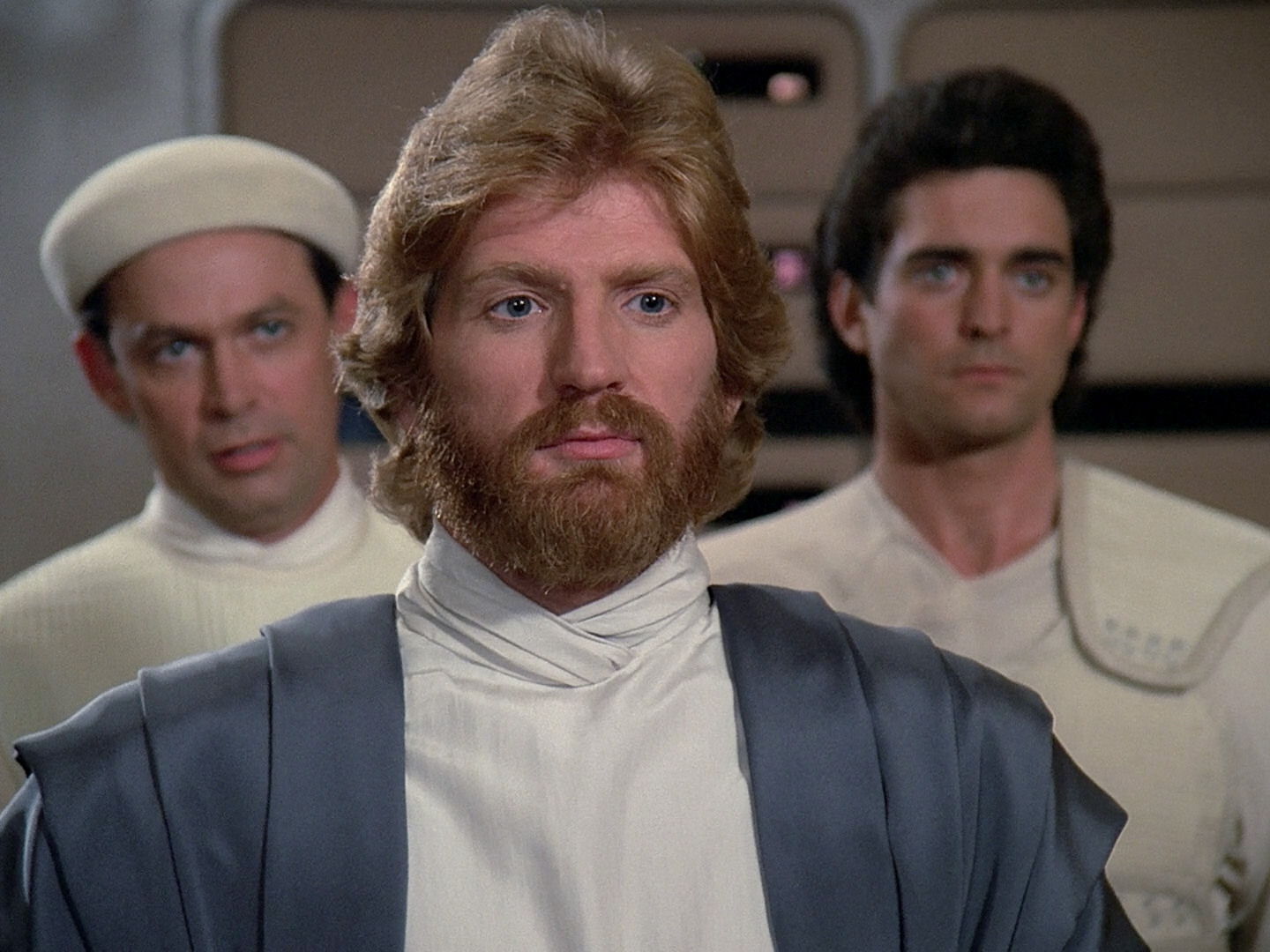
Stardate 42477.2: The mediator Riva is supposed to negotiate a peace treaty on Solais V. The away team are surprised that the man is deaf and uses a telepathic chorus to communicate: the Woman, the Scholar and the Warrior/Adonis. Riva is confident that he can resolve the conflict just by getting the two factions to talk to each other. However, upon beaming down to Solais V his chorus is killed by a fanatic warrior. Riva is struck with grief and remorse and wants to return to his home planet. Deanna and Data establish a communication with him; Riva gains new confidence and beams down to the planet to teach the opponents his sign language - turning his disadvantage into an advantage.
Review
Although it is built on two extremely overused clichés -the revered guest whose true nature is surprising and the negotiations between two factions who have been at war for centuries- I like the idea of the episode. The obvious underlying intention is to show that Riva, though he is born deaf-mute, may be very successful in what he is doing, and so can disabled people in our time. Geordi's blindness is woven into the story in a nice casual fashion when he first encounters Riva. But when Pulaski examines Geordi at the end of the episode, suggesting to him a method to reactivate his optic nerve, it becomes too obtrusive. I would have removed the latter part from the story and saved it for a future episode.
Anyway, while I like the idea of a deaf-mute negotiator who can only speak through the different personalities represented by his chorus, I don't have too much sympathy with Riva as a character. At the beginning his unique way of communication is still impressive as is his charisma, but gradually my impression of him changes for the worse. I think Riva consciously takes advantage of everyone's uncertainty in speaking with him, and everyone's respect for him, to hide his own weakness. Also, his treatment of his chorus doesn't exactly make him appear more likable. Riva may have to be authoritarian in order to make them work like a well-oiled machine but it could and perhaps should appear condescending to anyone else and might obstruct rather than help the mediation. His strategy is questionable anyway. In the first meeting in the conference lounge with the Enterprise officers Riva's attitude is presumptuous: "To date, I have never failed." He honestly claims that he could end the war without knowing any details about it: "Thank you, Captain, there is no need to continue. The specific issues of the conflict have no relevance." What the f*!? I call such a stance dangerously stupid. But Riva believes that any conflict on any planet is always a personal conflict, with which I strongly disagree. Where is the logic in claiming that a war that has been going on for centuries, with frequently changing leaders that may not even know each other, should be a personal one? He appears quite arrogant too when he suddenly leaves the meeting.
Riva's world that he enjoys to tower above collapses from one moment to the other when the chorus is suddenly killed. It is quite obvious that, deprived of his powers and distressed about the loss, he would have to cope with it in some fashion. Just like someone who always could speak and hear and loses these abilities from one moment to another. This is the part of the episode that is the most interesting to watch. Curiously it is Data of all crew members who can help Riva in his emotional distress, by learning his sign language when Troi's attempts to reach him fail. Later Data and Troi, in a joined effort, motivate and inspire Riva to accept the challenge. Well, after so much talking has been going on all the time, the solution to the problem is overly simplified. I strongly doubt that the weary Solari would have the patience to learn the sign language from Riva - after all they want to come to terms to stop the killing and would likely see this as a waste of time. Any other mediator may be better in this situation and I am worried about Riva's security. Well, if we see it as rather symbolic, it is a very Trek-like outcome though. As Riva states himself, it signifies that a disadvantage can be turned into an advantage.
Annotations
- Inconsistencies:
- There is one grave continuity problem in the episode. The Enterprise does have reports on Riva, as Picard says himself, but none of them bothers to mention that he is deaf-mute? Heck, Riva even negotiated between the Klingons and the Federation, as Picard as well as Worf know!!! "Before him, there was no Klingon word for peacemaker." And still no one knows that Riva is deaf-mute??? Sure, Riva's true nature is unknown at the beginning of the episode for the dramatic impact of the first meeting. But then the man simply can't be famous. It's like people talking about Stevie Wonder songs without anyone knowing he is blind.
- Since when are peace negotiations held with weapons? Wouldn't a really good negotiator set up the prerequisite that everyone has to appear unarmed?
- Why does the fanatic soldier aim at Riva and not at the leader of the enemy faction?
- The Solari are said to have lasers only but the effect of their weapon looks like that of a disruptor.
- Remarkable quote: "But I just wanted to say the words. Thank you. Well done." (Picard, to Troi - she needed and deserved just that!)
- Remarkable fact: Dr. Pulaski examines Geordi and finds out that it could be possible to grow new eyes. Interestingly, exactly this will happen in "Star Trek: Insurrection".
- Remarkable appearance: Howie Seago, who plays Riva, is in fact deaf.
Rating: 4
Unnatural Selection
Synopsis
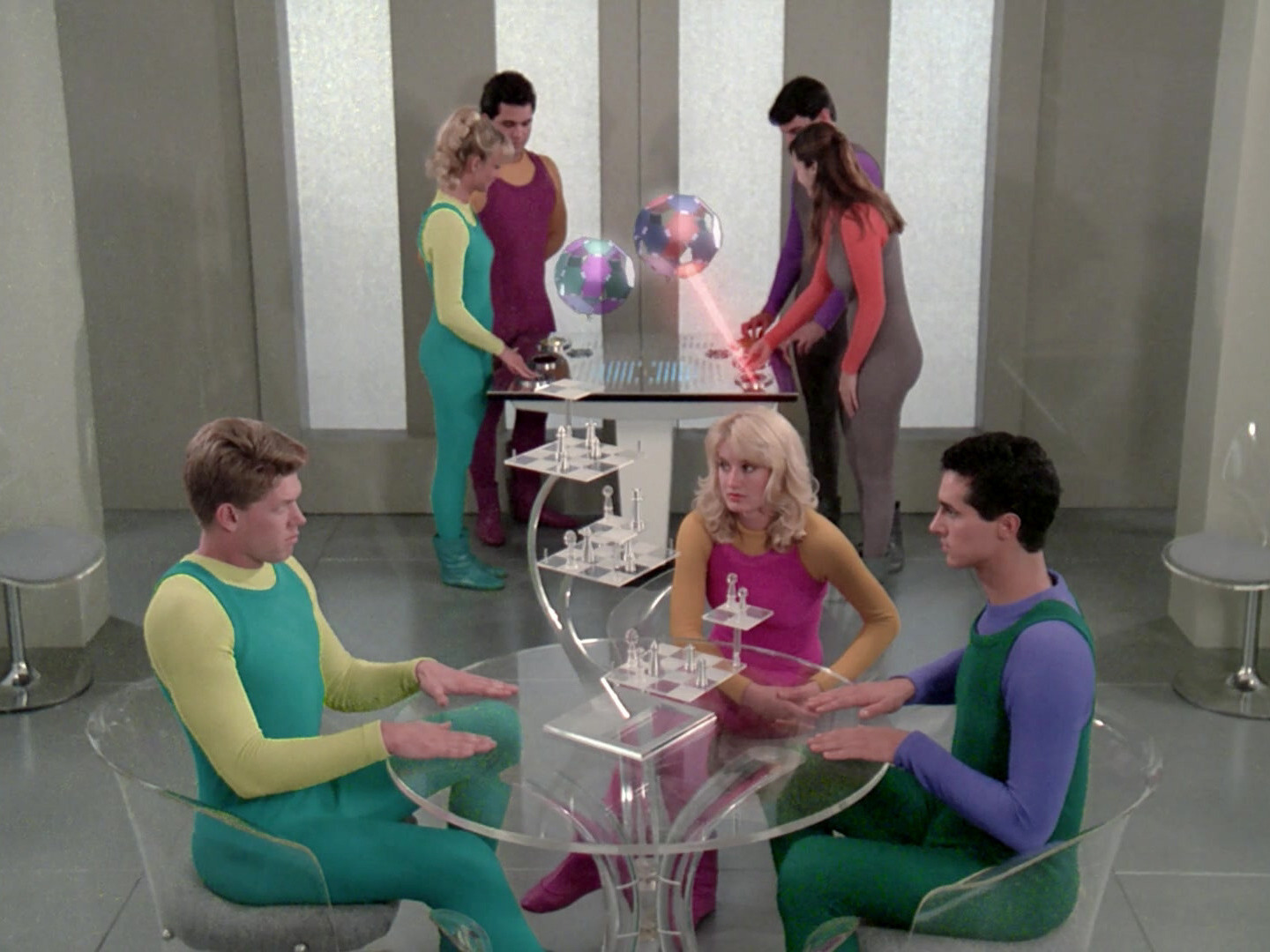
Stardate 42494.8: The Enterprise receives a distress call from the transport ship Lantree. The help, however, comes to late because the ship's whole crew has died of old age, although none of them actually was old. Picard sets a course for Darwin Station, the Lantree's last stop. The scientists on the station suffer from accelerated aging as well, only their genetically bred children do not have the disease. In order not to expose the Enterprise to the danger, Pulaski takes a shuttle to examine one of the children. She begins to age rapidly too. It turns out that the children are the actual source of the disease, because their immune system produces an antibody (against a harmless disease of one of the Lantree crewmen) that alters the DNA of every normal human being. Using the transporter and pieces of unaltered DNA, Pulaski and the staff of Darwin Station are cured eventually, whereas the children have to stay in quarantine for their whole lives.
Review
Dr. Katherine Pulaski, as her character has been established in the first couple of second-season episodes, is not exactly the most appealing Enterprise crew member. And so far she's definitely not as easy to handle for Picard as Beverly. It is only fair that Pulaski gets a chance for further development, to become more than the mature and often querulous woman who won't accept Data as a lifeform as she lets him know frequently. Perhaps, if the time had been ripe for it, she could have become something like a "House, M.D. in Space". But the way she is portrayed in "Unnatural Selection", as a physician who cares more about her job than about anything else and who is ready to jeopardize her life for it, is not really consistent with the impression I had of her so far. Well, perhaps I was mistaken. Anyway, while it is a quote positive trait, her dedication to her job doesn't make Pulaski appear as someone special, at least not among the ranks of TV doctors and of her colleagues in Star Trek. Also, Pulaski shares her dislike for the transporter with one of the latter. Furthermore, as Deanna notes, Picard and Pulaski may be much alike. To me it even seems that Pulaski's character was rectified in this very episode, to come across as more Beverly-like - for instance by insinuating that she too has a crush on her captain. Summarizing, I'm not opposed to the charm offensive for Pulaski in "Unnatural Selection", but it should have been done differently.
Regarding the story, the parallel to TOS: "The Deadly Years" is obvious. The race against time, to save Pulaski and the scientists, is perhaps a bit melodramatic, but overall well written. Yet, while the accelerated aging phenomenon and its consequences is given just the right amount of screen time, genetic enhancement and its impact remains a side aspect. Picard is skeptical about it, but he doesn't really condemn it; I miss a verdict of some sort. Pulaski even admires how those scientists play god and mess around with human DNA with unpredictable results. It seems that everything that happens on the research outpost is not only legal in the Federation, but it is also regarded as desirable to have superchildren who never get ill, who are completely grown up at six years and have telepathic powers on top of everything. In my view these children are essentially monsters even without their detrimental influence on natural human beings. "Unnatural Selection" is certainly not responsible for the blatant inconsistency that genetic enhancement is outlawed according to DS9: "Dr. Bashir, I Presume?". But as soon as a few episodes later, in "Up the Long Ladder", Pulaski, who is still fascinated by the superchildren here, will be upset that she has been cloned and will even agree to Riker killing her clone. So designing übermenschen by tampering with human DNA is okay, and merely creating a human being by cloning violates personal rights of the original, so much that the clone may be killed?
The scientific basis of the episode is very weak, of course. However, while I resent her admiration for the monster children, I appreciate that Pulaski is very cautious when she first has the child beamed up with a complete isolation and then continues her examination aboard a shuttle. It is also a nice idea that the transporter is used to reconstruct Pulaski's original appearance - something that will be done several times again in Star Trek. On a further positive note, the concept of the biofilter is referred to quite consistently.
Annotations
- Nitpicking: The crew is overly cautious from the start. No one beams over to examine what happened on the Lantree - which is what they otherwise always do, without exception.
- Remarkable dialogue: "All systems are functioning within normal specifications, Doctor." - "The manufacturer will be pleased to hear it." (Data and Pulaski, when he examines her)
- Remarkable quote: "The mere thought of a possible connection between the Lantree tragedy and a genetic research facility fills me with profound apprehension." (Picard)
- Remarkable shuttle: This episode features the too chunky mock-up of the Type-7 shuttle.
- Remarkable ship: We can see the Lantree, the first Miranda-class ship in TNG, and the only one of her class ever to be shown without the "rollbar".
Rating: 4
A Matter of Honor
Synopsis
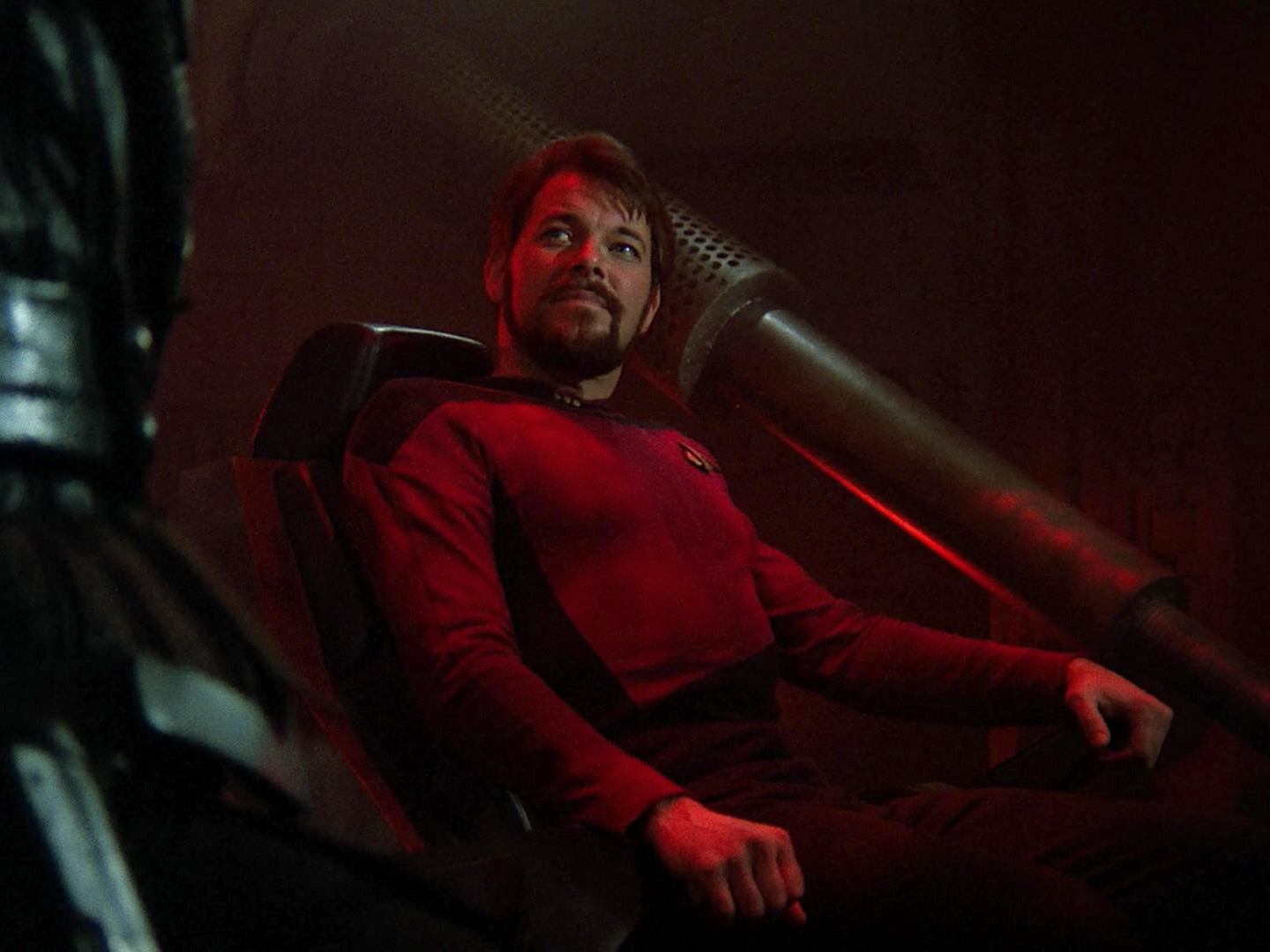
Stardate 42506.5: In a new exchange program Riker joins the crew of the Klingon Bird-of-Prey Pagh as their first officer. His studies of Klingon culture and cuisine pay. He earns the respect of Capt. Kargan and his crew, even though this means he has to beat up the insubordinate former first officer Klag. In the meantime, the Benzite Ensign Mendon discovers bacteria that are eating the hull of the Enterprise but remains silent about the discovery because the analysis is still pending. Picard tells him that it is his duty on a Federation ship to report anything that could be hazardous. On the Pagh, Kargan questions Riker's loyalty when the same bacteria are found on the Klingon ship. He makes Starfleet responsible for it. When the Pagh is about to attack the Enterprise, Riker uses a secret transponder to have Kargan beamed out; he assumes command of the ship and demands the Enterprise's "surrender", which Picard does, thereby satisfying the the Klingons' thirst for revenge.
Review
This is the TNG episode I have been waiting for. It is not a rehash of a well-known TOS theme but tells a story that is firmly rooted in the new intergalactic political situation of the 24th century. The story is both intelligent and exciting. And above all it is a fine lesson in leadership and in intercultural cooperation.
The key issues of this episode are trust and loyalty, two preconditions for people to work together that are mutually dependent. Riker has to learn the hard way how he can earn the trust and the loyalty of the Klingons, and how he himself can possibly return it. When he comes aboard the Pagh, the crew is naturally suspicious because they have never dealt with humans before. Especially the first officer, Klag, is understandably angry because Riker has taken his place. And so Riker has to "make his first command decision", as Captain Kargan expresses it. Riker has to apply force; he beats Klag to secure his place in the chain of command. Whether this is an act of reprimanding a rebellious subordinate or rather an initiation ritual, Riker has to do it the Klingon way. Any attempt to apply human or Federation standards would have been in vain, would have been interpreted as weakness and may have even cost him his life. Later, during the common meal Riker hesitates to eat live gagh, upon which the Klingons offer to breastfeed him. Riker understands their humor. He is even surprised that the Klingons do have humor, and the Klingons are equally pleased that in this field Riker can pay them back in their own coin. This establishes a mutual understanding, one in which both sides are equal. Riker can even go as far as appealing to Klag's feelings for his father, although the old man will die without honor (which, in hindsight, is very odd in light of Riker's own bad relationship with his father that will be established in "The Icarus Factor"). Anyway, when Captain Kargan has decided that Riker is a spy and his ship was intentionally contaminated by the Enterprise, only Riker's human qualities can help him, by outwitting the Klingon crew. Well, it may not seem fair that humans eventually gain the upper hand in this small-scale clash of civilizations, and in the B-plot as well. But the good thing is that in the end there are no losers in this conflict.
There is a noticeable effort to work out individual characteristics of the Klingon guest characters, to give their race a certain diversity. This is in contrast to the depiction of many other alien characters and particularly of other Klingons that appear in the various Trek series. After Kargan has been beamed away and Riker has taken command, Klag could have challenged Riker if I understand their chain of command correctly, but by now he trusts the human officer and does not interfere. Kargan, on the other hand, made an obvious error when he wanted to attack the Enterprise in a totally futile suicide mission, but he is too embarrassed to admit it and rather hides his defeat behind his relentlessness towards Riker.
Initially I didn't care much for the B-plot with the somewhat disagreeable Mendon, a guy who first chums up with everyone, only to present himself as a know-it-all. But then Mendon has to concede that he has made an error by not reporting a danger to the ship, which I think is an error not only by Starfleet regulations but also in the very matter. Anyway, while on Benzite ships it may be the correct procedure to ponder about a problem all alone until there is a solution, teamwork is absolutely necessary on the Enterprise. Mendon quickly learns this and, with some encouragement from Wesley, puts his inventiveness to good use by sharing his findings. And once he fits in, Mendon appears as a nicer person too. Well, compared to the hard time that Riker has on the Klingon vessel, Mendon's problems on the Enterprise are rather light-hearted. Still, the B-story with Mendon fits in nicely; it echoes Riker's situation without being contrived, because after all it is a part of the officer exchange program too.
Annotations
- Inconsistency: Captain Kargan asks Riker for the best tactics to attack the Enterprise, but Riker refuses to tell him anything. Kargan then says that if Riker had revealed secrets, he would have been a traitor and Kargan would have killed him. A few minutes later, however, Riker recommends to close to 40,000 kilometers for the attack. Even though the true reason is to allow use of the Enterprise's transporter, isn't that exactly the kind of treacherous conduct that Kargan was talking about to kill Riker for?
- Remarkable dialogue: "Klingons do not express feeling the way you do." - "Perhaps you should." - "We would not know how." - "Yesterday, I did not know how to eat gagh." (Klag and Riker, who then grabs live gagh from the bowl).
- Remarkable ship: This is the first time that we see a Klingon BoP in the 24th century, and the first of a couple of episodes in which the ship appears to be somewhat bigger than in the TOS movies.
- Remarkable fact: We see Klingon bloodwine and gagh for the first time.
Rating: 8
The Measure of a Man
Synopsis
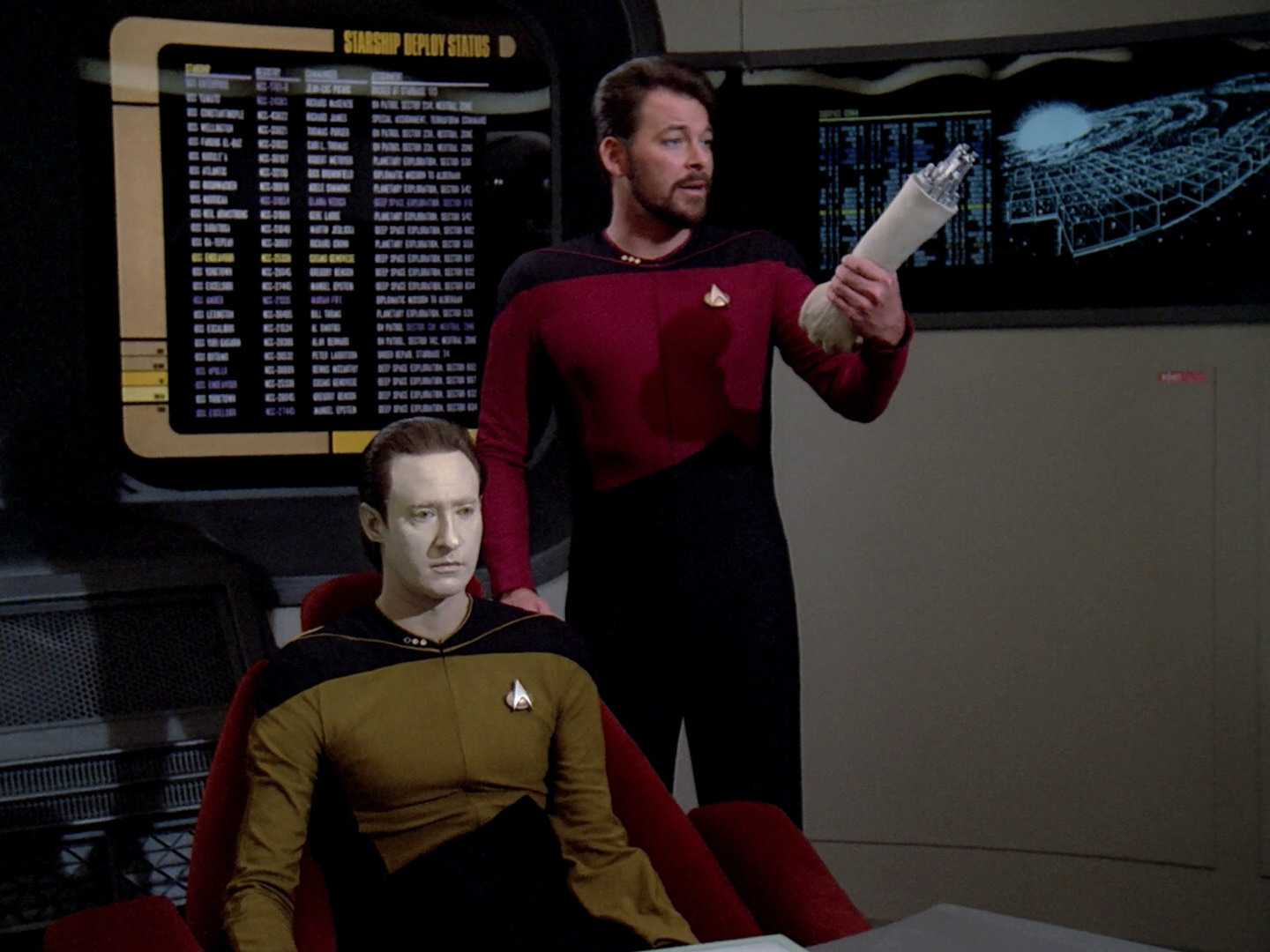
Stardate 42523.7: Starfleet Commander Bruce Maddox intends to disassemble Data to create copies of him. Picard seeks the advice of local Judge Advocate General officer Phillippa Louvois. She tells him that Data's only option is to resign his commission, which Data does. Maddox, however, refers to regulations that Data is not an individual who may decide for himself, but is Starfleet property. Picard challenges the ruling. Louvois has to arrange a hearing quickly, and due to the lack of legal staff she assigns Riker to the position of the prosecutor. Riker is aware that in case he refused the judgment would be automatically against Data, and so he does his best to prove that Data is only a machine. Picard, on the other hand, successfully argues that Data could be sentient indeed and that Starfleet must decide in his favor; otherwise they would endorse an army of slaves.
Review
"The Measure of a Man" is *the* classic courtroom drama of Star Trek, and although some later episodes have attempted to repeat its success it is still unequaled today. I love this episode for the originality of its plot, the depth of the story with its emotional impact and legal ramifications, the elaboration in dialogues and the actors' performances.
Special praise goes to Jonathan Frakes, whose task as Commander Riker is to act as the prosecutor, the advocatus diaboli. He has no other choice because otherwise there would be no trial, and Louvois would have to rule by the book that Data is Starfleet's property. Naturally Riker is reluctant to try to convince Louvois that Data is nothing more than a machine, because he knows that this isn't true. But Riker grows with his role. With a strange blend of bitterness and pleasure in his face and his voice he flips the switch and turns Data off, thereby making a strong point. This is a highlight of the episode. Patrick Stewart as Captain Picard makes for another highlight. At first he responds hesitantly, almost bashfully to Riker's arguments. It almost seems he has lost the thread. But then rises from his seat and gives a most passionate closing argument: "[to Maddox] You see, he's met two of your three criteria for sentience, so what if he meets the third. Consciousness in even the smallest degree. What is he then? I don't know. Do you? [to Riker] Do you? [to Louvois] Do you?"
There are just two points of criticism about "The Measure of a Man". The first is that Jean-Luc Picard shows his hard feelings towards Phillippa Louvois too openly and too often. While it is possible that he is still very much offended after ten years, at least I would have expected Picard to restrain himself from making frequent bitter remarks. Without being specific, he alludes to the Stargazer trial and to his low opinion of her six or seven times, even in the presence of Maddox. Louvois bears with him quite admirably, which may be because she has a crush on him. Well, perhaps Picard feels much the same and only hides it behind his resentment because he thinks it would not be appropriate. Still, he is becoming unnecessarily annoying.
My second beef is with the character of Commander Maddox. He is a tad too much like the stock character of a smug yet incompetent Starfleet scientist, just like Kosinski in "Where No One Has Gone Before". Maddox's disrespect of Data may be fitting in his position (he refers to Data as "it" and doesn't have the mind to ring the bell before entering the android's quarters). But overall it would have been more interesting, had Maddox's bad attitude and his lack of experience with the subject not been immediately obvious.
Annotations
- Continuity: The attacks on both sides of the Romulan Neutral Zone (TNG: "The Neutral Zone") are alluded to again.
- Nitpicking: Maddox was the only one in the committee to vote against Data's admission to Starfleet Academy. That was in 2341, 24 years prior to the episode. Either Starfleet Academy has children in their evaluation committee, or Maddox looks at least some 20 years younger than he is.
- Remarkable dialogue: "He's remarkable." - "You didn't call him 'it'." (Maddox and Louvois, after Data has walked out)
- Remarkable quotes:
- "You know, I never thought I would say this, but it's good to see you again. It brings a sense of order and stability to my universe to know that you're still a pompous ass. And a damn sexy man." (Phillippa Louvois, to Picard)
- "Are you prepared to condemn him and all who come after him to servitude and slavery? Your Honor, Starfleet was founded to seek out new life. Well, there it sits." (from Picard's closing argument)
- Remarkable scene: Commander Riker has already taken off Data's hand. He continues: "The Commander is a physical representation of a dream, an idea conceived of by the mind of a man. Its purpose is to serve human needs and interests. It's a collection of neural nets and heuristic algorithms. Its responses dictated by an elaborate software program written by a man. Its hardware built by a man." He walks behind Data's chair. "And now. And now a man will shut it off." He pushes the secret button on Data's back.
- Remarkable prop: Data's Tasha hologram
- Remarkable station: Starbase 173 is a re-use of Regula One, which originally appeared as the Orbital Office Complex. Unfortunately it becomes very clear in the visuals that the scale (with Starbase 173 supposed to be much bigger than the Enterprise) is totally off.
- Remarkable facts:
- "Webster's Twenty Fourth Century Dictionary, Fifth Edition, defines an android as an automaton made to resemble a human being."
- In the early 21st century the Acts of Cumberland were passed, regulating the rights of beings with artificial intelligence.
- Maddox works at the Daystrom Technological Institute, a nod to Richard Daystrom (TOS: "The Ultimate Computer").
- According to Maddox, the three criteria for a sentient being are "intelligence, self-awareness, consciousness".
- "I have an ultimate storage capacity of 800 quadrillion bits. My total linear computational speed has been rated at 60 trillion operations per second." (Data, about himself)
Rating: 9
The Dauphin
Synopsis
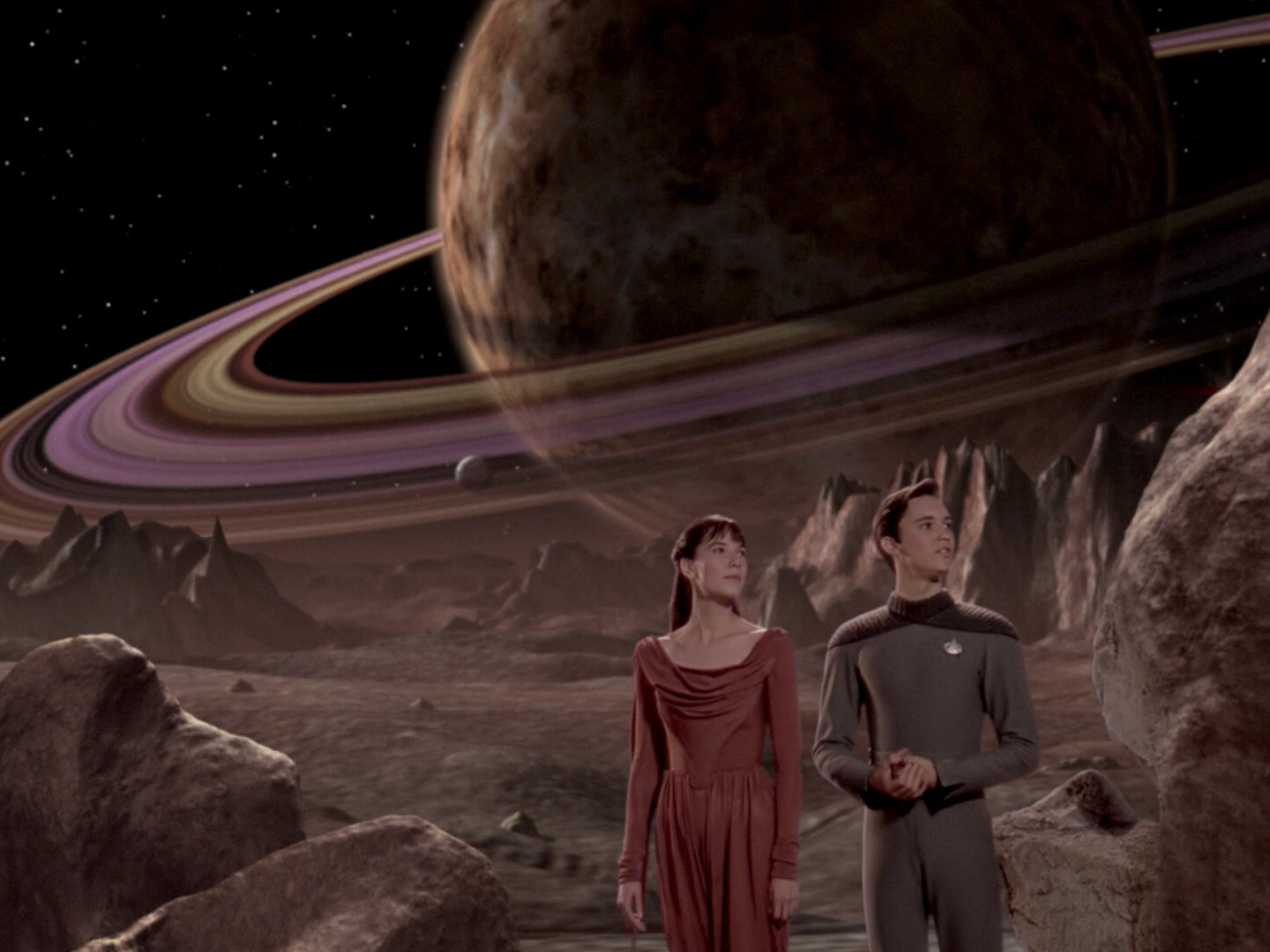
Stardate 42568.8: The Enterprise takes Salia, the future leader of Daled IV, and her guardian Anya back to their planet. Wesley gets romantically involved with the young girl, but Anya strives to protect Salia from every potential danger and keeps her confined to her quarters. During a tour of the ship Anya turns out to be an allassomorph, a shapeshifter. When Salia secretly visits Wesley in his quarters, Anya morphs into a ferocious creature and threatens Wesley, whereupon Salia changes her shape too to defend him. Wesley is horrified at first but then overcomes his fears and gives Salia a proper goodbye when she leaves the ship.
Review
Well, this episode has some nice visual effects, namely the morphing of Salia and Anya as well as the spectacular planetscapes on the holodeck. But aside from that there is nothing special about "The Dauphin". It's a cookie-cutter plot to start with (including the #1 TNG cliché: guests who conceal their true nature). But most of all this episode suffers from its spiritless anticlimactic script. The shapeshifting abilities of Anya are given away too early, and it is really no surprise any more that Salia too is an alassomorph. We are waiting in vain for something unexpected to happen. Also, after she wanted to kill a sick crew member only because he posed a danger to Salia, Anya should make a lot more fuss about Salia not being in her quarters after her return. But instead of wreaking havoc on the Enterprise security team she just gives Picard a call, upon which the camera cuts to Wesley's romantic date with Salia, taking away the little bit of suspense that has just been created. When Anya later surprises the two in Wesley's quarters and Anya turns into a wild creature and so does Salia, I was almost hoping for some simple "King Kong vs. Godzilla" action just to beef up this boring episode.
I have just two positive notes on "The Dauphin": The first is the nice touch that not only Deanna ("Their emotions do not fit who they are and what they're doing.") but also Worf ("Do not be fooled by her looks. The body is just a shell.") have presentiments while Picard and Riker both assume that everything is okay. The second is that Wesley comes across as a quite sympathetic and quite normal teenage boy. I can understand that he feels cheated when he learns that Salia is not humanoid. As he wants to pursue a career in Starfleet and in science, he must be ready for the unknown. But he is still a human being, and as such no one can expect him to fall in love with the unknown, and with someone who is not honest to him.
Annotations
- Continuity: Geordi gives Wesley advice on girls, but we will see in "Booby Trap" that he is awkward on his own date.
- Nitpicking:
- Well, no one states explicitly that Anya is the first shapeshifter ever encountered by Starfleet, so this is not a hard continuity error. But Pulaski says that she read about alassomorphs in the Galactic Zoological Catalog, rather than referring to the Chameloids (Martia) or the Antosians (who taught Garth shapeshifting), who are both known to Starfleet. On the other hand, alassomorphs may be a generic term that already includes the two TOS races.
- Since Anya and Salia were on a Federation ship before, it seems unlikely that their true nature wasn't discovered back then, especially considering that for beaming down to Daled IV (and up too?) they have to take on their natural shape.
- While the warp drive is still offline, why would Picard even bother to order to break orbit?
- Star Trek's transporter has a tradition of being capable of penetrating nearly everything, even solid rock. But considering that it is not possible for the Enterprise's communication array to send a simple audio signal to the planet surface it is very implausible that the transporter is capable of beaming a person down safely, which requires a zillionfold of bandwidth.
- Remarkable dialogue: [Worf roars] "That is how the Klingon lures a mate." - "Are you telling me to go yell at Salia?" - "No. Men do not roar. Women roar. Then they hurl heavy objects. And claw at you." - "What does the man do?" - "He reads love poetry. He ducks a lot." (Worf and Wesley)
- Remarkable facts:
- "Daled IV rotates only once per revolution. Therefore one side is constantly dark, and the other side constantly light." The difference in the two cultures is the possible cause of the conflict, which has lasted for centuries.
- Salia's parents were from opposite sides of the conflict on Daled IV. "They both died shortly after her birth. A Federation ship brought her and her governess to Klavdia III so that she could be raised in a neutral environment."
- According to Wesley, the Federation has explored 19% of the galaxy.
- Remarkable error: The correct title of this episode should be "The Dauphine", the female form of the French word for the throne heir.
Rating: 2
Contagion
Synopsis
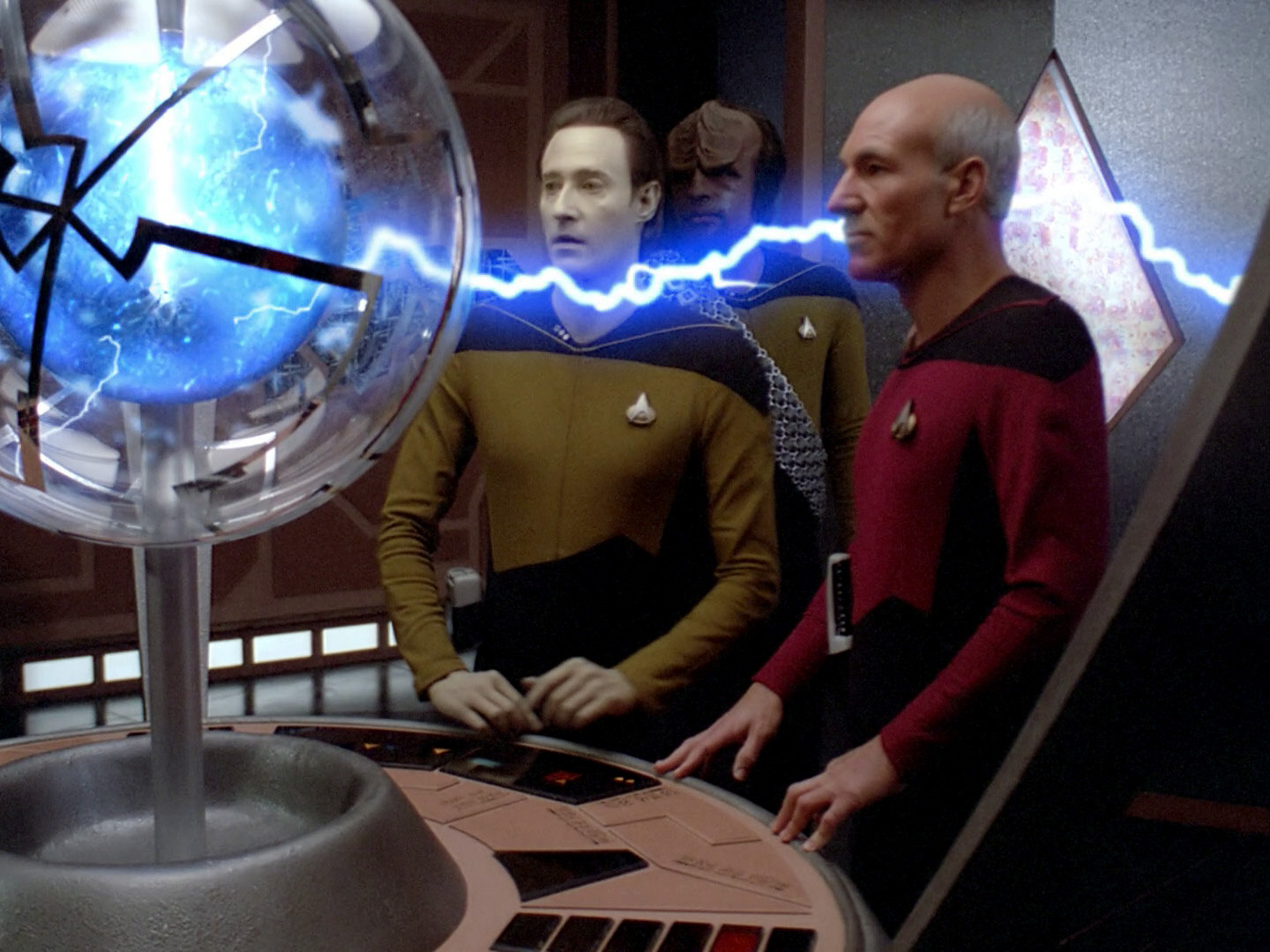
Stardate 42609.1: Following a distress call from Capt. Varley of the USS Yamato that is experiencing widespread system malfunctions, Picard sets a course for the Neutral Zone. But briefly after the Enterprise's arrival the sister ship explodes. Varley's logs reveal that he has found the mythical planet Iconia. The malfunctions on the Yamato started when the ship encountered an Iconian probe, and after downloading the logs from the Yamato the Enterprise is now infected too. Picard, Worf and Data beam down to the planet to examine the Iconian technology - including a portal which allows to reach remote places in an instant. A Romulan Warbird approaches, and it is obvious that the enemy ship is suffering from the same problems. On the planet, Data is disabled by the Iconian central computer. Worf takes him back to the Enterprise, using the gate, while Picard destroys the Iconian technology to prevent it from falling into Romulan hands. Back on the Enterprise, Data apparently dies - but actually reboots his system. Geordi performs the same procedure on the Enterprise and thereby eliminates the virus. Picard too enters the gate. It takes him to the Romulan bridge from where he can be beamed out. Before the Enterprise breaks orbit, Riker gives the Romulans instructions how to purge their computer.
Review
There are two reasons why "Contagion" stands out from TNG's early episodes. The first is its strong story and bold directing that makes it the most tense thriller of the series so far. When I compare my impression of this episode with my still relatively fresh memory of "Arsenal of Freedom" with its somewhat similar setting, the latter comes across as rather sedate. "Contagion" is not only more exciting, it is also full of memorable quotes and it includes a good dose of appropriate humor, such as Troi's smirking as the shields and weapons go online and offline again: "In another time and place this could be funny."
The second reason why I like "Contagion" so much is that everything related to the Iconian computer virus and the efforts to remove it is absolutely plausible. Well, it takes Geordi very long to recognize that he could simply reboot the computer from the protected memory core to get rid of the infection. But we have to bear in mind that the episode was written in 1988 (by a computer technician!), that the internet didn't yet exist and that computer viruses were something known only to absolute geeks. While it may have been foreseeable that computers of the real world would catch up with those in Star Trek sooner or later, no one could have predicted the proliferation of computer viruses that we have to cope with today.
Geordi's and Data's description of the warp core safety mechanisms that normally couldn't all fail at once is quite realistic as well. La Forge says: "In the event of a breach of seal integrity there's an emergency release system which dumps the antimatter." Data adds: "Apparently such a dump began, was then halted, and the containment seals were dropped. There was still sufficient antimatter present to lead to an explosion." Well, the antimatter containment on Federation ships will fail with increasing frequency in later episodes and series and for lesser reasons, ignoring the high safety standard established here and in other early TNG episodes.
The story also excels in the field of linguistics. Data's idea to reconstruct a common ancestral language based on simple words "such as mother, father, child, home", etc. is exactly how it is done in the real world too because they are generally subject to less change than more specialized words.
There are only two things I don't like about the episode. The first is how Picard sanctions the recklessness of Donald Varley to violate the Neutral Zone. Picard first criticizes Varley's actions, but he effectively continues his friend's mission. He does have a comfortable justification for going to Iconia because it's the source for the Enterprise's malfunctions, but his obvious main motivation is to find the planet before the Romulans do it, followed by his interest in archeology (which is the reason why he insists on beaming down himself). Agreed, the Romulans would have used used the Iconian technology against the Federation if only they had found it first, but Picard comes across as too self-complacent here.
My second complaint is about the "father-and-son" scene of Picard and Wesley, which is an unnecessary effort to provide a human touch and otherwise only serves to give Wesley a more meaningful role (he'd arguably better help Geordi in engineering).
Annotations
- Nitpicking: It is a bit too Indiana Jones-like that the Iconian technology is still operational after a devastating orbital bombing and after 200,000 years.
- Continuity:
- Picard tells Wesley, "Archaeology has been a hobby since Academy days." This is an understatement in light of the fact that he almost pursued a career in archeology, as will be established in TNG: "The Chase".
- The Yamato's registry, albeit barely legible here, was corrected since "Where Silence Has Lease", from "NCC-1305-E" to "NCC-71807".
- Another Iconian gateway will be discovered in DS9: "To the Death".
- Remarkable scene: Geordi's hell ride in the malfunctioning turbolift is a highlight of the episode. It would probably be visualized differently today, with CGI sequences showing how the car dashes up and down the shaft, but I like the purism of just seeing how Geordi is flung from one wall to another.
- Remarkable quotes:
- "Fate protects fools, little children and ships named Enterprise." (Riker)
- "Well, Number One, I can see why you want to keep the away missions to yourself. That's where the excitement is. So, what's been happening here? Same old routine, I suppose?" (Picard)
- Remarkable facts
- It is the first time that we can hear Picard's catch-phrase "Tea, Earl Grey, hot." Because of the malfunctions, he gets a potted plant instead of the tea.
- Iconian is the parent tongue of a language family which consists of Iccobar, Dewan and Dinasian.
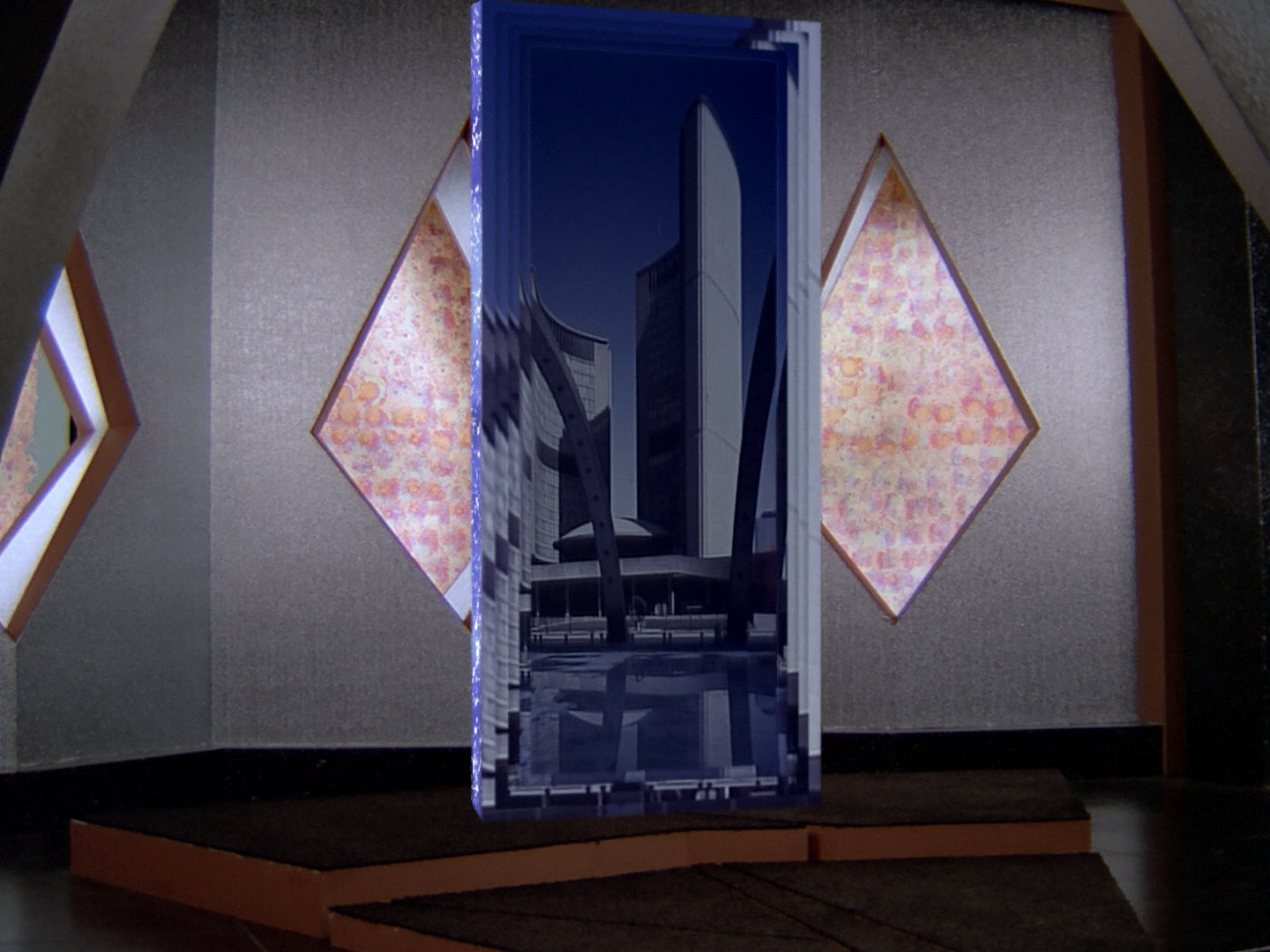
- The Toronto City Hall is among the buildings that can be seen on the far side of the Iconian gateway.
Rating: 8
The Royale
Synopsis
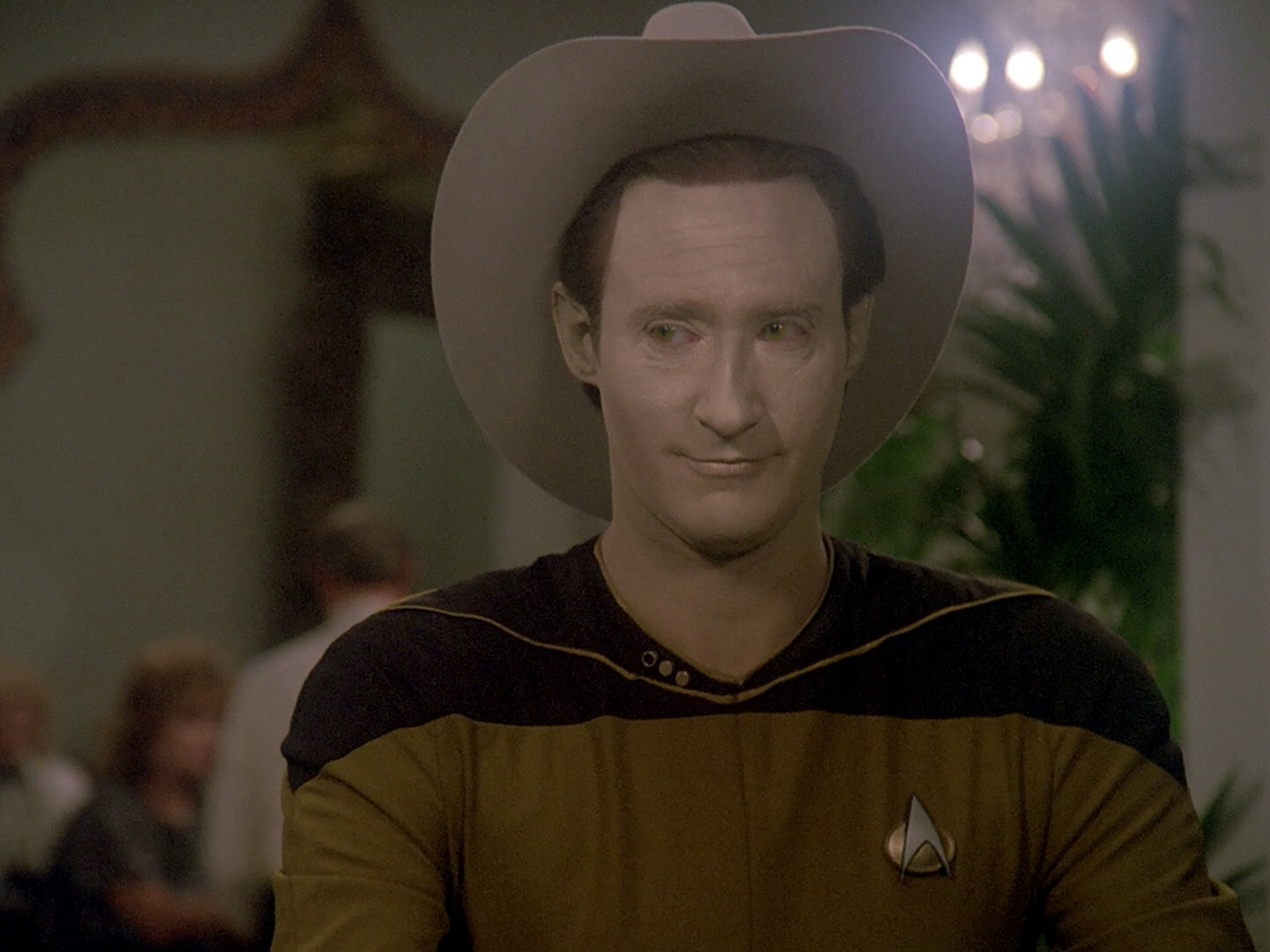
Stardate 42625.4: Riker beams up a hull fragment of a 21st-century NASA spacecraft in orbit of the hostile planet Theta 116 XIII. He then beams down with Worf and Data to a structure in a bubble of breathable air, where they get trapped in a soap opera about love, jealousy, greed and crime set in a casino resort called "Hotel Royale". They find the remains of one of the NASA astronauts in a suite, along with a book entitled "Hotel Royale". Obviously aliens accidentally infected his spaceship, which killed the rest of the crew. As a compensation, they recreated the setting as described in the book, not aware that it was just pulp and did not describe real life on Earth. In order to escape from the simulation, Riker, Worf and Data play it according to the book's ending. They break the bank and buy the hotel.
Review
Aliens turn an old book from Earth into reality. We've already had that in TOS: "A Piece of the Action". Unfortunately this crucial detail about "The Royale" makes the whole episode look like a rehash, although it otherwise tells a very different story. At least "The Royale" manages to recapture the spirit of the old TOS episode. The trashy scenery of the casino is not to the episode's disadvantage. On the contrary, the absurdity and surrealism of a Las Vegas-style casino hotel in space is a nice contrast that reaffirms how realistic the "real" world of the 24th century created for Star Trek is. Seeing Riker, Data and Worf (who calls the elevator a "turbolift" ;-)) as they are trying to find their way through the hotel is mostly fun. They are prepared to find anything on the planet, but definitely not a place like this, and they have to learn to play their roles, as silly as the game might seem. The solution that, in the end, they have to buy the hotel just as it is written in the novel is both intelligent and amusing.
The episode, however, is not very plausible in many regards. When the aliens encountered the Charybdis, the vessel must have been very close to our solar system. So why didn't they just return the surviving crew member to Earth? Why did they bother creating the whole scenario instead? If they could understood what was written in the book, a good course of action would have been to simply ask Richey what they could do for him. Well, maybe it is good if a small mystery remains here and then.
Annotations
- Nitpicking:
- I wonder why Riker, Worf and even Data are so astonished that the characters in the hotel are unreal. Would they expect a real hotel with real people to exist on that hostile planet, and have they never heard of holograms?
- Another question is why they don't try to leave the hotel as soon as they lose contact with the ship. Riker says that there is no danger but the least they could try is to walk out through the door to see if they can contact the ship from there.
- The ultimate question, however, is how the aliens could know how the hotel looked like - considering that all they had was the text of the book.
- Remarkable errors:
- The number of 52 stars on the American flag is an important detail of the story because it serves to identify the era in which the NASA ship was launched, between 2033 and 2079. This is why the Art Department created a special flag patch with exactly 52 stars, just in case some nerd would bother to count them, and a piece of debris with an according flag. But ironically, while they got this detail right, they made an arguably bigger mistake because on both props the blue field with the stars borders a red stripe and not a white one. Actually, on the real US flag the blue field extends one stripe farther down (so it occupies a bit more than half of the total height and not a bit less).
- Geordi states that the surface temperature is -291°C, which is below the absolute zero.
- Remarkable quote: "I write this in the hope that it will someday be read by human eyes. I can only surmise at this point, but apparently our exploratory shuttle was contaminated by an alien lifeform which infected and killed all personnel except myself. I awakened to find myself here in the Royale Hotel, precisely as described in the novel I found in my room. And for the last 38 years I have survived here. I have come to understand that the alien contaminators created this place for me out of some sense of guilt, presuming that the novel we had on board the shuttle about the Hotel Royale was in fact a guide to our preferred lifestyle and social habits. Obviously, they thought this was the world from which I came. I hold no malice toward my benefactors. They could not possibly know the hell they have put me through, for it was such a badly written book, filled with endless cliché and shallow characters. I shall welcome death when it comes." (from Col. Richey's diary)
- Remarkable facts:
- In the beginning, Picard attempts to find a proof of Fermat's last theorem (a^n+b^n=c^n has no solution with integers n>2). In the real world, the problem was solved in 1995.
- Richey's ship was the Charybdis, launched on July 23rd, 2037. "It was the third manned attempt to travel beyond the confines of the Earth's solar system."
Rating: 4
Time Squared
Synopsis
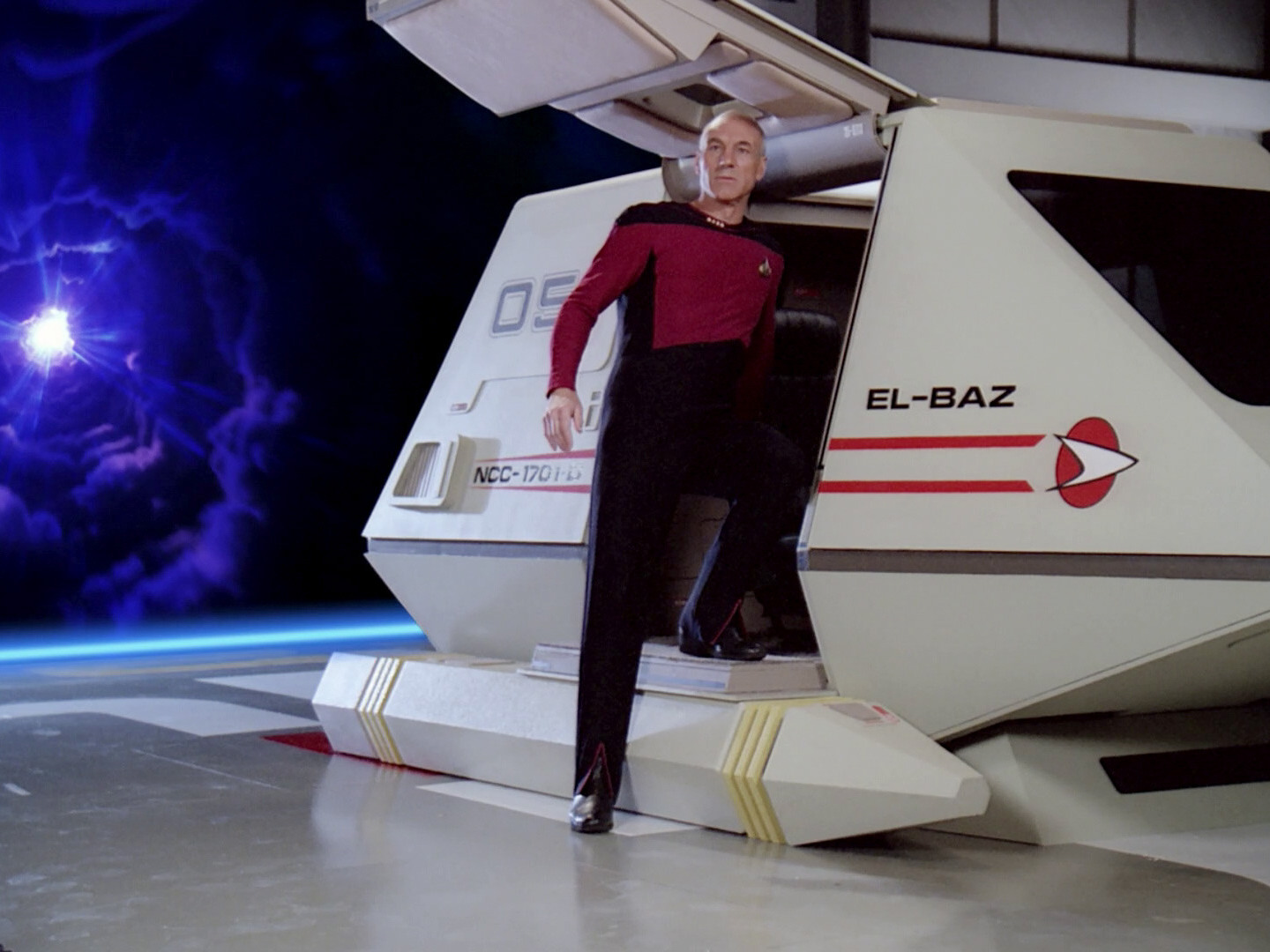
Stardate 42679.2: The Enterprise salvages a Starfleet shuttlepod, aboard which a comatose second Picard is found. The records from the shuttlepod reveal that it was launched from the Enterprise six hours into the future, and that the Enterprise was subsequently destroyed with all hands in a giant vortex. As the time of his departure approaches, the second Picard slowly recovers. The vortex appears as predicted, and the "present" Picard orders to hold position. Energy bolts attack Picard, insinuating that there is an intelligence urging him to leave the ship. When his double tries to leave the ship for exactly this reason, repeating what he already did, Picard decides his departure will only perpetuate the cycle and shoots him with a phaser. He then orders a full-speed course directly into the vortex, upon which the shuttle and his future self disappear and everything is back to normal.
Review
If we neglect "We'll Always Have Paris" with its small temporal "hiccups", it is "Time Squared" that shows us the first time travel incident in modern Trek. Compared to the countless time travel stories in later episodes and especially on Star Trek Voyager, the story development of "Time Squared" is rather slow. This is both a blessing and a curse as we are watching it today. It is very pleasant on one hand to see the perplexity and also the sense of wonder as the crew is confronted with the mystery of the second Picard. In later seasons of TNG and especially on Voyager such phenomena were close to becoming the crew's daily business. On the other hand, "Time Squared" is written a bit like it were the first time travel episode ever. It does not take into account that the phenomenon is well-established for a whole century (and retroactively even for two centuries) and is being taught at the Academy. The crew should be much more familiar with temporal mechanics and the possibility of paradoxes while they may still ponder about what exactly caused the anomaly in this particular case.
Regarding the other Picard's state of shock and the difficulties to read out the information from the shuttle, it is clear that this is primarily a ploy to keep the situation obscure. Well, there is no precedent of such an effect of time shifts in Star Trek. And while I concede that the fact that the second Picard is disabled successfully keeps up the suspense, it is exasperating how the camera repeatedly zooms into his contorted face.
I have a big problem with Picard anyway in this episode. Our Picard is unusually hostile towards the Picard from the future. He doesn't accept the second one's mere existence, and he treats him with great disrespect: "Except for his features, there is nothing about him that I find familiar." Well, we may say that, in some fashion, Picard is just being hard on himself, but at no point of the episode he considers the possibility that the other Picard may have the right to stay where he is if he wants to. It is an ethically questionable idea that towards the end Picard kills his ill-fated counterpart. The latter suffers from an irrational urge to repeat his error, but it would have been absolutely sufficient for our Picard to hold him back, for "the cycle must end", as he recognizes. What happened to phasers on stun? Ironically, after changing the timeline in this direction, the other Picard disappears anyway together with the shuttle. But rather than justifying Picard's killing of the other Picard, this only underlines that he acted prematurely and overall imprudently - and perhaps with a good deal of personal motivation to get rid of his disagreeable alter ego?
What I like about "Time Squared" despite all the criticism is the basic idea. Time travel does not always have to span many centuries; it may be just as interesting to throw a crew member no more than six hours to the past, where they may or may not repeat their decisions from another time frame. Also, the episode creates a quite eerie atmosphere, which is enhanced by a remarkable score.
Annotations
- Continuity: Riker talks about his father for the first time, whom he will meet him for the first time in many years in the following episode.
- Nitpicking:
- Why should the second Picard (and the second shuttlepod for that matter) be affected in any way as the past catches up with the time he departed from? Whatever is responsible for biological and electronic systems being out of phase, the phase shift remains the same as long as they remain in the wrong time frame. There is no such effect in other episodes, only a weak similarity to TOS: "All Our Yesterdays".
- Riker notes that accelerating beyond Warp 10 would enable time travel, which seems to imply that infinite speed is possible. More precisely, he states that this constitutes the only known method of going to the past, which is not true for all we know from countless time travel episodes. Anyway, if we believe him and anything beyond Warp 10 is equivalent to time travel, we may interpret it in a way that attaining exactly Warp 10 may be still impossible. Beyond Warp 10 the speed of a ship becomes undefined within the bounds of our space-time, because speed as a physical quantity always requires a fixed time frame that doesn't exist during a time travel.
- Remarkable quote: "Well, they say if you travel far enough you will eventually meet yourself. Having experienced that, Number One, it's not something I would care to repeat." (Picard)
- Remarkable background fact: In the original story Q would have been responsible for the anomaly. A lot is apparently left over from this first draft, including Riker's and Picard's suspicion that an intelligence may have created all this, Troi's sensing of a consciousness inside the vortex and finally the personal attacks on Picard in the form of energy beams. I think all this ought to have been removed or toned down, because after all the speculation and the cues it is rather disappointing that we never learn who created the anomaly and for what purpose. It better would have been a conventional "natural" phenomenon.
Rating: 6
The Icarus Factor
Synopsis

Stardate 42686.4: Will Riker is offered the command of the USS Aries. The civilian adviser who is going to brief him turns out to be his father Kyle who he hasn't seen in fifteen years. Will accuses Kyle of being guilty of his mother's death, and the fact that Kyle almost married Dr. Pulaski doesn't exactly console Will. Meanwhile Wesley, Geordi and Data wonder why Worf is so tense recently. They find out that he missed an important Klingon ritual and they program this scenario on the holodeck. Will and Kyle manage to settle their problems in an anbo-jyutsu match, and Number One eventually decides to stay on the Enterprise.
Review
I don't care much for "The Icarus Factor" because this episode creates various personal problems out of the blue. And it does so in the fashion of soap operas, involving nearly everyone of the cast (except Picard) instead of focusing on the essence. I sometimes complain that some of the main cast should be given a bigger part in the story, but I certainly didn't mean it that way. Most obviously, in order to tell the story of Riker's falling-out with his father, it would have sufficed to let the two carry out their conflict, with Riker seeking advice perhaps from Deanna and from Worf. I just don't see a good reason for the plot contrivance that Dr. Pulaski is Kyle Riker's ex-lover.
I don't like Kyle Riker anyway. He's a very socializing person (he seems to know everyone on board, not just Pulaski, and is shaking hands all the time) and at the same time very patronizing and manipulating too. The illegal maneuver that Kyle Riker uses in the anbo-jyutsu match and that Riker failed to noticed as a child is symptomatic of the latter traits. Overall, despite the sentimental scene in which Kyle Riker admits that he loves his son his character remains unlikable and doesn't qualify for a return to the series, if that was the writer's intention.
The B-plot about Wesley's attempts to cheer up Worf is rather lame per se. But while it may have made a nice small addition to any other episode, it loses significance because it only mirrors what happens in the A-plot about Riker and his father. Riker and Worf both suddenly suffer from some sorts of previously unmentioned childhood traumas independently of each other, and both resolve it in a painful ritual. It is just too contrived to be enjoyable.
Annotations
- Continuity: This is the first of several offers of captaincy that Riker turns down.
- Remarkable quote: "You wouldn't be running for mayor, would you?" (Dr. Pulaski, as Kyle Riker is shaking hands with half the people in Ten Forward)
- Remarkable joke: Pulaski's treatment against flu includes PCS, "Pulaski's Chicken Soup".
- Remarkable facts:
- Will Riker's mother Betty died when he was two years old. Kyle Riker raised his son in Alaska, but deserted him when the boy was fifteen. Twelve years ago, Kyle Riker was the only survivor of an attack on a starbase.
- After she and Kyle parted ways, Pulaski was married and divorced three times.
Rating: 2
Pen Pals
Synopsis
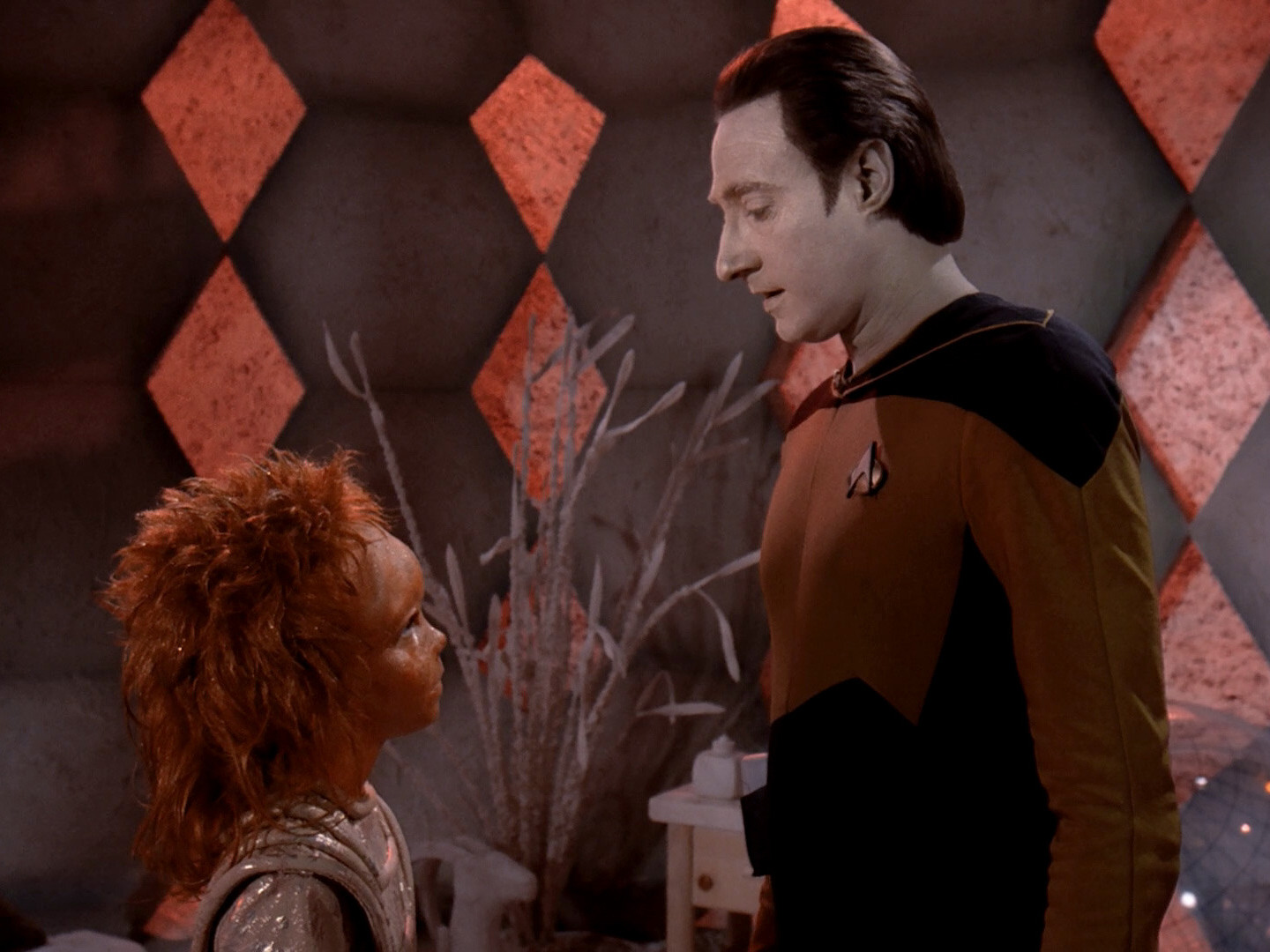
Stardate 42695.3: As a test of his leadership skills, Wesley is ordered to assemble a team of older crewmates to investigate unusually strong geological activities on the planets in the Selcundi Drema sector. In the meantime Data, in defiance of the Prime Directive, has answered to a transmission from a girl named Sarjenka on the unstable planet Drema IV. Picard reluctantly agrees to help the girl and her civilization but orders Data to sever the contact. Yet, when Sarjenka can't stay at home any longer Data eventually brings her aboard the Enterprise. Wesley and his team devise a plan to eliminate the tectonic stress in the dilithium deposits that are about to tear the planet apart. After they have succeeded, Picard has Dr. Pulaski erase all memories of Data and the ship from Sarjenka's brain.
Review
"Pen Pals" is an unusual episode because it involves several members of the cast personally without becoming trifling the way it happened most recently in "The Icarus Factor". It is ironical that of all crew members Data is the one whose interest in the Drema system goes beyond the cold investigation of an astrophysical phenomenon, the one who cares for the people and not just for the scientific mission and for the letters of the Prime Directive. It is an appreciable new development that of all crew members he receives the most support from Dr. Pulaski, the woman who initially called into question that he could possibly be more than a machine.
On the downside, while Geordi and Deanna are with Data, Worf, Riker and Picard are more concerned with the Prime Directive than with the people who would die without their interference. Especially Picard is not just worried but occasionally downright annoyed by the fact that he has to tend to an alien civilization whose fate he could otherwise disregard. The stance put forward in "Pen Pals" is that the Prime Directive forbids any interference with alien cultures, even if those aliens would otherwise die. This seems to go as far as any help for them is not permissible, even if they wouldn't notice it. As Riker expresses it, if the Dremans are perishing it is their fate, it may be a part of a "cosmic plan". However, since the concept of a "cosmic plan" can hardly constitute a part of the Prime Directive, Riker's opinion is nothing more than a convenient excuse in the best case, and an arrogant blend of Darwinism and religion in the worst case. It is also pretty one-dimensional for someone who otherwise thinks out of the box. Fortunately, the crew eventually don't obey the Prime Directive up to this ultimate callous consequence in "Pen Pals". They will do so in "Homeward" in the seventh season though.
Wesley too is quite personally involved when he is put in charge of a team in which everyone is older and more experienced than he is. While Wesley's story seems to start off as the A-plot, it subsequently gets subordinated to the one about Data and his contact to Sarjenka. I think it was a good decision to shift the focus because as much as this mission matters for Wes, it just isn't relevant enough for an A-plot.
Annotations
- Inconsistencies:
- Quadrants, sectors and planetary systems repeatedly get mixed up in this episode. At the beginning Picard speaks of the "Selcundi Drema sector" in his log entry. Later, albeit just in one instance, Riker mentions the "Drema quadrant". Well, prior to "The Price" the distinction of "sector" and "quadrant" was not yet clear-cut, but the two terms shouldn't be equivalent either, so what could be the difference here? To add to the confusion, the Enterprise investigates three star systems in the sector and/or quadrant. The first one is called "Selcundi Drema" just like the sector (which is absolutely possible), the name of the second one remains unmentioned. When they are in the third system (where Sarjenka lives), it too is called "Selcundi Drema" or simply "Drema". I was only waiting for a dialogue like this one: "Wesley, we have completed our survey of Drema" - "Completed? We've still got two solar systems to go in the Selcundi Drema sector." - "I mean the system, not the sector." - "Oh, I see. But which Drema?" - "Selcundi Drema" - "Uhm, wasn't that the one of last week?" - "No, not that Selcundi Drema but this one." - "Why don't you tell me sooner you mean Drema." - "Yes, sir. I will make clear that I mean Drema next time." While the actual designation of the star system may be longer and I understand the trend to shorten it in verbal communication, a numeral, Greek letter or something ought to be a part of the short name.
- The fact that "Drema IV has the largest deposit of dilithium ore ever recorded" may explain why this one planet is breaking up. But can the same apply to all planets in the whole sector? Hardly.
- Continuity: We can see Picard ride a horse in the holodeck in this episode. In "Starship Mine", when Picard is alone on the ship to get his saddle, he runs into the terrorists. Picard will ride again in "Generations".
- Remarkable dialogue: "You did a good thing, Data." - "But are we doing a good thing now, Doctor?" - "This is to protect her as much as us." - "By robbing her of her memories?" - "To remember you and this ship would complicate her future. She has to be the person she was born to be. And you'll remember." (Pulaski and Data, when she is going to remove Sarjenka's memories)
- Remarkable scene: When Data takes the still unconscious Sarjenka, who wouldn't be able to remember him, back to her home, he leaves behind the Elanin singer stone.
- Remarkable prop: We can see the oscillation overthruster from Buckaroo Banzai in the first of its many appearances on Star Trek.
- Remarkable fact: Andorian zabathus and Klingon sarks are animals similar to Earth's horses.
Rating: 5
Q Who
Synopsis
Stardate 42761.3: Angry about being denied a crew post, Q hurls the ship 7000 light-years away into unknown space where they encounter a new enemy - the Borg. It becomes obvious that the Borg were responsible for the destruction of the outposts along the Neutral Zone - as well as of Guinan's homeworld a hundred years ago. The Enterprise is intercepted by a huge cube-shaped Borg vessel. A Borg beams onto the Enterprise. Worf has to adjust the phaser to maximum and kills the Borg, but a second one appears with a shield that is impervious to his phaser. Eighteen of the crew are killed when the Borg cut out a piece of the hull. The Enterprise manages to damage the cube and beam over an away team to examine the humanoid-cybernetic species, but the cube begins to regenerate quickly and resumes the fight. When the shields are down and the situation becomes hopeless, Picard asks Q to take the ship back to Federation space.
Review
At the time "Q Who" was produced TNG was in need of a new principal enemy. The Klingons were not available any more because they had become allies of the Federation. The Romulans may have been deemed not alien enough. The Ferengi had turned out to be rather amusing than threatening. Also, none of the (too many) aliens-of-the-week would have had the potential to become permanent adversaries. It almost seems that the producers of the series are speaking through Q when he announces the upcoming first encounter of the Enterprise with the Borg: "You judge yourselves against the pitiful adversaries you have encountered so far. The Romulans, the Klingons. They are nothing compared to what's waiting."
Q doesn't promise too much. The Borg are unlike any other race encountered by the Federation so far, although many of their characteristics were already commonplace in science fiction at the time the episode was made. In particular the idea of a hive mind that everyone is connected to was quite fashionable in the 1980s, at the dawn of the cyberspace age.
I cherish "Q Who" as a pivotal episode that introduces a new enemy that is a well-known part of the legacy today, and TNG's arguably most notable innovation to the franchise besides the holodeck. On the other hand, I am a bit disappointed with the story. Sonya Gomez may look cute, but after the nervous ensign pours her chocolate on Picard's uniform we see her just one more time. Well, if she were a TOS character, she would probably die a useless death in the course of the episode. Likewise, there is no point in Guinan knowing Q and being able to sense his presence, as this isn't resolved in any fashion, and their banter in Ten Forward is rather silly.
There could have been overall more action and at least more motion, considering that the Enterprise runs into what is slated to be a major enemy. But the encounter with the Borg is unhurried, almost stagnant for much of the time. For instance, the crew are watching almost placidly what the intruder in engineering is doing, even as the Borg begins to access the ship's computer.
Annotations
- Continuity:
- "Q Who" reveals what happened to the destroyed outposts mentioned in TNG: "The Neutral Zone". The Borg removed any kind of technology from the surface.
- Co-executive producer Maurice Hurley had originally planned the Borg to be insectoid, but that idea was abandoned due to budget restrictions. Had the Borg been insectoid, the neural parasites in "Conspiracy" would have been the harbingers of the Borg invasion.
- "Q Who" introduces most of the familiar Borg hallmarks. Borg ships are cubes with thousands of alcoves. They act as a collective mind. They have adaptable personal shields. They disregard intruders. Also, we can see the characteristic green graphics and the "claw" emblem for the first time. However, there are also a few facts about the Borg that would be revised or reinterpreted in later episodes. In "Q Who" the concept of assimilation is not yet established. The impression is created that all Borg are born as fully humanoid, and that they are not interested in lifeforms but only in technology. Also, the Borg ship in "Q Who" has the ability of rapid self-repair, unlike those on Star Trek Voyager.
- The Borg invaded the star system of Guinan's people a century ago. This story will be picked up in "Star Trek Generations".
- Nitpicking: When Riker is on the Borg ship and sees that the crew is alive, he reports to Picard, "Our readings were incorrect. The Borg crew survived." But this makes no sense, considering that the Enterprise didn't detect any lifesigns on the Borg vessel even before the combat.
- Remarkable quote: "If we all die, here, now, you will not be able to gloat. You wanted to frighten us. We're frightened. You wanted to show us that we were inadequate. For the moment, I grant that. You wanted me to say I need you. I need you!" (Picard)
- Remarkable scene: There is one particularly impressive shot in which the camera zooms out, and the small balcony with Riker, Worf and Data is extended with a matte painting of the Borg ship's massive interior.
- Remarkable ship: The Borg cube is among the most iconic ships of the whole franchise, despite of just because of its extremely simplistic shape. It is also very impressive on the inside.
- Remarkable absence: Dr. Katherine Pulaski does not appear in this episode.
- Remarkable facts: Q throws the Enterprise into a region near the system J-25, 7000 light-years away, from where it would take 2 years, 7 months, 3 days, 18 hours to reach Starbase 185 at maximum warp.
Rating: 7
Samaritan Snare
Synopsis
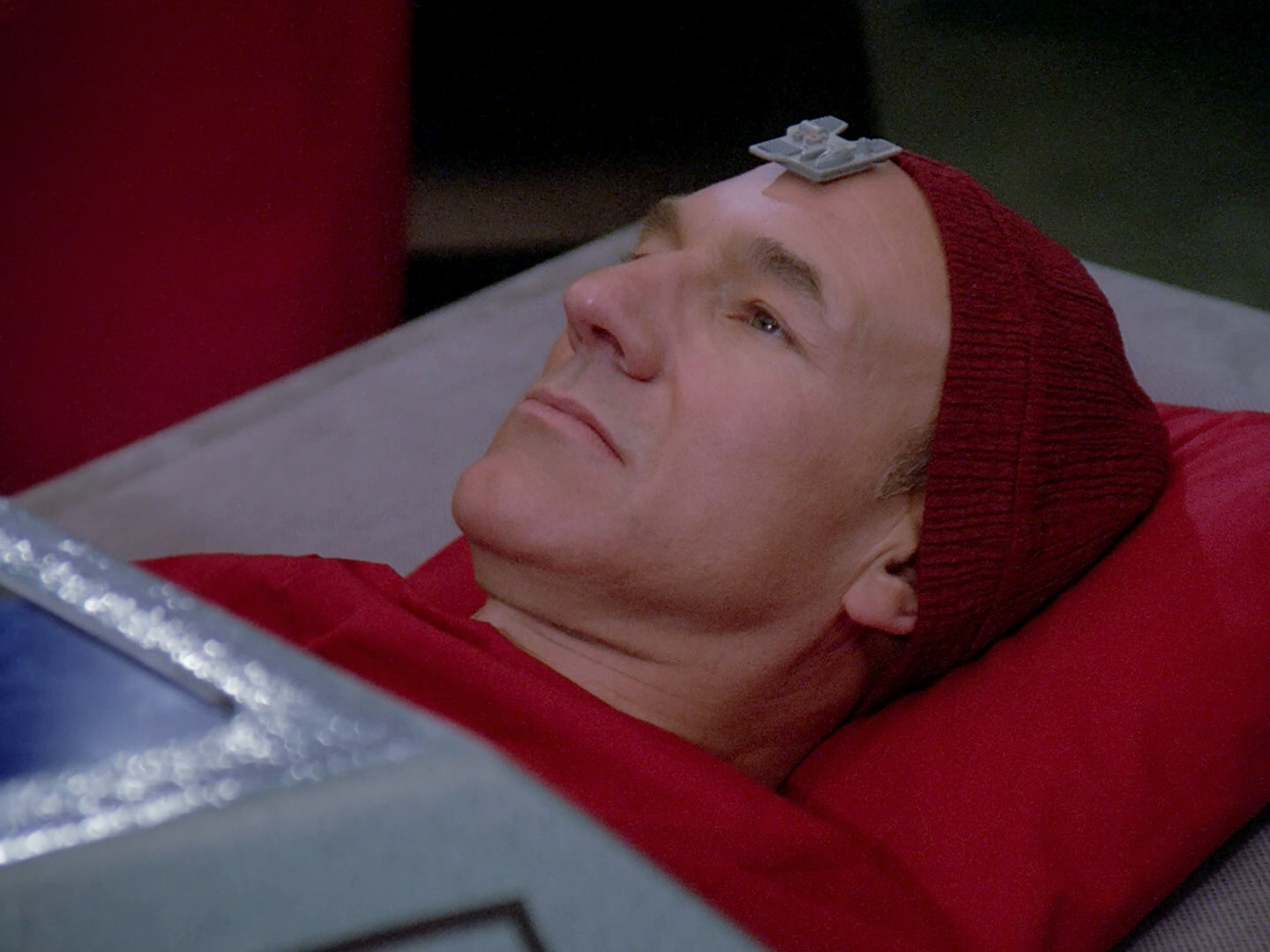
Stardate 42779.1: Picard joins Wesley on a shuttle ride to Starbase 515, where the boy is taking another exam for Starfleet Academy. Picard hesitates to tell Wesley the reason why he is going there - it is time to replace his malfunctioning artificial heart. He lost his natural heart in a fight with Nausicaans as a young ensign a long time ago. Meanwhile, the Enterprise encounters the Pakleds, a seemingly simple-minded race. However, they kidnap Geordi after he has beamed over to repair their ship. While Riker is still negotiating with the Pakled, he learns that Picard's situation is critical. He uses a ruse to get Geordi back, and the Enterprise rushes to Starbase 515 so that Dr. Pulaski can save Picard.
Review
This episode begins with a rather nebulous discussion between Picard and Pulaski, who mentions a "replacement" that Picard is going to get at Starbase 515. For quite a while the viewer is kept in uncertainty as to what they are talking of, which is quite untypical of Star Trek. I must say that I like the little mystery, and the irony that Picard speaks out on his cardiac implant to Wesley of all people. The two are an interesting pairing, not because Picard generally dislikes children but because Wesley is exactly the serious and disciplined young man that Picard would like to have been in retrospect. The young man who wouldn't have got himself into trouble and who would still have his natural heart instead of a malfunctioning cardiac implant. This all is worked out quite nicely, and the chemistry between the two is amazing, considering that the most remarkable thing Picard said to Wesley so far was the infamous "Shut up, Wesley!"
The other thread doesn't work so well, and this is not chiefly because of some gaping plot holes (see below). Most of all it irritates me that Riker is totally overwhelmed by the situation of Geordi being kidnapped by the Pakleds, and so are his fellow officers Troi, Data and Worf. They are clueless and they contribute hardly any useful suggestions. They don't listen to each other and they have conferences to absolutely no end (Data: "We are faced with an impossible conundrum." WTF?). Fortunately Geordi's resourcefulness compensates to some extent for the obvious weakness of his crewmates, even if the eventual solution to pretend to have armed the photon torpedoes that the Pakleds couldn't possibly have doesn't make sense.
Overall, "Samaritan Snare" is an unusual blend of a character building episode and a thriller, the latter part of which isn't quite convincing.
Annotations
- Nitpicking:
- If he's so much smarter and they wouldn't really notice what he is doing, why doesn't Geordi focus his attempts on bringing down the Pakleds' shields? And instead of pulling off the silly "crimson field" maneuver (an awkward homage to "The Corbomite Maneuver"), why doesn't Riker simply locate the shield emitter or any other important system and disable it with a phaser blast as soon as the Pakleds believe Geordi is on their side?
- Do the Pakleds really have photon torpedoes that Geordi would be able to prepare for launch? It seems so, because in the end he says that he actually disabled them. But if this is so, how could anyone know they had the torpedoes in the first place? The scans of the Pakled ship, while the shields were not yet up, explicitly revealed no advanced weaponry.
- In a passing remark Wesley says that at some point several years ago the Klingons joined the Federation, which is confirmed by Picard.
- Considering that there is a mortality rate of 2.4% for cardiac replacement operations after all, why isn't Starbase 515 prepared for the eventuality?
- Continuity: Picard was a young ensign on leave, spending some time at the Bonestell Recreation Facility on Starbase Earhart when he provoked three Nausicaans to a fight, in the course of which his chest got impaled by a blade weapon, upon which his natural heart had to be replaced with a cardiac implant. This whole back story will be picked up and visualized in TNG: "Tapestry", adding the dom-jot game as the actual reason for the whole trouble. Considering that Picard speaks of himself as "an undisciplined, loud-mouthed, opinionated young man", Q will give him the chance to change his life for the better in "Tapestry".
- Remarkable quotes:
- "Everyone knows. You don't like kids. That's too bad. You'd have made a good father." (Wesley)
- "We are looking for things - things that make us go." (Grebnedlog)
- Remarkable dialogue: "You think we are not smart." - "I think you need to continue to develop." (Grebnedlog and Riker)
- Remarkable ship: The Pakled ship Mondor is the first of several appearances of a new miniature of a "generic primitive vessel".
- Remarkable facts: Picard was never married and has no children.
Rating: 4
Up the Long Ladder
Synopsis
Stardate 42823.2: After receiving a distress call as it was in use in the 22nd century, the Enterprise rescues 200 Bringloidi colonists, who are maintaining a very simple lifestyle, from a planet threatened by solar flares. The crew learns of a second group, the Mariposans who came from Earth together with the Bringloidi almost 300 years ago, but settled on a different planet. The Mariposan colony entirely consists of clones of the five only people who survived the ship's crash landing. As the Mariposans suffer from replicative fading after several generations of clones, they need fresh DNA and clone Riker and Pulaski without their consent. The two officers are upset, and they decide to kill their clones. Picard finds a solution by bringing the two colonies together again: the Bringloidi with their diversity of DNA and the Mariposans with their advanced technology.
Review
There are so many reasons to dislike "Up the Long Ladder" that I don't know where to start. The first annoyance is that the episode harks back to a very unfortunate cliché from The Original Series. The rushed resolution of bringing the Bringloidi and Mariposans together creates the impression that the galaxy -alien civilizations and forgotten human colonies alike- is only waiting for the Enterprise to bring order to their miserable lives. And worse, that the Enterprise captain and crew are entitled to make swift yet irrevocable decisions without giving themselves and the people whom it concerns the due time to consider the consequences.
The whole setting is extremely contrived anyway. On one hand we have the backward and untidy Bringloidi. They may have been supposed to be charming but essentially they illustrate how much progress humanity has made in the meantime, not unlike the savage Post-Atomic Horror crowd in "Encounter at Farpoint". On the other hand there are the Mariposans, a civilization obsessed with technology, so much that they prefer cloning over natural reproduction. Granted, they are only trying to preserve their culture but their lifestyle comes across as quite undesirable nonetheless.
But what are the reasons for the rushed resolution to bring these two extremes together? Let's listen to the experts. Troi: "They [the Bringloidi] have the energy and drive, and the clones possess the emotional maturity and the technological knowledge." Oh well. So the big Federation can't supply the Bringloidi with technology, or the Mariposans with immigrants? Picard: "They started out together. It seems only fitting they should end up together." Now that is what I call brilliant logic. The fact that they once happened to be on the same ship certainly outweighs 300 years of separate history. Pulaski: "It's a match made in heaven." Yeah, it is their destiny, it can't be wrong. Seriously, this may be the single most stupid attempt to solve a problem not just of TNG but of all Star Trek. And even if we ignore the alarming naivety of the arguments put forward, it doesn't make any sense. The average of two wrongs doesn't make a right. You don't get a viable society (or one that the Enterprise crew or Starfleet deems viable) by just taking the best of the Bringloidi and of the Mariposans.
The episode also brims over with clichés about the Irish (you know, those untidy red-haired folks who are singing or drunk all the time or preferably both at once), so much that it is on verge of being racist. The whole idea of a 22nd century philosophy of a simple life would have been much more credible anyway without all the folklore, and instead of that with something more like modern hippies.
On a positive note, I really like that not only Riker (from whom I would expect it) but also Picard can still laugh about their strange encounter with the primitive Bringloidi who turn the cargo bay into a stable and fireplace. Riker, on the other hand, doesn't hesitate a second to hit on the "savage woman" while he is apparently on duty. "As the First Officer, I feel it's my responsibility to show you all the amenities." How pathetic!
I like the idea to comment on the practice of cloning. However, it takes as long as 27 minutes until the episode arrives at this important point and Pulaski discovers that the inhabitants of Mariposa are all clones. Everything essential happens in the following 8 minutes: the Mariposans' request to take tissue samples of the Enterprise crew, the outright refusal of that request, the kidnapping of Riker and Pulaski, the revelation that samples were taken from them against their will, the killing of the clones. The story simply has no time to unfold.
The arguably worst failing of the episode is that Riker, with Pulaski's consent, cold-bloodedly kills the clones. He kills living sentient beings that are most definitely protected by laws of the Federation, irrespective of their stage of development. And even if the "right to exercise control over our own bodies" that Riker cites constitutes a special case (a bit like abortion), it is still a crime to simply pull the trigger. Speaking of abortion, I am well aware that the ramifications of the story make it look like a comment on abortion, although it probably wasn't meant to be one. There is an additional reason why I find Riker and Pulaski's course of action appalling, considering that in "Unnatural Selection" she was still fascinated with the genetically engineered überchildren. It is very hypocritical of her to be opposed to genetic engineering only when she is personally concerned.
On a final positive note, I dig the interaction between Pulaski and Worf when she lies about his embarrassing condition (a childhood illness) and Worf thanks her with a Klingon tea ceremony. I only think that Pulaski goes to way too far when she drinks the poisonous tea. What if the antidote that she takes didn't work immediately and well enough?
Annotations
- Nitpicking:
- Promiscuity? Polygamy? Condoned by a society that is otherwise obsessed with keeping up a traditional Irish(-Catholic?!) lifestyle? Come on!
- "European Hegemony"? Would a union of European states really choose "hegemony" as a part of their official name? That's totally unthinkable. "Hegemony" means military or economic domination, and as such carries an extremely negative connotation.
- If the Mariposans need fresh blood, why don't they simply allow immigrants? They could pick the best ones, because that is what they really want and perhaps need. As Pulaski repeatedly states, cloning is not a viable method of reproduction, and getting additional clones will only postpone the problem.
- Remarkable dialogue: "I did not faint. Klingons do not faint." - "Excuse me, I'll rephrase. This Klingon suffered a dramatic drop in blood pressure, his blood glucose level dropped, there was deficient blood flow resulting from circulatory failure. In other words, he curled up his toes and laid unconscious on the floor." - "Doctor, there is no need to insult me." (Worf and Pulaski)
- Remarkable facts:
- The "European Hegemony" was "a loose alliance formed in the early part of the 22nd century. It was the first stirrings of world government."
- Rop'ngor is a Klingon childhood illness roughly comparable to measles.
Rating: 1
Manhunt
Synopsis
Stardate 42859.2: While ferrying two Antedian delegates who are in stasis, Picard has the special honor to welcome Lwaxana Troi once again. As is this were not unpleasant enough, she is presently in her "phase", a midlife period in which her sexual instinct is quadrupled or more. While Picard is lucky to escape to his Dixon Hill holoprogram, Lwaxana goes looking for other "victims" among the crew. She finally discovers the holodeck, where she mistakes bartender Rex, the only one who welcomes her advances, for a real person. Disappointed about the lack of passion on the ship, Lwaxana calms down again. She uses her telepathic abilities, and just when the Antedean delegates are going to be beamed to the conference, she casually points out that they are assassins.
Review
The qualities of "Manhunt" clearly don't lie in the plot but in the multitude of funny situations that it invokes. Actually, the story of Lwaxana Troi seeking sexual fulfillment is so incredibly meager that only the jokes keep it alive. And the side plot about the Antedean assassins is so gratuitous that we can forget about it anyway. It merely serves to give Lwaxana a reason to be on the ship in the first place, and to conclude the episode in a way that she leaves after having accomplished something aside from stirring up trouble among the male crew members.
That said, I have to concede that "Manhunt" is funny in spite of everything. To some extent the humor picks up themes that are already known from "Haven" (the heavy suitcase, the chimes during a Betazoid dinner, the traditional Betazoid wedding where everyone is naked), thereby turning them into running gags.
What I like most about "Manhunt" is that the story (as thin as it may be) works with the characters and doesn't turn them into caricatures just for some additional laughs. They all react to Lwaxana Troi just as we can expect them to do. Picard remains composed and discreet despite the absurd situation that he is faced with. He is visibly annoyed by Lwaxana Troi's open advances though, but he uses his prerogative as the ship's captain to make himself less available, whereas he orders his crew to treat Lwaxana Troi with the due respect. As already in "Haven", Deanna Troi loses her emotional balance because of the mere presence of her mother (well, and because of their frequent telepathic debates), and she is more than glad when her mother eventually leaves without having married anyone. Riker's role is particularly interesting to observe, as Lwaxana Troi's presence amuses him at first. But he keeps smirking only until he himself becomes the target of her advances and is accordingly baffled. Overall, the portrayal of the Lwaxana Troi's "victims" is decent and in character in spite of the farcical story, and this once again includes Majel Barrett-Roddenberry in her role as Lwaxana Troi herself.
Annotations
- Continuity: Lwaxana Troi evidently doesn't know what a holodeck is. She is surprised and upset that Rex is only a hologram although the computer explicitly told her where she was going. Star Trek Voyager, on the other hand, will insinuate that the technology has been around for many years. Well, Troi is technophobic anyway as she isn't familiar with the turbolift either and doesn't like to be beamed.
- Remarkable dialogue: "It's only at midlife that a Betazed female becomes, well, fully sexual, if you know what I mean." - "Yes, I think I do. I also think that I saw the captain on his way to her quarters." - "I wonder if I shouldn't warn him?" - "No. As ship's doctor I'd consider it an excellent exercise for his reflexes and agility." (Deanna and Pulaski)
- Remarkable quote: "Delegates? Last time I saw something like that, it was being served on a plate." (Lwaxana Troi, about the Antedians)
- Remarkably hilarious scenes:
- When Picard wisely declines to carry Lwaxana's suitcase (that he was hardly able to lift in "Haven"), Riker volunteers and has a hard time just like previously Picard.
- When Picard hands Mr. Homn a bottle as a gift for Lwaxana Troi, Homn empties it in one gulp much to Picard's chagrin.
- When the dinner with the sexually aroused Lwaxana becomes unpleasant, Picard calls Data to the rescue and feigns interest in the android's "anecdotes", such as on "the anomalous chemical composition of brown dwarf stars".
- Remarkable appearance: Mick Fleetwood of Fleetwood Mac plays one of the two Antedeans.
- Remarkable absence: Geordi La Forge is not in this episode. But Mr. Homn alludes to him as Lwaxana Troi's next "victim" when covers his eyes with his hand.
Rating: 3
The Emissary
Synopsis
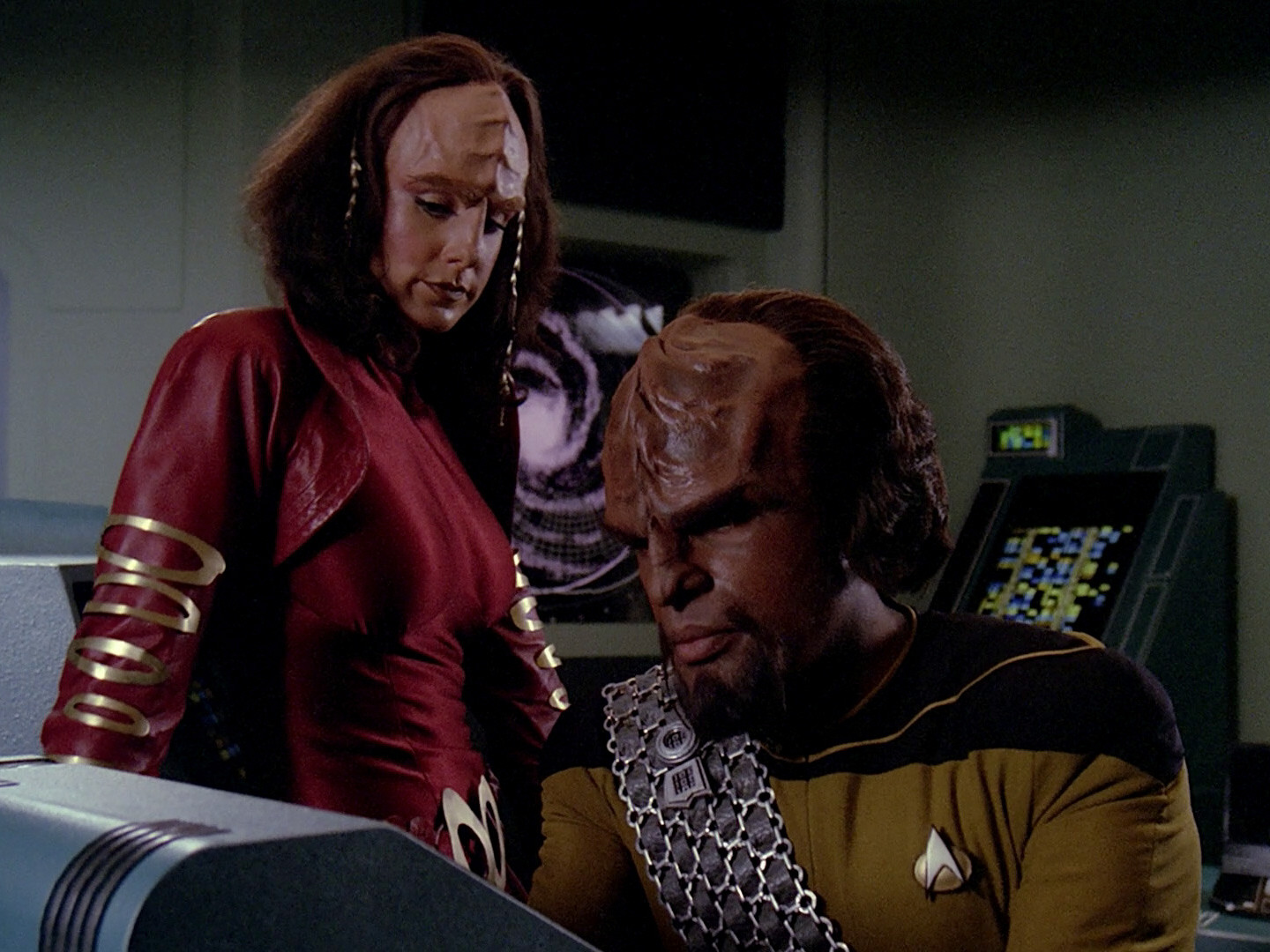
Stardate 42901.3: The Enterprise is ordered to rendezvous with a special emissary, who travels in a modified probe to save time. The half-human and half-Klingon emissary K'Ehleyr is on a mission to stop an old Klingon sleeper ship whose crew is not aware of the Klingon-Federation alliance in the 24th century. She turns out to be a former love of Worf's. Worf is reluctant at first, but the two surrender to their passion after a holodeck battle simulation. K'Ehleyr, however, refuses Worf's traditional marriage proposal. When the crew of the old Klingon cruiser awakens and the alternative would be to destroy the ship full of warriors who were raised to hate the Federation, Worf and K'Ehleyr act as the Enterprise's highest ranking officers, thereby suggesting that the Klingon Empire is the dominating force.
Review
"The Emissary" is the first TNG episode to involve Worf really personally. But other than adding to the lieutenant's history and enhancing the potential of his character the story doesn't really convince me.
Neglecting Worf's personal issues with K'Ehleyr for a moment, it is a cookie-cutter story. We've got another generic representative of Starfleet (who for some reason are quite often civilian just like recently Kyle Riker). K'Ehleyr comes aboard the ship on a special mission and unsurprisingly her views don't match those of Picard and his crew. There are controversial debates, the tactics that are being developed don't work out and eventually an improvised trick resolves the situation, rather than anything elaborated so far. This just isn't satisfying, especially since K'Ehleyr doesn't contribute anything to the solution in the end; she just sits there and lets Worf act as the ship's Klingon captain. It does a disservice to K'Ehleyr's character, because only generic jerks are usually ignored or outsmarted by the crew like this. And regarding the idea to transfer K'Ehleyr to the Klingon ship, I wonder what would happen if they found out that she was only half Klingon. Overall, this whole plot isn't very well considered.
K'Ehleyr's interaction with Worf is clearly the more interesting part of the story, but it doesn't come across as fully credible either. It doesn't feel quite right that the arguments between K'Ehleyr and Worf are so human. The reproaches and the way they are shouting at one another rather remind me of a human couple than of Klingons. Although she says to Deanna that due to her Klingon nature she often loses her temper, K'Ehleyr remains comparably composed all the time, the only real exception being when she smashes the glass table. Eventually on the holodeck there is something "wild" in her interaction with Worf the way we would expect it, irrespective of the sexual arousal. On the other hand, it is pleasant to watch K'Ehleyr and Deanna, not just because there is a good chemistry between the two but also because it calls forth K'Ehleyr's uneasy and vulnerable side that she tries to hide from Worf and everyone else. It is only a bit disappointing that her talks with Troi are not wrapped up in any fashion in the end.
Annotations
- Continuity:
- We can see Worf's "calisthenics" program from "Where Silence Has Lease" again.
- In "Reunion" K'Ehleyr will appear again, accompanied by her and Worf's son Alexander, who was obviously conceived on the holodeck in "The Emissary".
- Remarkable costume: I'm glad that for Worf K'Ehleyr changes from the ugly gray sack into the far more attractive brown leather jumpsuit.
- Remarkable ships:
- K'Ehleyr travels in a modified class-8 probe, actually a probe using the same casing as a photon torpedo.
- The K't'inga-class cruiser T'Ong is stock footage from "Star Trek: The Motion Picture", with new disruptor blasts added.
- Remarkable appearance: Suzie Plakson, who plays K'Ehleyr, previously appeared as Selar in "The Schizoid Man".
- Remarkable facts:
- The Boradis sector was colonized only recently. The first outpost was erected on Boradis III 34 years prior to the episode.
- The T'Ong went on a mission with an unknown goal over 70 years ago, with the crew in cryogenic sleep.
Rating: 4
Peak Performance
Synopsis
Stardate 42923.4: A simulation arranged by the arrogant Zakdorn strategist Kolrami is supposed to increase the crew's battle readiness. Riker and a skeleton crew change to the 80-year-old and largely defunct USS Hathaway to "fight" against the Enterprise. With the help of Wesley, who smuggles an experiment with antimatter off the Enterprise, Riker has warp power available for just two seconds. A Ferengi ship unexpectedly appears and threatens the two ships, whose weapons are disabled. Riker and Picard use a ruse to get rid of the Ferengi: The Enterprise fires a torpedo and in the very same moment the Hathaway jumps to warp, creating the illusion that the old ship was destroyed. Puzzled about Picard's brutal action, the Ferengi leave the scene. Data, who was initially unexpectedly beaten by Kolrami in a game of strategema, challenges the Zakdorn again. The android now plays the game not to win but to counter all of his opponent's actions, who grows weary and eventually gives up.
Review
When I first watched "Peak Performance" many years ago, the war game, the skirmish with the Ferengi and its surprising resolution was the thing I liked most about the story. However, in more recent years I have come to appreciate the excellent character studies during the preparations in the first 30 minutes, rather than the action in the final 15 minutes.
Perhaps most notably the story spotlights Data's becoming human when he experiences a loss of self-confidence after losing to Kolrami in a game of strategema. As Dr. Pulaski states, "The effects are the same, whether they're caused by human emotions or android algorithms." Data is just as perplexed as Dr. Pulaski that he is not infallible, and he begins an extensive self-diagnosis to find what is wrong with him. It needs Picard to put things straight again. With an insight as simple as this: "It is possible to commit no mistakes and still lose. That is not a weakness. That is life." I think this part of the story is the most enlightening in TNG in quite a while. The very idea is brilliant, as are the dialogues.
Will Riker's character too is worked out quite well in his role as the captain of the inferior vessel. It is a role in which he needs to improvise above all in order to have a small chance of success. It is a situation in which he can need people like Wesley who are much like him in this regard, and in which he has to allow, even encourage his crew to "cheat" (which reminds me of the cheating in the Kobayashi Maru scenario that Kirk had no problem with as he said in "Star Trek II"). Kolrami criticizes Riker as being jovial when he talks to Captain Picard, a quality that apparently gets in the way of his career, at least in the mindset of the Zakdorn bureaucrat. Once again Picard provides an excellent rationale: "Don't confuse style with intent." And indeed, it is just the way that Riker goes about it, without being any less dedicated and determined than any other first officer. He is unconventional, self-assured and audacious. Well, and jovial if you will. He doesn't mind being beaten by the master of strategema, quite unlike Data. He may have learned something from it, and if it's only the realization that he can still win playing his own game. Riker's seemingly easy-going way has brought him this far, and it can't be as wrong as Kolrami surmises.
What I like less about the episode today is the whole involvement of the Ferengi. The threat would have been more believable in the first place, had the Romulans appeared on the scene, just like in Worf's diversion. It is rather contrived anyway that just seconds after the false sensor reading a real enemy ship shows up. And it doesn't really make sense that the Ferengi assume there is something valuable on the Hathaway, rather than demanding the clearly superior but allegedly crippled Enterprise as a prize. Also, the more obvious course of action to get rid of the Ferengi would have been to try to trick them with false images of Federation ships first, before resorting to the dangerous stunt with the torpedoes and the warp jump. No doubt the episode is well written, but not in its technical and tactical aspects.
Annotations
- Continuity: The Borg threat is implicitly stated to be the incentive for the war game.
- Remarkable quote: "Only 21% of the time does he rely upon traditional tactics. So, the Captain must be prepared for unusual cunning. Counselor, Commander Riker will assume we have made this analysis, and knowing that we know his methods, he will alter them. But, knowing that we know that he knows that we know, he might choose to return to his usual pattern." (Data)
- Remarkable scene: Riker's ringing of the door bell disturbs Worf while he is building a model ship, and he breaks something off. When Riker enters Worf says that he just finished building, and he shoves the debris into a drawer.
- Remarkable set: The Hathaway bridge is a redress of the Enterprise-D battle bridge.
- Remarkable technology: We can have a look at the warp core of a post-TOS-era ship for the first time.
- Remarkable fact: The Hathaway is powered by Avidyne engines.
Rating: 8
Shades of Gray
Synopsis
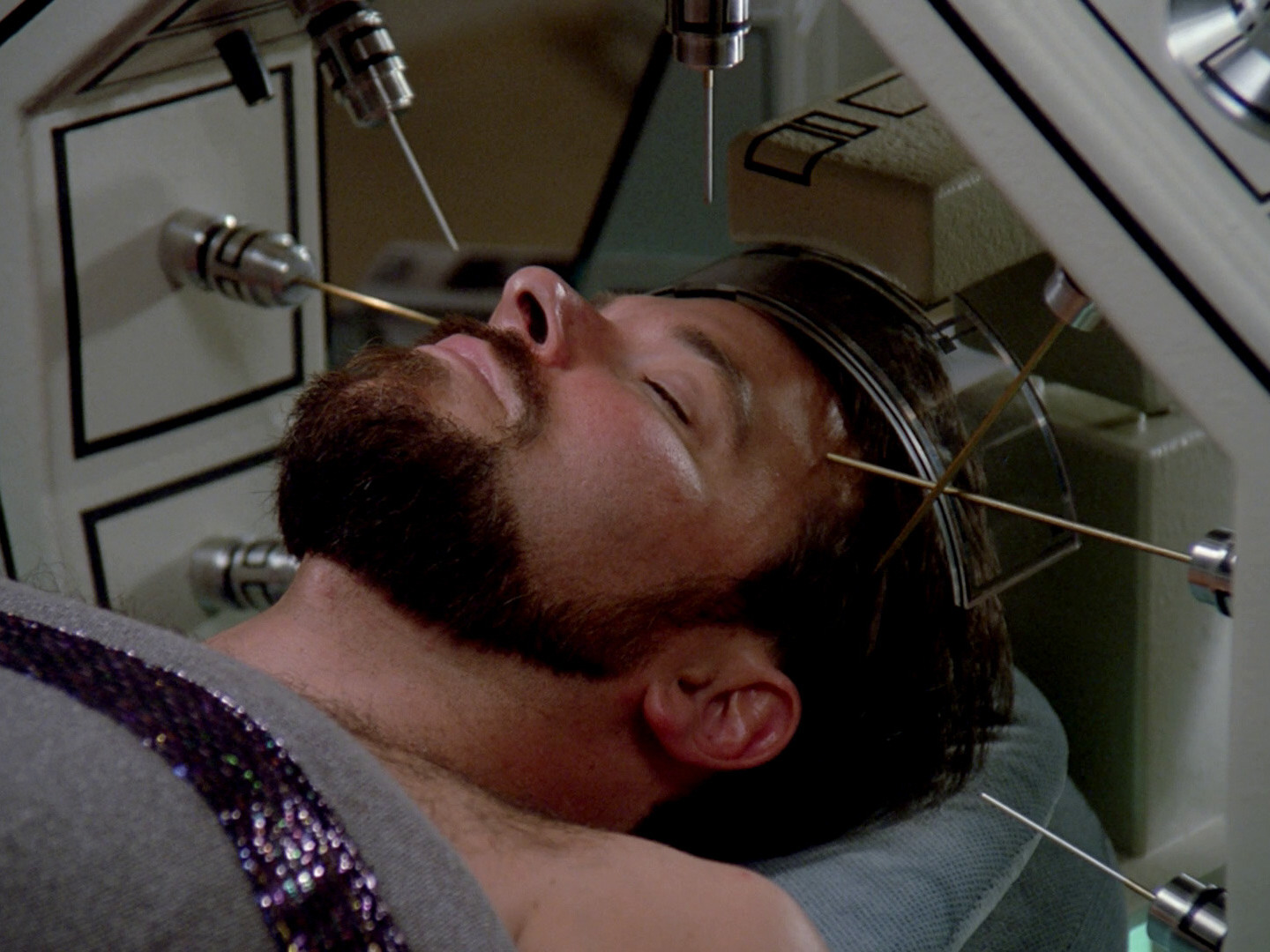
Stardate 42976.1: On an away mission on Surata IV Riker contracts an infection that will eventually reach his brain and kill him. Dr. Pulaski begins a treatment of neural stimulation in the course of which Riker experiences pleasant dreams. Deanna senses Riker's dreams while the infection is spreading even more rapidly and concludes that negative emotions might stop the growth. She and Pulaski begin stimulating negative memories such as Tasha Yar's death and other sad moments, upon which the infection is eventually slowed down and disappears.
Review
"Shades of Gray" is Star Trek's only clip show (not counting TOS: "The Menagerie" which was composed of the then unaired footage of the "Cage"). The episode was written to save time and money after the writers' strike of 1988 and after TNG had spent a considerable budget particularly on the expansive set of "Elementary, Dear Data" and the visual effects of "Q Who". In contrast, "Shades of Gray" was filmed in no more than three sets (sickbay, transporter room, planet surface), whereas the rest of the episode consists of stock footage from 17 episodes (according to Memory Alpha, I was too lazy to include them in my notes).
From a technical viewpoint "Shades of Gray" is a bad episode, arguably the worst of the series. However, it does have some redeeming qualities. I like the course of the story in the first 15 minutes, before the clip show kicks in. Most notably the scene in which Pulaski inserts the fat needles of the neural stimulator into Riker's head is quite thrilling, although or just because it lasts as long as two or three minutes largely without talking. "Shades of Gray" takes the due time to tell the story of Riker's sickness and recovery, unlike in some other episodes of TOS or TNG where the doctor develops a cure in just a few minutes, administers a hypospray and the patient can return to duty immediately.
While I think that the episode overall makes the most of its extremely limited budget and its accordingly thin storytelling potential, I only wonder why "Shade of Gray" jumps straight into action and in the very first scene Riker is already sitting there with his injury. Why doesn't it start with Geordi and Riker beaming down, strolling through the swamp for a couple of minutes and telling some anecdotes, as it is usual for TNG episodes? The way it was done is very counterproductive, considering that even more stock footage is needed to fill the rest of the 45 minutes.
Finally, I wonder why the clip show was made to be the season finale (and Pulaski's last show no less), which is outrageously anticlimactic especially after the events of "Q Who" and "Peak Performance". Did the producers hope that more viewers would tune in for the third season after this disappointment because it could only get better?
Annotations
- Nitpicking: Some of the flashbacks from "Heart of Glory" can't possibly come from Riker's memories because we see cuts to places (bridge, transporter room, the ships in space) where Riker isn't even present.
- Remarkable dialogue: "There may be some residual memory loss. I just want to be sure you still know who you are." - "Of course I know who I am. I'm Captain Jean-Luc Picard of the USS Enterprise." - "I'm delighted that you're feeling better, Captain. The Admiral and I were worried about you." - "Captain, I do not believe you have the authority to promote me to the rank of admiral." (Pulaski, Riker, Picard, Data)
- Remarkable quote: "My great-grandfather once got bit by a rattlesnake. After three days of intense pain, the snake died." (Riker)
- Remarkable scene: We can briefly see Remmick's exploding head that was originally cut from TNG: "Conspiracy".
Rating: 1