Star Trek Voyager (VOY) Season 1 Reviews
Season 1Season 2Season 3Season 4Season 5Season 6Season 7
CaretakerParallaxTime and AgainPhageThe CloudEye of the NeedleEx Post FactoEmanations
Prime FactorsState of FluxHeroes and DemonsCathexisFacesJetrelLearning Curve
Caretaker
Synopsis

Stardate 48315.6: The Starfleet ship USS Voyager under the command of Captain Kathryn Janeway sets out to search for a Maquis ship missing in the Badlands. Janeway enlists the help of Tom Paris, a former Starfleet officer who was expelled for causing an accident and who was briefly a member of the Maquis. The Maquis ship, commanded by another former Starfleet officer named Chakotay, was infiltrated by Tuvok, Voyager's tactical officer. However, inside the Badlands Voyager encounters a displacement wave and is dragged into the Delta Quadrant, just as previously the Maquis ship. Janeway's first officer, the helm officer, the chief medical officer, the nurse and the chief engineer are killed in the process. The surviving crew are held prisoners aboard a huge space station. After their release Ensign Harry Kim is still missing, as is B'Elanna Torres from the Maquis ship. They find themselves in the underground city of the Ocampa, suffering from a disease for which the Ocampa have no cure. Following the energy pulses that the station, called the Caretaker's Array, is sending out out, Janeway sets a course for the Ocampa planet. Voyager picks up a man named Neelix, who agrees to help the crew get back their missing people. But as an away team beams to the barren surface with water for the Kazon-Ogla living there, Neelix only cares to get Kes released, an Ocampa who has found her way to the surface and who he has fallen in love with. Kes persuades Neelix to further support the Starfleet crew. They find breaches in the security barrier that protects the Ocampa city from the outside world and beam down. The Caretaker, however, stops supplying the Ocampa and begins to seal the access to the city. The only way back to the surface for the away team, together with Kim and Torres, is through the ancient tunnels. Back at the Caretaker Array, Tuvok and Janeway find out that the Caretaker is dying. His race of extragalactic explorers once caused an ecological disaster on the Ocampa homeworld, and two of them have stayed behind, supplying the Ocampa with energy. The other Caretaker has abandoned her duty. Now that the remaining Caretaker is dying, his only worry is that the Kazon might take control of the Array and its technology, and overwhelm the Ocampa. This is why he activates the Array's self-destruct. Outside the Array a battle with the Kazon ensues, and Chakotay has to sacrifice his ship to disable a huge Kazon vessel. The Kazon vessel collides with the Array, disabling its self-destruct system. Janeway decides against a quick return and destroys the Array. The crews of the Federation ship and the destroyed Maquis ship join in their endeavor to find a way home, which would take 75 years at maximum warp. Neelix and Kes too join the crew of Voyager.
Review
Voyager's "Caretaker" is comparable to DS9's pilot episode "Emissary" in many ways. Both pilot episodes tell big stories on a familiar backdrop from the respective preceding series (the Borg and the Cardassian conflict were established in TNG, the Maquis was first shown in DS9). Both stories deal with superior non-corporeal entities that tend to a "primitive" civilization but don't really understand what their fosterlings need. Both episodes put Starfleet crews in an unusual situation that will become a permanent setting of the show.
What I like better about "Caretaker" is that it tells an exciting and well-rounded story, unlike the undecided plot development in "Emissary". On the other hand, "Caretaker" seems to take still a bit more pleasure in exposition. The plethora of facts and factoids about the ship and crew are sometimes more and sometimes less casually embedded in the story. Some of it is rather inefficient in hindsight, considering that a couple of people that were introduced would die a few minutes later. While Stadi may still count as some sort of a red herring because she looks like she could become Deanna II and Tom's love interest [insert joke about Betazoid helmswomen here], the two people with the most contempt for Tom Paris, namely Cavit and the nameless doctor, would die just as well. And just like already in "Emissary", some of the character relationships established in the pilot either don't work, or they would play no role in the following. In particular, I don't like the interaction between Tom and Chakotay. Tom only tells Janeway something like "He is such a mean man, he never gave me a chance". And just as to prove Tom right, Chakotay, who has learned only a second ago that Tuvok betrayed him, doesn't know anything better to do than spout insults at Tom, who was not involved with Tuvok's undercover mission at all! We never really learn why the two don't like one another, and since the writers don't manage to make sense of it either, they will forget about the animosity quickly.
On the other hand, "Caretaker" establishes many individual characteristics and interesting relationships that will persist, such as notably Janeway-Paris, Paris-Kim or Tuvok-Neelix, unlike it was the case in TNG and even DS9. The EMH, to name one more example, is simply deactivated by Janeway when he complains about the "conference" taking place in his sickbay. It is very satisfactory to see how his struggle for acceptance will continue throughout the following seasons, with growing success.
Since this pilot episode and especially its final minutes are rather action-heavy, the debate about how to proceed with the Caretaker Array gets a raw deal. Does it violate the Prime Directive to help the Ocampa? Or is it Janeway's duty to help them because, as she says herself, Voyager is already involved in the conflict? Is Janeway so anxious to do the right thing and not to appear as self-serving that she neglects the goal to return to the Alpha Quadrant? Whether or not it was the right decision to fulfill the Caretaker's last will and destroy the array, Janeway simply doesn't have the time to really consider the options. The Caretaker obviously underestimated the capabilities of the Ocampa. Perhaps they wouldn't be helpless after all? Perhaps the Kazon wouldn't even find out how to use the Array against the Ocampa? On the other hand, the Kazon reinforcements are already on the way.
Annotations
- Nitpicking:
- I don't understand why Janeway invites the reluctant Maquis that accompanies Chakotay to the away team and even gives him a compression rifle. Relations are anything but good at this time.
- There is one thing that is still bugging me most: While it is already problematic that the outside world knows anything about the Ocampa, who escape and are usually captured by the Kazon-Ogla, how could Neelix ever fall in love with Kes? At most he could have briefly seen her in the Kazon-Ogla camp while doing business there, but that wouldn't be a mutual thing and wouldn't create the familiarity that is obviously between the two.
- Water is a valuable commodity in this part of the Delta Quadrant. This may be plausible if the Kazon-Ogla were bound to the barren Ocampa planet and if they had primitive technology only. But they possess warp-capable starships, and at least one of them dwarfs Voyager. No one can tell me they wouldn't find a better planet to settle on, or at least other supplies of water, or ways to synthesize it from hydrogen and oxygen.
- When Janeway gives Tom a field commission, she reinstates him as a Starfleet officer, although he was discharged, joined the Maquis, was captured and sentenced to prison. She also gives him a promotion to full lieutenant. On the other hand, the Maquis, including Chakotay, are only granted provisional ranks. This isn't consequential.
- Remarkable dialogue: "Captain Kathryn Janeway of the Federation starship Voyager." - "A very impressive title. I have no idea what it means, but it sounds very impressive." (Janeway and Neelix)
- Remarkable speech: "We're alone in an uncharted part of the galaxy. We have already made some friends here, and some enemies. We have no idea of the dangers we're going to face, but one thing is clear. Both crews are going to have to work together if we're to survive. That's why Commander Chakotay and I have agreed that this should be one crew. A Starfleet crew. And as the only Starfleet vessel assigned to the Delta Quadrant, we'll continue to follow our directive to seek out new worlds and explore space. But our primary goal is clear. Even at maximum speeds, it would take 75 years to reach the Federation, but I'm not willing to settle for that. There's another entity like the Caretaker out there somewhere who has the ability to get us there a lot faster. We'll be looking for her, and we'll be looking for wormholes, spatial rifts, or new technologies to help us. Somewhere along this journey, we'll find a way back. Mister Paris, set a course for home." (Janeway)
- Remarkable sets:
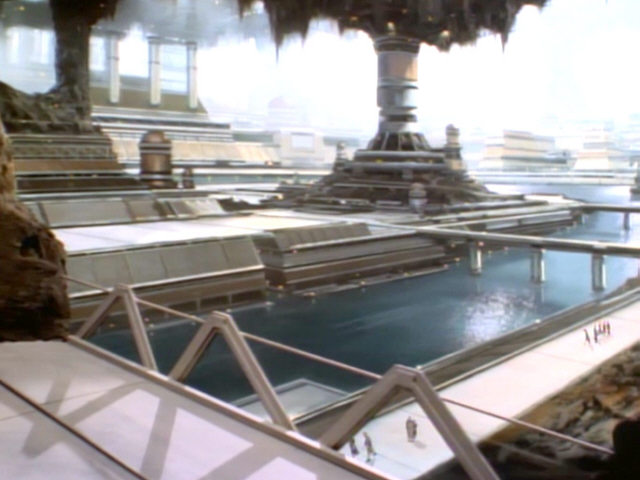
- The Ocampa city is very impressive, and the extensive use of the Los Angeles Convention Center location proves much more realistic than the studio atmosphere of usual alien planets.
- The scenes on the surface were shot in the El Mirage Dry Lake, which had already appeared in TNG: "Final Mission".
- Remarkable prop: the compression rifles with the fork-like muzzles
- Remarkable facts:
- Voyager has a crew of 141, 15 decks, a sustainable top speed of Warp 9.975 and bioneural gel packs. These specs are subject to vary though.
- Janeway served with Admiral Paris on the Al-Batani and was his science officer during the Orias expedition.
- Remarkable main title: I just love the Voyager title theme, and the spectacular imagery of the opening credits.
- Remarkable opening sequence: The opener with the scrolling letters and the small Maquis fighter chased by the big Cardassian ship is a bit like the beginning of "Star Wars, Episode IV". The full text: "Unhappy with a new treaty, Federation Colonists along the Cardassian border have banded together. Calling themselves 'The Maquis', they continue to fight the Cardassians. Some consider them heroes, but to the governments of the Federation and Cardassia, they are outlaws."
- Remarkable appearances:
- Jeff McCarthy, who plays the nameless chief medical officer, previously portrayed Roga Danar in "The Hunted".
- Robert Duncan McNeill previously played Cadet Nick Locarno in TNG: "The First Duty". Considering that Paris and Locarno look identical and have virtually the same history, I wonder why they still had to be different individuals.
- Remarkable background fact: Geneviève Bujold was cast to play Captain Nicole Janeway, but she quit after one and a half days of filming.
- Photon torpedoes used: 2, with tricobalt warheads
- Crew losses: unspecified, at least 5
- Current crew count: 141
- Missed opportunity to get home: #1, and Janeway wouldn't even have violated the Prime Directive
Rating: 8
Parallax
Synopsis
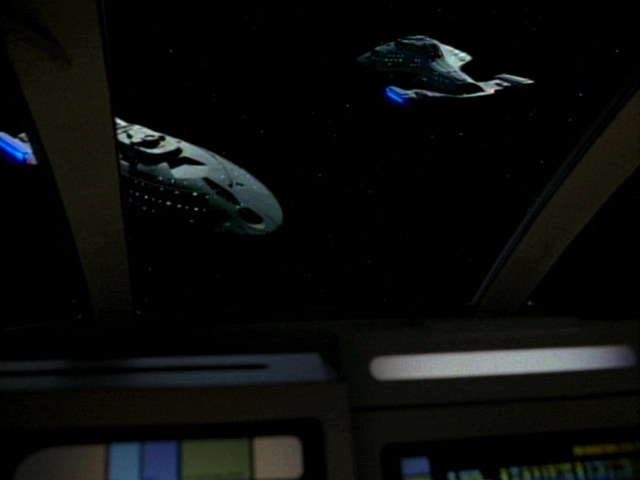
Stardate 48439.7: In engineering, B'Elanna Torres gets into an argument with Lieutenant Caery and breaks his nose. Still, Chakotay expects Janeway to consider Torres for the position of the ship's chief engineer. Voyager encounters a quantum singularity and picks up a message from another vessel that is apparently stuck within the event horizon of the anomaly. It is noticed too late that the call actually originates from Voyager itself at a time when the ship is already trapped in the singularity. B'Elanna turns out very helpful in finding a way out. In spite of her unrestrained manners she is promoted to chief engineer ahead of Carey.
Review
Rather than DS9, Star Trek Voyager carries on with TNG's tradition of showing the weird effects of spatial phenomena. The mere idea that Voyager could encounter a reflection of itself makes this story somewhat entertaining, although nearly all of the depicted effects allegedly associated with a quantum singularity are scientific nonsense. A real quantum singularity or black hole would never behave like in this episode. The event horizon is defined as the radius of a black hole inside which any energy or mass is inevitably trapped, but essentially only the word and not the concept is used in this episode. The real effect of a black hole would be that for an external observer time stands still on a starship near the event horizon, while it becomes invisible as soon as it is inside. There would be nothing like a "temporal reflection". Besides, it is highly questionable that the SIF could balance out the extreme gravity or spatial distortion near the event horizon, not to mention inside. The hallucination effect that the ship seems to leave the event horizon although it is still inside is just too odd and does not warrant further consideration. At least it is acceptable that Voyager can escape from the anomaly by means of Treknology (dekyon particles in this case). Overall, I would have expected a bit more plausibility in both the story and the science.
The other big topic of the episode and the perhaps more interesting one is the ongoing struggle between the former Maquis and the established Starfleet crew, which consists in more than just occasional disagreements at this time of the series. The competition between Carey and B'Elanna is just the tip of the iceberg. Several of the Maquis want more than just acceptance. Seska and another Maquis go as far as proposing to Chakotay to take over the ship. This creates a dilemma for Chakotay, whose self-imposed mission is to speak in favor of his people while remaining loyal to Captain Janeway. We can notice several times in this episode that the two not only respect but also like one another.
Still, Chakotay overstresses the emerging friendship when he asks B'Elanna what she can do to help the other ship in the anomaly and orders her to carry on, effectively passing over not only Carey but also Janeway. Janeway responds by calling the higher-ranking Carey and putting him in charge of the mission, although B'Elanna came up with the idea and would be more qualified. This disagreement entails a powerful scene in which Janeway and Chakotay discuss the situation of B'Elanna in particular and of the Maquis crew members in general. The two virtually cover the whole range of problems on the ship and with each other with the fewest possible words. They don't come to a definite solution. However, in case Janeway thought she could decide at will or strictly complying with Starfleet protocols, she now has to deal with diverging interests. Chakotay, on the other hand, has already learned his lesson at this point and is not susceptible to the Maquis plots against the captain any longer.
With the exception of this one scene (that is even a bit anticlimactic in hindsight), I have to say that the episode is devoid of real highlights. My impression is that problem with the anomaly as well as the one with B'Elanna are solved a bit too quickly and too easily.
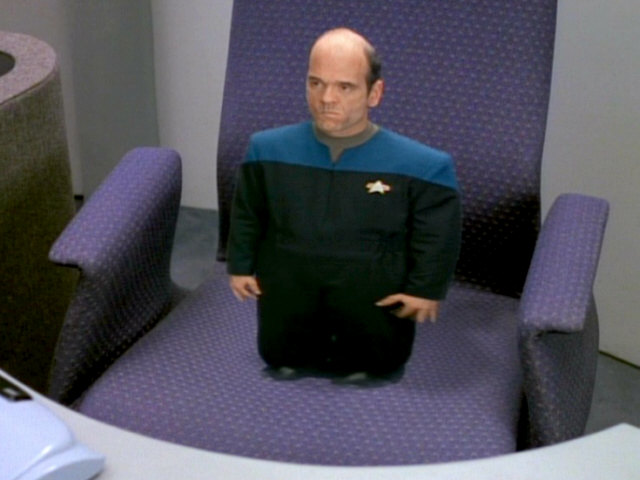
The "Incredibly Shrinking Doctor" (as a side effect of the anomaly) is only a side note in this episode, but I like how the embarrassment about the situation adds to the Doctor's personality.
Annotations
- Nitpicking:
- I wonder why it is deemed useful to drain energy from the holodecks. There is no reason why they should have an independent power source and, moreover, an incompatible one.
- "Warp particles" are mentioned for the first and last time, a particularly bad example of gratuitous technobabble. Well, the name could make sense in that it could be the particles equivalent to the warp field energy, they only should have been mentioned on other occasions for the sake of consistency. And it is just too implausible how the deflector can be modified to handle them in a matter of seconds.
- The other ship inside the anomaly is in visual range, close enough for Janeway to ask Neelix whether he recognizes the configuration. Why isn't it possible to zoom in a bit further or to get any other further readings? The crew was so close to finding out that the other ship was Voyager itself!
- Remarkable dialogues:
- "Regarding sickbay, we still need a chief medical officer." - "What about that electronic man down in sickbay?" - "It is an emergency medical hologram and its abilities are limited. It can only operate within the confines of sickbay." - "Not to mention its lousy bedside manner." (Janeway, Neelix, Tuvok, Paris)
- "You're right, Captain. I do consider these my people because nobody else on this ship will look out for them like I will. And I'm telling you, you're going to have to give them more authority if you want their loyalty." - "Theirs or yours, Commander?" (Chakotay and Janeway)
- Remarkable quote: "So it begins. The trivia of medicine is my domain now. Every runny nose, stubbed toe, pimple on a cheek becomes my responsibility." (the Doctor)
- Remarkable facts:
- The Doctor is programmed with 2000 references and the profiles of 47 medical officers.
- Apparently the transporter chief was killed too, raising the death toll to at least 6.
Rating: 4
Time and Again
Synopsis
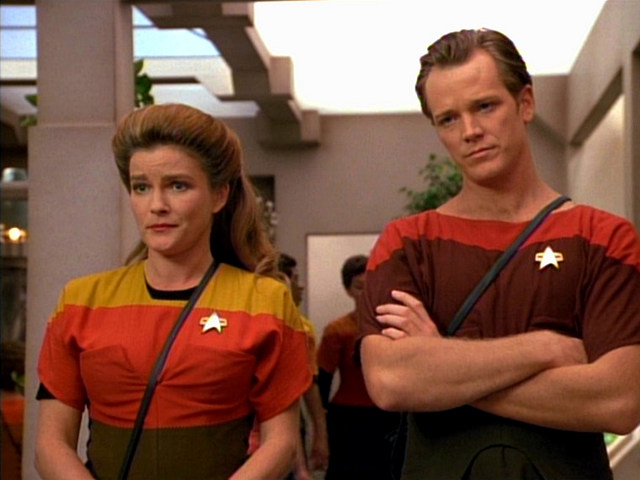
Stardate not given: Voyager arrives at a planet on which a massive polaric explosion has recently devastated the surface and extinguished all life. While examining the phenomenon, Janeway and Paris step into a subspace rift and find themselves at a time when the planet is still intact and Voyager is still far away. They suspect that sabotage on a polaric power plant by opponents of this technology was the cause of the global disaster, but Janeway orders Paris not to interfere because of the Prime Directive. Janeway, however, changes her strategy when she becomes aware that they have already interfered; their presence made the protesters change their plans. She now tries to prevent the sabotage. When she witnesses how a subspace rift opens, created by the Voyager crew in the future in an attempt to rescue her, she recognizes that this is the true cause of the disaster. Janeway uses her phaser to seal the rift, upon which the timeline is reset. The cycle is broken, the catastrophe never happened, and no one has any memory of it - except for Kes who is relieved when Voyager passes by the now inconspicuous planet.
Review
Perhaps it was not a good timing to come up with another time travel story governed by predestination just after "Parallax". Anyway, the writer did a better job with "Time and Again" and didn't just grab a few phenomena from a physics book and put them together to a plot. "Time and Again" comes with an intense and intelligent story, one that requires and deserves thinking while viewing it. It is a story in which Janeway and Paris are alone with the Prime Directive, with temporal paradoxes and with their own intuition and improvisation. I like how they put up with their new situation and try to come up with more or less plausible explanations regarding their look and their lack of knowledge about the civilization.
One point of criticism is that the unnamed civilization is just too human. It is quite a coincidence that the people on the planet conveniently look like humans, so Janeway and Paris don't strike anyone as aliens. Moreover, the clocks on the planet display Arabic numerals, which is a unique oddity in Star Trek so far. Well, in a way the fact that the civilization is very human has a symbolic meaning too, because it helps emphasize the parallel of polaric power and nuclear power. The leader of the protesters even mentions that they have found more support since the accident at Markov, which was the analogy to Chernobyl at the time the episode was made.
So the script combines the commentary on a real-world issue with an exciting science fiction story. It also nicely contrasts Paris and Janeway's investigation of the disaster with the "simultaneous" efforts of the Voyager crew to rescue the two missing officers, with the ironical outcome that the latter caused the first.
Well, I know there are many fans who hate stories with a built-in reset button, but I think "Time and Again" is among the better instances where this narrative technique is used. Perhaps not as extraordinary as TNG: "Cause and Effect" but commendable nonetheless. There are inevitable logical problems though. The predestination paradox that Voyager is responsible for an explosion that has already taken place when the ship arrives is already tough enough. It is even harder to explain, however, why this time loop is eventually interrupted when Janeway prevents the explosion.
I am glad that no B-plot is incorporated into the story because it would only have distracted. However, I don't really like the kind of Kes's involvement in this episode, as it reminds me a lot of Deanna's little helpful comments in the first two seasons of TNG. Kes has supernatural powers that not only include telepathy but also the power to experience the future and alternate timelines. But these powers play only a minor role in the story. Essentially it boils down to Kes being the only one who has any memory of the disaster that could have occurred on the planet, perhaps in an attempt to ease the effect of a total reset and the negative reactions of some viewers.
Annotations
- Remarkable quote: "Under normal circumstances I'd say we should come back tomorrow." (Paris at the demonstration, knowing that there will be no tomorrow on the planet)
- Remarkable styling: All people on the planet are wearing clothes in the following colors: mustard, orange, lime, olive, bordeaux. The emblem that can be seen in various places consists of similar colors.
- Remarkable facts:
- Tom Paris mentions the Delaney sisters for the first time; they work in stellar cartography.
- In 2268, an experiment with polaric energy almost devastated the Romulan colony Chaltok IV, and the technology was outlawed.
Rating: 6
Phage
Synopsis
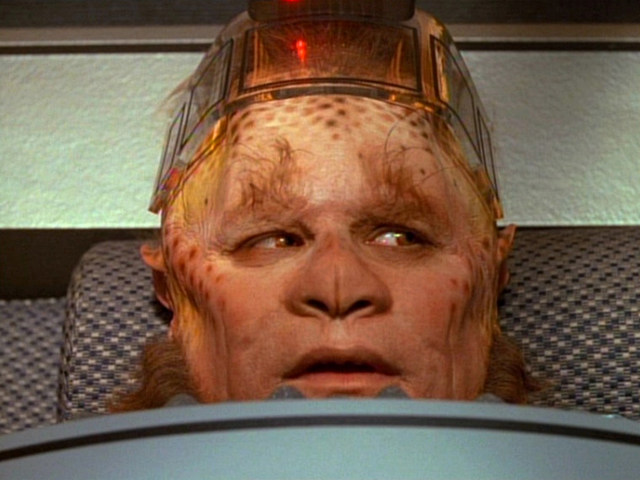
Stardate 48532.4: An away team beams down to a planetoid where Neelix expects to find rich dilithium deposits. But he runs into an alien, who uses an advanced medical instrument to remove his lung. The Doctor can only keep him alive by replicating a pair of holographic lungs. Voyager follows the ion trail of the alien ship into an asteroid. Inside the asteroid there is a "hall of mirrors" that doesn't allow to scan for the alien ship. On Chakotay's suggestion Tuvok sweeps the interior with a low-intensity phaser beam, which eventually hits the alien ship, thereby revealing its true location. Janeway has the two crew members beamed aboard. They are members of the Vidiians, a race that suffers from the "phage", a terrible decay of their organisms that forces them to steal alien organs for their survival. As Neelix's lungs have already been altered for one of the Vidiians named Motura and Janeway is opposed to killing him, she is willing to let them go. Motura, however, agrees to help Neelix before he leaves. He modifies one of Kes's lungs for a transplantation into Neelix's body.
Review
Doing an episode like "Phage" so early in the series was a daring move. The idea of some aliens stealing a crew member's lungs would have had all the potential for a silly episode along the lines of "Spock's Brain". Moreover, such a story requires an emotional impact that is not easy to accomplish with characters that we are not yet familiar with. The episode overcomes these obstacles with surprising ease. The character relationships are worked out well. There are a number of really great dialogues. And although he has been aboard for just a few weeks, it is nice to see how everyone puts his or her special expertise to use to help Neelix. Only Neelix's jealousy about Kes and Tom is over the top, even though later episodes will prove him right. The Doctor's insufferable demonstrative depreciation of Tom Paris is another lowlight of the episode. It is the pinnacle of a theme that will continue through all seven seasons.
I can imagine that one reason to make this episode with the Vidiians was that the producers were anxious to introduce a new recurring enemy soon enough, after their experiences with the rather bland first seasons of TNG and DS9. "Phage" is convincing in this regard too. I like the credible depiction of the Vidiians, who turn out to be victims of their ghastly disease, rather than ruthless organ thieves. Still, they are extremely dangerous and don't hesitate to kill for their survival, perhaps out of an instinct. If they can't get what they need from the dead, they take it from the living. We can only only wonder what human beings would do in their place.
One might think that it is too soon for a revelation that the Vidiians are victims just as well and for a more or less peaceful agreement with them, considering that the Vidiians will appear as villains in several more episodes. On the other hand, this gives Janeway a chance to demonstrate her diplomatic skills while leaving no doubt that she will use deadly force in the next encounter with the Vidiians. The solution that the not-so-bad villains are not punished and help their victims in return is very Trek-like. My regards to Captain Janeway, who lives up to the ideals of Kirk and Picard despite the adverse circumstances.
Annotations
- Remarkable dialogues:
- "Don't worry, I'm not going to kiss you, I'm only adjusting the restraint." - "I'll try to contain my disappointment." (The Doctor and Neelix)
- "First they tell me there's no doctor, so I have to be on call 24 hours a day. And then they tell me there are no nurses so I have no one to assist me." - "I thought Tom Paris was assigned to you." - "Like I said, no one to assist me." (The Doctor and Kes)
- Remarkable quotes:
- "Well, if I'm going to be in here a while, now's as good a time as any to tell you. Your ceiling is hideous." (Neelix)
- "And some music would be nice. Or better yet, are you programmed to sing?" (a prophetic Neelix)
- Remarkable scenes:
- Janeway finds Neelix's kitchen with ancient looking pans and pots in her private dining room. In my impression she is annoyed for the most part, but also a bit amused.
- Tom objects to holographic lungs, saying that a hologram is just a projection of light, whereupon the Doctor slaps him.
- Remarkable maneuvers:
- The last time someone ordered a Federation starship into an asteroid (TNG: "The Pegasus") it almost ended in a disaster. Janeway succeeds more by luck than judgment.
- Inside the asteroid, Chakotay saves the day when he suggests to fire a weak phaser beam that is reflected from the walls until it hits and thereby reveals the real Vidiian ship.
Rating: 6
The Cloud
Synopsis
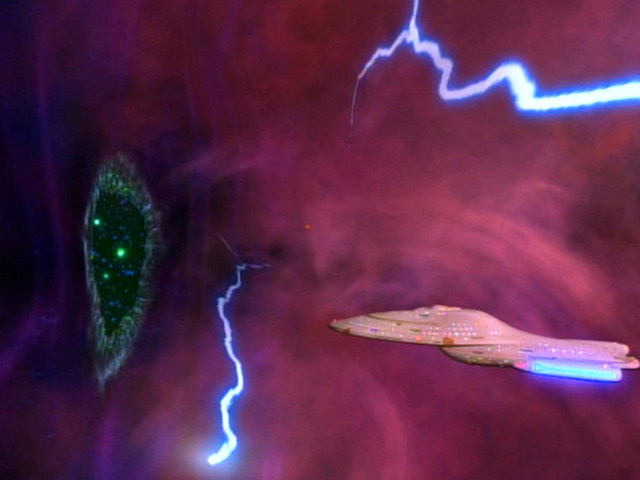
Stardate 48546.2: Voyager is running out of energy, and Janeway decides to take the ship into a nebula to harvest omicron particles. After breaking through an energy barrier the ship comes under attack by an unknown substance. Janeway orders to steer the ship clear. The substance, however, turns out to be organic and is part of a nucleogenic lifeform that was hurt when the ship penetrated its shell. Janeway decides to enter the nebula again to heal the "wound", using a nucleogenic beam. When the beam turns out insufficient, the Doctor suggests to suture the rupture, using the ship as a conduit for the nucleogenic energy. The surgical procedure succeeds. However, instead of replenishing the energy reserves Voyager ends up with 20% less energy.
Review
This episode is like the epitome of the first two seasons of the series, in which it seems that every initially promising discovery or alien encounter is to Voyager's disadvantage in the end. Here the ship starts off with scarce energy resources and ends up with still 20% less. But as Neelix correctly remarks, just as much as the search for energy it is Starfleet's curiosity that gets the ship into trouble, a theme that we are familiar with from previous Star Trek series. Overall, the A-plot doesn't show us anything really new, for we have already seen various mysterious nebulae, spaceborne creatures and similar phenomena in Star Trek. It is nice to see that the story is much like the antithesis to TOS: "The Immunity Syndrome". This time the Starfleet crew helps a space creature instead of killing it. On the other hand, we've had stories along the same lines already on Star Trek: The Next Generation, such as in "Galaxy's Child".
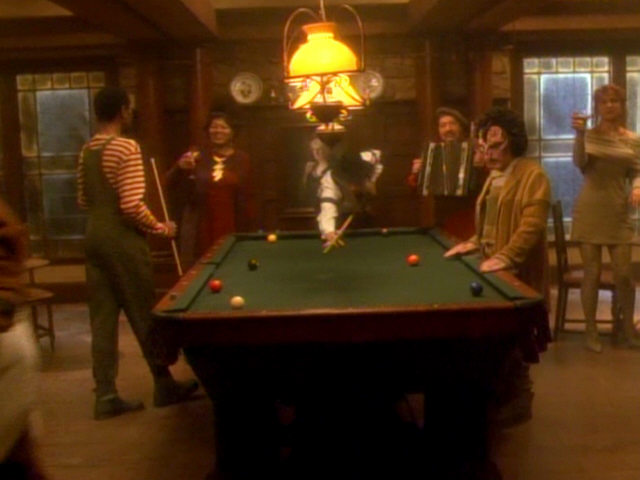
It is easy to notice that the A-plot of "The Cloud" is not sufficient to fill 45 minutes, and so Michael Piller incorporated a number of B-plots with a common "family" theme. The latter make up more than half of the episode's time (at least that is my impression). The various B-plots are a mixed bag. Some of them work nicely, some are just lame filler scenes, and overall they take away the suspense that has been built up, especially after Voyager leaves the nebula for the first time. The thing that bugs me most about the whole episode is the anticlimactic scene in which Tom wakes up Harry as if it was some kind of emergency. But he actually just wants the fellow junior officer to join him on the holodeck to see Tom's newest creation, the Chez Sandrine.
I don't like Tom's program anyway. The characters, namely Sandrine, Ricky, the pool player and the gigolo are so blatantly stereotypical, so cheap; I wonder in how far they reflect Tom's thoughts and ideas, which would be really poor. It is no surprise the figures in the Sandrine's will gradually disappear from the bar in the subsequent episodes, and make way for the real crew. On a positive note, Harry and Tom strengthen their friendship in the time they spend on the holodeck, a friendship that will persist and play a role in many future episodes.
In further efforts to establish a sense of family we can see Janeway take a walk through the ship while speaking her log entry. I rather like the way she cares for her crew, especially since in the end Harry (who initially hesitated to ask her to join him and Tom for breakfast) will return the favor and invite her to the holodeck. Chakotay and Janeway too strengthen their friendship when he shows her how to practice the old Indian meditation with the animal guide. Janeway's guide is a salamander, but she must not tell anyone. B'Elanna, on the other hand, wanted to kill her animal guide. The Doctor's craving for acknowledgement continues. Janeway simply mutes him and the EMH tries hard to catch the attention of the bridge crew. On another occasion he complains that no one cares to switch him off after he has done his job. Harry gets admonished by Tuvok not to say "I've never seen anything like it." again. Only a few minutes later, Tuvok himself makes a similar statement, and Harry takes the opportunity to remind Tuvok of what he said. All this is set up very nicely but overall it is just too much coziness at the expense of suspense.
Neelix, as already mentioned, is upset about the irrational explorer mentality of Starfleet that poses a danger to the ship and crew. He is certainly correct to some degree. However, this only shows that he is not yet a full member of the family. And his defiant attitude gets embarrassing when he complains about it in Janeway's office in a time of stress and when he appears on the bridge in another critical situation, calling himself the new "morale officer" and serving some cookies (well, I would appreciate the latter service). Fortunately the impression of Neelix as the ship's clown will be corrected in some of the later installments in which his character is more deeply explored.
Annotations
- Inconsistency: Why is it that plenty of energy may be consumed on the holodeck, whereas replicating a simple coffee is already regarded as a waste of energy? It seems the writers, like already in "Parallax", are very fond of the idea of an independent power source of the holodeck, although this would make no sense.
- Remarkable error: "Chez Sandrine à Marseilles" is an awkward mix-up of English and French. It should be "Marseille".
- Remarkable dialogues:
- "These people are natural born explorers, Neelix." - "These people are natural born idiots, if you ask me. They don't appreciate what they have here. This ship is the match of any vessel within a hundred light years, and what do they do with it? Well, let's see if we can't find some space anomaly today that might rip it apart!" (Kes and Neelix)
- "I need to know if we did serious harm to this lifeform." - "Let's see. You ran your ship through it, fired phasers at it and blew a hole in it with a photon torpedo. I'd say it's a pretty good chance that you did some fairly significant..." (Janeway and the Doctor)
- Remarkable quotes:
- "There's coffee in that nebula." (Janeway)
- "Dismissed. That's a Starfleet expression for 'get out.'" (Janeway, to Neelix)
- Remarkable log entry: "Personal log, Stardate 48546.2. Our journey home is several weeks old now, and I have begun to notice in my crew and in myself, a subtle change as the reality of our situation settles in. Here in the Delta Quadrant, we are virtually the entire family of man. We are more than a crew and I must find a way to be more than a captain to these people, but it's not clear to me exactly how to begin." (Janeway)
- Remarkable scene: After the Doctor has been switched to mute, he tries to get the attention of the bridge crew by waving from the main viewscreen in the background.
- Remarkable fact: The EMH was programmed at Jupiter Station by a man named Zimmerman (who looks a lot like the EMH).
- Photon torpedoes used: 1 out of 38 at this time
Rating: 3
Eye of the Needle
Synopsis
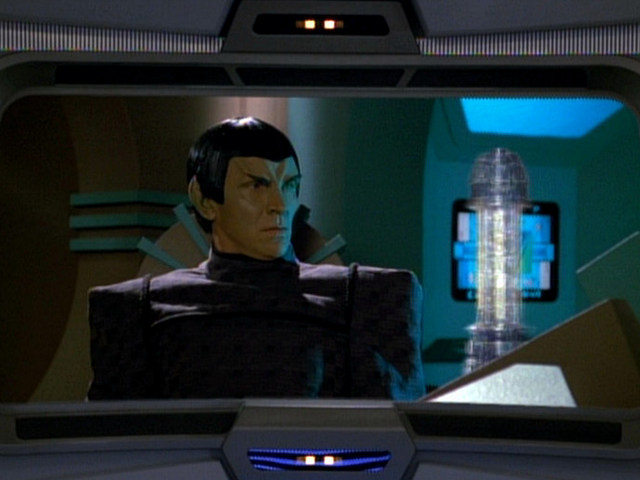
Stardate 48579.4: The crew is excited about the discovery of a wormhole. As it turns out too narrow for the ship to pass through, Janeway orders the launch of a microprobe to determine where the wormhole leads. The probe gets stuck inside the wormhole, but in the following it serves as a communications relay with a Romulan ship on the other end, in the Alpha Quadrant. Janeway has the crew prepare personal messages to their families that the Romulan commander is supposed to relay to Starfleet. Torres, however, comes up with the idea to transmit a transporter beam through the wormhole that would allow to evacuate the whole crew (except for the EMH). After a series of transports of test cylinders, the Romulan commander is beamed to Voyager. While everyone is excited that the return to the Alpha Quadrant is near, Tuvok discovers that the wormhole leads 20 years to the past, which forbids a transfer of the crew. Telek R'Mor, the Romulan commander, takes the messages with him, promising that he would pass them on in 20 years. However, Tuvok knows that R'Mor would die in 2367, four years too soon. This leaves the crew with the hope that after his death someone else could relay the messages on R'Mor's behalf.
Review
Maybe it was not wise of the people in charge to come up with a story that includes a tempting opportunity to get home so early in the first season. It is clear that the series is slated to last seven seasons and that Voyager would spend the next few years in the Delta Quadrant because that's the premise of the whole series after all. So "Eye of the Needle" is the first regular episode with a sequence of events that should become a notorious cliché of Voyager: The crew discovers some way back to the Alpha Quadrant, everyone is enthusiastic about it, but their hopes are eventually disappointed because of ethical concerns, because of bad luck or because of a lack of determination.
I like how the excitement about the discovery of a possible way home can still be felt among the crew in "Eye of the Needle", as opposed to the "anomaly/drive-of-the-week" routine in later seasons. On the other hand, this only applies to the basic mood, while the emotional rollercoaster of hope and disappointment gradually loses its intensity in the course of the episode. I like how everyone's emotional attachment to their families in the Alpha Quadrant is worked out. Only Torres doesn't seem to have anyone she really cares for, which she reveals to Harry of all people, the person who quite probably misses his beloved ones most of all. And while the families in the Alpha Quadrant are the center of the crew's thoughts in this episode, we can notice how the Delta Quadrant family is taking shape.
In this regard it is good to see how the Doctor continues to struggle for acceptance when a crew member ignores him as a person but keeps talking only to Kes. When Kes complains about the crew disrespecting the Doctor, Captain Janeway correctly remarks that the Doctor is rude to his patients just as well. And she adds that the EMH is only a piece of software that can be reprogrammed if necessary. Her priorities are evident because the needs of the crew to have a chief medical officer who is both capable and kind outweigh the integrity of the Doctor's personal subroutines. This view will change over the course of time, and it will change because the personal qualities of the Doctor become clear (and although his bedside manners won't improve a lot).
I am very fond of the idea of a gateway to the past and of its various implications that are worked into the story. Well, I remembered the episode as a highlight of the first season, but watching it again after several years I find it somewhat less exciting. The directing should have created more suspense and could have worked better with the many turning points of the story. As already mentioned, the various revelations about the wormhole and the disappointment come across as almost casual. "Oh, the wormhole doesn't allow to fly through. Never mind. It also leads to the past? So be it." In a story that draws on the crew's mood, rather than on action, I would have liked to see more variation in the mood.
The Romulan commander Telek R'Mor (played by Vaughn Armstrong) is a positive surprise. He is a very decent, considerate and open-minded person for a member of his species (a bit like already the commander in TNG: "The Chase"). We don't know what leads R'Mor to answer the hail in the first place (in 2351 the Romulans are in isolation after all), but it seems to be a combination of curiosity and suspicion. The latter makes way for compassion in the course of the episode, and it almost seems that a small Romulan science (spy?) ship and a lost Federation ship that are more than half a galaxy apart accomplish more intergalactic understanding in one encounter than their respective governments in years.
Annotations
- Nitpicking:
- The fixation on the Alpha Quadrant and the taboo not to mention the Beta Quadrant will continue throughout the whole series. The Alpha Quadrant is very large and anything but a precise spatial coordinate. A "signal from the Alpha Quadrant" could come from its far end, not much closer to the Federation than Voyager's current position. The Beta Quadrant, on the other hand, would have been just as good a place to go, and it would have made sense in this case, considering that the Romulan Empire is located there.
- I also wonder why the Romulan commander explicitly but unnecessarily states that his position is in the Alpha Quadrant, even before Janeway says she is in the Delta Quadrant. This is like someone in our time saying "Sorry, wrong number. My name is John Smith. I'm on Earth", just in case the call was coming from space.
- Missed opportunity to get home: #2, since the past is as good a time as any, and we know time travel is not that difficult
Rating: 7
Ex Post Facto
Synopsis
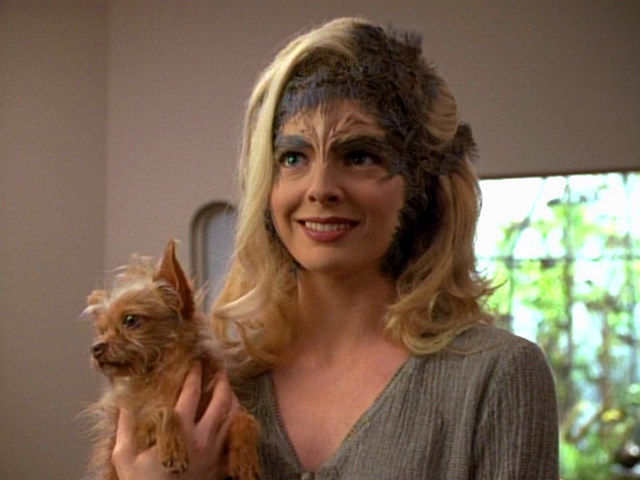
Stardate not given: Tom Paris gets bored when he and Harry Kim are guests in the house of the scientist Tolen Ren on the planet Banea, to discuss the design of a navigational deflector. He spends some time with Ren's young wife, Nidell. A jealous Ren confronts Tom, whereupon he stabs the scientist. At least that is what the memory engram from Ren's brain says. Tom is sentenced to see the crime through the eyes of his alleged victim every 14 hours. Harry Kim has to return to the ship alone. On the way to retrieve Tom, Voyager runs into patrol ships of the aggressive Numiri, who are at war with the Baneans. After performing a mind meld with Tom and further investigations on the Banean homeworld, Tuvok finds out what really happened. The evidence in Tom's brain shows that the murderer is the same height as Nidell, whereas Tom is taller. Also, the murderer was familiar with Banean anatomy, while Tom isn't. It turns out that Tolen Ren's wife has a relationship with the Banean doctor who extracted the memory engram, and they are both working for the Numiri. He altered the engram to show Tom Paris, and also included essential parts of Tolen Ren's research for the Numiri to find in Tom's brain.
Review
Many previous Star Trek stories already dealt with messed up memories, with faked evidence in a criminal case or with odd alien concepts of justice. "Ex Post Facto" is not very original to start with, but it also fails for two other reasons.
Firstly, the story is full of huge plot holes. I usually like episodes with a conclusion in which previously different problems (here the frequent Numiri attacks and Tom's alleged crime) turn out to have a common cause. However, did Nidell and the doctor really think they could get away with their crazy plan? Let me recapitulate: They knock out Tom, they kill the poor professor, they fake the memory engram and pack Tolen's research into it. And the good doctor not only happens to be an expert in the field of engrams but is also exactly the one who would be called to perform it. Evidently without anyone checking his work. And everything in the hope that Tom is convicted, turns out to have a compatible brain, is punished, gets released and can somehow be kidnapped by the Numiri. Seriously, while it may have been an elegant solution to get rid of Ren (provided that Nidell wants or needs his inheritance - otherwise the Baneans likely have something like divorce), there would have been much better and safer ways to transmit the research to the Numiri without a lot of unnecessary attention (an alien convicted of murder!). "Ex Post Facto" is more like "Murder, She Wrote" than like Star Trek. And the dog who ultimately exposes the murderer (something that wouldn't be considered valid evidence on Earth or on any other planet but only on TV) is just the icing on the cake. Since weird cases require equally weird investigators to solve them, Tuvok behaves much like a 20th century TV detective. Fortunately, Tim Russ gives a very logical performance in spite of Tuvok's odd role.
My second beef is with the depiction of the Baneans in general and of Lidell in particular, which strikes me as very contrived. It is clear that the Baneans have to be very human to make Tom's interest in Lidell plausible. The only difference is that they have slight forehead ridges and a plumage on their heads (that looks like a head of cabbage). Everything else, from their furniture to their food, is not alien at all. They are essentially a human civilization in the Delta Quadrant if it were not for their strange idea of punishment. Although it eventually matters a bit that the information is stored in Tom's brain, the faked evidence could have been a surveillance video just as well. It is a bit like a whole civilization is designed to fulfill the only purpose to give an implausible murder mystery an air of science fiction. And I don't like Nidell because she is such a stereotypical femme fatale and her vehement flirting with Tom never becomes credible. They have no chemistry at all.
What resonates with me, besides Tim Russ's performance, is that despite the many plot holes the story is exciting much of the time and comes with a nice space battle and with a Maquis trick to vent liquid nitrogen to make the enemy think Voyager is in trouble. Overall, "Ex Post Facto" doesn't work on many accounts but is nice watching.
Annotations
- Remarkable maneuver: the "playing dead" trick of the Maquis, venting LN2, letting the enemy ships close in and then firing on them
- Remarkable planet: The matte painting of the Banean homeworld originally appeared as Angel 1.
- Remarkable ship: The Numiri patrol vessel is one of many reuses of the hammerhead freighter (originally the Husnock ship).
Rating: 3
Emanations
Synopsis
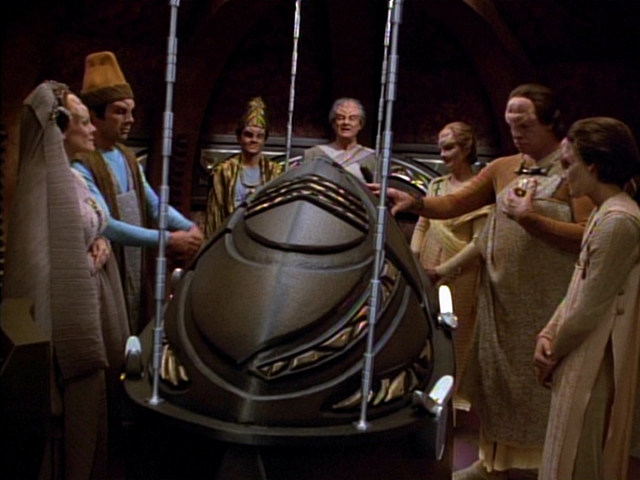
Stardate 48623.5: The ship's sensors pick up a new chemical element inside an asteroid belt. An away team, consisting of Tuvok, B'Elanna Torres and Harry Kim, is surprised to find some kind of cemetery inside an asteroid. When they are beamed back, an alien body has taken Harry's place. Harry, on the other hand, finds himself on the planet of its origin, inside a coffin-like device called cenotaph. The planet's inhabitants, the Vhnori, firmly believe they will transcend to the "next emanation" when they allow themselves to be killed inside a cenotaph just before a phenomenon called a spectral rupture appears. They don't know that the phenomenon is a subspace vacuole and that their dead bodies end up in the asteroid field. In the meantime, more dead bodies materialize on Voyager. The Doctor can revive one of them, a woman named Ptera. On the Vhnori homeworld, Harry is said to be the first one to return from the next emanation, and this discovery may shatter the beliefs of the Vhnori. Before a Vhnori thanatologist named Neria can further examine Harry, he takes the place in the cenotaph of a skeptic who wants to live on. Harry can be resuscitated back on Voyager, while Ptera dies during the attempt to transfer her to her homeworld.
Review
Star Trek Voyager, just like DS9 and unlike TNG, repeatedly deals with questions of religion. Whereas in TNG nearly every phenomenon that might evoke the existence of a god was explained away to everyone's satisfaction, DS9 and Voyager increasingly leave loopholes for religion to hold some truth. Most notably, the idea of the Bajoran Prophets is equally valid as that of Starfleet's "wormhole aliens" throughout the whole series, and the former sometimes wins over the latter. Well, the profane explanation that the dead bodies of their people are transferred to an asteroid field through subspace vacuoles may shatter the belief of the Vhnori that they can enter the next emanation with their bodies alive. But Harry as well as Kes suggest that there may be some sort of afterlife for the soul. To complete the picture, Chakotay holds burial rituals in high esteem (although he doesn't give away whether he believes in an afterlife himself), and B'Elanna says that the Klingons just dispose of dead bodies, which ultimately corroborates the notion that there may be a non-corporeal afterlife after all.
It is interesting though that the episode addresses many aspects of a possible afterlife without once referring to a deity. Neither the Vhnori nor anyone of the crew says anything about the next emanation or any other form of afterlife being a reward from a higher being. The Vhnori believe that they can move on as before, only in another dimension. The next emanation is much like moving to a new and hopefully better house for them. They apparently don't need a god as an explanation for how they were created and for who is guarding their lives. They are aware that the spectral ruptures are a phenomenon they just can't yet explain, and not something supernatural or divine. In a way, until they know better they just fill the gaps in their generally scientific reasoning with something they hope to be true. This may explain why Neria appears more like a curious scientist than like a dogmatic priest. Although he questions Harry's story (that Harry is an alien who just happened to be transferred to the Vhnori homeworld) and he is afraid that people may lose their belief in the next emanation because of this alien, Neria is just too eager to find out the truth instead of simply letting Harry go back. Neria is clearly more enlightened than we might expect from someone in his position in a TV drama. This avoidance of a cliché is one very positive aspect of the story. On the other hand, considering that Harry suddenly appeared in the cenotaph in the front of several eyewitnesses and that his physiology will turn out to be different from the Vhnori, we can only guess what would happen to him on that planet.
The Vhnori characters are interesting anyway. Hatil, the guy who is waiting to be put into the cenotaph, had doubts about the procedure even before Harry appeared. He only agreed to be killed because he felt he had become a burden for his family after an accident that left him partially paralyzed. This makes his change of mind in the face of Harry's testimonial less dramatic and more plausible. Hatil, like Neria, has a very objective view of things although for him it is nothing less than a question of life or death. Hatil is in a similar situation as Timicin in TNG: "Half a Life". Both men are expected in their respective culture to allow themselves to be killed in a ritual, in order not to become a burden for their people. And just as Timicin's daughter urged her father to subject himself to the ritual in the TNG episode, Hatil's wife Loria tries to lead her husband the right path to the next emanation.
Finally, there is Ptera who is in much the same position as the Boraalan in TNG: "Homeward" who found the way out of the holodeck, discovered the world of scientific wonders and committed suicide because he couldn't cope with it. As I first watched it, I hoped that "Emanations" would correct this outrageously hypocritical view of members of a "primitive" civilization that should better die than be overwhelmed with things that are beyond their grasp. In this regard I was very disappointed that Ptera eventually died just as well, and that the impression was created it was for her benefit. At least Ptera made a conscious decision to take the chance and, in a way, she ended up just where she was supposed to go after her death anyway. On the other hand, it irritates me how carelessly Janeway's crew is when they try to send Ptera home. It is my impression that, if Ptera hadn't said herself that she's already been dead and would die again if necessary, someone else would have used that reasoning.
One thing I really like is Garrett Wang's performance as Harry. He is confused at first, which is understandable considering that he suddenly wakes up in a coffin on an alien planet, but gradually manages to regain control over his own destiny and also over the impact he may have on the culture of the Vhnori.
The technobabble and mumbo jumbo in the story is frustrating because it detracts from the profound ethical issues. The newly discovered stable transuranic element 247, an asteroid with Class-M atmosphere and pleasant temperature, a subspace channel to the Vhnori planet, "neural energy" dispersed in space (the Vhnori souls?), all these things sum up to a scenario with too many coincidences. There should have been overall less phenomena, or it should have been attempted to link them in a way to have a common cause.
Overall, "Emanations" is an episode that I used to underrate for almost 20 years. It comes with multifaceted debates on ethical issues, with well thought out characters and with great visual effects. But it tries to accomplish just too much and becomes implausible.
Annotations
- Nitpicking: Even if Voyager was waiting for him and ready to pick him up, there is absolutely no reason for Harry to believe that he would survive the transfer inside subspace is the first place. (Well, in a way, he may have learned from the Vhnori to have faith.)
- Continuity:
- It becomes clear in this episode that Chakotay is not only an expert for his own Native American culture but also for all kinds of alien rituals and mysticism.
- This is the first time Harry Kim dies on Voyager.
- Remarkable quote: "My people have come to think of death as just another stage of our existence. There are some people who are even eager to die. If they feel depressed or lonely in this life, they simply move on to the next one." (Hatil)
- Remarkable filming: The scenes on the Vhnori homeworld were filmed with a tilted camera.
- Remarkable Greek: A "thanatologist" is a scientist who studies the phenomenon of death (thanatos), also in real life. "Cenotaph" means "empty tomb" but could be translated as "space tomb" as well. Finally, "Ptera" is Greek for "wings".
- Remarkable absence: Neelix does not appear in this episode.
- Remarkable facts: There are 246 chemical elements known to Federation science.
Rating: 5
Prime Factors
Synopsis
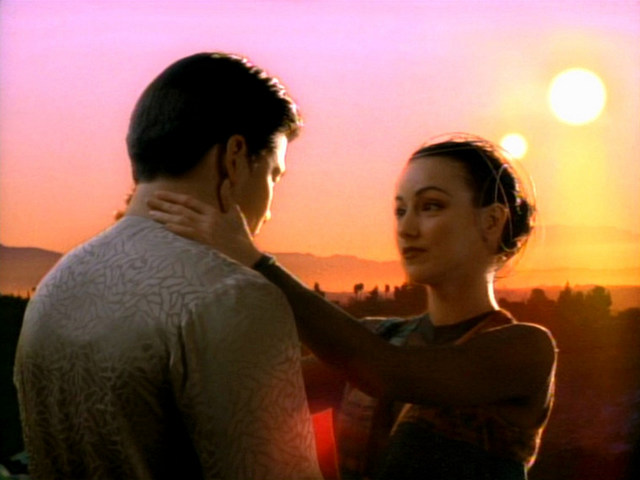
Stardate 48642.5: Voyager responds to a distress call, only to find that this is actually an invitation to the planet Sikaris, which is known for its hospitatlity. Something else that Sikaris has to offer is a trajector, a space-folding technology that could transport Voyager 40,000 light years closer to the Alpha Quadrant. The Sikarians, however, have strict laws that do not allow such a technology transfer. Janeway offers Magistrate Gathorel a databank of stories in exchange for the trajector, but he refuses. Jaret Otel, one of Gathorel's subordinates, is willing to make the deal with B'Elanna, Seska and Carey, who are acting against Janeway's explicit orders. Tuvok discovers their plan, but to their surprise he beams down to Sikaris with the databank to acquire the trajector himself. B'Elanna runs tests with the device in engineering, only to find that it needs to tap an energy source in the orbit of Sikaris to work, so time is pressing as Janeway orders the ship to break orbit. The trajector turns out to be incompatible with Voyager's systems, and B'Elanna eventually has to destroy it to avert a pending warp core breach. Seska still tries to cover up the incident, but B'Elanna decides to take responsibility. Janeway calls B'Elanna and Tuvok to her office, to tell them how much she is disappointed with them.
Review
Sikaris is a paradise. Beautiful people are doing beautiful things in a beautiful environment. And if their planet full of indulgences should get boring, the Sikarians have a device that transports them to another world, as far as 40,000 light years away.
This is all too good to be true. Knowledgeable Star Trek fans take for granted that paradisiac planets always hold a dark secret, such as a cruel ruler or strange laws just as in TNG: "Justice". And so I was only waiting for Sikaris to show its ugly face when I watched "Prime Factors" for the first time. But nothing like that happened. On the contrary, Sikaris turned out to be a mirror of the Federation: A culture that enjoys everything that life can offer but that is ultimately based on, and limited by, firm principles. A world that welcomes guests but does not let them in on every technological secret. Janeway herself finds the best words for the situation of her crew: "It's the first time we've been on the other side of the fence." Voyager's crew is to blame for the problems because of the "fence" that arise in the course of the story, rather than the Sikarians. In a way, the Starfleet crew takes over the role of the generic alien troublemakers of the kind that appeared in various TNG episodes.
The prospect of returning home soon stirs up more vehement and more diverse emotional reactions among the crew than lately in "Eye of the Needle". Everyone deals with the situation in a different way. It is not surprising in hindsight that Harry of all crew members discovers the advanced transporter technology and is so excited about it that he doesn't leave a chance for Janeway to contradict. It is very predictable that Harry blows the whistle on the plan to acquire the trajector from Jaret Otel, which leaves B'Elanna, Seska and Carey to go through with the plan. Overall, Harry's involvement remains little interesting, although he is responsible for a few major turning points of the story.
Janeway's stance is that just as she would not extend help to aliens in need if the Prime Directive forbids it, she would not ask someone subjected to similar laws for assistance either. Interestingly it is Tuvok who defies this strict ethical code. He says "At least if you deal with Jaret [the guy who wants to provide the trajector in exchange for the library of stories], it is his law that is being compromised, not ours." While this position makes sense, his justification for acquiring the trajector against explicit orders sounds very self-righteous. Tuvok says that he sacrificed himself for Janeway. I can forgive this statement because I know how loyal he is and because he is a Vulcan, but some of the worst dictators and other criminals in Earth's history used to act under the pretense that they made tough decisions (such as starting a war or ordering mass executions) only for their people. Tuvok's words leave a bad taste.
But Janeway doesn't leave a good impression either. I don't mind that she gets infatuated with Prince Charming. And I cherish her efforts to allure him to agree with the technology transfer in a way that both can save face. But when Gath doesn't want to understand her desire to return to her home and ultimately declines her request, Janeway overreacts, like a teenage girl in unrequited love. The two begin to exchange reproaches for no good reason, with the result that all away teams have to leave the planet immediately. While Janeway's principal complaint about the Sikarians, that they are only interested in Voyager's crew as a source for pleasure, holds some truth, Gath never promised anything else but pleasure. He only gave her the runaround in the hope that she would change her mind and stay. While Tuvok, B'Elanna, Seska and Carey certainly cause more damage (and arguably more damage to the mood on the ship than to the warp core), Janeway is responsible for the diplomatic affront.
A word about Janeway: She should stop taking the crew's faults personally. If she is disappointed about their actions now, the next time she may be disappointed about them doing nothing.
Speaking of the attempt to get the Sikarian trajector installed in Voyager's engineering, I am glad that it turns out incompatible and that, even if it were comptaible, it would only work in orbit around Sikaris. Technology with limitations is good for the story, and is good for the plausibility of the whole series - as opposed to the various drives of the week of later seasons that can usually be installed and activated with no trouble.
Overall, this is a bold story because of the Starfleet crew in the role of aliens who stir up trouble, because of the conflict among the crew and because of the downbeat ending. But realistically the episode should leave a rift through Voyager's crew, one which is not necessarily running between the Starfleet and the Maquis, but between Janeway's "respect local laws" and the "getting-home" faction. It is a pity that the main characters will develop a common understanding again as soon as in the next episode, and the only conflicts will be between the fundamentally virtuous crew on one hand and single traitors like Seska and Jonas on the other hand.
Annotations
- Continuity: The Sikarian transporter operates on the principle of folding space. Janeway says: "That's something that's been theorized, but no one's ever been able to develop the technology." She does not seem to know that the terrorists in TNG: "The High Ground" used a space-folding transporter.
- Remarkable dialogue: "It's the first time we've been on the other side of the fence." - "What fence?" - "The one that's made of binding principles. We have our own set of rules, which includes the Prime Directive. How many times have we been in the position of refusing to interfere when some kind of disaster threatened an alien culture. It's all very well to say we do it on the basis of an enlightened principle, but how does that feel to the aliens? I'm sure many of them think the Prime Directive is a lousy idea." (Janeway and Paris. Janeway's statement of not helping when disasters threaten alien cultures unpleasantly reminds me of the events in TNG: "Homeward".)
- Remarkable quote: "My logic was not in error, but I was." (Tuvok)
- Remarkable fact: Lieutenant Carey has a wife and two little boys.
- Missed opportunity to get home: #3, which might have been possible with a bit more patience and diplomacy
Rating: 6
State of Flux
Synopsis
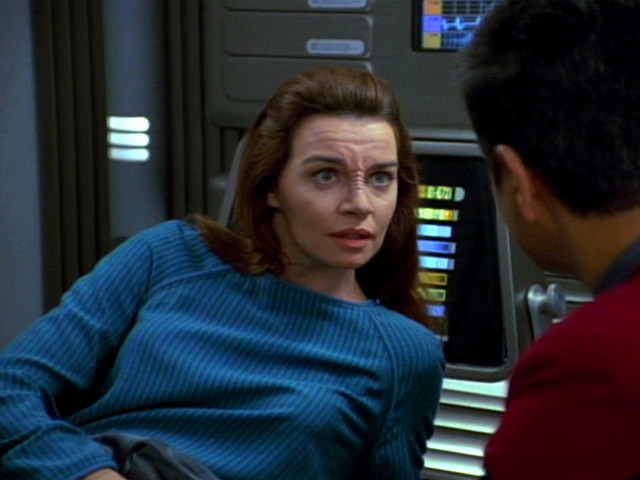
Stardate not given: Janeway orders an away team collecting food on a planet to beam up immediately because a Kazon ship is detected in orbit. Only Seska does not show up on the sensors. Chakotay finds her in a cave where the two have to fend off a group of Kazon attackers. Later, in deep space, Voyager responds to a distress call from a Kazon vessel on which a gruesome accident with an unknown device has fused the crew with the metal structures of their ship. There is only one survivor for whose survival the Doctor needs the crew as blood donors. Tuvok reports to Janeway that the Kazon were trying to activate a food replicator built with Federation technology, and that most likely a traitor aboard Voyager gave it to them. This makes Seska, who was alone with the Kazon for a while, the main suspect. Lt. Carey, on the other hand, had a motive as well, and the message to the Kazon was sent from his console. Maje Culluh of the Kazon arrives to discuss the issue of the stolen technology with Janeway, but all he cares about is to kill the survivor in sickbay with a nerve toxin. In the meantime the Doctor has found out that Seska is lacking typical blood characteristics of Bajorans, and that she is most likely Cardassian - surgically altered to infiltrate the Bajoran resistance. Seska makes up a story about her suffering from Orkett's disease in her childhood and a Cardassian bone marrow donor saving her. But the Doctor has already ruled out this possibility. Chakotay and Tuvok set up a trap, claiming that there is still evidence in the computer, and Seska takes the bait. When Janeway and Chakotay confront her, she activates a transporter protocol and beams over to the Kazon ship.
Review
I like the Kazon as Voyager's recurring enemies at this point of the series. "Caretaker" established that their technology is far inferior to that of the Federation, although the idea that they wouldn't even have water (or that they would settle on a planet without water in the first place if they could go anywhere in their huge ships) isn't credible. Anyway, it makes sense for the Kazon to get their hands on the valuable technology of Voyager, for which they need to leave the ship intact, although they would be able to take revenge for the events in "Caretaker" and blow Janeway's ship to pieces (at least with combined forces). And the goal of their efforts, to replicate food and other necessities that they sorely lacked in the pilot episode, rather than weapons, even creates some sympathy with the thieves, unfortunately only on a side note in this story.
Since the Kazon can't simply try to beam over and steal what they want to have, they need someone on Voyager who helps them. And this is where my problems with the story begin. It is obvious that Seska must have contacted them in the first place, that she gave them the tactical knowledge to hide their ship from Voyager's sensors and that she promised to give them the replicator component in exchange for, well, something. Her motivation doesn't become clear enough. She disapproves of Janeway's decision not to return to the Alpha Quadrant and of all the "Federation nobility". She says she was seeking allies, to build "a base of power" in the Delta Quadrant, which is bullshit if all she actually wants is to return home. Stranger things happen in the real world, where young people betray their people and join the scum of the so-called "Islamic State". But I don't understand why Seska would ally herself with an alien race that she knows absolutely nothing about, and that might kill her any time.
This is not my only beef with Seska. I don't like how the narrative hastily constructs her relationship with Chakotay that has never been hinted at in her few previous appearances. For Chakotay's moral conflict it wouldn't have been necessary for Seska to be his ex- or potential lover, it would have sufficed that Seska was a member of his Maquis crew.
And finally, the story draws on Cardassians as universal villains in a similar fashion as Hollywood on Germans (or characters with German names or only with German cars), even in movies totally unrelated to WWII. Cardassians are frequently shown as being cruel, sinister and untrustworthy, as opposed to other alien races whose representatives are both usually more likable and more diversified. It is also interesting to notice that once her identity is revealed, Seska behaves according to the Cardassian role cliché of being grandiose instead of her previous defiant Bajoran attitude - a change that Martha Hackett portrays quite credibly although it is very racist. And since I already posed the question about Seska's motivation to betray her crew, her being Cardassian suddenly is reason enough, at least in the logic of the story. Well, as Chakotay has to concede the fact that Seska is Cardassian does not make her a traitor, but we all know how the saying goes: "Fool me once..." Seska's being Cardassian is the final nail in the coffin of her deception, and the timing leaves no option for an alternative ending. The story could have been constructed better in this regard, or (preferably) the Cardassian connection could have been ditched altogether.
Other than that, I like how the spy story unfolds. There are two suspects, Seska and Carey, each of whom has a motive and would have had the ability to fabricate evidence to incriminate the other one. Considering that Seska is under suspicion because she was isolated from the rest of the crew and had the opportunity to meet with the Kazon, I used to think that it is a red herring, and that for everything incriminating her there may be a plausible explanation. And just as I wanted to settle on this idea, Carey was presented as an alternative culprit. But as I already mentioned, the revelation that Seska is Cardassian comes at the wrong time because now it is clear that she betrays Chakotay a second time.
Chakotay's inner conflict is worked out very well. He just wants Seska to be innocent, and he takes any chance to play down her possible motives and her opportunity to betray him, while he overstates evidence that could exonerate her. On the other hand, we have Tuvok, who solves this case with his incorruptible logic, but even more so with a very good intuition that we may not have expected from him.
Annotations
- Continuity:
- In DS9: "Second Skin" it appears that Kira Nerys is a Cardassian infiltrator on Bajor just as Seska here.
- The episode marks the first appearance of Maje Culluh (played by Anthony De Longis) of the Kazon-Nistrim. The story arc of Seska's alliance with Culluh will continue until "Basics, Part II".
- Seska leaves a surprise for her former crewmates in the form of a insidious holoprogram that will be activated in "Worst Case Scenario".
- This is the last appearance of the "real" Lt. Carey in the series before his death in VOY: "Friendship One", creating a big continuity problem. In VOY: "Relativity" and VOY: "Fury" we can see him in newly filmed scenes, but only as flashbacks. Where on the ship or in the universe will he hide for the following six(!) years?
- Tuvok ponders that another Federation ship might have been lost in the Delta Quadrant and might have encountered the Kazon. And indeed, Voyager will run into such a ship, the USS Equinox in VOY: "Equinox".
- Nitpicking:
- After retrieving the replicator circuits from the Kazon vessel, why doesn't Janeway order the ship to leave the scene, considering that more Kazon vessels are approaching, and not with peaceful intentions?
- It doesn't make sense for Seska to lie about her blood that may have Cardassian DNA because of a Cardassian bone marrow donor. Her anatomy and her other DNA would still be Cardassian, unless it was possible to alter this as well. In any case the Doctor should have examined the rest of her as well, and not only her blood.
- Remarkable dialogues:
- "We, err, we should be able to make an attempt by tomorrow." - "I want it ready by the end of the day." - "No, Captain. When I say tomorrow, I mean tomorrow. I don't exaggerate. Tomorrow is the best I can do." - "Understood, Lieutenant." (Torres and Janeway, in a wonderfully satirical note on Scotty and Kirk)
- "Can I ask you to be honest with me, Lieutenant?" - "As a Vulcan, I am at all times honest, Commander." - "That's not exactly true. You lied to me when you passed yourself off as a Maquis to get on my crew." - "I was honest to my own convictions within the defined parameters of my mission." - "You damned Vulcans and your defined parameters. That's easy for you." - "On the contrary. The demands on a Vulcan's character are extraordinarily difficult. Do not mistake composure for ease. How may I be honest with you today?" (Chakotay and Tuvok)
- Remarkable quote: "You know, I'm really easy to get along with most of the time. But I don't like bullies, and I don't like threats, and I don't like you, Culluh." (Janeway)
- Remarkable location: The exterior scenes were filmed at Bronson Caves in Bronson Canyon.
Rating: 6
Heroes and Demons
Synopsis
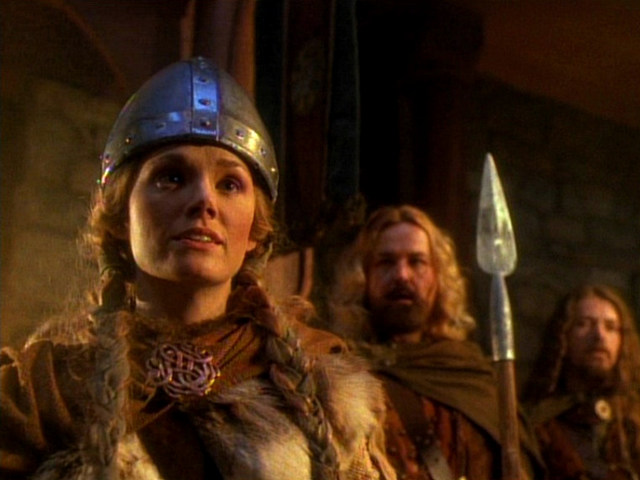
Stardate 48693.2: B'Elanna Torres beams samples of photonic energy aboard but loses one of them due to a containment breach. Harry Kim, who was on the holodeck in his free time, goes missing. Chakotay and Tuvok enter the still running holodeck program, based on the medieval epic of Beowulf. The two encounter a female warrior, Freya, who tells them that Bewoulf (obviously Harry's character) was killed by a monster called Grendel. The safety protocols are offline, so they have to act with caution. Chakotay and Tuvok are greeted by King Hrothgar, Freya's father, who is desperate about Grendel's frequent attacks on his people. In an attempt to examine Grendel, Chakotay and Tuvok vanish just as well. Paris prepares the Doctor to be transferred to the holodeck, in the hope that he, as a holographic person, may have better luck. The Doctor, under the name of Schweitzer, too runs into Freya, and he becomes romantically involved with her. He confronts Grendel in vain but can be transferred back to sickbay in the nick of time. B'Elanna finds out that the photonic energy is some sort of lifeform, and that Kim, Chakotay and Tuvok are their hostages. The Doctor returns to the holodeck with the container holding the remaining photonic energy sample. Unferth, one of the warriors, attempts to stab him but kills Freya who steps in front of the Doctor. The Doctor proceeds to Hrothgar's hall and successfully releases the photonic being in exchange for his three crewmates.
Review
The Doctor has undergone quite a development in a short time. Only a few episodes ago, his main concern was that crew members forgot to switch him off or ignored him altogether. And now he faces his "first away mission", as Janeway expresses it. It becomes clear that the Doctor's programming is more complex (or allows more extensions) than we might have expected from an emergency medical hologram. The Doctor is nervous about the tasks that don't belong to his original program - and nervousness definitely isn't anything that Lewis Zimmerman would have included with intent. So the sentiment must be something the Doctor develops on his own. The same goes for his romantic involvement with Freya, which is quite obviously something the good Doctor would never have expected to happen to him. And it also noticeable that the Doctor is afraid of Grendel. If there is one specific point at which the Doctor evolves from a simple computer program to a real personality, then it is in this episode.
While I like the story as a character study of the Doctor with a lot of emotional involvement, everything related to the photonic beings is unoriginal and predictable. There were plenty of stories along the same lines in TNG, and mostly better ones. And the idea that as soon as *some* malfunction occurs on the holodeck, it *inevitably* deactivates the safety protocols is utterly implausible. I appreciate the efforts made to create the Beowulf scenario, but after a while the confrontation of myths vs. technology isn't interesting any more. The bland Beowulf characters don't contribute much to the story and they keep playing their own game. With the only notable exception of Freya, they are more like obstacles the crew has to avoid in their efforts to retrieve the three missing crew members. Still, while the dumbness of the Beowulf characters is a letdown with regard to the story, it only emphasizes the big leap that the Doctor makes in this episode.
Annotations
- Continuity:
- The Doctor chooses to abandon his new name "Schweitzer" because it would sadly remind him of Freya's death. He won't get a name until the end of the series (at least not in the original timeline).
- Photonic beings will return in "Bride of Chaotica!", again on the holodeck.
- Remarkable quotes:
- "I can describe every detail of every piece of equipment in this sickbay from biobed to neurostimulator, but I've never even seen a sky or a forest, let alone Vikings and monsters. I can't afford to fail but I don't know what to expect in that holodeck." (The Doctor)
- "Well, there was the time I managed to stop the spread of Paronisti measles before it became epidemic. For a while, things were touch-and-go. Six people came down with it. Fortunately, I was able to isolate the endoplasmic virus and replicate it in order to form an antibody. Even then, it wasn't altogether clear I could create an effective vaccine, but I worked at it for 74 hours straight and managed to create an inoculation that successfully protected the crew." (The Doctor, to Hrothgar's people)
- Remarkable facts: "The Vok'sha of Rakella Prime believe that hate is a beast which lives inside the stomach. Their greatest mythical hero is a man who ate stones for twenty three days to kill the beast and became a saint." (according to Chakotay)
Rating: 4
Cathexis
Synopsis
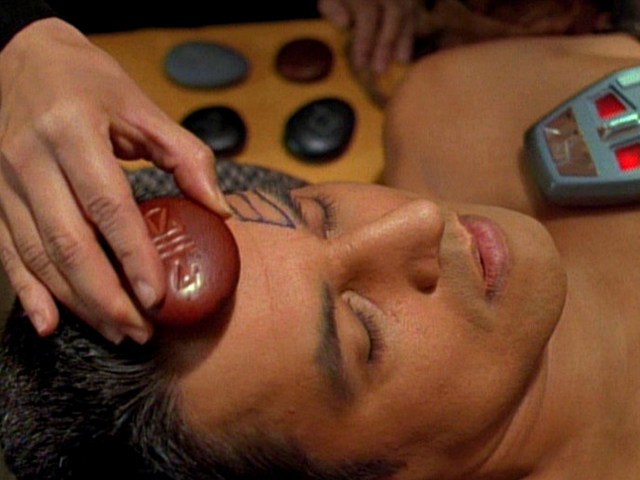
Stardate 48734.2: A shuttle with Tuvok and Chakotay aboard is attacked inside a dark matter nebula, leaving Chakotay without any bioneural energy - he is brain-dead. The Doctor says that he might be able to save Chakotay if he knew what kind of weapon was used, and so Janeway sets a course for the nebula. In the following, some unknown neural energy repeatedly takes control of crew members' minds and tampers with the navigation and propulsion system, obviously in an attempt to prevent the ship from entering the nebula. Janeway transfers her command codes to the Doctor because he is the only person aboard that can still be trusted. Kes too senses an alien presence and Tuvok suggests to help her focus her abilities through a mind-meld, but the two are attacked and Kes falls into a coma. Moreover, someone deactivates the Doctor and locks out his program. Janeway becomes aware that Tuvok lied. There was no attack with weapons but non-corporeal aliens have taken control of Tuvok's mind. The situation on the bridge escalates when Tuvok grabs a phaser and threatens to kill everyone. On his order the ship enters the nebula, where it is attacked by many alien beings. At the same time, however, Torres and briefly later Neelix are possessed by still another consciousness. It is Chakotay's. After disabling the alien in Tuvok with a magneton pulse that Torres had prepared to scan for the aliens, Janeway takes command of the ship again and follows a flight path suggested by Chakotay. The ship clears the nebula. The Doctor successfully reintegrates Chakotay's mind in his body.
Review
The idea of crew members who are possessed by aliens has a long tradition in Star Trek. It is accordingly difficult to come up with a new story of this kind. Specifically, the story of "Cathexis" reads much like a reissue of TNG: "Lonely Among Us". In both episodes an alien consciousness is picked up inside a nebula, it apparently keeps jumping from one crew member to another and it is up to no good. However, while the TNG episode raised interesting issues about how to deal with mutual mistrust and with an obviously possessed captain, "Cathexis" doesn't really address the danger of growing paranoia among the crew beyond a brief mention of the phenomenon. Well, the Voyager episode also has some traits of TNG: "Power Play" but it misses the chance to create suspense by showing the possessed Tuvok as a formidable enemy like Data, O'Brien and Deanna in the TNG episode. There isn't anything that stands out and there isn't much unique about the story of "Cathexis", except the comparably minor plot twist that one of the mysterious aliens turns out to be Chakotay's consciousness.
I can see how it was supposed to make sense in hindsight that some of the interference came from the energy beings, who wanted the ship to enter the nebula, and some was actually Chakotay's, who was trying to prevent exactly that. But after a while I didn't bother keeping track of which consciousness was occupying which crew member at what time and what was the effect on the ship's course. It didn't try to figure out if and why in particular Tuvok was lying about the attack on the shuttle and whether or not he was possessed by aliens for the whole episode. The logic may have worked but got obfuscated to an extent where it simply didn't matter that much. It became boring anyway to see Chakotay's soul hover through the ship (at least I think it was always Chakotay) and clueless crew members with memory gaps. The arc of suspense didn't captivate me. In order to work out the logic of the story better and to keep up the suspense, it may have been better to show the events on the ship consistently from the viewpoint of Tuvok or of the person who is currently possessed by Chakotay's mind, instead of trying to maintain the mystery.
As already mentioned, the story largely misses the chance to create a conflict among the crew. Overall, "Cathexis" fails to work with the characters like few other Voyager episodes. Well, Chakotay is dead anyway until the final minute of the episode. But there could have been more of a quarrel between Janeway and Tom, who is the first suspect when the course is altered from his console. Kes could have needed some more involvement, but after the prospect that Tuvok might mind-meld with her, she falls into a coma for the rest of the episode. And the mutual mistrust between Janeway and Tuvok is not consequentially elaborated. It arises too suddenly, remains indefinite and quickly makes way for a scene in which everyone threatens everyone else with a phaser.
It is clear that the Doctor would have to find some way to restore Chakotay and somehow put his mind (that is hovering through the ship) back into his body, but the effortless way it happens is both anticlimactic and unrealistic. The Doctor simply performs what we can call the first successful soul transplantation in history. A medical miracle that doesn't become more credible just because it is not shown and not described with technobabble ("It would take over ten hours just to explain it all"). Seriously, this isn't any less absurd than the brain surgery in "Spock's Brain".
Annotations
- Remarkable error: Tuvok's rank switches between lieutenant commander and lieutenant a couple of times during this episode. This would normally be rated as a simple instance of missing rank pips, but after this episode Tuvok consistently appears as a lieutenant.
- Remarkable dialogue: "Mister Neelix, just because a man changes his drink order doesn't mean he's possessed by an alien." - "Nevertheless, don't you think you should scan him or dissect him or something, just to make sure?" (EMH and Neelix)
- Remarkable quote: "Doc Brown. Lollipops in the waiting room, no holocomic books more than six months old, house calls. I caught a bad cold one time when I was nine years old. The doctor whipped up a pot of garlic soup and brought it over himself." (Tom)
Rating: 2
Faces
Synopsis
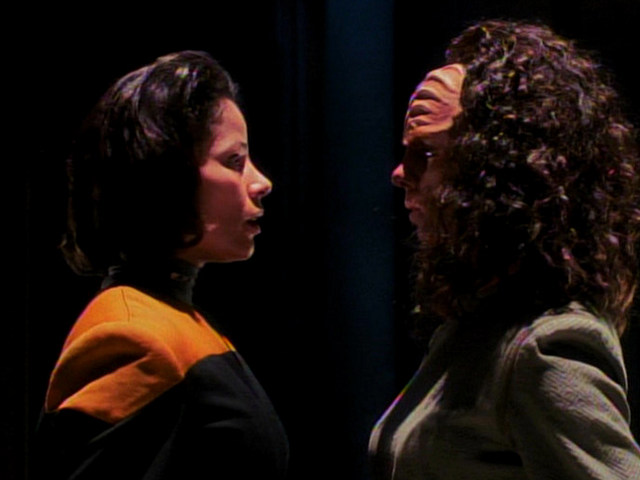
Stardate 48784.2: A geological survey team consisting of Paris, Torres and Durst doesn't show up at the arranged beam-up coordinates. They have been captured by the Vidiians. While Paris and Durst have to work in a mine, B'Elanna was taken to a laboratory where her DNA was split up in a way to form one fully Klingon and one fully human person. Chief surgeon Sulan hopes that the Klingon DNA may be the key to curing the phage. Sulan wants to "please" the Klingon B'Elanna and puts on the face of Durst, who has been killed to pillage his organs. The Klingon B'Elanna, who has inherited all the strength and courage, breaks free and escapes from the lab. She rescues her timid human counterpart from the labor camp. In the meantime Chakotay, in Vidiian disguise, is able to free Paris too. As the human B'Elanna is working to take the forcefield around the Vidiian installation down, Sulan fires his energy weapon. The Klingon B'Elanna jumps into the line of fire and is mortally injured. Back on Voyager the EMH tells B'Elanna that she would need the Klingon DNA to survive and that he is going to restore her as the hybrid she used to be.
Review
It is good to see the Vidiians return so soon after "Phage". They are formidable opponents and in light of the tragedy of their species there is always a rest of sympathy with their actions, as cruel as they may be. This holds true once again in "Faces", as Tom and Durst are put into a combination of labor camp and spare organ storage, whereas B'Elanna ends up in the lab of Sulan, a Vidiian Frankenstein of sorts, and a victim himself. In a manner of speaking, Sulan himself is the monster. It is not only his horrible appearance, but also his attempts to develop feelings and prove them to B'Elanna that he has in common with Frankenstein's monster. We sympathize with him and his efforts to find a cure for the phage, just as with other members of his species before. But when he puts on the face of the ill-fated Durst he eventually crosses a line, not only for B'Elanna but also for the viewer. Sulan is an interesting character, and I would have wished for him to get more screen time. Overall, if any episode of the first season besides the pilot would have had enough substance for a two-parter, it is "Faces".
The underlying idea of "Faces", that one person could be split up in two, with each one inheriting different aspects of the original personality, is not new. It already appeared in TOS: "The Enemy Within", where one "good" and one "evil" Kirk came to existence. The Voyager episode is a bit more credible, since the visual and behavioral differences between the two B'Elannas can be attributed to different DNA sequences. Still, there are some remarkable similarities between the episodes. Most obviously, the determined Klingon B'Elanna has many traits of the "evil" Kirk and the uncertain human B'Elanna behaves much like the "good" Kirk. While in the TOS episode the "good" Kirk initially appeared as the true person and the other one was regarded as an unfortunate by-product, it is the other way round in "Faces". Here Sulan only deems the Klingon B'Elanna valuable, not only because her DNA might cure the phage but also because of her overall strength, courage and even sex appeal that the human version is lacking (at least in his eyes). Yet, in both episodes it turns out that the two versions can't exist on their own, at least not on long term. Consideration is useless without determination, and vice versa.
Although it is made clear that neither the Klingon nor the human B'Elanna is the better person, the Voyager episode has a problem with the impersonation of the racial stereotypes. "Faces" takes the stereotypes one step further than previous Star Trek installments that used to depict the Klingons as generally more violent and humans as generally more resourceful and would have allowed exceptions. B'Elanna, however, is shown to be composed of two building blocks, one Klingon and one human, that have very little in common. And although the human B'Elanna eventually overcomes her fear and develops a kind of courage on her own, this story has a bad aftertaste because it ultimately reduces every person to "50% of your mother's and 50% of your father's genes". This is to the disservice of people who suffer from racial prejudices and especially children from interracial relationships. And speaking of things that are said to be genetically predetermined although they shouldn't, the impression is created that honor is something the Klingon B'Elanna has in her DNA, rather than this being a cultural aspect that she could only have acquired by living in the Klingon Empire, which she didn't.
Overall, this is a excellent episode for B'Elanna in spite of my reservations. It is the most intensive character study of the whole first season and a great chance for Roxann Biggs-Dawson to prove herself in a dual role. I think she does well, although at first it doesn't look like that. Her portrayal of the Klingon B'Elanna who is strapped to the examination table is over the top. Her grumbling with frequent dramatic pauses is supposed to sound somehow more alien than the normal B'Elanna, but comes across as hokey. I don't know in which order the scenes were filmed, but in the course of the episode the Klingon B'Elanna begins to talk more like a normal person, even when she explains the concept of honor to her human counterpart (which might be a reason for an overly solemn speech).
Annotations
- Continuity: This is the first episode with Tom Paris as lieutenant junior grade instead of lieutenant. There is no apparent reason why he was reduced in rank (he didn't take part in the illegal deal in "Prime Factors"). Curiously, in the Vidiian prison the freshly demoted Tom poses as the superior officer of (full) Lieutenant Durst.
- Nitpicking: In the mine, the Vidiian guards come to take the weakened human B'Elanna back to the barracks. With the guards standing next to her, B'Elanna says: "That's okay, Tom. Maybe if I'm there I can try to make contact with the ship." Uhm. Bad idea. Neither Tom nor B'Elanna is wearing a communicator, but they can understand the Vidiians and the other way round all the time, can't they?
- Remarkable technology: Besides the Vidiian method to extract organs without surgery already known from "Phage", the genotron, which reportedly converts matter to energy, is another hint that they should have transporter technology just as well.
- Remarkable facts: B'Elanna tells Tom the following about her childhood:"I grew up on a colony on Kessik IV. My mother and I were the only Klingons there, and that was a time when relations between the Homeworld and the Federation weren't too cordial. Nobody ever said anything, but we were different and I didn't like that feeling. Then my father left when I was five years old. One day he was there and the next he wasn't. I cried myself to sleep every night for months. Of course I never told anybody. And then I finally decided that he'd left because I look like a Klingon. And so I tried to look human."
- Crew losses: 1 (Durst)
Rating: 7
Jetrel
Synopsis

Stardate 48840.5: Ma'Bor Jetrel is a Haakonian scientist, who was responsible for the development of the metreon cascade, a weapon of mass destruction that dissolved 300,000 Talaxians on a moon called Rinax more than fifteen years ago. Among the victims was Neelix's entire family. Jetrel comes to redeem himself. He claims that Neelix may be suffering from a deadly disease, metremia, brought about by the weapon, and confirms this when Neelix agrees to be examined. Jetrel proposes to use the transporter to collect samples of the metreon cloud around Rinax, to synthesize an antibody. It turns out that Jetrel suffers from metremia himself, in its final stage. However, Jetrel's claim that Neelix was suffering from the illness was just a pretext to utilize Voyager's transporter technology in his effort to restore the victims. Janeway agrees to the plan, but the attempt fails because the pattern decay is too strong.
Review
This episode is hard to classify and therefore hard to rate. To be honest, I just don't like the story very much despite its strong emotional impact. The main problem in my view is that a character study of the type "victim faces culprit" alone is not enough to make a good story. Neelix's preoccupation is easy to understand, and so is Jetrel's repentance. They may find sort of a common understanding the way it would be generally desirable and it would be likely the case in a Star Trek episode. Or they could fail to do so, just for a change. In either case it wouldn't be much of a story. The writer may have had the same thoughts, and may have deemed it useful to beef it up. The result is the inept attempt to make it more of a sci-fi story, by shifting the focus to a question of medicine and ultimately of transporter technology. While the flow of the story is a bit boring until Jetrel's actual plan becomes clear, the implausible tech-heavy rest of the episode is to the disservice of the so far decent character study.
Another issue I have is that Jetrel's intentions unnecessarily turn out different than they appeared to be. Jetrel pretends that Neelix is suffering from metremia only to get access to Voyager's transporter and try his well-meant reviving of the dead. Why doesn't he tell the truth at the very beginning? The Starfleet crew would have gladly supported him, and he wouldn't have bothered and scared Neelix. I appreciate that despite his odd of way of trying to redeem himself Jetrel's goals are noble. On the other hand, his character, his course of action and the way how one of the crew develops emotional attachment to him reminds me a tad too much of Marritza in DS9: "Duet". Even the theme of the terminal illness as a consequence of the war is the same.
I like that Neelix, perhaps for the first time in the series, can be seen in a really serious role. It may be the first time that we are shown the real Neelix behind the funny façade that he has erected to be able to cope with his traumatic war experiences. In hindsight, we can understand well why he left his homeworld behind and sought happiness out in space, where nothing would remind him of those he had lost. In this context I think it's counter-productive that yet another facet is added to Neelix's character in this episode, as if the loss of his family hadn't been enough. Neelix was lying about his time in the Talaxian Defense Force. He refused to fight for his planet. He has never been in any battles. And while Rinax was attacked, he was hiding somewhere on Talax. Whether Neelix's reasons were pacificism or cowardice, he was dishonest to those few people whom he told about his battles but most of all to himself.
I understand that Neelix's secret is supposed to mirror Jetrel's ease of guilt in the logic of the story. No one is plain white or black in the Star Trek Universe. I only don't like how a principal character is deconstructed at the first chance of giving him some more depth. Yet, I dig Neelix's nightmare set in Tom's holographic bar (Sandrine's) in which he is haunted by Jetrel, but Jetrel eventually turns out to be Neelix himself.
Finally, I have a general complaint that TV and movies tend to exaggerate the role of scientists in political or military decisions - where they are usually depicted as either reckless, naive or mad - or everything at once. Fortunately there is a discussion of Jetrel's real responsibility and motivation in the episode, that he wasn't actually the guy who pushed the red button. Clearly Jetrel's remorse about the development of the deadly weapon and the fact that he was expelled from his homeworld for allegedly conspiring with the enemy is an intentional analogy to Robert Oppenheimer.
Annotations
- Continuity: We can see for the first time how the EMH deactivates himself.
- Nitpicking:
- Metremia is said to cause damage on the molecular level, then on the atomic level and finally (implicitly) even on the sub-atomic level. Yet, an antibody is deemd a suited therapy.
- It is not the first time that we see people moving while they are being beamed. But these people have been dead for more than a decade and their matter scattered in space. By all means, it is a stretch that it could be possible to reconstruct the victims of Rinax. But considering that the transporter was so close to achieving this goal up to a point that it obviously reanimated those people, it could have worked if only the crew had tried harder.
- Remarkable quote: "There is no way I can ever apologize to you, Mister Neelix. That's why I have not tried." (Jetrel)
- Remarkable shuttle: The Haakonian shuttle is a re-use of the Tarellian ship from TNG: "Haven", using stock footage from "The Game".
- Remarkable facts:
- Neelix says: "When I was much younger, my family and I lived on a moon called Rinax, a colony with the most temperate climate in the entire Talaxian system. Warm days, balmy nights. Until the metreon cascade... Doctor Jetrel was the scientist who conceived the metreon cascade, then he led the team of scientists who built it... In the blink of an eye Rinax was enveloped by a deadly cloud, and those lovely days were turned into one endless frigid night. More than 300,000 thousand were killed."
- Jetrel about metremia: "Our war records show that he [Neelix] was part of the team that returned to Rinax after the Cascade in order to evacuate survivors. He was exposed to high concentrations of Metreon isotopes. In recent years several of the rescuers have developed a degenerative blood disease called metremia... I am afraid that it's fatal. The disease attacks its victims on a molecular level. It may lay dormant for years, but once it manifests itself, it will cause the body's atomic structure to undergo fission. The cells will begin to disintegrate. My equipment is specifically designed to detect the sub-atomic signature of the disorder."
Rating: 4
Learning Curve
Synopsis
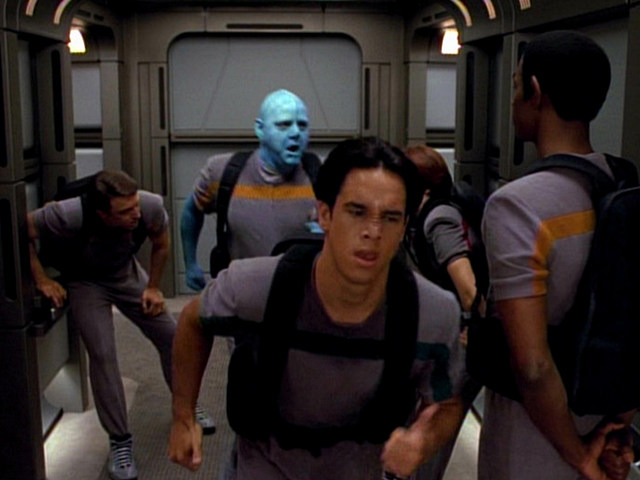
Stardate 48846.5: Tuvok notices how Crewman Dalby, a former member of Chakotay's crew, replaces a bioneural gel pack without authorization. Captain Janeway orders Dalby and three other former Maquis that are known to be stubborn and unmotivated to take part in a Starfleet training led by Tuvok. Tuvok arranges drills for the four crewman but with little success. In the meantime more gel packs have been infected, and the source is found to be a cheese that Neelix keeps in his kitchen. Multiple system failures occur on the ship, and Tuvok and the four crewman are trapped inside a cargo bay without being able to contact the bridge. Janeway orders to invert the warp field to heat up the gel packs and fight the infection, which causes a conduit in the cargo bay to rupture. As the room is filling with poisonous gas, Tuvok orders three of the crewmen to escape through a Jefferies tube, while he stays behind to save the fourth one, thereby earning the respect of the former Maquis.
Review
I don't like this story a lot. First of all, I don't agree with the reasoning that everyone could or even should be turned into a "more valuable" person in a boot camp, and I disapprove of many of the methods that are employed in there. Picking on people without explaining the reasons and giving them pointless orders (such as scrubbing the floor with a toothbrush) is nothing but a hollow demonstration of power in my view. It isn't helpful in any way to motivate subordinates or earn their respect. It is easy to pretend that it is a good concept, just because humbled and exhausted recruits don't contradict easily, and broken personalities don't have the power to commit crimes any longer. Breaking someone's will in order to get them to cooperate may be necessary in some extreme cases, but it shouldn't be the rule, not even in a military organization. I acknowledge that pushing people to their limit is naturally a crucial part of a drill, but it is inexcusable that Tuvok does not commend his recruits after their 10km run (with increased gravity). While I understand and accept that Starfleet is still built on discipline just like the military today, Tuvok's idea of drills is the one of the 20th century. Starfleet is an utopian organization with counselors and carpeted floor on their ships, and the idea of a drill instructor of Tuvok's kind just isn't fitting.
Well, I may be exaggerating a bit because some of Tuvok's training lessons do make sense. After the tactical bridge simulation (a kind of Kobayashi Maru scenario), for instance, he makes a good point when he says to Dalby that there would have been the option to retreat but Dalby simply doesn't want to hear that because he would prefer to go down with firing phasers. Here is an example of a spirit that should have no place on a Starfleet ship, and a reason for drills and lessons indeed.
Dalby is the toughest case among the four Maquis anyway. It is clear that the various cases of subordination in the episode must have disciplinary consequences for him. However, Tuvok is still comparably lenient on him, and he gives Dalby more leeway than his three fellow Maquis. I don't think that's right. If Tuvok's intention is to break the Maquis spirit it may be a good idea to target the weaker links in the chain but in terms of discipline and trust it is very counter-productive. Well, after talking to Neelix, Tuvok obviously tries to get to know Dalby better in the hope that if he can convince him of the Starfleet way it may work with the others just as well. Unfortunately the two continue to talk at at cross purposes even as Tuvok lowers the pressure on the cadets.
What I like about the story is how it becomes clear that much of the conflict is a simple matter of misunderstandings. Tuvok doesn't get across that his drills are not meant to be a punishment. The Maquis don't recognize that it will make everyone's lives easier once they obey a few simple rules. It requires a dangerous situation and the "cheesy" sub-plot with the gel pack infection to get them to work together and recognize that they have common goals.
On a final critical note, when Dalby complains to Chakotay about the Starfleet way, Chakotay punches him hard, saying that would be the Maquis way. So the Maquis way is violence instead of discipline?
In spite of the bad taste that it leaves (and I'm not talking of the cheese) the episode has its moments.
Annotations
- Remarkable dialogues:
- "The patient is sick." - "Can you be more specific?" - "To discuss the patient's condition in front of the patient would be a serious breach of professional etiquette. It's been suggested that I cultivate a greater sensitivity to my patient's needs. Don't worry, my little friend." (The Doctor and Torres)
- "These are Keela flowers. Beautiful and remarkably strong. The stem is flexible, impossible to break. But occasionally on the same plant there's a bloom whose stem is not so flexible. Ah, here's one. And when the stem is brittle, it breaks." - "You're saying that the Maquis crew is rigid and inflexible. That they will never adjust to Starfleet rules." - "No, Mister Vulcan, I'm saying that you are rigid and inflexible, but maybe if you'd learn to bend a little, you might have better luck with your class. Those Maquis aren't Starfleet cadets. You can't treat them the same way. Get to know them, try to find out what they're like inside. You might discover a better teaching method." (Neelix and Tuvok)
- Remarkable quote: "If you can learn to bend the rules, we can learn to follow them." (Dalby)
- Remarkable 47: There are 47 bioneural gel packs in reserve.
Rating: 4