Star Trek Enterprise (ENT) Season 4 Reviews
Season 1Season 2Season 3Season 4
Storm Front I/IIHomeBorderlandCold Station 12The
Augments
The Forge
AwakeningKir'SharaDaedalusObserver Effect
Babel OneUnitedThe AenarAfflictionDivergenceBound
In a Mirror, Darkly I/IIDemonsTerra PrimeThese Are The Voyages
Storm Front I/II
Synopsis
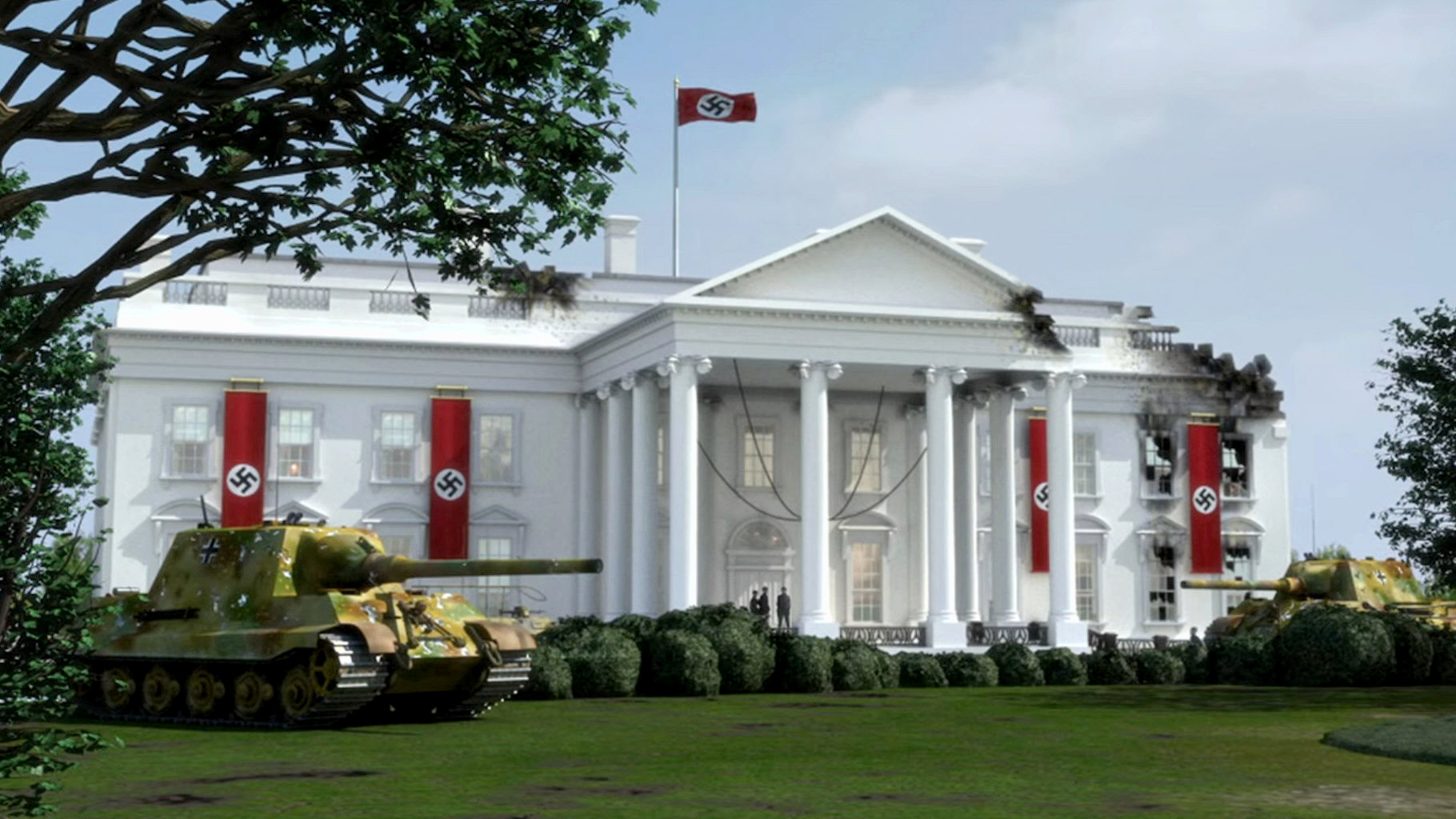
Date not given: In the year 1944, the Nazis have conquered parts of the USA with the help of their alien allies from the 29th century, led by Vosk. American resistance forces free Archer, who wakes up in the apartment of Alicia in the Nazi-occupied Brooklyn. Daniels appears on Enterprise, near-death, explaining that the Temporal Cold War has escalated, and that agents are changing history in many centuries. Silik crawls through the ship, attacks Tucker and steals a shuttlepod in which he escapes to New York. In the meantime, Archer, Alicia and her gang meet with one of the aliens. Alicia's friend Sal kills the alien, but not before Archer can get his communicator and contact Enterprise to be beamed up. Tucker and Mayweather, on the other hand, are captured by the Nazis while they are searching for Silik. Vosk is willing to return Tucker and Mayweather if Archer agrees to meet with him. But back on Enterprise, the alleged Tucker turns out to be Silik. Still, Archer and Silik join in an effort to find Tucker and to destroy a temporal conduit that is intended to bring Vosk back to his century. Alicia and the resistance group help them get into the building. Silik is killed, but Archer can find Tucker just before Enterprise blows up the facility. The ship returns to a 22nd century where everything is normal again.
Review
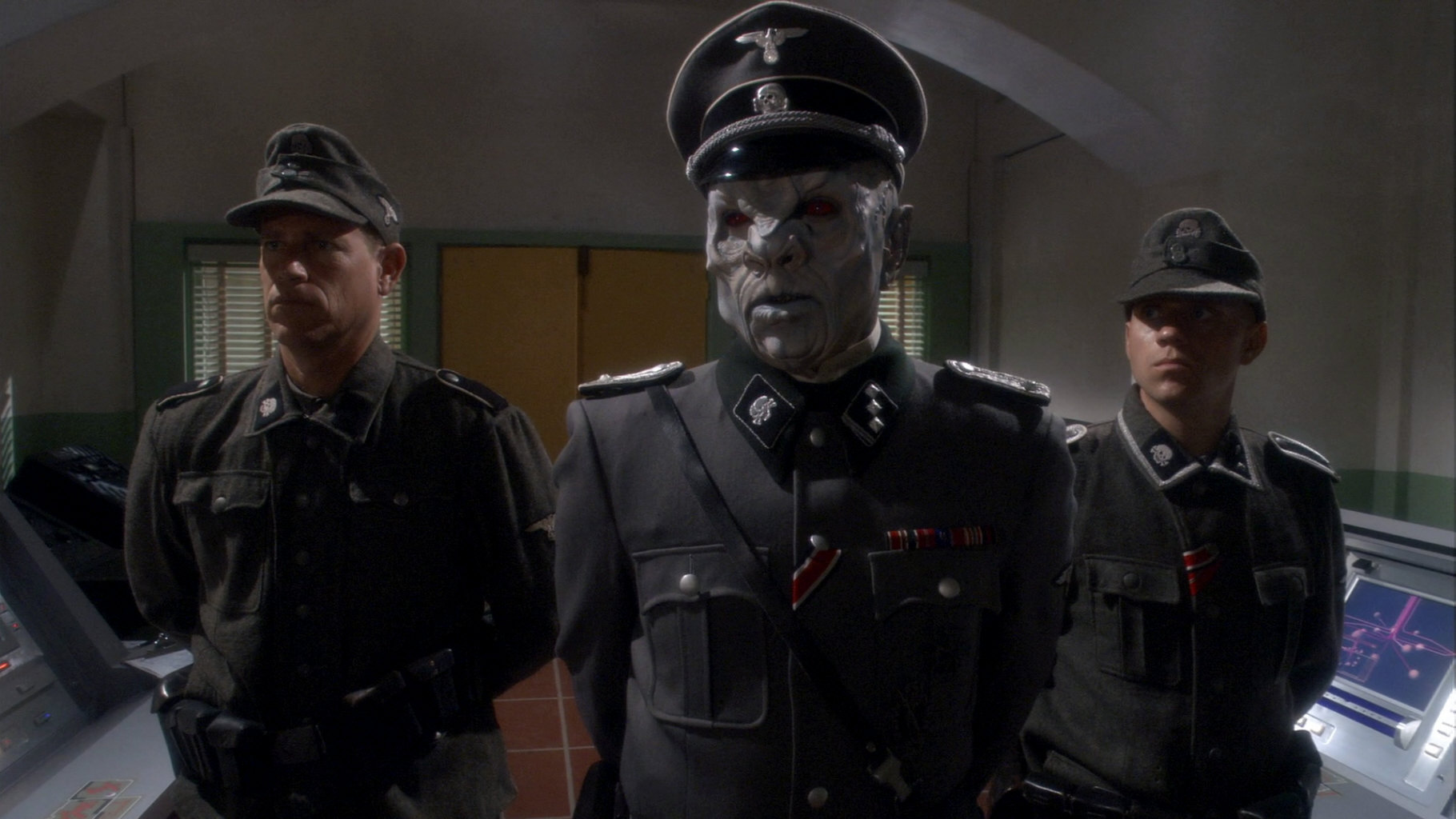
I almost lack the words to describe this disaster. "Storm Front" is an offense against the intelligence and the good taste of Star Trek fans. Right now, I am staring at the computer screen, struggling to write at least a few words, but it just gives me a headache. What I anticipated was a decent time travel story, only impaired by the exploitation of Hollywood's large pool of Nazi stereotypes. I was biased against a Nazi story for very good reasons, and I guess I've written enough about that in my review of "Zero Hour". But "Storm Front" turned out bad on almost all other accounts too. It is brainless even if we try to forget for a moment that it is based on the ludicrous idea of Space Nazis. In the tradition of pulp stories it is overcrowded with gaping plot holes, plot twists out of thin air, superficial protagonists who act erratically, unintentional humor and unmotivated action. And finally with a resolution where just something needs to be blown up to save Earth, just as in "Zero Hour". The Nazi theme is just the icing on the cake. In an attempt to see any merit in the topic of the episode, we may try to regard "Storm Front" as some sort of remake of "The City on the Edge of Forever" (some motives are the same), but a decent and intelligent story is not perceptible amidst the noise of rattling machine guns and bawling Nazis.
We are also looking at the perhaps worst time travel episode of the franchise, one where the sudden temporal dislocation is essentially just an excuse to let the brave crew fight against evil aliens and Nazis and then magically return to their own century. Even if the fan base is tired of the weird temporal phenomena after seeing so many of them, I think it is a waste to make a time travel episode devoid of any such ideas. Following the trend that Enterprise's time travel stories are dumbed down compared to those of TNG or Voyager, nothing is even supposed to make sense here. Not the slightest attempt is made to explain anything, the blunt remark "That's beyond your comprehension" is meant to suffice. As if blurring or ignoring the problems would make everything more plausible. Is this still science fiction? I don't think so.
The overall tone of the episode is like the authors keep telling us that killing Nazis is such an honorable goal that it doesn't matter when, where, how, with whose help and in which universe it is done. In a story with Nazis there is never a question whether the enemy is evil and whether it is ethically correct to destroy the enemy at all cost. In view of the unsurpassable singular evilness of Nazis, the heroes, and all of them, kill any Nazis they meet with a certain satisfaction. This is no surprise, at least by Hollywood standards. But isn't this still supposed to be Star Trek, a series with a reputation to seek peaceful solutions, where we habitually have weapons on stun instead of deadly bullets, where the lives even of the most dangerous aliens are spared if in any way possible? In "Storm Front", in contrast, German soldiers are frequently and uncompromisingly slaughtered. Two Germans in the episode are making racist jokes as Archer and Alicia are walking by, so as to justify that they may be killed. But this was the general tone of an era (and not only in Germany) that hopefully never comes back. Clearly the common German soldiers of the real WWII were fighting for the wrong goal and they were infected by Nazi propaganda. Some of them were criminals, but what gives the Star Trek producers the right to depict them as something less worth living than silicon crystals or plasma blobs - or New York mobsters?
One interesting thing I noticed despite all my anger was that, with the Nazis and Vosk, the authors tried to establish an alliance between two like-minded powers. This is a lot more fitting than the Hirogen's fondness of Nazi cruelties in VOY: "The Killing Game". The Hirogen are hunters, who chase and torture other beings just because it's their nature (or so they think). The Nazis are fanatic racists, who think they have the right to suppress and ultimately extinguish anyone who is not like them. In this regard Vosk is much more "human". It wouldn't even have required his solemn speech about "the mastery of time" to emphasize that. It just created a contrived literal parallel. At least it helped to make the alliance at least a little bit plausible. Still, I am sure that red-eyed aliens would be the first to put against the wall by the SS. And that Vosk could have found far better allies and far better technology in Earth's history - and most of all a far better place to build a secret installation than a city full of partisans in a recently occupied country.
Speaking of plot holes, they all somehow merge to a big question mark because nothing makes much sense. Let us look at Silik. What the heck is he doing all the time? None of his actions seems to serve any particular goal. Why is he crawling through the ship in the first place, what is his business on Earth that he needs a shuttlepod for, why does he spare Trip's life (Malcolm adds exactly this question to his own list, but still I want to know), why does he later replace Trip and then return to Enterprise? And perhaps most importantly, since when are Suliban perfect shapeshifters?
On a totally different note, I just can't believe that other reviewers almost unanimously praised the visual effects of the episode. I am disappointed how unreal the shuttlepod looks in the sky above San Francisco, the texture and the light reflections just don't feel right, and it is overall much too crisp. The White House with Nazi flags is even worse. This looks like a mediocre matte painting and could have been done much better using real pictures. Finally, the air combat with the colorful stukas just cries "video game". I have to concede that space battles are generally easier to do because we can't really tell how it would look like. But bearing in mind that we know well how planes and buildings on Earth look like, I would have expected much more from the CGI wizards, or they should have better begged the producers to forgo these particular visual effects. Another scene I don't like is when Daniels (suddenly healthy again) shows Archer a clip show of history. This looks just cheap and comes across as overly emotional. Something I actually enjoyed (and not only from a technical viewpoint) was the news reel about Hitler in New York. I was worried that this could become ridiculous when I read the first spoilers about the second part, but the way it turned out it was frighteningly realistic, with exactly the right imagery and tone of those days.
Annotations
- Continuity: Since when are Suliban perfect shapeshifters? We've seen the woman in "Broken Bow" do that and Silik himself in "Cold Front", but imitating someone whom Archer knows well is a completely different thing than just playing another alien.
- Remarkably scary quotes:
- "Americans are good at making movies. They're not so good at fighting." (German officer, just before he is ambushed by American partisans)
- "No need for extermination camps" (Vosk, about the possibility to kill non-Aryans with a pathogen)
- Remarkable fact: In the alternate reality, Lenin was killed in 1916. His revolution never took place, Russia didn't become Communist and wasn't considered a threat by Germany, so Hitler could conquer Europe without facing major resistance (I strongly disagree, history is not that one-dimensional!).
- Lost shuttles: 1
Rating: 0
Home
Synopsis
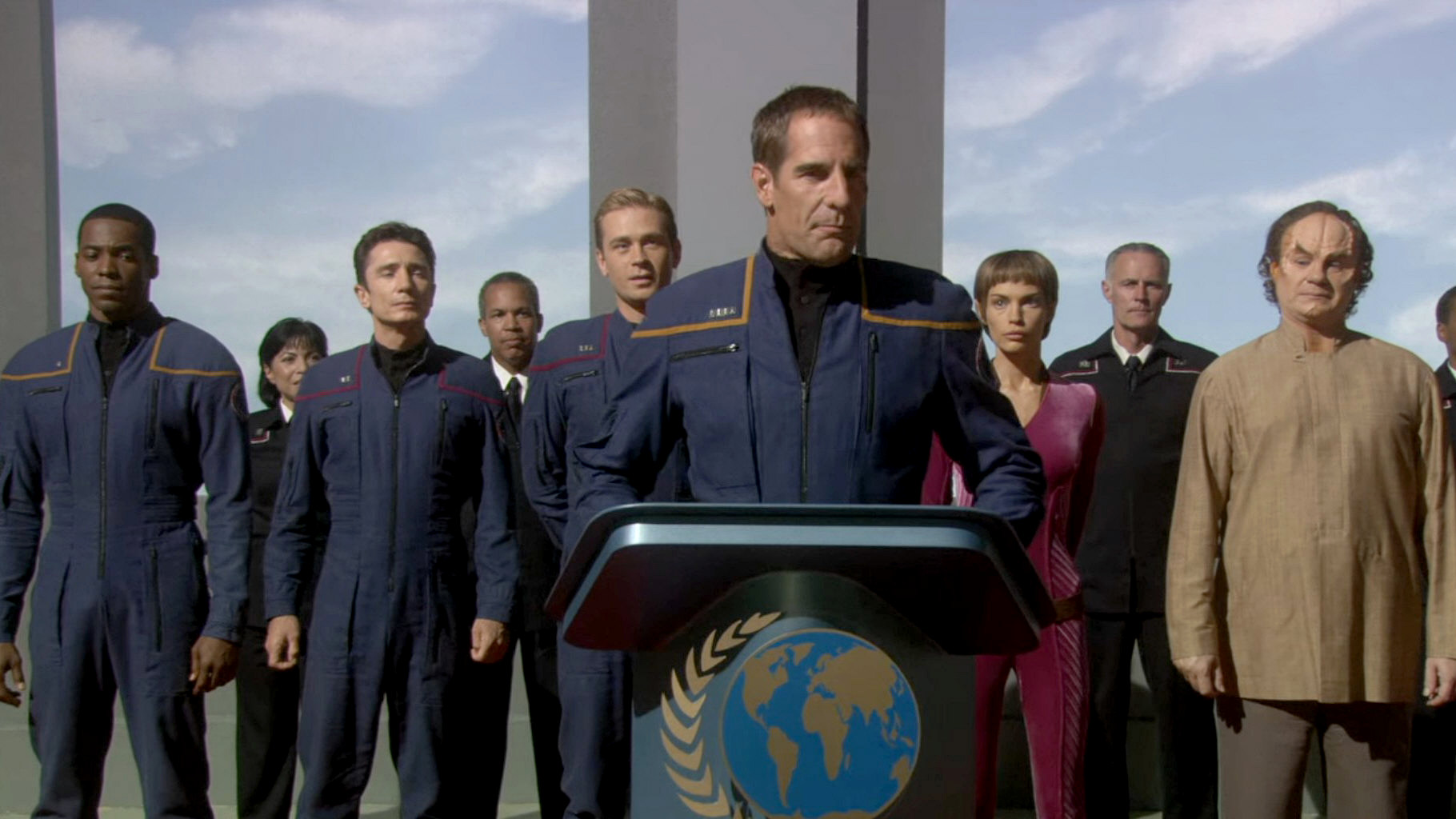
Date not given: After an official celebration Archer attends a de-briefing in which Soval reproaches him with not trying to save the crew of the Vulcan ship inside the Expanse, which upsets Archer. The captain takes a break and goes on a climbing tour when suddenly Erika Hernandez, the captain of NX-02 Columbia, joins him. Tired of all the fighting and of being the hero who saved Earth, Archer wonders what has become of the once peaceful mission of Starfleet and of himself. Xenophobia shows its ugly face on Earth when Dr. Phlox is harassed in a bar. Meanwhile on Vulcan, T'Pol visits her mother, T'Les, and introduces Tucker to her. T'Les notices that the two are romantically involved. But she has other concerns, as she was expelled from her position in the Vulcan Science Academy because her daughter is a persona non grata since the P'Jem incident. In order to restore the reputation of her family, T'Pol marries Koss, whose father is influential. On Earth, Archer apologizes to Soval, and the Vulcan ambassador stretches out his hand, thanking Archer for the service he has done to both worlds.
Review
This decent character-building episode may have been quite purposely written to be reminiscent of TNG: "Family", possibly one of the most successful of its kind. However, I think "Home" should have been aired earlier to put a worthy end to the Xindi arc, erasing the last few minutes of "Zero Hour" and all the Nazi crap that followed from history. Well, in some fashion that will never be explained it all didn't happen anyway. The way everything makes sense again in "Home", in real space and time, clearly demonstrates how stupid the departure to the erratic Nazi timeline was in the first place, and how dissatisfactory it was to abruptly discard the whole idea without answering any questions. I can only say I'm glad it's over and we can move on.
Now that Archer and his crew have blown up mean alien machines and thereby saved their planet even twice in just a few days, it is time for a celebration. They truly deserve it, even though the celebration in the huge stadium on the roof of a skyscraper is a tad too pompous. Subsequently the episode quickly finds its way back to the normal track of the series during the de-briefing. Soval, self-righteous as always, has nothing better to do than accusing Archer of what he has done or neglected to do inside the Expanse. As if we had expected anything else. Only the usual reproach that humans are not mature enough to go into space is missing this time. But the surprise comes in the end. Archer apologizes. I have great respect for that, after all it was the Vulcan who treated Archer like the suspect of a crime and, maybe still worse, didn't give a dawn on the captain's word that he did everything to save those Vulcans. And now Soval comes forward and does three amazing things. He says he was wrong about Archer, he stretches out his hand although Vulcans don't touch each other and he thanks the captain, something that, as T'Les wittingly states in the same episode, is a human custom. The continuity to "Impulse" makes this part of the plot perfect, even though I don't like the 3rd season episode.
On the downside, I don't care much for Archer's interaction with Erika Hernandez, except for her reminding Archer of what he was like before his ship became a flying armory. We can be sure that a possible love affair of the two captains would not be picked up again in the future, so this only reason to make Archer's mirror character a woman isn't really that important. Knowing that they used to date or even had an affair a rather long time ago reminds me of Kirk's and Picard's many acquaintances that used to show up in one episode and then vanished forever. As a character who primarily represents the enthusiasm that Archer has lost, I would have preferred a visibly younger man instead of her as the captain of NX-02, a guy whom Archer may not even have personally known before. I think that Archer would have been well able to find what he has lost without a kiss from a woman. Still, overall it is quite palpable how Archer is torn between his military duty and his role as a hero on one hand and his lost innocence on the other hand. The only thing that really irks me in that course is Archer's nightmare about the Xindi-Reptilians attacking him. This is simply obnoxious, especially considering that the Xindi are dead and buried (at least as a story arc). The episode wouldn't have needed any contrived action like that. I was never even near the verge of falling asleep while I was watching it.
There are more examples of excellent continuity in the episode. The story of P'Jem crops up once again, here as the reason for T'Les to lose her job. While I'm otherwise not happy about Vulcans who are shown as prone to seek revenge, I find it quite fitting that it may get T'Pol's mother into trouble, especially considering how great a role family ties seem to play on Vulcan. I don't think that T'Pol's hurried marriage with Koss to restore her mother's honor (well, she wouldn't call it "honor", but it's much the same) is a clever twist though. At least she doesn't change her mind in the very last second as many fans may have expected or hoped for. On an interesting side note, the Vulcan dignitary recites exactly the same words during the marriage ceremony as T'Pau in TOS: "Amok Time". Only that this time the bride doesn't call for kal-if-fee, the fight to the death. T'Pol mentions that just as an option, and not a serious one. So far continuity is preserved, bearing in mind that T'Pring is the first to demand that in many centuries. On the other hand, Koss's reaction is like he is not only familiar with it but prepared for it, so kal-if-fee almost seems to be a customary ritual in his view.
Finally there is the plot thread about xenophobia on Earth. Although this is the thinnest of the three and may not be meant to be ever continued, its impact is quite powerful. I think it is the first time on Star Trek that a present-day problem of Earth is addressed without disguising it or making it an issue of an alien planet-of-the-week. I can well imagine that in the future much the same kind of guys who harass humans of other racial and cultural heritage today may be running around and go for aliens. Racism is literally universal, and this becomes obvious here like rarely before. Just one week after the brainless Nazi trash here is a realistic and serious scenario as food for thought. The fact that Phlox seems to cope rather easily with the harassment at first (as we would expect from his character) but that eventually we can't be sure about that only emphasizes that racism doesn't start as late as there are physical attacks.
Annotations
- Remarkable quotes:
- "Things have changed since Enterprise left spacedock. You spend a lot of your time boldly going into battle." (Archer, to Hernandez)
- "You've done a great service to both our worlds." (Soval, to Archer)
- Remarkable scenery: It is the first time that we see a real Vulcan city and not only mystical places. It's still only desert, and we have to wonder if there is or has ever been agriculture anywhere on the planet. The building encompasses a garden though, and this looks very Japanese to me.
- Remarkable facts:
- Phlox can pump up his face, probably as a defensive action in the presence of danger.
- The planet of "Strange New World" is in a star system left of Polaris as seen from Earth.
- Vulcan is 16 light-years away from Earth.
- Guests in Vulcan houses are expected to prepare the morning meal at 04:00. Now that's truly inhuman(e)!
- Two or three dozen schools in North America are already named for Jonathan Archer.
- A WWIII epic won several movie (Academy?) awards.
- Crew losses: 27 altogether
Rating: 5
Borderland
Synopsis
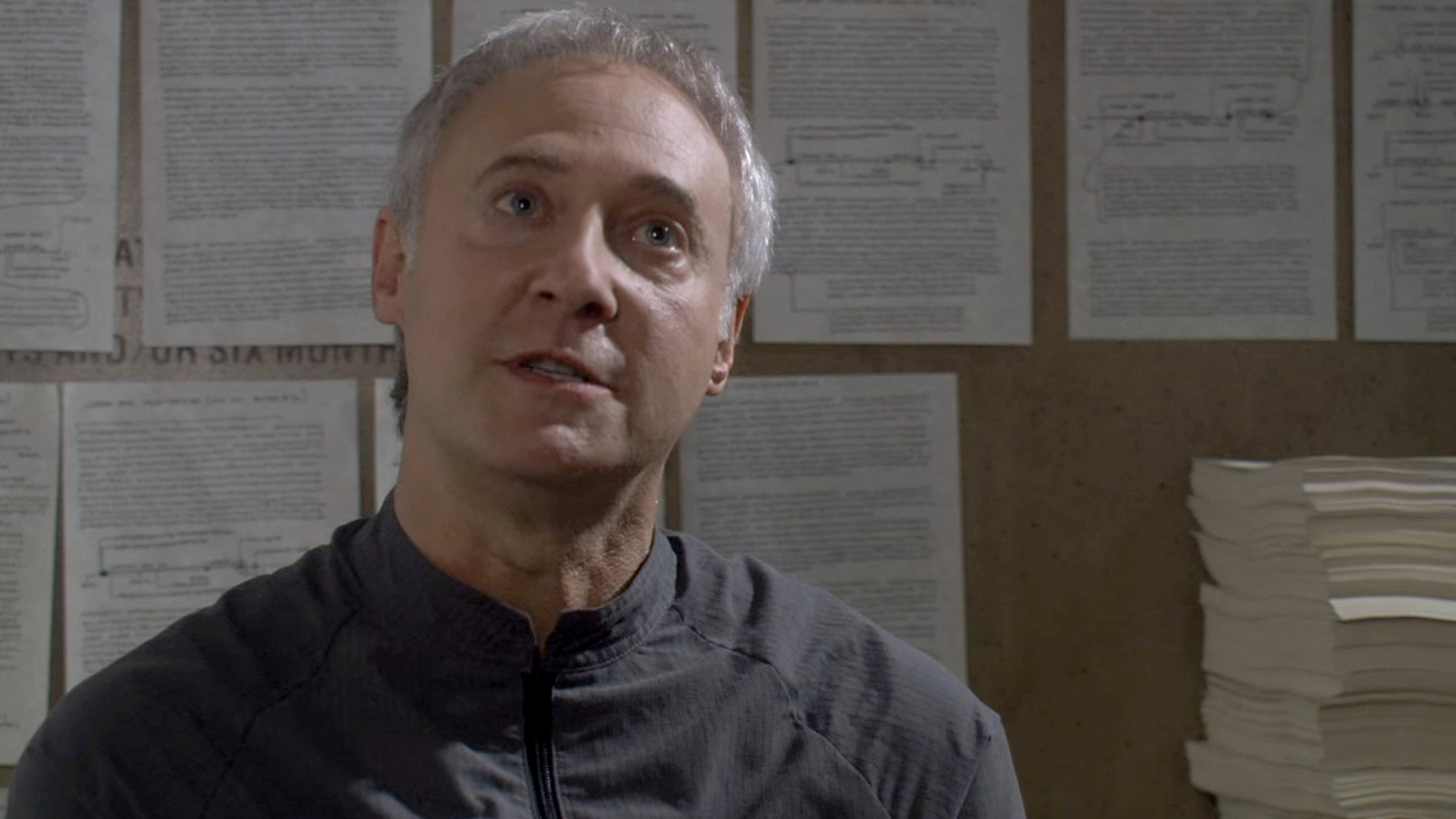
May 17th, 2154: Augments are genetically enhanced humans whose embryos were left over from the Eugenics Wars. Stolen from a lab by the ruthless scientist Arik Soong some 20 years ago, several now adult Augments have captured a Klingon ship in the Borderland, the volatile region between the Orions and the Klingon Empire. Enterprise leaves spacedock on a mission to find and apprehend them. Arik Soong is aboard to assist the crew. He helps to free some Enterprise crew members from an Orion slave market, but when Enterprise encounters the Augments who regard him as their father, he joins them and leaves the disabled Starfleet ship behind...
Review
I like the concept of Augments, who grew from frozen embryos, as a very intelligent way to hark back to the Eugenics Wars without messing up Trek history even more. Likewise, getting Brent Spiner on the show to play Arik Soong, the unethical ancestor of Data's creator Noonien Soong, was a terrific move, not only to boost ratings. But what was made of these ideas largely fails to convince me in this first installment of the Augments trilogy.
On the whole, "Borderland" unfolds to nothing more than an average action episode, using motifs that are commonplace and predictable. At times I had the impression I was watching a re-run of "Broken Bow" - not only due to the use of stock footage of Enterprise leaving the dock, but rather because the course of the plot and many of its minutiae are essentially the same. Enterprise is crippled by an attack from a previously unseen enemy, someone is abducted, an away team tries to find them on the generic dirty alien trade outpost. I don't like to see the Ogres (sorry, I meant Orions) anyway. At least not at this time. The episode is littered with references to Trek history, plus several new terms like "Augments" or "Borderland", and it may have been wiser to limit the scope to just Earth's problem with the remnants of the Eugenics Wars. The way it was done, it seems that the plot was just stretched to fill three episodes using many secondary and overall distracting threads.
Regarding the Augments, as much as I like the basic idea, I find their motivation, behavior and look little compelling. Some more interesting facets may be added in the two episodes to come, but here they appear as nothing more than a post-apocalyptic adolescent gang like in so many bad movies. They represent the worst of humanity (the insatiable desire for power, with the almost cutesy excuse that they are just seeking a home) and behave like a bunch of school kids with an odd love for their "father". It is hard to believe that they are superior and are supposed to be the future of humanity, according to Arik Soong. I understand that his character may be developed in a Frankenstein-like direction in that he suffers from the affection he has developed for the monster he created, but so far only Brent Spiner's talent to let the viewers hang on his lips prevents him from being just a throwaway mad scientist. Finally, the Augments' torn clothes may befit the look of Khan's people in "Star Trek II", but they should have been wearing something tidy, which would have made the parallel to the Trek movie and to the generic post-apocalyptic gang less overt.
There were some nifty details that I like much more than the plot itself. Soong, for instance, disables the beacon that was supposed to locate him through the electrostatic discharge from an Orion "painstick". Furthermore, when Soong climbs up a wall in his attempt to escape, Archer uses the remote control of his prisoner's handcuffs to unfasten them so Soong falls down.
Annotations
- Remarkable quote: "Jonathan Archer. What brings you here? Are they naming the prison for you?" (Arik Soong)
- Remarkable facts:
- T'Pol is now a full member of the Starfleet crew as Commander T'Pol. Archer gets a new captain's chair.
- The lighting in the background of the transporter pads seems to be different. It now reminds me more of TOS than before.
- Archer's father died of Clark's disease, something that Soong claims he could heal.
Rating: 5
Cold Station 12
Synopsis
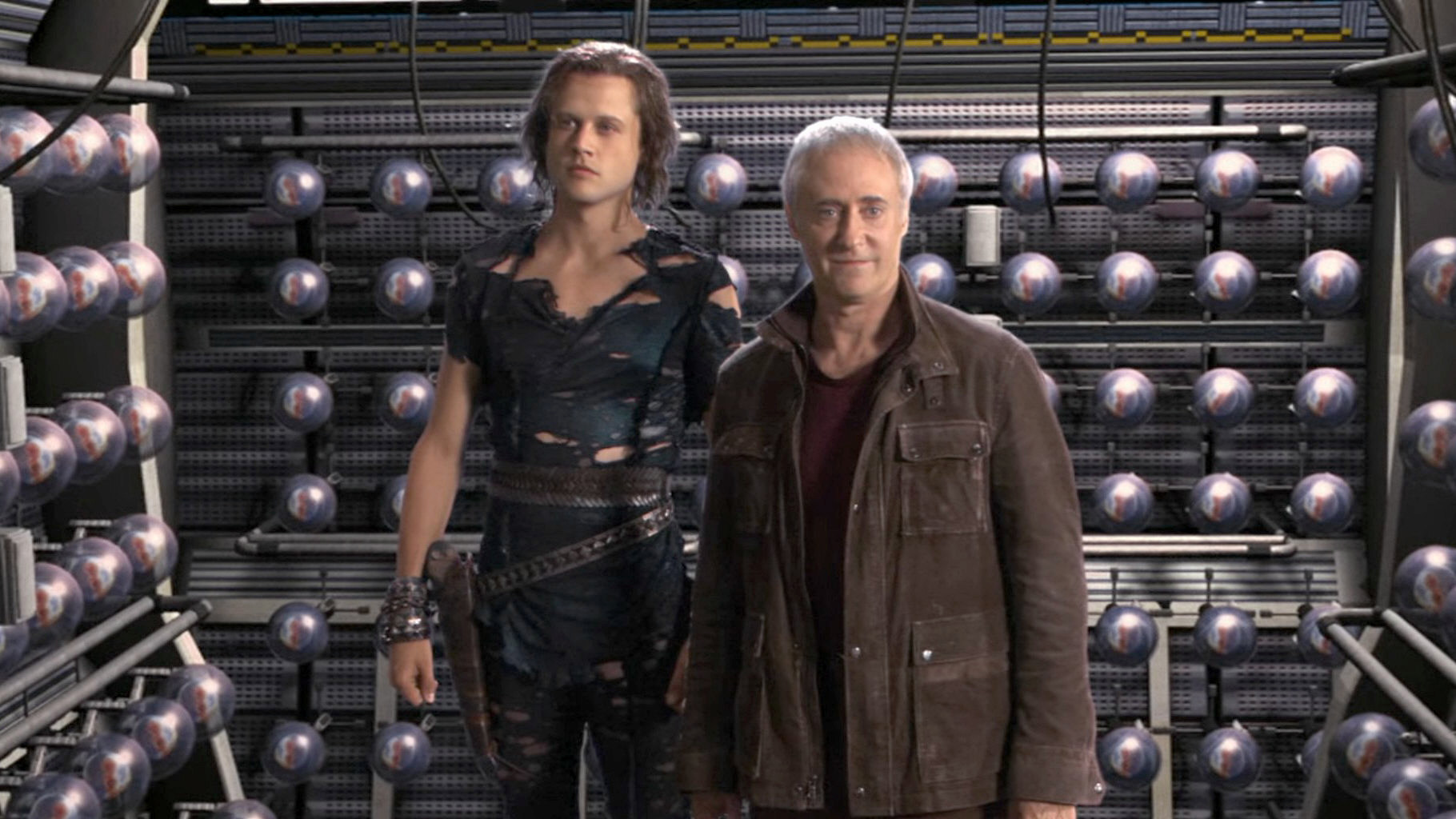
Date not given: An Enterprise landing party picks up Smike, an Augment who was left behind because he had not developed superior abilities. In the meantime Soong and the other Augments have occupied the facility Cold Station 12 where the remaining 1800 Augment embryos are stored. The human and Denobulan scientists working there, among them Phlox's friend Dr. Lucas, are taken hostages. Archer and Phlox themselves fall into the hands of the terrorists when their attempt to free the hostages fails. When the Augments threaten to kill Dr. Phlox, Lucas reveals the access code to the containment chambers. Enterprise attempts to destroy the station but is attacked by the hijacked Klingon Bird-of-Prey. The terrorist leader, who has been favoring extreme violence against the will of his father Soong, kills Smike. They escape unscathed and take the the embryos with them. The scientists and the landing party remain on the station where deadly viruses are about to be exposed...
Review
I liked it. Actually I wouldn't have expected the overused motive of a hostage crisis to be that exciting. Yet, sometimes Trek writers succeed in making something special even of an undemanding outline that wouldn't allow too much variation, especially since it was the middle part of a three-episode arc in this case. Although "Cold Station 12" doesn't come with too many surprises for this reason, it consequently continues and expands the story arc. While the plot of "Borderland" still struggled to find its way through the exposition, as it had to introduce many people and places, "Cold Station 12" is appealing just because it focuses on one place and on known characters. Even Dr. Lucas as Phlox's friend is in some way familiar, as he was previously mentioned in the show (most notably in "Dear Doctor"), so his character doesn't strike me as too contrived.
We could expect that the creatures would turn against their creator, and it is a clearly recognizable tendency of the plot that Soong's plan to improve mankind just doesn't go along with the Augments' unadorned desire to rule and to exert violence. Ironically, while Soong has gained his freedom and is close to accomplishing his dream of what he thinks is a better future, he is visibly losing control. This is sad because what Soong said was still something to ponder about in "Borderland", whereas we are now left with the Augments in power, whose actions are mostly determined by their mere instinct. As a result, Brent Spiner's presence in the role of Soong is not as strong as still in "Borderland". This loss of intellectual substance is a shortcoming of the episode, along with an overdose of violence, although the latter is acceptable here. The violence contributes to the story in that it divides Soong and his "children".
Smike is an overall pleasant figure, although my first idea of him was that of a "savage kid who needs guidance" stock character. But then he ends up as the martyr of the week. Well, that is obviously another cliché, but a useful one, because he has been expelled from the group much like a wolf pack would abandon their weakest member. And that is essentially what the Augments are. Only that I don't think that wolves wittingly kill one another, which is not instinctive behavior but rather human cold-bloodedness.
Annotations
- Nitpicking:
- I wonder how simply extending the transporter range could allow the crew to beam onto the planetoid from outside the system. Soong could obviously monitor the ship only seconds after it was said it was only 12 million kilometers away!
- Another problem I have is with the Denobulan shuttle. Clearly the large bridge indicates that it is a ship of 20-30m length at the very least, yet it looks smaller than the bridge section of the Klingon Bop when the ships encounter for the first time. But to make things much worse, when Soong and the Augments escape from CS-12 with 1800 embryos, the Denobulan shuttle approaches the supposed shuttlebay at the rear end of the Bop, and it seems to be just a few meters long, much smaller than its cockpit alone! Whether such a ship with the required capacity could land in the Bop's shuttlebay at all is highly doubtful so there is a general blunder in the plot.
- Remarkable fact: The deadly illnesses listed include Xenopolycythemia (TOS: "For the World is Hollow and I Have Touched the Sky"), Synthococcus Novae Type A, Rigelian Fever (TOS: "Requiem for Methuselah"), Telurian Plague (TNG: "A Matter of Time").
Rating: 7
The Augments
Synopsis
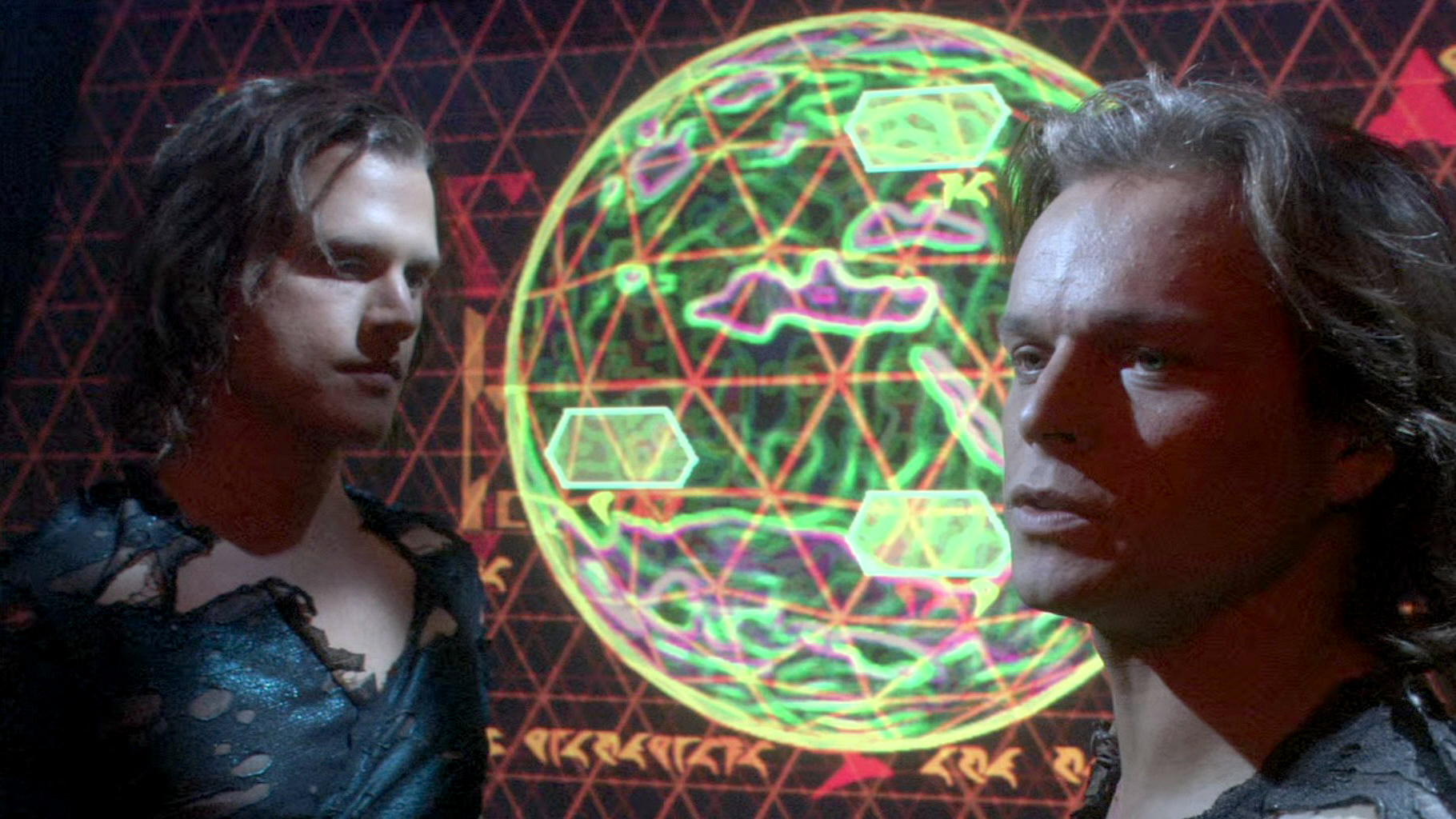
Date not given: Enterprise evacuates the Cold Station 12 crew and the landing party from the station and takes a pursuit course for the Bird-of-Prey of the Augments. An attempt to stop them fails when the Augments drop the Denobulan shuttle in the atmosphere of a gas giant. The Starfleet crew first has to mount a rescue mission. Soong flees from the Augments' starship in an escape pod and agrees to help the Starfleet crew in the hopes that he may convince his "children" to surrender. But they cross the Klingon border with the goal to use a bioweapon on a colony. Enterprise can destroy the weapon with Soong's help. After the Bird-of-Prey has been disabled, the Augments' leader destroys his vessel. Yet, he actually escapes to Enterprise to take revenge on his creator, which Archer averts with a deadly phase rifle blast.
Review
"The Augments" is the expected (or should I say predictable?) conclusion of the story arc. It bears surprises only in the execution, not in the basic course of the story. It was quite obvious that the Augments would all perish, preferably in a self-destruct of their ship, and that their "father" would have to witness that. Well, at times I pity Soong despite of all his misdeeds. It is just too pathetic when he threatens to put his "children" under curfew as if that were a adequate punishment for murder. But overall, action is given precedence over characterization. The episode has a couple of innovative ideas, like the stunt of beaming out Archer from the decompressing shaft or the benefit of having a grappler to tear another ship's nacelle apart. Yet, we have seen most of the other motives many times before. Just like the trick to fake a warp signature, the use of a (actually non-existing?) escape pod on a Klingon vessel or the firing at a weak spot of an enemy starship that only one key person knows of. Finally and worst of all, there is the horror thriller cliché of the villain, who is last seen in the middle of an explosion he couldn't possibly survive but appears once again out of thin air just to get back at a traitor.
The fast pace of the episode does not permit to take care of ethical concerns with the due profundity. In spite of or just because of this haste I wonder what the Starfleet crew could and what they should have done differently. The mission objective is to stop the Augments to avert a war, and I am sure that Captain Archer has the authority to apply whatever force he deems necessary. At latest since the attack on Cold Station 12 it is unmistakable that there is no arguing with these gangsters and that they are determined to subdue or destroy humanity. They have 1800 embryos to create more soldiers of their kind and are about to release a bioweapon and kill millions. Wouldn't it have been Archer's duty to fire all available weapons at them when he had the chance, more precisely when they had just released the Denobulan shuttle inside the gas giant? Perhaps there would have been a possibility to rescue the Denobulan pilot later, and if not, it wouldn't have mattered where she had to die. In any case it would have been a much smaller sacrifice than shooting down civilian airplanes that are being used as flying bombs. From a viewpoint of storytelling this incident is no intelligent move either, as the threat to kill a hostage couldn't strike us or the Enterprise crew as particularly cruel after what happened on Cold Station 12. So why is the episode trying to be "Trekkier" than would be realistic, why does Archer repeatedly hesitate and give the Augments a chance to surrender?
A related issue is how forthcoming Archer is to Soong in the end. Wasn't it that in "Borderland" the two couldn't stand each other, and now after the capital crimes Soong committed or approved of, Archer rewards him with a guest quarter and a visit to his prison? The latter obviously just to allow Soong to deliver the most contrived line of the whole arc, "Cybernetics - artificial lifeforms. I doubt I finish my work myself, it'll take a generation or two", followed by a Data-like smile. There is a better concealed allusion to TNG when Soong ponders what went wrong with the Augments and concludes there was an error in their genome that needs to be corrected. This sounds familiar when we think Lore and Data. Furthermore, especially this statement ultimately confirms the prevalent notion that the Augments are a failure and as such a somehow inferior race.
Based on the bare facts the outcome of the story arc is that the Augments are wild animals that you better kill before they come for you. But in a figurative sense, aren't they just hollow movie villains in the first place, who just happen to be genetically engineered? Their characterization is incredibly one-dimensional in all of the three parts and not much more profound than that of the dreadful Space Nazis. The bottom line is that tampering with human genes is not only unethical but intrinsically creates monsters. This stance has been more or less consistent through the history of Star Trek since the days of TOS: "Space Seed", but it has never been promoted with such a passion as in the story arc about the Augments. With the exception of the unfortunate Smike, who is arguably different, the Augments are not given a chance to show any positive facet; the honor of being a criminal who shows remorse goes to Soong but not to any of them. I don't think this idea is particularly Trek-like or tolerant, bearing in mind that we could look at the Augments as an ethnic group and not only a bunch of criminals.
Annotations
- Continuity: The remarks about Khan ("Botany Bay is a myth") are decent and skillful with regard to Trek history. Yet, there is the statement about "everything said about augments in the last 150 years..." which may be taken as a hint that Augments existed as soon as 1992. But perhaps it refers to the beginning of the genetic experiments on humans, just like we celebrate the anniversary of any technology relating to its first inception, not to a time when it was in common use.
- Remarkable quote: "Superior ability creates superior ambition. One of their creators wrote that. He was murdered by an Augment." (Archer, to Soong)
- Remarkable display: The Klingon colony bears a striking resemblance to Earth. Actually the visible hemisphere looks just like Earth except that Europe is fused into Africa and there is a sea instead of the Congo region. A parallel Earth?
- Remarkable fact: Soong heads for Klach D'kel Brakt, which he calls the "Briar Patch".
Rating: 5
The Forge
Synopsis
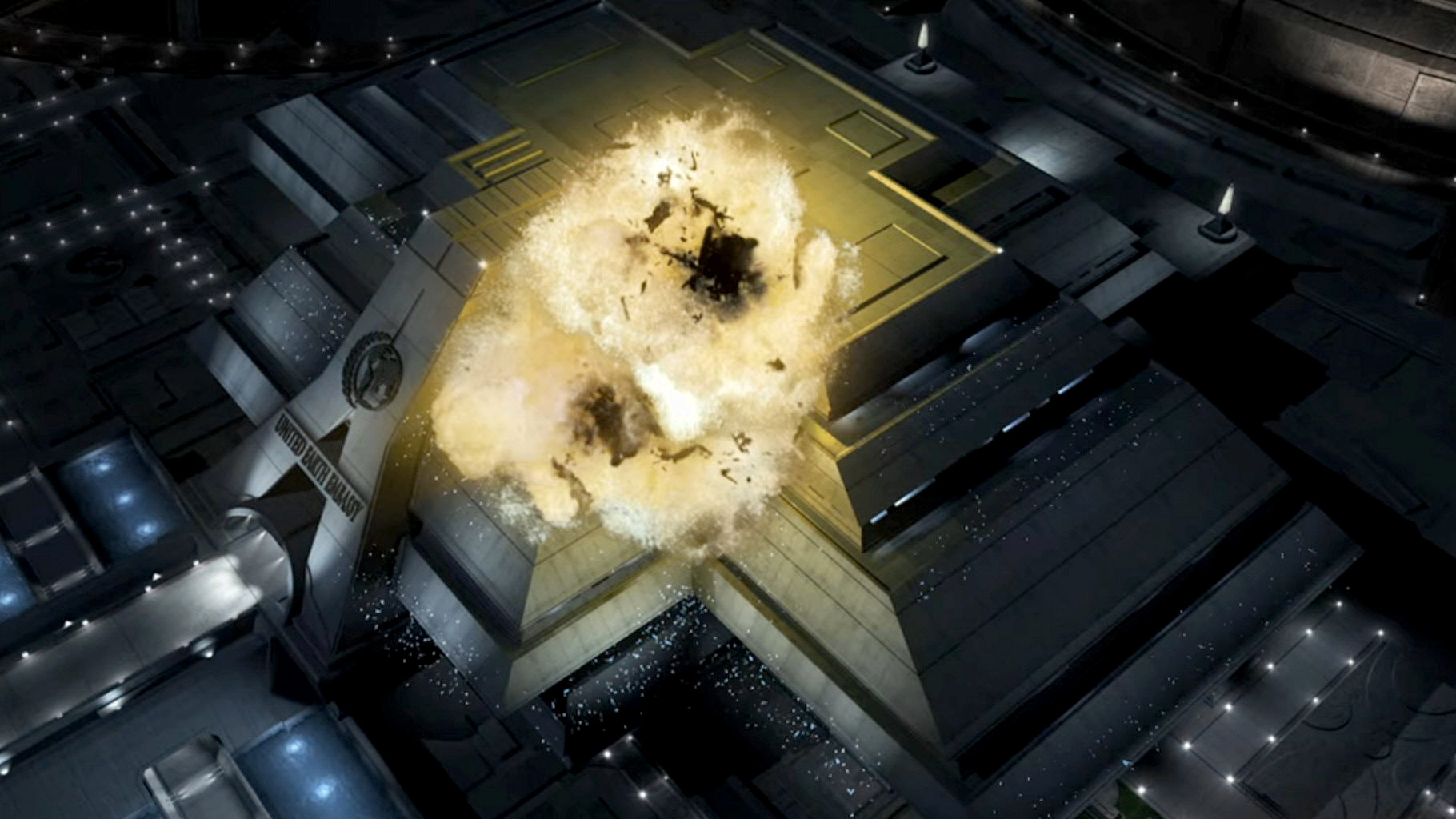
Date not given: A bomb explosion in the United Earth Embassy on Vulcan kills at least 43, among them Admiral Forrest, who rescues Ambassador Soval's life. DNA residue suggests that a woman named T'Pau, member of a sect known as the Syrranites, planted the bomb. Archer and T'Pol seek for the Syrranites in the Forge with the help of a map from T'Pol's mother T'Les, who is a Syrranite herself. The Forge is a Vulcan desert with heavy electromagnetic storms that disable any communication. Meanwhile on Enterprise, it is found that the evidence against T'Pau was forged. As Soval learns through a mind meld with a survivor, the aide to the Administrator of the High Command, V'Las, must have brought the bomb into the building. In the Forge, T'Pol and Archer meet a man, Arev, who is obviously a Syrranite. He explains them that his group is peaceful and is pursuing the true path of Surak, the father of Vulcan philosophy. One of the Syrranites is even said to carry Surak's katra, his immortal essence. Arev is killed in one of the storms, but not before mind-melding with Archer.
Review
Fascinating. This is the series as it should have been from the very beginning. Before "The Forge" there was Star Trek and there was Enterprise. In a quite compelling fashion the Vulcan story arc reconciles the two universes to a considerable extent. It helps to rationalize why the Vulcans of the 22nd century were not the peaceful and benevolent people we know from the 24th century. Even if the Vulcan trilogy initially damages the reputation of Vulcans or at least of their rulers even more than before, everything is resolved in an intelligent and agreeable way. Vulcan has found the true path, and so has Star Trek Enterprise - hopefully. Most importantly the imprudently established misconception that only a small fraction of the Vulcan population could perform mind melds is elegantly explained as a lie fabricated by the High Command to be used against the Syrranites. The mind meld dilemma is ingeniously modeled as a vital part of the story without ever appearing contrived. This alone deserves high praise. Two thumbs up for the writers, Judith and Garfield Reeves-Stevens!
The episode has a fast pace but sufficient room for character development too, even if this is largely achieved by isolating two of them, namely Archer and T'Pol, in a standard situation. Their stay in the Forge slows down the second half of the episode, and while they are not achieving any visible progress the more interesting events take place on Enterprise and on Vulcan. Most of all I was astonished how the formerly stubborn, even cynical Soval suddenly came to be an ardent supporter of the human cause - and of the Syrranite cause as well. Well, in some fashion Admiral Forrest (I will miss him!) was a personal friend. But it makes even more sense if we think of the Vulcan High Command or at least V'Las's version thereof as a stage where everyone has to play his role. The High Command reminds me a lot of a degraded Communist government where no one acts in accordance to the "true path" any longer but no one could ever freely admit that. Soval has taken the chance now that he has found natural allies in the humans. Yet, in this regard it was an unnecessary and counterproductive idea to make him a "melder", someone who must have been disagreeing with the High Command all the time. Even though all Vulcans can meld as we learn later, he must have been practicing mind melds in defiance the doctrine of his superiors. Anyway, the character of Soval could only improve, as we have known him so far just as a sarcastic detractor of humanity who hides behind phrases every time he is proven wrong. I like this new Soval better!
On a related note, it is a bit contrived that T'Pol's mother too belongs to the Syrranites. Is Vulcan full of dissenters? If this were so, how could V'Las rise to power without facing major resistance? However, we have enough precedents on Earth where the citizens just remained passive while their rights were gradually taken away.
It is easy to see the parallels of this story arc to recent events on our own planet, no matter if they were constructed on purpose or just because the episodes are skillfully written and hence very "life-like". The bombing of the embassy is a symbol just like 9/11. And many aspects are the same, just like the increased security precautions in the wake of the embassy blast that are likely to restrict civil rights. I refrain from further political comments, although some of the patterns of the High Command's crusade against the Syrranites look familiar too, be it intentional or not.
Almost needless to mention that the episode is visually spectacular too. We see a Vulcan landscape with large statues much like in the Director's Edition of TMP. Moreover, there is the nicely done Federation Embassy (even if the typically angular human construction doesn't really pay respect to Vulcan building tradition).
Annotations
- Continuity:
- It is a nice idea to pick up the idea of an inner eyelid of Vulcans (TOS: "Operation: Annihilate"). But how can an eyelid protect T'Pol against the burning sun if her eyes are open all the time?
- Other references to previous Vulcan episodes include the sehlat (TOS: "Journey to Babel", TAS: "Yesteryear") that we get to see in real life for the first time.
- There is also the IDIC symbol that T'Pol gets from her mother. We will see later that the symbol represents Mount Seleya with the sun in the background. A similar yet somewhat different symbol can be seen in the meeting room of the High Command.
- Soval uses the same words as Spock and most other Vulcans when he melds with the comatose patient.
- Finally, we see how Arev turns to Archer briefly before his death, touching him and whispering something. We would be damned if we didn't recognize that as a katra transfer and as a homage to "Star Trek II".
- Remarkable quotes:
- "Sounds like that Klingon opera Hoshi made us listen to." (Archer, about the sehlat noise)
- "They are smaller - slightly." (T'Pol, about domesticated sehlats)
- "Surak tells us, it is the heritage of every Vulcan, even those who don't believe in the practice." (Arev/Syrran/Surak, about mind melds)
- Remarkable fact: It took 1500 years to rebuild the Vulcan society and travel to the stars after the Awakening, 1800 years ago.
Rating: 8
Awakening
Synopsis
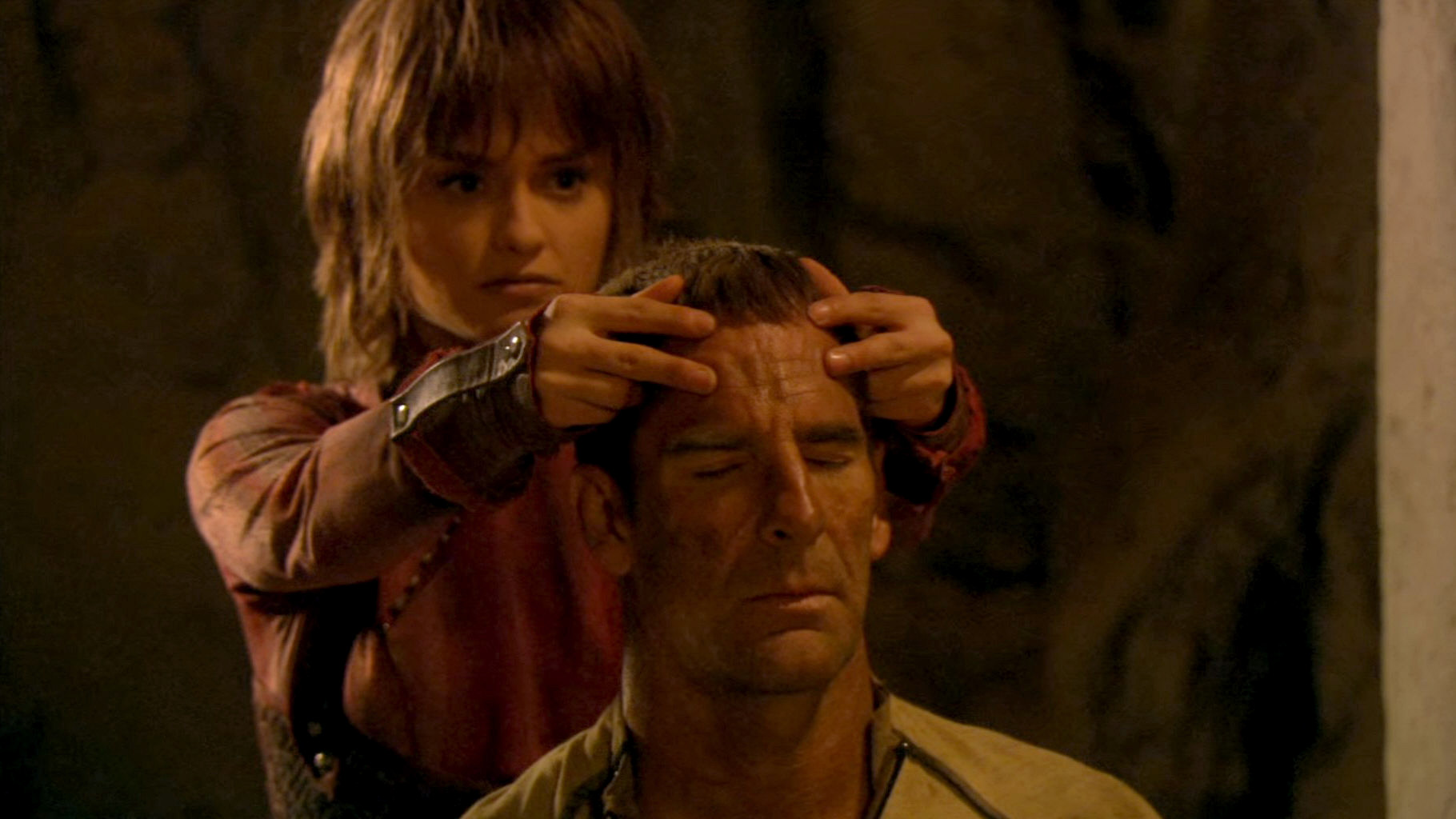
Date not given: Archer and T'Pol arrive in the Syrranite sanctuary, where they learn that man who called himself Arev was actually Syrran himself, the founder of the movement. It turns out that Archer is now carrying Surak's katra. Surak tells Archer to go search for the Kir'Shara, an ancient artifact that holds his original writings and that could help renew the Vulcan society. T'Pau makes an effort to recover Surak's katra through a mind meld with Archer, but she fails. Soval is about to lose his position because of the mind meld he performed, and he tries in vain to convince the High Command that the traitors are actually among them. The former ambassador returns to Enterprise. An attempt to rescue Archer and T'Pol from the Forge is unsuccessful, and Enterprise has to retreat when Vulcan cruisers attack the ship. Archer, T'Pol and Surak find the Kir'Shara while the area is being bombarded by the High Command. T'Les dies in the attack. Meanwhile on Enterprise, Soval reveals the High Command's plans to attack the Andorians because these are allegedly going to launch a Xindi weapon against Vulcan. Trip sets a course for Andorian space.
Review
"Awakening" must have been facing the usual problem of a middle part of a trilogy, to serve as a link that needs to be designed with two interfaces. Despite this intrinsic disadvantage, the episode ranks still higher in my view than "The Forge". Actually, I think it is even the best Enterprise episode so far!
Yet, I can't really tell why I like this episode so much. Some of the twists like the revelation that Archer is carrying Surak's katra are not surprising at all. Some motifs like Archer's communication with Surak look quite familiar as it is much the same as Sisko's visions of the Prophets. There is even a rather childish cookie-cutter scene with the massive door that opens smoothly in an Indiana Jones-like fashion after 1800 years, by just pushing a button. Furthermore, I don't really see a sense in letting T'Les die, who may have been a key figure in more Vulcan-based stories and in a continuation of the mother-daughter conflict.
But in spite of these points of slight criticism, "Awakening" is nothing less than an excellent drama with just the right share of action. In a (possibly daring) comparison to "Star Trek III" the portrayal of Archer, who is possessed by Surak's mind, is much better solved than it was done with McCoy and Spock, respectively. The humorous characterization in the movie always seemed rather silly to me. I like this version of Surak anyway because he is shown as a gentle and prudent leader, one that would win the hearts of the people and not simply lecture and command them. And Scott Bakula looks great although he still isn't exactly the best actor. The honor of best acting falls to Connor Trinneer once again, whose interaction with Soval is just wonderful. In some fashion the two are like the prototypes of Kirk and Spock.
It is well possible that the expected disadvantage of being only part 2 of 3 actually helped "Awakening". The writing could build upon what was established in the first part without the need to explain everything new, while it is not necessary to tie all loose threads together like in a final part. This worked in the Final Chapter of DS9 and even more obviously in ENT: "Countdown" too. Anyway, "Awakening" scores nine points. I rate the episodes of the trilogies separately, expecting many arcs like these still to come, which would otherwise significantly reduce the number of episodes in my statistics. Well, if there will be more excellent three-parters like this one, it will always be a triple boost of my ratings. :-)
Annotations
- Continuity: It is quite obvious that the young woman T'Pau is supposed to be the same as the old person of that name that will be present during Spock's canceled wedding in TOS: "Amok Time". Yet, it was not hinted at - fortunately, because it would have been just as contrived as Arik Soong's talking about his offsprings. Agreed, T'Pau will become a bit more bony and stubborn, but I don't find it too hard to accept.
- Remarkable quotes:
- "Deception has never been a stranger to this room."(Soval)
- "The culture you've come to know isn't the one I helped to create." (Surak, to Archer)
- Remarkable dialogues:
- "I lived on Earth for more than 30 years, Commander. In that time I developed an affinity for your world and your people." - "You did a pretty good job hiding it." - "Thank you." (Soval and Tucker)
- "How many warning shots do Vulcans usually fire?" - "None." (Tucker and Soval)
- Remarkable scene: One particular scene that I remember is when Archer has a vision of the Vulcan civil war. Surak says, "Vulcan is tearing itself apart", while Archer is watching how an atomic mushroom forms. Although there have been much more cruel scenes in Star Trek, this one is particularly moving, as during the whole story arc Vulcan is modeled after Earth.
- Remarkable ships:
- We see two new Vulcan starship types, or rather previously seen ships in new roles: a fighter (from "Carbon Creek") and a small cruiser (from "Fusion").
- Moreover, Travis is welding two extractable wings on the dorsal side of Enterprise's shuttlepod. However, I care for such attempts to make the shuttle look cooler about as much as Tuvok did in VOY: "Extreme Risk". At least Travis had something to do. ;-)
Rating: 9
Kir'Shara
Synopsis
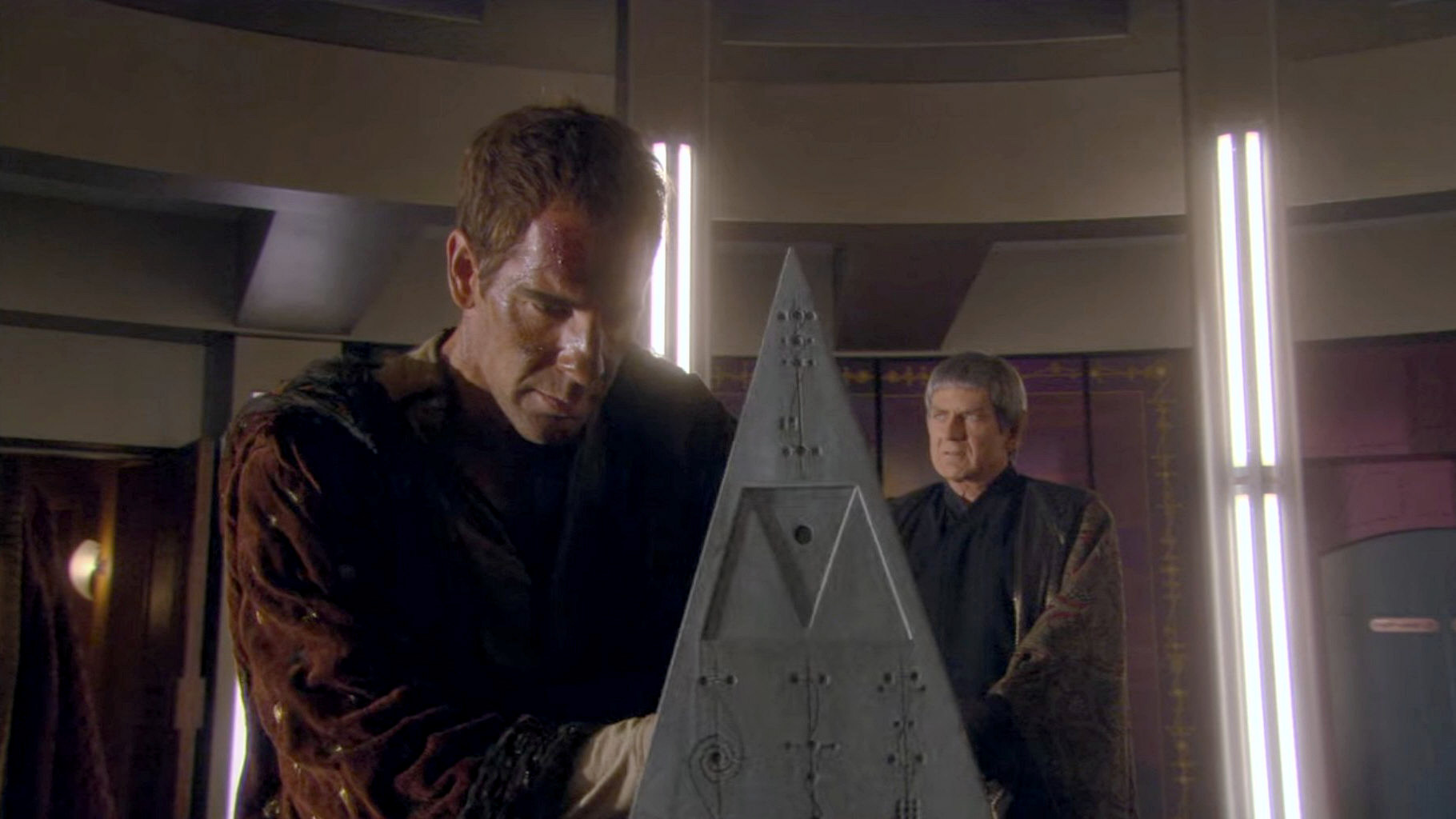
Date not given: Soval and Tucker meet with Shran and inform him about the agenda of the Vulcan High Command. The Andorian commander does not believe that Soval would betray his people. He kidnaps and tortures the Vulcan. But he recognizes that Soval was telling the truth. Near the Vulcan capital, the guards of the High Command locate Archer, T'Pau and T'Pol. The latter falls into the hands of the guards one of whom is Talok, a former subordinate who is willing to help her. Vulcan and Andorian ships engage in a battle, with Enterprise between the lines. Archer and T'Pau present the Kir'Shara to the High Command, and they come just in time to avert a worse conflict. V'Las is removed from his position, and an investigation against him is initiated. A priest takes over Surak's katra. On Enterprise, Koss tells T'Pol that their marriage is over now that her mother is dead. The ousted V'Las, however, secretly meets with his ally - a Romulan!
Review
After seeing "Awakening" and enjoying really every second of it much like in "Countdown", I was a bit afraid that the third part could become incoherent just like "Zero Hour". But there is absolutely no comparison between these two, save the unexpected alien to appear at the end of both episodes. No need to say I can much rather accept the Romulan. If there is ever a perfect opportunity to show them and let them enter the game, it is here. Still, it may already qualify as a Star Trek cliché that an unexpected guest appears in the last second of an episode. Like before, in "Awakening", it is a pleasure to see how Trip deals with everything on his own, and how he and Soval complement each other. And although I anticipated nothing less, the ultimate revelation that all Vulcans can mind-meld reconciles me with that part of Enterprise's history. It is good to know that sometimes authors and producers listen to the fans or read their websites.
"Awakening" is a slight letdown, although the high quality of writing persists throughout the whole episode. But I felt the pace slowed down too much during most of the time, with just too many filler scenes. The torturing of Soval didn't strike me as particularly exciting. It was too harsh anyway, although we know such violence isn't unusual for Andorians. Overall, the Vulcan trilogy may have worked with a bit less action and violence anyway, unlike the Augments arc. In addition, the continued stride through the desert with occasional obstacles was a bit monotonous to watch. These two parts of the story could have easily been shortened. This would have allowed to take more time for the resolution. The way it was actually done, there was simply too much happening or too much declared in just a couple of minutes (V'Las on trial, Archer getting rid of Surak, humans no longer under surveillance, T'Pol's marriage divorced, Romulans on Vulcan). I would still call it a worthy ending but its hurriedness was somewhat disappointing.
While I was watching, I already wondered why the Kir'Shara was supposed to have such an enormous impact on the High Command. It is a record of Surak's original teachings, that much is probably true and could be verified. On the other hand, did the writings of Qumran lead to a re-evaluation of Christian teachings, and even such a swift one? Would it have helped to show Lenin or Stalin a copy of Karl Marx's writings to convince them that they are on a wrong path? This is the somewhat naive part of the story, and as T'Pol correctly says, realistically it would accomplish nothing.
On a still different note, the Syrranites teach the true way of Surak. But what is the true way anyway? Back to the roots, abandoning technology? Forward to a decidedly cerebral or spiritual existence? The true way needs a pragmatic component, one that takes into account the stage of development and the overall conditions of a society. One that is democratic and pluralist and not just another ideology. The "true way", as proclaimed by the Syrranites, may remain an isolated and transitory phenomenon like the "Flower Power" movement or worse, it may become a similar fiasco as imposing obsolete concepts like Communism on a modern industrial society. Fortunately, as we can see in the 23rd and 24th centuries, Vulcan has been successful in more or less faithfully following the path of the Syrranites.
Annotations
- Continuity: As opposed to the assertions of the Vulcan High Command, every Vulcan could learn mind melds. Likewise, Pa'nar is a curable disease that exists since the days of Surak and is caused by melders who have been insufficiently trained.
- Nitpicking:
- What happened to humans not standing a chance against Vulcans on Vulcan because of the thin air? Archer fights against the Vulcan soldiers as if he were considerably stronger. Surak may have given him the knowledge how to perform nerve pinches, but how can his katra recondition Archer's body to be fit for Vulcan?
- Another thing that bugs me is the Kir'Shara itself. Undeniably we've seen more outlandish artifacts, but I wonder why ancient technology always has to be that sophisticated and why it always still works after so many centuries.
- Remarkable fact: Treason is one of the few crimes on Vulcan still punishable by execution.
Rating: 7
Daedalus
Synopsis
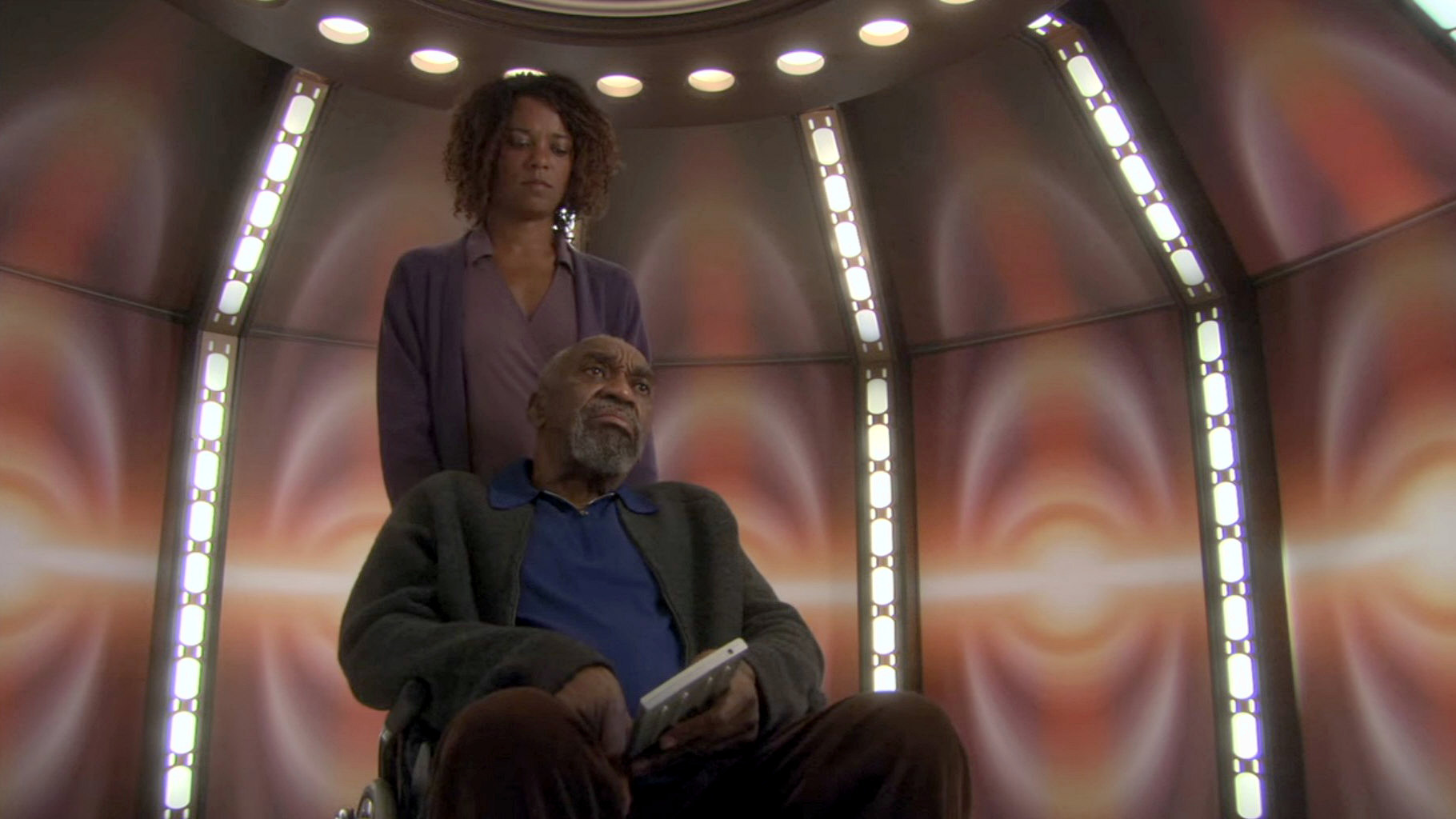
Date not given: Emory Erickson, the inventor of the transporter, and his daughter Danica are going to perform an experiment on Enterprise with a new subquantum transporter that could one day make starships dispensable. The ship enters the "Barrens", a region devoid of stars where it is struck by a spatial anomaly that kills one crew member. Trip becomes suspicious when he notices that Erickson requires more energy than necessary for his experiment. Erickson has to admit that his true goal is and always was to get back his son Quinn, who vanished during a subquantum transporter test in the Barrens 15 years ago. Despite Trip's anger and concerns about Erickson's unethical practices, Archer allows the scientist, who is an old friend of the family, to carry on. They retrieve Quinn, but he dies on the transporter platform because of cellular decay, leaving behind a father who is finally ready to live a normal life. In sickbay Dr. Phlox is pleased to tell T'Pol that her Pa'nar syndrome has been cured.
Review
"Daedalus" resumes seamlessly the recent trend of continuity-relevant episodes. The Augments arc presented some new aspects without harming continuity. The Vulcan arc even reconciled Enterprise with the rest of Trek in an unprecedented fashion. I am not yet tired of this type of stories, I only would not have amassed them in just one season. Yet, Daedalus can't quite catch up with the excitement about the aforementioned episodes, and this is not only because the three-episode arcs naturally have a stronger impact. It is nice to learn various trivia about the development of the transporter and the man who accomplished it. But overall the plot of "Daedalus" is too thin even for a single episode, at times I would have been bored if I hadn't been busy writing down some technical notes.
Almost everything that happens is quite predictable, considering that we know many stories along the same lines. I notice only now how very common the motive of a scientist obsessively trying to retrieve something he has lost is in Star Trek. The most obvious equivalent to "Daedalus" is how Jake Sisko underwent years of scientific education to rescue his father in DS9: "The Visitor". Just like Annorax in VOY: "Year of Hell" played with the course of time to get back his beloved wife. We've also had VOY: "Jetrel" with the Haakonian scientist of the same name, who attempted to re-materialize the many Talaxians he killed with the metreon cascade, and with exactly the same sad outcome as in "Daedalus". And finally Soran in "Generations", who struggled to get back into the Nexus at any cost. All of these episodes are fine and are full of ethical implications, and so is "Daedalus". But the surprising and new element is missing. Other obvious parallels that spring to my mind are TOS: "The Tholian Web" where captain Kirk vanishes into a parallel dimension, TNG: "Relics" where Scotty survives in a transporter beam for 80 years, TOS: "The Ultimate Computer" about a technology that utterly fails just like the subquantum transporter and the same again with the soliton wave in TNG: "New Ground". It almost seems like "Daedalus" pillages all kinds of Trek stereotypes about unsuccessful scientists and failed technologies.
On the bright side, I like the emotional touch that is in several aspects of the episode. Certainly the strongest of them is Emory Erickson's love for his son (and Danica's for her brother). I think this part of the episode is beyond criticism; it is skillfully written and profits from fine acting. I think it proves right to center the story around Erickson, giving him not only more lines than usual guest characters but also showing the events to some extent from his perspective. Well, elderly people in wheelchairs are always good for moving moments, but I don't think that it is as easy to play as it seems. Emotions also determine Archer's decision to let Erickson, his father's old friend, carry on with his experiments. It is clear that if it were any other scientist, the good captain would open the next airlock to kick him off the ship. Trip knows that, and this only corroborates his resistance against the captain's orders. Well, maybe the safety fanatic Reed would have made a still better opponent in this regard (moreover, the crewman died before his eyes), but then again Trip is the more notable character (and played by my favorite actor of the show). Could it be that the writers are even trying to build up a lasting conflict between the captain and the chief engineer? Shouldn't it have consequences that Archer acted against the interest of the ship and crew? The interaction between Trip and T'Pol, on the other hand, doesn't strike me as particularly interesting in "Daedalus". I have the impression that it largely consists of hollow phrases, but that may be because it amounts to just a couple of minutes altogether. On the other hand, it may have been just the right way to pick up the recent events on Vulcan that must have had some sort of effect on T'Pol.
Naturally the episode is quite full of scientific and technical references. The most remarkable among them comes from Erickson, who mentions that there was a metaphysical discussion about the transporter and whether a beamed person would be still the same or just some "weird copy". To my knowledge this question has not been explicitly asked on Star Trek so far, and I would have wished to hear more about it. It may have made a great plot idea to let a court or parliament on Earth outlaw the transporter because of exactly these concerns, and the Enterprise crew would need to prove that it's safe and that they are not just "copies".
We also learn that the concept of subquantum teleportation that Emory Erickson was allegedly pushing to replace starships "in a few decades" was flawed and wouldn't work in 1000 years according to Erickson. Fortunately, because otherwise we would be left with yet another technology that is completely abandoned or forgotten although it has at most a few bugs or security risks. In this respect, it was a bad idea to have Quinn materialize in an outwardly good shape. Indeed, the fact that someone almost survives in whatever realm Quinn was for 15 years indicates that with a little more work on the concept it could be made safe. Even if it wouldn't have given Erickson the opportunity to say good-bye to his son, it would have been a lot more believable to leave Quinn behind in the Barrens or even beam him back as something that "didn't live for long - fortunately", as cruel as this may sound.
Annotations
- Nitpicking: I noticed that there were no stars visible inside the Barrens. But a good deal of the stars that can be seen in the night sky from Earth are more than 100 light-years away, so the region can't be that dark.
- Remarkable quote: "I have lost someone close. And I'd do almost anything to get her back, except put other people in danger." (Trip, to Erickson)
- Remarkable facts:
- The Barrens are a region of space with "not a star system within a hundred light-years" (not clear whether it's the radius or diameter). This is explained by Erickson as the effect of a "subspace node, a bubble of curved space-time".
- Erickson achieves a transporter range of 40,000 kilometers, which is a record at the time.
- Enterprise's armory is on F-deck.
- Crew losses: 1
Rating: 5
Observer Effect
Synopsis
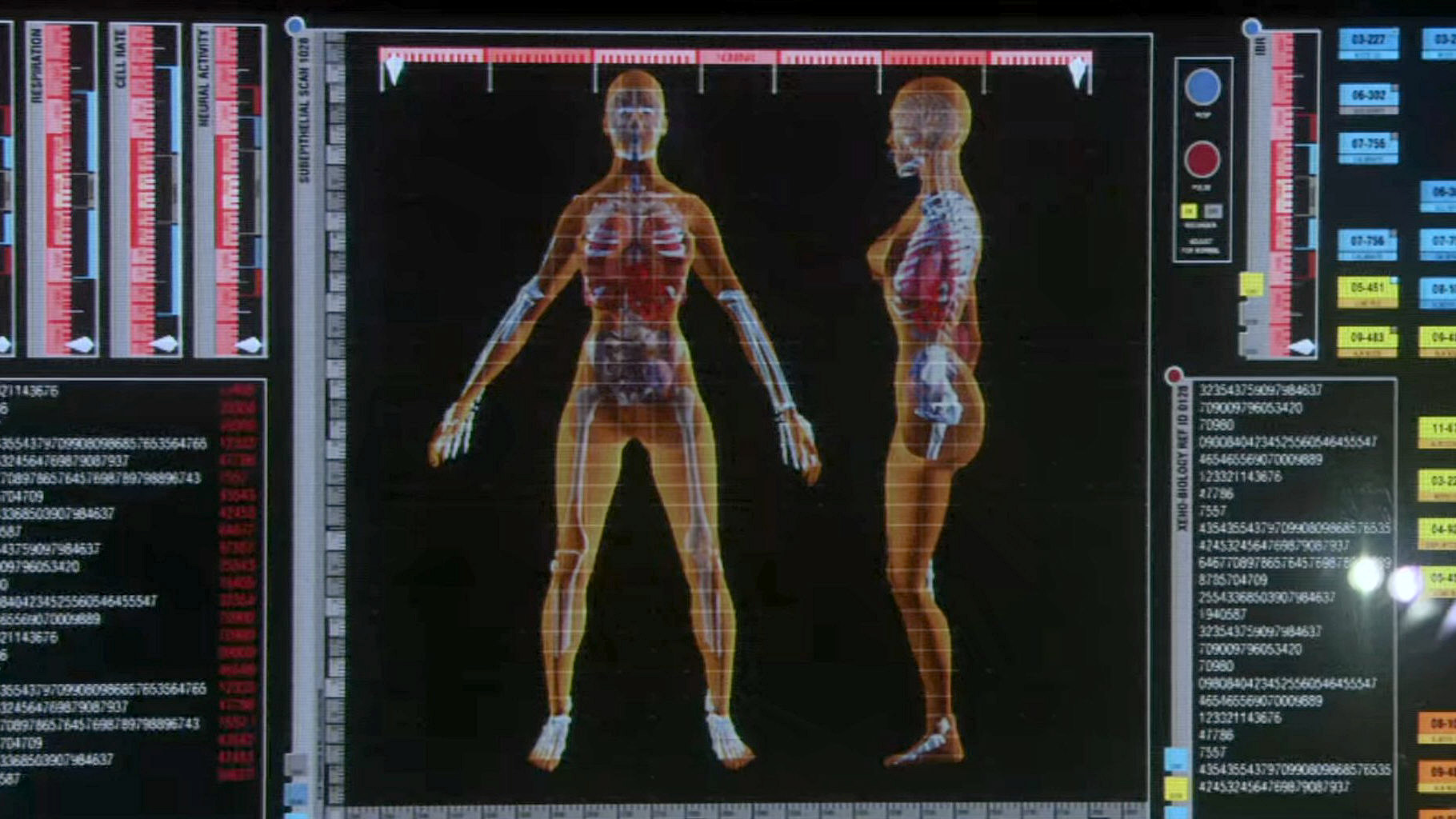
Date not given: Hoshi and Trip return from an alien planet with a contagious and incurable infection with a silicon-based virus. Their reactions and those of the rest of the crew are being observed by two non-corporeal Organians, as they have been doing it for hundreds of years with many different species. They may switch from one humanoid body to another for that purpose. What surprises them is how much compassion the humans show and that Archer is willing to sacrifice himself in order to save every single one of his crew. When Hoshi and Trip have died, the two Organians reveal themselves to the dying Archer, and one of them vows to save the crew and to break their long-standing rule not to interfere with the observed species.
Review
I am not particularly impressed with this variant of the old "lab rat" theme where highly advanced alien species are observing human behavior. At least "Observer Effect" turns out a tad more original than the blend of TNG: "Power Play", VOY: "Scientific Method" and ENT: "The Crossing" that I was expecting.
On the bright side, the new episode is pleasantly devoid of unnecessary action or distracting sub-plots, and it convinces with good performances especially of Connor Trinneer and John Billingsley. I like the teaser with Reed and Mayweather as chess geniuses, although it takes less than 30 seconds to recognize that these are not actually the two officers whom we would least expect to play chess but actually yet another couple of aliens possessing the bodies of Starfleet personnel. I also think that the reference to the Organians of TOS: "Errand of Mercy" was just the right idea to avoid having too many different non-corporeal entities floating around in our galaxy (and to avert an untimely appearance of Q, which would have ruined everything).
On the downside, the outcome is all too predictable. Since the Talosians in "The Cage" we have seen so many times that imagination, intuition or compassion prevails over the bureaucracy, technocracy or other stubbornness of a highly developed species. We have to wonder how they all could ever evolve so far without these human virtues. Ironically, the Organians of TOS as well as the very similar Metrons of TOS: "Arena" were still giving humanity a lesson in ethics more than 100 years later. But on most occasions in Trek it was just the other way round. In this regard, "Observer Effect" may have been meant to elucidate what is so special about humanity that this species, although they are neither the strongest nor the smartest, would become predominant in the known universe, at least among the humanoid races. The Organians reward human compassion and sacrifice and they listen to the words of the "primitive" Captain Archer, but I can't imagine that no other species has ever attempted the same. There is just too much diversity in the Star Trek Universe for humans to be located at the very upper end of an ethical scale. It is a contrived and arrogant twist that the superior Organians are so impressed only with humans that they would instantly revise long-standing policies for them, as flawed as these may always have been.
Something particularly bothersome, however, is how Archer defends the yet to be named Prime Directive that he swiftly made up in the ethically appalling episode ENT: "Dear Doctor". He makes good points in "Observer Effect", and it's honorable how he struggles for his and for Hoshi's and Trip's lives while acknowledging that the Organians are beyond his comprehension. Yet, he should not explain to the Organians but to the Valakians why two starship officers, who have chosen to go on dangerous missions, are to be saved, whereas a whole species is doomed just because of their "bad genes".
One more thing to remember is how two underused characters, namely Hoshi and Travis, are brought into play. This is laudable in the first place as far as the actors are concerned, but it's not exactly the right occasion to use them just when they would act out of character. The real Mayweather doesn't have a single line, and we really have to wonder what Judith and Garfield Reeves-Stevens were thinking when they decided to turn Hoshi into a secret gambler, who (albeit by accident) breaks the arm of her commanding officer. I think that giving a too amiable character a "dark past" is a rather cheap way to make him or her more faceted, and it is a poor excuse for not involving the character more into live action.
Annotations
- Remarkable quote: "I remember Exobiology 101, Captain. Humans are carbon-based. Our immune system can't fight silicon." (Trip, to Archer)
- Remarkable facts:
- The Organians have been observing the Klingons and the Cardassians before dealing with the virus infection. They both chose to kill their ill landing parties. The only difference was in how fast they came to that decision.
- Starfleet now seems to be using their own designation "Class M" instead of Minshara class for inhabitable planets.
- The quarantine station is located on D-deck.
Rating: 4
Babel One
Synopsis
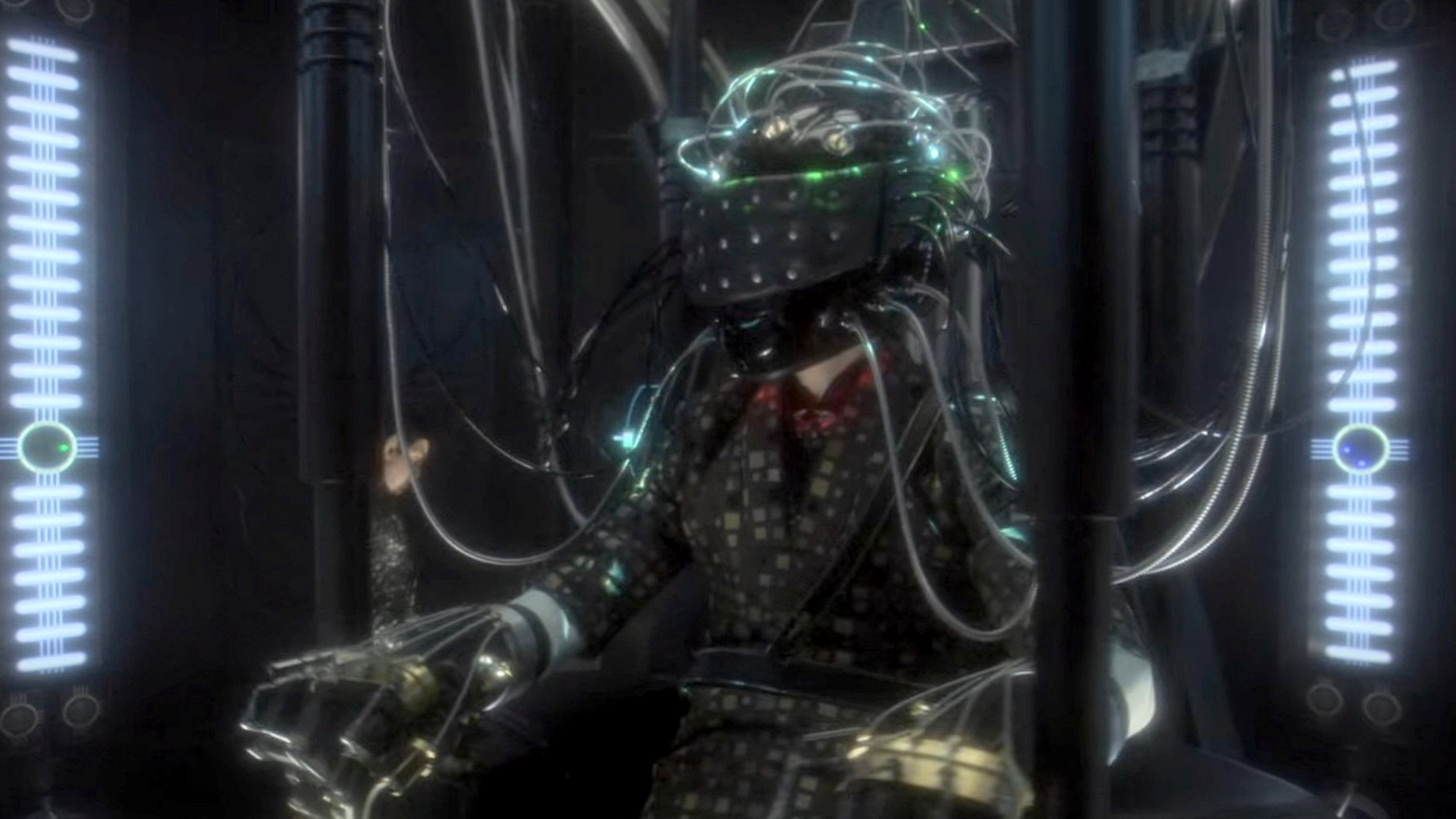
November 12th, 2154: Enterprise is ferrying a Tellarite delegation with Ambassador Gral to peace talks with the Andorians on Babel. On their way through Andorian space Archer picks up Shran and 19 survivors of his cruiser, which has been destroyed by the Tellarites, as Shran alleges. Soon Enterprise is attacked too, by what seems to be an Andorian cruiser. But T'Pol finds out that actually the two attacking vessels are one and the same, as is evidenced by the power signature that was identical in both cases. When the ship is found, no one is aware yet that they are dealing with a Romulan prototype vessel. A landing party beams over, but Trip and Malcolm are trapped there after the Romulans have disabled Enterprise's transporter. Meanwhile on Enterprise, Shran and Talas escape from their quarters to interrogate the Tellarites. Archer is just about to deescalate the situation when Talas and one Tellarite are wounded. On Romulus, it is discovered that Trip and Malcolm have found the bridge of the remote-controlled vessel...
Review
The new three-episode mini-arc starts with a promising yet not entirely captivating episode. I like how the established races and their mutual hostilities are brought into play here, without harming continuity. Everything revolves around the genuine and quite intelligent idea of a disguised mystery ship that is meant to trigger interstellar conflicts. The plot bears some surprises, the most obvious being the appearance of the Romulans (although they have to be physically absent as a continuity requirement). I think it is a fine homage to TOS: "Journey to Babel" to show a similar diplomatic conflict on Enterprise too, with the mention of "Babel" being more than just casual name-dropping. On the other hand, this type of stories has been overdone on Enterprise. Archer is playing the mediator almost every time he meets the Vulcans, Andorians, Klingons or Xindi and preferably more than one of them at once. It's certainly a nice trait and it befits the idea of Star Trek, but at some point the repeated attempts to make him a "22nd century Picard" become boring. Maybe this time has come now.
Speaking of clichés, some of them appear in a different light in this episode. A frequent theme in Trek is that coincidentally one of your opponents is on your bridge, and he will help you defeat one of his ships by pointing out a weak spot. To my amusement this time it doesn't succeed, and I wonder if this was purposely conceived as a parody of the cliché. Another thing that doesn't work quite as usual is the seductive woman who distracts the guard to escape from the prison. The guy is fortunate enough not really to fall for the trick. He manages to knock down Shran and put up a good fight against Talas until she can disable him. What I almost like most about the episode is the teaser with Archer and Hoshi rehearsing for their encounter with the Tellarites, who are known for getting into arguments about each and everything. It is always nice if she is allowed to say more than a just occasional lines, and it is really funny.
On a side note note, many of the scenes inside the Romulan drone were filmed with an extreme wide-angle lens. This may have had technical reasons, but most of all it created a creepy claustrophobic atmosphere like rarely before in the series.
Annotations
- Nitpicking:
- My principal complaint pertaining to the episode's technology is that the Tellarites would have deserved a new ship and not one of the Arkonians and Xindi-Arboreals to none of which their design may be related.
- The same goes for the Romulan prototype vessel, which is essentially the "Flea ship" from VOY: "The Fight" and looks nothing like a Romulan design.
- Something that bothers me too is that it would be impossible to control a ship in real time across many light-years (it is mentioned in the episode that it is far outside their territory).
- Finally, the Romulan city is the one from "Nemesis" but not like the one from TNG and DS9. Still, rather than assuming they are moving their capital back and forth, I am content with the explanation that not everything has to be located in their capital.
- Remarkable quote: "There's no rule that says the bridge has to be on top of the ship." (Malcolm)
- Remarkable facts:
- The Kumari was the first ship of her class. She had a complement of 86, of which 19 survived the Romulan attack.
- The Andorians and Tellarites have been feuding for over a century.
- Tellarites regard canines as a delicacy.
Rating: 7
United
Synopsis
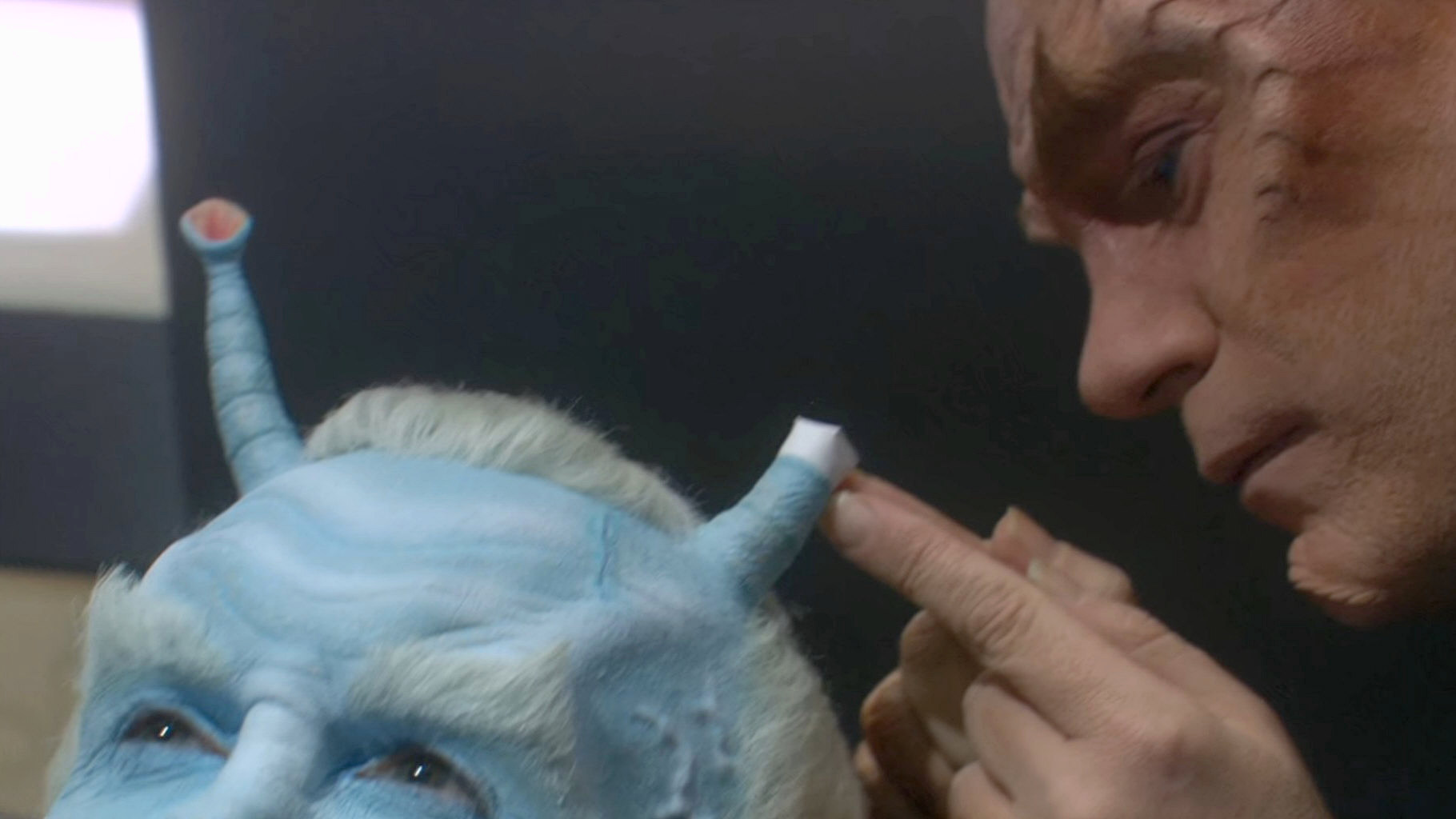
Date not given: Trip and Malcolm disable the warp drive of the Romulan drone. When the Romulans threaten to let Trip die, who is stuck in a radiation-poisoned service channel, Malcolm agrees to restore the propulsion system, but only to damage the ship considerably by overloading his phase pistol. Meanwhile on Enterprise, Archer and T'Pol devise a plan to hunt down the enemy vessel, but this would require humans, Vulcans, Andorians and Tellarites to cooperate. The alliance is about to fall apart before it can be forged when Talas dies of her injuries. Shran demands revenge, and because he would likely kill his Tellarite opponent in the ritual duel with saw-toothed ice miner tools, Archer steps in as a substitute. Shran nonetheless allows the fight to ensue, but it is over when Archer cuts off one of Shran's antennae. The Romulans have regained control of their drone thanks to its self-repair technology, and Reed and Trip are struggling to get to the hull to be beamed out. They escape from a hatch just before the ship goes to warp. The drone makes it back to Romulus where the pilot is disconnected from his remote control interface. He is a pale-skinned Andorian.
Review
"United" is an extraordinarily intelligent and technically almost flawless thriller from the first to almost the last second. Only the "Previously on Star Trek Enterprise" trailer is a bit lacking, as it fails to really summarize what had happened last week. Aside from this minor deficiency ,the episode rather benefited than suffered from being the second of three parts, like already "Cold Station 12" and "Awakening" earlier this season. This may have been the reason for the very fast pace of "United". What will be remembered most is the spectacular action, like Trip's and Malcolm's fight against the remote-controlled drone, the duel between Shran and Archer or the CGI attacks of the Romulan drone. Still, there is enough time for a good deal of nice character interaction, like between Archer and an unusually compassionate T'Pol when the captain is mentally preparing for the duel. Most notably Jeffrey Combs as Shran gives a marvelous Jekyll and Hyde performance throughout the episode that horrifies his friend Archer. And even Hoshi and Travis, as already in the two preceding episodes, are conceded a real part in the story. At long last the authors seem to have learned that it doesn't always have to be Archer, T'Pol, Trip or Phlox, who come up with ideas (although I wonder why the two don't spot earlier the paragraph in the Andorian ritual that would allow to end the fight when one contender is disabled).
Just as already "Babel One", this week's episode makes very skillful use of historical references instead of simply rehashing old stories with different actors. I am thinking of one-dimensional episodes like "Oasis", "Judgment" or "Regeneration" earlier in the series, to which there is no comparison. Clearly the fight between Archer and his friend Shran is a tip of the hat to TOS: "Amok Time", while the loss of Shran's antenna can be seen as an ironical reference to TOS: "Journey to Babel" where we saw the antenna of a phony Andorian break off. Likewise, several well-known clichés are either avoided or given a new twist. I'm thinking of Talas's death which comes more or less unexpected and off screen, not giving her the chance to utter her famous last words, something that I always see as very contrived. Or the scene in which Shran comes in to talk about Talas and then challenge the Tellarite murderer, during which it is never really clear whether he would rather pull a knife and kill the guy or offer him a drink to bury their conflict.
However, the idea of a sensor grid formed by many ships reminds me a tad too much of TNG: "Redemption" (even more because of the Romulan involvement). Fortunately the sensor grid is not such an important concept here as in the TNG episode, although tying more fleet operations into the story could have emphasized the idea that an alliance is being forged. The only slight annoyance of "United" is the pale-skinned Andorian as the pilot of the RC ship. It is clearly an interesting twist that will be explained later, but as a cliffhanger it leaves a bad taste, just due to its similarity to the shock about the pale alien Nazi in "Zero Hour".
Like in "Babel One", the camera movements are fantastic once again. Above all I recollect the scene when Shran rushes to sickbay, with the camera pursuing him. Then, without a cut, it moves to Archer's and Phlox's faces to turn back to Shran and around him while he is screaming "Nooo!". That's what I call perfection. And the CGI sequences with the "camera" following the extremely maneuverable Romulan probe are superb too (if only they had built a new and Romulan-looking model).
Annotations
- Remarkable quote: "You're good at building things, I'm good at blowing them up." (Malcolm)
- Remarkable facts:
- The Kumari, Shran's ship, was named for the first ice cutter to circumnavigate Andoria.
- We see two Remans, for the first time in Star Trek besides "Nemesis".
Rating: 9
The Aenar
Synopsis
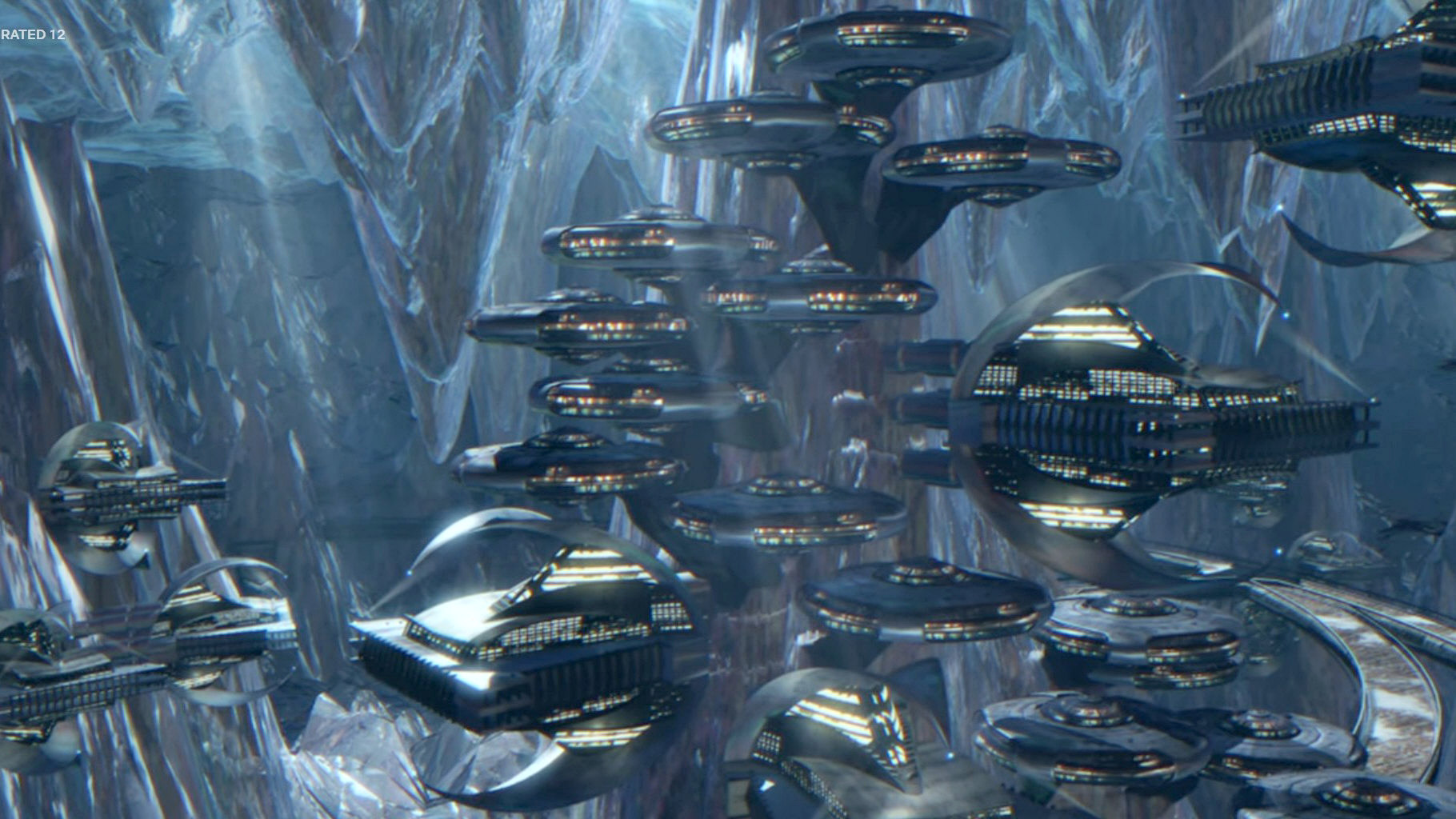
Date not given: An analysis of the Romulan pilot's brain pattern shows that he is an Aenar - a member of a telepathic Andorian subspecies whose existence was discovered only 50 years ago. Shran and Archer visit the secret Aenar city on Andoria where they hope to find the solution to the puzzle. The pacifist Aenar refuse to cooperate - except for Jhamel, the sister of the pilot, whose name is Gareb and who vanished some time ago. After T'Pol has attempted in vain to operate a replica of the so-called telepresence unit that allows to control the Romulan drones, Jhamel succeeds. When two drones are attacking Enterprise, she manages to telepathically contact her brother on Romulus and tell him to end the attack. He is killed by the Romulan Admiral, but it is too late. One of the drones destroys the other one, and Enterprise eliminates the remaining vessel.
Review
I see "The Aenar" as a bit of a disappointment. One reason is that the principal puzzle of the Romulan marauder was already solved in "United", as was the conflict between Shran and the Tellarites. There is essentially nothing left to do in the final part of the trilogy but to hunt down the drones, a task which doesn't strike me as thrilling. It is done almost casually if it had not been for the Aenar siblings who save the episode from becoming boring. The two are not even particularly strong guest characters but they are the ones that are emotionally involved. Jhamel's interest for Shran remains at the surface (although I like their scene in the dark, in the Aeanar city), and Gareb has to remain passive anyway the whole time. Getting rid of them is effortless. Gareb is simply shot by the Romulan admiral, and an unadorned farewell to the endearing Jhamel is deemed sufficient. Introducing two new characters and a whole new species is not a brilliant idea anyway as far as the whole trilogy is concerned, but at least it gives "The Aenar" some distinctiveness. The exploration of the motives of the two Romulans (the scientist and the admiral), who had not really been personally involved in the trilogy so far, should be seen in the same light.
In spite of everything, I am still surprised how little happens in the 42 minutes of this episode, compared to last week's "United" that was so full of action and drama that it seemed to last twice as long. Obviously more time for character development is left here, which finds use in some interaction between Archer and Shran as well as between Trip and T'Pol. Trip expresses his concerns that T'Pol is going to try out the telepresence unit, and once again he proves to be bad in explaining that it is out of personal interest and not just because she is a valuable officer.
What I miss too is an interesting revelation in the end, something that would shed a new light on the Andorians or maybe on the Romulans. Considering that it is the end of the trilogy I am not thinking of yet another cliffhanger, but rather of something to justify a follow-up at a later date (assuming that the decision to cancel the series had not yet been made when the episode was being produced). In any case Tucker's talk with Archer about a possible transfer to the Columbia is a rather poor ending of a great arc. One more point of criticism is that the parallels to motives in "The Forge" are so striking that they seem to come from an automatic plot generator. Just replace the Vulcan Forge with the Andorian ice desert, the electromagnetic storms with a dampening field, the secretive Syranites with the secretive Aenar. It's essentially the same story.
I may be overly critical about "The Aenar" as an episode of its own. Overall, "Babel One", "United" and "The Aenar" form a great trilogy with some of the best drama and action in the whole series.
Annotations
- Remarkable facts:
- The Aenar and their their city were discovered by the Andorians only some 50 years ago. There are supposed to be just a few thousand left.
- The Ticonderoga, a cargo vessel, seems to be another victim of the Romulan marauder.
Rating: 6
Affliction
Synopsis
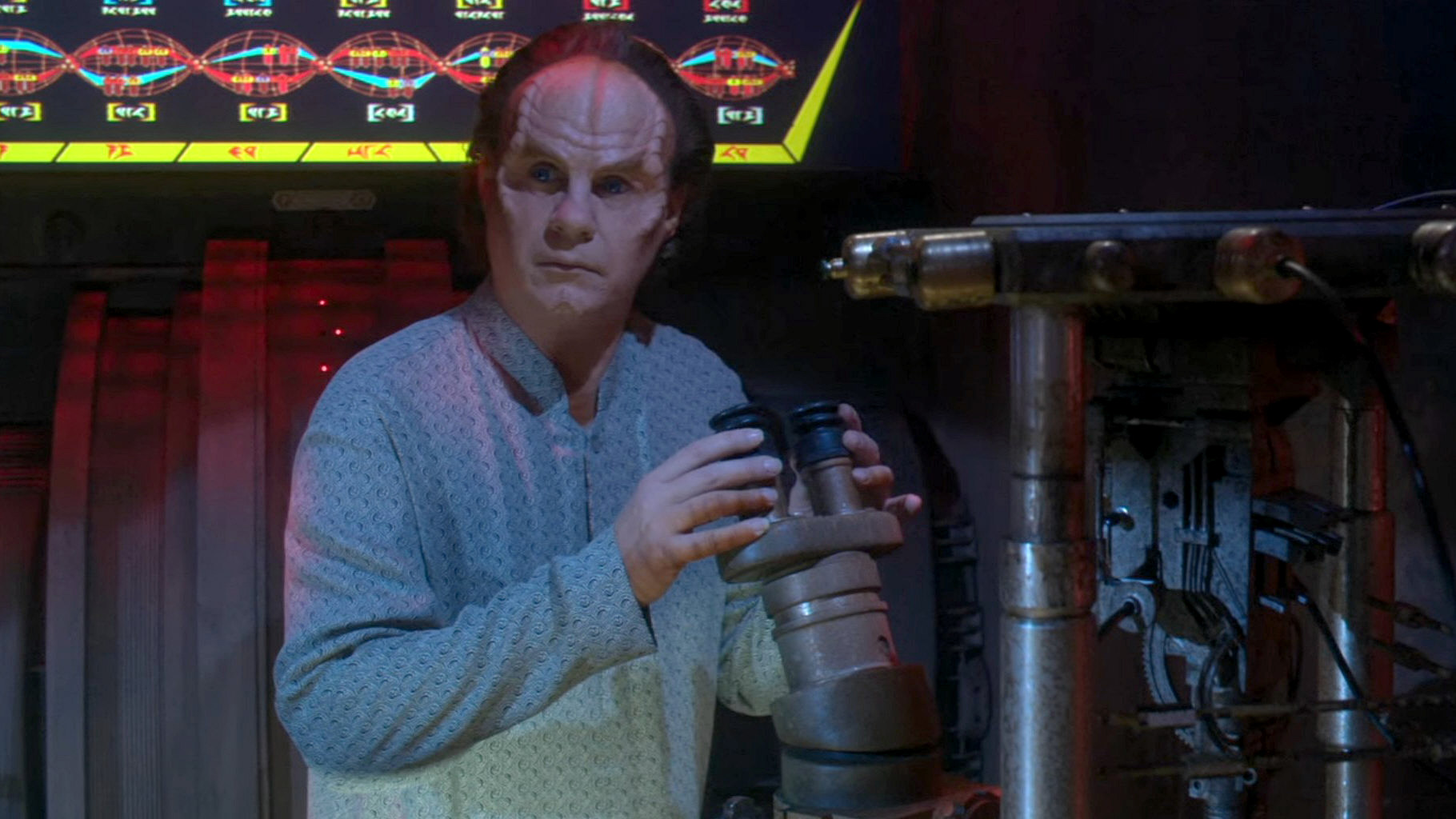
November 27th, 2154: Enterprise arrives at Earth to attend the launch of the sister ship Columbia. Trip joins the crew of Columbia. In San Francisco, Dr. Phlox is kidnapped and taken to a Klingon colony to find a cure against a virus that is spreading through the Klingon Empire and may cost the lives of millions. The crew of Enterprise figures out that the Rigelians are responsible for abducting Phlox, but the Rigelian freighter is found destroyed in space. Archer discovers that Malcolm Reed has obstructed the investigation by erasing the data in the Rigelian black box. He confines his armory officer, who is secretly working for a man named Harris of Section 31, to the brig. Enterprise is attacked by a Klingon vessel and is boarded. One of the intruders can be disabled by the MACOs and is taken to sickbay - he looks almost human, although his lifesigns are Klingon. As Dr. Phlox is told, the reason for the virus to become dangerous was that it combined with human DNA - more precisely with DNA of Augments that the Klingons were experimenting with to create stronger warriors. One side effect is that the Klingon Augments take over the characteristic smooth foreheads of humans. On Enterprise, it is found that the intruders have sabotaged the propulsion system. Because of an open antimatter regulator the ship has to stay at high warp...
Review
The obsession to explain each and everything in the Trek Universe in this fourth season hits its peak. Up to this episode, hardly any serious Trek fan would have asked for a solution to the infamous Klingon forehead dilemma on screen, knowing that there used to be the convenient and very simple answer that they were always supposed to look like they do since the first feature film, in accordance with what Roddenberry had in mind. Pondering about the foreheads was fun though, although at times it became bothersome to discuss all kinds of far-fetched theories that some people made up without caring about the facts. We can be glad that the small story arc explains away the problem in a quite elegant and mostly intelligent fashion to everyone's satisfaction. And I am glad that the frequent mails along the lines "Didn't you know that they were surgically altered to infiltrate the Federation" will stop. Addendum: They didn't stop completely. People still promote their own takes occasionally.
I don't like Tucker in this episode and his interaction with T'Pol (or rather the lack thereof). Why is the chief engineer suddenly so secretive and abrasive as if he were a totally different character? His complicated relationship with T'Pol can't be the only reason. In any case, we have probably never seen a character on Star Trek, who did such a bad job separating his personal affairs from his profession and duty. I'm not particularly fond of such sub-plots anyway. It went awry in TNG: "Lessons", and it doesn't work here either. And the dream sequence with T'Pol and Trip meeting in a white realm is tacky and gratuitous, unless this new telepathic link will play a major role in upcoming episodes (which I doubt). This raises the question why and how Trip will return to Enterprise. It seems like he is coming back just as suddenly and inexplicably as he left.
I am not really fond of the Reed's connection to Section 31 and his according role in the story either. Revealing that the armory officer was working for that organization behind Archer's back may have been good for a couple of stories still to come (if the series had not been discontinued). But essentially we could already seen something along these lines with Bashir on DS9. The story of "Affliction" would have worked without involving Section 31 and definitely without mentioning them, and as we will see in the follow-up Malcolm will resume his position sooner than we might think and than he might have deserved, bearing in mind the subversion he is guilty of. On a positive note, Reed is involved in a real conflict with another character for the first time in the series.
Hoshi is given two nice scenes, when she defends herself using some Aikido (at least that's what she mentioned before, I don't know the difference between Aikido and other martial arts) and when T'Pol performs her first mind meld with her, revisiting the scene of the kidnapping. Aside from Section 31 there is a lot more name-dropping in the episode, including references to the Orions, Mazarites, Tiburon, Levodian flu and metagenic research. Perhaps it should have been reduced, but for the most part it created useful consistency.
Annotations
- Remarkable ship: As T'Pol sais, the Columbia is virtually identical to Enterprise. Her larger deflector dish is the only significant difference, at least from the outside. But inside the ship there is the one thing I loathe about the Columbia: the flashing light columns on the bridge where they don't serve any obvious purpose and are just a pain in the neck of Captain Hernandez. Sure, the light columns are a way to establish the perhaps necessary visual difference between the two bridges. But the way they were fabricated they look like an immature fanboyish feature.
- Remarkable fact: Enterprise can be pushed up to Warp 5.2, although this speed (obviously above "maximum warp" that Archer had already ordered earlier) can't be maintained for long.
Rating: 6
Divergence
Synopsis
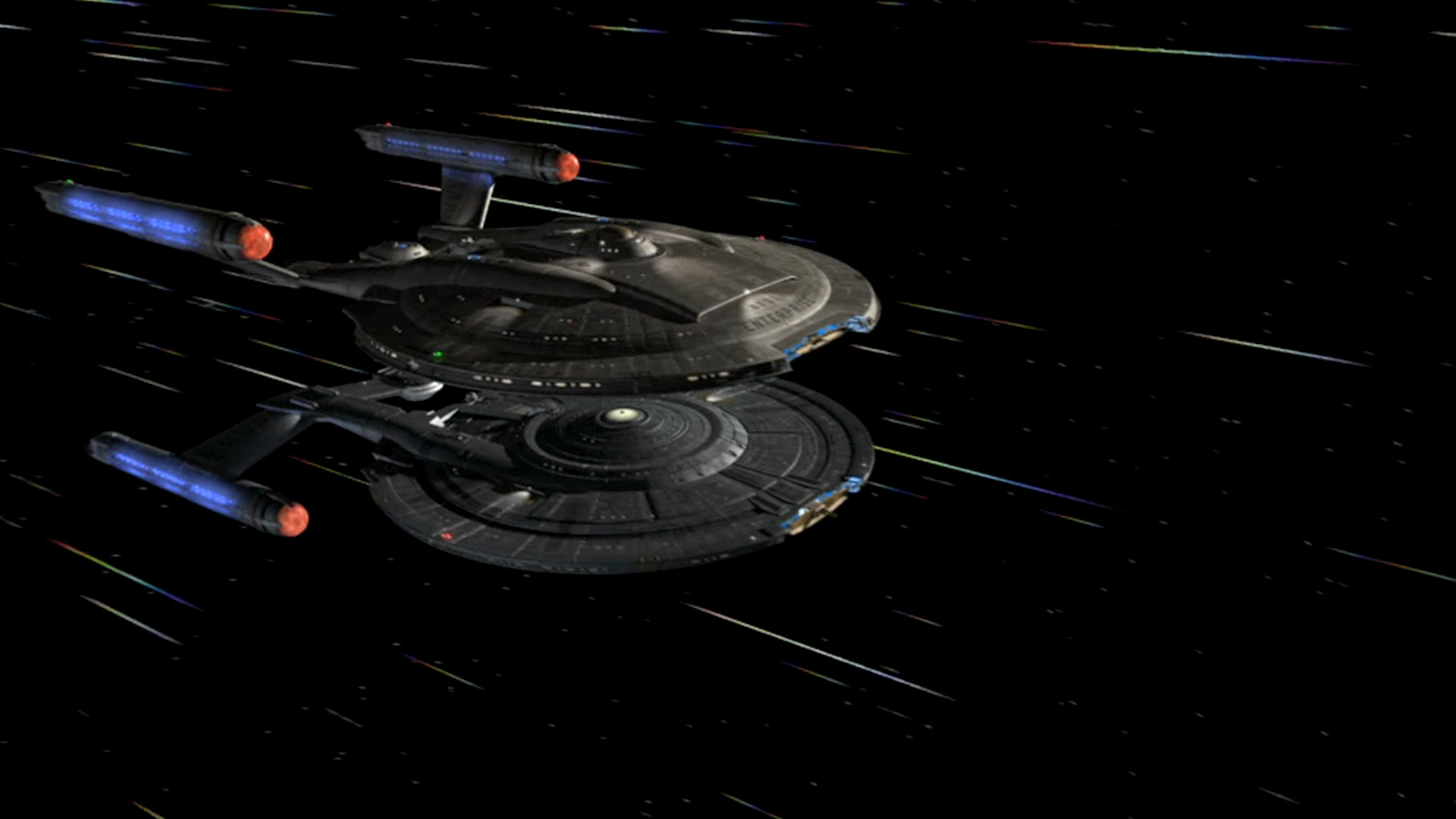
Date not given: In a daring maneuver Trip is transferred from Columbia to Enterprise, where he averts the disaster by performing a cold start of the warp reactor while Columbia is maintaining the warp field. As the Klingon fleet under the command of Fleet Admiral Krell is approaching to eradicate the infected colony, Phlox is struggling to devise a cure for the viral infection, supported by the Klingon scientist Antaak. When they find a remedy that would actually take away the superior abilities from the Klingon Augments, they decide not to tell General K'Vagh, who oversees their work. With little time left until the fleet arrives, the last four healthy Klingons agree to test four different strains of the antivirus that Phlox has developed, of which three are lethal and only one provides a cure. Time ultimately runs out when the Klingons attack and Enterprise and Columbia are being fired on too, against Krell's agreement with Section 31. Archer beams down and allows Phlox to inject the antivirus in his body to speed up the procedure. Then Antaak beams the virus into the Klingon lead ship, forcing Krell and his men to stand down to be healed. The cured Klingons retain their flat foreheads and are said to pass them on to their children.
Review
"Divergence" has some of the best action in the whole series, along with a mostly well thought-out story. Trip's stunt to get from Columbia to Enterprise is the probably most memorable part of "Divergence". Reed quite correctly states that using the transporter at warp wouldn't be possible. Here we have at least one limit of this technology compared to the 24th century, where we have occasionally seen beaming at warp. The principle of merging the warp fields of the two ships is quite plausibly explained and shown on screen. The only point of slight criticism is that it was not considered an option using a shuttlepod for the transfer. The whole maneuver is exciting and visually spectacular too. And it ultimately answers the questions why the ventral side of the NX class is so flat and how the design of the USS Prometheus came to life. ;-) On a related note, obviously the Klingons could beam through even two shields when they transported the canister with the virus to the lead ship of the attacking fleet.
It is an interesting twist, albeit not quite realistic, that Phlox has four strains of the virus and four healthy Klingons left. Perhaps it would have had more impact if Phlox had faced this decision earlier though, with the prospect of one by one of them dying. Another remarkable aspect of the episode is the conflict between the different castes of the Klingon Empire. The motivation of the biologist Antaak reminds me a lot of the scientist in TNG: "Suspicions", as well as of the lawyer in ENT: "Judgment". All of them have in common that they are struggling against a lot of prejudices of the warriors. The interaction between Phlox and both Klingons works out quite well anyway. Especially after the immediate threat of being executed is taken away from Phlox, their discussions greatly contribute to the story. It is only an overly unlikely coincidence that of all Klingons the son of General K'Vagh was captured on Enterprise, especially since he only briefly meets his father toward the end.
The rest of the character interaction is rather uninspiring. The conversation between Reed and the Klingon in the neighboring cell is dull for the most part, and the whole Section 31 sub-plot captures least of all my interest. I can hardly imagine how Section 31 could become so powerful considering as how naive and toothless Harris presents himself. Trip and T'Pol once again avoid using plain language, with Trip continuing to act out of character (and Connor Trinneer falling short of his talent). I only like the ironic detail that T'Pol at one point questions Trip about his dreams the same way normally humans would like to know trivial things from Vulcans.
Something that angers me a bit is that ridges form on Archer's forehead during the treatment, and that this happens quite suddenly. So does Archer grow new bones (after all it must be bones that are responsible for the Klingon look) in a matter of seconds? We may buy that the virus alters the DNA as on many other occasions in Trek, but showing impossible transformations just for the sake of a visual effect is something the series could easily do without. While the overall treatment of the forehead dilemma is quite skilled like already in "Affliction", I dislike a couple of side notes that are rather contrived. For instance, when Antaak comes to Phlox with a proposal for a cure, Phlox says after a quick glance that it would go along with "some minor changes in their appearance" as if this was meant as a broad hint for those viewers who still don't know that it is all about the famous Klingon forehead mutation. The remark that the children of the cured Klingons would inherit their smooth foreheads is necessary though, while we may want to forget about Phlox's idea that cranial reconstruction would likely become popular (Kor anyone?).
Annotations
- Nitpicking: Wasn't the reason for the hassle in "Affliction" that the antimatter flow regulators couldn't be closed? In other words, the produced power would blow the warp core if the plasma didn't all go into the propulsion system. That's why Archer ordered Mayweather to go to maximum warp and later even in excess of that (Warp 5.2). Conversely, Tucker now insists that the reactor needs to be shut down and restarted after removing the virus while still at warp. As we can witness, after shutting down the reactor the warp field grille goes off almost immediately, meaning that no plasma is flowing through it any longer. If the antimatter regulators automatically go offline too, anything is fine. But in this case it wouldn't have needed Tucker to accomplish that and there would have been no hurry to restart the reactor. Moreover, the warp core, especially when no plasma is flowing anyway, doesn't care whether a starship is at warp or not. If, however, the regulators were independent of the rest of the reactor or couldn't be closed because of the Klingon tampering (that's how it sounded like in "Affliction"), the ship would be destroyed in a huge matter-antimatter explosion the very instant the reactor goes offline. In either case the situation as shown in "Divergence" is inconsistent with "Affliction". Maybe, while overall the continuity between the two episodes was fine, this important technical concept didn't quite make the transition from one writer team (Coto & Sussman) to the other (Reeves-Stevens).
- Remarkable joke: The label on the wall between Reed's and the Klingon's cells reads "No entry". As if the prisoners wouldn't know that. ;-)
Rating: 7
Bound
Synopsis
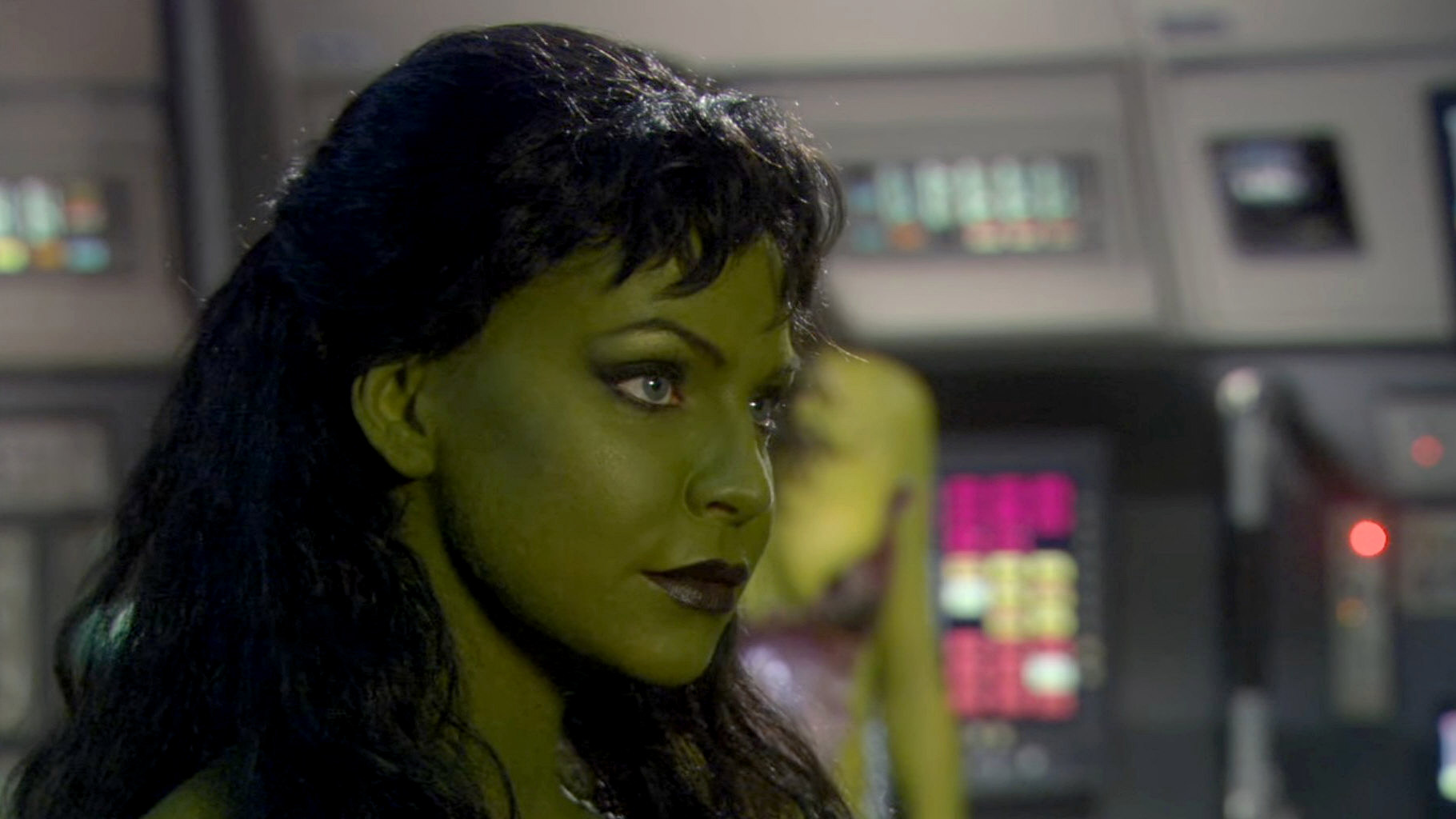
December 27th, 2154: After forging a deal with the Orion trader Harrad-Sar, Archer and Reed receive three beautiful slave women as a gift. The three women, Navaar, D'Nesh and Marras, have a disruptive influence on the crew. They begin to seduce the men up to the point of mind control, while women are suffering from headaches. Dr. Phlox finds out that pheromones are responsible for the effect. Only Tucker and T'Pol are immune because a bond has formed between them. When the three Orion women have taken over the bridge and Harrad-Sar arrives to tow away Enterprise as his booty, it turns out that he is under their control as well. Tucker rectifies the situation with a phase pistol. When T'Pol asks Trip to stay aboard, he says that he has already applied for his transfer back to Enterprise.
Review
"Bound in honor" is not what I would call that. As a matter of fact, I don't recall any modern Trek episode with such outspoken sexism. Well, it is hilarious up to some point to see an almost authentic TOS dramedy along the lines of "Mudd's Women" or "Elaan of Troyius" in a technically and artistically enhanced version. Also, I like the look and the movements of the Orion girls. I definitely prefer the sight of their scanty costumes (like William Ware Theiss made them for TOS) over the bashful hints of hedonism during TNG ("The Outrageous Okona" being the prime example) or Enterprise's own peep shows with exposed breasts & bums ("Harbinger"). Still, "Bound" doesn't belong in our time, no matter what efforts are taken to update it. It doesn't help either that in the outcome the Orion men turn out to be the actual slaves. This ironical twist is too late and too inconsequential to change anything. Essentially it just makes possible T'Pol's joke or whatever it was supposed to be about the Orion women in charge - the one good thing about an otherwise disagreeable species according to her. I sort of like the joke though because it is at least one fitting TOS homage (reminding us of Spock's closing words in many TOS episodes).
The explanation that the girls are not the slaves makes me wonder anyway why they permit themselves to be showcased on slave markets like we could see one only recently in "Borderland". Something doesn't work with the explanation, but this is just one problem in an episode that doesn't work on the whole. The plot has several holes, but even this shortcoming is surpassed by the general feeling of helplessness among the crew. We have seen so many alien takeovers before in the series and so many situations with the crew on edge, but none of them made Archer, Reed and the others look as dull as in "Bound". So dull that at some point I denied them my sympathy because it was only annoying to see them stumble around, recognize the danger, and then do nothing against it. For the same reason I already strongly disliked "A Night in Sickbay" and "Harbinger".
I haven't figured out yet what part Tucker's rival Kelby was supposed to play except for a scapegoat, because he got laid by one of the women, while Archer and Reed were not (or at least not that we are supposed to know of). It is a major annoyance of the episode that it preserves our heroes' clean records at any rate. In TOS, Kelby would have been killed in the course of the episode. Here he gets beaten up and then vanishes somewhere in sickbay or in the brig or elsewhere, which is just as deplorable.
Long-time fans know and appreciate Manny Coto's efforts to fill in every gap he can find in the TOS Universe and to tie TOS and ENT closer together in each single episode than was attempted in the whole previous three seasons combined. Now he has finally gone over the top. The plot of "Bound" is rather a farcical re-enactment of TOS than a homage. The screenplay is full of clichés, like the lacking security on the ship, T'Pol's immunity because of her Vulcan physiology and even the trick of sending some pulse back through the grappler rope to disable it (the latter rather from Voyager). And as we would not have expected otherwise, Dr. Phlox presents us the precise cause of the whole trouble: It's not a mystery like it will obviously be 100 years later ("The Cage"). No, Orion women are irresistible because of their pheromones. Or maybe midichlorians? Sorry, at some point the fans don't want to have each and everything explained.
There is one scene I enjoyed though that I would like to mention. When the ship arrives at the planet and Archer is intoxicated with the pheromones, the camera does a great job to show his dizziness. We can see some pans in unusual directions, like from the side wall to the screen.
Annotations
- Remarkable dialogue: T'Pol: "At least we've learned something about the Orions." - Malcolm: "Yeah, the women are in charge." - T'Pol: "It proves that even the most disagreeable species have some positive attributes."
- Remarkable error: Tucker calls Kelby "lieutenant", but Kelby is wearing the same commander pips as Tucker.
- Remarkable mentions:
- Berengaria is a potential site of a starbase. It was surveyed by the Vulcans over 50 years ago and is said to be inhabited by flying reptiles, some reportedly over 200 meters long. ;-) This legend is a homage to TOS: "This Side of Paradise".
- When Travis was 15, he met some irresistible Deltan women when his father picked them up from their defunct ship.
Rating: 2
In a Mirror, Darkly I/II
Synopsis
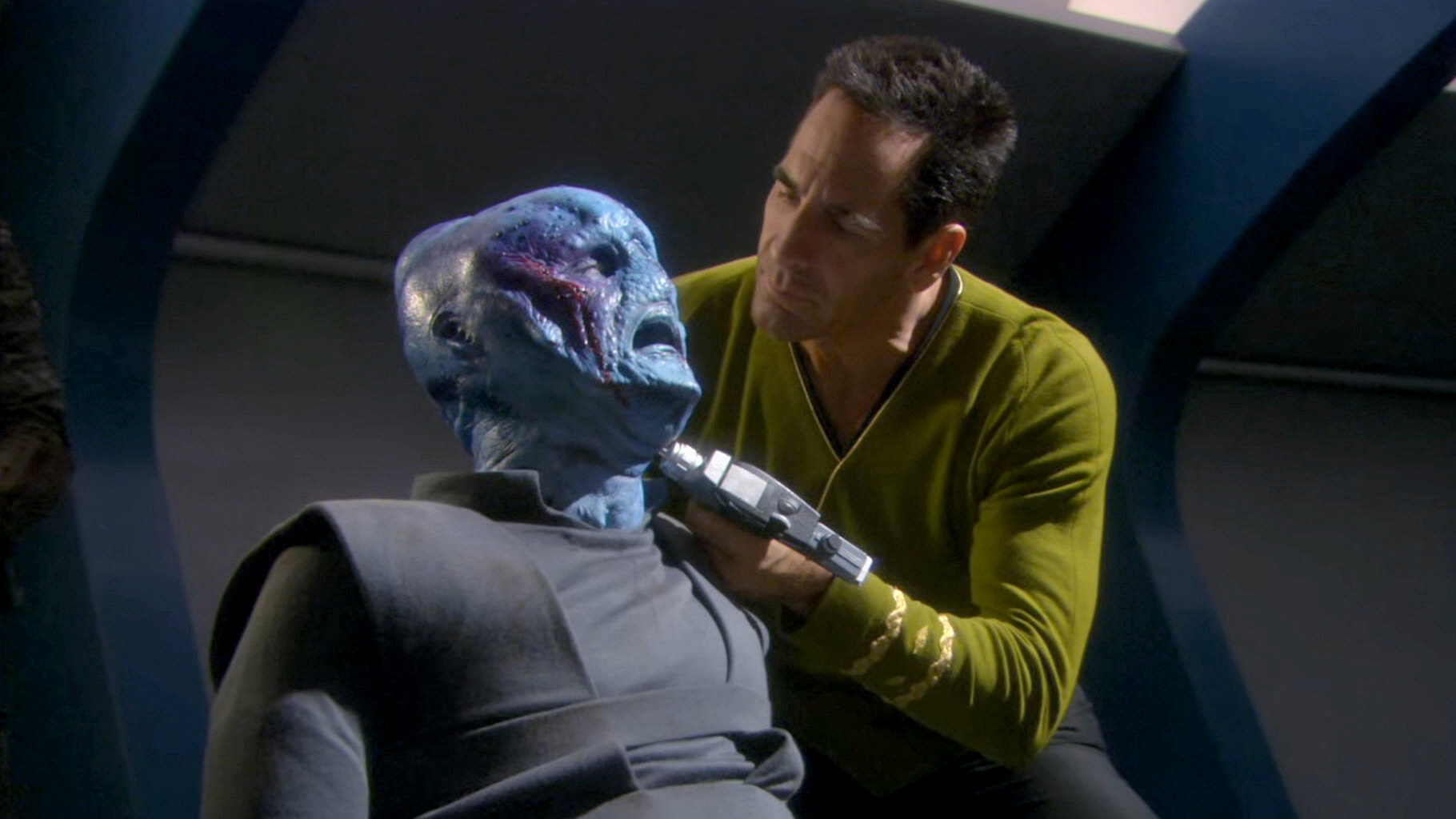
January 13th, 2155: In the brutal Terran Empire of the Mirror Universe, Commander Archer of the ISS Enterprise mutinies against Captain Forrest. His goal is to take the ship to Tholian space where reportedly an advanced vessel is in the hands of the hostile non-humanoid species. A captured Tholian reveals the location of the secret facility when Archer and Phlox apply torture. Not before long Commander T'Pol helps Forrest to regain command. But Archer has locked the helm with an encryption code and Starfleet command approves of Archer's mission. The crew find the USS Defiant NCC-1764 ready to launch in a drydock. Archer and a small team beam over and seize command of the Federation Starfleet vessel from the future that was lured into an interspatial rift by the Mirror Tholians. Alarmed by a distress call of the prisoner, Enterprise is soon surrounded by Tholian vessels and destroyed. Forrest dies on the ship, while the Defiant manages to recover a number of escape pods. A Gorn, who was still aboard the Defiant, sabotages the ship but Archer hunts down the reptilian. With a vessel more powerful than any other at his avail he breaks down a rebellion of other species against the Empire, including the Vulcans, Andorians and Tellarites. After a disagreement Archer kills Admiral Black. In the meantime T'Pol, Soval of the ISS Avenger and Phlox have forged an alliance against Archer. The Defiant heads for Earth where Archer is going to declare himself the new Emperor. But his mistress Hoshi Sato has poisoned his champagne. In Earth's orbit she introduces herself as Empress to the puzzled Starfleet Command...
Review
I'm glad this double feature about the Terran Empire winds up rather as appealing than as appalling. An overkill of cruelty and silliness almost ruined the huge fun of seeing the crew in the colorful TOS uniforms and having a fantastic CGI Defiant perform all the action that was sadly missing in TOS. I thoroughly enjoyed "In a Mirror, Darkly" as solid entertainment, but not without looking back at it with some grievances.
To start with, the story and the characters are pulp and would usually score close to zero points in my review. While the reason for that lies in the simplistic nature of the Mirror Universe and is not primarily the fault of the writer, I would still have expected at least a minimum of characterization. What little is done to elucidate the motives of the Mirror crew is rather contrived - worst of all the voice in Archer's head, which manifests itself as another Archer standing at his side. A lame "shoulder devil"-type plot device. Yet, although it turns out anything but light-hearted, this is also the reason why I can see it to some degree as a parody, which I genuinely enjoyed like most of the previous Mirror Universe installments. The multitude of tongue-in-cheek references, with kind regards from Manny Coto, clearly helped me to take a few things easy that would otherwise have bothered me. Still the narrative and its very concept is lacking in several regards.
The Mirror Universe has always been enticing as a "what if" scenario. But some questions that we might pose (or are expected to pose) would better remain unanswered. Do we really want to see our characters as tyrannical, faithless and overall inhumane jerks? Does it need a dark nightmare of the future to corroborate how bright the "true" vision of Star Trek is? While the basic idea of an antithetic version of the Federation was a fascinating new concept in TOS: "Mirror, Mirror", the Mirror Universe has gradually lost its impact in the DS9 features that followed 30 years later. DS9: "Through the Looking Glass" was still rather frightening in a positive sense, as it showed humans as the victims of their own former primacy. The way the Mirror Universe was treated in DS9: "Shattered Mirror" and ultimately in "The Emperor's New Cloak", however, it had degraded to an effortless concept of bringing excessive viciousness, comic relief and all kinds of weirdness into an otherwise rather composed TV show. This was possible because the Mirror Universe showed up only once in a while, so it wasn't required to explain too much in terms of continuity. Characters could be killed off at whim and the balance of power considerably shifted on each occasion. Everyone and everything is disposable, who cares? All this happened with few to no impact on the characters and the general setting of "our" universe. In this respect, the concept of the Mirror Universe has a built-in reset button like other, related motives, such as alternate futures or holodeck programs. My concern is not primarily that the Mirror Universe is unrealistic or that the evilness of their Mirror twins could rub off on our characters. It rather lies in the function of the Mirror Universe as a dumping ground for all kinds of ideas that are unthinkable in our universe or, in other words, in normal "serious" Star Trek installments.
I would even go as far as calling the whole approach that was taken in the Mirror Universe episodes hypocritical and discriminating. It is a place where nearly all characters torture, murder and betray one another all the time. This basic pattern of behavior is always the same, with too little variation. It is anything but plausible that a world could work like this and in terms of narrative quality such a setting is prone to produce pulp. What's more, it makes anything in our universe look good - even the most ruthless Klingon is a nice guy compared to the average Mirror character. The probably most hypocritical aspect ever brought up in the Mirror Universe was the "lesbian fetish" of DS9 (Kira, Leeta). No character in our Trek universe has ever been explicitly shown as homosexual, but in the Mirror Universe exactly this happened repeatedly and overtly. Keeping in mind what the characters in the Mirror Universe are like, the episodes seem to make up a correlation between homosexuality and criminal predisposition! If there should ever be a gay or lesbian character again, we can only hope that it will be done in a decent and not in such a defamatory fashion. Fortunately there is no such failing in "In a Mirror, Darkly". But the way "straight" sexuality is shown is not really better.
While it is bound to largely the same problems as other Mirror Universe stories before, there is something exceptional about "In a Mirror, Darkly". The episode entirely takes place in the Mirror Episode, there is not the slightest participation of "our" Enterprise NX-01, except for the historical personnel files from the Defiant that Mirror Archer and Sato read with amusement and astonishment. One might say this is overall for the benefit of continuity, as our universe will not become aware of the existence of the parallel reality until more than a hundred years later. On the other hand, a story that doesn't tell anything about the crew and the mission of our starship is completely pointless in the course of the series. Something like that has been done before with varying success especially on Voyager ("Living Witness", "Course: Oblivion", "11:59"), but it is sad to have such a stagnancy a few weeks before the series ends (much to soon).
Annotations
- Remarkable quote: "Without Vulcan technology the Empire wouldn't be where it is today." (Mirror Archer) Read it again, compare it to what "our" Archer always says about the Vulcans and enjoy the irony!
- The Mirror characters:
- Captain Forrest commands the ISS Enterprise.
- Commander Archer is the first officer.
- T'Pol (with long hair) has much the same role as in our universe.
- Reed is a MACO major, he invented the torturing booth.
- Mayweather is a MACO sergeant.
- Hoshi Sato was Forrest's concubine and becomes Archer's. She used to work in Brazil, like in our universe.
- Trip has a disfigured face because of delta radiation (the make-up is a homage to TOS: "The Menagerie").
- Remarkable species:
- We see a Tholian for the first time since TOS: "The Tholian Web". The look is consistent with Commander Loskene from the TOS episode although I was always convinced that the angular head was just a helmet. The insectoid Tholians are said to have both male and female characteristics.
- We can also see the first Gorn since TNG: "Arena". The CG version is a lot more agile than the Gorn captain that Kirk had to fight. Overall, not a faithful but a logical evolution of the look of the species.
- Remarkable facts:
- In our universe, Hoshi Sato will develop the linguacode translation matrix in her late thirties.
- Our Archer is considered to be "the greatest explorer of the 22nd century. Two planets were named after him."
Rating: 7
Demons
Synopsis
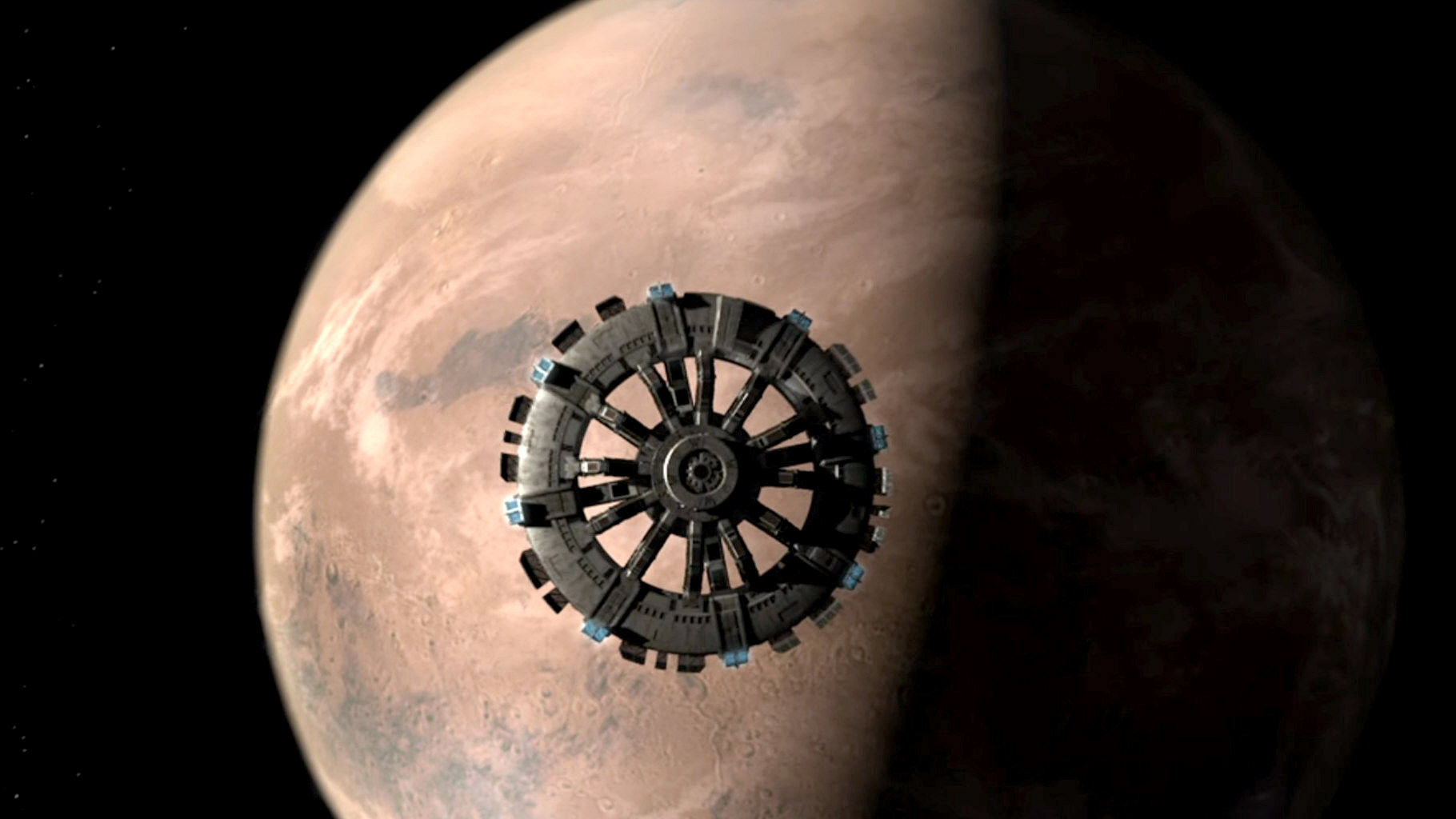
January 19th, 2155: While the Enterprise crew is attending a meeting of Minister Samuels with alien delegates on Earth, a fatally injured woman stumbles into the conference room. She warns T'Pol that someone is threatening her life and hands her a lock of hair. To everyone's surprise Phlox finds out that the hair is from a child with Vulcan and human DNA, a girl whose parents are T'Pol and Tucker. The woman, whose name was Susan Khouri, has been working for an isolationist movement known as "Terra Prime". Phlox's analysis that she used to take a medication against zero-g effects allows the crew to trace back her way. While T'Pol and Trip infiltrate the mining colony Orpheus on Earth's Moon, Mayweather's love interest, the journalist Gannett Brooks, is arrested as a spy working for Terra Prime. On the Moon, Trip is invited to join an assembly of Terra Prime supporters. But he and T'Pol are uncovered. Paxton, the owner of Orpheus and leader of Terra Prime, orders the colony, which he has transformed to a large starship, to lift off and head for Mars. On Mars he takes possession of a verteron weapon and he demands that every alien leave the Sol System...
Review
We may have expected an episode addressing the xenophobic reactions to aliens of some humans rather at the very beginning of Enterprise than at a time just before the series finale when the writers are in a hurry to establish a perspective for the future Federation. In this regard "Demons" is definitely a setback. At times I even feel reminded of the Mirror Universe feature "In a Mirror, Darkly", seeing that "our" world isn't that much better in essence. It may be just a minority, but here is a group of humans who are not willing to practice basic tolerance and who strive to ban or ultimately destroy everyone troubling them as "alien".
Xenophobia as we sadly know it from our time and as already hinted at in a skillful sub-plot of "Home" is a very dumb contempt, largely bereft of a deeper significance. As a theme in a TV drama it facilitates the creation of detestable villains and is likely to end up as a story full of accordingly cheap clichés. But I won't carry on with my usual rant about TV Nazis at this time. On the contrary, I am pleasantly surprised how realistically "Demons" embeds the issue into the context of the 22nd century. If the plot stunt of the Xindi attack in "The Expanse" had one long-lasting beneficial impact on the series, it is that it allowed for this week's episode.
As already mentioned (but it can't be said often enough), xenophobia is stupid by its very nature. Hordes of xenophobic morons, who harass "freaks" for just being different, are bad enough. But it becomes horrible when this happens in an organized fashion, authorized by a leader. With Hitler and the Nazis being the most obvious examples in real history. Paxton is meant to be the 22nd century version of such a leader, which is even corroborated by his unveiled admiration of Colonel Green, who was apparently responsible for the killing of hundreds of thousands of radiation victims after World War III - because Green saw them as "impure". 200 years after Hitler and 100 years after Green, Paxton's plans are in the same bad tradition. Unfortunately Paxton can't make a point beyond the simple statement "I'm a fascist" in this first part of the story. He remains the stereotypical villain because he doesn't primarily act as an enticer. Instead of manipulating people he rather relies on all kinds of technology like other TV villains before him. Starling from VOY: "Future's End" springs to my mind as a similar character, although the computer tycoon was just greedy. In this one respect I would have hoped for a toned down story in "Demon", one that would have given us more insight into Paxton's manipulative methods and his motivation. We can still hope for next week.
Regarding the other characters, I am not particularly impressed by any of them. But that may have to do with me paying attention to all the details of the story. It isn't as easy as usual to follow its course. Well, Mayweather has a part too, but I don't really care for it, nor do I care much for his girl-friend. Their involvement is too superficial so far, and honestly I don't really expect Mayweather to do more next week than steer a shuttlepod to apprehend the villain.
Annotations
- Remarkable quote: "They are extremely precise - though when I'm listening to the Tellarite Ambassador I wish they were a little less precise." (Minister Samuels to Hoshi about the universal translator)
- Remarkable facts:
- The emblem on the floor of the conference hall reads: "Starfleet Command - United Earth Space Probe Agency".
- The Tellarites, Andorians, Vulcans, Rigelians and Coridanites were present at the conference (although I remember Coridanites from "Shadows of P'Jem" as looking very different).
Rating: 6
Terra Prime
Synopsis
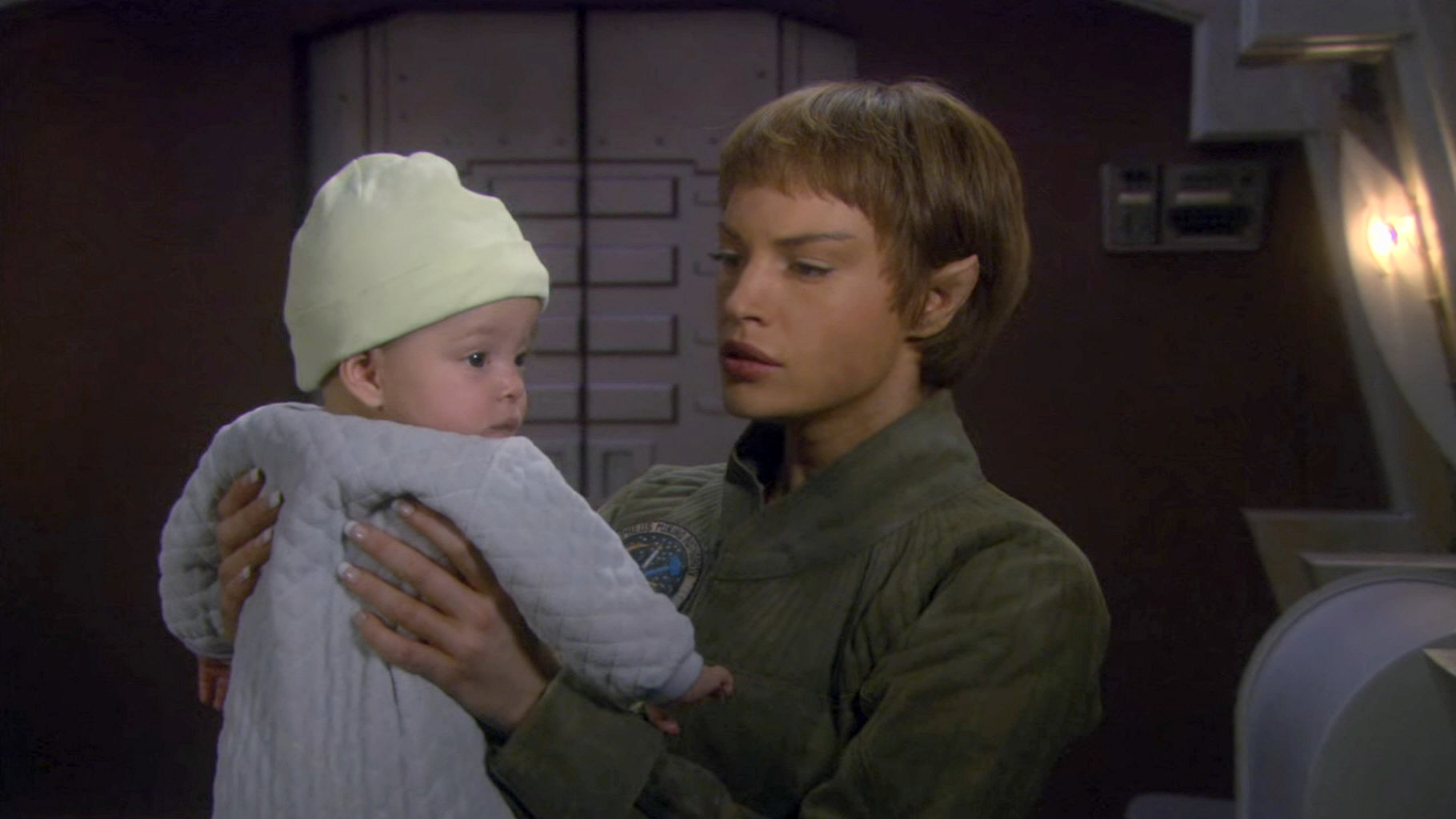
January 22nd, 2155: Paxton targets Starfleet Command with the verteron array on Mars, which was initially built to deflect asteroids. In order to knock out the weapon without harming T'Pol, Tucker, the child and the neighboring Utopia Colony, it is necessary to get inside Paxton's ship. Archer, Phlox, Reed and Mayweather follow the path of a comet to the surface of Mars so they remain unnoticed. They manage to overwhelm Paxton just in time. Back on Enterprise, it transpires that Gannett Brooks was not actually a Terra Prime agent, but a young ensign working in shuttle maintenance is found guilty of sabotage in Paxton's name. He commits suicide before Archer's eyes. Phlox discovers that the child who Tucker and T'Pol have named Elizabeth is going to die because Paxton purposely created her with a genetic defect. The doctor says that generally Vulcan and human DNA are compatible.
Review
With the exception of the shuttle ride on the comet's tail and the beautiful shots of the surface of Mars, the second part of the xenophobia arc turns out overall less spectacular than the first one. As I see it, this is mostly not to the episode's disadvantage. Although "Terra Prime" suffers even more from unproductive and unessential side plots, it makes up for much of the lack of characterization and interaction that I criticized in my review of "Demons".
Still, I would have expected more from Paxton. T'Pol is refreshingly blunt when she exposes the hypocrisy and self-delusion of the Terra Prime leader. Suffering from the Taggart Syndrome, he wouldn't even be alive without a medication developed by aliens. And as it is a form of genetic damage, his role model Colonel Green would have euthanized Paxton. Usually dogmatic leaders don't react at all to such open reproaches except with violence. Paxton at least attempts to evade the dilemma by referring to history: "I'm not the first significant leader who failed to measure up to his own ideals." It was the same with Hitler who looked anything like the blond, athletic and healthy archetype he valued above all. The message is clear: Racism was, is and will always be hypocritical and dishonest. A big lie. Paxton gives more insight into his ideology than last week or feels compelled to do so. But at some point I would have liked him to react to the confrontation with more than just phrases. Not that I knew any of their kind personally, but I doubt that dictators or terrorists talk in private like they do in the public. The contrast between the charismatic leader that Paxton strives to be and the pitiful person he actually is could have been worked out better. Maybe, instead of breaking together with the vengeful words "Terra Prime forever" on his lips, it should have been shown how he was arrested, as the weak man that remained without all the helpers and the technology.
The relationship between T'Pol and Tucker sees small progress at long last, and if only because of the exceptional and sad experience of having a common child who is about to die. Sato (who does a fine job commanding the ship in Archer's absence), Reed and Phlox all have a couple of good scenes too. Bakula, on the other hand, is acting a bit lethargically most of the time. Maybe this is even intentional, to show how Archer is tired of saving the planet all the time? Anyway, to Archer it is palpably primarily a matter of freeing his officers; the parallel between their fathers that Paxton makes up is a pathetic attempt to grab his attention, to involve him personally. Like I anticipated, Mayweather is at least allowed to steer the shuttle. His girl-friend, on the other hand, contributes absolutely nothing to the story any more. The two-parter could have easily done without this relationship that doesn't work out anyway. Speaking of dispensable plot ingredients, the previously nameless ensign, who is presented as the culprit, is another one.
Annotations
- Remarkable fact: We learn a bit about the colonization of Mars. The verteron array was built to deflect incoming comets. The terraforming has progressed to a point where no pressure suits are necessary in the lowlands of Mars. We get to see the landing site of Pathfinder, which the NASA named "Carl Sagan Memorial Station" in 1997 (the dedication plaque definitely being a later addition).
- Crew losses: 1
Rating: 6
These Are The Voyages
Synopsis
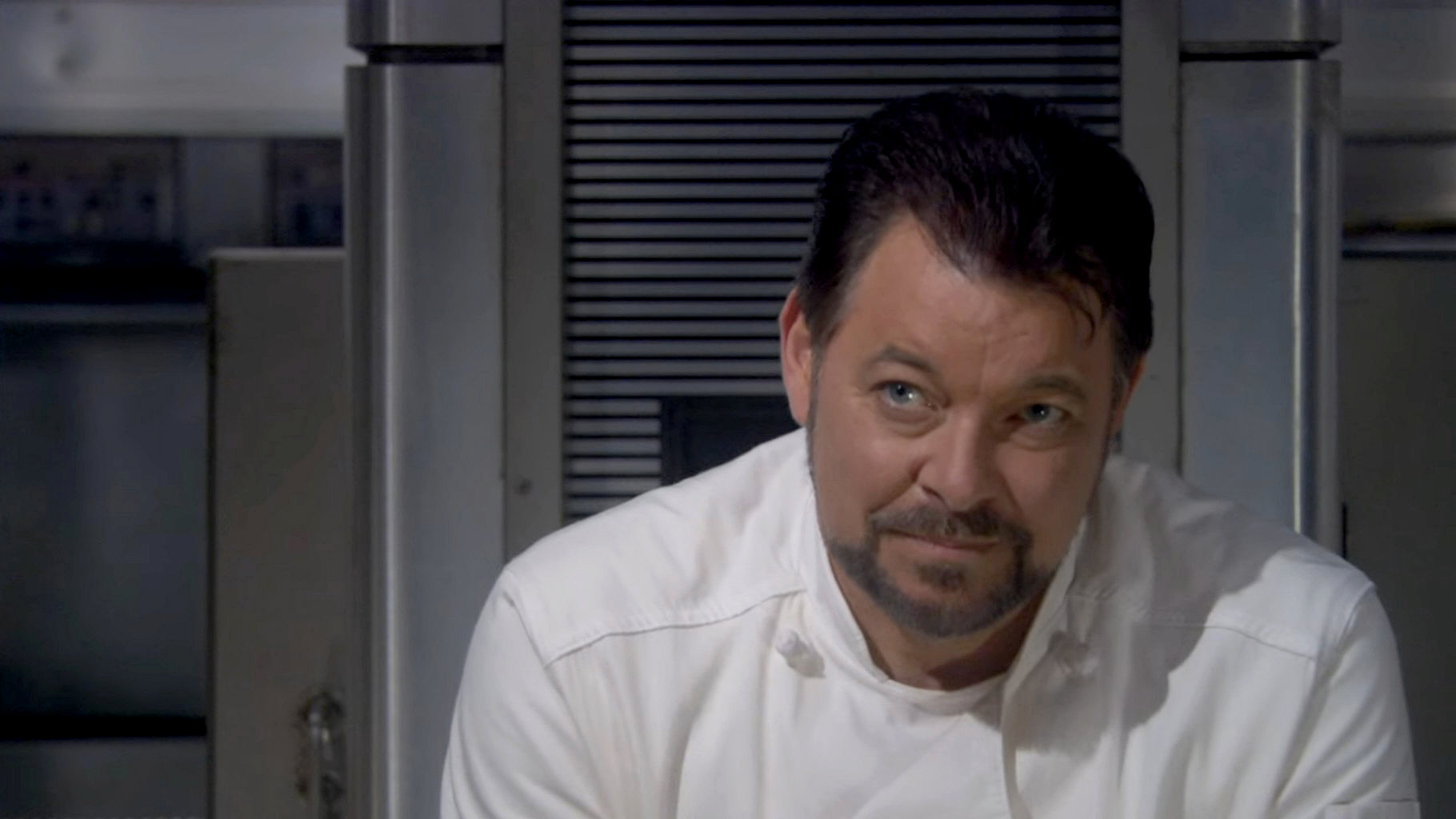
Stardate 47457.1: Commander Riker of the USS Enterprise NCC-1701-D is anxiously awaiting the confrontation with Admiral Pressman, his former commanding officer, who is responsible for a test of an illegal cloaking device that killed 73 of the crew of the Pegasus. Riker takes a break in the holodeck and he invites Deanna Troi to re-enact the last mission of Enterprise NX-01 prior to being decommissioned. Back in 2161, Shran asked Archer to help him free his abducted daughter. They succeeded, but later the kidnappers boarded the ship. In an act of self-sacrifice Trip blew up a plasma conduit and died. The holoprogram ends with Archer's speech at the founding ceremony of the Federation. Riker decides to let Captain Picard in on the true circumstances of the Pegasus disaster.
Review
Since the very first announcement I was opposed to Enterprise. I was convinced that Berman and Braga were joking when I saw their first list with blatantly stereotypical character drafts, and I thought even more so when the first pictures of the ship cropped up. I believed I would never get accustomed to Series V, much less that it would grow on me. I was wrong. Fortunately, because many single episodes of the first three years and nearly the complete fourth season lived up to the premise and gave us memorable moments of television. Not primarily stuff for nerds or for action fans, but quality entertainment with an attitude. Enterprise had several flaws, most of which I had predicted. It may not have been the most original or the most compelling Trek show. But it ultimately proved to be a worthy part of the legacy, as worthy as any of its four predecessors. My heartfelt thanks go to the creative staff, and in particular to Manny Coto, Judith & Garfield Reeves-Stevens and Mike Sussman, who did a terrific job.
However, even a mediocre show wouldn't have deserved to be dumped like this. With an abysmal installment that pretends in its unprecedented self-glorifying fashion to celebrate the series and to unite the fans but actually does quite the contrary. An episode that was hard to endure because of its artificiality and overall irrelevance of dialogues and interaction. I was glad when it was over. I'm trying not to be malicious, but it happened just when Berman and Braga used their privilege as executive producers and came up with one last story all by themselves.
To start with, "These Are The Voyages" does not actually belong to Star Trek Enterprise. It is a TNG episode, and a very pointless one because it just fills a tiny gap in an existing plot of "The Pegasus" with some trivia. The parallels between Riker's present situation and that of Enterprise NX-01 are awkwardly fabricated at best, and the plausibility how the edutainment could help against Riker's qualms escapes me. Almost nothing that we see of Riker's holodeck program is fully authentic and could depict exactly what happened back in 2161. The long-dead characters on Enterprise NX-01 are reduced to holographic projections and condemned to engage in trifling conversations most of the time. And worse, Archer and the others are not even speaking for themselves, they are just talking the way they are programmed, however correctly the characters themselves and their mission are modeled. This applies especially to their visits to "Chef" Riker's kitchen (as if all the senior officers had sought the chef's advice back in 2161). The weak parallel that is constructed in that the chef is the 22nd century version of a counselor doesn't help to make it in any way more plausible or more relevant.
I couldn't decide which is shoddier: Riker as he creates his own version of history, pulling the chef's character off the hat and interviewing a phony crew. Or rather Riker as a bystander (or should I say voyeur?) of events neither he nor anyone else in the 24th century could and should know so intimately. I don't mean that it is a bad or even immoral idea from the perspective of Riker's time. On the contrary, using the holodeck like this is an intelligent way to seek distraction and also an appropriate means of historical research. I would have loved such a re-enactment as a little tie-in in a genuine TNG episode. But not as a plot outline in a different series, and least of all in its series finale. It's just a holodeck simulation and not anything that is of any significance for the crew of Enterprise NX-01 - just like the recent Mirror Universe two-parter, but here with a poor premise and execution and at the worst possible time. Furthermore, "These Are The Voyages" relates to TNG like "11:59" to Voyager. The reason for my rant is essentially the same in both cases, only that it's much sadder now that a series finale and the preliminary end of Star Trek on TV is ruined.
I don't know why it was deemed necessary to kill off Trip. Because it was supposed to be realistic considering the ship's dangerous mission? Because it would give the characters in the otherwise straightforward plot some emotional involvement? Because the crew's only visible progress in the years between 2155 and 2161 was getting new patches on their uniforms, and Trip's death would make up for that in a bizarre fashion? Because in every series at least one of the main cast died, and if only temporarily? Because it was a way to say that Enterprise is dead and buried? Anyway, I don't like the whole idea, especially under the given circumstances that it happens on the holodeck and therefore somehow "off-screen". More on a side note, where are the darn security and MACOs after the intruder alert? Trip spends a couple of minutes distracting the gangsters and no one comes to help him. Or is this just another inaccuracy of the simulation?
As if the treatment of the Enterprise characters had not yet been bad enough because of the mere premise, there are two particular examples where the episode rides roughshod over them. The first is when Riker "resurrects" Trip who has died a few minutes earlier. Again, Riker has any right to do that; it is his simulation. But how impious can a writer be to play with a character like that, above all Trip with his many fans who are sad about his demise? The second annoyance along the same lines is when Riker ends the holoprogram just when Archer is about to begin his speech as if this part of the story wouldn't matter any longer. Once again it becomes clear that despite the good intent the episode does anything but pay respect to Enterprise. The only part of the show that truly builds a bridge between the different series of the franchise is the very ending, with the visuals of the ships and the voice-overs moving from Picard over Kirk to Archer.
Rick Berman said about "These Are The Voyages": "One of the reasons we did it is we wanted to say kind of a 'thank you' to people who watched not only Enterprise but some of the other shows." On another occasion Brannon Braga called it a "Valentine to all of Star Trek". I doubt that any flavor of fans will cherish the miscarried tribute. I wish it hadn't been made in the first place. "Terra Prime" was not exactly the best installment of the season, but it would have made a far better fitting finale. Although I can just speak for myself, I think in the hearts of the fans the series will have ended one episode earlier.
Annotations
- Remarkable quote: "Here's to the Next Generation." (Archer)
- Remarkable appearances: The crew of the Pegasus includes Ronald Moore, Dawn Velazquez, Eric Motz, Andy Simonson and Phil Wallace. Moore, Velazquez and Simonson are staff members of Trek series and features, the other two names possibly too. The TNG guest cast consists not only of Marina Sirtis as Deanna, Jonathan Frakes as Riker and Brent Spiner as Data's voice. In addition, Majel Roddenberry speaks the computer voice of the Enterprise-D. Real-life astronauts Mike Fincke and Terry Virts have guest appearances. Finally, Manny Coto can be seen as an admiral attending the ceremony.
Rating: 0